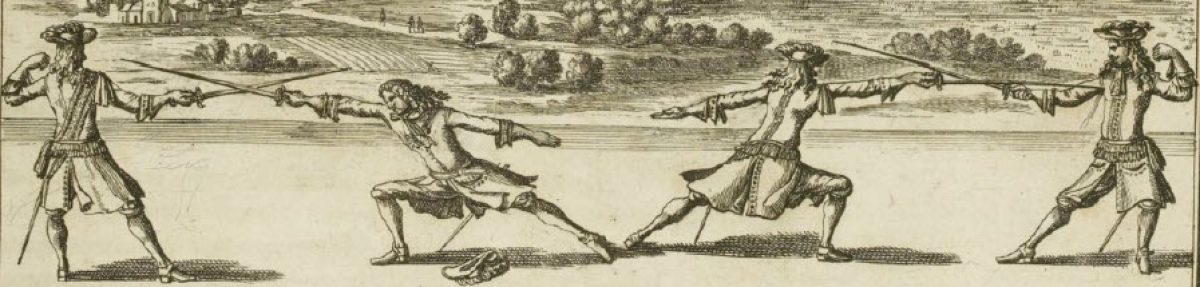
The recent discussion about George Silver that caused such a hullabaloo within historical fencing was, to my mind, answered in full by Stephen Hand in his paper “Will the Real George Silver Please Stand Up (available free, here: https://stephen-hand.selz.com/ ).”
In a post I shared here [“’Silver’ as Trigger Word,” 30 Dec. 2020] I mentioned that nothing I had seen by Hand suggested that he advocated the “slow hand” as described by those promoting the “alternative interpretation.” Having just purchased Mr. Hand’s English Swordsmanship: The True Fight of George Silver (2006), which I had not read at that time, I was finally able to see if Hand uses the term and if his opponents’ reading of it is correct. Yes, Hand does mention a “slow hand,” but no it doesn’t mean what that alternative camp thinks it does.
Page 11 of English Swordsmanship contains the “slow hand” discussion. Hand’s detractors have missed the point of the entire chapter. His approach to explaining this difficult concept uses hypophora, a well-known rhetorical device, in which the author asks questions and then answers them. For example, he asks “So how is it, that in an attack, the swift hand can move before the slow foot and yet both arrive together?” This is a device; it’s a way of setting up his explanation of Silver’s approach by guiding the reader to ask the right question.
The next sentence makes this even more clear, e.g. “Why isn’t it better to start moving with the slower foot and reserve the action of the swifter hand until the last possible moment?” This isn’t Hand asking the question but anticipating the sort of question that a reader without much training might ask. The last sentence in this first full paragraph ties it all together. Hand says, as a teacher might, that these are important questions, and that their answers—which he hasn’t discussed completely as yet—are “fundamental to an understanding of Silver’s true fight.” After all, this is what Hand is doing, explaining a key concept of fencing as Silver expressed it.
In truth, Hand provides the answer early in this section, but for those without a solid grasp of fencing theory they might miss it. Hand writes:
In any attack involving a foot movement, in any art, the attack should arrive at the same time as the stepping foot. This is so that the strength of the entire body can be transmitted through the arm into the weapon, to maintain correct balance and finally, because the attack should land as soon as the movement of the foot has brought the attacker (the Agent) close enough to hit. This is when the foot lands or possibly very slightly before.
That last line is critical. Silver is not talking about a lunge, but a step. In a lunge the true times apply as well—weapon/hand precedes foot and body—but the mechanics of the attack mean that the weapon, ideally, lands just before the front foot comes to rest. It often arrives at the same time. What cannot happen, however, is for that foot to start first. Why? The foot is slow and telegraphs the fact that an attack is coming, information that the defender can then use to decide whether to defend or attempt a counterattack. The weapon moving first puts the opponent in danger—they must deal with the advancing weapon or be injured.
Where a lunge is a compromise between safety and maximum extension of the weapon to target, a step or pass is shorter, the body closer to target as one closes. For example, if one is in Silver’s guard of Open Fight (similar to Ital. guardia alta), a guard where the weapon is poised above one ready to strike and intends to make a head-cut, letting the blade simply fall at the opponent won’t work. The arc is slow. If however one drops the fist down and out this projects the weapon between one and the opponent, increases the momentum, and makes it safer to step and finish the blow. When Hand refers to “slowing the hand, so that the attack arrives as the foot lands,” this is what he’s talking about. It’s a question of sequence—as he explains in the very next sentence:
Moving the hand first creates a threat (the weapon) before the target (the body) is brought into distance. In order to be safe, one must make a threat before one creates a target.
This doesn’t defy Silver’s admonition that the hand being tied to the foot is a false time, because the hand precedes the foot. It starts before the foot, it interposes the weapon before the foot moves, and that is the important part. Whether the blade lands at the same time or just before the foot is another issue, one that takes place after the attack starts. So long as the hand starts first—assuming everything else is in place—then one is observing the true times.
Should anyone think Silver is up the pole about this hand first business, a quick look at Marcelli’s Rule of Fencing (1686) makes an illuminating comparison:
From this presupposed termination, I take note of that which I have said until now, for the precedence of the hand in the beginning of the thrust. Since it is a certain maxim in fencing, that, in finishing the thrust, all the movements of the body have to finish together and in the same tempo, being in a single tempo firm and well situated with the body in the termination. For that reason, to effect accomplishing that, the hand must necessarily move before any other part, since this, having to make a longer path, and a greater movement, it is necessary that it would advance first of all. [n.]
However expressed, the concept can be difficult to grasp let alone perform. Hand does a fantastic job setting up this discussion and clearly took his time to do so because he knows full well how subtle a point this is: it may be a concept foreign to non-fencers or new martial artists and thus needs careful explanation. Despite the effective use of rhetorical devices to guide the reader, some will still trip up, especially if they don’t understand the principle of weapon-first. As Hand says, this is universal to martial arts. For a quick example, if I step into distance before launching a punch I may be punched first; if I kick from out of distance an opponent may trap my leg. Each of these examples distills the complex relationship between measure, tempo, and judgment, that is, knowing one is in the right place to attack.
It is exceedingly difficult to capture the complexities of movement in words. This said, Hand makes it very clear what he means by “slow hand:”
So, leading with the hand creates a threat before creating a target and allows for far greater tactical flexibility. The hand must be slowed, but does not have to remain slow. This natural by-product of attacking in the third or fourth true times can be used as an instrument of great tactical subtlety. I sometimes refer to this as attacking with the slow hand but perhaps a more useful term is broken time. A single time, by definition a single action, can be broken into two or more parts. These parts are not actions in their own right, but are distinct parts of a single complex action.
Anyone with a background in fencing should understand what this means. It’s a very old idea and one common to all fencing. For example, a direct lunge in foil is one tempo; an attack with a disengage is one tempo. However, if I feint or beat, that is two tempi. One might assume that a disengage is two tempi because the blade moves from one side to the other, but this motion happens—to quote Hand—as “distinct parts of a single complex action.” If a reader doesn’t understand this, however, then they are going to find Silver’s true times, especially in Silver’s English, challenging or nonsensical.
“Broken time” is more complex still. I tend to use similar language when I explain this to students. In fencing we often talk about breaking tempo. It is an advanced tactic that experienced fencers often use. The reason is that performing any action in single tempo is difficult enough. It takes time to do it well. As one improves one adds compound attacks and actions of multiple tempi, and then when these are well understood one learns how to break tempo.
This can be done a variety of ways. One can break tempo by changing the speed of one’s footwork, and, by changing the speed of one’s hand. In each instance, however, this only works if the elements of fencing are present, that is, if one is abiding the universal principles which govern it. For example, if I wish to change the tempo of a riposte, I might set up an opponent the first few exchanges to expect an immediate riposte. Then, the next time, I might a) hold the riposte for a second then make the return (an indirect riposte) or b) feint to the same line, but then cut to another (a compound parry-riposte). In that first instance, the indirect riposte, I’m playing with the tempo, I’m slowing my response so that my opponent will parry to the same place they did previously so that I can attack in a new line. That is using a “slow hand.” Of note, my hand still starts first—I do not advance and then strike (having just attacked me it is far more likely that I took a half step back to parry). If I hold an indirect or the first feint of a compound parry/riposte too long I increase the chance of my opponent making a remise (the renewal of an attack after its been parried by attacking to the same line as the original action). All of this, moreover, takes places in nanoseconds, so “slow” is extremely relative.
Most of the confusion should be resolved if one distinguishes between when the weapon/hand starts (it should be first) and when the weapon/hand lands. Manipulating tempo like that, breaking it, is not easy to do well and it can go wrong quickly. It is also a difficult skill to acquire if one hasn’t put in the time to master fundamental actions first. Generally, if a student is still learning the basic rules, if they are still working to grasp the order of operations for an attack, then they’re not ready to work on breaking tempo.
NOTES:
[n] Francesco Antonio Marcelli, Rules of Fencing, 1686, translated by Christopher A. Holzman, Lulu Press, 2019, 111. The original Italian reads: Da questa presupposta termination, prendo ragione di quell che sin’hora hò detto, per l’anticipatione della mano nella partenza della Stoccata. Poiche è Massima certa nella Scherma, che nel terminare la botta, si hanno da terminare unitamente, & in un’istesso tempo tutti I moti del corpo, restando in un tempo solo fermo, e ben situate con la vita nella termination. Perloche, ad effetto di conseguire ciò, necessariamente si deue movere la mano prima d’ogn’altro mēbro; se questa, dovendo fare camino piu longo, e motto più grande; accio si trovi à tēpo nel terminare insieme con gl’altri, è necessario, che camini prima di tutti. [Marcelli, Regole della Scherma, Libro Secondo, Ch. 6, 80, available via Google Books]. NB: “ē” here is an old abbreviation for “em,” thus mēbro is membro, tēpotempo.
A recent comment on facebook, one shared by a friend, illustrated something that has long troubled me—the failure to understand that tourney success is as poor a guide to how effective a tradition is as it can be individual prowess. The reason this should concern any sabreur remotely interested in historical fencing is two-fold.
First, there are well-known voices within HEMA who are influential and who have failed to appreciate these facts. Some have made public pronouncements without qualification that are likely to mislead many people and perpetuate ignorant ideas. Regardless of a fencer’s chosen area of focus in sabre one assumes they want as accurate a picture of past practice as they can garner, so for that reason alone it’s important to correct the error.
Second, competitors need to understand that daft comments about the prevalence of one style of sabre or another in major events reflect prevailing culture more than the merits or weaknesses within a given tradition. For a recent example one such commentator remarked
“nobody in modern times has ever won a major tournament using Italian sabre method. Sorry if that upsets you.” [1]
Where to start with this… If this individual, an Englishman, means within the span of modern competition beginning with the Olympics (1896), then there is ample evidence to the contrary. Of these examples my personal choice to illustrate the error would be H. Evan James, British sabre champion in 1905, who clearly didn’t share the commentor’s views. [2] If by “modern” he means HEMA, then that is worth examining in more detail.
There are two key reasons we don’t see more Italian sabre in HEMA and why we see even less in major competitions. Competitive HEMA sabre, by and large, reflects infantry sabre, and perhaps most often English infantry sabre, a watered-down version of a more complex methodology. [3] To be clear, it is not that more complete, sophisticated fencing didn’t exist in England, but that one isn’t going to find it in the Infantry Sword Exercise. Likewise, “simpler” here doesn’t mean “easy”—if anything, fans of infantry manuals face a greater challenge than those of us who prefer everything spelled out.
What this means is that rarely is one going to see any of the more sophisticated maneuvers and tactics one might find say in Masiello or Barbasetti, because those studying 40-page infantry manuals don’t learn them unless they dig deeper into their own corpus or parallel ones. Second, judging, such as it is, is calibrated to what those judges are expecting to see. So, if the level of sabre never rises beyond hop-and-chop, however well-performed, the judges will have a lot of trouble recognizing more complex actions. I’ve observed this first-hand myself at every single HEMA event I’ve ever attended or watched on video.
To use a local example, at the 2017 Winter’s End Tourney near Portland, Oregon, those fencers who attempted attacks into tempo with the point, such as an arrest or who attempted to manipulate distance tactically, suffered. Judges simply didn’t recognize what they were doing. What they saw, as the flags told it, was only what they knew to look for, obvious single-tempo attacks, all of which were made at close distance. Outside of the Italian and Olympic trained fencers present all of the fighters did their best to ape the images they saw in their sources, right down to never leaving close measure! Apparently, no instructor told them that what one might see on Angelo’s poster or described in a drill for the regiment to practice in unison, is not how one actually fights. One fencer, Italian trained, ate the competition alive but fared poorly because the judges lacked the ability to see what he was doing. [4] The fact that it was obvious meant nothing, because it was only obvious to the poor maestro I asked to officiate and to the few of us there who studied French or Italian fencing. Most everyone either missed it or ignored it because it didn’t look, and I quote, “martial” enough, a stupid term, much-used (incorrectly to boot) that boils down to one thing as HEMA-Bruh uses it, hitting hard and fast. A good fencer can hit hard, but chooses not to; a bad fencer doesn’t know the difference.
The quality of judging, like the quality of fencing, is relative—HEMA has yet to realize this. Any fencer who has spent time in Olympic fencing, on the contrary, knows all too well how true this is. An “A” ranked fencer in Bumblefuck, Middle of Nowhere, who is the best of all 6 people in their region, is likely not the same “A” that a fencer who earned that rank in a major city with hundreds of competitors is—what it takes to earn an “A” in the latter environment is a lot more demanding. In HEMA, however, most competitors possess only a modicum of skill, because their sources, even if they mine them top to bottom, do not include enough to make them brilliant one-on-one—the sources were not designed to do that. So, if both fencers only possess an “E” standard of skill (Olympic Fencing’s lowest rating), are held only to that elementary standard, and the judges lack the ability to judge beyond that, then however good those fencers might be, they remain “E” fencers. If this is all they know, and all they care to examine, then they will mistake that “E” for an “A.” This is what a lot of us outside or at the edges of HEMA see whenever we see HEMA bouts or what we conclude when some blowhard touts their supposed prowess.
There are exceptions too—there are students of Insular broadsword that bring out the best of their favored tradition. My go-to when I have questions about broadsword is Jay Maas of Broadsword Manitoba, Canada. In addition to being approachable, Jay is also one hell of a skilled fighter, one who to me exemplifies just how effective the Insular broadsword tradition can be. Why is he so good? Well, for one, he clearly has a knack for the Art, but he also studies not only regimental manuals, but those for highland broadsword, contemporary smallsword, and importantly—modern foil. Most significantly of all Jay understands these sources, that is, he has excellent command of the elements, fundamentals, or universal principles that make fencing what it is. He uses measure, his footwork is fantastic, his toolkit for technique and the options it provides deep, and his sense of timing is spot on. Jay puts in the time as anyone who has chatted with him or watched him fight or teach can attest. When I think of the people I want at an event, who represent their branch of sabre/broadsword, best, Jay is one of my top five, because I know he’s a gracious fencer and will give anyone, no matter what tradition, a fantastic fight.
With regard to officiating, if the standard by which HEMA judges fencing is rudimentary fencing, then it’s hardly surprising those competitors (and perhaps Youtube personalities) don’t realize the difference. Add their misguided hatred of all things non-HEMA and it makes even more sense—they refuse to learn by analogy, and what better analogy is there of how competition can go wrong than the excesses and gaming in Olympic fencing?
Italian sabre within HEMA, if we can even say that exists, is small. Because of the pedagogical approach, because of the source tradition, and because acquiring sufficient proficiency to compete takes time, there aren’t many of us competing. HEMA throws people into competition way too early, one result of which, well, I’m discussing here.
But there is another reason. No competitor who works hard to develop a sophisticated game is keen to jump into an event where none of that matters, where it will not even be seen, or where it will be, oddly enough, ridiculed. The shame there doesn’t belong to those of us in the Italian tradition, but to the boors who lack the inclination to look beyond their own source material, whose ego needs and dreams of badassdom cannot stomach the idea that someone else, or some other tradition, might have something to offer or, heaven forbid, be superior to their own.
It’s not an accident, after all, that Italian and French fencing stuck, that they were the traditions that formed modern fencing, because every nation in Europe, at the time, saw enough merit in the approaches to abandon their own native systems. It is worth noting that at the very time these nations adopted French or Italian methods both of those nations were still witness to the duel. It’s worth reflecting on all this, especially for those championing English infantry broadsword as the paragon of sabre systems, because if the popular Italian masters who so pissed off a certain Englishman circa 1599 don’t provide some hint as to the value Italian methods held for Englishmen, then perhaps the various repeated attempts to introduce more sophisticated sabre into England over the course of the late 19th and early 20th might.
Funny how for all the talk of English sabre no one ever talks about these men save Hutton (who recommended a “Continental” sabre by the way, page 2, Cold Steel, 1889). What about…
Francis Vere Wright, author of The Broadsword: As Taught By The Celebrated Italian Masters, Signors Masiello And Ciullini of Florence (W. H. Allen & Co., London,1889) or…
the Ministry of War’s 1895 Infantry Sword Exercise (based off of Masiello, but with errors in understanding) or…
Lt. Betts, The Sabre and How to Use It (Gale & Polden, Limited, Aldershot & Portsmouth, London, 1908) or…
Leon Bertrand, Cut and Thrust (Athletic Publications LTD, London, 1927)?
For some, I suspect, to discuss English attempts to improve their own fencing by introducing foreign ideas undermines the romance, jingoism, ethnic pride, and one sometimes suspects sadness over the loss of imperial glory. If those are the chief reasons one fences, they are poor reasons.
There is nothing wrong with studying regimental broadsword or infantry manuals, but there is in ignorantly claiming that they are the last word in sabre. For fans of English sabre who really want to know more about their chosen tradition looking beyond these sources is vital. For the Georgian/Regency period, a look at French smallsword and sabre (for the latter Le Marchant (1796) is a must) will be illuminating; both Angelo (1763 in French; 1765 in English) and Olivier (1771) wrote in English and French and Angelo has excellent plates and illustrations. As the grandfather of the Henry that wrote the Infantry Sword Exercise Domenico Angelo’s work will give one some idea of what the Angelo family’s salle offered in terms of instruction, that is, how much more there was to learn than what one sees in infantry manuals. For those more into Victorian sabre, contemporary French works (e.g. the Manuel d’escrime, 1877) and yes, Italian works (e.g. Del Frate (1868 & 1876), Rossi (1885), and especially Masiello (1887)), will help fill in the picture. There is merit in looking outside one’s own tradition, not only for what one might learn to help one’s game, but also because sabre then as now didn’t exist in a vacuum and gaining some sense of the larger picture will increase understanding.
In time, if HEMA survives its growing pains (betting is even money), we will likely see more events that allow for a wider, deeper variety of expression and sabre play than we do now. If and when it’s possible, one such event we’ve been trying to get off the ground here: a sabre invitational last held in 2019 that was slowly growing pre-Covid. The goal with this event is to provide a venue for fencers who want more than Mongo-chop-chop and who are capable of playing at a higher level. There is a lot of good sabre out there, most unfortunately drowned out by the din of arrogant single-tempo champs, but it doesn’t have to stay that way. The sources are there, and there are people who work from them, but that avails one little if they don’t take advantage of it.
NOTES:
[1] Matt Easton, facebook comment, shared with me March 19th, 2021. NB: The friend that shared this with me was quick to say that it may be a joke, that at least that some are treating it as one, and that Easton also appears to have walked back this comment somewhat.
I’ve not had the pleasure yet to meet Mr. Easton, but as a fellow fan of sabre and someone that has often pointed people to some of his videos, I might recommend in a friendly way that he be a trifle more careful. An experienced fencer, and no stranger to sources, Matt might make a joke that someone without his background takes at face value. Certainly the responses to his comment suggest wide support for what he said, and that is a problem being not only incorrect but needlessly inflammatory. No student of Italian sabre is unaware of what the majority of HEMA thinks of their tradition.
[2] Mr. James’ sabre is Radaellian, and if that seems incidental, then that very Italian leather sabre cuff should help cement the fact he studied Italian sabre. For his Olympic record, cf. https://www.olympedia.org/athletes/22152
[3] In an earlier post I discussed this issue, see “Dueling” or “Military” Sabre, May 15th, 2019. It should be obvious why an infantryman, relying on his rifle and bayonet more than a sabre or hanger, would require less training, but for those who don’t see that then a side-by-side comparison of Roworth or Angelo set against Del Frate, Masiello, Rossi, or Pecoraro & Pessina should make it pretty clear even if one is only counting techniques per source.
To reiterate: simpler texts do not equal easy to learn and fight, in fact they are far harder to use well. This system produced some very fine swordsmen, and does today when, like Jay Maas, Paul Wagner, Stephen Hand, Nick Thomas, and others read and study these works in light of fencing principles that supply what the authors of those texts assumed the reader knew.
[4] No, it wasn’t me, I was helping to officiate, but it was a friend of mine, a senior student of Maestro Sean Hayes, and a gifted fencer.
Resilience and creativity may not be the most lauded skills in fencing, but they probably deserve to be included among the virtues traditionally associated with it. Despite Covid-19, storms, fires, political upheaval, and much more, fencers have still found ways to study and train. The pandemic has forced everyone to find new ways to pursue the Art, from sharing solo drill footage to various online meetings. In a sense it’s an ideal time to work on self-improvement because most of us can’t congregate yet. We have time to expand our knowledge, increase our skill-base, and hone ability. It can help to have goals with this–this past week I started an extended course via the USFCA (the United States Fencing Coaches’ Association), online, and though we’ve only met once it’s clear to me just how valuable this class is going to be.
One thing I have always told students, be it in college courses or during fencing lessons, is that we never stop learning (we shouldn’t anyway). A teacher is first a student and if they’re smart they remain one. I have probably expressed this different ways, ad nauseum, in most settings, but it’s because I believe it’s true. Even if we have something down well and have taught it umpteenth times someone else may know a way to improve our approach. There’s always more to learn or new ways to do what we already do well. Every instructor should take time to continue their education–it’s important.
Interacting with new people, and especially a new maestro, can be difficult for many people, but for those of us farther along the introvert spectrum it can be down-right daunting. Luckily, a good friend alerted me to this course and is taking it himself–it turns out that two other people I know are as well, one a local coach, the other a master in California. I was nervous going into the class, partly because of the social interaction (something quarantine has done little to help), partly because despite using a lot of technology I tend to struggle with these online meeting platforms, and partly because as someone who has focused on historical fencing, who has had a challenging relationship with competitive fencing, it’s easy to feel out of place. Turns out there’s a lot that can tag along with that last one.
One Art, Many Paths
Like many people, I started teaching fencing when assigned the task by a maestro. The last two masters I studied with, both of whom I spent a fair amount of time with, asked me to help newer students or assist their more advanced fencers prep for an event. Dutiful and honored I did my best. I enjoy teaching and the chance to do so was fun, but teaching is also critical in improving our own ability and knowledge. Having to teach something goes beyond being able to do it–we have to understand it. I didn’t want to disappoint my maestri or steer my fellow students the wrong way. They trusted me to do a good job or they wouldn’t have asked me, but that doesn’t mean I felt up to the task every time.
My approach to teaching is, more or less, what I saw my own teachers do. This goes for everything: the sections of a lesson, the types of drills, the various cues–verbal and physical–we use, everything. In time, we develop our own style, we tweak this or that perhaps, but this method is by definition often informal, organic, and implicit rather than explicit. Feedback from those same masters helped, as does time in the saddle, but just how different this is from formal instruction in how to teach hit me hard last week.
This course is the first “how to teach” course in fencing I’ve taken. The maitre d’armes teaching it, a highly-respected, published, and extremely well-trained instructor, hit the ground running day one. He put names to things, gave explanations, and explained a lot of what we do as fencing instructors, things I have done but never really thought about. If that class had been the only one in the series it would still would have been extremely valuable, but to know that I have weeks and weeks of similar instruction coming is exciting. It’s also intimidating.
The course in question is on epee/spada, the weapon of the modern three I’ve had the least training in, but which I have fought quite a lot. I’ve read a lot about it, both in terms of its development as a distinct weapon and with regard to modern tactics. In addition to improving my teaching I hope to gain further insight into the weapon. Often tackling the hardest aspect of a challenge first makes sense, so epee being the least familiar to me, it’s a good place to start.
Fall Down 7 Times, Get up 8
The cosmos, if we’re paying attention, has a funny way of ensuring that we stay humble. Of the various gaffs in the universe’s comedic toolbox one of the most painful (if sometimes amusing) has to be self-sabotage. We can be our own worst enemies, and moreover, in different ways. In my case, the first homework assignment for the epee course put the spotlight on a prime example of this, and for spice, on multiple levels.
It may seem odd to share this, but to date I have found that sharing tales of failure as well as success isn’t just honest, but sometimes helpful. How, for example, is a student going to know it’s okay to make a mistake if we can’t admit our own? Maybe they will learn to harness failure or missteps without our help, but it sure might save them some pain if they have a model for how one might do that. As teachers we don’t expect or look for perfection, just improvement. Part of our role, I think, is making it okay to mess up, to fail, or as common parlance has it, “to suck.” We need to be able to be bad at something first if we wish to get better at it. I don’t think this is a one time deal either, but a reoccurring process we experience at various plateau moments in learning. I am not one to boast and it makes me uncomfortable when others do it–the culture I grew up in considered such behavior ugly–but I will say that I’ve been fencing a long time, teaching a long time, and I make mistakes too. I will make more. It’s part of learning. So, while the following story may read as more humiliating than illuminating, that’s okay–if it makes it even slightly less painful for anyone else to mess up, then great. Sharing this example also sticks it to my own ego, the root of the problem, and that is healthy as well.
In my own most recent example, I was intrigued but puzzled by the maestro’s homework assignment. I understood it, I thought, and it struck me as odd, but I assumed I more or less knew what he wanted so didn’t follow up with him. I should have. I always tell students to ask questions, and, that no question is stupid in class. Better to ask than not.
He had asked us to make a video where we coaches devise two responses against the student as the student recovers from the lunge. It will likely be immediately obvious to many reading this that after having shared these two options one would have the student demonstrate counters to them. I mean, that is what we do each time we teach, right?, we take them from this action to the next, sometimes building complexity, or changes of tempo, or working distance and the student eventually makes the touch. [1] Even with Covid I teach three times a week and never make this mistake. Well… I took the instructions rather literally.
Why? I’m not sure, but I’ve had a few days to think about it and I think I’ve figured it out. First, in the past when a maestro has given me an instruction I have carried it out, and, normally without question. If they said “okay, now do x, but in this tempo…” I did it; if they said “Help Sarah with transports,” I did it. In silent lessons they wouldn’t say anything and I had to figure it out from physical cues, precedent, or deduction based on principles. This may sound rather military in obedience or thoughtless, but it isn’t really. Two of the masters I worked with were retired military officers, and having grown up in that culture it’s comfortable if not natural to me, but one reason I didn’t join the military was because I actually don’t take orders well. [2] It’s also part of traditional fencing culture–there is a time and place to ask the maestro about something, but normally one doesn’t when the sala is full, the maestro busy, and there is work to do. If the master pauses a lesson and calls to us, we answer, especially when they are asking for us to help.
The other issue, the critical one, was over-thinking. On the one hand, I tend to feel like I wear a scarlet “H” on my jacket when I’m around many Olympic fencers. If you’ve read any of the previous posts here that will make sense, but if you haven’t in summary leaving the competitive world for the historical doesn’t earn one a joyous send-off at the pub, but the finger and all too often a loss of respect. The three other people I know in the class, all with experience in a variety of branches of fencing, also have more formal training in teaching fencing. [3] When we feel like the odd one out our brains can go crazy places–in this case, I focused too much on what the assignment said and not what we were supposed to get out of it. I was more worried about what the instructor would think of me, that I might earn a larger letter “H,” than just demonstrating via that homework what I’d do in that instance. That rabbit hole leads to crazy town and interior monologues such as “Maybe it’s a test of sorts to see what we know or how we think? If so, then it’s okay to focus on that alone… or is it…” repeat. It’s a horrible place to be. The solution was simple, but I was too worried to think of it: it’s a class on teaching, so, if I gave a student A and B, what might they do with them?
More wisdom from “Blackadder II” BBC
Coming up with two options as the student recovered was not the problem, but in worrying more about getting it right I neglected the most important aspect–why do it at all, so what, why does this matter? The most important question was to consider why the maestro assigned this, what it was meant to impart. Even in the midst of feeling bad about it that irony wasn’t lost on me.
Part of the assignment was to take video of these actions. My eldest son, a wiz at all this technology stuff, helped me, as did my spouse, and I put together option one and option two. This is where another layer popped up–trusting our gut. It felt like a really weird place to stop: if it’s just me showing the option, then the student is hit, and well, that’s not really what we do. We set things up for the student to make the touch properly. I was afraid to trust myself, reassured myself that this is what he asked for, and submitted it. But, the rest of the afternoon I just kept thinking about it. It bothered me.
Later, in chatting with a friend in the class, he showed me what he and his student had done. It was all there. He shared his two options, and significantly, what his student might do to counter them. I knew it! Panic set in. Every scenario blitzed through my head, and in each one I was hounded out of class, the look of polite disgust of my fellow students blatant in their zoom boxes, the maestro shaking his head slowly, the mean jailor from “Games of Thrones” pointing at me and saying slowly “shame…. shame….”
What could I do? Maybe nothing this time, but I needed to do something to change my mindset. I asked my son if he’d be willing to add an additional move; he was; so, we made another short video and I explained in it that I’d left out the most important part, where the student defeats those two options. The maestro saw it, and in discussion about it was kind, generous, and full of helpful feedback.
Teacher, Teach Thyself and Be Taught
I’d broken my own rule, the one by which I do most everything now, which was to leave ego out of it. I was so worried that I’d put it a poor showing, that I would mess up, that I would look stupid, etc., that I fulfilled the fear or at least felt that I did. Anyone who has weathered disappointment or failure ideally is better able to handle them the next time, and while it took a while to shake off the feeling of embarrassment, of letting myself down, and all the rest, when I could finally see it objectively I was glad it had happened. Having screwed up, what could I learn from it?
Too much concern over how we’ll be received or viewed, of what others will think, not only can taint an experience, but also prevent an experience from happening. Fear of censure or failure, worry about making a mistake or looking stupid, all of that can prevent us from doing the things we need to do, things we like to do, things we should do. Not the karmic burden I would have picked, but it’s hardly unique to me. Many if not all of us suffer this at one time or another.
We need to give ourselves, and sometimes be reminded…, that it’s okay to be new to something, to mess up, to be vulnerable. If we stumble, we get back up; if we fall again, we get back up. Ever forward.
If there is one thing more I learned it’s that being in this class, learning new things, and well… re-learning some of these same lessons again…, is precisely where I’m probably supposed to be. I’ve already learned a lot, and I’ll learn more, and really, that’s the point.
NOTES:
[1] The exception to allowing the touch is when a student performs the action incorrectly; in this case the attack may fail or we ensure that it does, and then examine why. All of that is geared toward helping them perform the correct action the right way and gain the touch.
[2] It’s a long story and not particularly interesting, but I had all but completed the initial ROTC courses at my first college and the commander met with me to figure out the next step. When I told him my major, he paused then said “Huh… well… um… let’s put down ‘undecided’ for now” and I realized then and there I was going to be a poor fit.
[3] These are three people I respect a great deal and whose friendship I value. The master in California is equally at home in Olympic, HEMA, and the SCA, and a super cool chap on top of it all; the local instructor, an old friend I’ve fenced with off and on for over a decade, and I were going to start on our certs together, but things happen and he started last year; and last, a good friend of mine and fellow devotee of Italian fencing is the one who told me about this class–he has taken a variety of courses, at Sonoma, in the USFCA, and in Europe.
Approached correctly every bout, win or lose, is a lesson. What we get out of it depends on our awareness, experience, and humility. However poetically one might view it ultimately there’s a direct correlation between what we learn and honest self-awareness. If the latter is lacking the lesson is likely lost. It’s the same with disagreements.
The minor furor over a post on this site (“‛Silver’ as Trigger-word in HEMA” 12-30-20) has had me pondering its lessons. Much of that exchange, sadly, proves the wisdom of both La Rochefoucauld, who said “we hardly find any persons of good sense save those who agree with us,” and Thomas Paine who remarked “To argue with a man who has renounced the use and authority of reason… is like administering medicine to the dead, or endeavoring to convert an atheist by scripture.” [1] Witnessing such a deep degree of intractability after the presentation of proof debunking a theory is painful, but with widespread examples of similar cognitive dissonance—“Q-anon,” anti-vaxers, the ancient aliens crowd, etc.—it should probably be less of a surprise if no less a disappointment.
It’s unfitting and small to celebrate anyone’s humiliation, especially when it’s public, obvious to all but them, and as divisive as it is amongst common associates. Just as one doesn’t deride and mock an opponent they’ve soundly beaten, so too should one refrain from crowing over another person’s embarrassment. The tired and pointless debate over George Silver’s “true times” etc. will persist as long as there are those who don’t understand what he said and how it conforms to the same bloody principles fencing masters with half a brain have espoused for centuries. To kick someone who has failed to grasp that is akin to scolding a child for not understanding calculus when they haven’t completed a basic study of algebra. It’s not nice and it’s counterproductive. In this case, and following the same analogy, too many children apparently skipped algebra and dove into calculus before they were ready. Called on it, they cross their arms, pout, and retort that math is stupid and so are we not only for pointing it out, but also for trying to help.
This issue with Silver isn’t a case of opinion, but of demonstrable fact, and yet no piece of evidence, no argument, nothing made the slightest impression. Research is difficult, more so than most people realize, and it’s easy to fall into one of the myriad pitfalls that await the unwary. These are pitfalls one must navigate or pull oneself out of in learning how to practice history—significantly, this is training that one never really completes, because the pitfalls remain. There are always pitfalls to avoid. As a professional researcher (among other jobs) I thought I might be able to help my wayward colleague. He had no interest in my help, called my ability into question, and then kindly offered to help me if I ever get “serious” about the topic. Not much one can do in such cases but Gallic shrug.
Fish Slapping Dance, Monty Python’s Flying Circus
I can’t explain why someone would staunchly defend a position so thoroughly undermined, but I worry about it because this problem goes beyond one hapless researcher. There are numerous examples of research gone wrong in most facets of “HEMA” study. Some would be relatively easy errors to correct, but as so often happens what should be about the material is really about ego. For example, there’s a glaring translation error, one that should have been obvious from the title page, in a smallsword text that came out in 2019. The mistranslation suggests the use of translation software, which is bad enough, but also of failure to have anyone expert in French review the finished product. Readers who asked about it were shut down by the “translator.” How the translator and his pals reconcile themselves to de St. Martin’s advice in using a “swordfish” instead of a sabre I don’t know—if I had to guess maybe they believe the French called sabres swordfish. Regardless, it’s it’s a poor translation. [2] This by itself reveals that the transcriber’s background is probably insufficiently deep to tackle this project. Few seem troubled by it, but it matters because he isn’t the only one producing shoddy translations.
Questionable translations tend to lead to questionable interpretations. At the very least the former call into question both translator’s skill and reader’s sense. In multiple cases I’ve witnessed a translator double down on their mistake, publicly—this reveals an attitude toward scholarship that defies reason. They either don’t know that they should be embarrassed or are incapable of feeling it. Quintilian supposedly remarked that “There is no one who would not rather appear to know than to be taught,” and in HEMA this apparently proves to be the rule rather than the exception. That’s a problem. From these shoddy translations to the misapplication of cutting mechanics borrowed from various Japanese sword-related ryū, from blind faith in images to a lack of familiarity with elementary fundamentals in fencing, HEMA scholarship is a patchwork composed of the finest linen and the most threadbare fabric. Bad as this is, the deeper concern is that too few people care, and that those with a stake in things, who enjoy their status, are quick to denounce any detractors however sensible their objections are.
Any parallel drawn between inferior HEMA research and a well-known parable by a famous Attic lover of wisdom concerning a cavern is likely to upset a lot of people, but it’s an easy parallel to draw. Less familiar, but far more succinct, are the words of another sage:
What is the first business of him who philosophizes? To throw away self-conceit. For it is impossible for a man to begin to learn that which he thinks that he knows. [Epictetus, Διατριβαί /Discourses, II.17] [3]
This is, I think, the major stumbling block in “HEMA,” too much unfounded belief in one’s own ability, be it knowledge, skill, or both. Second only to this is the collective failure in giving the floor to those so deluded. Unchallenged it’s hard to see that the shadows one takes for reality are illusory—after all, so many people make the same mistake. They go hand in hand and reinforce one another. As a community’s members begin to self-identify and are viewed as “those in the know” it becomes all the harder to see the problem or take criticism. When someone does eventually question them it goes poorly, because in so many ways it’s not about the subject, but about how they view themselves and how they believe others see them. External validation is powerful, but it’s dangerous. Acclaim can exist on falsehood just as much as truth. For HEMA, it has become more important to be seen as an expert than in fact to be one.
Authority & HEMA
Sunday! Sunday! Sunday! George Silver Theater!!! Ok, clearly quarantine has gotten to me too…
In an endeavor as multifaceted as ours, as broad in subject and timespan, there is no one expert, but a diverse collection of different experts. Authority, such as it is, should derive from informed consensus, not merely what is popular or because some swordy celebrity said so. That same authority should make logical sense, should be based upon the best each category of expert can supply in light of the evidence, and should be demonstrable to the degree possible. This demands an acceptance for what is logically sound and what is and what is not decent evidence or argument. If the recent episode of George Silver Theater is any guide our community can’t agree on the most elementary facts and struggles to apply the most basic reason—not much point in discussing anything when that’s the case.
We have multiple sources for authority in historical fencing. Many of them are worthy sources too. One of the strengths our community has is that so many skilled points of view inform it. We are less hidebound as a result, more open, and this is a good thing. The motley collection of artifacts (e.g. period weapons and armor), manuals and treatises, anecdotal evidence (e.g. accounts of duels and battles), legal proceedings, commentary (e.g. Brantôme or Gelli), artistic depictions, and fragmentary miscellanea of all kinds present us with a giant puzzle missing numerous pieces. We can get a general idea of what the image would be upon completion, but we can never assemble the whole. [4]
In light of this having different perspectives is vital. A sword-maker like Gus Trim has insights into more than the geometry necessary for balance, impact, and effectiveness in swords, but also perception into use because of those insights (not to mention long experience in Chinese swordsmanship). Kaja Sadowski of Valkyrie Western Martial Arts Assembly assists police in learning how to handle attackers—real-life experience as a martial arts instructor adds something to Kaja’s examination of rapier that most of us lack. The images produced by Roland Warzecha, a trained illustrator and artist, capture details that many of us miss. Examples are too many to count, and from most conceivable fields—archaeology, art history, dance, data analysis, engineering (of all sorts), equitation, history, linguistics, military experience, teaching, writing, and a wide variety of skilled trades. Most of all, there is passion for the topic, a love of swords, and much as we disagree this unites us. It should anyway.
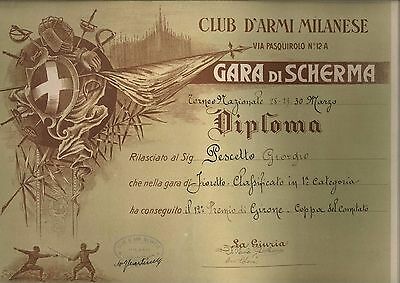
Fencing Competition diploma, Milan
However, in assigning any one of these voices authority we must be careful—are they, in their field, up to the task? What qualifies them as an authority? Sometimes it’s easy to determine. Fencing masters who are certified to teach, who know the languages necessary, and who—importantly—have studied fencing history are one example. There are many who have proven their ability within the historical community, maestri such as David and Dori Coblentz, Puck Curtis, Sean Hayes, Francesco Loda, Kevin Murakoshi, Giovanni Rapisardi, and Gerard Six to name only a few. Certifications are not everything, but they are a measure, and so it follows that those possessing them might have some insights by virtue of that specialized study.
At other times, credibility is less obvious, and this is where we tend to get into trouble. Training, good sense, and demonstrated ability as defined by a person’s field seem good places to start when considering credibility, but this requires us to have some familiarity with the specific discipline. How much knowledge is enough to do that adequately? At a minimum we need to know to whom to go for help, and in a community with as many talented people as ours someone we know is bound to know the right people if we don’t. It’s important to ask the obvious questions too–if, for example, someone has put forth an edited version of an old master’s work, then we should look into their suitability for the task. What training have they had? How are they qualified beyond interest and self-confidence? Who backs their project, if anyone, and what are their qualiifications?
With respect to fencing we have to consider any training they’ve had, not only in terms of how long they’ve studied, but also the quality of that training. We must consider their strengths and weaknesses within this background—one may be a fabulous teacher, but a mediocre competitor or vice versa. There is a difference in training, most of the time, between someone who studied with a maestro for a decade and someone who worked with an instructor who has one year more experience than the student. If nothing else it is depth of material and established pedagogy; a maestro, by virtue of the process of certification and teaching, typically draws from a deeper pool than the amateur who has memorized all of Henry Angelo’s Infantry Sword Exercise or who has attempted to wrestle with “Die Zettel” and associated glosses.
In terms of scholarship, someone like Jeffrey Forgeng, who has both the academic credentials and demonstrated ability to handle historical fencing sources well, is a good guide. Not everyone need be as skilled as he is, but he’s an excellent role model, and if one is going to attempt something beyond a short essay, then examining carefully how Forgeng treats evidence, builds an argument, and supports that argument will be valuable. There is no shame, incidentally, in realizing that a project is beyond our skill. However, when one attempts an academic paper and proves that they have no idea what they’re doing those who do are likely to find issues with it. In that case, the sensible thing to do is put ego aside, listen, consider what they have to say, and see if it can improve the project. If something is more complex, find help, contact a scholar—there are a lot active in HEMA—and see if they might be interested in collaborating. [5]
ΓΝΩΘΙ ΣΑΥΤΟΝ—Know Thyself
The most difficult part of this process is assessing ourselves. We must know our limitations. This doesn’t mean we settle for them, but that we’re aware that we don’t know everything, we don’t have all the answers, and that none of us has a monopoly on skill. We should strive to improve always. It’s far easier to start the long road to improvement when we take honest stock of where we are now. We need to do so without censure or pride or we skew that assessment. This means that there will be times when we’re not good at something. Everyone is a beginner at some point—have the courage to be a beginner or at least to cultivate a beginner’s mind.
At the same time, we need to have the strength of character to recognize another person’s gifts. If we’re smart, we’ll lean on them and their expertise. This doesn’t mean playing the sycophant or using people, but doing what we do unconsciously all the time when we seek a new doctor, tattoo artist, or vacuum repair shop. Expertise, in most cases, includes an unending, continuing education—any credible expert knows that. Likewise, credible experts know that they make mistakes too, but the better ones acknowledge and correct them.
Cultural bias to the contrary, skilled researchers normally spend years acquiring the tools of their trade, not just those of analysis but also familiarity with the discipline and its scholarship. [6] A violinist, by analogy, must learn the instrument, how to produce vibrato and slide as well as familiarize themselves with the corpus of music they wish to pursue. This same violinist, if they work at it, may be able to play both the Capriccio No. 23 of Locatelli and “The Longford Tinker,” but it will require a great deal of work and not everyone has the discipline, time, and degree of talent necessary to achieve such virtuosity.
If we’re honest with ourselves it’s a lot easier to be honest with others, and, to appreciate their gifts. It will fall hard on some ears and hopes, but the truth is that the branches of the Art we study—with few exceptions—are extinct, so no one can master them. “We are all apprentices in a craft where no one ever becomes a master.” [7] I don’t wish to go into the issues around the idea of “mastery” or the specific meaning that goes with maestro d’armi, but if the historical record is incomplete then any study of it is too. We are all apprentices when it comes to historical fencing. We cannot be otherwise.
NOTES:
[The title of this post is a nod to a fact my first-grade teacher, Ms. May, shared with us from her time in Australia. She related that emus, when they want to get through a fence, have been known to keep butting it with their heads until the fence gives or they do. I leave it to Aussie colleagues to verify that, but it’s a good metaphor for how nonsensical HEMA’s approach to research can be]
There is a difference between building a case on limited evidence that is sound and one that mishandles that evidence or ignores it. Roman historians who study Julius Caesar rely on the same set of sources, but draw different conclusions based on them, especially with regard to Caesar’s goals in pushing change in the government. We cannot know absolutely what he meant to do, but we can devise reasonable possibilities. The question is important, even when our answers are imperfect, and we learn something of value even when a theory is incorrect but well-built.
[2] There are times, especially with older works, where the current, first option in a dictionary isn’t correct. Translations programs tend to provide the most common, current definition. So, when presented with espadon in French, and the work in question is from 1804, it’s smart to look beyond the first entry. My edition of the Petit Larousse (1961), provides the following:
ESPADON n., m. (ital. spadone, grande épée): Grande et large épée qu’on tenait à deux mains (Xve – XVIIe s.). Zool. Poisson des mers chaudes et tempérées, atteignant 4 m de long et dont la mâchoire supérieure est allongée comme une lame d’épée (p. 398).
Helpful as this is, we can be sure that de St. Martin wasn’t talking about long- or great-swords, so, we keep looking. Cotgrave’s A Dictionarie of the French and English Tongues (1611) likewise defines espadon as a “short two-handed sword,” so it too is little help, though he includes espade which he defines as “a broad short sword” which gets us a little closer (http://www.pbm.com/~lindahl/cotgrave/397.html). The University of Chicago has an excellent, searchable database that looks to several period French dictionaries. In Le Dictionnaire de l’Académie française, Sixième Édition, 1835, there is a definition that makes more sense in re de St. Martin’s usage. It reads:
ESPADON. s. m.Le Dictionnaire de l’Académie française. Sixième Édition. T.1 [1835]
ESPADON. s. m. ESPADON. s. m. Grande et large épée qu’ on tenait à deux mains. Jouer de l’ espadon.
Il se dit, en termes d’ Escrime, Du sabre dont on apprend à se servir. Maître d’ espadon. Apprendre l’ espadon.
Il se dit, en Histoire naturelle, d’ Une espèce de grand poisson dont le museau est armé d’ un os plat et allongé comme un glaive.
The second definition refers to the usage of espadon with regard to fencing where it means “sabre.” The 5th edition of this lexicon, published in 1798, six years before de St. Martin’s work came out, does not provide this definition. Like my Petit Larousse it offers only the late period two-handed weapon and the fish as suggestions. Significantly, the Academy dictionary at least as early as 1694 included the term sabre as we typically think of it. Any translator faced with a less common word must thus move beyond a dictionary and see how other contemporary writers used the same term; if that comes up short, then one must go by context. The images in de St. Martin’s treatise clearly depict a sabre, not a fish, and so one would be safe translated his espadon as sabre.
For de St. Martin, the safest source to use is the original, a copy of which can be found via Google books. Cf. M. J. de St. Martin, L’art de faire des armes, réduit a ses vrais principes (Vienne: de l’imprimerie de Janne Schrämble, 1804). In addition to the “translation” mentioned above, there is one that has been put out by P. T. Crawley and Victor Markland, The Art of Fencing Reduced to True Principles, Lulu Press, 2014).
[3] Perseus at Tufts University has a good translation, as well as the Greek text, on site: see http://www.perseus.tufts.edu/hopper/text?doc=Perseus%3Atext%3A1999.01.0236%3Atext%3Ddisc%3Abook%3D2%3Achapter%3D17 . The English text they provide, and quoted above, is Epictetus, The Discourses of Epictetus, with the Encheridion and Fragments, trans. George Long (London: George Bell and Sons, 1890). See also Epictetus, Discourses, Books 1-2, Translated by W. A. Oldfather, Loeb Classical Library 131 (Cambridge, MA: Harvard University Press, 1925).
[4] For Pierre de Brantôme (d. 1614), see Duelling Stories of the Sixteenth Century from the French of Brantôme, George Herbert Powell, Ed., London: A. H. Bullen, 1904 (available on Google Books); J. Sambix, ed., Mémoires de Messire Pierre de Bourdeille, seigneur de Brantôme, contenans les anecdotes de la cour de France, sous les rois Henry II, François II , Henry III et IV, touchant les duels, 1722.
For Jacopo Gelli (d. 1935), see his Bibliografia generale della scherma. Con note critiche, biografiche e storiche, Firenze, L. Niccolai, Firenze: Tipografia Editrice di L. Niccolai, 1890.
[5] Jeffrey Forgeng, in addition to non-HEMA related topics, has produced excellent editions of both Ms. I 33 The Walpurgis Manuscript and of Meyer’s system. Russ Mitchell, author of Hungarian Hussar Sabre and Fokos Fencing (2019) and translator of Leszák’s Sabre Fencing (1906), is another excellent example of how one might approach difficult sources effectively. His Hussar Sabre is particularly well-designed for HEMA.
[6] Historians in my field, for example, spend considerable time on secondary literature and the most recent evaluations of the topic because things change, we find new evidence or fault with older theories. Sometimes those changes are dramatic (we know far more about Stonehenge now than we did even ten years ago), and sometimes they’re slow (medieval historians in recent decades have realized there’s not only evidence for once neglected segments of the population, such as the poor or women, but also good reason to study them).
[7] Ernest Hemingway, The Wild Years, is a collection of articles from the Toronto Star collected by Gene Z. Hanrahan in 1962 after the writer’s suicide. It was published in New York by Dell Publishing Co. At least one scholar believes this collection was put together to capitalize on popular feeling concerning Hemingway’s death. See Frank Stewart, “Hemingway Scholarship and the Critical Canon in American Literature,” 広島修大論集/Studies in the Humanities and Sciences 41: 1 (2) (2000): 305-345.
If you’ve followed the comments for the post “’Silver’as Trigger-Word” then you may have seen this, but if not I wish to share it here. Stephen Hand kindly reminded me that his response–far better to read than anything I might have to say–is free to view on his site:
I have read this paper–it’s very good–but neglected to link it–mea culpa! If you enjoy the ongoing saga over HEMA’s favorite Bogey man, The-Englishman-What-Shouldna-be-Nam-ed, then give this a read.
NB: As I explained in my comment yesterday my stake in this is general, more concerned with how research is conducted in historical fencing, the state of it, than with Silver per se. One does not have to be a card-carrying academic to do research; in fact I think our discipline would suffer were that the case. We’re stronger for a variety of views, but the value of this multifaceted view is only strong as the rigor we apply to this research. Like it or not, agree or not, there are standards in most research one ignores at one’s peril, least if they wish to be taken seriously.
Much of my career I’ve spent as a teacher and that tends to come out in situations like this–if my criticism appeared harsh that is unfortunate, but I stand by it. I do my best to express any criticism compassionately, and believe it or not that was my goal yesterday as well. I bear Mr. Winslow no ill will (we’ve never met) and sincerely hope he will continue to dive into the material–no one puts in as much time into a project as he clearly did unless they love it. This said, the rules that apply to anyone writing a research paper apply to him too. If we lack tools, we can acquire them and/or enlist the aid of someone who possesses them. There was, at last check, at least one fb page populated by various scholars who work on topics in historical fencing. That might be a good place to start.
A few weeks ago the excellent Paul Wagner (Stoccata School of Defense, Australia) posted a video as his answer to a… paper that attempted to reimagine the fight system of George Silver (ca. 1599). [1] I read the paper when it came out, promptly wrote a response, and decided not to do anything with it–to do so would suggest that the paper in question was worth the time and effort of a point-by-point response. It’s not. Save yourself the trouble and just watch Paul’s video.
The authors had asked for Paul’s response, so with his usual step by step process and humor he did, at least the main point of it. To address all the issues would take far too long, and what is more would be an utter waste of time. Here is a link to Paul’s video:
From what friends still braving facebook tell me Silver has once again worked his magic as HEMA’s favorite “trigger-word” in the aftermath of Paul’s review. There are the people who understand universal fight principles backing Paul, and then those who are quick to rush to the defense of their Dunning-Kruger demagogues. The sadness in this is that the latter are fighting an unnecessary fight–the only people likely to lose respect for them in taking the time to learn something of the universals, to acquire basic, fundamental understanding of fencing, are fools.
Like Paul, I don’t want to waste time–mine or anyone else’s–giving the red pen treatment to the paper, but it’s only right I share why I found it lacking. I don’t know the authors of the paper, and from what I’ve seen of them online, in video, and in this paper, I doubt they’d give two figs for what anyone outside their bubble thinks. But when my own students used to see me about a paper that was sure to fail or earn them a D I did all I could to help them, and so on the very off chance that they’d see this and/or care here are a few of the major red flags.
Sources Analysis
The chief criticism is that the authors drew selectively from Silver (and others) in order to support their thesis. One rule of research is that if you set out to find something, you will, meaning that it’s easy to find only what you’re looking for and leave out those aspects that fail to meet that goal. All the evidence must be addressed, especially any evidence that undercuts your thesis. Think of the “Ancient Aliens” crowd–they focus on superficial similarities and ignore evidence or logic against them. In a similar way both what this paper looks at and how affects the outcome. It’s best, hard as it is to do, to let a theory arise from the evidence, and if an old theory, say Hand’s in this case, doesn’t hold up to a reader, then they have some work to do, because the entire argument in this paper rests on some convoluted English that, once broken down, is pretty clear in what it says. Hand has explained it well and more in line with how the text reads. This is to say that it’s clear if you understand universal principles in fencing the way they’re normally imparted and used in fencing sources anyway. To put it bluntly, this paper wrestles with a concept that any first day foil student learns, to wit, that the weapon and hand proceed the feet.
In fairness, M&C think they have done this, and they tried to some degree. Rightly, they contacted Stephen Hand to make sure they understood him correctly. That is to be applauded. There are, however, some underlying assumptions even there that they didn’t address. Hand’s theory has changed over time with his continued study, and in my experience not one person working Silver has advocated this “slow hand” idea they attribute to him [see https://saladellatrespade.com/2021/03/29/note-concerning-george-silver-and-the-notion-of-a-slow-hand/ for the updated discussion about this]. This idea of the hand moving first and then slowing down, for example, is not a notion I’ve heard from anyone, Hand included. Maestro Sean Hayes, among others, doesn’t see it that way, and he’s a fan of the “True Times” model; it holds up just fine with the Italian iteration. Nathan Barnett likewise did not teach it that way the last time I took his class (first year at SwordSquatch, 2016). So, while including Hand’s supposed old theory, which they needed to do, they also needed to examine and consult more current devotees/theories of Silver. Paul Wagner and Nathan Barnett are only two they might have consulted. I’ve not had a chance to see Hand’s 2006 English Swordsmanship: The True Fight of George Silver as yet, so I’m not sure if he actually included the “slow hand” idea or not. No where in his videos on Youtube does Hand say anything of the kind.
Time, Tempo, and Tangents
Second, they introduce a discussion on timing that would be better as a stand-alone paper. They attempt to show the Italian position on timing etc. in Silver’s era, but examine works not necessarily representative of the Italian school or those branches of the Italian school most applicable. Some of the texts were written by Italians, sure, but do they represent some monolithic Italian position or that one author’s view of these ideas? Since the Italian masters disagreed with one another on points large and small, a monolithic “Italian” position isn’t tenable.
For the masters they do mention, the period between 1570 and 1600 is arguably as much “sidesword” as it is rapier so Fabris and Capo Ferro aren’t great examples. Both wrote after Silver–Fabris published in 1606, Capo Ferro in 1610, and while both discuss cutting the core of their systems was the thrust. That’s important to note since Silver, while he employs the thrust, cannot be said to typify a thrust-oriented school. “Downright blows” are his bread and butter. Thrusts are faster than cuts, something Silver tried (and failed) to disprove, so one can compare the two sides as it were in a general way, but one has to realize too that there are significant differences there, just as there are between an onager/catapult and a howitzer. There were contextual differences too.
There is not, oddly, a single mention of Marozzo or anyone else in the Bolognese tradition/Dardi School, easily the closest thing out of Italy to Silver. There is, likewise, no mention of contemporary French authors who treat cut-and-thrust fencing such as St. Didier (1573) and Peloquin (late 16th cen.). The authors also seem to have issues with the Italian school generally; it almost appears in their paper as it does for Silver, as a bugbear, and while I think the goal of gaining a better appreciation for “native” English ideas is a fair one, between mishandling Silver and misrepresenting the Italians they don’t succeed. [2] Some grappling with the fact that Silver includes guards with Italian names might be worth consideration too.
Beyond what Silver’s texts tell us of time, which is precious little save as applied to a fight, we must be careful. Silver’s concern was not an explication of Aristotelian ideas of time, nor that of anyone else, but how to fight according to his principles (in contrast to Thibault, who does discuss Aristotelian time in his 1626 Academy of the Sword, and Camillo Agrippa, Treatise on the Science of Arms, 1559, who spends several chapters discussing time–this last, being Italian and only preceding Silver by 40 years, might have been worth examining too on this specific topic…). [3] Silver doesn’t define time in his work, but uses the word in reference to when one does X or Y. I’m all for examining prevailing theories of time and how that might have influenced his work, but there’s not enough in his texts to do more than suggest what was likely in the big picture. As valuable as understanding the worldview is for understanding Silver’s time, the discussion about concepts of time adds little to the discussion and does even less to illuminate Silver’s use of the word. It throws in big names which sound impressive but have nothing to do with the issue at hand.
Fight Universals
Third, while the Italians and to a lesser extent the French distilled the concepts of measure, timing, and judgment most succinctly, the concepts they so well explained are universal to all fighting. This is to say that whether discussing boxing or using a pole axe, a katana or kris, these factors apply. These ideas aren’t ethnic in and of themselves. To suggest that is akin to saying Newton’s three laws only pertain to physics in England. Maybe that wasn’t their intention, but if so that sort of language needs to be tightened up to make it clear they’re not saying that. This is to say that while there’s a difference in how these concepts (tempo, measure, judgment, speed, etc.) are expressed, that any version will nonetheless reflect these universals. M&C ostensibly accept this since they bring in Japanese swordsmanship briefly as support.
Their treatment of Silver with regard to what moves first, and the “True Times,” illustrate these problems well. They talk around the universals, I think to avoid “Italian” ideas, but again these are not purely Italian. The idea of moving into attack distance is just stating the obvious—you can’t hit someone from 10m away. Every system has ways of navigating that. In this case, the Italians used both passing steps, as did Silver, as well as movement that in time became the advance and retreat of more recent fencing. The salient part, indeed the only part perhaps worth addressing, is which moves first, the hand/weapon or foot. To me, it’s not shocking that they don’t understand this well, since in most areas of US HEMA students lack the benefit provided in even short-term formal study of traditional or Olympic fencing. The general disdain if not outright hatred of both tends to mean that proverbial babies get thrown out with the bath-water, one effect of which we see here, failure to understand elementary fundamentals of distance/measure in fencing.
But, do we mean “first” getting into distance, or, “first” when in distance to strike? Do they believe that Silver’s rivals were advocating sticking the sword out there from forever away and then walking in? That’s hard to believe, especially as not one Italian source advocates throwing the point out half a mile from the opponent before starting to get close. The advance and the attack are not the same thing, though they may coincide. They prove nothing in suggesting one needs to be in distance; of course one does. Water is wet.
So, one passage in question they discuss, here taken directly from Jackson’s Three Elizabethan Fencing Manuals, p. 582/Silver’s p. 82-83 of his Brief Instructions upon my Paradoxes of Defense, Ch. 1, reads thus:
The reason wherof these 4 grownds or prnciples be the syrst and cheefest, are the followinge, because through Judgment, yō kepe yor dystance, through Distance yō take yō Tyme, through Tyme yō safly wyne or gayne the Place of yor adursarie, the Place beinge woon or gayned yō haue tyme safly eyther to stryke, thrust, ward, cloze, grype, slyp or go backe, in the wch tyme yor enemye is disapoynted to hurt yō, or to defend himself, by reason that he hath lost his true Place, the reason yt he hath lost his True place is by the length of tyme through the numbg of his feet, to wch he is of necessytie Dryven to yt wilbe Agent.
In modern English:
The reason why these four grounds or principles are the surest and chiefest, are the following, because through Judgment, you keep your distance, through Distance you take your Time, through Time you safely win or gain the Place of your adversary, the Place being won or gained you have time safely either to strike, thrust, ward, close, grip, slip or go back, in the which time your enemy is disappointed to hurt you, or to defend himself, by reason that he has lost his true Place, the reason that he has lost his True place is by the length of time through the numbering of his feet, to which he is of necessity Driven to that will be Agent.
Borrowing from Nathan Barnett’s page, here is the next section:
The 4 governors are those that follow
1. The first governor is judgment which is to know when your adversary can reach you and when not, and when you can do the like to him, and to know by the goodness or badness of his lying, what he can do, and when and how he can perform it.
2. The second governor is Measure. Measure is the better to know how to make your space true to defend yourself, or to offend your enemy.
3. The third and forth governors is a twofold mind when you press in on your enemy, for as you have a mind to go forward, so you must have at that instant a mind to fly backwards upon any action that shall be offered or done by your adversary.
Theories to the contrary, there is no great mystery in these passages in terms of movement, or, what comes first, weapon or foot. In short, all that Silver says in the Brief Instructions distills down into manipulating distance cautiously and at the right moment. No specific instructions on how to move are provided there, only general guidelines. The “Place” that M&C make such hay about is just Silver’s equivalent of what today we normally refer to as being “in distance,” that is, where either opponent might hit one another. It’s merely his wording for the same idea that other authors mention too. In this instance it means that so long as one does this right, one will be so situated as to take advantage of that fact, of the ability to strike first. The English is Early Modern and a mouthful, and that last sentence is a mess, but that’s what this section amounts to. Are there nuances within that depending on what an opponent is doing? Sure, but nothing Silver advocates is so divorced from his contemporaries as to comprise a wholly separate theory of fight.
M&C also quote from Silver’s polemical Paradoxes of Defense, section 14:
Of the difference between the true fight & the false. Wherein consists (the Principles being had with the direction of the four Governors) the whole perfection of fight with all manner of weapons.
14
The true fights be these: whatsoever is done with the hand before the foot or feet is true fight. The false fights are these: whatsoever is done with the foot or feet before the hand, is false, because the hand is swifter than the foot, the foot or feet being the slower mover than the hand, the hand in that manner of fight is tied to the time of the foot or feet, and being tied thereto, has lost his freedom, and is made thereby as slow in his motions as the foot or feet, and therefor that fight is false.
Silver’s line from the Paradoxes is no different from anything the Italians or others said. He says the “true fight” (i.e. the one that wins) is that wherein the fencer extends the weapon first. Again, a day-one foilist learns this. The false fight, in contrast, is to tie the hand to the actions of the feet, because they’re slower. Thus, assuming both opponents are in range to strike, the one who extends the weapon first, will hit first; the one who moves his hand with his feet is less likely to strike first. It may be somewhat difficult to read, but to suggest that this passage means the opposite or that the feet should precede the hand or even move with the hand are incorrect. One’s opponent may make these mistakes, so Silver provides suggestions for how to exploit them.
Due Diligence
Important in all this is the fact that Paradoxes was published in 1599, but the Brief Instructions, so far as we know, was not published until 1898 when G.R. Matthey found it in the British Museum. [4] As far as we know no one at the time read this work. M&C do not mention this. On this note, the “Additional Notes” they consult, found on the Wiktenauer selection for Silver, appear to have been added by a person named “Thornborow,” but it’s not certain when these were added or how. Are they present in the 1599 edition of Paradoxes? The 1606? The Leuven transcription (1800?) listed on Wiktenauer? [5] As Wiktenauer explains, unless someone can see the placement on the actual manuscript we’re not even sure to which work the “Additional Notes” pertain, Paradoxes or the Brief Instructions. That’s an important point, especially if one is building an argument using them–even a note that one is aware of the issue is important, because it shows one has been as thorough as one can without a trip to the British Museum. Had M&C’s paper been an academic one, it would be prudent sans such a trip to contact the BM and ask for help.
For all the discussion of the Brief Instructions, and important as they are in understanding Silver’s method, since it wasn’t published at the time we can’t be sure how widespread or representative of “native English fencing” it may have been. As a window into Silver, it’s great, but as a window into English fencing we need to be a bit more cautious. In a similar way, Paradoxes of Defense was a polemic written by a guy who was sort of the MAGA dude of his day, an Englishman upset about losing business to people he saw as upstart foreigners (the fear of it anyway). One can sympathize easily with Silver’s disgust with the duel (a portion worth reading), and, with the fact that there was a connection between the practice and Italy, but in large degree his book was a litany of personal woe and attempts to prove his rivals false; it was a proverbial case of sour grapes.
The success of Italian teachers in England no doubt did help popularize the blight of dueling, but few systems last long in any society that fail to work. However good Silver’s fight might be, there was something to be said for di Grassi, Saviolo, and other Italian masters or people would not have joined their ranks. After all, we are talking self-defense systems of that time, how to preserve one’s life, a very different context to our own where the sword is a sport/hobby/research past-time. We can approach the sword as a martial artist, and many of us think we all should, but the mindset, the need to know how to use one, all of that is so removed from our context that we must be careful not to apply our own situation to that of the past. [6]
NOTES:
[1] The paper in question is by Cory Winslow and Michael Edelson, “An Alternative Interpretation of the True Fight of George Silver,” April 13th, 2020, available on a website entitled historicalfencer[dot]com. CAVEAT: you should know that this page, so far as I can tell, is hosted by a known right-wing nationalist/apologist. Make of that what you will, but it does little to bolster the authors’ credibility, at least among anyone of sense or ethics.
[2] I have often wondered if much of the anti-Italian sentiment in HEMA is on account of the importance of Italy in the creation of modern fencing. Were those who take issue with the Italian school to read any of its sources, from Fiore (ca. 1410) down to Pessina-Pignotti (1972) or even Gaugler (2000), they’d see this bias is misplaced. Issues with the modern sport aside, it’s self-defeating to reject such a rich corpus of work because of excesses that really only took deep root in the 1990s.
[3] M&C do bring in Capo Ferro in their “Universality of Theory” portion, but not in CF’s discussion of time. Moreover, they mistake Italian ideas of contra-tempo for basic defense–they’re different.
[4] Matthey’s version is available via Google Books, and is worth a look for what he says about the Ms. history, its discovery in the BM in 1890, and the role Alfred Hutton played in verifying it as having been written by Silver.
[6] The idea of weapon-hand-then-feet is not mine, but a widely accepted and well-demonstrated and accepted theory concerning universals in using a sword, from the Walpurgis Ms. and Fiore on down to late 19th, early 20th century military manuals. It’s in pretty much every work on fencing, but we see it in Asian martial arts, boxing, etc. These universal principles of fight are elements that are always there, but which are expressed in different ways according to need, situation, context, time, ability, mindset, and purpose.
It’s also worth noting that the duel was relatively short-lived in England. The practice thrived longer in Ireland, but there too died out before it did on the Continent. France and Italy retained the duel far longer, one reason for the number of works on fencing produced in those two languages, and so it is little wonder that so much of what became the sport was influenced by the two nations where a fight between two opponents to first blood or death was still a possibility into the 20th century.
Last month I set to beating a favored Bucephalus, safety. Important as I think the discussion is—safety features in blade design—I was unhappy with the way it turned out, with my mode of expression. There was too much ire and not enough constructive criticism—while rants sans useful feedback may be de rigueur in modern American social and political life, they shouldn’t be. When we err, we can try to fix it and so this post is my attempt to cover some of the same concerns, but in a more appropriate manner.
We never lack for examples when discussing safety. The issue that came to my attention this week was alarming. It didn’t concern equipment per se, but behavior and outlook. Having left fb I would never have seen it, but my friends still managing the “Military and Classical Sabre” page on fb, a page I used to help admin, were debating what to do about a problematic post. I’m still in that chat group and long story short was asked to weigh in; I had earlier written one of those “oh that sucks, yikes, good luck” messages to show support, but no longer active on fb I didn’t want to usurp anyone. Clever people, they can easily manage without my input, and my butting in would be inappropriate. But the next morning a few of them approached me about strategies for writing a response, so I did my best to help.
When I was working as an admin I spent most of my time doing two things. First, I attempted to establish and foster a culture where polite, evidence-based debate was possible, and where a truly international community could meet and discuss the wonders of the sabre family safely. Second, I handled most problems, not only dealing with whatever the issue was (and the author at times), but also in using such occasions to reenforce the expectations for behavior. It takes a lot of time and energy to do all that, and it’s often unpleasant work. I won’t lie, really relieved I’m not handling this one.
The post in question asked the 6,000 members of the page if they would be interested in seeing live bouts, with sharp swords, and whether they’d be willing to pay to view these gladiatorial tragedies. Issues of fb policy about such questionable posts aside, this rightly raised concerns for the admins. It seems impossible that anyone would fail to see what a superbly bad idea this is, but judging by the comments the misguided poster has supporters. Maybe it was hypothetical, but the poster admitted that he would watch such a fight, lethal or not, and that he had watched people fight with sharps, though he shared no details. I don’t believe these are bad people. I want to believe, least I hope, that the majority aren’t sociopaths. Most likely they’re simply naïve and apply what they know from an agonistic context to an antagonistic one. [1] This doesn’t make this idea any less dangerous, but it might help explain why some members were all for it.
Romance & the Sword
People get involved in fencing, any fencing, for many reasons. Somewhere in that mix, usually, is a wish to live out or experience, even at a distance, what d’Artagnan, Rassendyll, Scaramouche, Zorro, and Luke Skywalker bring to life. Literature, film, t.v., comic books, most any way we enjoy story has so often involved fencing. It’s as true of Rafael Sabatini’s novels—so many of which became movies—as it is more recent tales like “Star Wars.” The sword is universal; most every culture has some example of it. Richard F. Burton, in his The Book of the Sword, remarked that “The history of the sword is the history of humanity.” [2] Much as Burton got wrong, I suspect he wasn’t too far off with this conclusion.
I have yet to meet anyone who got involved in fencing because they believe they look sexy in tight white polyester and enjoy the sound of buzzers as pretty lights flash. Similarly, no one I’ve met in historical circles joined up because of their love of thick black jackets, loud socks, and the masochistic thrill that is taking multiple Zwerchhaus to a mask not designed for that sort of battery. Okay, so I do know a few who dig the socks, but otherwise, what draws all these fencers—regardless of preference—is the romance around the sword. This is fine, of course, and for some maybe it is a way to live out some fantasy as Lancelot or Captain Blood, but no matter what every fencer should realize the difference between romance and reality.
A German student is patched up post Mensur
This said, because we no longer use swords we have little idea of what life was like when they were typical weapons. Most newsworthy events involving sword injuries are either freak accidents or crimes committed by those with severe behavioral pathologies. The few other modern examples stand out as exceptions—they’re anything but normal. There are the right-wing morons in Hamburg who slice one another up, there are religious sects like the subset among some Shia Muslims who flagellate themselves with sharp swords, a few isolated examples of fencers who thought they’d give it a try in varying degrees of seriousness, and then the one stand-out example with a venerable history regardless of how one feels about it, German fraternity duels, the Mensur.
The sword belongs to the past, and the past can have deep connections to fantasy. This is why it’s perhaps easier for people to ascribe what they’ve read or seen in novels and movies to what was, in truth, a bloody business. In a similar way many fencers view what they’re learning with more wishful thinking than honest assessment. The reality behind “swordfighting” is anything but pretty. Anyone who has experienced accidents from a kitchen or craft knife will understand this. Somehow, though, there can be a disconnection between any such injury and what swords can do. The gulf is widened even farther by the fact that modern safety equipment, most of the time, does keep people safe, even at full speed. Fencers are thus conditioned to fight with a false sense of security all the time.
One outcome of this for some fencers is too great a confidence in their skill set. This is a hard fact to demonstrate, especially to those who believe themselves so dangerous, because the few avenues they have to “test” those skills are false positives. The worst cases are often found among some who win gold medals, but fail to appreciate the contextual differences between mock and actual combat. They are not the same. The weapons may be similar; that trainer may be as real as can be save for an edge, but at the end of the day there is one fact that is inescapable: our psychology pre-match and our psychology pre-dangerous fight are not the same. There is similarity, but only on the surface. Many competitors experience jitters before a match, but what do they worry about? They worry about doing well, about advancing; of disappointing themselves, their instructor, or teammates; they worry they will be embarrassed if they score too few hits or mess up or lose; but what they’re not worried about so much is the very real chance they may be seriously injured, disfigured, crippled, or killed.
To demonstrate the difference, look up most any fencing bout on Youtube. Take your pick of Olympic or historical footage. Note how quickly and from the off one or both fencers rush at the other. Notice how little caution they display. Now, check out the various footage of late period duels, most between 1900-1920, that schlager7 has shared on Youtube:
This was early 20th cen. film, so the speed will be a little quick and the action somewhat staccato, but notice the difference in how most duelists move. Notice the hesitancy, even as each makes small false attacks in hopes of finding an open line. Their hands move fast, but their feet do not, and it isn’t until the feet move that one of the duelists has decided they have a shot. In these duels—most with epee/spada—the concern not to be hit is obvious. One can laugh all one likes at the size of an epee blade, but the damage one can do to a body is anything but laughable, particularly when the person wielding it means to and wants to do harm. Like its ancestor the smallsword, that 30-35 inch spike rushing toward one is powered by the weight, ire, fear, and power of the opponent, and is hardly something to laugh at.
The Ridiculous
This fb post, even if hypothetical, was a bad idea if for no other reason that it will fuel the fires of fools. [3] The well-known maxim “from the sublime to the ridiculous is but a step” enjoys too many manifestations in historical fencing. A few standout examples of the silly include the toe-first lunge (a result of misreading text and image and of misapplying semi-related works, chiefly from dance); the baseball grip for longsword as the one and true way to hold the weapon (despite a legion of period images arguing for a wide variety), the idea that “military” and “dueling” sabre are different (both look to military sources and the difference, such as it is, is one of context), and the idea that all feints are bad (contrary to a plethora of sources where masters cover them and mention the potential dangers). There is a lot of ridiculousness in HEMA. A lot. The interpretative examples just mentioned can be set side by side with similar gems from the tourney world (too much concern about afterblows, not enough about initial strikes), some of the books produced on various topics (from poor translations that are popular to expensive photo-rich works that blind the unwary to how little of substance lies within), and in the unfortunate turn that cutting contests have taken (the goal is to cut through the matts, not to cut within the mechanics of a given text or system). The idea of bloody prize-fights, of what amount to snuff-films, is a step beyond foolish: it is irresponsible, unhealthy, and potentially criminal. No one with any sense should want anything to do with it; those who do need help.
Hieronymus Bosch, “Ship of Fools” (ca. 1490-1500)
As a wise student of mine reminds me often, we all have staterooms on the ship of fools, no exceptions. I will be the last to deny it—if anything I feel my stateroom expands a little too much too often. The saving grace is perhaps realizing our propensity for the foolish and doing what we can to mitigate it. This can be challenging, especially given the degree to which the Dunning-Kruger effect is in play when it comes to martial arts. One aspect of this effect are assorted types of over-confidence. Among these classifications the one most germane here is overestimation,
the discrepancy between someone’s skills and their perception of those skills. People who overestimate themselves frequently engage in wishful thinking with harmful consequences. If someone overestimates their capabilities, they may take dangerous risks and overextend themselves beyond their limits, like an athlete pushing themselves to the point of injury. [4]
Fencers perhaps suffer from this more often than we might think, especially because of the pervasive values in the culture. Among these perhaps the most pernicious is the sense that tournament victories reveal the superior fighter. Winning a match can reveal true skill, but it is not automatic, a fact long recognized before tournaments existed.
For example, Andrew Steinmetz in The Romance of Duelling (1868) wrote “I mention this affair to show that something more than skill is necessary when using a naked weapon or shotted pistol; and the most able fencer and the first-rate shot are not always the best men in the field (61).” The duel in question was between a young officer, known for his skill with the foil, who fell to a “hardy, active, thickset youth, with the eye of a hawk and the nerve of a lion.” The kid had no training, but had nerve. [5] Mark Twain, who wrote about the duel on several occasions, also commented on this fact with his usual humor:
But, don’t you know, there are some things that can beat smartness and foresight? Awkwardness and stupidity can. The best swordsman in the world doesn’t need to fear the second best swordsman in the world; no, the person for him to be afraid of is some ignorant antagonist who has never had a sword in his hand before; he doesn’t do the thing he ought to do, and so the expert isn’t prepared for him; he does the thing he ought not to do; and often it catches the expert out and ends him on the spot. [6]
Even a seasoned duelist who survived multiple, even numerous duels could fall prey to some duffer scared out of their wits. To name one such example Felice Cavallotti, an Italian politician who had fought some thirty duels, died when he failed to be cautious. Aldo Nadi relates the duel in On Fencing, and though short, the description is gripping:
They met. After the usual instructions, the duel began. Seized by the fire of battle, Cavallotti jumped forward, shouting and swinging his sabre. Overwhelmed by this outburst, Macola froze. Instinctively, he stiffened his arm. Cavallotti’s weapon found no target. Macola’s blade passed through Cavallotti’s open mouth and out of the back of his neck. Cavallotti died on the spot. Macola wrote a beautiful obituary. [7]
The advantage the experienced duelist has is more a species of nerve than superior skill. Steinmetz, in referring to the young veterans in France post-Waterloo who sought out young, visiting Englishmen to exterminate, reminds the reader that these men had been “accustomed from their earliest years to face danger in every form, they had the advantage, even when their antagonists were equally skilled in handling the weapon.” (66) He adds that
Few sensations are more delightful than those we enjoy upon finding ourselves secure after our lives have been placed in imminent peril, and men who have once known the pleasure of escaping danger often seek it, or are, at least, careless about exposing their persons, hoping again to experience similar gratification. (66)
I have known a number of modern veterans who have struggled with this very phenomenon. They got to enjoy combat, the challenge, the risk, the excitement of facing a foe and living another day. Nice as gold medals and trophies are, whatever we feel upon having an award handed to us is nothing like what those exposed to life and death combat experience upon surviving, particularly those who come to enjoy it. [8]
Reality
I have spent most of my life at this point, in some respect, fencing. Teaching fencing and researching its history is currently my daily work, well, one of several jobs, and from experience, research, and observation I am concerned about people who wish to play warrior or duelist when they are grossly unprepared for what that means. It doesn’t matter if one is fencing Olympic or historical—the truth is that neither trains one for actual fighting the way say Krav Maga or boot camp do. In historical fencing, ostensibly, we are trying to be as accurate to fencing-as-a-combat-system as possible, but by the definition we can only do this to a point. [9] We must take safety precautions for reasons of good sense if not potential legal trouble, and mostly so that we don’t kill off the people interested in learning about it or they us. Historical fencing is a past-time. The corners we cut, which we must, do not prepare us for the reality of a naked blade in hand and another pointing at us. It’s a question of mindset, and while we can, and arguably should do all we can to cultivate an artificial awareness of how serious all this would be, by no stretch of the imagination should we train or proceed in such a way that people increase the chances of being hurt.
Bruce Lee, “Enter the Dragon,” 1973
All fencers—instructors, students, whoever—have a responsibility to one another as comrades in arms, as fellow people, to keep one another safe and demonstrate the virtues that the Art can bring out in us. If one works with children this is all the more important. We are not gladiators, and we should never be assassins—if we have learned well then we should know that the best martial artists do what they can to avoid a fight. They find ways to resolve an issue peacefully, and only call upon their skill when this fails. We should all endeavor to be ideal seconds, not duelists, and as such condemn needless danger. This particular danger, if realized, would do more than alarm authorities unlikely to sit idly by as people square off with sharp swords, but very likley damage or end lives. Horrible as this to contemplate for anyone, the damage collectively is worth considering too. Most authorities would condemn any such notion, and so should we.
NOTES:
[1] J. Christoph Amberger, a well-known researcher of fencing history, was the first I read to use this helpful distinction between antagonistic combat, where the potential for hurt is present and one purpose, and agonistic combat, or sport fighting, fencing as a pastime. There is a spectrum between these two poles, however, and I suspect that Amberger, who fenced Mensur in college, might list fencing with sharp schlagers as sort of a mix. The context for the Mensur is different than this pay-per view bloodsport—traditionally the university students who belong to the dueling fraternities observe strict rules and safety precautions. It’s a form of ritual combat, and while injuries are part of it, the target is limited and the action stopped after a hit by the seconds.
[2] Richard F. Burton, The Book of the Sword, London: Chatto and Windus, 1884. Reprint, New York, NY: Dover Publications, 1987, xv.
[4] “Dunning-Kruger Effect,” Psychology Today, https://www.psychologytoday.com/us/basics/dunning-kruger-effect, 12-19-2020. See also Dunning, D., Johnson, K., Ehrlinger, J., & Kruger, J., “Why people fail to recognize their own incompetence,” Current Directions in Psychological Science 12: 3 (2003): 83-87; “Studies in Swollen Heads: What Causes Overconfidence?” March 19, 2018, APS: Association for Psychological Science, https://www.psychologicalscience.org/publications/observer/obsonline/studies-in-swollen-heads-what-causes-overconfidence.html. The seminal article by Dunning and Kruger came out in 1999, J. Kruger and D. Dunning, “Unskilled and Unaware of It: How Difficulties in Recognizing One’s Own Incompetence Lead to Inflated Self-Assessments,” Journal of Personality and Social Psychology 77: 6 (1999): 1121-1134.
[5] Andrew Steinmetz, The Romance of Duelling in All Times and Countries, Vol. 1 (London: Chapman and Hall, 1868), 61.
[6] Mark Twain, A Connecticut Yankee in King Arthur’s Court, 344 [New York: Harper Brothers, 1917; Google Books]. In A Tramp Abroad Twain wrote much about German student dueling. Chapter VIII, “The Recent Great French Duel,” is a tour-de-force of humor if unfair to the valor of the French. The first line sets the tone well: “Much as the modern French duel is ridiculed by certain smart people, it is in reality one of the most dangerous institutions of our day. Since it is always fought in the open air, the combatants are nearly sure to catch cold.”
[8] Out of respect for these warriors, young and old, who struggle with simultaneously enjoying combat and living in a culture that, supposedly, decries violence, I will mention no names. My heart goes out to them as I’ve seen how this emotional Janus tears them apart. My first encounter with this phenomenon outside my own family was with a young retired marine who was taking my ancient history class. Comments I had made about the motivations of characters like Achilles caught his attention and he stayed after class to ask me about it. I didn’t know he had served, but he shared with me how much it meant to have someone speak about the joy these characters took in fighting, something he had come to like too and really struggled with. His plans were to work for the NOAA (National Oceanic and Atmosphere Administration, USA) on storm ships, chasing hurricanes, etc. because he missed the risk and danger. I’m not alone in finding this theme in works like “The Iliad” where we see the eagerness of Achilles and the hesitation of Hector. See Jonathan Shay, Achilles in Vietnam: Combat Trauma and the Undoing of Character, New York, NY: Scribner, 1994.
[9] Were those who study Armizare, for example, to approach Fiore’s delights more realistically the number of broken elbows and smashed teeth alone would quickly send people packing. Those of us teaching later period systems would run considerable risks were we using sharps. It just doesn’t make any sense. There are those, like Roland Warzecha/Dimicator, who use sharps to train at slow speed and within strict boundaries, but he too is an exception. Most people aren’t Roland and moreover have not trained in environments that prepare them for using sharp weapons.
The Much-Maligned Smallsword and Foil and why it Matters
from Brown University Digital Repository [https://repository.library.brown.edu/studio/item/bdr:244908/]
One of my favorite weapons to fence and teach is smallsword. I started fencing foil—a descendant of smallsword—in the 1980s, and though obviously adapted for safer training and the sport of fencing the fundamental elements of foil impart more than most people in “HEMA” believe. Moreover, my initial training was French, and the smallsword being perhaps the early modern French weapon par excellence there is something familiar and nostalgic (if that is the right word) about it. One benefit of subsequent training in a related, but distinct tradition (in my case Italian with Hungarian elements) is that one gains another view of that previous study, just as studying another language can illuminate one’s native grammar. While modern foil and smallsword are different, it is context more than anything else which separates them. The rebated weapons of two centuries ago, while similar to the tool of today, were used to mimic actual combat safely, not used purely as a game, and in this one key difference everything rests. Because so few people within historical fencing understand or accept this, however, one of the most deadly, sophisticated swords ever devised, and its descendant, is often the object of amusement and mockery. Sad as that is, what is worse is that in discounting smallsword and foil they lose the single greatest method by which to explore the extinct sword arts that do interest them.
Wigs, Lace, and Lorgnettes
“The Macaroni: A Real Character at the Late Masquerade,” (1773), Philip Dawe
The derision that smallsword suffers in “HEMA” reflects several failures within the community. Arguably it reveals a latent and wide-spread species of bigotry. The abuse aimed at this “dainty” or “tiny” or [insert equally facile insult here] weapon highlights the thinly veiled prejudice in HEMA’s macho culture, far too much of which poisons the community and retards its progress. Aside from compensatory attention devoted to big weapons, go hard or go home, and “I gots brusies bruh!” there is the bigoted notion where sophisticated = weak/effeminate/gay, the idiocy and ignorance of which speaks volumes. Second, dismissal of smallsword, just as with its descendants, indicates a complete failure to grasp the depth and importance of the primary means by which one learns the universals of fencing. This is not merely my opinion, but demonstrable on a number of levels, from the wide array of works on fencing published over the past five hundred years to the gulf in quality one sees in the historical community, not only in terms of performance, but also in terms of translation and teaching.
While fascinating, the parallels between modern disdain for smallsword and 18th century censure of the young people of fashion called “Macaroni” and “Macaronesses” goes beyond the confines of this piece. There are better places to go for the exploration of prejudice in the 18th century as well as the on-going discussion of the battle for equality and civil rights today. My stance on all that, for what it matters, should be obvious from previous posts, but I cannot speak to either issue as appropriately as I can to the second failure, that is, the mistake that most of HEMA makes with regard to anything they define—however poorly or inaccurately—as “sporty” versus what they deem “martial.” [1]
I dtir na Ndall [“In the Land of the Blind…”] [2]
As the old saying goes, in the land of the blind the one-eyed man is king, and if any one maxim summarizes HEMA it’s this one. Examining the usual allegations against smallsword and foil one sees how poorly they are glimpsed without full vision. First, the chief bias appears to be that smallsword (a weapon), because it is related to foil (a training device), is less a weapon than say broadsword. If foil is for sport, then anything like it must be too. Second, for those who see it as a weapon its size, complex method of use, and “late” appearance make it suspect. The logic here, such as it is, suggests that the older a system is, the more legitimate it is; that lighter weapons must be less “martial;” and that anything related to the duel—save rapier—are again less serious than the “heavier” and more manly longsword, axe, etc. The ridiculousness of each of these assertions is underserving of attention, so to be brief:
a foil is a practice weapon, be it the modern foil, a feder, or wooden wasters—that Messer you use? Yep, it’s a foil. Ditto your Albion, Regenyi, or Ensifer
puncture wounds, made by triangular bayonets or the often triangular smallsword blades, leave really nasty injuries; before the innovations of 20th cen. medicine there was little one could do to repair these wounds or deal with the infections that often resulted (cf. sepsis)
fighting in judicial combats with a pole-axe, sword, or anything else was just as formal and bound by convention as late period duels were by the restriction of ground and etiquette
These are all well-established by histories old and new. In truth the bias really has nothing to do with history at all, but with a strong desire to differentiate oneself from “sport.” Anything that is remotely connected to sport, then, is suspect in the eyes of HEMA-Bro. Late 19th century sabres of 650-800g? Too close to the modern sport sabres. Smallsword? Too much like modern foil. That’s it. That’s really all it comes down to, and such short-sightedness cripples not only their research, if they do any, but their own practice and pursuit of the Art.
Why Later Period Systems and Modern Fencing Matter
Misplaced bias against both later period historical systems and modern fencing means, in most cases, that these fencers lack a firm foundation in fencing universals and pedagogy. This lack is what tends to undermine their study most. For example, because they have no idea what actual fencing fundamentals are, they mistake aberrations for norms. When they see the problems that are easy to spot, such as the whip-like strikes from electric foils behind competitors’ heads or the floor-dragging sabre slap to a guard, they assume that what they see is the system. Wrong. Even now, decades into the worst offenses in foil, students are normally taught that extending the weapon proceeds movement of the foot and the body. This is universal and is reflected in literally centuries of treatises and hundreds of modern schools. Thus, when viewing anything in the Olympics, the World Cup, or the local NAC, one must differentiate between how a fencer performs that extension as well as how a director views and calls that same action, and examine it against what is taught. They’re often different. Competition, like it or not, comes down to successful exploitation of a rule-set. One doesn’t have to be the Chevalier de Saint-Georges or the Chevalier d’Éon to win; determination and skillful use of attributes win more fights than most fencers wish to admit.
“A macaroni dressing room,” (26 June 1772) by I.W.
Not only do they fail to distinguish between what is taught and how it is used, but HEMAland also rejects traditional and sport pedagogy. They lose far more than they gain from this. Open most any decent work on fencing published in our own time and one will see first, that most do not include the ridiculous point-eating techniques, and those that do often with qualification—that is an admission, by the way, that the authors recognize that the technique is not part of the received tradition. [3] A fencing treatise is more than a collection of “moves;” it is an organized program that orders techniques, drill, and lessons in a meaningful way. It also instructs one in a vocabulary shaped by centuries of development, one benefit of which is that it provides a more effective means to discuss one’s study. Most of all, a year of foil—and this is reflected in the better modern works—imparts fundamentals that transcend foil. Knowing, for example, how the chief universals—time, measure, judgment/method—operate, and how one manipulates and achieves those universals effectively through movement, is crucial in examining any other system of martial arts, but especially those from which the modern version derives. [4] That may not seem important, but for the historical fencer it ought to be, because it is far easier to understand the unknown through the known than to come at the former with nothing or some half-conceived theory of one’s own.
In my last post (Sept. 20, 2020) I mentioned the infamous example of the misreading of Capoferro where the untutored surmised outlandish theories about his lunge. Had they had proper training in the modern lunge, done a bit more digging in the sources between now and Capoferro’s time, then the great mystery of Capoferro’s lunge would not be a mystery to them. Armed with even a nodding acquaintance with modern theory and practice would’ve helped those fencers avoid a grave mistake. Put bluntly, throwing out all that modern fencing has to teach, a system built—again literally—on centuries of work, is stupid and self-defeating. Modern fencing no more exists in a vacuum than did early modern or medieval fencing.
The Problem
For the same reason they poo poo later period weapons and modern fencing, HEMA-Bruhs refuse to listen to those who’ve studied them. Only people with the benefit of that training, or who take the trouble to learn about it, can see how all of this is actually a problem and not just sour-grapes or envy. The HEMA equivalent of anti-vaxers are convinced they have it right, refuse even to entertain that there might be something to learn from late period systems (though they’re ready enough to apply Japanese cutting mechanics and poorly understood kinesiology…), and so dismiss it out of hand. This is not a problem limited to the States either, though it’s perhaps particularly entrenched in American HEMA. We see it in the posers who ape the scholars they denigrate, in the sad attacks on established researchers by people who either deliberately misrepresent their position or are too stupid to understand it, in the idea that a few seminars make one an instructor, and in the odd notion that a 12 page pamphlet contains the same depth and sophistication as the works of Rosaroll & Gristetti or Prevost.
If those with respectable experience in Olympic and traditional fencing are ignored, then the only way to realize the value of later period arts or modern fencing is for the SPES-clad fencer to take that painful step and look at it more closely. Few do, and the results to an informed perspective are disappointing—half-baked theories, ill-conceived approaches, flawed interpretations, and a near complete lack of awareness of the importance of drilling fundamentals. [5] Our interpretations of past combat systems are only as good as the effective use of our research tools—studying extinct sword arts without some knowledge of fencing is akin to entering a bout without a weapon. Together, these flaws mean that much of HEMA is getting it wrong, and for a community supposedly interested in producing as accurate an interpretation of these extinct arts as possible, that makes little sense.
NOTES:
[1] I’m male, middle-aged, white, and hetero, and thus should not and will not speak to the experience of women or LGBT people. Friends and family who fall into either category, however, have shared a LOT with me about their own experience with bigotry so concluding that it juuuuust might bother them doesn’t seem too crazy to me. Just saying.
For related 18th cen. views, interested parties may wish to read some of the literature about notions of “masculine,” “feminine,” and the connections to contemporary ideas about sexuality in the Baroque and Georgian eras:
[2] For the person interested in the full Irish version: I dtir na ndall is rí fear na leathshúile.
[3] Compare for example Maxwell R. Garret, et al., Foil, Sabre, and Épée Fencing: Skills, Safety, Operations, and Responsibilities, University Park, PA: University of Pennsylvania Press, 1994, p. 134 on the “Flick (Cutover)” and Henry de Silva, Fencing: The Skills of the Game, Ramsbury, UK: The Crowood Press, 1997, p. 23, “The Cut-over or French Coupé.” Maxwell presents the flick as a cut-over, a reflection of how it was treated in competition in the mid-90s, where de Silva, writing a few years later, treats only the cut-over sans “flick.” It’s a subtle distinction, but for those of us competing at the time that remember the controversy over the flick and ROW, this reads a certain way.
[4] The universals always include tempo and measure, but the third term varies. Marcelli in TheRule of Fencing (1686) supplies “method” to the first two terms; Terracusa e Ventura, True Neapolitan Fencing (1725), speaks of velocity, tempo, and measure; de Bazancourt in Secrets of the Sword (1862) refers to judgment, control, and speed; Castello in The Theory and Practice of Fencing (1933) prefers distance, timing, calculation. To understand how these relate, why different masters chose different terms, requires reading them, not only for why they say what they do, but for how these terms relate to one another. Without a handle on the universals one’s ability to make sense of most works on fencing is hobbled—Girard (though see Traite des armes, Part III, “Advice for Good Composure when Fencing,” XI), Angelo, and many others assume the reader understands these or explains them within particular sections, so while not spelled out these concepts underlie all that they discuss.
[5] An informed perspective includes but is not limited to professionally trained fencing instructors, experienced fencers, or credible researchers. These is wiggle-room within these terms and I mean for there to be. There are veteran fencers, for example, who know more than many masters and teach as well or better; amateur researchers (vs. university trained researchers) who help us push the boundaries of what we know responsibly; and there are masters and professional scholars who raise the bar higher for our study of historical fencing. However, there are a lot of people who are teaching and shouldn’t be; there are a lot of people playing scholar who haven’t the least idea how to conduct research; and there are professional academics and maestri who don’t play well with others.
It is telling to me, for example, that while details may be in dispute among the maestri, scholars, and veteran fencers I know, none subscribe to the ridiculous theories that plague historical fencing, such as the silly theory of the lunge where the toe/balls of the feet land first. They are, generally, more open to new interpretations when those interpretations are better; less ready to make firm conclusions, especially for the medieval works; and understand the differences in the types of texts, how illustrations can work, and that the less a source contains, the more careful we must be. Most of all, they possess more sophisticated reading skills and realize that what they read or say must be analyzed, not just taken at face value. As a close friend has remarked, the “plates and plays” approach to HEMA is flawed; it fails to take into account all that is not right there in the image.
The question asked of sound and trees falling in the woods works for many situations. It’s especially apt as so many of us work alone thanks to the pandemic, but even in the best of times fencing is—be it conducted within a club, school, or team—a solitary pursuit. Our training partners and opponents are instrumental in our growth, and we cannot progress far without them, but the hours of footwork, conditioning, and drill honing technique is a responsibility on the individual fencer. All the flash and fire, all the joy experienced in flow during a bout, little to none of that does one enjoy advancing, retreating, and lunging, doing point-control drills, or performing molinelli against a pell. At its best it can be meditative, but normally, about as good as it gets is merely the awareness that the dull work matters, that one has successfully executed the necessary discipline, and that it’s all important. Unlike bouting, it is not “fun,” though absolutely crucial in our development.
Solo Drill & Isolation
On a another level, however, there is or can be a loneliness in fencing. In most ways it’s a journey we take alone, so that makes sense, but in the deeper waters of the Art and in trying to find other explorers at that depth the isolation, if we’re not aware of it and careful, can be detrimental to our study. With the pandemic, when most of what we can do safely is solo drill, it’s hard enough to find motivation to do the grunt work let alone fight that added sense of isolation if it assails us. Thanks to the internet this is a problem we can alleviate in some degree—few days pass where I don’t chat with the few people I know who are as keen to plumb the Art’s depths, explore texts, and learn as I am. After all, few people in our community, never mind people outside of it, enjoy the deep dive and can discuss the Art for hours on end. I know I’m not the only one who has watched a hapless friend’s eyes glaze over with the unmistakable look of a person that realizes they should never have asked us about fencing. The ability to chat with people far distant is a lifeline we’ve not always had and we should be grateful for it.
“The IT Crowd,” BBC, on sports
On a public level too fencing can be lonely. Like any more or less obscure pursuits fencing is not one of the typical dinner-party topics or likely to come up at a rave, farmer’s market, or appropriately distanced line at a grocery checkout (the six feet rule protects us not only from the virus, but small talk 😉 ). [1] American football, however, or the other sports-ball games, the latest shows on television, etc. are far more likely as topics of conversation. In short, most fencers have no one else to discuss the Art with apart from other fencers, not all of whom devote the same amount of time to it.
Moreover, with all that is going on in the world, with the dire challenges of climate change, Covid-19, social and political turmoil, and every person’s own trials, devoting time to a complicated, obsolete martial art probably seems silly or irresponsible to many people. Even assuming the fears of the conspiracy-minded sorts out there panned out, it would be a long, long time before anyone needed to use a sword again in earnest–in the US alone it will take centuries to run out of bullets–so in terms of the “practical” side to fencing it’s a hard sell. Not impossible–a cane, umbrella, or stick in the hands of a decent fencer is not something anyone should want to experience. So, maybe studying a dead martial art ranks low among the wines and spirits, but the Art can also be a healthy diversion, decent exercise, and intellectual entertainment, which are reasons enough to pursue it. It can be more than that too. The combination of physical and mental stimulation and exertion can be great stress relief.
Of the various perspectives perhaps one of the hardest is the lack of interest or even censure from other fencers. It’s hard enough to feel isolated generally, but when it comes from seemingly like-minded people it is that much harder. Typically this is something, when I’ve experienced it myself, that comes from either Olympic fencers or from similarly narrow-minded sections within “HEMA.” Truth is that everyone filters things through their own experience; reason, evidence, all that has little to do with it.
For example, in the 1990s when some of us defected from Olympic fencing to explore ways to make fencing about swordplay again, there was little support from our comrades. Impassioned appeals were usually met with laughter or hostility. I know my own disappointment and frustration with the poor decisions the FIE was making were made worse by the near complete lack of sympathy from teammates. Our vocal complaints about the system, especially with newer fencers in the mix, were not conducive to group cohesion, but we wanted those newer fencers to know there was a difference between defense-minded approaches and the slap-happy b.s. then in vogue. This is something that typically hits harder as one has more perspective. As it turns out, those of us upset about some of these changes were correct, and this is maybe one reason that to this day some former teammates haven’t forgiven us. [2]
Scene from “Gaslight,” 1944
It is extremely easy to feel gas-lighted in situations like this. I tend to hate terms like “gas-light,” but having had too much experience with it, even in fencing, it’s appropriate. Like many things, there is a spectrum for gas-lighting, but one of the most difficult to manage and overcome is the particular species wherein people believe that you believe something, but do not believe you’re correct and actively do things, wittingly or unwittingly, that make one feel like they’re losing their mind. [3] They offer what seems like positive reinforcement but which really only confuses everything–one comes away under the false assumption that they agree, when they don’t. We discover that the face they present to us is not the one they share with everyone else, the result of which breeds further confusion when in company with shared associates and it becomes clear there is a difference in what they’ve heard.
For fencing, an illuminating example is where people stand with regard to a silly rule that to this day affects Olympic sabre, t. 70 1 & 2, which states:
METHOD OF MAKING A TOUCH t.70
The sabre is a weapon for thrusting and cutting with the cutting edge, the flat and the back of the blade.
All touches made with the cutting edge, the flat or the back of the blade are counted as good (cuts and back-cuts). [4]
It should be obvious why this is a problem. The decision to allow the flat of the blade to score was the FIE/USFA’s “solution” to the problem of whip-over in sabre. The logic was apparently that an attack made with right-of-way, even if it hit the guard, was valid if the light went off. Since the director cannot overrule the light (see for example t. 73.1), the only arbiter of the validity of a touch is the box, so despite the idiocy of attacking literally the strongest area of defense, one can–and people do–score by slapping the bell-guard. Because competition reflects responses to a rule-set, the nature of fencing and in time instruction (in some areas) changed.
Those of us unhappy about this were ignored, ridiculed, or told to shut up. Of these the response easiest to manage was ridicule–at least that was honest. We mined older works on fencing and photographs and illustrations of sabres with wider blade profiles. At one point, I collaborated with a close friend and fellow sabreur, an engineer, and we rigged up electric sabre kit with the closest thing we could find to period blades, schlager blades, and demonstrated that fixing the problem was as simple as returning to an earlier blade style. Whip-over disappeared. We even had one of our master’s assistant coaches try it, and while he agreed that it was better, he shrugged it off. It didn’t affect him at his level of competition–where training reflected a pre-electric mindset–so he didn’t see the issue. In his mind, the problem with whip-over wasn’t anything other than the fact that most people experiencing it were just “bad fencers.” To those of us trained as he was, but having to fence people increasingly taught to exploit this rule, it was maddening. One either adapted and did the same or quit.
The facts, evidence, the goal of helping the community fix an error meant nothing. A lot of us, myself included, felt abandoned, and it was easy to feel like it was all in one’s head. Rationally we knew the evidence supported us, but it didn’t matter to anyone else. What does one do when that happens? Our solution was to press on, and apparently a lot of other people did too, because now there are multiple companies making blades along earlier lines. There is also the classical/historical community that mushroomed in the wake of the exodus from Olympic competition.
So What?
The take away lesson is this: pursue the Art for you, for the reasons that make sense to you, and close your ears to those who mock, attack, or play Janus with you. If Olympic is your thing, do that; if classical/historical is, do that; if it’s bohurt, LARP, SCA, or anything else, go for it. So long as you’re honest in your study, with yourself, and with everyone else it’s hard to go wrong. Not everyone will see it that way, but the right people will and they are the ones who matter. They are your community even if they live half way around the world. As the pandemic continues, as we are forced to train more or less in isolation, we may as well do that the best way possible, and use this time to examine our study more closely, more honestly, and separate wheat from chaff, not only in terms of the Art, but of those who help or hinder us in our pursuit of it.
NOTES:
[1] Yes, I know, no one is going to raves or anything, but still.
[2] One of the hardest parts about owning one’s own share of the responsibility in a bad situation is that other parties will take advantage of it even so far as to use your admission against you. In this instance, both my close friend and I apologized for “souring” younger sabre fencers, but it did no good. It doesn’t matter that we were correct, it doesn’t matter that we did the right thing in owning our share of things, it changed nothing. It neither fixed that relationship or any other, and arguably it made some worse. This said, it was still the right thing to do.
For the past few weeks I’ve been working on an article that treats an issue I seem to return to again and again—the challenge of using images in interpreting historical fencing sources. If this amounts to the proverbial flogging of deceased equines, then in my defense this particular horse is a zombie. It just won’t die. The deeper into this current project I dive, the more I see the ways that we can go wrong in interpretation. It’s tricky work. It’s one reason that professional scholars and researchers spend so many years acquiring the skills, contextual knowledge, and tools required to do this sort of work.
No one is immune or safe from a poor interpretation. It’s not an accident that scholars worthy of the name also learn to remain open to new evidence and interpretations better than their own. No one enjoys discovering that their conclusions have turned out to be incorrect or missing something important, but sometimes it happens and the best response is to meet the news with a becoming grace. Thank them for their insight and for alerting you to it, then revise and cite their contribution.
For those of us working with and from treatises with images we must always be careful. Modern life is awash in imagery and most of it we see without noticing it, from billboards to commercials on tele. We apply, again without conscious thought much of the time, an impressive array of reading skills as we encounter ads, instructions, news articles, and street signs. We are good at this. However, our relationship to images is often different from the ways people approached them in the past. We have to be aware of our assumptions and how we assign meaning to what we read.
IKEA’s wee question man
To approach a period treatise on fencing the way we do furniture instructions from IKEA is often unwise. With the exception of the abstract figure with the speech bubble and question mark, the instructions for assembling your new cabinet are intended to be as simple and realistic as possible. No matter what language one speaks or reads those images should make sense. They need to 99% of the time if that product is going to be successful. In contrast, while it is possible that the author (or artist they hired to illustrate a fencing manual) desired a one-to-one relationship between image and reality, we shouldn’t assume that.
Capo Ferro’s lunge, p. 49 in _Great Representation of the Art and Use of Fencing_ (1610)
As a case in point the famous image of the lunge in Capo Ferro’s Great Representation of the Art and Use of Fencing (1610), Plate 4, page 49, has been subject to debate as to how one lands on the front foot.
Looking at this image alone, what do we see? Is the figure in motion? Is this a snapshot of one action? How do we answer that?
From the image alone it’s not clear. This is a two-dimensional figure. The use of perspective is lovely, but while it informs us the figure is in the foreground, it doesn’t helps us much as to whether we are seeing a moment within a series of movements or a static pose. Is this a guard? The conclusion of an attack? To a fencer this looks to be a lunge, specifically, the conclusion of a lunge (to modern eyes the placement of the front knee would inspire a grumble). Taken alone we have little to go on, so, since we have text for this image it’s best to turn to that next.
Capo Ferro supplies capital letters in this image to help us “unpack” it.
A The left shoulder while in guard B The left knee while in guard C The sole of the left foot while in guard D The regular stance while in guard E The sole of the right foot while in guard F The thigh and sloping leg while in guard G The right hand while in guard H The extension of the arm (equal to its length) I The extension of the right knee (almost equal to your stance) K The extension of the stance (a little over a shoe-length) L The extension of the left foot and the turn it makes M The extension of the left knee (equal to half your stance) [1]
Two things emerge from the list even before we look to see the placement of these letters in the image. First, A-G denote various positions of the limbs and body while in guard, H-M the various positions of the limbs and body after one has lunged. Second, we know that this image captures both a static moment (the conclusion of the lunge) and serves as a short hand to express movement from guard, through space, and into the lunge.
Even armed with this information we need more information. Capo Ferro, unlike most modern authors, explains movement in various places within his treatise. In the caption to this plate he says “Figure that shows the guard, as shown in our art, & the incredible increase of the long blow, compared to the limbs, which all move to wound.” [2]
The botta longa, often translated merely as “lunge,” here requires us to read more than the image and its accompanying legend. For example, in Chapter 13, section 11, Capo Ferro discusses walking. He says one must keep the right shoulder forward, and that one should step naturally, but that moving left or right (compassing) to move the left foot first, and in a straight line that one foot should follow the other. In discussing Plate 14 (p. 67) the master tells us that Fencer D, having gained the inside line, faces a disengage (cavando, i.e. cavazione) from C to his (D’s face). So, D drops the body and steps forward with the right leg wounding C in contratempo without parrying.
Plate 14, Capo Ferro, Gran Simulacro dell’Arte e dell’uso
Here as before we see a static image, but one that serves to illustrate movement–none of that comes across without reading the accompanying text.
Reading period manuals can be difficult. Even an experienced modern fencer will struggle because the vocabulary is often unfamiliar or used in a way different than they are accustomed to. To illustrate just how powerful this can be there are fencers within the historical community who refuse to call an obvious lunge a “lunge” simply because the word they expect, that defines the motion for them, is absent. It doesn’t matter that the treatise explains the exact same action, though it should. To expect each author, in different lands, at different times, to use a single term assumes a unity of fencing practice that did not exist until the 20th century. It also ignores what the author explicitly states. That’s a problem.
Our interpretations of these manuals mean little if we ignore what they say, what they describe and advise. It is worth the time and often painful effort to figure out what a master is saying. We may get it wrong, but that’s okay. We try again. We ask people who have sat with the text longer. We keep at it. Just as we should not assume people of the 17th century or any other had the exact same understanding of visual media we do, so too should we not assume that these texts are simple or easy to understand. Most often they’re not. The authors make assumptions about their readers then that do not hold for us now. So, we are translating more than just words and images, but a world-view too.
Returning to Plate 5, the lunge, and how the front foot lands, we have to go to the text. The foot is flat in the image. If Capo Ferro, who describes stepping “naturally” is to be taken at his word–a reasonable approach given that he is the author…–then the safest conclusion is that he wanted us to step as we normally do. From this figure that step is small, the distance between E and K (or if it helps think of this as K – E = D or The extension of the stance (a little over a shoe-length) – The sole of the right foot while in guard = The regular stance while in guard). There is no reason to conclude that one must step in any other way. Next, we try it out–can we make a short lunge with the heel first, barely lifting it? Yep. Can we be 110% sure that Capo Ferro, for some reason, desired us to tippy-toe? No, but it is far from likely too, and given that he is specific about so much but felt no need to describe what a “natural” step is, we’re on firmer ground (pardon the pun) if we don’t second-guess him.
[2] Text, Capo Ferro, Gran Simulacro dell’Arte e dell uso della Scherma, 48. This is my loose translation, but I checked it against Tom Leoni’s and while less eloquent it captures the sense.