Maitre Delmar Calvert, 1924-2019; photo from Westcoast Fencing Archive
This past weekend I attended the memorial for one of my
instructors, Matire Delmar Calvert, and among the many thoughts that assailed
me while there was a realization that despite the fact I was surrounded by
mostly Olympic fencers I was with “family.” I didn’t expect that.
These are all people I like, but I’ll be honest, I often have felt like I don’t
belong with them.
More often than not I’ve felt like an outsider in
fencing. When I stopped competing, many of my fellow fencers thought I was
over-reacting or was just full of sour grapes, and when I started doing
research into fencing, technique, etc. the kindest thing I was called was
“nerd.” When I started trying to find and use more historically
appropriate blades a fair number of people thought I was crazy (the historical
community as we know it didn’t exist then). Working from books was bad enough. It
didn’t get better.
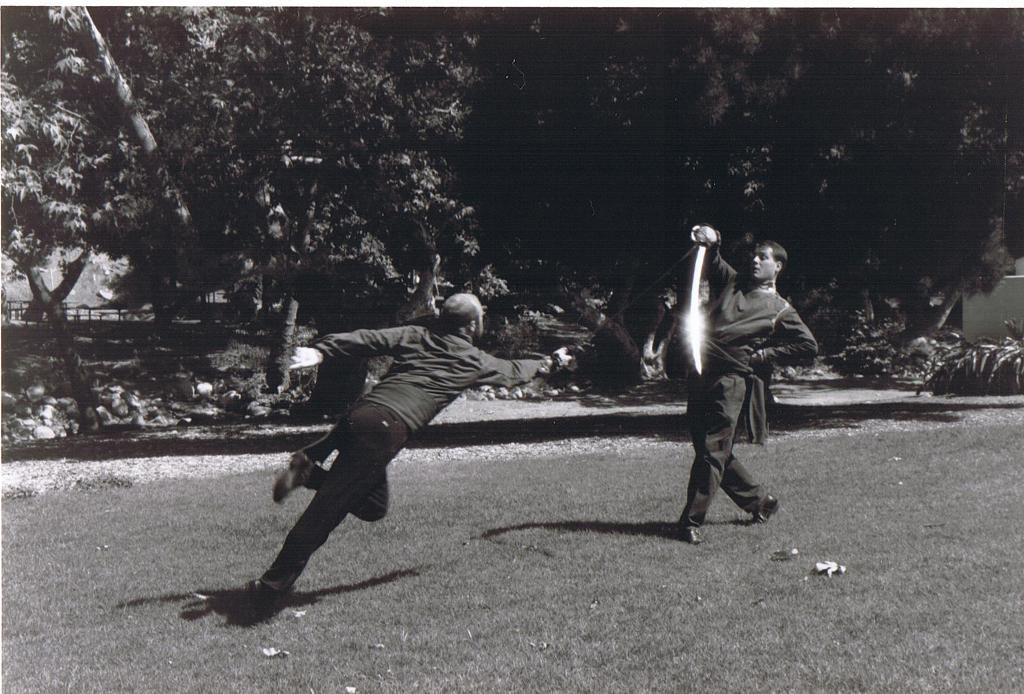
Jon Tarantino and I doing a photo-shoot, Oaks Park, Santa Barbara, for a friend in 1997–aside from schlager blades, these crappy Indian-made repro cavalry blades were all we had, and yes, they were rubbish.
I left the competitive world in 1996—I was disgusted with
the band-aid vs. cure approach of the FIE/USFA to the issues in electric sabre.
It just wasn’t fun anymore, not for me, and so I left. I began pursuing
“Classical” or “Traditional” fencing, but understand that
in saying that I don’t mean the artful dance variety—I wanted to return to
sabre pre-electric, and that led me further and further back, ultimately to the
core texts that created what I knew as sabre. Labeled “too sporty”
and failing to pay homage to what has become the established
“Classical” community, there was no welcome there either. It’s just
as cliquish as the Olympic world, maybe more so for being smaller, though I’m
happy to say that in more recent months I’ve had the pleasure to get to know
more people within that community and hope it’s a sign that we’ll communicate
more.
Time in historical fencing has proved just as difficult, if in different ways. The first historical club I attended, off and on, I entered at a difficult time for me and my family. I needed an out, something that wasn’t standing uselessly next to a pregnant spouse undergoing treatment for cancer and trying to keep a four-year old’s world as normal as possible. I should’ve done more research. I knew of Maestro Hayes’ school in Eugene, but with my schedule at the time I couldn’t make that drive. I did what anyone might do instead—I saw the need at the club I was in and decided I’d try to help. It was an utter and complete failure—fragile egos too often see help as a threat. This proved the case at this school.
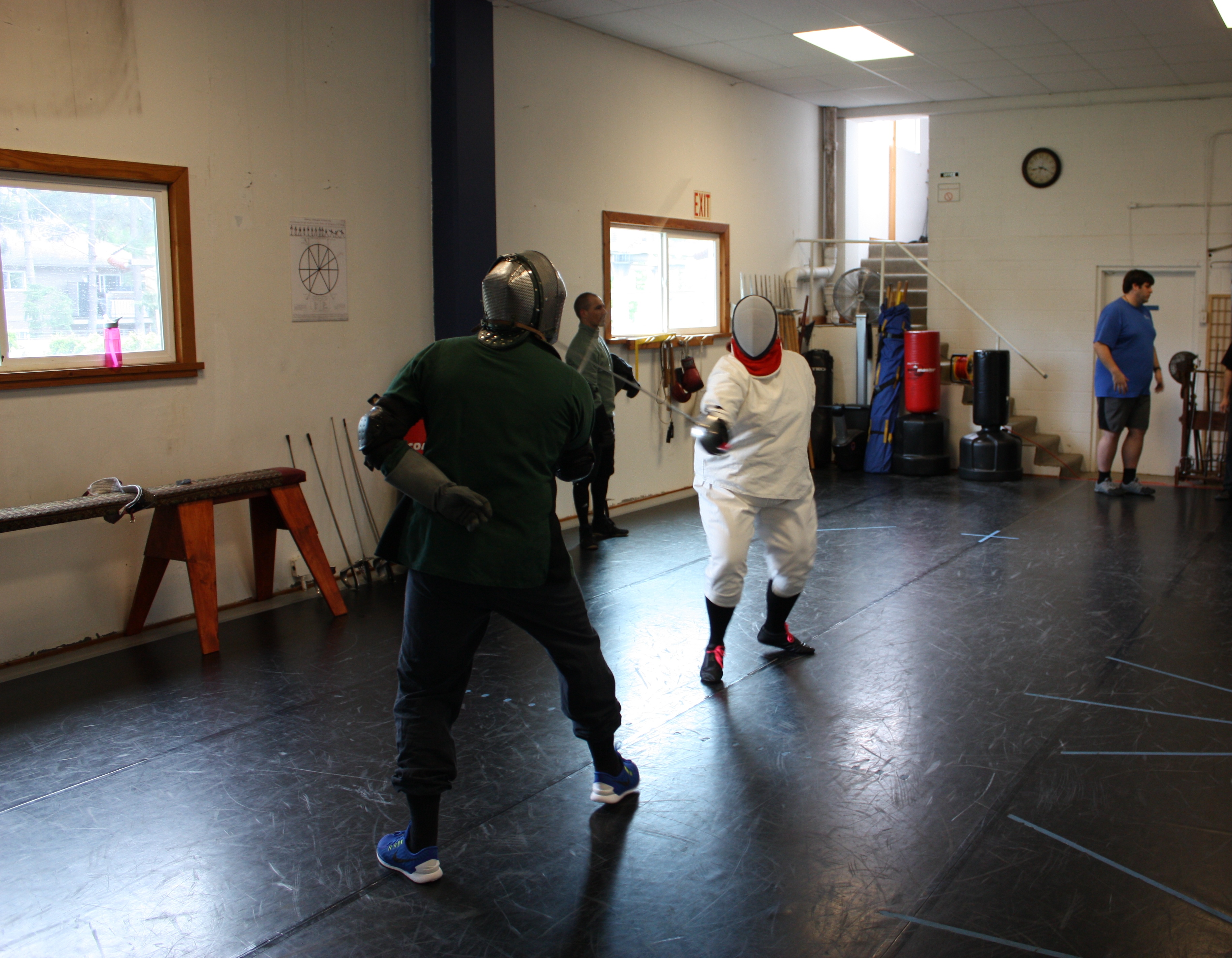
Alex Spreier of High Desert Armizare, vs. Velah Gilbert (Military and Classical Sabre page, FB), with Christopher Bigelow (Northwest Fencing Academy) in green and Mike Cherba (Northwest Armizare) in blue, both in the background, 2015, at the ill-fated seminar on Angelo’s sabre and broadsword I put together
My last event there, one I put together to help them, but which ended up being micromanaged by the guy in charge of sabre there (first by planting his student in the seminar to keep an eye on me, and then, at the last minute, by showing up himself and taking over the seminar), was the last straw. After sharing my thoughts about it with him, I left and never looked back, though happily and ironically, became the best of friends with his student, and, met two people better connected with the larger historical community. I visited one of their schools, one super close to my house as it turns out, and was there for several years.
Swordsquatch 2017, class I co-taught with a friend, covering Parise’s “On the Ground”
Having spent time in each camp’s turf, having fought side
by side with each gang, hearing what they have to say about one another,
themselves, all that, is illuminating. More than ever I think that despite the
differences there’s more that we have in common that we think. This is a hard
sell—group identity, misunderstanding, envy, ignorance, all work together to
prevent more interaction. We are all the sorrier for it.
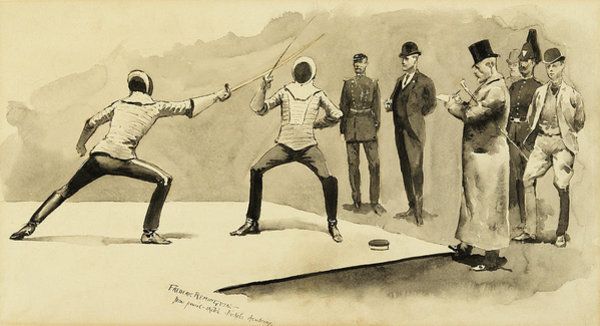
Fencing at- Dickels Academy, by Frederic-Remington
One of my goals with Sala delle Tre Spade is, to the degree possible, to bridge these divides. ALL fencers, whatever gang affiliation, are welcome—our turf is their turf. We are all united by study of the sword, and, we might learn a lot from one another. It makes me happy to know that in our tiny group we have historical, classical, and Olympic fencers; some have been or are in the SCA; some pursue several “styles” of fencing at different times in the week. We’re a small school, and so have very little influence in the larger fencing world, any of those worlds, but it’s a worthy goal trying to get people together to share what they know, because it builds ties and expands the parameters for what we might learn. We’re the richer for it, and while it’s anyone’s guess how long we’ll last, I know in a way that I know few things that it will have been worth it. We’ll all keep fencing regardless.
There are many things that distinguish Olympic and Classical
fencing from historical fencing, but one that’s surprised me is the place of
bouting with an instructor. It’s not that this doesn’t happen in Olympic or Classical
schools, but it happens differently when it does, and in my experience doesn’t
tend to raise the same questions.
I’ve not taken a poll, but I believe it’s common for instructors in historical circles to free fence with students. Not all do, but certainly many, and it’s easy to see why. Most “HEMA” clubs are grass-roots, that is, they start say with one or two people eager to explore extinct art X and they form a backyard study group. They start off, then, fencing one another. Many such clubs are so small that in order to have people to test techniques and plays against an instructor has to fence. That instructor often is only the instructor because they’ve spent more time with a text.
In Olympic and Classical schools normally instructors have been trained within those cultures—with long traditions of pedagogy, with established programs for training teachers, people entering these fencing spheres interact with instructors differently. New students, for example, take lessons from an instructor, but don’t fence them in free bouting. They may in time, but more often than not outside of teaching bouts new fencers fence against more advanced fencers. I’ve worked with four masters so far and only with the last have I enjoyed the privilege of free bouting. I had teaching bouts, sure, where I was restricted to specific things we’d been working on, just using them in real time, but not free bouting. Thus, my perspective as an instructor is largely shaped by these experiences.
The reason I’m exploring this here is that I’m always a bit shocked when someone asks me how they did or if I was holding back on them. These are honest questions, and I’m always happy to provide feedback, but it’s important I think to establish how one should think of any bout with an instructor. The caveat is that this is my view, one not shared by all within the historical community, but so far as the group I run goes this is how I look at it.
An instructor’s first duty is to teach. This should guide everything they do. This pertains not only to overseeing drill, but also to bouting. It’s especially important in bouting, because by its nature a combat between two people, even friendly, is a contest, it is competition, and few places are as prone to ego as this. Everyone likes to win, everyone wants to, but victory, even the small victory that comes in a single bout, isn’t the goal of an instructor in that match: their goal is to use that bout to build up the student. What does that mean?
First, it means that the instructor must balance pushing the student realistically enough that they respond correctly, but not so hard that they overwhelm that student. Second, it means that while the instructor is trying to land the touch, they’re not doing so at any cost—if landing the touch defeats the lesson, don’t land it. Start over, set it up for the student again. Third, it means holding back. This isn’t, by the way, being condescending toward that student, it’s honoring where they are skill-wise in that moment. Hitting them with every tool in your tool box, with all ferocity, is as useless and defeating as it is stupid. The instructor becomes a bully, the student is frustrated, embarrassed, and no one learns anything. The sala is not a place for the instructor to show off what they know, but to teach. If your self-worth requires you to seek these little wins, fine, but there are other venues for that. There is no glory in defeating your own students.
As an instructor, it’s your students who come first, not
you. When you bout with them, your goal is to increase their skill; yours will
improve in helping them.
It can be easy to get lost in the fun, so you must focus—limit yourself to those maneuvers that allow your students to see opportunities to use what they’ve learned, and set them up to do that. This doesn’t mean you’re handing it to them; one does with brand new fencers, but with more advanced students you need to sell it, make it real, otherwise you’re not helping them. Your job in these cases is to mimic what they’ll see on the strip or in the ring.
Instructors need good bouts too, and this is yet another
argument for continuing education. One should never stop being a student. If
you need bouts, find them, but go to the appropriate place—seek out better
fencers than yourself, enter a decent tourney, go to a master and take lessons.
It’s good for you, and, it’s good for your students.
This can be a
thorny topic. We talk a lot about safety, it sort of comes with the territory,
but ask any gathering of historical fencers what safe-practice means to them
and you’ll likely get more than one answer. People come to historical fencing
from different backgrounds, with different gear, safety protocols, and
expectations. This is an important point to keep in mind. It might be a window
into your instructor’s approach, but also it may explain why your training
partners have different attitudes toward safety in class.
In some respects, safety is a relative term. For example, I have friends and colleagues who generally wear only an unpadded canvas jacket. This is what they wore at the sala where they started out. The maestro who runs that school is classically trained and his program for Armizare, just as in his traditional fencing classes, inculcates an increasing amount of skill and control over time. Because his fencers have this control, and because they gradually build toward more intense drill, they can wear light jackets in relative safety. Not everyone starts this way—I see people from many backgrounds, classical, Olympic, MMA, Asian martial arts, and SCA. Each typically brings with them the safety protocols they are most familiar with, but naturally they don’t always meet up. Some are far more conservative, some downright dangerous. Combined with varying levels of skill differing ideas about safety can create a potential landmine.
In this clip, for example, my friend Mike Cherba, head instructor at Northwest Armizare, demonstrates that even a normal blow from a feder can wreck the typical fencing mask: https://www.youtube.com/watch?v=eW1Imv7yHig I know Mike well, and trust me, this is not his hardest cut—strong as he is, Mike’s level of control is equal to it and he’s one of the few people I feel I could fence with in longsword with a normal mask. If you’ve followed any HEMA tourney footage then you’ve seen people hit way, way harder. What constitutes a “hard blow” is relative too.
What can we
do to mitigate that? First, we need to be aware of these differences. It isn’t
necessarily something people think about it, but they need to. Not just the
instructor, everyone. Expectations
within any group or school should be explicit. This ensures that anyone new to
that school knows what the culture is, what gear requirements are, and armed
with that information can decide whether or not it’s the school for them.
Second,
people need to have a minimum of protective gear—just because they shouldn’t need it doesn’t mean they won’t. You have to plan for the lowest
common denominator with chance of injury, not the best case scenario. A mask is
a must, ditto a jacket, solid hand protection, and guards for groin and neck.
Chest protectors are not a bad idea for both sexes as well. It will only take
one broken rib to convince most people, but better they never get the broken
rib. I was never a big fan of the gorget, but I also recently heard about two
near-misses that convinced me that they’re a good idea (so that is me overcoming
my own background and bias).
Third, the
instructor must cultivate, and enforce, a culture of safety. Despite some
excellent recent articles about the idiocy and dangers of the “go hard or
go home” mentality, there is still a disproportionately large number of
people who embrace the idea that only pain teaches. This is macho bullshit at
its worst. If that’s your thing, fine, find a club that caters to the
fight-club ethos, but it’s on you. If you’re young, just remember this—whatever
fun you have now, whatever injuries you incur, they come back to haunt you
later and will affect the quality of your life. I was never given to macho b.s.
much, but in my twenties I was certainly less cautious and had no mind for the
possible long-term effects of injury. Now, comfortably into my forties… I have
joint issues all along my right side—knee, hip, elbow, and shoulder—thanks to
over-training, fighting while injured, and a few unrelated accidents that compounded
these existing problems; I have scar tissue from a stab wound and broken
fingers that also compromise my ability to train and enjoy something I love. Be
smarter than I was.
In designing
curriculum, the instructor needs to assess the potential risk in each drill.
This might mean working with another instructor or one of the more advanced
students to test it out prior to class. Consulting with other, knowledgeable
instructors can help too; there is no reason to go it alone. Stand on the
shoulders of giants if you need to.
Lastly, each
fencer must take responsibility for safety. They need to wear the right gear,
ensure that their friends do, keep an eye out of hazards, help maintain
weapons, and if they feel unsafe speak up. There’s no shame in that and it
might save someone a trip to the ER.
Most of all,
each fencer must work hard to become proficient enough that they have a basic
level of control. This does several things. It develops one’s ability to handle
the weapon, but in that process one also learns to read situations better; one
realizes faster if one’s own attack is going wrong as well as if one’s
partner’s is. Collectively this makes for a safer drilling and bouting
environment. Every fencer’s first defense is the Art, is good technique
well-applied—your gear is there, again, for when this fails.
Some basic guidelines everyone should follow:
Keep floors clean and gear out of the way
Wear your mask
When not engaged in a drill or bout, keep sword/weapon tips down, pointed at the floor
Maintain your weapons and safety gear; replace things when they wear out*
Refuse to play with anyone not as concerned about safety as you are—it’s not worth your eye
Don’t fence when too tired, angry, or otherwise distracted
Look out for your mates
Follow the rules, those of the sala and those provided with any drill or within a bout
*Romantic notions
of the sword-as-heirloom aside, yes, even swords must be replaced in time
One question I’m
asked about drills is to what degree they’re artificial, how they might set up
ideal or unlikely scenarios. A related question concerns whether or not there’s
a danger in having partners take turns making actions poorly, say in a stop-cut
drill. Taking this last question first the answer is “no” if an
instructor is on their game. Students, especially in their early training,
shouldn’t be drilling poor actions. Conventional wisdom and practice
demonstrate that the instructor should be the one exposing their arm for
stop-cuts, holding a poor guard, or making any other action defectively. The question
about artificiality, however, requires a longer answer.
In classical
and historical fencing our concern is to fence as if the blades are sharp, to
hit and not be hit, and so when a drill brings in maneuvers or plays that seem
to defy this ethos it’s only natural to wonder about their value. Students
often have assumptions about the nature of drill that informs this perspective,
and some of those assumptions are incorrect.
There are
different kinds of drills. Some we do solo, such as footwork drills or cutting
against a pell, mask, or fencing Oscar.[i]
Some we do with a partner. Others we do with an entire class. While “don’t
be hit” and “hit and don’t be hit” are our guiding principles,
applying these notions to every sort of drill, and each aspect of it, is
reductionist and can blind students to the value of a drill. All study, drill
included, should result in a style and method of fighting that illustrates this
guiding principle. However, not every drill or part of a drill need conform to
this absolutely all the time.
For a quick
example from sabre, let’s examine two maneuvers, the first being a common
compound attack, feint-cut head, draw the opponent’s parry of 5th,
and cut flank or chest; the second being the riposte to the flank from 5th.
Looking at the feint attack first, for it to work each partner has to act a
certain way. The attacker must simultaneously work a key offensive action, the
feint-cut, with a ton of technical movements designed to make that same attack effectively.
The instructor or partner on the receiving end, the defender, must do the same;
they must recognize and defeat the feint, and parry.[ii]
In the case
of the instructor, and you often see this in their posture, they’re not
necessarily mirroring exactly what an opponent would do, but performing those
parts that will help the attacker succeed in the drill. If the feint is
unconvincing, for instance, the instructor won’t parry and might counter
depending on what they’re working and how advanced the student is. Judging a
student’s readiness to go beyond a simple drill to a more complex version is
one of the more difficult tasks an instructor faces—so much depends upon
correct assessment.[iii]
In comparison
to the instructor, the case of the partner is more complex. On the one hand,
they need to help the attacker, just as the attacker will help them when they
switch roles, but on the other they shouldn’t be fencing in such a way that the
result is poor technique or tactically dubious choices.
Ideally, each partner is doing their best to make their half, offense or defense, work. The defending partner should use this opportunity to work on parries, specifically reacting to the cut to the head. For the basic set-up, this might be the goal in addition to gauging measure, working the feet, and maintaining the correct posture and hand/arm positions. One step deeper, however, the defender might have other options—they might for example, attempt to parry the actual cut after defeating the feint and then riposte. Drills usually start simply and develop into these more complex, multiple action versions as students advance in skill.
So far none
of this is “artificial,” but one thing students have asked me about
is the danger inherent in making that flank cut after the feint. Having drawn
the defender’s arm up into 5th, the defender’s arm is then poised
over the attacker making it possible to cut down onto the head. Isn’t that dangerous,
they ask. In a word, no, because the defender should be worried about the fact that they’re about to be cut in
the flank. Many fencers, because there is no actual danger decide to attempt a
counter as, or just after, they’ve been hit rather than parry. This brings up
an important aspect of fencing too deep to go into here, namely the priority of
the touch, but for our purposes here is making this kind of attack artificial?
Is it safe to assume that the defender will just accept the touch and not
counter?
If one is fencing as if they’re sharp, then one should never assume anything, but at all times attempt to cover oneself. One solution is to add a side-step with the cut to the flank. Assuming a right-hander, the attacker can extend the arm to make the final cut and lunge a bit to the left by extending the back leg out and to the left after or as the front foot lands. This does two things: first, it removes one’s head from being just under the opponent’s weapon, and two, it gives one just enough measure to cover in 5th or 3rd after the cut in case of counter-attack. This makes more sense after making the feint to head first, because from 5th the defender may still be able to retreat and make a molinello to the head.
On the other
hand, for the fencer riposting from 5th to the head, our second
example, things change a little—the riposte, having been parried, has lost its
momentum, so the fencer riposting to the flank has less to fear from the blade
over them. The fencer whose head cut failed now has a choice before them—they can
drop the blade on their opponent’s head, which remember has no momentum, or,
they can consider that fully developed cut speeding its way to their flank.
This is a simple choice if we apply the “fence as if they’re sharp”
rubric—the partner with the unsuccessful cut to the head should be considering
how they are going to parry that incoming cut. Whatever damage dropping the
blade on the attacker’s head might do, it’s likely going to be much less than a
fully developed cut to the flank.
The greatest danger of artificiality here is not in failing to account for that blade poised above one’s head, but in forgetting to behave as if both blades are sharp. When we forget that, we too often make actions we would never make (one hopes) were we fighting in earnest. But, if we cultivate the notion that the blades are “sharp,” then we’re more likely to make better decisions; in the example above, as the defender we’re more likely to worry about not getting hit and thus parry rather than go for a counter that will only mean both fencers are hit.
Ideally, the
only “artificial” aspect of drill should be our cultivated sense of
danger. No drill is worth the name which trains poor technique or tactics. This
is especially true with partner drills. There is an inherent argument here,
namely that instructors ought to be the only ones to present examples of poor
technique. However, this is no less dangerous for them, so it behooves every
instructor to continue to take lessons, to remain a student, so that they may
not include pedagogical tools like an open line or exposed arm in their own
assaults.
[i] This is what we called
them, but there are probably other names—an “Oscar” is a mock
opponent, often set up on a wooden frame, covered with jacket or similar
material, a mask, and often with an adjustable arm to shift a blade to
different positions.
[ii] This will vary with the
level of the fencer. An instructor or senior student might not defend as
effectively if focusing on a newer student learning this attack.
[iii] In his Fencing Illustrated (1670), Ch. XIV, Giuseppe
Morsicato Pallavicini discusses this very issue. The first bout a student has
should be with the instructor. Even when assigning a new student to work with a
more experienced one Pallavicini tells us that the instructor must supervise them.
See Giuseppe Moriscato Pallavicini, Fencing
Illustrated, Trans. by Christopher A. Holzman, Wichita, KS: Lulu Press,
2018, 91-98.
The historical
fencing community is increasingly fascinated with and implementing cutting
exercises. This is a good thing. Cutting is a common adjunct to the study of
the sword, but increasingly it’s used by some as a method of measuring readiness
for fighting with steel in tournaments. There are problems with this, and in
fact there are problems generally with the understanding, approach, and use of cutting,
but these less often come up in discussion. First, the assumption behind test-cutting
as proof of one’s ability to wield steel safely and with sufficient control in
tourneys is flawed.[i]
Second, the notion that a hewing blow was or is the ideal attack doesn’t hold
up well in light of the sources or historical accounts. Hewing blows are there,
yes, but among other options and hardly chief among them. Lastly, a lot of
fencers are only concerned with cutting through the mat, not in doing so according to recorded, historical mechanics; many
claiming to study “western” fencing are in fact using Japanese
mechanics in making their cuts. If cutting is intended to be a part of
historical fencing practice, then it should be in line with the techniques and
mechanics of whatever specific branch of fencing one is doing, be it KdF or 19th
cen. sabre.
Begging the Question
Cutting
as a test for tourney-readiness with steel is akin to judging a car mechanic’s
ability to change a transmission by how well they use a screwdriver. They’re both
important skills, both relate to making the car work, but there’s a lot more
that goes into replacing the transmission. It’s the same with tournaments. The
ability to cut a tatami or similar target well might demonstrate a fencer’s
edge-alignment, but it’s a poor measure for many other critical aspects that make up a good, safe tourney fighter.
Control,
for one, is different against a moving target than a static one—tatami not only
doesn’t hit back, it doesn’t move. An opponent does. The nerves and excitement
that are often present in fighters are generally different than they are when
cutting a target. Tournaments also require one to operate within a defined
space and according to a host of rules, there’s noise, there are time constraints,
and there is stress and exhaustion, never mind two people trying to hit one
another.
Lastly,
one is not making the same sort of cut against an opponent that one does
against a cutting-target: no one in the ring is trying to cut through anyone
(hopefully), and so power-generation is by definition restricted. Newer fencers
might hit hard, macho a-holes do too, but where the former is excusable because
they’re still developing control, the latter has no excuse. For all the blather
about “martial” blows few people who recite that mantra have really
considered what it means, or, how and whether it should apply in a tournament
setting.
Extant Sources and the Hewing Blow
Surviving
sources rarely encourage the fencer to deliver hewing blows with each strike. If one thinks about it, it
would be silly to do so, because it requires more energy to do and thus is more
taxing; it means the possibility of over-extension and thus exposure to
counters; and lastly it isn’t necessary—the human body is pretty easily cut by
less of a blow than one uses trying to fell a tree or that a headsman uses at
the block.
For
brevity, here are two examples, one medieval the other Victorian, in other
words, one from each pole as it were of the span of extant historical fencing sources.
First, the fendente or downward
strike of Fiore dei Liberi is instructive. He was active ca. 1409 CE and was an
experienced solider, policeman, mercenary, and fencing master. The four known
texts detailing his Armizare or
“art of arms” reveal a system that is uncompromising and brutal. The
intention is to maim or kill, precisely the skills that his audience,
professional fighting men, required in the field and in the lists. In the Getty
(Ms. Ludwig XV 13), Fiore says:
We are the cuts named fendenti (cleaving blows). In this art, our trade is to part the opponent’s teeth and to reach all the way down to his knee. We can easily transition from a guard to another, through a low guard. We also craftily break the opponent’s guards, while our strikes leave a trail of blood. We fendenti are not slow to strike, and recover in guard with each step.[ii]
Now, did
Fiore mean that each time one made this cut that one was trying to cut a person
in half, or, did he mean that this is the angle one should make in performing that
cut? Which is more likely? Such a cut, against a static target, might divide a
person from the jaw to the opposite knee, but it’s hard to imagine any fighter
attempting a cut that powerful each time they swing. Fiore also says “our
strikes leave a trail of blood.” The line reading either “trail of
blood” or “sign of blood” (it varies by translation) looks to
the same two words, sangue segno.
Sangue, or “blood” is cognate with our “sanguine” and
“sanguinary” and is pretty clear, but segno… that is trickier. If you look up the Italian today segno can mean “a sign; a mark; a
scratch; a sign or indication;” it can also meaning “shooting
target.” The word it comes from, Latin signum,
means much the same (e.g. sign), but took on some more abstract meanings during
the Middle Ages, such as “miracle,” “statue,” and even a
specific type of medieval bell-tower. Yet, several of these translations used
“trail” for segno. Trails
suggests more of a slicing wound, a deep cut, not the severing of a thorax.
In
context—context is everything—Fiore is saying the fendenti are downward strikes made at a sharp angle, roughly jaw to
opposite knee, and depending upon how hard and at what distance one hits it
might cut deep or leave a really nasty slice. The images accompanying this show
two men out of armor. To cut through linen, cotton, or wool one doesn’t need to
hew the same way one does straw or wood. Significantly, in the armored portions
of his work Fiore discusses the longsword in its guise as short pole-arm,
something for thrusting, not cutting.
Fiore, thus, advocates a blow that is likely to hit something given the angle,
that can cut deep or tear someone up nicely, but taken together is not meant to
hew limbs each time.
A
second, much later example comes from the Radaellian sabre tradition. Giuseppe
Radaelli’s major innovation was to implement the elbow rather than the wrist as
the axis of rotation for cuts. Another Radaellian fencer, Maestro Ferdinando
Masiello, related in a letter to Lt. Gen. Achille Angelini that Radaelli, having
seen how ineffective wrist-generated blows were from the saddle, decided to substitute
the elbow as axis. This produces a more powerful cut, but one still under
control.[iii]
Looking at the corpus of works on Radaellian sabre, from Del Frate (1868/1873) to
Pecoraro and Pessina (1912), nowhere does anyone advocate trying to cut anyone
in half; nowhere does one master suggest that a hewing blow is the goal.[iv]
An argument from silence isn’t worth much, but additional evidence supplies information
that does much to fill in the picture.
One such example comes from the same Lt.
Gen. Achille
Angelini mentioned above. In his work on dueling, the Italian
Chivalric Code,
published in 1883, he states that if something was important enough to fight
about, then the duel over it should result in a serious wound or death.
Anything less was a mockery. Angelini
states:
In the duel with the sabre neither the thrust, nor the cut to the head may be excluded. Duels with such exclusions, other than being ridiculous, are harmful, since the number of duels instead of decreasing would increase when a dandy could play the braggart with only the risk of getting a scratch of little consequence.[v]
Of note here, the choice of potentially less lethal targets, such
as the arm, are not bad choices, but ones less likely to keep to the serious
tone Angelini advocates. A cut to the arm would not necessarily end the fight. Significantly,
the arm doesn’t need to be severed to make it useless; a nasty cut across the
right ligaments, or which lacerates an artery, or that hits bone, can render
that fencer hors de combat. Even a
good bruise can. The arm was thus often wrapped to prevent this from prematurely
ending the fight. The arm was and is a primary target in sabre and with good
reason: take out the arm and the opponent can no longer fight.
The take away lesson here is that in the context of the duel in
late 19th century Italy, a context in which truly nasty wounds were
positively encouraged!, no one advocated a hewing blow. Even with powerful molinelli from the elbow the emphasis
wasn’t lopping off limbs or cutting people in half—it would have been too
dangerous for any duelist to so commit and expose himself.
The last
concern is the goal in cutting—what is it exactly? Is it merely to sever the
mat, or, to sever it according to the sources of one’s preferred tradition?
This is an important question. There are many ways to cut a mat, but if one is
performing this exercise as part of studying a specific sword system, then
ideally one is doing all one can to use the mechanics advocated within that system to the best of their ability.
Anything else is, well, sort of pointless. Call it fun, call it cutting, but if
divorced from the techniques of one’s tradition, then it isn’t really informing
that practice. Used correctly, cutting can actually be a good measure of what
is possible within a tradition if not exactly what say Fiore or even Radaelli would
have done. One young fencer I know, her first time cutting, easily sliced a
tatami using the mechanic she had learned from her instructor, one she had used
in drill and in bouts for years. Is her success proof of exactly what Fiore
intended? No, but it suggests that the interpretation of the cutting mechanic
at that school is a valid one given both the evidence from Fiore’s works and
her success with that cut. It’s valuable feedback.
There is a lot of video out there of cutting, and if you’re just watching for
the mat to slide off its base after the cut, it’s easy to miss red flags like
fencers leading off with the legs, with elbows, or pushing their hands out
before the blade. There is also heavy influence from Japanese practice, some
better than others, and it shows in stance, in execution, even in the number,
sequence, and direction of cuts. Will this cut a mat? Sure, and there are
people making their reputations on this, medaling, etc., but that doesn’t
automatically mean they’re in line with the traditions they claim to represent.
Maybe that doesn’t matter, but it might if you are trying to cut according to
the rhymes of the “Zettel” or Liechtenauer glosses and you’re using
the wrong techniques.
If
you’re going to include cutting in your practice, do so honestly, do so in
accordance with the dictates of your tradition as best you can. It’s a lot of
fun to do, and it can be good practice, but it should be about more than just
whether you cut the mat or bamboo. It should be about how you do so.
[i] In origin the tameshigiri from Japanese
swordsmanship—where this practice in HEMA originated—was not intended to test so much the swordsman as the sword. It is arguably better for that
than as a test for one’s ability to use steel, though many Japanese schools
have competitions for test-cutting in their own right which are about cutting
ability, not the sword, so the carry-over into HEMA is understandable. For
more on tameshigiri, see for example Victor
Harris, “Japanese Swords,” in Swords
and Hilt Weapons, ed. Michael D. Coe, et al., New York, NY: Barnes and
Noble Books, 1993, 148-171, see especially 168; Kazuhiro Sakaue, “A Case
Report of Human Skeletal Remains Performed ‘Tameshi-giri (test cutting with a
Japanese Sword),” in Bulletin of the National Museum of
Nature and Science, Series D, 36 (Dec. 2010): 27-36; John
M. Yumoto, The Samurai Sword: A Handbook,
Rutland, VT: Charles E. Tuttle Company, 1978, 74, 81-82.
[ii]Fiore de’
Liberi’s Fior di Battaglia, Fiore’s 1409 Martial Arts Treatise from the
Getty Manuscript, rev. 4, Trans. Tom Leoni [Ludwig XV 13]. For the manuscripts,
their history, and relation, Tom Leoni’s translation of Fiore de’ Liberi, Fior di Battaglia, 2nd Ed.,
Wheaton, IL: Freelance Academy Press, 2012, is a standard work; it can be had,
minus illustrations, via Lulu Press. Work continues on a new examination by Tom
Leoni and Ken Mondshein, Flowers of
Battle: The Complete Martial Works of Fiore dei Liberi, A Master of Arms and at
the Turn of the Fifteenth Century, 4 Vols., Wheaton, IL: Freelance Academy
Press, two of which have been published. Vol. 1 covers the Getty, Vol. 3 The
Florius or “Paris.” Some translations and transcriptions are
available online at Wiktnenauer, http://wiktenauer.com/wiki/Fiore_de%27i_Liberi
, though caution is required with this site. A far more useful and reliable
digital resource is “Pocket Armizare” available for Android. See also
Robert N. Charrette, Fiore Dei Liberi’s
Armizare: The Chivalric Martial Arts System of Il Fior di Battaglia,
Wheaton, IL: Freelance Academy Press, 2011; Ken Mondschein, The Knightly Art of Battle, Los Angeles,
CA: J. Paul Getty Museum, 2011; Guy Windsor, The Medieval Longsword, Mastering the Art of Arms Vol. 2, The School of European Swordsmanship, 2014.
[iii] See Christopher A. Holzman, The Art of the Dueling Sabre, Staten
Island, NY: SKA Swordplay Books, 2011, xxvi.
[iv] In addition to Del Frate (n. iii), see for example Luigi Barbasetti, The Art of the Sabre and Epee, New York, NY: E. P. Dutton & Co., Inc., 1936 [an English translation of his original 1899 edition in German]; Lieut. J. Betts, The Sword and How to Use It, London: Gale & Polden, LTD, 1908; Ferdinando Masiello, La Scherma Italiana di Spada e di Sicabola, Firenze, IT: Stabilimento Tipografico G. Civelli, 1887; Masiello, Sabre Fencing on Horseback, Firenze: G. Civelli Establishment, 1891, Translated by Christopher A. Holzman, 2015; Salvatore Pecoraro, and Carlo Pessina, Sabre Fencing: Includes Spada Fencing: Play on the Ground, 1910, Translated by Christopher A. Holzman, Lulu Press, 2016; Giordano Rossi, Scherma di Spada e Sciabola, Manuale Teorico-Pratico, Milano, IT: Fratelli Dumolard Editori, 1885.
[v] Lt. Gen. Achille Angelini, “Of the Duel with the
Sword or Sabre,” Italian Chivalric Code,
XI: 2; trans. Holzman, 2016.
With our tourney coming up—an invitational sabre match—I’m always conscious of how difficult these things are to do. I’ve either fenced in or judged a lot of tournaments, both Olympic and HEMA, and with each new historical tourney I’m struck by a disturbing fact—pound for pound, a tournament in HEMA and one in Olympic circles are not so very different. In both, too many fighters are playing the system, and worse, too many have zero regard for being hit. In both tournament worlds there is also a tendency to take medaling as the litmus test for excellence. Placing well can correlate with skill, but it’s not a sure thing. There are a number of reasons why this is so.
Everyone likes to
win. Emerging the victor in a bout, or better still a tournament, is a nice
feeling. It’s validating. It is important, however, to put any such victory in
context and remember that however well one does, victory on its own does not
mean mastery. There are several reasons for this and if you’re serious about
your development as a fencer you need to know this. You ignore it at your
peril, at the risk of further improvement, and it can easily lead to a false
sense of ability with all the ego problems that creates.
There is always someone out there better than
you are. This is just true.
Theoretically, out there somewhere, there is one fencer who truly is better than
everyone else, but see point two 😉 A
prime example of this is a close friend of mine—we’ll call him
“Dennis.” He’s a beautiful fencer, tactically brilliant, graceful,
powerful, the kind of fighter who makes you look even better than you are when
you fight him and he’s destroying you. Yes, that good. In the early 00’s, he
entered an epee event open only to fencers ranked B or higher; most everyone
there was an A-rated fencer. As this was epee, that ranking actually meant
something too–epee is the only weapon of the three to have retained much of
its martial ethos. No one there knew Dennis, and they expected to clean the
floor with him. He beat every single one of them, badly, and they were really
ticked when they realized that this was just something he did for fun, that he
wasn’t a “normal” tournament guy; he fenced enough to keep his
rating, but otherwise he’d just as soon be working on other hobbies. Dennis is
a good example of the unknown ego-check, of the truly gifted fencer out there
who is, quite literally, better than you or me.
Great fencers have bad days; poor fencers
good days. No matter how
good someone might be, even the best fencers have an off day. If this day
happens to be on a tournament day, chances are good they may not clear the
pools. In like guise, the poorest noob may end up taking the day. It just
depends. Maybe they just had more fire and the better fencers either
underestimated them or misapplied their skill. Maybe the directing was crap.
Maybe it was a combination. One can’t take anything for granted.
Tournament victory is only as good as the
quality of the pools. Not
all gold medals are the same. Medaling in a minor tournament with twenty
fencers of basic skill is not the same as medaling in a tournament where half
or more of the fifty competitors are truly skilled. Herein is one major problem
for WMA—what defines skill? Many people equate tournament victory with it, but that’s
a false equivalency, one only embraced by people who don’t know better or who
benefit from the fallacy. This is hard to combat because the same egos that
benefit from this, who derive their value from it, are quick to say any naysayer
is suffering sour grapes. Sort of makes discussing and fixing that,
demonstrating the problem, difficult.
Skill vs. Attribute Fencing One of the elephants in the ring is the issue of attribute fencing versus a more comprehensive skill-set well-applied. To be fair, most attribute-fencers have skill, but often this is a specific set of skills that exploit their reach, speed, etc. to the exclusion of a more comprehensive game. The thing is it works. If you’re fast, if you have reach, if you hit harder and intimidate people, it will take you pretty far. People medal and win tournaments all the time armed only with a few tricks that they have optimized. The confidence that comes with that cannot be underestimated. The test though, for those fencers, is what happens when they run into someone whose skill-set is broader, whose experience is deeper, and who knows how to nullify the advantages their opponent’s attributes offer. If attribute fencers are lucky, they’ll meet that opponent; if they’re smart, they’ll learn something from it.
Gaming the Tourney is another major issue. This isn’t new and
it’s not confined to WMA, but a major problem for Olympic fencing as well other
sports. There are advantages to winning, and so, some people are willing to do
whatever it takes to make it happen. For just a few examples, be wary of anyone
hosting a tournament that only enlists directors and/or judges from their
school or who stack staffing in their favor.[i]
Related tactics include attempting to intimidate officials and other
competitors, arguing for rule changes that favor one’s approach and fencers,
and hard-hitting. These kids don’t play with others, and worse, can give a
tournament, even a region, a bad rep. You don’t want that.
I’m not saying don’t fence in tourneys—you should if you want, they’re
fun, but, you should go into them with your eyes open and for the right
reasons. Not to wax too Miyagi, but primarily a tourney is a place to test, in
real-time, your skills and tactics; it’s a lesson, a chance to learn, an
opportunity to see what works and what doesn’t. It should also be fun. The
illusion of mastery, and especially of tourney gold as evidence of it, is a
problem for any fencer who truly wishes to improve. Mastery is less a
destination than it is a goal which pushes our training, which keeps us honest,
which keeps us striving.[ii]
This doesn’t mean don’t do your best, that you’re not trying to win—you
can’t test what you know if you’re going through the motions. The pressure, the
chance to think on your feet, to adapt, and all within seconds is a fantastic
way to see how well we apply what we’ve learned. If it all works, and you grab
that trophy, great! It is healthy, maybe after celebratory beers, to reflect on
the nature of the competition, to weight that against the heft of the medal
around your neck. That awareness shouldn’t detract from victory, but merely
inform it, and, better prepare you for the next one.
[i] This isn’t universally true of course. In small tournaments, especially where there is no one else to staff, one has little choice but to use who is on hand. Whenever possible, SdTS tries to enlist friends from other salas to help direct–our judges are pulled from the competitors.
[ii]
A black belt in TKD, for example, has
demonstrated that they are now ready to begin to study in earnest; a fencing master,
in a slightly different way, isn’t necessary the best fighter, but a teacher,
someone who has command of a particular pedagogical approach and is capable of
teaching other teachers.




 Capitale Escrime Historical Fencing