Tag: hema research
More on the Idea of Master/Mastery
This short video from my dear friend and colleague, Maestro Jay Maes, has a lot of excellent points in re mastery and the idea of masters in historical fencing today.
https://youtu.be/5CvcvR4gXHM?si=VdZehxDdTvVYe-aD
Visual Barbasetti–A Video Project
Though it is coming together by fits and starts, I’m doing my best to make good on a promise to create a series of videos that provide help in reading and using Luigi Barbasetti’s _The Art of the Sabre_ (1899). It builds on the excellent work of my friend and colleague, Maestro Michael Kňažko, Barbasetti Military Sabre (since 1895), Prague, Czechia, who so beautifully covered the introductory material, from guard, to parries, the molinelli, etc.
There is more to come, and I will do my best to order everything so that it mirrors the progression of the treatise. There are a few videos up now that are from sections later in the work, the result of questions I’ve received, but in the end the hope is to have each chapter covered well enough to assist someone brand new to the method.
https://youtube.com/playlist?list=PLMMzUA30gYjiof8X1OApZK1o3A-slwF8G&si=AcNXkfTaZUYJCbLN
K. u. k. Military Fencing Tournament
K. u. k. Military Fencing Tournament, Prague 2026, is an annual event dedicated to fencing with weapons taught at the K. u. k. Theresian Military Academy in Wiener Neustadt – foil, sabre, bayonet rifle.
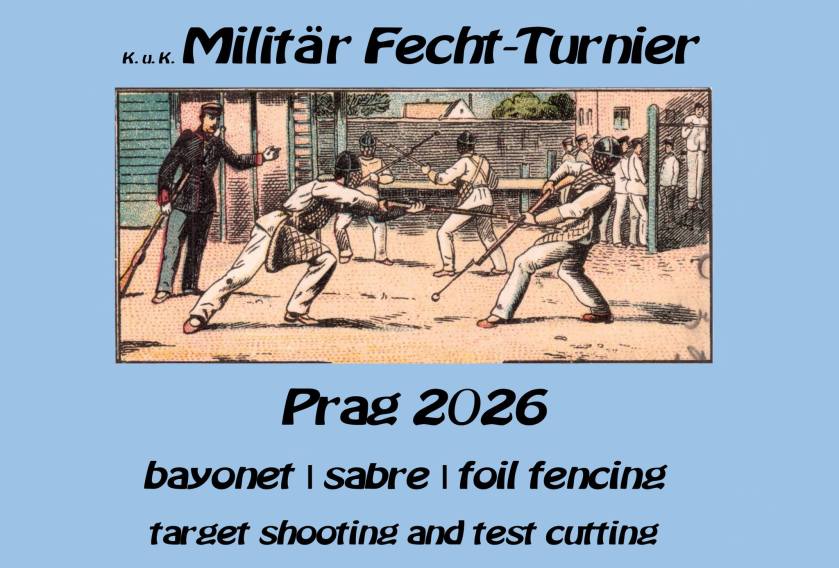
This event continues the tradition of the K. u. k. Armee Fechtturnier, a series of eleven successive Austro-Hungarian Army fencing tournaments held alternately in Vienna and Budapest between 1898 and 1914. The inaugural 1898 tournament was held as part of the jubilee celebrations marking the 50th anniversary of Emperor and King Franz Josef I’s accession to the throne.
The K. u. k. Military Fencing Tournament, Prague 2026, is open to practitioners of all styles and skill levels interested in military fencing from the 1895–1914 period.
DETAILS:
Official program:
Saturday April 18
9:30-10:00 registration
10:00 Opening ceremony
10:15-11:00 Foil fencing workshop with Maestro Michael Kňažko
11:00-12:30 Foil fencing tournament preliminary rounds and eliminations (max. 12 fencers in the pools).
13:00-14:00 lunch in the restaurant Na Urale
14:15-15:00 Bayonet fencing workshop – Maestro Leonid Křížek
15:00-16:30 Bayonet rifle fencing tournament preliminary rounds and eliminations (max. 12 fencers in the pools).
16:30 Bayonet rifle x sabre
17:00 Bayonet rifle x field shovel
Bayonet rifle charge
Target shooting
Test cutting
Pistol duelling
20:00 – 23:00 official dinner – restaurant U Topolu, Prague 6, Jugoslávských partyzánů 943/32, 160 00 Praha 6-Bubeneč
Sunday April 19
10:00-10:45 Sabre fencing workshop – Maestro Michael Kňažko
11:00-12:30 Sabre fencing tournament preliminary rounds and eliminations (max. 24 fencers in the pools)
13:00-14:00 lunch Na Urale
14:15 Pistol duelling workshop
15:00 target shooting & test cutting workshop
Closing ceremony
Tournament weapons:
Czechoslovak spring bayonet rifle – provided by the organizers
Classical French or Italian foil – own weapon required
Barbasetti Sabre 1895, model 2 – provided by the organizers
Tournament requirements:
– own complete protective foil/sabre/bayonet fencing gear (mask, jacket, gloves, protectors)
– own French or Italian foil
– bayonets rifles and sabres will be provided by the organizers
Host:
Barbasetti Military Sabre (since 1895), Prague, Czech Republic
Ars Dimicatoria School of Historical Fencing, Prague, Czech Republic
Place:
Main gym of the Primary School Emy Destinnové, náměstí Svobody 930/3, 160 00 Prague 6 Bubeneč 160 00, Czech Republic
Price: EUR 120
Official T-shirt: EUR 20
To reserve your place contact Michael Knazko
via fb messenger or e-mail: a.dimicatoria@gmail.com
Please note: The organizers reserve the right to make changes to the event program. The organizers also reserve the right to cancel the event wholly should unforeseen circumstances or/and risks to public health arise.
Some News
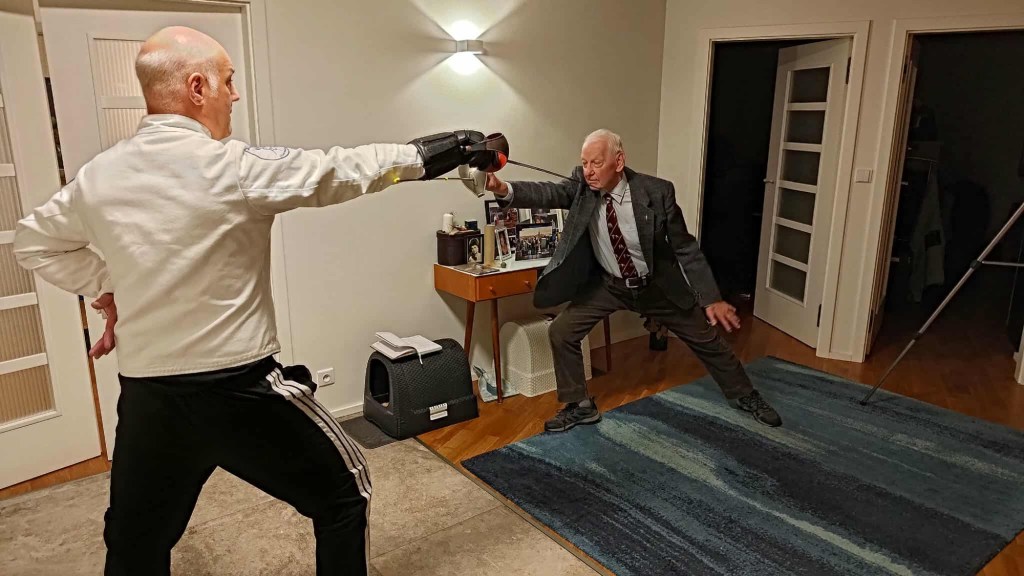
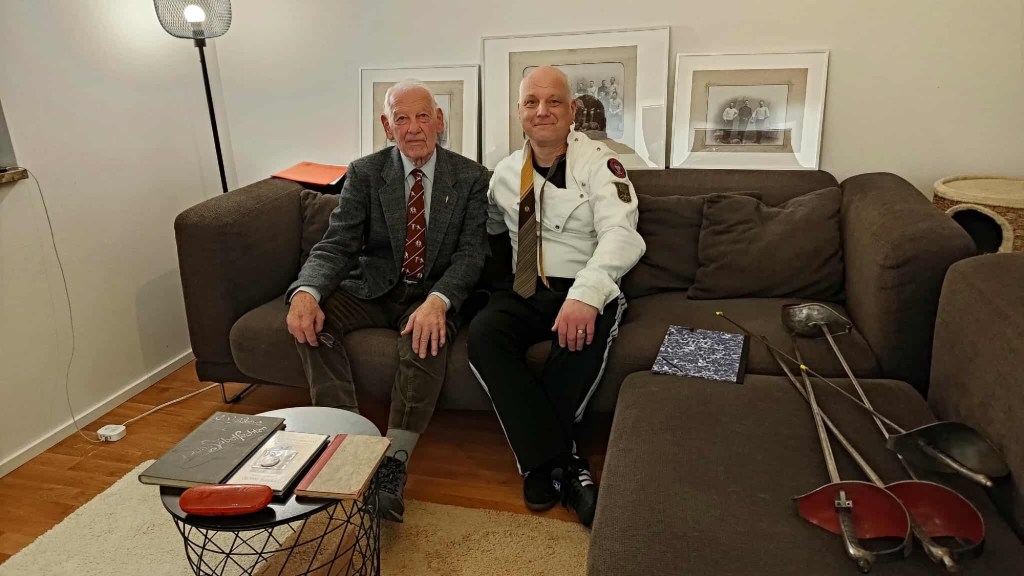
An old friend and fencing comrade, the excellent Jon Brammer, pointed out that I had mentioned but not followed up upon the master of arm’s examination I took in Prague. Apologies.
While happy to write about fencing, I find it difficult to write about myself, so I’ll be brief and say that I passed and share some photos.

SabreSlash 2025, Prague, Czechia

Four years ago, when I first had the pleasure to attend SabreSlash 2021 in Prague, Czechia, I was stunned at how well-run, how fun, and how high the level of skill was, both amongst the attendees and the instructors. This event jumped to the top of my list of “if you can go, GO!” historical fencing conferences. My visit this year, last week in fact, only cemented the value of this mix of workshops, fencing, and camaraderie. So, if you have a chance to attend, DO.
It was a busy week for me, partly because I wanted to support my dear friend, Maestro Michael Kňažko, as he set things up and managed the two-day mix of workshops and fencing, and partly because there was a double reason for my attendance this year: I would be testing for certification as a maître d’armes.
Michael, his amazing partner in life, Caroline, and the excellent folks at Barbasetti Military Sabre (since 1895) have preparations down to a science, and if anything set-up and take-down were faster than ever. The rest of the weekend was as well run—workshops were a good length and sandwiched between ample rest periods; “RandomSlash,” was super successful (more on that below); and everything was geared to allow people to mix and get to know one another.
Goals of SabreSlash
The three goals of SabreSlash are to celebrate and explore history, hone skills, and cultivate friendship. The first and second were most on display in the workshops and in the RandomSlash bouting day two. I have much to say about all the workshops, especially as I did my level best to be a grown-up and sit out so that I didn’t exacerbate any of the injuries I’ve been tending and which are all but managed. Few things are as difficult as seeing that degree of fun and forcing oneself to take notes.
What I would like to discuss first, because it is the most important to me, is the friendship portion. I honestly don’t know quite how to express this, but to say that there are few places in life where I have met that many people and felt an instant kinship, like I had always known them, and who are, to a person, absolutely remarkable, interesting, and kind. At my age, one doesn’t make a lot of new friends; distance and loss tend to start to take over, not necessarily from any ill-will, but stage of life.
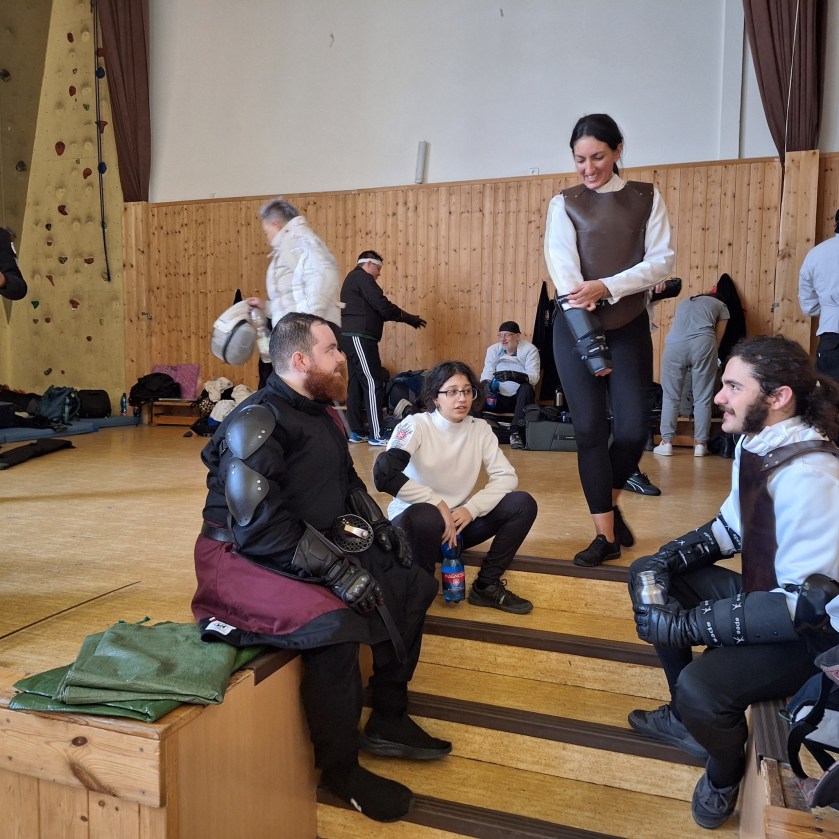
I was absolutely struck numb by the warmth, openness, and genuine interest to get to know everyone that pervaded the event. This was the first time I had met people from FISAS in Italy, as well as the team from the Malta Historical Fencing Association, or, from the Wrocław Polish Martial Arts Club SIGNUM POLONICUM. I cannot say enough really about how much all of them impressed me, not just for their fencing ability and related skills, but as people. We talked about a lot of things, not all of them easy topics, and the compassion, understanding, even hope were inspiring. I am so grateful to have met them—people like that enrich our lives in ways we don’t always see right away. I also had a chance to reconnect with people I met last time, especially Paul Chéreau from Paris, and meet his coach there, Maître Jean-François Gilles. Despite language barriers, we all managed to communicate pretty well—to be fair, my monolingual status was the greatest barrier, but I like to think that a little time trying to speak, even a little, in Czech, French, Italian, and German only helps. [n]
Workshops
The workshops made me feel like a kid in a toy shop. The first class, given by Maître Gilles and Paul, was on French contre-pointe, a topic of great interest to me. After lunch, Maestro Andrei Xuereb explored firm-footed fighting. Finally, a man I had been looking forward to meeting as we’d only chatted on facebook, Leonard Marynowski, took us through a detailed look at the way Polish winged-hussars fought from the saddle. The next day, Sunday, Maestro Franco Burberi, presented a close look at Radaellian sforzi di cambiamenti, and for me personally this was eye-opening. My class was the last one, and I think it went okay. I’m not always sure, but I tried not to speak too quickly or use too many odd idioms—this last tends to be a problem thanks to family and having moved around a lot.

RandomSlash
The RandomSlash fencing pools started next. These were inspired by the “Iron Quadrangle” popular in the FISAS clubs. Everyone got to fence everyone, and, more than once. The bouts were one-touch, and presided over by a single director, in this case a friend of Michael’s, Čestmír Cimler, and me. I know that pre-event not everyone was happy that the fencing portion would be less competitive, but I stand by Michael’s decision. There are plenty of tournaments, and when affixed to workshops eventually, in time, the tournament half tends to dominate. RandomSlash’s approach allowed people to fence A LOT, but more in the spirit of a shared joy of fencing than in the stress of advancing out of pools.

My praise of this event, by the way, is not to disparage competition or other styles of historical fencing get-togethers. My best competitive days are behind me, my day schedule makes training properly for a tournament difficult, and I have other priorities, such as the sports my children play. What I value about this style of competition, which is to say bouting, is that it takes some of the pressure away and lets people focus a bit better on technique and tactics. Only one bout got a little heated, but this was not out of anger but an excess of spirit and a preexisting rivalry between friends. There were, of course, no injuries, and, people used a variety of sabres. This last part is important because generally SabreSlash supplies their own 600-650g Austro-Hungarian army-inspired trainers, and, because these mixed without issue with those used by the Poles and others with wider, heavier sabres.
Still my Favorite Event
I confess that I have some natural bias towards this two-day fest of skill, bouting, classes, and bridge-building. I like these kinds of events. The organizer is a close friend. I am a member of the host school. These, yes, all predispose me to be supportive, but it goes beyond that.

Barbasetti Military Sabre (1895)’s “SabreSlash” has been running for years without any major hullabaloo or injuries. The level of skill is high. The teaching some of the best I have witnessed at any fencing event. The work I do with Storica Defensa, based in Canada, has very similar goals in terms of improving skills, teaching, and providing safer tournaments. It’s one reason we asked Maestro Kňažko to act as the director of the program. Beyond all the excellent instruction and fun, what SabreSlash provides is a model for running a high quality, safe, and thoroughly enjoyable event, one without injuries, one where everyone walks away with better understanding, and importantly, new allies and friends.
I can’t wait to go again.
Notes:
[n] I am not fluent in any of those languages. French, German, and Italian I have learned to read academically—this means I can read articles and the like so long as they pertain to my research field or fencing. It is next to useless for using a menu or making small talk. Czech, I continue to study, because as a member of a Czech salle it is only right I work to speak the language everyone there uses. It is not an easy language, but I like the challenge, and with luck one day I’ll be able to use it well enough not to embarrass myself too badly.
Article on “Military” Sabre–Additional Thoughts
My friends in Canada shared an excellent article with me today, one by Paul Becker with the Historical Fencing Academy, Nordhausen, Germany [https://www.hema-academy.com/home]. Entitled “Military Fencing & Military Sabre?” Mr. Becker explores, through detailed examples from the Austro-Hungarian Empire, what constitutes “military” fencing in his view. Do please read his article–it is well-done and covers a lot of ground that too often is left untilled. Readers will find not only his coverage of texts, but his examination of period weapons useful.
The link is here: https://www.hema-academy.com/blog/militaerfechten-militrsaebel?fbclid=IwY2xjawNLfuhleHRuA2FlbQIxMABicmlkETFNWFhBeEROeVJiOVJtR2gwAR4f6JSN3yJQ-8Lx-JSo9nfDbVAMm34vfEm6-ObW6zQ2xp0spOmIVtM2ea1J4Q_aem_KNNZWoEg5WhCCc_VVMw0dw
If you’ve read much I’ve written, then you will know how much I tend to detest the separation of sabre into “dueling” and “military” in popular “HEMA.” These labels, while in some degree useful, obscure an important fact, namely that the very people using sabres for duels were normally military officers. To quote my good friend Alex Spreier, somewhat out of context, “sabre is sabre.” The problem is that we often feel we need or at least wish to differentiate what we study from related topics–sabre encompasses a vast, truly global tool, and so is perhaps especially prone to fall into categorizing nightmares.
As I’ve too often stated, in “HEMA” the use of “military sabre” is normally meant to separate out what the user is doing from the sport. There is some sense in this, though it is over-emphasized given the vast amount of common ground shared by those examining historical systems and the modern sport. It is, historically speaking, redundant in that sabre was by and large a military weapon. It’s like calling a howitzer a “military howitzer.” The use of national terms, e.g. “Italian sabre” or “Hungarian” or “Spanish sabre” makes a bit more sense, as it refers–one assumes–to texts from those cultures and often in their respective languages. How different these systems are from one another, and how much they overlap, is a separate issue.
There were, as Mr. Becker rightly points out, differences even in the period many of us study: there was sabre intended for war; sabre intended for duels; there was sabre for fun and which employed competitive rule-sets. The weapons were often different too. For reasons I’ll leave aside for now, not that I know all of them, “HEMA” has taken a fancy to the heaviest sabres it can find, sabres that are rubbish to fence with–this doesn’t mean they wouldn’t be useful when mounted or as sharp clubs, but even there for a weapon to be effective and not exhaust the user too quickly some compromise was generally found. No one should be fencing with a 1.81 kg or 4lb sabre. One can, but why?
If one takes the time to examine the sources, and we have a ton of them, for sabre between say 1850 and 1950, they will readily see just how varied the tools were. There is the example of Lt. Col. Eduard Wagner, a Czech army officer, who not only worked with the common 600-700g training sabre, but also the heavier cavalry tool (this was about 1 kg). For a second example, one might recall the scene that Leon Bertrand shares in his odd book Cut and Thrust: The Subtlety of the Sabre (1927) where an Italian master, Giuseppe Magrini, crosses blades with an unnamed English soldier, the former armed with lighter sabre, the latter with a blunted cavalry weapon. The Englishman was also armored cap-a-pie “in heavy canvas, shin guards and cage-like mask.” [1]
In terms of the abuse of adjectives, Mr. Becker specifically calls out Barbasetti Military Sabre, and as a member of that school, and moreover as one who spent the last few months doing all I could to learn its history, I feel compelled to offer an alternative view. Allow me first to say that in most respects I agree with my esteemed colleague–but, there may be context he doesn’t have for Barbasetti Military Sabre, Prague, and if that is so then perhaps I can fill in that missing piece for him.
Barbasetti, the Military, and Fencing in Czechia
Barbasetti visited Prague in 1895. While there was sabre in the Czech Lands, it didn’t appear on the map until after the master’s visit. The influence of Barbasetti on the Austro-Hungarian army was profound. Prior to the establishment of the independent Czech state in 1918, Czech officers serving the Empire were trained, like their colleagues, in Barbasetti’s method alongside their comrades in Austria. Some, like František Dvořák and Robert Tvarúžek, attended the school at the Theresianische Militärakademie Wiener Neustadt and became masters themselves. Important to note, it was K.u.k. Fencing Master Robert Tvarúžek who wrote Šerm Šavlí, the first sabre text in Czech. Tvarúžek presented Barbasetti’s method only in the Czech language. [2]
Moreover, when the Czech army set up its own program for sword instruction, they also chose Barbasetti. From 1918, through the 1920s and 1930s, Barbasetti‘s formed the fencing curriculum in the Czech Republic. One well-known master at Vyšší vojenská reálka v Hranicích (the Military Academy, Hranice) was staff captain Karel Sekanina. He was posted to Hranice in January of 1920, and is important to the current program in Prague because he was the master who taught Master Leonid Křížek’s teacher, Lt. Col. Eduard Wagner (d. 1984). Sekanina worked with Wagner three times a week from 1923 to 1925. [3]
For Barbasetti Military Sabre itself, as a club, the use of “military” distinguishes the school’s approach from that of its colleagues in Prague. There is a close association, for example, between Barbasetti Military Sabre and Český šermířský klub Riegel–their histories are intertwined. Even today, many of the masters who teach at BMS also teach or have taught and/or fence at ČSK Riegel, including Maestro Josef Šolc and his son Maestro Michael Šolc. [4]
In addition, the terms “Barbasetti Military Sabre” also speak directly to the school’s lineage. Maestro Leonid Křížek, a key instructor and scholar with the school, was taught by Lt. Col. Eduard Wagner, in the 1960s–the method that Wagner learned, and importantly taught thereafter, was Barbasetti’s system. Maestro Křížek taught Master Michael Kňažko, and both have been important mentors to me.
The use of the term “military” is not one anybody at BMS takes at face value or wishes to project under false notions. None of us are active duty military, so some titles that we might apply would be borrowed glory and in bad form to assume. For example, the K.u.k. Armee Fechtturnier, was for military personnel. To call the event that our club puts on the “Imperial Army Fencing Tournament” is too specific–we are, again, not in the army, nor are we members of a now defunct empire. However, “military” is appropriate because the modern event celebrates these important tournaments, and, uses the same weapons and format. “Military,” here, is an appropriate and descriptive adjective. To call it K.u.k. Militär Fecht-Turnier is descriptive and avoids any confusion were we to use Armee.
SO, What do We Call Sabre?
That’s up to you. For me, I prefer “Historical Fencing” and “Historical Sabre” as it’s general enough to cover most things and yet specific enough so that students don’t show up expecting me to make them Olympic champions. I’m not the guy for that. Interested parties will ask “what kind of historical sabre?” and then I can explain the specifics of what I research and teach. My club name here, one chosen by students, is “Capitale Escrime” because most live in the state capital, Salem, OR, and we fence. We put it in French because, well, it sounds better, but also because the vast majority of students study French smallsword. My sabre students, when they meet again, will do so as a North American satellite of Barbasetti Military Sabre headquartered in Prague.
NOTES:
[1] Leon Bertrand, Cut and Thrust: The Subtlety of the Sabre, London, UK: Athletic House Publications, 1927, 74-76.
[2] K.u.k. is an abbreviation of German Kaiserlich und königlich, or, “Imperial and Royal.” See for example https://www.visitingvienna.com/culture/k-k/
[3] For a full history of Barbasetti’s impact in Czechia, see https://www.ars-dimicatoria.cz/en/barbasetti-military-sabre-since-1895-2/
Anatomy (of a) Lesson
A major benefit of study and review is the pleasure of reacquainting oneself with ideas and practices that one knows, maybe even relies on all the time, but which one less often articulates or thinks of the way a text might explain them. I should rather have titled this post anatomies of the lesson as in fencing there are actually a variety of lesson types. This is a topic I’ve covered in various ways before, but it’s one worth revisiting and/or tackling from different angles.
In my case, accidents of the environment in which I teach have led me to extend the duration of the usual lesson, and when I’m prepping for a more typical length of time, I’m sometimes painfully reminded of this fact. Living in a relatively rural area, a lot of my students drive in from the city or other areas, often 45 minutes to an hour away, and given the time, expense, and hassle of travel (highways here can be pretty jammed), the usual 15-20 minute, maybe 30 one often gets from a coach at a salle seems disproportionately short for the effort. I normally teach in hour blocks, but this means stretching out the 15-20 minute lesson rather than cramming the hour full of material. It means more time for drill, to explore specific actions and ideas, and, time to discuss what we’re doing.
An hour lesson is not normal, least, not in most settings. Every master with whom I’ve studied expected (if they did not outright demand) silence during the lesson. If they asked a question, one responded, otherwise one remained quiet and focused. The single greatest reason for this was time—they have a lot of students to work with and little time for lengthy discussions. Some of them, happily, are happy to talk about things or answer questions out of a lesson. Before this sounds extremely old-fashioned and doctrinaire, it might help to remember that most masters or their provosts giving lessons are giving multiple, even many lessons, and often within a short window of time. Even at those salles that are open all day, a coach may teach dozens of lessons, at all levels, and they need breaks.
In addition to time and numbers, another reason that lessons tend to be short is retention of material—people can only take in so much information. Fencing is as mental as it is physical, it’s a complex of thought, action, and expression in space, which can vary in tempo, speed, and distance. It’s a lot. To add too much to a lesson is to make the lesson worthless. Thus, one reason for different types of lessons.
Types of Lesson
Warm up: these are often mechanical, and maybe most often used before competition. It’s a way of warming up the fencer. Simple attacks, parry-riposte, counterattacks, maybe even actions they tend to favor might be the topic.
Teaching: this type introduces new actions or ideas, or, helps the fencer perfect something that needs work.
Options: in this version, one uses actions the fencer knows, but in different situations. The coach may initiate action, but the student might too. Sometimes both will depending on the topic. There are many things one can vary to explore the material—one can vary timing, distance, speed, type of footwork, initial action, final reactions, etc.
Bouting: these lessons tend to be used more with intermediate to advanced students, though there are ways to modify them for the less experienced depending on what it is one is covering. [1] Often, the coach will make some action a few times, and give the student opportunities to respond appropriately. There are a variety of ways to do this:
- Blocked Exercises (what I refer to as “Coach as Pell”)
- Blocked Exercises with a Simple Reaction
- Choice Repetition (more like an Options Lesson)
- Surprise or Switching Actions
- Foreseen vs. Unforeseen
- Coach or Student Initiated
What type of lesson we employ depends on the student’s level of training, the weapon they are studying, and something often left out of the mix, that student’s natural inclinations and strengths.
The demands on the coach are, to be honest, significant. This is one reason that there are traditionally three coaching levels. A moniteur d’escrime, for example, often teaches fundamentals of technique and footwork. In the US, much of the training for a moniteur centers around coaches who teach at small community clubs or school programs—most often these are coaches introducing students to fencing and giving them a solid grounding in technique and tactics. A Prévôt or Provost, is similar to a master, but is a coach who focuses mostly on training fencers rather than coaches. A Maitre d’armes or Maestro di Scherma in Italian, is normally a coach with long experience and able to teach not only fencers of all levels, but importantly, coaches as well. What they do will depend largely on the size and purpose of their program and where they teach.
Not all levels of coach will teach all types of lessons. It tends to be compartmentalized. Why people fence, and the degree to which they dive in, determines a lot about their coaching. For me, I have some dedicated students who want to learn all they can, but I also have some for whom fencing is just one of many hobbies. Some work with me for years, others for a few weeks. [2] I do my best to help each meet their goals, whatever they are, and I’m also lucky to work within a network of other coaches who can further the study of my own students. Locally, there are several historical clubs as well as Olympic clubs, to which I sometimes direct students. [3] I also work with two international organizations: I represent and teach the curriculum of my home salle, Barbasetti Military Sabre (since 1895), based in Prague, Czechia, and I have the honor to work with three masters, two in Canada, one in the US, who head Storica Defensa. [4]
What Lesson When?
I teach in two formats—classes and individual lessons. Both are challenging and while there is overlap, the differences shape each one. For individual lessons, which not all my students take, the first might be an assessment lesson or a teaching lesson. The former we use to gauge the level of a person with previous experience. It varies—some fenced ten or twenty years ago, but remember a lot; some are active competitors now. What we end up covering moving forward is largely built on the conclusions reached in that initial lesson. In the latter, a teaching lesson, it either starts from scratch or from the next logical step in an experienced fencer’s progress. It takes considerable training and experience to assess any of this with accuracy.
Once a fencer has command of the fundamentals, so once they can move comfortably, have decent blade handling, and a good grasp of the basic tactics to date, we start to explore new and more advanced material. These lessons might be teaching or option lessons; sometimes it’s a mix of both. It is not often I give warm up lessons, but I do when assisting fencers at events. Bouting Lessons, on the other hand, I use quite frequently with my advanced students. Over time, it should look and feel like a bout might in the salle or in competition. This lesson style in particular requires an ability to calibrate not only what one throws at a student or responds to, but how, in what tempo, speed, at what distance, and with a thought for any follow-up action if applicable.
Adapting Formats
How does one take one of these lesson types and expand it for an hour? Well, first, if you don’t have to do that, don’t. It’s better to stick to shorter lessons if at all possible. However, if like me, it’s the fairest option for a long-distance student, then pacing is everything. I literally stretch out the normal format.
In the first ten minutes or so, we warm up—this includes stretching, footwork, and some basic actions such as parry-riposte, simple attacks, disengagements, maybe stop-cuts or thrusts.
Next, we spend 15-20 minutes on the topic of the lesson. It can be tempting to try to cover a lot in an hour, but don’t—keep it simple. Find an action, technique, and/or tactic to focus on and a few permutations following from that basic topic. For example, maybe the topic is attacks by coulé or filo, by graze. Depending on the student, I might demonstrate it first, then have them do it. That might be all we do. If they have covered it before, we add to it. First, we switch roles—if I have them attack using it first, I then have them defend themselves against it. Second, and again, dependent on level, we build from there, maybe add a feint after the initial graze, then a disengagement. We then reverse roles again—a student needs to know how to defend as well as use an attack, and in covering both their understanding deepens.
For my advanced students, the next portion of a lesson usually follows whatever we explore in a teaching or options format; the purpose of it is to allow them a chance to work on and perfect what we covered in real time and depending on level, in as real a fashion as possible. [5] Using the previous example, we would bout and explore using the graze in real time. Initially, especially with someone new to it, I set them up to make it—this may be very obvious, but it helps train them to see what it is they are looking for, and, when to use it. Next I might make it a bit more difficult, or, vary the set up. I may remove the set up, in which case they might try to create an opportunity to use the action, or, decide on a different approach. My job is to help them learn how to do that. In this style of lesson, the coach must act not only as a teacher, but a fencer capable of presenting any potential skill level the fencer may face.
We end with a cool down, normally for sabre either stop-cut/parry-riposte or arrests, or, parry-riposte.
There is ample opportunity for students to ask questions, to explain aspects of what we’re covering, and make corrections. It is vital to make it safe for students so that they’re comfortable asking questions—with an hour, we have time. In a class or shorter lesson I will announce that I’m happy to chat in more detail once we’re through with things. Explanations must be clear, germane to the topic, and constructive. Corrections, the topic for another time, should be given compassionately, without emotion, and focus on the issue. It is never okay to disparage or strike a student, practices not uncommon when I was coming up. It’s unnecessary and unhelpful—our job as coach is to build them up, not tear them down.
In historical fencing, many more experienced students may dabble in other weapons, though this is as true in the sport. [6] When this is the case, and if the coach actually knows the other weapon, comparisons across them can be helpful in explanation, even correction. Some of my smallsword students study rapier too, and so when applicable we may cover how something is handled in each case. Ditto sabre and broadsword, Radaellian or contre-pointe. The caveat here is the coach truly having the familiarity and depth within different weapons to make those comparisons constructively. “HEMA” is full of people who think they know more than they do, and so students must be particularly wary. It goes beyond the purpose of this post, but I have met a lot of students coming from schools where the coach acted as if, maybe even believed they knew a subject, but clearly did not. One advantage to being source-based is fact-checking is relatively easy, assuming one reads, and, reads widely. This is all the more true when one knows credible coaches that teach weapons one does not. When I have students interested in longsword, I send them to the coaches I know that are worth their time—I’ve dabbled in longsword, and could teach the very basics, but beyond that it would be irresponsible. It is far easier to send them to my colleagues, and, better for them.
Use What Works
Not all students need all lesson types. That’s okay. It’s best to find out what they want, then tailor things to help them get what they seek. One of the tasks I’ve enjoyed most the last few years is helping other instructors learn how to use these lesson formats. As a student myself, it helps me too, because like any coach I can always improve and will always need practice. If I’m lucky, and live to be the same age as some of the masters under whom I studied, maybe I’ll provide lessons as fluidly and expertly as they did. For now, each lesson is study for me as well as the student, and that seems fitting to me.
NOTES:
[1] With newer students, a “bouting lesson” may consist only of repeating the same simple action, both as attacker and responding as defender, but in real time as appropriate. Every drill, to the degree possible and in alignment with that student’s skill level, should emulate the conditions of an actual bout best it can.
[2] Turn-over in fencing can be high, especially if one teaches children, and this is normal. Not everyone ends up loving it, and that’s okay. We do our best to represent the Art and make it fun, and hopefully, to project the values that accompany its study. We do not all agree about those values, but if the Art teaches us anything, it is that it belongs to all.
[3] I teach historical fencing, but have students that either wish to study Olympic or already do. So long as their coaches are good, great—do both! It will only make them better fencers. This said, for beginners it’s best to stick to one track, get it down well enough, and then study the other. Far less confusing and better chances of success.
[4] For Barbasetti Military Sabre (Since 1895), see https://www.ars-dimicatoria.cz/en/barbasetti-military-sabre-since-1895-2/ ; for Storica Defensa, the facebook page is the best source of information at this time.
[5] Outside of some very basic mechanical drills, I am not a fan of any drill too divorced from the requirements of an actual bout. Drills, ideally, however simple or complicated, should be snapshots of the actions and exchanges fencers actually make.
[6] It has always varied really, but there are many “three-weapon fencers” in the Olympic sphere. There are also some specialists. Changes in competition over the last thirty years have trended towards specialization, but it is not the rule.
Barbasetti as Bridge

When I left Olympic fencing competition, the first source I found, and have used ever since, was my uni’s copy of Luigi Barbasetti’s The Art of the Sabre and Epee. I still use the photocopy I made as my working copy for lesson planning, study, etc., and save the original English (1936), German (1899), and French (1931) for checking translation matters and enjoyment. Though I’ve not been asked often, there’s a question in the mind of many of my compatriots implicit in most any discussion about Barbasetti—why him? It’s a question I’d be happy to answer, and since I’m busy preparing for exams, this seems as good a time as any to share it.
The first reason is that Barbasetti presents a clear, well-organized, and well-explained manual. Not all fencing works are well-written, but his is, and it makes a difference—there is less to puzzle out and thus to question. Moreover, in writing The Art of the Sabre and Epee he makes his purpose explicit in the front matter, and it tells the reader more I think than they might realize. Barbasetti explains that his book is intended to aid three chief populations: prepare new masters, assist those instructors whose training may have been incomplete, and to help those fencers who wish to know more about particular aspects of the Art.[1] In short, it’s a book mostly geared towards coaches, and thus provides explanation in addition to listing techniques, actions, and drills. To be fair, most fencing manuals explain things in part, but not all explain them well or effectively.

Second, my own training in sabre was remarkably close to what I see in Barbasetti. Al Couturier, the master whom I spent the most time with, was a student of a Hungarian army officer (Joseph Vince) trained in Budapest when both Borsody and Santelli were transforming sabre.[2] Of note, Borsody was a student at Wiener Neustadt in 1898-1899, and thus attended the program when Barbasetti was its head.[3] I’ll not lie, in addition to feeling familiar, I found solace in reading Barbasetti in the mid-1990s, because it validated arguments I was making about sabre at a time when very few people saw the problems in the modern game and even fewer cared.
Third, and perhaps most germane here, Barbasetti—for me—represents the ideal expression of Radaellian sabre on foot. Let me reiterate—on foot. In no way do I wish to disparage the excellent works of Del Frate, Rossi, Masiello, or others, but what Barbasetti presents is a thoroughly Radaellian core with allowances made for the unique context of one-on-one fencing to cover any situation. This is one way in which he is a bridge: in Barbasetti’s time we had, for the last time perhaps, all three major roles of fencing in play at the same time: military, competitive, and fencing for the duel.
He taught at military schools, because fencing was a normal aspect of training until the middle of the Second World War. It was only then clear that the sword and mounted troops were obsolete. At the same time, Barbasetti taught competitors, most military, but still competitors and often those who competed in non-military contexts such as the Olympics.[4] Lastly, the duel was still a reality in both Italy and France, particularly within the military, and so the training had to work. In sum, Barbasetti’s approach to sabre retained the seriousness of the weapon’s use in earnest while at the same time helping shape the modern sport.
The importance of this for us, people living at a time when only competition and theater really have any claim to need fencing (if need is even the correct word), is that Barbasetti presents an approach that, Rosetta Stone-like, allows us to examine any of the then-extant expressions of the Art through a single filter. More than that, when one reads Barbasetti next to his fellow Radaellians, the connection is absolutely clear—he was not “less” Radaellian. His belief that the molinelli form the fundamental exercise for all good sabre fencing alone should indicate this, but the fact that he retained the elbow as the axis of rotation makes it all the more clear. His preference for the guard of second in the assault and duels, the importance of the thrust as both attack and preparatory action, and the body of technique and tactics he shares all demonstrate his training in the tradition.

However, his text is different, reads differently, and I think it’s because of the fact his approach is not limited to military instruction alone. Masiello’s Sabre Fencing on Horseback (1891), for example, is purely a military text. It’s a great example of late period cavalry technique, and thus a must-read for any student of the changes in mounted combat around the turn of the century, but for most fencers its less useful in their practical education. Del Frate, Rossi, and Masiello’s giant tome are far more so, and given their overall thoroughness, particularly with regard to Rossi and Masiello, even just one of their books can provide a fencer with a lifetime of material to learn and practice. Unlike Barbasetti, however, these three—and rightly—had in mind the needs of both soldier and regimental sword-master. As I have often pointed out, the needs of such fencers are not the same as those who compete or indeed ourselves today.
For a variety of reasons, “HEMA” has formed and embraced an insipid division of sabre into “military” and “dueling” sabre. This is yet another dead horse I need not beat here, yet again…, but briefly the mistake HEMA makes is in believing these are separate categories, even weapons, when sabre is, quite simply, sabre, and had multiple applications. If any additional term is needed, it would be “military,” but this is, honestly, redundant: all sabre was military or existed within a military context.
Barbasetti is one of many proofs that expose this error. Barbasetti was training men, some at least, who might need his skill and tutelage in all three scenarios. He didn’t write books for each, but one book. THIS is why his text is so good—it meets all the needs a sabreur of the time might have. It’s also one reason that Sabre Fencing is so valuable a text for us in historical fencing. It’s a bridge between applications of sabre, but also, a bridge between sabre of the earlier 19th century and sabre of the early 20th century.
NOTES:
[1] Barbasetti, The Art of the Sabre and Epee, 1936, xvii.
[2] For more on Vince, see https://westcoastfencingarchive.com/project/joseph-vince/
[3] See (https://szablyavivas.hu/borsody-laszlo/
[4] Among these competitions were events such as the K.u.k. Armee Fechtturnier, K.u.k. Military Fencing Tournament. The school where I am a student, Barbasetti Military Sabre (since 1895), holds an annual event dedicated to these tournaments and featuring the same classical weapons taught at the K.u.k. Theresian Military Academy in Wiener Neustadt: foil, sabre, and bayonet. It was held alternatively in Wien and Budapest in the years 1898 – 1914. For more information on Barbasetti Military Sabre, see https://www.ars-dimicatoria.cz/en/barbasetti-military-sabre-since-1895-2/
A Note on Liancour’s “Five Principles” plate in _Le maistre d’armes_ (1686)
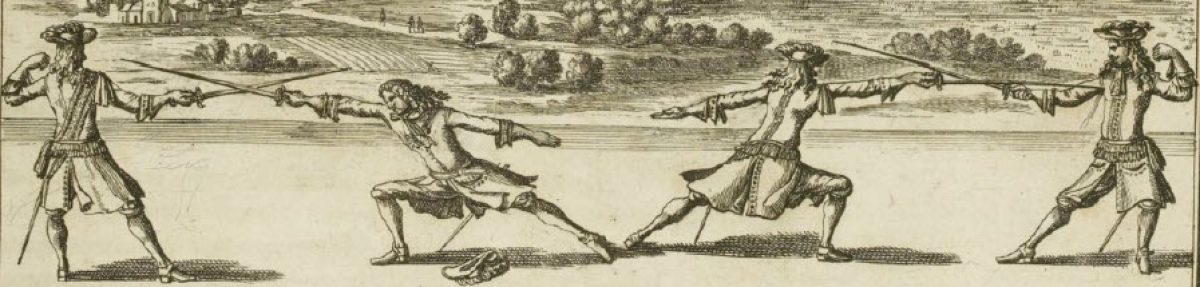
Liancour’s 1686 Le Maitre d’Armes presents a plate with five figures, each of which illustrates core principles of his approach. So far as I am aware, no one to date has pointed out that the descriptions and images for figures four and five are reversed. It is a minor point, perhaps, but important when reconstructing Liancour’s method. Historical fencers rely heavily on text and plates (when the latter are present), but in this case they may be confused and juxtapose these two core actions.
 Capitale Escrime Historical Fencing