Gauging Improvement in Fencing

Most of us tend to carry simplistic notions of progress and improvement. This is as true when we talk of societal “progress” as it is a particular skill-set such as fencing. [1] In broad outline the idea of progressive improvement is not “wrong,” assuming that the topic is subject to the idea of progress (here defined as an increase in skill, knowledge, and ability over time), but on a day-to-day, functional level it wants for a lot. How we view progress, especially our own improvement in something, depends greatly on our attitude toward it. Happily we have considerable control in shaping that. I don’t mean this in some sort of pie-in-the-sky Professor Pangloss way, but in the sense that there are considerations, methods, and approaches to the idea of improvement that we have control over and that can do much to make the process much less painful. [2] This doesn’t mean free from aggravation. Frustration is a part of learning, not just at the beginning of acquiring new skill, but later too, and how we manage that is as much about how we think about it as anything else. How and what we think affects how we learn as well as our enjoyment of the subject.

A Conventional View of Progress

This is just a chart I made, inexpertly, using Word and Paint, but it illustrates an attitude toward improvement that many of us have. We often don’t even realize we’re applying it:

Usual View of Mastery
One Typical Way of Viewing Progress

Looks so simple, right? In this view, beginners start at the bottom, and through hard work, discipline, and time, increase their knowledge, skill, and ability, until they reach mastery. It’s a straight line up a steep slope. Length of climb depends on the gifts of the student, the talent of the coach, and access to practice. It’s deceiving. The slope is steep and long, but the way looks smooth. It isn’t.

Were this an impressionist painting this view is the one that we’d get from perhaps mid-gallery. We see the whole work. Beginners start with no experience, spend time and effort, usually with help, and in time and assuming good coaching, discipline, etc. they master the new skills. As we get closer to the painting, however, we see more detail, we see the brush strokes, the ways in which different colors mix, and up close it’s harder to see how all this chaos leads to the attractive image we see. It’s not as pretty, but, it’s important, for without all those details there is no painting. It’s these less attractive details and how they relate that produce the pleasant whole. We need to step closer to the painting, or in this case the chart, and examine in closely to appreciate it fully.

Plateaus of Progress

What follows is a closer look at the painting. Rather than view this as above, as a nice isosceles triangle with a smooth slope to success, we’ll look at it as if it were a stepped-pyramid or ziggurat consisting of uneven blocks. The way forward, in truth, isn’t easy, straight, or made in regular stages, but in moments of insight and break-through, in long plateaus of stasis, followed by another jump in ability. [3]

Plateau Final hopefully
Plateaus of Progress, a.k.a. the Ziggurat of Improvement

Like the first chart, the beginner [B] starts at the bottom, but improvement is illustrated in a slightly different way. Initially, the climb is vertical, long, and improvement is marked by sharp contrast as we hit the first plateaus in learning (the sharp, 90 degree corners). Over time, as we grow, those edges round off a bit (steps farther up have rounded edges): adding new skills is a little less difficult because we have a better sense of the geography. In time, some plateaus are shorter, we spend less time on them; we grow a little faster. It may take us a while to incorporate the new skills as they grow in complexity, but we spend less time between them (steps are taller, but distance between one step and the next is shorter). “Mastery” here is a guide, not a goal; the concept of it helps us strive to improve and add to our ability, but the more we learn the more we realize that there’s always more to learn, and, ways to deepen what we already know. There’s no top to the ziggurat—in Babel fashion it just reaches into infinite heights.

Looked at this way, with full recognition that the path of improvement is not straight, should make harder aspects of the process less painful. Some sections of the path are easier than others, some take longer to travel than others. It’s all part of it. We will struggle sometimes, we’ll make mistakes, we won’t understand, we’ll feel like we’ve added one skill only to lose another, and we will sometimes feel as if we’ll never get it. Knowing that this is to be expected, that there’s nothing wrong with you, that it’s not a question of talent, but of dedication, can help us get through the rough patches.

We Control Attitude

Attitude is thought. Whatever native self-confidence or self-worth issues we might have, however much we might struggle with imposter syndrome, whatever sense of grace or clumsiness we possess, whatever setbacks we have or identify as setbacks, how we think about it all makes a difference. It can take an “I’m no good at this” or “I can’t do this” and change it to “I’m still learning this” and “I can’t do this yet” (or better, “I’ll be able to do this soon”). Fencing, no matter what sort you’re pursuing, is difficult; it’s a complex way of thinking with movement. It takes time.

Bob Ross, the famous television painter, said “Talent is a pursued interest. Anything that you’re willing to practice, you can do,” and he was right. [4] That fencer that you see whom you find gifted, who makes it all look easy, whose movement and tactics inspire, got where they are through hard work. Maybe they were precocious physically, but they too had to learn; they too made mistakes; they too struggled. They got to where they are because they didn’t give up. The best fencers recognize that the learning never stops.

An attitude that takes into account the mileposts, not just the destination, and realizes and accepts that parts of the path are bumpy, parts steep, parts easy, that some stretches are longer than others, will suffer less and get more out of the trip. Approached this way, it can be easier to focus on where you are now, on the new skill you’re working on, and not how much farther you have to go and all that you haven’t mastered. With practice, it’s possible not only to be present in the moment, focused on the task in front of you at this specific time, but enjoy it too. 

Theory and Practice

Theoretical approaches to pedagogy are informative, but how does one apply all this to the actual practice of fencing? There are two chief ways.

Macro Level

What I’ve shared above about a more useful way to consider improvement is the macro level. It’s the big picture. The whole painting seen from a distance. Put another way, it’s your life as a fencer from open to final curtain. When we hit a plateau in learning, when we feel like we’re not getting where we want to go as fast as we think we should, this is when a more realistic look at the big picture can help. It puts the present moment in context. We see that our current struggle is necessary, a key part of the journey, and importantly, that we’ll get past it and then work on another one.

Micro Level

This same ziggurat of improvement can help us with individual techniques, tactics, and maneuvers too. Just as our entire fencing life can be examined against this notion of improvement, so too can the acquisition of new skills. As an example, consider the simple cavazione/disengage in foil. When we first learn how to perform this, our actions are large and clumsy; our arms might not be extended. We pick the wrong time and distance to use it. Over time, with practice, we make smaller evasions; the action is tighter; our arms are more extended; we use thumb and forefinger more than arm. We start to select the right moment (where time and distance converge with judgment) to use it. The technique, the cavazione here, is now part of our repertoire.

Setting Expectations

This idea of plateaus of improvement assists us in setting realistic expectations and goals. Our expectations affect our performance, so developing a pattern that preempts the downside of frustration only helps us. Used on the macro and micro levels it helps us manage long- and short-term learning goals. It is also a kinder way to appreciate our improvement, because it’s easier to see each stage in context, as part of a much larger whole. Both student and instructor can benefit from this perspective [5].

“Wanderer above the Sea of Fog,” (ca. 1818), by Caspar David Friedrich [6]

Recognition of the reality of the road of improvement won’t erase frustration, but it can mitigate it. If nothing else one can look back over the climb they’ve made to date, realize how far they’ve come, how hard they’ve worked, and that today’s tough plateau is just one step in a series of plateaus we’ve already conquered and those yet to come. There’s an odd mix of satisfaction and determination in such moments. It builds confidence. It can be the one thing on a tough day that helps us with make the next leg of the journey. 


Macro & Micro Expectations

  • Expect learning new things to take time
  • Expect to improve with practice
  • Expect certain maneuvers to make more sense later
  • Expect to make mistakes & that it’s part of the process
  • Know that you have all you need to succeed
  • Know that you will improve
  • Know that your benchmark is not others, but yourself yesterday

Addendum, 10-24-19:

A fellow local fencer, and a chap who also teaches, shared some feedback with me about this piece. I want to share it in full here as it will speak more to those with experience than my attempt to reach a wider audience does. Most of the comment only restates, in more technical language, the point I was making, but he shares an idea there that I think is worth adding. Thank you Will P. for your feedback =)

“A very approachable explanation of a non-intuitive and important topic, thanks for writing it, Jim BT Emmons, and to Mike Cherba for sharing. Some feedback, though. As a preface, It’s a given that any concept involving humans is going to be complex enough that one has to strike a compromise between detail and actually getting something written, but there are two concepts that I think are fundamental enough to be worth knowing even in an overview. First, improvement comes in the complementary forms of expanding understanding and skill building. Skill-building follows an exponential decay pattern while understanding follows a step pattern (like in your diagram). And they inter-relate in that skill-building is capped by understanding while gains in understanding often require a certain threshold of skill in order to be meaningful. Putting the two together, and you get something like a ziggurat with heavily rounded corners, where the upwards movement is skill-building that gradually slows down until a new insight occurs that allows it to speed up again. Second, and more important for beginners to understand, is that progress (as can be seen externally) can be very different from the experience of progress, where the latter looks a more like the Dunning-Kruger curve: one feels like one is improving rapidly as a mysterious thing becomes comprehensible, followed by a period where one feels like one is getting worse (as the full scope of the skill becomes apparent), followed by a slow build (as one’s perception finally starts to align with reality). ” [source, NW Armizare, fb page, 10-23-19]

Will’s second point here, that experience of progress in oneself very often looks much different than that of a coach or other fencers, is important. Perspective changes with experience, and for newer fencers it can be easy to believe that one is doing technique X well when in fact one is only doing it marginally better than yesterday. This isn’t bad, but knowing that our own estimation of where we are, especially at the beginning, is important. I can attest to this well myself, though the example (one of many alas) is a little embarrassing. In my first year of competition, as the third string sabreur on my college squad, I left one bout of however many I fought that day convinced I’d won. Everything seemed to go well, better than well, and yet… I kept losing the touch. In this particular bout I think I managed 1-5. In discussion later, my coach at the time remarked that I had made some of the actions well, better than before, but at the wrong time or in the wrong context. Looking back on that now, some 30 years later, I know far better what he meant. Anyway, be kind to yourself, give yourself room to screw up, and keep fencing!

—————

NOTES:

[1] There’s not room enough to discuss the idea of “progress” or its failings, but if you’re curious the Stanford Encyclopedia of Philosophy has a decent summary: https://plato.stanford.edu/entries/progress/

[2] Pangloss, a caricature of the philosopher Gottfried W. Leibniz, is the ever-optimistic tutor of Candide in Voltaire’s Candide, or Optimism, translated from the German of Dr. Ralph (1759).

[3] In the process of editing this, and looking for typical charts for fencing improvement, I found a very similar idea if, in my opinion, less well spelled out 😉 [the link here has issues, so look up academyoffencingmasters, blog, and small-steps-big-progress and you should find it.

[4] Bob Ross, The Joy of Painting, “Meadow Lake” (Season 2, Episode 1).

[5] My plan for the next essay is on dealing with criticism/assessment of skill as fencer, instructor, and researcher.

[6] Photo obtained from https://en.wikipedia.org/wiki/Wanderer_above_the_Sea_of_Fog#/media/File:Caspar_David_Friedrich_-_Wanderer_above_the_sea_of_fog.jpg
Introducing Historical Fencing to Children

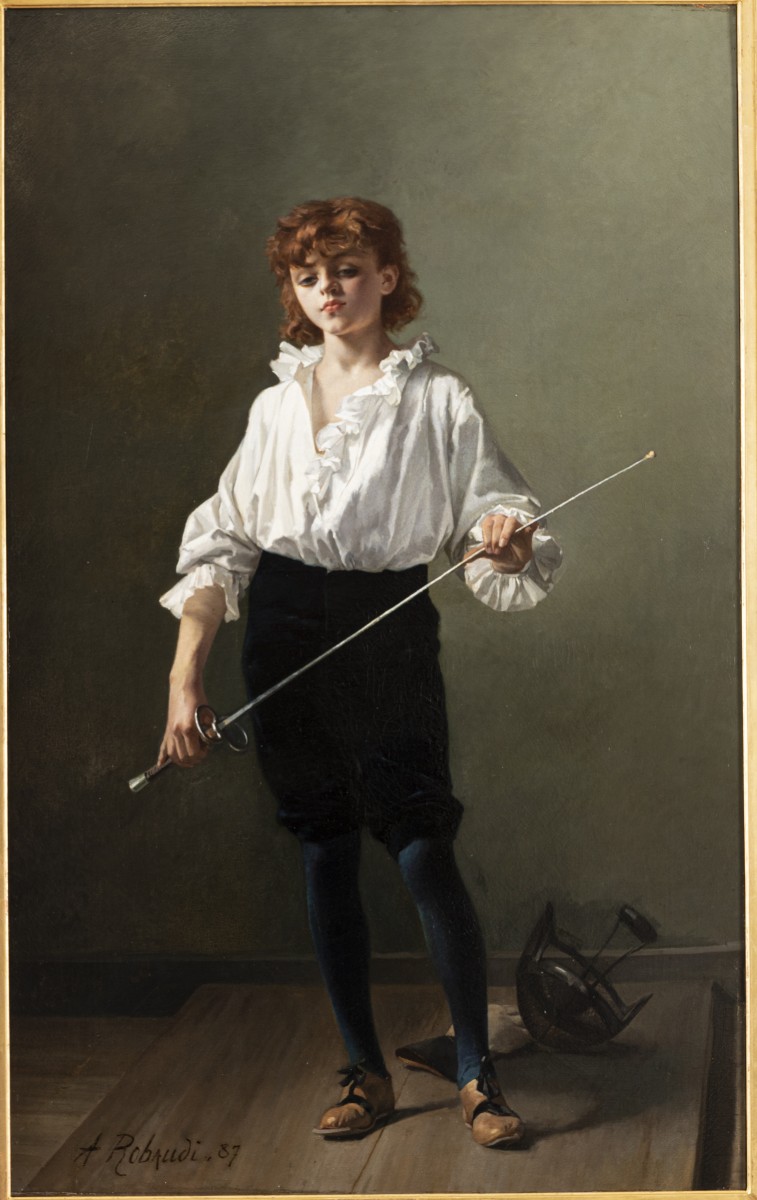
La Leçon d'escrime - Alcide-Théophile Robaudi (1850-1928)
“La Leçon d’escrime,” by Alcide-Théophile Robaudi (d.1928)

Children are one of many populations yet to make much appearance in historical fencing. There are a lot of reasons. Lacking decades of tradition few programs have developed specific versions suitable for kids. In a similar way there are fewer resources, from age-appropriate translations to gear that is child-sized; this makes it all the more difficult. In fairness, many clubs aren’t interested in working with kids and of course that’s okay.

Some avenues into the community are arguably safer and more approachable for children than others—sabre and smallsword for example, have workable trainers in terms of size and weight in ways that longsword does not. This said there are options for other systems that are worth considering. [1] Young people are an untapped market, and generally far more curious and excited about fencing, of any kind, than most adults. Working with kids can be great fun too. Their curiosity, enthusiasm, and ability to learn so well through play can make them good students.

There’s much to consider, however, when working with children. Here, I will cover some big-picture considerations that generally follow any activity with kids, and a few suggestions for how to start a kids’ program.

It’s about more than Sport or Recreation—Remember, You’re a Role Model

In a previous post (Oct. 18th, 2019) I briefly discussed a few ways in which instructors are role models. This is particularly true with regard to children, and so everything we do, say, and how we say and do things, must be beyond reproach. We have to be sensitive to the dangers children face, not just in terms of physical danger or harm, but psychologically too. One bad coach can affect a child’s ability and interest in a sport or hobby for the rest of their lives.

Given the delicate nature of working with young people there are a lot of other factors to consider apart from gear. We must consider their safety, our transparency in working with them, and the short- and long-term goals we’re helping them reach. While I have mostly taught adults, I’ve also taught children off and on for years, and in the last two years I’m teaching more and more of them. A number of things have come up for me in the process that might assist others interested in sharing the Art with young people.

Various Aspects of Safety

Safety is one of the top priorities—it should be for adults too, but it is just as much if not more of a concern with children since they are less effective at self-regulation. First, parents tend to need reassurance that their kids aren’t going to be hurt. Second, children, being less focused and more prone to horseplay, sometimes take longer to acculturate to traditional safety protocols. Lastly, there are most often legal issues around working with children that you ignore to your peril.

Safety & Horseplay

450px-Tom_Brown_6th_ed-p35
Single-stick match from Tom Brown’s School Days by Thomas Hughes, 1857

  Keeping kids safe comes down to several things. As the instructor you set the tone, so with kids it’s important to hit safety hard day one and reinforce it each practice. This can be just simple reminders to carry weapons point down, but quizzing them periodically is a good idea too. All gear must be sized correctly, in good repair, and actually worn. While boring, spending time from the off on safety, on some basic rules, establishes how things will be each class and provides a baseline to return to as needed. I break my approach down into an easy to remember abbreviation/acronym PET:    

P protocols and awareness

E equipment

T technique

Many children have pets and help take care of them, so when I introduce this idea that is the analogy I use. Protocols include not fencing without gear, holding weapons point down, and being aware of one’s place in space as well as that of one’s neighbors, expensive mirrors, etc. With equipment, I teach them to inspect their masks, jackets, and weapons for basic issues, such as large dents in the mask mesh, bad zippers or Velcro on jackets that don’t work, and loose weapon parts or blade burrs. Technique is, after our protocols, the most important—good technique helps ensure safety. Masks, jackets, all that stuff, is there for when our technique fails, or, when we’re playing good partner and allowing our partners to strike us. Each of these elements we constantly apply, regulate, and reinforce.

Horseplay is natural with kids, but potentially hazardous, so it is vital to nip it in the bud, kindly, as it happens. I tend to adopt a light, if firm tone with my students. With horseplay, for example, I might say, with a conspiratorial smile, something like “hey, I don’t remember saying we could start you two…—I love that you’re ready to start the drill, but let me finish explaining it, okay? That will make it easier and I want to be sure you all get it right.” One can’t give children swords and expect them not to swing them about, make cool sounds, etc., so giving them plenty of drills where they can do that helps.

Transparency

Allied to safety, when teaching children it’s best for all concerned if everything you do is transparent and public. It’s sad to have to say this, but because of the problems with crimes against children, even in places where they should be safe, it’s imperative to do all one can to make it clear that one is not a creep. The first step is to make allies of parents, not in word only, but in action. I encourage and remind parents each practice that they are welcome to stay and watch. To be honest, I want them there, for while I know I’m safe, they don’t and if they’re present there is never any question. Think about it—even if you don’t have kids of your own, how comfortable would you be dropping them off with some strange man who plays with swords? Transparency keeps kids safe and removes any remaining suspicions parents might have. I’m a parent myself and no way would I leave my kids in any situation I wasn’t 110% sure about.

Free Fencing Lessons
NOT a good way to advertise…

I teach children either in public venues, such as parks and covered play-grounds, or, in classrooms where there are other adults present. Teaching in back rooms solo is the fencing equivalent of a beat-up old van with “free candy” painted on the side (forgive my hastily produced creepster-van memethis demanded a visual 😉 ). Don’t do that. There is no reason to. Public lessons are free advertising too, and if kids and parents see other kids doing this fun stuff, more than one will approach and ask you about what you’re doing. This can lead to additional work, new people to share the Art with, so it’s an important consideration.

Having parents there and clearly welcome says a lot. There are other benefits too. If children need help getting suited up or down, parents are the perfect choice. Also, parents listen, and more than once I’ve had parents help reinforce basics—one mother told me after practice that she had been on her child to keep his front foot oriented correctly. If you’re really lucky, parents may become interested too, and then you may have an entire family training with you.

Depending on how you’re teaching there are additional steps you’ll either need to take or should to be on the up and up. Many organizations require, rightly, background checks. There are also oversight bodies like Safe Sport and Sport Safety International that have great resources. [2] If you’re male, then I encourage you to check out and get certified with Safe Sport. It’s good information for you to have and being certified with them will only lend more legitimacy to you. It’s not a guarantee of appropriate behavior, I know, but if you work with kids, especially young women, your job as role model not to perpetuate the toxic crap young women face from men is important. Be part of the solution, not the problem.

Goals—They Vary

FUN!

With kids, I make the number one priority fun. Fencing is fun. However, it’s a lot more fun if you know what you’re doing, so finding the right balance, the appropriate amount of what to teach them is vital. Some kids want to put on all the gear and just start wailing, but naturally that is not what we want them to do, so, making lessons fun will make the work seem less like work. Distance and footwork drills, for example, are ideal ways to have them expel all that excited energy, work on fundamentals, and play games. “Glove Tag” and “Foil/Mask Push” tend to be favorites. With group classes turning footwork up and down the floor into “Red Light/Green Light” with various types of footwork, e.g. advances up on green, retreats on red, or, lunges on green, recovery on red, tends to be a crowd pleaser too.

Most children you teach may take a class or two and then move onto something else. You should expect that and not take it personally. This stuff is hard, it’s not for everyone, but even exposure to fencing is valuable. Maybe they tell their friends about the “cool sword” class they took and some other kid signs up, or, maybe they just have a better appreciation for what they see in the next pirate movie. Making it fun is a worthy goal on its own—play is a vital part of being human.

Sharing the Art

One goal, obviously, is to impart some amount of the Art to them. With children start small, focus on fundamentals, not the fancy stuff. When they ask, and they will, remind them that we have to do the basics to do anything advanced. One analogy I use that normally works are building things with Legos—no one builds a giant castle, race car, or space ship right away: they start with a few pieces, follow the instructions, and in time build the super cool creation they want. It’s the same with fencing.

Looking Ahead
Some students will get hooked. This always makes me super happy, but I also realize that it’s important to check in with them periodically about their goals, about what they want out of it. One of my current students only wants to focus on the historical material, so that is what we do. Another, however, is interested in competition and so we’re talking about how that might work. There are fewer historical/classical tournaments than Olympic, so it may be that I introduce him to colleagues on that side. It really comes down to where his interest takes him. I don’t teach the modern game and am smart enough not to try, but I know people who do and my goal as instructor is to guide students as far as I can.

Ultimately, we have to accept that some students may stick around, some may move on, and that this is okay. Even if we are one stop on a much longer journey that’s important. We do our part. Some take this personally, but unless there is a good reason to I don’t see why that should be. The experience we have not only provides them with the tools of the Art, but also with ways to approach, understand, and pursue that Art as they grow. Discussions about their goals from time to time helps both instructor and student—it helps us design training, and, it helps the student develop because they set way-points to reach.

Historical Fencing for Kids—a Primer

In future posts I plan to share more detailed course ideas for kids—sabre, foil, some Armizare, backsword, etc. In addition to foil and sabre, I’ve helped teach some of Fiore’s Armizare to kids before and it’s great fun, but here I’ll provide a few general ideas to aid a seminar or series of short classes. Even if all you have is an hour—the two places I teach now only have that much time for us—you can do a lot. Keep the kids moving, change things up, and focus on fundamentals.

Safety Gear: this is one of the hardest parts. Naturally most people don’t own fencing gear, and it’s not like local sports stores carry it either. To run a decent class you need at the very least masks. Ebay, Craigslist, Fb Marketplace sometimes have gear, but you must be careful. Do your best to discover what shape the masks are in. Jackets are nice, but a stout jacket or sweatshirt can work too provided you emphasize control and not hard-hitting. Smaller work gloves, available in most garden shops, will work too and are relatively inexpensive.

Trainers: Olympic weight weapons, especially sizes 0-4 will work fine for smallsword (foils) and sabre. They can be had for about $30 or so each, so it adds up. The plastic Aramis brand foils and sabres are not bad, but can be harder to find now and will cost about as much.

In a pinch, two to three foot staves of rattan or dowels can work. For point work you’ll need to add a little padding—pool noodles and duct-tape work well. Boffers are another option, and can be made with a little pvc pipe, foam or pool noodles, and tape. My kids have played with these and even when they get rough there is less danger with boffers. They’re not ideal for edge-alignment, but with a little work you can shape a boffer to produce a suitable if not ideal edge.

Classes: Keep it simple, keep it fun. Depending on where you teach you will have to adjust. For parks and rec at present I teach a six week class that meets twice a week; at one area middle school I’m teaching a four week class that meets once a week. In each case I have one hour, which makes it hard to do much more than introduce some fundamentals.

Age is another consideration—younger kids, say 7-10, may not grasp concepts as fast as teenagers, so you may need to adjust your pace up or down. Attention spans are likewise variable, so with kids classes much longer than an hour are not a good idea. Most individual lessons are much shorter.

Drills: Drills as games are your bread and butter. Varying the drills per practice, introducing or removing time constraints, and providing short breaks all help. I rotate distance drills, for example, and switch from called footwork to timed footwork. Here are a few examples:

Distance Drills:

Glove Tag—  each fencer, armed with a glove, tries to attack the wrist or chest with the glove; each is also trying to stay just out of distance to avoid being hit, but not so far that they can’t strike in their turn; in systems using passing steps, which better allow for exploring space, the entire class can take turns: one or two students are “it” and must use proper footwork to “tag” others who then are “it” and chase still other students. [4]

Foil/Mask Push—   suspending a mask or weapon between two fencers, they change the distance between them and can’t drop the mask or weapon

Rope Drill— holding a rope approximately 5ft in length, the fencers hold it with their weapon hands with about 3ft between them; one fencer leads the footwork back and forth, the other must only use their feet to maintain the same bit of slack in the rope (they shouldn’t be using their arms to do this)

Footwork Drills:

Red Light/Green Light—   as mentioned above, on “green” they advance or lunge; on “red” they retreat or recover; or however you want to do it; it can work for forward passing steps, retreating passing steps, side to side movement, etc.

Shuttle Run—   like the old elementary school exercise, fencers line up on one side of the room and “race” to the other side and back; I sometimes have the kids on the waiting side hold a glove for the active fencers to grab and return with; then the other side goes. Rather than timed, this can also work with using particular types of footwork in turn

Timed Footwork—  I normally set the stop-watch for about 30 sec. to 1 min.; in that time, they go up and back with advances and retreats, or lunges and reverse lunges, or advance lunges and jump backs, etc.

Variable Footwork Drill— I use inexpensive sports cones, like one uses for soccer, and set up several lines; at each line students switch footwork. They might start with advances, then lunges when they reach the first cone, then advance lunges when they reach the second; on the way back do the opposite of each one

All of these can be adapted for whatever footwork your system uses.

Other Resources:

One of the best resources you have are your fellow instructors. If they work with kids and you haven’t, ask them for tips, for what they’ve found to work, for any advice they have. Visit an Olympic fencing class for kids—sport clubs are one of the best places you can go as they have a long tradition of working with kids. Moreover, many popular works on fencing include sections on drills that you can adapt.

Vintage-Art-Postcard-Children-Sword-Fight-Fencing-Battle


Working with children demands a lot of preparation as well as flexibility, but it can be very rewarding. There is growing interest in historical fencing among younger people thanks to the usual sources like movies, but as renaissance faires, living history groups, the SCA, and organizations like LARP become more popular,  more children are bumping into historical fencing if only obliquely. If you’re interested in sharing the Art with kids, don’t wait for the need—create it. A seminar, a visit to your local parks & recreation organization, to schools, the scouts, anyone who might have potential interest, could turn into an opportunity to share the Art with enthusiastic people normally left out. It can be great fun too.

———-

Notes:

[1]

There are some decent foam longswords out there with edge enough to make true and false edge made sense. My friend Mike Cherba and I used one version of these to teach some plays from Fiore to kids a few summers ago at the Oregon Renaissance Faire and they worked super well. The Armory Replicas Training Medieval Rampant Lion Practice sword is one example: https://www.amazon.com/Training-Medieval-Rampant-Practice-Longsword/dp/B015YN4LU2/ref=sr_1_12?dchild=1&keywords=toy+foam+longsword&qid=1571431225&sr=8-12

Mike is also the key researcher outside the Republic of Georgia for Lashkroba, a highland folk martial art out of the Khevsureti and neighboring regions, one aspect of which is sword and buckler. We’ve used wooden bucklers and rattan sticks with success. They require a mask, but are still cost effective. Mike is launching a new website for all things Lashkroba and Parikaoba (the more sportive version of the system)–soon as that is up I’ll share the link!

[2]       

Safe Sport https://usagym.org/pages/education/safesport/
Sport Safety International https://sportsafety.com/

[3]       

I must credit and thank my friend and Radaellian sabre mentor Chris Holzman, Sword School Wichita, for his suggestion to try starting with the glide in third for foil rather than the more typical direct thrust. In brief, while a slightly more difficult technique, the glide has a few benefits that in the long run are worth the extra effort. It is easier to thrust with a guide, so in sliding along the opposing steel to target students are less likely to try to “aim” the point to target—gliding along the opposing steel they extend rather than aim. They are introduced to and experience the idea of engagement better, ditto sentiment du fer, and from the glide it’s a little easier to understand the cavazione/disengage. Moreover, I’ve found that students make smaller disengages from the glide than they do fencing in absence. The traditional way still works—it’s how I was taught—but I’ve tried this and find it really useful, so much so that I’ve revamped my beginning foil curriculum.

For the molinelli, I focus on proper structure, and introduce first the descending molinello from the engagement in prima to the head, the rising molinello from fourth to flank, and the descending molinello from fifth to the left cheek. These are easier to do than the molinelli say form third or second, each of which I introduce later with initial preparatory actions.

[4] Mike Cherba’s Armizare classes, which are mostly adults, enjoy this too. Least I do 😉 Mike’s school is one of several here in Oregon that band together during faire season as “The Hawkwood Troope.” They do demos, answer questions, and put several hundred adults and kids through classes over two weekends. Some of my students first discovered historical fencing through this very process.

The Central Place and Importance of the Individual Lesson

deB3

In discussion with a friend and fellow fencer this morning I was reminded of something most of us on the Olympic or Classical side take for granted: the individual lesson. In historical circles one can find this option too, but less often, partly because of the backyard, study-group heritage of historical fencing, and partly because often there’s no one available who can, properly, teach the old, interpreted material super well. This isn’t a dig at my peers, just an observation. The historical community isn’t as venerable, relies less on precedent (and is often outright hostile to it), and is so varied in expression, purpose, and equipment that a standard teaching method, while desirable, is less easy to formulate.[i]

Joinville 2

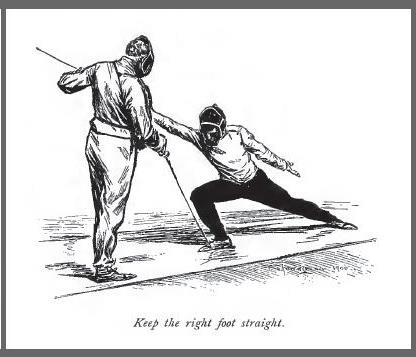
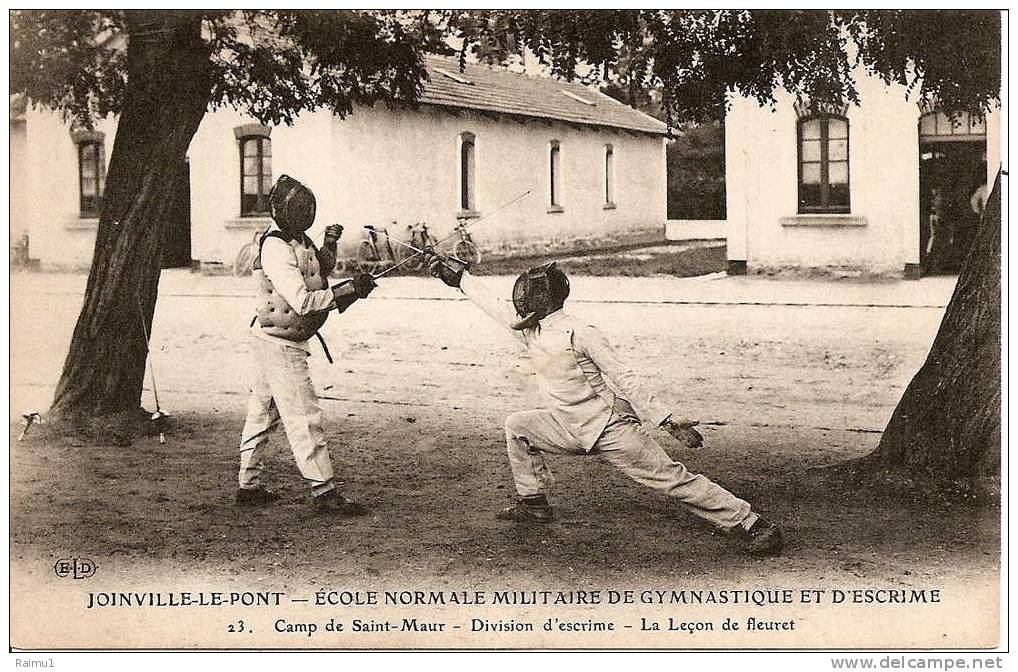
Why is the individual lesson so important? There’s a lot of literature on this, and much of it written by far wiser heads than mine (so you should check it out), but in summary the one-on-one lesson with an instructor is better because of focus, attention, and feedback. We learn a lot in group classes, but by their nature such classes can only do so much. The instructor, even with an assistant, must survey everyone, all the time, and notice what is going well, what not so well, and step in. Rather than helping one person in a focused way, they notice a problem one student might be having and make a group announcement. Maybe the student not turning that front foot straight during footwork drills realizes that the instructor is talking about them, maybe not. One on one, that student has no question. As students, we should seek out individual lessons if possible, at least if we truly wish to improve. The focused attention, the critical eye, the distinct correction for our specific idiosyncratic movement, all of that is invaluable.

One thing we don’t talk about enough, though, is what it takes for individual lessons to work well. The easy things to list are well, easy: a knowledgeable instructor, an attentive student, clear expression of ideas and techniques with demonstration, etc. But the single most important thing is personality fit. Not everyone learns the same way, not every style works for all. Students seeking individual lessons may need to shop around, and they should. Few things sink a student’s success like a bad rapport with a teacher—this could mean an outright gruff instructor to one that for whatever reason just isn’t a good fit. It’s like that sometimes.

Joinville 3

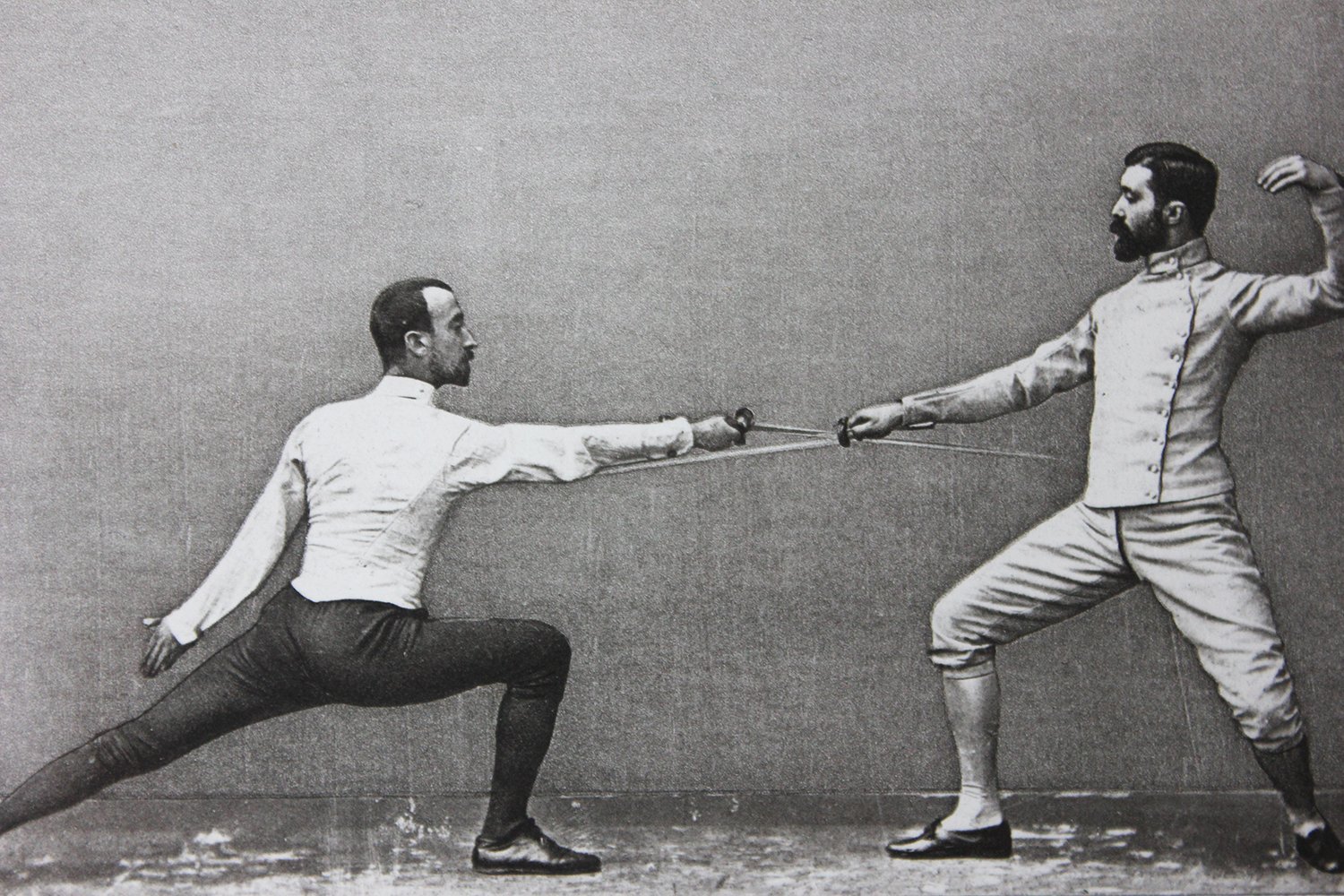
Instructors need to realize this too. If they’re in this to make money then it especially behooves them to find a style that will work for most people. Traditional approaches to the individual lesson, as still taught at the Coaches’ College or at the Sonoma program, remain the most effective, tried and true way to teach this material. There’s a reason that lessons are still taught as they are after several centuries of development.[ii] For those of us not in the profit game it’s just as important if we truly want to share this wonderful Art with people. For me, when I realize that a student struggles more with my presentation that the skill-set, if I realize that they need something I can’t give them, I recommend friends of mine or other schools who might. If we truly care about the student, then this is what we do. As an instructor, our goal is for students to grow, hopefully with us, but if not then with someone. We’re a small community, and to my mind we collectively gain by recommending one another, helping one another out, and promoting the Art over ourselves.
———-


[i] For complicated reasons many historical fencers outright reject anything smacking of “sport” or “classical” fencing, presumably for being less “martial”—a word over-used and too often poorly—than their more macho historical style of choice. This does their cousins in those other camps a disservice, but it also limits their own growth.

[ii] In brief, traditional lessons one on one start with a short warm up, say lunging a direct thrust or cut to the instructor via cues. Next, the instructor may either introduce a new concept or technique, or, may drill one already shared. Depending on the student there may be a little of both. Lessons often end with a cool-down drill, e.g. parry-riposte or stop-cut drills for sabre. Group lessons often mirror this, but writ large.

Safety Basics

This can be a thorny topic. We talk a lot about safety, it sort of comes with the territory, but ask any gathering of historical fencers what safe-practice means to them and you’ll likely get more than one answer. People come to historical fencing from different backgrounds, with different gear, safety protocols, and expectations. This is an important point to keep in mind. It might be a window into your instructor’s approach, but also it may explain why your training partners have different attitudes toward safety in class.

In some respects, safety is a relative term. For example, I have friends and colleagues who generally wear only an unpadded canvas jacket. This is what they wore at the sala where they started out. The maestro who runs that school is classically trained and his program for Armizare, just as in his traditional fencing classes, inculcates an increasing amount of skill and control over time. Because his fencers have this control, and because they gradually build toward more intense drill, they can wear light jackets in relative safety. Not everyone starts this way—I see people from many backgrounds, classical, Olympic, MMA, Asian martial arts, and SCA. Each typically brings with them the safety protocols they are most familiar with, but naturally they don’t always meet up. Some are far more conservative, some downright dangerous. Combined with varying levels of skill differing ideas about safety can create a potential landmine.

In this clip, for example, my friend Mike Cherba, head instructor at Northwest Armizare, demonstrates that even a normal blow from a feder can wreck the typical fencing mask: https://www.youtube.com/watch?v=eW1Imv7yHig I know Mike well, and trust me, this is not his hardest cut—strong as he is, Mike’s level of control is equal to it and he’s one of the few people I feel I could fence with in longsword with a normal mask. If you’ve followed any HEMA tourney footage then you’ve seen people hit way, way harder. What constitutes a “hard blow” is relative too.

What can we do to mitigate that? First, we need to be aware of these differences. It isn’t necessarily something people think about it, but they need to. Not just the instructor, everyone. Expectations within any group or school should be explicit. This ensures that anyone new to that school knows what the culture is, what gear requirements are, and armed with that information can decide whether or not it’s the school for them.

Second, people need to have a minimum of protective gear—just because they shouldn’t need it doesn’t mean they won’t. You have to plan for the lowest common denominator with chance of injury, not the best case scenario. A mask is a must, ditto a jacket, solid hand protection, and guards for groin and neck. Chest protectors are not a bad idea for both sexes as well. It will only take one broken rib to convince most people, but better they never get the broken rib. I was never a big fan of the gorget, but I also recently heard about two near-misses that convinced me that they’re a good idea (so that is me overcoming my own background and bias).

Third, the instructor must cultivate, and enforce, a culture of safety. Despite some excellent recent articles about the idiocy and dangers of the “go hard or go home” mentality, there is still a disproportionately large number of people who embrace the idea that only pain teaches. This is macho bullshit at its worst. If that’s your thing, fine, find a club that caters to the fight-club ethos, but it’s on you. If you’re young, just remember this—whatever fun you have now, whatever injuries you incur, they come back to haunt you later and will affect the quality of your life. I was never given to macho b.s. much, but in my twenties I was certainly less cautious and had no mind for the possible long-term effects of injury. Now, comfortably into my forties… I have joint issues all along my right side—knee, hip, elbow, and shoulder—thanks to over-training, fighting while injured, and a few unrelated accidents that compounded these existing problems; I have scar tissue from a stab wound and broken fingers that also compromise my ability to train and enjoy something I love. Be smarter than I was.

In designing curriculum, the instructor needs to assess the potential risk in each drill. This might mean working with another instructor or one of the more advanced students to test it out prior to class. Consulting with other, knowledgeable instructors can help too; there is no reason to go it alone. Stand on the shoulders of giants if you need to.

Lastly, each fencer must take responsibility for safety. They need to wear the right gear, ensure that their friends do, keep an eye out of hazards, help maintain weapons, and if they feel unsafe speak up. There’s no shame in that and it might save someone a trip to the ER.

Most of all, each fencer must work hard to become proficient enough that they have a basic level of control. This does several things. It develops one’s ability to handle the weapon, but in that process one also learns to read situations better; one realizes faster if one’s own attack is going wrong as well as if one’s partner’s is. Collectively this makes for a safer drilling and bouting environment. Every fencer’s first defense is the Art, is good technique well-applied—your gear is there, again, for when this fails.

Some basic guidelines everyone should follow:

  • Keep floors clean and gear out of the way
  • Wear your mask
  • When not engaged in a drill or bout, keep sword/weapon tips down, pointed at the floor
  • Maintain your weapons and safety gear; replace things when they wear out*
  • Refuse to play with anyone not as concerned about safety as you are—it’s not worth your eye
  • Don’t fence when too tired, angry, or otherwise distracted
  • Look out for your mates
  • Follow the rules, those of the sala and those provided with any drill or within a bout

*Romantic notions of the sword-as-heirloom aside, yes, even swords must be replaced in time

Trust & Partner Drills

Badminton 1893Drill is a mainstay of fencing. We do footwork. We practice point control. We make molinelli in the air and at a target. We (should) be doing a lot of drill. In historical fencing we sometimes devise or find ourselves doing drills that are new, concocted out of our source material, and it’s a fair question to ask what might be signs that a drill isn’t up to par or might even be dangerous? What does it take for a drill to be “safe” when we’re talking about hitting people with weapons? Different types of partner drills require different levels of complexity, intensity, and safety-gear. The instructor has primary responsibility for introducing safe drills and monitoring how fighters are managing safety, but there’s an equally heavy burden on fencers performing the drill. They need to exhibit proper control and courtesy or they’ll injure their comrades and injured comrades mean fewer people to fence with.
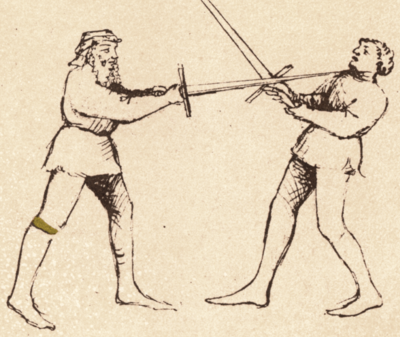
On the instructor side, it’s often a balance between imparting what a particular skill or play requires and safety. Teaching longsword and sabre, for example, requires modulating what safety means. If one is teaching Fiore dei Liberi’s Armizare, a combat system designed to main and murder people, either in the lists or in the field, then one must be more vigilant in some ways than when teaching sabre. Most if not all of Fiore’s techniques must be modified to make them safe and some of them one can never do at full speed save perhaps in armor (and sometimes not even then). Teaching a sabre class, in comparison, makes for an easier balance of technique and safety. The relative weight, flex, and delivery of the thrust in sabre, though deadly with sharps and in earnest, is likely to do little more than bruise someone, especially if they’re wearing proper protective gear. With a stout jacket, one is rarely marked at all. This is often not the case when thrusting with a longsword—there is more power generation, more mass, and more surface area to the weapon. One thrust against the mask with either weapon will demonstrate the difference. Each weapon was meant to do harm in different ways, in different contexts. Assuming the exact same safety requirements is dangerous–fencing masks, good as they are, were not designed for longsword.

An instructor must understand the dangers inherent in a drill and modify it when and as necessary. This is the first step. The second is monitoring a class to make sure that fencers aren’t doing anything to nullify that modification. There’s no room for leniency with this—if any fencer is acting in an unsafe way they either fix it or one pulls them out of the drill. In some cases the drill itself needs further refining. Safety gear, good as it is, is only a fail-safe, an additional layer after one’s technique fails. No mask, jacket, glove, or pad will make you invincible and it’s stupid to proceed as if they will.

The same heavy burden for safety is shared by the fencers executing the drill. Drills can be complicated and applying sufficient oomph to the play with the control required to ensure no one is hurt is a tough skill to learn. Not everyone, in fact, learns it. I’ve seen experienced fencers fail to exercise control in drills; I’ve seen them fail to pull a blow that had clearly gone wrong. No one should have to “Fence for Two”—it’s the responsibility of both drill partners to proceed in such a way that both fencers are as safe as they can be.

There are several attitudes and skills one needs to cultivate to be the sort of person people want to drill with:

Courtesy: It’s important to be a courteous partner, not just in the sense of polite salutes, hand-shakes, or the blade-smack to the butt or thigh a la American football, but most importantly in the sense of the Golden Rule. Do you want to be injured? Do you want to be fearful of working with someone? Of course not, no one does. Work to be a safe partner and you help everyone, yourself included.

Control: Control is the marriage of skill and awareness. It takes a long time to develop. It means having a full understanding of each move, its direction, intensity, and target, as well as the ability to modulate any of the three at will. It’s a hard-won but crucial skill that requires hours, weeks, months, and years of hard work, drill, and patience to develop. Never stop working to achieve it. Control is not fool-proof, however, as everyone can and will misjudge from time to time. However, once you have it, people will want to drill with you because they know you’re safe and can help them learn whatever technique it is you’re all working on. You will learn more too because you’re both comfortable.

Competence: A certain degree of skill, of the ability to use the weapon, is always to be desired. For beginners naturally this is not necessarily there, but it will develop over time and provided one puts in the time. Within historical fencing there is, unfortunately, this general sense that one can just “dive in” and become proficient. This is not true. Being aggressive and suicidal doesn’t make one a good fighter—have the patience and smarts to do it right first, to put in the time, to learn enough to make actual bouts worth your time. The truth is that those who just jump in do so because it’s fun, and it is, there is no arguing with that, but too often the goal is simply to win, not to learn, and bouts—like drills—are another learning opportunity. As ever, if your ego is driving you, if you’re relying on speed, strength, brutality, etc. alone, you’re never going to get very far, and moreover a lot of good people, better fencers who could help you improve, will avoid you. At my age, I don’t have time for macho b.s. and have no qualms refusing to fight people who don’t have the requisite skill or control. I have old injuries enough to deal with and I don’t care for more.

Consistency: Emerson’s ideas of a foolish consistency being the hobgoblin of little minds holds in fencing as elsewhere, so it’s important to be consistent in the right ways. First, developing the ability to perform the same action correctly and pretty much the same way each time is important. Likewise, the capacity to perform the same action in the same tempo or from a standard distance is helpful. Much of this comes down to practice, but a lot comes down to focus and awareness too. Staying zeroed in on the drill, its purpose, what you need to do to do it successfully seems obvious, but a lot of people sort of go through the motions, especially if it’s a drill they’ve done multiple times. Even the oldest, most basic drill remains useful if approached correctly.

These attitudes and skills work best where there is sufficient trust. When it comes to safety and a successful drill trust is at the very heart of it. Some time ago, in an Armizare practice, I saw a student, one with considerable skill for someone her age, break a drill out of fear. She knew how to do the drill; she knew what the instructor wanted her and her partner to do; but she didn’t trust her partner. In this drill, when she made a mandritto fendente as the initial attack, the defender was to counter by striking into it with bicornu—done right bicornu effectively takes the center-line and breaks the attack.Pisani-Dossi MS 19b-b

What she did was modulate her attack—if her opponent was likely to break her cut, she pulled and beat instead so as not to get spiked in the face. I spoke with her afterward during a break and it was clear she felt awful; in her mind she had messed up. I told her that, actually, she had demonstrated considerable skill in reading her opponent and adjusting things to keep herself safe. These are not bad things. She was just fencing for two because she didn’t want to get hurt. However, it also meant that the drill had failed. There are multiple sadnesses there: first, this dedicated, hard-working student learned less than she might have, as did her partner; second, this drill was a good one, but like anything it required trust to succeed; and lastly, a capable, skilled student left that drill feeling she had failed, when in fact, she had not. Trust is everything. Without it, nothing works or at least it won’t work as well.

Actively cultivating courtesy, control, competence, and consistency will do a lot to dispel fear, because on the one hand it helps train one to do things more effectively, but on the other it also alerts one’s classmates that one is a team-player, that they have your best interest at heart. It helps build trust, and when you’re playing with swords, even blunt ones, you need that. Students who don’t feel safe, who in fact aren’t safe, aren’t going to stay long, and that is a net loss for all of us.


First image, “Parry in Seconde,” from The Badminton Library of Sports and Pastimes,  Walter H. Pollock, E. B. Michell, and Walter Armstrong,  London: 1893.

Second image, sword in two hands, zogho largo/wide play, play of the first master, Pisani-Dossi MS 19b-b.

Fencing Drills and Artificiality

deB3

One question I’m asked about drills is to what degree they’re artificial, how they might set up ideal or unlikely scenarios. A related question concerns whether or not there’s a danger in having partners take turns making actions poorly, say in a stop-cut drill. Taking this last question first the answer is “no” if an instructor is on their game. Students, especially in their early training, shouldn’t be drilling poor actions. Conventional wisdom and practice demonstrate that the instructor should be the one exposing their arm for stop-cuts, holding a poor guard, or making any other action defectively. The question about artificiality, however, requires a longer answer.

In classical and historical fencing our concern is to fence as if the blades are sharp, to hit and not be hit, and so when a drill brings in maneuvers or plays that seem to defy this ethos it’s only natural to wonder about their value. Students often have assumptions about the nature of drill that informs this perspective, and some of those assumptions are incorrect.

There are different kinds of drills. Some we do solo, such as footwork drills or cutting against a pell, mask, or fencing Oscar.[i] Some we do with a partner. Others we do with an entire class. While “don’t be hit” and “hit and don’t be hit” are our guiding principles, applying these notions to every sort of drill, and each aspect of it, is reductionist and can blind students to the value of a drill. All study, drill included, should result in a style and method of fighting that illustrates this guiding principle. However, not every drill or part of a drill need conform to this absolutely all the time.

For a quick example from sabre, let’s examine two maneuvers, the first being a common compound attack, feint-cut head, draw the opponent’s parry of 5th, and cut flank or chest; the second being the riposte to the flank from 5th. Looking at the feint attack first, for it to work each partner has to act a certain way. The attacker must simultaneously work a key offensive action, the feint-cut, with a ton of technical movements designed to make that same attack effectively. The instructor or partner on the receiving end, the defender, must do the same; they must recognize and defeat the feint, and parry.[ii]

In the case of the instructor, and you often see this in their posture, they’re not necessarily mirroring exactly what an opponent would do, but performing those parts that will help the attacker succeed in the drill. If the feint is unconvincing, for instance, the instructor won’t parry and might counter depending on what they’re working and how advanced the student is. Judging a student’s readiness to go beyond a simple drill to a more complex version is one of the more difficult tasks an instructor faces—so much depends upon correct assessment.[iii]

In comparison to the instructor, the case of the partner is more complex. On the one hand, they need to help the attacker, just as the attacker will help them when they switch roles, but on the other they shouldn’t be fencing in such a way that the result is poor technique or tactically dubious choices.

Ideally, each partner is doing their best to make their half, offense or defense, work. The defending partner should use this opportunity to work on parries, specifically reacting to the cut to the head. For the basic set-up, this might be the goal in addition to gauging measure, working the feet, and maintaining the correct posture and hand/arm positions. One step deeper, however, the defender might have other options—they might for example, attempt to parry the actual cut after defeating the feint and then riposte. Drills usually start simply and develop into these more complex, multiple action versions as students advance in skill.

So far none of this is “artificial,” but one thing students have asked me about is the danger inherent in making that flank cut after the feint. Having drawn the defender’s arm up into 5th, the defender’s arm is then poised over the attacker making it possible to cut down onto the head. Isn’t that dangerous, they ask. In a word, no, because the defender should be worried about the fact that they’re about to be cut in the flank. Many fencers, because there is no actual danger decide to attempt a counter as, or just after, they’ve been hit rather than parry. This brings up an important aspect of fencing too deep to go into here, namely the priority of the touch, but for our purposes here is making this kind of attack artificial? Is it safe to assume that the defender will just accept the touch and not counter?

If one is fencing as if they’re sharp, then one should never assume anything, but at all times attempt to cover oneself. One solution is to add a side-step with the cut to the flank. Assuming a right-hander, the attacker can extend the arm to make the final cut and lunge a bit to the left by extending the back leg out and to the left after or as the front foot lands. This does two things: first, it removes one’s head from being just under the opponent’s weapon, and two, it gives one just enough measure to cover in 5th or 3rd after the cut in case of counter-attack. This makes more sense after making the feint to head first, because from 5th the defender may still be able to retreat and make a molinello to the head.

On the other hand, for the fencer riposting from 5th to the head, our second example, things change a little—the riposte, having been parried, has lost its momentum, so the fencer riposting to the flank has less to fear from the blade over them. The fencer whose head cut failed now has a choice before them—they can drop the blade on their opponent’s head, which remember has no momentum, or, they can consider that fully developed cut speeding its way to their flank. This is a simple choice if we apply the “fence as if they’re sharp” rubric—the partner with the unsuccessful cut to the head should be considering how they are going to parry that incoming cut. Whatever damage dropping the blade on the attacker’s head might do, it’s likely going to be much less than a fully developed cut to the flank.

The greatest danger of artificiality here is not in failing to account for that blade poised above one’s head, but in forgetting to behave as if both blades are sharp. When we forget that, we too often make actions we would never make (one hopes) were we fighting in earnest. But, if we cultivate the notion that the blades are “sharp,” then we’re more likely to make better decisions; in the example above, as the defender we’re more likely to worry about not getting hit and thus parry rather than go for a counter that will only mean both fencers are hit.

Ideally, the only “artificial” aspect of drill should be our cultivated sense of danger. No drill is worth the name which trains poor technique or tactics. This is especially true with partner drills. There is an inherent argument here, namely that instructors ought to be the only ones to present examples of poor technique. However, this is no less dangerous for them, so it behooves every instructor to continue to take lessons, to remain a student, so that they may not include pedagogical tools like an open line or exposed arm in their own assaults.


[i] This is what we called them, but there are probably other names—an “Oscar” is a mock opponent, often set up on a wooden frame, covered with jacket or similar material, a mask, and often with an adjustable arm to shift a blade to different positions.

[ii] This will vary with the level of the fencer. An instructor or senior student might not defend as effectively if focusing on a newer student learning this attack.

[iii] In his Fencing Illustrated (1670), Ch. XIV, Giuseppe Morsicato Pallavicini discusses this very issue. The first bout a student has should be with the instructor. Even when assigning a new student to work with a more experienced one Pallavicini tells us that the instructor must supervise them. See Giuseppe Moriscato Pallavicini, Fencing Illustrated, Trans. by Christopher A. Holzman, Wichita, KS: Lulu Press, 2018, 91-98.