Tag: HEMA Training
More on the Idea of Master/Mastery
This short video from my dear friend and colleague, Maestro Jay Maes, has a lot of excellent points in re mastery and the idea of masters in historical fencing today.
https://youtu.be/5CvcvR4gXHM?si=VdZehxDdTvVYe-aD
Visual Barbasetti–A Video Project
Though it is coming together by fits and starts, I’m doing my best to make good on a promise to create a series of videos that provide help in reading and using Luigi Barbasetti’s _The Art of the Sabre_ (1899). It builds on the excellent work of my friend and colleague, Maestro Michael Kňažko, Barbasetti Military Sabre (since 1895), Prague, Czechia, who so beautifully covered the introductory material, from guard, to parries, the molinelli, etc.
There is more to come, and I will do my best to order everything so that it mirrors the progression of the treatise. There are a few videos up now that are from sections later in the work, the result of questions I’ve received, but in the end the hope is to have each chapter covered well enough to assist someone brand new to the method.
https://youtube.com/playlist?list=PLMMzUA30gYjiof8X1OApZK1o3A-slwF8G&si=AcNXkfTaZUYJCbLN
Coaching Footwork
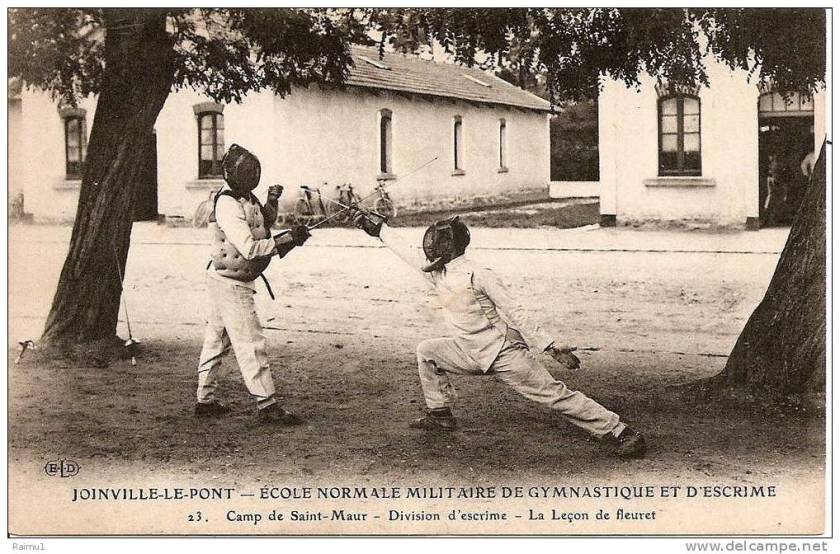
Coaches use a variety of types of footwork and positioning when teaching. Watch a typical Olympic lesson and you will notice quickly that the coach isn’t necessarily on guard, but more often than not standing. Rather than advancing and retreating they are walking. The reason for this is obvious, or should be, but a lot of people new to coaching do as they were taught and use the same footwork they do when fencing. That isn’t wrong, and in fact, most coaches will drop into those positions when necessary too, but they rarely stay in stance the entire time. The reason is that it’s fatiguing, especially over the course of the day.
If one is teaching a single solo-lesson, then walking steps and a more upright posture are less critical, but even there it can be helpful. If one is teaching multiple students in a day, then sparing one’s body is all the more important. Fencing is all about repetitive motion, and over time, especially over decades, some of that motion takes a toll. We can reduce wear and tear, as well as fatigue, if we take a few steps to make it easier on ourselves when we teach.
Walking Steps
I’m starting with walking as it can be the hardest to adopt, but also because most other changes follow naturally from it. Yes, walking. It was hard for me initially to walk rather than advance and retreat, not because I struggle with it physically, but because I wasn’t sure just when I should use it. For warm-ups and cool-downs walking is more natural, so start there—if you begin with wrist picks/arrests, stop-cut parry/riposte, disengage and thrust, etc., these are good times for the coach to walk versus adopt a proper guard.
In some drills one may walk as well—context is a good guide. If one is demonstrating aspects of the lunge, then it makes sense to adopt a proper guard, use appropriate footwork, and lunge as one does. This said, the coach in most other cases can substitute walking for all of this—for the lunge, we might just walk a bit faster.
Surface & Terrain
Generally, fencing is an indoor activity, and in Olympic circles almost always, but in historical fencing for a variety of reasons we are often fencing and teaching in mixed environments. If you have the good fortune to work indoors, and have proper flooring, such as wood, the springy artificial rubber stuff I don’t know the name of, or the like, then terrain is less a concern.
If you are outside, however, the coach has to take into account how terrain will affect both how they move and how the student does. I use these opportunities to expand what a student might find comfortable. Practice on gravel, sand, grass, blacktop, or concrete will test one’s mobility, balance, and endurance. Work accordingly. So, if your lesson is on a slippery surface, work on tighter footwork (cross-steps are good), and shorter lunges. If on super hard surfaces, such as concrete, make sure you include more frequent breaks, and depending on the type of fencing, limit anything that will mean more concentrated impact. When on concrete, I do not include as much footwork in the warm-up portion, for example.
Ambidexterity
Not everyone develops the ability to fence with their off-hand, but it’s something I encourage. Not only will it help you as coaching those in class who are in the minority handedness-wise, but it also provides the coach a break. When the dominant arm starts to tire, one can switch. After a time, it’s easy to forget which side one is using, and in that case changing more regularly can help balance out things.
Being able to move, to use footwork with the opposite side, also helps. The muscles etc. engage differently, and allow those on the dominant side a chance to work less strenuously. As a perk, one is far less likely to develop one side of the body overmuch.
Breaks
It may be obvious, but the coach shouldn’t be moving, let alone fencing, the entire time. Take breaks. It is not always easy to do, but they’re vital to focus and the longevity of one’s teaching career. We are not necessarily conditioned to do this; often in fencing we’re under pressure or feel that we are, and so will push on when we should not. To use myself as an example, a few years ago at a weekend coaching clinic at Halberstadt Fencing Club in San Francisco, Maitre Handelman approached me and told me “Take a break.” Both myself and the other not-young instructor had been going all day, and it was starting to tell in how we moved. We sat down, mutually lamented the horror of aging, but we did as ordered. I don’t think I could pick one thing that Matire Handelman shared as a favorite kernel of wisdom—he’s a consummate teacher and one of the best I’ve met—but this aside has stuck with me. Until recently, I was teaching every day, and had I not followed this sage advice, I’d be in worse shape than I am.
Take breaks between lessons, take them between classes. Right now, with only a three-hour block to teach on weekends, there is no gap between the three sections. So, what I do is use the footwork drills we start with to rest. In a class, and mine are mercifully small, the coach normally circulates between pairs as they work through drills, and depending on the walking surface this can be a long time to stand. When you can, sit. When you can, stretch.

Pacing
Just as we can with traditional fencing movement, we can speed up or slow down when walking. I was surprised at how much walking can affect distance, but it can, so some adjustment may be required in order to chase a student or retreat in turn if walking. This is stating the obvious, but it’s worth mentioning because if we’re not mindful about it students attacking can be in grappling range super quickly, and in attacking them it’s easy to feel like they’re sprinting away from us.
Benefits of Coaching Footwork
To explain this I’d like to point out, again, that fencing is one of those pursuits that many people pursue into their later years. This isn’t just as participation or a movement exercise–there are competitors who are elderly; coaches who teach all the time. They FENCE.
The reason they are able to do this is, no doubt, partly owing to the luck of genetics, but it’s also because most have taken care of themselves. Even if you come to this late, as I did, it will save you some hassle down the road. Having had the pleasure to learn from and compete against people decades older than I am, I know firsthand just how formidable these folks can be. The worst thrashing I ever experienced in competition was against an 80 year old man when I was 23. Al Couturier, who at the time was in his 70s, enjoyed turning on the speed during lessons as we cooled down–soon as we saw the smile in his mask and his arm take on a life of its own, we know we would be parrying like mad. It didn’t matter–he got us each time. Maitre Calvert was in his 90s when I worked with him, and would sometimes, in foil, pull off a behind the back shot as illustrated in Angelo. More recently, during my master’s exam, I had the pleasure to work with Grand Master Josef Šolc, who is 90, and can lunge a lot farther than I can and recover just as quickly. These elder fencers remind us of what is possible.
We can do it too, if we’re lucky, but that starts with taking responsibility for ourselves, setting a good example for younger fencers, and in managing our time, bouting or teaching, well.
SabreSlash 2025, Prague, Czechia

Four years ago, when I first had the pleasure to attend SabreSlash 2021 in Prague, Czechia, I was stunned at how well-run, how fun, and how high the level of skill was, both amongst the attendees and the instructors. This event jumped to the top of my list of “if you can go, GO!” historical fencing conferences. My visit this year, last week in fact, only cemented the value of this mix of workshops, fencing, and camaraderie. So, if you have a chance to attend, DO.
It was a busy week for me, partly because I wanted to support my dear friend, Maestro Michael Kňažko, as he set things up and managed the two-day mix of workshops and fencing, and partly because there was a double reason for my attendance this year: I would be testing for certification as a maître d’armes.
Michael, his amazing partner in life, Caroline, and the excellent folks at Barbasetti Military Sabre (since 1895) have preparations down to a science, and if anything set-up and take-down were faster than ever. The rest of the weekend was as well run—workshops were a good length and sandwiched between ample rest periods; “RandomSlash,” was super successful (more on that below); and everything was geared to allow people to mix and get to know one another.
Goals of SabreSlash
The three goals of SabreSlash are to celebrate and explore history, hone skills, and cultivate friendship. The first and second were most on display in the workshops and in the RandomSlash bouting day two. I have much to say about all the workshops, especially as I did my level best to be a grown-up and sit out so that I didn’t exacerbate any of the injuries I’ve been tending and which are all but managed. Few things are as difficult as seeing that degree of fun and forcing oneself to take notes.
What I would like to discuss first, because it is the most important to me, is the friendship portion. I honestly don’t know quite how to express this, but to say that there are few places in life where I have met that many people and felt an instant kinship, like I had always known them, and who are, to a person, absolutely remarkable, interesting, and kind. At my age, one doesn’t make a lot of new friends; distance and loss tend to start to take over, not necessarily from any ill-will, but stage of life.
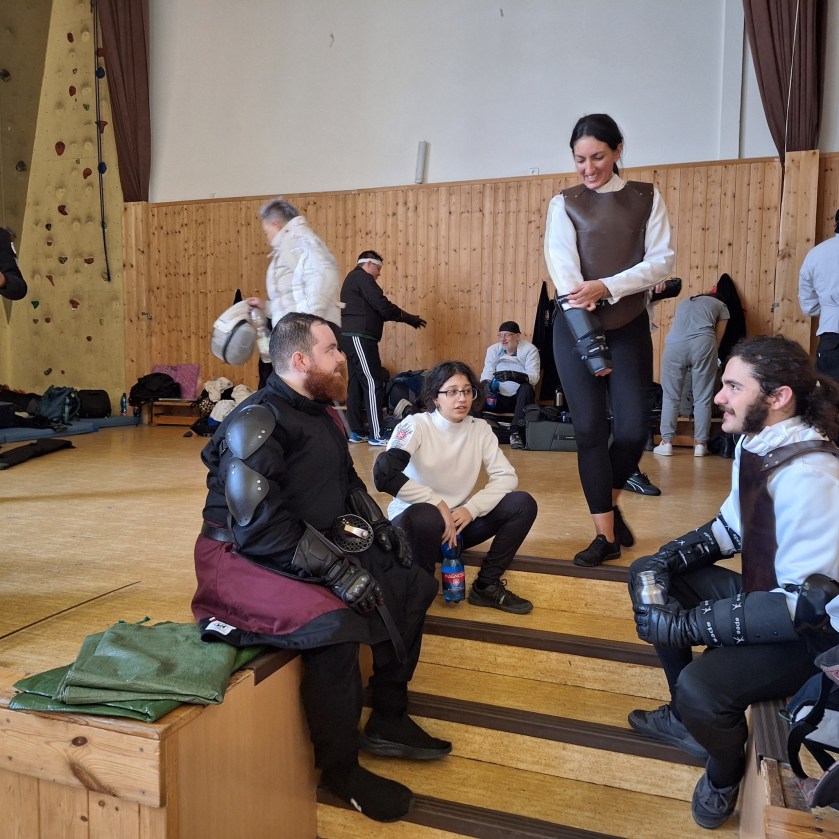
I was absolutely struck numb by the warmth, openness, and genuine interest to get to know everyone that pervaded the event. This was the first time I had met people from FISAS in Italy, as well as the team from the Malta Historical Fencing Association, or, from the Wrocław Polish Martial Arts Club SIGNUM POLONICUM. I cannot say enough really about how much all of them impressed me, not just for their fencing ability and related skills, but as people. We talked about a lot of things, not all of them easy topics, and the compassion, understanding, even hope were inspiring. I am so grateful to have met them—people like that enrich our lives in ways we don’t always see right away. I also had a chance to reconnect with people I met last time, especially Paul Chéreau from Paris, and meet his coach there, Maître Jean-François Gilles. Despite language barriers, we all managed to communicate pretty well—to be fair, my monolingual status was the greatest barrier, but I like to think that a little time trying to speak, even a little, in Czech, French, Italian, and German only helps. [n]
Workshops
The workshops made me feel like a kid in a toy shop. The first class, given by Maître Gilles and Paul, was on French contre-pointe, a topic of great interest to me. After lunch, Maestro Andrei Xuereb explored firm-footed fighting. Finally, a man I had been looking forward to meeting as we’d only chatted on facebook, Leonard Marynowski, took us through a detailed look at the way Polish winged-hussars fought from the saddle. The next day, Sunday, Maestro Franco Burberi, presented a close look at Radaellian sforzi di cambiamenti, and for me personally this was eye-opening. My class was the last one, and I think it went okay. I’m not always sure, but I tried not to speak too quickly or use too many odd idioms—this last tends to be a problem thanks to family and having moved around a lot.

RandomSlash
The RandomSlash fencing pools started next. These were inspired by the “Iron Quadrangle” popular in the FISAS clubs. Everyone got to fence everyone, and, more than once. The bouts were one-touch, and presided over by a single director, in this case a friend of Michael’s, Čestmír Cimler, and me. I know that pre-event not everyone was happy that the fencing portion would be less competitive, but I stand by Michael’s decision. There are plenty of tournaments, and when affixed to workshops eventually, in time, the tournament half tends to dominate. RandomSlash’s approach allowed people to fence A LOT, but more in the spirit of a shared joy of fencing than in the stress of advancing out of pools.

My praise of this event, by the way, is not to disparage competition or other styles of historical fencing get-togethers. My best competitive days are behind me, my day schedule makes training properly for a tournament difficult, and I have other priorities, such as the sports my children play. What I value about this style of competition, which is to say bouting, is that it takes some of the pressure away and lets people focus a bit better on technique and tactics. Only one bout got a little heated, but this was not out of anger but an excess of spirit and a preexisting rivalry between friends. There were, of course, no injuries, and, people used a variety of sabres. This last part is important because generally SabreSlash supplies their own 600-650g Austro-Hungarian army-inspired trainers, and, because these mixed without issue with those used by the Poles and others with wider, heavier sabres.
Still my Favorite Event
I confess that I have some natural bias towards this two-day fest of skill, bouting, classes, and bridge-building. I like these kinds of events. The organizer is a close friend. I am a member of the host school. These, yes, all predispose me to be supportive, but it goes beyond that.

Barbasetti Military Sabre (1895)’s “SabreSlash” has been running for years without any major hullabaloo or injuries. The level of skill is high. The teaching some of the best I have witnessed at any fencing event. The work I do with Storica Defensa, based in Canada, has very similar goals in terms of improving skills, teaching, and providing safer tournaments. It’s one reason we asked Maestro Kňažko to act as the director of the program. Beyond all the excellent instruction and fun, what SabreSlash provides is a model for running a high quality, safe, and thoroughly enjoyable event, one without injuries, one where everyone walks away with better understanding, and importantly, new allies and friends.
I can’t wait to go again.
Notes:
[n] I am not fluent in any of those languages. French, German, and Italian I have learned to read academically—this means I can read articles and the like so long as they pertain to my research field or fencing. It is next to useless for using a menu or making small talk. Czech, I continue to study, because as a member of a Czech salle it is only right I work to speak the language everyone there uses. It is not an easy language, but I like the challenge, and with luck one day I’ll be able to use it well enough not to embarrass myself too badly.
Barbasetti as Bridge

When I left Olympic fencing competition, the first source I found, and have used ever since, was my uni’s copy of Luigi Barbasetti’s The Art of the Sabre and Epee. I still use the photocopy I made as my working copy for lesson planning, study, etc., and save the original English (1936), German (1899), and French (1931) for checking translation matters and enjoyment. Though I’ve not been asked often, there’s a question in the mind of many of my compatriots implicit in most any discussion about Barbasetti—why him? It’s a question I’d be happy to answer, and since I’m busy preparing for exams, this seems as good a time as any to share it.
The first reason is that Barbasetti presents a clear, well-organized, and well-explained manual. Not all fencing works are well-written, but his is, and it makes a difference—there is less to puzzle out and thus to question. Moreover, in writing The Art of the Sabre and Epee he makes his purpose explicit in the front matter, and it tells the reader more I think than they might realize. Barbasetti explains that his book is intended to aid three chief populations: prepare new masters, assist those instructors whose training may have been incomplete, and to help those fencers who wish to know more about particular aspects of the Art.[1] In short, it’s a book mostly geared towards coaches, and thus provides explanation in addition to listing techniques, actions, and drills. To be fair, most fencing manuals explain things in part, but not all explain them well or effectively.

Second, my own training in sabre was remarkably close to what I see in Barbasetti. Al Couturier, the master whom I spent the most time with, was a student of a Hungarian army officer (Joseph Vince) trained in Budapest when both Borsody and Santelli were transforming sabre.[2] Of note, Borsody was a student at Wiener Neustadt in 1898-1899, and thus attended the program when Barbasetti was its head.[3] I’ll not lie, in addition to feeling familiar, I found solace in reading Barbasetti in the mid-1990s, because it validated arguments I was making about sabre at a time when very few people saw the problems in the modern game and even fewer cared.
Third, and perhaps most germane here, Barbasetti—for me—represents the ideal expression of Radaellian sabre on foot. Let me reiterate—on foot. In no way do I wish to disparage the excellent works of Del Frate, Rossi, Masiello, or others, but what Barbasetti presents is a thoroughly Radaellian core with allowances made for the unique context of one-on-one fencing to cover any situation. This is one way in which he is a bridge: in Barbasetti’s time we had, for the last time perhaps, all three major roles of fencing in play at the same time: military, competitive, and fencing for the duel.
He taught at military schools, because fencing was a normal aspect of training until the middle of the Second World War. It was only then clear that the sword and mounted troops were obsolete. At the same time, Barbasetti taught competitors, most military, but still competitors and often those who competed in non-military contexts such as the Olympics.[4] Lastly, the duel was still a reality in both Italy and France, particularly within the military, and so the training had to work. In sum, Barbasetti’s approach to sabre retained the seriousness of the weapon’s use in earnest while at the same time helping shape the modern sport.
The importance of this for us, people living at a time when only competition and theater really have any claim to need fencing (if need is even the correct word), is that Barbasetti presents an approach that, Rosetta Stone-like, allows us to examine any of the then-extant expressions of the Art through a single filter. More than that, when one reads Barbasetti next to his fellow Radaellians, the connection is absolutely clear—he was not “less” Radaellian. His belief that the molinelli form the fundamental exercise for all good sabre fencing alone should indicate this, but the fact that he retained the elbow as the axis of rotation makes it all the more clear. His preference for the guard of second in the assault and duels, the importance of the thrust as both attack and preparatory action, and the body of technique and tactics he shares all demonstrate his training in the tradition.

However, his text is different, reads differently, and I think it’s because of the fact his approach is not limited to military instruction alone. Masiello’s Sabre Fencing on Horseback (1891), for example, is purely a military text. It’s a great example of late period cavalry technique, and thus a must-read for any student of the changes in mounted combat around the turn of the century, but for most fencers its less useful in their practical education. Del Frate, Rossi, and Masiello’s giant tome are far more so, and given their overall thoroughness, particularly with regard to Rossi and Masiello, even just one of their books can provide a fencer with a lifetime of material to learn and practice. Unlike Barbasetti, however, these three—and rightly—had in mind the needs of both soldier and regimental sword-master. As I have often pointed out, the needs of such fencers are not the same as those who compete or indeed ourselves today.
For a variety of reasons, “HEMA” has formed and embraced an insipid division of sabre into “military” and “dueling” sabre. This is yet another dead horse I need not beat here, yet again…, but briefly the mistake HEMA makes is in believing these are separate categories, even weapons, when sabre is, quite simply, sabre, and had multiple applications. If any additional term is needed, it would be “military,” but this is, honestly, redundant: all sabre was military or existed within a military context.
Barbasetti is one of many proofs that expose this error. Barbasetti was training men, some at least, who might need his skill and tutelage in all three scenarios. He didn’t write books for each, but one book. THIS is why his text is so good—it meets all the needs a sabreur of the time might have. It’s also one reason that Sabre Fencing is so valuable a text for us in historical fencing. It’s a bridge between applications of sabre, but also, a bridge between sabre of the earlier 19th century and sabre of the early 20th century.
NOTES:
[1] Barbasetti, The Art of the Sabre and Epee, 1936, xvii.
[2] For more on Vince, see https://westcoastfencingarchive.com/project/joseph-vince/
[3] See (https://szablyavivas.hu/borsody-laszlo/
[4] Among these competitions were events such as the K.u.k. Armee Fechtturnier, K.u.k. Military Fencing Tournament. The school where I am a student, Barbasetti Military Sabre (since 1895), holds an annual event dedicated to these tournaments and featuring the same classical weapons taught at the K.u.k. Theresian Military Academy in Wiener Neustadt: foil, sabre, and bayonet. It was held alternatively in Wien and Budapest in the years 1898 – 1914. For more information on Barbasetti Military Sabre, see https://www.ars-dimicatoria.cz/en/barbasetti-military-sabre-since-1895-2/
Beginner Mind
“Once upon a time, there was a wise Zen master. People traveled from far away to seek his help. In return, he would teach them and show them the way …
Beginner Mind
Ft. Ligonier/Carlisle, PA, Pt. II
While there were a number of Carlisle, PA, adventures with my friend and host, Patrick Bratton, among them were a few with other coaches and some of his students. As another example and proof for the value of cross-fertilization in fencing, I’d like to talk about the morning I spent watching a fantastic lesson by an Olympic coach, the excellent Tony Alvarez.
Excellence in Coaching: Tony Alvarez
I’ve known about Tony since the Pandemic–he worked with Patrick online in the epee class with Maitre Robert Handelman we all took–but this was the first time I had met him in person. Knowing my background, or at least my current focus, he was quick to remind me that the lesson sample I was about to watch was modern. While I cannot say I enjoy modern sabre, I do recognize that there is much to learn there despite the problems, if for no other reason than smart fencing coaches like Tony adapt well.
I’ll not lie–I have been quick to criticize modern sabre, and I likely still will, but this said I gained a new vantage point on it thanks to Tony and Patrick this past Monday morning, and I’m grateful for that. First, and to honor Tony’s skill, he showed very few actions, but actions used in different measures and tempi, in different set-ups.
He started with actions in the box, between the two en garde lines, then outside the box. Watching Patrick and Tony, both of whom know what they’re doing, made it seem as if very little had changed since the days of my early training save in one respect: speed. The modern game relies on speed in a way that one could mitigate more easily before the end of proper edge-alignment in sabre. There simply is not time to make some actions, most especially ripostes, in every instance.
Everything is a distance game played at the right time and correct speed. Here’s the pinch–that has always been true. What differs is method and tool. A lighter, fast weapon that can score with any part of the blade demands tighter timing. This is one reason the age of competitors has dropped so significantly in the past three decades.
I learned A LOT watching Tony teach, and his advice for working with children–the majority of his clientele–is invaluable.
Quick Studies-A Radaellian Lesson with one of Patrick’s Students, “J.”
One of the things I most looked forward to was working with Patrick’s folks. One student, a young high-schooler, wanted a sabre lesson and the last day at the fort we were able to have a short one. Important things to note: this young man started fencing last August; he is a big man, but super quick and flexible (day one in Justin’s Besnard class he dropped effortlessly into a de la Touche lunge…).
I gave him a very traditional outline, but with Radaellian elements, meaning we started with some point in line/disengage work, then some parry/riposte to warm up. Then, I took him through two set-ups with feints. Finally, as a cool down, we did a stop-cut/parry-riposte drill. He made all of it look easy.
I have adult students who struggle with some of these set-ups, but J. looked like he had been doing these drills for years. Even in the cool-down he opted to use an arrest half the time, an action that takes considerable point-control and timing. I was so impressed and told him so.
J. is as good as he is because he has a great coach, and, because J. is motivated, keen to fence, and found the right place to learn. I have written a lot about the importance of the universals in teaching, of starting with and honing fundamental actions, and J. is proof of how sound an approach that is. Moreover, J., and Patrick’s other students, are working within a mixed community, diverse in many senses but also in the sense of fencing styles and influences. It shows.
Why is this important? It’s important because it reveals another layer of diversity within Patrick’s club–put simply, his students are getting tools for their toolbox not only from different stores, but different lines of work. In the U.S. now there are people keen to erase diversity and downplay its importance. They do this out of fear and ignorance, for there is no science, reason, or morality behind any of their claims.
A diverse club is a healthy club, one guaranteed to push people and help them grow, and not just in terms of their ability to lunge or parry well. Exposure to people different from us, in large ways and small, reveals that they are people like us, just fellow humans trying to make their way through life.
Diversity fosters strength–it is harder to accept the idiocy of race-politics, for example, when one spends a lot of time with different “races” etc. and therefore knows what politician A or pundit B says is complete horseshit.
Working in Pennsylvania, and in an area rather “red” as it were, what Patrick has achieved at Sala della Spada is remarkable. Under his roof you will find not only the usual notions of diversity, but also political diversity. Now, like many of us, politics is not a topic there is time for in a salle, so they focus on fencing, but everyone in the club knows that they are working with people who see the world differently in key ways and work together nonetheless. In this there is hope. It is hard to remain divided when we spend with people ostensibly on the “other side” from us. We find our common humanity, we find common ground. If nothing else, we all love to fence.
Continuous Education is for Everyone

I have had less time to post thanks to a demanding day-job, but with the return of one of my advanced sabre students I had the joy to teach an individual lesson this morning. As so often happens when we have an hour, we drilled but also had time to explore the whys and hows of aspects of the drill in great detail. This student is a quick study–she is extremely intelligent, athletic, and possesses a solid background in foil, all of which mean she has questions. I like questions.
Coming up, no master I’ve studied under brooked questions during the lesson, but most of these lessons were short, 15 to 20 minutes, 30 depending on how many of us were in attendance. Questions were for after the lesson. My student this morning drives in from the city and we meet half-way–given the distance and the fact we only meet once a week the lessons are longer, usually an hour, and so there is time for discussion. I want to make it worth her while and provide her enough material to practice on her own.
We covered some difficult material this morning, Barbasetti’s counter-prime and counter-quinte (pp. 45-46), and since I am deep into study for my master’s exam, I have had more occasion to think about these in detail. The description of them is brief as they assume the reader either has a working knowledge of them, is studying to become a master, or is working with a coach as well as reading the text. [1]
To dive straight into these useful but rarely covered techniques, even for an advanced student, is unwise. It is better to lead up to them, to show one’s math as it were, and so our warm-up consisted of exploring simple parry-ripostes in each line. Next, we examined two of the circular parries, “counter-parries” in Barbasetti, namely counters of tierce and quarte. We had not covered these for a while, so it was good drill. Once we added movement, things changed, and this afforded me a chance to introduce counter-quinte and counter-prime.
The Master’s words explain them better than I can:

The key aspects to note at the start are first that one employs these measures at close distance, often while while still in the lunge. Second, they work best advancing, which means a recovery forward into guard as one executes the counter. As I explained to my student, these two measures are sort of in between static, simple parries, and parries via molinello. They are, however, “active” parries, more cuts into the riposte than blocks.
My student asked me why we would use circular parries or these two counters. Excellent questions. Again, the master has an answer, but one I might expand upon a bit. Barbasetti wrote
But why not employ simple parries, since the counter-parries offer so many difficulties?
The object of these two parries is to put you in an advantageous position for the defense by means of unexpected movements.
The regular study of these parries trains your mechanism to such an extent that all complicated movements afterward seem easy to perform. [p. 46]
These are important considerations. Maestro Couturier made a similar point, as did his assistant Brian Peña, when I asked about some seriously complicated drills they had us do, ones with multiple feints, change beats, everything. It was, as I now say too, “medicine for the hand,” meaning that drilling complicated actions helps sharpen simpler ones. When I asked Brian when I would use this set of actions, he said “Oh, you wouldn’t; that isn’t why we do this type of drill.” Looking back on it, that was a key moment for me in my development as a fencer, one of those times were I realized just how much more to fencing there is than technique or actions.
It is the same here. Barbasetti also remarks that these counter parries improve our simple ones. He adds, however, that they can be “unexpected movements,” which is to say options when simple parries aren’t working and/or tactical choices. For example, if my opponent feints to my inside line and I parry quarte initiating their disengage, the simplest response is to return to tierce. Let’s say I do that twice during a bout. My opponent, if I’m lucky, believes that this is my response–if I have made that action on purpose to set them up (a species of second intention), I will surprise them when the third time I used the counter-parry of quarte.
It was a good lesson, one that generated considerable discussion about the actions themselves, but also and significantly putting them to work in real time. One of our primary goals is not to be hit at all versus considerations of right-of-way, so exploring how to make counter-parry-ripostes and use counter-prime or quinte and avoid being hit made for specific choices in terms of both the line the riposte would take as well as considerations of footwork. Though we do not read about it much in the Radaellian corpus, traverse steps, off-line footwork is implicit in the system. Sure, the intagliata and inquartata were and are standard subjects in Italian fencing, but there are options akin to them we can employ too. [2]
Much of what we covered today is material I’ve taught countless times at this point, but what stood out to me, and the reason for writing this post, is how much better the lesson went today because of my current study. At least as early as Fiore dei Liberi (fl. 1400) masters have advocated adding the study of treatises in one’s training, and today reminded me of the value in doing so. Because I teach historical fencing, I most often work from texts, but my study of Barbasetti is, in many ways, closer because I have to be able to answer, best I can, anything my masters in Prague ask me. [3]
Continuing education, study, is not just for exams. It’s something we should do all the time, forever, as long as we fence and teach. One of today’s lessons, for me, was to take this same granularity of study and apply it each week. This means spending more time pondering, examining, and experimenting with the ideas, techniques, and actions in all that I am teaching, from sabre to smallsword, from rapier to bayonet. Doing this, taking it all apart and examining it before putting it back together, increases understanding and lends depth to our approach. It will make us better coaches, and, better fencers.
NOTES:
[1] Barbasetti, The Art of the Sabre and Epee, 1936, xvii explains that his book is a guide for preparing masters, for masters whose training may have been incomplete, and for fencers who wish to understand better what they’re learning.
[2] Often-line footwork, such as traverse steps, is a commonplace in works on Insular broadsword, but I’d argue that the same footwork is useful for sabre. In the video series I am putting together on Master Barbasetti’s sabre methodology, I will explore examples.
[3] We have not yet set a date, by my mentor at Barbasetti Military Sabre (since 1895), Maestro Michael Kňažko, as well as his colleagues Masters Leonid Křížek, Michal Kostka, and Josef Šolc possess deep knowledge and decades upon decades of experience, and the nature of a master’s exam, both the written or oral exam as well as the practical one, are open to anything they should choose. It is a daunting, and at times I’ll admit it terrifying, experience, but one I look forward to. Pass or fail it will be valuable and I shall learn a lot and become a better coach. Should I pass (there are no guarantees with such exams), in truth the journey really only begins. I look at it the same way my elder son’s TKD master put it to him when he passed his black belt exam–“Now you’re ready to start learning.”
Historical Fencing Coaches Clinic–Post-Event Thoughts
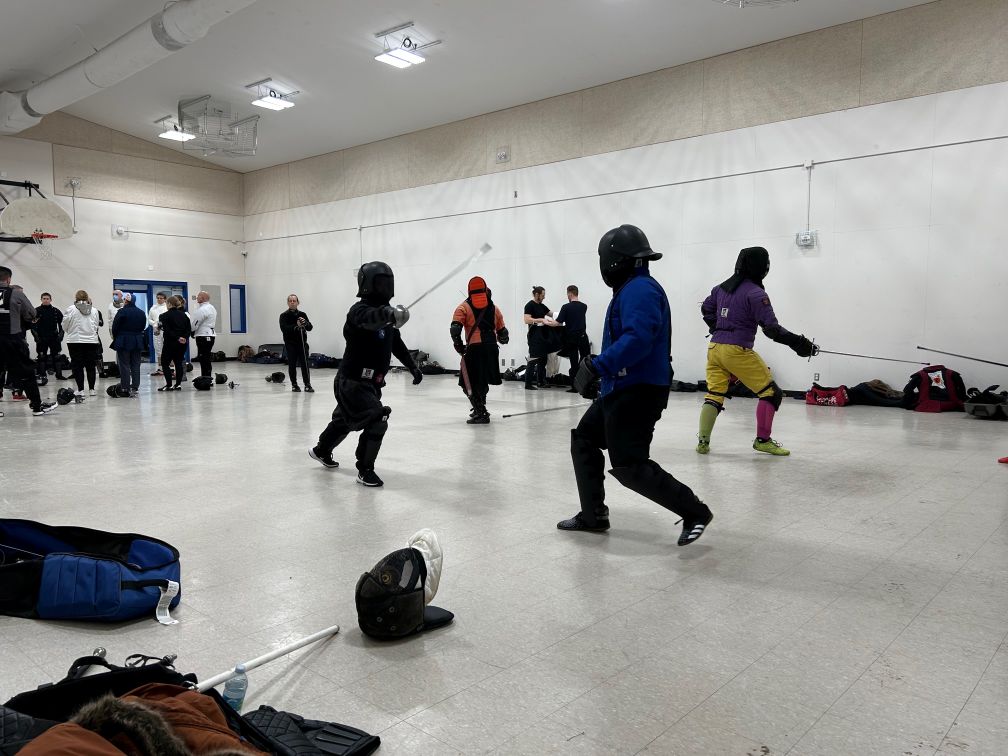
I had the great pleasure to visit old friends and make new ones a few weekends ago in Winnipeg, Canada, at the Historical Fencing Coaches Clinic sponsored by Storica Defensa. I’ve been to a fair number of coaching clinics, many Olympic, far fewer historical, but this one stood out, and no, not just because I am a Storica Defensa coach. This two-day event showed what is possible, and, perhaps a better path than typical in historical fencing.
In part, it was the mix of coaches, both in terms of experience and position, and in terms of background and focus. We had two masters from the excellent Sonoma Military Masters’ Program, David Coblentz and Eric Myers; we had Prevot Tim Guerinot from Texas; and we had two of our SD coaches, Xian Niles and myself, representing our organization. If I had any complaint it was that time demanded we have two classes run at once–I really wanted to take each one, start to finish. Even recovering from RSV and nursing a damaged Achilles’ tendon, which meant I wasn’t fencing, didn’t allow me enough time to devote to each class as they were running.
It’s all in the Details
Granularity. This was the leitmotif of the event. With many attempts in historical circles to improve fencing, from judging to technique, what’s missing is granularity, the specifics, all the step-by-step movement and thought behind all that we do. Much as it pains me to say it, this is often due to the fact that those teaching possess only a surface understanding of what it is they’re trying to teach. To the untrained eye, for example, a cut-1 in broadsword or a disengage in smallsword look simple enough, but to make either well and with consistent effectiveness demands deeper understanding, at least if one is facing an opponent better than oneself who will take one apart for the slightest mistake.
Despite the triumph of ignorance now prevailing in my nation (what sensible nation keen for equality dismantles the very agency designed to oversee that?), education and learning are difficult. The moronic maxim “those who can’t, teach,” underscores just how poorly people understand how difficult teaching is.
A lot of people can: but few can teach.
There is also great merit in incorporating different teaching and learning styles. Not everyone learns the same way, not everyone teaches a topic the same way. To have classically trained masters as well as people more on the coaching side only strengthens the approach, especially if well-organized.
The Classes
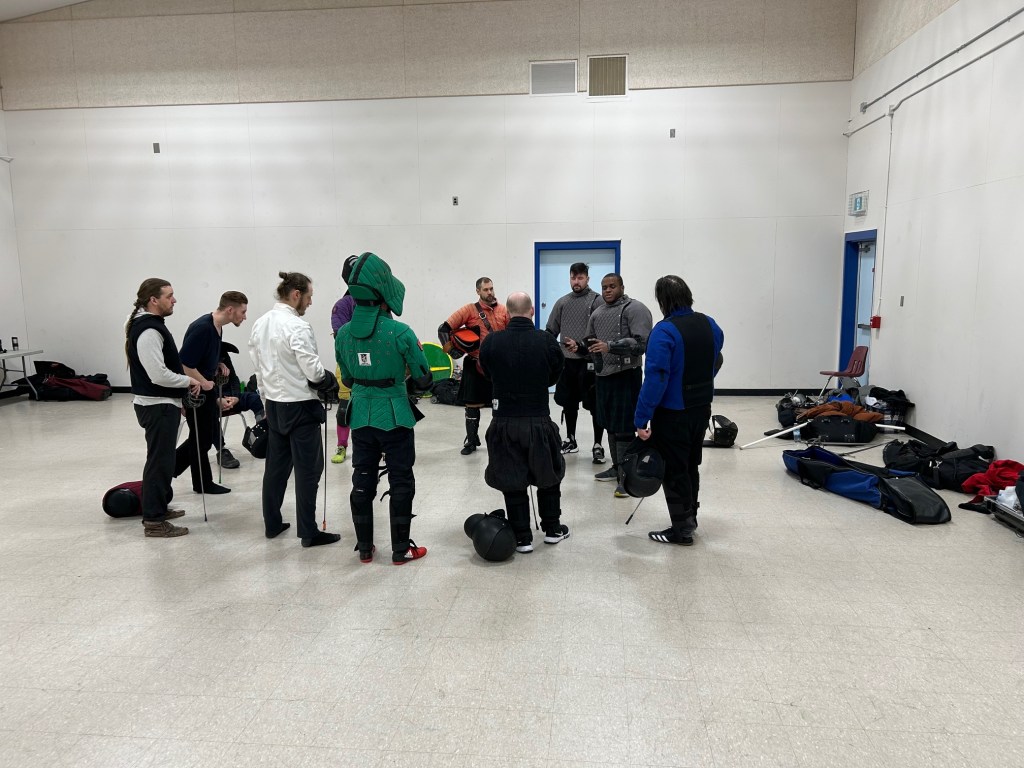
Space and reader patience doesn’t allow for a full description of the classes, but here are the topics:
SAT
9am
Maestro Eric Myers: “Better Fencing through using and Exploiting Fundamental Concepts of Fencing, Part 1.”
Coach Xian Niles: Strategos
11am
Maestro David Coblentz, “Setting up Students for Success”
Prevot Tim Guerinot, “Intention, Provocation, and Second Intention”
2pm
Coach Jim Emmons, “Text & Technique–From Description to Practice”
SUN
9am
Maestro Eric Myers: “Better Fencing through using and Exploiting Fundamental Concepts of Fencing, Part 2”
Prevot Tim Guerinot, “Intention, Provocation, and Second Intention, Part 2”
11am
Maestro David Coblentz, “Helping Students make Good Decisions”
Coach Xian Niles, “Am I still Doing the Thing?”
2pm
Coach Jim Emmons, “Concluding Remarks” [1]
The success of this year’s event has encouraged us to make this happen again, and if possible, often. We haven’t settled on a yearly or biannual schedule, but one way or another, the value of this type of meet-up was obvious in the marked-improvement in the attendees even over two days.

Why this Matters
Historical fencing is not so much a community as it is a collection of micro-communities, and so when it comes to any future forecasting there must be some qualification. I cannot speak to 99% of the community–I work with a small fraction of it. This said, for that sliver of the pie, I have some ideas for where it looks like we are headed.
SD, because it doesn’t seek ownership or control, will continue to reach out to recognized authorities for help in improving coaching and fencing. Many of these people may hold a master of arms, many will not. Expertise comes in different forms, and the ability to recognize that, and harness it, is what makes an organization like Storica Defensa both flexible and strong. Moreover, some fencers respond better to certain teaching styles, and since our goal is student and coach success, this means including any skilled fencer with sufficient depth and knowledge to assist us.
Not everyone cares about qualifications. Worse, many ascribe the wrong set of rubrics to what they call qualifications. Again, this is not just my sorrow and frustration over the anti-expert and anti-intellectualism so pervasive in the United States–it is painful and terrifying watching how this anti-expertise idiocy is helping destroy the nation we were and might yet have been to create a plutocrat’s playground.
It is also a known fact within “HEMA” that many favor things like “HEMA Ratings” or the over-confidence of play-acting scholars. They can do whatever they like, but few such people will get an invite to help us, because failure to understand the relative nature of tourney success and aping actual scholars only takes one so far, and, not as far as we wish to go.
This said, there is a LOT of talent in the wider community, but few truly effective means of harnessing it. Different foci, geographical distance, jealousy, arrogance, and even the innocent failure to understand that there is more to all this than one sees do much to prevent not only better unity, but also the sort of improvement we see in better developed branches of fencing, Olympic most of all. THIS is why my comrades to the north created Storica Defensa–we need it.
As a final word, but an important one, it is vital to note that SD is not a vanity project, certificate factory, or attempt to overthrow any other viable and worthy program. Over time, as people see the events we put on, as they see how we run tournaments, how we approach teaching; as they see how their coaching improves, how their students improve; as they see the caliber of fencer we ask for help, as they see the maestri and other experts we have asked to oversee and guide SD; all of these things will be the proof of that. [2]
There has been, sadly, considerable suspicion around what we are trying to do, and I’m happy to say none of it has any foundation. We’re literally doing what we say we are doing. It says a lot, and little of it positive, that such suspicion so naturally arose around an honest effort to make things better. In some cases, personal beef with one or more organizers, fear, and concern for turf explains these concerns, but I suspect a lot of it too is just curiosity poorly expressed.
I know I speak for all of SD’s organizers and coaches when I say this, but let me assure you that
- we are not trying to overturn your program or replace it
- we are not granting ourselves titles, authority, or certification
- we will not tell you how to run your club, curriculum, or what events to attend
We are, though, doing the following:
- working to improve coaching in historical fencing
- working to improve fencing in historical fencing
- working to create a viable, varied, and robust program to train coaches irrespective of any other program with which they may be involved
- working to build bridges internationally and within North America
NOTES:
[1] I had a class prepared for the afternoon slot on Sunday, but one part of teaching is reading a room. People were fried. At least one person, no kidding, was on a knee, head on their hand, looking like they needed a nap. There was also nothing in what I had planned to do that had not already been covered in depth by the other coaches.
So, I opted to scrap my class and sum up–this included a very brief reminder of how we can approach a given technique, in this case a beat attack, and build not only possibilities from it technique-wise, but also tactically. I could tell from peoples’ faces that they were a little confused that I had scrapped my class, but I lack sufficient vanity to put tired, mentally exhausted people through another in-depth class when what they really want to do is relax, free bout, or hit up our guest coaches for lessons. And, it turned out, that Javier, one of our attendees from Calgary, was celebrating his birthday that Sunday and wanted birthday bouts.
I never really know how well or poorly a class goes–few people offer a lot of feedback–but I stand by the decision.
[2] SD has approached and enlisted the help of several well-respected, certified experts to assist us as we grow. We have the honor to have the experience, knowledge, and guidance of:
Maestro Michael Knazko, Ars Dimicatoria/Barbasetti Military Sabre since 1895, Prague, Czechia, EU [Chief Advisor to SD]
Maestro Francesco Loda, PhD (x2), Cinecittà-RFA-UniTeramo, Rome, Italy, EU [Advisor]
Maitre Steve Symons, former President and CEO of the Canadian Fencing Federation (2004-2012), Winnipeg, Canada [Advisor]
 Capitale Escrime Historical Fencing