Today my friend and colleage, Jay, shared a video response to a concern several fencers aired on a fb page, namely, the problem with cultish programs. This is a real fear and justifiable given the fact that we do see groups who take advantage of members. It’s a shame, but it does happen. That could take many forms–perhaps students are charged for every little thing or to advance; perhaps they are expected to show absolute loyalty to some charismatic leader; perhaps they’re told not to fence with others because everyone but their own club is dangerous, or unskilled, or what have you. These are all red flags.
It’s important to me, and to Jay, because we work within an organization, Storica Defensa, that has already spooked a few people. There are, largely, personal reasons and/or prejudices that explain that, but some of those voices are loud and so we have done our best, all of us, to be as transparent as possible. There is no hidden knowledge we promise to “initiates,” there is no fee to advance, and each of the coaches is not only willing, but eager to demonstrate to potential SD fencers their qualifications. It’s only right we do so.
Moreover, we have been quick to state what we are not. None of us claim to be masters. We are not claiming any lineage, training, or certification we have not earned and/or which we cannot prove. We want everyone to know what they’re getting, and, why Xian and Jay created SD in the first place. Jay says it better than I can (see link below), but SD’s ranks do two things:
provide a set of goals, by skill-set, for students to help them improve [this also helps place them with people of similar skill level in events]
provide coaches with tools to teach more effectively
That’s it. As I often remind my own students, I didn’t invent any of the things I teach, but transmit what I learned to them. Sure, there are things I’ve added, tweaks here or there or suggestions, but these I always call out as such. None of us will be claiming to have invented the lunge… The why? is easily explained: historical fencing lacks these two things and desperately needs them.
It was a pleasure not only to share more Radaellian sabre fun with people, but also to be a student again at this year’s St. George’s Day Exhibition of Arms at the gorgeous Chateau South in Atlanta, Texas. This event, created and orchestrated by one of my favorite people, the redoubtable Russ Mitchell, with help from the lovely people at Winged Sabre Historical Fencing (based in Dallas), is part class, part graduate seminar, and all brilliantly enjoyable. A little over a year ago I wrote up a short piece on this event in which I called this weekend of classes, discussion, and bouting a bar raiser. [1] It was, and, it is. In fact, in year two Russ and friends have placed that bar at least a few feet higher.
There are many tells beyond my high opinion of the event, and to be fair, they are likely better gauges than whatever I might think; after all, Russ is a researching fencer and thus I may be slightly biased in his favor. He is a wonderful human in addition to his vast knowledge of fencing, history, and how the two mix, but again, I acknowledge the potential bias. In light of that, I offer the growth of the Exhibition—we had more people this year; the variety of classes—we had everything from 18th cen. Broadsword to Georgian sword and buckler to a deep dive into the various types of molinelli/moulinets one can make; and, the diversity of the crowd, already solid, expanded—to name one example, this was the first time—ever—I had a chance to cross swords with someone using Meyer’s system for single-handed cutting weapons. In sum, word of this special weekend clearly reached deep into corners of the historical fencing map this past year, and hopefully will continue to do so this year as word spreads.
The St. George’s Day Exhibition of Arms is one of the three events I point to for how we should be doing things. This is not to say that there are not other important events, only that of the many I have attended these three stick out. They are exemplars, models, paths to follow, with one caveat and a potentially contentious one—one must know what one is doing, or, know whom to invite in the case one does not. SabreSlash in Prague, The Exhibition, and Rose & Thorns all share common themes and ingredients. They are run by knowledgeable people, both in their own right and in whom they seek out to teach. Each of these events is run well and offers the attendee better cuisine than the average tournament of weekend seminar. The level of ability, of skill, not to mention knowledge, is high. Not above average—HIGH. This is true not only in terms of know-how, but in terms of execution. One test of this for me is how beginners are treated and what they take away from these events.
Come one, Come all
Among the new folks this year were also newer fencers. One of the things I watched closely was the degree to which beginners understood what the instructors were teaching and how more experienced fencers treated them. Full disclosure I was not worried much about this knowing what I know about Russ and his people, but all the same given the different backgrounds each had even the best designed event and intentions of the organizers can fail. One would have to ask those beginners, but from what I saw not only were newer people brought into the fold, but accommodated seemingly without effort. The first is less surprising—outside a few bad apples, most historical fencers are welcoming and just happy to find yet more sword nerds with whom to play. As Alex Spreier, who taught a fantastic course on the broadsword system of Zach Wylde said to one new person, who was a bit shocked at the open invitation to join us in the PNW (where we tend to house people to save them money), “Of course! You’re sword family!” This was beautiful and proper and makes me love Alex that much more, but more impressive were the ways in which Alex, Kat, Mike, and Russ arranged their classes to meet the needs of students of any level. This can be extremely difficult to do.
The Classes
Alex working Wylde with Jake
Kat’s class on footwork, a topic easily made way too challenging, was disarmingly unintimidating. Her explanations were simple, but dead-on to what was most important, and everything we explored one did at one’s own pace. She was there to answer questions, and at each turn exuded a “you can do this” demeanor that just made one want to try harder. In like vein, Russ’ class on the molinelli/moulinets was a textbook model for how to cover a complex topic effectively and in ways useful to beginner and experienced fencer alike. Starting with the shoulder alone and working our way slowly to using wrist and fingers, Russ enabled everyone to see the variety of methods used in various systems, but also foreshadowed and for-armed everyone for what they would need for each subsequent class. Mike Cherba’s class on Georgian sword and buckler is one I have attended, even assisted with, numerous times, but hands down this was his best iteration of it. He made converts. It’s dynamic, different, interesting, and so damn fun it’s hard not to fall in love with khmali and pari. The standout heretic—to use his own words—was Alex Spreier’s presentation of Zachary Wylde’s broadsword system. This early 18th century method tends to be snubbed by fencers better acquainted with salle fencing—Wylde’s English is not posh, and his system is bare-bones self-defense. It is also brutally effective (as it should be). Alex also made converts. I offered a close look at Radaellian molinelli and how one might use them via one tactical set up. This introduced a laboratory experiment taking that Radaellian version and seeing how it might apply, change, work, or not work in the Hussar system Russ teaches. [2]
Discussion at meals, over the oceans of coffee consumed, and in between classes was jovial, curious, and informative. It is often said that we learn more at these events after classes in small discussions, and that is likely true. Between the two there was a rich banquet of knowledge to digest. One of my favorite such moments was sitting by the atrium pool listening to Russ’ quick summary of the history of Hungarian fencing (yes, I took notes and yes some of these gems will find their way onto this page, guaranteed). Related to the last, several of Russ’ students were preparing to be examined as peers on the final day. Being the responsible man he is, Russ has avoided the pitfalls of ranking systems that often undermine the goal of such systems—to become a peer means demonstrating an ability to carry on the tradition should, as he put it, Russ been unable to do so himself. [3] Proof of stewardship is provided via an oral examination and in bouting, and if applicable, teaching. I am honored to announce that both Kat Laurange, whom I deeply respect, and Coleman Franchek, whom I just met but took an immediate liking to, both passed and are now instructors within the system.
OF NOTE: Russ, an expert in the Feldenkrais Method, once again and free of charge, helped me with a gimpy hip and the equally wonky wrist he helped me supinate when he was last in Portland–thank you Russ! If you’re in the DFW area, and need help with any movement challenges, see Russ [4]
Russ Feldenkraisening my wonky wrist; Coleman in mirror
FIGHT!
I have two favorite forms of public bouting. Accolade tournaments and exhibition bouts, and to be honest, of the two the latter appeals to me more and more. An “exhibition of arms,” as the name suggests, is a chance to highlight, to celebrate the particular approach to a weapon or system as a master or school envisioned it. The goal is not to win, though that’s nice, but to exemplify as best as possible what makes that tradition unique, distinct from others. There are a number of reasons this is important and useful, but it’s also just plain fun to watch. It says a lot that we kept score mainly just to ensure everyone had a turn to bout everyone else, and it perhaps says that much more than many of us had trouble even doing that. Russ at one point asked his student Jake, currently bouting with me, what the score was and neither of us had remembered to! So, we said “two to two” and kept playing.
We started with bouts between the instructors, one of my favorite things to do, and then each instructor did their best to fight everyone. I mean everyone. It can be exhausting, especially if like me one hasn’t been bouting qua bouting so much as engaging in teaching bouts, but it’s worth the exhaustion. It was a pleasure to cross swords with Russ who is as skilled as he is gracious; these traits are also shared by his students, old and new, and they are seriously challenging opponents. I won’t lie—they are among my favorite people to fight because it is always difficult and always super fun. Last year, Kat trounced me beautifully, and she did so again this year only differently—never saw that long, deep thrust coming since I was so concerned about my wrists lol. Kat is one of those fencers you should fence as often as you can and at any opportunity—she will make you a better fencer. Fighting Russ, Kat, Kevin, Jake, Jacob, Austin 1 and Austin 2, all of the Hussar fencers, was one of the reasons I made the trip. Quentin Armstrong, whom I just met, came to the event from Louisiana and offered me my first bout against someone who really understands Joachim Meyer’s sword in one hand. I am seriously hoping to do that again soon. I didn’t have a chance to fight everyone, so owe the first dance to Ellie and then next to Trevor, but I look forward to that eagerly,
Gratitude
I would like to thank Russ and the fine folk of Winged Sabre Historical Fencing, including not only his students but wonderful partner in life, Anna, for the invite and for taking such good care of us. Kat Laurange waited patiently for me at the airport despite a serious delay, and then graciously gave me a place to stay until we left the next morning (thanks Kat and Scott!). Russ and Anna gave me a lift to the venue and arranged for instructor rooms at the Chateau. Thank you Raoul for such generous use of this beautiful site (https://www.chateau-south.com/)!
Thank you to all the fencers who attended my class, chatted, and worked with me this weekend. I was and remain honored to have taught at The Exhibition and in such good company.
As a final note, before I left for Texas a friend of mine, a life-long martial artist, asked me if this was a paying gig. Having run a do-jang for years he knows how things work. Not being involved in historical fencing, I had to explain to him that for the most part renumeration is not standard, partly because we all do this because we love it, and partly because few programs can afford to cover travel, room and board, and food—most clubs are struggling to acquire the most basic, economically sourced gear that won’t break or fail. Then I told him, that in the case of The Exhibition, this is the sort of event one happily pays to attend. It’s the kind of event one saves money all year to attend. So dedicated are some attendees that they camp on site in tents, despite humidity, bugs, and new this year—tornado warnings! This is important and worth consideration.
[3] As a note on this, Storica Defensa’s ranking system is not a “belt system” either, but a way a) to categorize competitors by skill level, and b) a way to classify levels of coaching.
[warning: this is a long post, but I wanted to address a few things fully]
On several occasions lately I have been asked about my role in Storica Defensa, and in some cases the same way police might ask a teenager why they’re loitering outside a convenience store. There is some inherent suspicion there, and in this case, for several reasons. First, and perhaps most obvious to the denizens of social media’s historical fencing pages, because one of the founders, Jay Maas, a friend of mine, upset a lot of people with satire initially a little too subtle that aimed at fault lines in reasoning, practice, and interpretation in “HEMA.”[1] It is not that Jay was wrong in his criticisms—pound for pound he has been correct—but that he ruffled a lot of feathers. Not everyone saw the satire, and so took his memes, comments, etc. as personal affronts. For the record, Jay knows that his previous (key word: previous) approach was not the best, and has made repeated, concerted efforts to mend things with people. [2] In many ways Storica Defensa (SD) is part of that—it’s a way to give back and rather than point out the flaws, address them and work to fix them. Second, and at the risk of upsetting some colleagues, especially those with certifications through either the USFCA or equivalent bodies, there is a sense that unknown or troublesome upstarts are infringing on their turf. Third, SD is new, not well-known yet, and those upset by it or fearful that it may affect their own programs, have misunderstood, and in some cases misconstrued, the purpose of SD.
As a person brought on early in SD’s formation, I would like to address these in turn, and explain from the inside what SD actually is. I do not join anything without consideration. Experience, perhaps especially negative experience, is a powerful teacher. More than once, either through naivete or enthusiasm, I’ve allied myself with people or groups I later regretted having joined. For a local example, some years ago an instructor at one school I attended on occasion, during a particularly difficult time in my life, attempted to humiliate me publicly more than once. It didn’t end well, but as the truth will out, his poor behavior with still others ended up destroying that school and relegated him to the sidelines. We repeat lessons we haven’t learned, and this was, for me, just such a repeat—do not put faith in people or groups who do not have your best interest at heart.
This is to say that I would not back SD if I didn’t believe in its mission or if I took issue with the organizers. I’ve known all but one of the four initial members a long time, and the fourth, Xian Niles, I quickly developed a deep respect for, even before learning of his fencing education. If I had had the least doubt that any one of my colleagues was up to no good or eager to undermine anyone else, I would not have agreed to help.
My Own Involvement with Fencing Organizations
My first exposure to the larger issues plaguing most sizeable fencing associations was with the USFA (United States Fencing Association) in the early and mid-1990s. For several reasons I have never been over-fond of the USFA. First, it’s expensive—especially for younger students. Second, it dropped the ball (along with the FIE) when the “flick” in foil and the idiocies attending electric sabre ruined traditional technique and tactics.[3] Third, it’s myopic in focus: all that matters to the USFA is the competitive world. For the vast majority of fencers in the U.S., being competitive fencers, there is little to no problem with the governing organization. Most of the time it is more or less invisible, there in the background. It works well enough for them, especially if all they know is the post-flick and flat-of-the-sabre-as-able-to-score world. That is fencing to them. [4]
In more recent years, while working toward a certification through the USFCA, I was annoyed to learn—post exam—that I had to join the USFA and jump through other hoops as well. This was not clear up front either on the website or in the test preparation documents. Having to go through SafeSport, while an extra cost, at least is something I can get behind because it’s important—as a coach, and moreover one who works with a lot of children, mostly female children these days, it’s crucial to be a part of the solution and to model good behavior. Everything SafeSport teaches “should” be obvious, but it isn’t and so while ticked to find out about a hidden cost, again, this one I understand.
In fairness, I had good experiences with the USFCA (United States Fencing Coaches Association) up to then, and was disappointed to learn that it was merging with the USFA. On the surface it’s a natural alliance and makes sense, but of the two there was a chance, a slim one, that the coaching wing might, might continue to entertain the idea of a broader view and remain inclusive. The USFA is almost solely concerned with Olympic aspirations and the competitive scene, but fencing is, and has always been, much more than that. Most fencing coaches are not training Olympians, but working in obscurity at the YMCA, your local P&R, or some college campus. The USFA gives next to no thought to them—the USFCA did, at least a little. If nothing else they allowed the late Walter Green to push “classical” fencing classes and viewpoints and allowed obscure coaches like me to participate in classes for my own improvement as fencer and coach.
On the historical side, which is far more decentralized, the “HEMA Alliance,” for example, was a good idea, but like its cousin in the sport world is more concerned with sport (largely longsword) than anything else. They offer an instructor certification course, but it is unclear just who is evaluating candidates, and of course, like the USFA more recently, one must pay to retain a certification after a few years. [5] Given that leadership in the HEMA Alliance has often been people very new to fencing, it raises serious questions about who they think is qualified to evaluate other instructors. Most competitive HEMA is dismally poor in quality so one must question just how high the bar for skill is. Put another way, if fans of a medical tv drama are teaching and evaluating surgeons, that’s bad.
In sum, I am wary of most fencing organizations, Olympic or otherwise. It’s not that they don’t include a lot of good, because they often do, but that for one reason or another they fail. It may be that I have just been unlucky with these organizations. They work just fine for many people, after all, and while they don’t work for me, I don’t condemn anyone who finds value in them. This said, I think we can do better; I think most every fencing organization with whom I’ve had contact can do better. One of the things that attracted me to SD was that built in is the notion that it’s a new group that will grow, evolve, and improve over time. One may well wonder why that is, and so, here is the single most important reason.
It’s about the Material—not Us
While SD contains personalities, SD is not those personalities. Cults of personality are popular in “HEMA,” but a terrible basis for a teaching program. Skill trumps popularity. Openness tends to be healthier than stodgy isolation. Transparency fosters trustworthiness better than hiding in the shadows. NONE of what we teach is ours—our interpretations of past fight-systems are, like museum artifacts, property of the human race. We may help explain them, teach people about them, but we do not own any of this. Be wary of anyone claiming to have a monopoly on truth, ability, or understanding. The nature of historical fencing is mutable, and must be as new or better information may change previous conclusions.
Our focus is on the material, in this case, the corpus of fencing theory and practice as put to paper over the last 700 years. The best preparation for tackling period sources, contrary to the prevailing opinion in “HEMA” is a solid grounding in traditional pedagogy and technique. Modern fencing, the sport, while it features some aberrations, still imparts a thorough grounding in universal principles and much of technique. Armed with this, a student of historical fencing will more easily unpack what the sources contain. Certainly, historical understanding of the period is a boon, but this can be obtained secondarily by leaning on the historians who work in the specific period of one’s interest. There are even a few such historians active in historical fencing.
Added to the source traditions and time-proven teaching methods, SD’s founding members, among others, have extensive experience in other martial arts systems. Though wary of “frog DNA,” of misapplying one system’s material to an older, extinct one, a broader, deeper understanding of a variety of approaches does much to inform one’s own. [6] Where individual responsibility for clear delineation might fail, collective attention to the dangers of comparison, another built-in feature of SD, does much to correct.
Storica Defensa’s Goals
The goal of SD is three-fold. First, we wish to improve the quality of teaching. Second, we wish to improve the quality of ability in historical fencing. And lastly, we want to sponsor and cultivate not only safer competitions, but also better run and judged competitions. These are three of the areas that currently suffer the most in the community. To tackle any one of these areas is a daunting task. However, they’re related—if coaching is better, the fencing will be better; if both coaches and fencers have a more sophisticated understanding of the Art, then judging will improve too.
So, here is what we are actually attempting to do at Storica Defensa.
Teaching:
Many, maybe most “HEMA” groups got their start as a tiny group of people, or an individual, who saw something about historical fencing and wanted to get involved. Some people have a background in the sport, others in the SCA, still others in martial arts, and many with no athletic background whatsoever. [7] The grass-roots nature of historical fencing’s development, therefore, has rarely included much if any training in traditional fencing pedagogy. In fact, given the misguided disdain for all things Olympic fencing, most people in “HEMA” outright reject modern teaching methods.
There are a handful of schools with credible masters who teach historical fencing topics, often among more modern lessons, but these are comparatively few and too often exclusive. Some are exclusive out of fear, others out of arrogance, some suffer both, but the result is the same—unless one pays their way in, kowtows to the right people, one is forever excluded. This is true regardless of skill, knowledge, or anything else save perhaps notoriety. Get enough Youtube hits, who knows, you too may be invited to WMAW. It tends to be a closed club, however, and unless there are political or social reasons to consider, or one has made a big enough splash to appear knowledgeable, outsiders are not welcome. They may attend, if they can afford it, but they will not do so as intimates of the inner circle.
I do not wish to knock WMAW—it is a solid event and would that we had more conferences that combine classes, lectures, free-play, and the all-important after-hours conversations where the real learning happens, but with all appropriate respect to those benefits, and to my friends and colleagues who teach there, it doesn’t do much good for the vast majority of historical fencers. This is, granted, a bias of mine: I want everyone to have access to what we do, with as few economic or social barriers as possible, but not everyone sees it that way.
The few teaching programs available State-side, staffed by many of the same who teach at conferences like WMAW, tend to be exclusive too. One must travel to their events, pay for participation (which makes sense of course), and take whatever it is they’re teaching. Most of these programs have a set curriculum, and few offer help online to reach those unable to travel. This is not to say that the instruction is bad, but you get whatever it is they are offering and that may or may not be what one wants. I back—for the record—any informed, skilled, and valuable teaching program, and in do not wish to denigrate them; here, I am simply pointing out that there are various barriers that prevent these schools from reaching a lot of people who really, really need their help.
SD seeks to be inclusive, to teach teachers how to share all this disparate, often difficult material better, wherever they are and whatever the topic. Much of this can be done online. There is not, at present, any fee to join. Should SD work out and grow, in time that may change as costs to operate increase, but the goal is not profit or fame, but improving instructors and fencers. Moreover, SD does not take over a club or impose its will and ruleset on anyone—it is completely voluntary, and, is set up to work with any program. Your club, this is to say, will not be subsumed but continue to be your club. In fact, we want people to study with other coaches, as many good ones as they can, because we all benefit in the end.
Quality of Fencing:
If you’ve read much on this site you will know I do not have a high opinion of most historically-oriented competitive events. Much of it is unsophisticated, sloppy, and devoid of anything more complicated than single-tempo actions. I have, on the other hand, done my best to promote those events where both skill and officiating is excellent—SabreSlash in Prague, Czechia, and The Rose and Thorns Historical Fencing Symposium, Auburn, California, USA, stand out in this regard. The solution to seeing better fencing is creating better fencing instructors, thus point one just above. However, not everyone wants to coach, so SD has a system to help competitors or recreational fencers improve their game.
One learns better having to teach a topic, so for those clubs interested each rank in SD can teach certain other ranks a degree of material if that club wishes to do that. This can be as simple as leading footwork drills. Each rank, each set of rubrics, all the training videos, are built on traditional fencing instruction, close attention to the source material, and decades of experience between the organizers, all of whom continue to take lessons as well. As new information or better interpretations pop up, the various curricula will change if and when necessary: we do not want to rest in any interpretation should it be superseded by a better understanding of that weapon or tradition. All of our training videos and personal instruction reveal a path forward, but we also believe it is important to investigate other (rational, well-supported) interpretations. In the aggregate, we all learn more and improve.
Proof is on the piste. Watching some members work towards the next rank, and then looking back at earlier footage, the improvement stands out. The system works. For those of you more competitively-minded, SD fencers are cleaning up in a variety of events in Canada (where we started), and, in some cases at events actively hostile to some of our members. To overcome bias, dislike, and less than fair judging requires a degree of skill deep enough that it is absolutely clear who got the touch.
Safer, Better-Officiated Competitions:
Having witnessed injuries in historical fencing tournaments I never imagined I’d see, and hearing of even more, there is a deep need to provide safer, better run matches. We do this for fun, after all, and trips to the ER, permanent injuries, and all the cascading consequences of maimed limbs, concussions, and pulled muscles shouldn’t be normal.
The SD events held in Canada in 2023 and 2024 have been not only injury free, but have highlighted the difference solid officiating makes. It’s common, for a number of reasons, for attendees to act as judges. Many do not have adequate time-in let alone sufficient training to judge the high-speed action of a bout. It takes years to learn to do this even moderately well. SD dedicates time teaching instructors, fencers, everyone, how to judge. Fencers in SD, from the off, are taught to analyze and evaluate bouts. It makes sense too as for historical fencing, we do not have a body of officials specifically trained to do this job. This is normal, or was, in the Olympic world, and works better than winging it.
SD’s ruleset is also system agnostic. General terms, such as “outside parry,” for example, might apply to sabre, smallsword, longsword, or spear. Specific categories, say smallsword or longsword, will have rules appropriate for these tools, but the basis is the same: hit but do not be hit. For some weapons the scoring is weighted (e.g. longsword, sword and buckler), for others—especially those that are high-speed (smallsword, sabre), it’s non-weighted. Considerable thought and experience went into these rules.
WhoTF Do we Think We Are?
It is important to explain why we think we are able to offer what we do, and, what if any process we underwent to validate the claim. This is a fair question, and it deserves an honest, clear answer. Transparency is a necessary ingredient in trust, and in the spirit of that, here in no particular order are some of the reasons we feel capable to offer what we do.
First, none of us is claiming any rank or expertise that we have not earned. We are not maestri d’armi.
Second, each of us brings considerable experience, not only in terms of teaching, but competitively.
Third, we have taken and continue to take lessons whenever possible. Fencing is a lifetime pursuit and we are never, ever finished learning, correcting, or perfecting.
What else?
Combined the two founders (Xian and Jay) and their advisors (Patrick and myself) have over a century of experience and instruction. Moreover, each of us has long experience not only with traditional fencing pedagogy, but also deep grounding in the source traditions. Any one of us, by the way, is willing to provide evidence for this should one wish.
Both Patrick Bratton and I have doctorate degrees. In and of itself that doesn’t mean much—neither of us has a PhD in fencing ;-)—but it does mean that we spent years and years learning to conduct formal, public research, to analyze sources, to deliver conclusions clearly in print or at a rostrum, and that we know a thing or two about teaching. My initial research was in ancient and early medieval history, especially early medieval Ireland and things Celtic, but when academia didn’t pan out I turned my research skills to fencing and now, almost exclusively, research the history and development of various aspects of the Art.
ALL of us have years of formal instruction in fencing, and as I said, continue to study with a master whenever we can. Some of us more or less acted as prevots/provosts at various times in our careers. For example, my last master had me work with his younger students and ready them for competition.
Xian, Jay, and Patrick not only teach, but continue to compete in historical fencing tournaments. This means, among other things, that they’re putting their money where their mouths are—if you require proof of their skill and suitability, of their knowledge of tourney life, there it is. I used to compete, but age, injury, and a demanding schedule don’t make it easy for me to train for tournaments. Serious competitors train for these things, and let’s just say that past a certain age, and with comprised limbs, it’s absolutely necessary to train well unless one wishes to go to hospital or miss months of fencing thanks to recovery. [8]
As for the ranking system we employ in SD, from Ibis to Oak, it owes much to both the French and Canadian armband systems in Olympic fencing. [9] In fact, a former president of the Canadian Fencing Federation, Stephen Symmons (Phoenix Fencing), was instrumental in helping us devise a system for historical fencing. Note well: SD ranks are stand-alone—at present, and so far as I know for the future, there is no plan even to try to establish some equivalency with older, well-known programs and ranking systems. [10]
Finally, and to correct misinformation out there:
Storica Defensa does not control members. They are encouraged to train under as many affiliated and unaffiliated coaches as possible in a number of different martial arts and compete at outside events under diverse rulesets. This includes at a club level. While we enforce safety at SD sanctioned events and affiliated clubs, they may also participate in non-SD activities.
All SD members are valued and encouraged to contribute to SD projects, organization and ideas for curriculum. SD is a living organization, it is not a strict tradition or hierarchy. Avoiding some of that language was intentional in the formation of the project. Collaboration with other people, coaches and programs is an important part of our vision. [10]
NOTES:
[1] The internet is notorious as an imperfect medium for communication. It is easy to misinterpret a comment or joke. This can be a hard lesson to learn, but the responsibility goes both ways—just as we need to be mindful in what we say and how we say it, so too as readers we need to take the time to evaluate and make sure we understand what we’re reading. When in doubt, ASK.
[2] It pains me to see Jay’s concerted efforts to mend things with people and to encounter people who either ignore that fact or for some reason don’t think it’s enough. This has happened twice in the last month.
[3] I have waxed long and boringly on these faults often, so will leave it at this.
[4] One reason Olympic fencing will never fix the problems undermining it is that on the one hand those who have succeeded via dubious techniques have a vested interest in preserving the status quo. Second, it’s been long enough now that an entire generation or two of fencers doesn’t know any better. All the garbage, as I stated above, is fencing to them.
[5] Just as we have people play-acting as scholars, so too do we have people without ability playing instructor. Got to crawl before you can walk, and in “HEMA” too many people only run.
[6] In the “Jurassic Park” sense of frog DNA as a misguided shortcut. A classic example is cutting competitions—much of the technique by so-called experts comes not from the manuals and treatises they claim to use, but from their experience in Japanese sword arts. There are many ways to cut through a target, but that doesn’t mean they’re all the same.
[7] One of the best things about historical fencing is the diversity. However, the same ethos is too often applied to pursuits like research and teaching where there are conditions. We should have a variety of viewpoints in scholarship, but all of them should be informed; we should have different approaches to coaching and learning, but the people teaching should have sufficient training to teach.
[8] The older the engine, the more maintenance it requires. Time, wear, and repair take a toll. The vintage auto one takes out once in a while will likely survive a day trip in the country, but one should not take it to Le Mans.
[10] This is an important point to make. I have often expressed concern over people with dubious claims of authority and/or expertise, and thus am perhaps a little too ready to show my cards. I do though, because one must. So, if anyone reading this wishes to discuss my own credentials, etc., let me know and I will do so.
There are analogies with traditional fencing ranks, I know, but this has more to do with common roles and requirements. Put another way, the ranks we’ve devised are more job description than status marker. Need help getting ready for a tournament? Find a Lion or Fist. Have questions about devising a lesson plan or approaching a new weapon under study at your club? Ask an Oak.
In brief, the ranks divide into the following:
Competitive Ranks:* Ibis (green), Ram (blue), and Lion (red)
Coaching Ranks: Fist (bronze), Oak (black)
*these are coaching ranks as well, but more limited in scope.
For the most part, the ranks help determine where fencers will be placed in tournaments. So far, having people of similar skill levels compete against one another has worked out well. There are plenty of opportunities to push themselves in working with more advanced fencers too.
For the coaching ranks, Fists are high-level coaches who can teach fencers of all levels, and Oaks primarily coach other coaches. Each of us who have been granted the Oak rank underwent the same evaluation process that new candidates do. To earn the Oak rank a panel of at least 3 other Oak-rank coaches must meet and assess the fencer in at least 3 different weapons at all levels of coaching (Fist to Lion).
This past Sunday at a Capitale Escrime Historical Fencing practice one fencer raised an excellent question—does one always have the hand at the same height when lunging? As so often happens with drills, this sparked great discussion and steered my plan for the evening in a new, and more immediately useful direction. [1] For those familiar with the source material, hand height at the termination of the lunge varied considerably across masters and time. Different contexts, changing uses of the weapon, all these things explain the variation, but for smallsword fencers today this same variety can complicate study. [cf. “Reach for the Sky—Hand Height in the Smallsword Lunge” 11 November, 2022, https://wordpress.com/post/saladellatrespade.com/2647]
Generally, I recommend that fencers have the hand at a height between the chin and nose upon completion of the lunge. There is ample source support for this, but I’ve also found it works well in most cases. However, when a 6ft fencer and a much shorter fencer are drilling or bouting, this needs adjustment. If, for example, the taller fencer sticks to the rule of chin-nose height, even with the point down, they may be open to an arrest because they create more space under the arm. The shorter fencer, on the other hand, may need their hand slightly higher in order to close the line and/or avoid a double.
Girard, thrust in tierce
The question arose during a drill that focused on the redoublement. The redoublement is a double lunge. In practice, however, we often take an additional forward movement in other contexts, say when stepping or with the advance-lunge/pattinando. [2] These are technically different actions, but should the first movement fall short, sometimes we have the option to redouble. It is not wise in every situation. Normally it works best against an opponent who fails to riposte upon parrying or who takes too long to make the return.
One of the taller fencers found that they were keeping the hand at their own chin height upon the second lunge, but were vulnerable to a shorter’s fencer uncanny point-control and sense of timing and distance with their counterattacks. In the former’s case, it made sense to lower the hand to dissuade the opponent from attempting the counter. Important to note, distance as so often governs much of this—his opponent was merely taking a half-step back to parry or counter, and as a fencer with a longer lunge his hand had to be lower lest it be open. However, had the defender taken a full step or a second short step, the taller fencer may well have needed to keep the hand at more chin height.
But my Source Says… The Picture Suggests…
What we read in a source, and especially the images we often encounter within them, are excellent and helpful guides, but must be viewed against the needs of particular moments in a bout.
There is no platonic ideal for either parry or attack—most often what we read is base-line, a starting place, because in that position or method it sets us up and defends us well, and, because it’s an easier place from which to make adjustments. Fencing is action, a movie vs. a collection of still shots. A parry on the outside line, for example, may be a few centimeters higher or lower depending on the height of an opponent, the angle of their attack, or terrain. We adjust usually without thinking about it.
The same is true with the thrust, with attacks, especially when the goal is to strike and not be stricken. We are at our most vulnerable when attacking, because we’re placing ourselves in the measure of our opponent at speed, and so adjusting the hand, the line, anything we must alter, is vital if we are to maximize safety and reduce the chances of being hit as we strike.
NOTES:
[1] It’s often best to adjust on the fly, uncomfortable as it can be to depart from a lesson plan. This question raised a critical point, a fundamental one, and thus was worth exploring in depth.
[2] To be clear, I’m not arguing that a redoublement and an advance-lunge are the same. They’re not. They are both actions, however, that consist of two movements forward, and outside of a sporting context where ROW (right of way) dictates tactics, both expose one to potential risk being longer actions that cover more ground.
[14 Nov. 2023] It’s been busy lately, but I finally had a chance to make improvements to my three part series on the demi-pointe lunge. It is important to recognize a colleague’s contributions, and to that end I would like to thank Ian Brackley whose knowledge of both smallsword and 18th century history have done much to bolster several points I make. Even better, he provided another perspective on the protruding piece of leather on some fencing sandals–I have made sure to include his ideas in part three where footwear is covered. He raises an excellent alternative or additional reason for these bits of leather, and it is important to share it. Ian also shared a few more resources with me, down to page numbers, passages, and select images, some of which I missed in my own readings, some of which are new to me. Few people ever take me up on my offer in these papers to add additional information, proper criticism, or corrections, but when they do, and have the delicacy and sincerity Ian does, it only makes a paper better. IF you see this Ian, again, thank you.
NB: for those to whom this topic is new, and who are wondering why I spent so much time on it, I’m happy to explain. Reading the articles one might think that there is a major movement of people who think one should land on the toes or balls of the feet in historical fencing–I don’t believe this is true. Happily, most people don’t seem to have fallen prey to this interpretation. However, there are enough people out there (usually Scadians) who do buy into it that one may run into the notion, or, see yet another one of the queries about it that pop on some social media platform with some regularity.
It came up, again, for me earlier this month during Russ Mitchell’s recent seminar at Northwest Armizare. One of my fellow seminar-goers, when asked if we had questions about movement, was quick to ask whether one lands on the heel or balls of the feet when lunging. The person in question is also in the SCA, the likely origin of this garbage, and from the timbre of his inquiry thinks little of my study (or didn’t read it or did and doesn’t agree with it). Lest one think this is some manner of paranoia or arrogant assumption on my part, I was not the only one who found the question jarring and out of place in the discussion. Most advocates of the toe-tapping lunge tend to dig in when asked about it, so this isn’t unusual.
The purpose of the study is mostly to offer people an examination of the arguments people have presented for the demi-pointe lunge, and, how those arguments fail to hold up. There is no support for it in the sources. A number of those works they cite they have, quite clearly, misunderstood or misinterpreted.
If the snarky question at the recent seminar is any guide, no evidence, reason, or number and variety of proofs will sway those who, for whatever reason, find this daft way of landing appealing. People believe what they like. However, for those of us for whom evidence and reasoned analysis matter, my hope is that these articles will afford them some ammunition should they have the misfortune to run into this remora on the belly of historical fencing.
“Show, don’t tell,” was some of the best teaching/writing advice I ever received. To that end, I’m adding some specific drills to illustrate what I shared in the last post on this topic better (https://saladellatrespade.com/2023/10/31/yes-yes-very-nice-but-how-cultivating-defense/ ). Many, if not most of these drills, are venerable—if anything I may have adapted things here or there, but all of what follows are standard drills or types of drills. [1]
These progressive option drills start with a basic action and build in complexity. If a student is new or struggling, one may stop with the first version and work on that, or, aspects of it. For more advanced students, one can add an additional layer of difficulty as required. In the first example, for smallsword, one could simplify the drill even more by having the student initially deny the engagement and break measure. This would observe the “don’t get hit” rule, but not set them up well for a strike of their own.
Two things I didn’t add below, but which apply are first, that it’s important to switch roles, that is, have both the student and instructor initiate the action. This gives the student a chance to act as attacker and defender. Second, movement and varying distance is critical for success. If one starts “firm-footed,” that is, in place, fine, but then add movement. Chase the student, have the student chase the instructor; start out of measure, start in measure. For more advanced students, another option we can layer in is varying tempo and speed.
Drills & “Realism”
On their own, there is little inherent in most drills to make them impart a defensive mindset automatically. All the drills I provide below, for example, can be gamed to current tourney standards easily if one wishes. How “realistic” or not they are depends on explanation and reiterating correct principles over and over and over again within each element of the drill.
One of the most frequent questions I get in drills and lessons, and a good one, is “but why wouldn’t I just do this?” This simple question has become one of the single most important ways in which I push correct mindset. To cite one example from this past week, one student in a smallsword class asked me why they couldn’t just disengage and thrust against the glide in third. I told them that they could, but then asked what would happen if they did—what is the opponent doing? If the opponent is gliding to target, and one ignores that to strike… one is still hit. Not good enough. IF one wishes to disengage in response, fine, but don’t do so into absence, do so with opposition in the new line, a shift of the body to one side, or both. [2]
Ex. for Smallsword:
Option Drill with the Glizade/Glide in Third
To Start: S [student]: in guard of third I [instructor]: in guard of third *engaged on the outside line
Option 1A: Student Attacks
S: finds measure and gains weak of I’s blade with middle of own [3]
S: performs glide in 3rd, maintaining opposition, and strikes target (forward target or chest)
2A:
S: finds measure and gains weak of I’s blade with middle of own
S: performs glide in 3rd, maintaining opposition, and thrusts
I: parries 3rd, ripostes; S. parries in 3rd and ripostes [4]
3A
S: finds measure and gains weak of I’s blade with middle of own
S: performs glide in 3rd, maintaining opposition, and thrusts
I: parries 3rd, begins riposte; S. disengages, engages in 4th, thrusts to target with opposition
4A:
S: finds measure and gains weak of I’s blade with middle of own
S: performs glide in 3rd, maintaining opposition, and thrusts
I: makes dérobement to avoid glide and engages in 4th
S: via circular 3rd, retakes line and glides in 3rd to target
Option 2A: Instructor Attacks
I: finds measure and gains weak of I’s blade with middle of own
I: performs glide in 3rd, maintaining opposition, and thrusts
S: parries 3rd, ripostes
2A:
I: finds measure and gains weak of I’s blade with middle of own
I: performs glide in 3rd, maintaining opposition, and thrusts
S: parries 3rd, begins riposte; S. disengages, engages in 4th, thrusts to target with opposition
3A:
I: finds measure and gains weak of I’s blade with middle of own
I: performs glide in 3rd, maintaining opposition, and thrusts
S: makes via dérobement avoids glide and engages in 4th
I: via circular 3rd, retakes line and glides in 3rd to target
S: parries in 3rd, ripostes
Ex. for Rapier:
Finta Scorsa or Advancing Feint of Marcelli
To Start:
S: in guard of prima
I: in guard of third
Option 1A: Student Attacks
S: in prima, makes false attack to the high inside line
I: parries in 4th
S: via cavazione /disengages to outside line, and strikes target (forward or chest)
2A:
S: in prima, makes false attack to the inside line
I: parries in 4th
S: via cavazione /disengages to outside line; I parries 3rd, begins riposte
S: parries in 3rd (or 4th depending) and ripostes, striking target
3A
S: in prima, makes false attack to the inside line
I: parries in 4th
S: via cavazione /disengages to outside line; I parries 3rd, begins riposte low-line
S: takes 2nd, ripostes with opposition
4A:
S: in prima, makes false attack to the inside line
I: parries in 4th
S: via cavazione /disengages to outside line; I parries 3rd, begins riposte low-line
S: takes 2nd and thrusts; I. parries 2nd, begins riposte
S: parries 2nd, ripostes with opposition
Option 2A: Instructor Attacks
I: in prima, makes false attack to the high inside line
S: parries in 4th
I: via cavazione /disengages to outside line, and thrusts
S: parries in 3rd, ripostes to target
2A:
I: in prima, makes false attack to the inside line
S: parries in 4th
I: via cavazione /disengages to outside line; S. parries 3rd, begins riposte
I: disengages to 4th, starts riposte with opposition
S: disengages to 4th, ripostes with opposition to target
3A:
I: in prima, makes false attack to the inside line
S: parries in 4th
I: via cavazione /disengages to outside line; I parries 3rd, begins riposte low-line
S: takes 2nd and thrusts; I. parries 2nd, begins riposte
S: parries 2nd, ripostes with opposition
I: with parry in 2nd, passes left foot forward in order to seize guard
S: steps back, attacks to body
Ex. For Rapier and Dagger:
Working from Mezzaluna (Marcelli)
To Start:
S: in guard of mezzaluna
I: in fourth guard [5]
Option 1A: Instructor Attacks
I: in fourth guard, makes attack to the inside line
S: parries with dagger; with sword ripostes to target (forward or deep)
2A:
I: in fourth guard, makes false attack to the inside line
S: attempts to parry with dagger (downwards and out)
I: disengages to strike hand
S: parries with dagger (upwards and out), ripostes with sword to target
3A:
I: in fourth guard, makes beat attack against sword to open the inside line
S: parries in 4th to close line, ripostes with opposition
I: parries with dagger (upwards and out), ripostes with sword inside line
S: parries with dagger (downwards and out), ripostes to arm
Option 2A: Student Attacks
S: makes false attack to face
I: parries with dagger (upwards and out)
S: disengages and strikes arm or hand
2A:
S: makes false attack to face
I: parries with dagger (upwards and out); ripostes to arm
S: disengages and strikes to arm or hand
I: parries with dagger, ripostes
S: parries with dagger (downwards and out); ripostes to arm
3A
S: makes false attack to face
I: parries with dagger (upwards and out); ripostes to arm
S: makes circular parry in 3rd; ripostes via glide to outside line
I: parries in 3rd, checks with dagger, ripostes in high line over engagement [6]
S: parries with dagger (upwards); shifts right, ripostes to body
Ex. for Sabre:
Options from an Engagement in Second
S &I: in 2nd, at punta spada/last third/weak of the sword; then, start out of distance
Option 1A: Student Attacks
S: cuts over to threaten face with feint via half thrust
I: moves to parry in 1st
S: a. performs molinello ristretto or coupé to the arm [7] b. performs molinello ristretto via rising cut to the bottom of the arm
2A:
S: cuts over to threaten face with feint via half thrust
I: moves to parry in 1st
S: performs molinello ristretto via rising cut to the bottom of the arm
S: secondary attack: pushes through to thrust or cut flank
3A:
S: cuts over to threaten face with feint via half thrust
I: moves to parry in 1st
S: a. performs molinello ristretto or coupé to the arm
I: parries 3rd, cuts to head
S: parries 5th, cuts via molinello to head
4A:
S: cuts over to threaten face with feint via half thrust
I: moves to parry in 1st
S: performs molinello ristretto via rising cut to the bottom of the arm
S: secondary attack: pushes through to thrust or cut flank
I: parries in 2nd; ripostes via thrust
S: makes ceding parry in 2nd, ripostes via thrust to target
Option 1A: Instructor Attacks
I: cuts over to threaten face with feint via half thrust
S: moves to parry in 1st, parries via molinello to head
2A:
I: cuts over to threaten face with feint via half thrust
S: moves to parry in 1st
I. disengages and cuts to arm
S: parries 3rd, cuts head
3A:
I: cuts over to threaten face with feint via half thrust
S: moves to parry in 1st
I. disengages and cuts to arm
S: parries 3rd, cuts head
I: parries 5th, cuts to flank
S: parries in 2nd, thrusts to target
NOTES:
[1] To name one example, and analogous to the first one I share here, there is the discussion of options facing an opponent in 4th in Charles Besnard, Le maître d’arme liberal, 1653, 43 (63 [orig. French] and 161 [English] in the translation by Anne Chauvat and Rob Runacres, The Free Master of Arms, Glasgow, UK: Fallen Rook Publishing, 2022).
[2] The use of the inquartata or demi-volte, for example, would work in this instance.
[3] Two ways to vary this are to have the student find measure by a short extension of the arm from critical distance, in order to gain the weak with the middle of their weapon, or, have them step into measure to engage. The first is more conservative, but the second option is important—ideally, students learn to find measure and exploit it both ways.
[4] As set up here, the final actions are a battle of ceding/yielding parries and glides. Both help students cultivate better awareness of presence, varying pressure, measure, and opposition.
[5] Marcelli’s fourth guard for rapier and dagger is depicted thus:
Marcelli, Rules of Fencing, “fourth guard” (L) and “mezzaluna (R)
Mezzaluna, on the right, needs explanation. Chris Holzman points out that Terracusa e Ventura (1725) remarks that the tips of the two weapons are close enough to form a “half moon” shape. Here, there is a much wider gap between them. The accompanying text, however, tells us that the fencer “carries the dagger forward covering all the upper parts in such a way that the opponent only sees the chest below the dagger as target to strike.” [Holzman, Marcelli, Rules of Fencing, 1686, Wichita, KS: Lulu Press, 2019, 273; see also n. 115 that page.
Hà portato il Pugnale avanti, coprendosi tutte le parti superiori, di modo che il nemico vedesolo per bersaglio da colpire il petto per le parti di sotto il Pugnale [Marcelli, Regole della Scherma, Lib. I, Cap. III, 4]
[6] Here, the instructor, having parried the incoming sword in 3rd, uses the dagger to hold the opposing weapon in place in order to swing their weapon around obliquely to the right and up (assuming a right-hander) in order to threaten the face.
[7] The coupé , in Radaellian sabre as taken down by Del Frate, is also known as the colpo di cavazione or cavazione angolata. It is made by bending the forearm back a bit to increase power. Chris Holzman, in his gloss, remarks that it’s similar to the last step of the molinello. See Christopher A. Holzman, The Art of the Dueling Sabre, Staten Island, NY: SKA Swordsplay Books, 2011, 234.
Joshua and Noah, two of CEHF’s “Death Needle Cultists,” drilling 29 Oct. 2023. The drill was “foil tag”
This past weekend, while mixing with some of my favorite fellow Death Needle Cultists at Capitale Escrime in Salem, Oregon, one of our number informed me that they had started reading my last two posts. [1] Not going to lie, any time someone tells me they read anything I write it’s nice to hear, but given that the handful of people who do are—for the most part—not in North America it’s a double treat when I encounter a person who reads these posts and lives Stateside. He related that he found what I had to say in re defense over offense in historical fencing appealing, but wanted to know just how one can better cultivate that preference. Damn good question.
What follows are a few suggestions for ways to incorporate the notion of “don’t get hit” into both lessons and partner drills. For the former, this is advice to fellow instructors, and it will read a little differently than the recommendations for students. It’s not that a teacher’s perspective won’t help students, because it should, but that it falls to instructors to make what we call “purposeful mistakes” in order to train fencers. No fencer, least as I see it, should be drilling poor actions. That may be my former competitive experience speaking, but I think it makes sense and holds as a general principle.
Start at the Beginning
The first and most important thing one can do is assess their current thinking and approach, honestly, and see where it may fall short of the “don’t be hit” rubric. How often does one choose to parry over counterattacking, and, how often is one hit when they do so? How often does one double? At what distance is one in most bouts? Does one use measure or jump in and slog it out? How often is one hit when attacking?
The answers to these questions, importantly, cut both ways. As I attempted to point out in the last post, we don’t fence alone and what our partners in the ring or on piste are doing matters too. If, for example, one selects the right time to attack, at the right measure, and makes a decent action, but is continually hit as they do so, it may be that one’s opponent is making the mistake. They may be counterattacking rather than parrying, for example, and though one is “hit,” the fact is that the opponent should have defended. There is considerable static around this issue for most of us—in the quest to be honest we can easily gaslight ourselves into thinking we just aren’t doing something right when in fact we are, or, arrogantly, we can assume we are doing it right and that everyone else is making errors. Both poles present problems. Objective, well-trained third parties can do much to reduce the static.
One’s instructor (provided they have the necessary training) or one’s skilled colleagues can assist in assessing where the faults are. One caveat: we have to be open to criticism for this to work, and, those providing the insights succeed best when these evaluations are shared with compassion and in the spirit of collective improvement. If these keen eyes discover critical mistakes, say an arm too open on the attack, the body moving before hand and weapon, or that one is always in close measure, then these are good places to start corrections. This is a strong argument for teaching fencers how to analyze actions and bouts.
Mindfulness & Defense
I chose “mindfulness” purposefully and not in the sense of tired suburban affirmative wall art. [2] I mean it literally—we have to focus on defense consciously. We should anyway, but because we fence with friends and are thus not fighting for our lives, and because we wear safety gear and are thus unlikely to be injured, it’s super easy not to think about defense. We assume it without realizing that we are assuming only actual injury, not the theoretical injury we incur when making poor decisions in a bout. Consider, for example, how many times we are hit in the average practice. We get used to it and lose the fear we often have just starting out. To combat this, we must actively think about defense.
To do this with any success means emphasizing defense in every aspect of our practice. We have to create a culture of it. I try to reinforce this a few ways, but perhaps the most important is in always treating the weapon as if it’s sharp and all actions as if one might be hurt should they be struck. For example, I often discuss the extension of the weapon as projecting “the sharp thing” toward one’s opponent. In demonstrating and explaining a particular action, in evaluating an exchange in a bout, in answering questions, in any and every way I can I treat and attempt to project a sense that we are training as if we were going to need these skills. It’s artificial, but I’ve seen firsthand how it changes the way people fence.
scarto, from Masiello
The same language and attitude permeate all instruction. For example, in teaching Radaellian molinelli and the scarto, I explain why the latter is critical in certain actions. The molinelli are large cuts, made by rotating at the elbow, and thus can expose the arm if one is in measure. The scarto, because it means we start the cut leaning back (so just out of distance) and let the cut pull us forward reduces the chance of a stop-cut as we attack. Often, a student will ask what to do if someone counterattacks anyway. It’s a good question, but also an opportunity to reinforce the reality of the sharp thing—assuming one made the molinelli at the right time, from the right distance, then the opponent—if they’re smart—should have only one thought: stopping that giant cut. In “HEMA,” sadly, more often than not people choose to race to strike and arrive first, but wholly ignore the theoretical reality behind this choice. Defense is conservative—given a choice between a chancy stop-cut and the security of a parry, the parry is the better option.
Practice like The Blades are Sharp
Announcing that everyone should treat the blades as if real at the start of class or lesson is not enough. We have to create and maintain that attitude throughout practice. Here are a few ideas that emphasize different aspects of fencing defensively.
Mask Tag/Foil Tag: this is a drill that reduces everything to two options. The purpose is to get people moving and to consider how measure not only helps them reach target, but also avoid being one. In the sabre version, Mask Tag, students can only make a cut to the top of the head. That’s it. They cannot parry, only use their feet to evade. I remind them that it’s best to attack when someone is in negative balance or occupied, when they are about to step or make an action, when they are recovering into guard. Much of the game then consists of attempting to lure someone in to take advantage of the opponent’s initial action, or, luring them in to attack so that they fall just short of target and then strike them as they recover. For smallsword and rapier, the drill is the same only the attack is restricted either to the forward target or torso (thrusts only). One variation on this is to then allow each fencer a single parry-riposte in their bout; this means having to select the ideal time to use it.
Only Parries: in this style of bout, one can attack or defend, but cannot make any sort of counterattack. The goal is to focus on defense, and, condition fencers to the choice to parry over attempting attacks into tempo. When first introducing it, fencers often realize just how often they are reacting with counters automatically, a key first step to converting what is automatic to what is chosen.
In Drill: no matter what partner drill I have students do, no matter what weapon, from the initial demonstration and explanation to feedback as I circulate through the pairs, emphasis is on making the actions the way one would were the weapons sharp. It is easy to get lazy in drills, to go through the motions, especially if the drill is familiar. Part of my job is keeping everyone vigilant, reminding them that the glizade in tierce must successfully create opposition as it goes to target, that the beat in sabre must shift the opposing steel from the line and not just make contact to work, and that counterattacks work best if there is time both to strike in tempo and parry riposte.
In Bouting: it’s not always possible to provide a director for each bout, so I put the onus on students. In their bouts, I encourage them yet again to proceed as if it getting hit would send them to the hospital or the dirt. When I can direct them, at the halt I’ll have them analyze the action, provide some feedback, and then we collectively check what happened against the “don’t get hit” rule.
Instructors and Cultivating “Realism”
Though a strong advocate for collaborative learning, much of the culture of a club is set or directed by its instructors. We tend to attract, or at least retain, those with a similar outlook or who come to adopt our perspective. It is easiest for us to inculcate a sense of realism in individual lessons; they’re just more focused since we’re only working with one student.
Everything above holds in individual lessons as well, but in this context we can do something our students shouldn’t do on their own—present them with poor actions to exploit. In terms of pushing better approaches or correcting ones already in play, time spent one-on-one supporting or rebuilding a student’s particular skills can do much to improve their overall performance and understanding.
For example, often as a warm-up or cool-down, I have students work counterattacks. For smallsword and rapier this is typically an arrest drill; for sabre this is usually a stop-cut drill. I see this as not only good eye-hand-foot coordination exercises, but as ways to hone the way they should be viewing counterattacks. To reiterate I’m not against counterattacks, they have their place, but I am against overuse of them and want them made correctly.
Arrest/Parry-Riposte: I approach this the way my masters did it and how they taught me, that is, I chase the student by walking forward with a poor attack. In smallsword and rapier (or foil and epee, whatever you’re using), this means attacking from third or sixth with the inside of my arm more exposed, then the outside, then the underside. The student takes measure (a critical step) and makes the arrest to the exposed target, but importantly then adjusts again in order to parry my attack and riposte. What I do is simulate an attack that doesn’t stop, though when the arrest is made really well it will, quite literally, arrest my arm.
It might help to visualize it this way. To make the counter, the student reaches out to strike as they begin the initial retreat; they either land it or miss and then immediately take another small or half step back to parry and riposte.
Stop-cut/Parry-Riposte: the sabre version is exactly the same only I substitute cuts for the thrusts to the inside, outside, and underside of my arm. For more advanced students, I will have them make stop-thrusts as well. In Radaellian sabre our preferred guard is 2nd, and thrusts from 2nd, followed by parries in 1st, 2nd, or 5th (sometimes referred to as the “first triangle” of parries) are quick to perform.
Perhaps the greatest value in drilling counterattacks this way is that it conditions fencers to make counterattacks at the right time and from the right distance. So often in HEMA counters are just knee-jerk reactions to motion toward one, whether threatening or not. Critical in this drill is the instructor’s follow through—unless the arrest or stop-cut actually stops the arm, the instructor should not break off the attack. The student should be forced to consider defense and parry or at the very least, if the arrest was successful, break measure to remain safe. With period weight weapons this is easier to do, but regardless the student must face in drill what they will realistically experience in the assault.
The Right Atmos
If we fight as we drill (I think we do), then reproducing as faithfully as we can actual conditions, that is conditions that assume the sharp point and edge, we’ll only help our students realize and achieve a more thoughtful, accurate, and sensible bout. For coaches, whether taking some drill from synoptic tables, a treatise, or devising them oneself, be sure to ask how realistic the drill is, and, what steps one needs to take in order to support students in making combat-logical decisions. [3] For students, conceiving of drills not only as skill-building exercises, but also as opportunities to reflect upon the originally deadly purpose of what we do, can do much to make us more effective fighters, as well as help us appreciate just how beautiful and well-designed past fight systems could truly be.
NB: obviously this post addresses those who are more concerned with achieving some semblance of realism in historical fencing. Not everyone cares so much, and that’s fine. It’s important to me, because I don’t really understand the point of historical fencing otherwise, but I recognize that there are different points of view, that we get into this stuff for different reasons. It is not my intent to disparage other points of view—I may not agree with them, but I see no reason to put others down for the choices that make them happy. You be you.
NOTES:
[1] Though we have not settled on it yet, there is a fair chance that Capitale Escrime will either change the name to “Death Needle Cultists” or incorporate it say as a tag-line, e.g. “Home of the Death Needle Cultists.” It’s catchy and might attract more to the cause.
[2] There is nothing wrong with mindfulness, save when used by snake-oil gurus, but this said I typically have some of the lyrics from Jonathan Bree’s “You’re so Cool” in my head whenever I see the word. Cf. https://youtu.be/gxRq23qVE8A?si=VdbPsGIi4bwR0I9U[3] By combat-logical decisions I mean those one might make should the blades be sharp. With older works, those from a time when the sword was still a reality in war or personal quarrels and/or self-defense, drills more likely reflect the concerns of those who relied on instruction to preserve their lives. This is not, however, universally true. Many late 18th and 19th century works geared more for academic foil play rather than smallsword can include actions that would be unwise on the ground. To name one example, the extremely high hand in lunging that one sees in works like that we see in La Boëssière (1818) is extreme. Earlier works recommend a hand-height generally between the mouth and nose. Cf. https://saladellatrespade.com/2022/11/11/reach-for-the-sky-hand-height-in-the-smallsword-lunge/
This post is a follow-up to the last [“They Doth Cut too Much,” Methinks, 19 Oct. 2023] and takes up, again…, the issue of how we make a touch. This issue has been on my mind a lot in part because of teaching, but also because my current book project requires me to explain the challenge of hitting without being hit as simply and clearly as possible. While I’ve discussed this often, which is to say like the drone of a bagpipe in a particularly long air, it’s one of these critical issues that we can never really emphasize enough. The proper mindset determines everything we do.
In brief, rather than focusing on making the touch, we should focus on trying not to be hit. It’s easy to say, but far harder to put into practice. The old adage “nothing ventured, nothing gained” might work in dating, but it’s rubbish as a maxim for self-defense. We focus too much on offense. While the same conservatism would help Olympic fencers, it’s less necessary for those in foil or sabre thanks to the conventions of right-of-way (ROW); epee fencers, on the other hand, would certainly benefit. If the entire point of historical fencing is to approach as best we can how swords might have been used in the past, then fencing in ways that run counter to that ethos is nonsensical.
“HEMA,” the popular expression of historical fencing, has been around long enough that it’s likely that many newer fencers, because they have not had to face the issues that helped create the movement, may be wholly unaware of the place that attempting realism had/has in shaping “HEMA.” To enter this world now is, for the most part, to enter a sword-based sport similar to Olympic fencing, only without the pedagogy, organization, and recognition. This means that many fencers in “HEMA” are, in good faith, learning to approach things more concerned with competitive rule-sets than the logic of the sharp point. So ingrained is the competitive outlook that even those not actively competing often adopt the same methods and mentality. Social media, YouTube, and a few of the organizations, such as the HEMA Alliance, present a seemingly unified mode of play and purpose.
As a caveat, there’s nothing wrong with competition—despite all the bitching I’ve done here about problems with it, the fact is I like competition and have enjoyed it myself. The longer I look at these problems, the more convinced I am that many of them, such as doubles, obsession with the afterblow, etc., all might be remedied by better attention to defense rather than making the touch.
The Logic of the Sharp Point
At the risk of sounding reductionist or like yet another would-be western Zen guru, in the end there is nothing but the sharp point. It is all that matters. The entire purpose of fencing is defense—it’s in the name. “Fencing” derives from Middle Engligh fens, a shorter version of defens, a word used to denote defense, resistance, even fortification (the ME term ultimately comes down via medieval Latin defensum). Italian scherma and French escrime both derive, originally, from a Frankish word, skirmjan, “to protect or defend.” [1] While the denotation of words over time often change, it is worth noting the consistency in the meaning of the terms for fencing, and, how the source tradition reflects the same concern behind what these words mean. Sure, we read a lot about offense, but no master I can recall suggests rushing into the fray minus concern for personal safety or suggesting that winning a contest via afterblow is legitimate.
Maestro Nick Evangelista, so far as I know, is the origin for this phrase, the logic of the sharp point, but what he describes is, and should be, self-evident. [2] Every action we make, every decision, should reflect this logic. Having watched Olympic sabre tank in the 1990s, and having the misfortune to watch HEMA make many of the same mistakes ever since, I believe that this same logic should be present in competition. When it is absent, we see a lot of, to put it bluntly, stupid actions.
It is human nature to game systems, to find ways to work around them. We love loopholes. I’ve not stayed current on the latest trends in bio-social-anthropology or evolutionary psychology, but the studies that emerged when I did were sobering. Put briefly, if people believe they can get away with something, they’ll go for it. [3] As great a tragedy as that can be, when our rule-sets then follow suit and make the loophole canon, it’s a far greater calamity. Now a source of authority enshrines the mistake. Given the value most in HEMA place on competitive success (despite all the flaws in that assumption), to argue anything counter to established practice is treated like heresy. This is true no matter how well-supported the supposition might be. Emotion and identity typically beat out reason and evidence. Concurrently, the opinion of some “name” or “HEMA celebrity” trumps most arguments, however sound.
There is little one can do about human nature, and thus, little one can do to fix the cognitive bias that affects HEMA. Moreover, the increasing distrust of experts, in most any field, compounds the problem. The best we can probably do, following Voltaire, is tend our own garden. [4]
Fencing with the Logic of the Sharp Point
What follows is a quick summary of my approach. I’ll use smallsword and rapier as an example as these are the weapons I teach most (I follow the same methodology for sabre). Nothing here is new or uniquely mine—as I see it this is just doing what we should be doing IF the swords were sharp. Fencing this way requires far more concentration on the imagined danger than it does anything else. After all, we do this for fun and wear safety gear, and thus outside the lunatic fringe should have nothing to worry about. [5]
The first rule is “don’t get hit.” If there is a choice between making the touch and being hit, and avoiding the hit, I encourage students to choose the latter. Even if this means losing the opportunity to riposte, better that than be hit. Defense should govern all, and so I teach them to defend unless they are certain that an attack has some chance of reaching target without danger to themselves. For rapier and smallsword especially this means selecting those actions which provide opposition and which allow them to recover either behind the point, with a parry, or with a beat. This conservatism also means choosing the extended or advanced target over the body. The hand, wrist, and forearm allow one to strike a vital target—were the weapons sharp such a blow might end the fight—and at the same time allow one to stay farther away and better able to defend (there is textual support for attention to the forward target). [6] In order to defend well students must develop a keen sense of measure, tempo, and judgment, three of the most important universals in fencing. Attendant to observing these principles they must be able to move well, quickly, effectively, efficiently, and with balance. They must possess excellent point control. They must be able to read the opponent quickly.
It takes time to develop these skills, a lot of time. There is no royal road to skill acquisition. This said, regular practice, proper drill, and the right attitude can do more than one might think. It goes without saying that proper instruction is everything.
Institutionalized Suicidal Tendencies
My horrific GenX puns aside, HEMA is quickly institutionalizing (if it hasn’t already) an approach to fencing that would get most people killed were the weapons real. [7] The number of students I talk to who experience a peculiar gaslighting in bouts grows all the time. For example, one of the students I see, and who fences at another club as well, has been frustrated by the lack of concern colleagues at the latter seem to possess in bouts. Even when he has the initiative and launches a good thrust, one they should parry, they’re as likely to make some counterattack with a feeble cut than anything else. They have zero awareness of the problem, but my friend does because he fences as best he can to the logic of the sharp point. It is far harder to see this clearly when everyone around us sees it another way. We’ve chatted at length about it, and I’ve assured him that from what I’ve seen of him fencing, what I’ve experienced bouting with him, and from what I know of other clubs, he’s doing everything right, but, can’t and shouldn’t expect others to know that.
This is an uncomfortable place to be. This same friend wants his mates to improve too, but they won’t so long as they continue to fence like they’re playing a game of tag. Our bouts shouldn’t be about who hit first, but who hit and was not hit. I’d be at a loss for why this is even an issue, because it seems so obvious, but the truth is before us: the people playing tag think they are doing it right.
Earlier I mentioned the problem of cognitive bias: this is the best explanation for what my friend, what so many of us experience fighting in genpop HEMA. [8] The people making that ridiculous cut in rapier against a thrust they should be parrying believe they are acting correctly. It matches what they see in tournament footage, what their clubmates do, and so, ergo, it must be right. So, how do we overcome this problem? Can we overcome it?
I’d suggest as a first step entertaining the possibility that we might have something wrong. With historical fencing, we have copious sources against which to compare what we’re doing, and, in some cases, some pretty decent scholarship about it. All of us have to do this, as painful as it can be sometimes, because no one is infallible. We must consider the context of what we’re learning and place that next to our context which, for the most part, is very different. We should also compare notes, which here means visiting other clubs, taking lessons with people at other schools, and fencing with as many different people as we can (the more skilled, the better). If we do these things and are able to step back from it all, and analyze it, we are more likely to see the patterns, and within those patterns, any deviation. Maybe that deviation is correct, maybe not, but it can no more be taken on faith as anything else.
Let’s use my posts as an example—if you read them, thank you, but please go look up these topics and see what others say. Check my facts. I do my best to fact-check and support everything, but I goof up too. It’s one reason I leave comments on and a contact feature on this website—so I can make corrections when people share them with me. Watch footage on YouTube and look for suicidal fencing; look for more defensive fencing. Read. Chat with people. Collect all this stuff and then compare it. I’m not the betting sort, but I’d wager that if you do, and accept the universal principles outlined in so many works on fencing, you may notice the same set of problems. The more of us who do, the more likely we might effect any change for the better in HEMA.
NOTES:
[1] Cf. “escrime” at Trésor de la Langue Française informatisé,
[3] In the 1990s, early 2000s, two scholars at my alma mater (Leda Cosmides and Joh Tooby) produced some excellent work on this topic. See Leda Cosmides, et al., “Detecting Cheaters,” in Trends in Cognitive Sciences 9: 11 (2005): 508-510; a wonderful, but likely dated book on the topic is The Adapted Mind: Evolutionary Psychology and the Generation of Culture, Jerome H. Barkow, Leda Cosmides, and John Tooby, eds., New York, NY: Oxford University Press, 1992; Jens Van Lier, et al., “Detecting Cheaters without Thinking: Testing the Automaticity of the Cheater Detection Module,” in PloS One 8: 1 (20-13): https://www.ncbi.nlm.nih.gov/pmc/articles/PMC3547066/
I’m no prophet, but the divisions we see within HEMA will likely formalize in time—this is a pity, but understandable. Many of us, myself included, already believe our approach to be different enough that it no longer qualifies as “HEMA” (as typically defined and expressed). It’s one reason I prefer “historical fencing” or “historical martial arts” over the usual acronym. I’ve covered this too often to regurgitate it here, so will leave it at that (see for one examples, “Disparate Places, Liminal Spaces,” https://saladellatrespade.com/2021/06/15/disparate-places-liminal-spaces/ ).
[5] I hit these notes as often as the others, but again, it bears repeating. There is a weird fetishizing of injury in HEMA that I don’t understand. Whenever someone shares some fb post of some smiling fencer sporting their latest battle-wound I hear the words of Bismarck to a young German cadet. I forget where I read it (still trying to find the citation), but supposedly the young man thought to impress the chancellor with his scars. The latter supposedly remarked “In my day we parried with the blade, not our faces.” Von Bismarck was a redoubtable schlager and fought over seventy duels as a student.
[6] I’m not a fan of self-aggrandizement, but since I put a lot of time into this topic, may I suggest an article I wrote, “The Curious Case of the Forward Target in Rapier and Small Sword,” April 2023, available here: https://saladellatrespade.com/instructors/research-media/
[7] The title of this piece is a nod to the 1983 hit “Institutionalized” by Suicidal Tendencies, a band out of Venice, California, and one of the first punk/thrash hits to get much radio attention. See https://youtu.be/LoF_a0-7xVQ?si=c37NGGbWWPi1k6hn
Capo Ferro’s lunge, p. 49 in _Great Representation of the Art and Use of Fencing_ (1610)
In a recent discussion with a good friend and fellow fencer about differences in perception of success when bouting, we got to talking about how this plays out specifically for rapier. He’s been frustrated when bouting with the folks at his other school, namely by the lack of concern they have for their own theoretical safety, and, their over-reliance on cuts. Having spilt so much binary ink on the issue of failure to focus on how safely one makes a touch (over just making it no matter what), I’ll leave that aside, for now, and focus on the matter of cuts in rapier. [1]
It’s not that cuts didn’t exist within the canon of attacks for rapier, because they absolutely did, but that they tend to enjoy a disproportionate amount of attention in “HEMA.” Moreover, there are some clubs, perhaps the one my friend attends included, that opt for a cut over a thrust more often than they probably should. By and large, the rapier was a thrusting weapon; this use only intensified as rapier play developed, a fact demonstrated well within the surviving corpus of texts. The rapier of Agrippa and that of Marcelli, while similar in many ways, likely boasted an important difference: blade width and overall weight. [2]
Generally, cutting swords have a wider blade profile—there are more knowledgeable people than I am who can verify this. Gus Trim, Tinker, and Peter Johnsson, among others, can provide far more specific, detailed answers. Though not always critical depending on sword-type, many cutting swords weigh a bit more than those for thrusting do. [3] Earlier rapiers tended to boast wider blades than many later ones. None of this, however, was monolithic—there was no committee for rapier width and use. Older swords stayed in service or were re-hilted. Newer swords might reproduce a cherished heirloom. There was the issue of individual preference. And, surviving examples demand caution as not only are there many fakes produced for rich collectors in the late 19th/early 20th centuries, but some extant swords are likely an amalgam of different weapons.
With extant examples all over the map, and few in number relatively speaking, a far better guide to use, at least for suggested use, resides in the treatises on rapier. To cover more than a couple here would be the length of a bible, and since I’m told my posts are “too long” (really? Does no one read anything longer than a headline?), I’ll cover a small sample. What follows is a picture painted with broad strokes—individual texts may be more cut-happy, but compared to the majority of texts and the overall representation of the rapier as thrusting weapon the take-away is that the point is primary, not the edge.
Camillo Agrippa (1553)
Significantly, Agrippa assumed cuts as part of the fencer’s repertoire of actions. This said, he makes it clear that he vastly prefers the point, and, that it is superior to cuts. For example, Camillo in discussing his first guard wrote
Moreover, some people say they can raise a man out of a guard in which he holds his hand extended in this way by cutting with mandritti and riversi, with defensive weapons such as the dagger or the cape, or by seizing the blade with a guanto di presa. I reply that this is nonsense, for, as I have often repeated, someone who tries to beat the point of your sword aside with mandritti is only fooling themselves. That is because you can, in a single action, without moving your arm any, lower the point a little bit to evade the enemy’s sword, aim at his right side, extend your arm while rotating your hand, and step forwards with your right foot to hit him.
Et rispondendo à quelli che affermano poter levar’ uno facilmete da questa Guardia, tenendo tanto innanzi la mano, con mandritti, riversi, & co arme diffensive, come son oil pugnale, et la cappa, overo pigliandola co’l guanto da presa, fargliela distuile, dico replicando quan to ho detto molte volte, che s’ingannano d’ assai, difignando con loro mandritti, batterli la punta de la spada, perche senza movere punt il braccio dal suo loco, abbassando alquanto la detta punta, col schifar la spada contraria, & volgendo la mano in giro, verso la parte destra del nemico, et brevemente, co’l springere d’ esssa mano, & col passer innazi, di pie dritto, tutto in un tratta potrebbe invester l’ aversario… [4]
It is not that Agrippa eschewed these cuts, for he also says just a little farther into the same chapter that one can easily make these cuts from his guard of prima. He also mentions that these kinds of cuts can be useful if the opponent attempts to beat or seize one’s weapon—this implies an attack into tempo from a secure position and distance. It does not suggest using cuts as a direct attack. Elsewhere Agrippa mentions using cuts, such as a riversi to the flank or leg, from grappling distance, which makes sense: it’s harder to bring the point to bear from close measure:
However, if the enemy is so quick that he can make a stramazzone to your head, abandon the first technique, parry him close to your hilt, and follow with the same grappling technique, raising your right hand and aiming the point at his right side in second so that he has to parry—whereupon you can attack him with a riverso to the flank or leg.
Ma se il nemico fosse cosi presto, che volgesse co un stramzazzone per testa, Questo abbandonarebbe il principal colpo, ch’ io dissi di sopra, & volgendo di croce, pararebbe al contrario, presso al fornimento de la sua spada, & sequirebbe à far’ la presa sopradetta, alzando la mano dritta in alto, con la punta verso il fianco suo destro, con la volta di mano, & benche il nemico parata che havesse la Seconda di questo, potesse offenderlo d’un riverso nel fianoc, overo ne la gamba. [5]
Throughout his text, Agrippa does not discount the cut, but uses it in specific instances. For the most part, he advocates using the point whenever possible, and, it makes sense—thrusts are faster, and, more devastating.
Nicoletto Giganti (1606)
Giganti begins his work with the sword alone as “carrying a dagger, targa or rotella is not common in every part of the world,” and even so armed one might lose them in a combat and be left only with the sword. [6] His work starts with focus on the thrust. After introducing guards and counter-guards, and explaining measure and tempo, the very next thing Giganti shares is his take on the direct thrust via lunge.
It is not until his twelfth plate that he mentions cuts, and concerning that plate the topic is delivering a thrust in tempo against someone making a cut. [7] Two plates later he discusses defense against someone making a cut to the leg. [8] It is little surprise given his treatment of cuts in the portion dealing with the sword alone that when it comes to sword and dagger Giganti is also concerned more with defense against cuts than using them. Both cover methods for parrying a head-cut with the dagger, the second being specific to countering a riverso. [9]
This treatise is popular in “HEMA,” and Leoni’s edition is fantastic as he does much to help the reader understand not only terminology, but also the pedagogical approach and principles. Emphasis throughout this text is mostly on the thrust; where he covers cuts, it’s mostly in reference to defending against them.
Capo Ferro (1610)
NO idea what’s up with the formatting
This master’s work, another popular in “HEMA,” like those covered so far, is no exception for preferring the thrust to the cut. In chapter 12, “Of Strikes” (Del ferire), section 116, Capo Ferro states
The cut is of little importance, since it is impossible to use it in the narrow measure. The arc described by my arm and sword leaves me completely open and makes me lose measure; instead, it gives the opponent a good tempo in which to hit me. Although the cut is of some utility, the thrust can always be employed more fruitfully from the same measure and in the same tempo.
Il taglio è di poco momento; perche non posso ferire di taglio nelle dette distanza della misura stretta, che per il giro del braccio, e della spada, ch’io fo, non mi scuopra tutto è non dia misura, & tempo all’annversario di ferirmi, & se pure si trova qualche utilità di taglio non è però, che nella medesima misura, & nell’ istesso tempo non si possa mostrare una maggior della punta. [10]
Throughout his treatise, Capo Ferro’s focus in on the thrust, and in fact, he has a separate section near the end entitled “Some Principles regarding the Cut” (Dalcuni Termini del Taglio), where he makes this clear:
I had thought of adding some illustrations on how to deliver and parry cuts (plus a good number of actions on this topic), but I realized I can accomplish the same with a brief description of the following principles.
Ha vevo fra me stesso risoluto di appresetarvi aclune figure, che vi mostrassero il mod di coltelliggiare, sì del parare, come del ferire, & in quest’attione mostrarvi molti effetti, ma considerando, che quello, che potevo fare con le figure, possolo ancor fare co questi pochid’avertimenti, che vi propongo… [11]
Of note, Capo Ferro mentions cuts within the body of the work, often as options in certain situations, but his plates and the focus is, again, on thrusts.
Francesco Alfieri (1640)
On first glance this master might be said to have advocated for the cut more in his treatise, La Scherma/On Fencing, so it seemed fitting to include him. After all, if he provides an argument for the inclusion of the cut in our own rapier practice, then it would be remiss not to discuss him. However, a close reading will indicate that to say Alfieri was different than most other masters would be to misread him.
In chapter 18, on attacks and types of strikes, Alfieri mentions two types of attacks, the thrust and the cut. He then enumerates the various cuts and explains their meaning, e.g. riverso is a backhand cut, a mandritto a forehand cut. Importantly, just after the explication of cuts, he writes
It is common for all fencers to consider the thrust far preferable to the cut. The reason they point to is that the thrust is more lethal, which is something I don’t necessarily agree with. A shorter, wider sword wielded by a strong man can deliver cuts every bit as fearsome as thrusts—which means that the this reason must be complemented by other considerations to explain the most basic difference between these two modes of attack.
Tutti li Schermitori comunemente vogliano, che’l ferir di punta sia di gran longa, megliore che’l ferir di taglio, e la ragione che ne adducano è, perche la punta sia più mortale del taglio, io non resto in questo sodisfatto, I tagli d’una Spada corta, larga, è d’un braccio forte, si deveno cosi temere quanto le punte, e però alla ragion de gl’altri, par à me che si debbano aggiungere alter considerazioni le quali mostrano con maggior son damento la lor differeza. [12]
The master provides four additional reasons for the value of the thrust over a cut. First, one uses more of the weapon to cut, and casting so much of the weapon makes it easier for the opponent to defend since there is more of the weapon to intercept. Second, the thrust is faster—it traverses a shorter path to target; cuts, he adds, may be stopped by bone and not reach the vital organs. Third, because the arc of a cut is slow, it allows an opponent potentially more time to anticipate one’s attack and prepare for it. Lastly, cuts tire the arm as they require more energy and motion to make, not to mention often uncovering the body.
Plate 5, Alfieri, _La Scherma_, 1640
In his first dedicated section on the attack, Chapter V, Alfieri covers the stocata longa and the two principal cuts (due Tagli principali). Leoni translates the chapter title as “How to Perform the Lunge: The Two Main Cuts,” which obscures the importance of the word stocata. As he himself explains in the glossary of his translation of Giganti, stoccata is a general term for the thrust. [13] In the Italian the title of the chapter reads Come si Tiri la stocata longa, e i due Tagli principali, or, somewhat loosely, “How to Lunge the Thrust, and the Two Main Cuts.” A reader unacquainted with the original text (and Italian), will likely read this as “how to lunge the two main cuts.”
The Italian corpus includes a number of terms for the lunge—arguably stocata longa might be taken as merely a lunge, but next to the passage the title corresponds point for point. To translate this as a lunge versus a lunge via thrust gives undue precedence to the cut. In this very section, Alfieri indicates that the lunge with thrust comes first:
To learn how to deliver it [the lunge], place yourself in the mixed guard and move your hand, sword, arm, foot and shoulder all in a single tempo. By doing so, your thrust will reach farther, travel faster and your attack will be virtually impossible to parry.
Per imparare à tirar la bisogna ritrovarisi nella Guardia Mista, e in un tempo unire à far questo moto, la mano, la Spada, il braccio, il piede, e la spalla, con queste circostanze s’allonga il colpo, va con velocita, ed è poco meno che irreparabile… [14]
Placed together, the direct thrust and the two chief cuts, the mandritto and riverso, illustrate this author’s stance in re cuts: they belong in one’s arsenal. The next chapter likewise mixes these attacks, but notably starts with thrusting options. In sum, while Alfieri clearly valued the cut and provided options for it, he covers the thrust first and argues for its primacy.
Francesco Marcelli (1686)
As a last and late example, I’ve selected the text from which I work most, Marcelli’s Rules of Fencing. That changes in practice had occurred since Agrippa is clear—Marcelli remarks that
In order to fulfill my duty, because the cuts are not so frequently practiced, I must not omit their explanation, and also teach them to avail themselves of them in tempo, so that the studious disciple can, in a regulated manner, avoid the danger of it and turn it to their advantage. Nonetheless, with the warning made a little earlier, that the cuts are less effective than the thrusts, I have intended to delay the cuts for these; since one, as much as the other, can bring grave danger to the actor when they are performed out of their tempo; and those, as much as these, are well-made when they are made in tempo.
Non perche non siano tanto frequetemente pratticati I Tagli, devo tralascirare la di loro spiegatione, sì per coplire al mio debito, come anche per insegnarli à servirsense à Tempo, acciò lo studioso discepolo possa, con la regolata maniera, sfuggirne il pericolo, & insieme convertirlo in proprio vantaggio. E nè meno, con avertire poco fà, che i Tagli sono meno efficacy delle pute, hò inteso di posponerli à questse; poscia che, cosi gl’uni, come l’altre, possono apportar grave pregiuditio all’Attore, quado sono operate furoi del suo Tempo; e tanto quelli, quanto queste sono bone da farsi, quanod sono fatte à Tempo. [15]
Like Alfieri, Marcelli is quick to note that the cut is slower, larger, and therefore dangerous to make out of tempo. He goes on to say
The cut is called the son of the thrust because it must proceed in second intention in order not to be at risk (making it in first intention) of the evident danger of the opponent’s offense. The reason is that the cut is an action very poor for defense, in itself, as it goes to wound and exposes the whole body in the tempo that it makes its circle. It is not like the thrust that, in going forward and returning back, always moves along a line and keeps the body continually covered under the weapon, and is found in presence of the opponent.
Il Taglio si chiama figlio della punta, perche si deve sequire di Seconda intentione, per no arrischiarsi (facendolo di Prima) ad evidente pericolo dell’offesa dell’avversario. Periòche il Taglio è un’Attione per se stessa molto povera di difesa, nel mentre, che và per offendere, e scopre tutto il corpo nel tempo, che fa il suo circolo; e non è come la punta, la quale hell’andare avanti, e nel tornare in dietro, camina sempre per una linea, e mantiene continuamente il corpo coperto sotto l’armi, e si trova in persenza del nemico. [16]
The rest of the chapter introducing cuts describes the various specific uses and then ends with Marcelli’s suggestion that cuts be reserved largely for ripostes:
In summary all of the past discussion it is gathered that the cut must not be made to occur in the first intention, that is to say, other than as a riposte. This is for two reasons; first, because it is a universal rule of fencing that in all its actions, in order to make them perfect, it is necessary to make them sudden so that the velocity of the movement makes them invisible to the opponent’s eye so that he cannot parry them. If the cut, therefore, is also enumerated among those, and is it inferior in perfection and goodness to none when it is performed with regulation, it must also be based on that universal and invariable maxim of this profession… The second reason for which I advise against the aforesaid decision is because the cut has less measure than the thrust. Therefore, having to strike purposefully with it, it would be necessary to bring the torso very forward to accompany it with the body.
In somma da tutto il passato discorso si raccoglie, che il Taglio non si deve seguire di Prima intentione, che è l’istesso dire, che di risposta. E ciò per due ragioni: la prima, perche è Regola universale della Scherma, che tutte le attioni di essa; per far, che siano perfette, bisogna farle improvise, acciò la velocità del moto re renda invisibile all’occhio del nemico, che non possa pararle; se dunque il Taglio, è ancora numerato trà quelle, & a niuna è inferiore di perfettione, e bontà, quando è operato con regola, deve essere ancora appoggiato sù quella Massima universale, & infallibile di cotcsta Professione… La Seconda ragione, per la quale io consiglio il predetto partito, è, perche il Taglio hà minor misura della Stoccata, e perciò, per dover colpire con esso di proposta, sarebbe necessario di portare avanti assai la vita, e di accompagnarlo co’l corpo. [17]
Mondschein’s chart of weapon & blade specs in his translation of Agrippa parallels other studies on the changing nature of rapier blades over time. [18] There are always exceptions, which as I stated before we must be cautious with, but which are still important. Later period rapiers, generally, sport blades less ideal for cutting than they do thrusting. A week ago today (12 Oct. 2023) Matt Easton shared a beautiful 17th century rapier on his Youtube channel. This is a prime example of late period thrusting blades—its profile will not hold a decent edge. It was not meant to. [19] While many later period blades clearly were meant only for thrusting, it is significant that even when wider blades were in use focus was still more thrust than cut-centric.
An Argument for Looking Across Texts
One of the advantages we enjoy is access to so many period treatises. Hundreds reside on sites like Google Books or archive.org, and more and more are translated and published all the time (though not all are equal in execution). Reading the sources can be difficult, even frustrating, but it is important if we are serious about the “historical” aspect of what we study. Anyone teaching historical fencing should be doing this work. They risk leading students astray if they don’t.
Another plus to reading the texts, and to reading more than one, is that our understanding deepens. As the set of examples demonstrates here, despite the inclusion of the cut and the uses to which it might be put, the rapier was what we say it was, primarily a thrusting weapon. If we are not using this weapon as intended, and worse, if we’re teaching trusting folks to use the rapier improperly, then we’re not teaching historical fencing. Least we are not teaching it well. Instructors owe it to their students to do the hard work and represent what the treatises impart to the best of their ability.
As for the cut in rapier, yes, it existed, but as these examples reveal the cut was, normally, secondary to the thrust. If in one’s bouts there are more cuts than thrusts, it might be worth pausing to examine that. Textual support for it is thin, and as historical fencing—supposedly—looks to the extant works on the subject, that might be cause for concern.
NOTES:
[1] Among the many karmic burdens it seems my lot to carry (and inflict on others on this page) is the perennial issue of failure to appreciate that there’s a difference between making a touch and making a touch without being hit. I have no idea why this is such a tough point, but there it is.
[2] See especially the useful comparison chart in Ken Mondschein’s Fencing: A Renaissance Treatise by Camillo Agrippa, New York, NY; Italica Press, 2009, 120-127.
[3] I had the pleasure to handle a period 1796 light cavalry sabre a few years back. What struck me immediately, so used to modern trainers and clubs like the Ames 1865 sabre, was how flimsy the blade felt. It was wide—an important fact—but thin by modern standards. It was also far more flexible than I had anticipated. It was easy to appreciate just how nasty one of these would be to face or be struck by. NB: our trainers today are made to last, and, with the expectation of far more edge-to-edge contact than most used in period. A “thin” 1796 would not hold up well to modern bouting, but used against the woolen jackets and leather shakos of retreating infantry, they no doubt did just fine.
[4] Mondschein, Fencing: A Renaissance Treatise by Camillo Agrippa, 17; p. 26 of 158 in the pdf from archive.org, Agrippa, Trattato di scientia d’arme: con vn dialogo di filosofia, 1553, Prima Parte, Ch. 4.
[5] Mondschein, Fencing: A Renaissance Treatise by Camillo Agrippa, 44; p. 62 of 158 in the pdf from archive.org, Agrippa, Trattato di scientia d’arme: con vn dialogo di filosofia, 1553, Prima Parte, Ch. 20.
[6-8] Tom Leoni, Venetian Rapier, The School, or Salle, Nicoletto Giganti’s 1606 Rapier Fencing Curriculum, Wheaton, IL: Freelance Academy Press, 2010, p. 5; pl. 12 on p. 19; and pl. 14 on p. 21.
[9] Leoni, Venetian Rapier, plates 25 and 26 on pages 36 and 37 respectively.
[10] Tom Leoni, Ridolfo Capoferro’s The Art and Practice of Fencing, Wheaton, IL: Freelance Academy Press, 2011, 18; in the pdf. available via Google Books, Ridolfo Capo Ferro, Gran Simulacro dell’Arte e dell’Uso della Scherma, 1610, 23. Capo Ferro remarks, in the next section, 117, that the cut is useful from the saddle.
[11] Tom Leoni, Ridolfo Capoferro’s The Art and Practice of Fencing, 86; Capo Ferro, Gran Simulacro dell’Arte, 126.
[13] See Leoni’s Alfieri, Part 1, Ch. 5; or p. 92-93 in the pdf. For his definition of stoccata, see Leoni, Venetian Rapier, 57.
[14] Ibid.
[15] Francesco Marcelli, Rules of Fencing, 1686, trans. by Christopher A. Holzman, Wichita, KS: Lulu Press, 2019, 181; this passage may be found in Part I, Book II, Ch. XXII, p. 121ff in the pdf.
[16] Marcelli, Rules of Fencing, 1686, trans. by Christopher A. Holzman, 185; this passage may be found in Part I, Book II, Ch. XXII, p. 126ff in the pdf.
[17] Marcelli, Rules of Fencing, 1686, trans. by Christopher A. Holzman, 186-187; 127 in the pdf.
[18] See A.V.B. Norman, The Rapier and the Smalls-Sword 1460-1820, Reprint, Ken Trotman Publishing, 2019,19ff; Ewart Oakeshott, European Weapons and Armour: From the Renaissance to the Industrial Revolution, Woodbridge, UK: The Boydell Press, 2000, 136ff; see also Eric Valentine, Rapiers, Harrisburg, PA: Stackpole Books, 1968.
Hiro banging his head against a desk, “Big Hero 6” (2014)
Our sister school, Barbasetti Military Sabre since 1895, recently held its annual SabreSlash event in Prague, Czechia (Oct. 1 & 2). Maestro Michael Kňažko, a dear friend and one of the chief organizers of the event, related that it was the largest crowd they’ve yet had. As one of the best events I’ve ever had the privilege to attend, this naturally makes me happy, and having left most social media I’ve been slowly gathering what news I can from him, attendees, and those following the various stories on sites like facebook.
Of these, one of the more interesting if tragic tales related to me was about the confusion so many in “HEMA” have around right-of-way (ROW) and how it works or used to work in sabre. Much of this is explained by a lack of familiarity or experience with sabre pre-electric as well as electric. As someone who competed before the widespread adoption of electric scoring for sabre, and suffered for several years trying to make it work, I have some perspective that might help should they chance to read this.
One of the comments shared with me was this:
AFAIK, what they wanted to do with electric sabre didn’t work due to the technology. They experimented with sabres that had motion measuring devices, to try and only score proper cuts, and also looked at how to only have the edge and point score. In the end none of it worked properly and they gave up and ended up with the current ‘touch with any part of the magic wand’ result, and I guess in that context they thought they needed to have ROW for some reason. I don’t actually know why they chose ROW for Olympic sabre, but certainly in the late 1800s sabre rules ROW was not universal, and in at least one of the early Olympics they still allowed legs as a target. There was a lot going on at that time and it’s difficult to know why they landed on certain decisions, such as no-legs and ROW. But it was clear by the 90s that everyone was gaming the ROW horribly in sabre.
I don’t know who wrote this, but they raise key points that are worth examining.
First, sabre, like foil, employed ROW before the adoption of electric scoring. The only weapon that does not use ROW is epee. Officially, electric scoring for sabre was adopted in 1988, was first used at a major event in 1989, and was adopted for NCAA fencing in the mid-90s. It was a complete disaster and led, so the author above remarked, to “the current ‘touch with any part of the magic wand'” calamity that has dogged the sport ever since.
Second, the use of the capteur or accelerometer was short-lived. This device, a small gauge inserted into a port in the knuckle-bow of the bell-guard, more often created foil and epee-like mechanical issues on the strip than it did assist in determining the impact of a cut.
As I understand it, there is now a move afoot to reintroduce the capteur as well as the fleche. Good luck FIE, you’ll need it: at least two generations of sabre fencers have learned how not to fence and have about as much notion of proper edge alignment as they do why not getting hit might have value (a failing they share with their cousins in “HEMA”).
Right of Way
This concept is misunderstood and much abused in historical fencing. I get it, I do. As I’ve written here ad nauseam the logic behind ROW is solid–it’s the abuse of the rules around it that is the problem. Briefly, this is what ROW is:
IF threatened/attacked, one’s response should be defensive
In terms of specifics, the Refereeing Handbook provides a nice, short list:
A properly executed attack has priority over a counterattack
A properly executed stop-hit (attack in preparation) has priority over an attack
A riposte has priority over a remise
A properly established point-in-line has priority over everything
None of this applies in epee [1]
Fencers love arguing over what constitutes a “proper” attack, etc., but the first point “should” make sense: if something sharp is speeding toward one, the absolute stupidest thing one can do is counterattack–sure, maybe one hits, but one also failed to defend. Not smart.
The exception, point two, is a counterattack made in the right situation, and thus, at the right time and measure–normally this means one has at least one tempo of fencing time to attempt the counter. Such a tempo is often created by an attacker starting out of distance or attacking poorly, say with their arm too exposed. Ideally one has enough time to make the counterattack AND parry-riposte should that counter fail.
The riposte trumps a remise for the same reason as point one–the initial attack was parried and the initial attacker “should” expect that having lost their initiative, that their opponent is going to make a return. Thus, ignoring that riposte in order to push through a remise, that is a second attack in the same line, is utterly daft.
Ha! I got the touch! You lose bruh!
As an example, a close friend and old comrade from college, recently bouted in longsword with a KdF club in his area. His opponent made an Oberhau, or a descending cut from above and my friend parried this with Ochs; the attacker ignored the parry and thus the riposte and continued to push through, sans any force (it having been spent when parried) and received a Mittlehau or horizontal cut to the abdomen. The attacker was upset with my friend, but the weight of the riposte’s impact was entirely his fault. My friend, realizing that his opponent didn’t have the foggiest notion of the logic of the sharp point/edge attempted to explain it to him, but came away feeling that he had both failed and poisoned the well. It didn’t matter that he himself had been hit, only that he had eventually made contact, however weakly, with my friend’s mask.
Herein lies the major stumbling block with HEMA–getting the touch is not everything, it’s how we get the touch. If the only virtue is making contact, then one doesn’t need classes, drill, or practice. Find a friend, armor up, and just whack away–it requires no art, no science to do that.
The point-in-line, again a subject of pointless (haha) debate among fencers, is a simple concept: if someone is pointing a sharp thing at one, then it behooves one to deal with the sharp thing first before trying to reach target. [2] Put another way, don’t run onto a sword. The line has priority, and thus ROW, because it is, again, rather silly to rush upon something sharp.
No, generally they don’t
ROW as Pell
When historical fencers raise their hackles about ROW it is, nine times out of ten, not ROW they’re upset about but the ways in which their Olympic colleagues game it and/or misapply it. The examples of this are legion and cataloguing them of little value, so I’ll share two classics.
Exhibit A: Slappy Sabre
It would seem illogical that one could score by striking the strongest part of an opponent’s defense, but… one can. Thanks to the nature of the Olympic blade, a well-placed blow–yes, even with the s2000–can whip over the guard and hit. Because the rules allow any part of the blade to score, it’s irrelevant in the sport if one hits flat. This was a major problem in the 90s and one of the things that drove some of us out of competition–the choice was leave or adapt to the idiocy of some game divorced from fencing. Careers and more than one generous commercial deal were made this way.
It didn’t used to be like that. Before electric, before the director had to obey the box, they listened for the sound of steel or fabric, or the order they were in, and moreover, looked to see if a thrust was passe, that is, whether it had brushed against the target rather than sticking or slicing into it. The entire approach to sabre, even to how much of it is taught, exploited the disappearance of these critical nuances and does so still.
Exhibit B: Floppy Foil
Changes in timing within the box have helped, but a standout example from foil is the infamous “flick.” If one has ever held an actual smallsword or epee d’combat, one will realize instantly how insane this attack is. The argument for it was that it constituted an attack because the fencer had “forward momentum.” It was irrelevant that their blade might be pointed towards the sky or behind them.
Many of these flicks landed on the back and no one was turning tail, so… how an ostensibly rigid thrusting weapon should reach the back when no back was in view might have raised some doubts, but nope. Coaches and fencers eagerly adopted it and referees and rulebooks bent over willingly. For a time the language in the ruleset changed from “extended” arm to “extending” arm, a subtle but important distinction. [3]
It’s not just Making the Touch
George Bluth, “Arrested Development,” a Fox TV show on 2003-2019 at various intervals
Both “HEMA” and Olympic fencing struggle with poor understanding of what a touch means, and thus it’s little wonder they resemble one another more and more. There is a difference between making a touch at the right time and way and just merely making contact, however powerfully or “martially.” IF the goal is to fence as realistically as one can and/or in accordance with the principles that aimed to keep fencers of the past alive, then focus ought to be first on defense and second on reaching target without being hit oneself.
This changes how we fence. We attack less often or haphazardly; we’re more careful. It takes considerable effort and practice to do this at all, let alone well, for as I’ve blathered on and on about we feel safe and do this for fun. There is nothing wrong with fun–it’s maybe the best reason to fence. Likewise, it would be moronic not to fence safely, least in my country where legal and insurance reasons make not following safety protocols truly unwise choices.
This said, as a community we ought to focus a bit more on being honest about what it is we’re doing. If one is not concerned about being hit, only hitting, there are better and less expensive venues for living out sword and sorcery fantasies. You’ll get no judgement from me, I don’t kink shame. You be you and find like-minded consensual folks with whom to play. However, for so many in HEMA to insist upon a “martial” approach and then jump into the fray without any concern for protecting themselves and solely focus on getting the touch, whatever happens, is about as close to gaming the system in Olympic fencing as it gets.
ROW–Theory vs. Practice
Returning to ROW, the principles behind it are sound. They make sense, but importantly these ideas only work if one abides them, and, attempts to fence correctly. Playing to the director and/or judges, exploiting weaknesses in the rules, etc. are all part of fencing and have been for a long time, but one doesn’t have to fence that way. One can fence properly and in accordance with ROW–the problem is most people don’t, whether Olympic or HEMA. They want to win, not necessarily win and fence well, and too many people don’t realize that there is a difference. As I’ve commented more than once, one doesn’t need to fence expertly to win–if one knows the rules and how to massage them, if one is focused on making the touch at any cost, one can go super far.
Events like SabreSlash, in employing an interpretation of ROW, are raising the bar–appropriately–for competition in historical fencing. To anyone who understands ROW, and how it attempts to introduce the reality of the sharp point, most HEMA competitions look exceedingly poor. For all the time and effort HEMA players put in, the average skill level, if competitive bouts are any guide, is low. One reason for this is that too few fighters approach the bout with the logic ROW attempts to instill.
For colleagues in “HEMA,” learning to distinguish between theory and practice (exploiting rules, poor judging, etc.) will do a lot to lower one’s blood pressure. Learning to fence according to the logic of the sharp point will, if one works at it, improve one’s understanding and skill. [4] There is nothing to lose, and much to gain.
The Unexamined Training Regimen is not Worth Pursuing
ROW is not perfect. It’s just a concept meant to capture some of the reality behind fighting with actual swords. Like any theoretical framework it is subject to human foible, but this doesn’t mean that the core of ROW is silly–it isn’t. The whole point is first, not to be hit, and second, to strike the opponent in ways that minimize risk to oneself.
It’s difficult to understand why this would be such a point of contention in a pursuit like “historical martial arts.” It begs the question: why is it such a problem for some HEMA players? In this instance I think it perhaps comes down to being unable to reach the bar that events like SabreSlash present.
Looked at another way, many if not most of the directors that Barbasetti Military Sabre use are masters. They know more about fencing, and more about competitive fencing given their decades of experience, than most anyone competing. Some attendees have next to no experience outside of HEMA’s flawed rule-sets, and so stepping back, which is more likely, that a collection of masters with decades of experience are worthless, or, that the HEMA players whining are unhappy that their usual approach failed them? It is easier to cry foul than face the possibility that their training, years of hard work, and ability are flawed, that they may have in fact wasted considerable time and effort on poor interpretations and training.
My heart goes out to them, honestly, because that is a wretched place to land. They have a choice, though, and if anything it’s a harder one than facing the reality that their skill level is inferior, their years of training wasted. Anytime our sense of self is tied so intimately to training and where we believe ourselves to be with that training, we face two options. One, the easier and more popular choice, is to blame others, the ruleset, and seek communal support.
The other choice, is to step back from one’s sense of self, and examine the facts more objectively, to entertain the possibility that the real issue might be ourselves and not something else. It takes considerable strength to make this second choice, because if we intend to continue study it means starting over, at least in part, and acknowledging that some of the ideas and practices we’ve railed against for so long might, in fact, have merit that would have saved us from being in the very sport we’re in. It can be done. A good friend of mine, who started out in HEMA, faced this very situation and made the hard choice–he’s not only a better fencer now, but a happier one.
If I’ve learned one thing with these posts it’s that they are mostly a vox clamantis in deserto–my audience is extremely small and oddly enough, with less than five exceptions, comprised of European, East Asian, and South American readers. If anything I post here helps anyone, anywhere, even one person, then great. Site stats for this post have proved no exception to the handful o’ readers rule, which is too bad as I think this piece could help some HEMA players better understand ROW, and, what it might do for them, but as a teacher and fencing instructor I feel duty-bound to do what I can to help regardless of the actual impact it might have (its a lot like teaching freshman survey courses actually).
NOTES:
[1]USA Fencing Refereeing Handbook, Version 1. 2 (April 2012), 38.
[2] In Olympic fencing a proper point-in-line must be held at the right height, established before an opponent is in range, and is thus often a point of contention despite being a simple concept. In historical fencing, issues of when it is established aside, it doesn’t matter if that line is shoulder-height or not: if made in time, and projecting forward, then one must deal with that point. A surgeon likely wouldn’t ask the person spiked by such a line whether it was at the right height or not.
[4] IF HEMA players understood the logic of the sharp point better, the issues they have with double-touches and the afterblow would be greatly reduced. Doubles are often a result of not paying attention or reacting to an attack incorrectly. The afterblow, as used in competitive HEMA anyway, is a way to exploit the rules–it’s the same as doubling out in epee. Get one point ahead, then double or afterblow and win the match. It’s smart gaming, but not good fencing.
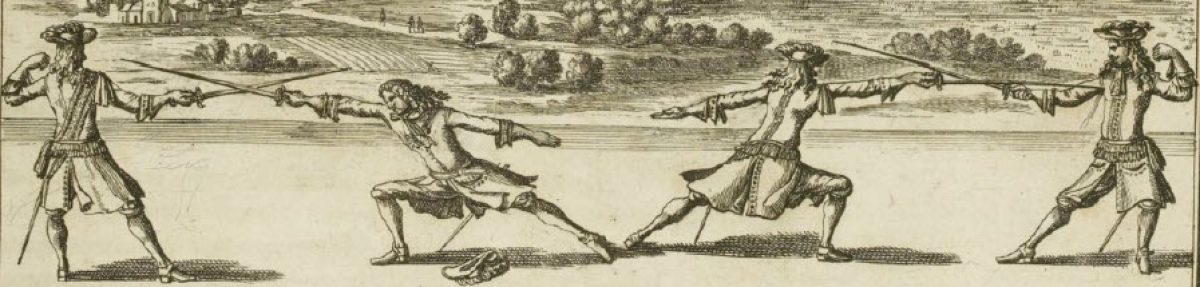


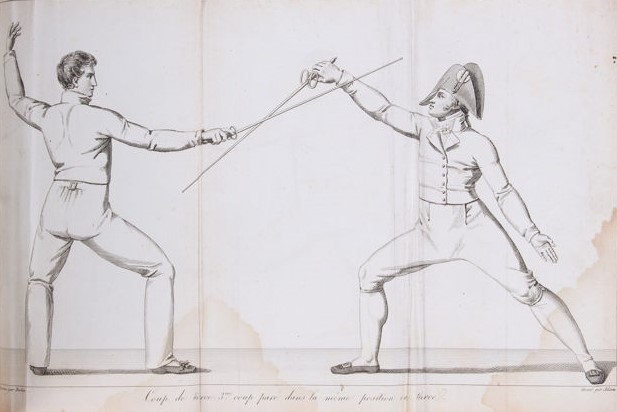






 Capitale Escrime Historical Fencing