How to Tournament

17 May-12 Aug 1928: Oreste Puliti (left) of Italy and Gyula Glykais (right) of Hungary fencing during a bout in the Team Sabre event at the 1928 Olympic Games in Amsterdam, Netherlands. The Hungarian Team won the gold and the ItalianTeam the silver medals in this event. Mandatory Credit: IOC Olympic Museum /Allsport

It seems only fair, given how often I have complained about the issues plaguing tournaments, that I should say something about the positive side of these events, and, offer some advice for those who compete in them. I’m not anti-tournament or competition, but I have high standards for them and for several reasons. First, they should be well-run and officiated. Second, they should be safe and the chance of injury reduced as much as possible. Lastly, however important medaling is, however much fun fighting is, tournaments are also learning tools, a chance to see what is working, what needs additional drill, and to test our strategies, tactics, and skill against other fencers.

With few exceptions, my competitive days are behind me, and no, I’m not happy about it. It’s less age than mileage—we pay for the fun of our teens, twenties, and thirties beginning in our forties (if we’re lucky it doesn’t start before then). It’s downhill from there. It’s not just stupid things we did when younger, though that is definitely in the mix, but decades of repetitive motion and too often not healing before starting up again. In one college event, for example, I rolled my ankle the night before, but wanted to compete so just wrapped the affected spot and fought anyway. Sometimes we’re just unlucky—I was in a serious car-accident in 2001 and not only injured my right arm, but in doing so unlocked all the existing trauma that was lying dormant. In an effort to prevent the crash I kept my hands on the wheel, which stretched out my supraspinatus tendon when we rolled, tore the rotator cuff, and released some lovely tennis elbow, the last a result of over-compensating when fencing and playing racquet sports thanks to a poor bone set. We can do a lot for a long time until something happens and we can’t.

PDX Winter Open, 2015, Steel Accolade. Here Will Petillo (in foreground) and I (in white jacket) fence a little sabre.

If time, injuries, and finances allowed, I would still be competing. I enjoyed it until sabre went electric and the flick took over foil. One of my attractions to what would become “HEMA” was the prospect of being able to compete again, but as things have turned out HEMA added new problems to the age-old issues so common in many tournaments. This is not to say that there are not well-run events, because there are—Sabre Slash, held in October each year in Prague, Czechia, and run by my friend Michael Kňažko, is an excellent example. [1] Likewise, I have heard that the Smallsword Symposium is worth attending, though I have yet to make that event. [2] By and large, however, most tournaments are poorly run collections of single-tempo doubles and abysmal officiating.

Until things change, if they do, one can still get something out of tournaments. It’s important to know what one is getting into, but with that caveat, there are several steps one can take not only to have fun at them, but also learn something.

Intelligence Gathering

Obtaining intel about other fighters is far easier to do now thanks to the internet and the tons of footage people share of their bouts on sites like Youtube. Pre-internet the typical way to check out other fighters was to show up at events and watch bouts when one wasn’t fighting. If one was super lucky, maybe there was a VHS tape around with footage, but that could be fishy—was this something the coach saved from a previous event? Hopefully. Or, was it some footage someone shot during another person or team’s training? Far less savory. Today, though, people share their bouts willingly and literally on platforms open to most of the world. Why not use it?

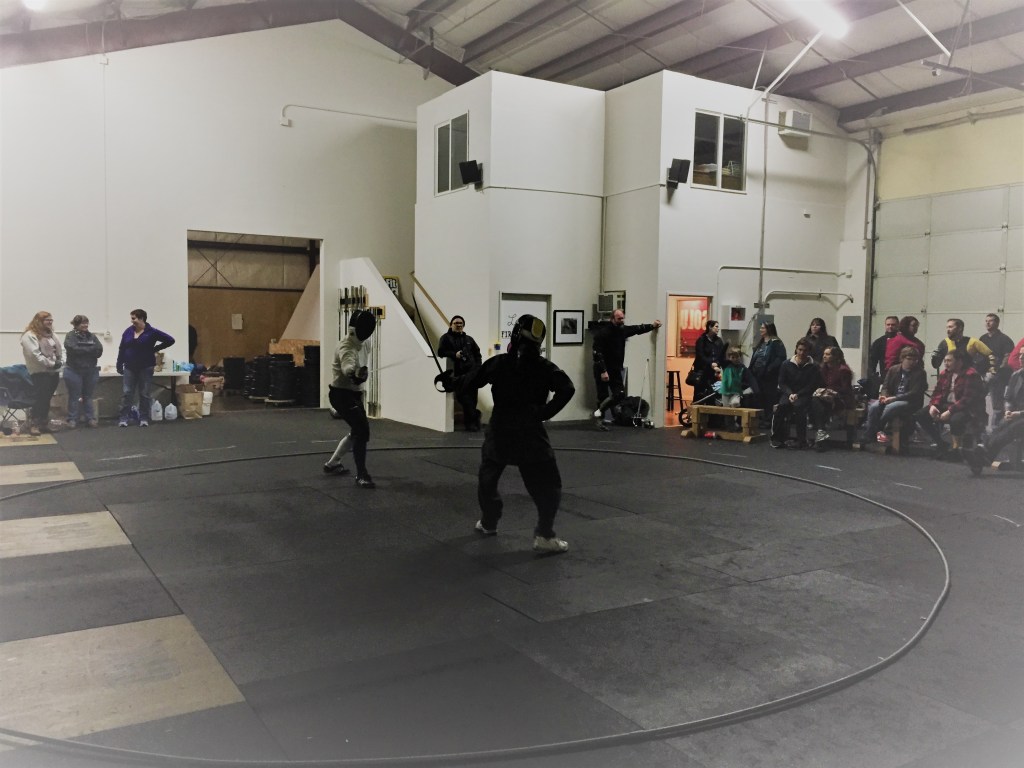
PDX Longsword Summer Tournament, June 2016

The value in studying other fencers is not just to see what they do, but how they do it. While super helpful when we fight them, watching better fencers and/or successful tournament fighters (not always the same thing), can helps us improve our own game. One doesn’t have to engage in intel gathering, but it’s a tried and true part of the game. Yes, game. There is a persistent, but false, notion that tournaments are somehow a “real” test of skill. They are, but not in the way most people think. There are rules, and where there are rules, there are ways to bend or break them, or, manipulate those who are there to enforce them. Thus, familiarizing yourself not only with the rules, but the officials, and players only helps.

The closest affinities between a tournament bout and an actual duel are in psychology and the role of chance. It is a lot easier to be calm, to think clearly, and use what we know when the situation we’re in is known, predictable, and subject to analysis that isn’t spur of the moment. In a sudden fistfight, in contrast, we gather intel as the fight progresses or once it’s over. If we’re smart, we size up a bar, theater, shopping center, etc. and assess potential threats, but that could be my natural bias as an American [3]. Put another way, tournaments provide us an opportunity to gather the same information without pressure and with ample time.

What to Look For: Intangible and Tangible

What should we examine? Start with general aspects. The easy things to assess are physical, such as height and thus reach. We can assess speed, the length of weapon, and the general composure of a fighter under pressure. Are they calm? Are they nervous? Do they rush right in at “allez!” or are they more calculating? If losing, do they lose composure and become wilder? Do they seem able to change tactics? Even knowing what club they’re from will tell you a lot—the fight-club style home to bruisers tend to fight a certain way, as do those from technique-driven schools, those with an Olympic background, etc.

Next, one can examine a fencer’s game and tactics. This is more successful if one knows what one’s seeing. Even sans a deep background and experience, one should be able to tell if a fencer tends to favor feints or actions on the blade or if they just wade in swinging. Does the fencer favor certain attacks? Guards? How well do they use the space in the ring or on the piste? Do they know when to attack or do they just attack whenever they feel like it? [4] Are they open in any line? Is their guard position correct and sufficient to protect them? Do they make a mistake consistently that one might exploit?

Tournaments as Pedagogical Tool

Tournaments should be fun. Ideally, they’re a chance to square off with opponents new and old, and test one’s game. Even in poorly run, shoddy events it’s possible to get something out of it, even if that means only adding another event to the list of those to avoid. Let’s assume the tournament is well-run and large enough to include a range of skillsets. Perhaps one makes it to the finals, perhaps not, but regardless each bout in the event is a learning opportunity. We often talk about competition as the crucible or pressure-cooker for what we’ve been learning, and in large part that is thanks to both the fact we tend to face new opponents and have the added pressure of rules, a clock, and ranking. Much fun as bouting with our weekly foes is, we get comfortable, complacent, and in the worse cases, cocky. Just because our favorite attack always works at home doesn’t mean it will work against unfamiliar opponents.

Competitive fencing, of any kind, can make or break people, and much of it comes down to how they view competitions. If the only goal is to win, and one isn’t winning, then it’s a lot easier to become discouraged. The top fencer at Podunk Sword Club is often shocked by a poor showing at Prominent Sword Club’s major event. Some quit after that, convinced they will never get better or that they are just not “naturals.” Others, however, seek out low-level competitions and sweep them; they like winning and it feds their self-worth needs—this may be the equivalent of an adult beating up a toddler, but somehow they see past that. A better path is to seek out better competitors, because they will push you and force you to grow; this requires, though, an awareness that initially at least one is going to lose a lot. A LOT. Be okay with that and learn from each bout, each fencer. In turn, as one advances, it helps everyone if we do our part to raise others up. Maybe you offer to be a ring-coach for a new fencer; maybe you experience the horrid martyrdom of officiating to help newer fencers see how things should be done; maybe you just offer advice to someone between pools. How we do this is everything—people can get on the ear fast when anyone suggests that they might need help, so be kind, open, and most of all only offer help if you can actually give it.

Over time, with patience, practice, and persistence, we improve, and our tournament experiences change. We’re grateful for the harder, more challenging opponents, and we realize we can never, ever underestimate anyone. Least we shouldn’t. [5] Each opponent is a teacher, each bout a chance to improve or see what needs shoring up, and if we’re really lucky, we have fun at the same time.

NOTES:

[1] Cf. https://saladellatrespade.com/2021/10/10/_fratres-in-armis_-historical-fencing-shared-traditions-friendship/

[2] My friend and colleague, Dr. Patrick Bratton, has attended this event for several years and has had good things to say about it. Smallsword, far as I can tell, tends to attract people for whom technical ability holds merit, and so while one can—and people have—won by buffaloing their way through the pools, the fencers who stand out are those who are skilled win or lose. Remember, competition = rules = ways to game the system.

[3] I jest, but also, well, depending on where one is this is an important skill. We shoot people at schools and theaters here, so…

[4] For example, there are ideal and less ideal time to attack. Some modern masters refer to looking for moments when the opponent is in “negative balance,” that is, as they just begin an action (especially if just out of distance), if they’re taking a step, or if they’ve just attacked and fallen short, since upon recovery from the lunge they’re less capable of covering themselves. [5] One of the axioms I teach is that we should never underestimate anyone. The best fencer can have a bad day, the worst a great day. History has plenty of examples where underestimating an opponent had dire consequences. Remember Signore Cavalotti, https://trove.nla.gov.au/newspaper/article/66694588

Censorship or Criticism? Why You’re Wrong about “Gate-Keeping”

“Discord is the great ill of mankind; and tolerance is the only remedy for it.”
― Voltaire, Philosophical Dictionary

[Warning: rant ensues]

The choice of quotation is not an accident. Thanks to a toxic mix of politics and poor life choices I left most social media a few years ago, and, with one exception (barring messenger/email apps), have next to nothing to do with it. Research articles on the effects of social media continue to support my belief that this was a good decision. It’s not just that people can’t watch or read anything longer than a tiktok video or tweet, but that the supposed anonymity fails to prevent, and maybe even encourages them to be nastier than they would be, in most cases, to one’s face. How does this related to fencing? I promise to connect A and B if you keep reading.

It gets worse. Swimming in such a shallow pool feels safe, because everything is on the surface, but this ignores that fact that one can still be sunburned, even drown in an inch of water. It changes people.

The faux familiarity, the apparent openness, and the need for connection that social media seeks to create but which it actually undermines, all produce an illusory culture of contented seemingly intimate pals. Test it. Say something vaguely controversial and see how people react—the ability to differentiate between confirmed belief and a joke is all but nonexistent; lacking facial cues, changes in intonation, etc., this is hardly surprising. It is not an accident, however, that this diminished capacity for communication and an equally strong inability to separate criticism and censorship have grown in parallel.

Gate-keeping online is the new Inquisition, not only for the social auto de fe that so often follows in its wake, but also for the fact that the basis for it is confused.

There are a lot of ways people define “gate-keeping,” but I find that the Urban Dictionary, while typically an amalgam of denotations, taken in toto provides a fair sense of what contemporary terms and movements mean. Here are a few from the first two pages of definitions:

  • Gatekeeping is to make your interests exclusive in order to protect them from becoming “mainstream”
  • When someone takes it upon themselves to decide who does or does not have access or rights to a community or identity.
  • A word used to describe when someone sets a standard/limit on what someone must do to call themselves a ‘true fan’ of something/someone.
  • When someone uses a hobby or interest as a means of elevating themselves above others to give oneself a sense of being superior transforming their passion or knowledge about a particular subject into an ugly tool of self-inflation
  • When someone takes it upon themselves to decide who has access to something
  • When people discriminate against others who want to enjoy the same things as them, and usually gatekeepers use the dumbest reasons as excuses [1]

For a slightly more august definition, the Cambridge Dictionary defines it as “the activity of trying to control who gets particular resources, power, or opportunities, and who does not. [2]

More than once I’ve been accused of gatekeeping, but according to these definitions I have not, in fact, been gate-keeping. No, I have criticized poorly constructed theories, ineffective training regimens, inexpert translations and interpretations, and bigots. This is important, because what I have NOT done is:

  • make my interests exclusive in order to protect them from becoming “mainstream”
  • set a standard/limit on what someone must do to call themselves a ‘true fan’ of something/someone
  • used a hobby or interest as a means of elevating myself above others to give myself a sense of being superior or transformed my passion or knowledge about a particular subject into an ugly tool of self-inflation
  • decided who has access to something
  • discriminated against others who want to enjoy the same things as me, and for the dumbest reasons

I would love for well-researched, well-coached, and inclusive historical fencing to take off and become mainstream. I have no business telling people what they can or should like—people like what they like. This hobby, well, um, it does not elevate one socially at all and those who, sadly, think it does I feel pity and compassion for—fencing is not going to help you find a date, fame, or money. Historical fencing should be for all—the only people I will not teach or interact with are people who are known bigots. [3] Finally, I have trouble understanding why anyone would discriminate against people who share the same interests—hell, I’d all but kill for more people interested in the things I am!

Here is what I do and will continue to do:

  • I will continue to support good research, and, attempt to improve bad research
  • I will continue to do my part, as an educator, researcher, and fencer to support, make, and improve interpretations of historical fencing
  • I will continue to do my part to create an inclusive culture (bigots either get wise or fuck off)
  • I will endeavor, as I have to date, to do all of this with compassion and understanding, because historical research and interpretation is, by its nature, extremely difficult to do and even harder to do well

Lastly, I issue a challenge. The next time you think someone is gate-keeping, take the time to consider a) what gate-keeping is and b) if what you find unpleasant conforms to those rubrics or not. IF, as so often happens, you’re simply reading something that you don’t like, or which you somehow think is about you, or which makes you feel attacked, pause and consider the likelihood of that. As I’ve said, most things are not about us. It’s probably not about you, and you know, if someone my age can figure out how to mute a channel or thread, then you can too. Like it or not you’re responsible for your feelings and how you react, not me. I take care of my garden, you take care of yours. That’s what wearing grown-up pants is all about kids.

In our context, if you’re upset that a cherished theory has been challenged or that some old, obscure upstart has dared accuse some HEMALand darling you admire of poor work, reflect upon what that says about you.

I am not interested in making enemies; I’m interested in good research and fulfilling my duty as a trained researcher to steer people right about research. It comes with the sheepskin. This said, if calling out charlatans and would-be experts creates enemies of them, or you, fine. IF I’ve taken the time to call them out, there is a reason, and it has nothing to do with self-aggrandizement, attacking others, or just being an asshole. It’s not like anyone thanks me for it—getting attaboys is not the purpose: improving research is. I don’t need or want thanks or anything of the sort, just better research.

If I’ve called someone out about their work [key word, their work, not they themselves], it’s because I know they lack the skill, experience, and/or knowledge to make the claims they are or have made a grave error and are fooling people about it. Most people, wisely, don’t pursue research as a career-path, and so there is a responsibility on those of us who do to do right by all. Theories and interpretations are things we can evaluate, that are demonstrable, and either someone has those skills or doesn’t; either they’ve proceeded responsibly with their research, or they haven’t. The only time this gets “mean” is in HOW we call these things into question. It is never my intention to be mean—life is cruel enough and hardships a plenty without my adding to it.

Please note: my goal in throwing myself up for a beat-down when I offer criticism (that is, critiques to help someone improve or fix a position they are sharing) is intended to help them, not blast them. I spent over a decade learning to conduct research and another decade honing and teaching others to reason and analyze information. I want people to do better work. Too many academics could care less, and most wouldn’t bother trying to help non-academics improve. There’s a direct correlation between depth of snootiness and lack of resources that explains that; put another way, many academics are small people and sad. For me, the so-called Ivory Tower is bloody useless if its treasures are hoarded away only to be enjoyed by the three people in that field (see gatekeeping defintions 1, 2, 4-6 above…). I won’t be party to that, and so, I do what I can to share those treasures with everyone, and for reasons of time, interest, and experience, I do that mostly in historical fencing.

NOTES:

[1] https://www.urbandictionary.com/define.php?term=Gatekeeping

[2] https://dictionary.cambridge.org/us/dictionary/english/gatekeeping

[3] By kn0wn-bigots I mean those who wear all the symbols and spout the trash that bigots do. If they don’t say these things in class, and attack no one, then I don’t know about and they fly under the radar. Locally, at least, people know from the main page on this site that bigots are not welcome.

Get Out of Your Way

Following on the heels of the last post (about the place of calm in our study of the Art), the following may feel like overkill, but it’s related and as important. Among the deceased equines to which I regularly apply a cat o’ nine tails is the problem of ego. Ego gets in our way; it impedes growth. Over concern with how we will be perceived affects calm; it takes us out of the moment. With our own path to self-improvement, just as in most any larger venture, we tend to succeed best when we don’t get in the way.

Why harp on so much about ego and arrogance? It goes beyond my own study and experience with the martial arts or life-experience, though the combination has done nothing to shake my belief that arrogance and misplaced confidence are bad for us and everyone else. Great confidence can read, sadly, like competence—that’s how unfit businessmen become president for example—but they’re different, and there are consequences to a misguided and overblown sense of self, just as there is in placing our faith in someone else’s inflated sense of self.

The Font of Awesomeness-ness

James Earl Jones as Thulsa Doom in 1982’s “Conan the Barbarian”

Arrogance has a variety of sources, but at the root is low self-esteem. I’m not a psychologist, so I say that as an observer and fellow human who wrestles with ego like anyone else, but I think it holds. In some, arrogance is a mask, a persona they adopt to navigate social environments in which they’re uncomfortable (or maybe all environments). For others, too high an opinion of themselves derives from life-long coddling and commensurate insulation that never put any of the wonderful things they heard growing up to the test. Still others truly believe in their own greatness. Whatever the reason, the egotistical person is generally less inclined to listen, to consider other opinions, or play well with others. They always know better.

Miles Gloriosus

Arrogance is common in fencing as indeed it is in most combat sports. In part, it’s theater—Mariel Zagunis, for example, in the gold medal bout in Athens 2004, more convincingly ripped her mask off and screamed than did her opponent, Xue Tan (China), and went onto win. On the other hand, there are people who for one reason or another think they are the Chevalier St. Georges or La Maupin reborn.

Basis for this is emotional, not rational. On the one hand, typical big fish/little pond dynamics often weigh into things, especially with regard to individual clubs and in tournaments. On the other hand, it’s easy for some to convert an activity they enjoy into a sense of identity; the more narrow that identity is, the easier it is to take criticism poorly. It becomes a personal slight rather than a comment on the acquisition of a difficult skillset (learning to fence is not easy for anyone).

Big Fish  & Identity

One compounding problem that clouds the fact that emotion drives so much of this is the place of the false-positives people take away from events and practices that on the surface appear neutral. More often perhaps than anyone should I’ve mentioned the iffy waters of the tournament scene as the litmus test for skill. It’s not. There are a host of considerations about competition that undercut the lesson so many take away from these events.

Those without serious competitive experience tend to fall prey to the lie more than others. Those who do have that experience and claim it counts for more than it does generally have benefited personally and thus have a vested interest. No one who’s made a name for themselves is quick to question the legitimacy of how that name was made. Zagunis, for example, is very good at the game that sabre has devolved into, but would likely take it badly should someone point out issues with edge alignment, the place of doubles, etc. in her fencing. It’s human nature.

Leaving aside issues with rulesets and officiating, it’s the collective level of ability that defines what first place means. This is important. Too often each tournament is approached as if neutral, as if medaling by definition reveals the superior fighter. It “can,” but it’s not automatic, and superior… how? In relation to whom? Only to who showed up and who had less of a good day than the winner. First place at Event X really only provides data for that one day and that group of fencers. The outcome form the same pools next week could look very different.

An important caveat is that this is not always the case—proper training and knowledge of tactics (both on the strip/in the ring and as far as playing to the director go) will normally out. The mistake is assuming that this particular skilled fencer is the same as the attribute fencer. The former, through skill, can win through the application of skill; the latter relies mostly on reach, speed, or strength. They’re not the same. The more actual, high-level fencers (which can be evaluated) at an event, the more likely that victory in that event means something.

“HEMA” in particular suffers from this—many events, even large ones, might collect a lot of attendees, but the actual skill level is generally quite low. [1] To win at one of these events speaks to stamina, no doubt, but so much of it is a roll of the dice. Attribute fencers do extremely well, as most rulesets don’t and in many ways can’t adjust for physical advantage. A rapier fencer over 6’ with a 42” weapon is going to have an edge over the 5’4” fencer with a 40” blade. Even when that taller fencer makes some daft action, something suicidal, their reach will often win out. The trog that blasts through any guard because he can isn’t better, just less concerned for his opponent’s safety. After all, what’s a double if it helps one “win,” right? No one was hurt, at least hurt too badly, so what’s it matter? Stupid, yes, but evident in most tournament footage. How these same fighters reconcile being hit so often, especially with doubles, and the purported concern for realism in so-called historical martial arts, isn’t a mystery—there sense of self demands it. It must be “good” fencing because they won. Their sense of self, their self-worth, requires that they be the best and be recognized as such. However untrue that might actually be, it feels true, and in large degree too many people believe that what feels true is true. Extreme political stances, be it qanon idiocy or the belief that vaccinations cause autism, are prime examples outside of fencing. Effective self-reflection is a lot harder to do when those around one help feed the fires of fandom. Too few fencers examine their need for victory, but they should.

To compound matters, those who can afford to attend many events and do well, gather a data set of victories, and with it a subsequent belief in their own ability based on false premises. On the face of it, multiple victories appear meaningful, and in some degree it is for that individual’s own progress, maybe, but what does it mean beyond that? It depends on many factors. Are all tournaments equal? Was the level of skill that high at each and every one of them? What ruleset was in use? How did they game the ruleset? How good were the officials? Much of HEMA is judged by the other competitors, most as green as their colleagues, so how accurately they understand let alone see what is happening is an open question more often than not.

To reiterate: I’m not against tournaments. I’m not against competition when approached correctly. [2] Every competitor, every instructor involved in training them, must understand the nature of tournament fighting and adjust for it (a topic for another time).

The Would-be Maisters

Arrogance can be infuriating in a student or opponent, but it can be a recipe for disaster with a coach. This said, in many endeavors, and fencing perhaps first among them outside ballet, coaches are often extremely full of themselves. When that same proud instructor gets results, people tend to look the other way. This is a lot easier to get away with in the Olympic world. There are three weapons, and there are three-weapon masters; to achieve that one must have at least a solid grasp of each one. In “HEMA,” however, there is no such oversight program or board for an instructor’s competence, and even sadder, a fair degree of active hostility toward those from closely related certification programs who might, conceivably, bring up the teaching level. There are a lot of people teaching, but not all have ample background to do so well.

Tim Roth as the smug Macaroni, Cunningham, in “Rob Roy” (1995)

Thus, a second problem with ego is that extends beyond misjudging our own ability or knowledge—it reaches into misjudging and assessing that of others too. To use another contemporary example, a half-wit pundit may appear on tele utterly convinced of a position, but nothing about that confidence or the smug delivery says a single thing about the accuracy of the message. People see the delivery and take it for the thing itself.

In the martial arts, and specifically in this case in historical fencing, there are those who put great weight on people who for lack of a better term are “celebrities.” They are known, and for that reason alone some have faith in them. To be fair, there are times when that faith is warranted, but that faith should be measured against demonstrable skill, knowledge, and importantly, suitability to a topic. If I may, I feel confident to speak on things Radaellian sabre, French smallsword, or late period rapier, but know I have no business teaching Brazilian Jiu Jitsu or Mair’s polearms. I know what they are, and I’ve read about them, and know people who actively study those branches of the Art, but I myself am not qualified and shouldn’t do anything more than point an interested party to those people. To pretend otherwise is dishonest.

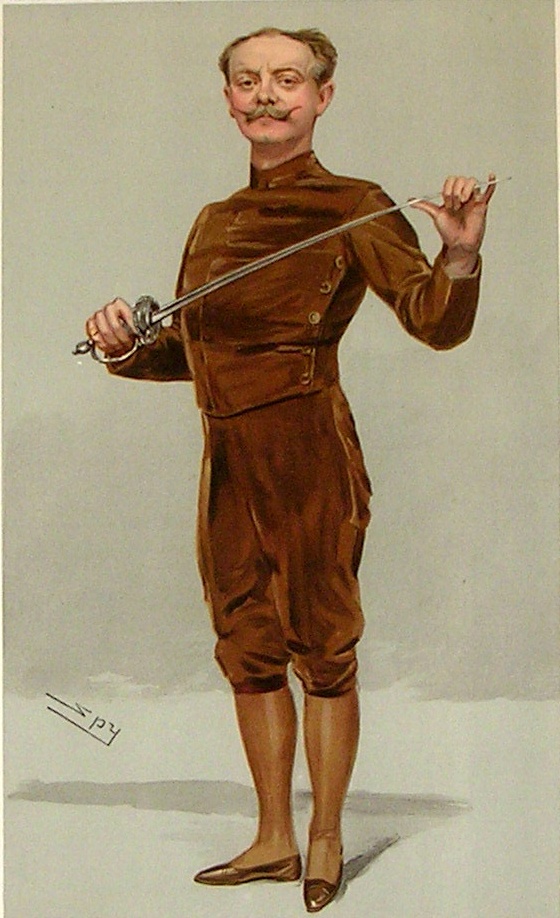
Cartoon of Egerton Castle (1905)

An inflated ego can blind us to the expertise around us. A big head more easily leads us to see what we want to see, not what is actually there. More times than I can count I’ve seen a HEMA player discount a person of experience, skill, and smarts in favor of some Youtube personality. In the best cases, that celebrity (again, small “c”) is good at something and/or has some serious training under their belts, but anyone can set up a Youtube channel and unless one knows what to look for it’s easy to be taken in and fall prey to these would-be experts. Few, luckily, fall into the same category as the fake martial arts masters who look at a room full of students and knock them down through a glance chockablock full o’ chi, but all the same, some get close. There is a prominent tourney goer, for example, that has fetishized his off-hand. Apparently, no one has told him that unless there is a weapon in that off-hand, such as a dagger or buckler, that no one should be looking at it. Ever. There’s no reason too. IF people are falling for this hand sans puppet or marotte, that doesn’t mean that the puppeteer has done anything other than select an event where the average skill is so low that competitors don’t know this. Given that a new foilist learns not to pay mind to the rear arm should illuminate just how sad this is.

As a last example, there are prominent figures who have skill, but misapply it. Were I to offer a class on poleaxe based on late French foil play I would be doing my students a disservice. The universals apply no matter what weapon, but how they apply, differs not only by shape, heft, and purpose, but context too. However, there are well-known personalities who do exactly this, who take a weapon they are proficient with and create a methodology they then attempt to apply to unrelated weapons. At best it confuses things, at worst students—should they continue—will realize one day that their time, effort, and significant financial investment… would have been better spent reading the actual manuscripts, wrestling with the difficult material, and talking to those who have done so before them. There is no royal road to skill. Get your ego out of the way and do the work.

“If You’ve got a Black-List, I Want be on It”

His antiquated and unfortunate politics aside, Billy Bragg’s line seems an appropriate one with which to close. [3] I know, should some read this post, that they will take it personally and call me names. That’s okay. Go nuts. Some may even recognize the unnamed examples I’ve provided and take affront. That too is okay. I stand by what I said—ego needs make for poor choices and big egos make for poor role models.

Age and experience offer little consolation to us, but two things they do offer are perspective and less need for recognition. I’ve spent considerable time taking myself out of the way; I think it helps, not only in my personal life, but as importantly in the larger projects in which I choose to participate. A desire for public validation tends to distract us and detract from what it is we wish to do, and what’s more important, the work (if it is important) or that people know we were involved? As a coach, what is more important, my experience during a lesson or the student’s? What matters more, how that lesson appears to others, or the content of that lesson and its effectiveness in conveying information? The correct answer is the student’s experience, because otherwise why is one coaching?

I don’t need my name in lights, and don’t want it to be for that matter. I don’t need widespread recognition, because just trying to do the best I can for students and colleagues is work enough. I’m content to be one way-station on what my prove a long path for my students. If I help them when they need it, and it moves them forward to wherever they’re going, then I’ve done my part, whether they or anyone else remembers that I did it. I don’t need lots of medals, a social media presence, or any of the other stuff that would take my focus from what I do well and care about.

Not everything is about me, and in fact, very few things are about me. It’s not usually about you either. When we know who we are and what we stand for, that fact tends to stand out pretty starkly. Our egos suggest to us that everything is about us, but few things are; the belief that it’s about us is no more true at 30 than it was at 3.

Get out of your way.

NOTES:

[1] The average skill level in HEMA is poor. Those inside HEMA are accustomed to what they see and scale within that, but the bar never having been high, there is only so “good” most people get. I’m talking average HEMA here, not everyone. I’ve mentioned a number of excellent students of the Art in these posts, and will do so again. The point is that much of what people see, if they knew better, would not impress them.

[2] What tourneys are for is debatable, but in addition to being good fun—ideally, they are also an additional method of learning. Yes, it’s nice to win, but bouting is to fencing what a pressure cooker is to the ingredients in a dish.

[3] Billy Bragg is proof of something my graduate advisor often said in re Communism—the only place it was alive and well post 1989 was in one or two offices at Oxford or Cambridge. Mr. Bragg, whom I believe has a good heart, championed the pie-eyed politics of Marx, something I suspect easier to do even in Thatcher’s England than in East Berlin or the gulags of the former U.S.S.R.

The All-Important Place of Calm

Young Kendoka in mokuso, via Pinterest

Having received some upsetting news and struggling with the mix of disappointment and rage that ensued, I got to thinking about the place of calm, not only in our lives, but also within the Art. We fight best when we are unemotional, calm, and receptive. Emotion clouds judgment. That is a lesson, a karmic burden, that I keep bumping into again and again, and in too many areas. Clearly, I have a long way to go. The question with regard to the Art is how do we cultivate that calm? Moreover, how do we teach it?

The Sword and the Mind

The heading is a nod to an excellent book, The Sword and the Mind, a collection of works on swordsmanship translated by Hiroaki Sato. In one section, Setsunintō (volume two in the book), the author wrote

listening to the sound of the wind and water means maintaining a calm surface and a fighting spirit within…just as a waterfowl afloat on the water maintains an outward calm while using its webbed feet busily below, so must the mind inside be kept on guard. And if you continue your training in this fashion, the mind inside and outside will melt into one, and the distinction between the two will disappear. To attain this state is the ultimate of the ultimate. [1]

This idea is something rarely if ever expressed in western European sources, least I’ve not encountered it in anything I remember reading. The attention to our state of mind, however, shows up a lot in East Asian works on the martial arts. In particular, the impact of Chan/Zen Buddhism on the fighting disciplines was profound. My early training was in East Asian martial arts and as I’ve remarked before my years studying those systems have influenced my approach to fencing. I see the Art not only as the pursuit of self-defense and combat skills, but more importantly as a means by which to grow, improve, and odd as it may sound, cultivate empathy and compassion. More so than any other portion of life, work, school, etc., it’s the Art that has given me the most. Thus, in my own training I’ve worked hard on the mental aspect. I’ve also tried to help my students toward this same quiet-mind.

In the west, the term we most often use for this state today is “flow,” a very modern concept in terminology and one perhaps popularized most by the work of Mihály Csíkszentmihályi and Jeanne Nakamura. The idea of “flow” has since been popularized in Csíkszentmihályi’s book Flow: The Psychology of Optimal Experience and in his TED talk, among many other, similar titles by other writers. [2] The basic premise is that in flow

Concentration is so intense that there is no attention left over to think about anything irrelevant, or to worry about problems. Self-consciousness disappears, and the sense of time becomes distorted. An activity that produces such experiences is so gratifying that people are willing to do it for its own sake, with little concern for what they will get out of it, even when it is difficult, or dangerous. [3]

This state is possible to reach via many methods, but for me I have encountered this state most often when fighting, and, typically when fighting a particularly skilled opponent. The thing is that entering a state of flow, and thus of calm in a sense, doesn’t happen automatically or without some degree of training, least in terms of the fighting arts. I fought empty-hand and with weapons for a long time before ever entering flow.

What I’ve come to realize, however, is that even if we aren’t in a state of flow, we can still cultivate the calm typically required for it to appear.

Cultivating Calm: Body and Mind

We tend to be more relaxed when we are confident. Some assurance that we know what we’re doing, that we can react appropriately, tends to make it easier to perform. For fencing, a key part of acquiring that confidence derives from the often monotonous practice of drill. There is no royal road to skill—one must put in the time. One of the things I advise in teaching students how to drill, especially on their own, is to remove the emotion they may have about it. I do the same thing with my own children when it comes to chores, homework, or anything unpleasant.

How? Well, we feel what we feel, right or wrong, appropriate or no, but how we feel doesn’t have to guide action. So, when a student says “Ugh, I hate drills… they’re so boring,” I reply “I know, but they’re important—take a minute and feel as strongly and passionately as you wish. When you feel ready, take those feeling and set them aside.” The analogy I give them is washing dishes—I work from home and do a lot of the housework. I don’t “like” housework. It’s not fun. So what? It must be done irrespective of how I feel, so, I simply apply no emotion to it. It just… is. This approach not only makes the task less unpleasant, but also makes it faster and less disruptive, particularly if I have other, more important or pleasant goals to meet during the day.

It takes practice to remove emotion. A LOT of practice. As a caveat, this does not mean one doesn’t feel things or that one shouldn’t; that is unhealthy. Feel. You’re human and feeling is part of our lot. The trick is to feel the emotion, whatever it is, acknowledge its legitimacy, and then consciously decide not to allow that feeling to drive thought or action.

Between the two, physical training with its repetition, correction, and perfecting, and, the mental aspect of setting aside emotion, we can more effectively reach a place of calm. When we work a this, and I do mean work at it, we find that one of the places where we are actually the most quiet, the most calm, is en garde. The conscious efforts we make toward that calm reap unconscious rewards. I’m not usually aware that I’m calm. It’s usually in retrospect or if I am actively thinking about my mental state when fencing.

Proof is in the Bouting

As a proof for the vital place of calm, if my own testimony is unconvincing, I offer the example of my friends at Winged Sabre Historical Fencing. One of my favorite fencers is Russ Mitchell—he’s a formidable and gracious opponent, and, one hell of a teacher. Rarely have I faced another school’s students and faced what I did in Texas a few weeks ago. From his senior student, Kat, to some of his newer students, what impressed me most was their calm, the lack of frenetic energy and motion that often accompanies not only new fencers, but some of the most seasoned (not all who bounce in modern epee do so tactically…).

One of the fencers I had the pleasure to fight was Kevin. He’s a bit older than me, and has only been at this for a few years, but I will be the first to tell you that between his being unflappable and the terrifying effectiveness of the Hussar system Russ teaches, I had my work cut out for me. To his credit, Kevin asked me after the bout what he did wrong so that he could work on things. I wasn’t sure how my answer would go over, but I led off with “well, let me tell you what you did right—everything.” He dominated that bout. I might have hit him once, but I know and am honest enough to admit he controlled the action and stymied my every attempt to get past that blasted middle-guard lol

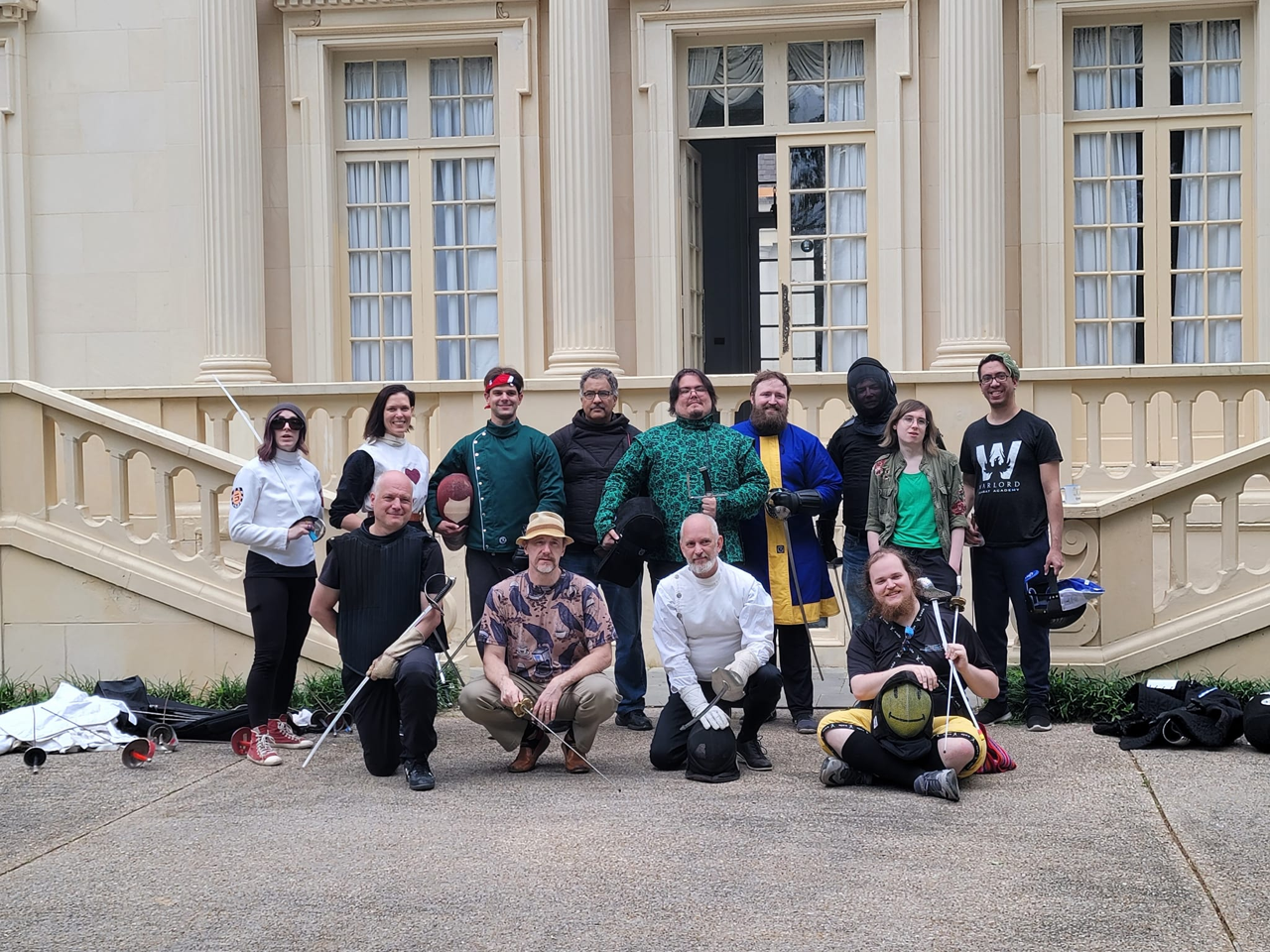
Some of the Attendees late Saturday, 22 April 2023 (photo by Annamarie Kovacs); Kevin is, I believe, in the mask on the left

I mentioned that his calm, something I noticed in all of Russ’ students, was the key. It allowed them the space and level-headedness to use what they had learned. I was–and remain–extremely impressed with what I saw from Russ’ fencers at the St. George’s Day Exhibition of Arms. This speaks to a master’s command of material and pedagogy, and while Russ may not have the sheepskin with maestro written upon it, he is one of the few people I consider a master in historical fencing. I have yet to pick his brain for how he approaches the cultivation of calm, but it’s on my list of things to ask wiser heads than mine.

Drill and Presence

For those interested in this, reading Csikszentmihályi’s book might help, but so too will practicing both purposeful shelving of emotion and drill. In class, in the lesson, or on one’s own, getting out of our own way is the key to progress. Much as one can, acknowledge the emotion that arises, then set it aside and actively focus on the task. In time, with practice, this process becomes more and more automatic. If it helps, read up on both western ideas of “flow” and the more philosophical works on fencing—use what applies, leave the rest. [4] It is worth the effort and time to cultivate calm—it will not only help one improve, but also make fencing a lot more fun and rewarding.

NOTES:

[1] The Sword and the Mind, translated by Hiroaki Sato, Woodstock, NY: The Overlook Press, 1986, p. 71.

[2] See especially Nakamura J, Csikszentmihályi M, “Flow Theory and Research,” in Handbook of Positive Psychology, Snyder CR, Lopez SJ (eds.), Oxford, UK: Oxford University Press, 195–206. See also Mihály Csíkszentmihályi, Flow: The Psychology of Optimal Experience, New York, NY: Harper Perennial, 2008. For the TED Talk, cf. https://lateralaction.com/articles/mihaly-csikszentmihalyi/

[3] Csíkszentmihályi, Flow, 71.

[4] For a few places to start, consider Taisen Deshimaru, The Zen Way to the Martial Arts, New York, NY: Penguin Books, 1991; Joe Hyams, Zen in the Martial Arts, New York, NY: Penguin Putnam, 1979; Michael Maliszewski, Spiritual Dimensions of the Martial Arts, Tokyo, JP: Charles E. Tuttle Company, Inc., 1996; also worth a read Pema Chodron’s When Things Fall Apart, Boston, MA: Shambhala, 1997. I suggest the following with caution as it’s very much a product of its environment, 18th century Samurai culture, and should be approached with an awareness that Hagakure by Yamamoto Tsunetomo reflects not only a disappointed warrior’s views of a changing world, but these ideas as recorded by another samurai, Tashiro Tsuramoto. The edition I have is Hagakure: The Book of the Samurai, translated by William Scott Wilson, New York, NY: Kodansha International, 1983.

A Bar Raiser

Chateau South, Atlanta, Texas

Super late last night I returned from a weekend of instruction, teaching, discussion, bouting, and all manner of swordy fun at the St. George’s Day Exhibition of Arms held at the beautiful Chateau South, Atlanta, Texas. The event was put on by Russ Mitchell and the excellent people at Winged Sabre Historical Fencing, and hosted by the generous owner of the Chateau, Raoul, who not only trusted us to honor the integrity and safety of this property, but also who grilled a feast for us. If you’re in eastern Texas, “Piney Texas,” and need a venue for any event–wedding, family reunion, business retreat, you name it–I can’t recommend Chateau South enough (https://www.chateau-south.com/). Raoul and the family who take care of the property and are helping to restore it, Shawn and Rebecca, put the hospitality in southern hospitality. Seriously nice and generous folk.

Learning, Camaraderie, and Cross-Fertilization

I hope that the St. George’s Day Exhibition of Arms will become a regular event, because it needs to be. We have tournaments, we have seminars, conferences, and in some rare instances a mix of the three, but in some cases the dates are tough to make, the cost prohibitive, or the environment/attitude less than welcoming. Russ Mitchell and the fine folk at Winged Sabre put together a fantastic event–it was friendly, open-minded, and welcoming, but more than that the classes and discussion, the chat over meals or between sessions, all were informative and thought-provoking.

In addition to my two classes, there were a class on movement and balance by Russ that has changed not only my understanding of footwork, but also how I will teach it from here on out; there were two by Francois Perrault (Montreal, CAN), first on French foil as a way to understand the second topic, contre-pointe (the French approach to sabre ca. 1800-1908); and two by Jonathan Carr (Dallas, TX), one that made more sense of Hutton’s sabre than anything I’ve read, seen, or heard until then, and then a fascinating lecture on Sir Richard Francis Burton’s 1875 sword system.

Some of the Attendees late Saturday, 22 April 2023 (photo by Annamarie Kovacs)

Discussion between classes, over meals, and especially at the end of the instruction-day, were as valuable. They were also a chance to get to know one another, share ideas, and increase understanding on the various tangents covered in the topics. For someone as introverted as I am, and who normally has to bow out to recharge, the fact I wasn’t once in need of that recharge should suggest a lot.

Tired, but still in for chatting–Aaron, Michael, and myself

Exhibition of Arms vs. Deeds of Arms

Both have their place, but what an exhibition of arms seeks to do is share a particular style or tradition’s uniqueness within the Art, that is, what makes it what it is. While I cannot say to have represented the Radaellian school particularly well in my own bouts, I will say that my compatriots did a wonderful job. Russ’ students have been studying hussar sabre, which is very different than the profiled styles that predominate; Francois’ early French approach and Jonathan’s debt to English sabre and broadsword were clear as well. The focus in our bouts was to do our best to fight within the body of techniques and tactics of our specific traditions, and, to have fun doing it.

We also had time to explore a venerable Hungarian weapon, the fokos, a shehpard’s axe that the Magyars brought with them from the Steppes in the Early Middle Ages and which was used in the trenches of the Great War. Never have I faced a more challenging weapon sabre in hand than I have that wee axe. Russ made a few converts among us, I’m sure; least, I’m looking into the more than academically now.

Russ arresting a cut with a fokos

Raising the Bar

Winged Sabre’s “St. George’s Day Exhibition of Arms” raises the bar for what we can and should be doing more often in historical fencing. Each of the classes had students drilling. There, I said it, the “d-word,” drill. It’s become a dirty word in “HEMA,” and to the detriment of that community. The garbage posted so often on Youtube as championship sabre is a case in point. The hop and chop, simultaneous single-tempo cuts lauded as the end-all be-all of sabre are to Plato’s cave what shadows on the wall are to the sun outside the cave that creates them.

Drill. Hard work. Effort, time, and sweat. These are what make a decent fencer. One can spend weeks, years even, in study, but if intentional, well-designed drill is missing, there is only far someone will go in that time. Another way to say this is that much of HEMA is doing it wrong, and should seek better methods, better instructors. I’ll not go so far as to list myself among their number, but I will say that I know some people you should talk to.

St. George’s Day Exhibition of Arms

[21-23 April, 2023] Next week the excellent Russ Mitchell and crew at Winged Sabre Historical Fencing, Atlanta, Texas, are hosting the St. George’s Day Exhibition of Arms (see link below). I have the honor to teach at this event and will cover two, related topics in Radaellian sabre.

The first is all things molinelli, that is, an exploration of the powerful, elbow-as-axis cuts fundamental to Radaelli’s approach. They were used not only for exercise and to build the muscles required for these cuts, but had offensive as well as defensive uses too.

The second class covers Masiello’s unmounted cavalry drill and exercises. Since the Radaellian method was primarily developed for cavalry it makes sense to acquaint oneself with this aspect of the tradition. Cavalry troopers not only practiced their style of combat in the saddle, but on foot as if in the saddle, what Masiello called come a cavallo, “as if on horseback.”

For more information, see:

https://chateau-south.ticketleap.com/exhibition-of-arms/details

Alex Spreier on Engaging Sources

Alex is a close friend and colleague, and one of the best students of the Art I know. I’ve learned a lot from him. In this post, he tackles the questions of when and how to question our sources.

Here is the link: https://www.highdesertarmizare.com/2023/04/05/questioning-the-masters/

More Marcelli!

My friend Patrick Bratton recently had Maestro Francesco Loda and Silvia Tomasetti over to teach. Loda has been studying Marcelli, among other works, for a long time and is one of the leading researchers into his system. Enjoy!

Marcelli’s Annervated Lunge Revisited

[NB: this is an updated look at this lunge, one that begins where this one left off: https://saladellatrespade.com/2021/11/09/a-note-on-francesco-marcellis-stoccata-annervata/]

Direct thrust, sword alone, Part I, Bk. II, Ch. VI

On occasion someone will share a video or the like with me and I’m reminded just how difficult it is interpreting historical fencing treatises. In the last few days I’ve had a chance to chat with a few other instructors about a popular interpretation of Saviolo’s system as well as a new video purportedly covering Marcelli. [1] There were many threads in our discussion, but the thing that kept sticking in mind was the Marcelli video. I spend a good part of my week on that master’s text, Rules of Fencing (1686), and despite the qualifications of the instructor sharing that video I saw several things that stood out to me as features of more recent fencing versus what Marcelli taught.

As a caveat, I have a lot of respect for Maestro and Maestra Coblentz, and the student in the video, Justin, clearly has solid training, but I take a different view on Marcelli and think it’s important enough to share. Naturally, if there is something I’ve missed or concluded incorrectly, I invite them to chat and demonstrate how I’ve erred. It’s never my intention with posts like this to attack anyone personally—that sort of thing is nonsensical, unnecessary, and unhelpful. However, as someone who focuses closely on Neapolitan rapier and teaches it, I feel obligated to point out a few things in the video that don’t seem to match what Marcelli taught.

To be clear: what I am evaluating are aspects of their interpretation based on a close reading of the text, both as a fencer and someone trained to read historical texts. Anyone who shares an interpretation is opening the field to evaluation, but there is also a condition on the critic (in this case me) too—they should be fair, back up any criticism, and stay on topic. In what follows I will cover only a few things that stood out to me, because they are critical to understanding Marcelli’s system, and attempt to demonstrate these conclusions with textual support.

Lunge vs. Annervated Lunge

Some months ago I had a post on this stoccata annervata as it’s foreign to most people and difficult to adopt if one is used to the better known lunge. [2] It is not a lunge the way we normally conceive of it. This annervated lunge is used only with rapier and dagger—one doesn’t use it when fencing with rapier alone. The genius of it is that it allows one to extend the point while still maintaining defense, something the longer lunge does not do as well with the pairing of rapier and dagger. The annervated lunge is less a lunge than it is an unwinding—the weapon and arm are propelled by unwinding the torso, not by pushing off the back leg (something Maestro Coblentz makes clear in the video). This is how Chris Holzman and Patrick Bratton explained it to me too when I first started working on the Neapolitan school a few years ago.

If one has fought with rapier and dagger, and importantly with the mindset that one cannot be hit, then the value of that pairing should be not only be obvious, but also attractive. It layers defense and makes an attack all the more dangerous. It is, as my fellow rapier enthusiast Ken Jay remarks frequently, a game-changer. In order for the pair to work one cannot stand in guard as one does sword alone: a dagger, buckler, cloak, etc. does little good if it’s behind us. Thus, the body is more square to the front—we can face someone head on because the dagger is there to aid defense. To lunge out with the trunk still squared would be both short and easy to see, so the solution, a brilliant one, is to twist the body back toward profile and shoot the blade and arm out to target. One can thus reach a little farther but with minimal exposure.

Key to this is the front leg: it remains straight. Unlike the lunge most people know, where the knee is over the heel, calf perpendicular to the ground upon completion, the annervated lunge makes a short step and lands leg straight. Proper use of measure is what determines when to make the lunge, and it is a different measure than when lunging in profile. It’s not an annervated lunge if one is landing as one does today.

In the video, the offhand and dagger are swung dramatically back as the Maestro Coblentz and his student, Julian, lunge. On the surface this appears very much like the image in Bk I, Part II, Ch. V, p. 15, figure 4:

However, what Marcelli explains about this image reveals important information for the feet:


All the movements that I have proposed to be made in performing the thrust are seen marked with the numbers in the present illustration. The number 1 signifies that the aforesaid Cavaliere has started the sword hand first. The number 2, marked near the left knee, denotes that after having brought the hand forward he has violently extended that knee, which was bent. The number 3 that stands at the right foot indicates that it was the third movement of the body, and that after having advanced the hand and extended the knee he has advanced the foot, which is the last movement, because it has to do the least travel of all.

Tutti i moti, che hò proposto da farsi nel tirar la Stoccata, si veggono segnati co’i numeri nella presente figura; dove il nu. 1 significa, che il sopradetto Caval. hà partito prima la mano della spada. Il num. 2., segnato vicino il ginocchio sinistro, dinota, che doppo haver anticipate la mano, hà disteso con violenza quel ginocchio, che stave piegato. Il num. 3., che stà nel pie destro, signitica, che quello e stato il terzo moto del corpo; e doppo haver caminato la mano, & annervato il ginocchio, ha caminato il piede, il quale e l’ultimo moto, perche hà da far camino meno di tutti. [3]

Note that number 3 in the image does not pertain to the dagger, but to the right leg:

number 3 that stands at the right foot indicates that it was the third movement of the body, and that after having advanced the hand and extended the knee he has advanced the foot, which is the last movement, because it has to do the least travel of all.

How does one reconcile this information with the image? One option, and presumably what Maestro Coblentz has concluded, is that since the dagger is shown to the rear in the image, one should do the same upon the lunge. For reasons I have shared ad nauseum on this site I am cautious with images—they can be helpful, but must always be read against the text. Nothing in this passage suggests one should remove the dagger to a position where it can do little good, and if one lunges along more modern lines that is what happens—the dagger is too far back to be of any real use. In the annervated version, however, because it’s shorter, the dagger is easier to bring back into play should it be needed. [4] As shown in the video, the dagger arm is doing the right thing, but the feet are not.

Mezzaluna & Dagger Placement

In similar vein, Marcelli was clear on his expectations for the dagger while on guard. He writes

In all these methods of standing on guard it must be advised to keep the dagger strongly closed in the hand…the dagger arm must stand strong, extended, and annervated, because it must use force and not lightness in defending from all blows that are violently performed by the opponent.

In tutti cotesti Modi di stare in Guardia si deve avvertire à tenere fortemente stretto il pugnale in mano…mà il braccio del pugnale deve start forte, disteso, & annervato, perche deve usar forza, e non leggierezza, nel difendersi da tutti i colpi, che violentemente li sono tirarti dal nemico. [5]

We see this with all four guards, but especially the one I believe they are trying to use in the video, mezzaluna.

Marcelli says that the guard of mezzaluna (fig. 1 in the image below) has one

Extending the foot forward along the straight line meeting the rear foot, and bending the left knee, with the torso counterweighted on this foot, keeping the right knee extended, the right foot metting the opponent, and the rear foot oblique… the sword arm is withdrawn to the rear, with the hand near the pocket. He carries his dagger forward covering all the upper parts in such a way that the opponent only sees the chest below the dagger as target to strike. He cannot wound him in another part than this, and therefore it is called the guard below the weapons.

cioè, stendendo il piede avanti per linea retta incontro al piè di dietro, e piegando il ginocchio sinistro con la vita contrapesata sù questo piede, mantiene il ginocchio destroy disteso, il piè dritto incontro al nemico, e’l pie di dietro per traverso; e ritirando il braccio della Spada a dietro, con la mano vicino la saccoccia, hà portato il Pugnale avanti, coprendosi tutte le parti superiori, di modo che il nemico vedesolo per bersaglio da colpire il petto per le parti do sotto il Pugnale, nè può ferire in altra parte che in questa, e percio si chima Guardia sotto l’armi. [6]

Here, as with the image before, we have a discrepancy between the image and what Marcelli says of it:

Fig 1 is in First Guard/Mezzaluna

In the image, Figure 1 has a clear gap between the weapons in direct contradiction of what Marcelli describes in the passage explaining it. Recall that

He carries his dagger forward covering all the upper parts in such a way that the opponent only sees the chest below the dagger as target to strike. He cannot wound him in another part than this.

Marcelli makes it clear that there is no middle passage to the chest. One can only attack in the low line.

For corroborating evidence we have the testimony of another Neapolitan master, Nicola Terracusa e Ventura, who in True Neapolitan Fencing (1725) claims that this guard is called “half moon” because the tips of the weapons form that shape, that is, are in contact. [7] If both masters are adamant that one can only attack below it, then there cannot be a gap between the sword and dagger. That would open a line in addition to the low line.

Closing the Line: Lesson and Reality

In one portion of the lesson (1:32), Maestro Coblentz has Justin hit him, again with a normal lunge, and then extends to hit him indicating that the student had left the line open. As set up, it’s true that Justin is open because he’s still in the lunge, however nothing, so far I can tell, cued Justin to know that an after-blow was likely. So far as I can tell the master has instructed the student to strike without the expectation that the instructor will parry or counter.

It’s important to note that there are many times, most even, when the instructor allows the student to hit them; in most ways the instructor is a willing target. But throwing a counter or after-blow into the mix is not normally something one does without some cue that it could happen. Ostensibly the maestro is reminding the student to close the line, but in this instance the student is slightly out of measure—they’re not wearing masks—and was told to lunge to target. It’s an occasion for potential confusion—is the student working an aspect of the lunge, doing so but with additional attention to the line, or both? This is to say that when teaching a student a new action, especially something as unusual as the annervated lunge, we tend to break it down into parts to make it easier to learn. Justin’s lunge (though not annervated) was solid and he struck target with his arm in the right place, so punishing him for that again can confuse things.

The solution they devise is to have the student drop the hand upon extending. Not only does this slow the thrust, but it opens the student up to a counter-attack to the arm. This addition would also be unnecessary if the lunge was properly annervated. Focus in most rapier and smallsword texts is on the torso as target, but the arm is a perfectly good target, often easier to hit, and a true liability if disabled. Lowering his arm in this fashion is dangerous. Again, this solution only works if one is using the modern lunge—annervated, one is not in as deep, and with the dagger more easily brought into play (since this lunge is shorter), it’s there to intercept any counter to the inside line by recovery into guard, the rapier there to defend the outside line.

To be fair the audio is not great in the video—it’s hard to hear Maestro Coblentz and there is at least one additional pair talking. It is entirely possible I missed something that would explain this. If the master didn’t provide some cue, then it makes little sense to punish the student when in fact they’ve performed the task they were asked to do correctly. If the student extends first, and their arm is in the right place, their measure good, then more than likely they have control of the line; adding an after blow introduces another layer of complexity that this drill didn’t seem to require.

We spend considerable time on the direct lunge. Marcelli himself says that there is no more important, or difficult, attack that the stoccata dritta. Moreover, he says

I certainly know that the parries are none other than direct thrusts performed either in the same tempo that it is parried, or ripostes to the opponent with it after having parried the blow. [8]

In other words, if the student knows how to attack properly, then they are already working on closing the line. Sure, they must defend against an after-blow, but this is a separate issue. Assuming the student made a good attack, from good measure, then they should be able to recover in such a way to avoid an after-blow. This is all the more true, and easier to do, with rapier and dagger. Regardless, it’s critical to set expectations and then stick within the parameters of them.

Conclusion

We all of us apply what we know to help us make sense of things we do not know. Knowledge and experience of the modern lunge aids us in understanding different versions, even older versions of the same action, but we must be cautious and pay careful attention to the differences. We must approach illustrations with the same diligence—taken alone they mislead us. It is often safer to go with what a master said over what the artist depicted (unless they were one in the same person). The artist may not have been a fencer, may not have been particularly skilled (just inexpensive), or may have been lazy, tired, or distracted. In the examples above, what Marcelli says and what his plates show do not match up 100%, so we have to make our best guess. That guess is going to be far better when we step back and compare what we know against what a text is actually saying.

Context is everything. Marcelli’s environment was very different from our own. We never fence in earnest, and so we are not conditioned to think the way one must when fighting with sharp swords. Even in a program as venerable as that which Sonoma represents, there is a mindset more akin to the sport than the dueling field. The longer, modern lunge puts one in far more danger against rapier and dagger than does the annervated version; this is why Marcelli advocated it. One can lunge as one normally does with rapier alone, but this too makes sense—we have no offhand weapon; we’re more in profile, and lunging this way keeps more of us behind the point and guard.

As a fan of the Neapolitan school, a tradition less popular than the earlier masters like Capo Ferro or those popular in “HEMA” and the SCA, such as Giganti, I’m thrilled to see others working on Marcelli. To have well-trained maestri working on it is a plus too–the Masters Coblentz, Maestro Francesco Loda, not to mention other well-respected researchers, help us bring what we read to life. We may not always agree on how to interpret something, but all of us are best guided by the text, however odd it may seem to us, and opportunities like the video discussed here help us push our collective understanding and with luck to better interpretations. [9]

NOTES:

[1] I’ve not seen the book, but a friend has a copy and we discussed the nomenclature, source, and other influences in the 1595 curriculum.

For the Marcelli video, see Maestro David Coblentz’ post https://youtu.be/jHZ3ynCAwVQ. The maestros Coblentz, David and Dori, are well-respected graduates of the Sonoma program and part of the team behind RASP (Rapier and Sabre Pedagogy), held in Georgia, USA.

[2] Cf. https://saladellatrespade.com/2021/11/09/a-note-on-francesco-marcellis-_stoccata-annervata_/

[3] Francesco Marcelli, Rules of Fencing, Trans. by Christopher A. Holzman (Wichita, KS: Lulu Press, 2019); for this passage, Marcelli, Rules of Fencing, Part II, Bk I, Ch. V, p. 15, fig. 4; Holzman, 288. See also Francesco Loda, Historical Fencing Manual: Rapier-Fencing in the 17th and 18th Centuries (Wheaton, IL: Freelance Academy Press, 2019).

[4] Marcelli, Rules of Fencing, Part II, Bk. I, Ch. V, 14; Holzman, 287:

The body, turned well in profile, must keep the dagger arm to the rear and the sword, advanced with lightness, must be squeezed in termination, and stopped in the right angle in the opponent’s chest.

Il corpo, voltato bene in profile, deve mantenere il braccio del pugnale à dietro; e la spada, caminata con leggierezza, si deve stringer nella termination fermata in angolo retto in petto al bersaglio.

[5] Marcelli, Rules of Fencing, Part II, Bk. I, Ch. IV, 10; Holzman, 281.

[6] Marcelli, Rules of Fencing, Part II, Bk I, Ch. III, p. 4, fig a.; Holzman, 273.

[7] Ibid, n. 113. See also Nicola Terracuse e Ventura, True Neapolitan Fencing, 1725, Trans. by Christopher A. Holzman, Wichita, KS: Lulu Press, 2017, 70.

[8] Marcelli, Rules of Fencing, Part I, Bk II, Ch. VI, p. 75; Holzman, 104.

[9] The annervated lunge is weird. It’s taken me a long time to warm up to it, and, only after a lot of awkward drilling. To someone well-versed in the modern lunge, that odd step onto the straight front leg seems like it will be jarring and unsteady. It was for me, initially, until wiser heads reminded me that the movement is driven by the torso, by unwinding, and that the step is short.