Progressive Drills & Building Comfort with the Phrase

from _Istruzioni per la sciabola di sciabola_ [_ (Instructions for Sabre Fencing_], by Arnoldo Ranzatto, first published in 1885, Venice; this is from the third edition, 1889.

Like most of my posts nothing I’m writing in this one is earth-shattering or new. Any reader familiar with individual lessons will recognize quickly what I’m talking about and why. Readers on the historical side, however, who often have little experience with this or who less often have a chance for individual lessons, may find this helpful. Regardless, discussing methods for increasing a student’s comfort and improving their ability to see actions and make decisions in real-time is valuable.

Generally, traditional individual lessons employ the same basic structure. A coach’s focus, personality, time-constraints, and student ages and experience weigh into this too, but normally it’s more a question of altering or augmenting the basic structure rather than adopting a completely different approach.

warm-up –> drill or new material –> cool down

Using sabre as an example, we usually start with a warm-up, such as a series of thrusts to the inside line from standing, then via the lunge; or a simple parry-riposte drill up and down the strip; or the “wood-chop” drill or similar. [1] This may be followed by drilling fundamentals—thrust and lunge, add disengage, or cuts to major targets, stop-cut drills, beats, feints—or by the introduction of a new technique or maneuver. To close there is usually a cool-down, often much like the warm-up (parry-riposte exercises, stop-cut drills, wood-chop drill, etc.).

In a sala where students are in class several days a week it’s possible to use the lesson to introduce new material and then have them drill with more advanced students. Assuming an appropriate degree of dedication this can be an effective strategy. If, however, one sees a student once a week, and especially if that student lacks others with whom to practice, it’s more difficult. Instructors are normally the first “foe” one faces, but improvement in fencing comes via meeting and overcoming new challenges, new challengers, not via habit and the familiar movements and tactics of one opponent.

Ideally, that lone student finds a way, either with you or another club, to find opponents and partners with whom to drill. This is always to be preferred, but until that happens what can one do to help them along, especially in terms of increasing their comfort with movement and the phrase? How can we speed them along, in a sense, when they have fewer opportunities to use what they’re learning? How can we get them to move beyond the one-two nature of so many drills?

Beyond the Play
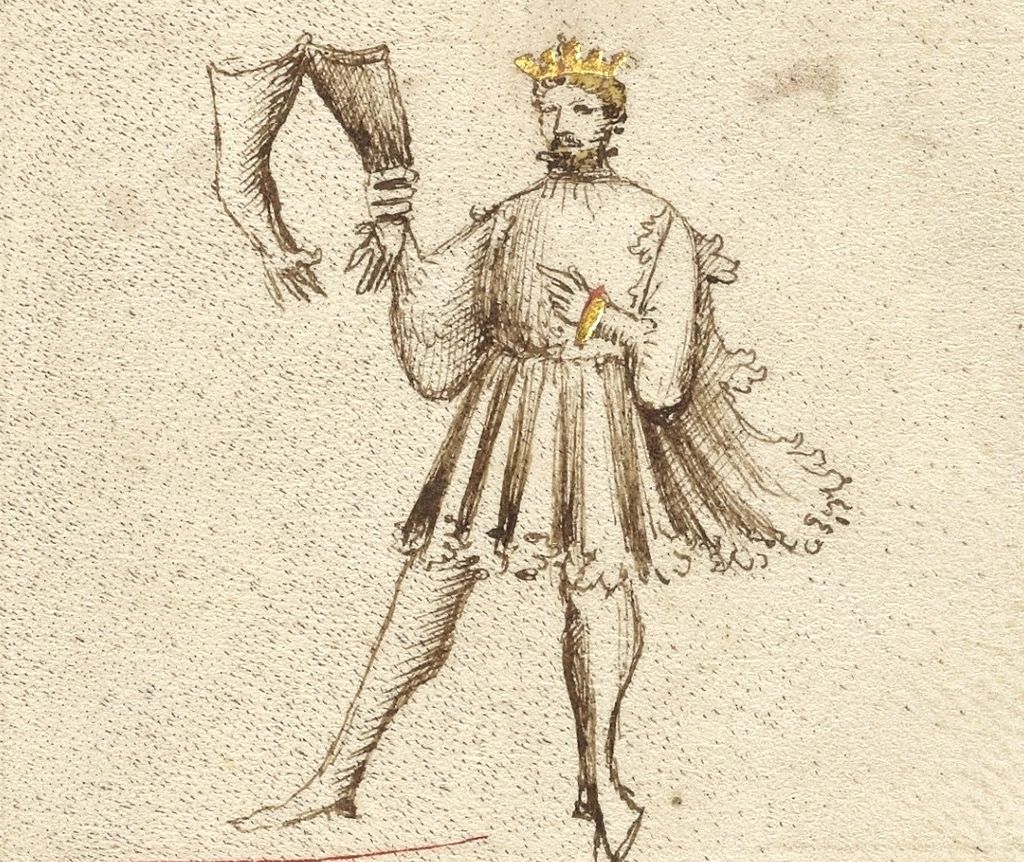
MS Ludwig XV 13, 25 r2 (“The Getty”)

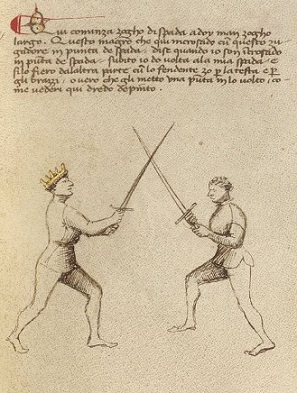
One of the challenges in historical fencing is deriving a useful curriculum from the sources. It’s especially difficult with older sources where more is assumed, the method of expression unusual, and where details we’d expect today are lacking. In Fiore’s corpus, for example, there are illustrations and descriptions, but a lot left unsaid too. Students working on the first master of the longsword wide plays, for example, have an illustration of the master and student crossed at punta spada (the top third of the sword or foible), another of the second option from this crossing, and an explanation:

 Here begins the Gioco Largo (Wide Plays) of the sword in two hands. This Master who is crossed at the point of his sword with this player says: “When  I am crossed at the points, I quickly switch my sword to the other side, and strike him from that side with a downward blow to his head or his arms. Alternatively, I can place a thrust into his face, as the next picture will show.”

Fiore dei Liberi, 1409

After the second image the Master continues:

 “I have placed a thrust into his face, as the previous Master said. Also, I could have done what he told you, that is, when my sword was crossed on the right I could have quickly switched sides to the left, striking his head or arms with a downward blow.” [2]

MS Ludwig XV 13, 25 r3 (“The Getty”)

There’s a lot here to work with, and the images help considerably, but it’s clear that Fiore assumes substantial knowledge on the part of the reader. Notice what is not there: there is no mention of how one gets to this crossing; we’re not told how the scholar might defend himself; while we know this is “wide play” there are no details about ideal distance or tempo; we’re not provided any indication as to which option to choose when, just that there are two. We have, thus, little context for this play, and not surprisingly when many of us learn it we do so as a set-drill. There are more and less effective ways to do this, but one hurtle many students must overcome is how to recognize that they’re in this situation within a bout, and, be prepared for what can happen after one of these options has been exercised. [3]

A similar conundrum faces students working on more recent material. One of my sabre students, for example, asked me how he might improve beyond the initial actions of a particular attack. In this case, he had no trouble making a feint-cut to right cheek, cavazione/disengage with a thrust from second, but if the attack was parried he found he tended to stop. He added that he often felt that way—there was the initial set-to, then he wasn’t sure what to do.

As we drill so we fight

In order to help him, we did the following:

Stage 1: from the engagement of second, cut right cheek (10x)

Stage 2: from the engagement of second, feint right cheek, cavazione/disengage and thrust to the chest (10X) [4]

Stage 3: from the engagement of second, feint right cheek, cavazione/disengage and thrust to the chest, BUT this time I parry the thrust and riposte

The first two stages are set-drills. Stage 1, which focuses on the attack the feint will simulate, is intended to prime the fencer to make as realistic a feint as possible. In Stage 2 they make the same action, this time as a feint, and finish the maneuver with a thrust. So far, the student is the “agent” as older English sources would term it, the instructor the “patient” or receiver. As is, these stages exercise the techniques which comprise this compound attack, but apart from working distance (potentially), they don’t situate the actions within the context of a bout. It’s a set-play focused on technique, distance, and tempo, but all on its own, isolated.

In Stage 3, we add just a little context. The instructor reacts rather than just receive the touch. When I employ this method I make sure that the first few parry/ripostes are consistent and the same, e.g. a half-step back, retake second, thrust, or I take fourth and riposte to the right cheek. After a few rounds of this, I then tell the student that I will vary the target on the riposte. This does a few important things. First, it alerts and prepares them to watch what I’m doing; they can’t just anticipate the same response. Second, it mimics what they’ll have to do in bouts when their opponent doesn’t call their shots. Lastly, they’re primed to continue fencing and not just stop after their attack, a common problem many fencers face starting out. Depending upon their skill level we may take it further with additional actions, especially if focusing on not stopping after the first three stages.

In the next exercise, we turn it around—I make the same attack (the one we’ve been drilling) and they practice the defense. Here too we start small and progressively add more actions. Depending on the student they can vary their defense too.

Approached well this takes a drill into what is, more or less, a bout in miniature. It situates a specific action or drill in context. It adds more movement. Because it’s a drill there is slightly less pressure for some students than a bout. Put another way, rather than face the giant question mark that is all the possibilities they might face in a bout, they face the smaller question mark of what to do following something they know, that they’ve been drilling the whole time. In the example just above, watching to see if I parry second and or fourth is much easier because it’s explicit, it’s limited to one of two responses, but it still trains the eye to watch the response and not anticipate or react blindly. This introduces a level of psychological comfort necessary for learning at the same time that it’s helping them grow accustomed to incorporating new actions into real time and honing observation skills.

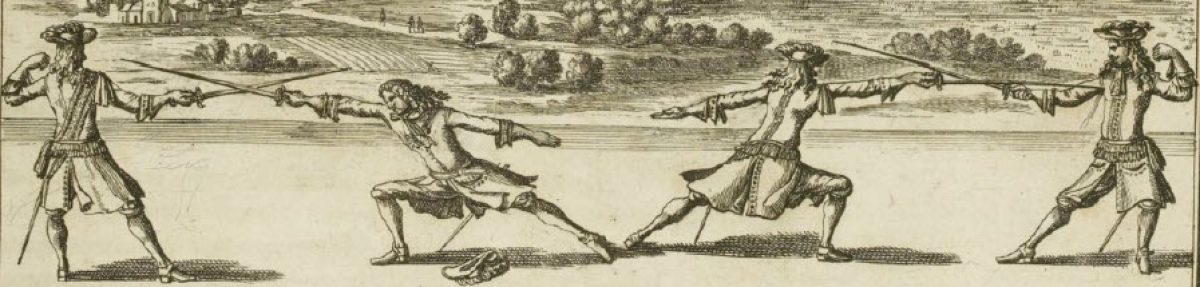
from Sir William Hope’s _New Method_ (2nd Ed., 1714)

There are other benefits to this approach. Placing the drill within a more combative context can serve as a pressure-cooker for testing more than how well they’re picking up a technique. If for example the student hesitates after the first few ripostes, encouraging them not to let up is important—if they have the advantage they should never stop before the halt. This said if they persist in the attack when it has failed, and up to that point neither person has been hit, encouraging them to take distance and reset is an acceptable goal. [5] Building confidence with a set of actions makes it that much easier for a student to incorporate them into their repertoire when they’re in the assault.

Progressive Drills in a Group Setting

Progressive drills can work in a group setting too. When I use this approach within a class setting I am careful to explain it at each stage, and check each pair of fencers frequently. This style of drill works best, however, with intermediate and advanced students. These students can help newer ones, but should have sufficient background to be able to notice basic trouble spots. Depending on the size of the class some amount of self-policing is necessary, another reason that it works better with more experienced fencers.

My more advanced students are quick to ask whenever they’re unsure about anything, and these discussions become opportunities to trouble-shoot, explain finer details, and explore variations on that particular drill. Time is often at a premium for many of us—we have barely two hours Sundays—but time taken to explain why we do something is important and isn’t wasted.

For beginners, I only use the progressive approach one on one, because the level of detail and attention required by both student and instructor is so much greater. One can make fewer assumptions, and sometimes we have to dial-back the complexity, something far easier to spot and correct one on one than in a group setting.

Progressive Drills & Curriculum Building

There is potential for this style of drill with our earlier works on the Art too. Returning to Fiore’s first master of the sword in two hands, wide play, the two options the master suggests could be Stage 1. Each partner would take turns attacking to work the two options. Stage 2 could introduce a defensive response—for the thrust, perhaps the defender counters with posta breve or frontale and cuts in turn or with the scambiar de punta (“The Exchange of the Thrust”). For the cut to the left side, one response might be posta fenestra followed by a thrust or a cut-around (or through) of the defender’s own. Stage 3, then, would allow the original attacker a chance to parry riposte, or, perhaps employ a move from the gioco stretto or close plays.

In the case of Fiore, whose exquisitely brutal system seems to have been intended to end a fight in two or three moves, there’s probably less need for long, extended plays (naturally proper safety gear is a must). This said there is value is situating his plays and exploring effective responses to them. Instructors in modern fencing will put students through drills with multiple actions within a lesson—something we rarely if ever need in an assault—because learning to work those multiple actions makes simple actions better. 

For instructors struggling to get their students beyond drill and into effective use of what they’re learning, to move them beyond set plays, progressive drills offer one potentially rich source. For students working without an instructor, say in a study group, this can also be an effective method of practice. It might be especially helpful for those small historical fencing study groups looking for ways to expand their practice and build curriculum.

NOTES:

[1] Wood-chop or Around the Horn Drill: this drill primarily works target placement and the fingers. With a mask as target, either hanging up or on a partner, the fencer makes a cut to the right cheek with a double tap of the fingers, then to the top of the mask, then a single bandolier cut to the bib, and either repeats the sequence or goes through various parry/ripostes before continuing the sequence.

[2]    Cf. http://www.nwarmizare.com/Pocket-Fiore/assets/www/getty_th_longsword2.html

This example is taken from the Getty, but a quick look at the three other known mss. adds little additional information. The Morgan is almost verbatim what the Getty offers and the Paris/Florius and Pisani-Dossi contain much less explanation.

[3]  Drilling First Master: researchers approach it differently, but one of the most sound I’ve seen is that employed by Mike Cherba (Northwest Armizare, Sherwood, OR) and Alex Spreier (High Desert Armizare, Bend, OR), both of whom first studied with Maestro Sean Hayes (Northwest Fencing Academy, Eugene, OR). Mike, for example, will have students start at punta spada, or start of out measure and meet there; if there is pressure against the agent’s sword, they cut around; if there’s not, they thrust through. Though first master of gioco largo doesn’t necessarily require pressure to work, the advantage here is that it provides one possible framework for the play and trains the student’s sentiment du fer.

[4] A look at most 19th cen. and many early 20th cen. Italian works on sabre will demonstrate the importance of having the hand about chin high on     the thrust. With the hand in second position (thumb to the left, knuckles up) or in first in second position a la Barbasetti, the top of the arm is covered by the guard, the hand high enough to prevent an unexpected shot to the face, and the arm is poised to make the parries of first, second, or fifth quickly.

[5]  If defense is the goal, if the goal is not to be hit, it’s better to break off than risk a counter attack or attack into tempo. The longer a phrase continues the more likely one might be hit.

Sabre with Rules, and, Without

Fencing Master (as Morgan Sheppard) 2
Morgan Sheppard, sword-master in “The Duellists”

There is this excellent scene in “The Duellists” (Ridley Scott, 1977) where the sword master, played by Morgan Sheppard, rushes upon the unprepared d’Hubert (played by Keith Carradine) during practice and says “On the watch, sir! Always on the watch… they don’t all fight like fine gentlemen.” A sword master like William Hobbs, who advised and choreographed the various duels in the film, no doubt knew well the reality of the duel—even with rules some people cheat. I’ve always loved this bit scene, because it reveals the reality behind what it takes to fight well (training), and, because it contains so much wisdom. It doesn’t hurt that it’s also packed with historical practice, e.g. duelists working out pre-duel with a master, an officer taking private instruction, a regimental master from the ranks as expert. The truth is that in fencing one must always be on the watch, can trust nothing, and assume nothing. We’re always safer assuming we face a superior opponent whether they prove so or not.

The traditional approach to teaching fencing, be it foil, spada, or sabre, assumes the duel, a battle between two people, on fixed ground, fought within the confines of rules. Even most longsword is taught this way at least as far as normally it’s approached one on one. There’s nothing wrong with that, but it’s important to remember, because off the dueling ground the experience could be quite different. In studying historical sabre, a weapon that draws greatly from military sources, we see a lot of overlap, but behind the fundamentals of footwork, attacks, parries, and drills is a context much different from that in most dueling codes. Sometimes we’re lucky and see glimpses of this in sources—Henry Angelo mentions several “grips” in the 1845 Infantry Sword Exercise; Rosaroll and Grisetti in the Science of Fencing (1803) list a number of similar maneuvers and their counters; Hutton too in his book The Swordsman explores those that Angelo must have read and that so far as I know go back at least as far as George Silver’s Brief Instructions upon my Paradoxes of Defense (1599).[i] A fencing instructor can teach technique; they can impart tactical reasoning and advice; but one thing they cannot do well is create the context of a fight outside of the duel.

Gladitoria MS_Germ.Quart.16_09v
Gladitoria, MS_Germ. Quart.16 09v

This is important. In historical circles more often than not fencers view the duel as somehow less worthy than a fight on a battlefield, despite the fact that most people actually train as if for a duel. In fairness, this bias really only affects the traditional three weapons and of those only sabre—no one says of Fiore, the Gladitoria, or works on rapier that the lists and Renaissance duels were less important. Why is that? Largely it’s bias against modern fencing—anything too “sporty” is immediately suspect. This is unfortunate, not only because so much of historical fencing pedagogy is borrowed from an Olympic context, but also because as far as competition is concerned, both “HEMA” and “Sport” fencing have more in common than either side is comfortable admitting. There is a lot of throwing out babies with bath-water when it comes to fencing tribalism.

Another, major factor is how difficult it is to create a battlefield scenario. Even small-squad tactics, fun as they are to play around with, often lack the surprises, set-backs, terrain, and chaos that so often attend such engagements historically. Being an agonistic vs. antagonistic endeavor we also lack fear. So, while we can train techniques, learn plays, and study tactics, we do so at an automatic disadvantage when it comes to how all these might have played out in the field. Many of the current venues that attempt this miss the mark—bohurt, for example, is plenty dangerous, but so far as I know no one is really trying to kill anyone or take and hold a position. I don’t wish to upset anyone, but as strong as these fighters are one sees less art than might.

I’ve argued elsewhere that one reason I think that the Italian military sources contain as much as they do was in a part because of the very real possibility that those reading it might be involved in a duel.[ii] Thus, officers needed to know more than what they’d likely need in actual combat. These manuals, however, had to work for rank and file, trooper as well as lieutenant, and so much of what we read there must have had practical applications on the battlefield too. While a solider might not find himself lunging a thrust or cut as he did in the sala or parade ground, what he acquired in learning to lunge were principles he could adapt to differences in terrain and situation. We do have some hints that regimental sword masters provided additional instruction too, often from their own practical experience.[iii] The surviving infantry manuals we have don’t often show one solider pitted against many, but we know they sometimes did; for example, Giuseppe Bolognini touches on this in his Sul Maneggio della Sciabola (1850).

Examining what is more appropriate for the dueling ground or battlefield within these manuals also begs the question—what isn’t gentlemanly? What is more appropriate or acceptable in war? Without rules one isn’t restricted, so pretty much anything you can imagine, like punching or shoving, as well as all the dirty tricks you can think of, from using terrain wisely to throwing dirt in their eyes, were possible. The grips, weapon-seizures, pommel strikes, punches with the bell-guard, and kicks while anathema in most duels were likely not only perfectly acceptable but preferable in war. This being the case, if we wish to train with these options how do we do so safely? Can we?

I believe we can, but with the caveat that safety must come first. By definition we are thus incompletely using the historical repertoire, but that’s okay. It’s important to appreciate this side of sabre, but being combat, life and death maneuvers, it makes sense we hold back. Students of Fiore dei Liberi, for example, are similarly hobbled—to use all that Fiore suggests we use in a fight would leave us without partners and very likely jail time. Even gaining minimal understanding of the options soldiers had will increase our appreciation for the weapon and its use.

The key to practicing these actions is to mix safety and control. Safety means an awareness that what we’re doing is dangerous and could hurt someone. Control means proceeding in such a way that we limit as much as possible the chance of injury. Not everyone has the control required to do this. If you’re sharing this with the inexperienced, I recommend moving at a snail’s pace. When I teach weapon seizures or the grips we start at slow speed, just going through the motions; there are only a few I typically teach and these have proved safe enough to do provided everyone behaves (and I work hard to ensure that). We speed the drill up as we go to instill a flavor of how these might have worked.

MS_Ludwig_XV_13_10r-b
MS Ludwig XV 13 10r-b (a.k.a. The Getty)

For those familiar with grappling from older works, especially medieval fight manuals, wrestling was the foundation for most everything. It makes sense—even disarmed one needs to be able to fight. My friends and colleagues locally who train Armizare and KdF are good examples for how to approach these potentially dangerous actions. The ligadure (It. “binds”) of Fiore, for example, could easily lead to a broken arm, elbow, or dislocated shoulder, so instructors like Mike Cherba and Alex Spreier take students through these moves slowly; even at “speed” the students slow down once the blades have made contact. Focus is on technique and timing. Because this is a partner drill the person turned into a pretzel is compliant; certainly this makes it easier but proficiency is gained through repetition, attention to detail, and making the maneuver, in time, as naturally as possible, not from fully performing the action as written. We do not have the “on the job training” that Fiore and his students did—in their case, this stuff either worked or they were hurt or killed. A lifetime of successful combat, especially against opponents less well-trained no doubt made skilled fighters formidable.

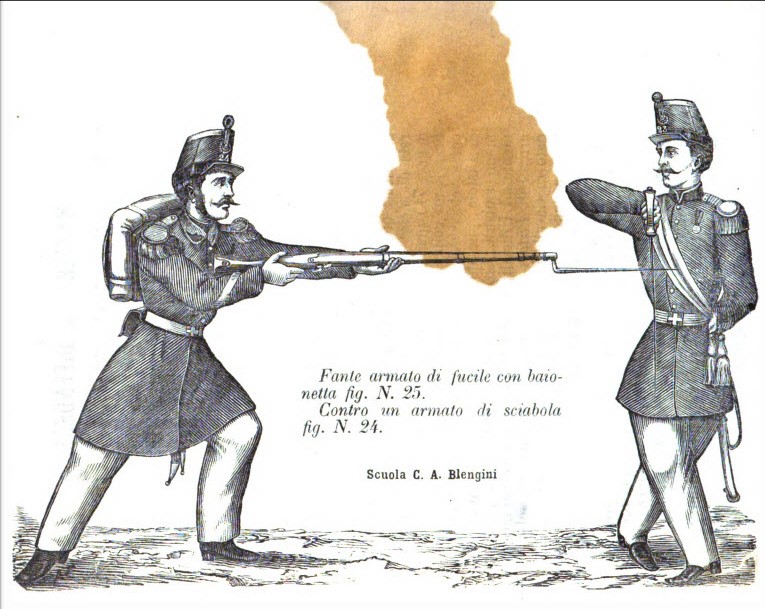
As an example for sabre, I’ll cover the “first grip” as shared by George Silver, Henry Angelo, and Alfred Hutton. Of note, this same maneuver is recommended in a number of bayonet texts. In this action, the attacker makes an attack at the left side of the opponent. Parrying in prima, the defender reaches under their own weapon and seizes the guard or wrist of the attacker and pulls them down and to the left—from here one can deliver a pommel strike, punch, and then cut or stab them after that.[iv] It’s a difficult maneuver to perform at speed, and from experience the seizure can become more of a check to the hand, but so long as one is quick with the follow-up blow it works pretty well.

Blengini, Trattato teorico-pratico di spada e sciabola e varie parate di quest’ultima contro la baionetta e la lancia

The first step I have them do is to practice oblique cuts at the left side of the head while the other parries in prima. Then they switch. Next, they take this move one step further—they parry the blow, step forward with the left-leg, passing the right as they reach under the parry to grab the guard or wrist. When they’re comfortable, I then have them deliver a tap to the mask as pommel strike (some stop short of the tap, which is fine). Lastly, they add a cut or thrust, e.g. a cut down the body from the attacker’s right shoulder to the left hip, and with the back edge of the sabre tip cut the back of the knee on the way back from that initial cut. Another option, if you have mats, is to take them to the floor after the pommel strike. We then go through the defense and grip for the right side (two versions), and follow up with the “Turkish disarm” or similar.

While no one is really punching, kicking, pommeling, or throwing dirt in anyone’s eyes, just moving through the grips can provide students a sense of sabre’s more rough and tumble side. This is usually material wholly unfamiliar to many students, and, it’s fun to learn! A further advantage to these exercises is that some, like that first grip, show up in a number of ways, not only for sword but as defense against bayonet. For students of “military” sabre some experience with the uglier side of the weapon can impart a deeper appreciation for the role the weapon played, for its use in the thick of things, but also for the ways in which traditional technique and combat intersected. Lacking as we do ideal sources for just how these formal techniques were adapted for war, such as a regimental sword master’s diary, we have to work with what we have, and, extrapolate the rest.[v] Any such experiment of course can, at best, reach what was possible, not necessarily what was actually done. This is unfortunate, but even in exploring what was possible we learn, sometimes ruling things out, but sometimes gaining insights we didn’t have before and so it’s worth it. It doesn’t hurt that it’s fun research to do either!


[i] See Henry Angelo, Infantry Sword Exercise (1845), 36ff; Rosaroll & Grisetti, The Science of Fencing, Milano: 1803, translated by Christopher A. Holzman, 2018, pages 219-236; Alfred Hutton, The Swordsman: A Manual of Fence and the Defense against an Uncivilized Enemy (1898), reprint by The Naval and Military Press in Association with the Royal Armouries, Leeds, 2009, 127ff; George Silver, Brief Instructions Upon My Paradoxes of Defence, 1599, Ch. 6, “The mannr of Certaine gryps & Closes to be used at yr single short sword fight Etc,” in James L. Jackson, Three Elizabethan Fencing Manuals, New York: Scholar’s Facsimiles and Reprints, 1972, 601ff.

[ii] See on this site, “‘Dueling’ or ‘Military’ Sabre?” May 16, 2019.

[iii] By the late 19th cen. sword combat outside colonial contexts was increasingly restricted to cavalry engagements. By its nature mounted sabre is more rudimentary; protecting one’s mount, delivering most attacks to right or left or just to either side of the horse’s head, and simple parries that might work best against sabre, lance, or bayonet require ample practice but much less technical know-how than the more complicated actions one might need on foot. It is also telling that regimental sword masters, some of whom must have been seasoned veterans, were responsible for teaching soldiers and troopers any additional “tricks” and skills they might need. See for just two examples Henry Angelo, Infantry Sword Exercise (1845), page 37, last paragraph; see also the Italian Ministry of War’s 1873 Regulations of Exercises and Evolutions for the Cavalry, Book I, trans. by Christopher A. Holzman, 2018,  70; 100.

[iv] See for example Cesare Alberto Blengini, Trattato della Modenra Scherma Italiana, Bolonga: Tipi Fava e Garagnani al Progresso, 1864, 78ff. Against rifle and bayonet this is a slightly easier grip to achieve.

[v] There are some anecdotal accounts that help inform us too. For one valuable collection of these J. Christoph Amberger’s The Secret History of the Sword: Adventures in Ancient Martial Arts, 1998, contains several such recollections, cf. “Battle Scenes from Balaclava” (p. 21) and “The Seduction of Art: Cut vs. Thrust in Military Swordplay” (33) contains several anecdotal snippets. This book can now be found online here [https://fencingclassics.files.wordpress.com/2015/01/the-secret-history-of-the-sword.pdf].

“Dueling” or “Military” Sabre?

[NB: My friend Jay Maas, a student of and instructor in Insular Broadsword, suggested I make a few things more clear than I did. His advice is sound and so I have made a few changes. It was never my intention to denigrate the British/Insular school; I merely chose texts from it as an example because like the Italians they have a rich source collection, the texts vary considerably, and because I know it best after Italian. I thought it was clear from my discussion below of the House of Angelo and its fame, as well as my comments about Roworth, that I know and acknowledge that there was a fully developed system in place and taught in 18th/19th cen. Britain, but it doesn’t hurt to make that more explicit. May 16, 2019]

[See also 23 March 2021, “Military vs. Dueling Sabre, Revisited” https://saladellatrespade.com/2021/03/23/military-vs-dueling-sabre-revisited/]

There’s considerable misunderstanding and a lot of misleading information out there about “dueling” and “military” sabre and how they relate. Some students ask me if what we’ll be doing is military sabre as opposed to “dueling” sabre, but this is a false dichotomy—they’re making a distinction based more on perception than fact, on specific application vs. body of technique. In large part both camps (not to mention sport fencing ultimately) draw upon the same material, the same sources, so how are they different? To what degree the same? It comes down, in part, to how we define each term. The quick answer is that there is no difference in technique, only in amount and purpose. Moreover, the duelist normally follows rules, a soldier normally operates in a theater without them.

When someone says “dueling” sabre what they mean, by and large, is “classical” sabre, that is, sabre as defined and intended for the dueling ground, and which in time led to the modern sport. Defining classical sabre, however, is as easy a task as defining classical fencing. A few examples. Columbia Classical Fencing, LLC‘s website, for example, defines classical fencing as “fencing as it was practiced in the West during roughly the late 1700s and into the 1800s.” [i]

Salle Green LLC in Virginia has a lot more to say, and suggests that classical fencing is:

fencing for sport or the duel, conducted in the manner of fencing in the years between 1880 and 1939, as reflected in the rich variety of fencing manuals in  English, Spanish, Italian, and French that survive from this period.  It is defined by the transition from a common set of weapons for civil and military use to a distinct set of weapons for primarily sporting and civil use, and ends with the development of the sports factory approach to training and the conversion to electrical scoring after World War II.  The classical period is important in the history of fencing as it makes the transition to the set of weapons we still use in modern fencing and establishes the form of footwork and blade technique that is the foundation for modern fencing skills.[ii]

These both situate classical fencing within a largely late 18th and 19th century context, though Green would push this, rightly in my opinion, into the first half of the 20th century. What’s missing in Maestro Green’s definition is what comprises “fencing manuals” in this period. Significantly, at least up until the 20th century (and indeed after 1900), many of these sources for sabre were military sources or written by military men.[iii] Often they were writing for a military audience, and in some cases, producing official government manuals on fencing. There are, of course, many exceptions, but if one looks at some of the more popular works per tradition the connection between military manuals and what tends to comprise classical fencing stands out starkly.

The supposed dichotomy between “military” and “dueling” (or “classical”) sabre is an issue more within the historical community than the classical. Many fencers within WMA/HEMA have desired to differentiate what they do from anything remotely resembling sport fencing. For them, classical fencing is too close to sport, and thus automatically suspect. Many within the classical camp use the same weapons as sport fencers, only with modified rules, and rather than address technique and purpose, which would show how much historical and classical fencers have in common, these same historical fencers reject them out of hand for using foils or S2000 sabre blades. The fact that the modern game derives from Italian and French fencing, that classical technique developed in these two lands, tends also to produce a quick reaction against things classical, especially given the popularity of English infantry manuals in HEMA. This is all guilt by association and ignores the salient fact: the classical tradition, especially for sabre, derives more from military than from civilian sources.[iv]

This bias, however understandable, is misguided. Ultimately it can be limiting too. Some proponents, for example, of English broadsword/sabre, often seem at pains to distinguish what they do as somehow more “military” than sport or classical, but here as elsewhere it comes down to definitions and how one applies them. What they fence is certainly closer to what an infantry private learned with his regiment, but it’s a far cry from what the officer in charge of that regiment likely learned. The texts of C. Roworth and Henry Angelo, for example, are no more military than those by Giordano Rossi and Ferdinando Masiello.[v] These English texts give us a window into sabre intended for the infantry between say 1800 and 1850, but while Roworth includes a comprehensive examination for sabre/broadsword, Angelo does not. Unlike Roworth or his Italian counterparts, Angelo’s sword exercise is hardly representative of the entire system he taught at his own sala. Henry Angelo, author of the Infantry Manual of 1845, was the grandson of Domenico Angelo Malevolti Tremamondo, author of the exquisite L’Ecole des Armes or The School of Fencing (1763). Very little of the sophistication the Angelo’s were famous for, and which is illustrated so wonderfully in Domenico’s book, made it into the 1845 Infantry Manual. It did not need to be there. It is almost as if some fans of Angelo and Co. find it more legitimate because the infantry manual is so bare-bones, so devoid of the sophisticated maneuvers they associate with artful, sport fencing. This is not to say it wasn’t there, that it didn’t exist, but to remind the reader that they won’t see much of it in that source.

The context for these various texts is on its own instructive. If, for example, one compares the works of Settimo Del Frate and Henry Angelo, the former contains a lot more instruction. Angelo’s goal was to provide a minimum of basic instruction, not a complete program. By and large the key Italian works present much of the state of the knowledge at the time, not just the fundamentals. One reason for this is that in the newly formed Republic of Italy, military fencing masters were vying for preference and position, so their works intended for the army were not just drill manuals, but books intended in part to reveal the author’s expertise over that of his fellows.[vi] Taken together, the corpus for Italian sabre is thus more exhaustive and sophisticated. This reflects a difference in context, in purpose for many of these treatises, and as students we need to keep that in mind.

The difference in context explains a lot, everything from why say Del Frate or Masiello’s works are longer and full of details, even lesson plans, and, why Angelo’s pamphlet on infantry sabre is so rudimentary. The rank and file did not need a complete course in swordsmanship. [vii] After the volley their next step was the bayonet. If the fighting came down to sabres, something had likely gone very, very wrong. They needed enough to be effective in the context of war, not thoroughly tutored in all the options required for combat mano a mano. The requirements of an infantry private are different from those of the duelist. That private, because of his rank, will not be fighting duels, and thus has little need for more than basic instruction, good as it might be. The duelist, on the other hand, only benefits from possessing a larger selection of options even if, and this is critical, they never use them. They must be able to recognize them, and, undermine them. In short, a duelist needs more than an infantry soldier.

The duel is a critical consideration in understanding why some sources are more detailed than others. While it had all but disappeared in England, dueling culture was still alive and well in Italy at the time these works were written. Though illegal, as it was in England, provisions were made within the military and several military men, most notably Achille Angelini and Giordano Rossi, wrote dueling codes.[viii] Many within historical circles thus equate “classical” and “dueling,” and this isn’t wrong, but they misspeak in saying that these are somehow separate from “military” sabre. They are one in the same, just presented in different ways for different audiences, for different purposes. Because the officer ranks were the only ones allowed to duel, in so much as anyone was, it is little wonder that the officers writing these manuals included more within their work, that is, included those maneuvers that any one of them might have occasion to call upon should he find himself called out. It should be noted that British officers, like their brothers most everywhere else in Europe, typically contracted a master for more complete, advanced training.

For students interested in military sabre, some notion of this historical context must be taken into consideration. This should go without saying, but for all the discussion of the “H” in HEMA, too often it is ignored. Many new fencers learn about military sabre from Youtube videos or social media, and if they see that one school of sabre uses the term “military” more often than others then perhaps it’s more understandable that they fail to see how other national texts on sabre were also largely codifications of military systems. It is also one reason they think that dueling and military sabre are different animals—few people ever talk about the connection between them.

Students of sabre should pay some attention to the wider corpus. Regardless of the tradition they favor, even a basic acquaintance with other national military programs, not to mention different applications for the same body of technique, can only benefit them. This is true for those interesting in “dueling” and those interested in “military” sabre—these are just different applications of the same material. At the very least it may prevent them from grossly misunderstanding what it is they are studying.


[i] See https://columbiaclassicalfencing.com/fencing-terms/#c. Accessed 3-5-18.

[ii] See https://www.sallegreen.com/programs/classical-fencing/. Accessed 3-5-18.

[iii] A master I worked with in Portland, Oregon, the late Maitre Delmar Calvert, was trained in the French army (he was a Foreign Legionnaire) at a time when they were still using the revised Règlement d’escrime issued to the French army in 1908. For more on Calvert’s early training and military career, see Bernard Coliat, Vercors 1944 des GI dans le Maquis, Imprimerie Jalin à Bourg-Les-Valence, 2003. See also http://usfencinghalloffame.com/wp/calvert-delmar/

[iv] As a quick example, Italian works from ca. 1850 on were largely produced by military men for a military audience, from Del Frate in 1868 to Pecoraro and Pessina in 1912. The French Reglement (1877), likewise, codified fencing for the French military. This is not to say that works dedicated to sport were not beginning to appear, but that even these, ultimately, looked back to these military sources.

[v] In fairness, Roworth’s 1804 treatise is a thorough work, providing more than Angelo’s later infantry manual. He entitled it a “complete” system for broadsword for a reason, and one examination will demonstrate why. Not only did Roworth lay out his approach to the use of the weapon, but he also covered defense against smallsword, spadroon, and bayonet.

[vi] For a good discussion of the competition between military masters in the newly unified Italy, see William M. Gaugler, The History of Fencing: Foundations of Modern European Swordplay, Bangor, ME: Laureate Press, 1998, 166-167; 216-217. A more recent, complete examination, and some of the key documents, can be found in several of the translations of Chris Holzman. See especially his The Art of the Dueling Sabre, xxv-xxxii; in The Roman-Neapolitan School of Fencing, Holzman includes some discussion of the Northern and Southern Italian rivalry (xxi-xxii) as well as the report of the Hon. Paulo Fambri to the commission dedicated to choosing which manual, and thus which region North or South, would define the official military program (xxxiii, ff.); for some sense of the vehement opposition to Parise and the Southern school by Radaellian devotees much can be gleaned from the observations about Masiello’s strong feelings in Holzman’s translation of Sabre Fencing on Horseback (1891), ix-xiv.

[vii] Masiello’s manual for cavalry, for example, is not a complete work on sabre, just sabre as applicable for fighting from the saddle.

[viii] See Lt. Gen. Achille Angelini, Italian Chivalric Code, Firezne: 1883, translated by Christopher A. Holzman, 2016; Giordano Rossi, “Concerning the Duel,” In Capt. Settimo Del Frate, Instruction in Fencing with the Sabre and the Sword, 1873, translated by Christopher A. Holzman (2011), 222-230 [this is a chapter from Rossi’s Scherma di Spada e Sciabola, Manuale Teorico-Pratico con Cenni Storici Sulle Armi e Sulla Scherma e Principale Norme pel Duello, Milano: Fratelli Dumolard Editori, 1885]. See also Masaniello Parise, “Fencing on the Ground (1904),” In The Roman-Neapolitan School of Fencing: The Collected Works of Masaniello Parise, Maestro di Scherma, translated by Christopher A. Holzman, 2015, 295-319 [revised in Carlo Pessina and Salvatore Pecoraro’s “Spada Fencing: Play on the Ground (1910),” In Sabre Fencing, 1912, translated by Christopher A. Holzman, 2016, 175-197.] It is important to note that McBane, who wrote works on smallsword and broadsword, was not only a fencing master and soldier, but a duelist.