Though it is coming together by fits and starts, I’m doing my best to make good on a promise to create a series of videos that provide help in reading and using Luigi Barbasetti’s _The Art of the Sabre_ (1899). It builds on the excellent work of my friend and colleague, Maestro Michael Kňažko, Barbasetti Military Sabre (since 1895), Prague, Czechia, who so beautifully covered the introductory material, from guard, to parries, the molinelli, etc.
There is more to come, and I will do my best to order everything so that it mirrors the progression of the treatise. There are a few videos up now that are from sections later in the work, the result of questions I’ve received, but in the end the hope is to have each chapter covered well enough to assist someone brand new to the method.
I have had less time to post thanks to a demanding day-job, but with the return of one of my advanced sabre students I had the joy to teach an individual lesson this morning. As so often happens when we have an hour, we drilled but also had time to explore the whys and hows of aspects of the drill in great detail. This student is a quick study–she is extremely intelligent, athletic, and possesses a solid background in foil, all of which mean she has questions. I like questions.
Coming up, no master I’ve studied under brooked questions during the lesson, but most of these lessons were short, 15 to 20 minutes, 30 depending on how many of us were in attendance. Questions were for after the lesson. My student this morning drives in from the city and we meet half-way–given the distance and the fact we only meet once a week the lessons are longer, usually an hour, and so there is time for discussion. I want to make it worth her while and provide her enough material to practice on her own.
We covered some difficult material this morning, Barbasetti’s counter-prime and counter-quinte (pp. 45-46), and since I am deep into study for my master’s exam, I have had more occasion to think about these in detail. The description of them is brief as they assume the reader either has a working knowledge of them, is studying to become a master, or is working with a coach as well as reading the text. [1]
To dive straight into these useful but rarely covered techniques, even for an advanced student, is unwise. It is better to lead up to them, to show one’s math as it were, and so our warm-up consisted of exploring simple parry-ripostes in each line. Next, we examined two of the circular parries, “counter-parries” in Barbasetti, namely counters of tierce and quarte. We had not covered these for a while, so it was good drill. Once we added movement, things changed, and this afforded me a chance to introduce counter-quinte and counter-prime.
The Master’s words explain them better than I can:
Counter-Prime and Counter-Quinte
The key aspects to note at the start are first that one employs these measures at close distance, often while while still in the lunge. Second, they work best advancing, which means a recovery forward into guard as one executes the counter. As I explained to my student, these two measures are sort of in between static, simple parries, and parries via molinello. They are, however, “active” parries, more cuts into the riposte than blocks.
My student asked me why we would use circular parries or these two counters. Excellent questions. Again, the master has an answer, but one I might expand upon a bit. Barbasetti wrote
But why not employ simple parries, since the counter-parries offer so many difficulties?
The object of these two parries is to put you in an advantageous position for the defense by means of unexpected movements.
The regular study of these parries trains your mechanism to such an extent that all complicated movements afterward seem easy to perform. [p. 46]
These are important considerations. Maestro Couturier made a similar point, as did his assistant Brian Peña, when I asked about some seriously complicated drills they had us do, ones with multiple feints, change beats, everything. It was, as I now say too, “medicine for the hand,” meaning that drilling complicated actions helps sharpen simpler ones. When I asked Brian when I would use this set of actions, he said “Oh, you wouldn’t; that isn’t why we do this type of drill.” Looking back on it, that was a key moment for me in my development as a fencer, one of those times were I realized just how much more to fencing there is than technique or actions.
It is the same here. Barbasetti also remarks that these counter parries improve our simple ones. He adds, however, that they can be “unexpected movements,” which is to say options when simple parries aren’t working and/or tactical choices. For example, if my opponent feints to my inside line and I parry quarte initiating their disengage, the simplest response is to return to tierce. Let’s say I do that twice during a bout. My opponent, if I’m lucky, believes that this is my response–if I have made that action on purpose to set them up (a species of second intention), I will surprise them when the third time I used the counter-parry of quarte.
It was a good lesson, one that generated considerable discussion about the actions themselves, but also and significantly putting them to work in real time. One of our primary goals is not to be hit at all versus considerations of right-of-way, so exploring how to make counter-parry-ripostes and use counter-prime or quinte and avoid being hit made for specific choices in terms of both the line the riposte would take as well as considerations of footwork. Though we do not read about it much in the Radaellian corpus, traverse steps, off-line footwork is implicit in the system. Sure, the intagliata and inquartata were and are standard subjects in Italian fencing, but there are options akin to them we can employ too. [2]
Much of what we covered today is material I’ve taught countless times at this point, but what stood out to me, and the reason for writing this post, is how much better the lesson went today because of my current study. At least as early as Fiore dei Liberi (fl. 1400) masters have advocated adding the study of treatises in one’s training, and today reminded me of the value in doing so. Because I teach historical fencing, I most often work from texts, but my study of Barbasetti is, in many ways, closer because I have to be able to answer, best I can, anything my masters in Prague ask me. [3]
Continuing education, study, is not just for exams. It’s something we should do all the time, forever, as long as we fence and teach. One of today’s lessons, for me, was to take this same granularity of study and apply it each week. This means spending more time pondering, examining, and experimenting with the ideas, techniques, and actions in all that I am teaching, from sabre to smallsword, from rapier to bayonet. Doing this, taking it all apart and examining it before putting it back together, increases understanding and lends depth to our approach. It will make us better coaches, and, better fencers.
NOTES:
[1] Barbasetti, The Art of the Sabre and Epee, 1936, xvii explains that his book is a guide for preparing masters, for masters whose training may have been incomplete, and for fencers who wish to understand better what they’re learning.
[2] Often-line footwork, such as traverse steps, is a commonplace in works on Insular broadsword, but I’d argue that the same footwork is useful for sabre. In the video series I am putting together on Master Barbasetti’s sabre methodology, I will explore examples.
[3] We have not yet set a date, by my mentor at Barbasetti Military Sabre (since 1895), Maestro Michael Kňažko, as well as his colleagues Masters Leonid Křížek, Michal Kostka, and Josef Šolc possess deep knowledge and decades upon decades of experience, and the nature of a master’s exam, both the written or oral exam as well as the practical one, are open to anything they should choose. It is a daunting, and at times I’ll admit it terrifying, experience, but one I look forward to. Pass or fail it will be valuable and I shall learn a lot and become a better coach. Should I pass (there are no guarantees with such exams), in truth the journey really only begins. I look at it the same way my elder son’s TKD master put it to him when he passed his black belt exam–“Now you’re ready to start learning.”
In my sabre lesson this morning my student and I explored some options from the invitations in 3rd and in 4th. Like a feint, these actions (hopefully) encourage an opponent to attack where we want them to. Baseline, what we’re setting up is a parry-riposte. Against a newer, less experienced fencer, this might be enough, but a more advanced fencer will see the trap and have some idea where one might go with it. There are, happy to say, more options from this simple set-up than meet the eye.
Student’s Invitation in 4th
After the basic parry-riposte set up, a solid next step is an indirect riposte—this requires us to hold the parry before making the riposte. It is best used when our opponent is too quick to parry. For example, if we have made a few cuts to the head, even probing, or better yet from this same set up but slightly out of distance, an opponent might expect us to cut head and so they assume parry 5. If we see them do that once or twice, we can invite, parry, wait a sec, then as they preemptively parry head we strike in an open line. One of the safest strikes is to the lead arm, thrust or cut, as this keeps us back a bit and puts more steel between us and the opponent. One can, though, attack almost anywhere so long as one covers on recovering from the lunge.
Another option is a compound parry-riposte. This is closely related to the indirect riposte as it assumes similar conditions. Where the latter hesitates, the former feints. Following the example above, if one invites in 4th and parries 3rd as the opponent takes the bait, one then might feint head to cut arm, flank, or chest. The feint might be made to any line, but works best against a known proclivity. Here, again, some probing actions or false attacks can sometimes tell us which parries an opponent is quick to take.
These are all defensive responses set up via second intention. However, one question today was can one make a counter-attack from this set-up. Yes, and, no. At its root, invitations set up defensive responses, but this said there are ways to include a counter-offensive action given certain conditions. This part is critical. It is possible to make oppositions cuts into the attack from an invitation. These are similar to what we call “bearing” in Insular broadsword. Using the same example, from 4th, should your opponent attack a little out of distance or with a poorly extended arm—either one provides a bit more tempo to act—then from 4th one would but cut in such a way that one simultaneously closes the line as one lands. [1] From 3rd, one would cut across closing the inside line and landing at the same time (often this means striking the arm). It is not easy to set up as it requires the opponent to make specific mistakes, but if they do, this is a fun conclusion to the invitation.
Student Initiated Attack–Shutting Down the Trap
When we switched roles and I adopted the invitation, my student had a chance to explore ways to shut down the trap. Timing, speed, and choice of action all meet in a tight place when we succeed. Using the false-edge, for example, I did not expect, and it succeeded beautifully. Many fencers will be unprepared for that. It can made from farther away, again limiting the danger faced by the attacker.
The simplest option in springing the trap is to attack knowing they will parry-riposte, and then making one’s own counter parry-riposte. I didn’t want to complicate things, but in that counter parry-riposte one can do much the same as the person inviting: one can use an indirect riposte, compound parry-riposte, even an opposition parry and cut if conditions allow it. Naturally, one’s feet are critical in success. If, for example, my student lunged her attack, then I would take a step back to parry. If she recovered quickly, I would have to lunge to riposte; if not, I might do it from standing. Regardless, we need enough room–and thus time–to act.
Invitation in 3rd–Barbasetti (1899/1936)
We also discussed the difference between an obvious invitation, e.g. taking 4th, and an invitation disguised to look like either incompetence or inattention to the line. For the latter, one might invite in 4th barely exposing the outside line of the sword-arm. This can appear like a lazy or untutored guard. One can feign being tired and thus sell the lazy guard too. All about selling it, a major aspect of tradecraft. [2]
If we want to invite in similar fashion in 3rd, we might hold that guard a bit too far out exposing the inside of the wrist. Many of the same options we covered with an obvious invitation apply here too, but this style is more likely to work against a fencer farther along in their training.
When we switched roles, one effective and less risky attack she made was to thrust to the inside wrist when I adopted a lazy 3rd, allow me to parry, and then thrust with opposition (usually with an advance-lunge or redoublement). If I adopted a lazy 4th, she could feint to the outside, and when I parried in 3rd cut around and cut with opposition to the arm or chest, or, make a bandolier cut and step a little back and to the right. Getting good extension on the cut—which keeps one safer—means having enough distance to extend, thus moving more back and right versus in and right.
Tactical Application
This lesson was a mix of types–we covered technique, options, and tactics. Not every lesson need do this, and in fact many should not. Today I was working with an extremely gifted fencer, one with a deep foil background, and with whom I’ve been working sabre for several years. Even today, though, in the last drill she realized she was pulling her chest cut, so we stopped and spent the last ten minutes of our time just working on getting proper extension on her cuts.
The tactical considerations for using invitations should derive from whatever intel we’ve been able to gather about our opponent. Sometimes we have next to no time–we meet someone new in the ring or on the strip and have to triage our choices via testing, probing, and false attacks. Sometimes we have had a chance to watch them fence and see what they typically do, how they respond, and larger picture considerations–are they calm? Nervous? Excited? More defensive? Offensive?
Considerations of another fencer’s proclivities is vital, because no matter how sound or expertly an action might be, it might be the wrong one to use against that opponent or at that time. For example, if my favorite action were to invite in 4th, but my opponent is likewise a defensive fighter, then we’re as likely to run out the clock as anything else. Boring. If, however, I’ve made some assessments, have some idea of how they play, then I can pick actions which might work better. If they’re more defensive, then I’ll start with the more offensive options in the tool box.
This may seem obvious, and it is, but it’s easy to focus on something to our detriment. I know that more than once coming up I had learned a new, cool maneuver and couldn’t wait to try it out, but in my zeal tried it when there was next to no chance it would work. I have been extremely lucky to work with awesome coaches, and they would ask me, post bout, why I had tried it. They knew I was working on it, but had to remind me that not every action will work in every instance.
In terms of large, obvious invitations, they can work super well, but if they’re not–don’t use them against that opponent. Today, for example, my student is far faster than I am. Even playing the invitee role I struggled to parry some of her cuts; I know how to compensate for that, but even so had our lesson been a bout I would have realized quickly that obvious invitations were a super bad idea in fighting her.
Use the right tool for the job.
NOTES:
[1]Opposition Cuts: I do not spend a lot of time on them, but they do exist, even for systems that seemingly don’t include them. Where bearing doesn’t work well with a curved guard, it works super well with a basket-hilt’s flatter guard top.
Within a Radaellian context, opposition cuts normally mean making one’s molinelli in such a way that they simultaneously strike and close the line.
[2] Tradecraft: a universal of fighting, tradecraft refers to all the intelligence gathering and mind-games we play with an opponent. In addition, it is a game we play with officials too.
from _Istruzioni per la sciabola di sciabola_ [_ (Instructions for Sabre Fencing_], by Arnoldo Ranzatto, first published in 1885, Venice; this is from the third edition, 1889.
Thanks to long-standing injuries and their maintenance I’ve not been teaching as much sabre than I have in the past, but I still have a few students grand-fathered in as well as one or two new people whom I’ve agreed to meet for Radaellian sabre. This summer I’ve had the pleasure to work with two adult fencers, both with experience, but new or newer to Radaelli’s method. As a firm believer that a teacher is (and should always remain) a student, I’ve found that no matter how many times I’ve taught the same, day-one material, that there’s always something new to learn, or, to appreciate in a way that I didn’t before. Students have a way of asking questions that help me refine answers, make them more succinct and intelligible, and that changes not only how I see the material, but also and importantly how I teach it.
The Scarto
In this post I’d like to focus on the scarto, a “shying away,” which was a key feature of Radaellian sabre, and, what sometimes proves a missing piece in modern reconstructions. In March of 2021 I added a post here entitled “Italian Sabre & ‘HEMA'” where I explored some of the reasons for the lack of popularity for this system. [1] One of the major criticisms leveled at the Radaellian method is the size of the cuts and the relative time it takes to make them. I’ve hear this from people in the community as well as from new students with some experience. It’s an important observation, and reveals to me that those of us teaching Radaellian sabre likely need to make the purpose of the scarto far more clear in our lessons.
What’s Up with this Leaning Stuff?
A natural question comes up in viewing the scarto–why should one do it? Everything we teach should have a solid reason for inclusion; it’s never satisfactory to say “because it’s in the treatises.” The why is critical. In origin, this shift of the trunk likely derives from fencing in the saddle. Giuseppe Radaelli, after all, was a cavalryman and his system was designed to revamp then current practice. Before Radaelli, the wrist was used as the axis of rotation for cuts, but in actual use some troopers found it ineffective in battle and thus Radaelli’s innovation, the elbow-driven cut. [2]
Christopher A. Holzman, who more than anyone else has opened up the Radaellian corpus to the English reading world, discusses briefly the connection between the scarto and mounted combat. His take on the scarto in The Art of the Dueling Sabre, which provides a translation of the 1876 edition of Del Frate’s manual–the first to codify Radaelli’s method–is corroborated by the evidence contained in Ferdinando Masiello’s 1891 Sabre Fencing on Horseback[3]. In short, from the saddle, both cuts and thrusts include a slight lean towards the target; in part this is explained by the height of one in the saddle, but it also helps ensure, for cuts, that enough of the weapon meets target to be effective.
Remember that when mounted one’s feet are in stirrups, one’s thighs grip the flanks of the horse, and one’s left-hand grips the reins (all troopers regardless of handedness were trained as right-handers)–all of these contact points affect movement of the upper body. Reach and angle are both affected–even in late cavalry practice we see troopers leaning forward if not to the side in stills from drill and maneuvers.
French Dragoons illustrating the lean in the saddle
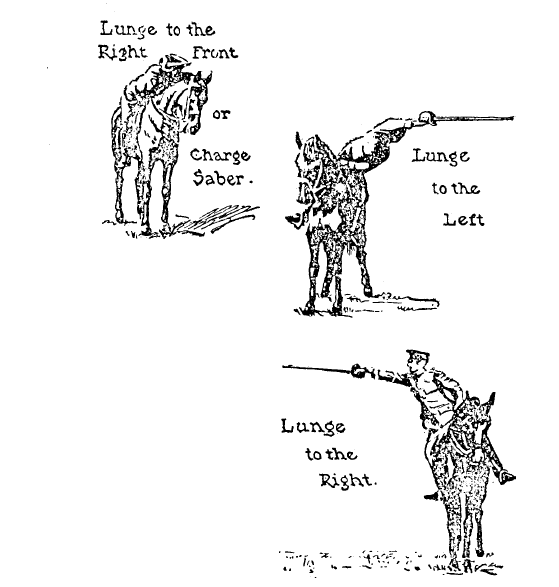
Though I’m not a great fan of Patton’s sabre, his Sabre Exercise from 1914 is another excellent point of reference for the place of the lean or scarto:
Patton, Sabre Exercise, 1914
Moreover, and without meaning to upset animal-right’s activists, the lean we often see in period photographs and illustrations owes something to the fact that the horse’s head and breast offered some cover as one faced the enemy. Though most late period cavalry engagements did not assume one-on-one melees between troopers, the lean toward the enemy may have helped one void the enemy’s weapon as well as assist reach to target. In reverse, leaning back to parry introduced that much more distance to attempt to defend.
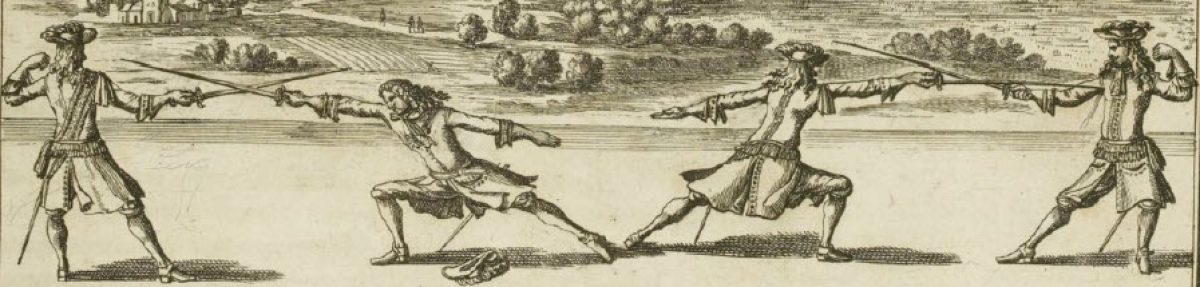
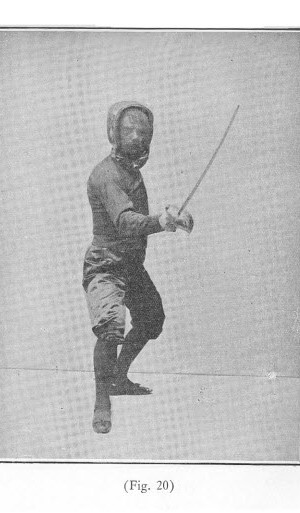
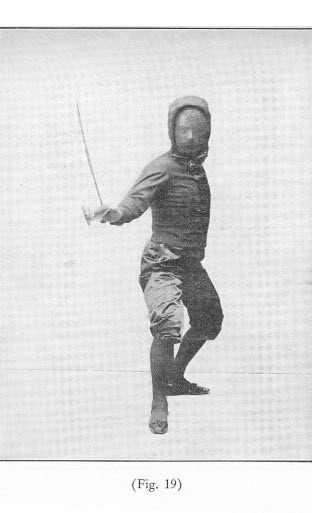
Unmounted cavalry sabre exercise in Italy, as in other places, included the use of the lean. [4] Even for exercise on foot, which is to say not standing as if mounted, we see this lean:
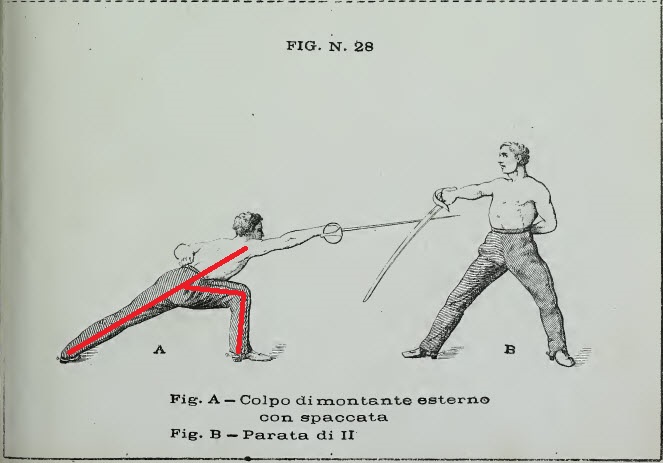
Compare the angle of the trunk here, in line with the rear leg, to that in Del Frate:
Del Frate, 1868: while rendered rather extended, as the red lines I’ve drawn indicate the trunk should be no farther than the angle of the rear leg.
What the Scarto Achieves
The historical precedent for the scarto is important to know, but for the vast majority of us fencing only on the ground vs. in the saddle, what good does it do us? Everything. The scarto, combined with proper management of measure, tempo, and judgment is what makes the system work against those traditions which rely more on quickly made direct cuts.
It’s the scarto which provides that additional bit of insurance when we attack or defend, and which when used properly discourages counter-attacks to the forward target. It should anyway. If you’re a Radaellian fencer and you’re experiencing stop-cuts or an arrest when you make your cuts, then add the scarto.
There is one caveat and a vital one for anyone mixing with non-Radaellians in “HEMA:” many if not most opponents will try to hit you anyway.
I forget which number of dead horse this is that I regularly beat, but many opponents will ignore the giant cut speeding toward them and select the ify counter-attack. They will argue that they hit you, and sure, they did, but they should not have: they should have opted to defend themselves first. Here as in most things we must artificially remove the mask and safety gear and imagine the weapons in our hands are sharp. NOTHING we do in historical fencing makes sense if we neglect this.
For example, imagine an opponent makes a cut to your head. You parry in 5th, then start the molinello from 5th to the inside cheek (assuming two right-handers). Made with the torso upright you might get the cut out without being hit with an incidental slice, but with the opposing steel there, and the tempo the elbow-generated cut takes, it’s possible for the opponent to draw the sabre back to guard and rake the arm as they do.
Now, add the scarto. When you take 5th, you add a little more distance with the slight lean back; this not only charges the blow a bit more, but importantly means that you start the cut from slightly farther away. The weapon always leads the way–it’s a universal–so… with the cut starting sooner, from juuuust out of distance, they have a choice: stop the giant cut or go for the counter.[5] One of these is sensible, one stupid. For it to work, however–and this is the important part–the opponent has to recognize the difference. Thanks to the fact that too many in HEMA are thinking more in terms of points than imagining sharps, one is likely to be hit a lot trying this out.
Do it anyway. We shouldn’t limit ourselves because our opponents are poorly-trained and approaching bouts as if slapping bells, however “martially,” with their cousins, Olympic sabreurs.
Incorporating the scarto will take some practice if you’re not already doing it, but it’s worth the effort. Start by employing the scarto in solo drills. [6] Next, use them in pair drills–a simple parry/riposte exercise is perfect for this. Once you’re comfortable, add it into all drills and into any bouting. With your fellow Radaellians, this will improve your appreciation for the system. Used against skilled opponents, the addition of the scarto will demonstrate why it is Radaelli who has been called the “father of modern sabre” and not someone else. [7] Lastly, remember against the average “HEMA” sabreur you cannot expect them to understand why despite their sense of victory they’re actually getting spanked, but you can take some comfort in knowing that you’re doing right by the system we study and more closely approaching what historcal fencing should be.
[2] For the impact of Radaelli’s innovation, see William M. Gaugler, The History of Fencing: Foundations of Modern European Swordplay. Bangor, ME: Laureate Press, 1998, 166-167; see especially 194-205.
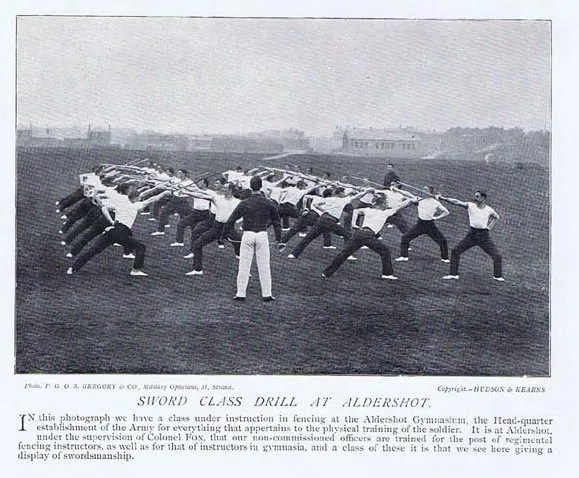
[4] We see use of the lean in other systems–this image from Aldershot, for example, would suggest the influence of Masiello on the 1895 English Infantry Sabre Exercise. NB: Radaellian sabre was split into three expressions–mounted practice, drill as if mounted but on the ground, and, on foot, the latter intended for combat as well as the growing agonistic sphere. What does “unmounted cavalry drill look like?” Like this:
English cavalry recruits, unmounted drill, 1914
[5] Counterattacks are a risk against a certainty. In the sport, so long as one makes the touch before the light (i.e. as if “in tempo”), fine, but it doesn’t work that way when they’re sharp. Put another way, if something sharp and pointy is about to hit one the smartest thing to do is go on defense, to parry, not to think “oh yeah, I’m just gonna go for it and hit them first; should work fine, no problem.” No, it might not work out if one’s goal is not to be hit too. In teaching counterattacks, regardless of weapon, I generally advise students to counterattack only if they’re at least one tempo ahead of the opponent’s attack; it follows, then, that in most cases the opponent has made a tactical error. They might have started the attack from out of distance; they might have started the attack with a bent arm or foot/body before weapon; or maybe they’ve just failed to cover their arm on the way in; in these cases one should, distance, timing, and judgment allowing, have a chance to attempt the counterattack and cover with a parry/riposte should it land or fail. If it looks like one might not have time to cover, don’t try it. Just parry and riposte.





 Capitale Escrime Historical Fencing