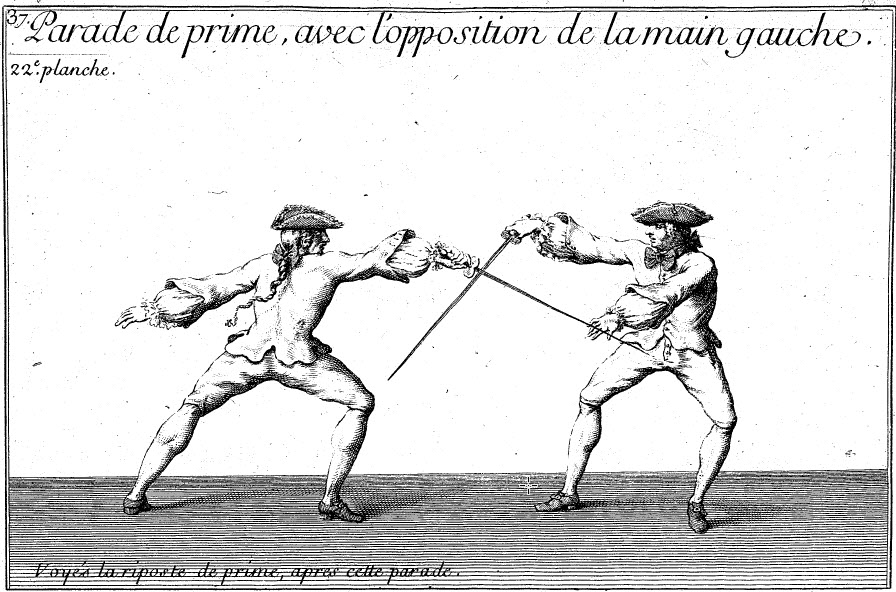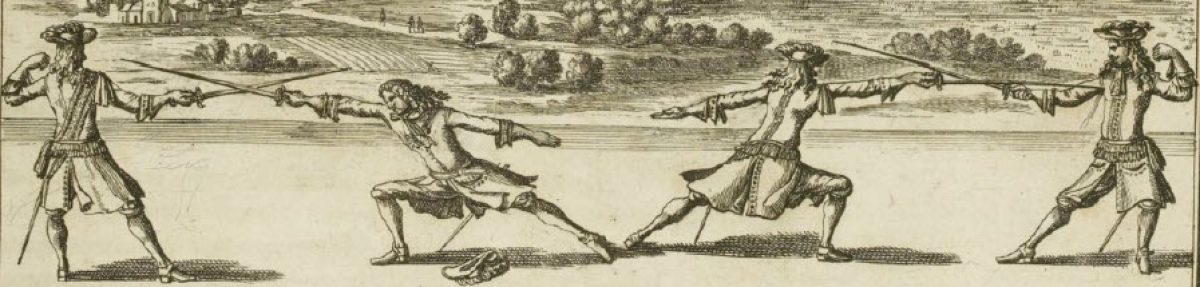
Suicidal Tendencies—“All I wanted was a Parry…”

This post is a follow-up to the last [“They Doth Cut too Much,” Methinks, 19 Oct. 2023] and takes up, again…, the issue of how we make a touch. This issue has been on my mind a lot in part because of teaching, but also because my current book project requires me to explain the challenge of hitting without being hit as simply and clearly as possible. While I’ve discussed this often, which is to say like the drone of a bagpipe in a particularly long air, it’s one of these critical issues that we can never really emphasize enough. The proper mindset determines everything we do.

In brief, rather than focusing on making the touch, we should focus on trying not to be hit. It’s easy to say, but far harder to put into practice. The old adage “nothing ventured, nothing gained” might work in dating, but it’s rubbish as a maxim for self-defense. We focus too much on offense. While the same conservatism would help Olympic fencers, it’s less necessary for those in foil or sabre thanks to the conventions of right-of-way (ROW); epee fencers, on the other hand, would certainly benefit. If the entire point of historical fencing is to approach as best we can how swords might have been used in the past, then fencing in ways that run counter to that ethos is nonsensical.

“HEMA,” the popular expression of historical fencing, has been around long enough that it’s likely that many newer fencers, because they have not had to face the issues that helped create the movement, may be wholly unaware of the place that attempting realism had/has in shaping “HEMA.” To enter this world now is, for the most part, to enter a sword-based sport similar to Olympic fencing, only without the pedagogy, organization, and recognition. This means that many fencers in “HEMA” are, in good faith, learning to approach things more concerned with competitive rule-sets than the logic of the sharp point. So ingrained is the competitive outlook that even those not actively competing often adopt the same methods and mentality. Social media, YouTube, and a few of the organizations, such as the HEMA Alliance, present a seemingly unified mode of play and purpose.

As a caveat, there’s nothing wrong with competition—despite all the bitching I’ve done here about problems with it, the fact is I like competition and have enjoyed it myself. The longer I look at these problems, the more convinced I am that many of them, such as doubles, obsession with the afterblow, etc., all might be remedied by better attention to defense rather than making the touch.

The Logic of the Sharp Point

At the risk of sounding reductionist or like yet another would-be western Zen guru, in the end there is nothing but the sharp point. It is all that matters. The entire purpose of fencing is defense—it’s in the name. “Fencing” derives from Middle Engligh fens, a shorter version of defens, a word used to denote defense, resistance, even fortification (the ME term ultimately comes down via medieval Latin defensum). Italian scherma and French escrime both derive, originally, from a Frankish word, skirmjan, “to protect or defend.” [1] While the denotation of words over time often change, it is worth noting the consistency in the meaning of the terms for fencing, and, how the source tradition reflects the same concern behind what these words mean. Sure, we read a lot about offense, but no master I can recall suggests rushing into the fray minus concern for personal safety or suggesting that winning a contest via afterblow is legitimate.

Maestro Nick Evangelista, so far as I know, is the origin for this phrase, the logic of the sharp point, but what he describes is, and should be, self-evident. [2] Every action we make, every decision, should reflect this logic. Having watched Olympic sabre tank in the 1990s, and having the misfortune to watch HEMA make many of the same mistakes ever since, I believe that this same logic should be present in competition. When it is absent, we see a lot of, to put it bluntly, stupid actions.

It is human nature to game systems, to find ways to work around them. We love loopholes. I’ve not stayed current on the latest trends in bio-social-anthropology or evolutionary psychology, but the studies that emerged when I did were sobering. Put briefly, if people believe they can get away with something, they’ll go for it. [3] As great a tragedy as that can be, when our rule-sets then follow suit and make the loophole canon, it’s a far greater calamity. Now a source of authority enshrines the mistake. Given the value most in HEMA place on competitive success (despite all the flaws in that assumption), to argue anything counter to established practice is treated like heresy. This is true no matter how well-supported the supposition might be. Emotion and identity typically beat out reason and evidence. Concurrently, the opinion of some “name” or “HEMA celebrity” trumps most arguments, however sound.

There is little one can do about human nature, and thus, little one can do to fix the cognitive bias that affects HEMA. Moreover, the increasing distrust of experts, in most any field, compounds the problem. The best we can probably do, following Voltaire, is tend our own garden. [4]

Fencing with the Logic of the Sharp Point

What follows is a quick summary of my approach. I’ll use smallsword and rapier as an example as these are the weapons I teach most (I follow the same methodology for sabre). Nothing here is new or uniquely mine—as I see it this is just doing what we should be doing IF the swords were sharp. Fencing this way requires far more concentration on the imagined danger than it does anything else. After all, we do this for fun and wear safety gear, and thus outside the lunatic fringe should have nothing to worry about. [5]

The first rule is “don’t get hit.” If there is a choice between making the touch and being hit, and avoiding the hit, I encourage students to choose the latter. Even if this means losing the opportunity to riposte, better that than be hit. Defense should govern all, and so I teach them to defend unless they are certain that an attack has some chance of reaching target without danger to themselves. For rapier and smallsword especially this means selecting those actions which provide opposition and which allow them to recover either behind the point, with a parry, or with a beat. This conservatism also means choosing the extended or advanced target over the body. The hand, wrist, and forearm allow one to strike a vital target—were the weapons sharp such a blow might end the fight—and at the same time allow one to stay farther away and better able to defend (there is textual support for attention to the forward target). [6] In order to defend well students must develop a keen sense of measure, tempo, and judgment, three of the most important universals in fencing. Attendant to observing these principles they must be able to move well, quickly, effectively, efficiently, and with balance. They must possess excellent point control. They must be able to read the opponent quickly.

It takes time to develop these skills, a lot of time. There is no royal road to skill acquisition. This said, regular practice, proper drill, and the right attitude can do more than one might think. It goes without saying that proper instruction is everything.

Institutionalized Suicidal Tendencies

My horrific GenX puns aside, HEMA is quickly institutionalizing (if it hasn’t already) an approach to fencing that would get most people killed were the weapons real. [7] The number of students I talk to who experience a peculiar gaslighting in bouts grows all the time. For example, one of the students I see, and who fences at another club as well, has been frustrated by the lack of concern colleagues at the latter seem to possess in bouts. Even when he has the initiative and launches a good thrust, one they should parry, they’re as likely to make some counterattack with a feeble cut than anything else. They have zero awareness of the problem, but my friend does because he fences as best he can to the logic of the sharp point. It is far harder to see this clearly when everyone around us sees it another way. We’ve chatted at length about it, and I’ve assured him that from what I’ve seen of him fencing, what I’ve experienced bouting with him, and from what I know of other clubs, he’s doing everything right, but, can’t and shouldn’t expect others to know that.

This is an uncomfortable place to be. This same friend wants his mates to improve too, but they won’t so long as they continue to fence like they’re playing a game of tag. Our bouts shouldn’t be about who hit first, but who hit and was not hit. I’d be at a loss for why this is even an issue, because it seems so obvious, but the truth is before us: the people playing tag think they are doing it right.

Earlier I mentioned the problem of cognitive bias: this is the best explanation for what my friend, what so many of us experience fighting in genpop HEMA. [8] The people making that ridiculous cut in rapier against a thrust they should be parrying believe they are acting correctly. It matches what they see in tournament footage, what their clubmates do, and so, ergo, it must be right. So, how do we overcome this problem? Can we overcome it?

I’d suggest as a first step entertaining the possibility that we might have something wrong. With historical fencing, we have copious sources against which to compare what we’re doing, and, in some cases, some pretty decent scholarship about it. All of us have to do this, as painful as it can be sometimes, because no one is infallible. We must consider the context of what we’re learning and place that next to our context which, for the most part, is very different. We should also compare notes, which here means visiting other clubs, taking lessons with people at other schools, and fencing with as many different people as we can (the more skilled, the better). If we do these things and are able to step back from it all, and analyze it, we are more likely to see the patterns, and within those patterns, any deviation. Maybe that deviation is correct, maybe not, but it can no more be taken on faith as anything else.

Let’s use my posts as an example—if you read them, thank you, but please go look up these topics and see what others say. Check my facts. I do my best to fact-check and support everything, but I goof up too. It’s one reason I leave comments on and a contact feature on this website—so I can make corrections when people share them with me. Watch footage on YouTube and look for suicidal fencing; look for more defensive fencing. Read. Chat with people. Collect all this stuff and then compare it. I’m not the betting sort, but I’d wager that if you do, and accept the universal principles outlined in so many works on fencing, you may notice the same set of problems. The more of us who do, the more likely we might effect any change for the better in HEMA.

NOTES:

[1] Cf. “escrime” at Trésor de la Langue Française informatisé,

http://stella.atilf.fr/Dendien/scripts/tlfiv5/visusel.exe?35;s=1403805600;b=13;r=1;nat=assiste; see also, “escrimer,: https://en.wiktionary.org/wiki/escrimer

[2] See Nick Evangelista, “When Classical Fencing Goes Bad,” The Evangelista School of Fencing, 20 April 2014, https://www.evangelistafencing.com/blog/2014/4/20/9swnz7n7n709uvg9cko2hkh5a1h3n5

[3] In the 1990s, early 2000s, two scholars at my alma mater (Leda Cosmides and Joh Tooby) produced some excellent work on this topic. See Leda Cosmides, et al., “Detecting Cheaters,” in Trends in Cognitive Sciences 9: 11 (2005): 508-510; a wonderful, but likely dated book on the topic is The Adapted Mind: Evolutionary Psychology and the Generation of Culture, Jerome H. Barkow, Leda Cosmides, and John Tooby, eds., New York, NY: Oxford University Press, 1992; Jens Van Lier, et al., “Detecting Cheaters without Thinking: Testing the Automaticity of the Cheater Detection Module,” in PloS One 8: 1 (20-13): https://www.ncbi.nlm.nih.gov/pmc/articles/PMC3547066/

[4] Cela est bien dit, répondit Candide, mais il faut cultiver notre Jardin.” Online, Project Gutenberg has both the French and English editions. For the French, see Voltaire, Candide, ou, L’ Optimisme, Chapitre XXX, 1759, https://www.gutenberg.org/cache/epub/4650/pg4650-images.html; Voltaire, Candide, Chapter XXX, 1759, https://www.gutenberg.org/files/19942/19942-h/19942-h.htm

I’m no prophet, but the divisions we see within HEMA will likely formalize in time—this is a pity, but understandable. Many of us, myself included, already believe our approach to be different enough that it no longer qualifies as “HEMA” (as typically defined and expressed). It’s one reason I prefer “historical fencing” or “historical martial arts” over the usual acronym. I’ve covered this too often to regurgitate it here, so will leave it at that (see for one examples, “Disparate Places, Liminal Spaces,” https://saladellatrespade.com/2021/06/15/disparate-places-liminal-spaces/ ).

[5] I hit these notes as often as the others, but again, it bears repeating. There is a weird fetishizing of injury in HEMA that I don’t understand. Whenever someone shares some fb post of some smiling fencer sporting their latest battle-wound I hear the words of Bismarck to a young German cadet. I forget where I read it (still trying to find the citation), but supposedly the young man thought to impress the chancellor with his scars. The latter supposedly remarked “In my day we parried with the blade, not our faces.” Von Bismarck was a redoubtable schlager and fought over seventy duels as a student.

[6] I’m not a fan of self-aggrandizement, but since I put a lot of time into this topic, may I suggest an article I wrote, “The Curious Case of the Forward Target in Rapier and Small Sword,” April 2023, available here: https://saladellatrespade.com/instructors/research-media/

[7] The title of this piece is a nod to the 1983 hit “Institutionalized” by Suicidal Tendencies, a band out of Venice, California, and one of the first punk/thrash hits to get much radio attention. See https://youtu.be/LoF_a0-7xVQ?si=c37NGGbWWPi1k6hn

[8] For a clear, user-friendly definition, see “Cognitive Bias 101: What It Is and How to Overcome It,” 2 May 2023, Cleveland Clinic, https://health.clevelandclinic.org/cognitive-bias/
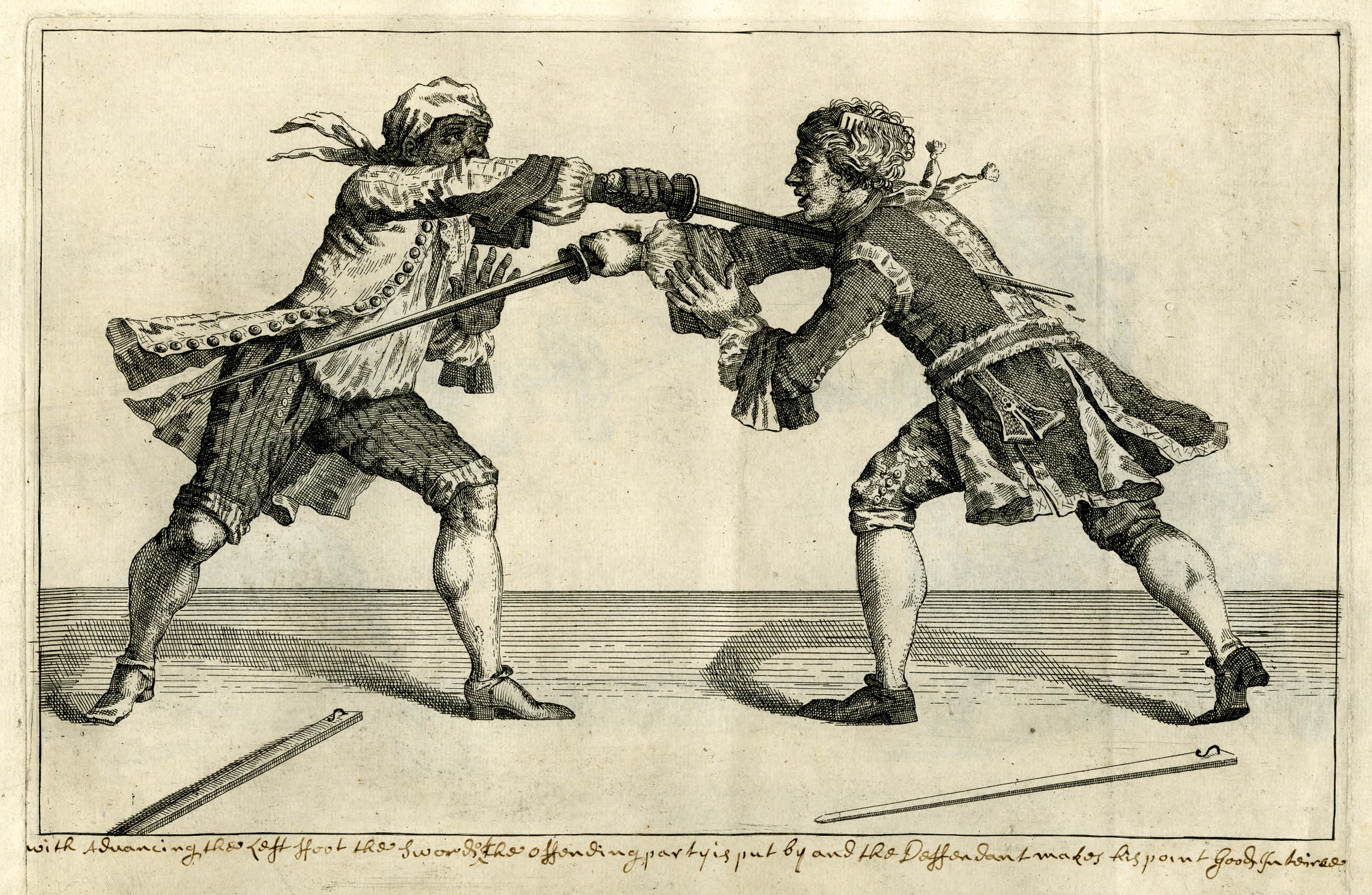
Old Wine in New Bottles: Fencing Theory and Interpretation

passing attack from _The Art of Fencing_ 1730

The much-maligned maestro, Nick Evangelista, turned a phrase that I have long used, “the logic of the sharp point.” [1] For anyone interested in fencing as more than an elaborate game of tag in unfortunate polyester uniforms, the logic of the sharp point should guide all they do. In short, this logic boils down to one idea:

If attacked, defend

When we don’t envision that point as sharp, we make poor choices—most doubles and the obsession with the after-blow stem from misunderstanding or misapplication of this logic. Why is it that in historical fencing, supposedly keen for fostering “realism,” we see such a gap between theory and practice? In short, the divergence stems from failure to learn and apply the most basic tenets of fencing theory. The reason for that is simple: too many historical fencers refuse to examine what modern fencing has to teach them.

This is a topic I’ve spent a lot of time on, but when a problem persists, we keep at it or quit. One fact I must accept, however, is that no matter how much time I or anyone spend on this, no matter how much evidence or analysis we throw at things, it won’t matter to most people in “HEMA.” There is daily proof of this, but there is also precedent: similar issues plagued the Olympic fencing world in the 1990s and early 2000s and then as now most people didn’t care. That doesn’t make them right. Their discomfort with a truth in no way changes the fact of that truth. I will argue until I’m worm-food that one should extend on a thrust, that the flat of the sabre shouldn’t score, and that off-target is, ultimately, illogical.

In like manner, not to avail oneself of modern fencing theory is to hobble our efforts at understanding fencing of the past. Modern theory was not created in a vacuum—it is the product of quite literally centuries of work. As always, one must distinguish between theory and how that theory is applied or misapplied. They are separate things.

For a quick example, applying right of way (ROW) to sabre, in theory, is sensible. ROW, in its way, attempts to enforce the logic of the sharp point, but being a game, a sport, this rule is less doctrinaire than it is for historical fencers. Historical fencers balk that ROW allows consideration of off target, and that one may win the point but still be hit. However, despite those aspects, despite the tyranny of electric scoring, the rule states that an attack should be dealt with, not just reacted to via counterattack out of time. One should defend if attacked—that is basic logic, the point, really, of fencing, defense. Thus, the ruling idea is sound, but how that rule is abused and interpreted is a mess.

Case Study: Passing Attacks

In one of the most recent and unfortunate fracases on social media, over a specific type of attack [see the post 13 August 2023, “Shadows in Caves,” https://saladellatrespade.com/2023/08/13/shadows-in-caves/], we have another example of the perils of interpretation. As I stated in an earlier post, part of it vested interest in maintaining a perceived status within the community, part of the problem was vocabulary, and partly it was a failure to understand how the sources and modern theory intersect. I’m fed to the teeth criticizing the all-consuming horror that ego plays in all this, so this post will instead focus on terms and misapplication of theory.

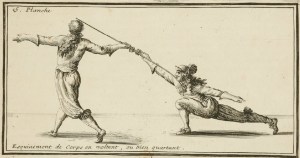
One mistake that people are making is equating a modern version of a species of attack for one of the same class from the past. It might help to illustrate how the terms relate. “Passing attacks” comprise a category of attacks where the rear foot passes the lead foot. Just how one does this changes. The terms and description vary as well. For two examples, we have the lunge made on the pass in de la Touche (1670), his “thrust of the pass” (l’estocade de passe), his “the finished pass” (la passe finie), and the modern flèche. [2]

de la Touche, 1670; the fencer on the right is making a thrust of the pass

No one in de la Touche’s time called any passing attack I’m aware of a “flèche.” Those quick to decry the use of a “flèche” in a recent Canadian tournament cite the use of a passing attack as modern and anachronistic, and thus out of keeping with period practice. It’s important to break down the attack, and criticism, to see if this criticism holds.

I’ve selected de la Touche in part because detractors have cited him for proof, but also because de la Touche did a fantastic job of explaining many aspects of technique. He was not the only one to include thrusts of the pass, but he is a good example. [3] The section on his thrust of the pass is long, thorough, and informative. In speaking of thrusts generally, de la Touche reminds us that one should be careful to aim for the most uncovered section of target, and, that one must thrust with conviction, that one should let oneself “go and extend as much as you can, so that the action has more force and swiftness of reach.” [4] I note this because swiftness, speed, is a critical consideration, one detractors downplay.

The master observes that one’s reach is longer with the thrust of the pass, and thus that the measure is larger so it requires more time to make. This is a crucial point. If one can hit with a thrust of the firm foot, then one shouldn’t use the thrust of the pass, unless one was initially aiming for the arm and decides to go for the body. It is particularly useful if the opponent is breaking measure (retreating) and if one wishes to surprise the adversary. Most importantly, one must accustom oneself to “execute the thrust of the pass with great swiftness, in order to compensate for the length of the action by the promptness of the execution.” [5]

Important to note, and a point in favor of the critics, de la Touche’s thrust of the pass assumes that the lead foot does not move. One advances the weapon, arm, body, and rear foot, but the front foot remains in place. [98] However, in the next section, De la Passe finie, “Of the Finished Pass,” de la Touche remarks that

De la Touche discusses this action, of moving the rear foot past the front, within the context of weapon-seizures. Such seizures are, as he observes, incredibly dangerous and chancy, especially if attempted when attacking (he is less uncomfortable with such seizures when defending). [7] One question arising from this is whether or not the master recommended this passing step only for weapon seizures. In answering this question one must interpret since de la Touche is not specific. How best to do that?

First, we must examine the action in the context in which the master shares it. It makes sense to include this passing step in a section relating to seizing the weapon as the distance one must travel is, arguably, longer than it is when lunging or lunging on the pass. Of note, this step is more connected to attempting a seizure when attacking than defending, as ostensibly the opponent is either standing firm-footed or breaking measure to defend.

Second, we must compare the advice in this passage with the rest of his work, with the general timbre of his approach. This is, granted, where we enter the world of conjecture. Thus, it is all the more important to work from the text, not just one passage or section. We must apply logic to any such comparison; it is, really, the only way to avoid the more obvious pitfalls, such as selecting only what supports our point of view or cherry-picking.

Whenever evidence works against us, we must deal with it honestly. In this case, the thrust of the pass itself does not appear to include moving the front foot from its place. De la Touche makes this clear. Those unhappy with the attack my friend and colleague made at An Cruinneachadh this past month are not incorrect about that. [8] However, I believe they are on far less firm ground if they suggest that the finished pass, that is a pass where both feet move, is only advisable when attempting a weapon seizure. Yes, that is the section in which it appears, but on its own that doesn’t make for a strong case. De la Touche covers the lunge in one section too, but one assumes that he wants one to use it whenever applicable.

Herein lies the crux of the problem—applicability. What follows is my take, my interpretation of de la Touche, and I will be the first to admit it is more spirit than letter of the law. I have reasons for that—we do our best to conform to what a text says, but we must remember the purpose of a source. De la Touche was concerned first and foremost with effective fencing. The goal, quite literally, was to strike and hopefully not be struck as one did so, because failure meant injury or death. If that was the goal, then slavish attention to any action makes little sense. Put another way, if one attempts a thrust of the pass, but the opponent retreats slightly more, one can either break off the attack, or, continue it (assuming the same elements of surprise and safety) by moving that immobile front foot. Fencers make different choices depending on the situation; technique, ultimately, backs up tactics, not the other way around. The attacker is at risk regardless—should they continue an already long attack, they increase the chance of failure, but should they recover needlessly just to follow the letter of the law they may create an opportunity for the adversary to attack in their turn.

In my reading, what Jay used in that match follows the logic of the finished pass and the thrust of the pass. Both fencers were working measure, but Jay launched his attack (about :07/:08 seconds in the video on fb) as his opponent (the chap in green) was in negative balance, as he was just about to initiate an action. Jay threw his arm and body forward, a la the thrust of the pass, but then crossed his feet a la finished pass in order to reach his now retreating opponent. Nothing in this action is out of keeping with what we read in de la Touche.

In fact, Jay used the proper speed to execute this attack successfully, an aspect de la Touche was quick to point out. Judging by both video of their fencing and from what I have observed on my own in person, many of Jay’s detractors do not employ speed in their own fencing, and one fears that they may not realize its importance. No attack made from just out of distance will succeed without it.

But his Fleche!

Now, what is the modern, well, 20th century flèche? It depends upon how one defines it. Generally, in French fencing, the fleche is a “running attack,” but in this can be further explained as Gaugler put it, as “a running attack executed following a loss of balance by an exaggerated forward displacement of the center of gravity.” [9] Maitre Robert Handleman provides a fuller description:

Handleman’s work was published in 2014, the flèche outlawed for sabre in 1994, but older works discuss the use of the attack in all three weapons. The flèche is still legal in modern foil and epee competitions.

So, did Jay flèche? Yes and no. Yes, he made a running attack, and going by just one definition, Gaugler’s above, we can call it a flèche. However, nothing in that action was out of keeping with what de la Touche, among others, described in their coverage of passing attacks. So where does that leave us?

Old Bottles, New Wine

Often in historical examinations we employ the simple tools of comparison and contrast. Examining patterns of what is similar, what different, we can unpack a source and see relationships, connections, and with further analysis, reach conclusions about what we are studying. In some cases, one type of comparison may reveal more to us. As a related example, from the study of myth, Joseph Campbell’s The Hero with a Thousand Faces does a great job of finding cross-cultural similarities in what he called the “monomyth,” but his study is only so useful because he did not, and did not intend, to examine the differences in how this motif was or is used. A hero’s motivations, for example, may be vastly different even if the narrative construct is similar; those differences will be far more revealing about cultural values than similarities.

In contrast, the situation here is one where similarities should help make sense of the sources, but which do not thanks to bias. Prejudice against the “new wine” of modern fencing, an outgrowth of the reactionary period in which modern historical fencing was born, has persisted and continues to affect how those suffering this bias view the “old bottles” that are period sources. The flèche as they see it is an artifact of modern, 20th century fencing, not that particular century’s version of an old and time-worn attack. Why? Because in their view nothing modern is legitimate.

In fairness to his critics, if one places a photo from mid-century where a fencer is nearly horizontal in the air as they flèche, and then a plate from de la Touche side by side, then the differences are obvious. It’s clear these are not exactly the same, but they’re not the same in execution, and it should be easy to see why: the contexts are different.

pass in seconde, de Liancour, 1696

This has been obvious to other scholars of fencing. Morton’s A-Z of Fencing contains a lengthy entry on the flèche as well as one for the pass which, so Morton states, was an older method of movement, and, one in which the lead foot might, if necessary, move as well. [11] As a last example, Nick Evangelista, in defining the flèche, echoes the same cautions as de la Touche, reminds the reader it is best used sparingly and as a surprise, and most importantly, that “the pass on avant of the eighteenth century is considered the forerunner of the flèche as it is practiced in modern times.” [12] These writers see continuity as well as change, versus change alone, and with good reason. No aspect of modern theory was created ex nihil—all of it is built on precedent.

De la Touche on more than one occasion is at pains to warn the reader against actions that will get them hurt, because in 1670 people were using swords and intended harm with them. No one of sound mind is fencing in that context today—realistic as we may wish to be, we do this for fun, not because our lives may depend on it; we fence with friends, not people keen to kill us; we use safer trainers and wear safety equipment, not a simple shirt or the lack of one. In contrast, fencers using the flèche in Olympic fencing, and especially in sabre in the late 1990s, not only had no fear since they were going for points, but especially in the case of the latter could stretch the action to ridiculous lengths to game the system. Indeed, so abused was the flèche that they outlawed crossing the legs in sabre.

Wine is Wine, Old Bottle or New

In the sitcom “Schitt’s Creek,” one of the main characters, David Rose, explains his sexual outlook to Stevie, a woman who works at the hotel where he is staying, and with whom he had hooked up:

Stevie Budd : So, just to be clear, um… I’m a red wine drinker.

David Rose : That’s fine.

Stevie Budd : Okay, cool. But, uh, I only drink red wine.

David Rose : Okay.

Stevie Budd : And up until last night, I was under the impression that you too only drank red wine. But I guess I was wrong?

David Rose : [nods knowingly]  I see where you’re going with this. Um… I do drink red wine. But I also drink white wine.

Stevie Budd : Oh.

David Rose : And I’ve been known to sample the occasional rosé. And a couple summers back, I tried a merlot that used to be a chardonnay…

Stevie Budd : Uh… okay.

David Rose : …which got a bit complicated.

Stevie Budd : Yeah, so… you’re just really open to all wines.

David Rose : I like the wine and not the label. Does that make sense?

Stevie Budd : [smiles]  Yes. That does. [13]

In addition to being a wonderful way to explain pansexuality, I see an analogy in re fencing theory. Fencing is, ultimately, fencing, and it is either effective or not. Contexts, purposes, equipment, and ethos all change, but should one lay out the better modern works on fencing side by side with those from the past the kinship becomes absolutely clear. Yes, there are differences, and in historical fencing in particular to ignore those differences makes what we do ridiculous. However, it’s double-edged—to ignore what modern theory provides any fencer, especially those attempting to interpret past sources for the Art, is to handicap one so terribly that the interpretation too easily becomes something other than what it should be, fencing. A prime example, which I’ve covered in other contexts, is the abject devotion to the images in the Bolognese corpus which produce versions of fencing more graceful than effective. [14] The desire to make “sidesword” different obscures the fact it was a cut and thrust weapon, and, that cut and thrust weapons existed before and after the 15th century. If pose becomes more important than purpose, one has lost one’s way.

The logic of the criticism used against the passing attack Jay used at An Cruinneachadh is faulty. The operating assumption is that anything that looks like a flèche, or indeed may be one, is automatically illegitimate and anachronistic. That doesn’t follow. One can make a fair case that the passing attack Jay employed abided all the cautions and guidelines that masters like de la Touche put forth, and as such, should not be classified as some aberration. [15]

NOTES:

[1] Nick Evangelista, “When Classical Fencing Goes Bad,” The Evangelista School of Fencing, 20 April 2014, https://www.evangelistafencing.com/blog/2014/4/20/9swnz7n7n709uvg9cko2hkh5a1h3n5

[2] Philibert, Sieur de la Touche, Les vrais principes de l’Espée seule, 1670, 66 (plate just before page 65); see also Reinier van Noort and Antoine Coudre, The True Principles of the Single Sword, Glasgow, UK: Fallen Rook Publishing, 2016, 88ff.

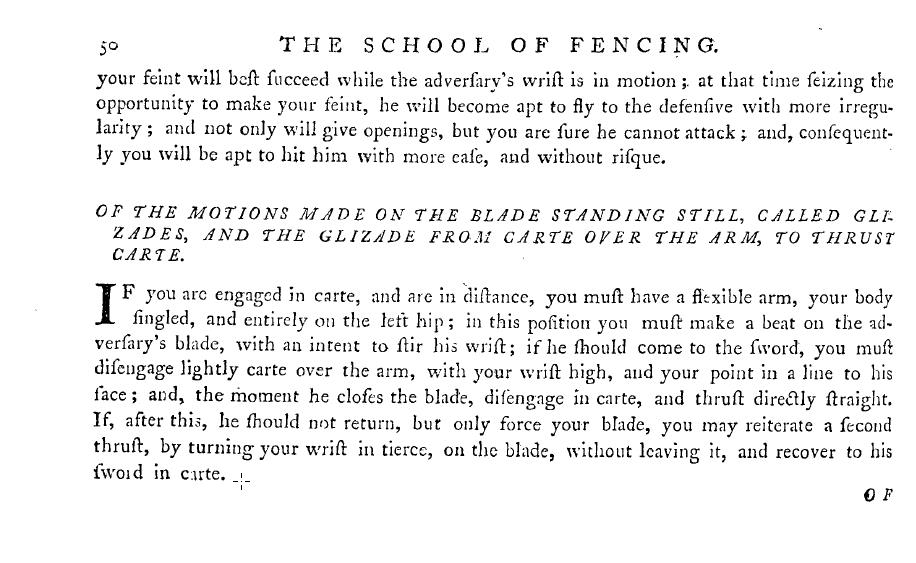
[3] For other examples, among others, see de Liancour’s passes to the inside and outside p. 24ff in Le maître des armes (1696), Girard’s pass of quarte p. 71ff Traité des armes (1740), and Angelo’s pass in carte over the arm p. 62 The School of Fencing (1787). Of note, many works cover passing steps in connection with weapon-seizures.

[4] Van Noort and Coudre, The True Principles of the Single Sword, 90.

[5] Ibid., 100.

[6] de la Touche, Les vrais principes de l’Espée seule, 75; cf. Van Noort and Coudre, The True Principles of the Single Sword, 108. I translated this passage myself, so it differs from that of van Noort and Coudre.

[7] de la Touche, Les vrais principes de l’Espée seule, 75-78; cf. Van Noort and Coudre, The True Principles of the Single Sword, 108-109.

[8] For the bout in question, see https://www.facebook.com/groups/261251458841817/permalink/835017504798540/?ref=share&mibextid=NSMWBT

[9] Willam M. Gaugler, A Dictionary of Universally used Fencing Terminology, Bangore, ME: Laureate Press, 1997, 34.

[10] Rob Handelman and Connie Louie, Fencing Foil: A Practical Training Guide for Coaches, Parents and Young Athletes, San Francisco, CA: Pattinando Publishing, 2014, 444.

[11] E.D. Morton, Martini A-Z of Fencing, London, UK: Antler Books, 1990, 67; for the pass, see 132-133.

[12] Nick Evangelista, The Encyclopedia of the Sword, Westport, CT: Greenwood Press, 1995. 250. Queen City Classical Fencing’s glossary, supplies

[Sir William Hope, A New, Short, and Easy Method of Fencing, Edinburgh, 1707, 136-138]

[13] This quotation was obtained from IMDB, https://www.imdb.com/title/tt3653932/characters/nm2391794

[14] 10 June: Lecture Transcript: “Prance or Pounce? Interpreting Images in Bolognese Treatises,” Northwest Armizare Weekly Online Meetup, https://saladellatrespade.com/instructors/research-media/

[15] Jay’s fencing is effective and he is doing well in competition, so it is possible that maybe that is the real issue: envy.

Jay, like me, like others, approaches past sources with the tools and theory that they bequeathed to modern fencing, and he is an effective fencer. Those aping the plates devoid of actual understanding are not doing as well, because their study is incomplete. When one is absolutely convinced that one’s point of view is correct, and especially when that stance is backed by those believed to wield authority (however true or untrue), then one is not only losing matches but forced to confront an even harder possibility: their training, however long, however passionate and dedicated, has been flawed. This is extremely painful and unpleasant, and my heart goes out to them. At the same time, it is something one can fix. Jay, in fact, can speak to this better than I can, as it happened to him. He didn’t quit, but put his disappointment and regret aside and started over with a better training regimen.

Curricula, Completeness, & Choice

The Noviciate of a Macaroni. Ranelagh. 1772. Colonial Williamsburg Museum

One of the best things about fencing are the interesting people one meets along the way. Say what one will about “nerds” and niche interests, rarely are they boring, and in some cases it’s precisely their eccentricity that bridges the gap between niche-folk and those just other side the creative wall. For example, a few years ago a writer contacted me with questions about sabre for a project he had in hand. Over the course of our many conversations, we became friends. In a discussion this morning, he asked me for my take on the issue of true teachers versus the McDojo sort who just out to make a buck.

One point I made was that there is often, sadly, a gulf between what we can actually use in martial arts, should we need it, and what a school or teacher makes their focus. For example, in one ruleset for competitive Tae Kwon Do, one can kick at the head, but not punch. [1] If one is studying at a school adhering to this ruleset, they may be doing themselves a disservice if the goal is training to keep themselves and others safe. This is not to say that competitively focused schools are inherently bad, they can be fun and build one’s confidence, etc., but one should not mistake them for what they’re not, either.

As we continued to chat, I brought in a few examples from historical fencing, and this raised a related set of questions. Do we try to share all aspects of a particular treatise? Should we? What if an action is dangerous? What if it’s safe to do in our context, but would be dangerous were the blades real? My short answer is “it depends.” There are sometimes reasons to teach dangerous maneuvers, but any time one does considerations of safety must come first.

Not all Masters Agreed; Not all were Equal

One of the most “medieval” aspects of historical martial arts, and “HEMA” in particular, is an almost blind faith in written words of the past. Textual authority, given that it is 90% of our evidence, makes sense, but reason must still be applied. Modern doctors do not rely on ancient Greek medicine for guidance in obstetrics, and it would be both unethical and criminal if they did. [2] Not everything written in the past was good.

An Englishman and his Fencing Master, British Museum

It can be difficult to assess the worth of an old fight manual. Our distance in time, methods of conducting violence, notion of law, everything is different. This said, there are times when we get help from within the texts themselves. For example, in de Liancour’s Le maitre d’armes/The Master of Arms, 1692, he says of the counter attack that

C’est une chose si difficile à prendre que les Temps, l’Epée à la main, que je ne conseille personne de s’y trop hasarder. J’estime mieux une bonne parade, ou un bon battement sec & tiré droit le long de l’Epée ennemie, sans oster la sienne de devant soy…

Je m’étendrois beaucoup sur ce Chapitre, mais comme j’ay résolu de ne parler que des choses essentielles, je dirary seulement que c’est in jeu de Salle, où ces coups se pratiquent allez souvent, mais fort rarement l’Epée à la main.

It is such a difficult thing to take on the Times, sword in hand, that I do not recommend anyone to risk it too much. I consider a good parry better, or a good dry/sharp beat & thrust along the enemy’s sword without removing his from your own.

I would dwell long on this Chapter, but as I have resolved to speak only of essential things, I will only say that it is a Salle game, where these blows are often practiced, not often sword in hand. [13 in the pdf of 1692; Lynch, 36] [3]

Here is a master pointing out the inherent danger in choosing a counter-attack over a solid defense. It’s an important point, and one I am quick to mention when I cover counter-attacks, but I still teach it. For one, though we aspire towards realism, the fact is we do this for fun and no one is in danger of actual injury. Second, and more importantly, though I advise students not to select a counter-attack save under specific circumstances, they need to know how to recognize them and practice defeating counter-attacks when this action is used against themselves.

For another example, Capt. John Godfrey, in his A Treatise upon the Useful Science of Defense, 1747, rails against an action common to most small sword works, the flanconade:

That Thrust called the Flanconade, I pronounce an Anathema upon, as being easily proved to be the most lewd and vile Debaucher of the Art, the Dignity of which consists chiefly in its generous Allowance of a proportionable Chance to the weak man. The other Thrusts depend upon a timely Swiftness mostly: Though to say, that equal Knowledge with more Strength has not the Advantage, would be preposterous, as certainly the greater the Velocity is, the greater the giving Strength must be… [12ff]

Godfrey’s argument is that a weaker person will be less likely to pull off the flanconade than a strong person. He was correct. His pro-English and anti-French bias, given his background, are not surprising but likely informed his position as well. He published, after all, during the War of the Austrian Succession (1744-1748), where the two nations were in conflict over territory in North America (among other theaters). One example should suffice:

The Art we had from the French; no Flaconade was thought of for some Time; but upon finding us very apt Scholars, and being willing to be our distinguished Masters, they brought the Flanconade and many tawdry Embroideries, which they are as famous for inventing, as, I am sorry to say, we are degenerate enough to imitate, and even mimick. Pity! that we should be so fond of imitating a Nation, who have always been deceiving us. Rouse then, though noble British Spirit! (for sure no Time more calling than the present) lift up they brave fronted Head above these dandling Actions, and become thy wonted self! Love thy King, love the Country; stay they Heart his these, and thou art safe.

            Thus I take my hearty farwel[sic] of the Flanconade. [13] [4]

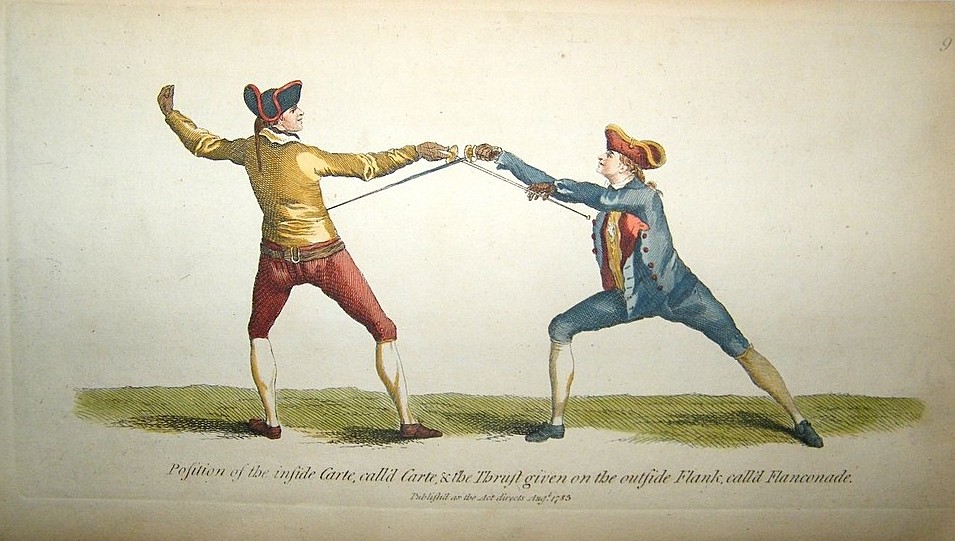
The Flanconade, Domenico Angelo, The School of Fencing, 1763/1787

Tin-foil tri-corn hats aside… the flanconade is a relatively difficult action to learn at first, but easier with practice. It does require, as Godfrey points out too, that the off-hand must come into play to stay the opposing blade after parrying in order that one doesn’t double as they go to target. [5] I teach this action too, and as with counter-attacks, because while difficult one must still know how to defend against it.

For a last example, this time in re position, James Underwood’s The Art of Fencing or the Use of the Small Sword, 1798, is instructive. In many, maybe most treatises the author advises one to be back-weighted while on guard. Underwood, however, disagreed:

I am of opinion, that the distribution of the duty laid upon each leg ought to be equal, and the more equally they share in the weight, I will venture to say the body will be so much more supported. But let us examine into the consequential practice, by the disadvantage of laying a greater stress upon one leg than the other, or the advantage to be expected from the strength accruing from the proper weight given to both. If too great a stress lie upon the left leg, your retreat must be obviously the more unsteady, and weaker; if upon the right, you are crimped and checked in your advancing. If the greater share of weight lie upon the right, the left leg must take that share off, before you can advance, and so, vice versa, the right must act for the left in the retreat. But then this is the loss of your time, upon which every thing depends; whereas by equilibrial weight upon the legs, that time is saved. Here your body will be equally supported, therefore stronger and steadier; but by recovering and shifting in the other way, the motion of the body must be so much greater, that your arm is more likely to be thrown out of line. [4-5]

Many fencers are taught this way today, that is, instructed to distribute their weight equally. It works fine. However, the rear-weighted stance was common and works equally well provided one distributes one’s weight properly. I had doubts about it myself, but in discussion with Russ Mitchell, and especially after his how-to-lunge class, I finally understood how it is supposed to work. [6] I teach students both. First, I show them what a majority of the texts advocate and why—our en garde position, and the lunge especially, are compromises between proximity to target and removal of our own target. Next, I show them the equi-weighted stance. Purists may balk, but I focus on the goal of our stances, not the letter of the law—bodies are different and so supplied with a few principles, I advise students to find a position that is comfortable and yet still meets the critical aspects. The front foot should be straight ahead, their bodies turned about 3/4, and fist and weapon just outside the body if on guard in tierce. If the rear heel is not precisely on the line of direction and in line with the front, no matter—are they stable, balanced, and can they move in any direction required? That’s what’s important.

Selective Reading & Teaching

When using a fencing treatise, I read it all and more than once, but I do not necessarily include all I read in class. I am selective in what I use—not in what I read. I read page to page, because I need to see the author’s approach in toto, and, compare it to other, related works—but not everything is equally important. I rely on Girard’s Traité des arms/Treatise on Arms, 1740, for much of my small sword curriculum, but I have no plan to include his short section on defense against grain flails. I use Domenico Angelo’s L’École des armes/School of Fencing, 1763/1787, as well, but spend very little time if any on weapon seizures outside demonstrations. They are, again to quote dance master Les Kendall in “Strictly Ballroom,” largely “flashy, crowd pleasing steps,” and less secure than a firm grounding in parry-riposte and thrusts made in opposition.

There are things I include for reasons of completeness or because it explains or aids core material. For example, there is good reason to believe that prime in small sword derives from broadsword practice. Angelo says as much, and this guard and parry are redolent of the hanging species of guard often used in sabre and broadsword, but I share that fact, if I do, because someone asked or because of some similar prompt. Girard covers the use of multiple feints, actions like the 1-2-3, but rarely does one need to resort to three feints in an actual bout. Complicated maneuvers like this are what we call “medicine for the hand:” we drill a triple feint because it will, we hope, make our single feint that much sharper and crisp. Have I seen anyone use a triple feint in a bout? Yes, among high level foilists thirty years ago, but in historical fencing circles? No. We still have to contend with people who believe feints are not “martial” enough (despite how often they pop up in the military sources…).

My goal is two-fold in most lessons and classes. First, I want to present and teach as accurately as I can either the tradition I was taught, or, those from the past I have studied. For the latter I always provide the caveat that we can never recreate these extinct fight systems perfectly, but we can, hopefully, get a good idea of how they might have worked. Second, I want what students learn to be both reflective of its sources and useful—I see no reason to teach anyone actions that are more likely to get them hit than not, so when I teach counter-attacks, when I teach the flanconade, I do so at the appropriate time and with the necessary warnings.

Curriculum building is selective, personal, and should be subject to revision as new insights, ideas, and flaws in the existing approach appear. Historical fencing is a research and experimental archaeology driven field. Unlike colleagues in the Olympic world, who are not uncovering hitherto unknown material or inventing new actions, our understanding changes with newly discovered texts and better interpretations. [7] If we are not open to new, better information, our programs become moribund and stagnate. Moreover, what we choose to teach and how is everything, but it depends on what our goals are. Unless we wish to produce graceful puppets, we should know not only what to teach, but why. What one selects is up to the individual instructor, but have a reason and be able to explain your choice.

NOTES:

[1] See for example https://olympics.com/en/news/know-your-sport-taekwondo-rules-scoring-equipment, “Scoring,” and “Penalties and Prohibited Acts.”

[2] To name only one example, the Hippocratic school concluded that most illness women faced was due to the uterus. From a very large sample, see Lesley Dean-Jones, Women’s Bodies in Classical Greek Science, New York, NY: Oxford University Press, 1994; Rebecca Flemming, “Women, Writing, and Medicine in the Classical World,” In The Classical Quarterly 57: 1 (2007): 257–79; Helen King, Hippocrates’ Woman: Reading the Female Body in Ancient Greece, New York, NY: Routledge, 1998; Vivan Nutton, Ancient Medicine, New York, NY: Routledge, 2005; Soranus, 1927.Gynecology. Edited by Ioannes Ilberg, Corpus Medicorum Graecorum/Latinorum, Berlin, DE: Teubner, 1927. [what, historians gonna history 😉 ]

[3] French speakers I ask your apologies for my loose translation. M.P. Lynch put out an edition in English (2021), which is useful, but which also has some translation choices that one might find less ideal, e.g. p. 110 where he uses “snafu;” for the original passage, see Ch. 17, p. 64:

Je répons que si l’on étoit affeuré que ce fùt un veritable coup tiré de droite ligne, sans feint, on pourroir y parer en opposant la main gauche, comme je l’ay fait voir dans mes autres Planches. Mais l’on peut étre trompé par des feintes, ou par des demy coups, & étant surprise, cette parade de cercle enveloppera tous ces coups qui pourroient vous étre poussez, & même fera perdre tous les desseins de vostre ennemy.  

[4] American sentiment, which has long baffled me given our long friendship with France, tends to back the English view on everything from the Hundred Years War to the colonial contests of the 18th and 19th centuries. Had it not been for French support, we may well have lost our rebellion against England. More recent history makes this all the odder given that England and France were allies, as were we with both nations, in the world wars. Just something to think about.

[5] The flanconade, often called a “high-low” attack in modern epee, is effected by parrying a thrust in the high line in fourth, then dropping the point to the outside over the opponent’s weapon. One then thrusts to the outside low line. Many earlier works advocate using the off-hand to secure the opposing steel after beginning the thrust to avoid a double. For a useful modern example, my go-to is professionescherma.org’s channel on Youtube: https://youtu.be/4G63pNHS90M

[6] See Russ Mitchell, Basic Body Mechanics for Martial Artists, 2018.

[7] One outcome of the unfortunate merger between the USFCA (the US Fencing Coaches Assoc.) and the USFA (US Fencing Association, the body that governs the sport; the US branch of the FIE), is that instructors are encouraged to “renew” their certifications yearly, much as someone say in a profession like pharmacy might with CEs (continuing education courses). While admirable that the organization(s) are interested in ensuring a higher degree of ability among instructors, there are issues with this decision. For one, this is expensive and assumes—as ever—full-time coaches with some manner of decent pay. That is not true for most coaches. Second, unlike pharmacy, no one is inventing new ideas or actions that we must learn to stay current. It’s difficult not to see this measure as a money-grab.

The Grip in Small Sword

One of the questions I’m asked frequently is how one should hold a smallsword. With a large corpus of treatises upon which to draw this is, lucky for me, a relatively easy question to answer, and, with some degree of certainty. There are differences among the masters, but most are subtle and have more to do with the positioning of the hand than in how the fingers grasp the weapon.

My approach, an amalgam based on the sources, is typical of “most” works:

  • The thumb extends along the grip towards the guard and stops 12mm/.5” from the shell
  • The forefinger rests just opposite the thumb so that thumb and forefinger are sort of pinching the guard
  • The three remaining fingers grasp the grip and help keep the pommel, while in guard, against the wrist
  • The fingers do not go through the Arms of the Hilt/annulets
Hand in Tierce
Hand in Quarte

Remember that in French fencing the numbers we use, prime, seconde, tierce, etc., refer to hand positions. There is not, for example, an ideal form of quarte–if the hand is in quarte, one is in quarte, whether parrying high, low, or midline. This is likely one reason, for example, that some masters referred to “quarte over the arm” (modern sixte) when parrying in quarte (hand in quarte) on the tierce side. Here is a handy reference and visual representation of this:

Still looking for the source for this image

In the two bottom quadrants, the lower outside and lower inside lines respectively, the parries for the former are octave (supinated-ish) and seconde (pronated-ish), and for the later septime (supinated-ish; a.k.a. “half circle”) and prime (knuckles up). Quinte, 5th, is a bit different than the similar position for sabre:

NB: 5th as positioned here is not set in stone, but reflects how the hand is held–this can be raised or lowered.

What do the Sources Say?

Below are excerpts from a few sources, mid-17th century to just before 1800, that cover the grip. Where possible I’ve added the original language if it was written in one other than English. For those without a translation, or for which I do not have one, I’ve summarized the import of the passage rather than offer a translation of my own. I’ve added images from the works when possible too—these are taken from public domain copies, but vary in quality.

NB: going from MS Word to WordPress, never mind the evils of autocorrect, often means errors in transliteration. I do my best to proofread, but if you notice misspellings, wonky accent marks, etc., please let me know and I will correct the error.

Charles Besnard, The Free Master of Weapons, 1653, p. 7 in ENG ver. by Rob Runacres and Reinier van Noort

To properly place oneself in guard and posture in order to practice the single sword or foil, one must first place the sword or foil in hand so that the thumb is placed on the cross or flat of the sword, and the index finger under the flat of the same in a half circle, and right under the thumb. Then tighten the grip of the three other fingers…

Pour bien se mettre en garde et posture pour faire l’exercice de l’épée seule ou fleuret, il faut premièrement mettre l’épée ou fleuret à la main, que le pouce soit posé sur la croisée ou plat de l’épée, et le doigt index soit sous le plat de celui-ci en demi rond, et droit sous le pouce, et serrer fermement la poignée des trois autres doigts…
[p. 7 in the Fr. Transcription by same editors]

De la Touche, The True Principles of the Single Sword, 1670

Next, you must draw the sword, taking it by the grip with the right hand and holding the scabbard with the left hand so that it does not follow the sword, and then draw it. This you can do in several manners, but it is done the easiest and the quickest by always keeping the thumb in the same position as it has in the first figure, and advancing and raising the hand until the sword is out of the scabbard, with the point turned towards the enemy, the thumb on the outside, that is to say, on the right side, and the sword on the edge, as in the second plate. [31 in van Noort and Coudre]

Les Vrais Principes [Ch. 2, p. 7]

Apres cela il faut tirer l’Espée, en la pregnant par la Poignée avec la main droite, & tenant le sourreau de la main gauche de peur qu’il ne suive l’Espée, & ensuite la tirer, ce que l’on peut faire de plusieurs manieres, mais la plus simple & la plus courte se fait en tenant toûjours le poulce dans la mesme situation qu’il a dans la premerie Figure, & avançant & levant la main jusques à ce que l’Espée soit hors du sourreau, la pointe tournee vers l’ennemy, le poulce en dehors, c’est a dire, du costé droit, & l’Espée sur le trenchant, comme dans la deuxiéme Planche.

de la Touche, 1670

Sir William Hope, Scots Fencing Master, 1686

Ma. You must hold your Sword after this manner; hold your Thumb upon the broad side of the Handle with your Fingers quite round it, as in the second Figure of the first Plate marked F and not as some do, who put their foremost and middle Fingers through the two arms of the Hilt, thinking that by doing that, they hold their Sword firmer, some use onely to put their foremost Finger through, which the Spainards did of old, and many even to this day do it; but both ways are most ridiculous, and dangerous.

Sch. I think any Man of common sense may perceive that, for when a Man holdeth his Sword in that fashion, with his Finger through the arms of the Hilt, he is in danger of having his Fingers broken, if his Adversary should inclose with him, and offer to force the Sword out of his hand, for holding it that way he cannot so easily quit with it, as he should, and therefore will infallibly in my opinion be in hazard of losing his Fingers, if not his life in the cause.

Ma. Sir, You have found exactly the hazard that a Man is in, in holding his Sword after that manner, but when you hold it, as I have before told you, you must hold it fast and firm, and not gently, so that your Adversary with the least sudden beat or twist may force it out of your hand. [11-13]

Sir William Hope, 1686

di Liancour, The Master of Arms, 1686

Let the right hand be turned half to tierce with the fingernails facing the ground, such that in parrying we need only turn the hand to half fourth, parrying straight thrusts to the inside from fourth with the cutting edge of the sword. [Lynch, 19]

Que la main droite soit tournée demy-tierce, les ongles vers la terre; d’autant qu’en parant l’on n’a qu’à tourner la main demy-quarte, l’on parera les coups poussez tout droit de Quarte dans les Armes, du trenchant de son Epée. [p. 8, Ch. III]

de Liancour, 1686

Jean-François Labat, The Art of Fencing, 1696/1740

…the Hilt of the Sword a little above the Hip, turning towards half Quart, the Thumb extended, pressing the Middle of the Eye of the Hilt, keeping the Fingers pretty close to the Handle, especially the little one, in order to feel the Sword firmer and freer in the Hand. [5, McMahon, Lector House edition]

L’art en fait d’armes ou de l’épée seule, avec les attitudes

…que le poignet de l’épée soit un peu plus haut que la hanche, tournant un peu vers la demi-quarte, le pouce étendu & apyué sur le milieu du corps de la garde entre les deux tranchains, serrant suffisament les doigts, sur tout le petit, asin de sentir l’épée plus ferme & plus libre dans la main. [9-10, L’Abbat]

L’Abbat/Labat, 1696/1740

Zachary Wylde, The English Master of Defense, 1711

your Hand fast gript about the hand of your Foil or Rapier, then put your Thumb long ways or forward upon it, your Arm quite extended from the Center of your Body, the Point of the Weapon being directed in a true Line against your Opponent’s right Pap, sinking somewhat low with your Body, your right Knee bowing or bent over the Toes of your right Foot, (tho’ some Masters teaches a strait Knee,) your left Knee more bent, inclining towards the Toes of your left Foot; lying in this Order is the Posture, which I call, Stand your Line, the Medium Guard then is fixt [p. 6 in the pdf]

Donald McBane, The Expert Swords-man’s Companion, 1712, p. 3-4:

Let the Grip of your Sword or Fleuret be no bigger, than that you can close your little Finger round it, and touch the Palm of your Hand; and let all your Fingers be round the Grip, and the point of your Thumb close too or near the Shell, which Guards your Hand, much more than as some People hold it, with the Pummel in the Hand, and fore Finger stretch’d out toward the Shell, they then can not command the Sword so well, and all the Advantage of hold it so, is, that they have a greater length from the Point to the Body, than if they held it with the Thumb close to the Shell. If the Grip of their Sword or Fleuret be larger than as here mention’d, it will be easily be Beat out of your Hand by a Batter.

When you are to Offend, whether at the Wall, or on the Floor, keep your and Hand Breast high, and Point rather below your Hand, and if you are to Defend at the Wall, keep your Hand as low as your or Hipp, and your Point as high as your Forehead; but for Defence on the Floor keep the proper Quart Guard, and by turning your Hand, you may Parie all high Thrufts, or Thrufts made at the Level of your Hand, and above; for Thrufts below the Level of your Hand, the Low Quart, and Seconde will Parie them.

Donald McBane, 1712; here with broadsword

Alexander Doyle, Neu Alamodische Ritterliche Fecht und Schirm-Kunst, 1715

Die Erstere nun/ Prima genennat/ belangend/ ziehet selbige ihren Nahmen daher/ wann man den Degen aus der Scheiden ziehen will/ denselben mit verkehrster Faust aud der Seiten ergreisset/ und nach dessen Entblosung sienem Feinde die spize bietet; da dann mit dem kleinen Finger in der Höhe/ dem Daumen unten/ mit zugelegter Faust und ausgeisirechtem Urm gegen die Uchsel die Spize praesentirt wird: Und in solcher Positur wird die so genannte Prima formiret [p. 1]

[Summary: prima/first is named for the fact that this is the position one is in after drawing the sword; one grabs it with the fist inverted; in this position, the thumb faces down, the little finger up; NB in the image below the fencers are not in prima]

Doyle, 1715

Henry Blackwell, The English Fencing Master, 1730

Secondly, To hold a good Guard to defend your Body, your Right-Hand must be straight out with a little bend in your Arm, the Point against your Adversary’s Right-Breast, with your Four Fingers bent under one part of the Handle, and your Thumb over the upper part, with the Pummel close to your Wrist, as you shall see in the Posture, etc. [2]

Henry Blackwell,

Girard, Traité des armes, 1740

III. Que la poignée soit serrée près du pommeau avec le petit doigt, & le second doigt, & que la milieu du poulce soit apuyé à plat sur ladite poignée de l’Epée près de la sous-garde; laquelle poignée étant soutenuë du dedans la jointure du premier doigt, on aura la facilité de dégager & de tirer.

IV. Avoir le bras droit, & le poignet flexible & tourné demi quarte, de sorte que le demi trenchant de la lame regarde la terre, comme il est dit, & que le bout des ongles des trois derniers doigts de la main droite regarde le Ciel, & la plus grande partie de l’ongle du poulce, ainsi que le bout du premier doigt. [5-6]

Crawley, Philip T. The Art of the Smallsword, Featuring P.J.F. Girard’s Treatise of Arms. Wyvern Media, UK: 2014, 38.

3. That the handle is gripped near the pommel with the little finger & the second finger, & that the middle of the thumb is laid flat on the grip, near to the body of the hilt; of which is supported by the inside of the knuckle of the index finger, which will give greater ease in disengaging and thrusting.

4. The right arm & the wrist flexible & turned to demi-quarte, in such a way that the ridge of the blade is toward the ground, as stated, & that the fingertips and nails of the three last fingers point towards the sky, as the greater part of the thumbnail and the tip of the index finger.

Girard, 1740

Le Perche du Coudray [attrib.], L’exercise des armes ou le mainement du fleuret, 1676/1743

Voila de Toutes les Gardes

La Situation la plus naturelle, la plus gratieuse, et la moins dangereuse, Car toutes les autres sont Exposée, a tant de Contrecoups qu’il ny [ne?] faut pas penser, cest pourquou je Conseilleray toujours aux Amateurs de ce noble exercise de ne s’Escarter jamais des regles de cette garde, qui sont dabord de bien tenir son Epeé, ayant pour cette Effet la poulce sure le plat de la poigneé, la pointe a la Hauter de l’Epaule, que le pomeau de l’Epeé tombe en ligne directe sur la pointe du pied droit, qu’il soit a la hauteur de la hanche droite, il faut que le Corps soit droit sur les deux hances, et posé entierement sur la partie gauche, Cavant bien la hanche droit, et Effacant bien l’Epaule gauche, pliant le genoüil gauche et laissant beacoup de liberté dans le droit, asin de n’etre point Embarassé ny pour marcher, ny pour faire les Engagements d’Epeé; il faux que les deux pieds soient dans la même ligne et que les deux Talons se respondent l’un a lautre. Il faux être sendu Environ de deux semeles il faut que le bras gauche soit èlevé en faisant un de ny Cercle et que le creux de la main soit directment a la hauter de l’Oeil gauche, la tête droite le Corps bien effacé et observer tourjours une g. de liberté, le talon droite vis a vis l’Oeil du soulier gauche [1]

[Summary: thumb is flat on the handle, point shoulder high, pommel in direct line with tip of the right foot, at height of right hip]

Le Perche du Coudray [attrib.], 1676/1743

Juan Nicolás Perinat, Arte de esgrimir floret y sable/Art of Fencing, 1757/8 [from the transcription and translation by Tim Rivera, 2018]

It is necessary to be in guard in the mode that is seen in the figures of the first plate, both feet on the same line, both legs bent, the left more than the right, the hip supported on the left side, both arms half extended, the left higher and arched, the head erect, looking at the enemy, the hand turned between fingernails up and fingernails down, or in the regular posture, and the thumb over the plane of the sword, presenting the point to the enemy. [1]

Es menester ponerse en guardia del modo que se vé en las Figuras de la Lámina primera, ambos piés sobre una misma línea, las dos corvas dobladas, la izquierda mas que la derecha, la Cadera apoyada en la parte izquierda, ambos brazos médio tendidos, el izquierdo mas levantado y arqueado, la cabeza derecha, mirando al Enemigo, la mano vuelta entre uñas arriba y uñas abaxo o en postura regular, y el pulgár sobre el plano de la Espada, presentando la punta al Enemigo. [1]

Domenico Angelo, The School of Fencing, 1763/1783

You must observe that the gripe of the sword be put on quite centrical to the heel of the fort of the blade, which should have a little bend above the fingers, when in hand, and let the whole mounting be turned a little inward, which will incline your point in carte. This way of mounting your sword will facilitate your disengagements, and give you an easy manner of executing your thrusts. [2 in the 1787]

Il faut ausi que la garde de l’epée porte juste sur l’affiette du talon du lame, laquelle doit baisser un peu sur les doigts de la main, & le corps de la garde doit être tourné un peu en quarte. Cette maniere de monter uné epée donne de la facilité pour dégager & de la liberté pour tirer les coups d’armes. [p. 21 in the pdf from the BNF Gallica site]

D. Angelo, 1763/1787

Andrew Lonnergan, The Fencer’s Guide, 1771

In holding your Foil observe, that you must lay your thumb upon the flat of the handle, or grip, somewhat extended with your fore finger on the other flat behind, forming a square with the point of your thumb. Sometimes you will find a Foil, with a square handle, where no flat side can be distinguished; in such case, the flat of your Foil’s blade must guide you as before; but now the Foil blades are also square, therefore you must be guided by the kind of shell the Foil has; which shews you where the real flats of the handle and blade are, though still square. Now the whole hand should be at such a distance from the shell, so that the little finger should lock into the hollow part, or neck of the pummel; yet practice will allow you to shift your hand hereafter. Observe, when the handle or blade of your Foil is bent, or arched, you must always lay your thumb upon the round side; and the inside of your fingers ends on, or against, the hollow side, or part of the blade, griping the handle gently, and with as much freedom as if on a flute.

Some make a practice of holding the Foil between the fore and middle fingers, with the thumb propped against the fore-finger; yet this method, though successful enough to many by long practice, is not so recommendable to begin with as the former. [1-3]

J. Olivier, Fencing Familiarized/L’Art des armes simplifie, 1771

Ch. 2 How to hold the Sword

In order to hold a sword well, the hilt must be flat in your hand, your thumb stretched and at an inch distance from the shell, the pummet under your wrist.

Never keep the sword fast in your hand, but when you parry or thrust. For, if you hold it always with strength, the muscle of your thumb will soon grow stiff. [9]

Ch. 2 Maniere de tenir l’Epée

Pour bien tenir votre épée, il faut que la poignée se trouve à plat dans votre main, le pouce etendu à la distance de 12 lignes de la coquille, le pommeau sous le poignet.

Ne serez jamais l’épée en votre main, que lorsque vous parez ou tirez car, si vous la teniez toujours avec force, vous vous engourdiriez bientôt le muscle du pouce. [p. 10]

John MacArthur, The Army and Navy Gentleman’s Companion, 1780 [NB: fan of J. Olivier’s teaching and method]

Lesson 1: The Manner of Holding the Sword or Foil, etc.

In order to hold your sword well, the hilt must be flat in your hand; so that the two edges will be nearly horizontal when you throw yourself upon guard; your thumb stretched along the upper flat part of the hilt, within half an inch of the shell, and the pummet is to rest under your wrist. [p. 3]

MacArthur, 1780

Danet, L’Art des armes, Paris, FR: Chez Herissant, Fils, 1788

Manière de tenir l’Epée

Pour tenir avantageusement l’épée, il faut que la poignée se trouve entre le tenar & l’hypotenar, & le pommeau à la naissance de la main; que le pouce soit allonge jus-qu’à la distance d’environ douze lignes [*] de la coquille sur le plat de la poignée; qu’en même temps le milieu de l’index se place dessous la poignée près de la coquille; que la poignée soit étroitement embrassée par le doigt majeur, & encore serrée contre le tenar vers la pommeau, par l’annulaire & l’auricularie: mais il ne faut serrer la poignée que dans l’instant seulement que vous tirez, ou que vous parez; parceque les muscles due pouce, de l’index & du doigt majeur s’engourdissent promptement, au lieu qu’il n’en est pas de même de ceux qui sont agir le petit doigt & l’annulaire.

Il est des occasions où il convient de lâcher ces deux doigts pour faciliter l’exécution de cetain coups. J’aurai attention de vous en prevenir quand il le saudra. [3]

[Summary: the thumb is extended along the grip and a short distance from the shell; index is under the grip, opposite the thumb; of note, Danet reminds the fencer not to grip tightly save when thrusting or parrying; the three remaining fingers keep the weapon secure, pommel is against the wrist]

* The ligne, “line,” was a unit of measure in pre-Revolution France. This particular measure had an English parallel, of the same name, which varied in length between 1/10 and 1/40 of an inch. The French ligne corresponds to about 2.3mm. Incidentally, a pouce, or “thumb” [approx. 27mm] was also a measurement within this system, but that is not how the word is used here. For more on this, a useful summary is provided in William A. Smeaton, “The Foundation of the Metric System in France in the 1790s: The Importance of Etienne Lenoir’s Platinum Measuring Instruments,” in Platinum Metals Rev. 44:3 (2000), 125ff [https://technology.matthey.com/article/44/3/125-134/]; see also Suzanne Débarbat,”Fixation de la longueur définitive du mètre,” in Ministère de la culture et de la communication (1999): https://francearchives.gouv.fr/fr/pages_histoire/39436 ; of note, the ligne is still used by some milliners, cf. https://www.levinehat.com/blogs/levine-hat-blog-1/19189051-what-are-french-lignes

The Importance of Measure

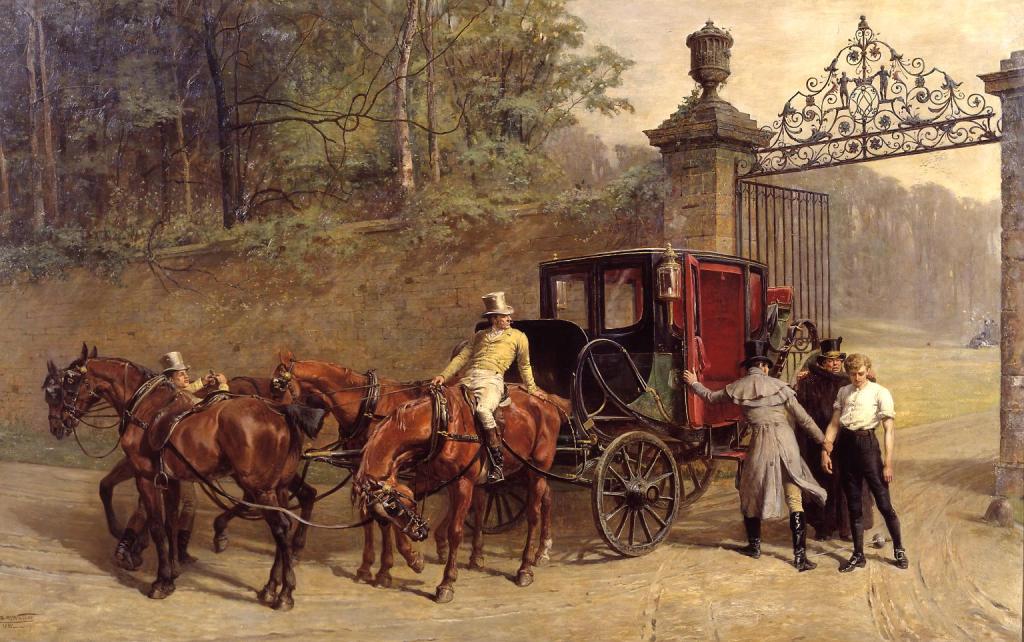
“Success!” 1881 Samuel Waller 1850-1903 Presented by Sir Henry Tate 1894 http://www.tate.org.uk/art/work/N01551

A number of dueling histories record the horrific duel between Colonel Barbier-Dufai and a young Captain, Raoul de Vere. According to most versions, the older adherent to Napoleon attempted to pick a fight with this member of the Royal Guard, but was initially unsuccessful. Barbier-Dufai, frustrated in finding the young man so unflappable, finally remarked that he was not insulting him, but his cockade, and after a heated exchange challenged the captain. However, when asked to select a weapon the captain replied that he had insufficient training in all of them. The colonel said he would not fight a child, a comment that irked de Vere and led him to slap the older man. A duel was now inevitable. In the ensuing sword fight, Barbier-Dufai disarmed his opponent several times. Finally, in frustration, the colonel suggested they hop into a carriage, arm themselves with daggers, tie their left arms to one another, and take two turns about the Place du Carousel. The young de Vere agreed and they set off in their mobile piste. When their seconds opened the carriage, blood was everywhere, Raoul clearly dead, and the colonel next to death. Both men died and honor was apparently satisfied. [1]

I share this story because it highlights the pure idiocy of fighting in close measure. There are times when it is unavoidable, but generally—unless one is in a confined space—there are means by which to extricate oneself from such proximity. One of the chief faults I see in both the wider community and among some of my own students is mismanagement of measure. Usually in my own classes, the culprit is a mix of well-intentioned aggression and fun—so intent on making the touch, some students neglect their own safety. I never want to chip away at the fun they’re having, especially among the younger students, because having fun is one reason people fence, but at the same time I need to ensure that they learn properly.

There are a few things we can do to ensure that our students have a proper notion of measure, and that can help them remember to use distance well in their bouts.

Teach them What Measure Is

First and foremost, from the off we need to teach them the various measures appropriate to their weapon or tradition. Regardless of the weapon or era my students study, I introduce them to the traditional breakdown of measure into three main categories:

  • Out of measure
  • In measure
  • Close measure

Out of measure, what Giordano Rossi calls “double measure” and Luigi Barbasetti refers to as “normal distance,” is the distance that requires us to make an advance first in order to lunge to target.[2] In measure means that one can lunge to target. Close measure is that spot were either opponent can reach one another without the lunge. There are some subsets to this, but to start this is ample.

I hesitate to say that “all” systems of measure reflect these basic breakdowns, but I feel safe to say that measure, being a fight universal, is common to all systems however described. Even in those like Rossi’s “measure” and “double measure” or Fiore dei Liberi’s “largo” and “stretto,” there is implied space between these two poles. Regardless of nomenclature, one must learn how to navigate any space along the continuum of “measure.”

Measure Drills

Measure drills by definition involve footwork. Ideally, any footwork drill save perhaps those used in warming up a class—where everyone advances and retreats down the hall using various types of footwork—will work distance too. Below are several drills I typically use in classes:

Glove Tag is a crowd favorite and very much a game. One can run this as a linear partner drill, or, as a general melee. I usually ask if anyone wants to be it, and if not then select someone. Fencers must use the appropriate footwork only, and, can only target the wrist. There is no parry. One has to move, or, parry with the feet (in the non-pejorative sense). [3] Fun as this is, and much as it helps them move, making it a bit more realistic is helpful (see Mask Tag below).

Foil-Push or mask-push, have the students, in guard, suspending a foil/sabre/etc. or mask between their lead hands. The goal is to move back and forth without dropping the foil or mask. I emphasize that while they are taking turns driving, so to speak, they are working as partners—the only way to keep that foil up is to move in concert. If fencer A steps back, B needs to step forward, and vice versa.

Mask-Tag and 1-Touch Tag, fencers don their masks and use the weapon to tag. For sabre, students target only the head, and, cannot parry. Thrust fencers can only target the chest (or arm depending on what we’re working on), and, as with sabre, cannot parry. They must move their feet. Students must use distance to their advantage. Success depends on moving, recognizing someone fell short and is now vulnerable in the recovery, or, selecting the moment the opponent is occupied, such as mid-step, to strike. If the attack fails, then retreating under guard or behind the point is the best option, and the fencers reset.

Mask-Tag Plus takes this drill one step farther—each opponent can parry and riposte once per action, that’s it. So, if Fencer A lunges with a thrust to the chest, B can parry in quarte and riposte, but if A retreats half a step, then B must recover—B can’t redouble. For more advanced students one can allow the redoublement. This option should be included at some point as so many students starting out stop just shy of the target.

Two-Step Tag is something I’ve used with foil and smallsword students. Two of my foilists, for example, are offensively-minded, so tend to close quickly at “Allez!” and descend into a flurry of jabs, thrusts, etc. I don’t want to take that drive away, so I’m trying to channel it instead. In this version, the only attack they can make is an advance-lunge to the chest. It’s super hard to do, especially since one’s opponent knows what’s coming, so everything depends on precise and keen use of footwork, timing, and distance.

The goal with all of these drills is to emulate, as much as one can, the conditions of a bout, but restrict the options so that the students are forced to use measure. It’s not that good handwork is unimportant or cheating, but that it can easily become clatter and chaos instead of well-planned attacks and responses. It becomes reactive, not active. I teach them that if an attack fails or if something isn’t working, to retreat, regroup, and try something else. Persistence in the face of stout defense is brave, sure, but foolhardy—if what we’re doing isn’t working, we try something else. [4].

Reinforcing Proper Use/Awareness of Measure in Bouting

It does little good to encourage proper measure in drills if we fail to do so in bouts. There are a few way to do this. In both classes and individual lessons I save any bouting we might do for after any focus on technique and drills. [5] This helps prime the pump as it were—students are more likely to consider measure if they’ve spent a bit of time focusing on it before bouting.

Within the bout, I have students actively bouting and those observing analyze the action, not only because it reinforces attention to measure, but also because it buttresses other important aspects, from recognizing who had initiative/started the attack to breaking down each action within a given exchange. Too few fencers learn to analyze bouts well, and the sooner they start the better.

Why Measure Matters

If you view most any bouting footage posted to sites like Youtube you will see, or should see, why better attention to using measure is worth one’s time. In one recent video, for example, one fencer analyzes his bout, but misses the reason that he found himself in the situation he did—they were fighting too close to one another. [6] If their sabres cross near the middle, they’re too close. Certain actions are harder to thwart at such proximity—in this case, a slip of the leg will likely fail because there is insufficient measure to remove the leg and strike the opponent’s head without being hit. More likely, and we see it in this example, both parties will be hit.

In fairness to this fencer, the rule-set he’s likely fighting under is not as doctrinaire as I am about the guiding principle of “don’t be hit.” Even when a rule-set is explicit, so much depends upon judges who know what to look for and how to make sense of what they’re seeing, and by and large tourney HEMA lacks a reliable pool of judges capable of analyzing the action at such a level. Add to this the excitement and/or nerves in a bout and of course things can turn out less ideally than we plan. It is not my intention to denigrate my fellow fencer, only to point out something important he didn’t address (his focus was on the slip). Were he my student, we’d likely work on this very set of actions at the proper distance, that is, set it up so that he is just about a step or so farther back then we see in the video. From punta spada/sword tip one is more likely in a place not only to make the attacker’s feint and strike more successfully (i.e. without be clobbered doing it) but also provide the defender sufficient measure (and thus time) to assess and adjust.

“Halberd against the Sword,” Hector Paulus Mair, MSS Dresd.C.93/C.94 (ca. 1540s)

Not all clubs or instructors take the same view I do. The more I read, the more I teach, the more I see how fencers learn, the more inclined I am to championing the goal of “don’t get hit.” It does change how we fence; it makes for a more circumspect, conservative, and hesitant game. The flash and fire, the dynamic move and rococo blade-work tend to impress, and that is what attracts many of us in the first place. It looks cool and we want to do that cool thing. While perhaps less flamboyant and exciting, I’d argue that there is as much beauty to the cold efficiency, exactness, and finality of a one-touch exchange. Moreover, training this way adds something else extremely important—improved confidence. The more one succeeds in gaining the line, striking, and getting out without suffering a counter-attack or double, the more one trusts themselves and the weapon they have in hand. In no way does that make one invulnerable, of course but confidence does much to help us cultivate the calm we need to fight with our heads and not our hearts. [7]

NOTES:

[1] There are a number of popular histories and websites that mention this duel, few with adequate citations. See for example Robert Baldick, The Duel: A History, New York, NY: Barnes & Noble, 1965, 164-165; Major Ben C. Truman, The Field of Honor, New York, NY: Fords, Howard, & Hulbert, 1884, 236, available online at [https://archive.org/stream/fieldofhonorbein00trumuoft/fieldofhonorbein00trumuoft_djvu.txt]; Thimm records a duel with daggers, minus a carriage, between two men in Italy in 1891, A Complete Bibliography of Fencing and Dueling, Reprint (Gretna, LA: Pelican Publishing, 1998), 457.

[2] Giordano Rossi, Sword and Sabre Fencing, Milan: Fratelli Dumolard Editori, 1885; translated by Sebastian Seager, Melbourne Fencing Society, 2021, 49-50; Luigi Barbasetti, The Art of the Sabre and Epee, New York, NY: E. P. Dutton & Co., Inc, 1936, 15-16. Cf. Gustav Arlow, Sabre Fencing, 1902, translated by Annamaria Kovacs and edited by Russ Mitchell, Austro-Hungarian Sabre Series, Vol. 3, Happycrow Publishing, 2022, 35.

The term “normal measure” is revealing–this is the distance from which one is still safe, but close enough to mount an attack. In other words, one isn’t four meters away from the opponent, and, isn’t in their lap.

[3] The “Coward’s Parry” or “Ninth Parry,” according to Morton, is the derisive term applied to those who avoid at attack by means of a step back. Where this idea originated I’m not sure, but it’s alive and well in HEMA. My guess, like Morton’s, is that this harkens back to the time with salle fencing, particularly in France, sought complex, elegant handwork over retreating (a “ninth” parry suggests an acceptable eight, and the French school in the 19th century looked to that number). See E.D. Morton, Martini A-Z of Fencing, London, UK: Antler Books, 1990[?], 43, 126.

[4] There are instances, of course, were it’s wiser not to break off the attack. If say one thrusts to the chest but lands short, and the opponent isn’t reacting properly, then redoubling to strike makes good sense.

[5] Most of my bouts are teaching bouts, that is, bouts in which I present what we covered in a lesson so that the student may work on those topics in real time. For classes, I still do this, but often include a little free-bouting at the end of class provided the students have enough in their toolkit to do so, otherwise I have them engage in restricted bouts where they move at real speed, but are restricted in what they can do.

[6] I do not know “@HEMA_Fight_Breakdowns,” and again, do not wish to disparage them in any way. Their video provided a great example of what I cover here, but my topic was not the same as theirs and I want to make that clear. To blast someone for not covering something we want them to, when that isn’t what they set out to do, is silly if all too common. This fencer has some good things to say about slipping the leg and one response to it–the topic of the video–it can be found here: https://youtu.be/Bk32YMYqiwA

[7] For this notion, see Master Perigore of Paris in the film adaptation of “Scaramouche” (1952): https://youtu.be/FQfsvMENYgc

Smallsword in Salem, OR

Waterfront Park, Salem, Oregon

Despite the cold and wind (it was 28F/-2C), a few of us met down by the waterfront in Salem this evening for smallsword. Though I am able to teach more often indoors again, there are still times where we lack that option, and so one either finds a way or doesn’t practice. The crew in Salem is dedicated, in no small part thanks to my friend Joshua, who approached me last year about the weapon and has done more than anyone to get others interested. It’s important to me to honor that commitment and drive, and to be honest easy to do since I enjoy smallsword so much. If they’re willing to meet on a chilly evening, I’m happy to make the trip.

It’s difficult working in the cold, especially in a two hour block, but we did our best to keep moving and stay out of the wind. Lucky for us, the amphitheater where we met has surprisingly good lighting, and thus we were able to continue practice after sundown. We were less successful avoiding the wind, but it kept us moving! We spent most of the time drilling specific actions and a few permutations following from them, but some measure/footwork exercises too.

Anatomy of a Lesson
From time to time I discuss lessons and lesson-planning on this page, and tonight’s class provides another great opportunity to do that. Since this was a two-hour block it’s important to organize what we’ll cover–there is only so much “new” material one can digest. What I typically do is consider first, whom I’m teaching, and next what they need. In this case, one of the two students who showed up has been away for a while, so some review of fundamentals (which I always include at some level) seemed appropriate. The other student has been practicing with me and at another school, and so is less in need of a refresher, but was happy to go over things again. [1] Regardless of topic, I usually structure lessons, long or short, the same way:

  • warm up
  • progressive drill
  • main lesson
  • cool down [or depending on the type of lesson, bouting, then cool down]

The warm up tends to consist of plyometric-oriented drills and/or fundamental actions. For rapier and smallsword, for example, I often start people out with something like an arrest drill–this requires me to make purposeful mistakes by exposing the weapon arm in various lines and the student to counter attack via arrest to the exposed section and then cover/parry and riposte. From there, I might add a counter-parry/riposte on my side, and so on. Varying the measure, the speed, and line make this warm-up more realistic and sort of primes the pump as it were for the main lesson.

Format for Sunday Evening
This time we began with a fencing version of a “push hands” drill. Joshua and Robert started with a glide in third, one fencer starting the attack, the other making a yielding parry in third, gaining leverage, and then attacking with a glide in their turn. There is a see-saw quality to it, but done well it’s a valuable drill: it helps both parties gain better sentiment du fer, helps them work on closing the line, provides them a convenient way to monitor how far to move the hand to parry, and tests the height of the hand on the thrust. [2] The same drill is useful in carte, half-circle/7th, and seconde. There are additions one can make to the base drill, but tonight we used the four main lines only and as a warm-up.

Next, we took this drill one step farther—we used the glide in third as a feint to draw the opponent’s tierce, then disengaged and made a thrust to the inside line with opposition in carte. Both fencers are taller than I am, and so one aspect of this exercise that proved particularly useful was changes in measure. Though the same attack can be made “firm-footed,” as the treatises refer to it, it’s important to vary the distance. Not every opponent stands still.

Girard, Traité des armes, 1740

I’ve often had students work from a glide, but at a certain point, once they have the concepts the glide teaches so well down, I expand upon it. [3] This time we discussed a guard where the glide doesn’t work well—Girard’s more extended tierce. One can make an attack by glide against this straighter guard, but it’s much easier for the defender to defeat it. [4] So, we discussed using a beat-feint instead. This was familiar ground, both offensively and defensively, but works a number of fundamental actions. It was a good set up to the prise de fer in seconde, and, the defenses against it.

The first line of defense against this attack, one anyway, is the derobement, that is, avoiding the envelopment by performing a tight circle around the opposing steel. Next, we used a yielding parry in seconde. Lastly, we upped the difficulty level and used a change of line from yielding seconde to yielding carte. This is not easy to do—it requires a keen sense of timing, distance, and evaluation of the line of attack. [5] It also raised additional questions—if one transports the blade to carte, one could riposte by flanconnade, but this is harder to do if the attacker’s hand is in tierce instead of carte.

As a way to reset and take a break from a complicated drill, we next played a version of glove tag. Often termed restricted or constrained bouting, this type of game limits one or both fencers to specific options. We started out having both fencers attack the inside line, but they could not parry—the only option was to use the feet and measure. Ideally, one provokes the opponent to fall short, then attack them as they recover back into guard, or, catch them on the march. It can be a workout. Next, each fencer could respond by parrying in carte and riposting, but nothing else.

Joshua lunges; Robert parries in carte

In the last twenty minutes we enjoyed a few unrestricted bouts. I urge fencers to do their best to use what we cover that day, and when I’m up I do my best to present students with opportunities to work on those actions. If the student is new, the cues I give are more obvious and I might hold them a second longer, but as much as possible I try to maintain the same conditions students face in actual bouts. Everything we do should relate to what students will need on the piste or in the ring, otherwise we do them a disservice. Footwork, warm-up, lessons, teaching bouts, pair drills, whatever it is we have students do, should always serve to improve their game.

Have Plastron, Will Travel
Fencing, State-side at least, is an obscure pursuit and outside the Olympic world, which is far better known and supported, it can be difficult to attract and retain students. There are a number of models for running a club and providing lessons, but the one I’ve opted for is as flexible as my other responsibilities allow. The “they can come to me” approach might work for some, but I’ve become a big believer in meeting people half-way whenever I can.

These days I teach six days a week in some capacity, which can be a lot when one has a day-job and family duties. Four nights a week I teach for parks & rec, Sunday mornings I meet people outside that system either at the local Grange or at the community college satellite, and twice a week I provide individual instruction (sabre with one 11 year old girl, rapier for one man in his 60s). It can be a lot, but I love it. Not a day goes by that I’m not grateful to my spouse and children for their generosity with time and the various clumps of fencing gear that occupy different corners of the house.

The Portland metro area, and PNW in general, boast a number of options for those interested in martial arts, and, in fencing. What I offer will not appeal to everyone, and that’s okay–happily, knowing many other instructors and coaches I can refer people to places and people that might better suit them. My close friends among other instructors do the same for me, and in fact, many if not most of my students came to me via people like Mike Cherba (Northwest Armizare). We’re a small community, but we do our best to look after one another, because in the aggregate we all benefit. The more like-minded fencers we train, and the better we train them, the more people we have to enjoy the Art with, so in a sense it’s self-serving. However, the study of the Art beyond mechanics and tactics can impart so much more; it can become a way of life, a philosophical position, and like any such study is one we can pursue all our lives long. The more time I spend in the Art, as student always, as teacher often, the more I appreciate the lessons–all of them–it imparts.

NOTES:

[1] I’m a big proponent for the continual training in the most basic, fundamental actions and techniques. We should review them often if not in some fashion each time we train. Typically, I manage that in my lessons via drills and exercises, and, regardless of skill-level. The kendo master I studied with briefly told us about his yearly retreat with his own, elderly master. Despite all my sensei had achieved, his rank, etc., his master could still find things even in his grip on the weapon to correct. We are never finished being students.

[2] Smallsword texts, as I’ve mentioned before, can vary considerably when in comes to hand height on the attack. For my part, the advice of many masters, who suggest that the hand should be as high as the chin, seems to fulfill the requirements for covering the high-line when lunging well enough. Some later texts, likely more reflective of salle play, can have the hand super high (e.g. La Boessiere), but raised so high one is far more likely to eat a counter-thrust.

[3] I will likely never be able to thank Chris Holzman, one of my mentors for Italian fencing, enough for his suggestion to start new students off with the glide vs. a direct thrust. It has no lie revolutionized my approach. Thank you, again, Chris 🙂

[4] Girard’s guard, as you see in the image, is more or less extended. What we see there is supported by the text accompanying it as well. On page 12 of the pdf available at the BnF Gallica site, the text reads Il faut présenter la pointe de l’Epée droite, vis à vis la mamelle droite de l’ennemi, & que le demi tranchant regarde la terre and Que le bout du pommeau de l’Epée regarde entre le teton droit & l’aisselle, & tombe directement au-dessus du bout du pied droit. Here, the tip of the blade and the end of the pommel both suggest a more or less horizontal blade.

This is harder to describe than demonstrate, but Girard’s guard, because it is more extended and horizontal, makes it more difficult for an opponent to effect the glide, but more than that, to defend against such an attempt requires merely a shift of the wrist right or left to defend. A beat may not sufficiently move the line, especially if one beats to the side of the opponent’s blade opposite the thumb, but combined with a feint it is more likely to succeed.

[5] My approach to working more complex actions is progressive and determined by skill-level. Though where we stopped is a viable response, it is also an unlikely one. The simplest, most efficient response is normally best, however there are at least two reasons to explore more complex iterations. First, it is “medicine for the hand,” and in training more sophisticated actions we hone the basic ones that comprise them. Second, there is always the chance one will face an opponent where the simplest defenses and responses will not b enough, and so having additional options in one’s repertoire makes sense.

Sources & the Lesson

In a recent discord discussion one participant asked a series of insightful questions about how we use sources in lessons and classes. [1] Specifically, they asked:

So as an instructor, do you prefer referencing texts right away, or introducing technique in a more generic way until your students have some foundation?

It’s one of those obvious questions that is in the background of most lesson planning, but for me at least not one I’ve asked aloud, and, it’s an important question. To what degree should we discuss the sources during class? How much should we quote from a text? Do we merely cite a source? Do we share a brief summary of how we’ve used the source before or after a lesson? Do we avoid mentioning, citing, or quoting the sources we use during lessons and classes? How much should one incorporate sources if at all in the actual business of teaching?

Here I’d like to share some of the salient points others made as well as my own take on this. Starting with my own view, how much I mention or include sources in class or an individual lesson depends a lot on purpose and context. We teach in different ways, so it follows that we might incorporate our sources differently depending on the audience, goals, and topic.

In a seminar where I’m introducing people to a general area of study, say Radaellian sabre, I normally begin with a brief explanation detailing critical information (who, what, when, and where) as well as its significance (why). The rest of the time we spend more or less on the “how,” that is, exploring the system in such a way that participants gain an idea of what distinguishes this sabre school from others. In the course of a seminar people may ask questions about the system or the sources for it, and that’s fine, but focus remains on actually working on the material sword in hand. Often, there is either a formal chance at the end to go into more detail, or, an informal chance afterwards to chat about things in more depth.

In a more focused seminar, say a particular aspect of a source or tradition, I may say a bit more, because I must. Radaellian molinelli, for example, require some explanation. It’s not just what they were used for, which one could wax upon at length, but also detailing and explaining the mechanics behind them. The nature of close study is normally a decent place to cite sources or passages within them directly. That’s not always the case. In a general seminar I may say that Del Frate, Masiello, and Rossi all say this about the molinelli, but in a more focused class I might just zero in on what one master says. In this case, not using what Del Frate or whomever said makes little sense: ostensibly the people attending are there because they want to know more about this author and their take on the topic. [2] There is often overlap. The last time I discussed the molinelli, for example, I drew heavily from Del Frate but brought in Barbasetti and others as appropriate. My class was one of two that day and we had ample time to spend using these circular cuts in different ways.

For a regular class, say one with 5 to 10 people that meets once or twice a week, I normally save the bulk of the source discussion for post-class review sheets. This said, there are times when in order to explain how or why we do something I do reference the texts. These snippets can be diverting and can eat up time, so I try to keep them to a minimum. It’s a judgment call in many cases—will sharing what Girard or Rossi or Marcelli said here help the student understand or introduce a speedbump to the learning process and pace of class? Sometimes I get that wrong. Few things let you know that like a student turning to look at a clock or shuffling impatiently because they’re eager to jump back into activity.

Individual lessons, by their nature, tend to mean that we spend very little time discussing source material. This too, however, can vary by student, skill level, and the length of the lesson. It also varies by age. One on one lessons are the best way to learn and an opportunity to go through material with focus. Much as I can, I try to stick to the meat of the lesson and less so everything underpinning it. Yes, it’s often relevant, but there are better ways to share all the substrata and more appropriate times.

But you Harp on about Sources all the Time? What Gives?!

True, I do, and I will continue to do so, but using sources doesn’t necessarily mean consulting the sacred tomes between each action. For historical fencing, the sources should guide and inform what we teach, but how we do that is another matter. I look at it this way:

One way to visualize text to teaching [3]

I start with the source. Maybe it’s Del Frate, maybe Girard, but regardless I read through the work or works and see what they say. Next, I consider what I know about the passage I’ve read and its context. Del Frate was writing for the cavalry and a close friend, Giuseppe Radaelli; this system went on to transform sabre most everywhere via the Radaelli’s students and their students. As someone trained within that lineage, I can compare what I was taught with earlier iterations, and then interpret what I want to do with that topic. If I plan to cover feints, I again compare what the source tradition says with what I was taught, and devise a lesson plan.

My lesson plans follow a traditional format—we start with a warm up, jump into the topic, then cool down. How much we do in the main lesson depends on the student, but I introduce the topic and then we explore it via drill, and importantly, by varying the drill. This is where pedagogical concerns come in—is the student new or experienced? What weight of weapon are they using? Where are they strong, where weak, and what balance do I strike so that they build confidence in what they find easy and improve in what challenges them? What kind of lesson is it? Is it a teaching lesson where they’re learning a new skill? An option lesson where we explore actions or tactics in different ways? A bouting lesson where one is preparing a student for a match?

Lastly, there are the nuts and bolts of delivery—how do I introduce the topic, drill, etc.; what language makes it most clear? What examples, analogies, or previous study will aid the student? In what order should we cover the material? For an experienced fencer, I can normally state things generally, such as we’ll be working feints, give them direction to feint by thrust, molinelli to the head, and we start. There will be more variation of movement, tempo, and the order of actions. For a newer student, we may just work on making that thrust convincing, or starting from the right distance. With a new student, I spend more time on basic mechanics; perhaps we just work on the extension or a convincing feint.

Macro vs. Micro

One approach, and what I’ve more or less described above, is to adjust source-inclusion according to the follow logic:

General points/summary/introduction = more source inclusion

Teaching specific movements/actions/technique = less source inclusion

The use of the comparative adjective “more” here is intentional, because so much depends on whom it is one is teaching, and what one is teaching. A seasoned, experienced fencer new to a specific tradition may need less explanation of how to make the action and more of what this particular source says about it. In contrast, a newer fencer, someone very young, generally needs far less explanation of why de Liancour advocated X or Y and way more time spent trying to do X or Y.

As should be evident, this places a considerable burden on the instructor to know, understand, and be able to use the sources. It goes beyond that: it also means the instructor must be able to assess audience, experience, and attentiveness in various contexts, and with luck, be able to adjust on the fly. Much of this depends on an instructor’s goals and what the club is there to do. [4] In some degree, however, if the school is “historical” in focus than there should be some attention to the sources regardless of what one does with it.

Incorporating Sources into Lessons

Specific examples never hurt, so below I’d like to provide a screen shot of one of the ways in which I do this. This selection is a portion of some post-class notes from a smallsword class. As one can see, I provide a scan of the original text, and in this case a transliteration as these students are less used to 18th cen. English orthography and typesetting. Within the transliteration I provide a few explanations and definitions. A few notes follow.

Of note, these explanations follow a lesson in which I mention but do not spend much time on the text—with only an hour in class I focus on technique and its application. This often consists of something like “Today we will cover the glide from third. In the sources this is often called a ‘glizade,’ and in modern works there are more terms still.” That’s it. If someone asks me which text I tell them, but again the focus is to learn how to make and use the action, not a history lesson. Most of my time is taken up setting them up to learn the drill, reviewing the weak and strong portions of the blade, what an engagement means, what opposition entails, and how measure and timing play into this action. That’s a lot of information, and, a lot to do.

D. Angelo, _The School of Fencing_, p. 50, on the glizade

[50] Of the Motions made on the Blade Standing Still, called Glizades, and the Glizade from Carter over the Arm, to Thrust Carte.

If you are engaged in carte [4th], and are in distance, you must have a flexible arm, your body singled [profiled], and entirely on the left hip:* in this position you must make a beat** on the adversary’s blade, with an intent to stir his wrist [get them to parry]; if he should come to the sword [parry], you must disengage lightly carte over the arm [in third, but nails up], with your wrist high, and your point in line to his face; and, the moment he closes the blade [parries], disengage in carte, and thrust directly straight. If, after this, he should not return [riposte], but only force your blade [stay in the parry], you may reiterate a second thrust***, by turning your wrist in tierce, on the blade, without leaving it, and recover to his sword in carte.

*in the day, most masters recommended keeping the weight on the rear leg while in guard

**we have not covered this yet, but will; it’s a quick, powerful wrap against the opposing blade with your own to open the line

***this is called a remise; it’s to make the attack a second time, in the same line, often by redoubling or double-lunging

There are other ways I use texts, but this is a common one and useful for introducing the “what” and “why” behind what I teach. It’s sort of bite-sized, and for people more keen to use swords than read about them, this is a decent happy-medium. I cite my sources so to speak and provide them information that might help them should they wish to practice on their own, but the choice is theirs–they can read or ignore these sheets as they wish.

On the course and lesson-planning side, having the word and pdf copies of these notes does much to help me revise or correct material as I continue. Each class, each student is a different, so I tend to recycle the historical portions but update and tailor the explanations and comments. I’ve also found it useful to compare my interpretations against the sources from time to time, because colleagues provide insights that change things, as do students. One of the best things about teaching historical fencing is that it can be collaborative—students will question why we do X or Y and each time there is the chance that they may see something I’ve missed. It happens more often than one might think, particularly if the students have a martial arts and/or fencing background. As a last point, for instructors who aren’t quite sure how to engage the sources, this is one way—pick a topic, say the glide, and sit with what a source or two says about it. Work it out in real time, sword in hand, and devise drills if they’re not provided. With practice, it gets easier to do and increases not only the usefulness of these texts, but also our enjoyment of them.

NOTES:

[1] the conversation took place within the local historical fencing Discord 12 Dec. 2022 run by Northwest Armizare’s Mike Cherba.

[2] Usually seminar and class titles are announced ahead of events, so my own operating assumption is that if someone is in that seminar they have at least a nominal interest.

[3] The sources codify, preserve, and help create a tradition, school, or style. There are often particular features in technique that distinguish one style from another, such as footwork, guard, the axis of rotation for cuts, etc. Teaching a particular tradition combines the body of technique with that tradition’s approach to delivery as well as the specific concerns that come with teaching, both individually and in groups. All of that informs how we deliver this material, how we share it, teach, and transmit the tradition.

[4] One issue inherent in this, and a bit of a bugbear in “HEMA,” is the place of the sources and by extension what we mean by “historical.” As the same participant noted in Discord, in re sources and faithfulness to them

What’s tricky though is that even the “H” in HEMA is still a bit vague … Someone might interpret the “Historical” as having an implied “accuracy” associated with it, whereas someone else might interpret “Historical” as just broadly drawing from a past time period…And even if the latter doesn’t mix in any modern technique, a combination of historical techniques is still technically historical to some people.

Maybe the least divisive way to handle this is for each instructor and group to determine what it is they want to do, that is, what “historical” is going to mean to them. It will seem passively relative to say this, but I stand by it—I can hold one definition of “historical” and seek to abide it while at the same time recognizing that not everyone will agree.

Trust but Verify—the Perils of Translation

This week’s smallsword class presented a piquant reminder of the caution required in using translations, even good translations. In this instance the translator and author were the same person, Domenico Angelo. One can usually assume that anyone wearing both hats has a firm idea of what they want to express—how well, consistently, or accurately they convey that in another tongue, however, is another matter. We can be too close to a topic, it can be too familiar, and since it makes sense in our heads we may unwittingly proceed as if all we have to do is put pen to paper (or hands to keys). This is just as true for the reader nowadays.

I often harp on the importance of reading the text and not just relying on images in our interpretations, and without meaning to sing the same old tired song, the topic here concerns one nuance of this theme. As my own example will show, what we’ve read can bias us in viewing images too, and so, as ever, we need to be cautious and read closely even if we “think” we know what a passage or illustration means.

Half Circle, Circle, Circular…
Angelo uses the terms “half circle” and “circle” in several ways and there is some potential confusion possible in his English version. I don’t know and thus am hesitant to suggest what Angelo was thinking as he wrestled with the French and English in producing the respective copies of his The School of Fencing, but as someone who mines his work today if I had to guess, I’d imagine that it was oversight on part of the author/translator, or, a printer’s error.

On the face of it, some of these issues with language are self-explanatory, but syntax, punctuation, and translation can complicate some of these terms, and deserve a closer read. Call it due diligence. We lose nothing in checking our reading, and in some cases, as I discovered comparing Girard and Angelo, we not only might correct errors we’ve made in interpretation, but also gain new insights into the sources.

Similarities in Girard, in this case, likely skewed my reading of Angelo. I fix these things as I find them (or as they are pointed out to me), but this is a good example because I do my best to do things as accurately as I can and still screw up sometimes. It can happen to any of us (and will on occasion).

In what follows, I’ll present the French from the 1763 edition and the English from the 1787 as these are the two copies I have on hand. The story of the evolution of L’Ecole des Armes/The School of Fencing has been well-covered by others, so those interested in the editorial history of the text should refer to the works in the notes, at least as a place to start. [1] While variations in edition are important, I’m working with the versions to which I have access and focusing on a single, practical concern: navigating some issues of translation in making use of the work.

Examples: Demi-cercle
Angelo first covers this parry for plate 19, or, page 97 in the pdf provided by the Bibliothèque nationale de France’s Gallica. [2] He writes:

De la Parade du Demi-cercle sur le Coup de Quarte basse
Voïez la Dixneuvieme Planche

La parade du demi-cercle doit être formée au dedans des armes par un coup ferme sur le foible de la lame de l’advesaire, avec le trenchant du dedans & du fort de l’epée. Il faut tourner les ongles en dessus, tender bien le bras, tenir le poignet a la hauteur du menton, & la pointe de l’epée basse & soutenuë du fort au foible.

The English reads thus:

Of the Half Circle Parade, or the Parry Against the Inside Thrust under the Wrist, called the Low Carte
Plate XIX

This parry of the half circle should be made within the sword, by a smart beat on the feeble of the adversary’s blade with your inside edge; your nails must be upward, your arm strait, your wrist raised to the height of your chin, and the point low, but well opposed from fort to feeble. [3]

The accompanying plate accords well with the explanation provided here. Much like the modern parry of 7th in French foil, the fencer on the right has the hand in fourth/supinated, the arm is straight, and opposes the adversary’s thrust with the inside edge (one can just make out the knuckle-bow). This parry is made higher than modern 7th, but covers more or less the same line only more conservatively since the arm is extended to parry farther from oneself. [4]

De la parade du demi-cercle sur le coup de quarte basse

The second mention of the term “demi-cercle” is used not to describe this parry, but the arc of the yielding parry made against a flanconade. The second paragraph of the section relating to the 20th plate reads

Le liement d’epée se fait aussi dans le tems qu’il tire le coup de flanconnade. Il faut ceder la pointe sans quitter sa lame, en forte que la pointe forme un demi-cercle en passant par dessous son poignet; & lorsque la parade sera formée, les deux poignets & lames se trouveront dans la position de quarte, comme on êtoit avant que le coup fut tiré, avec cette difference, que le poignet se trouvera plus bas que dans la garde ordinaire.

The English:

The second parade mentioned, called the binding of the blade, is made at the time the adversary attempts to thrust his flaconade. In order to [do] this, you must yield your point, and suffer your feeble to be taken, so as to let your point pas under his wrist, without quitting his blade in the least, that your sword may form a demi-circle; and, gathering his blade in carte, you will find that the two swords, and wrists, are in the same position as when the attack began, with only this difference, that the wrists will be a little lower than in the ordinary guard. [5]

In this instance, Angelo clearly means this descriptively, and so while the same term the context helps prevent confusion.

With the text for Plate 24, however, there is a potential problem. The French reads:

De la Risposte en Tierce sur le Coup de Tierce
Voïez la Vingt-quatriéme Planche

Dans le tems qu’on pare la tierece, en tendant le bras & baissant la pointe de l’épée au corps de l’adversaire, il faut lui risposter le coup de tierce le main tournée en tierce & le poignet cavé, faire en forte que la main parte le premiere en soutenant son épée dépuis le fort jusqu’à la pointe, puis se remettre en garde en prime, ou en demi-cercle. On peut aussi risposter en seconde et se remettre en garde en seconde, en tierce, ou en demi-cercle.

De la risposte en tierce de pied ferme sur le coup de tierce.

And the English:

Of the Return in Tierce, after the Tierce Thrust
Plate XXIV

At the time that you parry the tierce with a strait arm, and your point a little lowered to the adversary’s body, you must return the same thrust, only your wrist a little inclined to the outside. Take great care that the hand moves first, and oppose his blade well, from feeble to fort; to recover your guard in prime, or demi-circle parade.

You may also, after your tierce parry, return the thrust in seconde, and recover in seconde, demi-circle, or in tierce. [6]

Significantly, the punctuation is the same in the relevant section; both read “puis se remettre en garde en prime, ou en demi-cercle/to recover your guard in prime, or demi-circle parade.” Early on I had mistaken these clauses as appositive, but closer reading and practice have illustrated that this was an error. Angelo is referring to two, distinct parries.

Part of what threw me was Girard—I have spent more time with that text, and his “circular parry,” parries rather, are redolent of Angelo’s half circle parry, and, prime visually. Plate 19 in Girard looks like Angelo’s “half circle” but there is called “circle.” Plate 19 illustrates a circular parry with the hand in fourth or “nails upward; Girard has ensured that the off-hand check is depicted as well.

Plates 21 and 22 in Girard might be taken as if they represent one parry from different angles, but these are two, different parries. The images may appear similar, but each parry is made a little differently. Prime, generally, is made from tierce sweeping left (assuming a right-hander); circle, on the other hand, is achieved via a clockwise circle to gather up the incoming steel.

The parry in plate 22 could be the same “nails down” parry as 21, just seen from the other side and with the addition of the off-hand check, but 22 is Girard’s “prime,” 21 another version of “circle.” They’re not the same.

Parade of Circle with nails on top

Girard writes:

Parade du Cercle,

La main tournée de quarte, les ongles en dessus, le poignet haut & la pointe basse. Avec cette parade on pare la quarte haute, la quarte coupée, la seconde, & la flanconnade.

Pour parer lesdits coups, je fais lever le poignet à la hauteur de la bouche & tourné de quarte les ongles en dessus, le bras droit tendu, la pointe de l’Epée basse parant du cercle, en frapant d’un coup ferme sur le foible de sa lame avec le fort du trenchant pour jetter le coup au dehors des Armes, en opposant la main gauche à son Epée, crainte qu’elle ne vous offense: Et le coup paré, lorsqu’il a le pied levé pour se retirer en Garde, lui riposte de quarte droite dans les Armes; ayant toûjours la main gauche opposée à sa lame, & sans la quitter redouble la main bien soutenuë, puis se retirer dans la Garde ordinaire.

Voyez pour l’opposition de la main gauche, page 39.

Voïez la Figure de la parade du cercle les ongles en dessus [35]

Philip Crawley’s translation for this passage makes the action clear. He renders it thus:

Circular Parry

The hand turned to quarte, nails upward, wrist high & the point low. With this parade one parries high quarte, quarte coupe, seconde & the flanconnade.

To parry the above said attacks, I raise my wrist to mouth height & turned to quarte, the nails above, the right arm outstretched, the sword point low parrying in a circle, firmly hitting the weak of the sword with the strong edge of the blade to push out the attack, opposing with the left hand on the sword, for fear that they will hit me: And having parried the attack, when he raises his foot to return to guard, riposte him with a straight quarte inside the sword; always opposing his blade with your left hand &, without quitting, redouble using a well-supported hand, then return to the ordinary guard.

See the opposition of the left hand [, page 39]

See the figure on the circular parry the nails upward
[7]

The image in plate 21, as I read it, captures the moment that the defender (on the left) has described the circle and met the incoming steel. Note that his hand is in tierce/nails down–a key difference from plate 19. If one took the image without the text, always a danger in historical fencing, this might be taken for seconde.

Parade of Circle with nails underneath
Parade of prime, with opposition of the left hand

Read sans the filter of Girard, with whom I’m more familiar, Angelo’s passage in either language is much clearer: one can recover into guard and use a number of sweeping parries as one does so to ensure safety.

Example: Cercle or Half Circle?!
Lastly, there is section entitled “De la Parade du Cercle” [134] in the French text, and, what Angelo renders “Of the Half Circle Parry” [42]. It may be an error on either Angelo’s or his typesetter’s part, but regardless the English wording is, on the face of it, confusing. The description, however, makes it clear that this parry is not the same as the half circle parry covered earlier on page 29.

The French reads:

De la Parade du Cercle

Cette parade, qui est la principale des armes, pare non seulement tous les coups, mais aussi dérange toutes les feintes qu’un adversaire peut faire. Pour bien éxécuter cette parade, il faut bien tender le bras, tenir le poignet sur la ligne de l’epaule les ongles tournés in dessus, & par un movement ferré & vif du poignet la pointe de l’épée doit former de la droite a la gauche un cercle assez grand pour être a couvert depuis le tête jusqu’au genou. De cette maniere, en doublant le cercle jusqu’a ce qu’on ait arresté la lame de son adversaire, la parade sera formée.

Pour arrester cette parade du cercle, quand même il la doubleroit avec la plus grande vivacité, il faut arrester tout court sa lame en soutenant le poignet à la hauteur de l’épaule & tenant la pointe basse, comme dans la parade de quinte, & revenir promptement â l’épée en quarte.

Il faut s’exercer, autant qu’on peut, le poignet aux parades du cercle, au contre-dégagement, & du contre-dégagement au cercle. On peut prendre cette leçon tout seul, soit avec un fleuret, soit avec une épée. Cette exercise fortisie le poignet, le rend souple & le délie, & procure insensiblement le plus grande aisance & adresse pour se défendre dans le besoin.

The English:

Of the Half Circle Parade

This parade, which is the chief defensive parade of the sword, parries not only all the thrusts, but also obstructs all the feints that can be made; and, to execute it well, you should straiten your arm, keep your wrist in a line with your shoulder, your nails upward, and, by a close and quick motion of the wrist, the point should form a circle from the right to the left, large enough to be under cover from the head to the knee; in this manner, by doubling your circle till you have found the adversary’s blade, your parade will be formed.

And now, in order to stop this circle parade, notwithstanding its being redoubled with great vivacity, you may stop his blade short, by keeping your wrist the height of your shoulder, and lowering your point, as in the quinte parry; and, recovering, bind and gather his blade in carte.

You should exercise and practice these circle parades, from the counter disengages to the circle, and from the circle to the counter disengage. You may practice this lesson yourself, either with sword or foil: this will strengthen and supple your wrist, and will insensibly procure great ease and readiness to defend yourself upon all occasions. [8]

Of note, both Girard and Angelo’s parries of circle include a circular motion, something difficult to capture in the plates. We catch the action upon completion, at its start, or somewhere in between. Angelo’s “half circle,” on the other hand, does not include a circular motion, and thus, here, as ever, reliance on the plates alone will confuse one unless one is careful.

The Take-Away

This short examination of one term, whatever the reason for the discrepancy, hopefully serves as an example for why caution, even in a well-translated work, is sound. If, like me, you read a lot of different, contemporary sources, then this caution is all the more critical. It’s a truism of fencing old and less ancient that different authors, different masters will sometimes use the same terms to mean different things. Due appreciation for these nuances only aides us in our interpretations.

NOTES:

[1] See especially Ashley L. Cohen, “Fencing and the Market in Aristocratic Masculinity,” in Sporting Cultures, 1650-1850, Daniel O’Quinn and Alexis Tadie, eds., Toronto, CN: University of Toronto Press, 2018, 66-90, especially 69-72. See also Zbigniew Czajkowski, “Domenico Angelo—A Great Fencing Master of the 18th Century and Champion of the Sport of Fencing,” in Studies in Physical Culture and Tourism 17: 4 (2010): 323-334, esp. 327-328 for the circle parry and other content of the work; 329 for a quick look at publication; Jeannette Acosta-Martinez, “Domenico Angelo in History,” in The Fight Master 28:2 (Fall/Winter 2005): 12-15, esp. 13-14.

[2] The French edition I’m using is: Mr. Angelo, L’Ecole des armes, London, GB: Chez r. & J. Dodsley, 1763, found at the wonderful site provided by the Bibliothèque nationale de France’s Gallica site, cf. https://gallica.bnf.fr/ark:/12148/bpt6k15198162?rk=21459;2

[3] This is page 29 in this edition, The School of Fencing, London: 1787. I have a facsimile, in print, from Land’s End Press, New York, 1971, but also use the pdf available at The Smallsword Project, found here https://smallswordproject.com/historic-texts/  

[4] Zbigniew Czajkowski, “Domenico Angelo—A Great Fencing Master of the 18th Century,” 328, suggests the modern septime/7th was a result of “’diminishing’ quinte and circular parries,” but I’m less convinced that this is so. Angelo’s “half circle” is, extended arm notwithstanding, clearly meant to do the same job, and, in the same plane. The difference, as I read it, is that Angelo’s fencer may have had to do this to preserve their life, not just their placement in the pools. The extended arm parry, the rear-weighted stance, and attention to measure all imply a conservative game, one meant to maintain the uneasy compromise between one’s safety and still being able to reach target. In similar vein, though not called “sixth,” smallsword’s “carte over the arm” is the clear antecedent to the chief guard in the modern French school. We have ample evidence from our texts not only of thrusts made carte-over-the-arm, but of fencers adopting a guard that is more or less sixth, that is, arm on the tierce side, but supinated/hand in fourth.

[5] French, 101 in the pdf; English, 29-31.

[6] French, 117; English, 38 .

[7] See P.J.F. Girard, Traité des Armes, La Haye: Chez Pierre de Hondt, 1740; the French text is, again, from the pdf made available by the Bibliothèque nationale de France’s Gallica site, page 35 in the text/page 62 of the pdf, cf. https://gallica.bnf.fr/ark:/12148/btv1b8626151m?rk=21459;2

The English I borrowed from the translation of the smallsword portion of Girard, Philip T. Crawley, The Art of the Smallsword: Featuring P.J.F. Girard’s Treatise of Arms, Wyvern Media, UK, 2014, p.77.

[8] French, 134; English, 42-43.