
Referring to “context” is a commonplace in historical fencing. It means different things in different… contexts. We use it to mean the time and culture of a specific type of practice such as 15th century armored/unarmored combat; we mean the specific instances when such and such a system was applied (following the same analogy in war, the lists, in self-defense, as an instructor); we also use it to discuss the text that relates that same system, in this case everything from the question of author (did the master write it or have it written or did a student write it about them?), their purpose for writing it (as an attempt to woo patronage, as an aid to students, as an official government publication, etc.), how widely that text may have been known and used, as well as the culture of the book in their time. We also mean by “context” the reality of actual fighting versus training, bouting, tournaments, or play. Sometimes we can’t answer all of these questions or those that follow from them, but they’re important to ask regardless. If we don’t consider context(s) then we are likely to go wrong in our interpretations. It’s easy to go wrong even when people try to consider context.
For those who read the sources it’s also important to remember to read more than just the section on technique or plays. Any front matter, from dedications to prefaces, is worth a look if only once, because some questions we should have are often answered there. For example, in a preface an author often explains their purpose for writing, and if we’re lucky, something of their approach. Dedications likewise can tell us for whom they wrote the book, their relation to that person if any, and sometimes other connections we might not expect to see.
Few lessons or classes pass where we don’t discuss context in some way. With my sabre and broadsword classes, for example, we often discuss options as they pertain to the duel or combat. What isn’t allowed on the dueling ground is perfectly okay in the field. Put another way, the options we have say from a parry-riposte vary significantly in this case—following up a parry-riposte with a punch via bell-guard to the face or knocking someone to the ground was okay in combat, but an absolute no-no on the field of honor in most cases.

One analogy that has proved useful in smallsword lessons is to compare a smallsword to a small caliber pistol. There is this tendency to believe that for a weapon to be threatening it must be large, heavy, imposing, obvious, but this makes little sense—a weapon is a weapon, and whether a .32 caliber pocket pistol, switchblade, or kosh only a complete fool would think “nah, not dangerous enough.” No one wants to be shot by a .32 or .22 pistol. Will a .45 or .50 have more stopping power? Maybe, but in context the people who carry small caliber pistols are citizens who do so for self-defense, not soldiers. Peace of mind is the most powerful benefit a citizen gains from carrying a weapon—too often they have next to no practice using it and certainly not against people. The less insane among those who carry pistols hope it will be a deterrent, not overwhelming force. Assuming they have composure enough and time to pull a weapon, aim, and threaten or shoot just producing the gun will make most assailants react: it’s still a gun, .22 or not. Faced with a small pistol the assailant still has to think “is this worth six small bullets in my body?” [1]

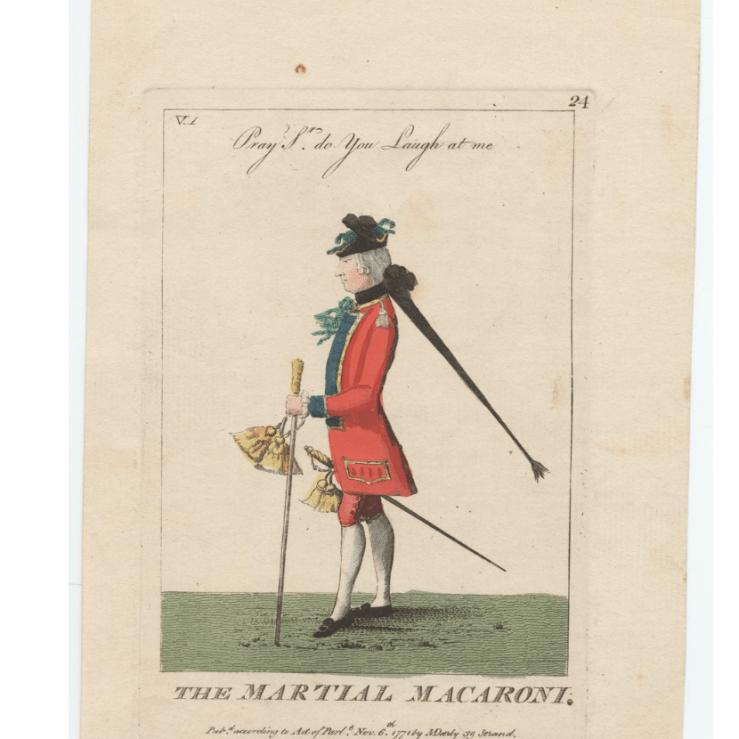
In like vein, a smallsword may not be as imposing as greatsword, but it’s fast, sharp, and deadly. It’s easy to assume some brigand seeing a fop with his sword-jewelry might think the dandy is an easy mark, but was he? The guy open-carrying may be a crack-shot or may never have fired the thing, but how many people will take the risk to find out? It’s abnormal to carry weapons in American culture—we don’t need to, not like people do in other areas of the world, and so when we see someone at a grocery store with some giant chimney on their hip we normally assume political posturing, mental health issues, or both. In the 18th century, when men were still carrying swords as a part of dress, seeing a weapon was relatively more common. It was part of the scenery. We can ask the same questions of them that we do of modern open-carry fans today: how much skill did/do they likely have?
The answer to the question is less important than asking it, because it puts us in touch with our assumptions, our bias built from our own context. It’s tricky—one the one hand, drawing analogies can help, but on the other we have to be careful not to equate the two halves of the analogy. It’s analogy—comparing two things in order to clarify or explain something, not equivalence. In this case, there are some important, critical differences between a smallsword and a .22 snub-nose, just as there is between an item of dress as normal as a hat and something that people notice because it’s an exception to normal, to the everyday. In this case, the point of comparing a small caliber pistol and smallsword is that both will ruin your day even though they’re not the M-60 or a montante.
I’ve pulled a few works from the 18th century and excerpted portions of their prefaces to see what they have to say and what we might learn from them. They are:
- 1702: Henry Blackwell’s The English Fencing Master
- 1707: William Hope’s A New, Short, and Easy Method of Fencing
- 1758: Juan N. Perinat’s Art of Fencing with Foil and Sabre
- 1771: J. Olivier’s Fencing Familiarized
- 1780: John McArthur’s The Army and Navy Gentleman’s Companion [2]
Taking each in turn, what do we learn?
Blackwell, Henry. The English Fencing Master. London: Printed by J. Downing, 1702.
I could very willingly have sav’d my self the Trouble of a Preface, had I not lain under a Necessity of Apologizing for the Brevity of this Undertaking, which I desire the Reader to accept as follows.
In the first place therefore, I do assure you the Peruser of this small Treatise, that there is scarce any thing needful to the Knowledge of the Small-Sword which is not here laid down, and that in so plain and clear a Method, as will give both Satisfaction and Delight to All Lovers of this Art. An Art so necessary to be known, and so proper a Qualification for constituting a Man a Gentleman, that I had almost said he can be none that is not skill’d therein.
A second Reason I might alledge for the Conciseness of this Work, is, that I have made use but of few Lessons, as judging that way most practicable, many Lessons being rather cloying than Instructive; besides that we too often experience, that Gentlemen are apt to forget one while they are learning another, by which means they scarce ever become perfect in any.
And now, were it any ways Useful to my Design, I might run a large Encomium in praise of Sword-playing, and show you particularly how England of late Years has exceeded all other Countries herein, even France it self, which has long boasted its Preference in this respect; but this being the Work rather of a Panegyric than a Sword’s-Man, I shall wave that point, and conclude with telling you, that if this Edition finds Acceptance in the World, I intend to enlarge on this and other parts of it, and oblige all Lovers hereof with a compleat System in a Second Edition. H.B.
Several things stand out in reading Blackwell’s preface. In the first line he informs us that this work is not long—“the Brevity of the Undertaking” is a florid way to express this, but amounts to the fact he will not be presenting an exhaustive treatment. He reiterates this a second time in the next section by referring to his “small Treatise” and significantly that despite the length the core of the system is present. Blackwell may assume some familiarity with fencing as well—a text he believes will please “All Lovers of this Art” is suggestive at least that some of his audience he expects to have a nodding acquaintance with the Art. Touching on the key aspects of the system the author then informs us that he includes few lessons as he believes these tend rather to confuse than help. In short, Blackwell tells the reader from the off that his work is not complete, but a distillation of key aspects of smallsword laid out in approachable lessons. For the historical fencer today keen to mine this text, this is important: it’s not complete, so while useful and informative, additional reading will be necessary.
Hope, W. A new, short, and easy method of fencing: Or, the art of the broad and small-sword rectified and compendized. Edinburgh: Printed by James Watson, 1707.
[x] A Dexterous Smalls-sword Man, how adroit soever he may be at the handling of his Rapeir in a Duel after the Common School-Method, will, when he comes to Engage at Clos Fight in a Field-Battel, either with Foot or Horse, find himself extremely put to it, and almost as much to seek, as if had no Art at all, if he be Masters or no better Defence, whereby to secure himself, than the Ordinary School Parades of Quarte and Tierce, which belong only to the Small-sword or Rapier; & whereof the unsuccessful Practice, (even in Duels, laying aside their Insufficiency in a Crowd, or Field-Battel) hath no doubt made many People value less the Art of the Sword, than otherwise they would have done; judging thereby, that there could be no better nor securer Defence drawn for it: For in such a Juncture, I mean in a Crowd or Battel, a Man hath neither Time nor Bounds, nicely to Ward off his Adversary’s Blows or Thrusts, nor to Break his Measure, as he would have, were he Engaged only in a Duel. Here he is a little more at Large and Freedom; but there, perhaps surrounded by two or three Stout and Vigorous Single Soldiers, or Troopers, who are with Fury Sabring, and Discharging Blows upon him.
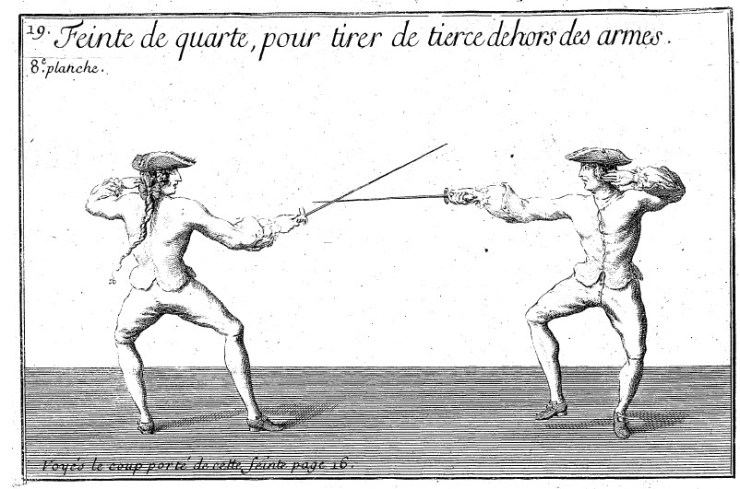
In this selection from Hope we see a stark contrast to Blackwell. Of concern here is Hope’s recognition that school play and actual combat are not the same. Most smallsword works make great hay of quarte and almost as much of tierce, but to Hope’s mind that is not enough. [3] It may serve in the salle, but on the ground or in combat these two principle parries are insufficient. As he remarks, the distance required to make these parries work well is not guaranteed in combat; the same is true of the ability to break measure. In a duel between two people, there is comparatively more room to act, more options, and fewer restrictions. That concluding line is particularly clear—armed with these more extended parries what shall the poor person with a smallsword do against three soldiers or cavarlymen bearing on him with sabres? Unlike the movies, they’re unlikely to take turns. Hope’s preference for a hanging guard, something one sees less often in smallsword treatises, makes more sense given that Hope’s assumptions are different.
Perinat, J. N. Art of Fencing with Foil and Sabre. Cadiz: Imprenta de la Real Academia de Cavalleros Guardias Marinas, 1758.
Prologue:
The art of fencing, that I demonstrate in this work, is one of the most essential parts of the military, whose object is the defense of our Holy Faith, the king and queen, and the state, and the glory of defeating their enemies. Because of this, in the most political governments special care is always taken that the youth destined for arms are instructed early in the art of fencing, to the end of acquiring agility, skill, boldness, and fearlessness.
In order to be able to perfect this art with more ease, it has been divided into two parts. The first, that one sees only in the play of the smallsword, pertains properly to the officers of war. The second, that one sees in the handling of the sword or sabre, is more commonly for the soldier. These two branches have always been separate from each other, and each one has had its own masters, but as the Marine Officers are destined for work in which it is very useful to be able to use the sabre, and that some have asked me to teach them, I have happily consented to give them this instruction, not withstanding the common worry of the academy masters, that they would lose some of their rights and prerogatives if they would teach the play of the sabre.
It is also true, that not all masters of the smallsword can teach the play of the sabre, and it is necessary to have found, as I have, the occasion of learning it. I confess, that in ten companies that I have done, in which I have encountered various sites and assaults, I would have perished had I not known how to parry a sabre.
In order to make this book more manual and less costly (which is the first brought to light in Spanish on the play of the foil), I have only placed in it the most necessary and subtle of the art. But if the public will receive it with benignity and manifest desire for a more extensive treatise, I will dedicate myself to giving one so complete that it won’t leave any desire for more on the subject.
As it has not been possible to represent in plates all the postures of the art, nor give greater perfection to the drawing, I ask the reader to pay attention more to the explanation than the plates, taking care that in all the thrusts in Fourth and its parries, the body has to be found in the same posture, as well as in those in Third and its parries, and that all the innumerable thrusts and parries that the art encompasses are founded in these four principal points, without the more skillful master being able to alter anything.
Juan Perinat’s treatise, like Blackwell’s, focuses on essentials. He tells us as much in the second to last paragraph, as well in suggesting that one pay more attention to the text than the plates. He suggests that because there are fewer plates that one is going to get more out of the text. Of note, he brings the study of foil (for smallsword) and sabre together in this work, something less common in mid-18th century Spain. As Perinat says, not all smallsword masters know sabre, but in active service he has found it useful, and thus believes that even officers should have some knowledge of it. There is a lot here to consider. As with Blackwell, to appreciate the place of Pernat’s treatise requires additional reading.
Olivier, J. Fencing familiarized: Or, A new treatise on the art of sword play. London: J. Bell, 1771.
From the dedication:
(xii-xx) The principles laid down in the following treatise are such as have arisen from the most serious attention to all the ordinary, as well as all possible thrusts with the sword rendered plain and easy by example, according to the usage and opinions of the most eminent swordsmen and masters of the academy at Paris.
When I was last in that capital, you are sensible Gentlemen, that the stay I made there, had no other object than our common improvement; and I shall esteem myself happy, if by all my cares, I am enabled to demonstrate the ardent desire I have to render the art of which I am a possessor at once both useful and agreeable.
In order to attain both these aims there can be no other method adopted than that of a theory well founded, such as may serve for a basis to all those movements which an agil and well framed body is capable of practicising, in order thereby to discover their defects or to point out their particular merit: without theory nothing satisfactory can be expected, nor is it possible to act with judgment; for it must not be imagined that to acquire some general notions by dint of practice is sufficient; this is only the out lines of the art, it is going no deeper than the surface, and leaving the subject untouched: the essence and sublime of the art is to draw progressive instructions from one thrust to another; to know how many variations it may be susceptible of, and when to use it with advantage: this is what I have endeavoured in the best manner I could to demonstrate to you.
How far I have succeeded I submit to your determination, happy if it contributes to the only view I proposed by it, your advancement…
From the Preface:
(xxii-xxix) This treatise on fencing will I hope be favourably received by all the lovers of that exercise; it will not only be found useful in regard to execution, the perusal of it from time to time will also serve to recall the principles to mind, and enable one to arrive in some measure at perfection; for it is not enough to preserve a same equality in an exercise, and to practise it now and then, the memory must likewise be refreshed by a revival and thorough examination of the principles; theory being as necessary as practice.
I have expressed myself in as clear and intelligible a manner as I was able, in order to be understood, even by those who may never have learnt this art. I have drawn no comparison between the ancients and moderns, as many have done; it serves only to perplex the learners ideas; of what import is it to me, that the ancients called prime what we term second: the name is of no consequence; it is the manner of pushing the thrust that it behoves us to learn, and it is what I have studied to demonstrate distinctly.
Neither do I speak of disarms, voltes, passes, plungeouns, etc. these are only thrusts of convention, obstructive to the proficiency of the learner, and which the ancients used only for shew, and to lengthen their lessons; now that we are more enlightened, it is found that these disarms, etc. are in reality very dangerous, expose much and impede execution.
I have likewise past over in silence the parade with the hand, which however may sometimes be very serviceable sword in hand; but as it exposes as well as the disarms, I have not mentioned it; my intention being to give none but true principles that lead to perfection: and for this reason I have made the play as simple as possible, to render it the more secure, the more easy, and intelligible.
Olivier was writing in the late 18th century and thus at a time when the sword as a necessary part of a gentleman’s dress was going out of fashion. Nonetheless, he set out to provide the principles underlaying all play with the sword, and significantly, extols the role of theory. What he has to say of theory is worth quoting in full:
without theory nothing satisfactory can be expected, nor is it possible to act with judgment; for it must not be imagined that to acquire some general notions by dint of practice is sufficient; this is only the out lines of the art, it is going no deeper than the surface, and leaving the subject untouched: the essence and sublime of the art is to draw progressive instructions from one thrust to another; to know how many variations it may be susceptible of, and when to use it with advantage
In Olivier’s mind, this work will help refresh a fencer’s memory as to the pertinent theory necessary to fence well while at the same time helping one recall techniques one may have forgotten. On this last note the master advocates occasional if not regular practice. In contrast to Hope, however, Olivier wastes no time, as he sees it, on past practice, especially on the various movements that less than a century before had been standard. This is important. Olivier casts these not as alternatives to the linear actions, but as fodder used by masters to extend lessons and garner more payment. Disarms too he discards as dangerous. Though he admits that the use of the off-hand to assist in parrying might help in some cases, he doesn’t cover them since like disarms it can leave one open. He makes a distinction here between the fencing he is presenting and what “may sometimes be very serviceable sword in hand.” What we see here is an acknowledgment that school play and what one might use on the ground could be different. [4] The historical fencer restricting themselves to this text might wish to read others alongside it if they are keen for more than school play and if they want to see what parts of Olivier correspond to more practical works.
McArthur, John. The Army and Navy Gentleman’s Companion or A New and Complete Treatise on the Theory and Practice of Fencing. London: Printed for James Lavers, 1780.
[vi-xi] The motives that principally induce me to publish the following Treatise on the Theory and Practice of the Art of Fencing, are, because such Treatises as I have perused, have been published by Professors, or Teachers of that art, and are incomprehensible to young learners; owing to the intricate manner they have made choice of, in describing the different movements, parades, and thrusts, which should be rendered as simple and easy as the nature of the Art would admit; so that young learners might acquire a perfect knowledge of the Theory of Fencing, and be enabled to execute, or put the same in practice, with little or no instructions from masters.
The treatises hitherto published, are entirely calculated for such persons as have a proficiency in Fencing; and not for gentlemen, who might only have the opportunity of a few months lessons. They may indeed be of use to the former, by having recourse to them occasionally, in order that they may recal to their memory what might be acquired during former practice; but can avail little to such gentlemen, as have only been superficially grounded in the principles of the Art.
I flatter myself, that proficient in fencing will find many things new in the following sheets; and young learners, who have a genius for the art, with the assistance of two or at most, three months lessons from a master, will be enabled to acquire a thorough knowledge of it, so as to put all their parades and thrusts in execution, when entering upon assaults or loose play. I will allow, that a great deal of practice is absolutely necessary, before a young learner can execute all his parades and thrusts with that ease, agility, and justness necessary; but, by strict attention to the rules I have laid down, after receiving thereof from a master, he may acquire justness and agility in fencing, equally as much by practicising these parades and thrusts with a learner, who has made similar progress, as if he practicised them with a master; always observing to execute every manoeuvre with minute exactness; and to prevent his contracting erroneous habits, to have frequent recourse to the lessons and instructions here laid down.
McArthur begins his preface by telling the reader that he desired a simple, straight-forward text for new fencers. In his opinion too many of those penned by the masters contained difficult language, unfamiliar terms, and explanations. Though this sounds a little like Ye Olde London Hemabruh, McArthur also has high praise for Olivier and the Paris Academy. Of particular notice is McArthur’s statement that many gentlemen only have a few lessons, and thus that there was a need for a book that would enable such fencers to recall what they had learned between lessons. Moreover, McArthur still sees a role for the master, even if he also claims that a new fencer, so long as they are disciplined and adhere to the principles he lays out, might make as much progress with another dedicated learner. The work closes with a discussion of “serious affairs” and practical advice. Published less than a decade after Olivier’s work, which in some ways reveals the trend toward school play, it’s clear that even in 1780 an English fencer might wind up in a duel.
So What?
So these different authors had different reasons to write and perspectives—who cares? If you’re serious about smallsword then you do. Change the subject to longsword, sabre, or pole-axe and the answer is the same. Each one of the texts here present’s one author’s view; there will be overlap between them, and, there will be differences. Looked at together we get a better sense of the state of fencing and fencing education between ca. 1700-1800. We learn some important facts about context for one:
- during the 18th century the slow split that led to the division of fencing into academic and practical was already under way
- similarly, texts like Hope (1707) and McArthur (1780) both cover practical advice for serious affairs where Olivier (1771) focuses on the assault or bout, so rather than a formal split the two extremes coexisted and were often taught under one roof (so, use of off-line footwork, off-hand parries, disarms is no more or less smallsword than not using them)
- we learn that many gentlemen might have studied fencing, but some only for a short time—this has implications for the average level of skill at the time
- we read that even someone keen to make things simple like McArthur put great value on theory, because if one grasps the principles then they’re less likely to fall into error
- that the sabre, often considered a common “soldier’s weapon” (at least in Spain) in the mid-18th century, became as popular if not more so with officers by at least the Napoleonic period if not the last quarter of the 18th century
- we also realize that while the difference in these works, some more “serious” than others, stand out to us, that reading all of them will give us a better sense of things than focus on one or the other does—neither sort existed in a vacuum
These are just a few quick conclusions after a cursory read. What they tell us, however, is important. If our goal is to produce interpretations that are as accurate as possible, then we have to consider more than one source (where we have more than one). A look at the collective corpus for smallsword, for example, will benefit a student in many ways, from gaining an appreciation for how different authors at the time approached the same problems to how many different ways they describe an action like the lunge. Students of the time often studied with different teachers. Fiore in the 15th century tells us that he did, and the same was true four and five-hundred years later. It’s even true today. What holds for instructors, holds for treatises—it’s in our best interest to spend time with more than one. We will understand our systems better, and so long as we’re careful and consider context, we’ll likely interpret those systems more accurately and effectively too.
NOTES:
[1] I realize that cultists of the gun in my nation may take umbrage with this, but I stand by it. Like many military brats I grew up around firearms and was instructed in their use. Moreover, from those who served in my family to friends of mine serving now I’ve heard ample anecdotal evidence that confirms rather than denies my assertion here. My father, for example, opted for a .45 pistol over a 9mm as he found the stopping power greater and in his context, jungle warfare, taking out one opponent fast meant dealing with the next (maybe unseen as yet) more quickly. A Marine I’ve known since high school favors a 9mm as sidearm, and he has fought in I don’t know how many tours since 2001. Lastly, from my own experience I’ve seen what a small caliber bullet can do. A close friend of mine, my eldest son’s godmother, was shot through her wooden door by a home-made .22 pistol (likely a gang initiation, but no one was talking of course). Had the door been any thinner she would have died—the bullet was slowed by the door so that when it hit her sternum it ricocheted up into her neck rather than shattering or passing beyond the breastbone. The bullet remains there today as not even the excellent surgeons at Baltimore’s shock-trauma felt safe removing a slug so close to an artery.
[2] Titles listed in order of appearance:
Henry Blackwell, The Gentleman’s Tutor for the Small Sword, or, The Compleat English Fencing Master, 1702/1730 (London, GB: J. Jackson, Archive.org.).
Sir William Hope, A New, Short and Easy Method of Fencing: Or the Art of the Broad and Small-Sword Rectified and Compendiz’d, 1701 (Edinburgh, SCT: James Watson, Google Books).
——. New Method of Fencing, 1708, Highland Swordsmanship: Techniques of the Scottish Swordmasters, ed. Mark Rector (Union City, CA: Chivalry Bookshelf, 2001), 89-189.
Juan Nicolás Perinat, Art of Fencing Foil and Sabre, translated by Tim Rivera, 2018 (Cadiz: Imprenta de la Real Academia de Cavalleros Guardias Marinas, 1758).
J. Olivier, Fencing Familiarized: or, A New Treatise of the Art of Sword Play, 1771 (London, UK: John Bell, Google Books). [NB: dual language, English and French]
John McArthur, The Army and Navy Gentleman’s Companion, ed. Philip T. Crawley. “Study,” The Smallsword Project, https://smallswordproject.com/historic-texts/, 2 September 2020 (London: 1780).
[3] Cf. posts such as “Military vs. Dueling Sabre, Revisited, 23 March, 2021.
[4] In some ways it’s likely impossible to determine exactly when this began. De la Touche, writing in 1670, features fencers using foils and in some cases making actions that seem risky, and yet the duel in France—while illegal—had not disappeared. Is his work academic or practical? My answer would be “yes.” It’s both. It’s what one might learn in an academy, but which still had practical use. Most of the 18th century works that I’ve read so far cut both ways (pardon the pun)—many fencers likely engaged in fencing as we do, as a past time, and yet some of their mates may have been called out or called out others. In the study I’m making now the split becomes more apparent in 19th century works; some of these barely touch on footwork, something no fencer can dispense with outside of the most artificial contexts (yes, I realize there are practices such as the Mensur where neither opponent may move, but while a bloody affair the Mensur is as much ritual as it is a duel—no one is fighting to the death with those sabres. The combats are, in a way, a drinking game. There were plenty of duels as we think of them in German principalities, from point-fencing to sabres mit Stich and pistol. See for one discussion Kevin McAleer’s Dueling: The Cult of Honor in Fin-de-Siècle Germany, Princeton, NJ: Princeton University Press, 1994).

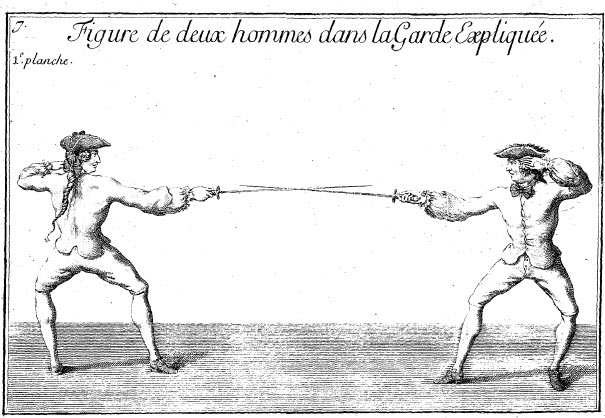



 With the disadvantages we face during the pandemic it helps to think outside the piste. Drill is rote even in the best of the times, but lessons often afford us that sense of time moving, of progression. As students we work on something, then next lesson may work on something new as well. Improvement may be slow sometimes, but it still feels more like progress than the same set of exercises month after month with no variation.
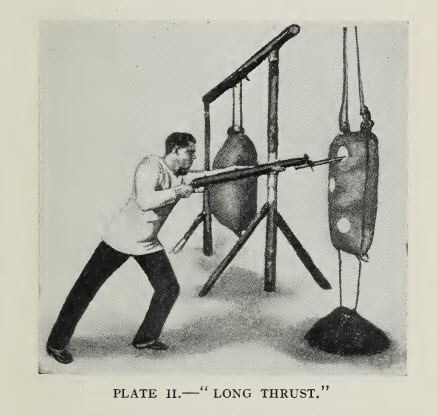 made from about 4-5ft away–as with the sword, bayonet and rifle move first. The student takes a half-step back, parries in prima, then steps slightly to their right and delivers a cut to the arm or down the barrel to the attacker’s hands (this second riposte must be made carefully, one reason that this is not a drill I run with beginners). There are other options, such as a cut to the head via molinello, but we were doing our best to maintain the requisite distance in light of Covid.