Reach for the Sky—Hand Height in the Smallsword Lunge

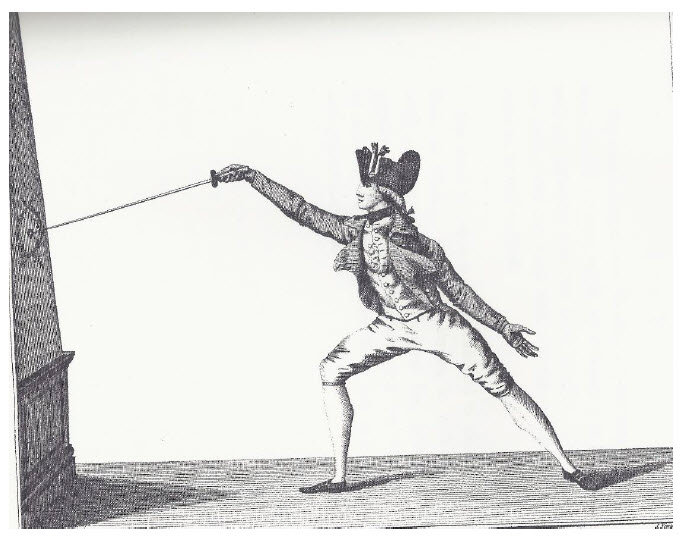
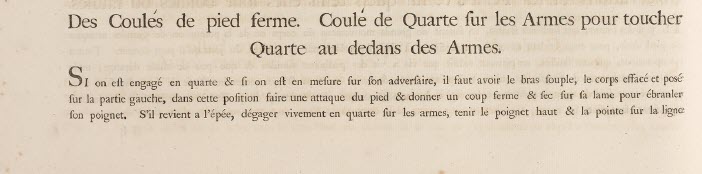
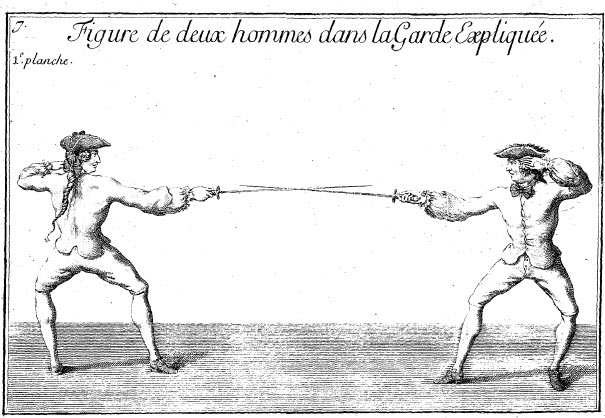
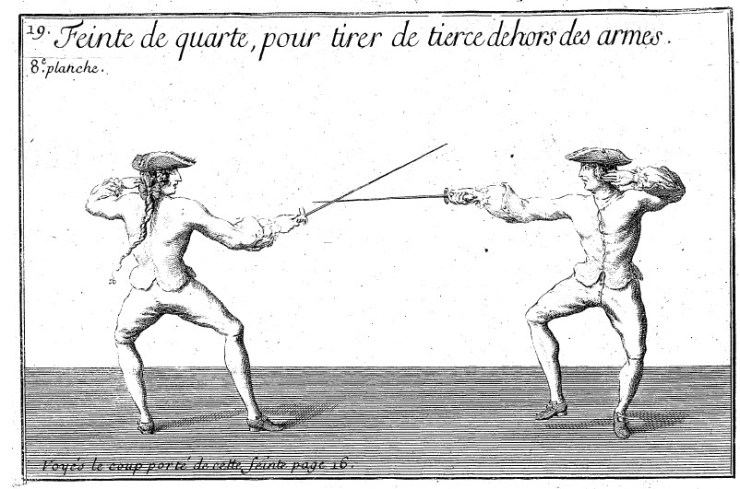
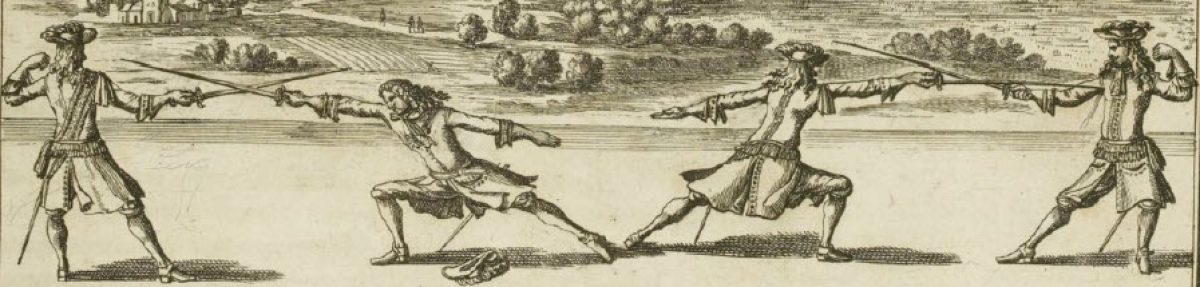
The cliché of a picture being worth a thousand words may be correct, but that doesn’t mean the same image doesn’t require explanation. Rather than take a screen shot of the myriad instances one can capture on Youtube and elsewhere, which might upset people, I’ve opted to go with an iconic, period image, and perhaps one reason for the madness:

de La Boëssière, 1818

There are many examples of this hand-above-the-head extension:

Olivier, 1771
McArthur, 1780

These are period images, mostly of foil play—to which I’ll return—and thus are “historical” in the sense that we normally mean it in historical fencing/martial arts. This said, there is an important distinction to be made between what we see in images like these and those from earlier works, equally historical but different in purpose. [1]

Every instructor has to make choices about what they want to include; they should be able to explain why as well. For me, lunging with one’s hand held so high is less covered than lunging with the hilt terminating at chin height as in earlier works for smallsword. If the goal is not to be hit, to reduce the chances of doubling, then a more conservative approach on the extension of the arm, the very first action made in the series of movements that comprise the lunge, makes sense.

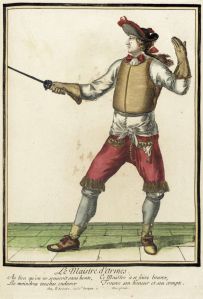
The treatise from which I work most is P.J. F. Girard’s Traité des armes (1740), though much of my curriculum brings in ideas from Domenico Angelo’s L’École des armes/The School of Fencing (1763/1787) and de Liancour Le maître d’armes (1686), among others. I make a constant effort to read and compare the works I rely upon with others, incorporating material from some, merely noting others, and in some cases rejecting some ideas for inclusion in lessons. There are also times when I shelf a treatise for a time—with Le Perche du Coudray (L’Exercise des armes, 1750), there are sufficient reasons I’ve found to work on things and come back to it.

For example, the first lunge he covers, from quarte, depicts the hand higher than the rest of his work suggests. Is this so or an accident of the artist’s hand? The accompanying text has details, but isn’t specific as to hand height on the extension, he merely writes

Aprés sétre mes en garde et en mesure il faut dabord que ce soit la main qui parte la premiere en soutenant bien la poignet et baissant la pointe de l’Epée jusqu’a l’Estomach de l’Ennnemy, que les ongles soient tournés en En haut le bras bien etendue et bien soutenu

After being in guard and in distance, the hand must move first, supporting the wrist well and lowering the point of the sword to the enemy’s stomach, so that the nails are turned upwards, the arm well-extended and well-supported… [2]

Here is the accompanying image:

Le Perche du Coudray, plate 6

In the illustration the lunging fencer’s hand is at his hairline, the lunge long, and nothing in the description offers an explanation as to why. Did Le Perche wish the fencer to lunge this way? Maybe. Parallels with other sources don’t offer much help. His lunge in tierce and seconde recall de la Touche’s (1670) super extended poses, the attacker’s head is much farther forward, and in some cases the attacker is not looking at target. [3]

Le Perche du Coudray, plate 7

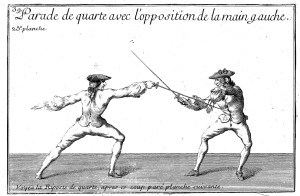
The fencers in the plates all hold foils, but is that significant? In Plate 11, for example, the fencer attacking in quarte—his arm a bit lower than the hairline this time—uses the off-hand parry/check to prevent a double. This recalls similar images in Girard and suggests at least some attention to self-preservation. [4]
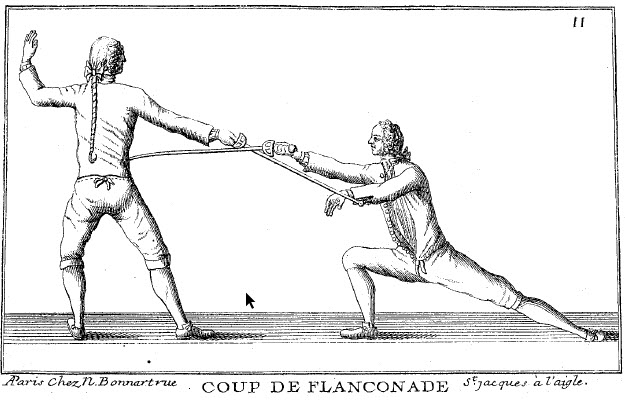
Le Perche du Coudray, plate 11

In sum, I’m not sure what to make of Le Perche yet and so, I’m noting what I see and will return to it later, hopefully armed with more information to help me read it more accurately. It’s possible that Le Perche is one of those texts that captures the subtle shift from practical swordplay to academic, salle play.

The hand in the air like one just doesn’t care… approach to the extension is popular in HEMA’s smallsword circles. While one can definitely point to sources for it, thus fulfilling the “H” of the acronym, the same cannot be said for the “MA” portion. To use a word I have come to detest, this raised hilt in the lunge is less “martial” than the custom preceding it.

Art vs. Practicality

It will come as no surprise that I do not teach this hand and hilt above the head approach to the extension. Graceful it may be, artful it may be, but from the standpoint of “don’t get hit” it’s less likely to protect one. Placed in this manner the weapon is more likely to fail to close the line as well as fall prey to an easy disarm.

Girard’s instruction illustrates well the more practical approach. In describing the guard, his very first point is revealing:

Il faut présenter la pointe de l’Epée droire, vis à vis la mamelle droite de l’ennemi, & que le demi tranchant regarde la terre.

The point of the sword must be presented straight, directed toward the right breast of the enemy, & so that the ridge of the blade is half turned to the ground [5]

Girard, two men on guard

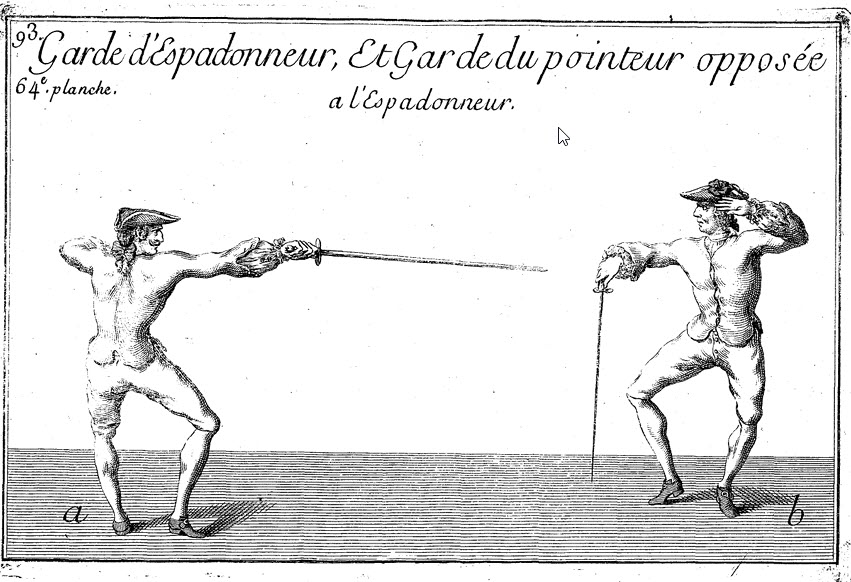
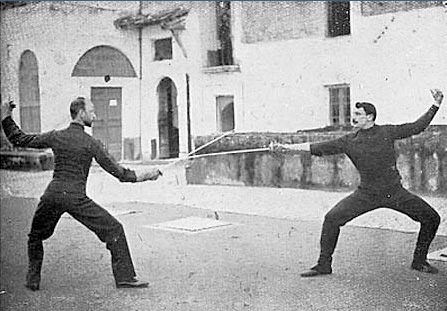
This point forward, semi-extended position places the sharp tip as close to the opponent as possible while keeping the body as far back as possible. This compromise will be very familiar to students of Italian fencing—we see similar guard positions from Rosaroll & Grisetti to that of 20th century masters like Agesilao Greco. [6]

Taking Girard’s thrust in tierce as an example, the same conservatism is in evidence. To thrust in third, one

Coup de Tierce Haute tire Droit au dehors des Armes

Etant bien en Garde & en mesure, l’Epée engagée de tierce dehors les Armes, les ongles regardant la terre, je fais partir la main la premiere, les bras étendus en forme de croix, la main gauche également tournée de tierce, le genou gauche bien étendu, le pied à plat, & ferme & sur la terre, le genou droit plié; de forte qu’il soit vis à vis le milieu du pied droit & dans las ligne de l’ennemi, le corps soutenu, le côté droit panché au-dessus du genou droit, les deux épaules effacées, & la tête le long du bras à l’oposite de l’Epée, pour se garantir le visage. Le coup achevé dans cette Attitude se retirer en Garde, l’Epée devant soy, sans laisser baisser le poignet.

The Thrust of High Third pushed Directly Outside the Sword

Being in a good guard and in measure, the Sword engaged in Tierce outside the Sword, the nails facing the ground, I extend the hand first, arms extended in the shape of a cross, the left hand also turned in Tierce, the left knee well-extended, the foot flat and firm on the ground, the right knee bent; so that it is over the middle of the right foot & in line with the enemy, the body propped up, the right side over the right knee, shoulders profiled, & the head along the arm opposite to the Sword, to protect the face. The attack complete, in this this posture return to Guard, Sword out in front, without dropping the wrist. [7]

The image accompanying this section of text accords with it well, but the text itself is clear—hand first, so weapon first, opposition as one thrusts, and body positioned so that it is not only behind the guard, but so situated that the head is leaning away from that opposition, both for safety—as the master remarks—and so, I suspect, one can see the thrust and the opponent’s reaction better.

Girard, thrust in tierce

As a check on this, it’s worth taking a look at Girard’s first attack, the thrust in quarte. He writes

Le Coup de Quarte Haute tire’ Droit Au-dedans des Armes

Etant bien dans la Garde qu’il dit & en mesure, l’Epée engagée de quarte dans les Armes, je fais partir la main la premiere en levant le poignet, les oncles tournés dessus, regardant le Ciel, ainsi que le dedans de la main gauche; les bras étendus en croix, le corps panche du cote droit, & soutenu au-dessus du genou droit; les épaules effacées, la tête panché du côté de l’Epaule droite pour regarder le coup à l’oposite de l’Epée, de forte que le pommeau regarde l’oeil gauche, le bout du pied droit vis à vis l’ennemi, que le genou tombe perpendiculairement au dessus du milieu du pied avec le pied gauche à plat & ferme sur la terre, la jambe & la cuisse gauche élevées. Le coup achevé & tiré dans l’Attitude qu’il est dit, se retirer bien en Garde l’Epée devant soy, sans laisser baisser le poignet.

Being well in guard & in measure, the Sword engaged in quarte within the Swords, I start the hand first by raising the wrist, the nails turned up, looking at the Sky, the left hand following suit; the arms outstretched like a cross, the body leaning to the right side, & supported above the right knee; the shoulders profiled, the head titled on the side of the Right Shoulder, to see the blow against the Opposite Sword, so that the pommel is in line with the left eye, the tip of the right foot towards the enemy, the knee falls perpendicular over the middle of the foot with the left foot flat and firm upon the ground, the leg and left thigh straight. Having made the thrust in this position, as stated, return well in Guard with the Sword in front of you, without letting the wrist fall. [8]

Girard, thrust in quarte

It’s possible to regard the attacker in the image “pushing” fourth as having his hand at the hairline, but given the description that doesn’t follow. More likely, the artist, who knew their craft well, meant to show the head leaning right over the shoulder. The fact that the right hand is nearly as large as the head suggests that it’s meant to present closer to the onlooker, again helping create perspective. With the head so tilted, lining up the left eye with the pommel occurs at an angle and thus lower than the top of the head were the head upright. As a side note, while the opponent may have been hit in the chest, it’s possible he was hit in the arm—few smallsword or rapier texts for that matter spend much time on the forward target (a topic for another time), but it would be unwise to assume that any instructor would have looked down on such a strike.

Text, Awareness, & Choice

As with most things in HEMAland one can adopt whichever hand-height one wishes. However, I will maintain that knowing why we do what we do and where it comes from makes sense. It’s historical fencing, and part of any historical examination is understanding the context for things; it’s all the more important when the waters are muddy. The overlap between smallsword and foil play is significant, and thus, it’s a lot easier to treat them as one in the same. Did many smallsword fencers, who sought to learn to use a sword in earnest, learn via foils? Absolutely. But… they didn’t show up to Stephen’s Green or The Dueling Oak armed with one, and if they attempted to use moves better suited to impressing their fellow salle mates with their grace and poise than keeping them safe, they were likely to leave the Green or the Oak on their backs.

The hand held high versus at chin height reflects a change in culture. It coincides with the decline of dueling in some areas on the one hand, but with the increasing importance of fencing as elite accomplishment on the other. Both are historical, but reflect different contexts, different attitudes. The later our “smallsword” texts are in time, generally the more we see this reach for the sky business. De St. Martin, for example, whose L’art de faire des armes came out in 1804, has it, and while perhaps not in each plate, it’s there. In discussing the parry and riposte from third, de St. Martin specifies that “la main bien élevée au dessus de la tête,” that is, that one should have the “hand well raised above the head.” [9] We see the concern for grace, poise, and elegant execution of technique not only increase in the treatises, but in other areas as well. Many 18th century advertisements, even in the American colonies, often paired fencing and dancing as two pursuits for the genteel portions of society or those who wished to join their ranks. [10]

People pursue historical fencing for their own reasons and enjoy different aspects of it. That’s really pretty awesome. For those keen for smallsword or the study of early foil as a distinct track, some attention to these distinctions will only help one’s study. An awareness of the differences between foil as art form and foil as safer training weapon for smallsword is especially important for anyone purporting to study the MA aspects of HEMA. Few people will notice or care which one chooses, but it’s logical to know what we’re doing, where it comes from, and why it was done that way.

NOTES:

[1] Images are from:

Antonine Texier La Boëssière, Traité de l’art des armes, Paris: de l’Imprimerie de Didot, 1818, plate 1.

Mr. Olivier, Fencing Familiarized, or, A New Treatise on the Art of Sword Play, London: John Bell, 1771

John McArthur, The Army and Navy Gentleman’s Companion, or, A New and Complete Treatise on the Theory and Practice of Fencing, London: James Laver, 1780, plate 6.

[2] Le Perche du Coudray, L’Exercise des armes, Paris: 1750, from the pdf made available from the Biblioteca de la Univeridad Polltécnica Madrid, España, plate 6 and text, 29 and 31 in the pdf.

[3] Le Perche, L’Exercise des armes, plate 7, p. 33 of the pdf. Cf. plates 8 (37) and 9 (41).

[4] Le Perche, L’Exercise des armes, plate 11, p. 49.

[5] Girard, Traité des armes, La Haye: Chez Pierre de Hondt, 1740, 5-6. In note IV of the same section he specifies that the hand and hilt are turned to half-quarte (Avoir le bras droit, & le poignet flexible & tourné demi quarte…de forte que le demi tranchant de la main droite regarde le Ciel…) so I have translated note I’s last clause, que le demi trenchant regarde la terre, as “half turned” to reflect this, demi tranchant meaning “half edge.” [Pagination is that of the BnF pdf]

[6] See Giuseppe Rosaroll & Pietro Grisetti, The Science of Fencing, Milan, 1803, trans. by Christopher A. Holzman, 99-101; table 2, figure 2.

Of note, in the Italian edition, § 66. Descrizione della stessa [guardia], explains this about the weapon and arm:

Il braccio destro disteso verso il nemico rappresenta la linea di offesa colla spada, la punta della quale dee essere diretta all’occhio del nemico, parlando di spade nuda, ed al centro del petto nelle accademie; il gomito del detto braccio dee essere volto alla terra, e propriamente sulla direttrice. [p.45 in the pdf]

The arm, much like Girard advocates, is more or less straight out, only pointing at the eye for serious encounters (diretta all’occhio del nemico) versus the chest.

Agesilao Greco, on the right as one looks, some timebefore 1900–not the arm:
[7] Girard, Traité des armes, p. 16.

[8] Girard, Traité des armes, p. 14-15.

[9] M. J. de St. Martin, L’art de faire des armes, Vienne: de l’Imprimerie de Janne Schrämble, 1804, p. 30. NB: this is not an isolated mention. When de St. Martin first mentions the direct thrust (le coup droit), he mentions that the wrist should be “well elevated” (le poignet bien élevé), p. 29. It’s always dangerous to take illustrations at face value, but overall most of his depictions of the lunge show the hand higher than Girard and other, earlier masters advise.

[10] See for example, https://adverts250project.org/tag/fencing-master/page/2/
Defining (Redefining?) a Successful Club

I’ve hesitated about posting this entry, but since it relates to a common problem many historical fencing instructors face, and since increasingly my chief role seems to be advising others like myself, I decided to chuck caution to Zephiros. I’ll not lie though: moving forward with this piece feels a lot like leaving a perfectly good guard position, dropping my weapon, and pointing to my chest so an opponent has only to extend to hit me.

Any group of people, however small, introduces complexity that should have one considering “success” on multiple levels, but here I mean in the usual sense behind this word in the United States. Success in this sense connotes “viable,” thriving, active; potential growing and improving. By implication stasis may be viewed as “less” successful, though most people would likely agree that stable trumps shrinking numbers. When most folks Stateside speak of a “successful club” they mean a certain thing—generally, they mean a club is large-ish, active, and popular. Logically, this is both valid and true given the premises most American historical fencers, if not others, assume in assessing these things, but the logic left out is as important. A club, group, or school can be successful if it doesn’t meet these qualifications. Popular doesn’t mean success on all fronts, and too often, not where it’s most important. Combating the normal attitude, however, is fighting uphill against greater numbers.

The problem is that being the common conception of success, if one’s school is smaller, less well-known, or uninterested in the usual pursuits, one still has to contend with the definition at large, with how others value and define everything. Well-meaning people will still seek out Club X because it’s popular. New to historical fencing, people do not necessarily have the tools to evaluate quality—big has to mean better, right? Maybe. Maybe not.

To demonstrate how extensive a problem this is, I have received advice—unsolicited—from both those who run other clubs and people completely unacquainted with fencing groups. Both have sometimes given me the advice that I might consider “redefining success.” I’ve balked every time for two reasons. First, I don’t share their definition of success, so there is no reason to redefine it. Second, even assuming I buy into the same definition, how, I ask myself, is this not a cop-out? How is it not really “relabeling failure?”

Debate over the relative merits of either position could occupy more time and space than necessary, but in brief here is a quick distillation. On the one hand, success should, in some if not most respects, relate to and reflect a collective definition of what constitutes achievement (key here is what we mean by “collective”). Without some degree of consensus, what denotes success becomes purely relative and ceases to mean much beyond the individual and their definition. On the other hand, widely held definitions of success can easily be outdated, myopic, or biased, and so, awareness at the very least of these potential pitfalls in assessing one’s own success seems prudent. The answer is to determine what success means to us and those in our circle and frame questions about it in light of that definition, not that of someone else. Sounds obvious, but it’s not.

It’s possible if not all too common to misapply a definition of success, even in a related field. For example, if the only rubric of success in historical fencing is increased understanding of the source material, but one’s interest is winning tournaments, then applying the former to the latter doesn’t make sense. There may be overlap, true, but neither tournament wins nor the ability to explicate a source require the other to be successful. It’s entirely possible to win a bout never having read a single word from a treatise. This said, any understanding of a treatise requires solid familiarity with the weapon and experience using it; theoretically, the more experience, the better the understanding, but then defining “experience” is just as prone to abuse. [1] It’s possible to gain understanding of a fencing text, in some degree, never having picked up a weapon, but far less possible to understand it well without some training. By this I mean not only a grasp of technique, but of theory, historical context, and the place of the text in situ. [2]

Apples and Oranges

How we define success, what it means to us, should determine much of what we do. Any such examination should consider one’s goals first. What is it that one wishes to accomplish in the study of historical fencing? There is no “right” or single answer. People jump into medieval, renaissance, and early modern martial arts for a variety of reasons. While I maintain there are better and worse ways to pursue most any avenue, the fact is that the choice of avenue is entirely up to the individual. [3]

There are many different “HEMA”s and thus there’s something for everyone. This said, how one defines progress and success should follow from one’s chosen path within those HEMAs, not necessarily the popular notion or that touted by folks with a different focus. Instructors most of all need to give thought to their purpose—it just makes sense: teachers need and want students, and students are easier to attract if one is explicit about what it is one teaches. Clubs doesn’t exist without students. An instructor on their own is just a practitioner—for those of us working with fewer people there will be, alas, times when we aren’t technically instructors.

The hard part for instructors who have students stick with their program beyond a Groupon is that invariably the question of how well one is doing will rear its ugly mug. This is where caution is important, and, where many of us go wrong. We look across the street, see Club X doing “well” (again by the standard definition), and think we’re failing. Unless we’re trying to do exactly what Club X does, that’s probably not true. We have to consider our goals, how those in our track specifically envision “success,” and evaluate our progress against that. Club heads, like any other individual fencer, can mix things up. The backyard brawler whose “cool tricks” beat fellow members of their fight-club should not assume that this means he is Leichtenauer reborn. The armchair historian who has never fenced but knows Capo Ferro in and out is not likely to find great success at the International Rapier Seminar. The SPES-clad tourney jock with a gold medal should assume neither that they’re Leichtenaur reborn nor that that their success at the IRS means they exemplify what Capo Ferro intended. If the instructor is making the same mistakes, not only will they be miserable, forever questioning their success, but also they’re likely to lose people. People do all this stuff for fun, and one-act plays featuring a teacher with ennui are not fun.

Instatwitterfacechat and False Reality

When we step back and think about this, we see how obvious this is, but that’s part of the problem: it’s hard to step back when so many arenas suggest everything is the same. Facebook, Instagram, Youtube, all of them, present a funneled version of reality, one no more as safe for historical fencing as it is for understanding politics. As presented, HEMA is mostly longsword, with some nods to rapier and the watered down world of infantry sabre. Tourney news makes headlines in a way that an article on Perinat will not. Name recognition is created more by flooding social media and “likes” than anything else. Authority, such as it is, follows suit, and yet most people wouldn’t use the same logic to find a surgeon or plumber. Strange women lying in ponds distributing swords is probably a better source of authority than these HEMA equivalents of swiping right on some dating app.

If one isn’t careful, one will assume that whatever they’re doing must conform to this pastiche of HEMAs, because everywhere one looks seemingly presents the same truth. Youtube, facebook, Instagram, none of these present reality, just specially tailored packages meant to convey what the creator desires and wants others to believe. These things are fine so long as one sees them for what they are, but no instructor, no fencer, should use them as a basis for comparison without first recognizing what they are and assessing whether or not it makes sense to use the media this way. [4]

Each of us, in conjunction with those on the same track, should decide what our goals are going to be, not the herd or those following paths going in different directions. If we’re lucky enough to find like-minded folk, people with similar goals, then they’re probably a lot safer to listen to than those who don’t share either our values or our reason for pursuing the Art. These are the people, not HEMA at large, who might help one define goals more appropriately.

NOTES:

[1] Experience means a lot of different things. Time in the saddle means nothing if that time wasn’t spent well. Over several decades I’ve watched many passionate fencers and fighters waste their time in programs which won’t help them improve. Saddest of all is watching a person like that try better schools, but leave because it’s either harder or because they feel less bad-ass. Serious students have to have the courage to be a beginner even when they’ve studied a long time. This doesn’t apply to the part-time folks just there to acquire enough skill and play for fun, but to those people who wish to grow in the Art.

[2] We have to consider, among other things, how was such a text used at the time. We need to ask… How were works on fencing understood? Why were they written and for what audience?

We often talk about the corpus of works as if it were homogenous, but it is anything but that save in broad outline—we have notes, lesson plans, fragments of larger works, government publications, poems, illustrations, treatises written for other teachers, popular works, and works meant to showcase a particular master’s approach for their patron.

[3] If the H and/or MA of “HEMA” are missing I’m not sure what separates what one is doing from Olympic save choice of weapon and a less viable, motley collection of pedagogical approaches.

[4] For example, I might suggest to a new rapier or smallsword fencer to look up Levi Fontaine or David Pascal’s bouts on Youtube, but this is so that they see what is possible, not because I’m expecting them to show up next week and move and fight as well as they do. New students shouldn’t compare themselves to people with so much more training, but, seeing beautiful fencing can inspire us. It also beats having them bump into the garbage out there that will only hurt their progress.

E.g.

Pants before Shoes: Skill Progression in Fencing

from the genius of Gary Larson and his “Far Side”

In fencing some skills are difficult by nature, some because we make them so. For the former, one must put in the time, sweat, and sometime frustration—there is no other way. For the latter, however, there is much we can do to limit the ways in which we make skill acquisition harder. As much as this applies to any student, it applies all the more to the instructor, for they plan the lessons and set the pace. It’s their responsibility to present material in a logical, progressive way so that shoes are not donned before pants, so that equines are not placed before carts. We do this in most things, and fencing is no different.

Culture & Approaches to Learning

So much of what we study is exciting and people can’t wait to dive in—deep—but the fact is that fencing, any fencing, requires considerable coordination, skill, and experience to do well. For the clubs (especially here in the U.S.), which are various takes on Chuck Palahniuk’s Fight Club, often newcomers are handed a weapon day-one and ten minutes later are bouting. It should be obvious why that’s a bad idea, but given how widespread the practice is, it’s not.

Often those running such clubs probably don’t realize how short-sighted this is; it might be the way they themselves got involved, so it seems normal. In addition, most clubs struggle to stay afloat, and the tired adage of “give the customer what they want so that they come back” may underpin this get-them-playing-right-away practice. It’s a tough spot for any club—we want people to stay, but the fact of the matter is that most people are there to play. It’s recreation. By and large “HEMA” consists of people in their late teens to those in their thirties, so college students, adults with jobs, people with time and just enough money to pursue this expensive hobby. It makes sense that many if not most folks don’t want to spend the little free time they have doing thirty minutes of footwork drills, working on point control, or exploring this play or that from technical aspects.

A caveat: I am not dogging play-time; however, I think it’s important to ask the question, to be mindful of what it is we offer, and why. If a club wishes to be the “HEMA” equivalent of fight-club meets theme-park, fine, but admit it; have the integrity to own that what you’re doing is less “martial” than it is playtime with a few historical “tricks” thrown in. There is room for this, and in my experience, that in fact is what most people actually want. This is to say that the numbers are telling. Those groups who focus more on technique, on building depth within the Art, not only tend to be far smaller than others, but also get people bouting at full tilt slowly. Between the length of time to learn enough skill to bout effectively and the fact that there is a lot of work up-front, few people stick. To reiterate: this is perfectly understandable. That doesn’t make it any less unfortunate.

The Difference between “Do this” and “Here is how to do this”

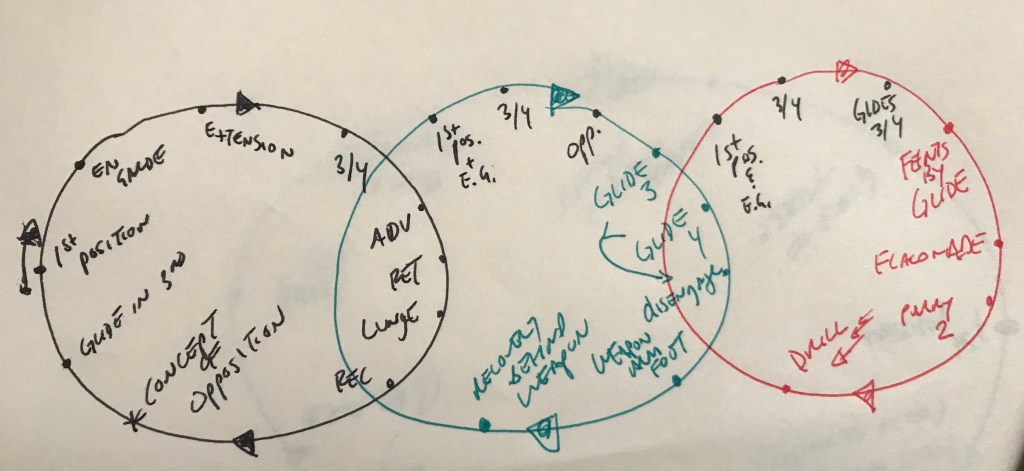
For those interested in comprehensive technical skill acquisition the old way is still the best way. Ideally students do this one-on-one with an instructor, but it also works in a group setting if slightly less well. In short, this approach takes “do this” and expands it to “this is how you do this.” For example, one could demonstrate how one stands in posta di donna in Armizare, ask the student to copy it, and when it looks right enough, say well done and continue. Alternatively, one could start there and then make the micro-adjustments that will save the student problems later. The instructor could speak to how far apart the feet out to be, what direction they’re pointing, and where one’s weight should be—between the feet? Front-weighted? Back-weighted? There is also more than one way to adopt posta di donna—one can adopt this stance with the sword over the right shoulder, over the left; one can stand in posta di donna pulsativa, which is more back-weighted, and, in the same way but with the sword on the left (posta di donna la senestra pulsativa). [1] The student might be wielding a longsword, a longsword as pole-arm, a spear, or a pole-axe, and while the stance is more or less the same the length and heft of the weapon change critical aspects, such as measure and tempo. Each one of these positions is useful for some instances, less so for others, and so it’s not enough to say “stand like this;” we also have to explain when and why to stand this specific way. If the student is shown one version of this posta they’re getting short shrift, and, it’s not going to work well for them.

An Argument for Slow & Steady

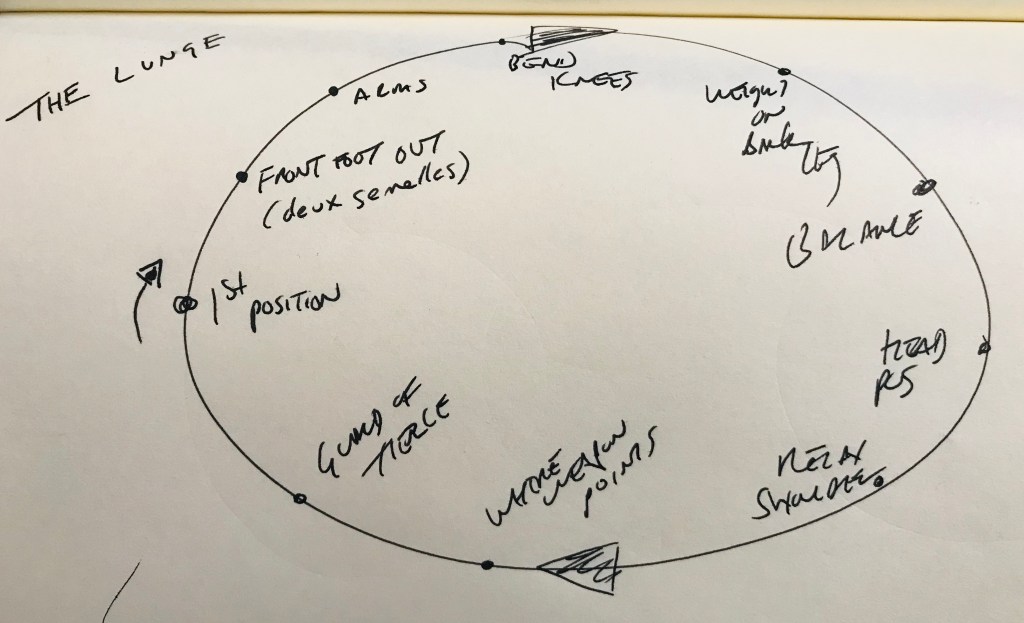
What’s the risk in not learning how to fence via a method which introduces complexity one step at a time? There are a few things. First, if their level of understanding is shallow, the student’s ability to add to their repertoire is affected. Lacking basic comprehension makes learning permutations for that skill or related ones harder. This is all the more true with fundamental actions. For example, if the student learns to lunge without ensuring that the front foot is pointed at their opponent/along the line of direction, there are cascading consequences. They increase the risk of injury to knee or ankle. They inhibit their ability to advance quickly or perform maneuvers which employ the same foot orientation, such as the advance lunge, jump lunge, or redoublement. In the worst cases the misdirected foot misdirects the body and thus the weapon.

Second, hard is it may be, the acquisition of skill in a logical, progressive sense builds confidence. Having mastered how to lunge, for example, the student is more inclined to use it, and often, more amendable to learning other methods of moving that employ it. Confidence—sensible confidence—is everything in fighting. Without it one is immobile, potentially at the mercy of a more confident opponent. Proper education instills proper confidence, because it is built on more than luck or the myopic reality of having something work in specific situations like tournaments where most people are at the same skill level. If one has learned to lunge well, and with it, when to lunge and from what distance, there is science in play—it’s adaptable, not tied to the conditions of any one situation. This is important, and, not only for the more source-driven, history-minded folks, but tournament folks too—fight long enough, in tournaments of different types, and one learns quickly whether their toolbox is as replete with tools as one thinks.

This brings us to a third reason the slow and steady approach to learning is important: resilience. When the tournament fighter reaches the day where their bag o’ tricks lets them down, the countdown to their quitting starts. They have nothing to fall back on; the more passionate among them seek out new tricks, but since these “tricks” are misapplied or misunderstood fundamental actions or composites of such actions, they are ultimately a dead end. This fighter doesn’t know how to recombine them. This is one reason, judging by local numbers, people jump into “HEMA” for two to three years, then leave. For the fighter, however, who possesses skill and understanding in the fundamentals, there is a built-in approach to analyze and problem-solve what went wrong in that bout or this tournament. So armed the student is less likely to hang up their mask and feder, but examine what went wrong and why, because they have the tools and technical vocabulary to do so.

Related to resilience, but perhaps more germane to the let us say the “mature” fencer…, a solid grounding in technique, not just in its use but in understanding, will allow them to keep fencing when they can no longer, or should no longer…, engage in some branches or fight with certain weapons. Call it adaptability. I work or have worked with fencers older even than I am, and the ones who are still fencing have been able to continue because their understanding isn’t shallow. Even moving say from KdF to smallsword wasn’t the speedbump some might think because they were well-trained in KdF. Their instructor at that club—one I knew and have a lot of respect for—taught them correctly. I didn’t have to teach them how to move, just adapt what they had been doing; I didn’t have to teach them to attack with the weapon first, because they already understood that; I didn’t have to introduce them to tempo because they’d learned this as well. All I have done is help them adapt the lessons they learned studying Liechtenauer, Dobringer, and the rest to new tools. With other fencers, in contrast, who have not received decent instruction, who, poor souls, were just thrown in the pool and told to swim, two things generally happen: they struggle in the first lesson where we go over basics, then in frustration they leave and I don’t see them again.

Further Examples

Specific examples help, so here I’d like to explore two. The first is from rapier, the second smallsword. I’ve not chosen these at random either—I see these very problems all the time. Seeing what sorts of issues these examples cause fencers has served to bolster my position on taking the time to learn to do things properly. The first example, from rapier, concerns adding too much too soon. The second, from smallsword, focuses on a complicated action as if it were simple.

Rapier and Dagger

One of the most popular combinations in historical fencing is rapier and dagger. Not going to lie, I love it too, and in fact it’s now difficult for me using any thrust-oriented weapon held in one hand not to want a dagger in the other. That defense-in-depth is a game-changer. Happily, we have a large number of rapier treatises that cover using an off-hand dagger, among other options, which means that we have comparatively less guess work than we do in so many areas.

If one examines a random selection of rapier works, it is worth noting when the source covers dagger, that is, where it is within the book. For example, I pulled these four from my shelves:

  • Camillo Agrippa, Trattato di Scientia d’Arme, 1553
  • Vincentio Saviolo, His Practice, 1595
  • Francesco Alfieri, La Scherma, 1640
  • Francesco Marcelli, Regole di Scherma, 1686

Agrippa is one of the oldest rapier texts, Marcelli arguably one of the latest, and so though brief this gives us some notion of changes over time. I also considered different translators as a sort of double-blind or check that I wasn’t favoring one (I have my favorites like anyone else).

from Agrippa’s _Trattato di Scientia d’Arme_

Agrippa’s Treatise on the Science of Arms features the pairing of sword and dagger from the off, and, in most sections. It is safe to assume, then, that working these in combination as one starts study of Agrippa makes some sense. In contrast, Saviolo covers sword alone first, then sword and dagger, then returns to sword alone. Likewise, Alfieri turns to sword and dagger later, in the twentieth chapter, in On Fencing. Marcelli’s Rules of Fencing covers the span of a bible before getting to sword and dagger—he begins coverage of it in part two, book one, chapter 1. [2]

Going by these four, and granted this is a tiny sample, starting with sword alone makes sense. There is another reason to study sword alone first—it’s hard enough studying one weapon without adding an additional set of positions and actions, never mind coordinating them both. Proper control of a single weapon is difficult, especially at first, so unless there is good reason to do so, why double that difficulty? [3] Put blunty, if the student can’t make a decent direct thrust or perform the most basic parries yet, then the addition of a second weapon isn’t going to help them: they’ll just have two tools with which they must struggle. Moreover, pairing sword and dagger changes one’s position—from a slightly profiled guard positon one adopts one that is more square, because the offhand weapon now provides some measure of security. To remain profiled limits if it doesn’t prevent one from using that offhand weapon. Thus, if a student’s footwork for sword alone isn’t decent, the addition of variations will only complicate things.

Smallsword

Turning to smallsword, a number of works discuss the demi-thrust, sometimes in English called a “half-thrust.” The term is deceptive—taken literally it might be mistaken for a thrust made half-way or perhaps some manner of in-fighting action, but it’s actually a species of false attack made by the defender. Girard’s Traité des armes (1740) illustrates this action well.

Demi-Botte de Quarte

Au dedans des armes pour tirer tierce, ou quarte dessus les armes

Ayant paré un coup de quarte au dedans des Armes, au lieu de riposte droit de quarte sans dégager, je fais level la main & la pointe plus basse, en frapant du pied droit, comme pour achiever le coup au dedans; & lorsque l’ennemi vient à la parade pour fraper l’Epée, dans le même-temps je fais dégager subtilement & tirer ferme au dehors, soit de tierce ou de quarte dessus les Armes, la main la premiere dans le principe, puis redouble de second sous la ligne du bras, ensuite faire retraite l’Epee devant soy. [4]

The defender, having parried in quarte, feigns a riposte in the same line (fourth), but as the opponent moves to parry in quarte, the defender makes an appel and disengages and thrusts in tierce with opposition. Seems simple, right? It is, if one has already a good command of the key actions that make up the demi-botte.

Girard covers this later in the text, well after discussion of the thrusts in tierce and quarte, the parries of the same number, how to move, and importantly, after explanations of feints, beats, and compound attacks in various tempi. Organized as it is, The Treatise on Arms proceeds from less to greater difficulty, so, if the demi-thrust is covered after these other complex actions, there is likely a good reason. There is complexity there.

An indication beyond placement within the treatise, Girard does not explain how to perform the specific actions that make up the demi-thrust; he just describes the action. He assumes that the reader, hopefully possessing at least a modicum of instruction, will supply the required skills and ideas. As it’s laid out, the demi-thrust reads like yet another technique employing a disengage, but it’s more than that. It recalls the section on feints, though it isn’t one, but it also assumes excellent timing and a keen sense of measure. [5] All of these must work in concert to make this defensive option viable.

Girard 1740, _Traité des armes_, plate 39

An instructor must know what each action within the text entails, and, plan what to cover (and in what depth) according to a student’s level. Following this example, if one wishes to cover the demi-botte, then the student needs at least to have a solid grasp on movement, the key lines of tierce and quarte, and the ability to use these techniques in more than one tempo.

Thanks Capt. Obvious

Often, most often really, I feel like my posts state the obvious, things people already know. I have my biases too, my blind spots, and that cuts both ways—I may assume people know something, or, I may assume they don’t. Apart from the handful of people who read this that I know, and who chat with me about things, I have no idea to what extent any of this is helpful, but the goal with these posts is to provide anyone who might need it some help. It’s offered in my role as a fellow-traveler, someone who’s been studying all of this for decades, and without any expectation or need for thanks, recognition, or anything else. Importantly, I’ll be the first to say I don’t know everything, and the longer I spend on the Art the more I realize how much greater what I will never know truly is (too large to measure).

Teaching is difficult, despite the sad maxim popular among my own people, and I’ve been fortunate to receive a LOT of training as a teacher, not only in fencing, but in higher education. [6] Lately, as I’ve been nursing injuries, teaching more than I’m bouting, I’ve been thinking it might be useful to share some of these things. Hopefully, it’s helpful, but if not, and you’ve read this far, thanks for reading it anyway.

NOTES:

[1] Online, cf. http://www.nwarmizare.com/Pocket-Fiore/assets/www/index.html

[2] See Camillo Agrippa, Trattato di Scientia d’Arme, see Ken Mondschein, ed., Fencing: A Renaissance Treatise (New York, NY: Italica Press, 2009); Vincentio Saviolo, His Practice, see James L. Jackson, Three Elizabethan Fencing Manuals (Delmar, NY: Scholars’ Facsimiles & Reprints, 1972), 197-247, 247-298, 298-310; Francesco Alfieri, La Scherma, translated by Tom Leoni (Lulu Press, 2018); for Marcelli, see Francesco Marcelli, Rules of Fencing, translated by Christopher A. Holzman (Witchita, KS: Lulu Press, 2019), cf. p. 267.

[3] There are exceptions. Agrippa assumes a dagger in much the same way that Georgian Laskhroba assumes a buckler (pari) when using a sword (khmali). In the latter tradition, sword and buckler work together, and at least as I have learned it while one can separate the hands, and in some cases absolutely should, but that is a lot easier to do if one has learned how to keep the together first.

[4] P.J.F. Girard, Traité des armes, La Haye, Chez Pierre de Hondt, 1740; the BnF pdf features this action on page 109. Finishing the action in tierce is one option; one can also complete this with quarte over the arm, that is in the line of tierce but hand supinated/in fourth position. Moreover, one can redouble and strike in seconde as well, before retreating behind the point.

[5] Arguably one could call this a compound parry-riposte, a return that employs a feint to draw a counter-parry and then which changes lines. Regardless, like the demi-botte in Girard, the compound parry-riposte is normally taught after a student has good command of the basics of single tempo parry-riposte.

[6] The quip in question is “those who can’t, teach,” easily one of the stupidest phrases yet uttered, and a deep window into the anti-intellectual culture gaining prominence in the United States. If this seems like the bitter thing a former academic might say, well, consider how our movies and television programs, many popular world-wide, portray professors, scientists, and scholars—almost universally they’re villains or clowns. Mine is the only nation I’ve visited, so far, where more than one person has referred to a PhD as “post-hole digger,” a remark that shows at once the disdain for higher education, the glorification of manual labor (which is perfectly fine and necessary), and the fact that with a glut of PhDs and MAs running around many are in service jobs.

Using Historical Fencing Treatises, Text & Subtext

Teaching from early fencing sources can be daunting. On the one hand, their organization, language, and lack of details can impede interpretation. There are also the challenges we face in using images, not to mention dealing with sources that lack them. On the other hand, we cannot always guess what assumptions the author had about the reader’s knowledge or even what they intended with the work. For the period in which the smallsword was popular (roughly ca. 1615 to 1800), some treatises were likely meant for public consumption, others were written in an attempt to solicit patronage, still others to challenge existing custom and/or defend a new approach. All on some level were meant to immortalize a particular author’s views and put their name on the rolls of influential masters. Some are mere tracts, others replete with a host of actions and maneuvers. Even when a source is less difficult to understand there remains how one should use it. Both deciphering challenging texts and deciding what to use from them (and how) are things we must consider when teaching from them.

As someone averse to anything remotely smacking of Bourdieu, Derrida, or Foucault, my use of the term “subtext” here is meant to convey the implications within our sources, not some hidden meaning or the imposition of some anachronistic, fashionable theme into the past. There is, plainly, what a book says, and, what it doesn’t, and we can learn a lot from both.

“Barcelona,” 1994, by Whit Stillman

Explicit vs. Implicit

When we’re lucky an author is explicit. They provide details as to the individual movements and positions that make up a stance, technique, or action. Sir William Hope, for example, is one of our chief sources for knowing that one should not insert the fingers through the annulets, those rings, descendents of a rapier’s pas d’âne, found on many smallsword hilts. In his Scots Fencing Master (1687) he wrote

You must hold your Sword after this manner; hold your Thumb upon the broad side of the Handle with your Fingers quite round it, as in the second Figure of the first Plate marked F. and not as some do, who their foremost and middle Fingers thorow to two arms of the Hilt, thinking that by doing that, they hold their Sword firmer, some use onely to put their foremost Finger through, which the Spaniards did of old, and many even to this day do it; but both ways are most ridiculous, and dangerous.
[2]

Presented in the much-used trope of master and student in discussion, the corresponding student comments that one is at risk of having one’s fingers broken should one come to grips. Details like this are critical in our interpretations as the presence of the annulets naturally suggests they are there to secure one’s grip.

The granularity of instruction, generally, is less precise than it is in more recent works. One reason for this is that the sword, being a feature of culture at the time, something carried, seen on stage, and of course discussed within treatises, meant that readers possessed better familiarity with the topic than most people today. This is, perhaps, why so many of the smallsword works appear deficient in specifics. There is still, however, much we can learn from them. For example, many suggest or list a series of lessons. De Liancour (1686/1692) and Wylde (1711), for example, both suggest lessons within their treatises, the former in a series of “games” a master might take a student through, the latter via a suggested lesson. [3]

from Sir William Hope’s _New Method_ (2nd Ed., 1714)

When we find ourselves left with less detail than we’d like, we must find a way to bridge text and subtext, that is, connect what is explicit with what is implied or assumed. There is an inherent danger in this, however, so we must apply precedent when available, analogy where applicable, established fact when known, and always the faculty of reason. An example I’ve often cited before is how to step. Whatever the word used, “step,” “pass,” “advance,” there are certain things we know (or should) about how humans walk. Given how long our species has been walking upright we can safely assume that people in the 17th and 18th century did too.

As another example, Wylde suggests that

The most absolute and truest way of thrusting Cart and Ters, is to perform your Pass as close to the Fort of your Opponents Weapon as you can; for in so doing, it will in a great Measure preserve you, if he happen to Counter Tang: but if your Push fails hitting, besure to make your recovery strongly engaged upon his Weapon, or spring your self backward withal the Celerity imaginable out of his distance, in a true Line.
[4]

If one is familiar with the parts of the blade, this may sound odd. Close to the “Fort” (forte/strong) of the blade seemingly goes against what most fencers know about the respective mechanical advantages and disadvantages of strong and weak. Placing the weak of our blade near the strong of theirs provides the opponent more leverage. To attack in such a way is to hand the opponent a parry. So, what does Wylde mean?

It will help to revisit Wylde’s division of the blade. He separates it into three sections, but one is more a point than a section:

The Blade, I likewise divide into Three Parts thus, From the Shell to the middle, I call the Fort or Strength of the Weapon: The middle is the equal Part betwixt the Shell and the Point: From the middle to the end, I call the Feeble or Weak. [5]

So, the “weak” here is really middle to tip, the “strong” middle to guard, and the middle merely where they meet. Armed with this notion of blade division Wylde’s admonition that one keep as close to the opponent’s forte makes more sense. The thrust isn’t tip to forte, but made so that the middle of one’s weapon is more or less along the middle of the opposing steel. He also provides reasons for this close thrust—it can help protect one from a counter-attack, and, should one’s attack fail, then it is easier and safer to retreat having already closed off the line. Wylde doesn’t remind the reader here what he means by forte and feeble; he assumes the reader knows.

Further clarification derives from Wylde’s guard position:

Stand upon a true half Body, or edge wise, which I call, lie narrow your leading or right Foot, two Foot or more distance from the left, being in a direct Line from the same, then your right and left Foot will resemble a Roman ‘I’; your Hand fast gript about the hand of your Foil or Rapier, then put your Thumb long ways or forward upon it, your Arm quite extended from the Center of your Body, the Point of the Weapon being directed in a true Line against your Opponent’s right Pap, sinking somewhat low with your Body, your right Knee bowing or bent over the Toes of your right Foot, (tho’ some Masters teaches a strait Knee,) your left Knee more bent, inclining towards the Toes of your left Foot; lying in this Order is the Posture, which I call, Stand your Line, the Medium Guard then is fixt.
[6]

This guard, sometimes called a middle guard, has the arm midline, not to the right or left depending on handedness. To thrust in Cart (quarte) or Ters (tierce) one is moving off that midline, so without attention to the opponent’s blade as one thrusts, without some opposition there is an increased chance of being hit as one strikes. We’re not dealing with right of way here, or foils, but sharp swords, and thus Wylde’s recommendation makes good sense.

Subtext & Using a Treatise

Moving from micro to macrocosm, there are times we must look to assumed or implicit knowledge to use a treatise effectively. The progression of techniques, for example, in P.J.F. Girard’s Traité des armes (1740) might seem a logical approach for introducing more complicated actions. In part this is true, however some distinction should probably be made between what we call today bread-and-butter techniques, those we use most of the time, and those that are “medicine for the hand,” those more complicated actions, especially compound actions, which are less viable in actual combat. It’s not that a double or triple-feint can’t work, but that the effective use of it assumes an opponent of considerable skill, more so than most people possess. One is likely to face a counter-attack using so many actions—the more parts to a maneuver, the more time, and thus the more opportunity for it to go wrong, for the opponent to take advantage or disrupt one’s plans.

This does not mean that one shouldn’t incorporate Girard’s excellent section on feints, but that the instructor should know, and be clear in teaching, that some of these drills we do to push skill forward, to hone it. [7] If one can make complex actions well, then one can make simple actions well. The importance of this, in a bout, is that we not only tend to find the most success with relatively simple actions, but also that in any arena in which nerves, fear, or excitement is likely our ability suffers. [8] So, the more effective and solid our technique is, the less far it is likely to fall off and hurt our chances. This is why effective teaching and constant drill are so vital.

Outside research, particularly into accounts of duels, as well as practical advice from those masters active when duels were prominent, can do much to fill in the missing context. Girard does not say that his more sophisticated actions are medicine for the hand. At a time when more people learned the sword and might use it in earnest it’s likely that a double-feint proved effective; not against every opponent, but against those well-trained it likely did. It remains an open question just how expert the average fencer in the age of the smallsword, or any age for that matter, was; our sources suggest much, but confirm little. There are enough references to fencers of “natural” skill and little training to suggest that many who carried a sword either hadn’t received instruction or at least not very much. A good analogy my friend Ken Jay has made in this regard is to the number of people in the U.S. who opt for concealed carry of firearms—many if not most have shot a pistol before, but the vast majority have little to no formal training in how to shoot in self-defense or combat scenarios. Maybe they’ve taken a class or series of classes, but here too the analogy holds up well with the Early Modern Period: for all the solid, experienced instructors teaching “tactial” handgun techniques, there are a multitude of charlatans and well-intentioned, but unskilled people offering training, just as there were when dubious sword masters set up shop and took in the credulous.

Oblique references, for example, indicate a wider knowledge of fencing, at least among those sections of society eligible to wear a sword, but also suggest that not all were particularly good students. We see extremes in the literature. Máire Anna MacNeill begins her doctoral dissertation with the example of cavaliers in England attending a performance of William Davenant’s “The Unfortunate Lovers” in 1660. The play included two dramatic sword fights in acts four and five which these same attendees, post show, mocked at a local tavern. They also drew their swords to show how the choreography failed. [9]

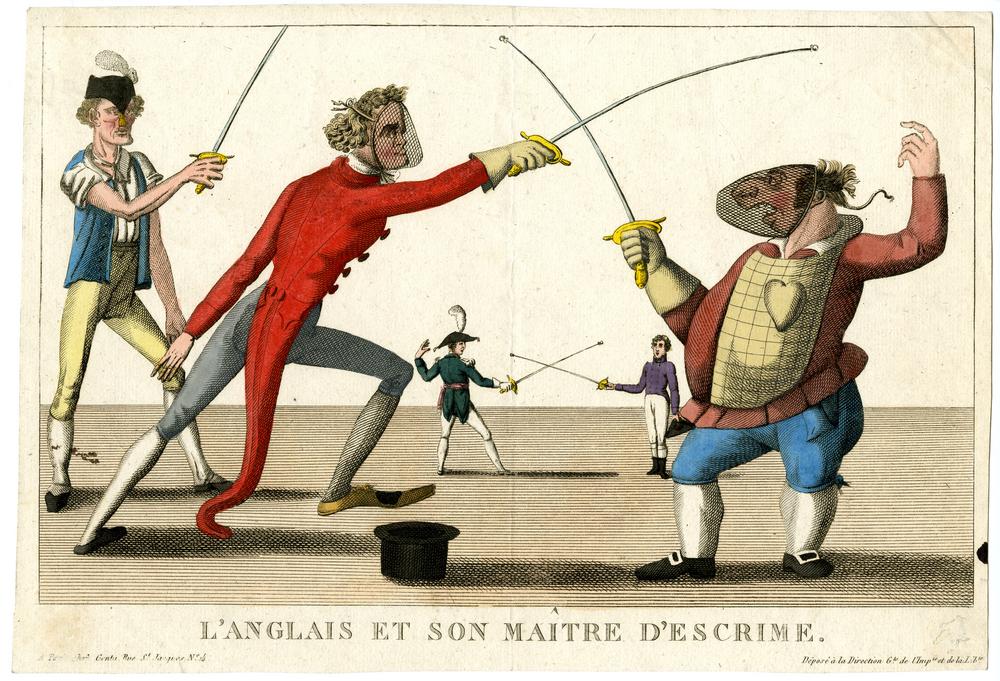
Satirical Print, 1814, The English Fencing Master and his Student, courtesy of the British Musuem, https://www.britishmuseum.org/collection/object/P_1856-0712-639

Against this example we have, again for England, references to the curious fashion of wearing a sword but it being rude to use one save in extreme situations. Aylward cites the example of a character in Fanny Burney’s Evelina (1778) grabbing his sword hilt—he remarks that this was “an unseemly gesture pardonable only in an excitable foreigner.” These two examples are separated by a century, but it’s important to note that works closer in time to that of Davenant echo similar sentiments. Aylward also cites Andrew Mahon’ 1734 translation of L’Abbat’s L’art en fait d’arms (1696), where Mahon remarks one should only draw a sword in service to the crown, for one’s honor, or in self-defense. [10] Between the poles of sword-as-fashion-accessory and sword as sidearm there is a vast middle ground. Likely, most people had some modicum of training, but like today’s concealed-carry types, extremely little chance of having to use that weapon.

For the instructor, examining a treatise in light of not only what it says, but when it was written and what prevailing views of the time suggest will improve their interpretation and teaching. Some works seem clearly more self-defense oriented—Hope, L’Abbat, de Liancour, McBane, and Wylde read very differently from de la Touche, Domenico Anglo, Olivier, and de St. Martin. The former are more clearly concerned with optimizing a guard for most situations (Hope and Wylde especially perhaps), one to two tempo attacks, and the importance of opposition. The latter cover much of the same material, but add some techniques more salle than on the ground friendly. We can learn a lot from both types of sources, and we should read and use both, but always with a keen appreciation for what they reflect. By the mid­-18th century, the foil play originally intended to create a slightly safer style of practice (key in a time before masks were standard) became a game in its own right. Domenico Angelo, writing in 1763, in some ways spans both worlds—he wanted all touches targeted to the chest, a fact that speaks on the one hand to his eschewing masks and on the other to an interest in fencing as an elegant exercise and ideal way to cultivate grace becoming the status of his many elite students. [11] His inclusion of smallsword versus various other weapons, “ethnic” guards, and weapon-seizures recall earlier works, like Girard’s, but the mix of smallsword and foil in his School of Fencing, not to mention the success of his London salle as the premiere academy, we must note too.

In terms of lesson-planning, one approach is to compare how several masters treat a specific action, say the thrust from tierce or quarte. What is different? What the same? Given the instructor’s own perspective, what does it make sense to emphasize? For those more concerned about smallsword as weapon, a more conservative approach makes sense; for those whose interest is tournaments, a mix of solid self-defense and salle fencing is appropriate. Of course, one can teach both as well. The point (no pun intended) is to be mindful about what we are teaching, how we teach it, and to keep the textual basis, explicit and implicit, before us as we plan, devise lessons, and teach them.

NOTES:

[1] Clip from “Barcelona” (1994), by Whit Stillman

[2] Sir William Hope, Scots Fencing Master, 1687, pp. 11-12. See also J. D. Aylward, The Small-Sword in England, its History, its Forms, its Makers, and its Masters, London, UK: Hutchinson & Son, LTD, 1960, 134-135. As an argument for reading the sources, one work from 1982, concerned only with the tool, makes the mistake of listing fingers through annulets as correct. Doubtless some fencers did. See Anthony North, European Swords, London, UK: Her Majesty’s Stationary Office, 1982, 19.

[3] See de Liancour, Le Maistre d’armes (1686/1692), p. 69/78; 119/128 in the BnF 1686 pdf); see Wylde, English Fencing Master, 15 in the pdf, https://smallswordproject.files.wordpress.com/2016/11/zach-wylde.pdf)

[4] Wylde, p. 13 of the pdf.

[5] Wylde, p. 5 of the pdf.

[6] Wylde, p. 6 of the pdf.

[7] See for example P.J.F. Girard, Traité des armes, 1740, pp. 47-51 (p. 80-86 in the BnF pdf).

[8] For a more recent historical example of this within the context of a duel, Aldo Nadi’s account of his duel in 1924 against Contronei in Milan is instructive. The few photographs of the engagement reveal the typically plate-perfect technique of Maestro Nadi drastically changed when confronted by a sharp spada. The goal—don’t get hit—changes everything. See Aldo Nadi, On Fencing, Sunrise, FL: Laureate Press, 1994 (originally published 1943), 24-35.

[9] See Máire Anna MacNeill, “The Sword as Didactic Tool on the London Comic Stage, 1660-1740,” PhD Dissertation, Royal Holloway, University of London, 2016, pp. 9ff.

[10] Aylward, The Small-Sword in England, 20; cf. Fanny Burney, Evelina, 1778, Letter 23, https://www.gutenberg.org/files/6053/6053-h/6053-h.htm . Aylward on Mahon and L’Abbat, 20; cf. L’Abbat, The Art of Fencing, Dublin, 1734, p. 72 in the edition by Lector House (2020).

[11] Aylward, The Small-Sword in England, 108-112.

“The 1690 Swipe”—A Brief look at Parries in Rapier and Smallsword

Most often I start a new post with some phrase along the lines of “in a recent conversation:” this one will be no exception. There are a handful of fencers I chat with regularly and these conversations, even if they don’t start with us, allow us to explore both issues of the moment and those that transcend whatever particular squabble on social media sparked the latest firestorm. In this case, on some page on Friendface there was a discussion about parries in rapier, and while the discussion there was predictably miserable it prompted some excellent discussion offline and prompted me to return to a few sources.

The issue was whether or not one keeps the point directed at target when parrying, or, if one can parry with the point off-line. It’s a longer subject than I want to dive into here, but in large degree this debate (such as it is) reflects variances in more modern practice and pedagogy more than it does discrepancies in the sources. Many fencers, myself included, who were brought up in the French school of foil, were taught to keep the point on target when parrying—not always, but as a starting place. There are enough of us around that some of “HEMA’s” micro-lineages have inadvertently made this notion canon—it isn’t. [1]

This begs the question: what do our sources say? There are many texts one could consult, but I decided to look at a few where it’s pretty clear one is not expected to have the point on target all the time. Texts from that netherworld between rapier and smallsword, a time of considerable overlap in the use of the two weapons, provide a good starting point. I’d like to look at the parry in three texts which conform to what I’ve opted to call “1690s swipe.” Feel free to use that 😉  The three texts in question are:

–Marcelli, Rules of Fencing (1686)
–L’Abbat, Le art en fait d’armes (1696)
–Wylde, English Master of Defense (1711)

Okay, so really only one of these was from the 1690s, and even it, L’Abbat’s work, is better known from the 1734 edition published in English by an Irishman, but what I wish to demonstrate with these texts circa 1690-1710 is that each in different ways touches on the issue of point-on or not when parrying. It seems likely to me that one reason we see similarities in them is that the foil qua foil was not yet established as an artistic form on its own merit, but still a tool by which to learn to use a sword in earnest. As for “swipe,” by this I mean a motion made to one side or the other, say for parrying third/outside or fourth/inside, versus the same block made with the tip using the nose of the opponent like the apex of a cone, and which generally requires more movement of the arm.

Smallsword ca. 1700: So Basic… so… Gauche

A number of my colleagues do not care much for this period of sources—the less well-known en garde positions, the lack of polish to them, the simplicity, all of it can be off-putting to many people trained in traditional programs. Wylde’s odd diction, his bravado (he claims he was the first to teach the “half-moon parry” for example…*), and relatively uncomplicated system seem to some fencers primitive and lacking in sophistication. How good can it be, so the thinking goes, if it’s that simple?

L’Abbat, while not quite the “Hutton” of the smallsword world, gets short-shrift in part because it too seems simplistic, and, perhaps because it’s easily obtained for free (Dover Thrift generally doesn’t suggest the latest, sexiest scholarship). L’Abbat and Wylde, like Hope, McBane, and a number of other masters writing around the turn of the 18th century were concerned with defense first and foremost. They were not what we’d call “salle fencers” or academicians. Some had spent a lifetime fighting, either on battlefields or in brawls and duels—McBane in particular had a colorful career, spending most of his life as a solider, but as a gambler and pimp too. Sir William Hope’s advocacy for a hanging guard as go-to for smallsword, broadsword, etc. likewise reflects a lifetime spent fighting, so to approach his work with the same assumptions one would Cordelois or Parise will skew the view of his system.

The best self-defense systems even now are simple, practical, and devoid of the fancy acrobatics likely to win points with judges—the hurricane kick, the flourish with a bo staff, they’re fun but are “flashy, crowd pleasing steps.” [2]. A kick to the knee or shin, a simple well-made blow with a staff typically serve one better on the ground. Just so, when one carried a sword ca. 1700, it was likely a smallsword unless one was on active duty or living in places like Spain or southern Italy were the rapier remained popular far longer. While the smallsword was a fashionable item of dress for many, it was also a side-arm, a weapon, and a great number of people lived in contexts where knowing how to use it, even just the basics, might be the difference between life and death.

Marcelli’s Rules of Fencing, on the other hand, is a well-documented, thorough examination; it’s well-written, detailed, and exhaustive. Experienced fencers tend to like it and with good reason: it’s easily one of the best works ever written on swordplay. However, Marcelli is a tough read for people without significant training and a decent grasp on fencing terminology. This isn’t a dig at people new to fencing or who didn’t come up through more traditional training, nor is it gate-keeping: Marcelli’s is a highly technical treatise full of terms and ideas that are difficult even for many experienced fencers to understand right away. [3]

Looking at each source in turn one notices several points germane to the debate over parries. In the passages below the authors do not specify where they want the tip save L’Abbat in one instance. Two caveats. First, it’s important to note a difference between arguments from silence and inference. The former implies that we lack information; the latter implies that we are deducing something from the information that exists. What follows is an example of the latter—I’m reading key passages, “unpacking” them and explaining what they mean, and attempting to demonstrate how theses passages reveal how these three authors, in this period of time, viewed the placement of the tip of the weapon when parrying. In my reading all three do not seem keen to have the point remain on target when parrying.

Second, three sources are hardly representative. I know that. As such, this examination–brief because it’s already too long for most readers–is merely one selection of data, a snapshot. It is suggestive, not conclusive, and if one takes the time to examine works from Camillo Agrippa to Camille Prevost one will see a variety of stances on where one points the tip when parrying.

To Point or Not to Point at Target

Marcelli, who has much to say about parries, discusses them in several distinct sections. The first instance is in the Part I, Book I, Chapter XIII, “The Parry,” where he explains


that in the tempo of the parry neither the rear foot, nor the front foot, must be moved. Instead, he must stay in that tempo with the body in the center, and with the torso composed, as it is found will situated in this guard. Having to parry, only the sword arm must move, which does its duty of defense with the strong, striking the opponent’s sword away from the line of the body, either to the inside, or to the outside, or toward the right, or toward the left side. It is advised, however, to parry precisely, without discomposing oneself from the guard, or the sword being moved too much, because defending excessively, a side is being exposed in that act with great jeopardy of being hit.

nel Tempo del riparare non si deve movere, nè il piè di dietro, nè il piè d’avanti; mà si deve stare in quell tempo co’l corpo in centro, e con la vita composta, come si trova ben situate nella sua guardia: e dovendo parare, deve movere solamente il braccio della Spada, il quale sa il suo officio della difesa co’l forte, urtando la Spada del nemico in fuori la linea del suo corpo, ò di dentro, ò di fuori, ò verso la parti destre, ò vero, verso le parti sinistre. Avuerta però à parare aggiustatamente, senza, scomponersi dalla guardia, ò moversi troppo con la Spada per souerchiamente defendersi, scoprendosi in qull’atto da una parta con molto preguidicio d’esser colpito: [4]

Nowhere in this passage does Marcelli specify what the tip is doing, but the idea of striking the incoming steel is suggestive. Knocking the opponent’s weapon to the side with the strong doesn’t preclude thrusting with opposition; one need not keep the point on target to achieve this. In discussing the direct thrust, which for him is the end-result of every thrust, Marcelli makes it clear that he intends one to thrust with cover. [5]

A later passage makes it even more clear that the blade need not be on target when parrying;

The blow having immediately been parried, and the ending of the action obtained, performing the riposte must be delayed a moment. It must not be extended then, when the opponent is found in the termination and holds the torso forward, because being found in that tempo with the body in profile, there is little, almost no, space to strike. For that reason, it is necessary to wait for when he goes to the rear to withdraw, and in the beginning of taking the torso backward and coming to turn the chest with that movement to offer the target, here (without in any way releasing the weapon once obliged by the parry) the riposte rapidly follows.

Subito parato il colpo, & ottenuto l’esito dell’Attione, non deve trattenersi un momento à tirar la riposta: la quale non deve spiccarsi all’hora, quando il nemico si trova nella terminatione, etiene avanti la vita, perche, trovandosi in qul tempo co’ l corpo in profilo, si hà poco, e quasi niente spatio do colpire. Perloche e necessario aspettare, quando quello si dà à dietro per ritirarsi, e nel principiare, che sa; di dare a dietro la vita, venendo con quel moto a voltare il petto, & ad offerire il bersaglio, qui, (senza rallentarli in modo alcuno l’arme una volta impegnata con la parata), si segque rapidamente la riposta. [6]

Of particular note here is the master’s comment about space to riposte—had he assumed the fencer to remain point-on-target this comment would make little sense. However, if one uses the strong to parry point off-line, and moreover one hasn’t broken ground to defend—as Marcelli advises—then the comment about space to riposte makes complete sense. The riposte too is not immediate, but applied only as the opponent begins their own recovery back into guard.

This is not to say that in those situations where one might simultaneously parry and riposte that one didn’t, but to say that the parry—as Marcelli defines it and consistently uses it through the Rules of Fencing—is made with a short movement of the arm and blade; that the parry is effected with the strong; and that the point very likely is not on target when parrying.

Turning to L’Abbat, this master recommended a “Middling Guard,” here meaning one held in the center. This suggests a lot about his parries as well. He writes

The Hilt should be situated in the Center, that is to say, between the upper and lower Parts, and the Inside and Outside of the Body, in order to be in a better Condition to defend whatever Part may be attacked. The Arm must not be strait nor too much bent, to preserve its Liberty and be cover’ed. The Parts being thus placed, the Wrist and the Point of the Right Foot will be on a perpendicular line.

Le poignet doit être situé dans le centre, c’est à dire dans le milieu du haut du bas du dedans & du dehors, afin d’être plus en état d’en defender l’endroit insulté. Il ne faut pas que le bras soit étendu, ni plié, qu’il tienne également de l’un & de l’autre, pour consèrver sa liberté, & pour n’être point découvert. [7]

From this position, then, one adjusts the wrist and blade depending upon the nature of the attack. For example, if the opponent thrusts to the inside line correctly, that is if their forte (strong) is opposed to one’s feeble (weak), then one’s hand moves up slightly and raises the point so that the opposing steel’s feeble more easily meets one’s own forte. [8]. In tierce, it’s much the same, only there one turns the hand out and up to achieve the same advantage (though the hand stays in third position, not fourth as other masters sometimes recommend).

Moreover, L’Abbat mentions two types of parries, the first which binds, the second which beats, each of which he recommends for specific lines. With regard to the beat, he says

And the Beat, giving a favourable Opportunity of riposting, is to be used when you ripost to a Thrust in Seconde; or when after having parryed a Thrust in Quart within, you an Opening under the Wrist. To these two Thrusts, you must ripost almost as soon as the adversary pushes, quitting his Blade for the Purpose, which is to be done only by a smart Motion, joining again immediately, in order to be in Defence if the Adversary should thrust.

& celles dont le coup sec favorise la risposte, tout devant tendre à sa sin, est lors qu’on risposte au coup de sécondé de l’ennemi, ou qu’on pare son alongement de quarte au dedans des armes & qu’on voit le jour sous le poignet, il faut à ces deux coups risposter presque dans le tems que l’ennemi porte en quitant son fer pour risposter , ce qui ne se peut que par un mouvement sec ; l’on doit immédiatement après le revenir joindre afin de se garantir s’il avoit dessein de pousser. [9]

The combination of making the beat with a “smart motion,” that is a strong knock, and of then immediately closing the line or “joining again immediately” suggests that the point isn’t necessarily on target when one parries. In tierce and quarte, for example, assuming a proper attack to either line one raises the point in order to gain mechanical advantage on the incoming steel.

As a last example, Zachary Wylde provides another instance of a master who favors a middle-guard. Similar to L’Abbat’s guard, Wylde recommends that one:

Stand upon a true half Body, or edge wise, which I call, lie narrow your leading or right Foot, two Foot or more distance from the left, being in a direct Line from the same… your Hand fast gript about the hand of your Foil or Rapier, then put your Thumb long ways or forward upon it, your Arm quite extended from the Center of your Body, the Point of the Weapon being directed in a true Line against your Opponent’s right Pap, sinking somewhat low with your Body, your right Knee bowing or bent over the Toes of your right Foot, (tho’ some Masters teaches a strait Knee,) your left Knee more bent, inclining towards the Toes of your left Foot; lying in this Order is the Posture, which I call, Stand your Line, the Medium Guard then is fixt. [10]

His parry consists of deviating the point only a few inches. The hand and hilt remain more or less centered, which means that the point by definition is offline when parrying:

The Parr or Parrade at Small – Sword, is perform’d thus, Stand your Line as directed, and if your Opponent makes an Assault or Thrust at you, wave or move your Weapons point Cross-wise, the Compass of four Inch, from the Line downwards and upwards, according as the nature of the Pass is made and so requires; this motion is perform’d by the Wrist, about the Center of your Weapon, your Arm kept in its certain Place; this I call the common Cross way of Parring, and is the strongest Parr that can be made. Observe that you make a Parr against every pretended Thrust, for no Man knows anothers Intention, or whether he designs to make his Pass true or false. [11]

This “Cross-wise Parr” involves moving the point off-line briefly to effect the block. From here, and with a decent extension, one can easily thrust with opposition to riposte. I suspect that it is this last factor, the decent extension, which is causing all the fuss.

The Importance of the Extension

The effort to dispense with all the evils of modernity is to historical fencing what Brexit is for the English: a mistake. It’s an easy mistake to make (easier than Brexit anyway), and to be fair, one often made honestly. It’s important to say that from the off, because just as I do not wish to disparage the smarter set in the sport, so too do I not wish to denigrate the many clever people in HEMA. With this disclaimer, a lot of the problem as I see it is the inability, even the lack of awareness, of how important the extension is in rapier or smallsword when starting an attack. The weapon, which travels via extension, must move first. The student who knows this, who has drilled how to thrust from various lines, can parry point on or off and still thrust effectively.

Even today in a much altered landscape, beginning foilists are still taught this—it’s primary, fundamental, and in no way new. The primacy of the sharp point demands attention—if my attack is parried the very next thought I should have (post sotto voce explicative utterance) is defense. A properly extended arm followed by the rest of us creates that primacy—the defender cannot, should not ignore it. All the hullaballoo about George Silver’s “true times” a few years ago in the end comes down to a failure to understand this universal principle of fight. Marcelli, perhaps more than most, harps on the importance of drilling this action, of working toward the best direct thrust one can, but it’s everywhere implied in our sources when not spelled out, and indeed, must be, because otherwise people will double every time.

There are, however, different ways to do this. The easiest, and indeed the way I teach it initially, is to keep the point on target, at least in smallsword. Rapier I do a bit differently, but it’s a different weapon and the weight and length change things. However, even in smallsword I eventually teach students to parry by beat, because it pays to know both. What makes it easy for students to go from the easier point-on-target to point-eventually-on-target is proper technique, a good extension, and a ton of practice performing it.

Drill is not as much fun as bouting, however it’s vital for fencers if they wish to improve. A bout can test our technique, sure, but it doesn’t allow us the time to ensure that our technique is proper, that all parts are moving as they should, and doesn’t allow us to make the same action the same way each time. Unless we know how to make that extension, or any action, well, we will struggle to use it effectively in the heat of a bout. Pants before shoes: get the technique working well first, then pressure test it and learn to adapt it as needed on the piste or in the ring. More time drilling core actions and less time “sparring” would do much to help HEMA players hone and improve their game.

NOTES:

[1] I’ve mentioned micro lineages before, but increasingly I see the problems inherent in some of them. People learn in good faith and are not capable (at first) or willing to examine this received learning against either the source record or established pedagogy. I feel I need to say this every time, but most of the traditional approach is still taught and taught well; we fail to see it for the excesses and abnormalities so obvious in the sport, and, in HEMA. I’m told people are using the fleche in HEMA…really? Come on… no.

*5ly. Another way of Parring, I call, The Semi-Circular, or half Moon Parr, which is thus, Lie in your Order, according to your first Direction, in a true Line; then lower or dip the Point of your Weapon about two Inch, lying the inside your Opponent’s; then if he Thrusts at you, make a half Circle, which will meet his Thrust, and Parr him. If you lie with your Weapon’s Point the outside his, in like manner as aforesaid, and he Thrusts at you, return your Weapon into its first Place, and you’l reingage him with the Blade of your Weapon, and perfect a Parr. This Parr is the most absolute and compleatest Parr that ever was invented; and without Ostentation, I can truly say, I was the first person that Taught it; and I dare further affirm, that there’s many Proffessors of this Noble Art, that knows no more of the half Moon Parr, than they do of the Man in the Moon. [page 10 in the pdf]

[2] To quote the character Les Kendall in 1992’s “Strictly Ballroom.” If you like Australian movies, dance, or a good laugh, check it out—not quite “The Castle” funny, but close 😉

https://www.imdb.com/title/tt0105488/?ref_=ttfc_fc_tt

[3] There is a difference between“gate keeping” and explanation, and, not all explanation is “man-splaining.” As always, I turn to the venerable Urban Dictionary for help here—to explain how something works because one knows how it works is not a) deciding who does or doesn’t have access or rights to a community or identity; or b) isn’t a method (for me anyway) of elevating myself above others as a tool of self-inflation [I’d need more than three readers even to start down that path lol].

In similar vein, I’m not devaluing another’s opinion because they’re not qualified, nor am I setting up arbitrary, subjective rubrics by which to evaluate said opinion. Opinion and fact are NOT the same. “Marzipan is delicious” is an opinion (one I share), a choice based on an individual’s sense of what tastes good or not. There is no objective way to measure that, though arguably there is for evaluating quality of marzipan. “All point-oriented fencing assumes that the point stays on target” is a statement one can evaluate against evidence. It’s a thesis, a proposition, NOT a fact, not unless the evidence bears it out, and thus one can evaluate it. I know this because I’m trained to conduct this sort of research and so have the tools to make that evaluation, and as importantly, was trained in a school of history that put significant value on transparency, honesty, and the humility necessary to concede a position when better evidence and/or an argument demonstrate a superior position.

[4] Always quick to examine precedent, Marcelli provides a brief look at the wisdom of Giovanni dall’Aogcchie, Nicoletto Giganti, and Alessandro Senese, and then remarks that valuable though their work is that he disagrees with the idea that one should move the feet when parrying. Modern fencers, in contrast, are generally taught to take a half-step back when parrying, so this can strike one as odd. However, his reasoning is sound if one considers the context in which Marcelli and his students operated (movement is different when weapons are sharp, there are no rules, and the terrain isn’t set at an official limit).

For the quotations, see Francesco Marcelli, Rules of Fencing, translated by Christopher A. Holzman (Wichita, KS: Lulu Press, 2019), 55; Francesco Marcelli, Regole della Scherma, (Roma: Nella Stamperia di Dom. Ant. Ercole, 1686); this version, vastly cleaner than the one on Google Books, is from achive.org, 42-43.

[5] See for example 106 in Holzman; Marcelli discusses the importance of the hand in 4th position to inside (nails up, supinated), hand in 2nd to outside (thumb to the inside, knuckles up, nails down).

[6] Holzman, Rules of Fencing,198; Marcelli, Regole della Scherma, 136.

[7] For the quotations, see Monsieur L’Abbat, The Art of Fencing, translated by Andrew Mahon (Dublin, 1734); this edition from Lector House, LLP, 2020, 5; Le Sieur Labat, L’art en fait d’armes (Toulouse, Chez J. Boude, 1696), pdf via FFAMHE – Fédération Française des Arts Martiaux Historiques Européens, 10.

[8] The mechanical advantage imparted by manipulating strong and weak parts of the blade is important in both offense and defense; for the parries of quarte and tierce respectively, see L’Abbat, The Art of Fencing, 10 and 13; L’art en fait d’armes, 22-24; 26-28.

I use the Italian hand position nomenclature here to help illustrate the point—that is not in L’Abbat. The four main positions are first, thumb pointing toward the ground (pronated); second, thumb pointing to the inside line; third, thumb on top; and fourth, thumb pointing to the outside line (supinated). There are typically two mid-way positions, but those go by different names and do not concern us here. One is “first in second” (prima in seconda) where the thumb is at 7 o’clock; the other is “second in third” (seconda in terza) which is close to second position more 9 o’clock where second is 8 o’clock. [Some also include “third in fourth” (terza in quarta) which is just shy of fourth position.

[9] L’Abbat, The Art of Fencing, 21; L’art en fait d’armes, 38-39.

[10] For the quotations, see Zachary Wylde, English Master of Defence (Tork: printed by John White, 1711); via The Smallsword Project, 6. [page numbers refer to those in the pdf] Wylde,8-9; he first describes the parry 6-7.

One Method for Curriculum Building in Fencing

Among the many challenges we face as instructors is how to organize lessons and classes, what to emphasize when and how best to accomplish that. What follows here is not new, nor is it any invention of mine; this is just how I conceive of a well-known process and one possible way we can use this approach to teach historical fencing. I refer to it as the “recursive model,” because each lesson incorporates key elements of the one preceding it. [1]

Rotae/Wheels

I’m intensely visual as a learner and so tend to chart a lot on a white board and paper. I like to be able to see ahead and see how things interconnect; it can be especially useful when managing both the micro- and macro-views of a topic, say something as finite as an individual technique and each part which comprises it as well as something as large as a series of classes which explore that technique in different ways. One method to capture this visually is with intersecting circles.

As I’ve worked with these I referred to them as “circles,” “rounds,” or rotae, but whatever the terminology the idea is that each circle represents say a new lesson that also returns to core material from the previous lesson. [2] This reinforces what students learn by repeating core actions and ideas, but at the same time increases the awareness of how everything works together. It’s also a great way to build or plan ready-made drills. All of it is scalable—it works for a technique or action, say the lunge, as well as a system, such as Girard’s approach to smallsword. One lesson rolls naturally into the other, and builds off what one has covered previously, so we increase complexity as we proceed. In a glance we have a model in which we can shift elements of a lesson, examine the interval between those examinations, and isolate individual themes actions, plays, or techniques to cover.

In my last post I discussed smallsword as a “gate-way drug” for historical fencing—that class is an experiment in using this approach in a formal way. For example, here are my initial notes for this class for the first three sessions, each an hour long:

First Three Lessons example*

In the first, we cover moving from first position into the en garde position; the extension of the weapon from guard, the guards/parries of tierce and carte; we then cover the advance, retreat, lunge and recovery out of the lunge (backward initially). Offensively I start with the glide in tierce. Each of these we can depict in the round as well, most especially those maneuvers like stepping into guard or the lunge which involve multiple steps:

Use of Rota to Breakdown the Lunge**

If one looks at the second circle (in green), one will notice that some of the first lesson (in black) starts that session off; it’s followed by the logical steps that proceed from that first lesson. Thus, in green ink, we see the “glizade” or glide in 3rd and the glide in 4th; moving from the outside to the inside engagement means covering the disengage. Students drill these attacks with special focus on the point landing before the front foot; the lesson portion concludes with teaching the basic defense against these glides (stepping back and taking tierce or carte) and reemphasizing the importance of closing the line.

Each new lesson incorporates review of the critical actions necessary to take on new material. However, if a class is struggling, then it’s easy to stop, work the same material from the previous lesson, and try the new material again in the next class. Thus, if in the third lesson (red) students are struggling to make the feint by glide in third, one can have them drill the glide in third minus the feint. Perhaps have them work on tight disengages, then the glide; time permitting, I have them advance lunge the glide. This will help them hone the necessary skills to start working on the feint.

How this Works

There are a few important considerations in using this method. First, the instructor must have a decent command of the material or they cannot delineate what is fundamental, what composite. If new to the material, then sitting down with the source and organizing it is the first step; this recursive rota approach can help one do that. Perhaps in reading the source one notices that the author covers movement first, then defense, then offense in increasing complexity. If one outlines each of those areas, what are the first things the author covers in each section? What cross-over is there between them? One will notice, for example, that the first attack likely starts from a position of defense covered in the second theme and uses movement from the first. Taking the initial steps in each section—movement, defense, and offense—is not a bad way to start a first lesson; at the very least it’s a decent goal to set for it as it will mean covering fundamental actions and thinking required for that system.

Second, the instructor must have at least an approximate sense of how difficult each new element typically is for new students, that is, how easily or not they can acquire a given skill. The advance and retreat, for example, are generally something students get quickly; there will be refinements to make to them, but the basic concept of stepping forward and backward one foot following the other shouldn’t be a major hurdle, but the feint-1-2 might be a lot harder as it will require coordinating hand, feet, and eye. The sequence within each circle should proceed from simple to more complex—this is not only easier to teach and to learn, but helps students see more effectively what each technique, action, or concept involves.

Third, and related to the second point, the instructor must know how to assess problem areas and be willing to stop a lesson and focus on those When necessary. This can be done without haranguing a class or student; it can be as simple as noticing they’re really struggling to extend first and deciding to make that the focus for the day. Depending on the class, one can ask them directly if they’re struggling as well—this tends to be safer with adults than with children. For example, the advance is simple, but there are common problems one must be on the lookout for and correct, such as not pointing the front foot towards the front. Critical as it is to point the foot, correcting it doesn’t require shutting down all footwork until they point their feet—students should continue to work on footwork, drill, but the instructor will make corrections as they do so. It doesn’t have to be perfect to start—it just needs to work effectively enough. As students grow in comfort and stability,  the instructor can make adjustments as necessary. If on the other hand no one is extending the arm before they lunge, then it is critical to correct that before moving to the glide or they’ll develop a dangerous habit that will affect their entire game.

Rotae and Recursive Learning as Continuing Program

Depending on one’s source material one may run through the circles in short time. It’s important to note too that going through some of the same material more than once is not only an option, but recommended. Using Girard as an example, one might get through most of his program in a few months (assuming say a few lessons a week and students who are dedicated). Fencing, any fencing, is about practice, drill, using the system; it’s not go through it once and done.

After an initial run through Girard’s system one might return to specific elements, say his section on beats. The choice comes down to a number of considerations. After one run through the circles, the instructor may notice areas the students are weak or where they struggled—that might be an ideal place to start for the second run through the circles. Once the students have acquired some familiarity and enough skill, it’s possible to mix up some of the circles, use them out of order, so that things stay “fresh.”

Girard, Broadsword vs. Smallsword (1740)

With some manuals, going through them the same way again and again will get old fast; boredom is the bane of learning (and teaching), so mixing things up, throwing in something different, can help. Returning to Girard, maybe peppering the lessons with attention to his sections on weapon-seizures or facing different weapons or national/ethnic guards will add a little “pop” and interest. For more advanced students, comparative analysis of Girard’s advice for facing a broadsword fencer or odd farm weapons with that of another master can be both fun and an effective way to widen and deepen their understanding of smallsword.

D. Angelo, Broadsword vs. Smallsword (1763/1787)

Multae Viae

There are many ways to learn, and instructors should use what works best for them and for their students. The recursive model is simply one method and one I find works well for teaching fencing. Most of us, I suspect, use a variety of methods; we adapt for different types of students, different contexts. Our goal as instructors is to share a body of knowledge and technique, to pass it on, and whatever helps us achieve that has merit.

NOTES:

[1] Online searching comes down to the terms we use, and I have to guess that I’m just not using the correct ones as I can’t find a formal name for the process I describe in this post. “Recursive learning,” “education,” and “model” all bring up a lot on machine languages and programming; I had much the same problem with the terms “reinforcement learning,” “rota learning method,” and similar iterations. A wider search for “curriculum design” or “styles” was likewise unhelpful. SO, if someone reading this knows what this approach is called, please let me know.

[2] Traditional fencing lessons work this way, at least they should. Students acquire new skills over time, but much of the lesson will incorporate or drill what they already know.

* My chicken-scratch is infamous, so here is a transliteration:
–1. Black Circle: starting with 1st position, en garde, extension, guards/parries 3 and 4; movement: the advance, retreat, lunge, recovery out of the lunge; concept of opposition; glide in 3rd and defense
–2. Green Circle: starting with review of 1st position and the en garde, guards 3 and 4, and opposition from first lesson; then the glide in 3rd, in 4th, and the disengage; importance of weapon-arm-foot; importance of recovering behind the point
–3. Red Circle: review of 1st. pos. and en garde, guards 3,4, glides in 3/4; feint by glide in 3rd and 4th; flanconade; parry 2; drills building off of Fencer A makes feint by glide to outside line; Fencer B parries 3; Fencer A disengages, thrusts in 4th with opposition–> Fencer B receives the touch; then, same set-up, but Fencer B parries 4th and ripostes by flanconade [this sets up a future lesson were Fencer A will parry in 2nd]

**Key Components of the Lunge viewed as Depicted via Rota:
–starting from 1st position; front foot extends out about two shoe lengths or so (Fr. deux semelles); position of arms; bending the knees; weight on back leg traditionally, but today often equi-weighted; balance and stability the goal so that en garde facilitates an explosive lunge; head position; importance of relaxing the shoulders; where to point the weapon; guard of tierce/3rd

Smallsword as Gate-way Drug

The lunge as represented in the Règlement of 1908

In the current adult “Introduction to Fencing” class I decided to proceed along more historical lines rather than stick to the form I inherited, traditional foil. Up to this session I’ve used foils (French, as I have more of them than Italian)—they’re inexpensive, light to ferry to and from the center where I teach, and as I teach it the presentation is closer to smallsword than modern foil. At the very least, so my reasoning goes, solid foil is an excellent foundation for the study of any other weapon, new or ancient. [1] The masters with whom I studied foil were “old-school” so we learned a very traditional method. I was not taught flicks, ducking to cover target, or any of the other bizarre ways to game ROW and directors. This said, traditional foil is not smallsword, but it is what I learned, and, learned first, so up to now I’ve taught foil more or less as one sees it in the Règlement of 1908 or Barbasetti [2].

Foil is comfortable, known, a place of comfort. I know I’m competent to teach it, and that confidence helps, not only with how I myself present in class, but also in terms of how students view me and respond. [3] If the teacher is unsure, the students will be too, and worst case scenario may just leave, confidence being one of those all-important traits in the United States (despite the fact confidence as such is often just faked, misplaced, or assumed without cause).

I usually teach smallsword one on one, and I fence it a fair amount. I spend and have spent countless hours studying, researching, and writing about the corpus; the more I work on smallsword the more I like it, and not only because it taxes past injuries less severely than many of the other weapons I teach. I like the mental game, the complexity, navigating all those angles. A question came up the first day of the adult class, about why one holds a French foil as one does in sixth, and sometime between explaining what “carte over the arm,” terza, and “hand in fourth” meant, I decided: next class we’re just going to do smallsword.

Rarely have I taken a chance like this and had it pay off, let alone immediately, but in four classes the four adults in this class have a clearer understanding of rule number one, “don’t get hit,” and are quickly gaining skill with the fundamentals I’ve shown them. It may be that these four are just precocious—all four are athletic—but I’ve worked with a lot of capable people, and with few exceptions have I seen a group take to what I teach them so fast.

I think it is two things. First, I am passionate about the topic and know it well; I appreciate how difficult it can be and so I ensure a lot of room to make mistakes, ask questions, and all without censure or impatience. Enthusiasm is infectious, so present a topic as fun and chances are good it will be fun. [4] Second, as complex as smallsword can be, approached from the point of view of “the point is live,” it becomes very simple.

La pointe d’une épée est une réalité qui fait disparaître bien des fantômes.

Baron César de Bazancourt, Les secrets de l’épée [153]
1862

It’s this second point that has been a revelation. What’s caught my attention is that my emphasizing “don’t get hit” first is not new—this guides every single class or lesson I teach. What’s different is how it’s working.

Critical Rule: Always be Open to Correction

This is, in some ways, a difficult realization, because it suggests strongly that some aspects of my approach have been somewhat more schizophrenic than I realized. As I examine it, as I review old lesson plans and notes, I see it. My approach to smallsword, foil, epee/spada, though not rapier interestingly, mixed elements of foil-as-sport with the sources. This wasn’t true across the board, but it was in certain places. It’s easy to fall into, because there is enough overlap that one can assume that a given maneuver is more or less the same; it likely is, but where it’s less the same, that is the thing on which to focus. A prime example is a simple one-two feint. Classically, in foil, the one-two consists of the following:

  • From sixth/third Fencer A feints inside line
  • From sixth/third Fencer B parries in fourth
  • Fencer A disengages and thrusts to the outside line

There’s nothing wrong with this, and, it can work in smallsword too. However, what is missing in the sporting formulation is the extra caution one needs in historical fencing. Feints are one of the most difficult actions for fencers to learn—they’re not just about technique, but psychology. We must “sell” a feint to make it work. We cannot, however, control what the other fencer does, and responses will vary—this is one reason that probing actions and solid footwork are so important. A feint is not always the right choice.

Girard, Traité des armes, (1740) thrust in fourth

The defender, for example, might parry fourth thereby opening the outside line, but they might also panic and just counter attack. They may just back up. Some will see it coming, parry fourth, then take a half-step back and take sixth/third and riposte. There are solutions to each of these scenarios and more (thanks Newton 😉 ), but for the attacker, some degree of commitment, even if to the false attack is vital or the feint will lack credibility. It must be made at just the right distance, not so close that one puts oneself at even greater risk, but not so far as to look ridiculous and unconvincing.

When one is fighting for points—not to touch and not be touched—some of these concerns are minor or absent. The foilist, so long as they attack with right-of-way and land the touch, will get the point, and this is irrespective of whether the defender counters. Only if that counter arrives in tempo, thus granting the defender ROW, will they score. In this case the defender countering is less concerned, if at all, about whether the initial attacker completes the attack, because they got the point. In this is the entire difference between sport and combat.

A Glizade by Any Other Name (coulé, filo, glide, graze …)

One challenge as an instructor is to instill an appropriate sense of danger, artificial as it will be, in new students. It can be difficult with experienced students too. One of the best solutions I’ve found, and one that at the same time helps develop a proper thrust, was suggested to me by a friend and virtual mentor, Chris Holzman. [5] A while back, while chatting with both Chris and Patrick Bratton about teaching the direct thrust, usually the first attack one learns in foil, Chris suggested starting students off with the glide in third [6]. It’s so obvious how this might help that I felt silly I hadn’t thought of it, but then that is why we consult more knowledgeable people.

Teaching the glide first has done wonders for my youth class, and it has been a boon in this adult class as well, not least of which because the glizade is common in smallsword works, but also because it focuses so clearly on opposition and not being hit. This benefit extends beyond this particular action as well. For example, I decided to set up their first feint as a feint-by-glide. The day we started a look at feints I reviewed the previous lesson, had them do the usual warm up, then footwork, and then had them practice the glide in third against one another. Next we added the defense against it, in this case the simplest, taking a half-step back and reasserting third. To help them set up for the subject of the day, I next had them engage in fourth, and as before, they practiced attacking and defending. [7]

After a short break, I had them complete a simple disengage drill, one in which each partner takes turns making disengages against a static line. In this case, Fencer A stands in guard, in third, and Fencer B disengages from third to fourth, making sure to maintain opposition. This is the critical part, and, a departure from modern foil. Going over just this action helps isolate where students may be struggling, and cements key aspects of the technique.

Coulé or glizade from Angelo, L’École des armes (1763)

From there, we started on the feint by glide in third to force a parry in third, followed by a disengage into fourth and thrust with opposition. Among other notable observations the students made was that they could not leave that glide until/unless the defender reacted. When they made the disengage automatically, before a response, they normally ran into the opposing steel. If they failed to take opposition in fourth, they were hit on their way to target. Finally, we discussed the defense against this attack and practiced it (defender takes a half-step back and parries in third, then follows the disengagement via a ceding parry in fourth, ripostes with opposition).

The exercise, start to finish, was fruitful, not only for what it imparted about offense, defense, footwork, and tactics, but sentiment du fer and a keen sense of the point. Discussion turned to other options, techniques we’ve not yet covered but will, and more than once the students, just via the logic of this play deduced either possible next steps or alternative actions to those we had just covered.

Smallsword as Gate-Way Drug

My nod to 1980’s Nancy Reagan “just say no” propaganda aside, smallsword can prove an excellent introduction to the universals we navigate and employ in all fencing. Foil, traditionally, was meant to do this, and still can depending on instructor, but the advantage of smallsword over foil in this respect comes down to clarity. In the 1860s de Bazancourt was one of those voices lamenting that foil training could prove a liability in duels; foil, for some time, had become more academic, what we often call today “salle fencing.” This was, as I’ve pointed out before, something at least one French official noted about the Italian approach—they learn one system, and the difference between sport and duel comes down not to technique, but the blade. One has a button, the other is sharp. [8] The rise of epee, in many respects, was the French attempt to return foil to the seriousness of smallsword—what they created was different, but the ethos was the same. Don’t be hit.

Alexander Doyle, Neu Alamodische Ritterliche Fecht- und Schirm-Kunst, 1715 [Courtesy of SUB Göttingen, Universität Göttingen, Deutschland]

If one knows foil well, reading a smallsword text is relatively easy—vocabulary is often different, orthography too, but the relationship stands out starkly. This said, the differences (as so often happens) are more important: if we ignore them we risk misinterpretation. We will treat smallsword as foil and they’re not the same. We see foils—the weapon—in many early works, from de la Touche (1670) to Angelo (1763/1787), but the similarity in tool then and now can obscure the intent behind it. The ruleset for foil, much of modern pedagogy, will not work for smallsword, not if we wish to approach it historically, as a weapon.

The grip in tierce is easy for beginners, and no bar to learning how to hold the hand in fourth, something they will learn in due course. There are many extant texts for smallsword, and while one needs to read them carefully and select those more geared to combat, having to read them closely to parse out what is academic and what suitable for on the ground only imparts a better understanding and appreciation for the corpus. [9]

The sense of realism, moreover, adds significantly to a class. It’s a form of time-travel, in a way, because students are wrestling with the concerns those two-hundred years ago had to consider too. At its best, historical fencing not only creates a redoubtable fencer, but also one who appreciates the richness and variety of the Art. The fact it’s possible to work so hard and have so much fun is another lesson worth one’s time.

Notes:

[1] Until recently, most every fencer started study with foil because it encapsulates the whole of the Art, from how to move to lines of attack, from the primacy of the sharp point to the interconnection between distance and tempo. Armed with a knowledge of foil, epee and sabre are easier to learn, but so too bayonet and spear.

[2] This is a note I’ve shared more than once, but I have no idea who may read this or if they’ve read anything on this site previously, and for completeness I like to cite anything I should or what people may wish to know, have questions about, etc. I initially was trained in French foil, and the first master with whom I studied sabre, Buzz Hurst, had been a student at the Naval Academy under the Deladriers, so when making comparisons in sabre lessons to foil it was the French system he referenced. More recently, I studied with the late Maitre Delmar Calvert, again in sabre, but who also referenced foil. He learned to fence in the French army according to the Réglement of 1908. My initial work in Italian foil looked to Barbasetti as outlined in his The Art of the Foil (1932).

[3] Teaching is intimate. Building and maintaining trust depends on a number of factors—I have found that honesty, transparency, and openness account for a lot. No one teacher has all the answers, and the best acknowledge that. If I don’t know, I say so, and then do what I can to find out. This may be off-putting to some, but I think it’s the right course. Students learn best when they can focus, when they don’t have to worry about other issues, and so much as I can I try to make a safe space—they know they will be heard, that they matter, and that no one is going to mock or judge them.

[4] Related to n. 3, people learn better when the topic is less work than it is play, children and adults. None of us are going to be fighting duels; we do this for fun, so, make it fun!

[5] I have had the good fortune to get to know Chris Holzman via the internet. He is a mentor in so many ways, a repository of knowledge, and a skilled fencer, teacher, and translator. One of these days I will make it out to Kansas for lessons, and whatever it is we cover I’ll come back the richer.

[6] The direct thrust is elemental, but it is also difficult. Before students understand that the extension is the key to it, that their posture and position guide the point, they attempt to aim the point. It’s far simpler than that—it’s all in the set-up, but acquiring that skill takes time and considerable effort. Marcelli, in his Rules of Fencing, Book II, Part I, Chapter Vi, remarked that the direct thrust underpins everything. Ripostes, feints, beats, all employ it. See Holzman’s translation, page 105.

[7] One of the major errors I see in “HEMA” is the lack of movement. Fencers enter into measure and duke it out, making very little use of the piste or ring. Varying movement in drills is vital. Using the example above of the 1-2 (feint to the inside line, disengage, thrust to the outside line), this can be performed from lunging distance or from advanced lunge distance. We often start in measure as it’s easier—depending on the action—but as much as possible vary the distance.

In this case, I had them start out in measure and work slowly to get the mechanics down, then we sped it up a bit to test it, and, show how tempo plays into the attack. Next, I had them advance the feint, then lunge the attack. In time, they’ll start out of distance and need to decide when to make the attack; initially I will give them a cue, say raising my blade to guard from a low guard, but as they increase in skill I will hold tierce and they have to pick the time.

[8] There is a lot of work to be done on the difference and nuances between “academic” versus “dueling” with smallsword and foil works. This is one of my current research projects.

[9] A good analogy for all this is the college history course. In some, one is made to memorize all manner of minutiae, then take some type of multiple choice test. It’s as boring as it is pointless. In others classes, one might listen to lectures germane to the topic; with luck these are engaging and explore the themes via something that makes the topic relatable, that touches the experience of being human that transcends time. One usually reads some period sources, some secondary literature about those sources and their context, and is then asked to write analytical essays, both as papers and in essay exams. The second method is far more demanding; some students absolutely hate it. Of the two, however, this is history, this is closer to how we conduct research.

Modern fencing makes next to no use, if any, of source material, books, etc. It’s impossible to study historical fencing without sources—even if one oneself isn’t reading and studying them, the person teaching them ostensibly is (they should be…). One advantage of having a rich source tradition is that it provides additional teaching tools. We have images and illustrations, key passages, anecdotal references to how people were trained and fought, all of which add much to how we teach. It can be a far richer meal.

That’s… Wylde

Two close friends, Alex and Sean, of High Desert Armizare (Bend, OR), have been working through Zachary Wylde’s The English Master of Defence OR, The Gentleman’s Al-a-mode Accomplish (1711). [1] This treatise is, like others from about the same time (e.g. Hope and McBane), typically unpopular with people trained in traditional fencing. The suggested guard, the variety of terms in non-standard spelling, and the tacit if not explicit issue that these works take with then traditional fencing is off-putting. [2] However, as someone who was skeptical at first, time spent with this book and blade in hand will reveal that it’s no joke. Wylde provides a viable system, one not just for smallsword, but broadsword and quarterstaff as well.

Alex and Sean took a look at his section on the flannconade and variations, and, shot video:

http://www.highdesertarmizare.com/2021/08/22/wyldes-flancanade/

NOTES:
[1] Cf. http://www.the-exiles.org/Manual%20Zach%20Wylde.htm

[2] Wylde’s vocabulary underscores the fact that English did not have a standard, authoritative dictionary as yet. Even before Robert Cawdrey’s Table Alphabeticall (1604), itself derived from other word lists, England had had lexica of different sorts, mostly for other languages, e.g. the Latin-English The Dictionary of Syr Thomas Eliot knyght (1538) and an Italian-English dictionary I still use once in a while, John Florio’s Worlde of Wordes (1598). There were a number of dictionaries produced in England in the 17th century, even specialized ones for slang, but it wasn’t until after Wylde’s time that any dictionary came to command spelling conventions and definitions for the language. Students of Wylde may find James Orchard Halliwell-Philipps’ A Dictionary of Archaic and Provincial Words, Obsolete Phrases, Proverbs, and Ancient Customs, 2 Vols. (London: John Russell Smith, 1881) useful.

What’s in a Preface?

Parable of the Blind Men and the Elephant

Referring to “context” is a commonplace in historical fencing. It means different things in different… contexts. We use it to mean the time and culture of a specific type of practice such as 15th century armored/unarmored combat; we mean the specific instances when such and such a system was applied (following the same analogy in war, the lists, in self-defense, as an instructor); we also use it to discuss the text that relates that same system, in this case everything from the question of author (did the master write it or have it written or did a student write it about them?), their purpose for writing it (as an attempt to woo patronage, as an aid to students, as an official government publication, etc.), how widely that text may have been known and used, as well as the culture of the book in their time. We also mean by “context” the reality of actual fighting versus training, bouting, tournaments, or play. Sometimes we can’t answer all of these questions or those that follow from them, but they’re important to ask regardless. If we don’t consider context(s) then we are likely to go wrong in our interpretations. It’s easy to go wrong even when people try to consider context.

For those who read the sources it’s also important to remember to read more than just the section on technique or plays. Any front matter, from dedications to prefaces, is worth a look if only once, because some questions we should have are often answered there. For example, in a preface an author often explains their purpose for writing, and if we’re lucky, something of their approach. Dedications likewise can tell us for whom they wrote the book, their relation to that person if any, and sometimes other connections we might not expect to see.

Few lessons or classes pass where we don’t discuss context in some way. With my sabre and broadsword classes, for example, we often discuss options as they pertain to the duel or combat. What isn’t allowed on the dueling ground is perfectly okay in the field. Put another way, the options we have say from a parry-riposte vary significantly in this case—following up a parry-riposte with a punch via bell-guard to the face or knocking someone to the ground was okay in combat, but an absolute no-no on the field of honor in most cases.

One analogy that has proved useful in smallsword lessons is to compare a smallsword to a small caliber pistol. There is this tendency to believe that for a weapon to be threatening it must be large, heavy, imposing, obvious, but this makes little sense—a weapon is a weapon, and whether a .32 caliber pocket pistol, switchblade, or kosh only a complete fool would think “nah, not dangerous enough.” No one wants to be shot by a .32 or .22 pistol. Will a .45 or .50 have more stopping power? Maybe, but in context the people who carry small caliber pistols are citizens who do so for self-defense, not soldiers. Peace of mind is the most powerful benefit a citizen gains from carrying a weapon—too often they have next to no practice using it and certainly not against people. The less insane among those who carry pistols hope it will be a deterrent, not overwhelming force. Assuming they have composure enough and time to pull a weapon, aim, and threaten or shoot just producing the gun will make most assailants react: it’s still a gun, .22 or not. Faced with a small pistol the assailant still has to think “is this worth six small bullets in my body?” [1]

In like vein, a smallsword may not be as imposing as greatsword, but it’s fast, sharp, and deadly. It’s easy to assume some brigand seeing a fop with his sword-jewelry might think the dandy is an easy mark, but was he? The guy open-carrying may be a crack-shot or may never have fired the thing, but how many people will take the risk to find out? It’s abnormal to carry weapons in American culture—we don’t need to, not like people do in other areas of the world, and so when we see someone at a grocery store with some giant chimney on their hip we normally assume political posturing, mental health issues, or both. In the 18th century, when men were still carrying swords as a part of dress, seeing a weapon was relatively more common. It was part of the scenery. We can ask the same questions of them that we do of modern open-carry fans today: how much skill did/do they likely have?

The answer to the question is less important than asking it, because it puts us in touch with our assumptions, our bias built from our own context. It’s tricky—one the one hand, drawing analogies can help, but on the other we have to be careful not to equate the two halves of the analogy. It’s analogy—comparing two things in order to clarify or explain something, not equivalence. In this case, there are some important, critical differences between a smallsword and a .22 snub-nose, just as there is between an item of dress as normal as a hat and something that people notice because it’s an exception to normal, to the everyday. In this case, the point of comparing a small caliber pistol and smallsword is that both will ruin your day even though they’re not the M-60 or a montante.

I’ve pulled a few works from the 18th century and excerpted portions of their prefaces to see what they have to say and what we might learn from them. They are:

  • 1702: Henry Blackwell’s The English Fencing Master
  • 1707: William Hope’s A New, Short, and Easy Method of Fencing
  • 1758: Juan N. Perinat’s Art of Fencing with Foil and Sabre
  • 1771: J. Olivier’s Fencing Familiarized
  • 1780: John McArthur’s The Army and Navy Gentleman’s Companion [2]

Taking each in turn, what do we learn?

Blackwell, Henry. The English Fencing Master. London: Printed by J. Downing, 1702.

I could very willingly have sav’d my self the Trouble of a Preface, had I not lain under a Necessity of Apologizing for the Brevity of this Undertaking, which I desire the Reader to accept as follows.

In the first place therefore, I do assure you the Peruser of this small Treatise, that there is scarce any thing needful to the Knowledge of the Small-Sword which is not here laid down, and that in so plain and clear a Method, as will give both Satisfaction and Delight to All Lovers of this Art. An Art so necessary to be known, and so proper a Qualification for constituting a Man a Gentleman, that I had almost said he can be none that is not skill’d therein.

A second Reason I might alledge for the Conciseness of this Work, is, that I have made use but of few Lessons, as judging that way most practicable, many Lessons being rather cloying than Instructive; besides that we too often experience, that Gentlemen are apt to forget one while they are learning another, by which means they scarce ever become perfect in any.

And now, were it any ways Useful to my Design, I might run a large Encomium in praise of Sword-playing, and show you particularly how England of late Years has exceeded all other Countries herein, even France it self, which has long boasted its Preference in this respect; but this being the Work rather of a Panegyric than a Sword’s-Man, I shall wave that point, and conclude with telling you, that if this Edition finds Acceptance in the World, I intend to enlarge on this and other parts of it, and oblige all Lovers hereof with a compleat System in a Second Edition. H.B.

Several things stand out in reading Blackwell’s preface. In the first line he informs us that this work is not long—“the Brevity of the Undertaking” is a florid way to express this, but amounts to the fact he will not be presenting an exhaustive treatment. He reiterates this a second time in the next section by referring to his “small Treatise” and significantly that despite the length the core of the system is present. Blackwell may assume some familiarity with fencing as well—a text he believes will please “All Lovers of this Art” is suggestive at least that some of his audience he expects to have a nodding acquaintance with the Art. Touching on the key aspects of the system the author then informs us that he includes few lessons as he believes these tend rather to confuse than help. In short, Blackwell tells the reader from the off that his work is not complete, but a distillation of key aspects of smallsword laid out in approachable lessons. For the historical fencer today keen to mine this text, this is important: it’s not complete, so while useful and informative, additional reading will be necessary.

Hope, W. A new, short, and easy method of fencing: Or, the art of the broad and small-sword rectified and compendized. Edinburgh: Printed by James Watson, 1707.

[x] A Dexterous Smalls-sword Man, how adroit soever he may be at the handling of his Rapeir in a Duel after the Common School-Method, will, when he comes to Engage at Clos Fight in a Field-Battel, either with Foot or Horse, find himself extremely put to it, and almost as much to seek, as if had no Art at all, if he be Masters or no better  Defence, whereby to secure himself, than the Ordinary School Parades of Quarte and Tierce, which belong only to the Small-sword or Rapier; & whereof the unsuccessful Practice, (even in Duels, laying aside their Insufficiency in a Crowd, or Field-Battel) hath no doubt made many People value less the Art of the Sword, than otherwise they would have done; judging thereby, that there could be no better nor securer Defence drawn for it: For in such a Juncture, I mean in a Crowd or Battel, a Man hath neither Time nor Bounds, nicely to Ward off his Adversary’s Blows or Thrusts, nor to Break his Measure, as he would have, were he Engaged only in a Duel. Here he is a little more at Large and Freedom; but there, perhaps surrounded by two or three Stout and Vigorous Single Soldiers, or Troopers, who are with Fury Sabring, and Discharging Blows upon him.

In this selection from Hope we see a stark contrast to Blackwell. Of concern here is Hope’s recognition that school play and actual combat are not the same. Most smallsword works make great hay of quarte and almost as much of tierce, but to Hope’s mind that is not enough. [3] It may serve in the salle, but on the ground or in combat these two principle parries are insufficient. As he remarks, the distance required to make these parries work well is not guaranteed in combat; the same is true of the ability to break measure. In a duel between two people, there is comparatively more room to act, more options, and fewer restrictions. That concluding line is particularly clear—armed with these more extended parries what shall the poor person with a smallsword do against three soldiers or cavarlymen bearing on him with sabres? Unlike the movies, they’re unlikely to take turns. Hope’s preference for a hanging guard, something one sees less often in smallsword treatises, makes more sense given that Hope’s assumptions are different.

Perinat, J. N. Art of Fencing with Foil and Sabre. Cadiz: Imprenta de la Real Academia de Cavalleros Guardias Marinas, 1758.

Prologue:

The art of fencing, that I demonstrate in this work, is one of the most essential parts of the military, whose object is the defense of our Holy Faith, the king and queen, and the state, and the glory of defeating their enemies. Because of this, in the most political governments special care is always taken that the youth destined for arms are instructed early in the art of fencing, to the end of acquiring agility, skill, boldness, and fearlessness.

In order to be able to perfect this art with more ease, it has been divided into two parts. The first, that one sees only in the play of the smallsword, pertains properly to the officers of war. The second, that one sees in the handling of the sword or sabre, is more commonly for the soldier. These two branches have always been separate from each other, and each one has had its own masters, but as the Marine Officers are destined for work in which it is very useful to be able to use the sabre, and that some have asked me to teach them, I have happily consented to give them this instruction, not withstanding the common worry of the academy masters, that they would lose some of their rights and prerogatives if they would teach the play of the sabre.

It is also true, that not all masters of the smallsword can teach the play of the sabre, and it is necessary to have found, as I have, the occasion of learning it. I confess, that in ten companies that I have done, in which I have encountered various sites and assaults, I would have perished had I not known how to parry a sabre.

In order to make this book more manual and less costly (which is the first brought to light in Spanish on the play of the foil), I have only placed in it the most necessary and subtle of the art. But if the public will receive it with benignity and manifest desire for a more extensive treatise, I will dedicate myself to giving one so complete that it won’t leave any desire for more on the subject.

As it has not been possible to represent in plates all the postures of the art, nor give greater perfection to the drawing, I ask the reader to pay attention more to the explanation than the plates, taking care that in all the thrusts in Fourth and its parries, the body has to be found in the same posture, as well as in those in Third and its parries, and that all the innumerable thrusts and parries that the art encompasses are founded in these four principal points, without the more skillful master being able to alter anything.

Juan Perinat’s treatise, like Blackwell’s, focuses on essentials. He tells us as much in the second to last paragraph, as well in suggesting that one pay more attention to the text than the plates. He suggests that because there are fewer plates that one is going to get more out of the text. Of note, he brings the study of foil (for smallsword) and sabre together in this work, something less common in mid-18th century Spain. As Perinat says, not all smallsword masters know sabre, but in active service he has found it useful, and thus believes that even officers should have some knowledge of it. There is a lot here to consider. As with Blackwell, to appreciate the place of Pernat’s treatise requires additional reading.

Olivier, J.  Fencing familiarized: Or, A new treatise on the art of sword play. London: J. Bell, 1771.

From the dedication:

(xii-xx) The principles laid down in the following treatise are such as have arisen from the most serious attention to all the ordinary, as well as all possible thrusts with the sword rendered plain and easy by example, according to the usage and opinions of the most eminent swordsmen and masters of the academy at Paris.

When I was last in that capital, you are sensible Gentlemen, that the stay I made there, had no other object than our common improvement; and I shall esteem myself happy, if by all my cares, I am enabled to demonstrate the ardent desire I have to render the art of which I am a possessor at once both useful and agreeable.

In order to attain both these aims there can be no other method adopted than that of a theory well founded, such as may serve for a basis to all those movements which an agil and well framed body is capable of practicising, in order thereby to discover their defects or to point out their particular merit: without theory nothing satisfactory can be expected, nor is it possible to act with judgment; for it must not be imagined that to acquire some general notions by dint of practice is sufficient; this is only the out lines of the art, it is going no deeper than the surface, and leaving the subject untouched: the essence and sublime of the art is to draw progressive instructions from one thrust to another; to know how many variations it may be susceptible of, and when to use it with advantage: this is what I have endeavoured in the best manner I could to demonstrate to you.

How far I have succeeded I submit to your determination, happy if it contributes to the only view I proposed by it, your advancement…

From the Preface:

(xxii-xxix) This treatise on fencing will I hope be favourably received by all the lovers of that exercise; it will not only be found useful in regard to execution, the perusal of it from time to time will also serve to recall the principles to mind, and enable one to arrive in some measure at perfection; for it is not enough to preserve a same equality in an exercise, and to practise it now and then, the memory must likewise be refreshed by a revival and thorough examination of the principles; theory being as necessary as practice.

I have expressed myself in as clear and intelligible a manner as I was able, in order to be understood, even by those who may never have learnt this art. I have drawn no comparison between the ancients and moderns, as many have done; it serves only to perplex the learners ideas; of what import is it to me, that the ancients called prime what we term second: the name is of no consequence; it is the manner of pushing the thrust that it behoves us to learn, and it is what I have studied to demonstrate distinctly.

Neither do I speak of disarms, voltes, passes, plungeouns, etc. these are only thrusts of convention, obstructive to the proficiency of the learner, and which the ancients used only for shew, and to lengthen their lessons; now that we are more enlightened, it is found that these disarms, etc. are in reality very dangerous, expose much and impede execution.

I have likewise past over in silence the parade with the hand, which however may sometimes be very serviceable sword in hand; but as it exposes as well as the disarms, I have not mentioned it; my intention being to give none but true principles that lead to perfection: and for this reason I have made the play as simple as possible, to render it the more secure, the more easy, and intelligible.

Olivier was writing in the late 18th century and thus at a time when the sword as a necessary part of a gentleman’s dress was going out of fashion. Nonetheless, he set out to provide the principles underlaying all play with the sword, and significantly, extols the role of theory. What he has to say of theory is worth quoting in full:

without theory nothing satisfactory can be expected, nor is it possible to act with judgment; for it must not be imagined that to acquire some general notions by dint of practice is sufficient; this is only the out lines of the art, it is going no deeper than the surface, and leaving the subject untouched: the essence and sublime of the art is to draw progressive instructions from one thrust to another; to know how many variations it may be susceptible of, and when to use it with advantage

In Olivier’s mind, this work will help refresh a fencer’s memory as to the pertinent theory necessary to fence well while at the same time helping one recall techniques one may have forgotten. On this last note the master advocates occasional if not regular practice. In contrast to Hope, however, Olivier wastes no time, as he sees it, on past practice, especially on the various movements that less than a century before had been standard. This is important. Olivier casts these not as alternatives to the linear actions, but as fodder used by masters to extend lessons and garner more payment. Disarms too he discards as dangerous. Though he admits that the use of the off-hand to assist in parrying might help in some cases, he doesn’t cover them since like disarms it can leave one open. He makes a distinction here between the fencing he is presenting and what “may sometimes be very serviceable sword in hand.” What we see here is an acknowledgment that school play and what one might use on the ground could be different. [4] The historical fencer restricting themselves to this text might wish to read others alongside it if they are keen for more than school play and if they want to see what parts of Olivier correspond to more practical works.

McArthur, John.  The Army and Navy Gentleman’s Companion or A New and Complete Treatise on the Theory and Practice of Fencing. London: Printed for James Lavers, 1780.

[vi-xi] The motives that principally induce me to publish the following Treatise on the Theory and Practice of the Art of Fencing, are, because such Treatises as I have perused, have been published by Professors, or Teachers of that art, and are incomprehensible to young learners; owing to the intricate manner they have made choice of, in describing the different movements, parades, and thrusts, which should be rendered as simple and easy as the nature of the Art would admit; so that young learners might acquire a perfect knowledge of the Theory of Fencing, and be enabled to execute, or put the same in practice, with little or no instructions from masters.

The treatises hitherto published, are entirely calculated for such persons as have a proficiency in Fencing; and not for gentlemen, who might only have the opportunity of a few months lessons. They may indeed be of use to the former, by having recourse to them occasionally, in order that they may recal to their memory what might be acquired during former practice; but can avail little to such gentlemen, as have only been superficially grounded in the principles of the Art.

I flatter myself, that proficient in fencing will find many things new in the following sheets; and young learners, who have a genius for the art, with the assistance of two or at most, three months lessons from a master, will be enabled to acquire a thorough knowledge of it, so as to put all their parades and thrusts in execution, when entering upon assaults or loose play. I will allow, that a great deal of practice is absolutely necessary, before a young learner can execute all his parades and thrusts with that ease, agility, and justness necessary; but, by strict attention to the rules I have laid down, after receiving thereof from a master, he may acquire justness and agility in fencing, equally as much by practicising these parades and thrusts with a learner, who has made similar progress, as if he practicised them with a master; always observing to execute every manoeuvre with minute exactness; and to prevent his contracting erroneous habits, to have frequent recourse to the lessons and instructions here laid down.

McArthur begins his preface by telling the reader that he desired a simple, straight-forward text for new fencers. In his opinion too many of those penned by the masters contained difficult language, unfamiliar terms, and explanations. Though this sounds a little like Ye Olde London Hemabruh, McArthur also has high praise for Olivier and the Paris Academy. Of particular notice is McArthur’s statement that many gentlemen only have a few lessons, and thus that there was a need for a book that would enable such fencers to recall what they had learned between lessons. Moreover, McArthur still sees a role for the master, even if he also claims that a new fencer, so long as they are disciplined and adhere to the principles he lays out, might make as much progress with another dedicated learner. The work closes with a discussion of “serious affairs” and practical advice. Published less than a decade after Olivier’s work, which in some ways reveals the trend toward school play, it’s clear that even in 1780 an English fencer might wind up in a duel.

So What?

So these different authors had different reasons to write and perspectives—who cares? If you’re serious about smallsword then you do. Change the subject to longsword, sabre, or pole-axe and the answer is the same. Each one of the texts here present’s one author’s view; there will be overlap between them, and, there will be differences. Looked at together we get a better sense of the state of fencing and fencing education between ca. 1700-1800. We learn some important facts about context for one:

  • during the 18th century the slow split that led to the division of fencing into academic and practical was already under way
  • similarly, texts like Hope (1707) and McArthur (1780) both cover practical advice for serious affairs where Olivier (1771) focuses on the assault or bout, so rather than a formal split the two extremes coexisted and were often taught under one roof (so, use of off-line footwork, off-hand parries, disarms is no more or less smallsword than not using them)
  • we learn that many gentlemen might have studied fencing, but some only for a short time—this has implications for the average level of skill at the time
  • we read that even someone keen to make things simple like McArthur put great value on theory, because if one grasps the principles then they’re less likely to fall into error
  • that the sabre, often considered a common “soldier’s weapon” (at least in Spain) in the mid-18th century, became as popular if not more so with officers by at least the Napoleonic period if not the last quarter of the 18th century
  • we also realize that while the difference in these works, some more “serious” than others, stand out to us, that reading all of them will give us a better sense of things than focus on one or the other does—neither sort existed in a vacuum

These are just a few quick conclusions after a cursory read. What they tell us, however, is important. If our goal is to produce interpretations that are as accurate as possible, then we have to consider more than one source (where we have more than one). A look at the collective corpus for smallsword, for example, will benefit a student in many ways, from gaining an appreciation for how different authors at the time approached the same problems to how many different ways they describe an action like the lunge. Students of the time often studied with different teachers. Fiore in the 15th century tells us that he did, and the same was true four and five-hundred years later. It’s even true today. What holds for instructors, holds for treatises—it’s in our best interest to spend time with more than one. We will understand our systems better, and so long as we’re careful and consider context, we’ll likely interpret those systems more accurately and effectively too.

NOTES:

[1] I realize that cultists of the gun in my nation may take umbrage with this, but I stand by it. Like many military brats I grew up around firearms and was instructed in their use. Moreover, from those who served in my family to friends of mine serving now I’ve heard ample anecdotal evidence that confirms rather than denies my assertion here. My father, for example, opted for a .45 pistol over a 9mm as he found the stopping power greater and in his context, jungle warfare, taking out one opponent fast meant dealing with the next (maybe unseen as yet) more quickly. A Marine I’ve known since high school favors a 9mm as sidearm, and he has fought in I don’t know how many tours since 2001. Lastly, from my own experience I’ve seen what a small caliber bullet can do. A close friend of mine, my eldest son’s godmother, was shot through her wooden door by a home-made .22 pistol (likely a gang initiation, but no one was talking of course). Had the door been any thinner she would have died—the bullet was slowed by the door so that when it hit her sternum it ricocheted up into her neck rather than shattering or passing beyond the breastbone. The bullet remains there today as not even the excellent surgeons at Baltimore’s shock-trauma felt safe removing a slug so close to an artery.

[2] Titles listed in order of appearance:

Henry Blackwell, The Gentleman’s Tutor for the Small Sword, or, The Compleat English Fencing Master, 1702/1730 (London, GB: J. Jackson, Archive.org.).

Sir William Hope, A New, Short and Easy Method of Fencing: Or the Art of the Broad and Small-Sword Rectified and Compendiz’d, 1701 (Edinburgh, SCT: James Watson, Google Books).

——. New Method of Fencing, 1708, Highland Swordsmanship: Techniques of the Scottish Swordmasters, ed. Mark Rector (Union City, CA: Chivalry Bookshelf, 2001), 89-189.

Juan Nicolás Perinat, Art of Fencing Foil and Sabre, translated by Tim Rivera, 2018 (Cadiz: Imprenta de la Real Academia de Cavalleros Guardias Marinas, 1758).

J. Olivier, Fencing Familiarized: or, A New Treatise of the Art of Sword Play, 1771 (London, UK: John Bell, Google Books). [NB: dual language, English and French]

John McArthur, The Army and Navy Gentleman’s Companion, ed. Philip T. Crawley. “Study,” The Smallsword Project, https://smallswordproject.com/historic-texts/, 2 September 2020 (London: 1780).

[3] Cf. posts such as “Military vs. Dueling Sabre, Revisited, 23 March, 2021.

[4] In some ways it’s likely impossible to determine exactly when this began. De la Touche, writing in 1670, features fencers using foils and in some cases making actions that seem risky, and yet the duel in France—while illegal—had not disappeared. Is his work academic or practical? My answer would be “yes.” It’s both. It’s what one might learn in an academy, but which still had practical use. Most of the 18th century works that I’ve read so far cut both ways (pardon the pun)—many fencers likely engaged in fencing as we do, as a past time, and yet some of their mates may have been called out or called out others. In the study I’m making now the split becomes more apparent in 19th century works; some of these barely touch on footwork, something no fencer can dispense with outside of the most artificial contexts (yes, I realize there are practices such as the Mensur where neither opponent may move, but while a bloody affair the Mensur is as much ritual as it is a duel—no one is fighting to the death with those sabres. The combats are, in a way, a drinking game. There were plenty of duels as we think of them in German principalities, from point-fencing to sabres mit Stich and pistol. See for one discussion Kevin McAleer’s Dueling: The Cult of Honor in Fin-de-Siècle Germany, Princeton, NJ: Princeton University Press, 1994).

From Page to Practice

L’armee Française–Cavalerie Lègère–Trompettes de Chasseurs

If the last few posts were a clarion call against what not to do, then this one, in order to restore a little balance, is more a small bugle announcing more of a what to do. Those who know the oeuvre of Peter Sellers may recall the opening scene of “The Party” (1968) where his character, an actor named Hrundi V. Bakshi, plays a Gunga Din who refuses to die even after volley after volley by both the Thugee cultists and the colonial English army. Tone-deaf and prejudicial issues around cultural appropriation and stereotypes aside, that scene is perhaps an apt analogy for the amount of binary ink I spill about the proper and improper use of our sources. It comes up a lot, but then it’s a major problem within historical fencing and thus a fitting topic to treat. Again, and again.

Of the students that I’ve been able to meet with during the pandemic one is an experienced fencer with whom, until recently, I have worked sabre. In our discussions about it, however, we’ve occasionally discussed parallels with other weapons, chief of which—for my tradition—is foil and by extension, smallsword. The north Italian fencing tradition, because of French influence during the Napoleonic era, was different than the southern Italian tradition as exemplified by masters like Terracusa e Ventura (1725), Rosaroll & Grisetti (1803), and Parise (1882). A good friend and fellow student of fencing both Italian and French, Patrick Bratton (Sala della Spada, Carlisle, PA), can speak to this better than I can as he has been studying the source tradition for specific elements of that influence, but in short there are some parallels in north Italian sabre and foil.

I was surprised, if thrilled, that my friend and student wanted to take a look at smallsword. With the pandemic the need for variety and diversion is perhaps stronger than usual, and so switching over to smallsword for the last few weeks has been a nice break. This has been, parallels notwithstanding, new material for him, and just enough different that it’s been important to go slow so that we build the fundamentals correctly.

Converting Text to Technique

To illustrate this process, and by extension how one can use sources, I’m going to take a look at one of the more complicated actions that we’ve looked at in his lessons to date. It’s important to note a few things. First, this is a quick look at one source, not an exhaustive look at how various works at the time cover the same action. Second, “complicated” is a relative term. For many Olympic fencers this attack, while compound, is relatively simple in the sense of easy (not in the technical sense of simple attacks). However, here one must remember that the art of defense, by definition, is conservative. The more actions one makes, the more tempi, and this means that one’s opponent has more opportunities to disrupt one’s plans and strike.

“Figure of two men in the guard as explained”–Girard (1740)

After having worked fundamental actions, in this case direct thrusts in tierce and quarte both firm-footed with a lean and with an advance-lunge, always with opposition, as well as simple feints, we took at look at double feints. For this drill I looked to P.J.F. Girard and his Traité des armes (1740), Second Part, “Double Feint Quarte:”

To Thrust Quarte

This thrust is done firm footed, advancing & retreating, with or without appels, as is generally the case with all fencing attacks, as has been said before.

Double Feint Quarte

Sword engaged in tierce, I feint quarte while stamping the right foot, hand at shoulder-height, with the nails turned upward & the point near the enemy’s hilt, body back, then feint tierce outside the sword; & when he returns to parry, thrust subtly in quarte inside the sword, the hand leading, to be ready for a parry in case of a riposte, & to riposte as you see fit. [1]

The original French reads thus:

Double Feinte de Quarte

Pour Tirer Quarte

Cette botte se fait de pied ferme, en marchant & en reculant, avec des appels du pied & sans appels; ainsi que généralement tous le coups d’Armes, comme il est déja dit.

Double Feinte de Quarte

L’Epée engagée de tierce, je fais faire une feinte de quarte en frapant du pied droit, la main à la hauteur de l’épaule, tournée les ongles en dessus & la pointe à côté de la Garde ennemie, le corps en arriere, puis la feinte de tierce dehors les Armes; & lorsqui’il revient à la parade, tirer subtilement de quarte au dedans des Armes, la main la premiere dans le principe, pour ȇtre en état de parer en cas de riposte, & de riposte à propos. [2]

There is a lot here and much of it requires familiarity with earlier material Girard covers in Part 1, in particular expressions such as “firm footed” (pied ferme), “sword engaged in tierce” (L’Epée engagée de tierce), or thrusting in “quarte inside the sword” (tirer… de quarte au dedans des Armes). These may or may not be obvious to the reader. Some expressions, such as “firm footed” are not part of modern fencing’s vocabulary, so, a first step is to go back and read the relevant sections in the work that explains these concepts. The master first mentions the idea in his twelve points for the en garde position, point 12 (Crawley, 38; BnF Girard, 7):

12. Finally the left foot is flat & firm upon the ground, presenting the inside of the foot to the right heel.

XII. Ensin le pied gauche à plat & ferme sur la terre, présentant le dedans du pied au talon droit.

Girard begins Part 1 with an examination of actions “against those who always remain firm footed” (Crawley, 48; BnF Girard, 14ff). [3] In simplest terms, he breaks down the assault into two major types, firm-footed (i.e. where they do not get in and out of measure, but remain in it) and those were at least one of the opponents is moving, either advancing or retreating.

I used the same break down to build a drill—initially we would approach this double feint firm-footed, and later employ more movement, in this instance where the student would begin out of measure and advance to engage.

What is Stated, and, What is Not

The concepts of “inside” and “outside” the sword refer to the same concepts today, that is, what we normally term the inside and outside lines. The outside is, assuming a right-hander, to the right of the weapon as one stands on guard; the inside line all that space on the left. To have the sword engaged in tierce, the fencer making the feint assumes the guard of tierce (modern Italian terza or French sixte), and makes contact with or engages the opposing steel so that the opponent’s blade is to the right. In this drill, we initially had both of us in tierce. [4] The feint is made in quarte, so, to the inside line. It is not stated here, but in order to do this one must disengage under the opposing steel, so, moving from tierce to quarte or from the outside to the inside line. Girard’s detail about the hand and place of the sword tip are crucial—this disengage must be tight and performed in such a way that one continues to block the threat of the opponent’s weapon.

Here too, Girard is not specific, but after the feint the assumption is that the opponent will move to parry in quarte thus safeguarding their inside line. As they do so, one feints in tierce or to the outside line—again via disengage—in order to draw the opponent once again into a parry of tierce. When they do, one then disengages a third time and thrusts along the inside line to target, but maintaining opposition in quarte. A student of modern foil with a few months of experience can likely puzzle this out, but even then some of the language is different, not to mention the emphasis placed on closing out the opposing steel.

It may be helpful for some fencers to render Girard’s instructions into modern fencing parlance:

  • From an engagement in third/sixth, disengage and feint to the inside line
  • As they parry fourth, disengage and feint to the outside line
  • As they reassume third/sixth, disengage and thrust in fourth to the inside line
  • *in each case, both feints and the final thrust, are made with opposition, that is, closing out the line so one is not hit
  • Start with both fencers in measure, blades engaged; later, have the student enter into distance and take the engagement

There is no reason one must retain the original wording, but it can help reinforce what one is reading sometimes. If the older expressions trip one up, then convert them to the modern versions if you know them—this exercise alone will force us to make sure that we really understand what it is we’re reading.

Languages

While a short passage, and seemingly clear, there is a lot that Girard assumes the reader will supply. He does not tell us to disengage; he assumes that we understand that we must because we are changing lines from outside to in, from inside to outside, and again from outside to inside. These are the little things that can make parsing historical fencing treatises difficult.

Blow of high quarte inside the swords–Girard 1740

I supplied the original French here for several reasons. First, we rely on translations—especially in the States—for most of our work. This means that we are attempting to recreate, as best we can, systems used in the past and conceived of and understood in a different language. Translation is as much science as art, and it takes considerable skill and training to do well; if you have French or Italian or whatever language your area of study was originally in, then it behooves you to ensure that your translations are solid. Check your English version against the original. If you don’t have French etc., but know someone who does, ask them to give it a once over. Second, because translations mean that the translator is making choices as to definitions, sentence structure, etc., it is useful to take a closer look at those choices. Sometimes, it makes little difference—pied ferme, for example, is pretty clear, “foot firm,” or as we would say in English, “firm foot.” But, if we look at tirer, for example, this is less clear. In modern French tirer can mean: “to pull, to pull to/to close; to draw (as in to draw curtains); to fire or shoot; to print; to take.” Not one of these definitions really works well here. The closest we get is the fifth meaning (according to my Collins French-English Dictionary), “to shoot or fire,” but we would not say that one “shoots a thrust” or “fires a thrust.” Philip T. Crawley renders tirer in Girard as “thrust,” and in context that makes good sense. Further examination into the use of this word in other works on fencing from the time would confirm that this is a good choice of definition. One might even note that the Italian cognate (tirare) was used the same way. [5]

Using Word & Image Together

Feint of quarte, to thrust tierce outside the sword–Girard 1740

Girard included illustrations which aid the reader, but as static images they capture at best a moment in time, a snapshot of action. We can easily see what a guard might look like, or the moment that one fencer is about to act or has completed an action, but we cannot see a disengage. We cannot see the intensity and attitude needed to sell a feint. Here, in Girard’s 8th plate (8 planche), we see the fencer on the right lift his foot to make an appel, and he is clearly in preparation, but unless one can read the French or has a decent translation, it would be easy to conclude–as one example–that he is mid-extension and about to lunge. We cannot see what a lunge looks like as it happens, but we might see one prepare for it. We need to read the caption to realize the difference. We can and should make use of the images if we have them, but always with the caveat that we cannot assume that they are completely faithful to what the author intended and what the fencer should do. Some images supply added material, such as dotted lines meant to capture the movement of a weapon or a limb, but even here these are representational; they’re symbols, shorthand for complex ideas and motion.

Exploring what Girard, or any other master, advocates for a fencer requires that we pay close attention, that we read carefully, compare any illustrations against what we read, and that we remain open to correction as our study continues. Were we only to use Girard’s plates we would not get very far—there is too much he doesn’t depict, too much he couldn’t depict. As the example of the double feint in quarte hopefully demonstrates, even the text which explains an action leaves out key information. It may be covered elsewhere in the work, but it might not, and so taking the time to read closely, to compare the translation in our language against the original, to work via analogy as and when appropriate, and to set word and text side by side is vital if we are to have any hope of successfully recreating the systems of combat that these sources preserve.

NOTES:

[1] This translation is via Philip Crawley’s edition of Girard; P.J.F. Girard, The Art of the Smallsword: Featuring P.J.F. Girard’s Treatise of Arms, trans. by Philip T. Crawley (Wyvern Media, UK: 2014), 95.

[2] P.J.F. Girard, Traité des armes (La Haye: Chez Pieree de Hondt, 1740); available as a pdf or online at Bibliothèque nationale de France, Gallica, 48, https://gallica.bnf.fr/ark:/12148/bpt6k229941w.image . Hereafter, BnF Girard. I cannot express how much I value the hard work and generosity of libraries like the BnF for sharing so much online.

NB: Languages change over time and in the 1740 publication, either because Girard rendered it this way or because the printer decided to, the initial “e” in l’épée is capitalized and lacking an accent aigu where one might expect one in modern French.

[3] Contre ceux qui demeurent toujours de pied ferme. Bnf Girard, 14.

[4] Of note, tierce in smallsword is held nails-down or pronated, thumb at about 8 or 9 o’clock; modern Italian third, hand in fourth position (suppinated, thumb at about 3 o’clock) is more typical of the invitation in third; French sixth, likewise, has the hand suppinated. All three are meant to cover the outside line or defend it, and create invitations to attack the inside line, but it’s important to note that they do this somewhat differently.

[5] I am currently reading through every source for rapier and smallsword I can obtain (and read) looking at some specific elements, and the similarity in language between some of the Italian and French works are striking if not unsurprising. Originally I had intended to produce an article out of this study, but it has grown too large for that and so it will likely live here in some guise.