Materials: steel; grip is wood covered with leather
Shrike’s Forge Broadsword
There are times when the challenge of writing a review consists of fighting the urge to gush with praise about the object of that review. Too effusive and the reader may suspect one of collaboration with author or creator. However, the pure joy in wielding and using this beautiful weapon makes it impossible for me to hold back praise. This is easily the finest sword I have ever used in a bout, and by finest I mean in every way: balance, sturdiness, performance, and design. The closest analogues I have to using this broadsword by smith Mark Howland are the legendary weapons made by Gus Trim. The latter are sharp, and thus only used for cutting practices, but in terms of quality, handling, and artistry Mark’s weapons are the blunt equivalent. If you know Gus’ work then you will know that is extremely high praise.
This weapon, a gift presented to me by the broadsword group at Northwest Armizare, was a deep honor to receive. How does one thank people for such an exquisite gift? I did my best to express my gratitude when the broadsword was handed to me, but this is the sort of thing that goes beyond words–it means a lifetime of trying to do right by the givers. [1] Each time I pick up this weapon I am reminded of my debt to them and encouraged to give them all I can as friend, peer, and instructor.
Close up, Portrait of Jas. Carnegie and Family, ca. 1809, Cork, Ireland
Background: This broadsword, the first of a batch Mark is making for the broadsword pod, is based on one my great-great-grandfather carried. [2] The blade, least as far as I can make out from the painting my cousin has, is a later design: it is thinner, more like the later 19th century regimental blades than something from the time of the ’45. The sword is lost, so far as the family knows, as is any idea of provenance or history. I opted for an earlier blade profile and heft as I have suitable trainers for later broadsword, but not for the earlier period, and, it changes things.
Overview: This is a stout blade, but nimble. Mark can speak better to the science behind this than I can, but from a user’s perspective one wants a robust blade that still has enough flex to manage the shock received in striking and parrying. This blade easily flexes several inches and returns to true–a good indication of quality.
7x7mm spatulate tip
The spatulate tip, now standard I think on many of Mark’s training weapons, is my preferred tip. It’s ample in size, but not so globulous that it’s comic. That’s a tough balance to strike. The blade’s edge is nicely rounded too, so between the two cuts and thrusts can be delivered–assuming appropriate use–safely. [3] Even with the control that my opponent, Josh Campbell, and I possess, these are heavy blades and can land with significant force. Any such danger is increased if the weapon in question lacks attention to the vital details that make a training blade a training blade. Mark put a lot of consideration into the width, flex, and tip, and for the size and heft of this broadsword one would be hard put to find a better, safer version.
Basket, right side, Carnegie family crest badge slightly visible on the plate
The guard is tough. In it’s inaugural bout, “Morag” fared well against a similar broadsword that is about a half-pound heavier, and the guard took no damage. [4] This is critical as a sword of this heft can break fingers more easily than a lighter one. The grip is lovely–the leather is turned suede-out which really sticks to the glove well, and the shape is perfect. These weapons are held with more of a hammer/racquet grip, and even without measuring my hand Mark managed to produce a grip that fits perfectly in my palm. Many on the market are too wide or too thin.
Handling & Performance: We often refer to swords in anthropomorphic ways. For example, we might say one should “listen” to the sword, or remark that “it wants to move” in such and such a fashion, and all are shorthand expressions for describing a complicated combination of weight, balance, and movement. This broadsword, for example, just as it should be has the point of balance (POB) father back than my usual sabres. It’s a weapon optimized for foot combat, and heavy, so having the balance closer to the hand reduces fatigue and allows the fencer to use more of the wrist in making cuts. In contrast, with Radaellian sabre, the POB is farther out as it would be for most mounted combat. So weighted, however, the elbow is a better axis for rotation.
Josh is a strong man, much stronger than I am, and, much younger, so the fact that I could bout with him and hold my own speaks volumes about how well-made Mark’s tools are. I let the sword move as it was intended to, which comes down in part to knowledge and training, but also and importantly to the right tool. This sword was constructed to move as broadswords did—not all broadsword trainers are balanced properly or perform like Mark’s. This one makes it far easier to appreciate what one reads in Thomas Page, for example, and that is important for anyone keen to understand how the tradition may have changed over time. While this broadsword has definite presence, it does not feel or function like it a ponderous club–it is nimble, quick, and seems almost to float.
If you’re in the market for a truly outstanding broadsword trainer, contact Mark. I have handled several of his weapons, from the khamlis he has made for Mike Cherba to several swords he’s made for Josh Campbell. They are impressive to behold and use. Wait time can be a while, but these are hand-made, and worth the wait.
NOTES:
[1] This is the second time I have been honored with a superior sword. It is extremely humbling. The first, a gorgeous Gus Trim early Hungarian sabre, was presented to me at Swordsquatch in 2017 for helping promote historical sabre in the PNW. Honored as I am, I also feel the responsibility that comes with such gifts, and strive to be worthy of them.
ATrim, early Hungarian sabre
[2] My father’s great-grandfather, James Carnegie, joined the Duke of Albany’s Own Highlanders, the 72nd Foot (later the Seaforth Highlanders) and saw action in the late 18th and early 19th centuries. When he demobbed he didn’t return to St. Vigeans, in Angus, Scotland, but settled in Cork, Ireland. The portrait close-up comes from a family portrait my cousin Rosanna displays in her home in the UK. We also have some photos taken of James, then a very elderly man, in Highland dress with what appears to be the same sword. These too helped Mark design the basket for mine. [For students of Scottish history and highland dress, yes, this is a hodgepodge of kit. Best we can tell James missed home and put together various items to honor it. Tartan experts, so far, believe it was some general plaid vs. anything related to the Carnegie pattern (itself modeled on the MacDonald)]
[3] Proper fencing is the best insurance for safety. Weight can add to any force multiplication, so optimizing a weapon for safety is all the more important.
[4] The minor surface scratches are normal, ditto tiny dings in the blade, both of which one removes with light Emory paper on a regular basis. This not only helps preserve the blade’s life (they are consumables after all), but also one’s opponent’s clothing.
I’m not in the habit of naming swords, but Josh in his eagerness to see how mine would do remarked that his broadsword, “Bessy,” was keen to play with her little sister. I figured it was only fitting to come up with a suitable name 😉
Additional Images:
Basket, interior and grip
Basket, left side
Knucklebow–some slight scratches and paint from Mike’s rotella
Martin Höppner, the head instructor at Schildwache Potsdam (DE), a club which focuses on the sources of Renaissance Italy, shared this video a few days ago. It’s one of the best I’ve seen on how to teach a technique within “HEMA.” It is worth watching.
Students with a traditional/classical background will recognize the structure of this lesson well. There are a few things Martin mentions, if briefly, that one will likely spend a bit more time on in an actual lesson, but for a video just shy of 17 minutes one will be hard put to find a better distillation than this.
She ordered Charles to have the horses put to. Holst understood this, which was said in French, and begged her for the love of God not to set out; he had orders not to let her depart. “You,” said she, in a somewhat haughty tone, “who are you? With what authority do you speak thus?” He said he had no written order, but by word of mouth, and that his governor would soon arrive…
From Memoirs of Leonora Christina, Daughter of Christian IV of Denmark, Written during her Imprisonment in the Blue Tower at Copenhagen, 1663-1685, translated by F. E. Bunnett, London, UK: Henry S. King & Co., 1872) [https://www.gutenberg.org/files/38128/38128.txt]
Last week I had a chance to discuss the Radaellian school of sabre with a distant colleague in Germany, Dr. Manouchehr Khorasani, on his channel Razmafzar TV. There is one topic we didn’t discuss in detail, and which in part I dreaded despite its importance, but which I shall try to address more fully here. This is the place of Italian sabre in “HEMA” and one of the major challenges within it. [1] Late period Italian “HEMA” is an archipelago of tiny islands scattered so widely that they are a related island chain in theory only.
There are several reasons for this. On the surface, and understandable, is the fact of geography. When pockets of interest are separated by miles, countries, and oceans naturally it’s hard for the inhabitants of these islands to visit one another. Beyond that, however, there is a less obvious reasons for division. There is an unfortunate cliquishness born of both a lack of familiarity with other, related groups, and some variance in concepts of authority.
When possible I prefer to build rather than burn bridges, and because I’ve met few of the people in the field in person, I can’t know how they will react. How one appears online is not a sure guide. The internet is notorious for skewing intent and meaning. It is not my wish to call anyone out or set fire to yet another bridge, but only to call out the elephant in the room. My sense, knowing what I do know about the inhabitants of some of these islands, is that they may take umbrage with someone they consider an unknown, an upstart daring to discuss topics which they believe belong only to them. If any do, then they do, and I can only hope they reach out to me to discuss it.
Cliques writ Large
“Mean Girls,” 2004
People, being social (least most of them—we introverts unite, separately, in our homes…), tend to congregate around those they identify with, who share their interests, and in some degree who provide some measure of external validation. These benefits of association are intensified when the group in question, for whatever reason, is actively under siege or feels as if they are. How one responds to attack, or the perception of one, varies. Some seek to adapt in hopes of crossing whatever barrier exists between themselves and the clique. Others seek to undermine that clique, to besiege the besiegers as it were. Still others solidify their own position and contend with their rivals as best they can. Some leave the contest all together.
Cliques writ Small
For my part, I lament the reality of the cliques I see within the conglomeration of Italian schools. We’re few enough as it is. No one in HEMA balks at mention of Fiore, Marozzo, or Giganti—to name only three popular Italian masters studied in historical fencing—but bring up Radaelli, Masiello, or Pecoraro and Pessina and suddenly one is categorized as “other.” The kinder sort relegate one to “classical” fencing (never well-defined); the nastier sort lump one in with the modern sport, HEMA’s favorite bugbear. I recognize, thanks to age and experience, the ways in which some of this is natural, but as a life-long student what I notice most acutely is that all of us lose more than we gain in maintaining these boundaries. Sad as it is to be the red-headed step-child in the larger community, it’s sadder that those who should be natural allies, our fellow late-Italian enthusiasts, should follow suit and treat their family members as poorly.
Outside geography and isolation, the hard lines seem to fall along the fault-lines of notions of authority and recognition. For example, those who have worked hard to obtain certifications sometimes believe that anyone who has not is, by definition, unqualified or certainly less qualified than they are to expound upon that subject. Sometimes this is true, but sometimes it needs adjustment: in “HEMA” certifications within modern traditions, while valuable, do not grant automatic authority for past systems, not even to those extinct branches which created one’s own.
While definitions of authority are often shared between cliques, there are often operating differences that work to demarcate one group from another. Credibility is important, but it doesn’t belong exclusively to the provosts and masters. This is an especially important fact for anyone believing that they themselves are an authority, because one of the unwritten rules of expertise is responsibility to manage it appropriately, and, to recognize just what “authority” entails. What is it, specifically, that grants authority? Is it the organization that grants it? The piece of paper declaring it? Is it the internal ability and knowledge? Some combination?
Just as important, however, and far, far more difficult for many established or certified individuals, is recognizing expertise or skill outside such certification. It takes more than memorizing rules, definitions, and regurgitating them to recognize and honor other capable folks. There are people within the Italian orbit who have done significant, important work, and yet don’t warrant an invite to major conferences, teaching seminars, or invitational tournaments (no, I do not mean me). Why is this? It’s not lack of skill, because in print, video, and in person they have demonstrated not only their grasp of the pedagogical tradition, but also proven their ability to teach it and fight it. Professional jealousy and fear, both outgrowths of ego, likely explain this “ghosting.” If one has worked hard to obtain a certification, but has done so without the proper sense of humility such a course should entail, it’s easy to fear the person outside that system that might show one up.
To be fair, comparatively speaking there are many masters and provosts in the Italian branch of “HEMA,” both from and in Italy as well as outside it, who are keen to work with lots of people, not just other masters. There are, however, some notable exceptions in North America who appear not to want to work with others save on their own terms. However much they believe they are guarding their sacred, occult tradition, the inability or unwillingness to provide more than that when it is readily available is a sure-fire way to sink a program. It leads to stagnation, cultic adherence to received learning as one learned it, and unless students of that program can hold their own against others, as fencers, teachers, or scholars, that program is going to atrophy. Certification programs should include the necessarily flexibility to adapt and adopt new ideas and approaches when those novel ideas might improve the course.
“The Adventures of Robin Hood,” 1938–in this scene Little John beats Robin and worries that the famous outlaw will be upset. Robin replies “On the contrary, I love a man who can best me.”
True confidence, true ability, recognizes that students can benefit from such experts, even if they are not card-carrying maestri. Not to enlist the aid of such people when the goal is learning and improvement is horribly short-sighted and limits one’s own program. It’s narrow-minded, the worst sort of conceit. It takes a degree of mental toughness to acknowledge an expert, let alone invite one in, but if one’s goal is learning, then this is the way it should be done. My model for this is the old-school model I learned as a graduate student in history: one doesn’t go to a school because it’s a “name school,” but instead applies to a person, to the people most qualified to guide one in one’s study. If they’re worth their repute, they will encourage one to see other experts too. That person might be at Turnpike Tech, not necessarily Oxford or the Sorbonne.
In an arena as varied and complex as historical martial arts it’s perhaps best to conceive of authority in the plural, as authorities, and recognize that while a master’s cert indicates significant training, that it’s not the only path. Patrick Bratton, in one of our chats, provided a few rubrics by which we might measure authority or credibility:
–can they teach effectively?
–are they a competent fencer in the system they are teaching?
–do they know the history/context and theory, AND can they effectively convey it to others?
Within these three broad categories are subsets of questions important to ask. In terms of teaching effectiveness, are they able to explain each technique, idea, or tactic in its most elemental specificity, from the position of the hand to the pressure exerted by control fingers, from the placement of the arm to the timing with which the technique is made in relation to the feet? Can they then incorporate that level of detail and build up? If they can, do they? There is a LOT of video out there, and so much of it is shared without any hint as to why. Teaching vids are some of the worst offenders in this regard. If one is sharing a teaching video, at least include what it is one is doing and why. With regard to fencing competency in the system in which they were certified, how adept are they? How often do they exercise and test this skill? Do they do so only with friends, or, do they venture out? When it comes to history and theory, how well do they know it, and, do they avail themselves of available resources?
Certification—What is it?
What the modern schools are supposed to teach is the current body of knowledge as handed down, and depending on rank, how to teach it. [2] This is as true of the USFCA as it is the Sonoma program. Masters emerging from either program should be able to teach anyone, at any level, and most importantly help train new teachers. What history they study, if they do, is generally minimal and/or tailored to the specific needs of their program. The USFCA, for example, is focused on the sport, not its development; the Sonoma program, which does cover some history, does so only within the confines of the work of their founder, Maestro William Gaugler. [3] What either program should provide is first an understanding of the universal principles in fencing, what Matire Robert Handelman refers to as “the elements of fencing.” [4] Second, they should impart technique and tactics, the first in fine-grained specificity, the second following logically from what it is possible to do with those techniques oneself, and, what one does when they’re used against one. Needless to say that all of the above must reflect the elements or universal principles. For the maestri, provosts, etc. who do study past systems, what gives them an edge is the fact that they are armed with a solid foundation in the application of the universals, technique, and tactics. It’s a lot easier to look at historical versions of this if one has a firm grasp on today’s systems.
Nothing in the purpose of modern fencing certification equates to expertise in historical fight systems. In fact, possession of the lanista’s rudis is not the only way, and in fact, might not be the best way. It depends on the person. There are other paths by which one may accrue both knowledge and skill. I will argue whenever I have the chance that everyone should take at least a year of foil or sabre, preferably in as traditional/classical as one can, before diving into HEMA, but beyond that I think it’s important to separate what one learns in becoming a provost or master today from what some certified teachers purport or suggest their sheepskin means.
A Challenge
For my colleagues within the late Italian sphere of fencing, especially those with the certifications of master or provost, I challenge you to reach beyond your clique; I challenge you to embrace discomfort and seek out those individuals who can best aid your students. Why pass up a good chance to improve your program? I challenge you to look beyond your certs and at what these individuals have to offer, humbly, without recourse to ego, fear, or envy. Put those aside, put what is best for your students first. It will be good for you too.
As a student myself, I seek out the best teachers I can, because I want to improve. My skill is never good enough for me; sure, it may be fair enough to impart basics to someone new, but for me myself the climb is eternal, the journey the point; it’s what I learn along the way more than it is any trophy, award, gift, or certification. The benchmarks we reach, such as certifications, signify key moments in study and growth, but are not destinations in and of themselves, least they ought not to be. [5] These honor my effort, and I appreciate them deeply, but I want to work with those who can best help me grow, certification or not.
[2] Ideally, any certification program, moniteur to master, is teaching one how to teach. This goes beyond watching and emulating, but down to actual discussion, instruction, and on-the-job training.
[3] Maestro Gaugler established a military masters’ program in San Jose, California, under the auspices of Italian programs like the Accademia Nazionale di Scherma in Naples and The Fencing Masters’ Preparatory Course at the National Institute of Physical Education, Rome. His works, A Dictionary of Universally Used Fencing Terminology (1997), The History of Fencing (1998), and The Science of Fencing (1997), perhaps with the addition of his articles, comprise the course reading at the program’s new home at Sonoma State University. Gaugler’s books are important additions, late ones, to a venerable corpus, but no replacement for the original sources or classics like Szabo’s Fencing and the Master.
[4] See for example Maitre Rob Handleman and Maitre Connie Louie, Fencing Foil: A Practical Training Guide for Coaches, Parents, and Young Athletes, San Francisco, CA: Pattinando Publishing, 2014, 308-312; see also Fencing Sabre: A Practical Guide for Coaches, Parents, and Young Athletes, 2010. The epee course I took in 2021, which is available in full via Fencing Metrics, takes the place of his book on epee. I’ve had the honor to take two courses with Maitre Handelman and he emphasizes over and over that everything we do, anything we teach, must emerge from the elements. The old masters would agree.
[5] My eldest son, when he completed his black belt, did so at a do jang with the right attitude. There is a poster hanging in the school that sums up what the students are meant to learn in acquiring that well-known symbol: a black belt means that they are now ready to start learning. I would suggest that our fencing certifications might be best viewed in a similar light.
Manliness consists not in bluff, bravado or lordliness. It consists in daring to do the right and facing consequences, whether it is in matters social, political or other. It consists in deeds not in words. [1]
Apart from this website, which is more one-way than two, my only “social media” consists of a Discord server used by The Collective, a name a few of us use for our conglomeration of clubs who share resources, work together, and support one another. This morning I read a post that I feel I must share here.
Though not a principal in the debate that took place, I was on its periphery and exchanged comments with one of the authors, Cory Winslow, about certain points in the paper he and another fellow had written [2]. On April 7th, on his school site, Cory shared something I know it was difficult to share. His words express it better than I can summarize, so please read what he posted:
It takes courage and character to admit fault, and even more to do so publicly, and I applaud Cory for making the hard choice. I do not know Cory save for our interactions here, but it’s important to me to meet people where they are and to recognize an act like this, especially as one of those who took them to task for the faults within the paper. I don’t know Stephen Hand or Paul Wagner well either (though I met Paul briefly a few years ago), but my sense is that they are the sort of people who will appreciate this gesture and respond in kind. They’re good blokes.
We can accomplish more working together honestly and humbly than we can otherwise. Bravo Cory–that took guts and I hope your olive branches to Hand and Wagner lead to excellent future collaboration!
[2] Cf. on this site “Silver as Trigger Word,” 30 Dec. 2020; “Arguments Argentine,” 27 Jan. 2021; “Emus and Fences,” 4 Feb. 2021; “Note–Concerning George Silver and the Notion of a Slow Hand,” 29 March, 2021
Yesterday I once again had the pleasure to chat with Dr. Manouchehr Khorasani on Razmafzar TV. This time we discussed the sabre system of Giuseppe Radaelli (d. 1882) and its legacy. I was lucky to have Mike Cherba from Northwest Armizare present to help demonstrate some of the key features of the system. In part 1 of the interview we discuss Radaelli, the works on his system, and his period. Part 2, coming soon, will share the demonstration portion.
My friend and colleague, Da’Mon Stith, one of the key figures in promoting HAMAA: The Historical African Martial Arts Association, is doing important work, the sort that goes well beyond just learning how to use swords or practice stick arts. They do a LOT of outreach in Austin and one of their goals is to create a space for those who can’t always enjoy these things.
Historical Martial Arts, generally, is expensive and thus prohibitive for many people, but Da’Mon and crew have developed programs and approaches that mean many more people can dive in and experience all the history, culture, and fun that comes with studying historical combat. If you’re looking for a good cause, and have a little funding to spare, please consider contributing to their project.
In historical fencing we place significant weight on the concept of “realism,” here defined as fencing as accurately as we can both in the sense of treating the blade as if sharp and in attempting to fight as closely as one can to the dictates of the system we study. However, outside the lunatic fringe, we also fence as safely as possible. One of the frequent observations I’ve shared here is that our sense of safety affects how effectively we accomplish this. Without fear we are prone to make actions we might not were we fighting in earnest. Short of expensive medical bills, law suits, and jail time, however, there is only so much we can do about it. It’s daft not to wear gear—as I tell kids “eyes don’t grow back”—so we are left with cultivating a strong sense of awareness. It’s not an ideal solution, but the effort isn’t wasted. The proper mindset, and awareness of how our study is hobbled, only improves our understanding and hopefully our interpretations. This subject popped up again for me recently during a rapier lesson and got me thinking about all this in more detail.
To date, I’ve covered this in a general way, mentioning the problem and suggesting that we would do well to keep it in mind. However, a natural question is how; how is one to cultivate this sense and where? Do we think this way all the time, just with certain maneuvers, or only in certain contexts?
‘Tis but a Scratch!
King Arthur and the “Invincible” Black Knight from “Monty Python and the Holy Grail,” 1975
Arguably one of the more serious failures we make in historical fencing is downplaying the effect, physical and psychological, even a non-lethal wound has on a person. More than once I’ve mentioned the kitchen or craft-knife accident, but a shot to the face by a hard ball, the lacrosse stick that misses pads and jabs an arm, the toe that meets a furniture corner, and the car-door that smashes a finger all ought to remind us that even “minor” injuries can ruin our day. I’m not the only person who believes we need to remember this—just his past week Matt Easton of Schola Gladitoria posted a video that discusses a number of examples of how non-lethal wounds can affect us. [1]
Somehow, however, once we don a mask we can forget this. I can’t count the number of times I’ve heard someone say “oh that was just my arm” or “meh, you only stabbed my hand,” and yet were we to have a finger smashed or an arm broken or cut-deeply I doubt we’d brush it off so casually. Having broken most of my fingers at some point, having had a near-compound fracture in my dominant arm, and having had stitches for deep wounds I know myself that sometimes one can keep going, and, sometimes one is rendered hors d’combat. I’ve fought on, twice, after having a finger smashed so badly it was bleeding, but only because I didn’t realize how bad it was. Once I did realize it I stopped fighting. I’ve also been bruised hard enough to stop a fight: I literally couldn’t hold the weapon after that hit. The context is important.
We cannot know, in many cases, how we would react in these situations, but even so we need to be mindful of the fact that even a so-called minor wound might stop a fight, incapacitate us, or freak us out enough that the fight would effectively be over. We forget this to our peril if we’re truly trying to fence as realistically as we can. While “HEMA” talks a lot about the after-blow, a shot made after one’s own that lands, we ought to be just as concerned about the incontro, the double, about being hit as we make our attack.
The Role of Teaching
Everything we teach should be in accordance with the source tradition we work in, but it also must abide the reality principle. If we are teaching anything without a concomitant concern for self-preservation, then we’re doing it the wrong way. It’s not just about making the touch, but doing so in such a way that one is not hit in the process. This will feel and present very differently than much of what we see today in historical fencing. It requires us to be more conservative, less aggressive from the off, and far more cautious.
To illustrate this I want to take a look at a few common aspects of most fencing: for offense, feints and beats; for defense the parry/riposte and attacks in tempo. Some of these I’ve mentioned before, but not in one place nor in this specific context. Regardless of consideration of technique or its application, however, we need to revisit what “don’t be hit” means as a guiding principle when making these common actions. How we teach them is everything.
Offense: Feints
Feints are what we often call “fake-outs” in colloquial American English. They are actions we make to force an opponent to move their blade out of the way so we can strike them in a specific line. They are not easy to do. On the one hand there is the technical aspect, the individual motions the fingers, hand, and arm make, the changing of lines, the false strike and real one, but on the other are the critical issues of measure and timing. When we teach feints we focus first on finding the right measure from which to start the feint—in brief, it needs to be made close enough to get the opponent to react, but just far enough out that one can change the line. Depending on the instructor the fine-tuning with this can be extremely specific. For a feint to work it must be convincing, but our sense of safety with a mask and trainer versus no mask and a sharp begs the question of whether we’d react even to a poor feint if it was close enough.
In examining two of Marcelli’s guards, mezzaluna and porto di ferro, last week, my friend Ken Jay and I realized something that might temper the specificity we normally apply to feints. [2] These guards, hallmarks of the Neapolitan School according to Terracusa e Ventura (ca. 1725), are stout positions. [3] Mezzaluna forces an opponent to the low line; porto di ferro, on the other hand, forces them to the high line. Rapier and dagger, deservedly, represent some of the best expressions of western swordplay, and these two guards, in our experience anyway, force one to pay close attention not only to distance and timing, but also to the nature of the attack: a simple attack will rarely succeed, and a compound one, while more likely to meet with success, can likewise be defeated thanks to the defense-in-depth provided by the dagger.
Ken observed, after I made a feint from slightly out of distance, that were my weapon sharp he might still have attempted to parry. This statement really got me thinking. In jackets, with masks, and armed with rebated rapiers neither of us is trying to be hit, but we’re not worried about what happens if we are either. We are not afraid.
This is a point worth long consideration—how perfect does a feint have to be if the weapon is sharp, the person wielding it keen to do us harm, and our own natural aversion to pain in play? Certainly training helps, but more so would experience. By the latter I mean having faced similar situations and having emerged from them unscathed. To do so would, with good reason, build confidence in one’s ability as well as a sense of how far out one can make a feint. However sure of oneself, a sharp point is a sharp point and so unless completely sure the prudent thing to do would be to react, in this case perhaps to take a half step back or off-line and parry, knowing that what looks like an attack might in fact be a feint or vice-versa. Would we take the chance and guess or play it safe? This is where experience and drill can make all the difference.
Beats
If one has spent time in Olympic fencing then one has likely learned a few different ways to effect beats. A beat is a sharp knock to the opposing steel using one’s weapon to deviate it from the line. Where a feint forces the opponent to open the line themselves, a beat is a way for us to force them to shift lines. In Olympic fencing, however, the concern is less over removing the steel from a specific line than it is in establishing right of way (ROW). This is a major difference, and for those of us who came up initially in the sport, it means a shift in view when using beats with period weapons. In the sport, making the beat regardless of shifting the weapon is sufficient to establish ROW—it’s symbolic.
Returning to Marcelli and rapier, facing an opponent in mezzaluna one can beat the rapier, but it’s not enough to make contact and strike. We may or may not have removed the steel: the opponent might replace it quickly after the beat; and of course they have the dagger waiting to intercept too. A beat from the retracted terza/third used in mezzaluna, against the inside line of a similarly held weapon, may move the weapon, but chances are high that one’s opponent will replace the line easily and quickly and thus negate the effort. Significantly, Marcelli touches on this issue in Part II, Book I, Ch. 12, “The Beats with the Sword” in Rules of Fencing.
I have not found a better occasion for making the beats than that, which is encountered in the Fourth Guard, in which the opponent’s point is found convenient for making this action. Although it can be practiced against all the other guards, nevertheless it is made more securely against this, or against any other that keeps the point of the sword forward. So then, he is always found ready to beat the opposing sword, with it standing forward, it stands separated from the defense of the dagger and stands more apt for this action. This cannot be done with such ease in the other, narrower and more united, guards because in those the opposing sword’s point is found defended by the dagger, and going to beat it, the opponent can easily be given the opportunity to take the Cavaliere’s sword with the dagger and would him with the time thrust.
[Occasione migliore per far le Toccate, Io non trovo di quella, che s’incontra nella Quarta Guardia, nella quale si trova commode la punta del nemico per farli questa attione; e benche contro tutte le alter Guardie si possa pratticare, con tuttociò più sicuramente si fà contro di questa, o contro di qual sivoglia altra, che tenga la pūta della spade avanti. Posciache all’hora si trova la spada nemica sempre pronta à toccarla, mentre con lo stare avanti, stà disunita dalla disesa del pugnale, e stà piu adattata per questa attione. Lo che non può farsi con tanta facilatà nelle alter Guardie più ristrettte., e piu unite, per che in quelle la punta della spada nemica so trova disesa dal pugnale, e con l’andare a toccaria, si potrebbe facilmente dar occasione al sopradetto di precarli la sua Spada co’l pugnale, e di offenderlo con li suoi Tempi.] [4]
Marcelli’s Fourth Guard (fig. 2, left) and First Guard or Mezzaluna (fig. 1, right); 274, Holzman, 204 in the pdf
Time spent working this sword (and dagger) in hand proves the wisdom in Marcelli’s caution. His Fourth guard, being more extended, is a safer bet for a beat than either mezzaluna or porto di ferro—with those, the beat may be a decent preparatory action, but on its own it’s not likely to succeed, not without one also being hit.
Marcelli goes on to explain that just as with feints, the strike must follow immediately after the beat is made. There is the danger that the opponent’s dagger will intercept, so any delay only increases the chances the beat-attack will fail. The beat may disorient, but that is not enough—it must clear the line sufficiently or one risks getting spiked making the attack. The most successful beats we have found were against the sword, but then delivered to the dagger hand with a shift to the side, or, followed by a feint. With the layered defense provided by rapier and dagger compound attacks are crucial. It’s not that simple attacks can’t work, but that against a skilled opponent they are harder to achieve. We have also found that beats from the outside line which drive an opponent’s rapier toward the inside line tend to work better—not only does it open the line more securely (there is no dagger), but also it’s easier to make the thrust and close-out the opposing weapon. Conversely, those beat-attacks we made on the inside to the inside were far more likely to be parried or earn us a spike as we closed the attack.
Defense:Parry/Ripostes
In teaching people to parry, we are attempting to impart to them an action which has a lot of moving pieces, all of which must work in concert, and which not only must begin at the right distance, but start at the correct time. The concept is simple—“stop the other sword”—but the execution is complex. A parry by itself might preserve one, but on its own does nothing to offend the opponent, and so we generally make a riposte afterwards. There is, in short, a lot that can go terribly wrong before one ever sets foot on the piste or in the ring.
Of all the ways to parry, simultaneous parry-ripostes, which block and strike at the same time—what Marcelli calls the “parries in tempo” (Parate in Tempo; 267pdf)—represent a sort of Platonic ideal of a parry for thrust-oriented systems. Marcelli writes:
The parries in tempo are none other than direct thrusts performed in the tempo that the opponent performs his; therefore, the method of making those must be learned well in order to then have more ease in the execution of these. In performing them, it must be advised that the parries in tempo can be made in all the guards, as much as in the guard below the weapons, as outside the weapons, inside the weapons, and in that of the sword forward.
[Le Parate in Tempo non sono altro, che Stoccate dritte tirate nel Tempo, che l’nimico tira la sua; perciò si deve imparar bene il Modo di far Quelle, per havere poi più facilità nell’esecutone di Queste. In opra delle quali si deve avertire, che in tutte le guardie si possono fare le Parate in Tempo, così neall Guardia sotto l’armi, come in quella di for a l’armi, in quella di dentro l’armi, & in quella di spade avanti.] [5]
Parries in tempo or what we might call simultaneous parry-ripostes take considerable time to learn to use effectively. The precision, sense of timing, and fortitude required demand consistent, dedicated training, and time to perfect.
Outside of thrust-oriented systems, however, we usually think of a parry as a block, an action which stops an attack by adopting a static opposing position. Weapon weight, measure, timing, and skill all affect how successful either version will be.
One of the worst mistakes we can make in teaching students how to parry and riposte is to fail to cement in their minds what a parry means. A successful parry is a sign that an attack has failed. This doesn’t mean that the defender is out of danger, but it does mean that the attacker should have one thought in their head: defense. The entire logic behind Olympic “right of way” rests on this principle. [6] Both fencers, early on, can misread this situation. The defender, having parried, may strike with zero regard for the fact the other person is still armed; the attacker, their first attempt stopped, may continue to target with no regard for the riposte screaming towards them. Both children and adults have commented to me in drill “but I hit them,” which is true, but only half-true. Yes, you hit them after or as they riposted, but was that the wisest, safest choice? No. You got hit too.
Marcelli’s Third Guard or Fianconata (left) and Porta di Ferro (right); 277 in Holzman, 208 of the pdf
The defender must do more than parry and strike—they must do so with the awareness that there is still a sharp point out there. The riposte must follow quickly lest the opponent use the extra tempo to remise, and ideally the defender will riposte as much as possible in such a way that a smart attacker will not try to take tempo, but parry in turn. The attacker, on the other hand, having been parried, should realize the attack failed and immediately go on defense. Sure, there are times the defender’s response is slow and a remise an option, but here too one must do what one can to renew that attack safely and cover.
Attacks in Tempo/Counter-Attacks
As mentioned just above, attacks made in tempo against an attack, versus a defensive response, are often an option, but they are dangerous to make. Fencers with an excellent sense of timing—which can be improved dramatically via drill—can avail themselves of this option with more success, but what holds for the less skilled holds for them too: they must consider their own safety in making such an attack.
The standard stop-cut drill in sabre is a good model for this. Ditto arrest drills in epee. In sabre, the instructor attacks poorly, usually in three main ways: cutting to the inside exposing the inside forearm; cutting the outside exposing the outside forearm; cutting to the head with a bent arm exposing the bottom of the forearm. The student makes a counter attack in tempo, either making a cut or an arrest to each of the exposed targets, as they step back, then parries the blow as it terminates in that line, and ripostes. Here, the student employs counter-offense, a blow in tempo, but also covers in case the attempt fails.
Cultivating Caution
None of what I’ve shared here means much unless one’s goals are to fence as “realistically” as possible. Any set of competition rules, by definition, has to make allowances for deviation from realism if for no other reason that the challenge of effective judging, and it’s competition, a game, so that is okay. One should be forthright about it, own that fact, but assuming one realizes the limitations, fine. In teaching, however, in drill, in all we do as learners we need to cultivate a proper sense of caution and do what we can within a given system to avoid being hit. To own the truth, being hit is historical too—sword combat crippled a lot of people and put a lot of people in the ground—but unless one is keen to emulate that, it’s probably wise to consider how our training, in every sense, supports or undermines the guiding principle of “don’t be hit.”
NOTES:
[1] Cf. Matt Easton, “How do you incapacitate someone with a sword?!” 18 March 2022, https://youtu.be/zqADQyPBZmw]
[2]NB: while beats can be made against these guards, they are far less susceptible to beats than say when facing sword alone or against Marcelli’s Fourth Guard with rapier and dagger.
[3] See Nicola Terracusa e Ventura, True Neapolitan Fencing, 1725, trans. Christopher A. Holzman (Wichita, KS: Lulu Press, 2017), 70. Google Books, p 66 of La vera scherma napolitana rinovata dal signor Nicola Terracusa, e Ventura, Parte II, Ch. III, “Del modo di tirare le stoccate, e delle tre guardie,” or page 68 in the pdf after download. Link: https://books.google.com/books?id=PYcpqbY0e2sC&pg=PA63#v=onepage&q&f=false
[4] Part II, Book I, Ch. 12, “The Beats with the Sword” in Francesco Antonio Marcelli, Rules of Fencing, 1686, trans. by Christopher A. Holzman (Witchita, KS: Lulu Press, 2019), 313; the pdf available on Google Books is p. 29 of Parte Seconda, Libro Primo Cap. XII online, but p. 231 of the pdf after download. Link: https://books.google.com/books?id=yOVEAQAAMAAJ&pg=PP1#v=onepage&q&f=false
[5] Part II, Book 2, Ch. 2, “Method of Making the Parries in Tempo,” Rules of Fencing, trans. Holzman, 369; Google Books p. 65 of Libro Secondo Cap. II, or p. 267 in the pdf after download.
Of note, Marcelli explains earlier in his work that he does not advocate moving anything other than the weapon and arm that wields it to parry. The fencer should stand firm, in guard, and use timing, a solid guard position, and just enough movement to block or deviate the incoming attack. [Part I, Book I, CH. XIII, p. 53ff in Holzman]. In many systems, including among many Italian masters later, the feet are often the first to move, even if a short half-step back. Given a weapon of the weight and length used in Marcelli’s period, however, there is less necessity for using the feet as one does in modern foil or late period sabre.
[6] My go-to example of this is the riposte to the flank delivered by lunge after parrying 5th in sabre. Students young and old have shared concern over the Damoclesian sword poised above them as they riposte. It’s an excellent observation. This said, while one can side step to the inside line if they so choose as they deliver the riposte, the initial attacker should be more worried about that riposte than in dropping their blade to bonk the opponent on the head. The blow was stopped, its energy is spent, so an extended arm grasping a sabre that can do nothing but drop is a poor trade for that fully developed riposte heading for their ribs.
Two posts ago [31 Jan. 2022 “Further Tales in Continuing Education”] I outlined a few ways the historical fencer might benefit from Olympic fencing’s pedagogy, terminology, and their well-established use of the universals in most aspects of their approach. Here, I’d like to do the same for the Olympic fencer and suggest a few ways they might take advantage of the historical approach. [1]
This post will read differently from the previous one. It’s not that there’s nothing the Olympic fencer can learn from historical fencing, but that what they might learn is more theoretical than practical or tied to specific applications useful in their game. This isn’t to say that time spent on (the better) historical interpretations won’t improve an Olympic fencer’s understanding of technique, even their fencing, but to say that where modern understanding can help “unpack” the sources, the knowledge and practice that emerge from the sources will not help one earn ratings or trophies. The contexts are too different: the rules that govern the sport, while still tied in some ways to the logic of the sharp point, are divorced enough from the original purpose that between the rules and electrical scoring apparatus fighting “historically” will only lose one points. This is something I’ve covered often, too often probably, so for brevity this time I leave that discussion in a note. [2]
Historical Fencing’s Value for the Sport: The Short Answer
More than anything else the modern fencer spending time in historical fencing should gain increased appreciation for the sport. I say “should” because if the Olympic fencer spends time on “bad HEMA,” then they’ll likely experience the same revulsion they normally do. So, assuming they find decent interpretations sans tin-foil hat thinking they should return to the piste with more awareness of their own game. It’s genealogy in a way. It’s time spent looking through a family tree, seeing connections, and ultimately how one’s own story fits into the larger one.
Few modern fencers need be told how complex and sophisticated the Art is, how difficult to acquire and how much more difficult to use effectively (never mind gracefully). On the other hand, most may not fully appreciate how much more to fencing there has been historically, how varied the tools were, or how nimbly people developed weapons and systems for unique contexts. They may also learn how the three modern weapons happened to be the three that “survived” to form the modern sport. It’s easy to assume no other outcome was possible, but even within more recent history there are examples that remind us of this rich past and that modern foil, epee, and sabre might have included other, now extinct branches. [3]
There are also, under the umbrella of appreciation, more specific benefits the modern fencer might acquire as well.
Increased Insight into the Hows and Whys of Technique
Olympic fencers, more so than their cousins in historical, pay careful attention to technique, to the proper use of and positioning that makes an attack or parry succeed. From the first day of instruction this awareness is inculcated; it’s a key aspect of teaching one how to fence. A day-one fencer learns why the sword and hand move first, why the lead foot points straight ahead, and how far the blade needs to move to defend against attacks in various lines. Everything, from the distance the elbow should be from the body on guard to where the knee should be over the foot, is taught as a matter of course. Depending on the club, an instructor may not have much time to explain each aspect in depth, but they rarely teach without this high degree of specificity. Typically students receive instruction, work on it with the maestro or instructor, and then drill it with other students. The average fencer doesn’t need to know how a technique developed, only how to perform and use it effectively. That is the goal, after all, movement streamlined to achieve a specific goal. It’s really only if those students get into teaching that some sense of the development of technique is important, but even here the goal is not history but effective transmission of what students need now.
Del Frate, 1876
To illustrate this one can look at a modern method of taking parry five, the head parry, in sabre. Few students are taught sixth, seventh, or first as alternatives, only fifth. Of note, the blade is turned out toward the opponent, not up, the reason being that so turned one’s parry is more easily taken farther out and has a better chance of defeating whip-over. [4] The mid-century method I learned was closer to what it was at 1900, that is, the thumbnail faces down, the blade is angled up, and then turned slightly forward and out. Earlier Italian practice was farther out even than this.
The Olympic fencer doesn’t need to know why they take 5th the way they do, but if they take the time to examine how the head parry has developed over time they will come away with greater insight, not only into what they are learning, but also into the changes demanded by different weights and balances of weapons and how rulesets affect technique. As I often remind students, there is no Platonic ideal of a parry—we have a starting place, but exactly where we take that parry in a given bout can vary in actual practice. [5]
Improved Appreciation for the Role the Universals Play
ROW (“right of way”) revolves around universal principles of fight. As I’ve mentioned before, ROW assumes the same logic we apply in historical fencing, which is to say that the attack takes precedence. If a sharp blade is racing toward us we had best defend. The application across schools, styles, and forms of hand-to-hand fighting may vary, but this principle is always in play. The difference in Olympic is that so long as one has ROW nothing else matters (save in epee where there is no ROW). This means that being hit at nearly the same time or just after, or off-target in foil and sabre, doesn’t mean much. It’s not that the rules don’t govern these incidents too, because they do, but that one is not concerned about being hit, only that one hits with priority.
What historical fencing offers the Olympic fencer is a stricter view of this principle. Our rule is “don’t get hit.” Ever. Whether defending or, importantly in this instance, on the attack, the goal is not to be struck. It’s not enough to hit first or start first; one must land the attack and not get hit while doing so. This doctrinaire approach to universal principles is useful. The reason the weapon and arm move first, also necessary for establishing ROW, is that when the swords were sharp this was primary: we are safest behind that sharp point and threaten best when it moves first. This way the dangerous bits reach target faster and are more likely to get a reaction from the opponent. It’s efficient motion—none of it is superfluous. One benefit of weapon-first is reducing the degree we telegraph an action. Add nerves in the mix and efficiency becomes all the more important; it’s one reason why we drill simple actions over and over again.
The historical approach, because it doesn’t have ROW or off-target, means that it’s unforgiving. A hit is a hit unless passé or flat. Like it or not, much of competitive fencing is performance; sure skill and tactics are vital, but the most successful competitors also know how to play to the director, judges, and audience. It’s as true in “HEMA.” If an Olympic fencer applied the same logic we do in historical, imagine how much more strongly that drama might read. [6] Few things send a clear message to director and opponent like stop-cutting the opposition and then parrying and striking them a second time. Whipover aside it reads a certain way—it implies control, calm, confidence. If anything, given the horrific issue of whipover even to achieve such a close-out once is significant and worthy of note.
Greater Understanding of the Origins and Development of the Sport
Returning to the genealogy of fencing, the Olympic fencer spending time in the average HEMA group will likely feel incredibly grateful for all that the sport has to offer. I don’t wish to rail against the historical community, but it’s a patchwork of clubs, groups, and schools of varying quality, and only a handful of which are able to offer much in terms of solid teaching. Most Olympic fencers will find the “fight club” nature of HEMA off-putting, the lack of drill foreign, the misuse of sources bizarre, and the inconsistency in pedagogy rightly concerning. Most ills in HEMA derive from these problems.
The Olympic fencer seeing the positive aspects of historical fencing will view their own training with new appreciation and awareness. It’s that learning a second language vantage point. With luck—and I confess this is a selfish wish—that fencer may also come to see their ruleset with new eyes. There are logical inconsistencies that make zero sense, which might be solved easily, and which vested interest and inertia ignore. My favorite example is the fact one can score with the flat of the sabre—the Olympic fencer, concerned with ROW, seeks to get the steel on target with little thought to which part of the blade. Needless to say with a live blade striking flat isn’t going to do much and certainly isn’t going to render one’s opponent hors de combat. We have blades now that could easily solve this problem, something a few of us were advocating twenty years ago but lacked decent tools for, and the investment would be worth it. Castille’s 16mm, Darkwood’s sabre blade (provided Scott increases the width and thickness of the tip), and a few others are all light enough that they don’t require a body-builder to wield, are flexible enough to be safe in the thrust provided the usual safety equipment and control, and still allow for complex actions. The net gain is worth the risk or trying something new that is, actually, old 😉 [7]
Case Study: Circa 1900 sabre at 755g vs. Olympic Sabre at 325g
Ferdinando Masiello, 1887
For a specific example of this awareness, a modern sabreur who picks up a sabre with the weight and balance of period originals will find it heavy. Of the three surviving weapons sabre, oddly enough, is the lightest of the three. [8] If they attempt to play the game they do today with yesterday’s weapon they will quickly appreciate how much has changed.
Luigi Barbasetti, 1899/1936
Direct cuts are made much the same with either weight of weapon, but some of the ripostes will initially feel slow, large, and dangerous. The molinello we make from the head parries of 5th or 6th, to name one example, requires more elbow. Weight affects distance too. The feint thrust to the inside line, disengage and thrust or cut to the other line, is slightly slower with a heavier blade, so where one starts that feint must be correct; moving the weapon faster in a pinch won’t work like it does with the s2000. Weight and balance affect speed. A beat made from third, for instance, may displace the point from the line, but it might be easier for the opponent to replace that line too—this defeats the purpose of the beat and can make this maneuver dangerous. This is rarely an issue with the s2000.
Pecoraro & Pessina, 1912
The nature of the blade changes things too. The fact one must hit with a cutting or stabbing portion of the blade with each blow will likely make an Olympic sabre fencer pause when trying to make a banderole cut the current way (flat). As nonsensical as it is with the s2000, seeing the wider flat of a 16 or 20mm sabre on target highlights how silly an idea it is. This same fencer will find the curve on copies of period sabres foreign too—modern sabre blades are all straight. This affects how one makes a point in line, how one targets a thrust, and how one makes certain actions on the blade.
Joseph Vince, 1940
Moreover, weapons built along historical lines can immediately explain some of the vestigial artifacts that survived into 20th century if not modern sabre. One reason we turn the hand out slightly in parrying third, which is still taught, is that it puts the edge out to receive the incoming steel. We have the elbow about a fist away from the body in Hungarian third/Italian terza bassa (low third) too. Why? The blade is best supported with one’s thumb behind it, and the forte on sabres wasn’t sharp—it was meant to block. So positioned, if the parry collapses, and depending on the weapon one is facing it can, then the arm is pushed directly into the body, but in a straight line and one that still, if all goes right, keeps one safe and keeps the edge aligned to riposte. A panic-parry made close to the body is possible with an historical blade; with the s2000 chances are high there will be whipover and one will receive a touch.
Using copies of the weapons which originally informed the system one fences is fun. That’s reason enough to try it out and see how they play. Paired with a decent historical source it’s all the more rewarding. It’s can be a slippery slope, though, so be warned. You might find you like it, and some of the best fencers I know have a one foot in Olympic, one in historical. It just means more fencing and when is that ever bad?
NOTES:
[1] As quick reminder, I use the term “Olympic” and less often “sport” as short-hand; I do not mean them pejoratively. These are descriptive terms and serve only to delineate their branch of the tree from historical. I’ve long been on record for the issues I have with the FIE’s handling of certain problems, and I stand by those complaints, but it’s important to clarify that one can take issue with rules and their interpretation and yet still value the culture those rules govern.
[2] The chief difference between Olympic and historical fencing is purpose. Though intimately related, the former seeks to score points, the latter not to be hit. Both, odd as it may seem, prioritize the initial offensive action, but they do so in different ways. In the sport, right of way (ROW for short), dictates that the first fencer to start an offensive action has “priority,” that is, will score unless the opponent successfully defends and ripostes or successfully attacks in tempo. If anyone is hit after that exchange, indeed if one is hit at nearly the same time, it doesn’t matter—the point goes to the person with ROW. This is meant to reflect the reality of the duel, and does in that one respect, but the lack of concern over near simultaneous strikes and “off-target” touches undercuts this reality significantly. Only in epee does a simultaneous attack automatically penalize both fencers.
In historical fencing, the priority of the attack is supposed to reflect the reality of a sharp point: if the point or edge is thrusting or arcing toward one, then prudence dictates one defend oneself lest one be (metaphorically) wounded or killed. Ideally, one makes that attack and is not hit on the way in, or, hit immediately afterward. There is no “off-target” in historical fencing.
On the face of it this understanding should have obvious appeal to the Olympic fencer, but however much it should help them the nature of their equipment is such that it doesn’t translate. For one example, the s2000 blade too easily wraps around defense to score, and while “one-light” touches happen, more often than not who struck first is determined by the box. It’s common for both fencers to be struck, and more likely in sabre since any portion of the blade, even the flat, may score.
[3] Victorian “HEMA,” such as the longsword and rapier work Alfred Hutton experimented with, is one such example (cf. his Old Swordplay: Techniques of the Great Masters, Mineola, NY: Dover Publications, 2001; see also Egerton Castle’s Schools and Masters of Fencing: From the Middle Ages to the Eighteenth Century, Mineola, NY: Dover Books, 2003). The man behind the revival of the Olympic Games, first held in 1896, was a fencer and had written a book on mounted fencing (cf. Baron Pierre de Coubertin et Louis Pascaud, Traite d’escrime equestre, Auxerre, FR: 1906) The 1904 Olympics had single-stick and in 1908 there was “three-cornered sabre,” see Richard Cohen, By the Sword: A History of Gladiators, Musketeers, Samurai, Swashbucklers, and Olympic Champions, New York, NY: Random House, 2002, 213). There were also oddities, such as the like longsword games constructed along the lines of Meyer, practiced by some of the Hitler Youth in World War II (see J. Christoph Amberger’s discussion, page 235ff, in The Secret History of the Sword, Burbank, CA: Unique Publications, 1998).
[4] Two posts ago I alluded to some differences in culture between historical and Olympic fencing that came up during a coaching clinic. One such example was the parry of 5th. During an exam, Maestra Connie Handelman asked me to demonstrate and explain 5th, which I did, and this started an interesting conversation about changes in the culture. I do things the old way, partly as an artifact of my own training (which was pre-electric) and partly because of the amount of time I’ve spent in classical/historical fencing with heavier sabres. She explained that the change in 5th had proved better defense against the nature of whipover.
[5] As a newer fencer, I had this mistaken idea that there were Platonic ideals of each parry, that is, a sort of ultimate, perfect example of each. Issues with Plato’s metaphysics aside, the parries as we learn them are a starting place, that spot where we need them most often, but they can and do shift. We see this in the literature, e.g. fourth and low-fourth, but in practice we see it too. We use a low version of prima to protect the inside line of the leg, a higher version to protect the upper body or cheek.
[6] In the 1990s when sabre was electrified in NCAA tournaments one of my coping mechanisms was to obtain the first two points. I didn’t care what happened after that. One of my go-tos was this combination of stop-cut/parry riposte; another was to strike, then cover and strike again. I could not beat the box, however, as the director officially cannot overrule the box, but I felt better for doing something I knew had merit.
[7] A look at earlier sabres used for competition will demonstrate that we have not always used the slight blades we do now.
foil: total weight must be under 500g; maximum total length is 110cm; maximum length of blade is 90cm
épée: total weight must be less than 770g; total maximum length is 110cm; maximum length of blade is 90cm
sabre: total weight must be less than 500g; total maximum length is 105cm; maximum length of blade is 88cm
Since smallswords were, on average, between 350-450g, and sabres 680-800g, it’s significant that the modern versions must both be less than 500 and are usually much, much lighter than that. The Olympic sabre I use most often for lessons with kids weights 340g.
In my last post I shared some thoughts about the value of studying beyond our core interest. It can be a hard sell suggesting to an Olympic fencer that there is something to “HEMA” and vice versa, but I stand by this and the longer I investigate the history of fencing the more I’m convinced there is merit to this interdisciplinary approach. But what if someone hasn’t had exposure to one or the other? How might someone who doesn’t have time to take a coaching clinic or attend a seminar on Marozzo obtain the tools they need? This is a fit subject for a lengthy book, but were a friend to ask me “what do I need if I have to teach this tomorrow?” I’d have a few recommendations.
What follows is how a “HEMA” fencer can benefit from familiarity with Olympic and trad fencing–a look at how the competitive fencer can benefit from a study of “HEMA” will follow.
When something is unfamiliar it’s often best to start small. In this case, first, I’d have them read up on and prepare to discuss the universals. [1] Second, I’d have them take one action, technique, or idea and focus on it to illustrate the general principle. Reading both modern treatments and the historical ones they wish to cover side by side is next. In 101 level history courses we refer to this as using “compare and contrast” to discover patterns, see what pops out, and collect data. Next, they need to analyze that data and figure out what if anything is significant about the patterns they have found. There are several ways to do this, but an easy one is to write out what each author says about X and then look at them side by side. Index cards, columns on a sheet of paper, or some digital means of doing the same all work.
It’s one thing to tell, another to show, so here I’d like to take an action or technique and apply this process. Let’s say that someone is working on Roworth’s “battering.” In his The Art of Defence on Foot with the Broad Sword and Sabre (1804), page 65, Roworth writes:
BATTERING
Is striking on your antagonist’s sword to obtain an opening, and requires the same degree of caution as bearing, lest your antagonist slip his blade from your stroke, and make a cut on the contrary side. It can seldom be attended with success against any but the outside and spadroon guards, when used to force an opening on the side at which you batter: but sometimes by inducing an adversary to resist that attack, you may disengage and cut on the contrary side.
Despite the brevity of the passage there is a lot to consider here:
battering requires the same caution attending bearing
battering can be defeated by slipping and cutting to the other side
battering works best against the outside and spadroon guards
battering sometimes works best to draw the opponent’s parry and attack in a different line
It makes sense to tackle the obvious first. What is bearing? What’s a slip? What does Roworth mean by “contrary side?” What is the outside guard? Spadroon guard?
Defining these means reading through the source. Bearing, for example, Roworth treats just before battering (64-65). He states:
BEARING
Is generally practiced by longeing forward briskly on the outside guard, opposing the fort of your blade to that of your antagonist, and from thence slipping your fort towards his feeble, by which means you may press his sword of the line; this (unless he takes to the hanging guard) leaves his head, neck, and breast exposed to your edge, and from this position a cut over and within his guard may be made, but must be executed with celerity.
Here too there is a lot of vocabulary:
longeing (lunging)
fort and feeble
opposing the fort
pressing out of line
hanging guard as counter
cut-over and within his guard
If one doesn’t know these terms, then mining the text and/or other, related works and seeing what they say is the next step. It may require a slight leap of faith, but some of these terms one will find in more modern works. The reason that more recent sources can help is that old and new are connected—terms change, rule sets change, and individual techniques sometimes change with them, but in looking at them across time it’s a lot easier to see these differences and figure out in the aggregate the nature of the action. It’s not a perfect analogy, but looking at how the definition of a “beat” changes over time generates a sort of Platonic ideal of “beat-ness,” that is, what a beat is and what’s for regardless of time period. We then have a distilled “generic” version that allows us to identify the same or similar action wherever we find it. The caveat to this is that we can’t stop with the similarity; it is crucial to note the differences too, especially looking backward.
I looked in Gaugler’s Fencing Terminology and Morton’s A-Z of Fencing and didn’t find anything, but Evangelista’s The Encyclopedia of the Sword does have a listing:
BATTERY AND BEATING
In his book Complete Fencing Master (1692), the celebrated swordsman Sir William Hope refers to “battery” as “striking with the edge and foible of your sword [the weak portion of the blade, closest to the point] against the edge and foible of your adversary.” “Beating,” he says, “is done with the forte of your sword [the strong portion of the blade, closest to the guard] on the foible of your adversary.”
The beat, he suggests, is more useful for taking control of an adversary’s weapon than is the battery. [49]
Significantly, the master Evangelista mentions and quotes, Hope, represents an earlier Insular text. That is potentially a decent piece of support—geographically both Hope and Roworth are from the Isles, and though separated by a century, the similarity in their use of battery is suggestive. Both describe the use of the forte against the foible.
It can pay to be thorough, so a check through a few more sources is wise. Looking at Maitre Rob Handelman and Maitre de Sabre Connie Handelman’s Fencing Sabre: A Practical Training Guide for Coaches, Parents and Young Athletes defines “beat” as:
A type of attaque au fer made by tapping the opponent’s blade sharply on the middle or upper part [311]
[attaques au fer: these attacks are actions that are more or less violently executed against the adversary’s blade. There are three kinds of attaques au fer: beat, pressure and expulsion (froissement). Beat and pressure are the only ones performed in modern sabre fencing] 310
Gaugler’s Fencing Terminology (18) offers:
Beat 1. French. a crisp movement of the blade against the opponent’s with the object of knocking it aside or obtaining a reaction, is called a beat. 2. Italian. a blow of measured violence delivered with the strong of the blade against the medium of the adversary’s steel to dislodge it from engagement or its position in line. The line in which the attacking blade encounters the opposing steel identifies the beat: we therefore speak of beats in first, second, third, and fourth.
Looking closer to my own tradition, Holzman’s translation of Settimo Del Frate’s Instruction in Fencing with the Sabre and the Sword (1876), provides a useful entry in his glossary (232):
Beat (Battuta, It.) A percussive blow against the opponent’s blade, meant to deviate it from line. It differs from the sforzo in that it is much smaller in scope and it rebounds quickly from the opponent’s blade rather than sliding on it. Capt. Del Frate’s sword text describes it as the falso pico (q.v.), but the sabre text does not discuss it. The beat in sabre does occur in Parise, Barbasetti, et al.
Now armed with definitions from 1692 to 2010, all of them pertaining to violent strikes against an opponent’s blade, we can better assess what Roworth describes as “battering.” No one definition may match exactly, but they are close enough that using comparison as well as paying close attention to the words Roworth uses we can get super close, and thus, derive a decent interpretation of this action.
Text & Weapon
With a grasp of each term one can then work it out text in one hand, sword in the other. For “battering,” one needs something to batter, so set up another weapon or dowel or similar as target. Returning to the text, Roworth tells us
BATTERING
Is striking on your antagonist’s sword to obtain an opening, and requires the same degree of caution as bearing, lest your antagonist slip his blade from your stroke, and make a cut on the contrary side. It can seldom be attended with success against any but the outside and spadroon guards, when used to force an opening on the side at which you batter: but sometimes by inducing an adversary to resist that attack, you may disengage and cut on the contrary side.
Start small. Set up the target-sword (if you don’t have a partner) so that it approximates Roworth’s “outside guard.” This corresponds to modern third.
Roworth; Barbasetti; de Beaumont*
Now, strike the opposing steel to deviate it and cut. If you have a partner, do the same, and then try what the author suggests—have your partner react and attempt to parry, then coupé/make a cut-over to the other line (this is sometimes called an indirect cut today).
Mixing Modern and Historical Approaches
Where modern training can help is in the details. For example, traditional and modern fencing teach us to strike immediately after making the beat to avoid the chance of an attack into tempo. Likewise, we make the beat with the fingers and without the hand deviating from the plane of 2nd/3rd—to bring the arm across to beat opens the line and exposes us to a counter-attack.
Modern pedagogy can also help us hone our ability with this action. Start from standing, in distance, and perform the action several times. Then, take a half-step to a step back and perform it with a lunge. This will change things—does one beat first, on the extension, and then lunge, making this a two tempi action, or, does one make the beat as they extend and then flow into the cut in one tempo? Try both. Two tempi beats will be easier to start with and help isolate each action: start of extension, beat, finalization of extension and touch. Now try the same action from just out of distance so that one must advance or cross-step first before lunging. Lastly, try it moving, going back and forth, and then selecting the right moment. This can be practiced offensively (make the beat as your partner retreats) or defensively (make the beat as you retreat).
Depending on weapon weight some of this will need alteration. Weight affects tempo, and thus measure, so it pays to calibrate if one is switching from a weapon under 500g to one of more historical weight between 650-800g. [3]. The good news is that it’s fun experimenting, and in the process of changing weight of weapon, the measure, and varying the tempo will make a single entry, a single action in Roworth far, far more valuable and useful.
Of note, using contemporary progression with footwork or employing similar cautions in performing the action, doesn’t undercut the interpretation or mean one is being automatically anachronistic. These are tactics we use to understand our sources. The footwork Roworth advocates may be different in certain ways, but a knowledge of how we advance and retreat today will only help one in looking at the way the author treats these as well as in what he advocates for the traverse steps, the slip, etc. There is remarkable, demonstrable continuity of theme if not execution in using the sword in one hand. The similarities help us understand the differences that we find so exciting.
NOTES:
[1] The universals, as termed, vary, but the list always includes measure or distance, tempo (rate of an action, its rhythm, the time of a single fencing action), and judgment. Speed, timing(the favorable time to make an action), and initiative (the first person to start an action) are often listed as well. These are concepts, but there are more practical expressions too, e.g. the concept of lines or quadrants of target (inside, outside line; high line vs. low line; inside high, outside low, etc.), the necessity of the weapon and hand moving before the foot and body, the role of evasion, deflect, block, and others.
[2] I’ve listed a few of these above, websites and books, but there are many more. The key thing is to locate credible resources. This is especially true with the web; not everything is equally worthy of your time. Books, at least those vetted by an editorial team and in some cases outside reviewers, are a safer bet than those published by an enthusiast. Historical fencing is an amateur pursuit, and I’ll be the last to knock that, but we have people in the community who are better researchers, writers, and teachers than others and it pays to take the time to consider what you are reading. I rely heavily on the translations by Chris Holzman, but Chris was well-trained, holds certification in fencing, and has his translations read not only by native speakers, but native speakers who are recognized fencing experts. It matters.
Often an experienced, capable researcher can assist us too, but as with the web and books, do your homework. For Insular broadsword my first stop is Jay Maas, but Nick Thomas is another good resource. There is a LOT of broadsword video out there, much of it poor, so consider the poster’s qualifications, how they’re viewed by experts and the more experienced, knowledgeable amateurs.
[3] One “can” beat with sabres over 800g, I have myself, but this comes down to balance and purpose. A basket-hilt or khmali meant for foot combat, because the pob is closer to the guard, can make a lovely beat, but a trooper weight sabre, because the pob is farther out, is less ideal. It’s one reason we see so many single-tempo attacks in competitive HEMA sabre—the weapons they’re using are too heavy to do anything but simple actions (which makes sense if one is in the saddle, but next to no sense on foot).
For any man, even if he’s wise, there’s nothing shameful in learning many things, staying flexible. Sophocles, “Antigone,” 710ff [1]
Entrance, Halberstadt Fencing Club, San Francisco, CA
Tired and sore, but still on a high from a weekend of learning and camaraderie, I returned to Portland today from San Francisco. I was there to attend a teaching clinic at Halberstadt Fencing Club run by Maitres Rob and Connie Handelman. [2] Last year I had the pleasure to take an online/zoom class with Rob on epee, and it was easily one of the best classes I’ve ever taken. So, when the excellent Patrick Bratton (Sala della Spada, Carlisle, PA, USA) told me that Rob was offering another class I didn’t have to think about it—whatever it was, I wanted to take it.
Though I had not met Connie, I had read her book on sabre and the prospect of working with them both was exciting. It was also intimidating. It’s not just that Halberstadt is a premier level competitive school and run by well-known and respected coaches, but that I often feel out of place at clubs like this. There are exceptions, but be it “HEMA” or Olympic fencing I’m never unaware of that fact I’m not a perfect fit in either branch. The discomfort is worth it, because I believe in the respective virtues of both branches. I talk about building bridges, so it’s important to be one myself to the degree that I’m able. Besides, one ought not shun any valuable source of education and improvement.
Common Ground
It’s unfortunate that an over-abundance of ignorance, pride, and a corresponding lack of interest in taking the time to examine the other, is an affliction shared by both Olympic and “HEMA” fencers. Generally, neither camp takes the other seriously. The excesses in both make it easy to point out flaws, but these receive a disproportionate amount of attention. It also obscures a fact that is likely uncomfortable for many: at the root there is less that separates them than unites them. One need look no farther than the central, foundational role that the universals—what Rob calls the “elements of fencing”—play. Fencers within the sport may not see them in “HEMA,” especially in the video most often shared online, and those in HEMA may not understand them (or worse deny their reality), but regardless these universals, measure/distance, tempo, timing, speed, initiative, and judgment are what makes fencing what it is. Even “trade-craft,” a feature the Handelmans include, is as active in “HEMA.” This is how we use rules, drama, and psychology to influence opponents and judges.
This is a long introduction to say that friends of mine on either side sometimes scratch their heads about the choices that I and those like me make when it comes to keeping one foot in Olympic, and one in historical. I’ve spilled enough binary ink on the why and how I got started in classical and historical fencing, so here I want to explore why I look to the Olympic side for instruction. In short, it’s better. It’s the best place to acquire not only technical skill, but an understanding of how that skill reflects and expresses the universals. For anyone interested in becoming an effective instructor Olympic pedagogy and the importance placed on effective teaching cannot be beat.
The mistake that “HEMA” makes about the sport of fencing is that it takes what it sees in competition as the sum. It’s not. Competition footage shows one competitive outcome of the principles and techniques, strategies and tactics, that fencing comprises. For example, every fencer—foil, epee, or sabre—is taught that the weapon and hand precede the foot. Any decent text on the subject, from our earliest extant sources to modern textbooks, verifies this. Put another way, ROW (“right of way”) in the sport and the “true times” of the Englishman who Shall not be Named assume the same principles. The chief difference is context, and within that, purpose.
There were sword-fighting competitions in Silver’s day too, sure, but unlike today there were real-life combat uses as well. We can do all we can to reach for as accurate and historical an interpretation as we can, but in the end this one difference undercuts our efforts. That’s not a complaint, just an observation. It’s something we must bear in mind, not only because it keeps us honest and can improve our interpretations, but also because whatever we come up with is no less artificial than what one sees at a NAC, the world cup, or in the Olympics. For those like me the preference for historical fencing reflects more of a difference in outlook in re rulesets than anything else. To me, off-target or being struck even when one has ROW means that one has still been hit, and I am uncomfortable with that. My friends in Olympic fencing, however, are not ignoring these hits, just assessing them differently and emphasizing another aspect more. The importance within ROW placed on the priority of the attack in foil and sabre assumes the same logic we use—that we should be using—in historical fencing: if something sharp is speeding toward us, we should defend first; if the attack is flawed or our use of measure better, we can attempt a counter-attack into that initial attack, but a smart fencer will still cover themselves as they complete that counter.
All of this is to say that viewed without the mud-splattered spectacles HEMA wears when viewing Olympic what makes fencing fencing is common to both branches. What we emphasize is different, and thus, how we employ technique. The clinic at Halberstadt this past weekend looked at every aspect in a granular way—each idea, technique, could be and was broken down as needed, then rebuilt so that in the aggregate one had a better understanding of it, why we do it and how, and how to teach it. It’s this last part that HEMA lacks most of all.
Teaching: Depth & Breadth
To dive deep into everything we covered would make for longer reading than my already wordy posts tend to be, so I’ll focus on a few examples. The first is attention to types of lessons—there are teaching lessons, where a student acquires a new skill such as a change-beat; there are option lessons, were a student explores a technique or concept from different angles. Using the change-beat, they may start standing, then add a step, a lunge, or advance lunge. They might change the tempo or line; the student might employ the change beat offensively or defensively (moving forward for the former, backward for the latter). There are tactical lessons too. The breadth of what can cover with a single action is vast.
Older Halberstadt arms
In terms of depth or specificity, each portion of the change-beat can be broken down into component parts. In one drill the coach playing student made a light beat in 4th to start the sequence, the coach made a light beat back, and then the student disengaged and made a beat in 3rd before striking. When the student makes each beat, at what distance, where they make it, how fast or slow they make it, all of that can vary, so understanding each step, its execution and purpose, is vital. For a coach, the ability to identify where something is going right or wrong, what section the student is struggling with, is crucial in helping them correct the mistake, drill the action correctly, and ultimately allow the student to add this action to their toolbox.
This method can be applied to historical fencing too, and, is by the better coaches. Armed with a knowledge of the universals, fundamental classes of actions, and a methodology for breaking actions down a researcher can look at one of the sources and more successfully engage that source. These skills do not automatically mean that one “unpacks” a text perfectly or accurately to the time, but it is better for several reasons. On the one hand the knowledge-base and methodological approach of modern fencing pedagogy is, arguably, the most effective means by which to attack these works. On the other, this same approach provides an international lexicon for describing what we read. Maybe that is as far as we get, maybe we only gain a better sense of the parries that Rosaroll & Grisetti mention but don’t really define, but this is still progress. [3] It is still useful. After all, modern fencing’s theory and pedagogy didn’t develop in a vacuum: it is the latest iteration of an art and science that one can chart in the corpus back at least 600 years. Today’s fencing, for all its differences, is still a grandchild of the sources the historical fencing community examines. They’re related.
Awareness & Cultural Difference
As one of two historical fencing instructors at the clinic this weekend I had a ring-side seat of the cultural differences, or perhaps better the “technical” differences, between say Radaellian sabre and modern sabre. I was there to learn, to catch up in a way, because with few exceptions I’ve not followed developments in the modern game since 1996. I know things have changed, but not having a lesson from a coach using modern understanding there is a lot to learn. For example, the banderole or “bandolier” cut, a quick slicing chest cut that starts in the inside high line and ends in the outside lowline before one snaps back into guard, no longer uses the edge. I learned it the old way, and as a fencer focusing on historical expression, I prefer the cutting edge to that flat. However, when in Rome one does as the Romans do, so, I learned how they make this attack today and why they do it that way. [4]
One of the critiques my fellow coaches and the two maitres made often was that my actions are larger than those they teach. They use sabres under 500g where I use one, typically, around 700-750g. One can make a disengage with either sabre, but the weight of the historical sabre, the fact the blade is curved, and how all of this affects measure and tempo means that sometimes actions are “larger.” Large actions are a bad idea in modern sabre even if by “large” we mean a relatively narrow difference—it’s a lot easier and faster to attack into tempo if one’s disengage isn’t super tight. Size of action, in some degree, relates to size and weight of weapon.
Because I was there to learn, to improve, the last thing I was going to do was argue that they should do it my way. My way won’t work in their context. I did what I think one should do in these situations—where appropriate I explained briefly why I did it that way (this is how they taught me 30 years ago, this is the way the texts I focus on now do it, etc.) but only to explain, not to contest or to make excuses. I followed this with a request that they show me how they do it and a promise to do my best to use their method. To argue that Radaellian molinelli are superior, or double-down on my old coaching, doesn’t signal that I’m there to learn and doesn’t tend to impress those who may be quizzing me later in a certification exam. I may prefer a different, historical method, but to insist on it in a modern school, one I am visiting in order to learn, makes little sense.
For my part, it was kind of fun seeing what stood out to them and what was the same. Their observations provided me not only awareness of what they do, but through their eyes what I am doing, and, how well I might be doing it. These are real time, get-to-know-people opportunities, and importantly a chance for me to represent what I do (hopefully) better than the videos they associate with “HEMA” do. Maybe it fails, maybe not, but trying to meet on common ground, respecting the expertise and culture of others who study the Art, remaining curious and open-minded, embracing suitable humility, honoring the skill and knowledge of others, and doing my best to represent historical fencing well is never wasted effort.
I am grateful for the time, dedication, rigor, and kindness the Maitres Handelman extended to us all, even to us two historical weirdos, and look forward to their next clinic whatever it is.
NOTES:
[1] For the Greek, http://www.perseus.tufts.edu/hopper/text?doc=Perseus%3Atext%3A1999.01.0185%3Acard%3D681 ; for a translation, see https://johnstoniatexts.x10host.com/sophocles/antigonehtml.html; the translation of this line can vary. In The Complete Plays of Sophocles, Moses Hadas, ed., Sir Ricard Claverhouse Jebb, trans. (New York, NY: Bantam Books, 1988), 133 the line is rendered “No, though a man may be wise, it is no shame for him to learn many things and bend in season.” The verb in the last clause, τείνειν, from τείνω ” to stretch, stretch to the uttermost” seems a fitting verb in this context of this post.
[2] Cf. https://www.halberstadtfc.com/. Halberstadt was founded in 1942 and is one of the oldest continuously running clubs in the country.
[3] Rosaroll & Grisetti discuss parries, but do not describe them in great detail, cf. § 81 and §173ff in Giuseppe Rosaroll Scorza and Pietro Grisetti, The Science of Fencing, 1803, trans. by Christopher A. Holzman (Wichita, KS: Lulu Press, 2018), 110, 161ff.
[4] We compartmentalize many things. Just as I use a Georgian khmali a little differently than an Italian sabre or French smallsword, so too can I use a sabre different ways. The reality of teaching the introductory classes that I do is that not all those students are interested in historical fencing. Some want to be Olympians. My approach in the P&R setting is to provide an introduction and foundation in basic skills, something hard to do in the short time these classes run. The focus is on fun, on getting kids excited about fencing, any fencing, while at the same time giving them a platform from which they can go any direction with it they might want. In SdTS classes and lesson I focus on historical, at CPRD they’re a little more agnostic.
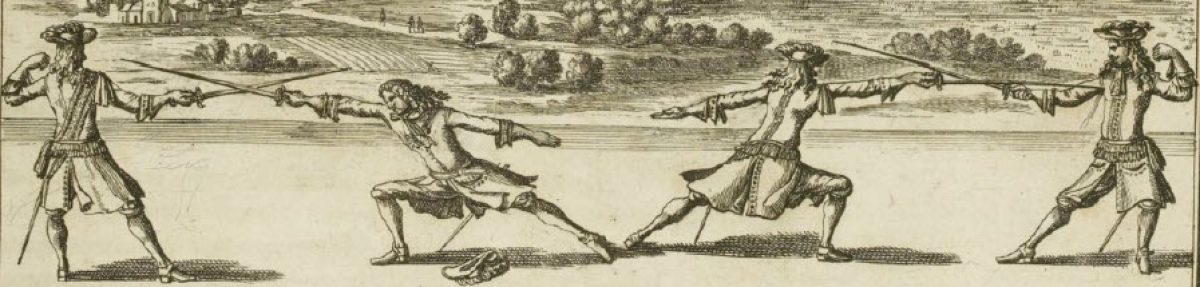

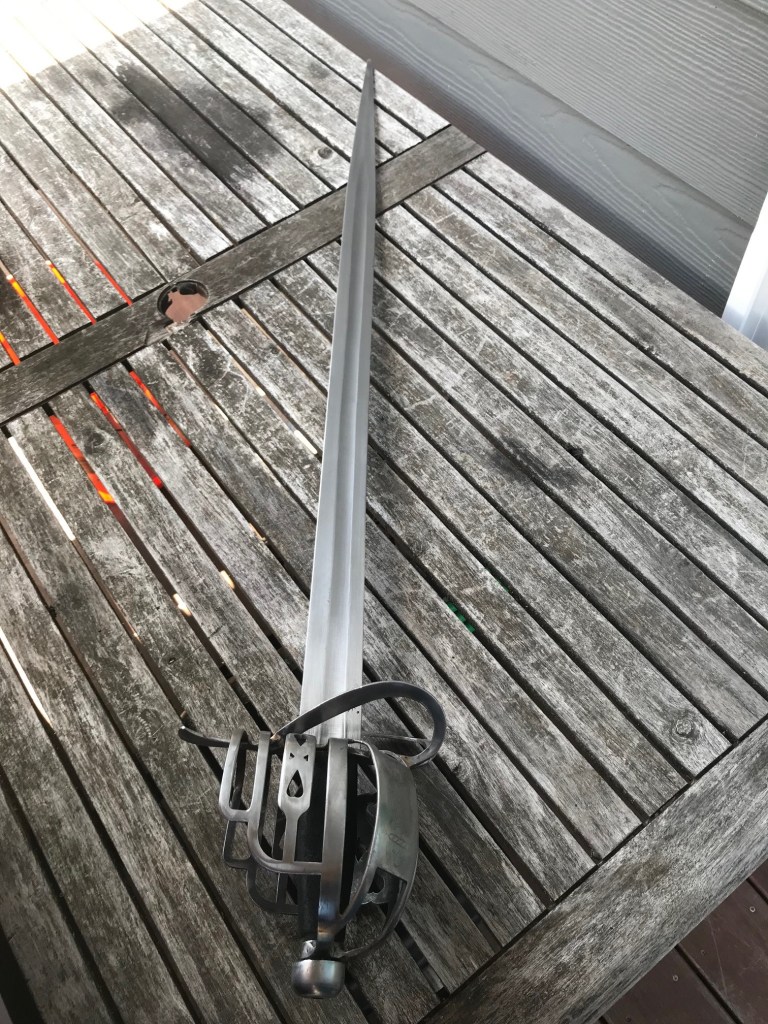

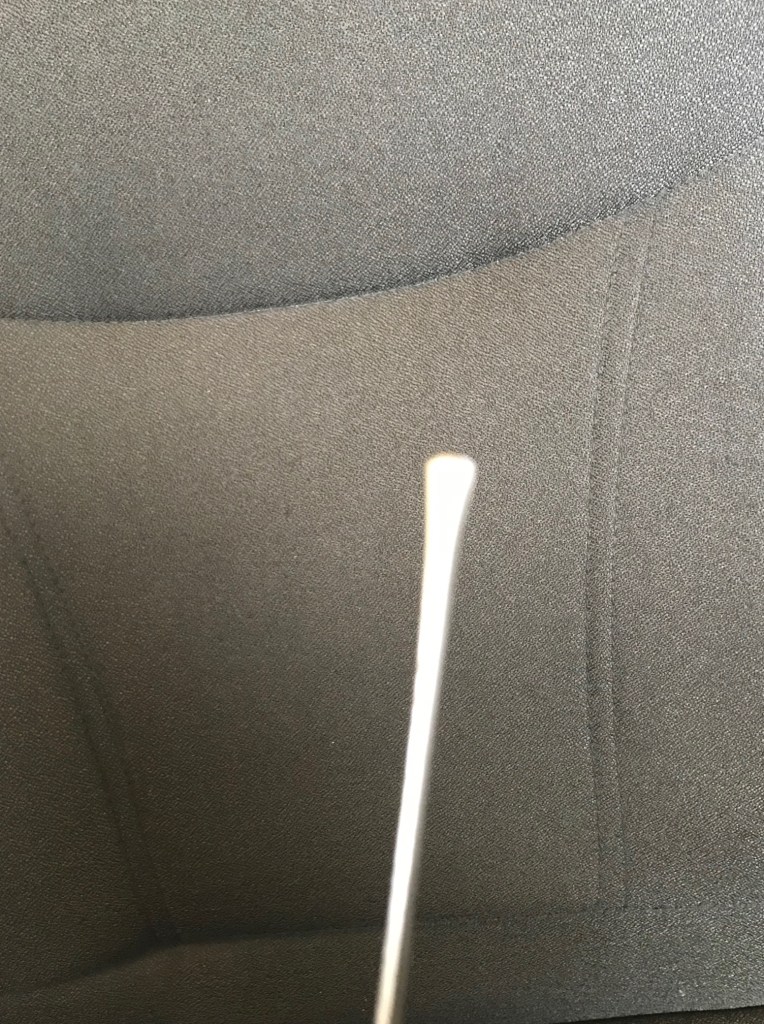
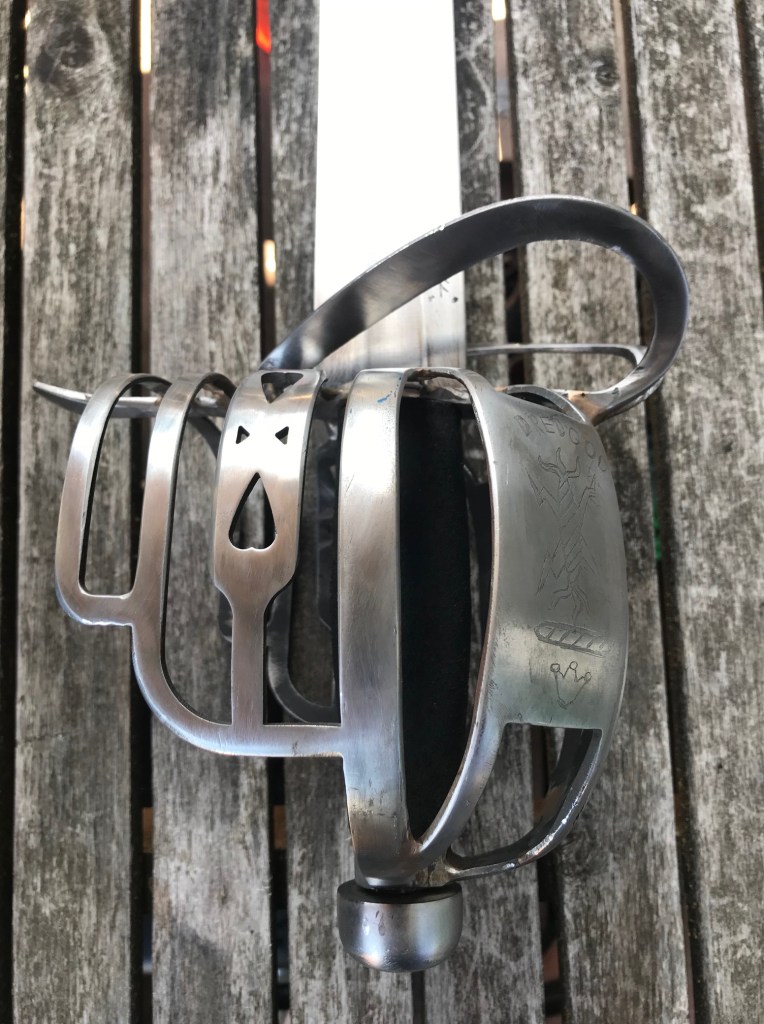


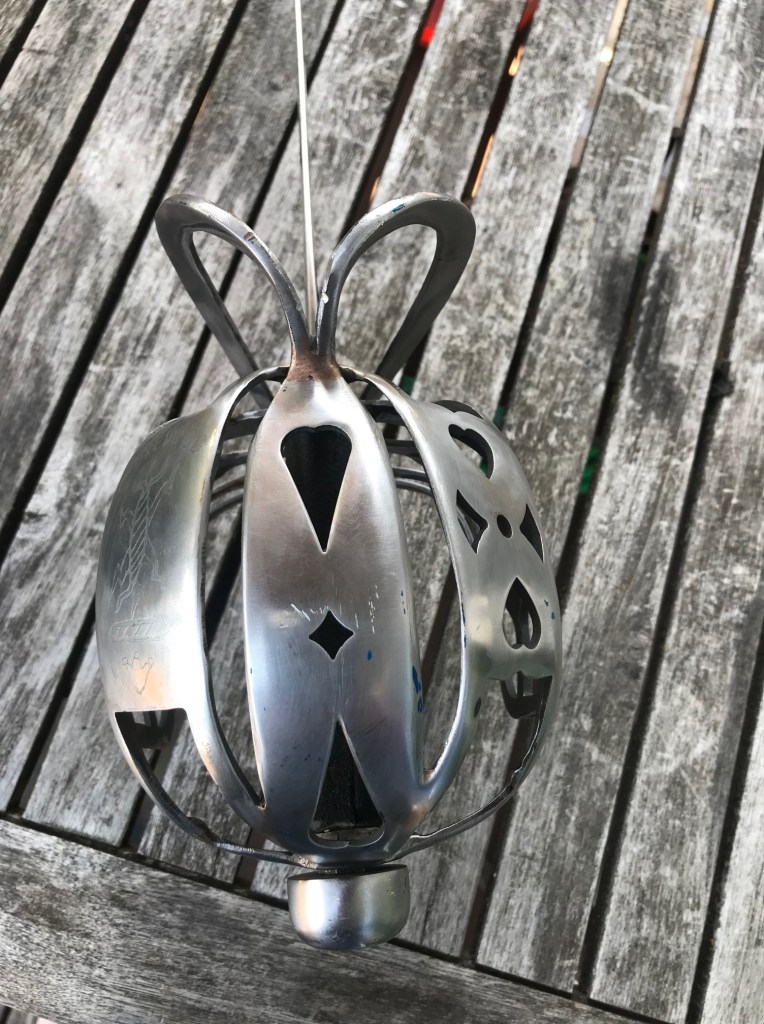
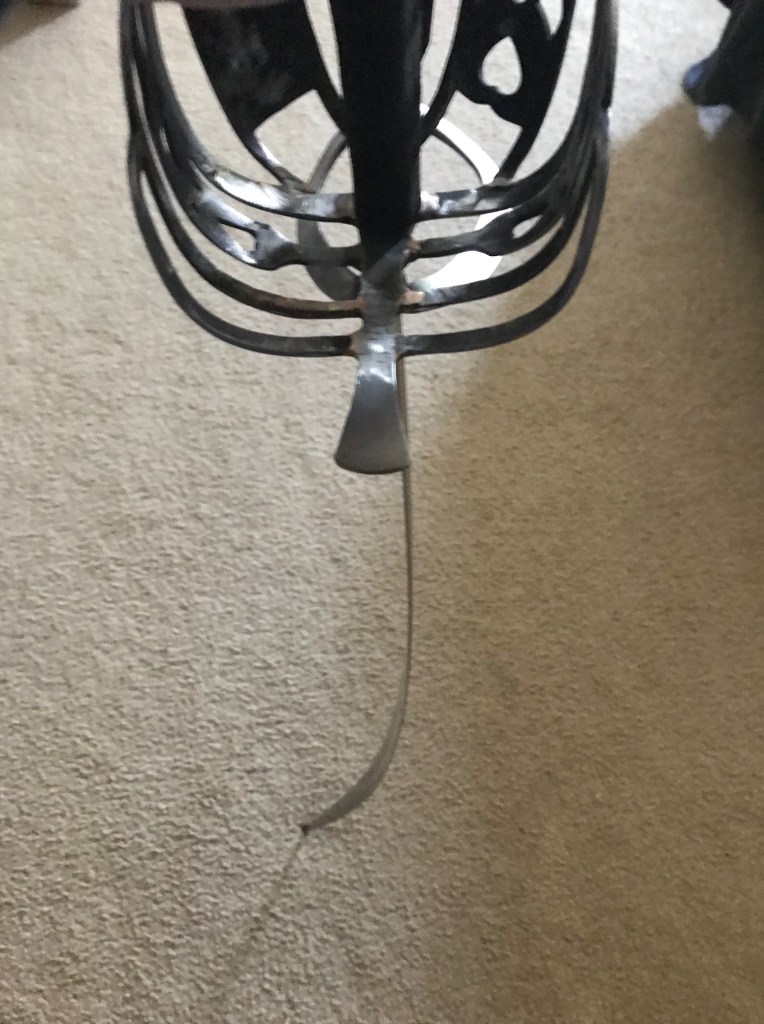

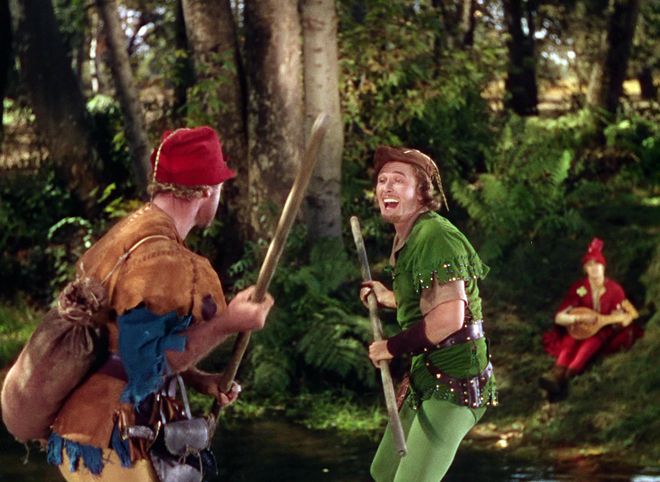


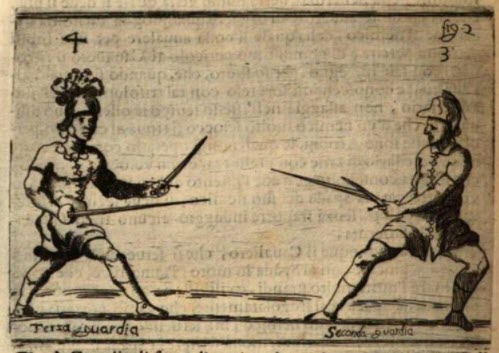




 Capitale Escrime Historical Fencing