This year has proved to be a challenge the world over in a multitude of ways. Few people are free from the trials that 2020 has thrown our collective way. State-side it is not an exaggeration to say that we’re undergoing some serious growing pains as a nation. Like a petulant toddler who refuses its veggies, we’re in “time-out” and can’t play with the other kids until we reflect on our choices, or to use the colloquial American, “get our shit together.”
It’s not just the mishandling of the pandemic, but the all too visible cracks in our political system, weaknesses now more obvious and impossible to ignore. We can hope but must also act so that this time of unrest becomes another important phase toward greater equality and not a return to Jim Crow era evils. News outlets, and especially the perniciousness of social media like facebook, tend to funnel everything into a spectre of doom that is, to be fair, at best a failure to report well, and at worst a directed, purposeful attempt to mislead. This month I decided to mothball fb and retain only messenger. If nothing else it has helped my blood-pressure lol
However challenging the times there is always room for gratitude, and so, in the spirit of emphasizing the positive while not ignoring the negative, I’d like to take a moment to express my thanks to several people. I am focusing here on people within the fencing community who have worked hard to keep their corner of the community active, and, who have remained particularly helpful to others even as they face their own hurdles. Moreover, these are people who mean a lot to me, whose friendship, guidance, and companionship have helped me through the last six months.
NB: I am listing them alphabetically so as to avoid any hint of preference, and, I am using images only with the permission of those mentioned. I have not included my family or students, though my first thanks and offers of appreciation are to all of them.
Patrick Bratton

Patrick and I met as many of us do initially, online, and via a mutual friend and mentor, Chris Holzman (mentioned below). I had the great pleasure to meet Patrick and his family in person a year ago June when they came out for SdTS’s second annual sabre invitational. Over the few days that the Brattons stayed with us we had many occasions to discuss fencing, history, and everything else. That week and our subsequent interaction convinces me that I have made a friend for life.
We continue to share anything of interest in our respective research, some of which overlaps, and enjoy the never-ending learning process. Patrick’s breadth of skill and knowledge, which he shares without hesitation, has not only increased my own knowledge, but also inspired me when I’ve felt less than thrilled at the turn of events this year in re fencing.
[See: https://www.saladellaspada.com/]
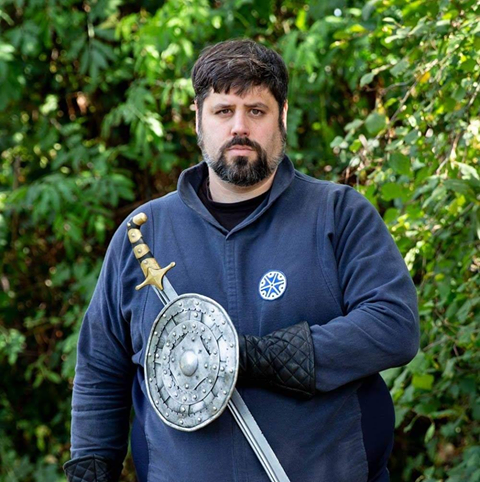
Mike Cherba
Anyone who knows me at all well will know how difficult it can be for me to see good in bad situations. It was at a particularly terrible event that I had the pleasure to meet Mike Cherba and Alex Spreier (see below). An occasional visitor at a now defunct club in town, and in the spirit of trying to bolster the program, I offered to hold an introduction to Henry Angelo’s infantry broadsword, the topic one of the instructors then was offering. He and his business partner were extremely busy with other events, and so this seemed a good win-win: I could help, they could do their thing.
Ten till start, the instructor waltzed in, informed me he was taking over, and left me in a bind—do I say “oh, well fuck you then” or do I suck it up and try to salvage the thing? I opted for the latter. By noon he had run out of material. After lunch he began making stuff up, so Mike and Alex, suspicious of one drill, asked me about it. This started a conversation that has, in some ways, continued to this day. I cut all ties with that club after giving the instructor my thoughts, and then joined Mike at a joint practice with another club, Indes WMA as it was called then, run by Brent Lambell.
I spent several years with Mike studying Fiore dei Liberi’s Armizare and acting as his pell as he researched a unique branch of the historical martial arts tree, the highland Georgian system of Lashkroba [1]. Mike, Alex, and I discuss the depths of the “Art” most every day; I didn’t realize how much I missed this in my life until I had friends with whom I could share it. Mike has held twice weekly online meetings during the pandemic, encouraged people to read, share video of solo drills, and keep moving while we all wait for that special day we can train together again.

Velah Gilbert
Like Mike and Alex, I met Velah at that school which shall remain unnamed. I had been gone for a while—it was an expensive place and I had read and drilled of Angelo what one can—and was working on my own again. He asked that I return if only to give his student, Velah, someone with whom to work as she prepared for a tournament. From the off we got on well—a passionate fencer, possessed of a sense of humor as dark as my own, and a sensible woman of the world, we became friends easily.
What stands out to me most about Velah is her mix of fortitude and generosity. An extrovert, people sometimes see only her friendliness and humor, and miss the person within them, and this is a terrible loss for them. Though it may embarrass her, not to mention me, I need to say this. In 2017, when depression and poor choices came to a head, the only friend I knew I could trust absolutely was Velah. Had it not been for my wife and Velah I doubt I’d be here writing this now.
It is a rare soul that can call you out for stupid choices and yet do so in such a way that it’s clear they care and support you. There was, on paper, zero reason for Velah to do so; she would have been within her rights to break ties with a mess like me, but she didn’t. I never feared what she might say behind my back, because she very compassionately said it to my face. If friends are the family we chose for ourselves, then Velah is my adopted sister, my fellow drunken toddler, and I am truly grateful for her wisdom, kindness, and ability to send me the most messed up jokes you can imagine.
Christopher A. Holzman
I can’t remember now what led me to contact the translator of one of my favorite works on sabre, but I did and never have I been more fortunate in contacting someone I don’t know. As a rule, I don’t do that—call it old-fashioned, but I prefer to meet in person first or be introduced by a mutual associate. I’ve not yet had the honor to take lessons with Chris—it’s on my list—but to say that he transformed my understanding of and approach to sabre is an understatement. In discussions with him, through his translations, and in working with him on a few projects I have learned twice what I did on my own in the nearly 30 years before I met him.
Chris Holzman is a masterful instructor—his knowledge is deep, his ability to communicate simple and complex actions and ideas equally strong, and his commitment to imparting the all too critical fundamentals unwavering. People literally fly out to work with him from all over the world, which says something, but he also instructs via his contributions to the community. Before Chris began translating the core works of the late Italian tradition (and a few key earlier ones, e.g. Marcelli), the only way to access the corpus was possession of Italian and deep familiarity with the tradition. In the span of less than ten years he made Del Frate, Parise, Masiello, Rossaroll and Grisetti, and others accessible to a much wider audience. Any student of the Italian tradition, particularly from the 17th century on, now has reliable translations from which to work. Though still very much a mentor, I count Chris a friend, and have found his humor, talents as tailor, fabricator, and cook equally deep and delightful. He even shares my distaste for gin.
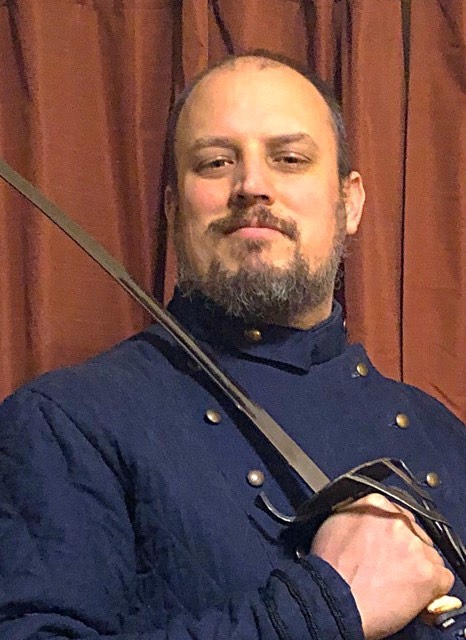
Matthew Howden
The excellent Matthew Howden I met, officially, in 2013 I think, but I’ve only come to know him at all well in the past two years. He is, like everyone listed here, a multi-talented, congenial, intelligent, and passionate fencer. Splitting time between the SCA and his research into destreza, particularly the work of Gerard Thibault and the sabre system of Simon de Frias, Matthew is a busy man. It is in keeping with his generosity that he shares his translation of Frias and insights online where all can access it.
He’s a dedicated teacher, ever ready to discuss a point in class, and always encouraging. During the pandemic he has held weekly meetings online to go through Frias. My schedule has not allowed me to sit in on these as much as I should like, but it’s a great class. I look forward to working with Matthew when time and conditions allow again, and it doesn’t matter what he is working on—I’ll learn a lot.
[see also https://www.historiccombat.com/]
Michael Knazko
Michael Knazko, of the Barbasetti Military Sabre School in Prague, Czech Republic, is a fencing instructor and the driving force behind “Sabre Slash,” the K.u.K. Military Fencing Tournament held in Prague each year. We were to meet in person this October, but between Covid-19 and now travel-restrictions, I am unable to join in the fun. My hope is that perhaps I shall make it in 2021.
Following the fencing tradition I do can be lonely. I say that not for pity, but as simple fact—not a lot of people pursue traditional Italian fencing in the States. [2] With the exception of a few local students, Chris Holzman, Patrick Bratton, and one or two others in the U.S., most of those with whom I discuss fencing are abroad. Michael, as a student in the Barbasetti tradition, is not only within the Italian orbit, but like a cousin—Barbasetti was active in Vienna when my master’s master was a student in Budapest, and thus we are both lineal descendants—as it were—of Radaellian instructors. Like me, he also enjoys fencing bayonet and foil, and, he is also keen to build bridges. His school has connections in Taiwan, for example, which now has its own Barbasetti group under the excellent Huang Chun-Yi of the Lionheart Historical European Swordsmanship school. Fingers crossed I can meet him and his crew in October of 2021.
[See for example, http://www.ars-dimicatoria.cz/en/barbasetti-military-sabre-since-1895-2/]
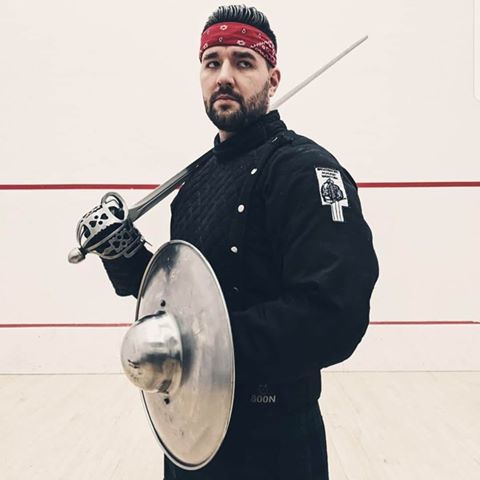
Jay Maas
I’m not going to lie, Jay is one of my very favorite fencers and researchers, and the more I get to know him the more I like him. As a person of sense, Jay doesn’t exclude paths that many other historical fencers shun, such as foil lessons with an Olympic coach. He is source-bound, which naturally someone like me would approve of, but combines that inquisitive examination with a willingness to update ideas in the light of new information or better interpretations. Jay has become my go-to for all things British sabre and broadsword—not only is his knowledge deep, but he shares it without hesitation. His videos on broadsword are some of the best on Youtube.
It was Jay that invited me to help put together another event, and as luck would have it, another casualty of 2020, the first SABR meet (Sabre and Broadsword Retreat). We had found a site in Minneapolis, MN, and were lining up an exciting series of classes. Between the two of us, especially having worked as mods on the fb page “Military/Classical Sabre,” we’re able to draw upon a global pool of talent. Much as I am down on fb at the moment, I value that page more than any other, and it’s one of the few things I miss about fb.
[See for example, https://cateransociety.wordpress.com/instructional-videos/]

Alex Spreier
I mentioned Alex above in reference to meeting Mike Cherba. With Mike, Alex represents one corner of the triangle of instructors teaching Fiore’s Armizare in Oregon (the third being Maestro Sean Hayes in Eugene). He is unlikely to mention it, so I will, but he studied classical Italian foil, has spent considerable time on the 15th century Burgundian pole-axe work “Le Jeu de la Hache” (“The Play of the Axe”), and studies a number of branches of the Art, from western wrestling and grappling to Xing Yi and Ba Gua. One of his major interests is the “Viking” Age, an extremely difficult period to unravel when it comes to martial arts; if anyone can do it responsibly, Alex can. [3]
I’ve taken classes from Alex, classes with Alex, and had the pleasure of him attending my seminars too, and he is one of those people who understands that a teacher is first and always a student (he is also one of our heroic elementary school teachers). We chat nearly every day about things, but especially about the deeper waters of the Art, teaching, and the perils of research. While he wrestles with the fact sometimes, Alex is not a one-trick pony, but a versatile, all-around martial artist, and it is one of the reasons he is so damn good. I mean that. I’ve fought him in a number of contexts, with a variety of weapons, and each one affords me a chance to grow.
Da’Mon Stith

Despite growing fame, from the historical martial arts community to television appearances, Da’Mon Stith remains humble and grounded. It’s the rare person who can balance his degree of skill and attention, but he does, and if you’ve met him you know why—Da’Mon is a gentleman, a man of noble heart, a keen mind, and is as generous with his skill and knowledge as he is in his life outside fencing. I’ve been studying martial arts a long time, fencing a long time, and no other experience has forced me to work harder, to question what I know, and grow like Da’Mon’s seminar he held at Northwest Armizare a few years ago. It’s not exaggerating that he made instant converts out of us.
Few areas of study for historical and cultural martial arts present the challenge that African systems do. Da’Mon is one of the organizers and heads of HAMAA, the “Historical African Martial Arts Association,” and it is worth every single researcher’s time to see how Da’Mon, Osa nKante, and Mansa Myrie pursue their study. First, they use any source of information of worth, from ethnographic studies to dance, from exported systems to the New World (e.g. Capoeira) to living African traditions like Al Matreg. To do this well requires not only considerable analytical ability, but also an awareness of the limitations inherent in such a disparate body of evidence and the humility to be honest and open about it. I aspire in my own work to follow Da’Mon’s model. Did I mention he is one of the finest opponents it has been my honor to cross swords with? He is. If you have a chance to take a class with him, any class, do it. If you have a chance to fight him, do it—you will learn a lot and have a blast at the same time.
There are a lot of people I didn’t mention here, but who are also doing great work during this difficult time, and I mean no insult in not mentioning them here. To them, to anyone reading this, wherever you are, I hope you are well and that you are finding ways to train as we figure out how to live in the light of Covid.
[See also http://www.silentsword.org/about-damon.html]
NOTES:
[1] Mike decided to share both his translation of a Soviet-era work on Georgian Parikaoba free online, as well as his on-going research. See:
Site blog: http://www.nwarmizare.com/parikaoba/
Article on Elashvili’s text: http://www.nwarmizare.com/parikaoba/index.php?controller=post&action=view&id_post=6
Translation of Elashvili’s Parikaoba: http://www.nwarmizare.com/parikaoba-translation-direct.pdf
[2] In addition to those mentioned, the center for most things Italian tradition is the master’s program at Sonoma State University in California. Run by Dr. John Sullins, this program carries on the work of William Gaugler who was the first to establish a sanctioned American branch of the Military Master’s Program in Italy.
 With the disadvantages we face during the pandemic it helps to think outside the piste. Drill is rote even in the best of the times, but lessons often afford us that sense of time moving, of progression. As students we work on something, then next lesson may work on something new as well. Improvement may be slow sometimes, but it still feels more like progress than the same set of exercises month after month with no variation.
 made from about 4-5ft away–as with the sword, bayonet and rifle move first. The student takes a half-step back, parries in prima, then steps slightly to their right and delivers a cut to the arm or down the barrel to the attacker’s hands (this second riposte must be made carefully, one reason that this is not a drill I run with beginners). There are other options, such as a cut to the head via molinello, but we were doing our best to maintain the requisite distance in light of Covid.

 many former plagues, Covid-19 is stealthy: symptoms may appear anywhere in 5 to 14 days; it can appear like allergies or a more run-of-the-mill cold; and it can even hide, like the Danaans in their wooden horse, in people who never develop symptoms but spread it far and wide. Against an enemy so difficult to track it pays to be cautious. For those of us teaching fencing or anything else that requires close proximity, be it dance or BJJ, we must make every effort to keep our students and ourselves safe.
 Parallel drilling works well and easily abides the social-distancing protocols. Yesterday after stretching we started with
  application. I include them in warm-up to prime us for more activity, but without the ability to get into distance we lose the opportunity to drill these offensively and defensively. My student today is at a stage where he would benefit from this, but it will have to wait.
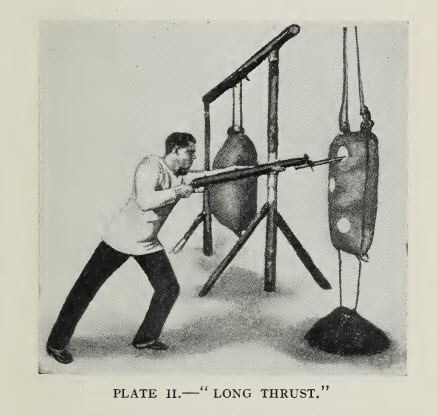
 I have some less standard material I plan to employ to help. I’m still brainstorming these, but as one example bayonet drill may afford some diversion. As a pole-arm, rifle and bayonet keep us a little further away. Even if I am the only one with the bayonet and the student is defending with a sabre, the distance will remain a little farther out. This means that some of the more fun, crowd-pleasing options are out, for now, but that is not wasted training. While the bayonet may be less often employed in today’s military, it’s extremely useful technique to have in one’s toolbox. [
 There is a simplicity, something natural about teaching out of doors. It’s not for everyone. Living in the Pacific Northwest means that one needs to be comfortable with months of rain and grey skies—two of my favorite things—but this means that by definition I’ll see fewer students. Rather than view that as another proof of failure, which it may very well be, I instead choose to see it as weeding out those who shouldn’t be working with me. [4]
 For a while now, I’ve been working hard on an issue we talk about all the time, but which we struggle to manifest: coverage. How to hit and not be hit. For historical fencers this is supposedly the guiding principle in how we approach the Art, and, what ostensibly separates us from our cousins in the Olympic world among others. This isn’t to say that the sport ignores proper coverage completely—ROW assumes it—but as often interpreted, taught, and scored “hit and don’t be hit” is less important than who made the touch with right-of-way, regardless of off-target or near simultaneous strikes. Historical fencers, particularly within their own sporting wing, struggle with the exact same issue only under different terminology. Considerable gymnastics form some answers to the problem, from over concern about “after-blows” to peculiar understandings of the angles for “effective” cuts, and to be fair similar gymnastics in rule-sets with point values by target…, so looked at honestly sport-HEMA faces the same challenges the Olympic world does. [1]
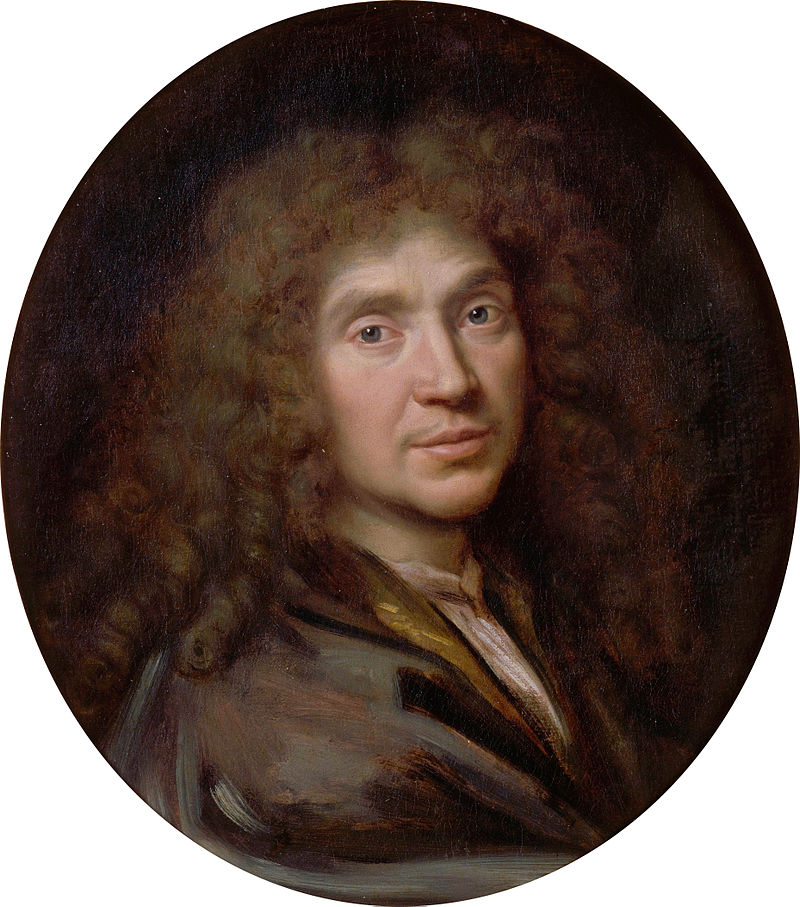 What exactly do we mean by “coverage?” In short, to quote Molière, it is “to give and not to receive” when fencing. This maxim derives from a line in a ballet by Jean-Baptiste Poquelin Molière (d. 1673), usually referred to only by his surname. He was a French dramatist whose work captured key social issues of the Ancien Régime. In his 1670 “Le Bourgeois Gentilhomme,” often translated as “The Would-be Gentleman,” Molière explored the ridiculousness of a social climber keen to take on the activities of his social superiors, something obvious to everyone but poor Monsieur Jourdain himself. Among those he employs to better his situation is a fencing master who, in an oft-quoted line in traditional fencing circles, remarks “As I have told you, the entire secret of fencing lies in two things: to give and not to receive.” [1] In the 1990s when “classical” fencing was quickly establishing itself in reaction to the excesses in the sport, this line was often the battle cry.
 The confidence gained in “on the job training” didn’t mean a lack of fear, only the ability to put that fear in check. More than anything else, it is the lack of fear, the lack of dire consequences which most affect our approach. Some historical fencers assume that because the system they study is “martial,” by which I believe they mean either for the battlefield or as a synonym for “effective,” that they are more or less automatically approaching it the same way as people did in the past. One may move much the same way a treatise suggests, but movement is mechanical however much informed by intent and to move the way a master recommends does not mean the mindset is the same. We can’t even be sure we’re moving the right way much of the time.
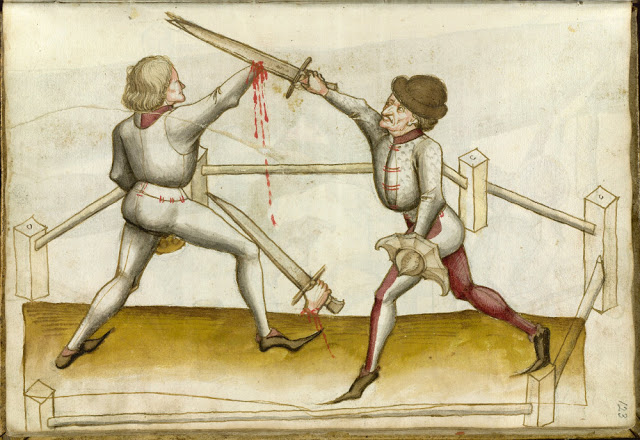 None of these are perfect and each have advantages and disadvantages. None, however, solve the problem of mindset. If cuts must be made at certain angles, then cuts that might have damaged someone but aren’t at those angles are ignored—”tippy” cuts to the hands, to name one example, aren’t considered “martial,” but the hands and forearms are common targets in the sources and as I learned from one sabre coach, if you remove the arm’s ability to wield the weapon, the rest of them is a lot easier to hit. The thorny issue of the “after-blow” likewise presents difficult choices—what is more important, responding properly, defensively to that initial attack or cutting into it to lessen its point value despite the fact both opponents are hit? Weighted point-systems set up similar challenges. For example, in my rule set I reasoned that weighting the first touch in a bout would make fencers more cautious and defensive, but the point advantage led more people to attack in hopes of being a point up from the start. These artificial attempts to infuse some species of “fear” and/or better fencing vary in quality, but none does the job super well.
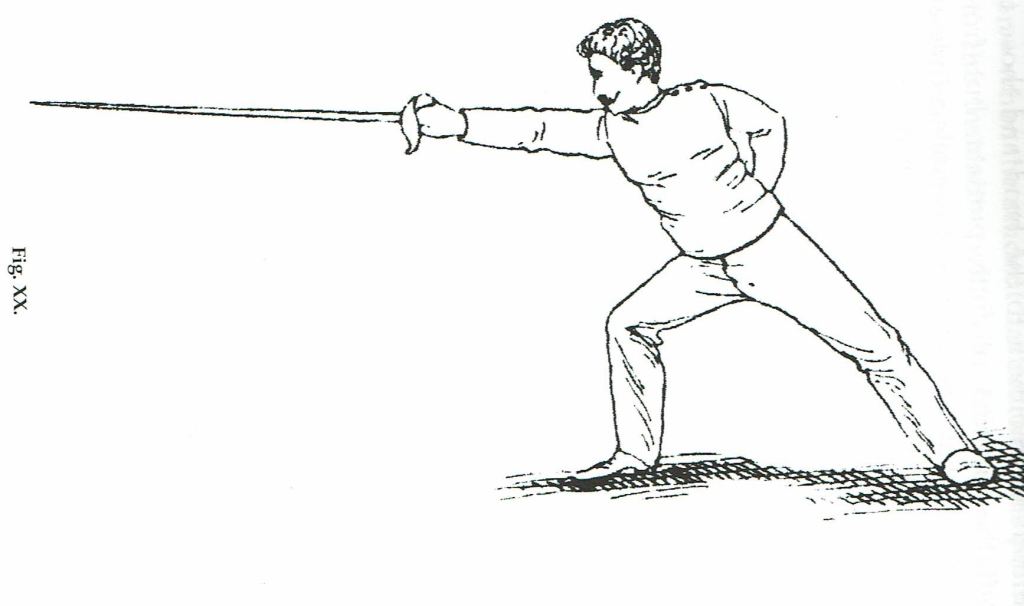
 At the risk of sounding too Pacific Northwest and as crunchy as organic granola, one thing we can do is cultivate a sense of danger, that is, be mindful from the moment we pick up a weapon that it’s a weapon. Blunt, not blunt, treat that sword like it’s dangerous. By analogy anyone who owns firearms knows to treat that rifle, pistol, or shotgun as if it is loaded. Always. Though clearly more critical for gunpowder, the same mind-set can help us approach our drill and bouting with more awareness of what it is, in theory, we’re doing. Employed appropriately our fencing will change. We can become more cautious. We may reconsider how that tip cut to the hand might have ended the fight. We can second guess an attack that puts us at too much risk even though we’re sure we’ll land the touch.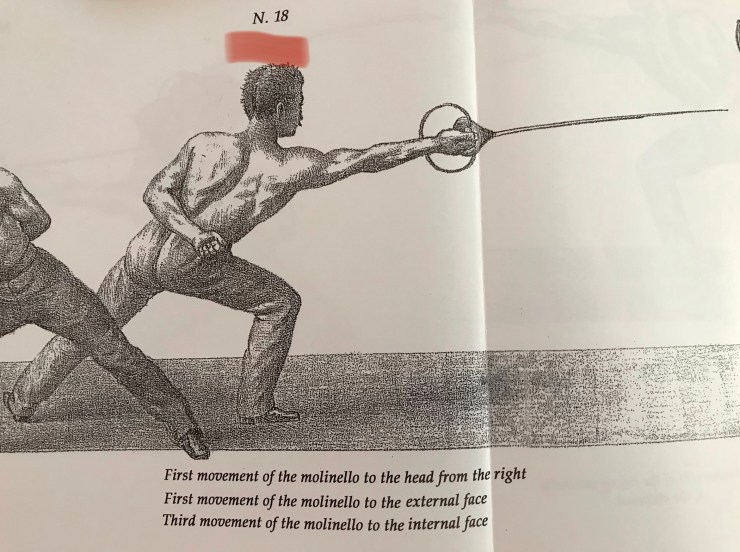


 )
)
 Capitale Escrime Historical Fencing