In Memoriam

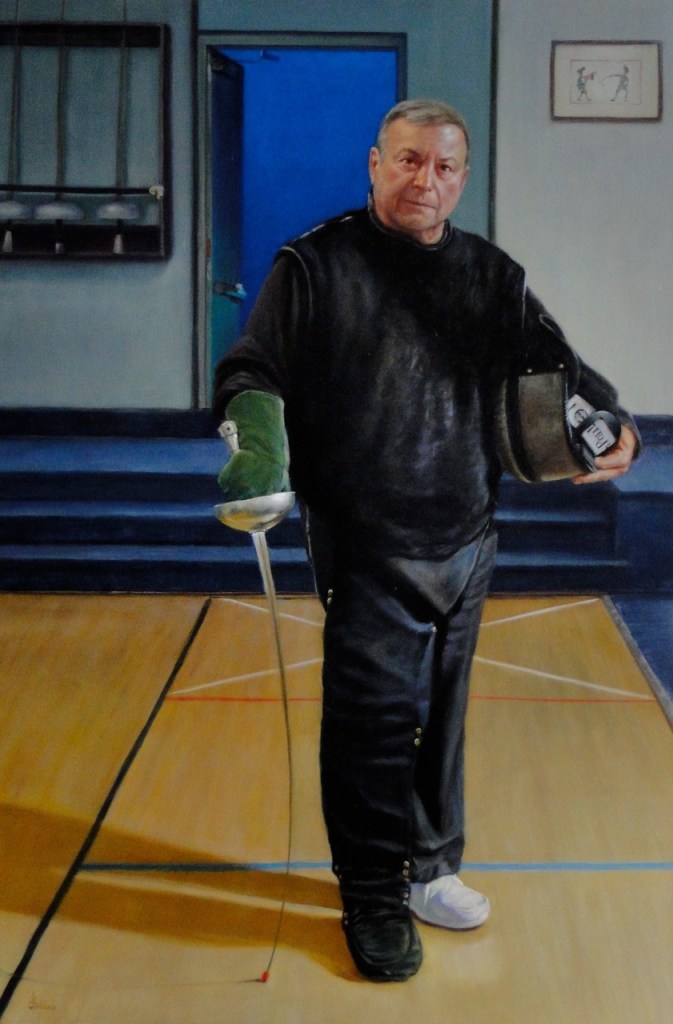
Maitre Edwin Hurst, portrait by Stephanie Goldman

I learned today that the first master with whom I worked, Edwin “Buzz Hurst, passed away last month at the age of 84. My good friend Patrick Bratton (Sala della Spada, Carlisle, Pennsylvania, USA) shared the USFA’s fb page about it:


https://www.facebook.com/USAFencing/posts/pfbid02NHb3eZD8oEUny3E7ijUBdCAggDn5en3fztnPMmsWCyh2EZUEsVAs8qHUfKU3LW75l

Before working with Buzz, I had studied foil with a gentleman in the DC area, one who split time between Olympic Fencing, SCA, and work. Working with Maestro Hurst was far more regimented, and true to his navy roots, more like working with a drill sergeant than a coach. He was somewhat notorious for berating fencers he didn’t think were trying hard enough, smacking them across the mask, and often expressing his opinions about one’s ability and/or ancestry. Having grown up in a military family, I didn’t take any of it to heart, so was better able to focus on the lesson, but I will say it was often as funny as it was mean. Some favorites:

“You move like a bovine.”

“Look, grow a pair, and hit that guy. My grandmother could hit him.”

“What’s your major?” [Buzz would often try to use our study track for analogies]
“Archaeology.”
“Damn. Uh… do you know boxing?”
“Yes sir.”
“Okay, we’ll go with that.”

I learned a lot from Buzz–he provided me a solid foundation upon which Al Couturier and his assistants, and later Delmar Calvert, constructed more of a building (one still very much in the process of being built).

Buzz had some fantastic stories. One of my favorites was about a collegiate bout he was in while at the Naval Academy in Annapolis, Maryland. One of his opponents, no kidding, was Neil Diamond, the pop star. In this particular tournament Buzz lost to Neil and it still bothered him. I heard this story in 1991 or 1992, and if I recall correctly he concluded with “Can’t believe I lost to the Jazz Singer.” Funny chap.

Rest in Peace Buzz, and thanks

*Being a club team, we couldn’t easily afford a coach of Buzz’s caliber, and so I think by 1994 he was in San Diego. He didn’t say much about it, least not that I have heard or read, but he was the first coach to get our team to first place, something a club team had not been able to do in at least 25 years.

UC Santa Barbara Fencing Team, 1992, All Conference Champions, SoCal Division

Challenge, Growth, & the Line Drawn in the Sand

It’s not a lack of fencing-related topics that has prevented me from writing more on this page, but the sorrow, anger, and consequent insecurity of watching one’s country take a bad turn that has occupied me. I’ve never been one to say “it can’t happen here,” because having taught history for so long I knew that tyranny can happen anywhere. Yes, even here. One might think that narcissists greedy for power and attention might give more thought to their legacy, but if the Nuremberg trials proved anything it’s that many such people go to the gallows still convinced their choices were correct. Evidence, reason, decency, these have no effect on such people.

Montesquieu wrote

and I have found this to be, in many ways, true. [n] Experience, especially disappointment, failure, and hardship work effectively against false positions, assumptions, and prejudice, at least if one is open enough to admit when one is wrong. My own partnership with these challenges has made me a different person than I was when I was younger. Contrary to form, as I’ve aged, I’ve grown more tolerant, less quick to judge, and more open-minded because having lived in the world, and having seen a bit of it, I know few things are as black and white or easy as we might wish to think. This is an approach to thing I take to everything and that includes my work as a fencing coach.

For the patient, what follows explains why my club values what it does today, and, why I think I think it’s important. If you don’t feel like a “long” read, then stop here, go to the “About Us” page, and scroll down to the various icons at the very bottom of the page and you will see where what follows leads.

Moments of Intense Clarity

Many of the people we meet in our lives become teachers in one fashion or another. One of the more important such people in my life was a female friend I first met at church in high school. One winter evening, between college semesters, we had a conversation about tolerance, equality, and Christian notions of morality. This friend, I should say, is extremely intelligent, but more than that she had a deep sense of justice and compassion. Though we have not stayed in touch much, I know her career as an academic took off, as it should have, and that she is doing good in the world.

As embarrassing as it is to admit, at that time, in my early 20s, I had a traditional view of certain things. With homosexuality, for example, the bible had some lines that it was a no-no, and I didn’t think about it beyond that. However, because I did my best to embrace the Second Great Commandment of the NT, I did not persecute, avoid, or mistreat anyone. “Tolerance,” to me then, was just that–I might find something “wrong,” but it wasn’t my place to judge it. My friend, however, pointed out that I was, in fact, judging them, and worse, I had not examined why. “It’s in the bible” is not an argument. Thanks to her I grew a little that night.

We debated back and forth a bit, but even then I knew she was right. IF the deity we believe in is all good, all knowing, all powerful, then it’s beyond our ability to comprehend save through metaphor. It’s a thing we can understand poetically, not scientifically. Does it make sense that this being would be so concerned with sexual preference? This idea of god as a middle-aged white male golf club president is not only simple, but insulting to that being.

Moreover, the admonitions against homosexuality are in OT law books, the same books that say we shouldn’t eat shellfish or be near mensurating women. The NT had two main commands, ones importantly upon which all the others hang, namely to love god and treat other people the way we wish to be treated. In truth, I can’t think of anything Jesus could have ordered people to do that is harder than these two things, the first because we cannot sense it or experience it in the way we do literally everything else, and the second, because people are sometimes complete bastards.

My friend, let’s call her JK, opened my eyes to hypocrisy I wasn’t even aware I suffered. The initial discomfort of being wrong was brief, and then the real work began: how do I interact with others in a way that abides the Golden Rule, really abides it? Love. Compassion. Empathy. These are the things that allow us to see others as fellow travelers, our fellow humans, each of us bumbling along just trying to make it all work. It means finding the common thing we all share and honoring it. We are all fragile, imperfect, and deeply flawed, and, we’re beautiful because of it.

I have been fortunate to travel, to live outside my own culture, and to spend sufficient time with others to know, without a doubt, that I do not know everything, and, that my way isn’t the only way or necessarily the best. It is hard to hate people once you know them, and this is one reason it is vital to leave a place of comfort and do the hard work. I have mixed so often with people who are a different color from me, who worship differently than me, who think in languages different than mine, who love differently than I do, that the differences–while there and a part of who they are–are less important than one, single, all important fact: they’re people too. We are, in the end, the same, bags of water that turn to dust.

More than once on this page I have talked about inclusion, equality, and doing our part to do right by others. Now, perhaps more than before, this is important–it is certainly more important than teaching them how best to make a counter-beat or 1-2 feint. Many of my students will fence for a while, then go on to other things, but if I’ve done my work well, the real work, they will remember the environment in which they learned how to lunge or use contre-temps.

Unfortunately, my nation stands at a line in the sand, a point of definition. Will we be complicit in evil, or, will we fight it? The efforts to remove DEI measures, for example, are not about focusing on merit, but erasing certain people in symbolic, official ways–it is the first step to removing them… permanently. The parallels between the USA in 2025 and Germany in the late 1930s are many, and some are worth a close look: fascists then and fascists now both targeted people they deemed “undesirables” at first to exclude them, then to eradicate them. It was not just Jews, but queer folk, gypsies, the mentally and physically challenged, and, intellectuals and teachers. Fascists are enemies of humanity–the only acceptable people in their eyes are themselves, regardless of how unscientific, ahistorical, and nonsensical that is. It is fantasy and really really bad fantasy at that.

This nation began as a democratic experiment, and there is a lot we got wrong, but representative democracy wasn’t one of those mistakes. Likewise, as a nation of immigrants–if you are not First Nations then sorry Skippy, you’re either an immigrant or the descendant of immigrants–the old notion of a a melting pot, a pluralist state where people regardless of background, faith, color, etc. could live their lives, where equality, the rule of law, the separation of powers, and the freedom to speak, think, and worship as they like allowed disparate people to unite around these common values was a noble ambition. We achieved it at times, and utterly failed at others, something our current plight places in high relief.

My club will remain open to people of good heart. I don’t care what color you are, what language you first spoke or speak at home; I don’t care what your sex or gender is; I don’t care how you love or who; I don’t care what religion you practice or if you practice none at all; I don’t care if you’re first generation or if you’re the fifth. You’re a person, a fellow human, my brothers and sisters, my sword family. The only people I do not welcome, and will actively repel, are bigots. But even they, should they examine their prejudice honestly, should they compare what they think they know against what has been demonstrated over and over again by science and history, should they find that they are just a person like everyone else, they’d be welcome too.

Notes:

[n] Charles Louis de Secondat, Baron de Montesquieu, The Complete Works of M. de Montesquieu (London: T. Evans, 1777), 4 vols. Vol. 1.. Bk 4, Ch. 4.

Wait, I thought you were a Sabreur?

Maestro Barbasetti

Social media may herald in the end of the world as effectively as it has poisoned politics, but it’s fantastic where fencing is concerned. A recent post on smallsword garnered questions about what it is, exactly, that I do–am I a foilist? A sabreur? Both? Something else?

The simple answer is “yes,” all of the above, but we focus on different things at different times. There can be many reasons for this. To the person’s first question, yes, I am still a sabre fencer, though more coach than anything else at this point. My main source is Luigi Barbasetti’s _The Art of the Sabre and Epee_ (1899/1936), not only because it is the text I’ve come back to time and again since the 1990s, but also and especially because his work formed the foundation for the school in which I am a student, Barbasetti Military Sabre since 1985, headquartered in Prague, Czechia.

Between some injury maintenance and a brutal schedule in my day job, Barbasetti’s approach has, as ever, proved solid and rewarding. Nearly all my students use s2000 Olympic blades, though several use historical trainers (two have Swordsmithy’s, two those by other makes, but all hovering around 650-700g). The system is such I could use sticks.

I am not taking new students for sabre, that is true, but mostly due to time constraints–I am unable to teach as often as I was and the larger the class, the less effective the instruction. I make exceptions for visitors and for the few people who seek me out from out of town, but otherwise my focus has been on related projects, teaching, and working on some international efforts to improve both coaching and fencing.

As ever, I’m happy to answer questions, so please feel free to do so–as I did here, I’ll do my best to answer promptly and succinctly.

Early & Later Smallsword Treatises: A Note

[originally posted 30 July 2023 on the old CEHF site]

It’s customary to discuss particular weapons in somewhat monolithic terms. We speak of “foil,” “smallsword,” “sabre,” or “longsword,” to name a few, as if these constitute a tidy, discrete facet of sword-types. In some ways, this is true: sabre is different from spear, longsword from smallsword. However, as convenient as compartmentalization is, despite how necessary it is to organize a topic as gigantic as swordplay, we can easily forget that within each division there exists both variety and change over time.

Hope’s earlier guard position

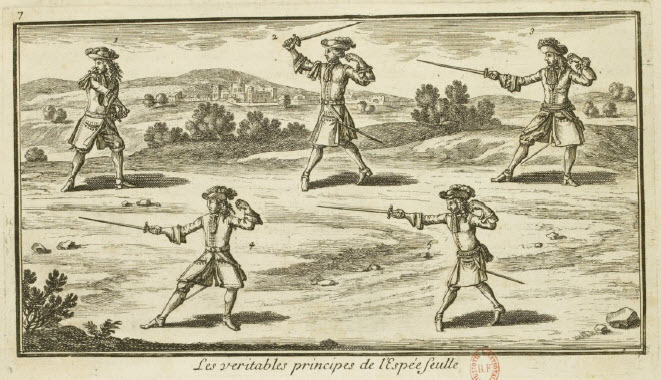
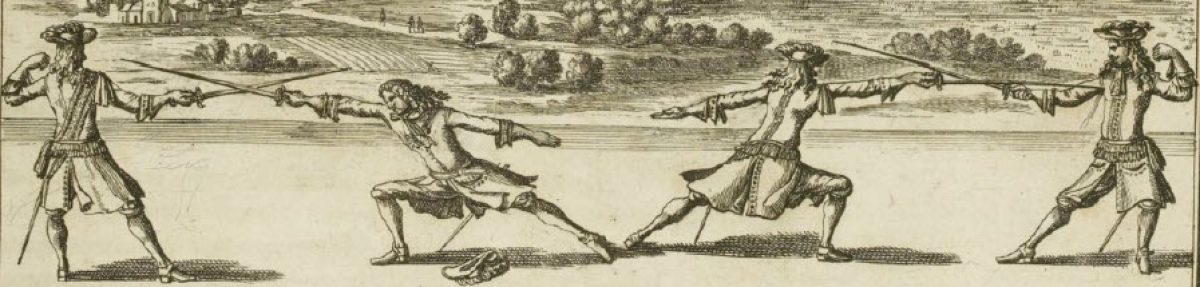
For smallsword, a cursory glance at earlier and later texts will reveal some critical differences. There is overlap to be sure, but the differences are important. Even among texts of the same general time one should compare them. De La Touche’s seminal work from 1670, Les vrays principes de l’espée/The True Principles of the Sword, for example, reads differently from de Liancour’s Le Maistre d’armes/The Fencing Master (1686), but both read very differently from Sir William Hope’s The Scots Fencing Master (1687) and A New Short and Easy Method of Fencing (1707).

from Hope’s New Method

The works of Sir William Hope, Zachary Wylde, and Donald McBane tend to read as primitive, unsophisticated works to many fencers with more traditional training. It’s easy to see why. These works contain fewer actions, seemingly odd things like weapon-seizures and guards other than tierce/sixth, and are often less well-written. Compared to the succinct descriptions in Le Sieur P.J.F. Girard’s Traité des armes (1740) or Domenico Angelo’s L’École des armes/The School of Fencing (1763/1787) one might conclude–erroneously–that these later works are “better” than those which preceded them.

from McBane

The answer is context. The earlier works reflect a different set of concerns. These are largely works of self-defense first and foremost. While Girard and Angelo also offer solid advice for the duelist, they also reflect a different culture, one in which smallsword was already transforming into the game of foil (originally a training tool for smallsword), that is, a polite game where beautiful execution and grace were often as or more important than actual combat effectiveness.

from Angelo

It behooves any student to study earlier and later works, because together they provide a far more complete examination of how smallswords were used. This is easier to do without bias: to apply the filter of late 19th/early 20th foil to 17th and 18th century foil jaundices our view and can lead us to the wrong conclusions.

The En Garde Position & Weight Distribution

[Originally posted 2 March 2023 on the now-defunct CEHF site] One of the most important positions we employ in fencing is the guard position. It’s the starting place from which pretty much everything happens, and thus it pays to work on it, practice it, and perfect it as much as possible. This means not only standing in guard and checking the position of everything head to toe, but also moving from that position, forward, backward, and side to side.

Like many works on rapier, a good number of those on small sword recommend a rear-weighted stance. For example, di Liancour offers little explanation apart from his belief that a rear-weighted stance makes it easier to recover to guard. One suspects the stance may also help remove one from target that much more:

Domenico Angelo appears to prefer weight on the rear leg as well. Though one can never be completely certain with images, the plates Angelo provides do, throughout the work, suggest a rear-weighted stance. He writes

Other masters advocate more equal distribution of weight. L’ Abbat, for example, says

In similar language, a master active a century after L’ Abbat, James Underwood, argued for a more equally weighted stance.

Underwood adds that the shift in weight to advance or retreat costs one time, and that everything depends on time. He was certainly correct–any additional, unnecessary movement that impedes an action only gives one’s opponent tempo to strike or change the field of action to their advantage.

SO, what should one do? Which is correct or better?

Yes. This is to say that both approaches are worth trying as they were both in use at the time. Ultimately, we tend to fare best with what works for us. I teach both, but prefer to be more equi-weighted. My suggestion, once I show someone the critical parts of the guard, is to have them adjust for their own bodies–we’re all built a little differently so it makes sense to adjust things to accommodate that.

So long as the critical aspects of the guard position are present, so long as one is balanced and can react and move efficiently, so long as one is well-protected, it will be fine. The critical aspects are

  • to have the lead foot pointing forward–it can help to picture the imaginary line, the line of direction, that connects the lead foot of each opponent and along which both parties move
  • to have the weapon arm, assuming an outside guard, in line and just outside the body to close off the lead arm’s side/outside line (those adopting a middle guard should have the arm and weapon mid-body)
  • to have about two of one’s own shoe lengths between the feet (the goal is a stable, easy to move in starting position)
  • to have the torso upright, head up, and as much as possible the body relaxed
  • to have some bend in the legs; these are the springs and need to be coiled, as it were, so one can move or lunge
  • to have the rear arm held back behind the head or at the chin, palm out (the latter is used to check a blade after making parries to the inside line, i.e. in quarte, prime, or seventh/half circle)

NOTES:

[1] Sieur di Liancour, The Master of Arms, 1686, Ch. 3, p. 18 in Lynch’s translation.

[2] Domenico Angelo, The School of Fencing, 1763/1787, 6.

[3] L’ Abbat, trans. by Mahon, 1734, The Art of Fencing, (Lector House edition), 4-5.

[4] James Underwood, The Art of Fencing or the Use of the Small Sword, Dublin, 1798, 4-5.

New Year, New Approach

For some time now I’ve tried to “go with the flow” rather than attempt to establish some ideal approach to the club. This tends to help me to help those who want or need it, and, introduces me to a wide variety of opportunities I might not have had otherwise as well new people I might not have met.

A new day-job has forced me to make some significant changes, and has restricted my availability far more than I anticipated. I’m not happy about that, but rather than whine about it the more useful thing to do is adapt, so, I’m adapting.

What Changes?

First, the name–henceforth I’ll be using the name an affiliate program has used to date, Capital Escrime Historical Fencing, because my adult program will be shifting more toward this group in Salem than the meets-sometimes-group in Newberg. For the Newberg folks, you are not only welcome, but encouraged to join us in Salem (it’s a 30min. drive).

Second, while I will continue to teach sabre, I will not be taking any new sabre students at this time. Instead, I will focus on smallsword and “transitional” rapier as presented by Charles Besnard (1653). To my friends in the Italian tradition, please do not take this as a snub, because my love for Marcelli, Radaelli, and others is still strong, but for sabre in particular I need a break so a few injuries will heal.

Third, the Newberg group will meet, but every other week; I will meet the Salem group in the weeks between. See “For Current Students” for more details.

Salem Location
An old friend and fellow fencer, Moses Jones, has kindly invited us to share his space at his school, Seize the Vor [https://www.seizethevor.com/]. His school meets out of Iron Phoenix Athletics, and is just off of I-5 in Salem. Moses and I have a LOT of plans, and while the change-over might be a bit rough, there are good things to come. 

For Those Upset by the Changes
I know that this will not work for everyone, and I’ll be sorry to see anyone go, but if possible I should like to help those for whom the new schedule/location doesn’t work find a good spot. There are a few decent options for historical fencing in the greater PDX area, and a lot of solid Olympic schools. Please chat with me and we can work something out for you or you child.

Fencing While Injured and/or Old

Wound Man from the Feldtbuch der Wundartzney of Hans von Gersdorff (Strasburg, 1519)

In two separate conversations in the last twenty-four hours the topic of martial arts, combat sports, and injury has come up. My spouse’s uncle, yesterday, remarked that when he was a teen studying TKD they viewed the semi-ambulatory middle-aged coaches as old men—now much, much older, he realizes that they were not old really, but battered and damaged from hard-training and fighting. This morning, I had a chat with a friend and college, Matt L., in California, about avoiding the very thing my uncle in law noted—early decrepitude thanks to martial arts. As someone navigating that very issue I have some perspective, and some advice for those not yet there about how to avoid, or at least forestall, the physical consequences of our training.

This is a post I’ve started a number of times, then put aside. It’s not that I don’t know what to write, but that there is so much to say, and, so little that most people will find motivating. I was no different, so if this sounds judgmental, know that I’m including myself in the censure. When I was in my teens and twenties, I could do things, and so, I did. I fought in a collegiate tournament on a sprained ankle that I taped up; I didn’t wait long enough to start training again after a slight tear in the meniscus of my right knee or years later after a chance stab wound to the same knee, one that nearly severed the LCL; I didn’t take a break, but taped and armored up my torso after a missed parry meant two cracked ribs. These were not smart choices, and, they’re choices that in one way or another I have to manage now.

Injury & Recovery

If you are injured, be it while fencing or in some other activity, take-a-break. Let yourself heal. This can be especially challenging when one is an active competitor, because the fear of losing ground, of any break affecting one’s standings, rank, or success is strong. Add to that the desire not to miss favorite events and it’s a double whammy.

You have time, use it. One “can” fence on injured joints or strained muscles, but one shouldn’t. I’ve likely stateed this on this site before, but we pay for all the fun of our teens and twenties in our forties and fifties, so, the better you manage yourself when younger, the less you’ll suffer when you’re older.

A good coach, by the way, will not only support a break to heal, but actively encourage or even order it. I’ve worked with ones who said tough it out, and, a few who told me to stop and take a break. Maitre Delmar Calvert, for example, when tennis elbow started plaguing my right arm again, told me to take a break and go to PT. Maitre Handleman just a few years ago told me and one other grey-bearded chap to take more breaks and to use walking steps during a weekend coaching seminar. This is good, proper coaching, and, good advice.

As a younger person, I fought competitively for several years in ITF conference TKD, and, at a time where the pads we had were good, but only so much. A smaller glove could easily reach through headgear; the footpads we wore had no sole, so a side-kick landed as it would in earnest; and we had no chest protection. By the age of 13 or 14 I’d had two ribs and my nose broken, never mind the damage I inflicted on people the same way. When a fellow student, a bit over-zealous, broke my nose in the practice right before a tournament, my coach—who was excellent—was more worried about my mother freaking out than the fact I’d been injured. It’s fighting, and well, we get hurt sometimes—it’s “normal.” He and another coach set my nose (NOT fun), told me to go and change out of my dobak (which was covered in blood), and to keep the paper-towel under the nostril inside my lip there until it stopped bleeding (a great way to stop a bloody nose by the way).

Muhammad Ali, a hero of mine since childhood, was “the Greatest,” but paid dearly for repeated punches to the head

We accept injury as normal, but should we? Would it not be better to prevent it? I’m not sure I have a great answer or solution. On the one hand, I’m grateful for having learned early how much punching and getting punched can hurt—it no doubt helped me avoid trouble I was likely to be in otherwise. On the other hand, as a parent, well, I don’t like seeing any children hurt, especially when it isn’t necessary. My solution has been to focus on the mental side of all this, to help students cultivate mental toughness, confidence, calm, and wisdom to avoid trouble if at all possible.

Time & Repetitive Movement

Even if you are lucky to escape injury, years and years of repetitive actions take a toll on us. At 45, I started having an odd pain in my right leg and so saw my doctor. She ordered x-rays and other tests, and turns out my right hip was in the early stages of arthritis. I thought that was crazy; “I’m only 45!” was my reaction, but she then reminded me that I had been lunging on that same leg since I was 16. How many thousands and thousands of times had I likely lunged? Never mind other traumas to that leg.

It was the same with my elbows—Radaellian sabre mechanics use the elbow as axis, and even my Olympic training retained vestiges of this approach to cutting. I have tennis elbow in both arms, ironically because in 2001 I was in a serious car accident that all but destroyed my right shoulder, and so I started training as a leftie.

Neither of these issues arose from anything improper or stupid—they are the result of activity and repetition. While some degree inevitable, depending on one’s genetics and training, there is a lot we can prevent by taking simple steps. For example, had I rested my elbows longer; had I continued my PT exercises; had I taken better care of myself I wouldn’t be in as bad a condition as I am. I’ve been slightly wiser with my hip, though it has cost me some fun—I use more walking steps than fencing stance and footwork when teaching, and, hardest of all, force myself not to do things I actively want to do. At Rose & Thorns earlier this year, I desperately wanted to bout with people, but with my hip acting up after a misstep while teaching, I know I’d be on a cane, again, if I did. Missing out on the fun makes this a lot harder, but, if I can attend in 2026, hopefully that choice means I will be able to fence people.

Be Kind to your Future Self

Many of us want to fence into old age, right up until we drop, and generally we can IF we take care of ourselves. Nothing I say or write is likely to change anyone’s mind—I didn’t listen well when I was 18 or 28 either—but I’ve reached the age where it’s now my turn to take up the mantle and sound like Chicken Little.

If you’re injured, take a break and heal. If you are fencing a lot, warm-up, stretch properly, and after your workout cool down and maybe stretch again. If you are doing stupid things, and let’s be honest, at some point many of us have, at least consider first what that choice will look like in twenty to thirty years. I can’t say for sure that twice jumping out of a second-story window also contributed to my hip issues, but… [1] Fencing with seriously garbage repro sabres in the mid-90s while understandable given interest in historical fencing, meant that injuries from them were a magnitude higher than with an Olympic or Schlager blades. Neither of the latter ever cracked my ribs, sunk into my knee, or broke my fingers protected poorly by a brass knuckle-bow. The truth is the training I received, particularly from Maestro Al Couturier and his assistants, was perfect for studying Radaellian sabre, and the cutting dynamic doesn’t need a 100% accurate tool to work—one can use an Olympic sabre, something slightly heavier, or a stick. It’s the mechanics, not the tool. [2]

Ideally, in addition to fencing one is also exercising for health. This not only contributes to your general condition and well-being, but will aid you in preventing injury. A solid program for cardiovascular health and an appropriate weight-lifting/condition regimen only help. [3]

To the examples of Masters Albert and Delmar already mentioned, I’d like to point out some of the masters I’m working under in Barbasetti Military Sabre since 1895, Josef Šolc, who is 89 years old, has fenced for 75 years and is still going.

Exhibit A: Me

In much the same way as Sy Sperling was both president and a client for his “Hair Club for Men,” I’m not just advocating that you take care of yourself, but I’m a living example of what happens when you don’t. [4] I’ve been better about it in the last decade or so, but consider how late that is—I was in my 40s when I finally started paying attention to the good advice I got from coaches, maestri, and health professionals. There is no round-trip ticket to yesterday, so I can’t undo that or go back and smack sense into my younger self, but for many of you it’s not too late.

You can avoid being the middle-aged person often on a cane, or sitting out from the fun, or taking extended breaks to fix something you made worse by not taking that break earlier. We often say that the most difficult opponent we face is ourselves, and this can be as true on the piste or in the ring as it is outside of them. It will take willpower, discipline, and strength to avoid some of the pitfalls I’ve outlined here, but it can be done. You’re future self will thank you if you start taking care of yourself now.

NOTES:

[1] Details are unimportant, but needless to say jumping out of windows, for whatever reason, if it can be avoided, should be. When I talk about being young and dumb, I speak from experience 😉

[2] This is an important point and one often misunderstood, despite the fact that most of the historical fencing community is aware that people in the past often trained with sticks. The value of using a period-weight trainer isn’t that one is required to do things correctly, but that it helps us understand why certain aspects were necessary. For example, many cavalry sabres, especially mass-produced trooper blades, are front-weighted. It’s not only harder to use the wrist to move them, but it’s a less effective way to use the weapon. Radaelli’s innovation provided a better approach. One can, however, use the same elbow-as-axis mechanics with a sport sabre or stick.

[3] Beach muscles (or would we say Instagram/Tiktok now?) are not generally helpful in fencing. One needs strength in some degree, but the real value is in muscular support of joints, the cultivation of stamina, and the side benefits for one’s general health.

[4] Cf. 1984’s commercial, https://youtu.be/xeFoLdeqG1I?si=wW-4jlN131y13SgP

Technique Leak: Overcoming Issues in Cross-Weapon Fencing

I started the day off in a rapier lesson with one of the students with whom I’ve worked longest. I have often said that teaching is a two-way street, that both instructor and student—ideally—learn, grow, and improve as they work together. During one drill, my friend stopped, said “question,” and we stopped to chat. “Is there a reason you’re taking such a big second?” It was an easy observation, but one I had not made—was I? Was I taking too large a parry? He then asked “what else are you working on right now?” and then it hit me. What followed was a lovely chat about the ways in which different weapon tracks can “leak” into one another, something that can be a benefit, but in good cosmic equilibrium, can also work against us.

In this case, it was the latter, and I was grateful for his observation and said so. Focused as I was on the lesson plan, and on making purposeful mistakes, I didn’t notice an unintentional one, another insight Ken shared with me. There are many instances in which the instructor makes mistakes on purpose—it’s critical for teaching a fencer what to look for, how to take advantage of such issues, and it’s all valuable, but it’s sometimes a difficult thing to switch off, which is to say that a lot of us find ourselves struggling not to be in teacher mode when we’re bouting to bout.

The Drill

Here, the danger was not only my own overblown parry of second, but also undermining an otherwise valuable drill. At Ken’s level, we work on a lot of tactical set-ups, on second intention, traps, and ways to conserve energy. For me to drop the ball in any one section breaks the drill, and, potentially—were Ken not so aware—upsets the student’s learning. The drill in question started with a classic, workaday action:

Student: feint thrust to hand from 2nd or 3rd
Instructor: parries 4th
Student: disengages to strike outside of the hand or arm

Next, we added a second exchange:

Student: feint thrust to hand from 2nd or 3rd
Instructor: parries 4th
Student: disengages to strike outside of the hand or arm
Instructor: takes a half-step back, parries 2nd, thrusts with opposition
Student: transitions from 2nd to 3rd to block, ripostes over the instructor’s weapon

In taking my parry of 2nd so vertically, I made it a lot easier to hit me, something someone on their game would be less likely to do. After Ken’s correction, my parry reverted back to what it should be in this case, shallower, point closer to him, and danger way more real should he not cover.

Whither yon Leak?

It didn’t take me long to figure out what was happening. What I was doing in the instant was not so much taking 2nd as it was dropping into what broadsword sources refer to as an “outside half-hanging” parry, that is, a block defending the same area as 2nd, but which has the blade hanging more vertically. The “outside hanging” parry defends the upper half well in the same way.

For some time now I’ve been spending more time on “Old Style” broadsword. Thomas Page is the major source I am using, and the nature of that style of fight, never mind the change in heft and balance with a baskethilt, enables one to drop the blade more to parry in an outside half-hanger because the axis of rotation is the wrist, and, it’s thus quick for a riposte.

In rapier, such a deep parry is to invite a counter-attack or fail to cover a line, and so while there are similarities between them, they work differently. With Ken’s help, I now can start to work on better compartmentalizing these weapons.

Stopping the Leak

Awareness is the first step. Thanks to Ken, I am aware of that issue, and best of all, will double-check everything else I am doing.

Next, I drill both weapons with specific attention to the techniques unique to them. It always comes down to drill, more and more drill. I will also be far more mindful now, which is never bad, and with work not only will I fix some of these issues, but better serve my students.

As a coach of other fencers, and thus responsible for raising them up, challenging them, helping them reach the next goal, correct technique, just like proper timing, distance, everything, is a must. As a coach to other coaches, there is also benefit—each pitfall I encounter is another lesson for my colleagues, especially those starting out and yet unaware of problem X or issue Y. We are never finished learning, and, so long as we retain a “beginner’s mind,” we will continue to grow and be better able to make corrections as we discover places that require them.

Masks & What Matters

This summer’s Olympics have witnessed considerable controversy, from artistic choices in the opening ceremonies to some truly strange debates over sex and gender. I won’t waste anyone’s time with my views on artistic expression, but I’d like to address the vitriol a few man-boys have made about female athletes, gender, and athletics. As a coach, as a human being, and especially as one who works with a diverse clientele, I have a responsibility to do right by them.

Predictably, the men whinging most are the least fit intellectually or physically to attack a world champion like Simone Biles or Imane Khelif. I have no idea what made them so intimidated by women, but regardless of cause there’s zero justification for it. These idiots make the rest of us look bad, and I resent that. Having been raised by a single-mother; having only a sister as sibling; having had mostly female teachers and bosses; and having been fortunate to marry a woman who deserves better than me, it’s possible that I’ve just been super lucky to see how empty any notion of female inability is.  Whatever the reason, it’s important to show my colors, not just to reassure my students, but because one cannot sit on fence when it comes to bigotry.

I am not female and will not dare speak for women. [1] Women are perfectly capable and happy to put morons in their place, and I don’t wish to be lumped in with the morons (not any more than I might be already). With that caveat, I have some perspective on sex, gender, and sports, and think it is important to offer some real-life examples for the simple men who likely have not worked closely with women. Moreover, at the moment, most of my students are, or identify as, female. Most are young, between the ages of 11 and 15, so there is an added impetus to be a good role model and influence.

As a middle-aged, cis, white chap there is an important responsibility on me not to be part of the problem. It seems like common decency to me to support, advocate, and build-up my students, especially as there are so many men who look like me spouting horseshit. Often, these same clowns are vocal, loud, and quick to say things that can hurt regardless of the fact there is no truth to them.

Persistent Perils

I don’t follow the news much, because with treatment resistant depression the news does little to lift my mood, but I follow enough to know that athletics, across the board, continues to be plagued by horrors that should never happen anywhere. From coaches molesting their young charges, to sexual harassment of colleagues, to downright dismissal as serious competitors, women face a disproportionate amount of abuse. It’s utterly shameful.

We are making some progress, but we clearly have a long, long way yet to go. Organizations like Safe Sport have done much to increase awareness of the issues, and importantly, educate coaches about better, more professional and appropriate interactions. This, of course, won’t fix creeps, but it can reduce both unintended line-crossing and foster both better awareness and behavior.

Real change begins with us, each of us, in our homes, at work, with friends and family. Not to wax hippie, but we have to be the change we want to see. It won’t convince everyone, but it will convince someone.

Sex, Gender, and Fencing

Historical fencing falls under the general heading of “combat sports,” and traditionally such pursuits are a “male” arena. Despite historical precedent, science, and good sense, there are still men quick to say that while women might play sportsball, they have no business boxing, or wrestling, or using hand-to-hand weapons. Claptrap.

Absolutely women should be able to pursue these arts. There’s no reason why they shouldn’t. This is especially true where weapons are concerned.

The truth was summed up beautifully by Francesco Marcelli in 1686:

Vis enim vinictur Arte

“For strength is conquered by Art.” [2] The use of weapons changes whatever physical advantages one was born with—it does not level the field automatically, but it can, and, regardless of whatever one has in the way of genitalia. In many martial arts, size and strength play a greater role, and so weight-classes, age brackets, division by skill level, all characterize competition. This is sensible. A 5’ 9,” 140lb woman might be plenty strong and skilled, but in grappling arts she will be at a disadvantage against a man 6’ 5” and 350lbs. Put a weapon in her hand, though, the math changes.

Sad as it is to say, I remember when women were finally allowed to fence epee and sabre. It’s not that women didn’t dabble in these weapons, but that they could not compete. It was not until 1996 that we saw women’s epee in the Olympics. Women’s sabre did not appear in the Olympics until 2004! Up until then, the only weapon women were allowed to compete in was foil. It seems ludicrous now, and it should, but these changes only happened twenty to thirty years ago.

You are a Mask

Outside of severe physical or mental limitations, anyone can and should be allowed to fence, box, or wrestle. One advantage to fencing is that the addition of a weapon can—again can—mitigate size and strength differences.

In my classes, in my lessons, everyone is a MASK: their sex, gender, sexual orientation, all of that is largely irrelevant. Not unimportant, but in the context of what we do—fencing—irrelevant. Identity makes no difference. In the HBO series “Game of Thrones,” Aria’s sword-master, Syrio Forel, shares a similar view. When his new student remarks that she is a girl, he replies “Boy, girl… You are a sword. That is all.” [3] Though fiction, the author, George R. R. Martin, shares a truth most serious martial artists know–skill is skill.

For me, the acquisition of skill is challenging enough without adding additional hurdles—as a mask, one has only one task, one focus. In the salle/sala, the only concern is growth.

In truth, there are still some considerations; anatomy, for example, sometimes dictates decisions about safety-gear. Women with larger chests, for example, often struggle to find suitable protection. Most of the off-the-shelf stuff is one-size-fits-all, and I’m told uncomfortable to wear. There is a major opportunity for an enterprising person to devise better solutions for chest coverage.

Every body is different, regardless of sex or gender, and so my job as a coach is to help each person find a way to stand and move that takes into account their unique shape. If one’s hips are a little wider, fine, then try standing a bit more square versus in profile. Likewise, if one’s chest is broader, one may have to turn at the hips to make an inside parry. If one is recovering from injury, has balance issues, whatever, there are ways to make it work most of the time.

Mask & Culture

Happily, the culture I’ve worked hard to create has tended both to minimize problems in class and scare away people who don’t share the same values. Advertising one’s stance on key issues, as I do on this site (go to “About Us” and scroll all the way down), does much to send bigots packing. It’s rare, but on occasion I have had to reeducate young men who “didn’t want to fight a girl” or had something outdated to say about either the ability or suitability of women in combat sports.

As I’ve remarked here before, I’ve fought alongside female martial artists all my life. When my formal training began, so did my sister’s. In college I fought alongside female fencers. I know women in a variety of martial arts, from fencing to BJJ, and a lot of female coaches and club-heads. They are my colleagues, peers, and friends. Their identity as female, again, doesn’t weigh into things for me because what matters is their ability and outlook. If we share the same values and they’re good at their job, then great.

There is only one place where I feel I need to pay more attention to their identity—as an ally. This is true as colleague, coach, or student, in any role I assume. This is to say that men should advocate for their colleagues regardless of sex or gender, and, regardless of where that man is in a hierarchy.

At my age, I have seen a diverse range of behaviors towards women in sports, some great, some bad. Current politics in the United States has reached a point where it’s no longer enough merely to support—one must act. What one does may not be national or international in scale; it may be local. As an obscure coach in a small city next to miles of vineyards and hop-fields, I see firsthand, every day, the very same problems we see on a national scale. My focus, thus, is here, helping where I can, as I can. I do my best to model a better way for my students, and, I do my best to create an inclusive, safe atmosphere in which to learn.

I don’t talk about any of this much, because being an ally is something one does, and in a day where “virtue-signaling” is as ugly as a running mate plugging a book arguing that “progressives” are “subhuman,” I’d just rather not contribute to useless, ego-driven posturing. [4] Ideally, advocacy comes out in all that we say and do. I’m talking about it here because the comments about Ms. Khelif, the addition of a new student in my sabre class, and the observations one of my 12-year-old female fencers shared last Sunday highlight the importance of the issues. Each example highlights either the problem with attitudes toward women, as was the case with Khelif, or, gives the lie to ideas that women might be less skilled or knowledgable.

From the Mouth of Babes (NB: “babes” in the age sense)

To give the lie to the idea that women have no place in sports, I submit the following, recent examples. First, there is a 15-year-old female fencer who just started attending my Sunday sabre class. She has worked with me for several years via the parks and rec class, but she caught the bug—she loves this stuff, wants to do more, and is keen to improve. In consultation with her parents, I invited her, and them, to the class. [5] When I told the existing students we would have a new fencer, they were excited as it’s been a while since a new person started.

To my delight, they greeted her with open arms, and couldn’t wait to work with her. She soundly defeated the three boys who were there. I am not one to crow, but if I may, I was so proud of all of them. She acquitted herself super well, and was gracious in victory. For the boys—they were thrilled to meet so good an opponent. They complimented her fencing and told her that she would love fencing G., my longest attending student.

This past week, when he returned, everyone had trouble focusing on drills because of the anticipation of what all expected to be a high-level bout. My most experienced student found a serious challenge in the newcomer, and at the end extended his hand and complimented her. She is one of them now, as if she had always been, and for me if I have done nothing else right, I have at least created a safe, healthy culture for these kids however they might identify. They’re mutually supportive, humble, eager to learn, and enjoy a good challenge. If they don’t fence later in life, hopefully the environment in which they did fence, and the implicit lessons they’re learning, will stay with them.

As a second example, in an earlier class that day, the youth foil/smallsword class, one of my 13-year-olds wanted to talk about the Olympic fencing she had seen on tele. Her first question was why everyone was hopping about like rabbits and failing to extend the arm on the attack. I nearly cried with joy. We then discussed why what we do seems so different from what they’re seeing in Paris. Since the mid-1990s I have tried, largely in vain, to argue with other adults for the time-honored wisdom of extending the weapon first, and here was a room of young middle-schoolers who not only understand it, but also can call out the very same issues when they see footage of modern fencing bouts.

Sports, Identity, and a Healthy Society

Within that discussion, we discussed the issue of people gravitating to what is easy versus what is hard. In explaining why modern fencing allows silly things like not extending the arm we discussed how hard it can be to change large organizations, to change what people find comfortable, and what benefits those in control. Change, all change, begins with an individual. Working together we can do more. This rounded back to why we look at things the way we do in our club. I have always reminded them that what we do is super difficult and takes a long time to learn and do well. They know that one is never finished learning. Our way is harder, but richer.

There is a real-world parallel. Bigotry is generally born of ignorance and fear. It’s lazy, comfortable, easy. It takes zero strength or courage. It is harder to rid oneself of bigotry if one benefits from it. These are the reasons it is so entrenched in American culture, and, one reason many people are so afraid. It takes courage to face something or someone new. It takes courage, strength, an open mind, and a willingness to change one’s stance given new data. Much as I don’t want a bunch of bigots at my sala door, I would honor the chance to introduce them to people that terrify them and let them learn for themselves that regardless of gender, sex, race, or sexual orientation, they’re all just people.

“The Chevalier d’Eon,” by Thomas Stewart (1792), at the National Portrait Gallery, London

Traditionally, fencing is male dominated, and a “white” sport, but it hasn’t been that for a long time if ever. History recounts a number of female fencers, fencers of color, not to mention some pretty fluid gender identities. Whether we’re talking about one of my favorites, Julie d’Aubigny—better known as “La Maupin”(d. 1707), or the Chevalier Saint-Georges (d. 1799), who was of color, or the Chevalier d’Eon (d. 1810), who wore women’s clothing, fencing has never been exclusively male or white. More recent history indicates just how much it has all changed– Peter Westbrook, Ibtihaj Muhammad, and Sada Jacobson are just a few examples.

Joseph Bologne, Chevalier de Saint-Georges
after William Ward, after Mather Brown
reproduction of mezzotint, original published 1788, National Portrait Gallery, London

The Person in the Mask is a Person

Despite my being an old white dude, over the past few years more young women have enrolled in my classes as have many LGBTQIA+ fencers. Not all stay, but some do, and that is significant. There is no magic involved—retaining anyone comes down to one simple factor: how we treat them. Honor another human being as a human being, as a person. It has proved important for several reasons.

First, I have been told by several LGBTQIA+ fencers of the relief they have felt in knowing they are free to be themselves, and safe, at my school. Locally, the past few years have seen increased hostility towards any student that is not white and straight. The effort by alt-right school board members in my city, for example, to ban any symbol but the American flag was a clumsy attempt to ban both Pride and BLM flags. [6] I got involved with this as parent, educator, and coach, and like others ended up the blacklist of one alt-right supporter. No one shares a list like this on the internet to send one cake…

TWO of my students at the time were directly affected by this. One, who bravely spoke up during one of the virtual board meetings, told me his heart about sank when he saw me on screen, a wall of books and a giant American flag behind me—it’s our flag too, and, propaganda works both ways. He was relieved when he realized that I was sharing the same message of inclusion he did. Another student ended up moving when one of his parents, at the time involved in education, received death threats. I could not let these students down, I didn’t want to let any child down.

Second, I have no illusions or fantasies about my role. I’m a recreational coach in a small, rural city, and while I have had the great fortune to work outside it, even in other countries, what will matter most in the end is the impact I have here. Each generation, if it’s on its game, does what it can to help and prepare the one to follow. I want these kids to grow up and inhabit a world where we see less of the idiocy around sex, gender, and sexual orientation. It causes so many people so much pain, and for the lamest of reasons. We can do better, but only if we ourselves actually do better, and, give these kids a map for social interaction that emphasizes their common humanity. My hope is that what little I can do will help, at least enough so that when they leave the salle each week, they will carry some of the lessons with them they learned while in their masks.

NOTES:

[1] Someone like me can support, can advocate for, and stand with women, but as a male I have no business speaking for them. That has always been part of the problem–witness the idiocy of men determining national and state policy with regard to women’s reproductive issues and rights.

NB: in using the term “women” I mean those born so or who discover that they are. Each person has the task of determining what their identity is, and yes, in some cases it may change or defy easy definition. So what? Regardless of how they identify they’re a fellow human, and that is what matters.

[2] Francesco Antonio Marcelli, The Rule of Fencing, Book 2, Ch. 1, 55-56 in Holzman’s translation.

[3] Game of Thrones, HBO, “Lord Snow” S1: E3.

[4] The alt-right rejects data, evidence, and reason. Denying facts is not disagreement, but willful denial of fact. Everything comes down to their “values.” As an historian who spent a lot of time studying the early church, I especially challenge them on their persistent use of OT lawbooks rather than the NT commands of Christ. Lists of dos and don’ts are easy, convenient, and do not require one to think or choose. The second great commandment Jesus laid down was to love one’s neighbor as oneself. He didn’t include exceptions. Moreover, he expressly told people not to judge others. Somehow, though, judging others and choosing exclusion over love and understanding defines their “Christianity.” On a similar note, the cover of the book Vance touted features a hammer and sickle, a nod to rightwing fears of Commies. There are no commies. Both of them are keeping pretty quiet right now. What we do have, and what the DHS and FBI have released reports about, is the great danger we face from right-wing terrorists. But again, facts don’t matter to them.

[5] Complete transparency is an absolute must when working with minors. I encourage parents to stay for practices—it reassures them, often makes the kids more comfortable, and no one is better to help a child with an ill-fitting jacket or the like than one of their parents. If a lone child is waiting for a parent, we wait outside at the grange or in the public lobby if at The Aquatic Center. There should never, ever be any question as to one’s ethics. Working with children is a sacred trust and must be honored as such.

[6] The damage that the alt-right members of the school board did has been considerable. This was, of course, part of the plan—fascism thrives best where people are not educated in anything other than party dogma. Two articles should suffice to explain the issues:

Budget Crisis: https://www.kgw.com/article/news/education/newberg-school-district-faces-more-than-3-million-dollars-in-debt/283-4639e728-df91-4082-80be-487fc871df9b

Alt-Right on the School Board: https://www.oregonlive.com/education/2023/11/trial-begins-challenging-alleged-secret-meetings-to-discuss-firing-newberg-schools-superintendent.html

Just this weekend, so 17 Aug., a LGBTQAI+ student informed me that my attitude is one reason she has stuck with my program. I honor her for who she is, and while I will fight to the death to protect her right to love whomever she might love, the fact of her orientation is, again, irrelevant in learning fencing.

More on Invitations

Invitation in 4th–Barbasetti (1899/1936)

In my sabre lesson this morning my student and I explored some options from the invitations in 3rd and in 4th. Like a feint, these actions (hopefully) encourage an opponent to attack where we want them to. Baseline, what we’re setting up is a parry-riposte. Against a newer, less experienced fencer, this might be enough, but a more advanced fencer will see the trap and have some idea where one might go with it. There are, happy to say, more options from this simple set-up than meet the eye.

Student’s Invitation in 4th

After the basic parry-riposte set up, a solid next step is an indirect riposte—this requires us to hold the parry before making the riposte. It is best used when our opponent is too quick to parry. For example, if we have made a few cuts to the head, even probing, or better yet from this same set up but slightly out of distance, an opponent might expect us to cut head and so they assume parry 5. If we see them do that once or twice, we can invite, parry, wait a sec, then as they preemptively parry head we strike in an open line. One of the safest strikes is to the lead arm, thrust or cut, as this keeps us back a bit and puts more steel between us and the opponent. One can, though, attack almost anywhere so long as one covers on recovering from the lunge.

Another option is a compound parry-riposte. This is closely related to the indirect riposte as it assumes similar conditions. Where the latter hesitates, the former feints. Following the example above, if one invites in 4th and parries 3rd as the opponent takes the bait, one then might feint head to cut arm, flank, or chest. The feint might be made to any line, but works best against a known proclivity. Here, again, some probing actions or false attacks can sometimes tell us which parries an opponent is quick to take.

These are all defensive responses set up via second intention. However, one question today was can one make a counter-attack from this set-up. Yes, and, no. At its root, invitations set up defensive responses, but this said there are ways to include a counter-offensive action given certain conditions. This part is critical. It is possible to make oppositions cuts into the attack from an invitation. These are similar to what we call “bearing” in Insular broadsword. Using the same example, from 4th, should your opponent attack a little out of distance or with a poorly extended arm—either one provides a bit more tempo to act—then from 4th one would but cut in such a way that one simultaneously closes the line as one lands. [1] From 3rd, one would cut across closing the inside line and landing at the same time (often this means striking the arm). It is not easy to set up as it requires the opponent to make specific mistakes, but if they do, this is a fun conclusion to the invitation.

Student Initiated Attack–Shutting Down the Trap

When we switched roles and I adopted the invitation, my student had a chance to explore ways to shut down the trap. Timing, speed, and choice of action all meet in a tight place when we succeed. Using the false-edge, for example, I did not expect, and it succeeded beautifully. Many fencers will be unprepared for that. It can made from farther away, again limiting the danger faced by the attacker.

The simplest option in springing the trap is to attack knowing they will parry-riposte, and then making one’s own counter parry-riposte. I didn’t want to complicate things, but in that counter parry-riposte one can do much the same as the person inviting: one can use an indirect riposte, compound parry-riposte, even an opposition parry and cut if conditions allow it. Naturally, one’s feet are critical in success. If, for example, my student lunged her attack, then I would take a step back to parry. If she recovered quickly, I would have to lunge to riposte; if not, I might do it from standing. Regardless, we need enough room–and thus time–to act.

Invitation in 3rd–Barbasetti (1899/1936)

We also discussed the difference between an obvious invitation, e.g. taking 4th, and an invitation disguised to look like either incompetence or inattention to the line. For the latter, one might invite in 4th barely exposing the outside line of the sword-arm. This can appear like a lazy or untutored guard. One can feign being tired and thus sell the lazy guard too. All about selling it, a major aspect of tradecraft. [2]

If we want to invite in similar fashion in 3rd, we might hold that guard a bit too far out exposing the inside of the wrist. Many of the same options we covered with an obvious invitation apply here too, but this style is more likely to work against a fencer farther along in their training.

When we switched roles, one effective and less risky attack she made was to thrust to the inside wrist when I adopted a lazy 3rd, allow me to parry, and then thrust with opposition (usually with an advance-lunge or redoublement). If I adopted a lazy 4th, she could feint to the outside, and when I parried in 3rd cut around and cut with opposition to the arm or chest, or, make a bandolier cut and step a little back and to the right. Getting good extension on the cut—which keeps one safer—means having enough distance to extend, thus moving more back and right versus in and right.

Tactical Application

This lesson was a mix of types–we covered technique, options, and tactics. Not every lesson need do this, and in fact many should not. Today I was working with an extremely gifted fencer, one with a deep foil background, and with whom I’ve been working sabre for several years. Even today, though, in the last drill she realized she was pulling her chest cut, so we stopped and spent the last ten minutes of our time just working on getting proper extension on her cuts.

The tactical considerations for using invitations should derive from whatever intel we’ve been able to gather about our opponent. Sometimes we have next to no time–we meet someone new in the ring or on the strip and have to triage our choices via testing, probing, and false attacks. Sometimes we have had a chance to watch them fence and see what they typically do, how they respond, and larger picture considerations–are they calm? Nervous? Excited? More defensive? Offensive?

Considerations of another fencer’s proclivities is vital, because no matter how sound or expertly an action might be, it might be the wrong one to use against that opponent or at that time. For example, if my favorite action were to invite in 4th, but my opponent is likewise a defensive fighter, then we’re as likely to run out the clock as anything else. Boring. If, however, I’ve made some assessments, have some idea of how they play, then I can pick actions which might work better. If they’re more defensive, then I’ll start with the more offensive options in the tool box.

This may seem obvious, and it is, but it’s easy to focus on something to our detriment. I know that more than once coming up I had learned a new, cool maneuver and couldn’t wait to try it out, but in my zeal tried it when there was next to no chance it would work. I have been extremely lucky to work with awesome coaches, and they would ask me, post bout, why I had tried it. They knew I was working on it, but had to remind me that not every action will work in every instance.

In terms of large, obvious invitations, they can work super well, but if they’re not–don’t use them against that opponent. Today, for example, my student is far faster than I am. Even playing the invitee role I struggled to parry some of her cuts; I know how to compensate for that, but even so had our lesson been a bout I would have realized quickly that obvious invitations were a super bad idea in fighting her.

Use the right tool for the job.

NOTES:

[1] Opposition Cuts: I do not spend a lot of time on them, but they do exist, even for systems that seemingly don’t include them. Where bearing doesn’t work well with a curved guard, it works super well with a basket-hilt’s flatter guard top.

Within a Radaellian context, opposition cuts normally mean making one’s molinelli in such a way that they simultaneously strike and close the line.

[2] Tradecraft: a universal of fighting, tradecraft refers to all the intelligence gathering and mind-games we play with an opponent. In addition, it is a game we play with officials too.