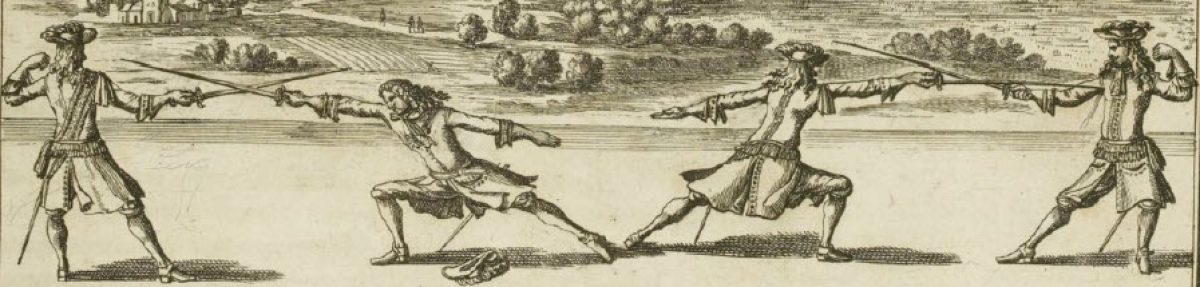
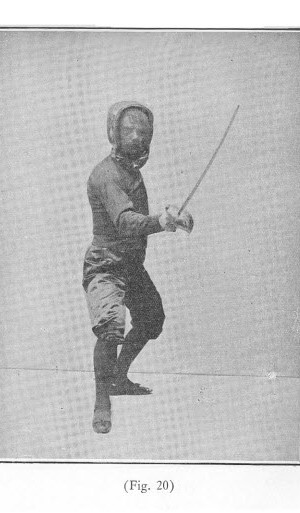
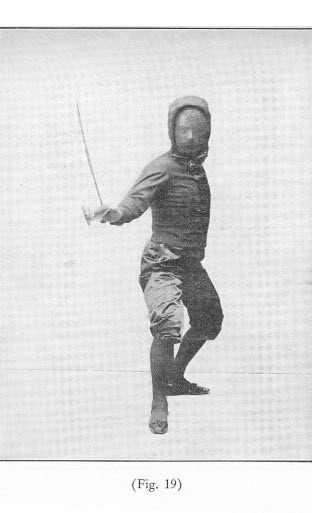
I started the day off in a rapier lesson with one of the students with whom I’ve worked longest. I have often said that teaching is a two-way street, that both instructor and student—ideally—learn, grow, and improve as they work together. During one drill, my friend stopped, said “question,” and we stopped to chat. “Is there a reason you’re taking such a big second?” It was an easy observation, but one I had not made—was I? Was I taking too large a parry? He then asked “what else are you working on right now?” and then it hit me. What followed was a lovely chat about the ways in which different weapon tracks can “leak” into one another, something that can be a benefit, but in good cosmic equilibrium, can also work against us.
In this case, it was the latter, and I was grateful for his observation and said so. Focused as I was on the lesson plan, and on making purposeful mistakes, I didn’t notice an unintentional one, another insight Ken shared with me. There are many instances in which the instructor makes mistakes on purpose—it’s critical for teaching a fencer what to look for, how to take advantage of such issues, and it’s all valuable, but it’s sometimes a difficult thing to switch off, which is to say that a lot of us find ourselves struggling not to be in teacher mode when we’re bouting to bout.
The Drill
Here, the danger was not only my own overblown parry of second, but also undermining an otherwise valuable drill. At Ken’s level, we work on a lot of tactical set-ups, on second intention, traps, and ways to conserve energy. For me to drop the ball in any one section breaks the drill, and, potentially—were Ken not so aware—upsets the student’s learning. The drill in question started with a classic, workaday action:
Student: feint thrust to hand from 2nd or 3rd Instructor: parries 4th Student: disengages to strike outside of the hand or arm
Next, we added a second exchange:
Student: feint thrust to hand from 2nd or 3rd Instructor: parries 4th Student: disengages to strike outside of the hand or arm Instructor: takes a half-step back, parries 2nd, thrusts with opposition Student: transitions from 2nd to 3rd to block, ripostes over the instructor’s weapon
In taking my parry of 2nd so vertically, I made it a lot easier to hit me, something someone on their game would be less likely to do. After Ken’s correction, my parry reverted back to what it should be in this case, shallower, point closer to him, and danger way more real should he not cover.
Whither yon Leak?
It didn’t take me long to figure out what was happening. What I was doing in the instant was not so much taking 2nd as it was dropping into what broadsword sources refer to as an “outside half-hanging” parry, that is, a block defending the same area as 2nd, but which has the blade hanging more vertically. The “outside hanging” parry defends the upper half well in the same way.
For some time now I’ve been spending more time on “Old Style” broadsword. Thomas Page is the major source I am using, and the nature of that style of fight, never mind the change in heft and balance with a baskethilt, enables one to drop the blade more to parry in an outside half-hanger because the axis of rotation is the wrist, and, it’s thus quick for a riposte.
In rapier, such a deep parry is to invite a counter-attack or fail to cover a line, and so while there are similarities between them, they work differently. With Ken’s help, I now can start to work on better compartmentalizing these weapons.
Stopping the Leak
Awareness is the first step. Thanks to Ken, I am aware of that issue, and best of all, will double-check everything else I am doing.
Next, I drill both weapons with specific attention to the techniques unique to them. It always comes down to drill, more and more drill. I will also be far more mindful now, which is never bad, and with work not only will I fix some of these issues, but better serve my students.
As a coach of other fencers, and thus responsible for raising them up, challenging them, helping them reach the next goal, correct technique, just like proper timing, distance, everything, is a must. As a coach to other coaches, there is also benefit—each pitfall I encounter is another lesson for my colleagues, especially those starting out and yet unaware of problem X or issue Y. We are never finished learning, and, so long as we retain a “beginner’s mind,” we will continue to grow and be better able to make corrections as we discover places that require them.
[I’m not a fan of “trigger-warnings,” but as most folks who read this page read it for fencing, this post has a fair amount of politics as they relate to sport, etc. Unless you’re up for reading a beat-down of right-wing idiocy, don’t read this]
This summer’s Olympics have witnessed considerable controversy, from artistic choices in the opening ceremonies to some truly strange debates over sex and gender. I won’t waste anyone’s time with my views on artistic expression, but I’d like to address the vitriol a few man-boys have made about female athletes, gender, and athletics. As a coach, as a human being, and especially as one who works with a diverse clientele, I have a responsibility to do right by them.
Predictably, the men whinging most are the least fit intellectually or physically to attack a world champion like Simone Biles or Imane Khelif. I have no idea what made them so intimidated by women, but regardless of cause there’s zero justification for it. These idiots make the rest of us look bad, and I resent that. Having been raised by a single-mother; having only a sister as sibling; having had mostly female teachers and bosses; and having been fortunate to marry a woman who deserves better than me, it’s possible that I’ve just been super lucky to see how empty any notion of female inability is. Whatever the reason, it’s important to show my colors, not just to reassure my students, but because one cannot sit on fence when it comes to bigotry.
I am not female and will not dare speak for women. [1] Women are perfectly capable and happy to put morons in their place, and I don’t wish to be lumped in with the morons (not any more than I might be already). With that caveat, I have some perspective on sex, gender, and sports, and think it is important to offer some real-life examples for the simple men who likely have not worked closely with women. Moreover, at the moment, most of my students are, or identify as, female. Most are young, between the ages of 11 and 15, so there is an added impetus to be a good role model and influence.
As a middle-aged, cis, white chap there is an important responsibility on me not to be part of the problem. It seems like common decency to me to support, advocate, and build-up my students, especially as there are so many men who look like me spouting horseshit. Often, these same clowns are vocal, loud, and quick to say things that can hurt regardless of the fact there is no truth to them.
Persistent Perils
I don’t follow the news much, because with treatment resistant depression the news does little to lift my mood, but I follow enough to know that athletics, across the board, continues to be plagued by horrors that should never happen anywhere. From coaches molesting their young charges, to sexual harassment of colleagues, to downright dismissal as serious competitors, women face a disproportionate amount of abuse. It’s utterly shameful.
We are making some progress, but we clearly have a long, long way yet to go. Organizations like Safe Sport have done much to increase awareness of the issues, and importantly, educate coaches about better, more professional and appropriate interactions. This, of course, won’t fix creeps, but it can reduce both unintended line-crossing and foster both better awareness and behavior.
Real change begins with us, each of us, in our homes, at work, with friends and family. Not to wax hippie, but we have to be the change we want to see. It won’t convince everyone, but it will convince someone.
Sex, Gender, and Fencing
Historical fencing falls under the general heading of “combat sports,” and traditionally such pursuits are a “male” arena. Despite historical precedent, science, and good sense, there are still men quick to say that while women might play sportsball, they have no business boxing, or wrestling, or using hand-to-hand weapons. Claptrap.
Absolutely women should be able to pursue these arts. There’s no reason why they shouldn’t. This is especially true where weapons are concerned.
The truth was summed up beautifully by Francesco Marcelli in 1686:
Vis enim vinictur Arte
“For strength is conquered by Art.” [2] The use of weapons changes whatever physical advantages one was born with—it does not level the field automatically, but it can, and, regardless of whatever one has in the way of genitalia. In many martial arts, size and strength play a greater role, and so weight-classes, age brackets, division by skill level, all characterize competition. This is sensible. A 5’ 9,” 140lb woman might be plenty strong and skilled, but in grappling arts she will be at a disadvantage against a man 6’ 5” and 350lbs. Put a weapon in her hand, though, the math changes.
Sad as it is to say, I remember when women were finally allowed to fence epee and sabre. It’s not that women didn’t dabble in these weapons, but that they could not compete. It was not until 1996 that we saw women’s epee in the Olympics. Women’s sabre did not appear in the Olympics until 2004! Up until then, the only weapon women were allowed to compete in was foil. It seems ludicrous now, and it should, but these changes only happened twenty to thirty years ago.
You are a Mask
Outside of severe physical or mental limitations, anyone can and should be allowed to fence, box, or wrestle. One advantage to fencing is that the addition of a weapon can—again can—mitigate size and strength differences.
In my classes, in my lessons, everyone is a MASK: their sex, gender, sexual orientation, all of that is largely irrelevant. Not unimportant, but in the context of what we do—fencing—irrelevant. Identity makes no difference. In the HBO series “Game of Thrones,” Aria’s sword-master, Syrio Forel, shares a similar view. When his new student remarks that she is a girl, he replies “Boy, girl… You are a sword. That is all.” [3] Though fiction, the author, George R. R. Martin, shares a truth most serious martial artists know–skill is skill.
For me, the acquisition of skill is challenging enough without adding additional hurdles—as a mask, one has only one task, one focus. In the salle/sala, the only concern is growth.
In truth, there are still some considerations; anatomy, for example, sometimes dictates decisions about safety-gear. Women with larger chests, for example, often struggle to find suitable protection. Most of the off-the-shelf stuff is one-size-fits-all, and I’m told uncomfortable to wear. There is a major opportunity for an enterprising person to devise better solutions for chest coverage.
Every body is different, regardless of sex or gender, and so my job as a coach is to help each person find a way to stand and move that takes into account their unique shape. If one’s hips are a little wider, fine, then try standing a bit more square versus in profile. Likewise, if one’s chest is broader, one may have to turn at the hips to make an inside parry. If one is recovering from injury, has balance issues, whatever, there are ways to make it work most of the time.
Mask & Culture
Happily, the culture I’ve worked hard to create has tended both to minimize problems in class and scare away people who don’t share the same values. Advertising one’s stance on key issues, as I do on this site (go to “About Us” and scroll all the way down), does much to send bigots packing. It’s rare, but on occasion I have had to reeducate young men who “didn’t want to fight a girl” or had something outdated to say about either the ability or suitability of women in combat sports.
As I’ve remarked here before, I’ve fought alongside female martial artists all my life. When my formal training began, so did my sister’s. In college I fought alongside female fencers. I know women in a variety of martial arts, from fencing to BJJ, and a lot of female coaches and club-heads. They are my colleagues, peers, and friends. Their identity as female, again, doesn’t weigh into things for me because what matters is their ability and outlook. If we share the same values and they’re good at their job, then great.
There is only one place where I feel I need to pay more attention to their identity—as an ally. This is true as colleague, coach, or student, in any role I assume. This is to say that men should advocate for their colleagues regardless of sex or gender, and, regardless of where that man is in a hierarchy.
At my age, I have seen a diverse range of behaviors towards women in sports, some great, some bad. Current politics in the United States has reached a point where it’s no longer enough merely to support—one must act. What one does may not be national or international in scale; it may be local. As an obscure coach in a small city next to miles of vineyards and hop-fields, I see firsthand, every day, the very same problems we see on a national scale. My focus, thus, is here, helping where I can, as I can. I do my best to model a better way for my students, and, I do my best to create an inclusive, safe atmosphere in which to learn.
I don’t talk about any of this much, because being an ally is something one does, and in a day where “virtue-signaling” is as ugly as a running mate plugging a book arguing that “progressives” are “subhuman,” I’d just rather not contribute to useless, ego-driven posturing. [4] Ideally, advocacy comes out in all that we say and do. I’m talking about it here because the comments about Ms. Khelif, the addition of a new student in my sabre class, and the observations one of my 12-year-old female fencers shared last Sunday highlight the importance of the issues. Each example highlights either the problem with attitudes toward women, as was the case with Khelif, or, gives the lie to ideas that women might be less skilled or knowledgable.
From the Mouth of Babes (NB: “babes” in the age sense)
To give the lie to the idea that women have no place in sports, I submit the following, recent examples. First, there is a 15-year-old female fencer who just started attending my Sunday sabre class. She has worked with me for several years via the parks and rec class, but she caught the bug—she loves this stuff, wants to do more, and is keen to improve. In consultation with her parents, I invited her, and them, to the class. [5] When I told the existing students we would have a new fencer, they were excited as it’s been a while since a new person started.
To my delight, they greeted her with open arms, and couldn’t wait to work with her. She soundly defeated the three boys who were there. I am not one to crow, but if I may, I was so proud of all of them. She acquitted herself super well, and was gracious in victory. For the boys—they were thrilled to meet so good an opponent. They complimented her fencing and told her that she would love fencing G., my longest attending student.
This past week, when he returned, everyone had trouble focusing on drills because of the anticipation of what all expected to be a high-level bout. My most experienced student found a serious challenge in the newcomer, and at the end extended his hand and complimented her. She is one of them now, as if she had always been, and for me if I have done nothing else right, I have at least created a safe, healthy culture for these kids however they might identify. They’re mutually supportive, humble, eager to learn, and enjoy a good challenge. If they don’t fence later in life, hopefully the environment in which they did fence, and the implicit lessons they’re learning, will stay with them.
As a second example, in an earlier class that day, the youth foil/smallsword class, one of my 13-year-olds wanted to talk about the Olympic fencing she had seen on tele. Her first question was why everyone was hopping about like rabbits and failing to extend the arm on the attack. I nearly cried with joy. We then discussed why what we do seems so different from what they’re seeing in Paris. Since the mid-1990s I have tried, largely in vain, to argue with other adults for the time-honored wisdom of extending the weapon first, and here was a room of young middle-schoolers who not only understand it, but also can call out the very same issues when they see footage of modern fencing bouts.
Sports, Identity, and a Healthy Society
Within that discussion, we discussed the issue of people gravitating to what is easy versus what is hard. In explaining why modern fencing allows silly things like not extending the arm we discussed how hard it can be to change large organizations, to change what people find comfortable, and what benefits those in control. Change, all change, begins with an individual. Working together we can do more. This rounded back to why we look at things the way we do in our club. I have always reminded them that what we do is super difficult and takes a long time to learn and do well. They know that one is never finished learning. Our way is harder, but richer.
There is a real-world parallel. Bigotry is generally born of ignorance and fear. It’s lazy, comfortable, easy. It takes zero strength or courage. It is harder to rid oneself of bigotry if one benefits from it. These are the reasons it is so entrenched in American culture, and, one reason many people are so afraid. It takes courage to face something or someone new. It takes courage, strength, an open mind, and a willingness to change one’s stance given new data. Much as I don’t want a bunch of bigots at my sala door, I would honor the chance to introduce them to people that terrify them and let them learn for themselves that regardless of gender, sex, race, or sexual orientation, they’re all just people.
“The Chevalier d’Eon,” by Thomas Stewart (1792), at the National Portrait Gallery, London
Traditionally, fencing is male dominated, and a “white” sport, but it hasn’t been that for a long time if ever. History recounts a number of female fencers, fencers of color, not to mention some pretty fluid gender identities. Whether we’re talking about one of my favorites, Julie d’Aubigny—better known as “La Maupin”(d. 1707), or the Chevalier Saint-Georges (d. 1799), who was of color, or the Chevalier d’Eon (d. 1810), who wore women’s clothing, fencing has never been exclusively male or white. More recent history indicates just how much it has all changed– Peter Westbrook, Ibtihaj Muhammad, and Sada Jacobson are just a few examples.
Joseph Bologne, Chevalier de Saint-Georges after William Ward, after Mather Brown reproduction of mezzotint, original published 1788, National Portrait Gallery, London
The Person in the Mask is a Person
Despite my being an old white dude, over the past few years more young women have enrolled in my classes as have many LGBTQIA+ fencers. Not all stay, but some do, and that is significant. There is no magic involved—retaining anyone comes down to one simple factor: how we treat them. Honor another human being as a human being, as a person. It has proved important for several reasons.
First, I have been told by several LGBTQIA+ fencers of the relief they have felt in knowing they are free to be themselves, and safe, at my school. Locally, the past few years have seen increased hostility towards any student that is not white and straight. The effort by alt-right school board members in my city, for example, to ban any symbol but the American flag was a clumsy attempt to ban both Pride and BLM flags. [6] I got involved with this as parent, educator, and coach, and like others ended up the blacklist of one alt-right supporter. No one shares a list like this on the internet to send one cake…
TWO of my students at the time were directly affected by this. One, who bravely spoke up during one of the virtual board meetings, told me his heart about sank when he saw me on screen, a wall of books and a giant American flag behind me—it’s our flag too, and, propaganda works both ways. He was relieved when he realized that I was sharing the same message of inclusion he did. Another student ended up moving when one of his parents, at the time involved in education, received death threats. I could not let these students down, I didn’t want to let any child down.
Second, I have no illusions or fantasies about my role. I’m a recreational coach in a small, rural city, and while I have had the great fortune to work outside it, even in other countries, what will matter most in the end is the impact I have here. Each generation, if it’s on its game, does what it can to help and prepare the one to follow. I want these kids to grow up and inhabit a world where we see less of the idiocy around sex, gender, and sexual orientation. It causes so many people so much pain, and for the lamest of reasons. We can do better, but only if we ourselves actually do better, and, give these kids a map for social interaction that emphasizes their common humanity. My hope is that what little I can do will help, at least enough so that when they leave the salle each week, they will carry some of the lessons with them they learned while in their masks.
NOTES:
[1] Someone like me can support, can advocate for, and stand with women, but as a male I have no business speaking for them. That has always been part of the problem–witness the idiocy of men determining national and state policy with regard to women’s reproductive issues and rights.
NB: in using the term “women” I mean those born so or who discover that they are. Each person has the task of determining what their identity is, and yes, in some cases it may change or defy easy definition. So what? Regardless of how they identify they’re a fellow human, and that is what matters.
[2] Francesco Antonio Marcelli, The Rule of Fencing, Book 2, Ch. 1, 55-56 in Holzman’s translation.
[3] Game of Thrones, HBO, “Lord Snow” S1: E3.
[4] The alt-right rejects data, evidence, and reason. Denying facts is not disagreement, but willful denial of fact. Everything comes down to their “values.” As an historian who spent a lot of time studying the early church, I especially challenge them on their persistent use of OT lawbooks rather than the NT commands of Christ. Lists of dos and don’ts are easy, convenient, and do not require one to think or choose. The second great commandment Jesus laid down was to love one’s neighbor as oneself. He didn’t include exceptions. Moreover, he expressly told people not to judge others. Somehow, though, judging others and choosing exclusion over love and understanding defines their “Christianity.” On a similar note, the cover of the book Vance touted features a hammer and sickle, a nod to rightwing fears of Commies. There are no commies. Both of them are keeping pretty quiet right now. What we do have, and what the DHS and FBI have released reports about, is the great danger we face from right-wing terrorists. But again, facts don’t matter to them.
[5] Complete transparency is an absolute must when working with minors. I encourage parents to stay for practices—it reassures them, often makes the kids more comfortable, and no one is better to help a child with an ill-fitting jacket or the like than one of their parents. If a lone child is waiting for a parent, we wait outside at the grange or in the public lobby if at The Aquatic Center. There should never, ever be any question as to one’s ethics. Working with children is a sacred trust and must be honored as such.
[6] The damage that the alt-right members of the school board did has been considerable. This was, of course, part of the plan—fascism thrives best where people are not educated in anything other than party dogma. Two articles should suffice to explain the issues:
Just this weekend, so 17 Aug., a LGBTQAI+ student informed me that my attitude is one reason she has stuck with my program. I honor her for who she is, and while I will fight to the death to protect her right to love whomever she might love, the fact of her orientation is, again, irrelevant in learning fencing.
In my sabre lesson this morning my student and I explored some options from the invitations in 3rd and in 4th. Like a feint, these actions (hopefully) encourage an opponent to attack where we want them to. Baseline, what we’re setting up is a parry-riposte. Against a newer, less experienced fencer, this might be enough, but a more advanced fencer will see the trap and have some idea where one might go with it. There are, happy to say, more options from this simple set-up than meet the eye.
Student’s Invitation in 4th
After the basic parry-riposte set up, a solid next step is an indirect riposte—this requires us to hold the parry before making the riposte. It is best used when our opponent is too quick to parry. For example, if we have made a few cuts to the head, even probing, or better yet from this same set up but slightly out of distance, an opponent might expect us to cut head and so they assume parry 5. If we see them do that once or twice, we can invite, parry, wait a sec, then as they preemptively parry head we strike in an open line. One of the safest strikes is to the lead arm, thrust or cut, as this keeps us back a bit and puts more steel between us and the opponent. One can, though, attack almost anywhere so long as one covers on recovering from the lunge.
Another option is a compound parry-riposte. This is closely related to the indirect riposte as it assumes similar conditions. Where the latter hesitates, the former feints. Following the example above, if one invites in 4th and parries 3rd as the opponent takes the bait, one then might feint head to cut arm, flank, or chest. The feint might be made to any line, but works best against a known proclivity. Here, again, some probing actions or false attacks can sometimes tell us which parries an opponent is quick to take.
These are all defensive responses set up via second intention. However, one question today was can one make a counter-attack from this set-up. Yes, and, no. At its root, invitations set up defensive responses, but this said there are ways to include a counter-offensive action given certain conditions. This part is critical. It is possible to make oppositions cuts into the attack from an invitation. These are similar to what we call “bearing” in Insular broadsword. Using the same example, from 4th, should your opponent attack a little out of distance or with a poorly extended arm—either one provides a bit more tempo to act—then from 4th one would but cut in such a way that one simultaneously closes the line as one lands. [1] From 3rd, one would cut across closing the inside line and landing at the same time (often this means striking the arm). It is not easy to set up as it requires the opponent to make specific mistakes, but if they do, this is a fun conclusion to the invitation.
Student Initiated Attack–Shutting Down the Trap
When we switched roles and I adopted the invitation, my student had a chance to explore ways to shut down the trap. Timing, speed, and choice of action all meet in a tight place when we succeed. Using the false-edge, for example, I did not expect, and it succeeded beautifully. Many fencers will be unprepared for that. It can made from farther away, again limiting the danger faced by the attacker.
The simplest option in springing the trap is to attack knowing they will parry-riposte, and then making one’s own counter parry-riposte. I didn’t want to complicate things, but in that counter parry-riposte one can do much the same as the person inviting: one can use an indirect riposte, compound parry-riposte, even an opposition parry and cut if conditions allow it. Naturally, one’s feet are critical in success. If, for example, my student lunged her attack, then I would take a step back to parry. If she recovered quickly, I would have to lunge to riposte; if not, I might do it from standing. Regardless, we need enough room–and thus time–to act.
Invitation in 3rd–Barbasetti (1899/1936)
We also discussed the difference between an obvious invitation, e.g. taking 4th, and an invitation disguised to look like either incompetence or inattention to the line. For the latter, one might invite in 4th barely exposing the outside line of the sword-arm. This can appear like a lazy or untutored guard. One can feign being tired and thus sell the lazy guard too. All about selling it, a major aspect of tradecraft. [2]
If we want to invite in similar fashion in 3rd, we might hold that guard a bit too far out exposing the inside of the wrist. Many of the same options we covered with an obvious invitation apply here too, but this style is more likely to work against a fencer farther along in their training.
When we switched roles, one effective and less risky attack she made was to thrust to the inside wrist when I adopted a lazy 3rd, allow me to parry, and then thrust with opposition (usually with an advance-lunge or redoublement). If I adopted a lazy 4th, she could feint to the outside, and when I parried in 3rd cut around and cut with opposition to the arm or chest, or, make a bandolier cut and step a little back and to the right. Getting good extension on the cut—which keeps one safer—means having enough distance to extend, thus moving more back and right versus in and right.
Tactical Application
This lesson was a mix of types–we covered technique, options, and tactics. Not every lesson need do this, and in fact many should not. Today I was working with an extremely gifted fencer, one with a deep foil background, and with whom I’ve been working sabre for several years. Even today, though, in the last drill she realized she was pulling her chest cut, so we stopped and spent the last ten minutes of our time just working on getting proper extension on her cuts.
The tactical considerations for using invitations should derive from whatever intel we’ve been able to gather about our opponent. Sometimes we have next to no time–we meet someone new in the ring or on the strip and have to triage our choices via testing, probing, and false attacks. Sometimes we have had a chance to watch them fence and see what they typically do, how they respond, and larger picture considerations–are they calm? Nervous? Excited? More defensive? Offensive?
Considerations of another fencer’s proclivities is vital, because no matter how sound or expertly an action might be, it might be the wrong one to use against that opponent or at that time. For example, if my favorite action were to invite in 4th, but my opponent is likewise a defensive fighter, then we’re as likely to run out the clock as anything else. Boring. If, however, I’ve made some assessments, have some idea of how they play, then I can pick actions which might work better. If they’re more defensive, then I’ll start with the more offensive options in the tool box.
This may seem obvious, and it is, but it’s easy to focus on something to our detriment. I know that more than once coming up I had learned a new, cool maneuver and couldn’t wait to try it out, but in my zeal tried it when there was next to no chance it would work. I have been extremely lucky to work with awesome coaches, and they would ask me, post bout, why I had tried it. They knew I was working on it, but had to remind me that not every action will work in every instance.
In terms of large, obvious invitations, they can work super well, but if they’re not–don’t use them against that opponent. Today, for example, my student is far faster than I am. Even playing the invitee role I struggled to parry some of her cuts; I know how to compensate for that, but even so had our lesson been a bout I would have realized quickly that obvious invitations were a super bad idea in fighting her.
Use the right tool for the job.
NOTES:
[1]Opposition Cuts: I do not spend a lot of time on them, but they do exist, even for systems that seemingly don’t include them. Where bearing doesn’t work well with a curved guard, it works super well with a basket-hilt’s flatter guard top.
Within a Radaellian context, opposition cuts normally mean making one’s molinelli in such a way that they simultaneously strike and close the line.
[2] Tradecraft: a universal of fighting, tradecraft refers to all the intelligence gathering and mind-games we play with an opponent. In addition, it is a game we play with officials too.
In addition to being one of my favorite works on sabre, Luigi Barbasetti’s The Art of the Sabre and the Épée (1899/1936) is a core text within the pedagogical system at Barbasetti Military Sabre (since 1895). Under the guidance of my friend and colleague, Maestro Michael Kňažko, I am steadily if slowly working towards further certification as a fencing instructor, and naturally much of the material we draw upon, and upon which I will be tested, consists of Barbasetti’s take on the Radaellian corpus. No matter how long I spend time with this text, I always find some new value in it, and/or come to understand something better than I did previously.
In another post I mentioned my long-standing dependence on Barbasetti, that it was the first book I read after leaving competition, and just how great the influence it has had in my approach to teaching. When I first started teaching on my own, which is to say without being ordered to by a master, I looked to Barbasetti and Del Frate for inspiration and lesson plans. My co-instructor at the time and I would sit down and pour over Barbasetti discussing lesson ideas, adaptation for new or more advanced students, and even now as I teach on my own this is a weekly practice.
In preparation for future examinations, but also because the book contains so much, I mine it weekly for drills, lesson plans, and exercises. This past week I decided to take my sabre students through a drill I had never had any of them do, a drill I have not used probably since 2016, namely, working from the invitation in 5th.
Invitation in Fifth
There is some fuzziness between the guard, invitation, and parry of 5th, and on first glance they may appear the same, but they are not. For the most part, 5th does not constitute a guard, least not one anyone typically uses—held above and out from the head, to hold it long would be tiresome and limit one to certain actions. Second and third are vastly superior guards. As a parry 5th is the stand-out, standard head parry, one of the first we learn. Though unusual, the invitation of 5th is valuable, and while seemingly too open to be realistic, this is a false conclusion. Moreover, the benefits for working out of 5th go beyond the tactical use of the invitation.
Here is, verbatim, the drill as Barbasetti laid it out:
In devising my sabre lesson this week this is the example with which I started. I changed a few things, added a few things, but this was the core of the drill. Post warm-up, the first thing I did was have the student invite in 5th. This meant that the student more or less assumed the parry of 5th. [2] I would attack, first with a thrust, then a cut, and the student would drop from the invitation of 5th to the parries of 2nd or 1st depending on where I was aiming. As two of the “first triangle” of parries, and working from the third, this is good foundational practice for covering those lines, and effecting good ripostes.
Next, we switched roles, so that the student made the attack. This portion of the drill was meant to help them work a simple feint. In 5th, everything below is open, and so there are myriad feints one might make. I had them start with a feint thrust from 2nd, and when I dropped to parry in second, the student made a molinello to the head. While this can be done from the lunge, I had them work this from advance-lunge range. This means that the preparatory action, the feint, was best made on the advance to force me to cover, and once I had, they could lunge with the actual attack. Since we spend so much time at this distance, it’s a good practice to put everything together in real time. From a stationary distance, we then moved back and forth and the student decided when to launch their attack, again, in an effort to resemble the conditions of a bout more closely.
The variation we added was a feint cut to the flank, which again I could cover in 2nd, and which allowed them a chance to cut to the top-inside of the arm or head. A critical aspect of this version is coverage after the attack. Increasingly I have added in counter-measures to prevent being hit by suicidal fencers. The fetish for the “after-blow” and the practice of doubling when one is ahead in competition, while insipid nonetheless provide an opportunity to pay better attention to the dictum “don’t be hit.” Ever. In this case, a student might cut to the head, then cover in 4th as they recover out of the lunge.
Next, the student feinted with a thrust or cut to the inside line to draw me into parrying in 1st. This version allowed the student to work on cut-overs, either with a thrust in 2nd and with opposition, or, a rising cut to the flank or bottom of the arm. To extricate themselves and avoid an after-blow, etc., a slight step left as they thrust with opposition or cut via molinello, moves them a bit offline, but also allows them a tempo to drop into 2nd or 5th depending on what response I give them.
Drills like this afford instructor and student a lot of options. They not only exercise fundamental actions, but also provide opportunities to work on getting to target and back out again safely. If a student is newer or struggling with the first action, one can stay there and work solely on that. If it is easy and they can perform the action with ease, one can build from there. Moreover, there are ways to make the lesson an exploration of tactical options, both offensively and defensively.
Often, and we see it in this case, the details provided in the drill are minimal, so the onus is on the instructor to know every aspect of each action, each idea, and how they can be combined and applied. As a final note, a drill such as this one provides a template for similar lessons, but in other weapons. My theme this week in smallsword was different—we worked almost exclusively on getting to target and back out safely—but looking over my notes I see that the actions I chose to drill all that were essentially the same actions I used in the sabre lessons, only with modification for the requirements of smallsword.
NOTES:
[1] Luigi Barbasetti, The Art of the Sabre and the Épée, New York, NY: E.P. Dutton & Co., Inc., 1936, 69. This is the fifth example in his section on feints with the cutting edge.
[2] In 3rd, for example, the invitation could be just being in guard, or, taking a poor 3rd, say leaving the inner or outer arm just barely exposed, the idea being to project a sense that one is careless and doesn’t know they’re open. One can merely take the parry position in 5th.
“Cela est bien dit, répondit Candide, mais il faut cultiver notre Jardin.” Candide, Voltaire (1759)
Unlike most posts here this one, while it deals with some aspects of historical fencing, likely will say far more about me than anything sword-related [readers keen for the former can stop reading here]. We each of us have our karmic burdens, our boulders to push uphill over and over again, and so long as we don’t go completely mad or become crushed by those boulders, so long as we take a look around us, chances are good we may learn something. If nothing else perhaps we build resilience and in a chaotic, irrational, and unerringly unfair world, that counts for something. Not to admit defeat, at times, is the best middle-finger one can extend to that chaos.
In my case, and returning to karmic burdens, I seem to require relearning certain lessons repeatedly. Perhaps I’m uncommonly thick-headed (jury is mostly still out on that) or perhaps I was born under an unlucky star, but regardless the one lesson I’ll be highlighting here concerns assumptions about how people think. Fair to say, I’m a walking poster-child for all manner of mistakes, but this one, because it might conceivably help a reader, seemed appropriate to share. It’s also an issue I run into all the time in the historical fencing community: I assume reason; I assume evidence matters; I assume people look to these even when first experiencing something emotionally, but by and large they do not. I always fail to realize most people work off emotion with little to no rational reflection. [n]
When we lack or fail to use more rational introspection, we can come to the wrong conclusions. That can be especially dire if the conclusions are about another person’s intentions, because we may blame them or attribute motives to them that are not there. There are many explanations as to why this happens, and while interesting to analyze, the why is less important than developing ways not to make the mistake. Our operating assumptions, viewpoint, and experience can be at complete variance, and we need to be aware of this fact. Sometimes we may look at the exact same thing, but we come away with different conclusions, and the more we realize that this might be in play, the more likely we are to find happier solutions.
It may be my age or life-experience (it’s no doubt both), but it’s clear to me that often I’m not, to quote Inigo Montoya, “using the same wind they are using.” I run into this time and time again, and because I value reason, analysis, etc., and because life has not allowed me much opportunity if any to assume I’m always correct, I look at this and think that the one common denominator is me. Somehow, I must be doing something wrong, or expressing things in a less ideal way, something. Often that is true, but, just as often the problem isn’t me.
When we find ourselves in any disagreement or confrontation, it’s healthy to ask what our responsibility is and what we may have contributed to the problem. Emotion is not our friend in this instance—depending on one’s emotional make-up and experience, guilt, fear, anger, all manner of unhelpful emotions, often unrelated to the event at had but the awful gifts of past trauma, infect the current problem. So, we have to think, analyze evidence, and as much as possible work from facts. It’s not that emotion is wrong or bad, it just is, but if we act on emotion alone we get into trouble. Sometimes a lot of trouble.
One thing I try to remember is that very few things in life are about us. The me-o-centric universe that so often seems to shape behavior today, while common in the age of the selfie and instatwitterbook, is a deviation from normal. Put another way, not everything is about you. In the example that spawned this post I realized pretty quickly that while directed at me, the issue was not about me at all, but another’s own doubts and sense of self. That is liberating for me, and that’s nice, but out of concern for the other party I felt compelled to respond to their message.
Even when insulted, angry, or hurt, some pause, some time to allow ourselves to feel something, and then time spent thinking about it, applying the tools of reason, is vital. Analysis makes emotion take a back seat. Analysis clears the way for us to be more compassionate, odd as that may sound, and in most human interactions if not all compassion is a far better response than any other. What I know, just from my own collection of personal hells, is that very very few people know I have them, and so, I suspect that everyone else does too.
When I received that recent complaint, one I felt was unjust, I was angry—it’s an extremely short trip as I am baseline angry all the time and have been since I was eleven. I also knew that responding in anger would do nothing, in fact, it might make things worse. I let that wash over me, just as one might a wave too large to surf, and thought about it—why did they send this? What is it that they’re upset about, and what if anything does it have to do with me? Do I own any part of it? What steps make the most sense to improve if not solve this?
When I responded, it was after sober reflection, well after the immediate emotional response, and I did my best to be polite and fair. This person felt hurt whether I believed they should or not, and so it made sense to tread lightly, to be compassionate. This doesn’t mean I didn’t explain things from my perspective—I’m not good at taking things on the chin—but my hope was that what I shared might help them reevaluate their own perspective and maybe reexamine their own assumptions. I have no idea how they responded, as they didn’t reply, but I hope that they realize that some of their fears were without foundation, and, that I in no way had it in for them. I have monsters enough to fight without trying to creating enemies.
The Point: the reason I am sharing this extremely personal, embarrassing, and uncomfortable stuff is because the approach so closely matches the decision making in fighting, in fencing, and especially in a competitive space. Emotion is not our friend in fighting—it will steer us wrong. Good fencers spend years learning to think versus feel, as do most martial artists, and there is a good reason, one beyond the benefits in fighting. It is practice for life. If one spends hours and hours a week actively choosing to think rather than react emotionally; if one works at keeping a cool head; if one does one’s level best to see each opponent as a teacher, a learning opportunity, as an equal, a partner; if one approaches a fight of any kind with understanding and compassion; then one is more likely to use the same approaches and point of view in other aspects of life. Make no mistake—it takes considerable strength to wield understanding and compassion in a disagreement; it’s far harder than anger. Anger is easy.
As a caveat, I am not saying don’t feel things or that one should stifle emotion, not at all. FEEL what you feel, give yourself space to feel whatever it is as powerfully as you must, for as long as you need, but then set it aside. We feel all kinds of things, and no matter how real, legitimate, or illegitimate, one should always think before one acts. It’s a cycle, because we will (hopefully) always feel things, but rarely is it wise to act on feeling alone, this is as true in fighting as it is in romance, as true at family dinners as in one’s workplace.
Fencing, I know, rarely applies the same life lessons that one more commonly finds in East Asian martial arts, but it’s there. The Art is one. It belongs to all people, all nations, and no matter what it is, Muy Thai, fencing, boxing, BJJ, Tai Chi, you name it, one can find meaning in the study of the Art beyond the piste or ring. There is something to be said for a path that helps reduce the pain of existence, ours, but maybe that of those around us too. We are better able to, as Candide recommended, tend our garden. One thing Voltaire left out, that I’d like to add is that our gardens invariably lie adjacent to those of many others, and so part of tending our garden is being mindful of those next to us, that even those in gardens far away, face the same struggles, the same challenges, and thus deserve some empathy.
Manitoba Highland Gathering Tournament, East Selkirk, Manitoba, Canada, 22-23 June 2024
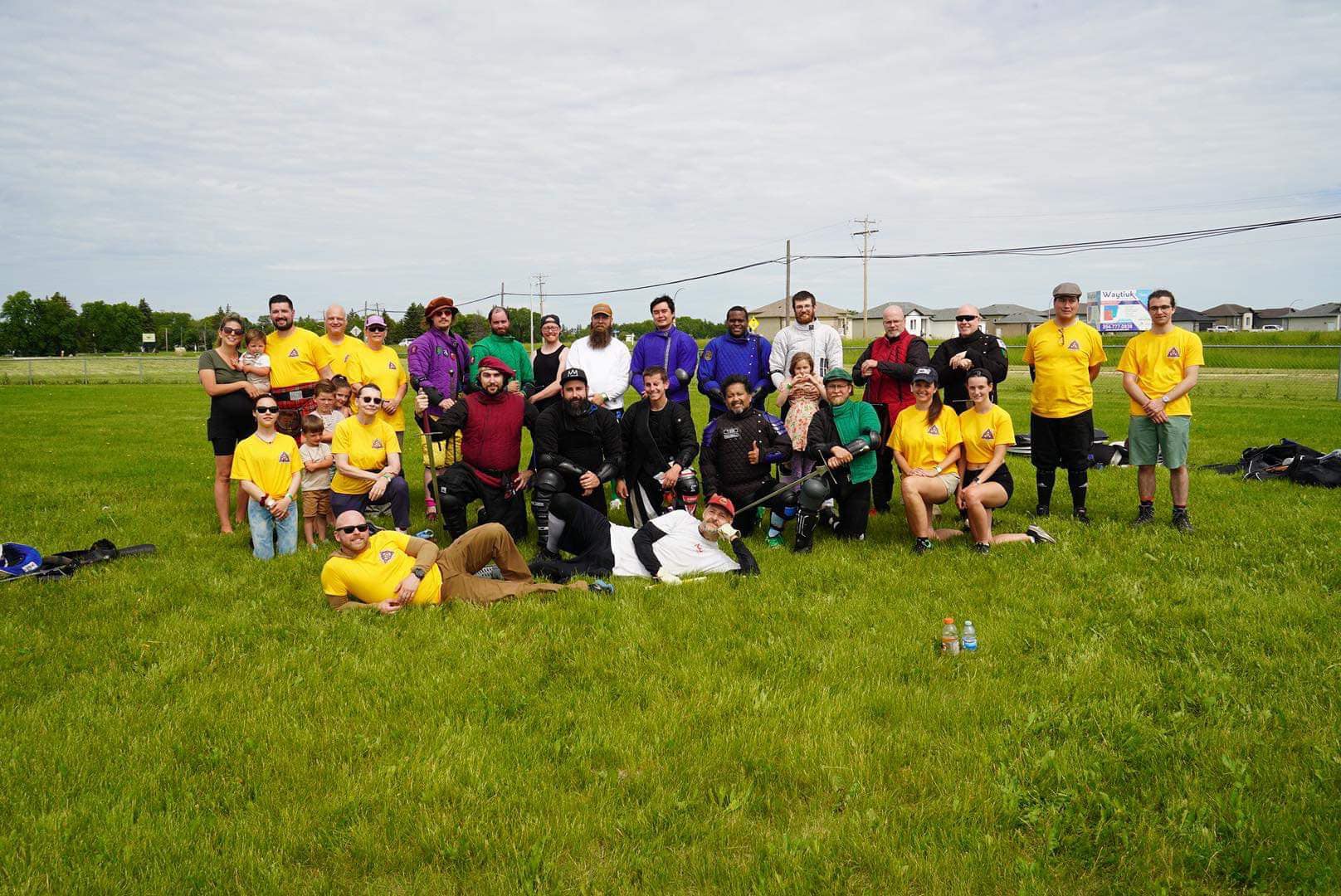
This past weekend, I had the great privilege to attend and assist my Storica Defensa colleagues in the various tourney pools at the Manitoba Highland Gathering in East Selkirk, Canada (held June 22nd and 23rd). This two-day event included longsword, veteran’s sabre, broadsword, and women’s smallsword. Despite some truly warm weather, some swampy fields, and a few moves between gyms, everything went amazingly well. The MHG Tournament marks the seventh SD event and serves to add another data point in support for the approach we are taking to competition.
In terms of safety, no one was hurt. Not one. To date, there have only been two minor injuries in SD events, both involving a failure in gloves to protect forefingers. This is more a kit issue than one of safety culture, and no such injuries occurred last weekend. We place heavy emphasis on safety and no hard-hitting is permitted. So far as I know, not one judge had to remind anyone about force levels. Club members, especially Eric Elloway, army veteran and first-aid certified, brought a giant cooler of water and officials pushed hydration hard. In fact, my friend Xian Niles noticed I was starting to stare off and had me get water, then go sit in the shade (thank you my friend, that was a wise decision). Best of all, the fencers looked out for one another—on two occasions I witnessed, fencers halted action so their opponents could fix gear.
Very Serious Fencing…
The camaraderie was visible and honestly endearing. Most bouts ended in hugs as well as handshakes, and people were keen to keep fencing post event. This is not to say that the competition wasn’t high, because it was as any clip of footage will demonstrate. The hush that fell upon us all watching some of those final matches… I don’t think anyone made a peep during the final broadsword match between Xian Niles (Niles’ Fencing Academy, Halifax, Nova Scotia, Canada: https://www.nilesfencingacademy.com/) and Zach Brown (Superior HEMA, Thunder Bay, Ontario, Canada: https://www.superiorhema.com/?fbclid=IwZXh0bgNhZW0CMTAAAR0noPMDPX7PaM8kxh8SpQdf-e15Ie53xzsJucV58BZno1pycKsN_r25q9I_aem_yB6MUK3J6OWM7jK68jGjaQ). People were quick to concede points and generally did so appropriately, and were gracious when calls didn’t go their way. If anyone needed gear, another fencer was happy to help. Rarely have I seen so many competitors as generous in assistance to one another as I have here.
The level of skill was high. The pools were designed around Storica Defensa competitive levels as much as possible. Most action was easy to follow, and thus, easy to judge (comparatively speaking—judging is never easy). The timbre of an event, the expectations that are set, do much to determine how an event goes. SD’s rules and expectations are clear in the ruleset, and so from the off everyone was more or less on the same page. In specific terms this means that people knew any hard-hitting would be called out, that fencers were honor bound to admit a hit, and that there would be zero tolerance for poor behavior. We also hit the safety aspect hard. I mean, HARD. To put this another way, these expectations attract a particular type of fencer, and in doing so, discourage those fighters keen for garbage like heavy-hitting, use of the afterblow to gain points, and other b.s. Free-fencing post pools was common, and speaks again to the level of positive interaction—people wanted to keep fencing one another.
Eric Elloway with a beautiful running attack in the vets’ sabre event
Organization is critical to running a good tournament, and it is a testament to the planning Jay and crew had that even with a few hick-ups everything went smoothly. Day one was super hot, not a cloud in the sky, and in the morning the ground was a bit damp; day two we had to switch gyms. In each case everyone just got to work and made things happen. We carried tables, gear, scoring placards, everything, and neither day went late. In fact, on both days we ended in time for people to free fence for hours before the Gathering shut down for the night.
SUMMARY:
The MHG Tournament is growing, and in time I suspect will double in size. It’s not just the fact that winners in each event received lovely prizes—sharps, training weapons, and discounts for gear—but that people were safe, enjoyed the fights, and were eager to socialize afterwards. This event is one I am adding to my list of go-to, must-attend events (the others being SabreSlash in Prague, Rose & Thorns Historical Fencing Symposium, and the St. George’s Day Exhibition of Arms).
Following fast on the heels of another two-day tournament I attended, this time as a live-stream announcer, the contrasts stood out starkly. That first event was large, and in most respects typical of “HEMA” events. [n] For example, I witnessed a fencer injure another—twice. The offender was barely censured, but should have been black-carded, and the victim, though evaluated by a medic, was not taken to the hospital. He should have been as he received a pommel-strike, full on, from a running opponent, and was visibly shaken, never mind nursing a mask-waffle print on his nose. The judging was also poor. The silver medalist in rapier, for example, should have taken gold, but the judges failed to call the action correctly. Many, I found out later, were pretty new fencers.
One of Storica Defensa’s goals is to provide better tournaments, not only safer ones, but better run, better judged ones. In this it is exceeding expectation, and I’m keen to see this develop. True, I have a stake in it as a coach for SD, but I stand by what we’re doing. It’s working.
Drills are cornerstone of fencing education, and rightly so, but are also prone to certain problems. If left unattended, these issues can undermine the benefits of the drill. Typically, drills are something that one does, not something one talks about—this is as true of coaches as it is fencing students. We do not dwell on them, analyze them, examine them objectively as we often should—we learn them in good faith, we usually benefit, and so assume it all goes to plan. For the most part, proper and effective corrections allowing, this is true. However, it is not automatic.
Some time ago I wrote a short piece on the problem of artificiality in drills and whether or not some standard drills are “realistic” in the don’t-get-hit sense [https://saladellatrespade.com/2019/06/05/fencing-drills-and-artificiality/]. Here, I should like to discuss the issue of anticipation, specifically how students, facing a known and repeated sequence, often act preemptively. Usually this means that they make their action too soon and nullify the point of the drill. An example will help illustrate this.
Drill: Circular Parries in 4th
Coach: attacks with thrust to inside line
Student: takes 4th to parry
Coach: makes a derobement to continue the attack
Student: circles around to retake 4th, parries, and ripostes
In this setup, one we might use with many different weapons, the two most likely places a student might act too soon are with the initial parry and with the second, circular parry. Of the two, it is the second, the circular parry, where this tends to happen more.
Ideally, parries are responses to a specific, concrete stimulus, the attack. It is a reaction. When we know where a blow is coming, as we do in a drill, it is easy to act on what we know will happen instead of what we actually see. A good coach will see this and correct it, especially if the student is not brand new. With newer, beginning students, we often pick one egregious fault to focus on, and tackle other issues in time. We might point out that the front foot is not aligned, or that they’re not extending first before lunging, but we do not provide a litany of woes each lesson as it is not helpful, but demoralizing.
However, with a student ready to make circular parries, as in the example covered here, we would be right to correct any anticipatory, not-reactive action. How we do this is as important as doing it. The first step is noticing it, which any coach should straight away. The second step is pointing out to the student, plainly and kindly. Some students will recognize it themselves and correct, others will when corrected, and still others may not see it or be unable, for whatever reason, to correct.
For those students who struggle, there are things we can do to help them help themselves. The first, and easiest thing to do, is to expose the anticipatory action—in the example here, the coach would attack, but not disengage. To expose the preemptory second parry, all the coach need do is slow down the speed of the attack. If the student is making the circular action too early, they will bump into the incoming steel. This is a good moment to point out the issue as the student will see, in real time, why acting too early defeats the purpose.
The coach might also change the measure, perhaps step farther in on the initial attack—while not wise from a tactical point of view, from a teaching point of view it will first reveal if the student isn’t maintaining good distance, and second will likewise lead them to encounter the coach’s weapon if the student parries too soon. Here as before one would then point out the mistake, have the student reset, and try again. If the student begins to keep distance and wait for the disengage, then the coach should revert to more appropriate speed and measure. [1]
There are times that students rush because they’re uncomfortable and perhaps not ready to make an action. That is okay. It is not always easy to tell, so a good approach is to simplify the drill. Again following the example above, start by having them work only on the initial parry 4; changes in measure and speed will help the student perfect the action and test their ability to adapt. Once they’re comfortable with this simpler action, one can try the more advanced version again.
It may help to bridge the gap between simple parry and the addition of a circular parry by having them drill the circular movement in isolation too. One way to do this is by playing “keep away” with the weapon. Coach and student, or two partnered students, take turns chasing the other’s blade—one has an extended line, the attacker; the other a bent arm on defense. When the attacker attempts to make contact/engage the blade, the other disengages and/or circles around to avoid the engagement. Next, the defender attempts to engage the attacker’s blade in the same ways, and the attacker attempts to avoid in turn. Exercises like this help one learn and perfect the motor movements necessary to disengage and perform derobements, but also are predicated on reacting to real-time stimuli—one can only avoid if one avoids the steel at the right time.
In sum, if one finds a student preemptively acting in a drill, slow the stimulus down, change up the measure and speed if necessary, and should it prove useful stop and return to simpler material. There is nothing wrong with the basics—in the end, we use those most, and the best fencing is normally a result of simple actions executed at a high level of skill.
NOTES:
[1] In option lessons, this is normal, that is that the coach normally varies things in order to hone the student’s ability. We start with an action the student knows, and then introduce it in increasingly more difficult tactical set-ups.
I have the deep honor to announce that I have officially joined the ranks of our sister school, Barbasetti Military Sabre (since 1895), based in Prague, Czechia. Though already close to the school, and counting Maestro Michael Knazko a dear friend, I’ve been keen to strengthen ties and build bridges, and this seemed an important, logical next step.
Moreover, it is a fantastic way to continue learning, as the maestri there are talented, experienced, and excellent ambassadors of the Art.
Today my friend and colleage, Jay, shared a video response to a concern several fencers aired on a fb page, namely, the problem with cultish programs. This is a real fear and justifiable given the fact that we do see groups who take advantage of members. It’s a shame, but it does happen. That could take many forms–perhaps students are charged for every little thing or to advance; perhaps they are expected to show absolute loyalty to some charismatic leader; perhaps they’re told not to fence with others because everyone but their own club is dangerous, or unskilled, or what have you. These are all red flags.
It’s important to me, and to Jay, because we work within an organization, Storica Defensa, that has already spooked a few people. There are, largely, personal reasons and/or prejudices that explain that, but some of those voices are loud and so we have done our best, all of us, to be as transparent as possible. There is no hidden knowledge we promise to “initiates,” there is no fee to advance, and each of the coaches is not only willing, but eager to demonstrate to potential SD fencers their qualifications. It’s only right we do so.
Moreover, we have been quick to state what we are not. None of us claim to be masters. We are not claiming any lineage, training, or certification we have not earned and/or which we cannot prove. We want everyone to know what they’re getting, and, why Xian and Jay created SD in the first place. Jay says it better than I can (see link below), but SD’s ranks do two things:
provide a set of goals, by skill-set, for students to help them improve [this also helps place them with people of similar skill level in events]
provide coaches with tools to teach more effectively
That’s it. As I often remind my own students, I didn’t invent any of the things I teach, but transmit what I learned to them. Sure, there are things I’ve added, tweaks here or there or suggestions, but these I always call out as such. None of us will be claiming to have invented the lunge… The why? is easily explained: historical fencing lacks these two things and desperately needs them.
It was a pleasure not only to share more Radaellian sabre fun with people, but also to be a student again at this year’s St. George’s Day Exhibition of Arms at the gorgeous Chateau South in Atlanta, Texas. This event, created and orchestrated by one of my favorite people, the redoubtable Russ Mitchell, with help from the lovely people at Winged Sabre Historical Fencing (based in Dallas), is part class, part graduate seminar, and all brilliantly enjoyable. A little over a year ago I wrote up a short piece on this event in which I called this weekend of classes, discussion, and bouting a bar raiser. [1] It was, and, it is. In fact, in year two Russ and friends have placed that bar at least a few feet higher.
There are many tells beyond my high opinion of the event, and to be fair, they are likely better gauges than whatever I might think; after all, Russ is a researching fencer and thus I may be slightly biased in his favor. He is a wonderful human in addition to his vast knowledge of fencing, history, and how the two mix, but again, I acknowledge the potential bias. In light of that, I offer the growth of the Exhibition—we had more people this year; the variety of classes—we had everything from 18th cen. Broadsword to Georgian sword and buckler to a deep dive into the various types of molinelli/moulinets one can make; and, the diversity of the crowd, already solid, expanded—to name one example, this was the first time—ever—I had a chance to cross swords with someone using Meyer’s system for single-handed cutting weapons. In sum, word of this special weekend clearly reached deep into corners of the historical fencing map this past year, and hopefully will continue to do so this year as word spreads.
The St. George’s Day Exhibition of Arms is one of the three events I point to for how we should be doing things. This is not to say that there are not other important events, only that of the many I have attended these three stick out. They are exemplars, models, paths to follow, with one caveat and a potentially contentious one—one must know what one is doing, or, know whom to invite in the case one does not. SabreSlash in Prague, The Exhibition, and Rose & Thorns all share common themes and ingredients. They are run by knowledgeable people, both in their own right and in whom they seek out to teach. Each of these events is run well and offers the attendee better cuisine than the average tournament of weekend seminar. The level of ability, of skill, not to mention knowledge, is high. Not above average—HIGH. This is true not only in terms of know-how, but in terms of execution. One test of this for me is how beginners are treated and what they take away from these events.
Come one, Come all
Among the new folks this year were also newer fencers. One of the things I watched closely was the degree to which beginners understood what the instructors were teaching and how more experienced fencers treated them. Full disclosure I was not worried much about this knowing what I know about Russ and his people, but all the same given the different backgrounds each had even the best designed event and intentions of the organizers can fail. One would have to ask those beginners, but from what I saw not only were newer people brought into the fold, but accommodated seemingly without effort. The first is less surprising—outside a few bad apples, most historical fencers are welcoming and just happy to find yet more sword nerds with whom to play. As Alex Spreier, who taught a fantastic course on the broadsword system of Zach Wylde said to one new person, who was a bit shocked at the open invitation to join us in the PNW (where we tend to house people to save them money), “Of course! You’re sword family!” This was beautiful and proper and makes me love Alex that much more, but more impressive were the ways in which Alex, Kat, Mike, and Russ arranged their classes to meet the needs of students of any level. This can be extremely difficult to do.
The Classes
Alex working Wylde with Jake
Kat’s class on footwork, a topic easily made way too challenging, was disarmingly unintimidating. Her explanations were simple, but dead-on to what was most important, and everything we explored one did at one’s own pace. She was there to answer questions, and at each turn exuded a “you can do this” demeanor that just made one want to try harder. In like vein, Russ’ class on the molinelli/moulinets was a textbook model for how to cover a complex topic effectively and in ways useful to beginner and experienced fencer alike. Starting with the shoulder alone and working our way slowly to using wrist and fingers, Russ enabled everyone to see the variety of methods used in various systems, but also foreshadowed and for-armed everyone for what they would need for each subsequent class. Mike Cherba’s class on Georgian sword and buckler is one I have attended, even assisted with, numerous times, but hands down this was his best iteration of it. He made converts. It’s dynamic, different, interesting, and so damn fun it’s hard not to fall in love with khmali and pari. The standout heretic—to use his own words—was Alex Spreier’s presentation of Zachary Wylde’s broadsword system. This early 18th century method tends to be snubbed by fencers better acquainted with salle fencing—Wylde’s English is not posh, and his system is bare-bones self-defense. It is also brutally effective (as it should be). Alex also made converts. I offered a close look at Radaellian molinelli and how one might use them via one tactical set up. This introduced a laboratory experiment taking that Radaellian version and seeing how it might apply, change, work, or not work in the Hussar system Russ teaches. [2]
Discussion at meals, over the oceans of coffee consumed, and in between classes was jovial, curious, and informative. It is often said that we learn more at these events after classes in small discussions, and that is likely true. Between the two there was a rich banquet of knowledge to digest. One of my favorite such moments was sitting by the atrium pool listening to Russ’ quick summary of the history of Hungarian fencing (yes, I took notes and yes some of these gems will find their way onto this page, guaranteed). Related to the last, several of Russ’ students were preparing to be examined as peers on the final day. Being the responsible man he is, Russ has avoided the pitfalls of ranking systems that often undermine the goal of such systems—to become a peer means demonstrating an ability to carry on the tradition should, as he put it, Russ been unable to do so himself. [3] Proof of stewardship is provided via an oral examination and in bouting, and if applicable, teaching. I am honored to announce that both Kat Laurange, whom I deeply respect, and Coleman Franchek, whom I just met but took an immediate liking to, both passed and are now instructors within the system.
OF NOTE: Russ, an expert in the Feldenkrais Method, once again and free of charge, helped me with a gimpy hip and the equally wonky wrist he helped me supinate when he was last in Portland–thank you Russ! If you’re in the DFW area, and need help with any movement challenges, see Russ [4]
Russ Feldenkraisening my wonky wrist; Coleman in mirror
FIGHT!
I have two favorite forms of public bouting. Accolade tournaments and exhibition bouts, and to be honest, of the two the latter appeals to me more and more. An “exhibition of arms,” as the name suggests, is a chance to highlight, to celebrate the particular approach to a weapon or system as a master or school envisioned it. The goal is not to win, though that’s nice, but to exemplify as best as possible what makes that tradition unique, distinct from others. There are a number of reasons this is important and useful, but it’s also just plain fun to watch. It says a lot that we kept score mainly just to ensure everyone had a turn to bout everyone else, and it perhaps says that much more than many of us had trouble even doing that. Russ at one point asked his student Jake, currently bouting with me, what the score was and neither of us had remembered to! So, we said “two to two” and kept playing.
We started with bouts between the instructors, one of my favorite things to do, and then each instructor did their best to fight everyone. I mean everyone. It can be exhausting, especially if like me one hasn’t been bouting qua bouting so much as engaging in teaching bouts, but it’s worth the exhaustion. It was a pleasure to cross swords with Russ who is as skilled as he is gracious; these traits are also shared by his students, old and new, and they are seriously challenging opponents. I won’t lie—they are among my favorite people to fight because it is always difficult and always super fun. Last year, Kat trounced me beautifully, and she did so again this year only differently—never saw that long, deep thrust coming since I was so concerned about my wrists lol. Kat is one of those fencers you should fence as often as you can and at any opportunity—she will make you a better fencer. Fighting Russ, Kat, Kevin, Jake, Jacob, Austin 1 and Austin 2, all of the Hussar fencers, was one of the reasons I made the trip. Quentin Armstrong, whom I just met, came to the event from Louisiana and offered me my first bout against someone who really understands Joachim Meyer’s sword in one hand. I am seriously hoping to do that again soon. I didn’t have a chance to fight everyone, so owe the first dance to Ellie and then next to Trevor, but I look forward to that eagerly,
Gratitude
I would like to thank Russ and the fine folk of Winged Sabre Historical Fencing, including not only his students but wonderful partner in life, Anna, for the invite and for taking such good care of us. Kat Laurange waited patiently for me at the airport despite a serious delay, and then graciously gave me a place to stay until we left the next morning (thanks Kat and Scott!). Russ and Anna gave me a lift to the venue and arranged for instructor rooms at the Chateau. Thank you Raoul for such generous use of this beautiful site (https://www.chateau-south.com/)!
Thank you to all the fencers who attended my class, chatted, and worked with me this weekend. I was and remain honored to have taught at The Exhibition and in such good company.
As a final note, before I left for Texas a friend of mine, a life-long martial artist, asked me if this was a paying gig. Having run a do-jang for years he knows how things work. Not being involved in historical fencing, I had to explain to him that for the most part renumeration is not standard, partly because we all do this because we love it, and partly because few programs can afford to cover travel, room and board, and food—most clubs are struggling to acquire the most basic, economically sourced gear that won’t break or fail. Then I told him, that in the case of The Exhibition, this is the sort of event one happily pays to attend. It’s the kind of event one saves money all year to attend. So dedicated are some attendees that they camp on site in tents, despite humidity, bugs, and new this year—tornado warnings! This is important and worth consideration.
[3] As a note on this, Storica Defensa’s ranking system is not a “belt system” either, but a way a) to categorize competitors by skill level, and b) a way to classify levels of coaching.