An old friend and fencing comrade, the excellent Jon Brammer, pointed out that I had mentioned but not followed up upon the master of arm’s examination I took in Prague. Apologies.
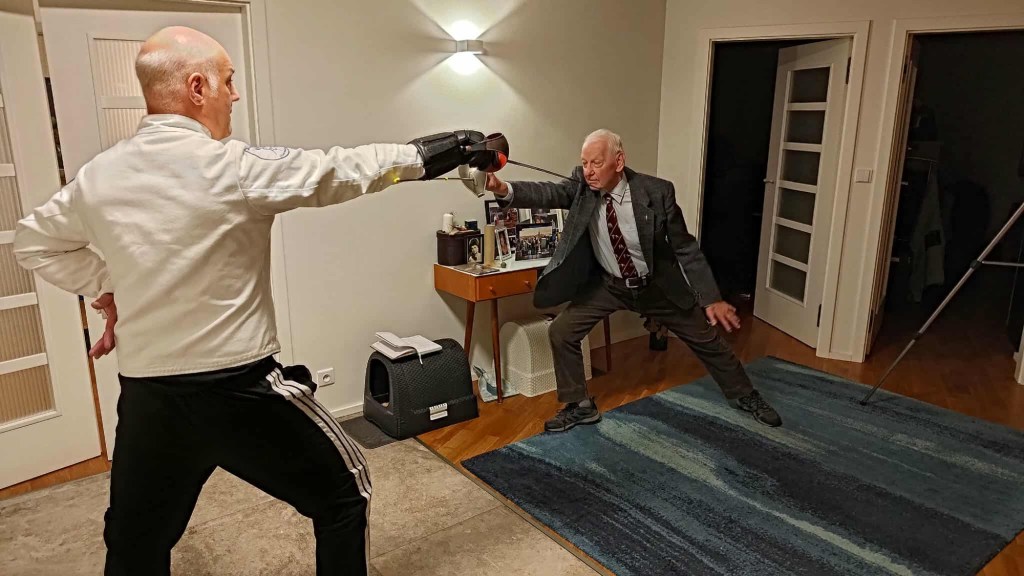
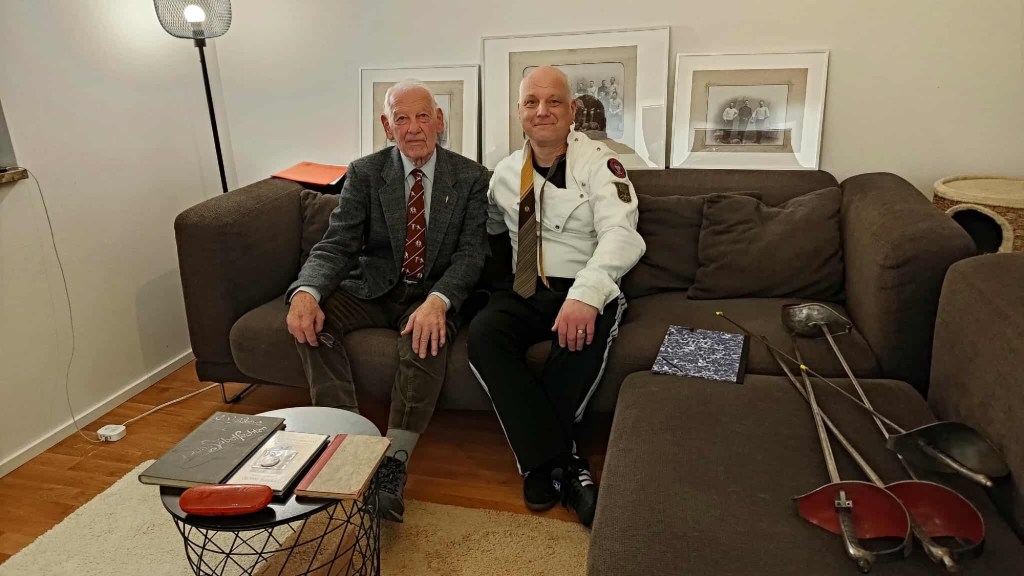
While happy to write about fencing, I find it difficult to write about myself, so I’ll be brief and say that I passed and share some photos.
When I left Olympic fencing competition, the first source I found, and have used ever since, was my uni’s copy of Luigi Barbasetti’s The Art of the Sabre and Epee. I still use the photocopy I made as my working copy for lesson planning, study, etc., and save the original English (1936), German (1899), and French (1931) for checking translation matters and enjoyment. Though I’ve not been asked often, there’s a question in the mind of many of my compatriots implicit in most any discussion about Barbasetti—why him? It’s a question I’d be happy to answer, and since I’m busy preparing for exams, this seems as good a time as any to share it.
The first reason is that Barbasetti presents a clear, well-organized, and well-explained manual. Not all fencing works are well-written, but his is, and it makes a difference—there is less to puzzle out and thus to question. Moreover, in writing The Art of the Sabre and Epee he makes his purpose explicit in the front matter, and it tells the reader more I think than they might realize. Barbasetti explains that his book is intended to aid three chief populations: prepare new masters, assist those instructors whose training may have been incomplete, and to help those fencers who wish to know more about particular aspects of the Art.[1] In short, it’s a book mostly geared towards coaches, and thus provides explanation in addition to listing techniques, actions, and drills. To be fair, most fencing manuals explain things in part, but not all explain them well or effectively.
Second, my own training in sabre was remarkably close to what I see in Barbasetti. Al Couturier, the master whom I spent the most time with, was a student of a Hungarian army officer (Joseph Vince) trained in Budapest when both Borsody and Santelli were transforming sabre.[2] Of note, Borsody was a student at Wiener Neustadt in 1898-1899, and thus attended the program when Barbasetti was its head.[3] I’ll not lie, in addition to feeling familiar, I found solace in reading Barbasetti in the mid-1990s, because it validated arguments I was making about sabre at a time when very few people saw the problems in the modern game and even fewer cared.
Third, and perhaps most germane here, Barbasetti—for me—represents the ideal expression of Radaellian sabre on foot. Let me reiterate—on foot. In no way do I wish to disparage the excellent works of Del Frate, Rossi, Masiello, or others, but what Barbasetti presents is a thoroughly Radaellian core with allowances made for the unique context of one-on-one fencing to cover any situation. This is one way in which he is a bridge: in Barbasetti’s time we had, for the last time perhaps, all three major roles of fencing in play at the same time: military, competitive, and fencing for the duel.
He taught at military schools, because fencing was a normal aspect of training until the middle of the Second World War. It was only then clear that the sword and mounted troops were obsolete. At the same time, Barbasetti taught competitors, most military, but still competitors and often those who competed in non-military contexts such as the Olympics.[4] Lastly, the duel was still a reality in both Italy and France, particularly within the military, and so the training had to work. In sum, Barbasetti’s approach to sabre retained the seriousness of the weapon’s use in earnest while at the same time helping shape the modern sport.
The importance of this for us, people living at a time when only competition and theater really have any claim to need fencing (if need is even the correct word), is that Barbasetti presents an approach that, Rosetta Stone-like, allows us to examine any of the then-extant expressions of the Art through a single filter. More than that, when one reads Barbasetti next to his fellow Radaellians, the connection is absolutely clear—he was not “less” Radaellian. His belief that the molinelli form the fundamental exercise for all good sabre fencing alone should indicate this, but the fact that he retained the elbow as the axis of rotation makes it all the more clear. His preference for the guard of second in the assault and duels, the importance of the thrust as both attack and preparatory action, and the body of technique and tactics he shares all demonstrate his training in the tradition.
However, his text is different, reads differently, and I think it’s because of the fact his approach is not limited to military instruction alone. Masiello’s Sabre Fencing on Horseback (1891), for example, is purely a military text. It’s a great example of late period cavalry technique, and thus a must-read for any student of the changes in mounted combat around the turn of the century, but for most fencers its less useful in their practical education. Del Frate, Rossi, and Masiello’s giant tome are far more so, and given their overall thoroughness, particularly with regard to Rossi and Masiello, even just one of their books can provide a fencer with a lifetime of material to learn and practice. Unlike Barbasetti, however, these three—and rightly—had in mind the needs of both soldier and regimental sword-master. As I have often pointed out, the needs of such fencers are not the same as those who compete or indeed ourselves today.
For a variety of reasons, “HEMA” has formed and embraced an insipid division of sabre into “military” and “dueling” sabre. This is yet another dead horse I need not beat here, yet again…, but briefly the mistake HEMA makes is in believing these are separate categories, even weapons, when sabre is, quite simply, sabre, and had multiple applications. If any additional term is needed, it would be “military,” but this is, honestly, redundant: all sabre was military or existed within a military context.
Barbasetti is one of many proofs that expose this error. Barbasetti was training men, some at least, who might need his skill and tutelage in all three scenarios. He didn’t write books for each, but one book. THIS is why his text is so good—it meets all the needs a sabreur of the time might have. It’s also one reason that Sabre Fencing is so valuable a text for us in historical fencing. It’s a bridge between applications of sabre, but also, a bridge between sabre of the earlier 19th century and sabre of the early 20th century.
NOTES:
[1] Barbasetti, The Art of the Sabre and Epee, 1936, xvii.
[4] Among these competitions were events such as the K.u.k. Armee Fechtturnier, K.u.k. Military Fencing Tournament. The school where I am a student, Barbasetti Military Sabre (since 1895), holds an annual event dedicated to these tournaments and featuring the same classical weapons taught at the K.u.k. Theresian Military Academy in Wiener Neustadt: foil, sabre, and bayonet. It was held alternatively in Wien and Budapest in the years 1898 – 1914. For more information on Barbasetti Military Sabre, see https://www.ars-dimicatoria.cz/en/barbasetti-military-sabre-since-1895-2/
I learned today that the first master with whom I worked, Edwin “Buzz Hurst, passed away last month at the age of 84. My good friend Patrick Bratton (Sala della Spada, Carlisle, Pennsylvania, USA) shared the USFA’s fb page about it:
Before working with Buzz, I had studied foil with a gentleman in the DC area, one who split time between Olympic Fencing, SCA, and work. Working with Maestro Hurst was far more regimented, and true to his navy roots, more like working with a drill sergeant than a coach. He was somewhat notorious for berating fencers he didn’t think were trying hard enough, smacking them across the mask, and often expressing his opinions about one’s ability and/or ancestry. Having grown up in a military family, I didn’t take any of it to heart, so was better able to focus on the lesson, but I will say it was often as funny as it was mean. Some favorites:
“You move like a bovine.”
“Look, grow a pair, and hit that guy. My grandmother could hit him.”
“What’s your major?” [Buzz would often try to use our study track for analogies] “Archaeology.” “Damn. Uh… do you know boxing?” “Yes sir.” “Okay, we’ll go with that.”
I learned a lot from Buzz–he provided me a solid foundation upon which Al Couturier and his assistants, and later Delmar Calvert, constructed more of a building (one still very much in the process of being built).
Buzz had some fantastic stories. One of my favorites was about a collegiate bout he was in while at the Naval Academy in Annapolis, Maryland. One of his opponents, no kidding, was Neil Diamond, the pop star. In this particular tournament Buzz lost to Neil and it still bothered him. I heard this story in 1991 or 1992, and if I recall correctly he concluded with “Can’t believe I lost to the Jazz Singer.” Funny chap.
Rest in Peace Buzz, and thanks
*Being a club team, we couldn’t easily afford a coach of Buzz’s caliber, and so I think by 1994 he was in San Diego. He didn’t say much about it, least not that I have heard or read, but he was the first coach to get our team to first place, something a club team had not been able to do in at least 25 years.
UC Santa Barbara Fencing Team, 1992, All Conference Champions, SoCal Division
[originally posted 30 July 2023 on the old CEHF site]
It’s customary to discuss particular weapons in somewhat monolithic terms. We speak of “foil,” “smallsword,” “sabre,” or “longsword,” to name a few, as if these constitute a tidy, discrete facet of sword-types. In some ways, this is true: sabre is different from spear, longsword from smallsword. However, as convenient as compartmentalization is, despite how necessary it is to organize a topic as gigantic as swordplay, we can easily forget that within each division there exists both variety and change over time.
Hope’s earlier guard position
For smallsword, a cursory glance at earlier and later texts will reveal some critical differences. There is overlap to be sure, but the differences are important. Even among texts of the same general time one should compare them. De La Touche’s seminal work from 1670, Les vrays principes de l’espée/The True Principles of the Sword, for example, reads differently from de Liancour’s Le Maistre d’armes/The Fencing Master (1686), but both read very differently from Sir William Hope’s The Scots Fencing Master (1687) and A New Short and Easy Method of Fencing (1707).
from Hope’s New Method
The works of Sir William Hope, Zachary Wylde, and Donald McBane tend to read as primitive, unsophisticated works to many fencers with more traditional training. It’s easy to see why. These works contain fewer actions, seemingly odd things like weapon-seizures and guards other than tierce/sixth, and are often less well-written. Compared to the succinct descriptions in Le Sieur P.J.F. Girard’s Traité des armes (1740) or Domenico Angelo’s L’École des armes/The School of Fencing (1763/1787) one might conclude–erroneously–that these later works are “better” than those which preceded them.
from McBane
The answer is context. The earlier works reflect a different set of concerns. These are largely works of self-defense first and foremost. While Girard and Angelo also offer solid advice for the duelist, they also reflect a different culture, one in which smallsword was already transforming into the game of foil (originally a training tool for smallsword), that is, a polite game where beautiful execution and grace were often as or more important than actual combat effectiveness.
from Angelo
It behooves any student to study earlier and later works, because together they provide a far more complete examination of how smallswords were used. This is easier to do without bias: to apply the filter of late 19th/early 20th foil to 17th and 18th century foil jaundices our view and can lead us to the wrong conclusions.
Wound Man from the Feldtbuch der Wundartzney of Hans von Gersdorff (Strasburg, 1519)
In two separate conversations in the last twenty-four hours the topic of martial arts, combat sports, and injury has come up. My spouse’s uncle, yesterday, remarked that when he was a teen studying TKD they viewed the semi-ambulatory middle-aged coaches as old men—now much, much older, he realizes that they were not old really, but battered and damaged from hard-training and fighting. This morning, I had a chat with a friend and college, Matt L., in California, about avoiding the very thing my uncle in law noted—early decrepitude thanks to martial arts. As someone navigating that very issue I have some perspective, and some advice for those not yet there about how to avoid, or at least forestall, the physical consequences of our training.
This is a post I’ve started a number of times, then put aside. It’s not that I don’t know what to write, but that there is so much to say, and, so little that most people will find motivating. I was no different, so if this sounds judgmental, know that I’m including myself in the censure. When I was in my teens and twenties, I could do things, and so, I did. I fought in a collegiate tournament on a sprained ankle that I taped up; I didn’t wait long enough to start training again after a slight tear in the meniscus of my right knee or years later after a chance stab wound to the same knee, one that nearly severed the LCL; I didn’t take a break, but taped and armored up my torso after a missed parry meant two cracked ribs. These were not smart choices, and, they’re choices that in one way or another I have to manage now.
Injury & Recovery
If you are injured, be it while fencing or in some other activity, take-a-break. Let yourself heal. This can be especially challenging when one is an active competitor, because the fear of losing ground, of any break affecting one’s standings, rank, or success is strong. Add to that the desire not to miss favorite events and it’s a double whammy.
You have time, use it. One “can” fence on injured joints or strained muscles, but one shouldn’t. I’ve likely stateed this on this site before, but we pay for all the fun of our teens and twenties in our forties and fifties, so, the better you manage yourself when younger, the less you’ll suffer when you’re older.
A good coach, by the way, will not only support a break to heal, but actively encourage or even order it. I’ve worked with ones who said tough it out, and, a few who told me to stop and take a break. Maitre Delmar Calvert, for example, when tennis elbow started plaguing my right arm again, told me to take a break and go to PT. Maitre Handleman just a few years ago told me and one other grey-bearded chap to take more breaks and to use walking steps during a weekend coaching seminar. This is good, proper coaching, and, good advice.
As a younger person, I fought competitively for several years in ITF conference TKD, and, at a time where the pads we had were good, but only so much. A smaller glove could easily reach through headgear; the footpads we wore had no sole, so a side-kick landed as it would in earnest; and we had no chest protection. By the age of 13 or 14 I’d had two ribs and my nose broken, never mind the damage I inflicted on people the same way. When a fellow student, a bit over-zealous, broke my nose in the practice right before a tournament, my coach—who was excellent—was more worried about my mother freaking out than the fact I’d been injured. It’s fighting, and well, we get hurt sometimes—it’s “normal.” He and another coach set my nose (NOT fun), told me to go and change out of my dobak (which was covered in blood), and to keep the paper-towel under the nostril inside my lip there until it stopped bleeding (a great way to stop a bloody nose by the way).
Muhammad Ali, a hero of mine since childhood, was “the Greatest,” but paid dearly for repeated punches to the head
We accept injury as normal, but should we? Would it not be better to prevent it? I’m not sure I have a great answer or solution. On the one hand, I’m grateful for having learned early how much punching and getting punched can hurt—it no doubt helped me avoid trouble I was likely to be in otherwise. On the other hand, as a parent, well, I don’t like seeing any children hurt, especially when it isn’t necessary. My solution has been to focus on the mental side of all this, to help students cultivate mental toughness, confidence, calm, and wisdom to avoid trouble if at all possible.
Time & Repetitive Movement
Even if you are lucky to escape injury, years and years of repetitive actions take a toll on us. At 45, I started having an odd pain in my right leg and so saw my doctor. She ordered x-rays and other tests, and turns out my right hip was in the early stages of arthritis. I thought that was crazy; “I’m only 45!” was my reaction, but she then reminded me that I had been lunging on that same leg since I was 16. How many thousands and thousands of times had I likely lunged? Never mind other traumas to that leg.
It was the same with my elbows—Radaellian sabre mechanics use the elbow as axis, and even my Olympic training retained vestiges of this approach to cutting. I have tennis elbow in both arms, ironically because in 2001 I was in a serious car accident that all but destroyed my right shoulder, and so I started training as a leftie.
Neither of these issues arose from anything improper or stupid—they are the result of activity and repetition. While some degree inevitable, depending on one’s genetics and training, there is a lot we can prevent by taking simple steps. For example, had I rested my elbows longer; had I continued my PT exercises; had I taken better care of myself I wouldn’t be in as bad a condition as I am. I’ve been slightly wiser with my hip, though it has cost me some fun—I use more walking steps than fencing stance and footwork when teaching, and, hardest of all, force myself not to do things I actively want to do. At Rose & Thorns earlier this year, I desperately wanted to bout with people, but with my hip acting up after a misstep while teaching, I know I’d be on a cane, again, if I did. Missing out on the fun makes this a lot harder, but, if I can attend in 2026, hopefully that choice means I will be able to fence people.
Be Kind to your Future Self
Many of us want to fence into old age, right up until we drop, and generally we can IF we take care of ourselves. Nothing I say or write is likely to change anyone’s mind—I didn’t listen well when I was 18 or 28 either—but I’ve reached the age where it’s now my turn to take up the mantle and sound like Chicken Little.
If you’re injured, take a break and heal. If you are fencing a lot, warm-up, stretch properly, and after your workout cool down and maybe stretch again. If you are doing stupid things, and let’s be honest, at some point many of us have, at least consider first what that choice will look like in twenty to thirty years. I can’t say for sure that twice jumping out of a second-story window also contributed to my hip issues, but… [1] Fencing with seriously garbage repro sabres in the mid-90s while understandable given interest in historical fencing, meant that injuries from them were a magnitude higher than with an Olympic or Schlager blades. Neither of the latter ever cracked my ribs, sunk into my knee, or broke my fingers protected poorly by a brass knuckle-bow. The truth is the training I received, particularly from Maestro Al Couturier and his assistants, was perfect for studying Radaellian sabre, and the cutting dynamic doesn’t need a 100% accurate tool to work—one can use an Olympic sabre, something slightly heavier, or a stick. It’s the mechanics, not the tool. [2]
Ideally, in addition to fencing one is also exercising for health. This not only contributes to your general condition and well-being, but will aid you in preventing injury. A solid program for cardiovascular health and an appropriate weight-lifting/condition regimen only help. [3]
To the examples of Masters Albert and Delmar already mentioned, I’d like to point out some of the masters I’m working under in Barbasetti Military Sabre since 1895, Josef Šolc, who is 89 years old, has fenced for 75 years and is still going.
Exhibit A: Me
In much the same way as Sy Sperling was both president and a client for his “Hair Club for Men,” I’m not just advocating that you take care of yourself, but I’m a living example of what happens when you don’t. [4] I’ve been better about it in the last decade or so, but consider how late that is—I was in my 40s when I finally started paying attention to the good advice I got from coaches, maestri, and health professionals. There is no round-trip ticket to yesterday, so I can’t undo that or go back and smack sense into my younger self, but for many of you it’s not too late.
You can avoid being the middle-aged person often on a cane, or sitting out from the fun, or taking extended breaks to fix something you made worse by not taking that break earlier. We often say that the most difficult opponent we face is ourselves, and this can be as true on the piste or in the ring as it is outside of them. It will take willpower, discipline, and strength to avoid some of the pitfalls I’ve outlined here, but it can be done. You’re future self will thank you if you start taking care of yourself now.
NOTES:
[1] Details are unimportant, but needless to say jumping out of windows, for whatever reason, if it can be avoided, should be. When I talk about being young and dumb, I speak from experience 😉
[2] This is an important point and one often misunderstood, despite the fact that most of the historical fencing community is aware that people in the past often trained with sticks. The value of using a period-weight trainer isn’t that one is required to do things correctly, but that it helps us understand why certain aspects were necessary. For example, many cavalry sabres, especially mass-produced trooper blades, are front-weighted. It’s not only harder to use the wrist to move them, but it’s a less effective way to use the weapon. Radaelli’s innovation provided a better approach. One can, however, use the same elbow-as-axis mechanics with a sport sabre or stick.
[3] Beach muscles (or would we say Instagram/Tiktok now?) are not generally helpful in fencing. One needs strength in some degree, but the real value is in muscular support of joints, the cultivation of stamina, and the side benefits for one’s general health.
“Cela est bien dit, répondit Candide, mais il faut cultiver notre Jardin.” Candide, Voltaire (1759)
Unlike most posts here this one, while it deals with some aspects of historical fencing, likely will say far more about me than anything sword-related [readers keen for the former can stop reading here]. We each of us have our karmic burdens, our boulders to push uphill over and over again, and so long as we don’t go completely mad or become crushed by those boulders, so long as we take a look around us, chances are good we may learn something. If nothing else perhaps we build resilience and in a chaotic, irrational, and unerringly unfair world, that counts for something. Not to admit defeat, at times, is the best middle-finger one can extend to that chaos.
In my case, and returning to karmic burdens, I seem to require relearning certain lessons repeatedly. Perhaps I’m uncommonly thick-headed (jury is mostly still out on that) or perhaps I was born under an unlucky star, but regardless the one lesson I’ll be highlighting here concerns assumptions about how people think. Fair to say, I’m a walking poster-child for all manner of mistakes, but this one, because it might conceivably help a reader, seemed appropriate to share. It’s also an issue I run into all the time in the historical fencing community: I assume reason; I assume evidence matters; I assume people look to these even when first experiencing something emotionally, but by and large they do not. I always fail to realize most people work off emotion with little to no rational reflection. [n]
When we lack or fail to use more rational introspection, we can come to the wrong conclusions. That can be especially dire if the conclusions are about another person’s intentions, because we may blame them or attribute motives to them that are not there. There are many explanations as to why this happens, and while interesting to analyze, the why is less important than developing ways not to make the mistake. Our operating assumptions, viewpoint, and experience can be at complete variance, and we need to be aware of this fact. Sometimes we may look at the exact same thing, but we come away with different conclusions, and the more we realize that this might be in play, the more likely we are to find happier solutions.
It may be my age or life-experience (it’s no doubt both), but it’s clear to me that often I’m not, to quote Inigo Montoya, “using the same wind they are using.” I run into this time and time again, and because I value reason, analysis, etc., and because life has not allowed me much opportunity if any to assume I’m always correct, I look at this and think that the one common denominator is me. Somehow, I must be doing something wrong, or expressing things in a less ideal way, something. Often that is true, but, just as often the problem isn’t me.
When we find ourselves in any disagreement or confrontation, it’s healthy to ask what our responsibility is and what we may have contributed to the problem. Emotion is not our friend in this instance—depending on one’s emotional make-up and experience, guilt, fear, anger, all manner of unhelpful emotions, often unrelated to the event at had but the awful gifts of past trauma, infect the current problem. So, we have to think, analyze evidence, and as much as possible work from facts. It’s not that emotion is wrong or bad, it just is, but if we act on emotion alone we get into trouble. Sometimes a lot of trouble.
One thing I try to remember is that very few things in life are about us. The me-o-centric universe that so often seems to shape behavior today, while common in the age of the selfie and instatwitterbook, is a deviation from normal. Put another way, not everything is about you. In the example that spawned this post I realized pretty quickly that while directed at me, the issue was not about me at all, but another’s own doubts and sense of self. That is liberating for me, and that’s nice, but out of concern for the other party I felt compelled to respond to their message.
Even when insulted, angry, or hurt, some pause, some time to allow ourselves to feel something, and then time spent thinking about it, applying the tools of reason, is vital. Analysis makes emotion take a back seat. Analysis clears the way for us to be more compassionate, odd as that may sound, and in most human interactions if not all compassion is a far better response than any other. What I know, just from my own collection of personal hells, is that very very few people know I have them, and so, I suspect that everyone else does too.
When I received that recent complaint, one I felt was unjust, I was angry—it’s an extremely short trip as I am baseline angry all the time and have been since I was eleven. I also knew that responding in anger would do nothing, in fact, it might make things worse. I let that wash over me, just as one might a wave too large to surf, and thought about it—why did they send this? What is it that they’re upset about, and what if anything does it have to do with me? Do I own any part of it? What steps make the most sense to improve if not solve this?
When I responded, it was after sober reflection, well after the immediate emotional response, and I did my best to be polite and fair. This person felt hurt whether I believed they should or not, and so it made sense to tread lightly, to be compassionate. This doesn’t mean I didn’t explain things from my perspective—I’m not good at taking things on the chin—but my hope was that what I shared might help them reevaluate their own perspective and maybe reexamine their own assumptions. I have no idea how they responded, as they didn’t reply, but I hope that they realize that some of their fears were without foundation, and, that I in no way had it in for them. I have monsters enough to fight without trying to creating enemies.
The Point: the reason I am sharing this extremely personal, embarrassing, and uncomfortable stuff is because the approach so closely matches the decision making in fighting, in fencing, and especially in a competitive space. Emotion is not our friend in fighting—it will steer us wrong. Good fencers spend years learning to think versus feel, as do most martial artists, and there is a good reason, one beyond the benefits in fighting. It is practice for life. If one spends hours and hours a week actively choosing to think rather than react emotionally; if one works at keeping a cool head; if one does one’s level best to see each opponent as a teacher, a learning opportunity, as an equal, a partner; if one approaches a fight of any kind with understanding and compassion; then one is more likely to use the same approaches and point of view in other aspects of life. Make no mistake—it takes considerable strength to wield understanding and compassion in a disagreement; it’s far harder than anger. Anger is easy.
As a caveat, I am not saying don’t feel things or that one should stifle emotion, not at all. FEEL what you feel, give yourself space to feel whatever it is as powerfully as you must, for as long as you need, but then set it aside. We feel all kinds of things, and no matter how real, legitimate, or illegitimate, one should always think before one acts. It’s a cycle, because we will (hopefully) always feel things, but rarely is it wise to act on feeling alone, this is as true in fighting as it is in romance, as true at family dinners as in one’s workplace.
Fencing, I know, rarely applies the same life lessons that one more commonly finds in East Asian martial arts, but it’s there. The Art is one. It belongs to all people, all nations, and no matter what it is, Muy Thai, fencing, boxing, BJJ, Tai Chi, you name it, one can find meaning in the study of the Art beyond the piste or ring. There is something to be said for a path that helps reduce the pain of existence, ours, but maybe that of those around us too. We are better able to, as Candide recommended, tend our garden. One thing Voltaire left out, that I’d like to add is that our gardens invariably lie adjacent to those of many others, and so part of tending our garden is being mindful of those next to us, that even those in gardens far away, face the same struggles, the same challenges, and thus deserve some empathy.
Manitoba Highland Gathering Tournament, East Selkirk, Manitoba, Canada, 22-23 June 2024
This past weekend, I had the great privilege to attend and assist my Storica Defensa colleagues in the various tourney pools at the Manitoba Highland Gathering in East Selkirk, Canada (held June 22nd and 23rd). This two-day event included longsword, veteran’s sabre, broadsword, and women’s smallsword. Despite some truly warm weather, some swampy fields, and a few moves between gyms, everything went amazingly well. The MHG Tournament marks the seventh SD event and serves to add another data point in support for the approach we are taking to competition.
In terms of safety, no one was hurt. Not one. To date, there have only been two minor injuries in SD events, both involving a failure in gloves to protect forefingers. This is more a kit issue than one of safety culture, and no such injuries occurred last weekend. We place heavy emphasis on safety and no hard-hitting is permitted. So far as I know, not one judge had to remind anyone about force levels. Club members, especially Eric Elloway, army veteran and first-aid certified, brought a giant cooler of water and officials pushed hydration hard. In fact, my friend Xian Niles noticed I was starting to stare off and had me get water, then go sit in the shade (thank you my friend, that was a wise decision). Best of all, the fencers looked out for one another—on two occasions I witnessed, fencers halted action so their opponents could fix gear.
Very Serious Fencing…
The camaraderie was visible and honestly endearing. Most bouts ended in hugs as well as handshakes, and people were keen to keep fencing post event. This is not to say that the competition wasn’t high, because it was as any clip of footage will demonstrate. The hush that fell upon us all watching some of those final matches… I don’t think anyone made a peep during the final broadsword match between Xian Niles (Niles’ Fencing Academy, Halifax, Nova Scotia, Canada: https://www.nilesfencingacademy.com/) and Zach Brown (Superior HEMA, Thunder Bay, Ontario, Canada: https://www.superiorhema.com/?fbclid=IwZXh0bgNhZW0CMTAAAR0noPMDPX7PaM8kxh8SpQdf-e15Ie53xzsJucV58BZno1pycKsN_r25q9I_aem_yB6MUK3J6OWM7jK68jGjaQ). People were quick to concede points and generally did so appropriately, and were gracious when calls didn’t go their way. If anyone needed gear, another fencer was happy to help. Rarely have I seen so many competitors as generous in assistance to one another as I have here.
The level of skill was high. The pools were designed around Storica Defensa competitive levels as much as possible. Most action was easy to follow, and thus, easy to judge (comparatively speaking—judging is never easy). The timbre of an event, the expectations that are set, do much to determine how an event goes. SD’s rules and expectations are clear in the ruleset, and so from the off everyone was more or less on the same page. In specific terms this means that people knew any hard-hitting would be called out, that fencers were honor bound to admit a hit, and that there would be zero tolerance for poor behavior. We also hit the safety aspect hard. I mean, HARD. To put this another way, these expectations attract a particular type of fencer, and in doing so, discourage those fighters keen for garbage like heavy-hitting, use of the afterblow to gain points, and other b.s. Free-fencing post pools was common, and speaks again to the level of positive interaction—people wanted to keep fencing one another.
Eric Elloway with a beautiful running attack in the vets’ sabre event
Organization is critical to running a good tournament, and it is a testament to the planning Jay and crew had that even with a few hick-ups everything went smoothly. Day one was super hot, not a cloud in the sky, and in the morning the ground was a bit damp; day two we had to switch gyms. In each case everyone just got to work and made things happen. We carried tables, gear, scoring placards, everything, and neither day went late. In fact, on both days we ended in time for people to free fence for hours before the Gathering shut down for the night.
SUMMARY:
The MHG Tournament is growing, and in time I suspect will double in size. It’s not just the fact that winners in each event received lovely prizes—sharps, training weapons, and discounts for gear—but that people were safe, enjoyed the fights, and were eager to socialize afterwards. This event is one I am adding to my list of go-to, must-attend events (the others being SabreSlash in Prague, Rose & Thorns Historical Fencing Symposium, and the St. George’s Day Exhibition of Arms).
Following fast on the heels of another two-day tournament I attended, this time as a live-stream announcer, the contrasts stood out starkly. That first event was large, and in most respects typical of “HEMA” events. [n] For example, I witnessed a fencer injure another—twice. The offender was barely censured, but should have been black-carded, and the victim, though evaluated by a medic, was not taken to the hospital. He should have been as he received a pommel-strike, full on, from a running opponent, and was visibly shaken, never mind nursing a mask-waffle print on his nose. The judging was also poor. The silver medalist in rapier, for example, should have taken gold, but the judges failed to call the action correctly. Many, I found out later, were pretty new fencers.
One of Storica Defensa’s goals is to provide better tournaments, not only safer ones, but better run, better judged ones. In this it is exceeding expectation, and I’m keen to see this develop. True, I have a stake in it as a coach for SD, but I stand by what we’re doing. It’s working.
It was a pleasure not only to share more Radaellian sabre fun with people, but also to be a student again at this year’s St. George’s Day Exhibition of Arms at the gorgeous Chateau South in Atlanta, Texas. This event, created and orchestrated by one of my favorite people, the redoubtable Russ Mitchell, with help from the lovely people at Winged Sabre Historical Fencing (based in Dallas), is part class, part graduate seminar, and all brilliantly enjoyable. A little over a year ago I wrote up a short piece on this event in which I called this weekend of classes, discussion, and bouting a bar raiser. [1] It was, and, it is. In fact, in year two Russ and friends have placed that bar at least a few feet higher.
There are many tells beyond my high opinion of the event, and to be fair, they are likely better gauges than whatever I might think; after all, Russ is a researching fencer and thus I may be slightly biased in his favor. He is a wonderful human in addition to his vast knowledge of fencing, history, and how the two mix, but again, I acknowledge the potential bias. In light of that, I offer the growth of the Exhibition—we had more people this year; the variety of classes—we had everything from 18th cen. Broadsword to Georgian sword and buckler to a deep dive into the various types of molinelli/moulinets one can make; and, the diversity of the crowd, already solid, expanded—to name one example, this was the first time—ever—I had a chance to cross swords with someone using Meyer’s system for single-handed cutting weapons. In sum, word of this special weekend clearly reached deep into corners of the historical fencing map this past year, and hopefully will continue to do so this year as word spreads.
The St. George’s Day Exhibition of Arms is one of the three events I point to for how we should be doing things. This is not to say that there are not other important events, only that of the many I have attended these three stick out. They are exemplars, models, paths to follow, with one caveat and a potentially contentious one—one must know what one is doing, or, know whom to invite in the case one does not. SabreSlash in Prague, The Exhibition, and Rose & Thorns all share common themes and ingredients. They are run by knowledgeable people, both in their own right and in whom they seek out to teach. Each of these events is run well and offers the attendee better cuisine than the average tournament of weekend seminar. The level of ability, of skill, not to mention knowledge, is high. Not above average—HIGH. This is true not only in terms of know-how, but in terms of execution. One test of this for me is how beginners are treated and what they take away from these events.
Come one, Come all
Among the new folks this year were also newer fencers. One of the things I watched closely was the degree to which beginners understood what the instructors were teaching and how more experienced fencers treated them. Full disclosure I was not worried much about this knowing what I know about Russ and his people, but all the same given the different backgrounds each had even the best designed event and intentions of the organizers can fail. One would have to ask those beginners, but from what I saw not only were newer people brought into the fold, but accommodated seemingly without effort. The first is less surprising—outside a few bad apples, most historical fencers are welcoming and just happy to find yet more sword nerds with whom to play. As Alex Spreier, who taught a fantastic course on the broadsword system of Zach Wylde said to one new person, who was a bit shocked at the open invitation to join us in the PNW (where we tend to house people to save them money), “Of course! You’re sword family!” This was beautiful and proper and makes me love Alex that much more, but more impressive were the ways in which Alex, Kat, Mike, and Russ arranged their classes to meet the needs of students of any level. This can be extremely difficult to do.
The Classes
Alex working Wylde with Jake
Kat’s class on footwork, a topic easily made way too challenging, was disarmingly unintimidating. Her explanations were simple, but dead-on to what was most important, and everything we explored one did at one’s own pace. She was there to answer questions, and at each turn exuded a “you can do this” demeanor that just made one want to try harder. In like vein, Russ’ class on the molinelli/moulinets was a textbook model for how to cover a complex topic effectively and in ways useful to beginner and experienced fencer alike. Starting with the shoulder alone and working our way slowly to using wrist and fingers, Russ enabled everyone to see the variety of methods used in various systems, but also foreshadowed and for-armed everyone for what they would need for each subsequent class. Mike Cherba’s class on Georgian sword and buckler is one I have attended, even assisted with, numerous times, but hands down this was his best iteration of it. He made converts. It’s dynamic, different, interesting, and so damn fun it’s hard not to fall in love with khmali and pari. The standout heretic—to use his own words—was Alex Spreier’s presentation of Zachary Wylde’s broadsword system. This early 18th century method tends to be snubbed by fencers better acquainted with salle fencing—Wylde’s English is not posh, and his system is bare-bones self-defense. It is also brutally effective (as it should be). Alex also made converts. I offered a close look at Radaellian molinelli and how one might use them via one tactical set up. This introduced a laboratory experiment taking that Radaellian version and seeing how it might apply, change, work, or not work in the Hussar system Russ teaches. [2]
Discussion at meals, over the oceans of coffee consumed, and in between classes was jovial, curious, and informative. It is often said that we learn more at these events after classes in small discussions, and that is likely true. Between the two there was a rich banquet of knowledge to digest. One of my favorite such moments was sitting by the atrium pool listening to Russ’ quick summary of the history of Hungarian fencing (yes, I took notes and yes some of these gems will find their way onto this page, guaranteed). Related to the last, several of Russ’ students were preparing to be examined as peers on the final day. Being the responsible man he is, Russ has avoided the pitfalls of ranking systems that often undermine the goal of such systems—to become a peer means demonstrating an ability to carry on the tradition should, as he put it, Russ been unable to do so himself. [3] Proof of stewardship is provided via an oral examination and in bouting, and if applicable, teaching. I am honored to announce that both Kat Laurange, whom I deeply respect, and Coleman Franchek, whom I just met but took an immediate liking to, both passed and are now instructors within the system.
OF NOTE: Russ, an expert in the Feldenkrais Method, once again and free of charge, helped me with a gimpy hip and the equally wonky wrist he helped me supinate when he was last in Portland–thank you Russ! If you’re in the DFW area, and need help with any movement challenges, see Russ [4]
Russ Feldenkraisening my wonky wrist; Coleman in mirror
FIGHT!
I have two favorite forms of public bouting. Accolade tournaments and exhibition bouts, and to be honest, of the two the latter appeals to me more and more. An “exhibition of arms,” as the name suggests, is a chance to highlight, to celebrate the particular approach to a weapon or system as a master or school envisioned it. The goal is not to win, though that’s nice, but to exemplify as best as possible what makes that tradition unique, distinct from others. There are a number of reasons this is important and useful, but it’s also just plain fun to watch. It says a lot that we kept score mainly just to ensure everyone had a turn to bout everyone else, and it perhaps says that much more than many of us had trouble even doing that. Russ at one point asked his student Jake, currently bouting with me, what the score was and neither of us had remembered to! So, we said “two to two” and kept playing.
We started with bouts between the instructors, one of my favorite things to do, and then each instructor did their best to fight everyone. I mean everyone. It can be exhausting, especially if like me one hasn’t been bouting qua bouting so much as engaging in teaching bouts, but it’s worth the exhaustion. It was a pleasure to cross swords with Russ who is as skilled as he is gracious; these traits are also shared by his students, old and new, and they are seriously challenging opponents. I won’t lie—they are among my favorite people to fight because it is always difficult and always super fun. Last year, Kat trounced me beautifully, and she did so again this year only differently—never saw that long, deep thrust coming since I was so concerned about my wrists lol. Kat is one of those fencers you should fence as often as you can and at any opportunity—she will make you a better fencer. Fighting Russ, Kat, Kevin, Jake, Jacob, Austin 1 and Austin 2, all of the Hussar fencers, was one of the reasons I made the trip. Quentin Armstrong, whom I just met, came to the event from Louisiana and offered me my first bout against someone who really understands Joachim Meyer’s sword in one hand. I am seriously hoping to do that again soon. I didn’t have a chance to fight everyone, so owe the first dance to Ellie and then next to Trevor, but I look forward to that eagerly,
Gratitude
I would like to thank Russ and the fine folk of Winged Sabre Historical Fencing, including not only his students but wonderful partner in life, Anna, for the invite and for taking such good care of us. Kat Laurange waited patiently for me at the airport despite a serious delay, and then graciously gave me a place to stay until we left the next morning (thanks Kat and Scott!). Russ and Anna gave me a lift to the venue and arranged for instructor rooms at the Chateau. Thank you Raoul for such generous use of this beautiful site (https://www.chateau-south.com/)!
Thank you to all the fencers who attended my class, chatted, and worked with me this weekend. I was and remain honored to have taught at The Exhibition and in such good company.
As a final note, before I left for Texas a friend of mine, a life-long martial artist, asked me if this was a paying gig. Having run a do-jang for years he knows how things work. Not being involved in historical fencing, I had to explain to him that for the most part renumeration is not standard, partly because we all do this because we love it, and partly because few programs can afford to cover travel, room and board, and food—most clubs are struggling to acquire the most basic, economically sourced gear that won’t break or fail. Then I told him, that in the case of The Exhibition, this is the sort of event one happily pays to attend. It’s the kind of event one saves money all year to attend. So dedicated are some attendees that they camp on site in tents, despite humidity, bugs, and new this year—tornado warnings! This is important and worth consideration.
[3] As a note on this, Storica Defensa’s ranking system is not a “belt system” either, but a way a) to categorize competitors by skill level, and b) a way to classify levels of coaching.
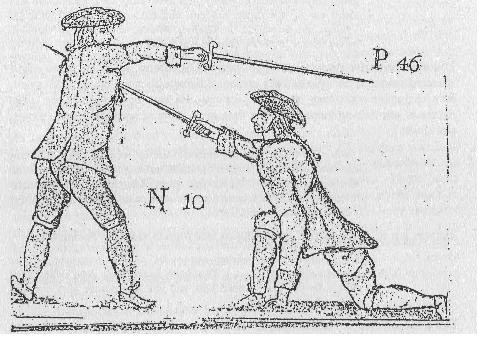
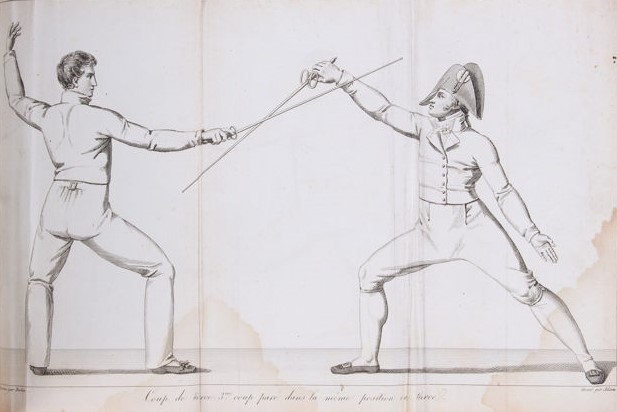
This past Sunday at a Capitale Escrime Historical Fencing practice one fencer raised an excellent question—does one always have the hand at the same height when lunging? As so often happens with drills, this sparked great discussion and steered my plan for the evening in a new, and more immediately useful direction. [1] For those familiar with the source material, hand height at the termination of the lunge varied considerably across masters and time. Different contexts, changing uses of the weapon, all these things explain the variation, but for smallsword fencers today this same variety can complicate study. [cf. “Reach for the Sky—Hand Height in the Smallsword Lunge” 11 November, 2022, https://wordpress.com/post/saladellatrespade.com/2647]
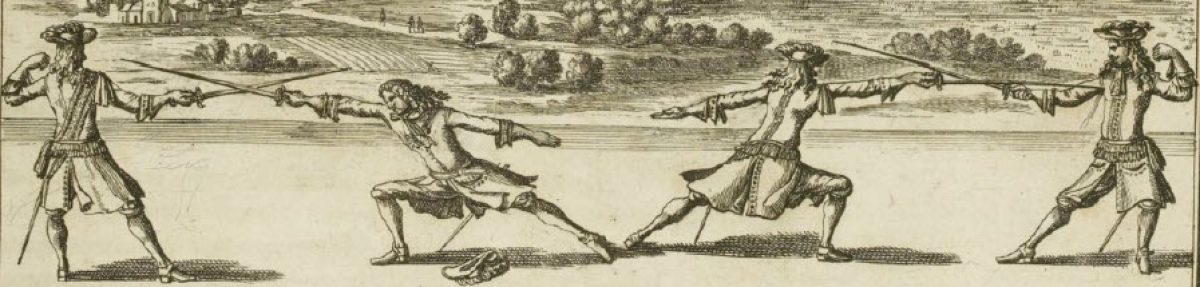
Generally, I recommend that fencers have the hand at a height between the chin and nose upon completion of the lunge. There is ample source support for this, but I’ve also found it works well in most cases. However, when a 6ft fencer and a much shorter fencer are drilling or bouting, this needs adjustment. If, for example, the taller fencer sticks to the rule of chin-nose height, even with the point down, they may be open to an arrest because they create more space under the arm. The shorter fencer, on the other hand, may need their hand slightly higher in order to close the line and/or avoid a double.
Girard, thrust in tierce
The question arose during a drill that focused on the redoublement. The redoublement is a double lunge. In practice, however, we often take an additional forward movement in other contexts, say when stepping or with the advance-lunge/pattinando. [2] These are technically different actions, but should the first movement fall short, sometimes we have the option to redouble. It is not wise in every situation. Normally it works best against an opponent who fails to riposte upon parrying or who takes too long to make the return.
One of the taller fencers found that they were keeping the hand at their own chin height upon the second lunge, but were vulnerable to a shorter’s fencer uncanny point-control and sense of timing and distance with their counterattacks. In the former’s case, it made sense to lower the hand to dissuade the opponent from attempting the counter. Important to note, distance as so often governs much of this—his opponent was merely taking a half-step back to parry or counter, and as a fencer with a longer lunge his hand had to be lower lest it be open. However, had the defender taken a full step or a second short step, the taller fencer may well have needed to keep the hand at more chin height.
But my Source Says… The Picture Suggests…
What we read in a source, and especially the images we often encounter within them, are excellent and helpful guides, but must be viewed against the needs of particular moments in a bout.
There is no platonic ideal for either parry or attack—most often what we read is base-line, a starting place, because in that position or method it sets us up and defends us well, and, because it’s an easier place from which to make adjustments. Fencing is action, a movie vs. a collection of still shots. A parry on the outside line, for example, may be a few centimeters higher or lower depending on the height of an opponent, the angle of their attack, or terrain. We adjust usually without thinking about it.
The same is true with the thrust, with attacks, especially when the goal is to strike and not be stricken. We are at our most vulnerable when attacking, because we’re placing ourselves in the measure of our opponent at speed, and so adjusting the hand, the line, anything we must alter, is vital if we are to maximize safety and reduce the chances of being hit as we strike.
NOTES:
[1] It’s often best to adjust on the fly, uncomfortable as it can be to depart from a lesson plan. This question raised a critical point, a fundamental one, and thus was worth exploring in depth.
[2] To be clear, I’m not arguing that a redoublement and an advance-lunge are the same. They’re not. They are both actions, however, that consist of two movements forward, and outside of a sporting context where ROW (right of way) dictates tactics, both expose one to potential risk being longer actions that cover more ground.









 Capitale Escrime Historical Fencing