Drills are cornerstone of fencing education, and rightly so, but are also prone to certain problems. If left unattended, these issues can undermine the benefits of the drill. Typically, drills are something that one does, not something one talks about—this is as true of coaches as it is fencing students. We do not dwell on them, analyze them, examine them objectively as we often should—we learn them in good faith, we usually benefit, and so assume it all goes to plan. For the most part, proper and effective corrections allowing, this is true. However, it is not automatic.
Some time ago I wrote a short piece on the problem of artificiality in drills and whether or not some standard drills are “realistic” in the don’t-get-hit sense [https://saladellatrespade.com/2019/06/05/fencing-drills-and-artificiality/]. Here, I should like to discuss the issue of anticipation, specifically how students, facing a known and repeated sequence, often act preemptively. Usually this means that they make their action too soon and nullify the point of the drill. An example will help illustrate this.
Drill: Circular Parries in 4th
Coach: attacks with thrust to inside line
Student: takes 4th to parry
Coach: makes a derobement to continue the attack
Student: circles around to retake 4th, parries, and ripostes
In this setup, one we might use with many different weapons, the two most likely places a student might act too soon are with the initial parry and with the second, circular parry. Of the two, it is the second, the circular parry, where this tends to happen more.
Ideally, parries are responses to a specific, concrete stimulus, the attack. It is a reaction. When we know where a blow is coming, as we do in a drill, it is easy to act on what we know will happen instead of what we actually see. A good coach will see this and correct it, especially if the student is not brand new. With newer, beginning students, we often pick one egregious fault to focus on, and tackle other issues in time. We might point out that the front foot is not aligned, or that they’re not extending first before lunging, but we do not provide a litany of woes each lesson as it is not helpful, but demoralizing.
However, with a student ready to make circular parries, as in the example covered here, we would be right to correct any anticipatory, not-reactive action. How we do this is as important as doing it. The first step is noticing it, which any coach should straight away. The second step is pointing out to the student, plainly and kindly. Some students will recognize it themselves and correct, others will when corrected, and still others may not see it or be unable, for whatever reason, to correct.
For those students who struggle, there are things we can do to help them help themselves. The first, and easiest thing to do, is to expose the anticipatory action—in the example here, the coach would attack, but not disengage. To expose the preemptory second parry, all the coach need do is slow down the speed of the attack. If the student is making the circular action too early, they will bump into the incoming steel. This is a good moment to point out the issue as the student will see, in real time, why acting too early defeats the purpose.
The coach might also change the measure, perhaps step farther in on the initial attack—while not wise from a tactical point of view, from a teaching point of view it will first reveal if the student isn’t maintaining good distance, and second will likewise lead them to encounter the coach’s weapon if the student parries too soon. Here as before one would then point out the mistake, have the student reset, and try again. If the student begins to keep distance and wait for the disengage, then the coach should revert to more appropriate speed and measure. [1]
There are times that students rush because they’re uncomfortable and perhaps not ready to make an action. That is okay. It is not always easy to tell, so a good approach is to simplify the drill. Again following the example above, start by having them work only on the initial parry 4; changes in measure and speed will help the student perfect the action and test their ability to adapt. Once they’re comfortable with this simpler action, one can try the more advanced version again.
It may help to bridge the gap between simple parry and the addition of a circular parry by having them drill the circular movement in isolation too. One way to do this is by playing “keep away” with the weapon. Coach and student, or two partnered students, take turns chasing the other’s blade—one has an extended line, the attacker; the other a bent arm on defense. When the attacker attempts to make contact/engage the blade, the other disengages and/or circles around to avoid the engagement. Next, the defender attempts to engage the attacker’s blade in the same ways, and the attacker attempts to avoid in turn. Exercises like this help one learn and perfect the motor movements necessary to disengage and perform derobements, but also are predicated on reacting to real-time stimuli—one can only avoid if one avoids the steel at the right time.
In sum, if one finds a student preemptively acting in a drill, slow the stimulus down, change up the measure and speed if necessary, and should it prove useful stop and return to simpler material. There is nothing wrong with the basics—in the end, we use those most, and the best fencing is normally a result of simple actions executed at a high level of skill.
NOTES:
[1] In option lessons, this is normal, that is that the coach normally varies things in order to hone the student’s ability. We start with an action the student knows, and then introduce it in increasingly more difficult tactical set-ups.
[A short review/overview of the Hussar Sabre & Fokos seminar featuring Russ and hosted by Mike Cherba and the folks at Northwest Armizare, Sherwood, OR, USA, 4-5 Nov., 2023]
Hussar Sabre & Fokos Seminar, 4-5 Nov., 2023, with Russ Mitchell, hosted by Northwest Armizare
A core aspect of teaching, of the Art, is remaining a student. Whenever I can, I take lessons, classes, any seminars to learn, unlearn, or improve, because we’re never finished learning. As my old kendo master once shared, even at his level his own master would fix things as elemental as his grip whenever they met up. In tandem with cultivating a student mind, I encourage my own students (when they’re ready) to seek out other teachers, and, better fencers.
This past weekend I had another chance to work with a better fencer, the excellent Russ Mitchell (Winged Sabre Historical Fencing, Irving, TX, USA), and explore new material. [1] One of the traditions Russ learned while in Budapest was a broken lineage for sabre, one adapted to the unique needs of early 20th century soldiers in greatcoats, carrying packs, and either in ranks or in trenches. Professor Hidán Csaba, with whom Russ studied in the late 1990s, learned this system from his grandfather, a drill master in the later years of the Great War, and from his grandfather’s friends. [2] Russ will be the first to add that we lack much of the pedagogical apparatus for the system, but through study and his time in Hungary, he is confident that much of the physical game is correct. If I may offer a proof for it, I have found fencing his students extremely difficult—they are not duelists where most of us, whether we admit it or not, are.
Movement & Bones
Among the many hats Russ wears he’s also an expert in movement. A student of the Feldenkaris Method, his approach to martial arts includes many of the tenets of the Method, and, for the better. [3] To be quite honest, I had not heard of FM until this weekend, but have now seen, firsthand, its effectiveness. In grade school I fractured my right wrist badly—the bones were all but poking out of the skin. It did not set super well, and so for decades I’ve not been able to supinate fully. Years of fencing, racquet sports, etc. added layer upon layer of compensation for this issue. Then, in 2001, I was in a serious auto accident, one that injured my shoulder and released all the horrors that might not have appeared until later, tennis elbow chief among them.
Sunday, before the second day of class, Russ kindly took a look at my arm. We chatted first and I gave him the history and general problems I experience with it. He examined my arm, had me perform a few exercises, and then had me supinate again. I believe I said, well, shouted, “WTF…” in disbelief. Where I had been able to turn my hand maybe 120 degrees on a good day, here I was supinating to about 170 degrees. I couldn’t believe it. I have homework to do, and I’ve never been more motivated to do it, but I have far more mobility in my wrist, and best of all, did not experience the usual, weekly night of hell with a neck and backache I cannot treat save through heat, ice, and leaning into the pain. [4]
Lest one think that the seminar included certain smokable plants and esoterica, it didn’t. Russ explained much of what we were doing in terms of what bones, muscles, and tendons were working at any one time. The first half of Saturday, for example, explored balance, weight-shifting, and the biomechanics of the lunge. I said last April that Russ had changed my understanding and approach to teaching the lunge—this portion of the class added to that understanding, and, as before, though we spent a LOT of time lunging, no one was tired. For anyone who has spent time in an Olympic school and knows how challenging footwork drills can be, that should reveal just how effective Russ’ system is.
Hussar Sabre
Following the lunge portion, we then learned the rudiments of the Hussar sabre system Csaba imparted to Russ. The footwork, cutting mechanics, and options this system uses are simple, but not simplistic. The videos that Russ has shared on YouTube will give one a far better idea than any description I provide can, so please see the link below to his channel. [5] Of note, this is an unforgiving, effective, and brutally efficient system of sabre.
Russ and Noah demonstrated how to parry low-line
Significantly, this system assumes a curved sabre, and, takes complete advantage of false-edge cuts. Measure is generally closer than someone from my background is comfortable with, but this said it fits the system well. The first four cuts, one through four, bisect the target in an “X” formation: cut 1 descends from the right, cut 2 from the left; cut 3 ascends from the right, 4 from the left. There are other cuts, including horizontal blows, but we spent the most time with 1 and 2, and, options from there as both attacker and defender. This was especially valuable to me as having fought a school of people using this system, and knowing how challenging it is, I know have a better idea of how it works.
Fokos
Sunday we started out with more bio-mechanic work to prep us for working with the fokos or shepherd’s axe. Sometimes described Stateside as a long-hafted tomahawk (an apt analogy), this axe was long-used by shepherds, but was also used in the Great War. Russ showed us the military application he was taught, but also some of the “folk” uses. The latter, for example, might help one collar old uncle Boris after he overindulged at the pub. Like the sabre, one is using more of the hips and torso to propel the weapon and block. This means that one turns to stay behind the weapon.
One thing I did not anticipate, it not being my thing, was the amount of grappling one can do with the fokos, either against someone without the weapon or with one. The hooking ability of the axe can bind up not only an opposing fokos, but limbs. We explored this aspect in the “folk” portion, and like most folk arts a fair amount of learning how to use the axe to assist grappling is experimental. Russ armed us with a few principles, demonstrated a few set-ups, and then had us play with these actions and ideas.
The military portion was more intuitive for me as the starting position is one shared with bayonet. That is not an accident. Given the weight of the average rifle ca. 1915 the fokos makes for a much faster, nimble tool. Our brief exposure to this weapon only increased my sense of horror that attended trench warfare. [6] It’s a delightfully nasty weapon.
Take Aways
Russ told us our brains would be full and he wasn’t wrong. I’m still processing a lot of what we covered, never mind reeling from the fact I can supinate on my right side now. That still seems unreal.
At the risk of sounding sycophantic, Russ is one of a handful of instructors whom I would advise anyone to work with regardless of what he’s teaching. His knowledge is as deep as it is varied, his skill impressive, and he has a fantastic sense of humor. Moreover, and one sees this is his books, Russ is aware that not everyone is 19 and a paragon of fitness. As easily the oldest person at the seminar this weekend, I might have special appreciation for this fact, but what this means is that regardless of one’s shape, ability, or fitness level, Russ can and will work with you, and, you’ll get something out of it. A lot of something.
In addition to his videos (see link below), Russ is a prolific author, and produces works that combine the rigor of his academic training with an ease of reading that is often rare in our field. Buy his books and read them; watch his videos; and if you have a chance to take a class with him, whatever it is, take it. You need not thank me, but you might wish to. [7]
[4] I have spent a lot of time, off and on, studying both yoga and MBSR (mindfulness-based stress reduction), the latter thanks to the cancer program at OHSU (see for example https://www.apa.org/topics/mindfulness/meditation). Much of what we covered echoed what I have learned in these disciplines as well as in various PT sessions for injuries.
[6] My paternal grandfather fought in the Great War, and though he didn’t like to talk about it, I learned from my own father that between the sound of gas canisters and trench warfare, it was utterly terrifying. I can’t imagine having to face one of these axes–they may look small and delicate, but they’re effective and quick.
“Show, don’t tell,” was some of the best teaching/writing advice I ever received. To that end, I’m adding some specific drills to illustrate what I shared in the last post on this topic better (https://saladellatrespade.com/2023/10/31/yes-yes-very-nice-but-how-cultivating-defense/ ). Many, if not most of these drills, are venerable—if anything I may have adapted things here or there, but all of what follows are standard drills or types of drills. [1]
These progressive option drills start with a basic action and build in complexity. If a student is new or struggling, one may stop with the first version and work on that, or, aspects of it. For more advanced students, one can add an additional layer of difficulty as required. In the first example, for smallsword, one could simplify the drill even more by having the student initially deny the engagement and break measure. This would observe the “don’t get hit” rule, but not set them up well for a strike of their own.
Two things I didn’t add below, but which apply are first, that it’s important to switch roles, that is, have both the student and instructor initiate the action. This gives the student a chance to act as attacker and defender. Second, movement and varying distance is critical for success. If one starts “firm-footed,” that is, in place, fine, but then add movement. Chase the student, have the student chase the instructor; start out of measure, start in measure. For more advanced students, another option we can layer in is varying tempo and speed.
Drills & “Realism”
On their own, there is little inherent in most drills to make them impart a defensive mindset automatically. All the drills I provide below, for example, can be gamed to current tourney standards easily if one wishes. How “realistic” or not they are depends on explanation and reiterating correct principles over and over and over again within each element of the drill.
One of the most frequent questions I get in drills and lessons, and a good one, is “but why wouldn’t I just do this?” This simple question has become one of the single most important ways in which I push correct mindset. To cite one example from this past week, one student in a smallsword class asked me why they couldn’t just disengage and thrust against the glide in third. I told them that they could, but then asked what would happen if they did—what is the opponent doing? If the opponent is gliding to target, and one ignores that to strike… one is still hit. Not good enough. IF one wishes to disengage in response, fine, but don’t do so into absence, do so with opposition in the new line, a shift of the body to one side, or both. [2]
Ex. for Smallsword:
Option Drill with the Glizade/Glide in Third
To Start: S [student]: in guard of third I [instructor]: in guard of third *engaged on the outside line
Option 1A: Student Attacks
S: finds measure and gains weak of I’s blade with middle of own [3]
S: performs glide in 3rd, maintaining opposition, and strikes target (forward target or chest)
2A:
S: finds measure and gains weak of I’s blade with middle of own
S: performs glide in 3rd, maintaining opposition, and thrusts
I: parries 3rd, ripostes; S. parries in 3rd and ripostes [4]
3A
S: finds measure and gains weak of I’s blade with middle of own
S: performs glide in 3rd, maintaining opposition, and thrusts
I: parries 3rd, begins riposte; S. disengages, engages in 4th, thrusts to target with opposition
4A:
S: finds measure and gains weak of I’s blade with middle of own
S: performs glide in 3rd, maintaining opposition, and thrusts
I: makes dérobement to avoid glide and engages in 4th
S: via circular 3rd, retakes line and glides in 3rd to target
Option 2A: Instructor Attacks
I: finds measure and gains weak of I’s blade with middle of own
I: performs glide in 3rd, maintaining opposition, and thrusts
S: parries 3rd, ripostes
2A:
I: finds measure and gains weak of I’s blade with middle of own
I: performs glide in 3rd, maintaining opposition, and thrusts
S: parries 3rd, begins riposte; S. disengages, engages in 4th, thrusts to target with opposition
3A:
I: finds measure and gains weak of I’s blade with middle of own
I: performs glide in 3rd, maintaining opposition, and thrusts
S: makes via dérobement avoids glide and engages in 4th
I: via circular 3rd, retakes line and glides in 3rd to target
S: parries in 3rd, ripostes
Ex. for Rapier:
Finta Scorsa or Advancing Feint of Marcelli
To Start:
S: in guard of prima
I: in guard of third
Option 1A: Student Attacks
S: in prima, makes false attack to the high inside line
I: parries in 4th
S: via cavazione /disengages to outside line, and strikes target (forward or chest)
2A:
S: in prima, makes false attack to the inside line
I: parries in 4th
S: via cavazione /disengages to outside line; I parries 3rd, begins riposte
S: parries in 3rd (or 4th depending) and ripostes, striking target
3A
S: in prima, makes false attack to the inside line
I: parries in 4th
S: via cavazione /disengages to outside line; I parries 3rd, begins riposte low-line
S: takes 2nd, ripostes with opposition
4A:
S: in prima, makes false attack to the inside line
I: parries in 4th
S: via cavazione /disengages to outside line; I parries 3rd, begins riposte low-line
S: takes 2nd and thrusts; I. parries 2nd, begins riposte
S: parries 2nd, ripostes with opposition
Option 2A: Instructor Attacks
I: in prima, makes false attack to the high inside line
S: parries in 4th
I: via cavazione /disengages to outside line, and thrusts
S: parries in 3rd, ripostes to target
2A:
I: in prima, makes false attack to the inside line
S: parries in 4th
I: via cavazione /disengages to outside line; S. parries 3rd, begins riposte
I: disengages to 4th, starts riposte with opposition
S: disengages to 4th, ripostes with opposition to target
3A:
I: in prima, makes false attack to the inside line
S: parries in 4th
I: via cavazione /disengages to outside line; I parries 3rd, begins riposte low-line
S: takes 2nd and thrusts; I. parries 2nd, begins riposte
S: parries 2nd, ripostes with opposition
I: with parry in 2nd, passes left foot forward in order to seize guard
S: steps back, attacks to body
Ex. For Rapier and Dagger:
Working from Mezzaluna (Marcelli)
To Start:
S: in guard of mezzaluna
I: in fourth guard [5]
Option 1A: Instructor Attacks
I: in fourth guard, makes attack to the inside line
S: parries with dagger; with sword ripostes to target (forward or deep)
2A:
I: in fourth guard, makes false attack to the inside line
S: attempts to parry with dagger (downwards and out)
I: disengages to strike hand
S: parries with dagger (upwards and out), ripostes with sword to target
3A:
I: in fourth guard, makes beat attack against sword to open the inside line
S: parries in 4th to close line, ripostes with opposition
I: parries with dagger (upwards and out), ripostes with sword inside line
S: parries with dagger (downwards and out), ripostes to arm
Option 2A: Student Attacks
S: makes false attack to face
I: parries with dagger (upwards and out)
S: disengages and strikes arm or hand
2A:
S: makes false attack to face
I: parries with dagger (upwards and out); ripostes to arm
S: disengages and strikes to arm or hand
I: parries with dagger, ripostes
S: parries with dagger (downwards and out); ripostes to arm
3A
S: makes false attack to face
I: parries with dagger (upwards and out); ripostes to arm
S: makes circular parry in 3rd; ripostes via glide to outside line
I: parries in 3rd, checks with dagger, ripostes in high line over engagement [6]
S: parries with dagger (upwards); shifts right, ripostes to body
Ex. for Sabre:
Options from an Engagement in Second
S &I: in 2nd, at punta spada/last third/weak of the sword; then, start out of distance
Option 1A: Student Attacks
S: cuts over to threaten face with feint via half thrust
I: moves to parry in 1st
S: a. performs molinello ristretto or coupé to the arm [7] b. performs molinello ristretto via rising cut to the bottom of the arm
2A:
S: cuts over to threaten face with feint via half thrust
I: moves to parry in 1st
S: performs molinello ristretto via rising cut to the bottom of the arm
S: secondary attack: pushes through to thrust or cut flank
3A:
S: cuts over to threaten face with feint via half thrust
I: moves to parry in 1st
S: a. performs molinello ristretto or coupé to the arm
I: parries 3rd, cuts to head
S: parries 5th, cuts via molinello to head
4A:
S: cuts over to threaten face with feint via half thrust
I: moves to parry in 1st
S: performs molinello ristretto via rising cut to the bottom of the arm
S: secondary attack: pushes through to thrust or cut flank
I: parries in 2nd; ripostes via thrust
S: makes ceding parry in 2nd, ripostes via thrust to target
Option 1A: Instructor Attacks
I: cuts over to threaten face with feint via half thrust
S: moves to parry in 1st, parries via molinello to head
2A:
I: cuts over to threaten face with feint via half thrust
S: moves to parry in 1st
I. disengages and cuts to arm
S: parries 3rd, cuts head
3A:
I: cuts over to threaten face with feint via half thrust
S: moves to parry in 1st
I. disengages and cuts to arm
S: parries 3rd, cuts head
I: parries 5th, cuts to flank
S: parries in 2nd, thrusts to target
NOTES:
[1] To name one example, and analogous to the first one I share here, there is the discussion of options facing an opponent in 4th in Charles Besnard, Le maître d’arme liberal, 1653, 43 (63 [orig. French] and 161 [English] in the translation by Anne Chauvat and Rob Runacres, The Free Master of Arms, Glasgow, UK: Fallen Rook Publishing, 2022).
[2] The use of the inquartata or demi-volte, for example, would work in this instance.
[3] Two ways to vary this are to have the student find measure by a short extension of the arm from critical distance, in order to gain the weak with the middle of their weapon, or, have them step into measure to engage. The first is more conservative, but the second option is important—ideally, students learn to find measure and exploit it both ways.
[4] As set up here, the final actions are a battle of ceding/yielding parries and glides. Both help students cultivate better awareness of presence, varying pressure, measure, and opposition.
[5] Marcelli’s fourth guard for rapier and dagger is depicted thus:
Marcelli, Rules of Fencing, “fourth guard” (L) and “mezzaluna (R)
Mezzaluna, on the right, needs explanation. Chris Holzman points out that Terracusa e Ventura (1725) remarks that the tips of the two weapons are close enough to form a “half moon” shape. Here, there is a much wider gap between them. The accompanying text, however, tells us that the fencer “carries the dagger forward covering all the upper parts in such a way that the opponent only sees the chest below the dagger as target to strike.” [Holzman, Marcelli, Rules of Fencing, 1686, Wichita, KS: Lulu Press, 2019, 273; see also n. 115 that page.
Hà portato il Pugnale avanti, coprendosi tutte le parti superiori, di modo che il nemico vedesolo per bersaglio da colpire il petto per le parti di sotto il Pugnale [Marcelli, Regole della Scherma, Lib. I, Cap. III, 4]
[6] Here, the instructor, having parried the incoming sword in 3rd, uses the dagger to hold the opposing weapon in place in order to swing their weapon around obliquely to the right and up (assuming a right-hander) in order to threaten the face.
[7] The coupé , in Radaellian sabre as taken down by Del Frate, is also known as the colpo di cavazione or cavazione angolata. It is made by bending the forearm back a bit to increase power. Chris Holzman, in his gloss, remarks that it’s similar to the last step of the molinello. See Christopher A. Holzman, The Art of the Dueling Sabre, Staten Island, NY: SKA Swordsplay Books, 2011, 234.
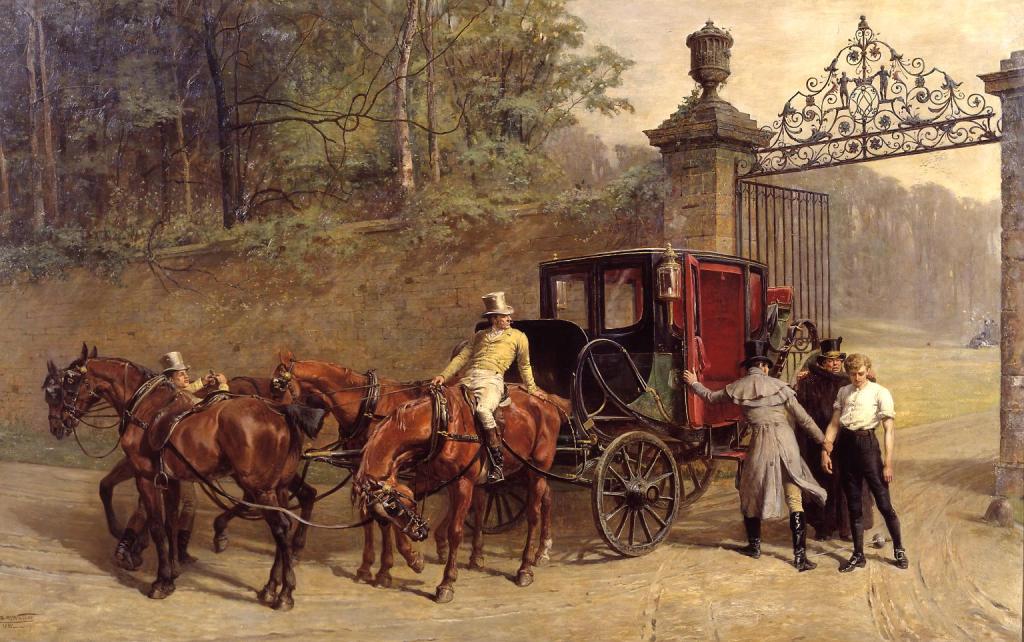
A number of dueling histories record the horrific duel between Colonel Barbier-Dufai and a young Captain, Raoul de Vere. According to most versions, the older adherent to Napoleon attempted to pick a fight with this member of the Royal Guard, but was initially unsuccessful. Barbier-Dufai, frustrated in finding the young man so unflappable, finally remarked that he was not insulting him, but his cockade, and after a heated exchange challenged the captain. However, when asked to select a weapon the captain replied that he had insufficient training in all of them. The colonel said he would not fight a child, a comment that irked de Vere and led him to slap the older man. A duel was now inevitable. In the ensuing sword fight, Barbier-Dufai disarmed his opponent several times. Finally, in frustration, the colonel suggested they hop into a carriage, arm themselves with daggers, tie their left arms to one another, and take two turns about the Place du Carousel. The young de Vere agreed and they set off in their mobile piste. When their seconds opened the carriage, blood was everywhere, Raoul clearly dead, and the colonel next to death. Both men died and honor was apparently satisfied. [1]
I share this story because it highlights the pure idiocy of fighting in close measure. There are times when it is unavoidable, but generally—unless one is in a confined space—there are means by which to extricate oneself from such proximity. One of the chief faults I see in both the wider community and among some of my own students is mismanagement of measure. Usually in my own classes, the culprit is a mix of well-intentioned aggression and fun—so intent on making the touch, some students neglect their own safety. I never want to chip away at the fun they’re having, especially among the younger students, because having fun is one reason people fence, but at the same time I need to ensure that they learn properly.
There are a few things we can do to ensure that our students have a proper notion of measure, and that can help them remember to use distance well in their bouts.
Teach them What Measure Is
First and foremost, from the off we need to teach them the various measures appropriate to their weapon or tradition. Regardless of the weapon or era my students study, I introduce them to the traditional breakdown of measure into three main categories:
Out of measure
In measure
Close measure
Out of measure, what Giordano Rossi calls “double measure” and Luigi Barbasetti refers to as “normal distance,” is the distance that requires us to make an advance first in order to lunge to target.[2]In measure means that one can lunge to target. Close measure is that spot were either opponent can reach one another without the lunge. There are some subsets to this, but to start this is ample.
I hesitate to say that “all” systems of measure reflect these basic breakdowns, but I feel safe to say that measure, being a fight universal, is common to all systems however described. Even in those like Rossi’s “measure” and “double measure” or Fiore dei Liberi’s “largo” and “stretto,” there is implied space between these two poles. Regardless of nomenclature, one must learn how to navigate any space along the continuum of “measure.”
Measure Drills
Measure drills by definition involve footwork. Ideally, any footwork drill save perhaps those used in warming up a class—where everyone advances and retreats down the hall using various types of footwork—will work distance too. Below are several drills I typically use in classes:
Glove Tag is a crowd favorite and very much a game. One can run this as a linear partner drill, or, as a general melee. I usually ask if anyone wants to be it, and if not then select someone. Fencers must use the appropriate footwork only, and, can only target the wrist. There is no parry. One has to move, or, parry with the feet (in the non-pejorative sense). [3] Fun as this is, and much as it helps them move, making it a bit more realistic is helpful (see Mask Tag below).
Foil-Push or mask-push, have the students, in guard, suspending a foil/sabre/etc. or mask between their lead hands. The goal is to move back and forth without dropping the foil or mask. I emphasize that while they are taking turns driving, so to speak, they are working as partners—the only way to keep that foil up is to move in concert. If fencer A steps back, B needs to step forward, and vice versa.
Mask-Tag and 1-Touch Tag, fencers don their masks and use the weapon to tag. For sabre, students target only the head, and, cannot parry. Thrust fencers can only target the chest (or arm depending on what we’re working on), and, as with sabre, cannot parry. They must move their feet. Students must use distance to their advantage. Success depends on moving, recognizing someone fell short and is now vulnerable in the recovery, or, selecting the moment the opponent is occupied, such as mid-step, to strike. If the attack fails, then retreating under guard or behind the point is the best option, and the fencers reset.
Mask-Tag Plus takes this drill one step farther—each opponent can parry and riposte once per action, that’s it. So, if Fencer A lunges with a thrust to the chest, B can parry in quarte and riposte, but if A retreats half a step, then B must recover—B can’t redouble. For more advanced students one can allow the redoublement. This option should be included at some point as so many students starting out stop just shy of the target.
Two-Step Tag is something I’ve used with foil and smallsword students. Two of my foilists, for example, are offensively-minded, so tend to close quickly at “Allez!” and descend into a flurry of jabs, thrusts, etc. I don’t want to take that drive away, so I’m trying to channel it instead. In this version, the only attack they can make is an advance-lunge to the chest. It’s super hard to do, especially since one’s opponent knows what’s coming, so everything depends on precise and keen use of footwork, timing, and distance.
The goal with all of these drills is to emulate, as much as one can, the conditions of a bout, but restrict the options so that the students are forced to use measure. It’s not that good handwork is unimportant or cheating, but that it can easily become clatter and chaos instead of well-planned attacks and responses. It becomes reactive, not active. I teach them that if an attack fails or if something isn’t working, to retreat, regroup, and try something else. Persistence in the face of stout defense is brave, sure, but foolhardy—if what we’re doing isn’t working, we try something else. [4].
Reinforcing Proper Use/Awareness of Measure in Bouting
It does little good to encourage proper measure in drills if we fail to do so in bouts. There are a few way to do this. In both classes and individual lessons I save any bouting we might do for after any focus on technique and drills. [5] This helps prime the pump as it were—students are more likely to consider measure if they’ve spent a bit of time focusing on it before bouting.
Within the bout, I have students actively bouting and those observing analyze the action, not only because it reinforces attention to measure, but also because it buttresses other important aspects, from recognizing who had initiative/started the attack to breaking down each action within a given exchange. Too few fencers learn to analyze bouts well, and the sooner they start the better.
Why Measure Matters
If you view most any bouting footage posted to sites like Youtube you will see, or should see, why better attention to using measure is worth one’s time. In one recent video, for example, one fencer analyzes his bout, but misses the reason that he found himself in the situation he did—they were fighting too close to one another. [6] If their sabres cross near the middle, they’re too close. Certain actions are harder to thwart at such proximity—in this case, a slip of the leg will likely fail because there is insufficient measure to remove the leg and strike the opponent’s head without being hit. More likely, and we see it in this example, both parties will be hit.
In fairness to this fencer, the rule-set he’s likely fighting under is not as doctrinaire as I am about the guiding principle of “don’t be hit.” Even when a rule-set is explicit, so much depends upon judges who know what to look for and how to make sense of what they’re seeing, and by and large tourney HEMA lacks a reliable pool of judges capable of analyzing the action at such a level. Add to this the excitement and/or nerves in a bout and of course things can turn out less ideally than we plan. It is not my intention to denigrate my fellow fencer, only to point out something important he didn’t address (his focus was on the slip). Were he my student, we’d likely work on this very set of actions at the proper distance, that is, set it up so that he is just about a step or so farther back then we see in the video. From punta spada/sword tip one is more likely in a place not only to make the attacker’s feint and strike more successfully (i.e. without be clobbered doing it) but also provide the defender sufficient measure (and thus time) to assess and adjust.
“Halberd against the Sword,” Hector Paulus Mair, MSS Dresd.C.93/C.94 (ca. 1540s)
Not all clubs or instructors take the same view I do. The more I read, the more I teach, the more I see how fencers learn, the more inclined I am to championing the goal of “don’t get hit.” It does change how we fence; it makes for a more circumspect, conservative, and hesitant game. The flash and fire, the dynamic move and rococo blade-work tend to impress, and that is what attracts many of us in the first place. It looks cool and we want to do that cool thing. While perhaps less flamboyant and exciting, I’d argue that there is as much beauty to the cold efficiency, exactness, and finality of a one-touch exchange. Moreover, training this way adds something else extremely important—improved confidence. The more one succeeds in gaining the line, striking, and getting out without suffering a counter-attack or double, the more one trusts themselves and the weapon they have in hand. In no way does that make one invulnerable, of course but confidence does much to help us cultivate the calm we need to fight with our heads and not our hearts. [7]
NOTES:
[1] There are a number of popular histories and websites that mention this duel, few with adequate citations. See for example Robert Baldick, The Duel: A History, New York, NY: Barnes & Noble, 1965, 164-165; Major Ben C. Truman, The Field of Honor, New York, NY: Fords, Howard, & Hulbert, 1884, 236, available online at [https://archive.org/stream/fieldofhonorbein00trumuoft/fieldofhonorbein00trumuoft_djvu.txt]; Thimm records a duel with daggers, minus a carriage, between two men in Italy in 1891, A Complete Bibliography of Fencing and Dueling, Reprint (Gretna, LA: Pelican Publishing, 1998), 457.
[2] Giordano Rossi, Sword and Sabre Fencing, Milan: Fratelli Dumolard Editori, 1885; translated by Sebastian Seager, Melbourne Fencing Society, 2021, 49-50; Luigi Barbasetti, The Art of the Sabre and Epee, New York, NY: E. P. Dutton & Co., Inc, 1936, 15-16. Cf. Gustav Arlow, Sabre Fencing, 1902, translated by Annamaria Kovacs and edited by Russ Mitchell, Austro-Hungarian Sabre Series, Vol. 3, Happycrow Publishing, 2022, 35.
The term “normal measure” is revealing–this is the distance from which one is still safe, but close enough to mount an attack. In other words, one isn’t four meters away from the opponent, and, isn’t in their lap.
[3] The “Coward’s Parry” or “Ninth Parry,” according to Morton, is the derisive term applied to those who avoid at attack by means of a step back. Where this idea originated I’m not sure, but it’s alive and well in HEMA. My guess, like Morton’s, is that this harkens back to the time with salle fencing, particularly in France, sought complex, elegant handwork over retreating (a “ninth” parry suggests an acceptable eight, and the French school in the 19th century looked to that number). See E.D. Morton, Martini A-Z of Fencing, London, UK: Antler Books, 1990[?], 43, 126.
[4] There are instances, of course, were it’s wiser not to break off the attack. If say one thrusts to the chest but lands short, and the opponent isn’t reacting properly, then redoubling to strike makes good sense.
[5] Most of my bouts are teaching bouts, that is, bouts in which I present what we covered in a lesson so that the student may work on those topics in real time. For classes, I still do this, but often include a little free-bouting at the end of class provided the students have enough in their toolkit to do so, otherwise I have them engage in restricted bouts where they move at real speed, but are restricted in what they can do.
[6] I do not know “@HEMA_Fight_Breakdowns,” and again, do not wish to disparage them in any way. Their video provided a great example of what I cover here, but my topic was not the same as theirs and I want to make that clear. To blast someone for not covering something we want them to, when that isn’t what they set out to do, is silly if all too common. This fencer has some good things to say about slipping the leg and one response to it–the topic of the video–it can be found here: https://youtu.be/Bk32YMYqiwA
[7] For this notion, see Master Perigore of Paris in the film adaptation of “Scaramouche” (1952): https://youtu.be/FQfsvMENYgc
from _Istruzioni per la sciabola di sciabola_ [_ (Instructions for Sabre Fencing_], by Arnoldo Ranzatto, first published in 1885, Venice; this is from the third edition, 1889.
Like most of my posts nothing I’m writing in this one is earth-shattering or new. Any reader familiar with individual lessons will recognize quickly what I’m talking about and why. Readers on the historical side, however, who often have little experience with this or who less often have a chance for individual lessons, may find this helpful. Regardless, discussing methods for increasing a student’s comfort and improving their ability to see actions and make decisions in real-time is valuable.
Generally, traditional individual lessons employ the same basic structure. A coach’s focus, personality, time-constraints, and student ages and experience weigh into this too, but normally it’s more a question of altering or augmenting the basic structure rather than adopting a completely different approach.
warm-up –> drill or new material –> cool down
Using sabre as an example, we usually start with a warm-up, such as a series of thrusts to the inside line from standing, then via the lunge; or a simple parry-riposte drill up and down the strip; or the “wood-chop” drill or similar. [1] This may be followed by drilling fundamentals—thrust and lunge, add disengage, or cuts to major targets, stop-cut drills, beats, feints—or by the introduction of a new technique or maneuver. To close there is usually a cool-down, often much like the warm-up (parry-riposte exercises, stop-cut drills, wood-chop drill, etc.).
In a sala where students are in class several days a week it’s possible to use the lesson to introduce new material and then have them drill with more advanced students. Assuming an appropriate degree of dedication this can be an effective strategy. If, however, one sees a student once a week, and especially if that student lacks others with whom to practice, it’s more difficult. Instructors are normally the first “foe” one faces, but improvement in fencing comes via meeting and overcoming new challenges, new challengers, not via habit and the familiar movements and tactics of one opponent.
Ideally, that lone student finds a way, either with you or another club, to find opponents and partners with whom to drill. This is always to be preferred, but until that happens what can one do to help them along, especially in terms of increasing their comfort with movement and the phrase? How can we speed them along, in a sense, when they have fewer opportunities to use what they’re learning? How can we get them to move beyond the one-two nature of so many drills?
Beyond the Play
MS Ludwig XV 13, 25 r2 (“The Getty”)
One of the challenges in historical fencing is deriving a useful curriculum from the sources. It’s especially difficult with older sources where more is assumed, the method of expression unusual, and where details we’d expect today are lacking. In Fiore’s corpus, for example, there are illustrations and descriptions, but a lot left unsaid too. Students working on the first master of the longsword wide plays, for example, have an illustration of the master and student crossed at punta spada (the top third of the sword or foible), another of the second option from this crossing, and an explanation:
Here begins the Gioco Largo (Wide Plays) of the sword in two hands. This Master who is crossed at the point of his sword with this player says: “When I am crossed at the points, I quickly switch my sword to the other side, and strike him from that side with a downward blow to his head or his arms. Alternatively, I can place a thrust into his face, as the next picture will show.”
Fiore dei Liberi, 1409
After the second image the Master continues:
“I have placed a thrust into his face, as the previous Master said. Also, I could have done what he told you, that is, when my sword was crossed on the right I could have quickly switched sides to the left, striking his head or arms with a downward blow.” [2]
MS Ludwig XV 13, 25 r3 (“The Getty”)
There’s a lot here to work with, and the images help considerably, but it’s clear that Fiore assumes substantial knowledge on the part of the reader. Notice what is not there: there is no mention of how one gets to this crossing; we’re not told how the scholar might defend himself; while we know this is “wide play” there are no details about ideal distance or tempo; we’re not provided any indication as to which option to choose when, just that there are two. We have, thus, little context for this play, and not surprisingly when many of us learn it we do so as a set-drill. There are more and less effective ways to do this, but one hurtle many students must overcome is how to recognize that they’re in this situation within a bout, and, be prepared for what can happen after one of these options has been exercised. [3]
A similar conundrum faces students working on more recent material. One of my sabre students, for example, asked me how he might improve beyond the initial actions of a particular attack. In this case, he had no trouble making a feint-cut to right cheek, cavazione/disengage with a thrust from second, but if the attack was parried he found he tended to stop. He added that he often felt that way—there was the initial set-to, then he wasn’t sure what to do.
As we drill so we fight
In order to help him, we did the following:
Stage 1: from the engagement of second, cut right cheek (10x)
Stage 2: from the engagement of second, feint right cheek, cavazione/disengage and thrust to the chest (10X) [4]
Stage 3: from the engagement of second, feint right cheek, cavazione/disengage and thrust to the chest, BUT this time I parry the thrust and riposte
The first two stages are set-drills. Stage 1, which focuses on the attack the feint will simulate, is intended to prime the fencer to make as realistic a feint as possible. In Stage 2 they make the same action, this time as a feint, and finish the maneuver with a thrust. So far, the student is the “agent” as older English sources would term it, the instructor the “patient” or receiver. As is, these stages exercise the techniques which comprise this compound attack, but apart from working distance (potentially), they don’t situate the actions within the context of a bout. It’s a set-play focused on technique, distance, and tempo, but all on its own, isolated.
In Stage 3, we add just a little context. The instructor reacts rather than just receive the touch. When I employ this method I make sure that the first few parry/ripostes are consistent and the same, e.g. a half-step back, retake second, thrust, or I take fourth and riposte to the right cheek. After a few rounds of this, I then tell the student that I will vary the target on the riposte. This does a few important things. First, it alerts and prepares them to watch what I’m doing; they can’t just anticipate the same response. Second, it mimics what they’ll have to do in bouts when their opponent doesn’t call their shots. Lastly, they’re primed to continue fencing and not just stop after their attack, a common problem many fencers face starting out. Depending upon their skill level we may take it further with additional actions, especially if focusing on not stopping after the first three stages.
In the next exercise, we turn it around—I make the same attack (the one we’ve been drilling) and they practice the defense. Here too we start small and progressively add more actions. Depending on the student they can vary their defense too.
Approached well this takes a drill into what is, more or less, a bout in miniature. It situates a specific action or drill in context. It adds more movement. Because it’s a drill there is slightly less pressure for some students than a bout. Put another way, rather than face the giant question mark that is all the possibilities they might face in a bout, they face the smaller question mark of what to do following something they know, that they’ve been drilling the whole time. In the example just above, watching to see if I parry second and or fourth is much easier because it’s explicit, it’s limited to one of two responses, but it still trains the eye to watch the response and not anticipate or react blindly. This introduces a level of psychological comfort necessary for learning at the same time that it’s helping them grow accustomed to incorporating new actions into real time and honing observation skills.
from Sir William Hope’s _New Method_ (2nd Ed., 1714)
There are other benefits to this approach. Placing the drill within a more combative context can serve as a pressure-cooker for testing more than how well they’re picking up a technique. If for example the student hesitates after the first few ripostes, encouraging them not to let up is important—if they have the advantage they should never stop before the halt. This said if they persist in the attack when it has failed, and up to that point neither person has been hit, encouraging them to take distance and reset is an acceptable goal. [5] Building confidence with a set of actions makes it that much easier for a student to incorporate them into their repertoire when they’re in the assault.
Progressive Drills in a Group Setting
Progressive drills can work in a group setting too. When I use this approach within a class setting I am careful to explain it at each stage, and check each pair of fencers frequently. This style of drill works best, however, with intermediate and advanced students. These students can help newer ones, but should have sufficient background to be able to notice basic trouble spots. Depending on the size of the class some amount of self-policing is necessary, another reason that it works better with more experienced fencers.
My more advanced students are quick to ask whenever they’re unsure about anything, and these discussions become opportunities to trouble-shoot, explain finer details, and explore variations on that particular drill. Time is often at a premium for many of us—we have barely two hours Sundays—but time taken to explain why we do something is important and isn’t wasted.
For beginners, I only use the progressive approach one on one, because the level of detail and attention required by both student and instructor is so much greater. One can make fewer assumptions, and sometimes we have to dial-back the complexity, something far easier to spot and correct one on one than in a group setting.
Progressive Drills & Curriculum Building
There is potential for this style of drill with our earlier works on the Art too. Returning to Fiore’s first master of the sword in two hands, wide play, the two options the master suggests could be Stage 1. Each partner would take turns attacking to work the two options. Stage 2 could introduce a defensive response—for the thrust, perhaps the defender counters with posta breve or frontale and cuts in turn or with the scambiar de punta (“The Exchange of the Thrust”). For the cut to the left side, one response might be posta fenestra followed by a thrust or a cut-around (or through) of the defender’s own. Stage 3, then, would allow the original attacker a chance to parry riposte, or, perhaps employ a move from the gioco stretto or close plays.
In the case of Fiore, whose exquisitely brutal system seems to have been intended to end a fight in two or three moves, there’s probably less need for long, extended plays (naturally proper safety gear is a must). This said there is value is situating his plays and exploring effective responses to them. Instructors in modern fencing will put students through drills with multiple actions within a lesson—something we rarely if ever need in an assault—because learning to work those multiple actions makes simple actions better.
For instructors struggling to get their students beyond drill and into effective use of what they’re learning, to move them beyond set plays, progressive drills offer one potentially rich source. For students working without an instructor, say in a study group, this can also be an effective method of practice. It might be especially helpful for those small historical fencing study groups looking for ways to expand their practice and build curriculum.
NOTES:
[1] Wood-chop or Around the Horn Drill: this drill primarily works target placement and the fingers. With a mask as target, either hanging up or on a partner, the fencer makes a cut to the right cheek with a double tap of the fingers, then to the top of the mask, then a single bandolier cut to the bib, and either repeats the sequence or goes through various parry/ripostes before continuing the sequence.
This example is taken from the Getty, but a quick look at the three other known mss. adds little additional information. The Morgan is almost verbatim what the Getty offers and the Paris/Florius and Pisani-Dossi contain much less explanation.
[3]Drilling First Master: researchers approach it differently, but one of the most sound I’ve seen is that employed by Mike Cherba (Northwest Armizare, Sherwood, OR) and Alex Spreier (High Desert Armizare, Bend, OR), both of whom first studied with Maestro Sean Hayes (Northwest Fencing Academy, Eugene, OR). Mike, for example, will have students start at punta spada, or start of out measure and meet there; if there is pressure against the agent’s sword, they cut around; if there’s not, they thrust through. Though first master of gioco largo doesn’t necessarily require pressure to work, the advantage here is that it provides one possible framework for the play and trains the student’s sentiment du fer.
[4] A look at most 19th cen. and many early 20th cen. Italian works on sabre will demonstrate the importance of having the hand about chin high on the thrust. With the hand in second position (thumb to the left, knuckles up) or in first in second position a la Barbasetti, the top of the arm is covered by the guard, the hand high enough to prevent an unexpected shot to the face, and the arm is poised to make the parries of first, second, or fifth quickly.
[5] If defense is the goal, if the goal is not to be hit, it’s better to break off than risk a counter attack or attack into tempo. The longer a phrase continues the more likely one might be hit.
Drill is a mainstay of fencing. We do footwork. We practice point control. We make molinelli in the air and at a target. We (should) be doing a lot of drill. In historical fencing we sometimes devise or find ourselves doing drills that are new, concocted out of our source material, and it’s a fair question to ask what might be signs that a drill isn’t up to par or might even be dangerous? What does it take for a drill to be “safe” when we’re talking about hitting people with weapons? Different types of partner drills require different levels of complexity, intensity, and safety-gear. The instructor has primary responsibility for introducing safe drills and monitoring how fighters are managing safety, but there’s an equally heavy burden on fencers performing the drill. They need to exhibit proper control and courtesy or they’ll injure their comrades and injured comrades mean fewer people to fence with.
On the instructor side, it’s often a balance between imparting what a particular skill or play requires and safety. Teaching longsword and sabre, for example, requires modulating what safety means. If one is teaching Fiore dei Liberi’s Armizare, a combat system designed to main and murder people, either in the lists or in the field, then one must be more vigilant in some ways than when teaching sabre. Most if not all of Fiore’s techniques must be modified to make them safe and some of them one can never do at full speed save perhaps in armor (and sometimes not even then). Teaching a sabre class, in comparison, makes for an easier balance of technique and safety. The relative weight, flex, and delivery of the thrust in sabre, though deadly with sharps and in earnest, is likely to do little more than bruise someone, especially if they’re wearing proper protective gear. With a stout jacket, one is rarely marked at all. This is often not the case when thrusting with a longsword—there is more power generation, more mass, and more surface area to the weapon. One thrust against the mask with either weapon will demonstrate the difference. Each weapon was meant to do harm in different ways, in different contexts. Assuming the exact same safety requirements is dangerous–fencing masks, good as they are, were not designed for longsword.
An instructor must understand the dangers inherent in a drill and modify it when and as necessary. This is the first step. The second is monitoring a class to make sure that fencers aren’t doing anything to nullify that modification. There’s no room for leniency with this—if any fencer is acting in an unsafe way they either fix it or one pulls them out of the drill. In some cases the drill itself needs further refining. Safety gear, good as it is, is only a fail-safe, an additional layer after one’s technique fails. No mask, jacket, glove, or pad will make you invincible and it’s stupid to proceed as if they will.
The same heavy burden for safety is shared by the fencers executing the drill. Drills can be complicated and applying sufficient oomph to the play with the control required to ensure no one is hurt is a tough skill to learn. Not everyone, in fact, learns it. I’ve seen experienced fencers fail to exercise control in drills; I’ve seen them fail to pull a blow that had clearly gone wrong. No one should have to “Fence for Two”—it’s the responsibility of both drill partners to proceed in such a way that both fencers are as safe as they can be.
There are several attitudes and skills one needs to cultivate to be the sort of person people want to drill with:
Courtesy: It’s important to be a courteous partner, not just in the sense of polite salutes, hand-shakes, or the blade-smack to the butt or thigh a la American football, but most importantly in the sense of the Golden Rule. Do you want to be injured? Do you want to be fearful of working with someone? Of course not, no one does. Work to be a safe partner and you help everyone, yourself included.
Control: Control is the marriage of skill and awareness. It takes a long time to develop. It means having a full understanding of each move, its direction, intensity, and target, as well as the ability to modulate any of the three at will. It’s a hard-won but crucial skill that requires hours, weeks, months, and years of hard work, drill, and patience to develop. Never stop working to achieve it. Control is not fool-proof, however, as everyone can and will misjudge from time to time. However, once you have it, people will want to drill with you because they know you’re safe and can help them learn whatever technique it is you’re all working on. You will learn more too because you’re both comfortable.
Competence: A certain degree of skill, of the ability to use the weapon, is always to be desired. For beginners naturally this is not necessarily there, but it will develop over time and provided one puts in the time. Within historical fencing there is, unfortunately, this general sense that one can just “dive in” and become proficient. This is not true. Being aggressive and suicidal doesn’t make one a good fighter—have the patience and smarts to do it right first, to put in the time, to learn enough to make actual bouts worth your time. The truth is that those who just jump in do so because it’s fun, and it is, there is no arguing with that, but too often the goal is simply to win, not to learn, and bouts—like drills—are another learning opportunity. As ever, if your ego is driving you, if you’re relying on speed, strength, brutality, etc. alone, you’re never going to get very far, and moreover a lot of good people, better fencers who could help you improve, will avoid you. At my age, I don’t have time for macho b.s. and have no qualms refusing to fight people who don’t have the requisite skill or control. I have old injuries enough to deal with and I don’t care for more.
Consistency: Emerson’s ideas of a foolish consistency being the hobgoblin of little minds holds in fencing as elsewhere, so it’s important to be consistent in the right ways. First, developing the ability to perform the same action correctly and pretty much the same way each time is important. Likewise, the capacity to perform the same action in the same tempo or from a standard distance is helpful. Much of this comes down to practice, but a lot comes down to focus and awareness too. Staying zeroed in on the drill, its purpose, what you need to do to do it successfully seems obvious, but a lot of people sort of go through the motions, especially if it’s a drill they’ve done multiple times. Even the oldest, most basic drill remains useful if approached correctly.
These attitudes and skills work best where there is sufficient trust. When it comes to safety and a successful drill trust is at the very heart of it. Some time ago, in an Armizare practice, I saw a student, one with considerable skill for someone her age, break a drill out of fear. She knew how to do the drill; she knew what the instructor wanted her and her partner to do; but she didn’t trust her partner. In this drill, when she made a mandritto fendente as the initial attack, the defender was to counter by striking into it with bicornu—done right bicornu effectively takes the center-line and breaks the attack.
What she did was modulate her attack—if her opponent was likely to break her cut, she pulled and beat instead so as not to get spiked in the face. I spoke with her afterward during a break and it was clear she felt awful; in her mind she had messed up. I told her that, actually, she had demonstrated considerable skill in reading her opponent and adjusting things to keep herself safe. These are not bad things. She was just fencing for two because she didn’t want to get hurt. However, it also meant that the drill had failed. There are multiple sadnesses there: first, this dedicated, hard-working student learned less than she might have, as did her partner; second, this drill was a good one, but like anything it required trust to succeed; and lastly, a capable, skilled student left that drill feeling she had failed, when in fact, she had not. Trust is everything. Without it, nothing works or at least it won’t work as well.
Actively cultivating courtesy, control, competence, and consistency will do a lot to dispel fear, because on the one hand it helps train one to do things more effectively, but on the other it also alerts one’s classmates that one is a team-player, that they have your best interest at heart. It helps build trust, and when you’re playing with swords, even blunt ones, you need that. Students who don’t feel safe, who in fact aren’t safe, aren’t going to stay long, and that is a net loss for all of us.
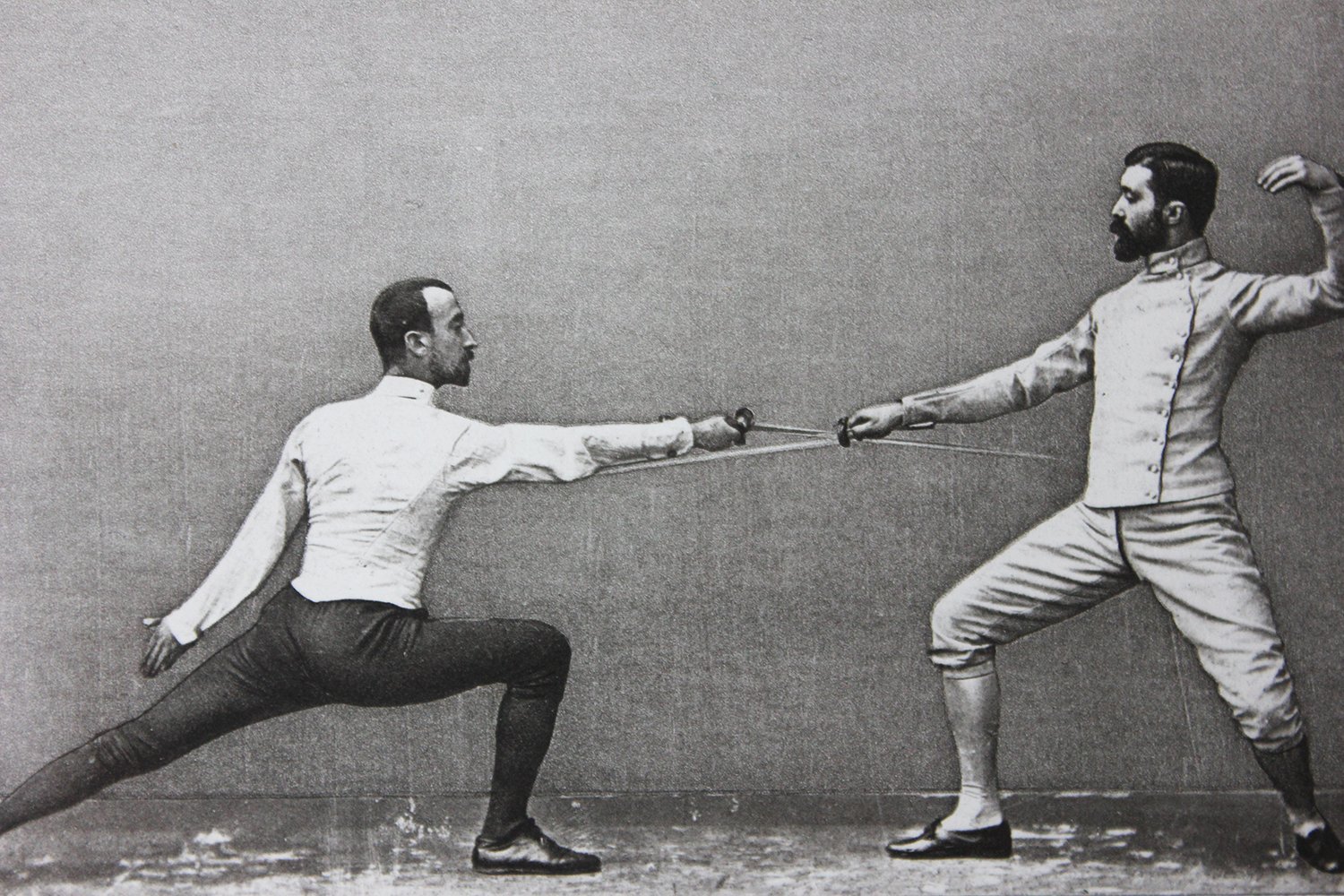
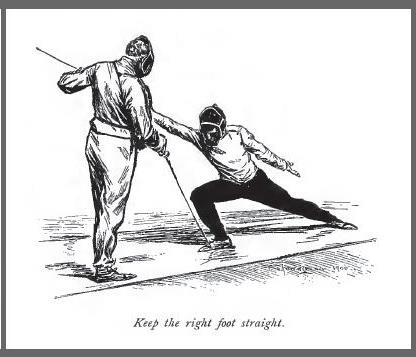
First image, “Parry in Seconde,” from The Badminton Library of Sports and Pastimes, Walter H. Pollock, E. B. Michell, and Walter Armstrong, London: 1893.
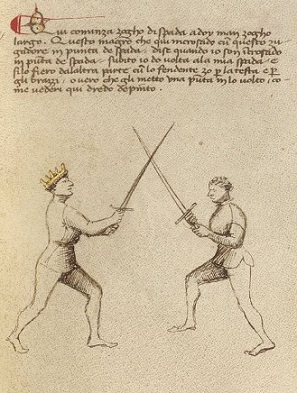
Second image, sword in two hands, zogho largo/wide play, play of the first master, Pisani-Dossi MS 19b-b.
One question I’m
asked about drills is to what degree they’re artificial, how they might set up
ideal or unlikely scenarios. A related question concerns whether or not there’s
a danger in having partners take turns making actions poorly, say in a stop-cut
drill. Taking this last question first the answer is “no” if an
instructor is on their game. Students, especially in their early training,
shouldn’t be drilling poor actions. Conventional wisdom and practice
demonstrate that the instructor should be the one exposing their arm for
stop-cuts, holding a poor guard, or making any other action defectively. The question
about artificiality, however, requires a longer answer.
In classical
and historical fencing our concern is to fence as if the blades are sharp, to
hit and not be hit, and so when a drill brings in maneuvers or plays that seem
to defy this ethos it’s only natural to wonder about their value. Students
often have assumptions about the nature of drill that informs this perspective,
and some of those assumptions are incorrect.
There are
different kinds of drills. Some we do solo, such as footwork drills or cutting
against a pell, mask, or fencing Oscar.[i]
Some we do with a partner. Others we do with an entire class. While “don’t
be hit” and “hit and don’t be hit” are our guiding principles,
applying these notions to every sort of drill, and each aspect of it, is
reductionist and can blind students to the value of a drill. All study, drill
included, should result in a style and method of fighting that illustrates this
guiding principle. However, not every drill or part of a drill need conform to
this absolutely all the time.
For a quick
example from sabre, let’s examine two maneuvers, the first being a common
compound attack, feint-cut head, draw the opponent’s parry of 5th,
and cut flank or chest; the second being the riposte to the flank from 5th.
Looking at the feint attack first, for it to work each partner has to act a
certain way. The attacker must simultaneously work a key offensive action, the
feint-cut, with a ton of technical movements designed to make that same attack effectively.
The instructor or partner on the receiving end, the defender, must do the same;
they must recognize and defeat the feint, and parry.[ii]
In the case
of the instructor, and you often see this in their posture, they’re not
necessarily mirroring exactly what an opponent would do, but performing those
parts that will help the attacker succeed in the drill. If the feint is
unconvincing, for instance, the instructor won’t parry and might counter
depending on what they’re working and how advanced the student is. Judging a
student’s readiness to go beyond a simple drill to a more complex version is
one of the more difficult tasks an instructor faces—so much depends upon
correct assessment.[iii]
In comparison
to the instructor, the case of the partner is more complex. On the one hand,
they need to help the attacker, just as the attacker will help them when they
switch roles, but on the other they shouldn’t be fencing in such a way that the
result is poor technique or tactically dubious choices.
Ideally, each partner is doing their best to make their half, offense or defense, work. The defending partner should use this opportunity to work on parries, specifically reacting to the cut to the head. For the basic set-up, this might be the goal in addition to gauging measure, working the feet, and maintaining the correct posture and hand/arm positions. One step deeper, however, the defender might have other options—they might for example, attempt to parry the actual cut after defeating the feint and then riposte. Drills usually start simply and develop into these more complex, multiple action versions as students advance in skill.
So far none
of this is “artificial,” but one thing students have asked me about
is the danger inherent in making that flank cut after the feint. Having drawn
the defender’s arm up into 5th, the defender’s arm is then poised
over the attacker making it possible to cut down onto the head. Isn’t that dangerous,
they ask. In a word, no, because the defender should be worried about the fact that they’re about to be cut in
the flank. Many fencers, because there is no actual danger decide to attempt a
counter as, or just after, they’ve been hit rather than parry. This brings up
an important aspect of fencing too deep to go into here, namely the priority of
the touch, but for our purposes here is making this kind of attack artificial?
Is it safe to assume that the defender will just accept the touch and not
counter?
If one is fencing as if they’re sharp, then one should never assume anything, but at all times attempt to cover oneself. One solution is to add a side-step with the cut to the flank. Assuming a right-hander, the attacker can extend the arm to make the final cut and lunge a bit to the left by extending the back leg out and to the left after or as the front foot lands. This does two things: first, it removes one’s head from being just under the opponent’s weapon, and two, it gives one just enough measure to cover in 5th or 3rd after the cut in case of counter-attack. This makes more sense after making the feint to head first, because from 5th the defender may still be able to retreat and make a molinello to the head.
On the other
hand, for the fencer riposting from 5th to the head, our second
example, things change a little—the riposte, having been parried, has lost its
momentum, so the fencer riposting to the flank has less to fear from the blade
over them. The fencer whose head cut failed now has a choice before them—they can
drop the blade on their opponent’s head, which remember has no momentum, or,
they can consider that fully developed cut speeding its way to their flank.
This is a simple choice if we apply the “fence as if they’re sharp”
rubric—the partner with the unsuccessful cut to the head should be considering
how they are going to parry that incoming cut. Whatever damage dropping the
blade on the attacker’s head might do, it’s likely going to be much less than a
fully developed cut to the flank.
The greatest danger of artificiality here is not in failing to account for that blade poised above one’s head, but in forgetting to behave as if both blades are sharp. When we forget that, we too often make actions we would never make (one hopes) were we fighting in earnest. But, if we cultivate the notion that the blades are “sharp,” then we’re more likely to make better decisions; in the example above, as the defender we’re more likely to worry about not getting hit and thus parry rather than go for a counter that will only mean both fencers are hit.
Ideally, the
only “artificial” aspect of drill should be our cultivated sense of
danger. No drill is worth the name which trains poor technique or tactics. This
is especially true with partner drills. There is an inherent argument here,
namely that instructors ought to be the only ones to present examples of poor
technique. However, this is no less dangerous for them, so it behooves every
instructor to continue to take lessons, to remain a student, so that they may
not include pedagogical tools like an open line or exposed arm in their own
assaults.
[i] This is what we called
them, but there are probably other names—an “Oscar” is a mock
opponent, often set up on a wooden frame, covered with jacket or similar
material, a mask, and often with an adjustable arm to shift a blade to
different positions.
[ii] This will vary with the
level of the fencer. An instructor or senior student might not defend as
effectively if focusing on a newer student learning this attack.
[iii] In his Fencing Illustrated (1670), Ch. XIV, Giuseppe
Morsicato Pallavicini discusses this very issue. The first bout a student has
should be with the instructor. Even when assigning a new student to work with a
more experienced one Pallavicini tells us that the instructor must supervise them.
See Giuseppe Moriscato Pallavicini, Fencing
Illustrated, Trans. by Christopher A. Holzman, Wichita, KS: Lulu Press,
2018, 91-98.
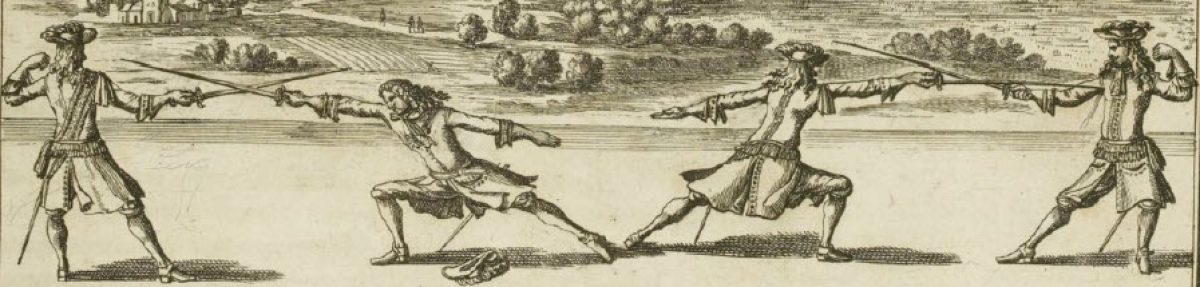






 Drill is a mainstay of fencing. We do footwork. We practice point control. We make molinelli in the air and at a target. We (should) be doing a lot of drill. In historical fencing we sometimes devise or find ourselves doing drills that are new, concocted out of our source material, and it’s a fair question to ask what might be signs that a drill isn’t up to par or might even be dangerous? What does it take for a drill to be “safe” when we’re talking about hitting people with weapons? Different types of partner drills require different levels of complexity, intensity, and safety-gear. The instructor has primary responsibility for introducing safe drills and monitoring how fighters are managing safety, but there’s an equally heavy burden on fencers performing the drill. They need to exhibit proper control and courtesy or they’ll injure their comrades and injured comrades mean fewer people to fence with.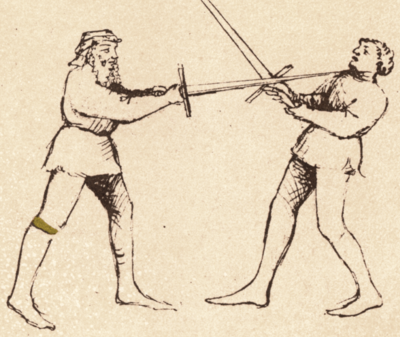
 Capitale Escrime Historical Fencing