[14 Nov. 2023] It’s been busy lately, but I finally had a chance to make improvements to my three part series on the demi-pointe lunge. It is important to recognize a colleague’s contributions, and to that end I would like to thank Ian Brackley whose knowledge of both smallsword and 18th century history have done much to bolster several points I make. Even better, he provided another perspective on the protruding piece of leather on some fencing sandals–I have made sure to include his ideas in part three where footwear is covered. He raises an excellent alternative or additional reason for these bits of leather, and it is important to share it. Ian also shared a few more resources with me, down to page numbers, passages, and select images, some of which I missed in my own readings, some of which are new to me. Few people ever take me up on my offer in these papers to add additional information, proper criticism, or corrections, but when they do, and have the delicacy and sincerity Ian does, it only makes a paper better. IF you see this Ian, again, thank you.
NB: for those to whom this topic is new, and who are wondering why I spent so much time on it, I’m happy to explain. Reading the articles one might think that there is a major movement of people who think one should land on the toes or balls of the feet in historical fencing–I don’t believe this is true. Happily, most people don’t seem to have fallen prey to this interpretation. However, there are enough people out there (usually Scadians) who do buy into it that one may run into the notion, or, see yet another one of the queries about it that pop on some social media platform with some regularity.
It came up, again, for me earlier this month during Russ Mitchell’s recent seminar at Northwest Armizare. One of my fellow seminar-goers, when asked if we had questions about movement, was quick to ask whether one lands on the heel or balls of the feet when lunging. The person in question is also in the SCA, the likely origin of this garbage, and from the timbre of his inquiry thinks little of my study (or didn’t read it or did and doesn’t agree with it). Lest one think this is some manner of paranoia or arrogant assumption on my part, I was not the only one who found the question jarring and out of place in the discussion. Most advocates of the toe-tapping lunge tend to dig in when asked about it, so this isn’t unusual.
The purpose of the study is mostly to offer people an examination of the arguments people have presented for the demi-pointe lunge, and, how those arguments fail to hold up. There is no support for it in the sources. A number of those works they cite they have, quite clearly, misunderstood or misinterpreted.
If the snarky question at the recent seminar is any guide, no evidence, reason, or number and variety of proofs will sway those who, for whatever reason, find this daft way of landing appealing. People believe what they like. However, for those of us for whom evidence and reasoned analysis matter, my hope is that these articles will afford them some ammunition should they have the misfortune to run into this remora on the belly of historical fencing.
[A short review/overview of the Hussar Sabre & Fokos seminar featuring Russ and hosted by Mike Cherba and the folks at Northwest Armizare, Sherwood, OR, USA, 4-5 Nov., 2023]
Hussar Sabre & Fokos Seminar, 4-5 Nov., 2023, with Russ Mitchell, hosted by Northwest Armizare
A core aspect of teaching, of the Art, is remaining a student. Whenever I can, I take lessons, classes, any seminars to learn, unlearn, or improve, because we’re never finished learning. As my old kendo master once shared, even at his level his own master would fix things as elemental as his grip whenever they met up. In tandem with cultivating a student mind, I encourage my own students (when they’re ready) to seek out other teachers, and, better fencers.
This past weekend I had another chance to work with a better fencer, the excellent Russ Mitchell (Winged Sabre Historical Fencing, Irving, TX, USA), and explore new material. [1] One of the traditions Russ learned while in Budapest was a broken lineage for sabre, one adapted to the unique needs of early 20th century soldiers in greatcoats, carrying packs, and either in ranks or in trenches. Professor Hidán Csaba, with whom Russ studied in the late 1990s, learned this system from his grandfather, a drill master in the later years of the Great War, and from his grandfather’s friends. [2] Russ will be the first to add that we lack much of the pedagogical apparatus for the system, but through study and his time in Hungary, he is confident that much of the physical game is correct. If I may offer a proof for it, I have found fencing his students extremely difficult—they are not duelists where most of us, whether we admit it or not, are.
Movement & Bones
Among the many hats Russ wears he’s also an expert in movement. A student of the Feldenkaris Method, his approach to martial arts includes many of the tenets of the Method, and, for the better. [3] To be quite honest, I had not heard of FM until this weekend, but have now seen, firsthand, its effectiveness. In grade school I fractured my right wrist badly—the bones were all but poking out of the skin. It did not set super well, and so for decades I’ve not been able to supinate fully. Years of fencing, racquet sports, etc. added layer upon layer of compensation for this issue. Then, in 2001, I was in a serious auto accident, one that injured my shoulder and released all the horrors that might not have appeared until later, tennis elbow chief among them.
Sunday, before the second day of class, Russ kindly took a look at my arm. We chatted first and I gave him the history and general problems I experience with it. He examined my arm, had me perform a few exercises, and then had me supinate again. I believe I said, well, shouted, “WTF…” in disbelief. Where I had been able to turn my hand maybe 120 degrees on a good day, here I was supinating to about 170 degrees. I couldn’t believe it. I have homework to do, and I’ve never been more motivated to do it, but I have far more mobility in my wrist, and best of all, did not experience the usual, weekly night of hell with a neck and backache I cannot treat save through heat, ice, and leaning into the pain. [4]
Lest one think that the seminar included certain smokable plants and esoterica, it didn’t. Russ explained much of what we were doing in terms of what bones, muscles, and tendons were working at any one time. The first half of Saturday, for example, explored balance, weight-shifting, and the biomechanics of the lunge. I said last April that Russ had changed my understanding and approach to teaching the lunge—this portion of the class added to that understanding, and, as before, though we spent a LOT of time lunging, no one was tired. For anyone who has spent time in an Olympic school and knows how challenging footwork drills can be, that should reveal just how effective Russ’ system is.
Hussar Sabre
Following the lunge portion, we then learned the rudiments of the Hussar sabre system Csaba imparted to Russ. The footwork, cutting mechanics, and options this system uses are simple, but not simplistic. The videos that Russ has shared on YouTube will give one a far better idea than any description I provide can, so please see the link below to his channel. [5] Of note, this is an unforgiving, effective, and brutally efficient system of sabre.
Russ and Noah demonstrated how to parry low-line
Significantly, this system assumes a curved sabre, and, takes complete advantage of false-edge cuts. Measure is generally closer than someone from my background is comfortable with, but this said it fits the system well. The first four cuts, one through four, bisect the target in an “X” formation: cut 1 descends from the right, cut 2 from the left; cut 3 ascends from the right, 4 from the left. There are other cuts, including horizontal blows, but we spent the most time with 1 and 2, and, options from there as both attacker and defender. This was especially valuable to me as having fought a school of people using this system, and knowing how challenging it is, I know have a better idea of how it works.
Fokos
Sunday we started out with more bio-mechanic work to prep us for working with the fokos or shepherd’s axe. Sometimes described Stateside as a long-hafted tomahawk (an apt analogy), this axe was long-used by shepherds, but was also used in the Great War. Russ showed us the military application he was taught, but also some of the “folk” uses. The latter, for example, might help one collar old uncle Boris after he overindulged at the pub. Like the sabre, one is using more of the hips and torso to propel the weapon and block. This means that one turns to stay behind the weapon.
One thing I did not anticipate, it not being my thing, was the amount of grappling one can do with the fokos, either against someone without the weapon or with one. The hooking ability of the axe can bind up not only an opposing fokos, but limbs. We explored this aspect in the “folk” portion, and like most folk arts a fair amount of learning how to use the axe to assist grappling is experimental. Russ armed us with a few principles, demonstrated a few set-ups, and then had us play with these actions and ideas.
The military portion was more intuitive for me as the starting position is one shared with bayonet. That is not an accident. Given the weight of the average rifle ca. 1915 the fokos makes for a much faster, nimble tool. Our brief exposure to this weapon only increased my sense of horror that attended trench warfare. [6] It’s a delightfully nasty weapon.
Take Aways
Russ told us our brains would be full and he wasn’t wrong. I’m still processing a lot of what we covered, never mind reeling from the fact I can supinate on my right side now. That still seems unreal.
At the risk of sounding sycophantic, Russ is one of a handful of instructors whom I would advise anyone to work with regardless of what he’s teaching. His knowledge is as deep as it is varied, his skill impressive, and he has a fantastic sense of humor. Moreover, and one sees this is his books, Russ is aware that not everyone is 19 and a paragon of fitness. As easily the oldest person at the seminar this weekend, I might have special appreciation for this fact, but what this means is that regardless of one’s shape, ability, or fitness level, Russ can and will work with you, and, you’ll get something out of it. A lot of something.
In addition to his videos (see link below), Russ is a prolific author, and produces works that combine the rigor of his academic training with an ease of reading that is often rare in our field. Buy his books and read them; watch his videos; and if you have a chance to take a class with him, whatever it is, take it. You need not thank me, but you might wish to. [7]
[4] I have spent a lot of time, off and on, studying both yoga and MBSR (mindfulness-based stress reduction), the latter thanks to the cancer program at OHSU (see for example https://www.apa.org/topics/mindfulness/meditation). Much of what we covered echoed what I have learned in these disciplines as well as in various PT sessions for injuries.
[6] My paternal grandfather fought in the Great War, and though he didn’t like to talk about it, I learned from my own father that between the sound of gas canisters and trench warfare, it was utterly terrifying. I can’t imagine having to face one of these axes–they may look small and delicate, but they’re effective and quick.
“Show, don’t tell,” was some of the best teaching/writing advice I ever received. To that end, I’m adding some specific drills to illustrate what I shared in the last post on this topic better (https://saladellatrespade.com/2023/10/31/yes-yes-very-nice-but-how-cultivating-defense/ ). Many, if not most of these drills, are venerable—if anything I may have adapted things here or there, but all of what follows are standard drills or types of drills. [1]
These progressive option drills start with a basic action and build in complexity. If a student is new or struggling, one may stop with the first version and work on that, or, aspects of it. For more advanced students, one can add an additional layer of difficulty as required. In the first example, for smallsword, one could simplify the drill even more by having the student initially deny the engagement and break measure. This would observe the “don’t get hit” rule, but not set them up well for a strike of their own.
Two things I didn’t add below, but which apply are first, that it’s important to switch roles, that is, have both the student and instructor initiate the action. This gives the student a chance to act as attacker and defender. Second, movement and varying distance is critical for success. If one starts “firm-footed,” that is, in place, fine, but then add movement. Chase the student, have the student chase the instructor; start out of measure, start in measure. For more advanced students, another option we can layer in is varying tempo and speed.
Drills & “Realism”
On their own, there is little inherent in most drills to make them impart a defensive mindset automatically. All the drills I provide below, for example, can be gamed to current tourney standards easily if one wishes. How “realistic” or not they are depends on explanation and reiterating correct principles over and over and over again within each element of the drill.
One of the most frequent questions I get in drills and lessons, and a good one, is “but why wouldn’t I just do this?” This simple question has become one of the single most important ways in which I push correct mindset. To cite one example from this past week, one student in a smallsword class asked me why they couldn’t just disengage and thrust against the glide in third. I told them that they could, but then asked what would happen if they did—what is the opponent doing? If the opponent is gliding to target, and one ignores that to strike… one is still hit. Not good enough. IF one wishes to disengage in response, fine, but don’t do so into absence, do so with opposition in the new line, a shift of the body to one side, or both. [2]
Ex. for Smallsword:
Option Drill with the Glizade/Glide in Third
To Start: S [student]: in guard of third I [instructor]: in guard of third *engaged on the outside line
Option 1A: Student Attacks
S: finds measure and gains weak of I’s blade with middle of own [3]
S: performs glide in 3rd, maintaining opposition, and strikes target (forward target or chest)
2A:
S: finds measure and gains weak of I’s blade with middle of own
S: performs glide in 3rd, maintaining opposition, and thrusts
I: parries 3rd, ripostes; S. parries in 3rd and ripostes [4]
3A
S: finds measure and gains weak of I’s blade with middle of own
S: performs glide in 3rd, maintaining opposition, and thrusts
I: parries 3rd, begins riposte; S. disengages, engages in 4th, thrusts to target with opposition
4A:
S: finds measure and gains weak of I’s blade with middle of own
S: performs glide in 3rd, maintaining opposition, and thrusts
I: makes dérobement to avoid glide and engages in 4th
S: via circular 3rd, retakes line and glides in 3rd to target
Option 2A: Instructor Attacks
I: finds measure and gains weak of I’s blade with middle of own
I: performs glide in 3rd, maintaining opposition, and thrusts
S: parries 3rd, ripostes
2A:
I: finds measure and gains weak of I’s blade with middle of own
I: performs glide in 3rd, maintaining opposition, and thrusts
S: parries 3rd, begins riposte; S. disengages, engages in 4th, thrusts to target with opposition
3A:
I: finds measure and gains weak of I’s blade with middle of own
I: performs glide in 3rd, maintaining opposition, and thrusts
S: makes via dérobement avoids glide and engages in 4th
I: via circular 3rd, retakes line and glides in 3rd to target
S: parries in 3rd, ripostes
Ex. for Rapier:
Finta Scorsa or Advancing Feint of Marcelli
To Start:
S: in guard of prima
I: in guard of third
Option 1A: Student Attacks
S: in prima, makes false attack to the high inside line
I: parries in 4th
S: via cavazione /disengages to outside line, and strikes target (forward or chest)
2A:
S: in prima, makes false attack to the inside line
I: parries in 4th
S: via cavazione /disengages to outside line; I parries 3rd, begins riposte
S: parries in 3rd (or 4th depending) and ripostes, striking target
3A
S: in prima, makes false attack to the inside line
I: parries in 4th
S: via cavazione /disengages to outside line; I parries 3rd, begins riposte low-line
S: takes 2nd, ripostes with opposition
4A:
S: in prima, makes false attack to the inside line
I: parries in 4th
S: via cavazione /disengages to outside line; I parries 3rd, begins riposte low-line
S: takes 2nd and thrusts; I. parries 2nd, begins riposte
S: parries 2nd, ripostes with opposition
Option 2A: Instructor Attacks
I: in prima, makes false attack to the high inside line
S: parries in 4th
I: via cavazione /disengages to outside line, and thrusts
S: parries in 3rd, ripostes to target
2A:
I: in prima, makes false attack to the inside line
S: parries in 4th
I: via cavazione /disengages to outside line; S. parries 3rd, begins riposte
I: disengages to 4th, starts riposte with opposition
S: disengages to 4th, ripostes with opposition to target
3A:
I: in prima, makes false attack to the inside line
S: parries in 4th
I: via cavazione /disengages to outside line; I parries 3rd, begins riposte low-line
S: takes 2nd and thrusts; I. parries 2nd, begins riposte
S: parries 2nd, ripostes with opposition
I: with parry in 2nd, passes left foot forward in order to seize guard
S: steps back, attacks to body
Ex. For Rapier and Dagger:
Working from Mezzaluna (Marcelli)
To Start:
S: in guard of mezzaluna
I: in fourth guard [5]
Option 1A: Instructor Attacks
I: in fourth guard, makes attack to the inside line
S: parries with dagger; with sword ripostes to target (forward or deep)
2A:
I: in fourth guard, makes false attack to the inside line
S: attempts to parry with dagger (downwards and out)
I: disengages to strike hand
S: parries with dagger (upwards and out), ripostes with sword to target
3A:
I: in fourth guard, makes beat attack against sword to open the inside line
S: parries in 4th to close line, ripostes with opposition
I: parries with dagger (upwards and out), ripostes with sword inside line
S: parries with dagger (downwards and out), ripostes to arm
Option 2A: Student Attacks
S: makes false attack to face
I: parries with dagger (upwards and out)
S: disengages and strikes arm or hand
2A:
S: makes false attack to face
I: parries with dagger (upwards and out); ripostes to arm
S: disengages and strikes to arm or hand
I: parries with dagger, ripostes
S: parries with dagger (downwards and out); ripostes to arm
3A
S: makes false attack to face
I: parries with dagger (upwards and out); ripostes to arm
S: makes circular parry in 3rd; ripostes via glide to outside line
I: parries in 3rd, checks with dagger, ripostes in high line over engagement [6]
S: parries with dagger (upwards); shifts right, ripostes to body
Ex. for Sabre:
Options from an Engagement in Second
S &I: in 2nd, at punta spada/last third/weak of the sword; then, start out of distance
Option 1A: Student Attacks
S: cuts over to threaten face with feint via half thrust
I: moves to parry in 1st
S: a. performs molinello ristretto or coupé to the arm [7] b. performs molinello ristretto via rising cut to the bottom of the arm
2A:
S: cuts over to threaten face with feint via half thrust
I: moves to parry in 1st
S: performs molinello ristretto via rising cut to the bottom of the arm
S: secondary attack: pushes through to thrust or cut flank
3A:
S: cuts over to threaten face with feint via half thrust
I: moves to parry in 1st
S: a. performs molinello ristretto or coupé to the arm
I: parries 3rd, cuts to head
S: parries 5th, cuts via molinello to head
4A:
S: cuts over to threaten face with feint via half thrust
I: moves to parry in 1st
S: performs molinello ristretto via rising cut to the bottom of the arm
S: secondary attack: pushes through to thrust or cut flank
I: parries in 2nd; ripostes via thrust
S: makes ceding parry in 2nd, ripostes via thrust to target
Option 1A: Instructor Attacks
I: cuts over to threaten face with feint via half thrust
S: moves to parry in 1st, parries via molinello to head
2A:
I: cuts over to threaten face with feint via half thrust
S: moves to parry in 1st
I. disengages and cuts to arm
S: parries 3rd, cuts head
3A:
I: cuts over to threaten face with feint via half thrust
S: moves to parry in 1st
I. disengages and cuts to arm
S: parries 3rd, cuts head
I: parries 5th, cuts to flank
S: parries in 2nd, thrusts to target
NOTES:
[1] To name one example, and analogous to the first one I share here, there is the discussion of options facing an opponent in 4th in Charles Besnard, Le maître d’arme liberal, 1653, 43 (63 [orig. French] and 161 [English] in the translation by Anne Chauvat and Rob Runacres, The Free Master of Arms, Glasgow, UK: Fallen Rook Publishing, 2022).
[2] The use of the inquartata or demi-volte, for example, would work in this instance.
[3] Two ways to vary this are to have the student find measure by a short extension of the arm from critical distance, in order to gain the weak with the middle of their weapon, or, have them step into measure to engage. The first is more conservative, but the second option is important—ideally, students learn to find measure and exploit it both ways.
[4] As set up here, the final actions are a battle of ceding/yielding parries and glides. Both help students cultivate better awareness of presence, varying pressure, measure, and opposition.
[5] Marcelli’s fourth guard for rapier and dagger is depicted thus:
Marcelli, Rules of Fencing, “fourth guard” (L) and “mezzaluna (R)
Mezzaluna, on the right, needs explanation. Chris Holzman points out that Terracusa e Ventura (1725) remarks that the tips of the two weapons are close enough to form a “half moon” shape. Here, there is a much wider gap between them. The accompanying text, however, tells us that the fencer “carries the dagger forward covering all the upper parts in such a way that the opponent only sees the chest below the dagger as target to strike.” [Holzman, Marcelli, Rules of Fencing, 1686, Wichita, KS: Lulu Press, 2019, 273; see also n. 115 that page.
Hà portato il Pugnale avanti, coprendosi tutte le parti superiori, di modo che il nemico vedesolo per bersaglio da colpire il petto per le parti di sotto il Pugnale [Marcelli, Regole della Scherma, Lib. I, Cap. III, 4]
[6] Here, the instructor, having parried the incoming sword in 3rd, uses the dagger to hold the opposing weapon in place in order to swing their weapon around obliquely to the right and up (assuming a right-hander) in order to threaten the face.
[7] The coupé , in Radaellian sabre as taken down by Del Frate, is also known as the colpo di cavazione or cavazione angolata. It is made by bending the forearm back a bit to increase power. Chris Holzman, in his gloss, remarks that it’s similar to the last step of the molinello. See Christopher A. Holzman, The Art of the Dueling Sabre, Staten Island, NY: SKA Swordsplay Books, 2011, 234.
Joshua and Noah, two of CEHF’s “Death Needle Cultists,” drilling 29 Oct. 2023. The drill was “foil tag”
This past weekend, while mixing with some of my favorite fellow Death Needle Cultists at Capitale Escrime in Salem, Oregon, one of our number informed me that they had started reading my last two posts. [1] Not going to lie, any time someone tells me they read anything I write it’s nice to hear, but given that the handful of people who do are—for the most part—not in North America it’s a double treat when I encounter a person who reads these posts and lives Stateside. He related that he found what I had to say in re defense over offense in historical fencing appealing, but wanted to know just how one can better cultivate that preference. Damn good question.
What follows are a few suggestions for ways to incorporate the notion of “don’t get hit” into both lessons and partner drills. For the former, this is advice to fellow instructors, and it will read a little differently than the recommendations for students. It’s not that a teacher’s perspective won’t help students, because it should, but that it falls to instructors to make what we call “purposeful mistakes” in order to train fencers. No fencer, least as I see it, should be drilling poor actions. That may be my former competitive experience speaking, but I think it makes sense and holds as a general principle.
Start at the Beginning
The first and most important thing one can do is assess their current thinking and approach, honestly, and see where it may fall short of the “don’t be hit” rubric. How often does one choose to parry over counterattacking, and, how often is one hit when they do so? How often does one double? At what distance is one in most bouts? Does one use measure or jump in and slog it out? How often is one hit when attacking?
The answers to these questions, importantly, cut both ways. As I attempted to point out in the last post, we don’t fence alone and what our partners in the ring or on piste are doing matters too. If, for example, one selects the right time to attack, at the right measure, and makes a decent action, but is continually hit as they do so, it may be that one’s opponent is making the mistake. They may be counterattacking rather than parrying, for example, and though one is “hit,” the fact is that the opponent should have defended. There is considerable static around this issue for most of us—in the quest to be honest we can easily gaslight ourselves into thinking we just aren’t doing something right when in fact we are, or, arrogantly, we can assume we are doing it right and that everyone else is making errors. Both poles present problems. Objective, well-trained third parties can do much to reduce the static.
One’s instructor (provided they have the necessary training) or one’s skilled colleagues can assist in assessing where the faults are. One caveat: we have to be open to criticism for this to work, and, those providing the insights succeed best when these evaluations are shared with compassion and in the spirit of collective improvement. If these keen eyes discover critical mistakes, say an arm too open on the attack, the body moving before hand and weapon, or that one is always in close measure, then these are good places to start corrections. This is a strong argument for teaching fencers how to analyze actions and bouts.
Mindfulness & Defense
I chose “mindfulness” purposefully and not in the sense of tired suburban affirmative wall art. [2] I mean it literally—we have to focus on defense consciously. We should anyway, but because we fence with friends and are thus not fighting for our lives, and because we wear safety gear and are thus unlikely to be injured, it’s super easy not to think about defense. We assume it without realizing that we are assuming only actual injury, not the theoretical injury we incur when making poor decisions in a bout. Consider, for example, how many times we are hit in the average practice. We get used to it and lose the fear we often have just starting out. To combat this, we must actively think about defense.
To do this with any success means emphasizing defense in every aspect of our practice. We have to create a culture of it. I try to reinforce this a few ways, but perhaps the most important is in always treating the weapon as if it’s sharp and all actions as if one might be hurt should they be struck. For example, I often discuss the extension of the weapon as projecting “the sharp thing” toward one’s opponent. In demonstrating and explaining a particular action, in evaluating an exchange in a bout, in answering questions, in any and every way I can I treat and attempt to project a sense that we are training as if we were going to need these skills. It’s artificial, but I’ve seen firsthand how it changes the way people fence.
scarto, from Masiello
The same language and attitude permeate all instruction. For example, in teaching Radaellian molinelli and the scarto, I explain why the latter is critical in certain actions. The molinelli are large cuts, made by rotating at the elbow, and thus can expose the arm if one is in measure. The scarto, because it means we start the cut leaning back (so just out of distance) and let the cut pull us forward reduces the chance of a stop-cut as we attack. Often, a student will ask what to do if someone counterattacks anyway. It’s a good question, but also an opportunity to reinforce the reality of the sharp thing—assuming one made the molinelli at the right time, from the right distance, then the opponent—if they’re smart—should have only one thought: stopping that giant cut. In “HEMA,” sadly, more often than not people choose to race to strike and arrive first, but wholly ignore the theoretical reality behind this choice. Defense is conservative—given a choice between a chancy stop-cut and the security of a parry, the parry is the better option.
Practice like The Blades are Sharp
Announcing that everyone should treat the blades as if real at the start of class or lesson is not enough. We have to create and maintain that attitude throughout practice. Here are a few ideas that emphasize different aspects of fencing defensively.
Mask Tag/Foil Tag: this is a drill that reduces everything to two options. The purpose is to get people moving and to consider how measure not only helps them reach target, but also avoid being one. In the sabre version, Mask Tag, students can only make a cut to the top of the head. That’s it. They cannot parry, only use their feet to evade. I remind them that it’s best to attack when someone is in negative balance or occupied, when they are about to step or make an action, when they are recovering into guard. Much of the game then consists of attempting to lure someone in to take advantage of the opponent’s initial action, or, luring them in to attack so that they fall just short of target and then strike them as they recover. For smallsword and rapier, the drill is the same only the attack is restricted either to the forward target or torso (thrusts only). One variation on this is to then allow each fencer a single parry-riposte in their bout; this means having to select the ideal time to use it.
Only Parries: in this style of bout, one can attack or defend, but cannot make any sort of counterattack. The goal is to focus on defense, and, condition fencers to the choice to parry over attempting attacks into tempo. When first introducing it, fencers often realize just how often they are reacting with counters automatically, a key first step to converting what is automatic to what is chosen.
In Drill: no matter what partner drill I have students do, no matter what weapon, from the initial demonstration and explanation to feedback as I circulate through the pairs, emphasis is on making the actions the way one would were the weapons sharp. It is easy to get lazy in drills, to go through the motions, especially if the drill is familiar. Part of my job is keeping everyone vigilant, reminding them that the glizade in tierce must successfully create opposition as it goes to target, that the beat in sabre must shift the opposing steel from the line and not just make contact to work, and that counterattacks work best if there is time both to strike in tempo and parry riposte.
In Bouting: it’s not always possible to provide a director for each bout, so I put the onus on students. In their bouts, I encourage them yet again to proceed as if it getting hit would send them to the hospital or the dirt. When I can direct them, at the halt I’ll have them analyze the action, provide some feedback, and then we collectively check what happened against the “don’t get hit” rule.
Instructors and Cultivating “Realism”
Though a strong advocate for collaborative learning, much of the culture of a club is set or directed by its instructors. We tend to attract, or at least retain, those with a similar outlook or who come to adopt our perspective. It is easiest for us to inculcate a sense of realism in individual lessons; they’re just more focused since we’re only working with one student.
Everything above holds in individual lessons as well, but in this context we can do something our students shouldn’t do on their own—present them with poor actions to exploit. In terms of pushing better approaches or correcting ones already in play, time spent one-on-one supporting or rebuilding a student’s particular skills can do much to improve their overall performance and understanding.
For example, often as a warm-up or cool-down, I have students work counterattacks. For smallsword and rapier this is typically an arrest drill; for sabre this is usually a stop-cut drill. I see this as not only good eye-hand-foot coordination exercises, but as ways to hone the way they should be viewing counterattacks. To reiterate I’m not against counterattacks, they have their place, but I am against overuse of them and want them made correctly.
Arrest/Parry-Riposte: I approach this the way my masters did it and how they taught me, that is, I chase the student by walking forward with a poor attack. In smallsword and rapier (or foil and epee, whatever you’re using), this means attacking from third or sixth with the inside of my arm more exposed, then the outside, then the underside. The student takes measure (a critical step) and makes the arrest to the exposed target, but importantly then adjusts again in order to parry my attack and riposte. What I do is simulate an attack that doesn’t stop, though when the arrest is made really well it will, quite literally, arrest my arm.
It might help to visualize it this way. To make the counter, the student reaches out to strike as they begin the initial retreat; they either land it or miss and then immediately take another small or half step back to parry and riposte.
Stop-cut/Parry-Riposte: the sabre version is exactly the same only I substitute cuts for the thrusts to the inside, outside, and underside of my arm. For more advanced students, I will have them make stop-thrusts as well. In Radaellian sabre our preferred guard is 2nd, and thrusts from 2nd, followed by parries in 1st, 2nd, or 5th (sometimes referred to as the “first triangle” of parries) are quick to perform.
Perhaps the greatest value in drilling counterattacks this way is that it conditions fencers to make counterattacks at the right time and from the right distance. So often in HEMA counters are just knee-jerk reactions to motion toward one, whether threatening or not. Critical in this drill is the instructor’s follow through—unless the arrest or stop-cut actually stops the arm, the instructor should not break off the attack. The student should be forced to consider defense and parry or at the very least, if the arrest was successful, break measure to remain safe. With period weight weapons this is easier to do, but regardless the student must face in drill what they will realistically experience in the assault.
The Right Atmos
If we fight as we drill (I think we do), then reproducing as faithfully as we can actual conditions, that is conditions that assume the sharp point and edge, we’ll only help our students realize and achieve a more thoughtful, accurate, and sensible bout. For coaches, whether taking some drill from synoptic tables, a treatise, or devising them oneself, be sure to ask how realistic the drill is, and, what steps one needs to take in order to support students in making combat-logical decisions. [3] For students, conceiving of drills not only as skill-building exercises, but also as opportunities to reflect upon the originally deadly purpose of what we do, can do much to make us more effective fighters, as well as help us appreciate just how beautiful and well-designed past fight systems could truly be.
NB: obviously this post addresses those who are more concerned with achieving some semblance of realism in historical fencing. Not everyone cares so much, and that’s fine. It’s important to me, because I don’t really understand the point of historical fencing otherwise, but I recognize that there are different points of view, that we get into this stuff for different reasons. It is not my intent to disparage other points of view—I may not agree with them, but I see no reason to put others down for the choices that make them happy. You be you.
NOTES:
[1] Though we have not settled on it yet, there is a fair chance that Capitale Escrime will either change the name to “Death Needle Cultists” or incorporate it say as a tag-line, e.g. “Home of the Death Needle Cultists.” It’s catchy and might attract more to the cause.
[2] There is nothing wrong with mindfulness, save when used by snake-oil gurus, but this said I typically have some of the lyrics from Jonathan Bree’s “You’re so Cool” in my head whenever I see the word. Cf. https://youtu.be/gxRq23qVE8A?si=VdbPsGIi4bwR0I9U[3] By combat-logical decisions I mean those one might make should the blades be sharp. With older works, those from a time when the sword was still a reality in war or personal quarrels and/or self-defense, drills more likely reflect the concerns of those who relied on instruction to preserve their lives. This is not, however, universally true. Many late 18th and 19th century works geared more for academic foil play rather than smallsword can include actions that would be unwise on the ground. To name one example, the extremely high hand in lunging that one sees in works like that we see in La Boëssière (1818) is extreme. Earlier works recommend a hand-height generally between the mouth and nose. Cf. https://saladellatrespade.com/2022/11/11/reach-for-the-sky-hand-height-in-the-smallsword-lunge/
This post is a follow-up to the last [“They Doth Cut too Much,” Methinks, 19 Oct. 2023] and takes up, again…, the issue of how we make a touch. This issue has been on my mind a lot in part because of teaching, but also because my current book project requires me to explain the challenge of hitting without being hit as simply and clearly as possible. While I’ve discussed this often, which is to say like the drone of a bagpipe in a particularly long air, it’s one of these critical issues that we can never really emphasize enough. The proper mindset determines everything we do.
In brief, rather than focusing on making the touch, we should focus on trying not to be hit. It’s easy to say, but far harder to put into practice. The old adage “nothing ventured, nothing gained” might work in dating, but it’s rubbish as a maxim for self-defense. We focus too much on offense. While the same conservatism would help Olympic fencers, it’s less necessary for those in foil or sabre thanks to the conventions of right-of-way (ROW); epee fencers, on the other hand, would certainly benefit. If the entire point of historical fencing is to approach as best we can how swords might have been used in the past, then fencing in ways that run counter to that ethos is nonsensical.
“HEMA,” the popular expression of historical fencing, has been around long enough that it’s likely that many newer fencers, because they have not had to face the issues that helped create the movement, may be wholly unaware of the place that attempting realism had/has in shaping “HEMA.” To enter this world now is, for the most part, to enter a sword-based sport similar to Olympic fencing, only without the pedagogy, organization, and recognition. This means that many fencers in “HEMA” are, in good faith, learning to approach things more concerned with competitive rule-sets than the logic of the sharp point. So ingrained is the competitive outlook that even those not actively competing often adopt the same methods and mentality. Social media, YouTube, and a few of the organizations, such as the HEMA Alliance, present a seemingly unified mode of play and purpose.
As a caveat, there’s nothing wrong with competition—despite all the bitching I’ve done here about problems with it, the fact is I like competition and have enjoyed it myself. The longer I look at these problems, the more convinced I am that many of them, such as doubles, obsession with the afterblow, etc., all might be remedied by better attention to defense rather than making the touch.
The Logic of the Sharp Point
At the risk of sounding reductionist or like yet another would-be western Zen guru, in the end there is nothing but the sharp point. It is all that matters. The entire purpose of fencing is defense—it’s in the name. “Fencing” derives from Middle Engligh fens, a shorter version of defens, a word used to denote defense, resistance, even fortification (the ME term ultimately comes down via medieval Latin defensum). Italian scherma and French escrime both derive, originally, from a Frankish word, skirmjan, “to protect or defend.” [1] While the denotation of words over time often change, it is worth noting the consistency in the meaning of the terms for fencing, and, how the source tradition reflects the same concern behind what these words mean. Sure, we read a lot about offense, but no master I can recall suggests rushing into the fray minus concern for personal safety or suggesting that winning a contest via afterblow is legitimate.
Maestro Nick Evangelista, so far as I know, is the origin for this phrase, the logic of the sharp point, but what he describes is, and should be, self-evident. [2] Every action we make, every decision, should reflect this logic. Having watched Olympic sabre tank in the 1990s, and having the misfortune to watch HEMA make many of the same mistakes ever since, I believe that this same logic should be present in competition. When it is absent, we see a lot of, to put it bluntly, stupid actions.
It is human nature to game systems, to find ways to work around them. We love loopholes. I’ve not stayed current on the latest trends in bio-social-anthropology or evolutionary psychology, but the studies that emerged when I did were sobering. Put briefly, if people believe they can get away with something, they’ll go for it. [3] As great a tragedy as that can be, when our rule-sets then follow suit and make the loophole canon, it’s a far greater calamity. Now a source of authority enshrines the mistake. Given the value most in HEMA place on competitive success (despite all the flaws in that assumption), to argue anything counter to established practice is treated like heresy. This is true no matter how well-supported the supposition might be. Emotion and identity typically beat out reason and evidence. Concurrently, the opinion of some “name” or “HEMA celebrity” trumps most arguments, however sound.
There is little one can do about human nature, and thus, little one can do to fix the cognitive bias that affects HEMA. Moreover, the increasing distrust of experts, in most any field, compounds the problem. The best we can probably do, following Voltaire, is tend our own garden. [4]
Fencing with the Logic of the Sharp Point
What follows is a quick summary of my approach. I’ll use smallsword and rapier as an example as these are the weapons I teach most (I follow the same methodology for sabre). Nothing here is new or uniquely mine—as I see it this is just doing what we should be doing IF the swords were sharp. Fencing this way requires far more concentration on the imagined danger than it does anything else. After all, we do this for fun and wear safety gear, and thus outside the lunatic fringe should have nothing to worry about. [5]
The first rule is “don’t get hit.” If there is a choice between making the touch and being hit, and avoiding the hit, I encourage students to choose the latter. Even if this means losing the opportunity to riposte, better that than be hit. Defense should govern all, and so I teach them to defend unless they are certain that an attack has some chance of reaching target without danger to themselves. For rapier and smallsword especially this means selecting those actions which provide opposition and which allow them to recover either behind the point, with a parry, or with a beat. This conservatism also means choosing the extended or advanced target over the body. The hand, wrist, and forearm allow one to strike a vital target—were the weapons sharp such a blow might end the fight—and at the same time allow one to stay farther away and better able to defend (there is textual support for attention to the forward target). [6] In order to defend well students must develop a keen sense of measure, tempo, and judgment, three of the most important universals in fencing. Attendant to observing these principles they must be able to move well, quickly, effectively, efficiently, and with balance. They must possess excellent point control. They must be able to read the opponent quickly.
It takes time to develop these skills, a lot of time. There is no royal road to skill acquisition. This said, regular practice, proper drill, and the right attitude can do more than one might think. It goes without saying that proper instruction is everything.
Institutionalized Suicidal Tendencies
My horrific GenX puns aside, HEMA is quickly institutionalizing (if it hasn’t already) an approach to fencing that would get most people killed were the weapons real. [7] The number of students I talk to who experience a peculiar gaslighting in bouts grows all the time. For example, one of the students I see, and who fences at another club as well, has been frustrated by the lack of concern colleagues at the latter seem to possess in bouts. Even when he has the initiative and launches a good thrust, one they should parry, they’re as likely to make some counterattack with a feeble cut than anything else. They have zero awareness of the problem, but my friend does because he fences as best he can to the logic of the sharp point. It is far harder to see this clearly when everyone around us sees it another way. We’ve chatted at length about it, and I’ve assured him that from what I’ve seen of him fencing, what I’ve experienced bouting with him, and from what I know of other clubs, he’s doing everything right, but, can’t and shouldn’t expect others to know that.
This is an uncomfortable place to be. This same friend wants his mates to improve too, but they won’t so long as they continue to fence like they’re playing a game of tag. Our bouts shouldn’t be about who hit first, but who hit and was not hit. I’d be at a loss for why this is even an issue, because it seems so obvious, but the truth is before us: the people playing tag think they are doing it right.
Earlier I mentioned the problem of cognitive bias: this is the best explanation for what my friend, what so many of us experience fighting in genpop HEMA. [8] The people making that ridiculous cut in rapier against a thrust they should be parrying believe they are acting correctly. It matches what they see in tournament footage, what their clubmates do, and so, ergo, it must be right. So, how do we overcome this problem? Can we overcome it?
I’d suggest as a first step entertaining the possibility that we might have something wrong. With historical fencing, we have copious sources against which to compare what we’re doing, and, in some cases, some pretty decent scholarship about it. All of us have to do this, as painful as it can be sometimes, because no one is infallible. We must consider the context of what we’re learning and place that next to our context which, for the most part, is very different. We should also compare notes, which here means visiting other clubs, taking lessons with people at other schools, and fencing with as many different people as we can (the more skilled, the better). If we do these things and are able to step back from it all, and analyze it, we are more likely to see the patterns, and within those patterns, any deviation. Maybe that deviation is correct, maybe not, but it can no more be taken on faith as anything else.
Let’s use my posts as an example—if you read them, thank you, but please go look up these topics and see what others say. Check my facts. I do my best to fact-check and support everything, but I goof up too. It’s one reason I leave comments on and a contact feature on this website—so I can make corrections when people share them with me. Watch footage on YouTube and look for suicidal fencing; look for more defensive fencing. Read. Chat with people. Collect all this stuff and then compare it. I’m not the betting sort, but I’d wager that if you do, and accept the universal principles outlined in so many works on fencing, you may notice the same set of problems. The more of us who do, the more likely we might effect any change for the better in HEMA.
NOTES:
[1] Cf. “escrime” at Trésor de la Langue Française informatisé,
[3] In the 1990s, early 2000s, two scholars at my alma mater (Leda Cosmides and Joh Tooby) produced some excellent work on this topic. See Leda Cosmides, et al., “Detecting Cheaters,” in Trends in Cognitive Sciences 9: 11 (2005): 508-510; a wonderful, but likely dated book on the topic is The Adapted Mind: Evolutionary Psychology and the Generation of Culture, Jerome H. Barkow, Leda Cosmides, and John Tooby, eds., New York, NY: Oxford University Press, 1992; Jens Van Lier, et al., “Detecting Cheaters without Thinking: Testing the Automaticity of the Cheater Detection Module,” in PloS One 8: 1 (20-13): https://www.ncbi.nlm.nih.gov/pmc/articles/PMC3547066/
I’m no prophet, but the divisions we see within HEMA will likely formalize in time—this is a pity, but understandable. Many of us, myself included, already believe our approach to be different enough that it no longer qualifies as “HEMA” (as typically defined and expressed). It’s one reason I prefer “historical fencing” or “historical martial arts” over the usual acronym. I’ve covered this too often to regurgitate it here, so will leave it at that (see for one examples, “Disparate Places, Liminal Spaces,” https://saladellatrespade.com/2021/06/15/disparate-places-liminal-spaces/ ).
[5] I hit these notes as often as the others, but again, it bears repeating. There is a weird fetishizing of injury in HEMA that I don’t understand. Whenever someone shares some fb post of some smiling fencer sporting their latest battle-wound I hear the words of Bismarck to a young German cadet. I forget where I read it (still trying to find the citation), but supposedly the young man thought to impress the chancellor with his scars. The latter supposedly remarked “In my day we parried with the blade, not our faces.” Von Bismarck was a redoubtable schlager and fought over seventy duels as a student.
[6] I’m not a fan of self-aggrandizement, but since I put a lot of time into this topic, may I suggest an article I wrote, “The Curious Case of the Forward Target in Rapier and Small Sword,” April 2023, available here: https://saladellatrespade.com/instructors/research-media/
[7] The title of this piece is a nod to the 1983 hit “Institutionalized” by Suicidal Tendencies, a band out of Venice, California, and one of the first punk/thrash hits to get much radio attention. See https://youtu.be/LoF_a0-7xVQ?si=c37NGGbWWPi1k6hn
Capo Ferro’s lunge, p. 49 in _Great Representation of the Art and Use of Fencing_ (1610)
In a recent discussion with a good friend and fellow fencer about differences in perception of success when bouting, we got to talking about how this plays out specifically for rapier. He’s been frustrated when bouting with the folks at his other school, namely by the lack of concern they have for their own theoretical safety, and, their over-reliance on cuts. Having spilt so much binary ink on the issue of failure to focus on how safely one makes a touch (over just making it no matter what), I’ll leave that aside, for now, and focus on the matter of cuts in rapier. [1]
It’s not that cuts didn’t exist within the canon of attacks for rapier, because they absolutely did, but that they tend to enjoy a disproportionate amount of attention in “HEMA.” Moreover, there are some clubs, perhaps the one my friend attends included, that opt for a cut over a thrust more often than they probably should. By and large, the rapier was a thrusting weapon; this use only intensified as rapier play developed, a fact demonstrated well within the surviving corpus of texts. The rapier of Agrippa and that of Marcelli, while similar in many ways, likely boasted an important difference: blade width and overall weight. [2]
Generally, cutting swords have a wider blade profile—there are more knowledgeable people than I am who can verify this. Gus Trim, Tinker, and Peter Johnsson, among others, can provide far more specific, detailed answers. Though not always critical depending on sword-type, many cutting swords weigh a bit more than those for thrusting do. [3] Earlier rapiers tended to boast wider blades than many later ones. None of this, however, was monolithic—there was no committee for rapier width and use. Older swords stayed in service or were re-hilted. Newer swords might reproduce a cherished heirloom. There was the issue of individual preference. And, surviving examples demand caution as not only are there many fakes produced for rich collectors in the late 19th/early 20th centuries, but some extant swords are likely an amalgam of different weapons.
With extant examples all over the map, and few in number relatively speaking, a far better guide to use, at least for suggested use, resides in the treatises on rapier. To cover more than a couple here would be the length of a bible, and since I’m told my posts are “too long” (really? Does no one read anything longer than a headline?), I’ll cover a small sample. What follows is a picture painted with broad strokes—individual texts may be more cut-happy, but compared to the majority of texts and the overall representation of the rapier as thrusting weapon the take-away is that the point is primary, not the edge.
Camillo Agrippa (1553)
Significantly, Agrippa assumed cuts as part of the fencer’s repertoire of actions. This said, he makes it clear that he vastly prefers the point, and, that it is superior to cuts. For example, Camillo in discussing his first guard wrote
Moreover, some people say they can raise a man out of a guard in which he holds his hand extended in this way by cutting with mandritti and riversi, with defensive weapons such as the dagger or the cape, or by seizing the blade with a guanto di presa. I reply that this is nonsense, for, as I have often repeated, someone who tries to beat the point of your sword aside with mandritti is only fooling themselves. That is because you can, in a single action, without moving your arm any, lower the point a little bit to evade the enemy’s sword, aim at his right side, extend your arm while rotating your hand, and step forwards with your right foot to hit him.
Et rispondendo à quelli che affermano poter levar’ uno facilmete da questa Guardia, tenendo tanto innanzi la mano, con mandritti, riversi, & co arme diffensive, come son oil pugnale, et la cappa, overo pigliandola co’l guanto da presa, fargliela distuile, dico replicando quan to ho detto molte volte, che s’ingannano d’ assai, difignando con loro mandritti, batterli la punta de la spada, perche senza movere punt il braccio dal suo loco, abbassando alquanto la detta punta, col schifar la spada contraria, & volgendo la mano in giro, verso la parte destra del nemico, et brevemente, co’l springere d’ esssa mano, & col passer innazi, di pie dritto, tutto in un tratta potrebbe invester l’ aversario… [4]
It is not that Agrippa eschewed these cuts, for he also says just a little farther into the same chapter that one can easily make these cuts from his guard of prima. He also mentions that these kinds of cuts can be useful if the opponent attempts to beat or seize one’s weapon—this implies an attack into tempo from a secure position and distance. It does not suggest using cuts as a direct attack. Elsewhere Agrippa mentions using cuts, such as a riversi to the flank or leg, from grappling distance, which makes sense: it’s harder to bring the point to bear from close measure:
However, if the enemy is so quick that he can make a stramazzone to your head, abandon the first technique, parry him close to your hilt, and follow with the same grappling technique, raising your right hand and aiming the point at his right side in second so that he has to parry—whereupon you can attack him with a riverso to the flank or leg.
Ma se il nemico fosse cosi presto, che volgesse co un stramzazzone per testa, Questo abbandonarebbe il principal colpo, ch’ io dissi di sopra, & volgendo di croce, pararebbe al contrario, presso al fornimento de la sua spada, & sequirebbe à far’ la presa sopradetta, alzando la mano dritta in alto, con la punta verso il fianco suo destro, con la volta di mano, & benche il nemico parata che havesse la Seconda di questo, potesse offenderlo d’un riverso nel fianoc, overo ne la gamba. [5]
Throughout his text, Agrippa does not discount the cut, but uses it in specific instances. For the most part, he advocates using the point whenever possible, and, it makes sense—thrusts are faster, and, more devastating.
Nicoletto Giganti (1606)
Giganti begins his work with the sword alone as “carrying a dagger, targa or rotella is not common in every part of the world,” and even so armed one might lose them in a combat and be left only with the sword. [6] His work starts with focus on the thrust. After introducing guards and counter-guards, and explaining measure and tempo, the very next thing Giganti shares is his take on the direct thrust via lunge.
It is not until his twelfth plate that he mentions cuts, and concerning that plate the topic is delivering a thrust in tempo against someone making a cut. [7] Two plates later he discusses defense against someone making a cut to the leg. [8] It is little surprise given his treatment of cuts in the portion dealing with the sword alone that when it comes to sword and dagger Giganti is also concerned more with defense against cuts than using them. Both cover methods for parrying a head-cut with the dagger, the second being specific to countering a riverso. [9]
This treatise is popular in “HEMA,” and Leoni’s edition is fantastic as he does much to help the reader understand not only terminology, but also the pedagogical approach and principles. Emphasis throughout this text is mostly on the thrust; where he covers cuts, it’s mostly in reference to defending against them.
Capo Ferro (1610)
NO idea what’s up with the formatting
This master’s work, another popular in “HEMA,” like those covered so far, is no exception for preferring the thrust to the cut. In chapter 12, “Of Strikes” (Del ferire), section 116, Capo Ferro states
The cut is of little importance, since it is impossible to use it in the narrow measure. The arc described by my arm and sword leaves me completely open and makes me lose measure; instead, it gives the opponent a good tempo in which to hit me. Although the cut is of some utility, the thrust can always be employed more fruitfully from the same measure and in the same tempo.
Il taglio è di poco momento; perche non posso ferire di taglio nelle dette distanza della misura stretta, che per il giro del braccio, e della spada, ch’io fo, non mi scuopra tutto è non dia misura, & tempo all’annversario di ferirmi, & se pure si trova qualche utilità di taglio non è però, che nella medesima misura, & nell’ istesso tempo non si possa mostrare una maggior della punta. [10]
Throughout his treatise, Capo Ferro’s focus in on the thrust, and in fact, he has a separate section near the end entitled “Some Principles regarding the Cut” (Dalcuni Termini del Taglio), where he makes this clear:
I had thought of adding some illustrations on how to deliver and parry cuts (plus a good number of actions on this topic), but I realized I can accomplish the same with a brief description of the following principles.
Ha vevo fra me stesso risoluto di appresetarvi aclune figure, che vi mostrassero il mod di coltelliggiare, sì del parare, come del ferire, & in quest’attione mostrarvi molti effetti, ma considerando, che quello, che potevo fare con le figure, possolo ancor fare co questi pochid’avertimenti, che vi propongo… [11]
Of note, Capo Ferro mentions cuts within the body of the work, often as options in certain situations, but his plates and the focus is, again, on thrusts.
Francesco Alfieri (1640)
On first glance this master might be said to have advocated for the cut more in his treatise, La Scherma/On Fencing, so it seemed fitting to include him. After all, if he provides an argument for the inclusion of the cut in our own rapier practice, then it would be remiss not to discuss him. However, a close reading will indicate that to say Alfieri was different than most other masters would be to misread him.
In chapter 18, on attacks and types of strikes, Alfieri mentions two types of attacks, the thrust and the cut. He then enumerates the various cuts and explains their meaning, e.g. riverso is a backhand cut, a mandritto a forehand cut. Importantly, just after the explication of cuts, he writes
It is common for all fencers to consider the thrust far preferable to the cut. The reason they point to is that the thrust is more lethal, which is something I don’t necessarily agree with. A shorter, wider sword wielded by a strong man can deliver cuts every bit as fearsome as thrusts—which means that the this reason must be complemented by other considerations to explain the most basic difference between these two modes of attack.
Tutti li Schermitori comunemente vogliano, che’l ferir di punta sia di gran longa, megliore che’l ferir di taglio, e la ragione che ne adducano è, perche la punta sia più mortale del taglio, io non resto in questo sodisfatto, I tagli d’una Spada corta, larga, è d’un braccio forte, si deveno cosi temere quanto le punte, e però alla ragion de gl’altri, par à me che si debbano aggiungere alter considerazioni le quali mostrano con maggior son damento la lor differeza. [12]
The master provides four additional reasons for the value of the thrust over a cut. First, one uses more of the weapon to cut, and casting so much of the weapon makes it easier for the opponent to defend since there is more of the weapon to intercept. Second, the thrust is faster—it traverses a shorter path to target; cuts, he adds, may be stopped by bone and not reach the vital organs. Third, because the arc of a cut is slow, it allows an opponent potentially more time to anticipate one’s attack and prepare for it. Lastly, cuts tire the arm as they require more energy and motion to make, not to mention often uncovering the body.
Plate 5, Alfieri, _La Scherma_, 1640
In his first dedicated section on the attack, Chapter V, Alfieri covers the stocata longa and the two principal cuts (due Tagli principali). Leoni translates the chapter title as “How to Perform the Lunge: The Two Main Cuts,” which obscures the importance of the word stocata. As he himself explains in the glossary of his translation of Giganti, stoccata is a general term for the thrust. [13] In the Italian the title of the chapter reads Come si Tiri la stocata longa, e i due Tagli principali, or, somewhat loosely, “How to Lunge the Thrust, and the Two Main Cuts.” A reader unacquainted with the original text (and Italian), will likely read this as “how to lunge the two main cuts.”
The Italian corpus includes a number of terms for the lunge—arguably stocata longa might be taken as merely a lunge, but next to the passage the title corresponds point for point. To translate this as a lunge versus a lunge via thrust gives undue precedence to the cut. In this very section, Alfieri indicates that the lunge with thrust comes first:
To learn how to deliver it [the lunge], place yourself in the mixed guard and move your hand, sword, arm, foot and shoulder all in a single tempo. By doing so, your thrust will reach farther, travel faster and your attack will be virtually impossible to parry.
Per imparare à tirar la bisogna ritrovarisi nella Guardia Mista, e in un tempo unire à far questo moto, la mano, la Spada, il braccio, il piede, e la spalla, con queste circostanze s’allonga il colpo, va con velocita, ed è poco meno che irreparabile… [14]
Placed together, the direct thrust and the two chief cuts, the mandritto and riverso, illustrate this author’s stance in re cuts: they belong in one’s arsenal. The next chapter likewise mixes these attacks, but notably starts with thrusting options. In sum, while Alfieri clearly valued the cut and provided options for it, he covers the thrust first and argues for its primacy.
Francesco Marcelli (1686)
As a last and late example, I’ve selected the text from which I work most, Marcelli’s Rules of Fencing. That changes in practice had occurred since Agrippa is clear—Marcelli remarks that
In order to fulfill my duty, because the cuts are not so frequently practiced, I must not omit their explanation, and also teach them to avail themselves of them in tempo, so that the studious disciple can, in a regulated manner, avoid the danger of it and turn it to their advantage. Nonetheless, with the warning made a little earlier, that the cuts are less effective than the thrusts, I have intended to delay the cuts for these; since one, as much as the other, can bring grave danger to the actor when they are performed out of their tempo; and those, as much as these, are well-made when they are made in tempo.
Non perche non siano tanto frequetemente pratticati I Tagli, devo tralascirare la di loro spiegatione, sì per coplire al mio debito, come anche per insegnarli à servirsense à Tempo, acciò lo studioso discepolo possa, con la regolata maniera, sfuggirne il pericolo, & insieme convertirlo in proprio vantaggio. E nè meno, con avertire poco fà, che i Tagli sono meno efficacy delle pute, hò inteso di posponerli à questse; poscia che, cosi gl’uni, come l’altre, possono apportar grave pregiuditio all’Attore, quado sono operate furoi del suo Tempo; e tanto quelli, quanto queste sono bone da farsi, quanod sono fatte à Tempo. [15]
Like Alfieri, Marcelli is quick to note that the cut is slower, larger, and therefore dangerous to make out of tempo. He goes on to say
The cut is called the son of the thrust because it must proceed in second intention in order not to be at risk (making it in first intention) of the evident danger of the opponent’s offense. The reason is that the cut is an action very poor for defense, in itself, as it goes to wound and exposes the whole body in the tempo that it makes its circle. It is not like the thrust that, in going forward and returning back, always moves along a line and keeps the body continually covered under the weapon, and is found in presence of the opponent.
Il Taglio si chiama figlio della punta, perche si deve sequire di Seconda intentione, per no arrischiarsi (facendolo di Prima) ad evidente pericolo dell’offesa dell’avversario. Periòche il Taglio è un’Attione per se stessa molto povera di difesa, nel mentre, che và per offendere, e scopre tutto il corpo nel tempo, che fa il suo circolo; e non è come la punta, la quale hell’andare avanti, e nel tornare in dietro, camina sempre per una linea, e mantiene continuamente il corpo coperto sotto l’armi, e si trova in persenza del nemico. [16]
The rest of the chapter introducing cuts describes the various specific uses and then ends with Marcelli’s suggestion that cuts be reserved largely for ripostes:
In summary all of the past discussion it is gathered that the cut must not be made to occur in the first intention, that is to say, other than as a riposte. This is for two reasons; first, because it is a universal rule of fencing that in all its actions, in order to make them perfect, it is necessary to make them sudden so that the velocity of the movement makes them invisible to the opponent’s eye so that he cannot parry them. If the cut, therefore, is also enumerated among those, and is it inferior in perfection and goodness to none when it is performed with regulation, it must also be based on that universal and invariable maxim of this profession… The second reason for which I advise against the aforesaid decision is because the cut has less measure than the thrust. Therefore, having to strike purposefully with it, it would be necessary to bring the torso very forward to accompany it with the body.
In somma da tutto il passato discorso si raccoglie, che il Taglio non si deve seguire di Prima intentione, che è l’istesso dire, che di risposta. E ciò per due ragioni: la prima, perche è Regola universale della Scherma, che tutte le attioni di essa; per far, che siano perfette, bisogna farle improvise, acciò la velocità del moto re renda invisibile all’occhio del nemico, che non possa pararle; se dunque il Taglio, è ancora numerato trà quelle, & a niuna è inferiore di perfettione, e bontà, quando è operato con regola, deve essere ancora appoggiato sù quella Massima universale, & infallibile di cotcsta Professione… La Seconda ragione, per la quale io consiglio il predetto partito, è, perche il Taglio hà minor misura della Stoccata, e perciò, per dover colpire con esso di proposta, sarebbe necessario di portare avanti assai la vita, e di accompagnarlo co’l corpo. [17]
Mondschein’s chart of weapon & blade specs in his translation of Agrippa parallels other studies on the changing nature of rapier blades over time. [18] There are always exceptions, which as I stated before we must be cautious with, but which are still important. Later period rapiers, generally, sport blades less ideal for cutting than they do thrusting. A week ago today (12 Oct. 2023) Matt Easton shared a beautiful 17th century rapier on his Youtube channel. This is a prime example of late period thrusting blades—its profile will not hold a decent edge. It was not meant to. [19] While many later period blades clearly were meant only for thrusting, it is significant that even when wider blades were in use focus was still more thrust than cut-centric.
An Argument for Looking Across Texts
One of the advantages we enjoy is access to so many period treatises. Hundreds reside on sites like Google Books or archive.org, and more and more are translated and published all the time (though not all are equal in execution). Reading the sources can be difficult, even frustrating, but it is important if we are serious about the “historical” aspect of what we study. Anyone teaching historical fencing should be doing this work. They risk leading students astray if they don’t.
Another plus to reading the texts, and to reading more than one, is that our understanding deepens. As the set of examples demonstrates here, despite the inclusion of the cut and the uses to which it might be put, the rapier was what we say it was, primarily a thrusting weapon. If we are not using this weapon as intended, and worse, if we’re teaching trusting folks to use the rapier improperly, then we’re not teaching historical fencing. Least we are not teaching it well. Instructors owe it to their students to do the hard work and represent what the treatises impart to the best of their ability.
As for the cut in rapier, yes, it existed, but as these examples reveal the cut was, normally, secondary to the thrust. If in one’s bouts there are more cuts than thrusts, it might be worth pausing to examine that. Textual support for it is thin, and as historical fencing—supposedly—looks to the extant works on the subject, that might be cause for concern.
NOTES:
[1] Among the many karmic burdens it seems my lot to carry (and inflict on others on this page) is the perennial issue of failure to appreciate that there’s a difference between making a touch and making a touch without being hit. I have no idea why this is such a tough point, but there it is.
[2] See especially the useful comparison chart in Ken Mondschein’s Fencing: A Renaissance Treatise by Camillo Agrippa, New York, NY; Italica Press, 2009, 120-127.
[3] I had the pleasure to handle a period 1796 light cavalry sabre a few years back. What struck me immediately, so used to modern trainers and clubs like the Ames 1865 sabre, was how flimsy the blade felt. It was wide—an important fact—but thin by modern standards. It was also far more flexible than I had anticipated. It was easy to appreciate just how nasty one of these would be to face or be struck by. NB: our trainers today are made to last, and, with the expectation of far more edge-to-edge contact than most used in period. A “thin” 1796 would not hold up well to modern bouting, but used against the woolen jackets and leather shakos of retreating infantry, they no doubt did just fine.
[4] Mondschein, Fencing: A Renaissance Treatise by Camillo Agrippa, 17; p. 26 of 158 in the pdf from archive.org, Agrippa, Trattato di scientia d’arme: con vn dialogo di filosofia, 1553, Prima Parte, Ch. 4.
[5] Mondschein, Fencing: A Renaissance Treatise by Camillo Agrippa, 44; p. 62 of 158 in the pdf from archive.org, Agrippa, Trattato di scientia d’arme: con vn dialogo di filosofia, 1553, Prima Parte, Ch. 20.
[6-8] Tom Leoni, Venetian Rapier, The School, or Salle, Nicoletto Giganti’s 1606 Rapier Fencing Curriculum, Wheaton, IL: Freelance Academy Press, 2010, p. 5; pl. 12 on p. 19; and pl. 14 on p. 21.
[9] Leoni, Venetian Rapier, plates 25 and 26 on pages 36 and 37 respectively.
[10] Tom Leoni, Ridolfo Capoferro’s The Art and Practice of Fencing, Wheaton, IL: Freelance Academy Press, 2011, 18; in the pdf. available via Google Books, Ridolfo Capo Ferro, Gran Simulacro dell’Arte e dell’Uso della Scherma, 1610, 23. Capo Ferro remarks, in the next section, 117, that the cut is useful from the saddle.
[11] Tom Leoni, Ridolfo Capoferro’s The Art and Practice of Fencing, 86; Capo Ferro, Gran Simulacro dell’Arte, 126.
[13] See Leoni’s Alfieri, Part 1, Ch. 5; or p. 92-93 in the pdf. For his definition of stoccata, see Leoni, Venetian Rapier, 57.
[14] Ibid.
[15] Francesco Marcelli, Rules of Fencing, 1686, trans. by Christopher A. Holzman, Wichita, KS: Lulu Press, 2019, 181; this passage may be found in Part I, Book II, Ch. XXII, p. 121ff in the pdf.
[16] Marcelli, Rules of Fencing, 1686, trans. by Christopher A. Holzman, 185; this passage may be found in Part I, Book II, Ch. XXII, p. 126ff in the pdf.
[17] Marcelli, Rules of Fencing, 1686, trans. by Christopher A. Holzman, 186-187; 127 in the pdf.
[18] See A.V.B. Norman, The Rapier and the Smalls-Sword 1460-1820, Reprint, Ken Trotman Publishing, 2019,19ff; Ewart Oakeshott, European Weapons and Armour: From the Renaissance to the Industrial Revolution, Woodbridge, UK: The Boydell Press, 2000, 136ff; see also Eric Valentine, Rapiers, Harrisburg, PA: Stackpole Books, 1968.
The excellent Sebastian Seager of Radaellianscholar blog and translator of Rossi’s 1885 treatise posted the following recently. It’s an excellent read:
2016 Italian sabre seminar, Grit City HEMA, Tacoma, WA–Will Richomd is in black, center of frame
Thanks to a notification from Google I was reminded today that on this day a few years ago I team-taught a class with a colleague at SwordSquatch, a yearly event hosted by Lonin League in Seattle, Washington. Our topic, Radaellian sabre and considerations for fencing “on the ground” a la Masaniello Parise, didn’t garner much interest, but it was challenging to do, fun, and a good experience. [1] Despite the fact that much of my life, from school to martial arts, has been directed along more authoritarian lines, and perhaps because of it, I have long advocated and attempted to follow a collaborative model of teaching. Working with someone versus approaching instruction as a one-way transfer has worked well, though in fairness it’s not for everyone. It’s important to note that students should seek out and find what works best for them—if one’s current coach is not a great fit, hopefully they have the sophistication to recommend someone who might better meet one’s needs.
To date, the best discussion of the collaborative model I’ve yet found, for fencing, is in Zbigniew Czajkowski’s Understanding Fencing: The Unity of Theory and Practice. [2] It’s a fantastic book, but can be difficult to use. On the one hand, Czajkowski assumes some familiarity with the topic, but on the other it’s not a read cover to cover style of book, though one can. In his coverage of leadership styles Czajkowski includes the following:
Dictatorial Style: extreme form of formal and directive styles—the coach behaves like a dictator: he does not explain anything; he does not care about the pupil’s opinions and feelings; he simply gives orders. He applies negative reinforcements, often treating his pupils instrumentally.
Directive Style: the coach distinctly plays the part of the superior and leader. He lectures and gives orders, and the athletes listen and follow the orders, but the tone is not as severe as the dictatorial style.
Formal Style: the coach and athlete co-operate, concentrating on the achievement of consecutive training tasks.
Cooperative Style: this style may be applied even with you pupils: the coach directs the course of training but he explains his decisions; he takes into account the pupil’s feelings, doubts, questions, and opinions; he stimulates student initiative and independence.
Friendly Style: this style may be applied with adult, intelligent athletes: there is friendly cooperation and a marked emotional linkage. [3]
It will come as no surprise probably that I agree with the authors conclusion that one gets the best results from the last two styles of teaching. Just for spice, these two styles, cooperative and friendly, are also two of the hardest to employ effectively.
I have had coaches, fencing and otherwise, that fit all of these categories in some degree, but most have been either dictatorial or directive. No style of teaching is easy—all include managing personalities, distractions, and learning styles, not to mention attempting to teach the material. Since dictatorial instructors allow no latitude for anything other than their approach, students either fall in line or leave. Those that stay make it work regardless of how they may feel, how best they may learn, or what the coach may say to them. My first sabre coach, for example, was notorious for the negative reinforcement he used in lessons. A navy veteran, his approach was closer to boot camp than a classroom; for people like me raised within a military culture it was easier to see past the insults, but he reduced more than one student to tears. Many quit. It was not fun to be told that we moved like a bovine or that the coach’s grandmother, and I quote, “has bigger balls, fucking hit the guy!” Outside of practice we enjoyed comparing and compiling a collection of his better quips, but few of us looked forward to the day he showed up to teach.
My next master, Al Couturier, and his assistants, were more directive, but friendly and best of all, open to questions after lessons or classes. This was important to students like me who never really outgrew the constant query of three-year olds the world over, “why?” It follows that Al and his prevots had the greatest impact on me since I studied with them longest, but subsequent training as a teacher cemented what I suspected was true with them, namely, that it’s possible to focus lessons and explain why we do what we do.
What is Collaborative Teaching?
Czajkowski explains it far better than I ever could, so I will quote him here in full:
Essence and Main Characteristics: the athletes cooperate in creating general training plans and forming tasks for consecutive training stages. Not only are they informed about what they have to do, but they have a certain influence on the coach, who listens to their questions, doubts, and proposals. The coach wants the athletes to precisely understand the essence and goal of all exercises and to be able, by themselves, to assess the quality of their performance, and application of learned actions in competition. The athletes cooperate in directing the process of training.
Coach’s Approach: the coach, appreciating the value of competition and results, tries, at the same time, to develop athletes’ personalities, their upbringing and education. He is interested in an increase of his pupil’s abilities, skills, and knowledge.
Main Feature of Coach-Pupil Relationship: the coach treats his pupils as partners, taking into consideration their feelings and views. He takes care of their development, emotions, satisfaction, progress, and results in competition.
Coach’s Perception of the Athletes: cf. McGregor’s “Y” theory, i.e.
Physical and mental effort is as natural and pleasant to people as rest and play
People can direct their own lives and work, themselves; they are able to check the fulfillment of the tasks with which they identify themselves.
The average human being, in favorable conditions, not only willingly accepts responsibilities, but actively seeks them out
Empathy: a lot of empathy; cooperative and friendly relationships
Most Important Factors of Achievement Motivation: Task and self-improvement involvement; feeling of independence and responsibility; fascination and interest in the chosen discipline of sport; optimal (not mania-like) level of motive of success. The opponent ought to be treated as partner and colleague, not enemy.
Psychological Basis: Cognitive psychology—appreciating and stressing the social humanistic values of sport; also taking into account emotions and emotional intelligence.
Difficulty; Range of Application: this style is quite difficult to apply. It requires from the coach a good deal of experience, knowledge of pedagogy, and tact and patience. The most effective style when dealing with intelligent and cultured persons. The coach develops positive dimensions of personality and endeavors. [4]
There is a lot there, and not all aspects apply all the time; for example, few of my students currently compete, but that is largely because there are too few events available, especially for younger students. This said, competition is the crucible in which we test our mettle, refine our skill, and slowly replace the dross of awkward form and/or bad habits with more efficient and effective technique and tactics.
When I started teaching fencing more often, rather than as just helping a master with newer students, I pretty quickly turned to people I knew and respected to help me. The first seminar I was invited to teach, I held in conjunction with my friend Will Richmond. I worked with Chris Bigelow, then the sabre instructor at Northwest Fencing Academy in Eugene, Oregon, at another seminar. While coaching at Northwest Armizare, I taught with a friend that had been my first adult student, Natalie Rowland. Though the class size waxed and waned, it led to future opportunities, not just at events like Swordsquatch, but to sharing sabre with friends at another area school, Indes WMA (now Indes Ferox Gladio), where Natalie went on to teach for a while. In more recent years, I had the pleasure to work with Maestro Michael Kňažko at SabreSlash (2021) in Prague, Czechia, and work in close association with Russ Mitchell and other instructors at the St. George Exhibition of Arms (April 2023). Even now, in most places I teach, I lean heavily on others, or, work more behind the scenes to support their efforts.
Swordsquatch, “Protecting your Lily-White Honor–Late 19th cen. Italian Dueling Codes and the Advice from Military Fencing Masters,” Natalie R, me, Vincent Chiu in purple, and Natalie’s husband, David, in yellow 2017, Seattle, WA
For me, the value of the collaborative approach is multi-layered. On the one hand, it conforms best to my own values—it assumes the best, is inclusive, and recognizes each student’s personhood. Much as I may teach them, I learn from them too, and in fact, listening to their questions, their insights, and debating points with them all make me a better teacher. Having been a life-long student, and firmly believing one should always retain a student’s mind, I know how difficult acquiring new skills and information can be. Little comes to us without effort, and so, support while we struggle is useful.
Pre-seminar Warm-up, Chris Bigelow in green, Hertzstich Dueling Club, Tacoma, WA, 2018
As an historian, and moreover one who majored in classical Greco-Roman language, literature, art, and archaeology, the humanist appeal of fencing as education and personal development appeals to me. One of the best, most recent expressions of this ethos is from Sifu Adam Chan, an instructor of Chinese martial arts, who remarked in an interview that:
Gung fu is about horizontal, as a metaphor. Because how many times are you going to get into a fight in your life. Out of a hundred fights, how many of them are actually against someone skillful who can take your life? So, I’ve known plenty of people that lived and died without ever getting into one real fight. That was actually life-threatening. So if you’re training only to be able to kick ass, buy a gun. It works better, and it’s a lot quicker than training thirty years. The whole point of learning how to kill, or learning how to fight, whatever you want to call it, however far you take it, it’s to be able to transcend it to the point where it becomes a metaphor. Without words. Take all the lessons you learn in combat, like I illustrated today, and use it in your conduct to better your life, to better your relationships. Right? To problem solve, to kill problems. To not be attached to fullness and going to emptiness to flow around obstacles so you’re not a victim and yet you’re not fighting your way through life…. Gung Fu and all Warrior Arts if taken to the point of a metaphor is teaching you how to solve problems by killing it but without killing it, without being attached to fullness, without fighting your way through life without all that stuff. [5]
If one is familiar with Bruce Lee’s work, among others, many of the sentiments here will resonate. The thing is, I think it’s true—if we recognize the fragility of life, something we should learn in the pursuit of martial arts, then we’re going to be far less likely to take life for granted or be quick to risk our own or anyone else’s; if we strive to improve and in so doing realize that everyone, no exception, is also struggling to become who they are, then we become more empathetic. The ability to problem solve, the formation of resilience, the cultivation of patience, and a better sense of ourselves, good and bad, and our place in the world, are all outcomes of proper study.
To be fair, not all martial arts schools, of whatever type, focus on this; some could care less. But, for those that do, the value one gets in this training goes far, far beyond any skill we develop with fist or weapon. In this light, it’s impossible not to see one’s schoolmates as well as opponents as partners in learning. Early exposure to East Asian martial arts, I know, has influenced my approach to fencing, and especially to how I teach it.
Ex Dolore, Vis
From pain, strength. One of the lessons we learn in the acquisition of a hard-earned skill like fencing is that difficulty, while often unpleasant, can build us up if approached the right way. It’s in part because learning all one needs, from footwork to complicated blade actions, from assessing measure to interpreting and exploiting tempo, takes time and considerable effort, and all of that is easier with a compassionate guide. Why make it harder?
I know, almost weekly, that the collaborative style I favor is not for everyone. There is at least one adult in my classes whose body language reveals his impatience with explanation. That’s okay. I do my best to keep people moving, but they need to know why we do what we do too, so when he starts looking at the clock, I realize I probably need to wrap it up. Whether he intends it or not, he’s collaborating with me, he’s helping me teach, and do a better job of it.
Requirements
Czajkowski’s explanations for how the style works is valuable, but to add to it I should say that collaborative teaching requires several attitudes and practices to work. First, and again as Master Czajkowski remarked, one needs to know what they’re doing, have some knowledge of how to teach, and patience. Second, it helps to recognize that people learn in different ways, and that the more ways we can share an idea, the better—what doesn’t work for one person, may for the next. Third, empathy, not only for how challenging it can be learning how to fence, but also for any outside difficulties a student may have only helps. They may, or may not, tell you about past trauma, how shy they are, or whatever it might be, but being sensitive, paying attention, and seeing them for who they are will help.
Lastly, and in some ways the most critical element I have found that makes or breaks a class or lesson, is that it is not about me. It’s about the material, the subject, and sharing it with others. When we focus on the material, and not our experience of it, we tend to do a better job, because our passion for the subject comes through with less ego to filter it. People respond best to genuineness, to our excitement for a topic, even when they may not care for it as much as we do. That is also okay. Fencing is something we do, and martial arts may greatly inform our approach to life, but neither fencing nor the Art itself is the totality of who we are. This said, when we are honest, open, and passionate about something, when its genuine, that shines through, and tends to say far more about us than how fast our beat attacks are or how many bouts we win.
NOTES:
[1] Swordsquatch is a yearly event, but not one I’ve attended since 2017. That year, my colleague Natalie Rowland and I co-taught the class covering “on the ground” actions and tactics. It was… not well attended, but her husband, David was there, an excellent chap named Vincent from Vancouver BC, and a few others as well. Neither of us is particularly extroverted, so team-teaching was not only a way to bounce off one another’s strengths, but a way to manage discomfort with strangers. The Rowlands have left fencing for the most part and study Brazilian Jiu Jitsu at a local school and have found it super rewarding. The Art is one, but a one with may paths.
[2] Zbigniew Czajkowski, Understanding Fencing: The Unity of Theory and Practice, Staten Island, NY: SKA Swordplay Books, 2005. For collaborative teaching see especially 189-196.
[3] Ibid., 189-192.
[4] Ibid., 192-193.
[5] See Adam Chan, “Fullness VS Emptiness,” Adam Chan Yotube Channel, 4 Sept. 2023, https://www.youtube.com/watch?v=T3J5qMFoDEQ&t=1726s , accessed 8 Sept. 2023. For this section, start around 24 minutes into the interview.
The much-maligned maestro, Nick Evangelista, turned a phrase that I have long used, “the logic of the sharp point.” [1] For anyone interested in fencing as more than an elaborate game of tag in unfortunate polyester uniforms, the logic of the sharp point should guide all they do. In short, this logic boils down to one idea:
If attacked, defend
When we don’t envision that point as sharp, we make poor choices—most doubles and the obsession with the after-blow stem from misunderstanding or misapplication of this logic. Why is it that in historical fencing, supposedly keen for fostering “realism,” we see such a gap between theory and practice? In short, the divergence stems from failure to learn and apply the most basic tenets of fencing theory. The reason for that is simple: too many historical fencers refuse to examine what modern fencing has to teach them.
This is a topic I’ve spent a lot of time on, but when a problem persists, we keep at it or quit. One fact I must accept, however, is that no matter how much time I or anyone spend on this, no matter how much evidence or analysis we throw at things, it won’t matter to most people in “HEMA.” There is daily proof of this, but there is also precedent: similar issues plagued the Olympic fencing world in the 1990s and early 2000s and then as now most people didn’t care. That doesn’t make them right. Their discomfort with a truth in no way changes the fact of that truth. I will argue until I’m worm-food that one should extend on a thrust, that the flat of the sabre shouldn’t score, and that off-target is, ultimately, illogical.
In like manner, not to avail oneself of modern fencing theory is to hobble our efforts at understanding fencing of the past. Modern theory was not created in a vacuum—it is the product of quite literally centuries of work. As always, one must distinguish between theory and how that theory is applied or misapplied. They are separate things.
For a quick example, applying right of way (ROW) to sabre, in theory, is sensible. ROW, in its way, attempts to enforce the logic of the sharp point, but being a game, a sport, this rule is less doctrinaire than it is for historical fencers. Historical fencers balk that ROW allows consideration of off target, and that one may win the point but still be hit. However, despite those aspects, despite the tyranny of electric scoring, the rule states that an attack should be dealt with, not just reacted to via counterattack out of time. One should defend if attacked—that is basic logic, the point, really, of fencing, defense. Thus, the ruling idea is sound, but how that rule is abused and interpreted is a mess.
Case Study: Passing Attacks
In one of the most recent and unfortunate fracases on social media, over a specific type of attack [see the post 13 August 2023, “Shadows in Caves,” https://saladellatrespade.com/2023/08/13/shadows-in-caves/], we have another example of the perils of interpretation. As I stated in an earlier post, part of it vested interest in maintaining a perceived status within the community, part of the problem was vocabulary, and partly it was a failure to understand how the sources and modern theory intersect. I’m fed to the teeth criticizing the all-consuming horror that ego plays in all this, so this post will instead focus on terms and misapplication of theory.
One mistake that people are making is equating a modern version of a species of attack for one of the same class from the past. It might help to illustrate how the terms relate. “Passing attacks” comprise a category of attacks where the rear foot passes the lead foot. Just how one does this changes. The terms and description vary as well. For two examples, we have the lunge made on the pass in de la Touche (1670), his “thrust of the pass” (l’estocade de passe), his “the finished pass” (la passe finie), and the modern flèche. [2]
de la Touche, 1670; the fencer on the right is making a thrust of the pass
No one in de la Touche’s time called any passing attack I’m aware of a “flèche.” Those quick to decry the use of a “flèche” in a recent Canadian tournament cite the use of a passing attack as modern and anachronistic, and thus out of keeping with period practice. It’s important to break down the attack, and criticism, to see if this criticism holds.
I’ve selected de la Touche in part because detractors have cited him for proof, but also because de la Touche did a fantastic job of explaining many aspects of technique. He was not the only one to include thrusts of the pass, but he is a good example. [3] The section on his thrust of the pass is long, thorough, and informative. In speaking of thrusts generally, de la Touche reminds us that one should be careful to aim for the most uncovered section of target, and, that one must thrust with conviction, that one should let oneself “go and extend as much as you can, so that the action has more force and swiftness of reach.” [4] I note this because swiftness, speed, is a critical consideration, one detractors downplay.
The master observes that one’s reach is longer with the thrust of the pass, and thus that the measure is larger so it requires more time to make. This is a crucial point. If one can hit with a thrust of the firm foot, then one shouldn’t use the thrust of the pass, unless one was initially aiming for the arm and decides to go for the body. It is particularly useful if the opponent is breaking measure (retreating) and if one wishes to surprise the adversary. Most importantly, one must accustom oneself to “execute the thrust of the pass with great swiftness, in order to compensate for the length of the action by the promptness of the execution.” [5]
Important to note, and a point in favor of the critics, de la Touche’s thrust of the pass assumes that the lead foot does not move. One advances the weapon, arm, body, and rear foot, but the front foot remains in place. [98] However, in the next section, De la Passe finie, “Of the Finished Pass,” de la Touche remarks that
The finished pass is an action by which, commanding the weak of the enemy’s sword with the forte of one’s own, one advances the foot which is behind the other in order to take the enemy in the body or to seize the sword to strike or snatch it.
La Passe finie es une action, par laquelle en dominant le foible de l’Espee de l’ennemy du fort de la vostre, on avance le pied qui se trouve derriere devant l’autre, a dessin deprendre l’ennemy au corps, ou de luy faisir l’Espee pour le frapper, ou pour luy arracher. [6]
De la Touche discusses this action, of moving the rear foot past the front, within the context of weapon-seizures. Such seizures are, as he observes, incredibly dangerous and chancy, especially if attempted when attacking (he is less uncomfortable with such seizures when defending). [7] One question arising from this is whether or not the master recommended this passing step only for weapon seizures. In answering this question one must interpret since de la Touche is not specific. How best to do that?
First, we must examine the action in the context in which the master shares it. It makes sense to include this passing step in a section relating to seizing the weapon as the distance one must travel is, arguably, longer than it is when lunging or lunging on the pass. Of note, this step is more connected to attempting a seizure when attacking than defending, as ostensibly the opponent is either standing firm-footed or breaking measure to defend.
Second, we must compare the advice in this passage with the rest of his work, with the general timbre of his approach. This is, granted, where we enter the world of conjecture. Thus, it is all the more important to work from the text, not just one passage or section. We must apply logic to any such comparison; it is, really, the only way to avoid the more obvious pitfalls, such as selecting only what supports our point of view or cherry-picking.
Whenever evidence works against us, we must deal with it honestly. In this case, the thrust of the pass itself does not appear to include moving the front foot from its place. De la Touche makes this clear. Those unhappy with the attack my friend and colleague made at An Cruinneachadh this past month are not incorrect about that. [8] However, I believe they are on far less firm ground if they suggest that the finished pass, that is a pass where both feet move, is only advisable when attempting a weapon seizure. Yes, that is the section in which it appears, but on its own that doesn’t make for a strong case. De la Touche covers the lunge in one section too, but one assumes that he wants one to use it whenever applicable.
Herein lies the crux of the problem—applicability. What follows is my take, my interpretation of de la Touche, and I will be the first to admit it is more spirit than letter of the law. I have reasons for that—we do our best to conform to what a text says, but we must remember the purpose of a source. De la Touche was concerned first and foremost with effective fencing. The goal, quite literally, was to strike and hopefully not be struck as one did so, because failure meant injury or death. If that was the goal, then slavish attention to any action makes little sense. Put another way, if one attempts a thrust of the pass, but the opponent retreats slightly more, one can either break off the attack, or, continue it (assuming the same elements of surprise and safety) by moving that immobile front foot. Fencers make different choices depending on the situation; technique, ultimately, backs up tactics, not the other way around. The attacker is at risk regardless—should they continue an already long attack, they increase the chance of failure, but should they recover needlessly just to follow the letter of the law they may create an opportunity for the adversary to attack in their turn.
In my reading, what Jay used in that match follows the logic of the finished pass and the thrust of the pass. Both fencers were working measure, but Jay launched his attack (about :07/:08 seconds in the video on fb) as his opponent (the chap in green) was in negative balance, as he was just about to initiate an action. Jay threw his arm and body forward, a la the thrust of the pass, but then crossed his feet a la finished pass in order to reach his now retreating opponent. Nothing in this action is out of keeping with what we read in de la Touche.
In fact, Jay used the proper speed to execute this attack successfully, an aspect de la Touche was quick to point out. Judging by both video of their fencing and from what I have observed on my own in person, many of Jay’s detractors do not employ speed in their own fencing, and one fears that they may not realize its importance. No attack made from just out of distance will succeed without it.
But his Fleche!
Now, what is the modern, well, 20th century flèche? It depends upon how one defines it. Generally, in French fencing, the fleche is a “running attack,” but in this can be further explained as Gaugler put it, as “a running attack executed following a loss of balance by an exaggerated forward displacement of the center of gravity.” [9] Maitre Robert Handleman provides a fuller description:
Flèche: an accelerating offensive footwork progression that may start from on guard with a rapid extension of the arm and back leg which causes the body to lean forward and become unbalanced. The front leg then releases like a coiled spring causing the fencer to leap or run forward. The rear leg comes forward to land first, in a running-like movement; the hit should arrive as the legs cross or before. The flèche is used in foil and epee and may be delivered at any distance but is most effective as a surprise in shorter or medium distance. Another variation includes bringing the front foot towards the rear to shift the balance forward and then a rapid extension of the arm in the attack and a forward drive off the front leg. [10]
Handleman’s work was published in 2014, the flèche outlawed for sabre in 1994, but older works discuss the use of the attack in all three weapons. The flèche is still legal in modern foil and epee competitions.
So, did Jay flèche? Yes and no. Yes, he made a running attack, and going by just one definition, Gaugler’s above, we can call it a flèche. However, nothing in that action was out of keeping with what de la Touche, among others, described in their coverage of passing attacks. So where does that leave us?
Old Bottles, New Wine
Often in historical examinations we employ the simple tools of comparison and contrast. Examining patterns of what is similar, what different, we can unpack a source and see relationships, connections, and with further analysis, reach conclusions about what we are studying. In some cases, one type of comparison may reveal more to us. As a related example, from the study of myth, Joseph Campbell’s The Hero with a Thousand Faces does a great job of finding cross-cultural similarities in what he called the “monomyth,” but his study is only so useful because he did not, and did not intend, to examine the differences in how this motif was or is used. A hero’s motivations, for example, may be vastly different even if the narrative construct is similar; those differences will be far more revealing about cultural values than similarities.
In contrast, the situation here is one where similarities should help make sense of the sources, but which do not thanks to bias. Prejudice against the “new wine” of modern fencing, an outgrowth of the reactionary period in which modern historical fencing was born, has persisted and continues to affect how those suffering this bias view the “old bottles” that are period sources. The flèche as they see it is an artifact of modern, 20th century fencing, not that particular century’s version of an old and time-worn attack. Why? Because in their view nothing modern is legitimate.
In fairness to his critics, if one places a photo from mid-century where a fencer is nearly horizontal in the air as they flèche, and then a plate from de la Touche side by side, then the differences are obvious. It’s clear these are not exactly the same, but they’re not the same in execution, and it should be easy to see why: the contexts are different.
pass in seconde, de Liancour, 1696
This has been obvious to other scholars of fencing. Morton’s A-Z of Fencing contains a lengthy entry on the flèche as well as one for the pass which, so Morton states, was an older method of movement, and, one in which the lead foot might, if necessary, move as well. [11] As a last example, Nick Evangelista, in defining the flèche, echoes the same cautions as de la Touche, reminds the reader it is best used sparingly and as a surprise, and most importantly, that “the pass on avant of the eighteenth century is considered the forerunner of the flèche as it is practiced in modern times.” [12] These writers see continuity as well as change, versus change alone, and with good reason. No aspect of modern theory was created ex nihil—all of it is built on precedent.
De la Touche on more than one occasion is at pains to warn the reader against actions that will get them hurt, because in 1670 people were using swords and intended harm with them. No one of sound mind is fencing in that context today—realistic as we may wish to be, we do this for fun, not because our lives may depend on it; we fence with friends, not people keen to kill us; we use safer trainers and wear safety equipment, not a simple shirt or the lack of one. In contrast, fencers using the flèche in Olympic fencing, and especially in sabre in the late 1990s, not only had no fear since they were going for points, but especially in the case of the latter could stretch the action to ridiculous lengths to game the system. Indeed, so abused was the flèche that they outlawed crossing the legs in sabre.
Wine is Wine, Old Bottle or New
In the sitcom “Schitt’s Creek,” one of the main characters, David Rose, explains his sexual outlook to Stevie, a woman who works at the hotel where he is staying, and with whom he had hooked up:
Stevie Budd : So, just to be clear, um… I’m a red wine drinker.
In addition to being a wonderful way to explain pansexuality, I see an analogy in re fencing theory. Fencing is, ultimately, fencing, and it is either effective or not. Contexts, purposes, equipment, and ethos all change, but should one lay out the better modern works on fencing side by side with those from the past the kinship becomes absolutely clear. Yes, there are differences, and in historical fencing in particular to ignore those differences makes what we do ridiculous. However, it’s double-edged—to ignore what modern theory provides any fencer, especially those attempting to interpret past sources for the Art, is to handicap one so terribly that the interpretation too easily becomes something other than what it should be, fencing. A prime example, which I’ve covered in other contexts, is the abject devotion to the images in the Bolognese corpus which produce versions of fencing more graceful than effective. [14] The desire to make “sidesword” different obscures the fact it was a cut and thrust weapon, and, that cut and thrust weapons existed before and after the 15th century. If pose becomes more important than purpose, one has lost one’s way.
The logic of the criticism used against the passing attack Jay used at An Cruinneachadh is faulty. The operating assumption is that anything that looks like a flèche, or indeed may be one, is automatically illegitimate and anachronistic. That doesn’t follow. One can make a fair case that the passing attack Jay employed abided all the cautions and guidelines that masters like de la Touche put forth, and as such, should not be classified as some aberration. [15]
[2] Philibert, Sieur de la Touche, Les vrais principes de l’Espée seule, 1670, 66 (plate just before page 65); see also Reinier van Noort and Antoine Coudre, The True Principles of the Single Sword, Glasgow, UK: Fallen Rook Publishing, 2016, 88ff.
[3] For other examples, among others, see de Liancour’s passes to the inside and outside p. 24ff in Le maître des armes (1696), Girard’s pass of quarte p. 71ff Traité des armes (1740), and Angelo’s pass in carte over the arm p. 62 The School of Fencing (1787). Of note, many works cover passing steps in connection with weapon-seizures.
[4] Van Noort and Coudre, The True Principles of the Single Sword, 90.
[5] Ibid., 100.
[6] de la Touche, Les vrais principes de l’Espée seule, 75; cf. Van Noort and Coudre, The True Principles of the Single Sword, 108. I translated this passage myself, so it differs from that of van Noort and Coudre.
[7] de la Touche, Les vrais principes de l’Espée seule, 75-78; cf. Van Noort and Coudre, The True Principles of the Single Sword, 108-109.
[9] Willam M. Gaugler, A Dictionary of Universally used Fencing Terminology, Bangore, ME: Laureate Press, 1997, 34.
[10] Rob Handelman and Connie Louie, Fencing Foil: A Practical Training Guide for Coaches, Parents and Young Athletes, San Francisco, CA: Pattinando Publishing, 2014, 444.
[11] E.D. Morton, Martini A-Z of Fencing, London, UK: Antler Books, 1990, 67; for the pass, see 132-133.
[12] Nick Evangelista, The Encyclopedia of the Sword, Westport, CT: Greenwood Press, 1995. 250. Queen City Classical Fencing’s glossary, supplies
passe avant [Fr., “pass forward”]: a step in which, from the en garde position, the fencer places his rear foot in front of the lead foot and the latter is immediately replaced forward, returning the fencer to the en garde position. [https://queencityclassicalfencing.com/fencing-terms/#p]
Important to note, the terms for passing attacks varied. Hope, for example, referred to the “true-pass” and the “half-pass:”
According to the Rules, a True-Pass is a running Motion, which a Man makes bye his Adversary’s Right-Side, in the time he is performing his Thrust against him; whereas a Thrust is commonly delivered with a close and fixed Left-foot. ‘Tis true, both of them terminat in a Thrust; but there is this Difference, that in all Thrusts wherein the different Lessons terminat, the Left-Foot is generally kept fixed; whereas Passing is performed, as I said, but a running Motion, the Body stooping forewards and the Thrust delivered, just as a Man is passing bye his Adversary’s Right-Side.
[Sir William Hope, A New, Short, and Easy Method of Fencing, Edinburgh, 1707, 136-138]
[15] Jay’s fencing is effective and he is doing well in competition, so it is possible that maybe that is the real issue: envy.
Jay, like me, like others, approaches past sources with the tools and theory that they bequeathed to modern fencing, and he is an effective fencer. Those aping the plates devoid of actual understanding are not doing as well, because their study is incomplete. When one is absolutely convinced that one’s point of view is correct, and especially when that stance is backed by those believed to wield authority (however true or untrue), then one is not only losing matches but forced to confront an even harder possibility: their training, however long, however passionate and dedicated, has been flawed. This is extremely painful and unpleasant, and my heart goes out to them. At the same time, it is something one can fix. Jay, in fact, can speak to this better than I can, as it happened to him. He didn’t quit, but put his disappointment and regret aside and started over with a better training regimen.
from _Istruzioni per la sciabola di sciabola_ [_ (Instructions for Sabre Fencing_], by Arnoldo Ranzatto, first published in 1885, Venice; this is from the third edition, 1889.
Thanks to long-standing injuries and their maintenance I’ve not been teaching as much sabre than I have in the past, but I still have a few students grand-fathered in as well as one or two new people whom I’ve agreed to meet for Radaellian sabre. This summer I’ve had the pleasure to work with two adult fencers, both with experience, but new or newer to Radaelli’s method. As a firm believer that a teacher is (and should always remain) a student, I’ve found that no matter how many times I’ve taught the same, day-one material, that there’s always something new to learn, or, to appreciate in a way that I didn’t before. Students have a way of asking questions that help me refine answers, make them more succinct and intelligible, and that changes not only how I see the material, but also and importantly how I teach it.
The Scarto
In this post I’d like to focus on the scarto, a “shying away,” which was a key feature of Radaellian sabre, and, what sometimes proves a missing piece in modern reconstructions. In March of 2021 I added a post here entitled “Italian Sabre & ‘HEMA'” where I explored some of the reasons for the lack of popularity for this system. [1] One of the major criticisms leveled at the Radaellian method is the size of the cuts and the relative time it takes to make them. I’ve hear this from people in the community as well as from new students with some experience. It’s an important observation, and reveals to me that those of us teaching Radaellian sabre likely need to make the purpose of the scarto far more clear in our lessons.
What’s Up with this Leaning Stuff?
A natural question comes up in viewing the scarto–why should one do it? Everything we teach should have a solid reason for inclusion; it’s never satisfactory to say “because it’s in the treatises.” The why is critical. In origin, this shift of the trunk likely derives from fencing in the saddle. Giuseppe Radaelli, after all, was a cavalryman and his system was designed to revamp then current practice. Before Radaelli, the wrist was used as the axis of rotation for cuts, but in actual use some troopers found it ineffective in battle and thus Radaelli’s innovation, the elbow-driven cut. [2]
Christopher A. Holzman, who more than anyone else has opened up the Radaellian corpus to the English reading world, discusses briefly the connection between the scarto and mounted combat. His take on the scarto in The Art of the Dueling Sabre, which provides a translation of the 1876 edition of Del Frate’s manual–the first to codify Radaelli’s method–is corroborated by the evidence contained in Ferdinando Masiello’s 1891 Sabre Fencing on Horseback[3]. In short, from the saddle, both cuts and thrusts include a slight lean towards the target; in part this is explained by the height of one in the saddle, but it also helps ensure, for cuts, that enough of the weapon meets target to be effective.
Remember that when mounted one’s feet are in stirrups, one’s thighs grip the flanks of the horse, and one’s left-hand grips the reins (all troopers regardless of handedness were trained as right-handers)–all of these contact points affect movement of the upper body. Reach and angle are both affected–even in late cavalry practice we see troopers leaning forward if not to the side in stills from drill and maneuvers.
French Dragoons illustrating the lean in the saddle
Though I’m not a great fan of Patton’s sabre, his Sabre Exercise from 1914 is another excellent point of reference for the place of the lean or scarto:
Patton, Sabre Exercise, 1914
Moreover, and without meaning to upset animal-right’s activists, the lean we often see in period photographs and illustrations owes something to the fact that the horse’s head and breast offered some cover as one faced the enemy. Though most late period cavalry engagements did not assume one-on-one melees between troopers, the lean toward the enemy may have helped one void the enemy’s weapon as well as assist reach to target. In reverse, leaning back to parry introduced that much more distance to attempt to defend.
Unmounted cavalry sabre exercise in Italy, as in other places, included the use of the lean. [4] Even for exercise on foot, which is to say not standing as if mounted, we see this lean:
Compare the angle of the trunk here, in line with the rear leg, to that in Del Frate:
Del Frate, 1868: while rendered rather extended, as the red lines I’ve drawn indicate the trunk should be no farther than the angle of the rear leg.
What the Scarto Achieves
The historical precedent for the scarto is important to know, but for the vast majority of us fencing only on the ground vs. in the saddle, what good does it do us? Everything. The scarto, combined with proper management of measure, tempo, and judgment is what makes the system work against those traditions which rely more on quickly made direct cuts.
It’s the scarto which provides that additional bit of insurance when we attack or defend, and which when used properly discourages counter-attacks to the forward target. It should anyway. If you’re a Radaellian fencer and you’re experiencing stop-cuts or an arrest when you make your cuts, then add the scarto.
There is one caveat and a vital one for anyone mixing with non-Radaellians in “HEMA:” many if not most opponents will try to hit you anyway.
I forget which number of dead horse this is that I regularly beat, but many opponents will ignore the giant cut speeding toward them and select the ify counter-attack. They will argue that they hit you, and sure, they did, but they should not have: they should have opted to defend themselves first. Here as in most things we must artificially remove the mask and safety gear and imagine the weapons in our hands are sharp. NOTHING we do in historical fencing makes sense if we neglect this.
For example, imagine an opponent makes a cut to your head. You parry in 5th, then start the molinello from 5th to the inside cheek (assuming two right-handers). Made with the torso upright you might get the cut out without being hit with an incidental slice, but with the opposing steel there, and the tempo the elbow-generated cut takes, it’s possible for the opponent to draw the sabre back to guard and rake the arm as they do.
Now, add the scarto. When you take 5th, you add a little more distance with the slight lean back; this not only charges the blow a bit more, but importantly means that you start the cut from slightly farther away. The weapon always leads the way–it’s a universal–so… with the cut starting sooner, from juuuust out of distance, they have a choice: stop the giant cut or go for the counter.[5] One of these is sensible, one stupid. For it to work, however–and this is the important part–the opponent has to recognize the difference. Thanks to the fact that too many in HEMA are thinking more in terms of points than imagining sharps, one is likely to be hit a lot trying this out.
Do it anyway. We shouldn’t limit ourselves because our opponents are poorly-trained and approaching bouts as if slapping bells, however “martially,” with their cousins, Olympic sabreurs.
Incorporating the scarto will take some practice if you’re not already doing it, but it’s worth the effort. Start by employing the scarto in solo drills. [6] Next, use them in pair drills–a simple parry/riposte exercise is perfect for this. Once you’re comfortable, add it into all drills and into any bouting. With your fellow Radaellians, this will improve your appreciation for the system. Used against skilled opponents, the addition of the scarto will demonstrate why it is Radaelli who has been called the “father of modern sabre” and not someone else. [7] Lastly, remember against the average “HEMA” sabreur you cannot expect them to understand why despite their sense of victory they’re actually getting spanked, but you can take some comfort in knowing that you’re doing right by the system we study and more closely approaching what historcal fencing should be.
[2] For the impact of Radaelli’s innovation, see William M. Gaugler, The History of Fencing: Foundations of Modern European Swordplay. Bangor, ME: Laureate Press, 1998, 166-167; see especially 194-205.
[4] We see use of the lean in other systems–this image from Aldershot, for example, would suggest the influence of Masiello on the 1895 English Infantry Sabre Exercise. NB: Radaellian sabre was split into three expressions–mounted practice, drill as if mounted but on the ground, and, on foot, the latter intended for combat as well as the growing agonistic sphere. What does “unmounted cavalry drill look like?” Like this:
English cavalry recruits, unmounted drill, 1914
[5] Counterattacks are a risk against a certainty. In the sport, so long as one makes the touch before the light (i.e. as if “in tempo”), fine, but it doesn’t work that way when they’re sharp. Put another way, if something sharp and pointy is about to hit one the smartest thing to do is go on defense, to parry, not to think “oh yeah, I’m just gonna go for it and hit them first; should work fine, no problem.” No, it might not work out if one’s goal is not to be hit too. In teaching counterattacks, regardless of weapon, I generally advise students to counterattack only if they’re at least one tempo ahead of the opponent’s attack; it follows, then, that in most cases the opponent has made a tactical error. They might have started the attack from out of distance; they might have started the attack with a bent arm or foot/body before weapon; or maybe they’ve just failed to cover their arm on the way in; in these cases one should, distance, timing, and judgment allowing, have a chance to attempt the counterattack and cover with a parry/riposte should it land or fail. If it looks like one might not have time to cover, don’t try it. Just parry and riposte.
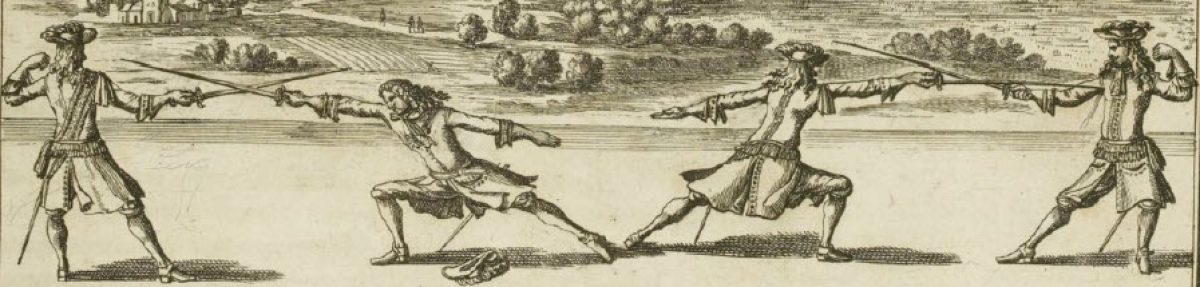




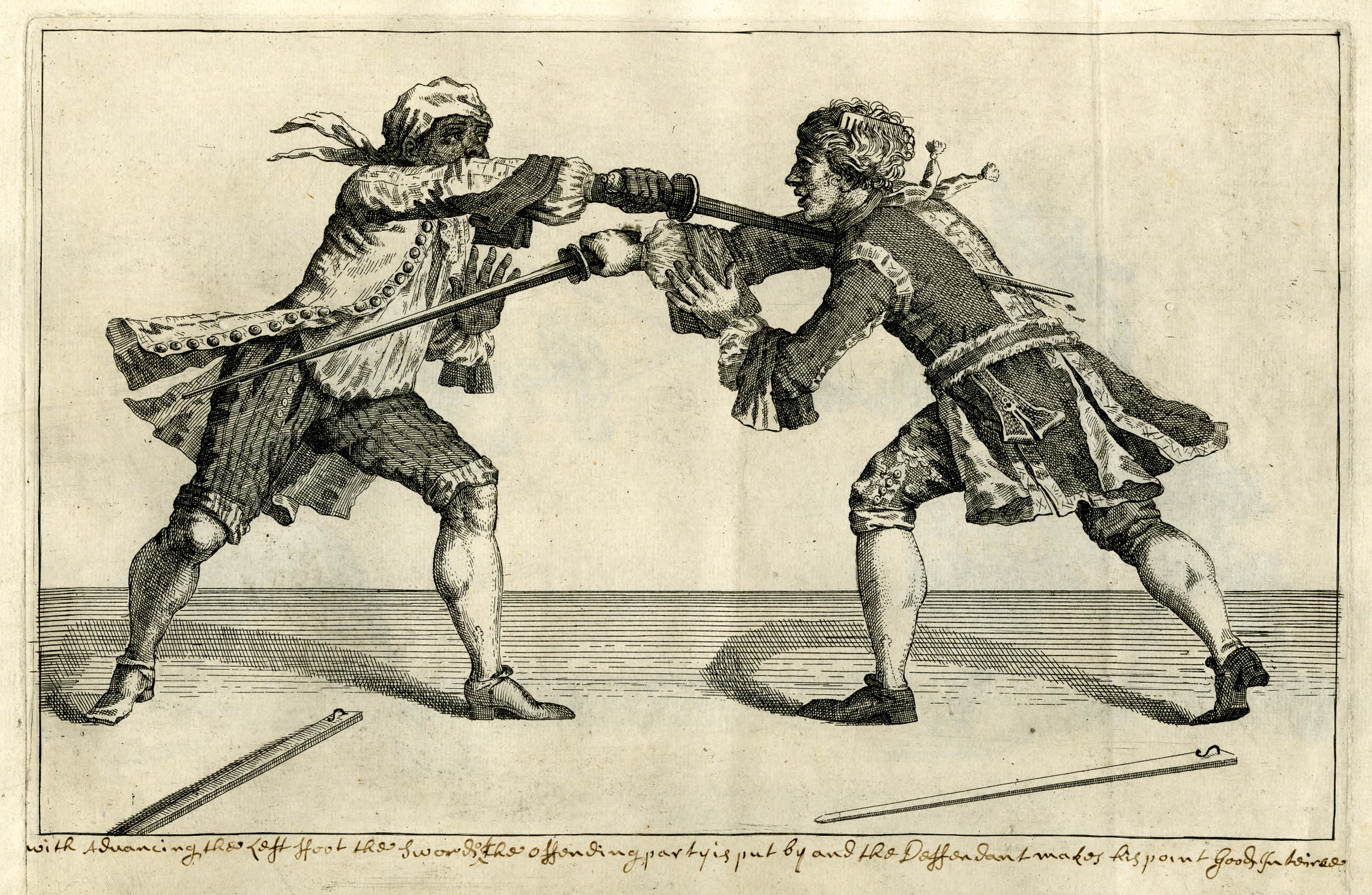


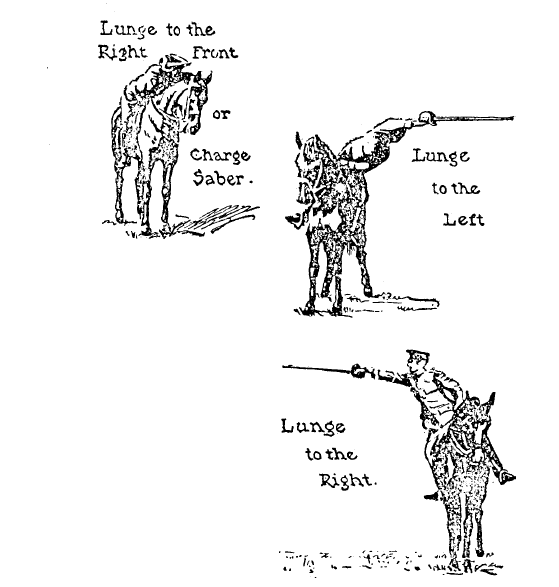
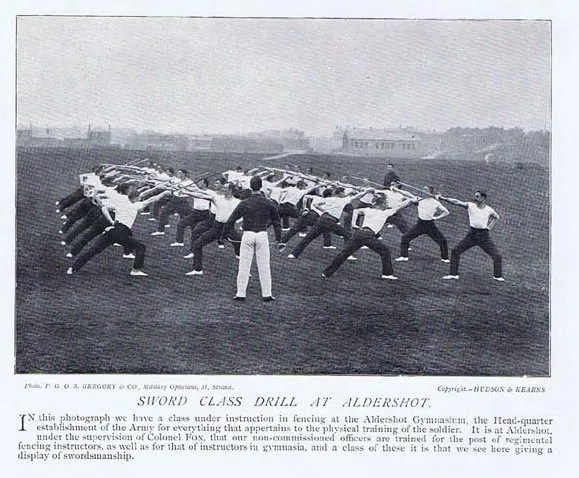
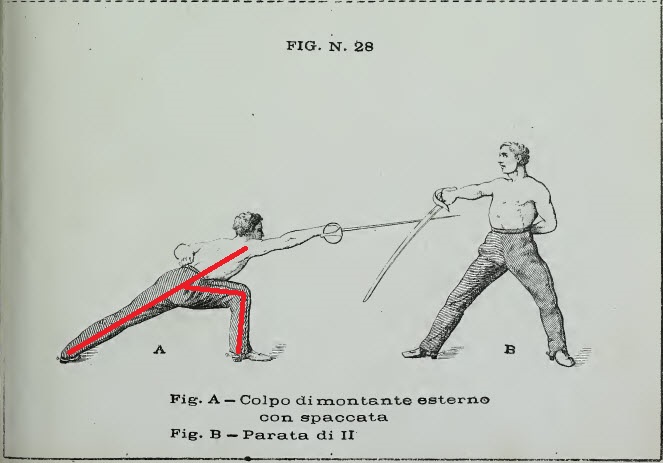

 Capitale Escrime Historical Fencing