Old Wine in New Bottles: Fencing Theory and Interpretation

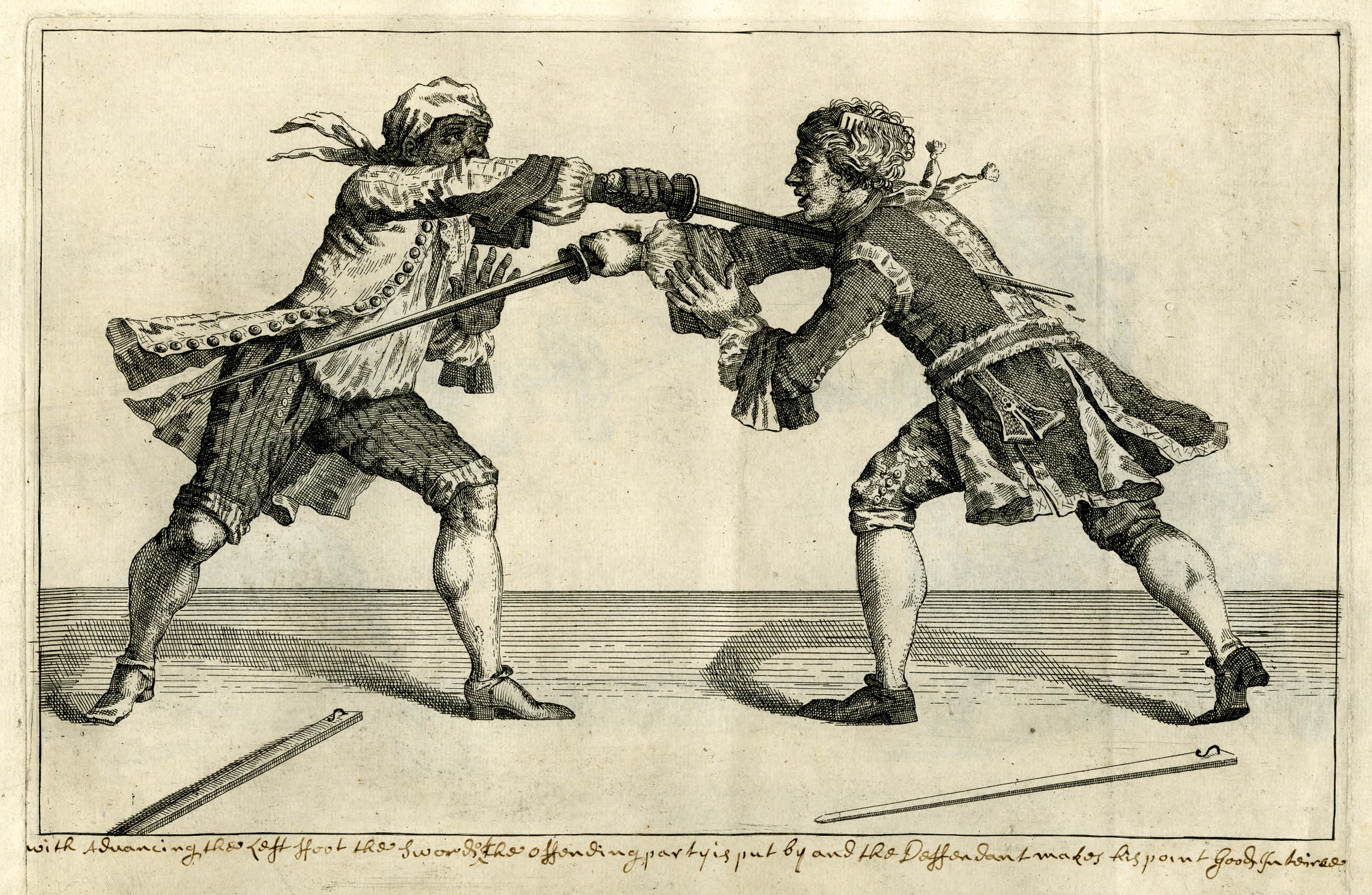
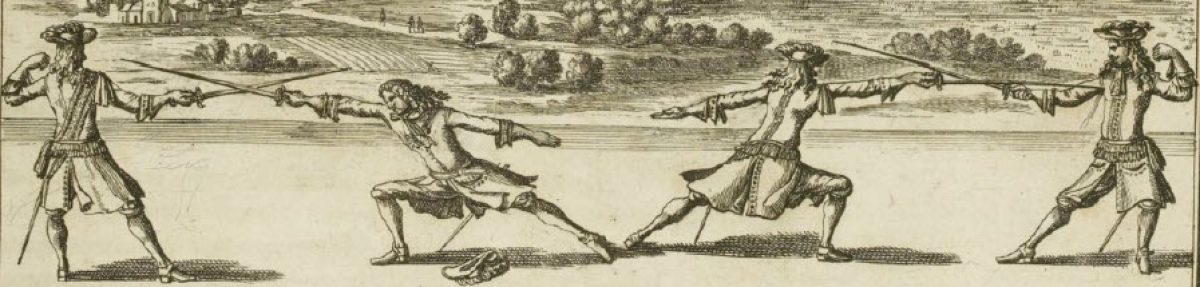
passing attack from _The Art of Fencing_ 1730

The much-maligned maestro, Nick Evangelista, turned a phrase that I have long used, “the logic of the sharp point.” [1] For anyone interested in fencing as more than an elaborate game of tag in unfortunate polyester uniforms, the logic of the sharp point should guide all they do. In short, this logic boils down to one idea:

If attacked, defend

When we don’t envision that point as sharp, we make poor choices—most doubles and the obsession with the after-blow stem from misunderstanding or misapplication of this logic. Why is it that in historical fencing, supposedly keen for fostering “realism,” we see such a gap between theory and practice? In short, the divergence stems from failure to learn and apply the most basic tenets of fencing theory. The reason for that is simple: too many historical fencers refuse to examine what modern fencing has to teach them.

This is a topic I’ve spent a lot of time on, but when a problem persists, we keep at it or quit. One fact I must accept, however, is that no matter how much time I or anyone spend on this, no matter how much evidence or analysis we throw at things, it won’t matter to most people in “HEMA.” There is daily proof of this, but there is also precedent: similar issues plagued the Olympic fencing world in the 1990s and early 2000s and then as now most people didn’t care. That doesn’t make them right. Their discomfort with a truth in no way changes the fact of that truth. I will argue until I’m worm-food that one should extend on a thrust, that the flat of the sabre shouldn’t score, and that off-target is, ultimately, illogical.

In like manner, not to avail oneself of modern fencing theory is to hobble our efforts at understanding fencing of the past. Modern theory was not created in a vacuum—it is the product of quite literally centuries of work. As always, one must distinguish between theory and how that theory is applied or misapplied. They are separate things.

For a quick example, applying right of way (ROW) to sabre, in theory, is sensible. ROW, in its way, attempts to enforce the logic of the sharp point, but being a game, a sport, this rule is less doctrinaire than it is for historical fencers. Historical fencers balk that ROW allows consideration of off target, and that one may win the point but still be hit. However, despite those aspects, despite the tyranny of electric scoring, the rule states that an attack should be dealt with, not just reacted to via counterattack out of time. One should defend if attacked—that is basic logic, the point, really, of fencing, defense. Thus, the ruling idea is sound, but how that rule is abused and interpreted is a mess.

Case Study: Passing Attacks

In one of the most recent and unfortunate fracases on social media, over a specific type of attack [see the post 13 August 2023, “Shadows in Caves,” https://saladellatrespade.com/2023/08/13/shadows-in-caves/], we have another example of the perils of interpretation. As I stated in an earlier post, part of it vested interest in maintaining a perceived status within the community, part of the problem was vocabulary, and partly it was a failure to understand how the sources and modern theory intersect. I’m fed to the teeth criticizing the all-consuming horror that ego plays in all this, so this post will instead focus on terms and misapplication of theory.

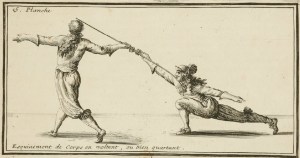
One mistake that people are making is equating a modern version of a species of attack for one of the same class from the past. It might help to illustrate how the terms relate. “Passing attacks” comprise a category of attacks where the rear foot passes the lead foot. Just how one does this changes. The terms and description vary as well. For two examples, we have the lunge made on the pass in de la Touche (1670), his “thrust of the pass” (l’estocade de passe), his “the finished pass” (la passe finie), and the modern flèche. [2]

de la Touche, 1670; the fencer on the right is making a thrust of the pass

No one in de la Touche’s time called any passing attack I’m aware of a “flèche.” Those quick to decry the use of a “flèche” in a recent Canadian tournament cite the use of a passing attack as modern and anachronistic, and thus out of keeping with period practice. It’s important to break down the attack, and criticism, to see if this criticism holds.

I’ve selected de la Touche in part because detractors have cited him for proof, but also because de la Touche did a fantastic job of explaining many aspects of technique. He was not the only one to include thrusts of the pass, but he is a good example. [3] The section on his thrust of the pass is long, thorough, and informative. In speaking of thrusts generally, de la Touche reminds us that one should be careful to aim for the most uncovered section of target, and, that one must thrust with conviction, that one should let oneself “go and extend as much as you can, so that the action has more force and swiftness of reach.” [4] I note this because swiftness, speed, is a critical consideration, one detractors downplay.

The master observes that one’s reach is longer with the thrust of the pass, and thus that the measure is larger so it requires more time to make. This is a crucial point. If one can hit with a thrust of the firm foot, then one shouldn’t use the thrust of the pass, unless one was initially aiming for the arm and decides to go for the body. It is particularly useful if the opponent is breaking measure (retreating) and if one wishes to surprise the adversary. Most importantly, one must accustom oneself to “execute the thrust of the pass with great swiftness, in order to compensate for the length of the action by the promptness of the execution.” [5]

Important to note, and a point in favor of the critics, de la Touche’s thrust of the pass assumes that the lead foot does not move. One advances the weapon, arm, body, and rear foot, but the front foot remains in place. [98] However, in the next section, De la Passe finie, “Of the Finished Pass,” de la Touche remarks that

De la Touche discusses this action, of moving the rear foot past the front, within the context of weapon-seizures. Such seizures are, as he observes, incredibly dangerous and chancy, especially if attempted when attacking (he is less uncomfortable with such seizures when defending). [7] One question arising from this is whether or not the master recommended this passing step only for weapon seizures. In answering this question one must interpret since de la Touche is not specific. How best to do that?

First, we must examine the action in the context in which the master shares it. It makes sense to include this passing step in a section relating to seizing the weapon as the distance one must travel is, arguably, longer than it is when lunging or lunging on the pass. Of note, this step is more connected to attempting a seizure when attacking than defending, as ostensibly the opponent is either standing firm-footed or breaking measure to defend.

Second, we must compare the advice in this passage with the rest of his work, with the general timbre of his approach. This is, granted, where we enter the world of conjecture. Thus, it is all the more important to work from the text, not just one passage or section. We must apply logic to any such comparison; it is, really, the only way to avoid the more obvious pitfalls, such as selecting only what supports our point of view or cherry-picking.

Whenever evidence works against us, we must deal with it honestly. In this case, the thrust of the pass itself does not appear to include moving the front foot from its place. De la Touche makes this clear. Those unhappy with the attack my friend and colleague made at An Cruinneachadh this past month are not incorrect about that. [8] However, I believe they are on far less firm ground if they suggest that the finished pass, that is a pass where both feet move, is only advisable when attempting a weapon seizure. Yes, that is the section in which it appears, but on its own that doesn’t make for a strong case. De la Touche covers the lunge in one section too, but one assumes that he wants one to use it whenever applicable.

Herein lies the crux of the problem—applicability. What follows is my take, my interpretation of de la Touche, and I will be the first to admit it is more spirit than letter of the law. I have reasons for that—we do our best to conform to what a text says, but we must remember the purpose of a source. De la Touche was concerned first and foremost with effective fencing. The goal, quite literally, was to strike and hopefully not be struck as one did so, because failure meant injury or death. If that was the goal, then slavish attention to any action makes little sense. Put another way, if one attempts a thrust of the pass, but the opponent retreats slightly more, one can either break off the attack, or, continue it (assuming the same elements of surprise and safety) by moving that immobile front foot. Fencers make different choices depending on the situation; technique, ultimately, backs up tactics, not the other way around. The attacker is at risk regardless—should they continue an already long attack, they increase the chance of failure, but should they recover needlessly just to follow the letter of the law they may create an opportunity for the adversary to attack in their turn.

In my reading, what Jay used in that match follows the logic of the finished pass and the thrust of the pass. Both fencers were working measure, but Jay launched his attack (about :07/:08 seconds in the video on fb) as his opponent (the chap in green) was in negative balance, as he was just about to initiate an action. Jay threw his arm and body forward, a la the thrust of the pass, but then crossed his feet a la finished pass in order to reach his now retreating opponent. Nothing in this action is out of keeping with what we read in de la Touche.

In fact, Jay used the proper speed to execute this attack successfully, an aspect de la Touche was quick to point out. Judging by both video of their fencing and from what I have observed on my own in person, many of Jay’s detractors do not employ speed in their own fencing, and one fears that they may not realize its importance. No attack made from just out of distance will succeed without it.

But his Fleche!

Now, what is the modern, well, 20th century flèche? It depends upon how one defines it. Generally, in French fencing, the fleche is a “running attack,” but in this can be further explained as Gaugler put it, as “a running attack executed following a loss of balance by an exaggerated forward displacement of the center of gravity.” [9] Maitre Robert Handleman provides a fuller description:

Handleman’s work was published in 2014, the flèche outlawed for sabre in 1994, but older works discuss the use of the attack in all three weapons. The flèche is still legal in modern foil and epee competitions.

So, did Jay flèche? Yes and no. Yes, he made a running attack, and going by just one definition, Gaugler’s above, we can call it a flèche. However, nothing in that action was out of keeping with what de la Touche, among others, described in their coverage of passing attacks. So where does that leave us?

Old Bottles, New Wine

Often in historical examinations we employ the simple tools of comparison and contrast. Examining patterns of what is similar, what different, we can unpack a source and see relationships, connections, and with further analysis, reach conclusions about what we are studying. In some cases, one type of comparison may reveal more to us. As a related example, from the study of myth, Joseph Campbell’s The Hero with a Thousand Faces does a great job of finding cross-cultural similarities in what he called the “monomyth,” but his study is only so useful because he did not, and did not intend, to examine the differences in how this motif was or is used. A hero’s motivations, for example, may be vastly different even if the narrative construct is similar; those differences will be far more revealing about cultural values than similarities.

In contrast, the situation here is one where similarities should help make sense of the sources, but which do not thanks to bias. Prejudice against the “new wine” of modern fencing, an outgrowth of the reactionary period in which modern historical fencing was born, has persisted and continues to affect how those suffering this bias view the “old bottles” that are period sources. The flèche as they see it is an artifact of modern, 20th century fencing, not that particular century’s version of an old and time-worn attack. Why? Because in their view nothing modern is legitimate.

In fairness to his critics, if one places a photo from mid-century where a fencer is nearly horizontal in the air as they flèche, and then a plate from de la Touche side by side, then the differences are obvious. It’s clear these are not exactly the same, but they’re not the same in execution, and it should be easy to see why: the contexts are different.

pass in seconde, de Liancour, 1696

This has been obvious to other scholars of fencing. Morton’s A-Z of Fencing contains a lengthy entry on the flèche as well as one for the pass which, so Morton states, was an older method of movement, and, one in which the lead foot might, if necessary, move as well. [11] As a last example, Nick Evangelista, in defining the flèche, echoes the same cautions as de la Touche, reminds the reader it is best used sparingly and as a surprise, and most importantly, that “the pass on avant of the eighteenth century is considered the forerunner of the flèche as it is practiced in modern times.” [12] These writers see continuity as well as change, versus change alone, and with good reason. No aspect of modern theory was created ex nihil—all of it is built on precedent.

De la Touche on more than one occasion is at pains to warn the reader against actions that will get them hurt, because in 1670 people were using swords and intended harm with them. No one of sound mind is fencing in that context today—realistic as we may wish to be, we do this for fun, not because our lives may depend on it; we fence with friends, not people keen to kill us; we use safer trainers and wear safety equipment, not a simple shirt or the lack of one. In contrast, fencers using the flèche in Olympic fencing, and especially in sabre in the late 1990s, not only had no fear since they were going for points, but especially in the case of the latter could stretch the action to ridiculous lengths to game the system. Indeed, so abused was the flèche that they outlawed crossing the legs in sabre.

Wine is Wine, Old Bottle or New

In the sitcom “Schitt’s Creek,” one of the main characters, David Rose, explains his sexual outlook to Stevie, a woman who works at the hotel where he is staying, and with whom he had hooked up:

Stevie Budd : So, just to be clear, um… I’m a red wine drinker.

David Rose : That’s fine.

Stevie Budd : Okay, cool. But, uh, I only drink red wine.

David Rose : Okay.

Stevie Budd : And up until last night, I was under the impression that you too only drank red wine. But I guess I was wrong?

David Rose : [nods knowingly]  I see where you’re going with this. Um… I do drink red wine. But I also drink white wine.

Stevie Budd : Oh.

David Rose : And I’ve been known to sample the occasional rosé. And a couple summers back, I tried a merlot that used to be a chardonnay…

Stevie Budd : Uh… okay.

David Rose : …which got a bit complicated.

Stevie Budd : Yeah, so… you’re just really open to all wines.

David Rose : I like the wine and not the label. Does that make sense?

Stevie Budd : [smiles]  Yes. That does. [13]

In addition to being a wonderful way to explain pansexuality, I see an analogy in re fencing theory. Fencing is, ultimately, fencing, and it is either effective or not. Contexts, purposes, equipment, and ethos all change, but should one lay out the better modern works on fencing side by side with those from the past the kinship becomes absolutely clear. Yes, there are differences, and in historical fencing in particular to ignore those differences makes what we do ridiculous. However, it’s double-edged—to ignore what modern theory provides any fencer, especially those attempting to interpret past sources for the Art, is to handicap one so terribly that the interpretation too easily becomes something other than what it should be, fencing. A prime example, which I’ve covered in other contexts, is the abject devotion to the images in the Bolognese corpus which produce versions of fencing more graceful than effective. [14] The desire to make “sidesword” different obscures the fact it was a cut and thrust weapon, and, that cut and thrust weapons existed before and after the 15th century. If pose becomes more important than purpose, one has lost one’s way.

The logic of the criticism used against the passing attack Jay used at An Cruinneachadh is faulty. The operating assumption is that anything that looks like a flèche, or indeed may be one, is automatically illegitimate and anachronistic. That doesn’t follow. One can make a fair case that the passing attack Jay employed abided all the cautions and guidelines that masters like de la Touche put forth, and as such, should not be classified as some aberration. [15]

NOTES:

[1] Nick Evangelista, “When Classical Fencing Goes Bad,” The Evangelista School of Fencing, 20 April 2014, https://www.evangelistafencing.com/blog/2014/4/20/9swnz7n7n709uvg9cko2hkh5a1h3n5

[2] Philibert, Sieur de la Touche, Les vrais principes de l’Espée seule, 1670, 66 (plate just before page 65); see also Reinier van Noort and Antoine Coudre, The True Principles of the Single Sword, Glasgow, UK: Fallen Rook Publishing, 2016, 88ff.

[3] For other examples, among others, see de Liancour’s passes to the inside and outside p. 24ff in Le maître des armes (1696), Girard’s pass of quarte p. 71ff Traité des armes (1740), and Angelo’s pass in carte over the arm p. 62 The School of Fencing (1787). Of note, many works cover passing steps in connection with weapon-seizures.

[4] Van Noort and Coudre, The True Principles of the Single Sword, 90.

[5] Ibid., 100.

[6] de la Touche, Les vrais principes de l’Espée seule, 75; cf. Van Noort and Coudre, The True Principles of the Single Sword, 108. I translated this passage myself, so it differs from that of van Noort and Coudre.

[7] de la Touche, Les vrais principes de l’Espée seule, 75-78; cf. Van Noort and Coudre, The True Principles of the Single Sword, 108-109.

[8] For the bout in question, see https://www.facebook.com/groups/261251458841817/permalink/835017504798540/?ref=share&mibextid=NSMWBT

[9] Willam M. Gaugler, A Dictionary of Universally used Fencing Terminology, Bangore, ME: Laureate Press, 1997, 34.

[10] Rob Handelman and Connie Louie, Fencing Foil: A Practical Training Guide for Coaches, Parents and Young Athletes, San Francisco, CA: Pattinando Publishing, 2014, 444.

[11] E.D. Morton, Martini A-Z of Fencing, London, UK: Antler Books, 1990, 67; for the pass, see 132-133.

[12] Nick Evangelista, The Encyclopedia of the Sword, Westport, CT: Greenwood Press, 1995. 250. Queen City Classical Fencing’s glossary, supplies

[Sir William Hope, A New, Short, and Easy Method of Fencing, Edinburgh, 1707, 136-138]

[13] This quotation was obtained from IMDB, https://www.imdb.com/title/tt3653932/characters/nm2391794

[14] 10 June: Lecture Transcript: “Prance or Pounce? Interpreting Images in Bolognese Treatises,” Northwest Armizare Weekly Online Meetup, https://saladellatrespade.com/instructors/research-media/

[15] Jay’s fencing is effective and he is doing well in competition, so it is possible that maybe that is the real issue: envy.

Jay, like me, like others, approaches past sources with the tools and theory that they bequeathed to modern fencing, and he is an effective fencer. Those aping the plates devoid of actual understanding are not doing as well, because their study is incomplete. When one is absolutely convinced that one’s point of view is correct, and especially when that stance is backed by those believed to wield authority (however true or untrue), then one is not only losing matches but forced to confront an even harder possibility: their training, however long, however passionate and dedicated, has been flawed. This is extremely painful and unpleasant, and my heart goes out to them. At the same time, it is something one can fix. Jay, in fact, can speak to this better than I can, as it happened to him. He didn’t quit, but put his disappointment and regret aside and started over with a better training regimen.

Addendum, Shadows in Caves

It’s never my intention to be mean or divisive. To the best of my ability, I try to focus on the material and evaluate both arguments and support. The more directly and clearly one does that, the better, but directness, especially online, can read differently to people. It’s easy to take any criticism personally even when it’s not intended. [1]

I didn’t pull any punches in my last post, but no blow was aimed at people as people—my intent was to target interpretations, argumentation, and issues of authority either widely acknowledged as problematic, such as “HEMA” lacking any real oversight, or, concerned with questions about credentials that have long been under discussion. [2] It’s important.

As an instructor and historian I have a responsibility to my students and everyone else to be honest about my training, how I arrive at the interpretations I do or why I use those by someone else, and to be as transparent as I can. When I get things wrong (and I do), I owe it to all involved to own it, correct it, and give credit where credit is due.

Few things are harder than declaring, publicly, that one made a mistake, but it’s one of the most important things we can do. First, it’s honest—everyone screws up. Second, owning mistakes and trying to correct them argues for one’s credibility. Third, because our interpretations are shared, we owe it to those who use them to keep them in the know. My own experience with this has demonstrated to me that not everyone will appreciate it, but it’s the right thing to do regardless of reception. Thus, whenever someone offers us valid criticism, it’s on us to consider it and if necessary adjust our conclusions.

Working remotely in a tiny corner of the world, and rarely able to travel to events, conferences, or seminars (though I try), I know of, but do not know, most of the people engaged in the current debate within smallsword circles. I know them only via their work or participation in the community. Even if I did know them, I should not judge them as people (provided they’re not bigots or overly arrogant) but evaluate their work. I expect people to do the same with anything I might share of my work. That is how research works, well, how it’s supposed to work. [3]

All of this is to say that if you are hurt reading my critique, please remember I see you as a colleague in a difficult endeavor; that we, all of us, owe it to all using our work to do right by them and produce the best work we can. Good research is a collective pursuit—we rely on others for support, for correction, and for making our work better. In like vein, we also owe it to our students and one another to be honest, frank, and ready to back up any credentials we claim. The study of martial arts, any branch, relies on trust, and we establish that trust more in action than words.

Notes:

[1] Even in person it can be hard to face criticism, but it’s part of the job. Online communication is notorious for confusion; lacking facial cues, body language, etc., we have to work harder to be clear in what we write and be sensitive to how things might read.

[2] The burden of proof for one’s credentials is on the individual. Normally, it’s easy enough to prove should one question things—maestri, for example, are handed a diploma produced by the organization that granted it and that displays the signatures of those masters that evaluated the candidate. There shouldn’t be any mystery around it.

[3] Work in research long enough and you will see the best and worst in people when it comes to using or evaluating one’s work. For every instance of helpful, well-intended help, there are a legion of people who fail to read it completely, or worse, misconstrue and misrepresent our work. For example, one reviewer of a book I wrote failed to read the preface; had he done so he would have realized that his major criticism, that the book was less monograph than he expected, was targeted towards undergraduates. For a more serious example, a dissertation from 2014, and which mentioned my dissertation from 2002, not only resorted to insulting language, but also misrepresented my work (how her dissertation committee let that go is anyone’s guess—mine would have read me the riot act for such a breach of professionalism).

Shadows in Caves

One of the benefits of not having to suffer the tempests in teapots that boil over on social media is that I only hear of them second-hand. I’ve heard a lot in the past few days about an unfortunate debate on one of facebook’s smallsword pages concerned with a particular action. Controversies like this have a way of forcing people to show their colors, and this latest hullabaloo is no exception.

The lines, as I understand it, are drawn between those upset by the inclusion of a passing attack, a collection of enthusiasts including a number of English fencers, at least one sword-maker, and a few vocal students, largely American. Their opposition consists of an assortment of historical fencers who have argued for this attack based on the sources. If one is familiar with my posts here it will not be difficult to determine where I land in this debate (not that what I think will matter to many participants). However, as an instructor and historian I feel a duty to those I work with to say something.

False Equivalencies & the Fleche

The action in question is a rapid attack meant to surprise an opponent and one made by passing the back foot in front of the lead foot. To work, one chooses the right measure and tempo, and then applies the right speed and weapon angle to close the line. Whatever the name, these are the component features. It is, in truth, a dangerous action, especially if made poorly or at the wrong time or distance, but the fact that it shows up in so many works means it is worth study.

The criticism aimed at the passing-step proponents centers upon this action being too “sporty,” too “modern,” and since that first generation of classical and historical fencers arose in large part because of the excesses in the sport, anything remotely whiffing of the modern piste is immediately suspect. I  know because I was there, and like these poor folks, once over-compensated and over-corrected. This was easy to do in the 1990s and early 2000s for several reasons. The  complete lack of concern and disdain from fellow fencers about over-use of the fleche, of the flick in foil, of duck and cover, or any of the other aberrations was hard to understand and unpleasant to face. Second, and in ways that echo in the current debate, none of the evidence–and there was plenty–proving that these were departures from the point of fencing and ahistorical made the slightest dent in their resolve. On the one hand, older fencers unaffected by much of this failed to see the danger. On the other, many newer fencers, having made their reputations on these dubious actions were loath to condemn them; to do so would be to condemn themselves, to call into question their own position. 

Ego drove much of this, and, ego drives the anti-passing step side now. Combined with misunderstanding of the problem the anti-passing step faction has taken the suggestion that a move like the fleche is viable as a personal affront. Ironically, they decry the action despite the evidence from the very sources they claim to use. Ego is the first barrier: an inflated sense of self and one’s importance tends to blind one to reason. The second barrier is mistaking issues with a particular action for the action itself. Memories of fleche after fleche in the late 1990s and all the daft measures the FIE took have made any attack like it, never mind the fleche itself, anathema.

Of note, the pro-fleche camp, for lack of a better term, has not argued that the passing attack in Vadi or L’Abat is exactly the same as the flying leap sabreurs so took advantage of in the 1990s. Contexts are different, the weapons different. This said, the idea of a rapid, surprise attack made by throwing the weapon forward and passing the rear leg past the lead one is present in our sources. Whether one chooses to use it or not is another question. Whether one makes the attack well is another matter. Whether a master advocated it or merely included it is an additional consideration. Some masters specified that they didn’t care for an action, or, that it was dangerous outside the salle, but often we don’t know where they stood on its effectiveness or safety for actual fighting. [1] There is ample precedent for fleche-like actions on the record, so to poo poo the use of an effective passing attack in modern historical competitions, which we do for fun, is about turf and ego, not the sources.

Why the one faction should stubbornly argue against the evidence of the sources should make one pause. For smallsword works alone, the inclusion of the passing-step attack is common. It should be little wonder as to why. Given the place of cross-steps forward and back in earlier works (de Liancour, 1686, is a good example), adding speed to the same method of advancing follows logically. The same attack, however, appears earlier in the sources, from Vadi to many rapier treatises. What separates historical fencing from other branches is, supposedly, reliance on the sources, so to ignore the basis for interpretation, particularly when we can trace this action over time and across masters, is odd. If the source tradition isn’t their basis for support, then what is?

The Problem of Authority

One of the bugbears within “HEMA” is a blind appeal to assumed authority. In this case, a number of early researchers and their fan-base appeal to the early success and acclaim these luminaries enjoyed in the belief that it’s as valid now as it was in the early 2000s. That is, sadly, not often the case. Research has not stopped since their time, yet many of these same people stick to outdated theories and flawed interpretations.[2] Their argument, thus, is not made from evidence and analysis, but from ego, from fear of losing the status they depend upon from their acolytes. They fear being eclipsed. The last has already happened as this latest fracas, one skirmish of many in the past twenty to thirty years, demonstrates.

Time-in is another supposed source of authority. It can lend one credibility, but depends on other factors. On its own time-in means absolutely nothing. If one has been in “HEMA” for thirty years and has not only been working from poor theories, but also continues to argue that they were correct despite the evidence, then time-in means very little. This happens a lot–I’ve met many people who have wasted years with charlatans or in glorified fight-clubs or working from once key interpretations that have been superseded.

Complicating the stagnation is an often surprising lack of understanding of fundamental actions and concepts. For example, a well-known fencer recently quoted de Bazancourt with respect to rushing in, which not only demonstrates a failure to understand the intended use of the action, but also serves to corroborate the fact they are basing their view on misuse of the action. Preparation is everything in fencing, and attacks like the passing step and even its much abused 1990s version (ideally…) relied on setting an opponent up for it. The sabreurs who flung themselves stupidly at “allez!” and who never varied the game are a different animal. In the footage I’ve seen from a recent Canadian event, the fencer employing the “fleche” used it wisely, and, as intended: as a surprise against an unprepared opponent. I am a fan of much of de Bazancourt’s wisdom, but the quotation supplied is misapplied. Used at the appropriate time and in the right setting, the passing step or fleche is no more dangerous than a lunge. Both put one at risk. Every form of attack potentially does.

Another issue plaguing “HEMA” is the echo-chamber effect. Adherents to this idea or that group focus increasingly only on what those within their section of the community teach, believe, and use. Their views become myopic, limited, and prone to precisely the ego-driven arguing we see in this current example, because for them the debate is less about sources than it is their reputations as “authorities.” They view the shadows cast on the wall by the tiny flame in their hands or in those of their heroes and take those shadows for reality. It seems real and legitimate to them because they refuse to consider any other well-made argument. In like vein, if any light is cast from someone they don’t know or who fails to pass the anemic view of authority they employ, they ignore it, or, call them heretics.

Proof is in the Teaching

Perhaps it is the Hollywood notion of 18th century manners, of high style, and the romance around the waning influence and power of European aristocracy, but many of the interpretations from the anti-passing-step camp are wooden, slow, and lacking in vigor. They present more like demonstrations or dance than a fight. It’s form over function. For all the formality and etiquette that people of the past attempted to apply to personal conflict, in the end it was a sword fight. The intent was bodily harm or semi-acceptable ritual murder, and no evidence we possess suggests that two people, potentially angry and emotional, fighting fear, and terrified of public opinion, were more likely to square off and fight as if dancing. All evidence is to the contrary. Surviving footage of late period duels is no exception, and many of those were first-blood affairs, not to the death. For all the blather about “realism” few in “HEMA” spend much time if any pondering what that means, or, what it should mean in our context. [3]

The flaccid yet florid approach these fighters take to fencing reveals too much concern for aping the elegant plates within the treatises rather than what those treatises were meant to help teach: fighting. I am not the only one cautioning fencers about over-reliance on images, but time and again many in the community gravitate to the images because they don’t understand the text. [4] While language and diction are often challenging, the deeper issue is that these same fencers lack sufficient understanding to read the text. The one place they might go for help, a solid Olympic or traditional fencing program, is anathema among them, and so, they do their best to adopt what they see in the illustrations and produce pretty bouts largely devoid of any intent.

In the footage of their bouts, in their instructional videos, and especially in their attempts to shout down opponents, the shallowness of their understanding and skill emerge vividly. The inability to fence beyond a snail’s pace, the poor use of measure, and the more choreographed timing are red flags. No one fought in slow motion. It’s hard not to conclude that this is one reason that the clubs and cliques against passing step attacks avoid bouting anyone outside their little world. Against fencers with legitimate training and armed with sufficient knowledge they come up short. Such defeats should suggest to these fencers that maybe there is more to learn or better ways to learn it. In fairness to the newer students among them, hearing from their clubs that these defeats don’t count because others are wrong or too dangerous etc. is easier to accept within their echo chamber, when the only voices they hear are all part of the same program. [5]

Make the Bold Move

It takes courage to accept new ideas, even when well-presented and argued, but it remains the right choice if one wishes to retain any respectability. Lacking any official organization to manage these things, we are left only with each faction’s arguments and how to evaluate them. The best approach is to evaluate the respective arguments in light of the evidence, and, against what the purpose of fencing used to be. The masters who wrote these works, many of them anyway, meant for their books to help teach students how to fight. Sure, some, especially later, were more concerned with salle play than with duels, but for those clearly self-defense oriented, like many mentioned in the debate over the passing attack, the goal was effectiveness first and foremost. There was ample attention to deportment and conducting oneself with grace in many works, but this was, outside a fencing hall, a secondary goal. No master stayed employed long if their students died or were maimed for life. [6]

Those quick to condemn historical fencers using the passing step attack should take their example from other members of the older guard, people like Paul Wagner, Stephen Hand, and Dave Rawlings, all of whom have continued to learn, adapt, and alter their thinking based on new and better information. Though well-known, they have remained humble and thus open to learning, and between these factors and being gracious opponents, they have stayed relevant. They have not been eclipsed. 

When it comes to past fight systems, no one has a monopoly on the truth. Every interpretation must be tested and compared against the sources, and when new and better ideas make sense, when they follow from the sources, then they’re worth consideration however much that may disappoint one. At such times, hard as it is, once those shadows on the cave wall have been revealed for what they are, it’s time to do the hard thing and turn around. When one does, one sees better and grows, and often, one finds that those they have perceived as enemies turn out to be staunch allies.

Notes:

[1] De Liancour, for example, believed counter-attacks better suited for salle play than affairs on the ground (Le maitre d’armes/The Master of Arms, 1692, 13 in the pdf, 29; in Lynch’s translation, 36); Capt. John Godfrey, in his A Treatise upon the Useful Science of Defense, 1747, 12-13, expresses his dislike of the flanconade.

[2] A prime example is the demi-pointe lunge. See my papers related to this topic in the “Research” section found at the bottom of the Instructor page.

[3] I’ve spent a lot time on this in previous points, so here I’ll only add that while we strive to be historically accurate and as “realistic” as possible, the fact remains that we do this for fun, wear protective gear, and have no real need for this skillset in our own time and cultures.

[4] See my pieces on using and misusing images in historical fencing under “Research” in the Instructors section.

[5] Most fencing schools, most of the better martial arts programs, include working with and/or competing against those outside one’s own school. It’s critical for growth. It is never a good sign when instructors fear this or actively preach against it.

[6] Even in self-proclaimed self-defense works we see concern for deportment. In James Underwood, The Art of Fencing, Dublin, 1798, p. 7, he explains that he doesn’t like the off-hand arm forward because “I think the beauty of the figure is strangely disfigured by it, and that all fencers will allow that they cannot help being pleased with a symmetrical posture.”

How to Tournament, Deuxième Partie

[This is a continuation of the post “How to Tournament” posted yesterday (19 June 2023)–much of what I say here has been said before, including by me, but since it is on theme, here it is anyway]

In part one of “How to Tournament,” I focused mostly on intelligence gathering and assessing the competition. Here, I’d like to discuss mental preparation, a topic covered earlier in part by the “The All-Important Place of Calm” [15 May 2023, https://saladellatrespade.com/2023/06/19/how-to-tournament/]. The approach to managing emotion is key here too, because nerves, excited or fearful or nervous, can derail us no matter how well-trained we are or ready we are to compete and succeed. One way to think of it is akin to drill. We tend to fight as we drill, because we condition ourselves to respond to certain actions and situations and reinforce this via repetition. We can do the same thing mentally—without meaning to sound like Moonbeam the Hippy or some faux guru on tele, cultivating calm and simultaneously picturing ourselves in an event, start to finish, and in specific instances of action, can do much to help us the day of the event. What is familiar is less likely to unsteady us, so from physical training to mental training, we can make even competition just another day sword in hand.

Calm, Revisited

Not to repeat the earlier post, but calm is something we can choose and practice like anything else. In this instance, this means consciously focusing on one’s place in the event and when necessary supplanting negative emotions (nerves, anxiety, fear, whatever) with concrete thought. For the first, visualizing our performance, from the moment we enter the event to specific actions, beforehand can do a lot to prime us. It’s not magic (sorry Moonbeam). Whatever other benefits visualization may have, the process of making something familiar helps remove uncertainty. The more we know something, the more comfortable we are with it, and thus, the less likely nerves take over. [1] [yes, I did just repeat this… see? repetition!]

Duel between an unfortunate braggart and Kyuzo, “Seven Samurai,” 1954

When nerves pop up, and they sometimes will, we’re better prepped to manage them having already envisioned the situation, but we can apply active replacement too. This requires noticing, consciously, that we feel nervous, and then pausing to distance ourselves long enough to set that emotion aside and replace it with something more useful. For example, Fencer X has just completed the first pools, and is nervous about the second. The competitors here are strong and Fencer X begins to doubt. Noticing this, Fencer X stops, takes a deep breath, and says to themselves “No. Focus on what you know. You’ve seen these people fight; you know how to counter them. Relax and have fun.” Conscious thought, that focus, can—with practice—remove some degree if not all of the negative emotion that undermines us in a fight.

Constructive Visualization

In no way is this a nod to crystal-thumping charlatans; I draw upon a few sources for this, but maybe the most important being well-attested memorization protocols. [2] Self-help books from the 1980s aside, all this is really is a form of meditation, just very focused meditation. Simply put, one focuses on imagining oneself at the event. If one can visit the venue first, that helps—gives a face to things. It might help to visualize oneself entering the facility, full of calm, and warming up. Next, one might visualize a specific action one’s been working on lately and successfully executing it in a bout. Perhaps an entire bout, maybe even against a specific opponent, is worth contemplating.

None of this determines the outcome, but what it does do is prime the mind for action and reduce potential nerves. Ideally, one gets on the strip or steps up to the ring and is utterly calm or maybe just in state of happy excitement. One can tell, by the way, when this happens. It shows. I have found in competition, as well as in at least two actual fights (fists, not swords), that steady calm can utterly unnerve some opponents. Calm suggests confidence, and with that, skill. This can affect what judges see too (remember: competition is a game, as psychological as physical if not more the former). [3]

Pre-Tourney Practice

In conjunction with mental preparation, one normally trains physically before an event too. This exercise may take place during regular practices or within individual lessons if one is taking those, but people often add additional drill in the mix too. Much of this may be one’s normal cardio and/or weight etc. training—all ideal times by the way to visualize things the day of.

?

For those practices focused on fencing, emulating the warm-up or pre-competition lesson tends to work best. This style of lesson is similar to a technical lesson, but the goal is to build confidence in the fencer, not to impart new skills. Keep things simple and focus on those actions a fencer does best—drill so as to make these actions as crisp, tight, and well-timed as they can be. Warm-up lessons are also typically short, maybe 10 minutes, tops 15. My approach in the past has been to include some of these types of lesson a few times in the weeks leading up to an event. The week of, we focus hard on these things, and, anything that the fencer may have had trouble with in the past. [4] The day of the event, I would have them warm up, then put them through the same short, 10 minute warm-up. Like contemplating success, this style of lesson has them work things they do well, all of which build confidence and ready them for the pools.

Intent, Expectations, and Take Aways

As in so many things, we get out of them what we put into them, but added to this much comes down to how we do this, what it is exactly that we invest. I tell my students and any colleague I prep for an event, to set goals. What do they want out of this event? How does it fit into their growth and experienced as a fencer? Laying all that out helps set expectations for an event, and thus, helps prevent the common distractions that come up when things don’t go as planned.

Versatility is a vital skill for any fighter—if weapons break, does one have a backup? If one’s tactics are failing, can one notice, adapt, and continue the fight? How does one handle victory in a bout? How does one handle defeat? The culture we create in a club or school goes a long way in shaping and cultivating this skill.

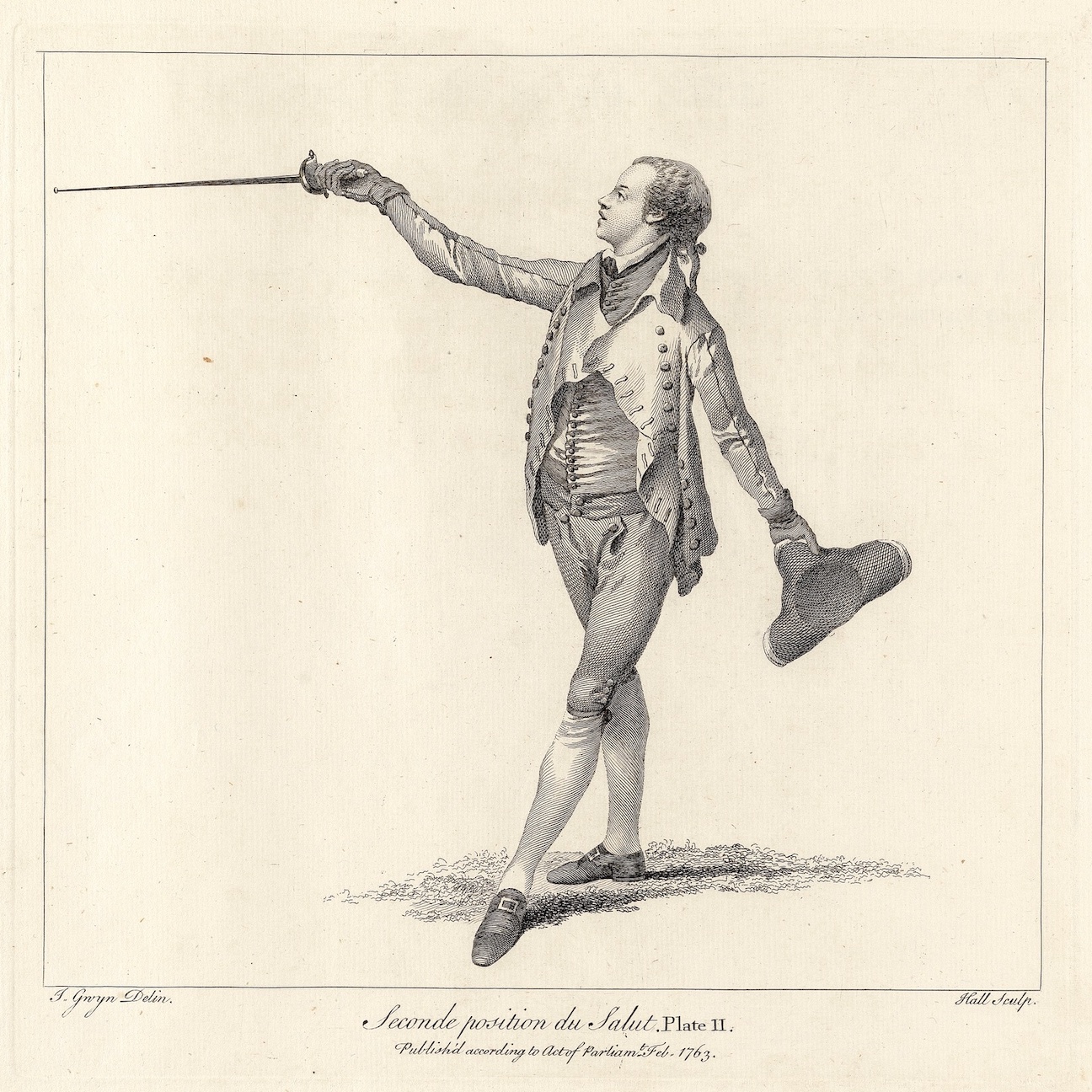
Charles Hall (1720?-1783) after James Gwin (1700-1769), “Seconde position du Salut. Plate 11.” from L’Ecole des Armes  by Domenico Angelo (1717?-1802), London,  R. & J. Dodsley, [1763],  engraving, Yale Center for British Art, Paul Mellon Collection; SOURCE https://www.ccpl.org/charleston-time-machine/swords-fencing-and-masculine-choreography-early-charleston

Be gracious, be courteous, and show largesse win or lose. I’m a strong advocate for managing both victory and defeat with a becoming grace and humility. Today it went one’s way—great; tomorrow it might not. No one with any aspiration to sanity dislikes a generous, gracious fighter. In fact, people will want to fight with that person because their heads are screwed on right and they make it fun. Fencers like that make the bout about the bout; they think in terms of a shared, dare I say it intimate experience and not just what these tiny victories might do for their self-worth. Officials like them too, because they don’t whine when they lose a point, even if unfairly, and use proper channels to protest something they find illegitimate or untoward.

After the Event

Conducting a post mortem after the tournament is important. With any fencer I have prepped, I like to follow up with them and see what they thought went well, what not so well, and how the experience might guide future training. This helps me, as their instructor, but it helps them too. It’s a chance to see that what they’ve learning is working as well as those areas that might benefit from additional practice.

Lastly, I always asked them if they had fun. Fencing tournaments, of any kind, are not famous for making any participant rich. We don’t have pay-per-view prize fights with purses to match. In the U.S. one never sees fencing on tele unless it’s the Summer Games and we have high level fencers in the run for medals.

We fight in tournaments, for the most part, because they’re fun. I have written a lot about tournaments and bouting as learning tools, and they are, but they should be enjoyable as well. Looked at in this way, a good tournament (emphasis on good events…), can push our skills forward and be a blast at the same time, and there are not many areas in our lives to day to day where we can often say that.

NOTES:

[1] We are resilient creatures. One of the best, if more extreme examples of this, emerges powerfully from combat and the process by which many military folks become accustomed to the extremes of life-threatening horror. I leave it to those military personnel and veterans willing to talk about it to explain this as they can do so better than I can.

[2] I mean no offense to modern spiritualists etc., just those trying to make a buck off of people. There was a spate of new-agey self-help books in the 1980s that mixed decent advice with a lot of b.s. Check the shelves of most any bookstore and these scams are still on the shelves. There has been a lot of work on how we can use, even improve memory, and condition ourselves. One of the more influential books for me, odd though it may sound, is M. T. Clanchy’s From Memory to Written Record, England 1066-1307, Hoboken, NJ: John Wiley & Sons, 2009. I also recommend, for a broader look, Fances A. Yates, The Art of Memory, Chicago, IL: University of Chicago Press, 1974.

[3] I remain convinced that I will never acquit myself better in a fight than I did in the last one I had, or didn’t have rather, in college. A sub-letter got nasty with my girlfriend at the time about rent, and I told him to knock it off. He decided to take it outside, and once outside, kicked off his shoes and danced about posturing. I stood across from him, ready, and waited. At one point he started to approach, so I started to raise my hands and smiled. He stopped, and a few second later walked over with his hand outstretched. Having had excellent masters, I didn’t trust this gesture and made it clear that if it was a ploy it wasn’t going to work. He was, happily, sincere. So, we walked away from the small crowd that had gathered and talked it all out. I was just looking after my girlfriend, and he was trying to save face, both understandable places to land, and since I had no ill will toward him, nor he toward me so far as I know, it was easy to fix.

[4] I didn’t invent this style of lesson. They’re well-known in Olympic circles. For a solid explanation of warm-up lessons, among other types, see Maitre Robert Handelman and Maitre Connie Louie, Fencing Foil: A Practical Training Guide for Coaches, Parents, and Young Athletes, San Francisco, CA: Pattinando Publishing, 2014, 324-325.

Censorship or Criticism? Why You’re Wrong about “Gate-Keeping”

“Discord is the great ill of mankind; and tolerance is the only remedy for it.”
― Voltaire, Philosophical Dictionary

[Warning: rant ensues]

The choice of quotation is not an accident. Thanks to a toxic mix of politics and poor life choices I left most social media a few years ago, and, with one exception (barring messenger/email apps), have next to nothing to do with it. Research articles on the effects of social media continue to support my belief that this was a good decision. It’s not just that people can’t watch or read anything longer than a tiktok video or tweet, but that the supposed anonymity fails to prevent, and maybe even encourages them to be nastier than they would be, in most cases, to one’s face. How does this related to fencing? I promise to connect A and B if you keep reading.

It gets worse. Swimming in such a shallow pool feels safe, because everything is on the surface, but this ignores that fact that one can still be sunburned, even drown in an inch of water. It changes people.

The faux familiarity, the apparent openness, and the need for connection that social media seeks to create but which it actually undermines, all produce an illusory culture of contented seemingly intimate pals. Test it. Say something vaguely controversial and see how people react—the ability to differentiate between confirmed belief and a joke is all but nonexistent; lacking facial cues, changes in intonation, etc., this is hardly surprising. It is not an accident, however, that this diminished capacity for communication and an equally strong inability to separate criticism and censorship have grown in parallel.

Gate-keeping online is the new Inquisition, not only for the social auto de fe that so often follows in its wake, but also for the fact that the basis for it is confused.

There are a lot of ways people define “gate-keeping,” but I find that the Urban Dictionary, while typically an amalgam of denotations, taken in toto provides a fair sense of what contemporary terms and movements mean. Here are a few from the first two pages of definitions:

  • Gatekeeping is to make your interests exclusive in order to protect them from becoming “mainstream”
  • When someone takes it upon themselves to decide who does or does not have access or rights to a community or identity.
  • A word used to describe when someone sets a standard/limit on what someone must do to call themselves a ‘true fan’ of something/someone.
  • When someone uses a hobby or interest as a means of elevating themselves above others to give oneself a sense of being superior transforming their passion or knowledge about a particular subject into an ugly tool of self-inflation
  • When someone takes it upon themselves to decide who has access to something
  • When people discriminate against others who want to enjoy the same things as them, and usually gatekeepers use the dumbest reasons as excuses [1]

For a slightly more august definition, the Cambridge Dictionary defines it as “the activity of trying to control who gets particular resources, power, or opportunities, and who does not. [2]

More than once I’ve been accused of gatekeeping, but according to these definitions I have not, in fact, been gate-keeping. No, I have criticized poorly constructed theories, ineffective training regimens, inexpert translations and interpretations, and bigots. This is important, because what I have NOT done is:

  • make my interests exclusive in order to protect them from becoming “mainstream”
  • set a standard/limit on what someone must do to call themselves a ‘true fan’ of something/someone
  • used a hobby or interest as a means of elevating myself above others to give myself a sense of being superior or transformed my passion or knowledge about a particular subject into an ugly tool of self-inflation
  • decided who has access to something
  • discriminated against others who want to enjoy the same things as me, and for the dumbest reasons

I would love for well-researched, well-coached, and inclusive historical fencing to take off and become mainstream. I have no business telling people what they can or should like—people like what they like. This hobby, well, um, it does not elevate one socially at all and those who, sadly, think it does I feel pity and compassion for—fencing is not going to help you find a date, fame, or money. Historical fencing should be for all—the only people I will not teach or interact with are people who are known bigots. [3] Finally, I have trouble understanding why anyone would discriminate against people who share the same interests—hell, I’d all but kill for more people interested in the things I am!

Here is what I do and will continue to do:

  • I will continue to support good research, and, attempt to improve bad research
  • I will continue to do my part, as an educator, researcher, and fencer to support, make, and improve interpretations of historical fencing
  • I will continue to do my part to create an inclusive culture (bigots either get wise or fuck off)
  • I will endeavor, as I have to date, to do all of this with compassion and understanding, because historical research and interpretation is, by its nature, extremely difficult to do and even harder to do well

Lastly, I issue a challenge. The next time you think someone is gate-keeping, take the time to consider a) what gate-keeping is and b) if what you find unpleasant conforms to those rubrics or not. IF, as so often happens, you’re simply reading something that you don’t like, or which you somehow think is about you, or which makes you feel attacked, pause and consider the likelihood of that. As I’ve said, most things are not about us. It’s probably not about you, and you know, if someone my age can figure out how to mute a channel or thread, then you can too. Like it or not you’re responsible for your feelings and how you react, not me. I take care of my garden, you take care of yours. That’s what wearing grown-up pants is all about kids.

In our context, if you’re upset that a cherished theory has been challenged or that some old, obscure upstart has dared accuse some HEMALand darling you admire of poor work, reflect upon what that says about you.

I am not interested in making enemies; I’m interested in good research and fulfilling my duty as a trained researcher to steer people right about research. It comes with the sheepskin. This said, if calling out charlatans and would-be experts creates enemies of them, or you, fine. IF I’ve taken the time to call them out, there is a reason, and it has nothing to do with self-aggrandizement, attacking others, or just being an asshole. It’s not like anyone thanks me for it—getting attaboys is not the purpose: improving research is. I don’t need or want thanks or anything of the sort, just better research.

If I’ve called someone out about their work [key word, their work, not they themselves], it’s because I know they lack the skill, experience, and/or knowledge to make the claims they are or have made a grave error and are fooling people about it. Most people, wisely, don’t pursue research as a career-path, and so there is a responsibility on those of us who do to do right by all. Theories and interpretations are things we can evaluate, that are demonstrable, and either someone has those skills or doesn’t; either they’ve proceeded responsibly with their research, or they haven’t. The only time this gets “mean” is in HOW we call these things into question. It is never my intention to be mean—life is cruel enough and hardships a plenty without my adding to it.

Please note: my goal in throwing myself up for a beat-down when I offer criticism (that is, critiques to help someone improve or fix a position they are sharing) is intended to help them, not blast them. I spent over a decade learning to conduct research and another decade honing and teaching others to reason and analyze information. I want people to do better work. Too many academics could care less, and most wouldn’t bother trying to help non-academics improve. There’s a direct correlation between depth of snootiness and lack of resources that explains that; put another way, many academics are small people and sad. For me, the so-called Ivory Tower is bloody useless if its treasures are hoarded away only to be enjoyed by the three people in that field (see gatekeeping defintions 1, 2, 4-6 above…). I won’t be party to that, and so, I do what I can to share those treasures with everyone, and for reasons of time, interest, and experience, I do that mostly in historical fencing.

NOTES:

[1] https://www.urbandictionary.com/define.php?term=Gatekeeping

[2] https://dictionary.cambridge.org/us/dictionary/english/gatekeeping

[3] By kn0wn-bigots I mean those who wear all the symbols and spout the trash that bigots do. If they don’t say these things in class, and attack no one, then I don’t know about and they fly under the radar. Locally, at least, people know from the main page on this site that bigots are not welcome.

Get Out of Your Way

Following on the heels of the last post (about the place of calm in our study of the Art), the following may feel like overkill, but it’s related and as important. Among the deceased equines to which I regularly apply a cat o’ nine tails is the problem of ego. Ego gets in our way; it impedes growth. Over concern with how we will be perceived affects calm; it takes us out of the moment. With our own path to self-improvement, just as in most any larger venture, we tend to succeed best when we don’t get in the way.

Why harp on so much about ego and arrogance? It goes beyond my own study and experience with the martial arts or life-experience, though the combination has done nothing to shake my belief that arrogance and misplaced confidence are bad for us and everyone else. Great confidence can read, sadly, like competence—that’s how unfit businessmen become president for example—but they’re different, and there are consequences to a misguided and overblown sense of self, just as there is in placing our faith in someone else’s inflated sense of self.

The Font of Awesomeness-ness

James Earl Jones as Thulsa Doom in 1982’s “Conan the Barbarian”

Arrogance has a variety of sources, but at the root is low self-esteem. I’m not a psychologist, so I say that as an observer and fellow human who wrestles with ego like anyone else, but I think it holds. In some, arrogance is a mask, a persona they adopt to navigate social environments in which they’re uncomfortable (or maybe all environments). For others, too high an opinion of themselves derives from life-long coddling and commensurate insulation that never put any of the wonderful things they heard growing up to the test. Still others truly believe in their own greatness. Whatever the reason, the egotistical person is generally less inclined to listen, to consider other opinions, or play well with others. They always know better.

Miles Gloriosus

Arrogance is common in fencing as indeed it is in most combat sports. In part, it’s theater—Mariel Zagunis, for example, in the gold medal bout in Athens 2004, more convincingly ripped her mask off and screamed than did her opponent, Xue Tan (China), and went onto win. On the other hand, there are people who for one reason or another think they are the Chevalier St. Georges or La Maupin reborn.

Basis for this is emotional, not rational. On the one hand, typical big fish/little pond dynamics often weigh into things, especially with regard to individual clubs and in tournaments. On the other hand, it’s easy for some to convert an activity they enjoy into a sense of identity; the more narrow that identity is, the easier it is to take criticism poorly. It becomes a personal slight rather than a comment on the acquisition of a difficult skillset (learning to fence is not easy for anyone).

Big Fish  & Identity

One compounding problem that clouds the fact that emotion drives so much of this is the place of the false-positives people take away from events and practices that on the surface appear neutral. More often perhaps than anyone should I’ve mentioned the iffy waters of the tournament scene as the litmus test for skill. It’s not. There are a host of considerations about competition that undercut the lesson so many take away from these events.

Those without serious competitive experience tend to fall prey to the lie more than others. Those who do have that experience and claim it counts for more than it does generally have benefited personally and thus have a vested interest. No one who’s made a name for themselves is quick to question the legitimacy of how that name was made. Zagunis, for example, is very good at the game that sabre has devolved into, but would likely take it badly should someone point out issues with edge alignment, the place of doubles, etc. in her fencing. It’s human nature.

Leaving aside issues with rulesets and officiating, it’s the collective level of ability that defines what first place means. This is important. Too often each tournament is approached as if neutral, as if medaling by definition reveals the superior fighter. It “can,” but it’s not automatic, and superior… how? In relation to whom? Only to who showed up and who had less of a good day than the winner. First place at Event X really only provides data for that one day and that group of fencers. The outcome form the same pools next week could look very different.

An important caveat is that this is not always the case—proper training and knowledge of tactics (both on the strip/in the ring and as far as playing to the director go) will normally out. The mistake is assuming that this particular skilled fencer is the same as the attribute fencer. The former, through skill, can win through the application of skill; the latter relies mostly on reach, speed, or strength. They’re not the same. The more actual, high-level fencers (which can be evaluated) at an event, the more likely that victory in that event means something.

“HEMA” in particular suffers from this—many events, even large ones, might collect a lot of attendees, but the actual skill level is generally quite low. [1] To win at one of these events speaks to stamina, no doubt, but so much of it is a roll of the dice. Attribute fencers do extremely well, as most rulesets don’t and in many ways can’t adjust for physical advantage. A rapier fencer over 6’ with a 42” weapon is going to have an edge over the 5’4” fencer with a 40” blade. Even when that taller fencer makes some daft action, something suicidal, their reach will often win out. The trog that blasts through any guard because he can isn’t better, just less concerned for his opponent’s safety. After all, what’s a double if it helps one “win,” right? No one was hurt, at least hurt too badly, so what’s it matter? Stupid, yes, but evident in most tournament footage. How these same fighters reconcile being hit so often, especially with doubles, and the purported concern for realism in so-called historical martial arts, isn’t a mystery—there sense of self demands it. It must be “good” fencing because they won. Their sense of self, their self-worth, requires that they be the best and be recognized as such. However untrue that might actually be, it feels true, and in large degree too many people believe that what feels true is true. Extreme political stances, be it qanon idiocy or the belief that vaccinations cause autism, are prime examples outside of fencing. Effective self-reflection is a lot harder to do when those around one help feed the fires of fandom. Too few fencers examine their need for victory, but they should.

To compound matters, those who can afford to attend many events and do well, gather a data set of victories, and with it a subsequent belief in their own ability based on false premises. On the face of it, multiple victories appear meaningful, and in some degree it is for that individual’s own progress, maybe, but what does it mean beyond that? It depends on many factors. Are all tournaments equal? Was the level of skill that high at each and every one of them? What ruleset was in use? How did they game the ruleset? How good were the officials? Much of HEMA is judged by the other competitors, most as green as their colleagues, so how accurately they understand let alone see what is happening is an open question more often than not.

To reiterate: I’m not against tournaments. I’m not against competition when approached correctly. [2] Every competitor, every instructor involved in training them, must understand the nature of tournament fighting and adjust for it (a topic for another time).

The Would-be Maisters

Arrogance can be infuriating in a student or opponent, but it can be a recipe for disaster with a coach. This said, in many endeavors, and fencing perhaps first among them outside ballet, coaches are often extremely full of themselves. When that same proud instructor gets results, people tend to look the other way. This is a lot easier to get away with in the Olympic world. There are three weapons, and there are three-weapon masters; to achieve that one must have at least a solid grasp of each one. In “HEMA,” however, there is no such oversight program or board for an instructor’s competence, and even sadder, a fair degree of active hostility toward those from closely related certification programs who might, conceivably, bring up the teaching level. There are a lot of people teaching, but not all have ample background to do so well.

Tim Roth as the smug Macaroni, Cunningham, in “Rob Roy” (1995)

Thus, a second problem with ego is that extends beyond misjudging our own ability or knowledge—it reaches into misjudging and assessing that of others too. To use another contemporary example, a half-wit pundit may appear on tele utterly convinced of a position, but nothing about that confidence or the smug delivery says a single thing about the accuracy of the message. People see the delivery and take it for the thing itself.

In the martial arts, and specifically in this case in historical fencing, there are those who put great weight on people who for lack of a better term are “celebrities.” They are known, and for that reason alone some have faith in them. To be fair, there are times when that faith is warranted, but that faith should be measured against demonstrable skill, knowledge, and importantly, suitability to a topic. If I may, I feel confident to speak on things Radaellian sabre, French smallsword, or late period rapier, but know I have no business teaching Brazilian Jiu Jitsu or Mair’s polearms. I know what they are, and I’ve read about them, and know people who actively study those branches of the Art, but I myself am not qualified and shouldn’t do anything more than point an interested party to those people. To pretend otherwise is dishonest.

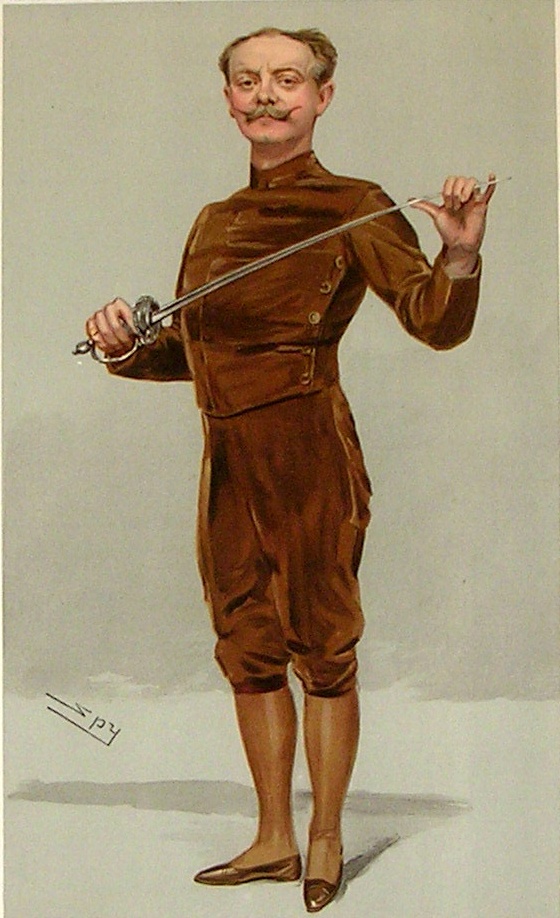
Cartoon of Egerton Castle (1905)

An inflated ego can blind us to the expertise around us. A big head more easily leads us to see what we want to see, not what is actually there. More times than I can count I’ve seen a HEMA player discount a person of experience, skill, and smarts in favor of some Youtube personality. In the best cases, that celebrity (again, small “c”) is good at something and/or has some serious training under their belts, but anyone can set up a Youtube channel and unless one knows what to look for it’s easy to be taken in and fall prey to these would-be experts. Few, luckily, fall into the same category as the fake martial arts masters who look at a room full of students and knock them down through a glance chockablock full o’ chi, but all the same, some get close. There is a prominent tourney goer, for example, that has fetishized his off-hand. Apparently, no one has told him that unless there is a weapon in that off-hand, such as a dagger or buckler, that no one should be looking at it. Ever. There’s no reason too. IF people are falling for this hand sans puppet or marotte, that doesn’t mean that the puppeteer has done anything other than select an event where the average skill is so low that competitors don’t know this. Given that a new foilist learns not to pay mind to the rear arm should illuminate just how sad this is.

As a last example, there are prominent figures who have skill, but misapply it. Were I to offer a class on poleaxe based on late French foil play I would be doing my students a disservice. The universals apply no matter what weapon, but how they apply, differs not only by shape, heft, and purpose, but context too. However, there are well-known personalities who do exactly this, who take a weapon they are proficient with and create a methodology they then attempt to apply to unrelated weapons. At best it confuses things, at worst students—should they continue—will realize one day that their time, effort, and significant financial investment… would have been better spent reading the actual manuscripts, wrestling with the difficult material, and talking to those who have done so before them. There is no royal road to skill. Get your ego out of the way and do the work.

“If You’ve got a Black-List, I Want be on It”

His antiquated and unfortunate politics aside, Billy Bragg’s line seems an appropriate one with which to close. [3] I know, should some read this post, that they will take it personally and call me names. That’s okay. Go nuts. Some may even recognize the unnamed examples I’ve provided and take affront. That too is okay. I stand by what I said—ego needs make for poor choices and big egos make for poor role models.

Age and experience offer little consolation to us, but two things they do offer are perspective and less need for recognition. I’ve spent considerable time taking myself out of the way; I think it helps, not only in my personal life, but as importantly in the larger projects in which I choose to participate. A desire for public validation tends to distract us and detract from what it is we wish to do, and what’s more important, the work (if it is important) or that people know we were involved? As a coach, what is more important, my experience during a lesson or the student’s? What matters more, how that lesson appears to others, or the content of that lesson and its effectiveness in conveying information? The correct answer is the student’s experience, because otherwise why is one coaching?

I don’t need my name in lights, and don’t want it to be for that matter. I don’t need widespread recognition, because just trying to do the best I can for students and colleagues is work enough. I’m content to be one way-station on what my prove a long path for my students. If I help them when they need it, and it moves them forward to wherever they’re going, then I’ve done my part, whether they or anyone else remembers that I did it. I don’t need lots of medals, a social media presence, or any of the other stuff that would take my focus from what I do well and care about.

Not everything is about me, and in fact, very few things are about me. It’s not usually about you either. When we know who we are and what we stand for, that fact tends to stand out pretty starkly. Our egos suggest to us that everything is about us, but few things are; the belief that it’s about us is no more true at 30 than it was at 3.

Get out of your way.

NOTES:

[1] The average skill level in HEMA is poor. Those inside HEMA are accustomed to what they see and scale within that, but the bar never having been high, there is only so “good” most people get. I’m talking average HEMA here, not everyone. I’ve mentioned a number of excellent students of the Art in these posts, and will do so again. The point is that much of what people see, if they knew better, would not impress them.

[2] What tourneys are for is debatable, but in addition to being good fun—ideally, they are also an additional method of learning. Yes, it’s nice to win, but bouting is to fencing what a pressure cooker is to the ingredients in a dish.

[3] Billy Bragg is proof of something my graduate advisor often said in re Communism—the only place it was alive and well post 1989 was in one or two offices at Oxford or Cambridge. Mr. Bragg, whom I believe has a good heart, championed the pie-eyed politics of Marx, something I suspect easier to do even in Thatcher’s England than in East Berlin or the gulags of the former U.S.S.R.

Alex Spreier on Engaging Sources

Alex is a close friend and colleague, and one of the best students of the Art I know. I’ve learned a lot from him. In this post, he tackles the questions of when and how to question our sources.

Here is the link: https://www.highdesertarmizare.com/2023/04/05/questioning-the-masters/

The Importance of Measure

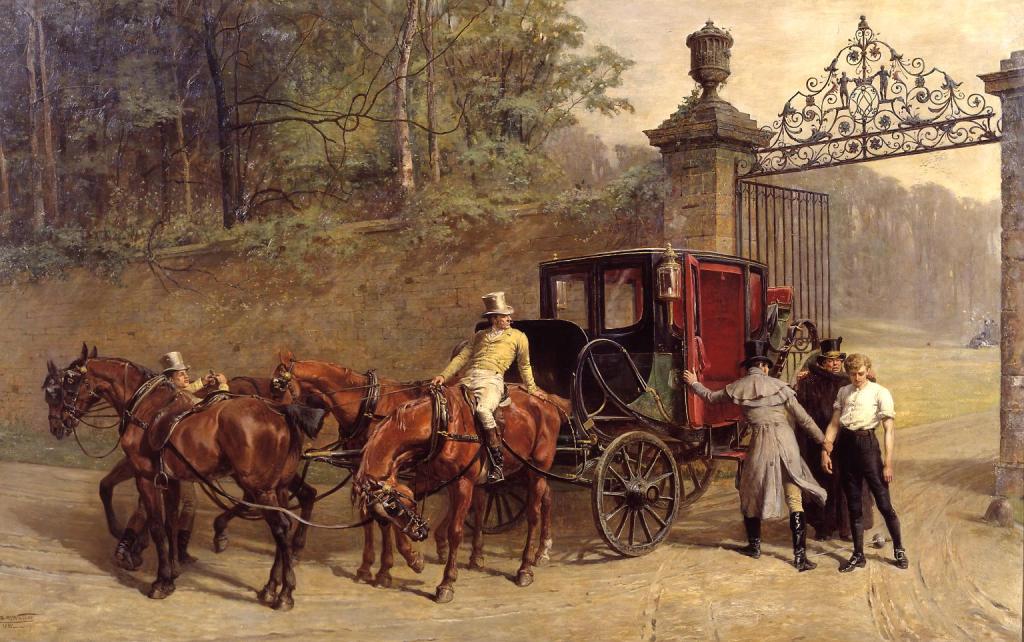
“Success!” 1881 Samuel Waller 1850-1903 Presented by Sir Henry Tate 1894 http://www.tate.org.uk/art/work/N01551

A number of dueling histories record the horrific duel between Colonel Barbier-Dufai and a young Captain, Raoul de Vere. According to most versions, the older adherent to Napoleon attempted to pick a fight with this member of the Royal Guard, but was initially unsuccessful. Barbier-Dufai, frustrated in finding the young man so unflappable, finally remarked that he was not insulting him, but his cockade, and after a heated exchange challenged the captain. However, when asked to select a weapon the captain replied that he had insufficient training in all of them. The colonel said he would not fight a child, a comment that irked de Vere and led him to slap the older man. A duel was now inevitable. In the ensuing sword fight, Barbier-Dufai disarmed his opponent several times. Finally, in frustration, the colonel suggested they hop into a carriage, arm themselves with daggers, tie their left arms to one another, and take two turns about the Place du Carousel. The young de Vere agreed and they set off in their mobile piste. When their seconds opened the carriage, blood was everywhere, Raoul clearly dead, and the colonel next to death. Both men died and honor was apparently satisfied. [1]

I share this story because it highlights the pure idiocy of fighting in close measure. There are times when it is unavoidable, but generally—unless one is in a confined space—there are means by which to extricate oneself from such proximity. One of the chief faults I see in both the wider community and among some of my own students is mismanagement of measure. Usually in my own classes, the culprit is a mix of well-intentioned aggression and fun—so intent on making the touch, some students neglect their own safety. I never want to chip away at the fun they’re having, especially among the younger students, because having fun is one reason people fence, but at the same time I need to ensure that they learn properly.

There are a few things we can do to ensure that our students have a proper notion of measure, and that can help them remember to use distance well in their bouts.

Teach them What Measure Is

First and foremost, from the off we need to teach them the various measures appropriate to their weapon or tradition. Regardless of the weapon or era my students study, I introduce them to the traditional breakdown of measure into three main categories:

  • Out of measure
  • In measure
  • Close measure

Out of measure, what Giordano Rossi calls “double measure” and Luigi Barbasetti refers to as “normal distance,” is the distance that requires us to make an advance first in order to lunge to target.[2] In measure means that one can lunge to target. Close measure is that spot were either opponent can reach one another without the lunge. There are some subsets to this, but to start this is ample.

I hesitate to say that “all” systems of measure reflect these basic breakdowns, but I feel safe to say that measure, being a fight universal, is common to all systems however described. Even in those like Rossi’s “measure” and “double measure” or Fiore dei Liberi’s “largo” and “stretto,” there is implied space between these two poles. Regardless of nomenclature, one must learn how to navigate any space along the continuum of “measure.”

Measure Drills

Measure drills by definition involve footwork. Ideally, any footwork drill save perhaps those used in warming up a class—where everyone advances and retreats down the hall using various types of footwork—will work distance too. Below are several drills I typically use in classes:

Glove Tag is a crowd favorite and very much a game. One can run this as a linear partner drill, or, as a general melee. I usually ask if anyone wants to be it, and if not then select someone. Fencers must use the appropriate footwork only, and, can only target the wrist. There is no parry. One has to move, or, parry with the feet (in the non-pejorative sense). [3] Fun as this is, and much as it helps them move, making it a bit more realistic is helpful (see Mask Tag below).

Foil-Push or mask-push, have the students, in guard, suspending a foil/sabre/etc. or mask between their lead hands. The goal is to move back and forth without dropping the foil or mask. I emphasize that while they are taking turns driving, so to speak, they are working as partners—the only way to keep that foil up is to move in concert. If fencer A steps back, B needs to step forward, and vice versa.

Mask-Tag and 1-Touch Tag, fencers don their masks and use the weapon to tag. For sabre, students target only the head, and, cannot parry. Thrust fencers can only target the chest (or arm depending on what we’re working on), and, as with sabre, cannot parry. They must move their feet. Students must use distance to their advantage. Success depends on moving, recognizing someone fell short and is now vulnerable in the recovery, or, selecting the moment the opponent is occupied, such as mid-step, to strike. If the attack fails, then retreating under guard or behind the point is the best option, and the fencers reset.

Mask-Tag Plus takes this drill one step farther—each opponent can parry and riposte once per action, that’s it. So, if Fencer A lunges with a thrust to the chest, B can parry in quarte and riposte, but if A retreats half a step, then B must recover—B can’t redouble. For more advanced students one can allow the redoublement. This option should be included at some point as so many students starting out stop just shy of the target.

Two-Step Tag is something I’ve used with foil and smallsword students. Two of my foilists, for example, are offensively-minded, so tend to close quickly at “Allez!” and descend into a flurry of jabs, thrusts, etc. I don’t want to take that drive away, so I’m trying to channel it instead. In this version, the only attack they can make is an advance-lunge to the chest. It’s super hard to do, especially since one’s opponent knows what’s coming, so everything depends on precise and keen use of footwork, timing, and distance.

The goal with all of these drills is to emulate, as much as one can, the conditions of a bout, but restrict the options so that the students are forced to use measure. It’s not that good handwork is unimportant or cheating, but that it can easily become clatter and chaos instead of well-planned attacks and responses. It becomes reactive, not active. I teach them that if an attack fails or if something isn’t working, to retreat, regroup, and try something else. Persistence in the face of stout defense is brave, sure, but foolhardy—if what we’re doing isn’t working, we try something else. [4].

Reinforcing Proper Use/Awareness of Measure in Bouting

It does little good to encourage proper measure in drills if we fail to do so in bouts. There are a few way to do this. In both classes and individual lessons I save any bouting we might do for after any focus on technique and drills. [5] This helps prime the pump as it were—students are more likely to consider measure if they’ve spent a bit of time focusing on it before bouting.

Within the bout, I have students actively bouting and those observing analyze the action, not only because it reinforces attention to measure, but also because it buttresses other important aspects, from recognizing who had initiative/started the attack to breaking down each action within a given exchange. Too few fencers learn to analyze bouts well, and the sooner they start the better.

Why Measure Matters

If you view most any bouting footage posted to sites like Youtube you will see, or should see, why better attention to using measure is worth one’s time. In one recent video, for example, one fencer analyzes his bout, but misses the reason that he found himself in the situation he did—they were fighting too close to one another. [6] If their sabres cross near the middle, they’re too close. Certain actions are harder to thwart at such proximity—in this case, a slip of the leg will likely fail because there is insufficient measure to remove the leg and strike the opponent’s head without being hit. More likely, and we see it in this example, both parties will be hit.

In fairness to this fencer, the rule-set he’s likely fighting under is not as doctrinaire as I am about the guiding principle of “don’t be hit.” Even when a rule-set is explicit, so much depends upon judges who know what to look for and how to make sense of what they’re seeing, and by and large tourney HEMA lacks a reliable pool of judges capable of analyzing the action at such a level. Add to this the excitement and/or nerves in a bout and of course things can turn out less ideally than we plan. It is not my intention to denigrate my fellow fencer, only to point out something important he didn’t address (his focus was on the slip). Were he my student, we’d likely work on this very set of actions at the proper distance, that is, set it up so that he is just about a step or so farther back then we see in the video. From punta spada/sword tip one is more likely in a place not only to make the attacker’s feint and strike more successfully (i.e. without be clobbered doing it) but also provide the defender sufficient measure (and thus time) to assess and adjust.

“Halberd against the Sword,” Hector Paulus Mair, MSS Dresd.C.93/C.94 (ca. 1540s)

Not all clubs or instructors take the same view I do. The more I read, the more I teach, the more I see how fencers learn, the more inclined I am to championing the goal of “don’t get hit.” It does change how we fence; it makes for a more circumspect, conservative, and hesitant game. The flash and fire, the dynamic move and rococo blade-work tend to impress, and that is what attracts many of us in the first place. It looks cool and we want to do that cool thing. While perhaps less flamboyant and exciting, I’d argue that there is as much beauty to the cold efficiency, exactness, and finality of a one-touch exchange. Moreover, training this way adds something else extremely important—improved confidence. The more one succeeds in gaining the line, striking, and getting out without suffering a counter-attack or double, the more one trusts themselves and the weapon they have in hand. In no way does that make one invulnerable, of course but confidence does much to help us cultivate the calm we need to fight with our heads and not our hearts. [7]

NOTES:

[1] There are a number of popular histories and websites that mention this duel, few with adequate citations. See for example Robert Baldick, The Duel: A History, New York, NY: Barnes & Noble, 1965, 164-165; Major Ben C. Truman, The Field of Honor, New York, NY: Fords, Howard, & Hulbert, 1884, 236, available online at [https://archive.org/stream/fieldofhonorbein00trumuoft/fieldofhonorbein00trumuoft_djvu.txt]; Thimm records a duel with daggers, minus a carriage, between two men in Italy in 1891, A Complete Bibliography of Fencing and Dueling, Reprint (Gretna, LA: Pelican Publishing, 1998), 457.

[2] Giordano Rossi, Sword and Sabre Fencing, Milan: Fratelli Dumolard Editori, 1885; translated by Sebastian Seager, Melbourne Fencing Society, 2021, 49-50; Luigi Barbasetti, The Art of the Sabre and Epee, New York, NY: E. P. Dutton & Co., Inc, 1936, 15-16. Cf. Gustav Arlow, Sabre Fencing, 1902, translated by Annamaria Kovacs and edited by Russ Mitchell, Austro-Hungarian Sabre Series, Vol. 3, Happycrow Publishing, 2022, 35.

The term “normal measure” is revealing–this is the distance from which one is still safe, but close enough to mount an attack. In other words, one isn’t four meters away from the opponent, and, isn’t in their lap.

[3] The “Coward’s Parry” or “Ninth Parry,” according to Morton, is the derisive term applied to those who avoid at attack by means of a step back. Where this idea originated I’m not sure, but it’s alive and well in HEMA. My guess, like Morton’s, is that this harkens back to the time with salle fencing, particularly in France, sought complex, elegant handwork over retreating (a “ninth” parry suggests an acceptable eight, and the French school in the 19th century looked to that number). See E.D. Morton, Martini A-Z of Fencing, London, UK: Antler Books, 1990[?], 43, 126.

[4] There are instances, of course, were it’s wiser not to break off the attack. If say one thrusts to the chest but lands short, and the opponent isn’t reacting properly, then redoubling to strike makes good sense.

[5] Most of my bouts are teaching bouts, that is, bouts in which I present what we covered in a lesson so that the student may work on those topics in real time. For classes, I still do this, but often include a little free-bouting at the end of class provided the students have enough in their toolkit to do so, otherwise I have them engage in restricted bouts where they move at real speed, but are restricted in what they can do.

[6] I do not know “@HEMA_Fight_Breakdowns,” and again, do not wish to disparage them in any way. Their video provided a great example of what I cover here, but my topic was not the same as theirs and I want to make that clear. To blast someone for not covering something we want them to, when that isn’t what they set out to do, is silly if all too common. This fencer has some good things to say about slipping the leg and one response to it–the topic of the video–it can be found here: https://youtu.be/Bk32YMYqiwA

[7] For this notion, see Master Perigore of Paris in the film adaptation of “Scaramouche” (1952): https://youtu.be/FQfsvMENYgc

Smallsword in Salem, OR

Waterfront Park, Salem, Oregon

Despite the cold and wind (it was 28F/-2C), a few of us met down by the waterfront in Salem this evening for smallsword. Though I am able to teach more often indoors again, there are still times where we lack that option, and so one either finds a way or doesn’t practice. The crew in Salem is dedicated, in no small part thanks to my friend Joshua, who approached me last year about the weapon and has done more than anyone to get others interested. It’s important to me to honor that commitment and drive, and to be honest easy to do since I enjoy smallsword so much. If they’re willing to meet on a chilly evening, I’m happy to make the trip.

It’s difficult working in the cold, especially in a two hour block, but we did our best to keep moving and stay out of the wind. Lucky for us, the amphitheater where we met has surprisingly good lighting, and thus we were able to continue practice after sundown. We were less successful avoiding the wind, but it kept us moving! We spent most of the time drilling specific actions and a few permutations following from them, but some measure/footwork exercises too.

Anatomy of a Lesson
From time to time I discuss lessons and lesson-planning on this page, and tonight’s class provides another great opportunity to do that. Since this was a two-hour block it’s important to organize what we’ll cover–there is only so much “new” material one can digest. What I typically do is consider first, whom I’m teaching, and next what they need. In this case, one of the two students who showed up has been away for a while, so some review of fundamentals (which I always include at some level) seemed appropriate. The other student has been practicing with me and at another school, and so is less in need of a refresher, but was happy to go over things again. [1] Regardless of topic, I usually structure lessons, long or short, the same way:

  • warm up
  • progressive drill
  • main lesson
  • cool down [or depending on the type of lesson, bouting, then cool down]

The warm up tends to consist of plyometric-oriented drills and/or fundamental actions. For rapier and smallsword, for example, I often start people out with something like an arrest drill–this requires me to make purposeful mistakes by exposing the weapon arm in various lines and the student to counter attack via arrest to the exposed section and then cover/parry and riposte. From there, I might add a counter-parry/riposte on my side, and so on. Varying the measure, the speed, and line make this warm-up more realistic and sort of primes the pump as it were for the main lesson.

Format for Sunday Evening
This time we began with a fencing version of a “push hands” drill. Joshua and Robert started with a glide in third, one fencer starting the attack, the other making a yielding parry in third, gaining leverage, and then attacking with a glide in their turn. There is a see-saw quality to it, but done well it’s a valuable drill: it helps both parties gain better sentiment du fer, helps them work on closing the line, provides them a convenient way to monitor how far to move the hand to parry, and tests the height of the hand on the thrust. [2] The same drill is useful in carte, half-circle/7th, and seconde. There are additions one can make to the base drill, but tonight we used the four main lines only and as a warm-up.

Next, we took this drill one step farther—we used the glide in third as a feint to draw the opponent’s tierce, then disengaged and made a thrust to the inside line with opposition in carte. Both fencers are taller than I am, and so one aspect of this exercise that proved particularly useful was changes in measure. Though the same attack can be made “firm-footed,” as the treatises refer to it, it’s important to vary the distance. Not every opponent stands still.

Girard, Traité des armes, 1740

I’ve often had students work from a glide, but at a certain point, once they have the concepts the glide teaches so well down, I expand upon it. [3] This time we discussed a guard where the glide doesn’t work well—Girard’s more extended tierce. One can make an attack by glide against this straighter guard, but it’s much easier for the defender to defeat it. [4] So, we discussed using a beat-feint instead. This was familiar ground, both offensively and defensively, but works a number of fundamental actions. It was a good set up to the prise de fer in seconde, and, the defenses against it.

The first line of defense against this attack, one anyway, is the derobement, that is, avoiding the envelopment by performing a tight circle around the opposing steel. Next, we used a yielding parry in seconde. Lastly, we upped the difficulty level and used a change of line from yielding seconde to yielding carte. This is not easy to do—it requires a keen sense of timing, distance, and evaluation of the line of attack. [5] It also raised additional questions—if one transports the blade to carte, one could riposte by flanconnade, but this is harder to do if the attacker’s hand is in tierce instead of carte.

As a way to reset and take a break from a complicated drill, we next played a version of glove tag. Often termed restricted or constrained bouting, this type of game limits one or both fencers to specific options. We started out having both fencers attack the inside line, but they could not parry—the only option was to use the feet and measure. Ideally, one provokes the opponent to fall short, then attack them as they recover back into guard, or, catch them on the march. It can be a workout. Next, each fencer could respond by parrying in carte and riposting, but nothing else.

Joshua lunges; Robert parries in carte

In the last twenty minutes we enjoyed a few unrestricted bouts. I urge fencers to do their best to use what we cover that day, and when I’m up I do my best to present students with opportunities to work on those actions. If the student is new, the cues I give are more obvious and I might hold them a second longer, but as much as possible I try to maintain the same conditions students face in actual bouts. Everything we do should relate to what students will need on the piste or in the ring, otherwise we do them a disservice. Footwork, warm-up, lessons, teaching bouts, pair drills, whatever it is we have students do, should always serve to improve their game.

Have Plastron, Will Travel
Fencing, State-side at least, is an obscure pursuit and outside the Olympic world, which is far better known and supported, it can be difficult to attract and retain students. There are a number of models for running a club and providing lessons, but the one I’ve opted for is as flexible as my other responsibilities allow. The “they can come to me” approach might work for some, but I’ve become a big believer in meeting people half-way whenever I can.

These days I teach six days a week in some capacity, which can be a lot when one has a day-job and family duties. Four nights a week I teach for parks & rec, Sunday mornings I meet people outside that system either at the local Grange or at the community college satellite, and twice a week I provide individual instruction (sabre with one 11 year old girl, rapier for one man in his 60s). It can be a lot, but I love it. Not a day goes by that I’m not grateful to my spouse and children for their generosity with time and the various clumps of fencing gear that occupy different corners of the house.

The Portland metro area, and PNW in general, boast a number of options for those interested in martial arts, and, in fencing. What I offer will not appeal to everyone, and that’s okay–happily, knowing many other instructors and coaches I can refer people to places and people that might better suit them. My close friends among other instructors do the same for me, and in fact, many if not most of my students came to me via people like Mike Cherba (Northwest Armizare). We’re a small community, but we do our best to look after one another, because in the aggregate we all benefit. The more like-minded fencers we train, and the better we train them, the more people we have to enjoy the Art with, so in a sense it’s self-serving. However, the study of the Art beyond mechanics and tactics can impart so much more; it can become a way of life, a philosophical position, and like any such study is one we can pursue all our lives long. The more time I spend in the Art, as student always, as teacher often, the more I appreciate the lessons–all of them–it imparts.

NOTES:

[1] I’m a big proponent for the continual training in the most basic, fundamental actions and techniques. We should review them often if not in some fashion each time we train. Typically, I manage that in my lessons via drills and exercises, and, regardless of skill-level. The kendo master I studied with briefly told us about his yearly retreat with his own, elderly master. Despite all my sensei had achieved, his rank, etc., his master could still find things even in his grip on the weapon to correct. We are never finished being students.

[2] Smallsword texts, as I’ve mentioned before, can vary considerably when in comes to hand height on the attack. For my part, the advice of many masters, who suggest that the hand should be as high as the chin, seems to fulfill the requirements for covering the high-line when lunging well enough. Some later texts, likely more reflective of salle play, can have the hand super high (e.g. La Boessiere), but raised so high one is far more likely to eat a counter-thrust.

[3] I will likely never be able to thank Chris Holzman, one of my mentors for Italian fencing, enough for his suggestion to start new students off with the glide vs. a direct thrust. It has no lie revolutionized my approach. Thank you, again, Chris 🙂

[4] Girard’s guard, as you see in the image, is more or less extended. What we see there is supported by the text accompanying it as well. On page 12 of the pdf available at the BnF Gallica site, the text reads Il faut présenter la pointe de l’Epée droite, vis à vis la mamelle droite de l’ennemi, & que le demi tranchant regarde la terre and Que le bout du pommeau de l’Epée regarde entre le teton droit & l’aisselle, & tombe directement au-dessus du bout du pied droit. Here, the tip of the blade and the end of the pommel both suggest a more or less horizontal blade.

This is harder to describe than demonstrate, but Girard’s guard, because it is more extended and horizontal, makes it more difficult for an opponent to effect the glide, but more than that, to defend against such an attempt requires merely a shift of the wrist right or left to defend. A beat may not sufficiently move the line, especially if one beats to the side of the opponent’s blade opposite the thumb, but combined with a feint it is more likely to succeed.

[5] My approach to working more complex actions is progressive and determined by skill-level. Though where we stopped is a viable response, it is also an unlikely one. The simplest, most efficient response is normally best, however there are at least two reasons to explore more complex iterations. First, it is “medicine for the hand,” and in training more sophisticated actions we hone the basic ones that comprise them. Second, there is always the chance one will face an opponent where the simplest defenses and responses will not b enough, and so having additional options in one’s repertoire makes sense.

Russ & CO.–Interview with Chris Holzman on all things Radaelli!

This video is so good. SO. GOOD. Chris is a friend and a mentor, so I know I am partisan and possess some bias, but for those who listen and find themselves uncomfortable, I challenge you to listen to what he says. Some of it will be hard, but it’s important. Few people like being called out for the inconsistencies and nonsensical things we do, but wee bruised egos aside it’s healthy for us to do so.

This is also a wonderful introduction to Radaellian sabre, a thorough examination of how this system influenced so many others, of the development of the sport, and a personal bugbear, another nail in the coffin in the silly dichotomy people insist exists between so-called “military” sabre and “dueling” or “sport” sabre.