Some News

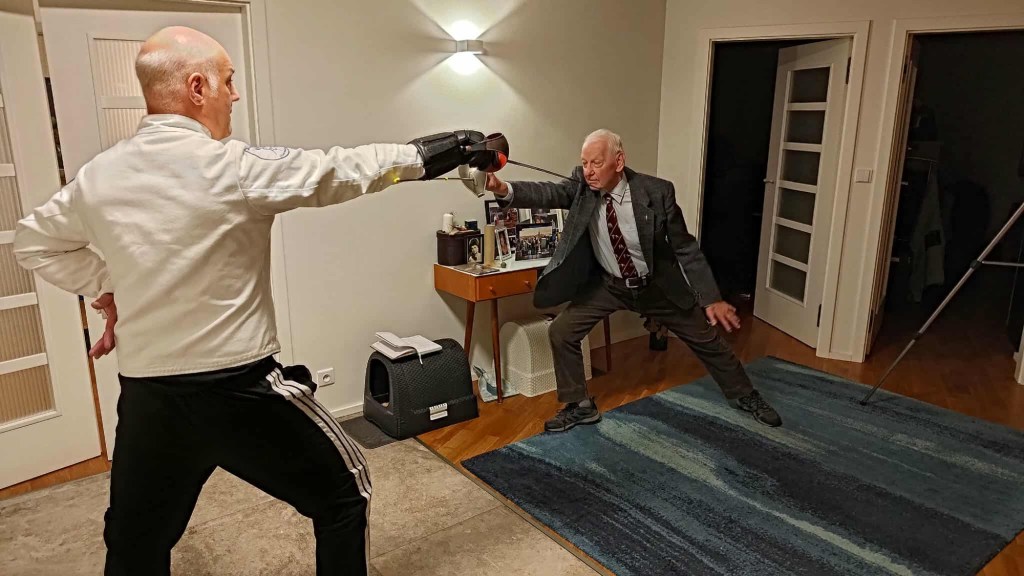
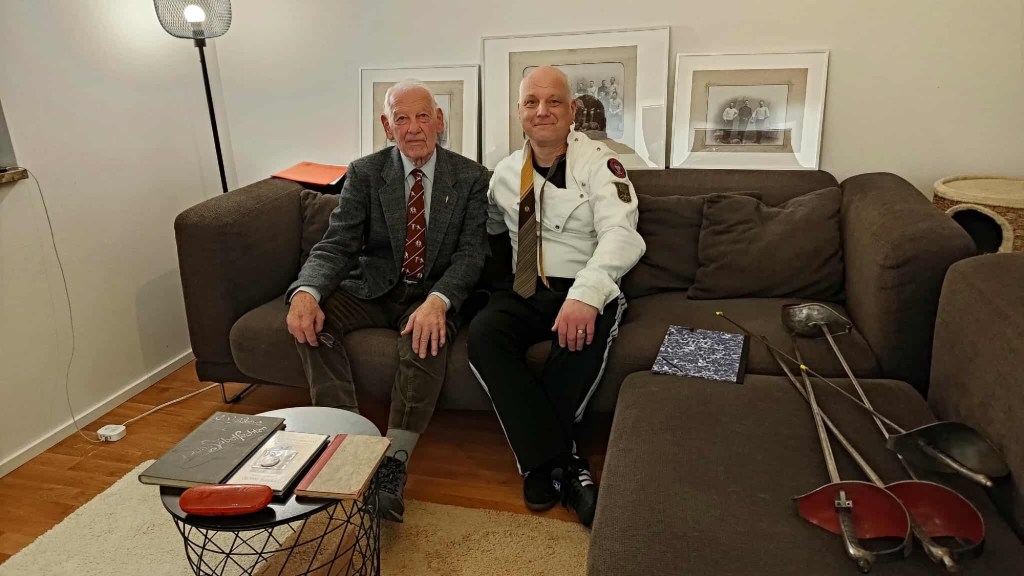
An old friend and fencing comrade, the excellent Jon Brammer, pointed out that I had mentioned but not followed up upon the master of arm’s examination I took in Prague. Apologies.

While happy to write about fencing, I find it difficult to write about myself, so I’ll be brief and say that I passed and share some photos.

Ft. Ligonier/Carlisle, PA, Pt. II

While there were a number of Carlisle, PA, adventures with my friend and host, Patrick Bratton, among them were a few with other coaches and some of his students. As another example and proof for the value of cross-fertilization in fencing, I’d like to talk about the morning I spent watching a fantastic lesson by an Olympic coach, the excellent Tony Alvarez.

Excellence in Coaching: Tony Alvarez

I’ve known about Tony since the Pandemic–he worked with Patrick online in the epee class with Maitre Robert Handelman we all took–but this was the first time I had met him in person. Knowing my background, or at least my current focus, he was quick to remind me that the lesson sample I was about to watch was modern. While I cannot say I enjoy modern sabre, I do recognize that there is much to learn there despite the problems, if for no other reason than smart fencing coaches like Tony adapt well.

I’ll not lie–I have been quick to criticize modern sabre, and I likely still will, but this said I gained a new vantage point on it thanks to Tony and Patrick this past Monday morning, and I’m grateful for that. First, and to honor Tony’s skill, he showed very few actions, but actions used in different measures and tempi, in different set-ups.

He started with actions in the box, between the two en garde lines, then outside the box. Watching Patrick and Tony, both of whom know what they’re doing, made it seem as if very little had changed since the days of my early training save in one respect: speed. The modern game relies on speed in a way that one could mitigate more easily before the end of proper edge-alignment in sabre. There simply is not time to make some actions, most especially ripostes, in every instance.

Everything is a distance game played at the right time and correct speed. Here’s the pinch–that has always been true. What differs is method and tool. A lighter, fast weapon that can score with any part of the blade demands tighter timing. This is one reason the age of competitors has dropped so significantly in the past three decades.

I learned A LOT watching Tony teach, and his advice for working with children–the majority of his clientele–is invaluable.

Quick Studies-A Radaellian Lesson with one of Patrick’s Students, “J.”

One of the things I most looked forward to was working with Patrick’s folks. One student, a young high-schooler, wanted a sabre lesson and the last day at the fort we were able to have a short one. Important things to note: this young man started fencing last August; he is a big man, but super quick and flexible (day one in Justin’s Besnard class he dropped effortlessly into a de la Touche lunge…).

I gave him a very traditional outline, but with Radaellian elements, meaning we started with some point in line/disengage work, then some parry/riposte to warm up. Then, I took him through two set-ups with feints. Finally, as a cool down, we did a stop-cut/parry-riposte drill. He made all of it look easy.

I have adult students who struggle with some of these set-ups, but J. looked like he had been doing these drills for years. Even in the cool-down he opted to use an arrest half the time, an action that takes considerable point-control and timing. I was so impressed and told him so.

J. is as good as he is because he has a great coach, and, because J. is motivated, keen to fence, and found the right place to learn. I have written a lot about the importance of the universals in teaching, of starting with and honing fundamental actions, and J. is proof of how sound an approach that is. Moreover, J., and Patrick’s other students, are working within a mixed community, diverse in many senses but also in the sense of fencing styles and influences. It shows.

Why is this important? It’s important because it reveals another layer of diversity within Patrick’s club–put simply, his students are getting tools for their toolbox not only from different stores, but different lines of work. In the U.S. now there are people keen to erase diversity and downplay its importance. They do this out of fear and ignorance, for there is no science, reason, or morality behind any of their claims.

A diverse club is a healthy club, one guaranteed to push people and help them grow, and not just in terms of their ability to lunge or parry well. Exposure to people different from us, in large ways and small, reveals that they are people like us, just fellow humans trying to make their way through life.

Diversity fosters strength–it is harder to accept the idiocy of race-politics, for example, when one spends a lot of time with different “races” etc. and therefore knows what politician A or pundit B says is complete horseshit.

Working in Pennsylvania, and in an area rather “red” as it were, what Patrick has achieved at Sala della Spada is remarkable. Under his roof you will find not only the usual notions of diversity, but also political diversity. Now, like many of us, politics is not a topic there is time for in a salle, so they focus on fencing, but everyone in the club knows that they are working with people who see the world differently in key ways and work together nonetheless. In this there is hope. It is hard to remain divided when we spend with people ostensibly on the “other side” from us. We find our common humanity, we find common ground. If nothing else, we all love to fence.

Why Storica Defensa?

[warning: this is a long post, but I wanted to address a few things fully]

On several occasions lately I have been asked about my role in Storica Defensa, and in some cases the same way police might ask a teenager why they’re loitering outside a convenience store. There is some inherent suspicion there, and in this case, for several reasons. First, and perhaps most obvious to the denizens of social media’s historical fencing pages, because one of the founders, Jay Maas, a friend of mine, upset a lot of people with satire initially a little too subtle that aimed at fault lines in reasoning, practice, and interpretation in “HEMA.”[1]  It is not that Jay was wrong in his criticisms—pound for pound he has been correct—but that he ruffled a lot of feathers. Not everyone saw the satire, and so took his memes, comments, etc. as personal affronts. For the record, Jay knows that his previous (key word: previous) approach was not the best, and has made repeated, concerted efforts to mend things with people. [2] In many ways Storica Defensa (SD) is part of that—it’s a way to give back and rather than point out the flaws, address them and work to fix them. Second, and at the risk of upsetting some colleagues, especially those with certifications through either the USFCA or equivalent bodies, there is a sense that unknown or troublesome upstarts are infringing on their turf. Third, SD is new, not well-known yet, and those upset by it or fearful that it may affect their own programs, have misunderstood, and in some cases misconstrued, the purpose of SD.

As a person brought on early in SD’s formation, I would like to address these in turn, and explain from the inside what SD actually is. I do not join anything without consideration. Experience, perhaps especially negative experience, is a powerful teacher. More than once, either through naivete or enthusiasm, I’ve allied myself with people or groups I later regretted having joined. For a local example, some years ago an instructor at one school I attended on occasion, during a particularly difficult time in my life, attempted to humiliate me publicly more than once. It didn’t end well, but as the truth will out, his poor behavior with still others ended up destroying that school and relegated him to the sidelines. We repeat lessons we haven’t learned, and this was, for me, just such a repeat—do not put faith in people or groups who do not have your best interest at heart.

This is to say that I would not back SD if I didn’t believe in its mission or if I took issue with the organizers. I’ve known all but one of the four initial members a long time, and the fourth, Xian Niles, I quickly developed a deep respect for, even before learning of his fencing education. If I had had the least doubt that any one of my colleagues was up to no good or eager to undermine anyone else, I would not have agreed to help.

My Own Involvement with Fencing Organizations

My first exposure to the larger issues plaguing most sizeable fencing associations was with the USFA (United States Fencing Association) in the early and mid-1990s. For several reasons I have never been over-fond of the USFA. First, it’s expensive—especially for younger students. Second, it dropped the ball (along with the FIE) when the “flick” in foil and the idiocies attending electric sabre ruined traditional technique and tactics.[3] Third, it’s myopic in focus: all that matters to the USFA is the competitive world. For the vast majority of fencers in the U.S., being competitive fencers, there is little to no problem with the governing organization. Most of the time it is more or less invisible, there in the background. It works well enough for them, especially if all they know is the post-flick and flat-of-the-sabre-as-able-to-score world. That is fencing to them. [4]

In more recent years, while working toward a certification through the USFCA, I was annoyed to learn—post exam—that I had to join the USFA and jump through other hoops as well. This was not clear up front either on the website or in the test preparation documents. Having to go through SafeSport, while an extra cost, at least is something I can get behind because it’s important—as a coach, and moreover one who works with a lot of children, mostly female children these days, it’s crucial to be a part of the solution and to model good behavior. Everything SafeSport teaches “should” be obvious, but it isn’t and so while ticked to find out about a hidden cost, again, this one I understand.

In fairness, I had good experiences with the USFCA (United States Fencing Coaches Association) up to then, and was disappointed to learn that it was merging with the USFA. On the surface it’s a natural alliance and makes sense, but of the two there was a chance, a slim one, that the coaching wing might, might continue to entertain the idea of a broader view and remain inclusive. The USFA is almost solely concerned with Olympic aspirations and the competitive scene, but fencing is, and has always been, much more than that. Most fencing coaches are not training Olympians, but working in obscurity at the YMCA, your local P&R, or some college campus. The USFA gives next to no thought to them—the USFCA did, at least a little. If nothing else they allowed the late Walter Green to push “classical” fencing classes and viewpoints and allowed obscure coaches like me to participate in classes for my own improvement as fencer and coach.

On the historical side, which is far more decentralized, the “HEMA Alliance,” for example, was a good idea, but like its cousin in the sport world is more concerned with sport (largely longsword) than anything else. They offer an instructor certification course, but it is unclear just who is evaluating candidates, and of course, like the USFA more recently, one must pay to retain a certification after a few years. [5] Given that leadership in the HEMA Alliance has often been people very new to fencing, it raises serious questions about who they think is qualified to evaluate other instructors. Most competitive HEMA is dismally poor in quality so one must question just how high the bar for skill is. Put another way, if fans of a medical tv drama are teaching and evaluating surgeons, that’s bad.

In sum, I am wary of most fencing organizations, Olympic or otherwise. It’s not that they don’t include a lot of good, because they often do, but that for one reason or another they fail. It may be that I have just been unlucky with these organizations. They work just fine for many people, after all, and while they don’t work for me, I don’t condemn anyone who finds value in them. This said, I think we can do better; I think most every fencing organization with whom I’ve had contact can do better. One of the things that attracted me to SD was that built in is the notion that it’s a new group that will grow, evolve, and improve over time. One may well wonder why that is, and so, here is the single most important reason.

It’s about the Material—not Us

While SD contains personalities, SD is not those personalities. Cults of personality are popular in “HEMA,” but a terrible basis for a teaching program. Skill trumps popularity. Openness tends to be healthier than stodgy isolation. Transparency fosters trustworthiness better than hiding in the shadows. NONE of what we teach is ours—our interpretations of past fight-systems are, like museum artifacts, property of the human race. We may help explain them, teach people about them, but we do not own any of this. Be wary of anyone claiming to have a monopoly on truth, ability, or understanding. The nature of historical fencing is mutable, and must be as new or better information may change previous conclusions.

Our focus is on the material, in this case, the corpus of fencing theory and practice as put to paper over the last 700 years. The best preparation for tackling period sources, contrary to the prevailing opinion in “HEMA” is a solid grounding in traditional pedagogy and technique. Modern fencing, the sport, while it features some aberrations, still imparts a thorough grounding in universal principles and much of technique. Armed with this, a student of historical fencing will more easily unpack what the sources contain. Certainly, historical understanding of the period is a boon, but this can be obtained secondarily by leaning on the historians who work in the specific period of one’s interest. There are even a few such historians active in historical fencing.

Added to the source traditions and time-proven teaching methods, SD’s founding members, among others, have extensive experience in other martial arts systems. Though wary of “frog DNA,” of misapplying one system’s material to an older, extinct one, a broader, deeper understanding of a variety of approaches does much to inform one’s own. [6] Where individual responsibility for clear delineation might fail, collective attention to the dangers of comparison, another built-in feature of SD, does much to correct.

Storica Defensa’s Goals

The goal of SD is three-fold. First, we wish to improve the quality of teaching. Second, we wish to improve the quality of ability in historical fencing. And lastly, we want to sponsor and cultivate not only safer competitions, but also better run and judged competitions. These are three of the areas that currently suffer the most in the community. To tackle any one of these areas is a daunting task. However, they’re related—if coaching is better, the fencing will be better; if both coaches and fencers have a more sophisticated understanding of the Art, then judging will improve too.

So, here is what we are actually attempting to do at Storica Defensa.

Teaching:

Many, maybe most “HEMA” groups got their start as a tiny group of people, or an individual, who saw something about historical fencing and wanted to get involved. Some people have a background in the sport, others in the SCA, still others in martial arts, and many with no athletic background whatsoever. [7] The grass-roots nature of historical fencing’s development, therefore, has rarely included much if any training in traditional fencing pedagogy. In fact, given the misguided disdain for all things Olympic fencing, most people in “HEMA” outright reject modern teaching methods.

There are a handful of schools with credible masters who teach historical fencing topics, often among more modern lessons, but these are comparatively few and too often exclusive. Some are exclusive out of fear, others out of arrogance, some suffer both, but the result is the same—unless one pays their way in, kowtows to the right people, one is forever excluded. This is true regardless of skill, knowledge, or anything else save perhaps notoriety. Get enough Youtube hits, who knows, you too may be invited to WMAW. It tends to be a closed club, however, and unless there are political or social reasons to consider, or one has made a big enough splash to appear knowledgeable, outsiders are not welcome. They may attend, if they can afford it, but they will not do so as intimates of the inner circle.

I do not wish to knock WMAW—it is a solid event and would that we had more conferences that combine classes, lectures, free-play, and the all-important after-hours conversations where the real learning happens, but with all appropriate respect to those benefits, and to my friends and colleagues who teach there, it doesn’t do much good for the vast majority of historical fencers. This is, granted, a bias of mine: I want everyone to have access to what we do, with as few economic or social barriers as possible, but not everyone sees it that way.

The few teaching programs available State-side, staffed by many of the same who teach at conferences like WMAW, tend to be exclusive too. One must travel to their events, pay for participation (which makes sense of course), and take whatever it is they’re teaching. Most of these programs have a set curriculum, and few offer help online to reach those unable to travel. This is not to say that the instruction is bad, but you get whatever it is they are offering and that may or may not be what one wants. I back—for the record—any informed, skilled, and valuable teaching program, and in do not wish to denigrate them; here, I am simply pointing out that there are various barriers that prevent these schools from reaching a lot of people who really, really need their help.

SD seeks to be inclusive, to teach teachers how to share all this disparate, often difficult material better, wherever they are and whatever the topic. Much of this can be done online. There is not, at present, any fee to join. Should SD work out and grow, in time that may change as costs to operate increase, but the goal is not profit or fame, but improving instructors and fencers. Moreover, SD does not take over a club or impose its will and ruleset on anyone—it is completely voluntary, and, is set up to work with any program. Your club, this is to say, will not be subsumed but continue to be your club. In fact, we want people to study with other coaches, as many good ones as they can, because we all benefit in the end.

Quality of Fencing:

If you’ve read much on this site you will know I do not have a high opinion of most historically-oriented competitive events. Much of it is unsophisticated, sloppy, and devoid of anything more complicated than single-tempo actions. I have, on the other hand, done my best to promote those events where both skill and officiating is excellent—SabreSlash in Prague, Czechia, and The Rose and Thorns Historical Fencing Symposium, Auburn, California, USA, stand out in this regard. The solution to seeing better fencing is creating better fencing instructors, thus point one just above. However, not everyone wants to coach, so SD has a system to help competitors or recreational fencers improve their game.

One learns better having to teach a topic, so for those clubs interested each rank in SD can teach certain other ranks a degree of material if that club wishes to do that. This can be as simple as leading footwork drills. Each rank, each set of rubrics, all the training videos, are built on traditional fencing instruction, close attention to the source material, and decades of experience between the organizers, all of whom continue to take lessons as well. As new information or better interpretations pop up, the various curricula will change if and when necessary: we do not want to rest in any interpretation should it be superseded by a better understanding of that weapon or tradition. All of our training videos and personal instruction reveal a path forward, but we also believe it is important to investigate other (rational, well-supported) interpretations. In the aggregate, we all learn more and improve.

Proof is on the piste. Watching some members work towards the next rank, and then looking back at earlier footage, the improvement stands out. The system works. For those of you more competitively-minded, SD fencers are cleaning up in a variety of events in Canada (where we started), and, in some cases at events actively hostile to some of our members. To overcome bias, dislike, and less than fair judging requires a degree of skill deep enough that it is absolutely clear who got the touch.

Safer, Better-Officiated Competitions:

Having witnessed injuries in historical fencing tournaments I never imagined I’d see, and hearing of even more, there is a deep need to provide safer, better run matches. We do this for fun, after all, and trips to the ER, permanent injuries, and all the cascading consequences of maimed limbs, concussions, and pulled muscles shouldn’t be normal.

The SD events held in Canada in 2023 and 2024 have been not only injury free, but have highlighted the difference solid officiating makes. It’s common, for a number of reasons, for attendees to act as judges. Many do not have adequate time-in let alone sufficient training to judge the high-speed action of a bout. It takes years to learn to do this even moderately well. SD dedicates time teaching instructors, fencers, everyone, how to judge. Fencers in SD, from the off, are taught to analyze and evaluate bouts. It makes sense too as for historical fencing, we do not have a body of officials specifically trained to do this job. This is normal, or was, in the Olympic world, and works better than winging it.

SD’s ruleset is also system agnostic. General terms, such as “outside parry,” for example, might apply to sabre, smallsword, longsword, or spear. Specific categories, say smallsword or longsword, will have rules appropriate for these tools, but the basis is the same: hit but do not be hit. For some weapons the scoring is weighted (e.g. longsword, sword and buckler), for others—especially those that are high-speed (smallsword, sabre), it’s non-weighted. Considerable thought and experience went into these rules.

WhoTF Do we Think We Are?

It is important to explain why we think we are able to offer what we do, and, what if any process we underwent to validate the claim. This is a fair question, and it deserves an honest, clear answer. Transparency is a necessary ingredient in trust, and in the spirit of that, here in no particular order are some of the reasons we feel capable to offer what we do.

First, none of us is claiming any rank or expertise that we have not earned. We are not maestri d’armi.

Second, each of us brings considerable experience, not only in terms of teaching, but competitively.

Third, we have taken and continue to take lessons whenever possible. Fencing is a lifetime pursuit and we are never, ever finished learning, correcting, or perfecting.

What else?

Combined the two founders (Xian and Jay) and their advisors (Patrick and myself) have over a century of experience and instruction. Moreover, each of us has long experience not only with traditional fencing pedagogy, but also deep grounding in the source traditions. Any one of us, by the way, is willing to provide evidence for this should one wish.

Both Patrick Bratton and I have doctorate degrees. In and of itself that doesn’t mean much—neither of us has a PhD in fencing ;-)—but it does mean that we spent years and years learning to conduct formal, public research, to analyze sources, to deliver conclusions clearly in print or at a rostrum, and that we know a thing or two about teaching. My initial research was in ancient and early medieval history, especially early medieval Ireland and things Celtic, but when academia didn’t pan out I turned my research skills to fencing and now, almost exclusively, research the history and development of various aspects of the Art.

ALL of us have years of formal instruction in fencing, and as I said, continue to study with a master whenever we can. Some of us more or less acted as prevots/provosts at various times in our careers. For example, my last master had me work with his younger students and ready them for competition.

Xian, Jay, and Patrick not only teach, but continue to compete in historical fencing tournaments. This means, among other things, that they’re putting their money where their mouths are—if you require proof of their skill and suitability, of their knowledge of tourney life, there it is. I used to compete, but age, injury, and a demanding schedule don’t make it easy for me to train for tournaments. Serious competitors train for these things, and let’s just say that past a certain age, and with comprised limbs, it’s absolutely necessary to train well unless one wishes to go to hospital or miss months of fencing thanks to recovery. [8]

As for the ranking system we employ in SD, from Ibis to Oak, it owes much to both the French and Canadian armband systems in Olympic fencing. [9] In fact, a former president of the Canadian Fencing Federation, Stephen Symmons (Phoenix Fencing), was instrumental in helping us devise a system for historical fencing. Note well: SD ranks are stand-alone—at present, and so far as I know for the future, there is no plan even to try to establish some equivalency with older, well-known programs and ranking systems. [10]

Finally, and to correct misinformation out there:

NOTES:

[1] The internet is notorious as an imperfect medium for communication. It is easy to misinterpret a comment or joke. This can be a hard lesson to learn, but the responsibility goes both ways—just as we need to be mindful in what we say and how we say it, so too as readers we need to take the time to evaluate and make sure we understand what we’re reading. When in doubt, ASK.

[2] It pains me to see Jay’s concerted efforts to mend things with people and to encounter people who either ignore that fact or for some reason don’t think it’s enough. This has happened twice in the last month.

[3] I have waxed long and boringly on these faults often, so will leave it at this.

[4] One reason Olympic fencing will never fix the problems undermining it is that on the one hand those who have succeeded via dubious techniques have a vested interest in preserving the status quo. Second, it’s been long enough now that an entire generation or two of fencers doesn’t know any better. All the garbage, as I stated above, is fencing to them.

[5] Just as we have people play-acting as scholars, so too do we have people without ability playing instructor. Got to crawl before you can walk, and in “HEMA” too many people only run.

[6] In the “Jurassic Park” sense of frog DNA as a misguided shortcut.  A classic example is cutting competitions—much of the technique by so-called experts comes not from the manuals and treatises they claim to use, but from their experience in Japanese sword arts. There are many ways to cut through a target, but that doesn’t mean they’re all the same.

[7] One of the best things about historical fencing is the diversity. However, the same ethos is too often applied to pursuits like research and teaching where there are conditions. We should have a variety of viewpoints in scholarship, but all of them should be informed; we should have different approaches to coaching and learning, but the people teaching should have sufficient training to teach.

[8] The older the engine, the more maintenance it requires. Time, wear, and repair take a toll. The vintage auto one takes out once in a while will likely survive a day trip in the country, but one should not take it to Le Mans.

[9] For France, see for example https://www.escrime-parisnord.com/les-blasons; for Canada, see https://fencing.ca/armband-instructional-program/

[10] This is an important point to make. I have often expressed concern over people with dubious claims of authority and/or expertise, and thus am perhaps a little too ready to show my cards. I do though, because one must. So, if anyone reading this wishes to discuss my own credentials, etc., let me know and I will do so.

There are analogies with traditional fencing ranks, I know, but this has more to do with common roles and requirements. Put another way, the ranks we’ve devised are more job description than status marker. Need help getting ready for a tournament? Find a Lion or Fist. Have questions about devising a lesson plan or approaching a new weapon under study at your club? Ask an Oak.

In brief, the ranks divide into the following:

Competitive Ranks:* Ibis (green), Ram (blue), and Lion (red)

Coaching Ranks: Fist (bronze), Oak (black)

*these are coaching ranks as well, but more limited in scope.

For the most part, the ranks help determine where fencers will be placed in tournaments. So far, having people of similar skill levels compete against one another has worked out well. There are plenty of opportunities to push themselves in working with more advanced fencers too.

For the coaching ranks, Fists are high-level coaches who can teach fencers of all levels, and Oaks primarily coach other coaches. Each of us who have been granted the Oak rank underwent the same evaluation process that new candidates do. To earn the Oak rank a panel of at least 3 other Oak-rank coaches must meet and assess the fencer in at least 3 different weapons at all levels of coaching (Fist to Lion).

[10] SD Informational Brochure, 2, 3.
Granularity in Teaching Fencing

As so often happens, a student observation yesterday during the first practice session initiated not only a valuable learning moment, but also provided a reminder to me as a coach about the place of detail in teaching technique. How much detail and just when we share it are often part of a balancing act between sufficient explanation to help the student and overwhelming them with too much information. Experience tends to be a good guide to this, but it varies by student, and there are times we misread and unwittingly confuse rather than clarify things.

In discussing a thrust with opposition, the student commented that until that moment he had equated “engagement” and “opposition,” and that this is one reason, so he discovered, that he has struggled to make a glide/glizade work. The two terms can correspond, but they’re different–an engagement merely means that the two weapons are in contact in a specific line; opposition refers to a way of parrying or thrusting that shuts out the opposing steel.

The student, so he shared, had been simply thrusting straight out from guard, say from third, along the blade, but importantly without opposition. In effect, he was only aiding his opponent–performed this way, he was placing the weak of his own weapon into the strong of his opponent’s, basically handing them a parry. It’s not that I haven’t covered how to perform a glide over and over again, because I have, but that the concept hadn’t really solidified for him yet. Both his version and the proper one slide along the other blade, but they do so very differently.

It was a key “a ha!” moment for him, and immediately it changed not only how he fenced yesterday, but how he will fence, how he will drill, from now on. A leftie, the chances of doubling with a glide are greater, because both weapons are in the same plane. Armed with new information, well, better understanding of old information, he was able to adjust his hand to the right height and create the proper parabola to target.

Later, in the hours before my next class, I thought about what had happened. Occasions like this are important and can help us improve our methods. First, I wanted to establish that I had not neglected anything previously. Second, I reviewed my notes for the ways in which I normally introduce this action. One of the things I noticed is that I list terms, but realized that in class I may not always define them or do so adequately. I do my best, but familiarity with the information can blind us to the fact that an “obvious” notion may not be so obvious to others. A similar phenomenon can happen in demonstrating an action–even should we execute it perfectly, students may not understand the finer points that create good execution.

So, for next time, my plan with the glide in a new class is to be sure to define the most important ideas. In this instance, that means making sure they see a distinction between an engagement/contact and the leverage that the glide requires. I will do a better job pointing out the height of my hand, its distance from the line, and how the glide follows a parabola to target. This will bring in other, critical concepts vital for success, from the proper measure to the tempo inherent in the action.

Generally, when we lunge with the glide, the point is lower than the fist, hand just outside our own bodies, angled slightly in, and upon termination of the lunge the hand is somewhere between the chin and nose. Some masters show it higher than that, but it need not be unless one is fighting someone uncommonly tall. It’s normally best to be as efficient as possible. Having engaged the opponent’s weak with our middle, the hand makes a slight arc as we reach for target–this ensures that we maintain leverage for as long as possible, this leverage being vital for opposition. Another way to refer to opposition is that one is “closing out” the opposing weapon, keeping it offline and maintaining that deviation so as not to double.

I’ve used this hastily drawn image before, but it serves well to illustrate the angle from above:

Though in this example the blades are not aligned ideally, one will notice that the fencer at the bottom has their point off-target. Assuming the top fencer shifts measure, either with feet or the arm, to command their weak, then they might perform a glide, and at this angle, the bottom fencer’s point will continue to go off to the left.

The “Point”

This short post is meant to highlight a few things. First, that we always be careful that we explain things well, demonstrate them well, and keep an eye out for problem areas.

Second, the ability to add or remove detail to assist a student is important, but takes time to develop. Start small, start simple. With a more advanced fencer, but new to smallsword or whatever you’re teaching, a lot of basic concepts will likely already be there–in this case it may be demonstrating how the action changes from foil.

Third, very few historical manuals go into great detail or as much as we often need to teach, so a major part of interpretation and implementation is filling in those missing details. This is arguably one of the most important, but dangerous things we do, because we leave the page and have to connect the dots as best we can. For smallsword, given the similarities between it and aspects of traditional foil and epee, this is a little easier to do. However, it remains tentative much of the time, especially for actions that became obsolete. It means constantly checking the details we provide against the text and/or texts which include the relevant action.

We will sometimes get it wrong, but this is part of the process, and if we’re conscientious, honest, and open to correction or new information, we are far less likely to go wrong.

Yes, yes, very Nice, but… HOW? Cultivating Defense

Joshua and Noah, two of CEHF’s “Death Needle Cultists,” drilling 29 Oct. 2023. The drill was “foil tag”

This past weekend, while mixing with some of my favorite fellow Death Needle Cultists at Capitale Escrime in Salem, Oregon, one of our number informed me that they had started reading my last two posts. [1] Not going to lie, any time someone tells me they read anything I write it’s nice to hear, but given that the handful of people who do are—for the most part—not in North America it’s a double treat when I encounter a person who reads these posts and lives Stateside. He related that he found what I had to say in re defense over offense in historical fencing appealing, but wanted to know just how one can better cultivate that preference. Damn good question.

What follows are a few suggestions for ways to incorporate the notion of “don’t get hit” into both lessons and partner drills. For the former, this is advice to fellow instructors, and it will read a little differently than the recommendations for students. It’s not that a teacher’s perspective won’t help students, because it should, but that it falls to instructors to make what we call “purposeful mistakes” in order to train fencers. No fencer, least as I see it, should be drilling poor actions. That may be my former competitive experience speaking, but I think it makes sense and holds as a general principle.

Start at the Beginning

The first and most important thing one can do is assess their current thinking and approach, honestly, and see where it may fall short of the “don’t be hit” rubric. How often does one choose to parry over counterattacking, and, how often is one hit when they do so? How often does one double? At what distance is one in most bouts? Does one use measure or jump in and slog it out? How often is one hit when attacking?

The answers to these questions, importantly, cut both ways. As I attempted to point out in the last post, we don’t fence alone and what our partners in the ring or on piste are doing matters too. If, for example, one selects the right time to attack, at the right measure, and makes a decent action, but is continually hit as they do so, it may be that one’s opponent is making the mistake. They may be counterattacking rather than parrying, for example, and though one is “hit,” the fact is that the opponent should have defended. There is considerable static around this issue for most of us—in the quest to be honest we can easily gaslight ourselves into thinking we just aren’t doing something right when in fact we are, or, arrogantly, we can assume we are doing it right and that everyone else is making errors. Both poles present problems. Objective, well-trained third parties can do much to reduce the static.

One’s instructor (provided they have the necessary training) or one’s skilled colleagues can assist in assessing where the faults are. One caveat: we have to be open to criticism for this to work, and, those providing the insights succeed best when these evaluations are shared with compassion and in the spirit of collective improvement. If these keen eyes discover critical mistakes, say an arm too open on the attack, the body moving before hand and weapon, or that one is always in close measure, then these are good places to start corrections. This is a strong argument for teaching fencers how to analyze actions and bouts.

Mindfulness & Defense

I chose “mindfulness” purposefully and not in the sense of tired suburban affirmative wall art. [2] I mean it literally—we have to focus on defense consciously. We should anyway, but because we fence with friends and are thus not fighting for our lives, and because we wear safety gear and are thus unlikely to be injured, it’s super easy not to think about defense. We assume it without realizing that we are assuming only actual injury, not the theoretical injury we incur when making poor decisions in a bout. Consider, for example, how many times we are hit in the average practice. We get used to it and lose the fear we often have just starting out. To combat this, we must actively think about defense.

To do this with any success means emphasizing defense in every aspect of our practice. We have to create a culture of it. I try to reinforce this a few ways, but perhaps the most important is in always treating the weapon as if it’s sharp and all actions as if one might be hurt should they be struck. For example, I often discuss the extension of the weapon as projecting “the sharp thing” toward one’s opponent. In demonstrating and explaining a particular action, in evaluating an exchange in a bout, in answering questions, in any and every way I can I treat and attempt to project a sense that we are training as if we were going to need these skills. It’s artificial, but I’ve seen firsthand how it changes the way people fence.

scarto, from Masiello

The same language and attitude permeate all instruction. For example, in teaching Radaellian molinelli and the scarto, I explain why the latter is critical in certain actions. The molinelli are large cuts, made by rotating at the elbow, and thus can expose the arm if one is in measure. The scarto, because it means we start the cut leaning back (so just out of distance) and let the cut pull us forward reduces the chance of a stop-cut as we attack. Often, a student will ask what to do if someone counterattacks anyway. It’s a good question, but also an opportunity to reinforce the reality of the sharp thing—assuming one made the molinelli at the right time, from the right distance, then the opponent—if they’re smart—should have only one thought: stopping that giant cut. In “HEMA,” sadly, more often than not people choose to race to strike and arrive first, but wholly ignore the theoretical reality behind this choice. Defense is conservative—given a choice between a chancy stop-cut and the security of a parry, the parry is the better option.

Practice like The Blades are Sharp

Announcing that everyone should treat the blades as if real at the start of class or lesson is not enough. We have to create and maintain that attitude throughout practice. Here are a few ideas that emphasize different aspects of fencing defensively.

Mask Tag/Foil Tag: this is a drill that reduces everything to two options. The purpose is to get people moving and to consider how measure not only helps them reach target, but also avoid being one. In the sabre version, Mask Tag, students can only make a cut to the top of the head. That’s it. They cannot parry, only use their feet to evade. I remind them that it’s best to attack when someone is in negative balance or occupied, when they are about to step or make an action, when they are recovering into guard. Much of the game then consists of attempting to lure someone in to take advantage of the opponent’s initial action, or, luring them in to attack so that they fall just short of target and then strike them as they recover. For smallsword and rapier, the drill is the same only the attack is restricted either to the forward target or torso (thrusts only). One variation on this is to then allow each fencer a single parry-riposte in their bout; this means having to select the ideal time to use it.

Only Parries: in this style of bout, one can attack or defend, but cannot make any sort of counterattack. The goal is to focus on defense, and, condition fencers to the choice to parry over attempting attacks into tempo. When first introducing it, fencers often realize just how often they are reacting with counters automatically, a key first step to converting what is automatic to what is chosen.

In Drill: no matter what partner drill I have students do, no matter what weapon, from the initial demonstration and explanation to feedback as I circulate through the pairs, emphasis is on making the actions the way one would were the weapons sharp. It is easy to get lazy in drills, to go through the motions, especially if the drill is familiar. Part of my job is keeping everyone vigilant, reminding them that the glizade in tierce must successfully create opposition as it goes to target, that the beat in sabre must shift the opposing steel from the line and not just make contact to work, and that counterattacks work best if there is time both to strike in tempo and parry riposte.

In Bouting: it’s not always possible to provide a director for each bout, so I put the onus on students. In their bouts, I encourage them yet again to proceed as if it getting hit would send them to the hospital or the dirt. When I can direct them, at the halt I’ll have them analyze the action, provide some feedback, and then we collectively check what happened against the “don’t get hit” rule.

Instructors and Cultivating “Realism”

Though a strong advocate for collaborative learning, much of the culture of a club is set or directed by its instructors. We tend to attract, or at least retain, those with a similar outlook or who come to adopt our perspective. It is easiest for us to inculcate a sense of realism in individual lessons; they’re just more focused since we’re only working with one student.

Everything above holds in individual lessons as well, but in this context we can do something our students shouldn’t do on their own—present them with poor actions to exploit. In terms of pushing better approaches or correcting ones already in play, time spent one-on-one supporting or rebuilding a student’s particular skills can do much to improve their overall performance and understanding.

For example, often as a warm-up or cool-down, I have students work counterattacks. For smallsword and rapier this is typically an arrest drill; for sabre this is usually a stop-cut drill. I see this as not only good eye-hand-foot coordination exercises, but as ways to hone the way they should be viewing counterattacks. To reiterate I’m not against counterattacks, they have their place, but I am against overuse of them and want them made correctly.

Arrest/Parry-Riposte: I approach this the way my masters did it and how they taught me, that is, I chase the student by walking forward with a poor attack. In smallsword and rapier (or foil and epee, whatever you’re using), this means attacking from third or sixth with the inside of my arm more exposed, then the outside, then the underside. The student takes measure (a critical step) and makes the arrest to the exposed target, but importantly then adjusts again in order to parry my attack and riposte. What I do is simulate an attack that doesn’t stop, though when the arrest is made really well it will, quite literally, arrest my arm.

It might help to visualize it this way. To make the counter, the student reaches out to strike as they begin the initial retreat; they either land it or miss and then immediately take another small or half step back to parry and riposte.

Stop-cut/Parry-Riposte: the sabre version is exactly the same only I substitute cuts for the thrusts to the inside, outside, and underside of my arm. For more advanced students, I will have them make stop-thrusts as well. In Radaellian sabre our preferred guard is 2nd, and thrusts from 2nd, followed by parries in 1st, 2nd, or 5th (sometimes referred to as the “first triangle” of parries) are quick to perform.

Perhaps the greatest value in drilling counterattacks this way is that it conditions fencers to make counterattacks at the right time and from the right distance. So often in HEMA counters are just knee-jerk reactions to motion toward one, whether threatening or not. Critical in this drill is the instructor’s follow through—unless the arrest or stop-cut actually stops the arm, the instructor should not break off the attack. The student should be forced to consider defense and parry or at the very least, if the arrest was successful, break measure to remain safe. With period weight weapons this is easier to do, but regardless the student must face in drill what they will realistically experience in the assault.

The Right Atmos

If we fight as we drill (I think we do), then reproducing as faithfully as we can actual conditions, that is conditions that assume the sharp point and edge, we’ll only help our students realize and achieve a more thoughtful, accurate, and sensible bout. For coaches, whether taking some drill from synoptic tables, a treatise, or devising them oneself, be sure to ask how realistic the drill is, and, what steps one needs to take in order to support students in making combat-logical decisions. [3] For students, conceiving of drills not only as skill-building exercises, but also as opportunities to reflect upon the originally deadly purpose of what we do, can do much to make us more effective fighters, as well as help us appreciate just how beautiful and well-designed past fight systems could truly be.

NB: obviously this post addresses those who are more concerned with achieving some semblance of realism in historical fencing. Not everyone cares so much, and that’s fine. It’s important to me, because I don’t really understand the point of historical fencing otherwise, but I recognize that there are different points of view, that we get into this stuff for different reasons. It is not my intent to disparage other points of view—I may not agree with them, but I see no reason to put others down for the choices that make them happy. You be you.

NOTES:

[1] Though we have not settled on it yet, there is a fair chance that Capitale Escrime will either change the name to “Death Needle Cultists” or incorporate it say as a tag-line, e.g. “Home of the Death Needle Cultists.” It’s catchy and might attract more to the cause.

[2] There is nothing wrong with mindfulness, save when used by snake-oil gurus, but this said I typically have some of the lyrics from Jonathan Bree’s “You’re so Cool” in my head whenever I see the word. Cf. https://youtu.be/gxRq23qVE8A?si=VdbPsGIi4bwR0I9U [3] By combat-logical decisions I mean those one might make should the blades be sharp. With older works, those from a time when the sword was still a reality in war or personal quarrels and/or self-defense, drills more likely reflect the concerns of those who relied on instruction to preserve their lives. This is not, however, universally true. Many late 18th and 19th century works geared more for academic foil play rather than smallsword can include actions that would be unwise on the ground. To name one example, the extremely high hand in lunging that one sees in works like that we see in La Boëssière (1818) is extreme. Earlier works recommend a hand-height generally between the mouth and nose. Cf. https://saladellatrespade.com/2022/11/11/reach-for-the-sky-hand-height-in-the-smallsword-lunge/

Collaborative Teaching

2016 Italian sabre seminar, Grit City HEMA, Tacoma, WA–Will Richomd is in black, center of frame

Thanks to a notification from Google I was reminded today that on this day a few years ago I team-taught a class with a colleague at SwordSquatch, a yearly event hosted by Lonin League in Seattle, Washington. Our topic, Radaellian sabre and considerations for fencing “on the ground” a la Masaniello Parise, didn’t garner much interest, but it was challenging to do, fun, and a good experience. [1] Despite the fact that much of my life, from school to martial arts, has been directed along more authoritarian lines, and perhaps because of it, I have long advocated and attempted to follow a collaborative model of teaching. Working with someone versus approaching instruction as a one-way transfer has worked well, though in fairness it’s not for everyone. It’s important to note that students should seek out and find what works best for them—if one’s current coach is not a great fit, hopefully they have the sophistication to recommend someone who might better meet one’s needs.

To date, the best discussion of the collaborative model I’ve yet found, for fencing, is in Zbigniew Czajkowski’s Understanding Fencing: The Unity of Theory and Practice. [2] It’s a fantastic book, but can be difficult to use. On the one hand, Czajkowski assumes some familiarity with the topic, but on the other it’s not a read cover to cover style of book, though one can. In his coverage of leadership styles Czajkowski includes the following:

Dictatorial Style: extreme form of formal and directive styles—the coach behaves like a dictator: he does not explain anything; he does not care about the pupil’s opinions and feelings; he simply gives orders. He applies negative reinforcements, often treating his pupils instrumentally.

Directive Style: the coach distinctly plays the part of the superior and leader. He lectures and gives orders, and the athletes listen and follow the orders, but the tone is not as severe as the dictatorial style.

Formal Style: the coach and athlete co-operate, concentrating on the achievement of consecutive training tasks.

Cooperative Style: this style may be applied even with you pupils: the coach directs the course of training but he explains his decisions; he takes into account the pupil’s feelings, doubts, questions, and opinions; he stimulates student initiative and independence.

Friendly Style: this style may be applied with adult, intelligent athletes: there is friendly cooperation and a marked emotional linkage. [3]

It will come as no surprise probably that I agree with the authors conclusion that one gets the best results from the last two styles of teaching. Just for spice, these two styles, cooperative and friendly, are also two of the hardest to employ effectively.

I have had coaches, fencing and otherwise, that fit all of these categories in some degree, but most have been either dictatorial or directive. No style of teaching is easy—all include managing personalities, distractions, and learning styles, not to mention attempting to teach the material. Since dictatorial instructors allow no latitude for anything other than their approach, students either fall in line or leave. Those that stay make it work regardless of how they may feel, how best they may learn, or what the coach may say to them. My first sabre coach, for example, was notorious for the negative reinforcement he used in lessons. A navy veteran, his approach was closer to boot camp than a classroom; for people like me raised within a military culture it was easier to see past the insults, but he reduced more than one student to tears. Many quit. It was not fun to be told that we moved like a bovine or that the coach’s grandmother, and I quote, “has bigger balls, fucking hit the guy!” Outside of practice we enjoyed comparing and compiling a collection of his better quips, but few of us looked forward to the day he showed up to teach.

My next master, Al Couturier, and his assistants, were more directive, but friendly and best of all, open to questions after lessons or classes. This was important to students like me who never really outgrew the constant query of three-year olds the world over, “why?” It follows that Al and his prevots had the greatest impact on me since I studied with them longest, but subsequent training as a teacher cemented what I suspected was true with them, namely, that it’s possible to focus lessons and explain why we do what we do.

What is Collaborative Teaching?

Czajkowski explains it far better than I ever could, so I will quote him here in full:

Essence and Main Characteristics: the athletes cooperate in creating general training plans and forming tasks for consecutive training stages. Not only are they informed about what they have to do, but they have a certain influence on the coach, who listens to their questions, doubts, and proposals. The coach wants the athletes to precisely understand the essence and goal of all exercises and to be able, by themselves, to assess the quality of their performance, and application of learned actions in competition. The athletes cooperate in directing the process of training.

Coach’s Approach: the coach, appreciating the value of competition and results, tries, at the same time, to develop athletes’ personalities, their upbringing and education. He is interested in an increase of his pupil’s abilities, skills, and knowledge.

Main Feature of Coach-Pupil Relationship: the coach treats his pupils as partners, taking into consideration their feelings and views. He takes care of their development, emotions, satisfaction, progress, and results in competition.

Coach’s Perception of the Athletes: cf. McGregor’s “Y” theory, i.e.

  • Physical and mental effort is as natural and pleasant to people as rest and play
  • People can direct their own lives and work, themselves; they are able to check the fulfillment of the tasks with which they identify themselves.
  • The average human being, in favorable conditions, not only willingly accepts responsibilities, but actively seeks them out

Empathy: a lot of empathy; cooperative and friendly relationships

Most Important Factors of Achievement Motivation: Task and self-improvement involvement; feeling of independence and responsibility; fascination and interest in the chosen discipline of sport; optimal (not mania-like) level of motive of success. The opponent ought to be treated as partner and colleague, not enemy.

Psychological Basis: Cognitive psychology—appreciating and stressing the social humanistic values of sport; also taking into account emotions and emotional intelligence.

Difficulty; Range of Application: this style is quite difficult to apply. It requires from the coach a good deal of experience, knowledge of pedagogy, and tact and patience. The most effective style when dealing with intelligent and cultured persons. The coach develops positive dimensions of personality and endeavors. [4]

There is a lot there, and not all aspects apply all the time; for example, few of my students currently compete, but that is largely because there are too few events available, especially for younger students. This said, competition is the crucible in which we test our mettle, refine our skill, and slowly replace the dross of awkward form and/or bad habits with more efficient and effective technique and tactics.

When I started teaching fencing more often, rather than as just helping a master with newer students, I pretty quickly turned to people I knew and respected to help me. The first seminar I was invited to teach, I held in conjunction with my friend Will Richmond. I worked with Chris Bigelow, then the sabre instructor at Northwest Fencing Academy in Eugene, Oregon, at another seminar. While coaching at Northwest Armizare, I taught with a friend that had been my first adult student, Natalie Rowland. Though the class size waxed and waned, it led to future opportunities, not just at events like Swordsquatch, but to sharing sabre with friends at another area school, Indes WMA (now Indes Ferox Gladio), where Natalie went on to teach for a while. In more recent years, I had the pleasure to work with Maestro Michael Kňažko at SabreSlash (2021) in Prague, Czechia, and work in close association with Russ Mitchell and other instructors at the St. George Exhibition of Arms (April 2023). Even now, in most places I teach, I lean heavily on others, or, work more behind the scenes to support their efforts.

Swordsquatch, “Protecting your Lily-White Honor–Late 19th cen. Italian Dueling Codes and the Advice from Military Fencing Masters,” Natalie R, me, Vincent Chiu in purple, and Natalie’s husband, David, in yellow 2017, Seattle, WA

For me, the value of the collaborative approach is multi-layered. On the one hand, it conforms best to my own values—it assumes the best, is inclusive, and recognizes each student’s personhood. Much as I may teach them, I learn from them too, and in fact, listening to their questions, their insights, and debating points with them all make me a better teacher. Having been a life-long student, and firmly believing one should always retain a student’s mind, I know how difficult acquiring new skills and information can be. Little comes to us without effort, and so, support while we struggle is useful.

Pre-seminar Warm-up, Chris Bigelow in green, Hertzstich Dueling Club, Tacoma, WA, 2018

As an historian, and moreover one who majored in classical Greco-Roman language, literature, art, and archaeology, the humanist appeal of fencing as education and personal development appeals to me. One of the best, most recent expressions of this ethos is from Sifu Adam Chan, an instructor of Chinese martial arts, who remarked in an interview that:

If one is familiar with Bruce Lee’s work, among others, many of the sentiments here will resonate. The thing is, I think it’s true—if we recognize the fragility of life, something we should learn in the pursuit of martial arts, then we’re going to be far less likely to take life for granted or be quick to risk our own or anyone else’s; if we strive to improve and in so doing realize that everyone, no exception, is also struggling to become who they are, then we become more empathetic. The ability to problem solve, the formation of resilience, the cultivation of patience, and a better sense of ourselves, good and bad, and our place in the world, are all outcomes of proper study.

To be fair, not all martial arts schools, of whatever type, focus on this; some could care less. But, for those that do, the value one gets in this training goes far, far beyond any skill we develop with fist or weapon. In this light, it’s impossible not to see one’s schoolmates as well as opponents as partners in learning. Early exposure to East Asian martial arts, I know, has influenced my approach to fencing, and especially to how I teach it.

Ex Dolore, Vis

From pain, strength. One of the lessons we learn in the acquisition of a hard-earned skill like fencing is that difficulty, while often unpleasant, can build us up if approached the right way. It’s in part because learning all one needs, from footwork to complicated blade actions, from assessing measure to interpreting and exploiting tempo, takes time and considerable effort, and all of that is easier with a compassionate guide. Why make it harder?

I know, almost weekly, that the collaborative style I favor is not for everyone. There is at least one adult in my classes whose body language reveals his impatience with explanation. That’s okay. I do my best to keep people moving, but they need to know why we do what we do too, so when he starts looking at the clock, I realize I probably need to wrap it up. Whether he intends it or not, he’s collaborating with me, he’s helping me teach, and do a better job of it.

Requirements

Czajkowski’s explanations for how the style works is valuable, but to add to it I should say that collaborative teaching requires several attitudes and practices to work. First, and again as Master Czajkowski remarked, one needs to know what they’re doing, have some knowledge of how to teach, and patience. Second, it helps to recognize that people learn in different ways, and that the more ways we can share an idea, the better—what doesn’t work for one person, may for the next. Third, empathy, not only for how challenging it can be learning how to fence, but also for any outside difficulties a student may have only helps. They may, or may not, tell you about past trauma, how shy they are, or whatever it might be, but being sensitive, paying attention, and seeing them for who they are will help.

Lastly, and in some ways the most critical element I have found that makes or breaks a class or lesson, is that it is not about me. It’s about the material, the subject, and sharing it with others. When we focus on the material, and not our experience of it, we tend to do a better job, because our passion for the subject comes through with less ego to filter it. People respond best to genuineness, to our excitement for a topic, even when they may not care for it as much as we do. That is also okay. Fencing is something we do, and martial arts may greatly inform our approach to life, but neither fencing nor the Art itself is the totality of who we are. This said, when we are honest, open, and passionate about something, when its genuine, that shines through, and tends to say far more about us than how fast our beat attacks are or how many bouts we win.

NOTES:

[1] Swordsquatch is a yearly event, but not one I’ve attended since 2017. That year, my colleague Natalie Rowland and I co-taught the class covering “on the ground” actions and tactics. It was… not well attended, but her husband, David was there, an excellent chap named Vincent from Vancouver BC, and a few others as well. Neither of us is particularly extroverted, so team-teaching was not only a way to bounce off one another’s strengths, but a way to manage discomfort with strangers. The Rowlands have left fencing for the most part and study Brazilian Jiu Jitsu at a local school and have found it super rewarding. The Art is one, but a one with may paths.

[2] Zbigniew Czajkowski, Understanding Fencing: The Unity of Theory and Practice, Staten Island, NY: SKA Swordplay Books, 2005. For collaborative teaching see especially 189-196.

[3] Ibid., 189-192.

[4] Ibid., 192-193.

[5] See Adam Chan, “Fullness VS Emptiness,” Adam Chan Yotube Channel, 4 Sept. 2023, https://www.youtube.com/watch?v=T3J5qMFoDEQ&t=1726s , accessed 8 Sept. 2023. For this section, start around 24 minutes into the interview.

The Problem with Bouting

Bouting is easily one of the most enjoyable aspects of fencing, but it can also prove to be a troublesome problem. The fact that it’s so fun only helps mask the issue. In this case I do not mean those clubs who focus on little else but “sparring,” a different misfortune, but the misuse of bouting, specifically focusing so much on winning that the value of bouting as a pedagogical tool is all but lost.

“HEMA,” because it lacks a robust coaching pool, is all over the map when it comes to teaching.[1] Some groups do their best to work fundamental actions, but many do not. Too many put a weapon in a new person’s hand, give them five minutes of instruction, and push them into the ring. People with busy lives and for whom swords are recreation often want to get fighting as soon as they can; it’s understandable, but lamentable. Instructors cater to this desire because they don’t want to lose people. That too is understandable, but again, lamentable. Given the audience for this site, and the unpopularity of my position on this, I don’t expect to sway many to adopt the approach I have embraced, but it would be remiss of me not to try, because I’m convinced after decades of watching what happens when people bout too early that there’s a better way to build solid skill.

Why Bouting Too Early is Unwise

There are several reasons why new students shouldn’t bout from the off, but spend time acquiring and drilling good technique, building a keen appreciation for measure, and an equally keen sense of timing. 

Safety: First, fighting even with blunted weapons is dangerous. New fencers hit hard because they lack control and the fine motor skill required to modulate their attacks. Thrown into the stress and excitement of a bout in real time, these fencers are unlikely to learn finer motion because they’re too keen to strike and to a lesser extent defend. Their actions tend to be larger and harder, neither of which are hallmarks of skill.

Stunted Growth: Traditionally there’s a reason why new fencers weren’t thrown into the assault too early. Without solid fundamentals fighting before one is ready is a prime way to cement bad habits, none of which are easy to correct once they become ingrained. One of the reasons that “HEMA” suffers so badly from shoddy fencing is because many fencers are, ironically, rewarded for crappy fencing. It’s not hard to “git gud” in one’s local group, jump into a local tourney, and intimidate and/or hurt one’s opponents on the path to a medals and glory. I’ve judged a lot of tournaments and have seen this over and over again. Worse, these same fencers take their good luck for skill and start teaching, thus creating another generation of hard-hitting louts convinced of their own genius.

Wasted Opportunity: Bouting, approached correctly, is a pedagogical tool, at least that’s what it is supposed to be. It’s a chance for both fencers to test out what they’re learning in real time. Ideally the first bouts a fencer has is with their coach–these teaching bouts, as they’re often called, require a lot from the instructor. They must possess the skill to alter how they present an action, change tempo, play with distance, all of these things in order to provide the student with realistic scenarios.

Drill, good as it is, often consists of snapshots of actions made in an actual assault. The feint to the inside line, disengage to the outside line, for example, is something two fencers can practice and within a short time get down because they establish a rhythm. Fighting isn’t like that. The metronome effect that can occur in drills creates a fencer who can only make that action if the same, exact conditions are present. [2]

Free-bouting, as opposed to a teaching-bout, ideally takes the conditions a coach changes on purpose and randomizes them. This is to say that a coach usually tells a student what it is they’re working on, what they will set up, and what the student must try to do, at least at first. As a student advances, a coach can say less about the specifics. With a fellow fencer, however, the student normally does not get any advanced warning. They just jump in and either seize the initiative or react to that of their opponent. This can be a super effective learning tool IF both fencers take advantage of it, if both realize that the bout is way to test, break, and improve their tool sets.

One Upsmanship: No one is immune from ego issues. Competition is one place where we often see these normally hidden issues emerge. Whatever self-worth concern drives a person can easily take over a bout, because “winning” makes people feel good and serves as a species of external validation. When the goal is winning, in feeling good about one’s skill and self, then learning normally takes a back seat. One becomes more concerned with getting the touch than in how one makes the touch, and that how matters. It’s easy to hit an opponent, but not easy to hit them and not be hit oneself–that requires far more attention and presence of mind, far more calm and mental fortitude, and none of that is fostered well when the concern is ego-driven.

Moreover, too much concern with winning can make things ugly; it can break down what should be a partnership in learning into a battle of egos. If one person crows about landing a touch, the other may not take it well. Resentment may fuel hard-hitting in both directions, shots after the halt, and ill-will. Learning and improvement, the purpose of a class or lesson, suffers when behavior like this enters the picture. People tend to struggle to learn in a place where they don’t feel safe. Class should challenge students, but because it should push them it must be a place where other stressors are removed or at least reduced. Behavior which introduces needless distraction, which engages emotions unhelpful in the acquisition of skill, have no place in the sala.

Bouts as Learning Tools

The bout within the context of a class is not the place for the same energy, ethos, or goals as one has in competition. A fencing class is a cooperative learning lab, not the piste, not the ring. Everyone will get far more use and enjoyment from bouts when they bring the right mind-set to it. Use these bouts as a way to practice, to learn, to see what works and what doesn’t. Use them to play with measure and tempo, to test them out with different techniques and tactics.

Inevitably instructors will encounter students who struggle to embrace this notion of bouting as really just more or less unplanned drills in real time. My advice, if this goes against one’s plans, is to quash it immediately. I have a sort of “Defcon Levels” approach to managing this problem in my classes:

Level 1–Student is no longer allowed to bout
Level 2–Less gentle reminders and a review of my approach to bouting
Level 3–Gentle reminders that we’re partners in learning, opponents not adversaries
Level 4–Cultivating and reemphasizing expectations about bouting
Level 5–Establishing clear expectations about bouting

First, I make sure that my rules and expectations for bouting are explicit, not only when someone joins a class, but before each portion of class that includes bouting. 

RULES for BOUTING

  • Safety equipment–mask, jacket, glove, etc.–are mandatory
  • Be respectful: your opponent is your partner in learning
  • Be gracious: acknowledge a hit and refuse to accept a touch you know you didn’t make
  • Be humble: we’re here to learn. Save all the fire and drive for competitions
  • Be gentle: hard-hitting is the mark of a poor fencer, of an untutored brute
  • Be curious: ask questions if you have them; observe and analyze the action
  • Have fun!

Second, I actively cultivate the proper approach and do my best to model the behavior I want to see, from congratulating my partner on a good touch to keeping the mood light. When a student breaks protocol, if they crow about a point, get too aggressive, or start talking about who won/lost I remind them that we are here to learn, we are working together toward that goal, and that it’s not about win or lose, but improvement. If the gentle reminder fails, and it does sometimes, I stop class, have everyone remove their masks, and I lecture them: I reiterate the rules and expectations, and inform them that future infractions will mean no bouting for that person. If after a more stern warning a student persists, I stop the class and remove them from bouting. It’s not happened (yet…) but should a student persist in such behavior, I will ask them to leave until they’re ready to act responsibly.

What we do is dangerous. Part of my job as an instructor is to help students hone a dangerous skill set safely, to learn to use it responsibly, and in the spirit of camaraderie that should unite us all as comrades-in-arms. One of my goals is to instill in my students the truth of the school motto, vis enim vincitur arte, “for force is conquered by art.” Strength, power, all of these have their place in fighting, but our tools in fencing–applied correctly–replace and mitigate force. That’s why we use them. [3] 

Each club or school will have its own approach and protocols for bouting. I have found, having visited so many schools, having fought so many people from different club cultures, that treating the bout as a tool produces better results. The assault engaged in as a learning exercise can still be fun, it can still be a fight, but with the focus on improvement over net performance, students are better prepared for competitions, they’re more likely to help others improve, and generally they’re a lot more fun to fight because they’re there to learn and have fun instead of beating people down. There is a time and place for the aggressive, go-get-’em approach, but generally it’s untoward and unhelpful within a class setting.

NOTES:

[1] There are many good instructors out there. However, there are also a lot of horrificly poor ones.

[2] This is one reason altering drills, even simple ones, via the universals is so important. In the example used here, changing the measure and footwork, changing the tempo the feint and thrust/cut are made in, changing the set up, all work to make this one action far more useful when the fencer needs to use it in a bout.

[3] We talk a lot in historical fencing about attribute fencers, about this person’s speed, that person’s strength, and we tend to downplay them because the milieu in which we work is focused on skill, not the application of natural abilities. In an actual fight, however, and depending on the context, something like strength does matter. It might not in a duel between two people with smallswords, but it almost definitely would in armored combat in the lists.

Using Historical Fencing Treatises, Text & Subtext

Teaching from early fencing sources can be daunting. On the one hand, their organization, language, and lack of details can impede interpretation. There are also the challenges we face in using images, not to mention dealing with sources that lack them. On the other hand, we cannot always guess what assumptions the author had about the reader’s knowledge or even what they intended with the work. For the period in which the smallsword was popular (roughly ca. 1615 to 1800), some treatises were likely meant for public consumption, others were written in an attempt to solicit patronage, still others to challenge existing custom and/or defend a new approach. All on some level were meant to immortalize a particular author’s views and put their name on the rolls of influential masters. Some are mere tracts, others replete with a host of actions and maneuvers. Even when a source is less difficult to understand there remains how one should use it. Both deciphering challenging texts and deciding what to use from them (and how) are things we must consider when teaching from them.

As someone averse to anything remotely smacking of Bourdieu, Derrida, or Foucault, my use of the term “subtext” here is meant to convey the implications within our sources, not some hidden meaning or the imposition of some anachronistic, fashionable theme into the past. There is, plainly, what a book says, and, what it doesn’t, and we can learn a lot from both.

“Barcelona,” 1994, by Whit Stillman

Explicit vs. Implicit

When we’re lucky an author is explicit. They provide details as to the individual movements and positions that make up a stance, technique, or action. Sir William Hope, for example, is one of our chief sources for knowing that one should not insert the fingers through the annulets, those rings, descendents of a rapier’s pas d’âne, found on many smallsword hilts. In his Scots Fencing Master (1687) he wrote

You must hold your Sword after this manner; hold your Thumb upon the broad side of the Handle with your Fingers quite round it, as in the second Figure of the first Plate marked F. and not as some do, who their foremost and middle Fingers thorow to two arms of the Hilt, thinking that by doing that, they hold their Sword firmer, some use onely to put their foremost Finger through, which the Spaniards did of old, and many even to this day do it; but both ways are most ridiculous, and dangerous.
[2]

Presented in the much-used trope of master and student in discussion, the corresponding student comments that one is at risk of having one’s fingers broken should one come to grips. Details like this are critical in our interpretations as the presence of the annulets naturally suggests they are there to secure one’s grip.

The granularity of instruction, generally, is less precise than it is in more recent works. One reason for this is that the sword, being a feature of culture at the time, something carried, seen on stage, and of course discussed within treatises, meant that readers possessed better familiarity with the topic than most people today. This is, perhaps, why so many of the smallsword works appear deficient in specifics. There is still, however, much we can learn from them. For example, many suggest or list a series of lessons. De Liancour (1686/1692) and Wylde (1711), for example, both suggest lessons within their treatises, the former in a series of “games” a master might take a student through, the latter via a suggested lesson. [3]

from Sir William Hope’s _New Method_ (2nd Ed., 1714)

When we find ourselves left with less detail than we’d like, we must find a way to bridge text and subtext, that is, connect what is explicit with what is implied or assumed. There is an inherent danger in this, however, so we must apply precedent when available, analogy where applicable, established fact when known, and always the faculty of reason. An example I’ve often cited before is how to step. Whatever the word used, “step,” “pass,” “advance,” there are certain things we know (or should) about how humans walk. Given how long our species has been walking upright we can safely assume that people in the 17th and 18th century did too.

As another example, Wylde suggests that

The most absolute and truest way of thrusting Cart and Ters, is to perform your Pass as close to the Fort of your Opponents Weapon as you can; for in so doing, it will in a great Measure preserve you, if he happen to Counter Tang: but if your Push fails hitting, besure to make your recovery strongly engaged upon his Weapon, or spring your self backward withal the Celerity imaginable out of his distance, in a true Line.
[4]

If one is familiar with the parts of the blade, this may sound odd. Close to the “Fort” (forte/strong) of the blade seemingly goes against what most fencers know about the respective mechanical advantages and disadvantages of strong and weak. Placing the weak of our blade near the strong of theirs provides the opponent more leverage. To attack in such a way is to hand the opponent a parry. So, what does Wylde mean?

It will help to revisit Wylde’s division of the blade. He separates it into three sections, but one is more a point than a section:

The Blade, I likewise divide into Three Parts thus, From the Shell to the middle, I call the Fort or Strength of the Weapon: The middle is the equal Part betwixt the Shell and the Point: From the middle to the end, I call the Feeble or Weak. [5]

So, the “weak” here is really middle to tip, the “strong” middle to guard, and the middle merely where they meet. Armed with this notion of blade division Wylde’s admonition that one keep as close to the opponent’s forte makes more sense. The thrust isn’t tip to forte, but made so that the middle of one’s weapon is more or less along the middle of the opposing steel. He also provides reasons for this close thrust—it can help protect one from a counter-attack, and, should one’s attack fail, then it is easier and safer to retreat having already closed off the line. Wylde doesn’t remind the reader here what he means by forte and feeble; he assumes the reader knows.

Further clarification derives from Wylde’s guard position:

Stand upon a true half Body, or edge wise, which I call, lie narrow your leading or right Foot, two Foot or more distance from the left, being in a direct Line from the same, then your right and left Foot will resemble a Roman ‘I’; your Hand fast gript about the hand of your Foil or Rapier, then put your Thumb long ways or forward upon it, your Arm quite extended from the Center of your Body, the Point of the Weapon being directed in a true Line against your Opponent’s right Pap, sinking somewhat low with your Body, your right Knee bowing or bent over the Toes of your right Foot, (tho’ some Masters teaches a strait Knee,) your left Knee more bent, inclining towards the Toes of your left Foot; lying in this Order is the Posture, which I call, Stand your Line, the Medium Guard then is fixt.
[6]

This guard, sometimes called a middle guard, has the arm midline, not to the right or left depending on handedness. To thrust in Cart (quarte) or Ters (tierce) one is moving off that midline, so without attention to the opponent’s blade as one thrusts, without some opposition there is an increased chance of being hit as one strikes. We’re not dealing with right of way here, or foils, but sharp swords, and thus Wylde’s recommendation makes good sense.

Subtext & Using a Treatise

Moving from micro to macrocosm, there are times we must look to assumed or implicit knowledge to use a treatise effectively. The progression of techniques, for example, in P.J.F. Girard’s Traité des armes (1740) might seem a logical approach for introducing more complicated actions. In part this is true, however some distinction should probably be made between what we call today bread-and-butter techniques, those we use most of the time, and those that are “medicine for the hand,” those more complicated actions, especially compound actions, which are less viable in actual combat. It’s not that a double or triple-feint can’t work, but that the effective use of it assumes an opponent of considerable skill, more so than most people possess. One is likely to face a counter-attack using so many actions—the more parts to a maneuver, the more time, and thus the more opportunity for it to go wrong, for the opponent to take advantage or disrupt one’s plans.

This does not mean that one shouldn’t incorporate Girard’s excellent section on feints, but that the instructor should know, and be clear in teaching, that some of these drills we do to push skill forward, to hone it. [7] If one can make complex actions well, then one can make simple actions well. The importance of this, in a bout, is that we not only tend to find the most success with relatively simple actions, but also that in any arena in which nerves, fear, or excitement is likely our ability suffers. [8] So, the more effective and solid our technique is, the less far it is likely to fall off and hurt our chances. This is why effective teaching and constant drill are so vital.

Outside research, particularly into accounts of duels, as well as practical advice from those masters active when duels were prominent, can do much to fill in the missing context. Girard does not say that his more sophisticated actions are medicine for the hand. At a time when more people learned the sword and might use it in earnest it’s likely that a double-feint proved effective; not against every opponent, but against those well-trained it likely did. It remains an open question just how expert the average fencer in the age of the smallsword, or any age for that matter, was; our sources suggest much, but confirm little. There are enough references to fencers of “natural” skill and little training to suggest that many who carried a sword either hadn’t received instruction or at least not very much. A good analogy my friend Ken Jay has made in this regard is to the number of people in the U.S. who opt for concealed carry of firearms—many if not most have shot a pistol before, but the vast majority have little to no formal training in how to shoot in self-defense or combat scenarios. Maybe they’ve taken a class or series of classes, but here too the analogy holds up well with the Early Modern Period: for all the solid, experienced instructors teaching “tactial” handgun techniques, there are a multitude of charlatans and well-intentioned, but unskilled people offering training, just as there were when dubious sword masters set up shop and took in the credulous.

Oblique references, for example, indicate a wider knowledge of fencing, at least among those sections of society eligible to wear a sword, but also suggest that not all were particularly good students. We see extremes in the literature. Máire Anna MacNeill begins her doctoral dissertation with the example of cavaliers in England attending a performance of William Davenant’s “The Unfortunate Lovers” in 1660. The play included two dramatic sword fights in acts four and five which these same attendees, post show, mocked at a local tavern. They also drew their swords to show how the choreography failed. [9]

Satirical Print, 1814, The English Fencing Master and his Student, courtesy of the British Musuem, https://www.britishmuseum.org/collection/object/P_1856-0712-639

Against this example we have, again for England, references to the curious fashion of wearing a sword but it being rude to use one save in extreme situations. Aylward cites the example of a character in Fanny Burney’s Evelina (1778) grabbing his sword hilt—he remarks that this was “an unseemly gesture pardonable only in an excitable foreigner.” These two examples are separated by a century, but it’s important to note that works closer in time to that of Davenant echo similar sentiments. Aylward also cites Andrew Mahon’ 1734 translation of L’Abbat’s L’art en fait d’arms (1696), where Mahon remarks one should only draw a sword in service to the crown, for one’s honor, or in self-defense. [10] Between the poles of sword-as-fashion-accessory and sword as sidearm there is a vast middle ground. Likely, most people had some modicum of training, but like today’s concealed-carry types, extremely little chance of having to use that weapon.

For the instructor, examining a treatise in light of not only what it says, but when it was written and what prevailing views of the time suggest will improve their interpretation and teaching. Some works seem clearly more self-defense oriented—Hope, L’Abbat, de Liancour, McBane, and Wylde read very differently from de la Touche, Domenico Anglo, Olivier, and de St. Martin. The former are more clearly concerned with optimizing a guard for most situations (Hope and Wylde especially perhaps), one to two tempo attacks, and the importance of opposition. The latter cover much of the same material, but add some techniques more salle than on the ground friendly. We can learn a lot from both types of sources, and we should read and use both, but always with a keen appreciation for what they reflect. By the mid­-18th century, the foil play originally intended to create a slightly safer style of practice (key in a time before masks were standard) became a game in its own right. Domenico Angelo, writing in 1763, in some ways spans both worlds—he wanted all touches targeted to the chest, a fact that speaks on the one hand to his eschewing masks and on the other to an interest in fencing as an elegant exercise and ideal way to cultivate grace becoming the status of his many elite students. [11] His inclusion of smallsword versus various other weapons, “ethnic” guards, and weapon-seizures recall earlier works, like Girard’s, but the mix of smallsword and foil in his School of Fencing, not to mention the success of his London salle as the premiere academy, we must note too.

In terms of lesson-planning, one approach is to compare how several masters treat a specific action, say the thrust from tierce or quarte. What is different? What the same? Given the instructor’s own perspective, what does it make sense to emphasize? For those more concerned about smallsword as weapon, a more conservative approach makes sense; for those whose interest is tournaments, a mix of solid self-defense and salle fencing is appropriate. Of course, one can teach both as well. The point (no pun intended) is to be mindful about what we are teaching, how we teach it, and to keep the textual basis, explicit and implicit, before us as we plan, devise lessons, and teach them.

NOTES:

[1] Clip from “Barcelona” (1994), by Whit Stillman

[2] Sir William Hope, Scots Fencing Master, 1687, pp. 11-12. See also J. D. Aylward, The Small-Sword in England, its History, its Forms, its Makers, and its Masters, London, UK: Hutchinson & Son, LTD, 1960, 134-135. As an argument for reading the sources, one work from 1982, concerned only with the tool, makes the mistake of listing fingers through annulets as correct. Doubtless some fencers did. See Anthony North, European Swords, London, UK: Her Majesty’s Stationary Office, 1982, 19.

[3] See de Liancour, Le Maistre d’armes (1686/1692), p. 69/78; 119/128 in the BnF 1686 pdf); see Wylde, English Fencing Master, 15 in the pdf, https://smallswordproject.files.wordpress.com/2016/11/zach-wylde.pdf)

[4] Wylde, p. 13 of the pdf.

[5] Wylde, p. 5 of the pdf.

[6] Wylde, p. 6 of the pdf.

[7] See for example P.J.F. Girard, Traité des armes, 1740, pp. 47-51 (p. 80-86 in the BnF pdf).

[8] For a more recent historical example of this within the context of a duel, Aldo Nadi’s account of his duel in 1924 against Contronei in Milan is instructive. The few photographs of the engagement reveal the typically plate-perfect technique of Maestro Nadi drastically changed when confronted by a sharp spada. The goal—don’t get hit—changes everything. See Aldo Nadi, On Fencing, Sunrise, FL: Laureate Press, 1994 (originally published 1943), 24-35.

[9] See Máire Anna MacNeill, “The Sword as Didactic Tool on the London Comic Stage, 1660-1740,” PhD Dissertation, Royal Holloway, University of London, 2016, pp. 9ff.

[10] Aylward, The Small-Sword in England, 20; cf. Fanny Burney, Evelina, 1778, Letter 23, https://www.gutenberg.org/files/6053/6053-h/6053-h.htm . Aylward on Mahon and L’Abbat, 20; cf. L’Abbat, The Art of Fencing, Dublin, 1734, p. 72 in the edition by Lector House (2020).

[11] Aylward, The Small-Sword in England, 108-112.

Meet them Where they Are

Last night I finished up the penultimate summer intro-to-fencing camp. These short courses are always challenging—they pack a lot (too much) into a handful of days, and the shorter the run the longer each individual class. Managing all that and keeping kids between 12 and 15 engaged is not for everyone. I like the challenge of it, and seeing children enjoy the class, and hopefully learn something in the process of it, makes it worthwhile.

One thing working with kids will demonstrate powerfully is that people learn in different ways. They also have different comfort levels. Being sensitive to these facts is vital. I always have a plan for class, but built into it is a degree of flexibility because once through the door it can all change. It usually does. However well planned, a lesson plan doesn’t determine how a class goes; the class does. It’s not just the class in toto, but individual students, sometimes both, that can mean leaning into that flexibility.

In the last two courses I’ve taught I’ve had a student in each hesitate to join. When it’s clear to me that they aren’t struggling with the oddities of fencing jackets or distracted by gym traffic, but hesitant for some other reason I find a way to get things going and then check in with them. One thing that makes that easier is letting students know from the off that if they need a break, they take it; if they have a question, they should ask. I do all I can to make it a safe environment. No one learns much, or has fun, if they don’t feel safe.

This past week, once the rest of the class was starting footwork drills, I checked in with this student. Just getting them talking can be hard—they don’t know me, they’re in a new class (and often with kids they don’t know), and however interested they might be all of that, not to mention other factors, can weigh into how present they are. The past school year’s stress, the mix of isolation and virtual life, all of that has taken a toll on children. It can be hard to snap back.

A parent had told me that before quarantine this child had advanced pretty far in Tae Kwon Do, so I figured their hesitation was less likely physical. Often a student just wants to get a feel for what we’re doing, so after asking them if they were okay and if I might help them with anything I told them that they could join, watch, or think about it, that there was no wrong answer. Over the course of the week this student mostly watched—each day I checked in with them before as well as a few times during class. The other students were curious, but followed my lead—I told them some people learn by watching, some by doing, etc., and that people join when they feel like it. That was enough for them.

I did my best to meet this student where they were. Having been in classes, having worked with instructors, and having spent so many years teaching I know that it doesn’t always go that way. Just as people learn differently, so too do they teach differently. No matter how hard we try, there will be people we can’t reach, people who just don’t take to us. That is part of teaching. However, we increase the chances of reaching more of them if we are sensitive to the fact that a student’s comfort level and/or learning style may vary.

This doesn’t mean we cater to each student. We can’t teach much of anything that way. I more or less stick to my lesson plan—the difference is that I don’t force students to conform to it as one might in boot camp. It’s an intro class, one designed to give the some sense of what fencing can be, and, for fun. If they take more classes, if they get serious, the necessary discipline will develop.

Of Parries, Precipitation, and Poultry

Photo by Kalisa Veer, https://unsplash.com/@kalisaveer

We can do most anything when it’s important to us. In the sodden pinelands of the Pacific Northwest the pursuit of most everything entails acceptance of weather if not outright preparation for it. Whatever it is, hiking, sailing, running anyone devoted to these activities does them irrespective of weather. Fencing is normally more or less immune to the elements because usually it’s indoors. Here, because of the damp, we may buy and apply more 3-in-1 oil than others, but fencers everywhere must combat the rust that mixing damp kit and steel fosters. The combination of PNW weather and a pandemic, however, means facing unique challenges. Most fencers at this point have either participated in or know people who have attended online classes, posted footage of drills, or who have even worked out together via zoom or google-meet. Because we can’t congregate inside or in large groups, we’ve had to be creative. Many of us studying the Art have to train; it’s not just the exercise, but that it’s part of who we are, our way of understanding the world, even acting in that world, and so we can’t not, if that makes sense.

The group classes I was teaching either collapsed thanks to Covid or have been put off until it’s once again safe to train indoors. The more fencers with whom I speak the more I hear similar tales of woe. Most of us, if we have a space, pull in just enough to pay rent; moreover, the most affordable insurance demands that we operate as non-profits, so it’s very week by week, skin of the teeth staying open. I wasn’t the only one to lose a space and the people who used it. While easy to take that to heart—and one does at least in part—the truth is that most martial arts studios, of any kind, probably have a shorter half-life than new restaurants. My other classes, conducted through a local parks and recreation organization, will (hopefully) return when we’re in a better place with Covid, but otherwise I imagine what I am doing now will continue.

One of several excellent covered spots in the region

Most of this year I have taught a handful of people, individually, once a week, outside, and masked. Living where I do this means navigating months and months of rain. I’ve found a few places, such as public parks, with sufficient covering to keeps us from being soaked, but at various times these have been closed during quarantine.  So, we’ve used porches, garages, one portion of a barn, my backyard, an empty street, and a local basketball court. Focused on the students, and what they need, as well as how best to supply that, it’s easy to ignore the cold or wet (less so the heat for me). It also strikes me, each practice, how dedicated these fencers are. They meet with me every week, and like ancient Persia’s messengers, “are stopped neither by snow nor rain nor heat nor darkness from accomplishing their appointed course with all speed.” [1] Their zeal in turn keeps me going too; I work harder, prepare more, and do all I can to help them improve. I owe them my best.

There are times, though, when just how weird all this is hits me. Probably my favorite example, so far, was having to stop practice to chase a chicken back into its coop. One of my students lives on a small farm just outside of town, and we often meet in a space next to his barn. We had a good laugh about it once that blasted wee dinosaur was back in its cage, but never did I think managing fowl was something I needed to be prepared for. Ridiculous moments like that help make the difficulties in working out of doors easier. Slipping on mud, wet planks or concrete; walking to practice with a giant garbage bag over my fencing gear (not looking at all suspicious, I’m sure); the strange head-bobbing machinations we make to ensure that face-masks don’t become headbands inside our fencing masks; and competing for covered space with any other group who normally trains indoors (high school dance and cheer teams, kids at play, adults meeting to chat so many feet apart) it’s all become part of the equation. In addition to the sad contributions we make to slapstick comedy, there are other benefits.

This farm I visit once a week, for example, has a little concrete, but is mostly gravel where we practice, and so footwork drills in particular are affected. Working without a decent floor creates a number of hurdles. Concrete is nice and flat, but hard; it can also be slick. Gravel is pure rubbish to fence on, but sometimes the only option, especially as what isn’t mud is more than likely a fen in hiding. Grass is slick, but also hides those covert fens until one steps into them and loses a shoe (NB: shoes fill surprisingly fast with mud. It’s worse than chickens). Wood, such as decking or the planks at certain parks (sitting areas, bridges, etc.) are better, but the latter are normally full of benches, picnic tables, or railing. Somehow, wherever we end up each week, we “make it work” (the excellent Tim Gunn, a fencer by the way, would be proud). One unlooked for benefit from all these odd places is that trying to fence on them helps put some of the observations in the sources about terrain into higher relief. For one example, Monsieur L’Abbat, who wrote about smallsword, not only recommends that the lead foot be lifted slightly and set down “flat and firm,” but also that the rear foot, depending on the ground, not turn over too much onto the edge. [2] It also, I believe, helps us learn to adjust footwork to fit the ground—the importance of proper technique with footwork is all the clearer too: if we don’t do it right there is the very real chance that we’ll twist a knee or ankle or end up cap-a-pie in mud. Terrain also affects measure which can affect tempo, and while certainly not an ideal way to work those all-important universals, what we’re learning would be difficult to do otherwise.

In a similar way, attempting to fence in winter clothing can be illuminating. It’s rarely truly cold here, but the damp makes it feel much colder, and balancing layers with exercise is tricky. Like normal outdoor activities we often start with more on and discard layers as we warm up. No one, however, wants a nice winter coat slashed or poked, and so this often means various layers underneath fencing jackets. Mobility can be affected either way. The days where we conduct lessons without rain and roof mean situating ourselves as best we can to avoid the sun (it can refract nicely on the mesh of the mask); if it starts to drizzle we normally keep going, but rain makes it hard to hear and see, never mind the potential danger in slipping. That’s really not ideal even with practice weapons in hand. While additional clothing, because it’s modern, doesn’t necessarily give us a sense of how fighting in a great coat, justeaucorps, or pelisse was, it nonetheless makes us aware of how clothing can affect technique, and, of what we need to do to ensure we maintain good form.

In recent weeks some of this has been harder to juggle. An ice storm last weekend made homework for the epee course tricky; my other responsibilities and various jobs, vehicle failures, changes in school schedules, everything it seems makes coordinating lessons a little more difficult. But I do it. We do it. Because we can’t not. More than anything else this is the fact that comes up for me most when I stand back at look at the past year.

Salute, from Girard, P. J. F. Traité des armes. France: La Haye, 1740.

It’s an honor to meet these students each week. With all that is going on in the world, in their own lives, with all the shared challenges humanity faces, they make time for fencing. Rain, snow, or shine, they make it. Their level of dedication, depth of passion for the Art, and the discipline it takes to do that each week is truly impressive. As their instructor I’m humbled by that, especially given the loss of a school and students, of major plans that had to be postponed, of all the disappointments, because these woes are out front, visible, and quick to clamor for attention. It would be easy to dwell on what I lost.

When the Art is our life, when what we learn in studying it is the lens through which we understand so much of what we experience, when it is for lack of a better expression a way of life, a creed, then these seemingly small victories appear less small. My students are fencers in a long, difficult bout, and they’re not giving up. Covid, online school, sick friends and relatives, job issues, isolation, all that may have points on them, but they’re not forfeiting; they’re still in the fight. That sort of resilience is perhaps the greatest lesson we are learning each week. It’s proof of fudoshin (Japanese “immovable mind”) and its benefits, of the ability to focus despite calamity, poor weather, or chickens. [3] Sharing this time with my students, handing down the tradition handed to me, and seeing them improve, all while things collapse around us… there’s beauty in all that and I’m grateful to be a part of it.

NOTES:

[1] Herodotus, The Persian Wars, 8.98. See for example Herodotus, The Persian Wars, 4 vols., translated by A.D. Godley, Cambridge, MA: Harvard University Press, 1920-1925, available online at http://www.perseus.tufts.edu/hopper/text?doc=Hdt.%208.98&lang=original

[2] Andrew Mahon, who translated L’Abbat’s book into English, makes a piquant observation about the rear foot and the ways in which it might turn onto the edge:

“Monsieur L’Abbat recommends the turning on the Edge of the Left-foot in a Lunge, as may be seen by the Attitudes. This Method indeed was formerly practised by all Masters, and would be very good, if their Scholars had not naturally run into an Error, by turning the Foot so much as to bring the Ancle to the Ground, whereby the Foot became so weak as to make the Recovery difficult… Therefore I would not advise the turning on the Edge of the Foot to any but such as, by long Practice on the Flat, are able to judge of the Strength of their Situation, and consequently, will not turn the Foot more than is consistent therewith.

It may sometimes be necessary to turn on the Edge, on such Ground whereon the Flat would slip, and the Edge would not, if it were properly turned; but even in this Case, by turning it too much it would have no Hold of the Terrace, and therefore would be as dangerous as keeping it on the Flat.

The chief Reason for turning on the Edge, is that the Length of the Lunge is greater by about three Inches, which a Man who is a Judge of Measure need never have recourse to, because he will not push but when he knows he is within Reach.

Monsieur L’Abbat, The Art of Fencing, or the Use of the Small Sword, 1734, ed. Andrew Mahon (Dublin, IRE: James Hort, Gutenberg.org).

For the lead foot, of note is this passage:

The Foot should fall firm without lifting it too high, that the Soal of the Sandal, or Pump, may give a smart Sound, which not only looks better and animates more, but also makes the Foot firm, and in a Condition to answer the Swiftness of the Wrist.

Care must be taken not to carry the Point of the Foot inward or outward, because the Knee bending accordingly, as part of the Thigh, goes out of the Line of the Sword, and consequently, of the Line of Defence, besides ‘tis very disagreeable to the Sight.


The Feet sometimes slip in the Lunge, the Right Foot sliding forward, or the Left backward; the first is occasioned by carrying out the Foot before the Knee is bent, whereas when the Knee brings it forward, it must fall flat and firm; the other proceeds from the Want of a sufficient Support on the Left Foot.

Il est bon que le pied frape ferme sans l’élever, que la sandale claque avec éclat, ce qui non seulement paroît & anime advantage, mais encore bonifie le peid & le met en état de suivre la Vitesse du poignet; il faut éviter de porter la pointe en dedans ou en dehors, parce que le genoüil ployant sure cette ligne se fort, & une partie de la cuisse de la ligne de l’epée, & par ce moyen de la défense, outre que cela choque extremement la veüe. Les pieds peuvent encore manquer dans l’alongement le droit glissant en avant & le gauche en arriere; le premier vient de ce qu’on porte le pied avant de ployer le genoüil, au lieu que quand le genoüil le deviance il ne peut se porter qu’à plomb, & par consequent avec fermeté, & l’autre se fait par le manque d’apuy sur la partie gauche.

Jean-Francois le Sieur Labat, L’Art en Fait d’Armes ou de L’Epee Seule, 1696 (Toulouse, FR: Chez J. Boude, La Fédération Française des Arts Martiaux Historiques Européens), Ch. 3, p. 18-19.

[3] 不動心(fudōshin) is a concept in various schools of Japanese swordsmanship. My exposure to this concept, for fencing, was via kendo. There are various resources for those interested in this idea. See for example, Taisen Deshimaru, The Zen Way to the Martial Arts (New York, NY: Penguin Compass, 1982); Joe Hyams, Zen in the Martial Arts (New York, NY: Tarcher/Putnam, 1979); Michael Maliszewski, Ph.D., Spiritual Dimensions of the Martial Arts (Rutland, VT: Charles E. Tuttle Company, 1996); Hiroaki Sato, ed., The Sword & The Mind (Woodstock, NY: The Overlook Press, 1986).