Senese, Alessando. The True Use of the Sword. Bologna, IT: Herede di Vittorio Benacci, 1660. Translated by Christoper A. Holzman, 2025, Lulu Press.
Though a fencing text long-dismissed as poorer than most (Iacopo Gelli referred to it as “a work of limited fencing value”), Senese’s True Use of the Sword, despite its flaws, nonetheless contains considerable value. Not only does it contain some useful insights into the Art, but it also contains contemporary concerns that resonate today within the historical fencing community. Beyond this, while the True Use of the Sword will frustrate readers keen for detailed explanations of individual techniques or actions, it is surprisingly insightful with regard to combat psychology and preparedness, as well as some of the deeper truths that arise after long study of the Art.
I had the pleasure to assist Christopher Holzman with the Latin portions of this translation, and came to understand his doubts about it in the process. [n] Most of the works that Chris has translated into English, to date, have been stand-out treatments in one way or another. Marcelli, Rosaroll & Grisetti, and Del Frate are major works within the Italian fencing tradition; even less significant works, such as Terracusa e Ventua’s True Neapolitan Fencing is important for what it reveals about the survival of the Neapolitan system, and, as one of the only Italian works on fencing from the 18th century.
Senese’s text, in contrast, is a curious book. As with his previous work, Chris does his best to stay as close as one can to the original phrasing and vocabulary, a particularly daunting task when the original author was not, to put it mildly, a great writer. If anything, Chris has improved the readability of the original, an impressive feat given the sometimes-convoluted modes of expression Senese favored. Footnotes, courtesy of Chris, will help explain some of the terms and clarify some of the denser explanations the author offered.
Organization
The book is organized around Senese’s chief tenets for fencing. There is considerable front-matter, mostly dedicatory, and much of it in Latin. Senese informs the reader in a short epilogue that a friend provided the florid Latin encomia to Charles Ferdinand, Archduke of Further Austria (d. 1662) and the Latin summary in the last part of the book. The initial dedication appears in Latin and Italian, but is followed by an ode, an epigram, and a distichon, all in Latin.
For students of history and early modern literature, the inclusion of the seven liberal arts to frame the ode will be unsurprising, but the ways in which Senese (or his friend) link each one to aspects of fencing is perhaps novel. The epigram is rich in classical imagery and in a way echoes the use of the liberal arts in the ode, though here the author enumerates his specific concepts of fencing and their value.
A note to the reader follows and in it Senese explains his position:
The art of using the sword for the defense of one’s body is the true art; not that which is commonly practiced in the schools and taught by the professors, let alone those particular blows that I read from the writers; but for that which the most famous swords of my country already practiced, and for those precepts that I offer to you to read in this present work.
The true art is that which offers a determined end to be infallibly obtained with the exact observance of its precepts.
The letter to the reader informs what follows in his rules; it is the why to his how, as it were, and beyond that gives at least one master’s view of his contemporaries. Fencing treatises were often resumes of a sort, and naturally Senese ‘s poor opinion of the efforts of all other masters was meant to push himself forward, but at the same time some of what he says was also true. This is not to say that one could make oneself unbeatable or invincible, nice as that would be, but that there were issues within many schools that led their students to losses, even death, when it mattered. Senese was hardly alone in such complaints.
The first few chapters define terms and provide key explanations of his ideas. Chapter 2, for example, explores what Senese calls “the long game,” what we would today call working from critical distance versus fighting in distance. The next chapter takes up “weight,” what we would call “guard” or the guard position today. Like many 17th, even 18th century works, Senese wanted the weight on the rear leg (cf. Besnard, Marcelli, Girard, etc.). Measure and its navigation, motion and movement, line, perspective, finding the sword, and what he calls “the indivisible tempo” follow.
His chapters on the “true wound” and “true parries” reveal a far more conservative approach to defense than that of many of his contemporaries. It is not that other masters failed to take this perspective, but that they less consciously call out the issues and problems around them. This perspective is one of the chief attractions to The True Use of the Sword: it is less a book on fencing than it is a book on how to approach actual fighting with a sword.
Chapter 11, on the feints, is likely to excite the simple-minded and kindle useless debate and discussion in some circles of historical fencing, but nothing he says there is untoward. Readers who stop at the first line, however, will miss the point. The feint, to be effective, must appear to be a credible threat and not, as he remarks, motions that are basically probing actions. A proper feint forces the opponent to parry. Cuts, the subject of Chapter 12, will read a bit differently from some masters, too. In Senese’s view, cuts are used in two instances: as a riposte or as an attack. An obvious point, but one he makes as a way to attack those who use cuts poorly. The example he gives, a feint to the face to draw the parry, and then a cut to the torso or leg, illustrates his meaning. Here, as in most places, Senese reminds us that measure, timing, etc. must be correct as well.
Of particular interest is his chapter (Chapter 13) on the use of the sword alone against someone using sword and dagger. Much of what Senese says here provides a window into the thinking that typifies “transitional rapier” and ultimately, smallsword. For Senese, if one relies on a dagger for defense, one is handicapped. In this he is not wrong, but he was not alone in stating this either. Marcelli, among others, covered the sword alone first for a reason. In Senese what we see is a 17th century master attacking common problems of the day—this is important, because we have a tendency to think fencers were “better” in the past, that masters were as effective at fighting as they were in teaching, and in putting forth their own views it can be easy to miss the reality. Then as now some were better teachers, more effective fighters, than others.
Chapter 14 provides a brief summary of his key tenets; chapter 15 the key faults in poor fencers.
The remaining portions of the book, the first on “the necessary and infallible rules of the proper handling of the sword” and the second on “a figure explaining the theory of a would to the opponent’s left,” were written in Latin. The rules, via fourteen individual sections, repeat, again, the principles by which Senese teaches the Art. The explanation of the figure is rough reading, but will prove useful for the patient reader who takes the time to explore it in space.
Significance
Unlike most works of the time, Senese does not include detailed descriptions of technique or list a multitude of various actions. He states, then repeats, a set of guidelines that should inform how one uses the repertoire of fencing. By analogy, Senese is more akin to Zbigniew Czajkowski’s Understanding Fencing than he is Gaugler’s Science of Fencing. For example, Senese states that anyone who wishes to teach the sword professionally must be able to “operate respectively in four cases:” in courteous bouts for amusement and as exhibition; effectively in bouts where they demonstrate their superior skill against strangers; in actual fights where harm or death are possible; and in those cases where the teacher is out in the world in difficult terrain. The reason is that
In each of these four cases, the person must have meditated and prepared what he must do, because he has to operate differently in each of the aforementioned ways, since it takes more than knowing how to put oneself in beautiful perspective on guard and performing a pretty thrust to the target, however, the perceived opinion of the common people against the professors is now wonder.
The True Use of the Sword contains many such asides that highlight different cultural attitudes. For another example, Senese is quick to call out those untutored but nonetheless teaching, a problem that resonates all the more now:
they remain blind and learn all that can be learned in six months, which has nothing to do with the perfect science that is learned with effort and not in months but in years. So, sparing the effort, they also spare the science…
Therefore, take it as the most certain vanity every time that someone will be persuaded to want to teach this profession in a short time, or rather, some particular blows, because he will really teach being killed by some hasty, bestial ignoramus.
In like vein, Senese laments the common incidence of the incontro, or double, in bouts and duels of his time. Today’s historical fencers—for sometimes different reasons—wrestle with the same problem. One explanation as valid then as now is that
many fencers with a singular and artful game who, having arrived so that they are at a certain mark, stop themselves there as if no more remains for them to learn and in the occasions they remain either confused or doubtful and they always have questions to ask according to the diversity of encounters, a sign that they lack the true rule that resolves all the questions and hinders all the vanity.
Tourney-“HEMA,” for example, is rife with fencers rushing to measure and doubling; some even game doubling just as their Olympic cousins do. All of this is to say that Senese demonstrates that nothing is new and that the problems we see now are merely the same issues in different costume.
This text, however, is not without practical advice for given situations. Sense, wisely, recommends that the “most secure” wound is one that follows a parry. He reminds us that in seeking another’s blade we should only do so when it is out straight before us. Read together with other fencing treatises of the time is perhaps the best way to read Senese. At the very least, having read him, a fencer will read Giganti, Pallavicini, and Marcelli with a better grasp of the larger picture informing their respective approaches.
Do not read Senese for technique—this will be a disappointment. Read Senese first for the view it gives one of 17th century fencing culture. Second, read Senese for the sound tactical advice he shares, advice that in this reviewer’s opinion would do much to improve historical fencing today. His defensive mindset, his abhorrence of the double, and his wisdom in advocating that one does best who fences as if the swords where “white” (i.e. sharp) rather than “black” (practice weapons) is as sound now as it was in 1660.
[n] My close friend and colleague, Dr. Antone Minard (Simon Fraser University & UBC), and I had the pleasure to manage the Latin portions.
Social media may herald in the end of the world as effectively as it has poisoned politics, but it’s fantastic where fencing is concerned. A recent post on smallsword garnered questions about what it is, exactly, that I do–am I a foilist? A sabreur? Both? Something else?
The simple answer is “yes,” all of the above, but we focus on different things at different times. There can be many reasons for this. To the person’s first question, yes, I am still a sabre fencer, though more coach than anything else at this point. My main source is Luigi Barbasetti’s _The Art of the Sabre and Epee_ (1899/1936), not only because it is the text I’ve come back to time and again since the 1990s, but also and especially because his work formed the foundation for the school in which I am a student, Barbasetti Military Sabre since 1985, headquartered in Prague, Czechia.
Between some injury maintenance and a brutal schedule in my day job, Barbasetti’s approach has, as ever, proved solid and rewarding. Nearly all my students use s2000 Olympic blades, though several use historical trainers (two have Swordsmithy’s, two those by other makes, but all hovering around 650-700g). The system is such I could use sticks.
I am not taking new students for sabre, that is true, but mostly due to time constraints–I am unable to teach as often as I was and the larger the class, the less effective the instruction. I make exceptions for visitors and for the few people who seek me out from out of town, but otherwise my focus has been on related projects, teaching, and working on some international efforts to improve both coaching and fencing.
As ever, I’m happy to answer questions, so please feel free to do so–as I did here, I’ll do my best to answer promptly and succinctly.
In my sabre lesson this morning my student and I explored some options from the invitations in 3rd and in 4th. Like a feint, these actions (hopefully) encourage an opponent to attack where we want them to. Baseline, what we’re setting up is a parry-riposte. Against a newer, less experienced fencer, this might be enough, but a more advanced fencer will see the trap and have some idea where one might go with it. There are, happy to say, more options from this simple set-up than meet the eye.
Student’s Invitation in 4th
After the basic parry-riposte set up, a solid next step is an indirect riposte—this requires us to hold the parry before making the riposte. It is best used when our opponent is too quick to parry. For example, if we have made a few cuts to the head, even probing, or better yet from this same set up but slightly out of distance, an opponent might expect us to cut head and so they assume parry 5. If we see them do that once or twice, we can invite, parry, wait a sec, then as they preemptively parry head we strike in an open line. One of the safest strikes is to the lead arm, thrust or cut, as this keeps us back a bit and puts more steel between us and the opponent. One can, though, attack almost anywhere so long as one covers on recovering from the lunge.
Another option is a compound parry-riposte. This is closely related to the indirect riposte as it assumes similar conditions. Where the latter hesitates, the former feints. Following the example above, if one invites in 4th and parries 3rd as the opponent takes the bait, one then might feint head to cut arm, flank, or chest. The feint might be made to any line, but works best against a known proclivity. Here, again, some probing actions or false attacks can sometimes tell us which parries an opponent is quick to take.
These are all defensive responses set up via second intention. However, one question today was can one make a counter-attack from this set-up. Yes, and, no. At its root, invitations set up defensive responses, but this said there are ways to include a counter-offensive action given certain conditions. This part is critical. It is possible to make oppositions cuts into the attack from an invitation. These are similar to what we call “bearing” in Insular broadsword. Using the same example, from 4th, should your opponent attack a little out of distance or with a poorly extended arm—either one provides a bit more tempo to act—then from 4th one would but cut in such a way that one simultaneously closes the line as one lands. [1] From 3rd, one would cut across closing the inside line and landing at the same time (often this means striking the arm). It is not easy to set up as it requires the opponent to make specific mistakes, but if they do, this is a fun conclusion to the invitation.
Student Initiated Attack–Shutting Down the Trap
When we switched roles and I adopted the invitation, my student had a chance to explore ways to shut down the trap. Timing, speed, and choice of action all meet in a tight place when we succeed. Using the false-edge, for example, I did not expect, and it succeeded beautifully. Many fencers will be unprepared for that. It can made from farther away, again limiting the danger faced by the attacker.
The simplest option in springing the trap is to attack knowing they will parry-riposte, and then making one’s own counter parry-riposte. I didn’t want to complicate things, but in that counter parry-riposte one can do much the same as the person inviting: one can use an indirect riposte, compound parry-riposte, even an opposition parry and cut if conditions allow it. Naturally, one’s feet are critical in success. If, for example, my student lunged her attack, then I would take a step back to parry. If she recovered quickly, I would have to lunge to riposte; if not, I might do it from standing. Regardless, we need enough room–and thus time–to act.
Invitation in 3rd–Barbasetti (1899/1936)
We also discussed the difference between an obvious invitation, e.g. taking 4th, and an invitation disguised to look like either incompetence or inattention to the line. For the latter, one might invite in 4th barely exposing the outside line of the sword-arm. This can appear like a lazy or untutored guard. One can feign being tired and thus sell the lazy guard too. All about selling it, a major aspect of tradecraft. [2]
If we want to invite in similar fashion in 3rd, we might hold that guard a bit too far out exposing the inside of the wrist. Many of the same options we covered with an obvious invitation apply here too, but this style is more likely to work against a fencer farther along in their training.
When we switched roles, one effective and less risky attack she made was to thrust to the inside wrist when I adopted a lazy 3rd, allow me to parry, and then thrust with opposition (usually with an advance-lunge or redoublement). If I adopted a lazy 4th, she could feint to the outside, and when I parried in 3rd cut around and cut with opposition to the arm or chest, or, make a bandolier cut and step a little back and to the right. Getting good extension on the cut—which keeps one safer—means having enough distance to extend, thus moving more back and right versus in and right.
Tactical Application
This lesson was a mix of types–we covered technique, options, and tactics. Not every lesson need do this, and in fact many should not. Today I was working with an extremely gifted fencer, one with a deep foil background, and with whom I’ve been working sabre for several years. Even today, though, in the last drill she realized she was pulling her chest cut, so we stopped and spent the last ten minutes of our time just working on getting proper extension on her cuts.
The tactical considerations for using invitations should derive from whatever intel we’ve been able to gather about our opponent. Sometimes we have next to no time–we meet someone new in the ring or on the strip and have to triage our choices via testing, probing, and false attacks. Sometimes we have had a chance to watch them fence and see what they typically do, how they respond, and larger picture considerations–are they calm? Nervous? Excited? More defensive? Offensive?
Considerations of another fencer’s proclivities is vital, because no matter how sound or expertly an action might be, it might be the wrong one to use against that opponent or at that time. For example, if my favorite action were to invite in 4th, but my opponent is likewise a defensive fighter, then we’re as likely to run out the clock as anything else. Boring. If, however, I’ve made some assessments, have some idea of how they play, then I can pick actions which might work better. If they’re more defensive, then I’ll start with the more offensive options in the tool box.
This may seem obvious, and it is, but it’s easy to focus on something to our detriment. I know that more than once coming up I had learned a new, cool maneuver and couldn’t wait to try it out, but in my zeal tried it when there was next to no chance it would work. I have been extremely lucky to work with awesome coaches, and they would ask me, post bout, why I had tried it. They knew I was working on it, but had to remind me that not every action will work in every instance.
In terms of large, obvious invitations, they can work super well, but if they’re not–don’t use them against that opponent. Today, for example, my student is far faster than I am. Even playing the invitee role I struggled to parry some of her cuts; I know how to compensate for that, but even so had our lesson been a bout I would have realized quickly that obvious invitations were a super bad idea in fighting her.
Use the right tool for the job.
NOTES:
[1]Opposition Cuts: I do not spend a lot of time on them, but they do exist, even for systems that seemingly don’t include them. Where bearing doesn’t work well with a curved guard, it works super well with a basket-hilt’s flatter guard top.
Within a Radaellian context, opposition cuts normally mean making one’s molinelli in such a way that they simultaneously strike and close the line.
[2] Tradecraft: a universal of fighting, tradecraft refers to all the intelligence gathering and mind-games we play with an opponent. In addition, it is a game we play with officials too.
In addition to being one of my favorite works on sabre, Luigi Barbasetti’s The Art of the Sabre and the Épée (1899/1936) is a core text within the pedagogical system at Barbasetti Military Sabre (since 1895). Under the guidance of my friend and colleague, Maestro Michael Kňažko, I am steadily if slowly working towards further certification as a fencing instructor, and naturally much of the material we draw upon, and upon which I will be tested, consists of Barbasetti’s take on the Radaellian corpus. No matter how long I spend time with this text, I always find some new value in it, and/or come to understand something better than I did previously.
In another post I mentioned my long-standing dependence on Barbasetti, that it was the first book I read after leaving competition, and just how great the influence it has had in my approach to teaching. When I first started teaching on my own, which is to say without being ordered to by a master, I looked to Barbasetti and Del Frate for inspiration and lesson plans. My co-instructor at the time and I would sit down and pour over Barbasetti discussing lesson ideas, adaptation for new or more advanced students, and even now as I teach on my own this is a weekly practice.
In preparation for future examinations, but also because the book contains so much, I mine it weekly for drills, lesson plans, and exercises. This past week I decided to take my sabre students through a drill I had never had any of them do, a drill I have not used probably since 2016, namely, working from the invitation in 5th.
Invitation in Fifth
There is some fuzziness between the guard, invitation, and parry of 5th, and on first glance they may appear the same, but they are not. For the most part, 5th does not constitute a guard, least not one anyone typically uses—held above and out from the head, to hold it long would be tiresome and limit one to certain actions. Second and third are vastly superior guards. As a parry 5th is the stand-out, standard head parry, one of the first we learn. Though unusual, the invitation of 5th is valuable, and while seemingly too open to be realistic, this is a false conclusion. Moreover, the benefits for working out of 5th go beyond the tactical use of the invitation.
Here is, verbatim, the drill as Barbasetti laid it out:
In devising my sabre lesson this week this is the example with which I started. I changed a few things, added a few things, but this was the core of the drill. Post warm-up, the first thing I did was have the student invite in 5th. This meant that the student more or less assumed the parry of 5th. [2] I would attack, first with a thrust, then a cut, and the student would drop from the invitation of 5th to the parries of 2nd or 1st depending on where I was aiming. As two of the “first triangle” of parries, and working from the third, this is good foundational practice for covering those lines, and effecting good ripostes.
Next, we switched roles, so that the student made the attack. This portion of the drill was meant to help them work a simple feint. In 5th, everything below is open, and so there are myriad feints one might make. I had them start with a feint thrust from 2nd, and when I dropped to parry in second, the student made a molinello to the head. While this can be done from the lunge, I had them work this from advance-lunge range. This means that the preparatory action, the feint, was best made on the advance to force me to cover, and once I had, they could lunge with the actual attack. Since we spend so much time at this distance, it’s a good practice to put everything together in real time. From a stationary distance, we then moved back and forth and the student decided when to launch their attack, again, in an effort to resemble the conditions of a bout more closely.
The variation we added was a feint cut to the flank, which again I could cover in 2nd, and which allowed them a chance to cut to the top-inside of the arm or head. A critical aspect of this version is coverage after the attack. Increasingly I have added in counter-measures to prevent being hit by suicidal fencers. The fetish for the “after-blow” and the practice of doubling when one is ahead in competition, while insipid nonetheless provide an opportunity to pay better attention to the dictum “don’t be hit.” Ever. In this case, a student might cut to the head, then cover in 4th as they recover out of the lunge.
Next, the student feinted with a thrust or cut to the inside line to draw me into parrying in 1st. This version allowed the student to work on cut-overs, either with a thrust in 2nd and with opposition, or, a rising cut to the flank or bottom of the arm. To extricate themselves and avoid an after-blow, etc., a slight step left as they thrust with opposition or cut via molinello, moves them a bit offline, but also allows them a tempo to drop into 2nd or 5th depending on what response I give them.
Drills like this afford instructor and student a lot of options. They not only exercise fundamental actions, but also provide opportunities to work on getting to target and back out again safely. If a student is newer or struggling with the first action, one can stay there and work solely on that. If it is easy and they can perform the action with ease, one can build from there. Moreover, there are ways to make the lesson an exploration of tactical options, both offensively and defensively.
Often, and we see it in this case, the details provided in the drill are minimal, so the onus is on the instructor to know every aspect of each action, each idea, and how they can be combined and applied. As a final note, a drill such as this one provides a template for similar lessons, but in other weapons. My theme this week in smallsword was different—we worked almost exclusively on getting to target and back out safely—but looking over my notes I see that the actions I chose to drill all that were essentially the same actions I used in the sabre lessons, only with modification for the requirements of smallsword.
NOTES:
[1] Luigi Barbasetti, The Art of the Sabre and the Épée, New York, NY: E.P. Dutton & Co., Inc., 1936, 69. This is the fifth example in his section on feints with the cutting edge.
[2] In 3rd, for example, the invitation could be just being in guard, or, taking a poor 3rd, say leaving the inner or outer arm just barely exposed, the idea being to project a sense that one is careless and doesn’t know they’re open. One can merely take the parry position in 5th.
It was a pleasure not only to share more Radaellian sabre fun with people, but also to be a student again at this year’s St. George’s Day Exhibition of Arms at the gorgeous Chateau South in Atlanta, Texas. This event, created and orchestrated by one of my favorite people, the redoubtable Russ Mitchell, with help from the lovely people at Winged Sabre Historical Fencing (based in Dallas), is part class, part graduate seminar, and all brilliantly enjoyable. A little over a year ago I wrote up a short piece on this event in which I called this weekend of classes, discussion, and bouting a bar raiser. [1] It was, and, it is. In fact, in year two Russ and friends have placed that bar at least a few feet higher.
There are many tells beyond my high opinion of the event, and to be fair, they are likely better gauges than whatever I might think; after all, Russ is a researching fencer and thus I may be slightly biased in his favor. He is a wonderful human in addition to his vast knowledge of fencing, history, and how the two mix, but again, I acknowledge the potential bias. In light of that, I offer the growth of the Exhibition—we had more people this year; the variety of classes—we had everything from 18th cen. Broadsword to Georgian sword and buckler to a deep dive into the various types of molinelli/moulinets one can make; and, the diversity of the crowd, already solid, expanded—to name one example, this was the first time—ever—I had a chance to cross swords with someone using Meyer’s system for single-handed cutting weapons. In sum, word of this special weekend clearly reached deep into corners of the historical fencing map this past year, and hopefully will continue to do so this year as word spreads.
The St. George’s Day Exhibition of Arms is one of the three events I point to for how we should be doing things. This is not to say that there are not other important events, only that of the many I have attended these three stick out. They are exemplars, models, paths to follow, with one caveat and a potentially contentious one—one must know what one is doing, or, know whom to invite in the case one does not. SabreSlash in Prague, The Exhibition, and Rose & Thorns all share common themes and ingredients. They are run by knowledgeable people, both in their own right and in whom they seek out to teach. Each of these events is run well and offers the attendee better cuisine than the average tournament of weekend seminar. The level of ability, of skill, not to mention knowledge, is high. Not above average—HIGH. This is true not only in terms of know-how, but in terms of execution. One test of this for me is how beginners are treated and what they take away from these events.
Come one, Come all
Among the new folks this year were also newer fencers. One of the things I watched closely was the degree to which beginners understood what the instructors were teaching and how more experienced fencers treated them. Full disclosure I was not worried much about this knowing what I know about Russ and his people, but all the same given the different backgrounds each had even the best designed event and intentions of the organizers can fail. One would have to ask those beginners, but from what I saw not only were newer people brought into the fold, but accommodated seemingly without effort. The first is less surprising—outside a few bad apples, most historical fencers are welcoming and just happy to find yet more sword nerds with whom to play. As Alex Spreier, who taught a fantastic course on the broadsword system of Zach Wylde said to one new person, who was a bit shocked at the open invitation to join us in the PNW (where we tend to house people to save them money), “Of course! You’re sword family!” This was beautiful and proper and makes me love Alex that much more, but more impressive were the ways in which Alex, Kat, Mike, and Russ arranged their classes to meet the needs of students of any level. This can be extremely difficult to do.
The Classes
Alex working Wylde with Jake
Kat’s class on footwork, a topic easily made way too challenging, was disarmingly unintimidating. Her explanations were simple, but dead-on to what was most important, and everything we explored one did at one’s own pace. She was there to answer questions, and at each turn exuded a “you can do this” demeanor that just made one want to try harder. In like vein, Russ’ class on the molinelli/moulinets was a textbook model for how to cover a complex topic effectively and in ways useful to beginner and experienced fencer alike. Starting with the shoulder alone and working our way slowly to using wrist and fingers, Russ enabled everyone to see the variety of methods used in various systems, but also foreshadowed and for-armed everyone for what they would need for each subsequent class. Mike Cherba’s class on Georgian sword and buckler is one I have attended, even assisted with, numerous times, but hands down this was his best iteration of it. He made converts. It’s dynamic, different, interesting, and so damn fun it’s hard not to fall in love with khmali and pari. The standout heretic—to use his own words—was Alex Spreier’s presentation of Zachary Wylde’s broadsword system. This early 18th century method tends to be snubbed by fencers better acquainted with salle fencing—Wylde’s English is not posh, and his system is bare-bones self-defense. It is also brutally effective (as it should be). Alex also made converts. I offered a close look at Radaellian molinelli and how one might use them via one tactical set up. This introduced a laboratory experiment taking that Radaellian version and seeing how it might apply, change, work, or not work in the Hussar system Russ teaches. [2]
Discussion at meals, over the oceans of coffee consumed, and in between classes was jovial, curious, and informative. It is often said that we learn more at these events after classes in small discussions, and that is likely true. Between the two there was a rich banquet of knowledge to digest. One of my favorite such moments was sitting by the atrium pool listening to Russ’ quick summary of the history of Hungarian fencing (yes, I took notes and yes some of these gems will find their way onto this page, guaranteed). Related to the last, several of Russ’ students were preparing to be examined as peers on the final day. Being the responsible man he is, Russ has avoided the pitfalls of ranking systems that often undermine the goal of such systems—to become a peer means demonstrating an ability to carry on the tradition should, as he put it, Russ been unable to do so himself. [3] Proof of stewardship is provided via an oral examination and in bouting, and if applicable, teaching. I am honored to announce that both Kat Laurange, whom I deeply respect, and Coleman Franchek, whom I just met but took an immediate liking to, both passed and are now instructors within the system.
OF NOTE: Russ, an expert in the Feldenkrais Method, once again and free of charge, helped me with a gimpy hip and the equally wonky wrist he helped me supinate when he was last in Portland–thank you Russ! If you’re in the DFW area, and need help with any movement challenges, see Russ [4]
Russ Feldenkraisening my wonky wrist; Coleman in mirror
FIGHT!
I have two favorite forms of public bouting. Accolade tournaments and exhibition bouts, and to be honest, of the two the latter appeals to me more and more. An “exhibition of arms,” as the name suggests, is a chance to highlight, to celebrate the particular approach to a weapon or system as a master or school envisioned it. The goal is not to win, though that’s nice, but to exemplify as best as possible what makes that tradition unique, distinct from others. There are a number of reasons this is important and useful, but it’s also just plain fun to watch. It says a lot that we kept score mainly just to ensure everyone had a turn to bout everyone else, and it perhaps says that much more than many of us had trouble even doing that. Russ at one point asked his student Jake, currently bouting with me, what the score was and neither of us had remembered to! So, we said “two to two” and kept playing.
We started with bouts between the instructors, one of my favorite things to do, and then each instructor did their best to fight everyone. I mean everyone. It can be exhausting, especially if like me one hasn’t been bouting qua bouting so much as engaging in teaching bouts, but it’s worth the exhaustion. It was a pleasure to cross swords with Russ who is as skilled as he is gracious; these traits are also shared by his students, old and new, and they are seriously challenging opponents. I won’t lie—they are among my favorite people to fight because it is always difficult and always super fun. Last year, Kat trounced me beautifully, and she did so again this year only differently—never saw that long, deep thrust coming since I was so concerned about my wrists lol. Kat is one of those fencers you should fence as often as you can and at any opportunity—she will make you a better fencer. Fighting Russ, Kat, Kevin, Jake, Jacob, Austin 1 and Austin 2, all of the Hussar fencers, was one of the reasons I made the trip. Quentin Armstrong, whom I just met, came to the event from Louisiana and offered me my first bout against someone who really understands Joachim Meyer’s sword in one hand. I am seriously hoping to do that again soon. I didn’t have a chance to fight everyone, so owe the first dance to Ellie and then next to Trevor, but I look forward to that eagerly,
Gratitude
I would like to thank Russ and the fine folk of Winged Sabre Historical Fencing, including not only his students but wonderful partner in life, Anna, for the invite and for taking such good care of us. Kat Laurange waited patiently for me at the airport despite a serious delay, and then graciously gave me a place to stay until we left the next morning (thanks Kat and Scott!). Russ and Anna gave me a lift to the venue and arranged for instructor rooms at the Chateau. Thank you Raoul for such generous use of this beautiful site (https://www.chateau-south.com/)!
Thank you to all the fencers who attended my class, chatted, and worked with me this weekend. I was and remain honored to have taught at The Exhibition and in such good company.
As a final note, before I left for Texas a friend of mine, a life-long martial artist, asked me if this was a paying gig. Having run a do-jang for years he knows how things work. Not being involved in historical fencing, I had to explain to him that for the most part renumeration is not standard, partly because we all do this because we love it, and partly because few programs can afford to cover travel, room and board, and food—most clubs are struggling to acquire the most basic, economically sourced gear that won’t break or fail. Then I told him, that in the case of The Exhibition, this is the sort of event one happily pays to attend. It’s the kind of event one saves money all year to attend. So dedicated are some attendees that they camp on site in tents, despite humidity, bugs, and new this year—tornado warnings! This is important and worth consideration.
[3] As a note on this, Storica Defensa’s ranking system is not a “belt system” either, but a way a) to categorize competitors by skill level, and b) a way to classify levels of coaching.
I had the great pleasure to meet again with my friend Dr. Manouchehr M. Khorasani of Razmafzar TV. This session we explored a bit about using sources in historical fencing–it’s just a cursory, basic look, but slides help so I am attaching them here as a pdf.
The next planned meeting will explore using a specific text in more depth, and, with luck I’ll have someone able to assist me in demonstrating the various things we cover.
“Show, don’t tell,” was some of the best teaching/writing advice I ever received. To that end, I’m adding some specific drills to illustrate what I shared in the last post on this topic better (https://saladellatrespade.com/2023/10/31/yes-yes-very-nice-but-how-cultivating-defense/ ). Many, if not most of these drills, are venerable—if anything I may have adapted things here or there, but all of what follows are standard drills or types of drills. [1]
These progressive option drills start with a basic action and build in complexity. If a student is new or struggling, one may stop with the first version and work on that, or, aspects of it. For more advanced students, one can add an additional layer of difficulty as required. In the first example, for smallsword, one could simplify the drill even more by having the student initially deny the engagement and break measure. This would observe the “don’t get hit” rule, but not set them up well for a strike of their own.
Two things I didn’t add below, but which apply are first, that it’s important to switch roles, that is, have both the student and instructor initiate the action. This gives the student a chance to act as attacker and defender. Second, movement and varying distance is critical for success. If one starts “firm-footed,” that is, in place, fine, but then add movement. Chase the student, have the student chase the instructor; start out of measure, start in measure. For more advanced students, another option we can layer in is varying tempo and speed.
Drills & “Realism”
On their own, there is little inherent in most drills to make them impart a defensive mindset automatically. All the drills I provide below, for example, can be gamed to current tourney standards easily if one wishes. How “realistic” or not they are depends on explanation and reiterating correct principles over and over and over again within each element of the drill.
One of the most frequent questions I get in drills and lessons, and a good one, is “but why wouldn’t I just do this?” This simple question has become one of the single most important ways in which I push correct mindset. To cite one example from this past week, one student in a smallsword class asked me why they couldn’t just disengage and thrust against the glide in third. I told them that they could, but then asked what would happen if they did—what is the opponent doing? If the opponent is gliding to target, and one ignores that to strike… one is still hit. Not good enough. IF one wishes to disengage in response, fine, but don’t do so into absence, do so with opposition in the new line, a shift of the body to one side, or both. [2]
Ex. for Smallsword:
Option Drill with the Glizade/Glide in Third
To Start: S [student]: in guard of third I [instructor]: in guard of third *engaged on the outside line
Option 1A: Student Attacks
S: finds measure and gains weak of I’s blade with middle of own [3]
S: performs glide in 3rd, maintaining opposition, and strikes target (forward target or chest)
2A:
S: finds measure and gains weak of I’s blade with middle of own
S: performs glide in 3rd, maintaining opposition, and thrusts
I: parries 3rd, ripostes; S. parries in 3rd and ripostes [4]
3A
S: finds measure and gains weak of I’s blade with middle of own
S: performs glide in 3rd, maintaining opposition, and thrusts
I: parries 3rd, begins riposte; S. disengages, engages in 4th, thrusts to target with opposition
4A:
S: finds measure and gains weak of I’s blade with middle of own
S: performs glide in 3rd, maintaining opposition, and thrusts
I: makes dérobement to avoid glide and engages in 4th
S: via circular 3rd, retakes line and glides in 3rd to target
Option 2A: Instructor Attacks
I: finds measure and gains weak of I’s blade with middle of own
I: performs glide in 3rd, maintaining opposition, and thrusts
S: parries 3rd, ripostes
2A:
I: finds measure and gains weak of I’s blade with middle of own
I: performs glide in 3rd, maintaining opposition, and thrusts
S: parries 3rd, begins riposte; S. disengages, engages in 4th, thrusts to target with opposition
3A:
I: finds measure and gains weak of I’s blade with middle of own
I: performs glide in 3rd, maintaining opposition, and thrusts
S: makes via dérobement avoids glide and engages in 4th
I: via circular 3rd, retakes line and glides in 3rd to target
S: parries in 3rd, ripostes
Ex. for Rapier:
Finta Scorsa or Advancing Feint of Marcelli
To Start:
S: in guard of prima
I: in guard of third
Option 1A: Student Attacks
S: in prima, makes false attack to the high inside line
I: parries in 4th
S: via cavazione /disengages to outside line, and strikes target (forward or chest)
2A:
S: in prima, makes false attack to the inside line
I: parries in 4th
S: via cavazione /disengages to outside line; I parries 3rd, begins riposte
S: parries in 3rd (or 4th depending) and ripostes, striking target
3A
S: in prima, makes false attack to the inside line
I: parries in 4th
S: via cavazione /disengages to outside line; I parries 3rd, begins riposte low-line
S: takes 2nd, ripostes with opposition
4A:
S: in prima, makes false attack to the inside line
I: parries in 4th
S: via cavazione /disengages to outside line; I parries 3rd, begins riposte low-line
S: takes 2nd and thrusts; I. parries 2nd, begins riposte
S: parries 2nd, ripostes with opposition
Option 2A: Instructor Attacks
I: in prima, makes false attack to the high inside line
S: parries in 4th
I: via cavazione /disengages to outside line, and thrusts
S: parries in 3rd, ripostes to target
2A:
I: in prima, makes false attack to the inside line
S: parries in 4th
I: via cavazione /disengages to outside line; S. parries 3rd, begins riposte
I: disengages to 4th, starts riposte with opposition
S: disengages to 4th, ripostes with opposition to target
3A:
I: in prima, makes false attack to the inside line
S: parries in 4th
I: via cavazione /disengages to outside line; I parries 3rd, begins riposte low-line
S: takes 2nd and thrusts; I. parries 2nd, begins riposte
S: parries 2nd, ripostes with opposition
I: with parry in 2nd, passes left foot forward in order to seize guard
S: steps back, attacks to body
Ex. For Rapier and Dagger:
Working from Mezzaluna (Marcelli)
To Start:
S: in guard of mezzaluna
I: in fourth guard [5]
Option 1A: Instructor Attacks
I: in fourth guard, makes attack to the inside line
S: parries with dagger; with sword ripostes to target (forward or deep)
2A:
I: in fourth guard, makes false attack to the inside line
S: attempts to parry with dagger (downwards and out)
I: disengages to strike hand
S: parries with dagger (upwards and out), ripostes with sword to target
3A:
I: in fourth guard, makes beat attack against sword to open the inside line
S: parries in 4th to close line, ripostes with opposition
I: parries with dagger (upwards and out), ripostes with sword inside line
S: parries with dagger (downwards and out), ripostes to arm
Option 2A: Student Attacks
S: makes false attack to face
I: parries with dagger (upwards and out)
S: disengages and strikes arm or hand
2A:
S: makes false attack to face
I: parries with dagger (upwards and out); ripostes to arm
S: disengages and strikes to arm or hand
I: parries with dagger, ripostes
S: parries with dagger (downwards and out); ripostes to arm
3A
S: makes false attack to face
I: parries with dagger (upwards and out); ripostes to arm
S: makes circular parry in 3rd; ripostes via glide to outside line
I: parries in 3rd, checks with dagger, ripostes in high line over engagement [6]
S: parries with dagger (upwards); shifts right, ripostes to body
Ex. for Sabre:
Options from an Engagement in Second
S &I: in 2nd, at punta spada/last third/weak of the sword; then, start out of distance
Option 1A: Student Attacks
S: cuts over to threaten face with feint via half thrust
I: moves to parry in 1st
S: a. performs molinello ristretto or coupé to the arm [7] b. performs molinello ristretto via rising cut to the bottom of the arm
2A:
S: cuts over to threaten face with feint via half thrust
I: moves to parry in 1st
S: performs molinello ristretto via rising cut to the bottom of the arm
S: secondary attack: pushes through to thrust or cut flank
3A:
S: cuts over to threaten face with feint via half thrust
I: moves to parry in 1st
S: a. performs molinello ristretto or coupé to the arm
I: parries 3rd, cuts to head
S: parries 5th, cuts via molinello to head
4A:
S: cuts over to threaten face with feint via half thrust
I: moves to parry in 1st
S: performs molinello ristretto via rising cut to the bottom of the arm
S: secondary attack: pushes through to thrust or cut flank
I: parries in 2nd; ripostes via thrust
S: makes ceding parry in 2nd, ripostes via thrust to target
Option 1A: Instructor Attacks
I: cuts over to threaten face with feint via half thrust
S: moves to parry in 1st, parries via molinello to head
2A:
I: cuts over to threaten face with feint via half thrust
S: moves to parry in 1st
I. disengages and cuts to arm
S: parries 3rd, cuts head
3A:
I: cuts over to threaten face with feint via half thrust
S: moves to parry in 1st
I. disengages and cuts to arm
S: parries 3rd, cuts head
I: parries 5th, cuts to flank
S: parries in 2nd, thrusts to target
NOTES:
[1] To name one example, and analogous to the first one I share here, there is the discussion of options facing an opponent in 4th in Charles Besnard, Le maître d’arme liberal, 1653, 43 (63 [orig. French] and 161 [English] in the translation by Anne Chauvat and Rob Runacres, The Free Master of Arms, Glasgow, UK: Fallen Rook Publishing, 2022).
[2] The use of the inquartata or demi-volte, for example, would work in this instance.
[3] Two ways to vary this are to have the student find measure by a short extension of the arm from critical distance, in order to gain the weak with the middle of their weapon, or, have them step into measure to engage. The first is more conservative, but the second option is important—ideally, students learn to find measure and exploit it both ways.
[4] As set up here, the final actions are a battle of ceding/yielding parries and glides. Both help students cultivate better awareness of presence, varying pressure, measure, and opposition.
[5] Marcelli’s fourth guard for rapier and dagger is depicted thus:
Marcelli, Rules of Fencing, “fourth guard” (L) and “mezzaluna (R)
Mezzaluna, on the right, needs explanation. Chris Holzman points out that Terracusa e Ventura (1725) remarks that the tips of the two weapons are close enough to form a “half moon” shape. Here, there is a much wider gap between them. The accompanying text, however, tells us that the fencer “carries the dagger forward covering all the upper parts in such a way that the opponent only sees the chest below the dagger as target to strike.” [Holzman, Marcelli, Rules of Fencing, 1686, Wichita, KS: Lulu Press, 2019, 273; see also n. 115 that page.
Hà portato il Pugnale avanti, coprendosi tutte le parti superiori, di modo che il nemico vedesolo per bersaglio da colpire il petto per le parti di sotto il Pugnale [Marcelli, Regole della Scherma, Lib. I, Cap. III, 4]
[6] Here, the instructor, having parried the incoming sword in 3rd, uses the dagger to hold the opposing weapon in place in order to swing their weapon around obliquely to the right and up (assuming a right-hander) in order to threaten the face.
[7] The coupé , in Radaellian sabre as taken down by Del Frate, is also known as the colpo di cavazione or cavazione angolata. It is made by bending the forearm back a bit to increase power. Chris Holzman, in his gloss, remarks that it’s similar to the last step of the molinello. See Christopher A. Holzman, The Art of the Dueling Sabre, Staten Island, NY: SKA Swordsplay Books, 2011, 234.
Capo Ferro’s lunge, p. 49 in _Great Representation of the Art and Use of Fencing_ (1610)
In a recent discussion with a good friend and fellow fencer about differences in perception of success when bouting, we got to talking about how this plays out specifically for rapier. He’s been frustrated when bouting with the folks at his other school, namely by the lack of concern they have for their own theoretical safety, and, their over-reliance on cuts. Having spilt so much binary ink on the issue of failure to focus on how safely one makes a touch (over just making it no matter what), I’ll leave that aside, for now, and focus on the matter of cuts in rapier. [1]
It’s not that cuts didn’t exist within the canon of attacks for rapier, because they absolutely did, but that they tend to enjoy a disproportionate amount of attention in “HEMA.” Moreover, there are some clubs, perhaps the one my friend attends included, that opt for a cut over a thrust more often than they probably should. By and large, the rapier was a thrusting weapon; this use only intensified as rapier play developed, a fact demonstrated well within the surviving corpus of texts. The rapier of Agrippa and that of Marcelli, while similar in many ways, likely boasted an important difference: blade width and overall weight. [2]
Generally, cutting swords have a wider blade profile—there are more knowledgeable people than I am who can verify this. Gus Trim, Tinker, and Peter Johnsson, among others, can provide far more specific, detailed answers. Though not always critical depending on sword-type, many cutting swords weigh a bit more than those for thrusting do. [3] Earlier rapiers tended to boast wider blades than many later ones. None of this, however, was monolithic—there was no committee for rapier width and use. Older swords stayed in service or were re-hilted. Newer swords might reproduce a cherished heirloom. There was the issue of individual preference. And, surviving examples demand caution as not only are there many fakes produced for rich collectors in the late 19th/early 20th centuries, but some extant swords are likely an amalgam of different weapons.
With extant examples all over the map, and few in number relatively speaking, a far better guide to use, at least for suggested use, resides in the treatises on rapier. To cover more than a couple here would be the length of a bible, and since I’m told my posts are “too long” (really? Does no one read anything longer than a headline?), I’ll cover a small sample. What follows is a picture painted with broad strokes—individual texts may be more cut-happy, but compared to the majority of texts and the overall representation of the rapier as thrusting weapon the take-away is that the point is primary, not the edge.
Camillo Agrippa (1553)
Significantly, Agrippa assumed cuts as part of the fencer’s repertoire of actions. This said, he makes it clear that he vastly prefers the point, and, that it is superior to cuts. For example, Camillo in discussing his first guard wrote
Moreover, some people say they can raise a man out of a guard in which he holds his hand extended in this way by cutting with mandritti and riversi, with defensive weapons such as the dagger or the cape, or by seizing the blade with a guanto di presa. I reply that this is nonsense, for, as I have often repeated, someone who tries to beat the point of your sword aside with mandritti is only fooling themselves. That is because you can, in a single action, without moving your arm any, lower the point a little bit to evade the enemy’s sword, aim at his right side, extend your arm while rotating your hand, and step forwards with your right foot to hit him.
Et rispondendo à quelli che affermano poter levar’ uno facilmete da questa Guardia, tenendo tanto innanzi la mano, con mandritti, riversi, & co arme diffensive, come son oil pugnale, et la cappa, overo pigliandola co’l guanto da presa, fargliela distuile, dico replicando quan to ho detto molte volte, che s’ingannano d’ assai, difignando con loro mandritti, batterli la punta de la spada, perche senza movere punt il braccio dal suo loco, abbassando alquanto la detta punta, col schifar la spada contraria, & volgendo la mano in giro, verso la parte destra del nemico, et brevemente, co’l springere d’ esssa mano, & col passer innazi, di pie dritto, tutto in un tratta potrebbe invester l’ aversario… [4]
It is not that Agrippa eschewed these cuts, for he also says just a little farther into the same chapter that one can easily make these cuts from his guard of prima. He also mentions that these kinds of cuts can be useful if the opponent attempts to beat or seize one’s weapon—this implies an attack into tempo from a secure position and distance. It does not suggest using cuts as a direct attack. Elsewhere Agrippa mentions using cuts, such as a riversi to the flank or leg, from grappling distance, which makes sense: it’s harder to bring the point to bear from close measure:
However, if the enemy is so quick that he can make a stramazzone to your head, abandon the first technique, parry him close to your hilt, and follow with the same grappling technique, raising your right hand and aiming the point at his right side in second so that he has to parry—whereupon you can attack him with a riverso to the flank or leg.
Ma se il nemico fosse cosi presto, che volgesse co un stramzazzone per testa, Questo abbandonarebbe il principal colpo, ch’ io dissi di sopra, & volgendo di croce, pararebbe al contrario, presso al fornimento de la sua spada, & sequirebbe à far’ la presa sopradetta, alzando la mano dritta in alto, con la punta verso il fianco suo destro, con la volta di mano, & benche il nemico parata che havesse la Seconda di questo, potesse offenderlo d’un riverso nel fianoc, overo ne la gamba. [5]
Throughout his text, Agrippa does not discount the cut, but uses it in specific instances. For the most part, he advocates using the point whenever possible, and, it makes sense—thrusts are faster, and, more devastating.
Nicoletto Giganti (1606)
Giganti begins his work with the sword alone as “carrying a dagger, targa or rotella is not common in every part of the world,” and even so armed one might lose them in a combat and be left only with the sword. [6] His work starts with focus on the thrust. After introducing guards and counter-guards, and explaining measure and tempo, the very next thing Giganti shares is his take on the direct thrust via lunge.
It is not until his twelfth plate that he mentions cuts, and concerning that plate the topic is delivering a thrust in tempo against someone making a cut. [7] Two plates later he discusses defense against someone making a cut to the leg. [8] It is little surprise given his treatment of cuts in the portion dealing with the sword alone that when it comes to sword and dagger Giganti is also concerned more with defense against cuts than using them. Both cover methods for parrying a head-cut with the dagger, the second being specific to countering a riverso. [9]
This treatise is popular in “HEMA,” and Leoni’s edition is fantastic as he does much to help the reader understand not only terminology, but also the pedagogical approach and principles. Emphasis throughout this text is mostly on the thrust; where he covers cuts, it’s mostly in reference to defending against them.
Capo Ferro (1610)
NO idea what’s up with the formatting
This master’s work, another popular in “HEMA,” like those covered so far, is no exception for preferring the thrust to the cut. In chapter 12, “Of Strikes” (Del ferire), section 116, Capo Ferro states
The cut is of little importance, since it is impossible to use it in the narrow measure. The arc described by my arm and sword leaves me completely open and makes me lose measure; instead, it gives the opponent a good tempo in which to hit me. Although the cut is of some utility, the thrust can always be employed more fruitfully from the same measure and in the same tempo.
Il taglio è di poco momento; perche non posso ferire di taglio nelle dette distanza della misura stretta, che per il giro del braccio, e della spada, ch’io fo, non mi scuopra tutto è non dia misura, & tempo all’annversario di ferirmi, & se pure si trova qualche utilità di taglio non è però, che nella medesima misura, & nell’ istesso tempo non si possa mostrare una maggior della punta. [10]
Throughout his treatise, Capo Ferro’s focus in on the thrust, and in fact, he has a separate section near the end entitled “Some Principles regarding the Cut” (Dalcuni Termini del Taglio), where he makes this clear:
I had thought of adding some illustrations on how to deliver and parry cuts (plus a good number of actions on this topic), but I realized I can accomplish the same with a brief description of the following principles.
Ha vevo fra me stesso risoluto di appresetarvi aclune figure, che vi mostrassero il mod di coltelliggiare, sì del parare, come del ferire, & in quest’attione mostrarvi molti effetti, ma considerando, che quello, che potevo fare con le figure, possolo ancor fare co questi pochid’avertimenti, che vi propongo… [11]
Of note, Capo Ferro mentions cuts within the body of the work, often as options in certain situations, but his plates and the focus is, again, on thrusts.
Francesco Alfieri (1640)
On first glance this master might be said to have advocated for the cut more in his treatise, La Scherma/On Fencing, so it seemed fitting to include him. After all, if he provides an argument for the inclusion of the cut in our own rapier practice, then it would be remiss not to discuss him. However, a close reading will indicate that to say Alfieri was different than most other masters would be to misread him.
In chapter 18, on attacks and types of strikes, Alfieri mentions two types of attacks, the thrust and the cut. He then enumerates the various cuts and explains their meaning, e.g. riverso is a backhand cut, a mandritto a forehand cut. Importantly, just after the explication of cuts, he writes
It is common for all fencers to consider the thrust far preferable to the cut. The reason they point to is that the thrust is more lethal, which is something I don’t necessarily agree with. A shorter, wider sword wielded by a strong man can deliver cuts every bit as fearsome as thrusts—which means that the this reason must be complemented by other considerations to explain the most basic difference between these two modes of attack.
Tutti li Schermitori comunemente vogliano, che’l ferir di punta sia di gran longa, megliore che’l ferir di taglio, e la ragione che ne adducano è, perche la punta sia più mortale del taglio, io non resto in questo sodisfatto, I tagli d’una Spada corta, larga, è d’un braccio forte, si deveno cosi temere quanto le punte, e però alla ragion de gl’altri, par à me che si debbano aggiungere alter considerazioni le quali mostrano con maggior son damento la lor differeza. [12]
The master provides four additional reasons for the value of the thrust over a cut. First, one uses more of the weapon to cut, and casting so much of the weapon makes it easier for the opponent to defend since there is more of the weapon to intercept. Second, the thrust is faster—it traverses a shorter path to target; cuts, he adds, may be stopped by bone and not reach the vital organs. Third, because the arc of a cut is slow, it allows an opponent potentially more time to anticipate one’s attack and prepare for it. Lastly, cuts tire the arm as they require more energy and motion to make, not to mention often uncovering the body.
Plate 5, Alfieri, _La Scherma_, 1640
In his first dedicated section on the attack, Chapter V, Alfieri covers the stocata longa and the two principal cuts (due Tagli principali). Leoni translates the chapter title as “How to Perform the Lunge: The Two Main Cuts,” which obscures the importance of the word stocata. As he himself explains in the glossary of his translation of Giganti, stoccata is a general term for the thrust. [13] In the Italian the title of the chapter reads Come si Tiri la stocata longa, e i due Tagli principali, or, somewhat loosely, “How to Lunge the Thrust, and the Two Main Cuts.” A reader unacquainted with the original text (and Italian), will likely read this as “how to lunge the two main cuts.”
The Italian corpus includes a number of terms for the lunge—arguably stocata longa might be taken as merely a lunge, but next to the passage the title corresponds point for point. To translate this as a lunge versus a lunge via thrust gives undue precedence to the cut. In this very section, Alfieri indicates that the lunge with thrust comes first:
To learn how to deliver it [the lunge], place yourself in the mixed guard and move your hand, sword, arm, foot and shoulder all in a single tempo. By doing so, your thrust will reach farther, travel faster and your attack will be virtually impossible to parry.
Per imparare à tirar la bisogna ritrovarisi nella Guardia Mista, e in un tempo unire à far questo moto, la mano, la Spada, il braccio, il piede, e la spalla, con queste circostanze s’allonga il colpo, va con velocita, ed è poco meno che irreparabile… [14]
Placed together, the direct thrust and the two chief cuts, the mandritto and riverso, illustrate this author’s stance in re cuts: they belong in one’s arsenal. The next chapter likewise mixes these attacks, but notably starts with thrusting options. In sum, while Alfieri clearly valued the cut and provided options for it, he covers the thrust first and argues for its primacy.
Francesco Marcelli (1686)
As a last and late example, I’ve selected the text from which I work most, Marcelli’s Rules of Fencing. That changes in practice had occurred since Agrippa is clear—Marcelli remarks that
In order to fulfill my duty, because the cuts are not so frequently practiced, I must not omit their explanation, and also teach them to avail themselves of them in tempo, so that the studious disciple can, in a regulated manner, avoid the danger of it and turn it to their advantage. Nonetheless, with the warning made a little earlier, that the cuts are less effective than the thrusts, I have intended to delay the cuts for these; since one, as much as the other, can bring grave danger to the actor when they are performed out of their tempo; and those, as much as these, are well-made when they are made in tempo.
Non perche non siano tanto frequetemente pratticati I Tagli, devo tralascirare la di loro spiegatione, sì per coplire al mio debito, come anche per insegnarli à servirsense à Tempo, acciò lo studioso discepolo possa, con la regolata maniera, sfuggirne il pericolo, & insieme convertirlo in proprio vantaggio. E nè meno, con avertire poco fà, che i Tagli sono meno efficacy delle pute, hò inteso di posponerli à questse; poscia che, cosi gl’uni, come l’altre, possono apportar grave pregiuditio all’Attore, quado sono operate furoi del suo Tempo; e tanto quelli, quanto queste sono bone da farsi, quanod sono fatte à Tempo. [15]
Like Alfieri, Marcelli is quick to note that the cut is slower, larger, and therefore dangerous to make out of tempo. He goes on to say
The cut is called the son of the thrust because it must proceed in second intention in order not to be at risk (making it in first intention) of the evident danger of the opponent’s offense. The reason is that the cut is an action very poor for defense, in itself, as it goes to wound and exposes the whole body in the tempo that it makes its circle. It is not like the thrust that, in going forward and returning back, always moves along a line and keeps the body continually covered under the weapon, and is found in presence of the opponent.
Il Taglio si chiama figlio della punta, perche si deve sequire di Seconda intentione, per no arrischiarsi (facendolo di Prima) ad evidente pericolo dell’offesa dell’avversario. Periòche il Taglio è un’Attione per se stessa molto povera di difesa, nel mentre, che và per offendere, e scopre tutto il corpo nel tempo, che fa il suo circolo; e non è come la punta, la quale hell’andare avanti, e nel tornare in dietro, camina sempre per una linea, e mantiene continuamente il corpo coperto sotto l’armi, e si trova in persenza del nemico. [16]
The rest of the chapter introducing cuts describes the various specific uses and then ends with Marcelli’s suggestion that cuts be reserved largely for ripostes:
In summary all of the past discussion it is gathered that the cut must not be made to occur in the first intention, that is to say, other than as a riposte. This is for two reasons; first, because it is a universal rule of fencing that in all its actions, in order to make them perfect, it is necessary to make them sudden so that the velocity of the movement makes them invisible to the opponent’s eye so that he cannot parry them. If the cut, therefore, is also enumerated among those, and is it inferior in perfection and goodness to none when it is performed with regulation, it must also be based on that universal and invariable maxim of this profession… The second reason for which I advise against the aforesaid decision is because the cut has less measure than the thrust. Therefore, having to strike purposefully with it, it would be necessary to bring the torso very forward to accompany it with the body.
In somma da tutto il passato discorso si raccoglie, che il Taglio non si deve seguire di Prima intentione, che è l’istesso dire, che di risposta. E ciò per due ragioni: la prima, perche è Regola universale della Scherma, che tutte le attioni di essa; per far, che siano perfette, bisogna farle improvise, acciò la velocità del moto re renda invisibile all’occhio del nemico, che non possa pararle; se dunque il Taglio, è ancora numerato trà quelle, & a niuna è inferiore di perfettione, e bontà, quando è operato con regola, deve essere ancora appoggiato sù quella Massima universale, & infallibile di cotcsta Professione… La Seconda ragione, per la quale io consiglio il predetto partito, è, perche il Taglio hà minor misura della Stoccata, e perciò, per dover colpire con esso di proposta, sarebbe necessario di portare avanti assai la vita, e di accompagnarlo co’l corpo. [17]
Mondschein’s chart of weapon & blade specs in his translation of Agrippa parallels other studies on the changing nature of rapier blades over time. [18] There are always exceptions, which as I stated before we must be cautious with, but which are still important. Later period rapiers, generally, sport blades less ideal for cutting than they do thrusting. A week ago today (12 Oct. 2023) Matt Easton shared a beautiful 17th century rapier on his Youtube channel. This is a prime example of late period thrusting blades—its profile will not hold a decent edge. It was not meant to. [19] While many later period blades clearly were meant only for thrusting, it is significant that even when wider blades were in use focus was still more thrust than cut-centric.
An Argument for Looking Across Texts
One of the advantages we enjoy is access to so many period treatises. Hundreds reside on sites like Google Books or archive.org, and more and more are translated and published all the time (though not all are equal in execution). Reading the sources can be difficult, even frustrating, but it is important if we are serious about the “historical” aspect of what we study. Anyone teaching historical fencing should be doing this work. They risk leading students astray if they don’t.
Another plus to reading the texts, and to reading more than one, is that our understanding deepens. As the set of examples demonstrates here, despite the inclusion of the cut and the uses to which it might be put, the rapier was what we say it was, primarily a thrusting weapon. If we are not using this weapon as intended, and worse, if we’re teaching trusting folks to use the rapier improperly, then we’re not teaching historical fencing. Least we are not teaching it well. Instructors owe it to their students to do the hard work and represent what the treatises impart to the best of their ability.
As for the cut in rapier, yes, it existed, but as these examples reveal the cut was, normally, secondary to the thrust. If in one’s bouts there are more cuts than thrusts, it might be worth pausing to examine that. Textual support for it is thin, and as historical fencing—supposedly—looks to the extant works on the subject, that might be cause for concern.
NOTES:
[1] Among the many karmic burdens it seems my lot to carry (and inflict on others on this page) is the perennial issue of failure to appreciate that there’s a difference between making a touch and making a touch without being hit. I have no idea why this is such a tough point, but there it is.
[2] See especially the useful comparison chart in Ken Mondschein’s Fencing: A Renaissance Treatise by Camillo Agrippa, New York, NY; Italica Press, 2009, 120-127.
[3] I had the pleasure to handle a period 1796 light cavalry sabre a few years back. What struck me immediately, so used to modern trainers and clubs like the Ames 1865 sabre, was how flimsy the blade felt. It was wide—an important fact—but thin by modern standards. It was also far more flexible than I had anticipated. It was easy to appreciate just how nasty one of these would be to face or be struck by. NB: our trainers today are made to last, and, with the expectation of far more edge-to-edge contact than most used in period. A “thin” 1796 would not hold up well to modern bouting, but used against the woolen jackets and leather shakos of retreating infantry, they no doubt did just fine.
[4] Mondschein, Fencing: A Renaissance Treatise by Camillo Agrippa, 17; p. 26 of 158 in the pdf from archive.org, Agrippa, Trattato di scientia d’arme: con vn dialogo di filosofia, 1553, Prima Parte, Ch. 4.
[5] Mondschein, Fencing: A Renaissance Treatise by Camillo Agrippa, 44; p. 62 of 158 in the pdf from archive.org, Agrippa, Trattato di scientia d’arme: con vn dialogo di filosofia, 1553, Prima Parte, Ch. 20.
[6-8] Tom Leoni, Venetian Rapier, The School, or Salle, Nicoletto Giganti’s 1606 Rapier Fencing Curriculum, Wheaton, IL: Freelance Academy Press, 2010, p. 5; pl. 12 on p. 19; and pl. 14 on p. 21.
[9] Leoni, Venetian Rapier, plates 25 and 26 on pages 36 and 37 respectively.
[10] Tom Leoni, Ridolfo Capoferro’s The Art and Practice of Fencing, Wheaton, IL: Freelance Academy Press, 2011, 18; in the pdf. available via Google Books, Ridolfo Capo Ferro, Gran Simulacro dell’Arte e dell’Uso della Scherma, 1610, 23. Capo Ferro remarks, in the next section, 117, that the cut is useful from the saddle.
[11] Tom Leoni, Ridolfo Capoferro’s The Art and Practice of Fencing, 86; Capo Ferro, Gran Simulacro dell’Arte, 126.
[13] See Leoni’s Alfieri, Part 1, Ch. 5; or p. 92-93 in the pdf. For his definition of stoccata, see Leoni, Venetian Rapier, 57.
[14] Ibid.
[15] Francesco Marcelli, Rules of Fencing, 1686, trans. by Christopher A. Holzman, Wichita, KS: Lulu Press, 2019, 181; this passage may be found in Part I, Book II, Ch. XXII, p. 121ff in the pdf.
[16] Marcelli, Rules of Fencing, 1686, trans. by Christopher A. Holzman, 185; this passage may be found in Part I, Book II, Ch. XXII, p. 126ff in the pdf.
[17] Marcelli, Rules of Fencing, 1686, trans. by Christopher A. Holzman, 186-187; 127 in the pdf.
[18] See A.V.B. Norman, The Rapier and the Smalls-Sword 1460-1820, Reprint, Ken Trotman Publishing, 2019,19ff; Ewart Oakeshott, European Weapons and Armour: From the Renaissance to the Industrial Revolution, Woodbridge, UK: The Boydell Press, 2000, 136ff; see also Eric Valentine, Rapiers, Harrisburg, PA: Stackpole Books, 1968.
The excellent Sebastian Seager of Radaellianscholar blog and translator of Rossi’s 1885 treatise posted the following recently. It’s an excellent read:
from _Istruzioni per la sciabola di sciabola_ [_ (Instructions for Sabre Fencing_], by Arnoldo Ranzatto, first published in 1885, Venice; this is from the third edition, 1889.
Thanks to long-standing injuries and their maintenance I’ve not been teaching as much sabre than I have in the past, but I still have a few students grand-fathered in as well as one or two new people whom I’ve agreed to meet for Radaellian sabre. This summer I’ve had the pleasure to work with two adult fencers, both with experience, but new or newer to Radaelli’s method. As a firm believer that a teacher is (and should always remain) a student, I’ve found that no matter how many times I’ve taught the same, day-one material, that there’s always something new to learn, or, to appreciate in a way that I didn’t before. Students have a way of asking questions that help me refine answers, make them more succinct and intelligible, and that changes not only how I see the material, but also and importantly how I teach it.
The Scarto
In this post I’d like to focus on the scarto, a “shying away,” which was a key feature of Radaellian sabre, and, what sometimes proves a missing piece in modern reconstructions. In March of 2021 I added a post here entitled “Italian Sabre & ‘HEMA'” where I explored some of the reasons for the lack of popularity for this system. [1] One of the major criticisms leveled at the Radaellian method is the size of the cuts and the relative time it takes to make them. I’ve hear this from people in the community as well as from new students with some experience. It’s an important observation, and reveals to me that those of us teaching Radaellian sabre likely need to make the purpose of the scarto far more clear in our lessons.
What’s Up with this Leaning Stuff?
A natural question comes up in viewing the scarto–why should one do it? Everything we teach should have a solid reason for inclusion; it’s never satisfactory to say “because it’s in the treatises.” The why is critical. In origin, this shift of the trunk likely derives from fencing in the saddle. Giuseppe Radaelli, after all, was a cavalryman and his system was designed to revamp then current practice. Before Radaelli, the wrist was used as the axis of rotation for cuts, but in actual use some troopers found it ineffective in battle and thus Radaelli’s innovation, the elbow-driven cut. [2]
Christopher A. Holzman, who more than anyone else has opened up the Radaellian corpus to the English reading world, discusses briefly the connection between the scarto and mounted combat. His take on the scarto in The Art of the Dueling Sabre, which provides a translation of the 1876 edition of Del Frate’s manual–the first to codify Radaelli’s method–is corroborated by the evidence contained in Ferdinando Masiello’s 1891 Sabre Fencing on Horseback[3]. In short, from the saddle, both cuts and thrusts include a slight lean towards the target; in part this is explained by the height of one in the saddle, but it also helps ensure, for cuts, that enough of the weapon meets target to be effective.
Remember that when mounted one’s feet are in stirrups, one’s thighs grip the flanks of the horse, and one’s left-hand grips the reins (all troopers regardless of handedness were trained as right-handers)–all of these contact points affect movement of the upper body. Reach and angle are both affected–even in late cavalry practice we see troopers leaning forward if not to the side in stills from drill and maneuvers.
French Dragoons illustrating the lean in the saddle
Though I’m not a great fan of Patton’s sabre, his Sabre Exercise from 1914 is another excellent point of reference for the place of the lean or scarto:
Patton, Sabre Exercise, 1914
Moreover, and without meaning to upset animal-right’s activists, the lean we often see in period photographs and illustrations owes something to the fact that the horse’s head and breast offered some cover as one faced the enemy. Though most late period cavalry engagements did not assume one-on-one melees between troopers, the lean toward the enemy may have helped one void the enemy’s weapon as well as assist reach to target. In reverse, leaning back to parry introduced that much more distance to attempt to defend.
Unmounted cavalry sabre exercise in Italy, as in other places, included the use of the lean. [4] Even for exercise on foot, which is to say not standing as if mounted, we see this lean:
Compare the angle of the trunk here, in line with the rear leg, to that in Del Frate:
Del Frate, 1868: while rendered rather extended, as the red lines I’ve drawn indicate the trunk should be no farther than the angle of the rear leg.
What the Scarto Achieves
The historical precedent for the scarto is important to know, but for the vast majority of us fencing only on the ground vs. in the saddle, what good does it do us? Everything. The scarto, combined with proper management of measure, tempo, and judgment is what makes the system work against those traditions which rely more on quickly made direct cuts.
It’s the scarto which provides that additional bit of insurance when we attack or defend, and which when used properly discourages counter-attacks to the forward target. It should anyway. If you’re a Radaellian fencer and you’re experiencing stop-cuts or an arrest when you make your cuts, then add the scarto.
There is one caveat and a vital one for anyone mixing with non-Radaellians in “HEMA:” many if not most opponents will try to hit you anyway.
I forget which number of dead horse this is that I regularly beat, but many opponents will ignore the giant cut speeding toward them and select the ify counter-attack. They will argue that they hit you, and sure, they did, but they should not have: they should have opted to defend themselves first. Here as in most things we must artificially remove the mask and safety gear and imagine the weapons in our hands are sharp. NOTHING we do in historical fencing makes sense if we neglect this.
For example, imagine an opponent makes a cut to your head. You parry in 5th, then start the molinello from 5th to the inside cheek (assuming two right-handers). Made with the torso upright you might get the cut out without being hit with an incidental slice, but with the opposing steel there, and the tempo the elbow-generated cut takes, it’s possible for the opponent to draw the sabre back to guard and rake the arm as they do.
Now, add the scarto. When you take 5th, you add a little more distance with the slight lean back; this not only charges the blow a bit more, but importantly means that you start the cut from slightly farther away. The weapon always leads the way–it’s a universal–so… with the cut starting sooner, from juuuust out of distance, they have a choice: stop the giant cut or go for the counter.[5] One of these is sensible, one stupid. For it to work, however–and this is the important part–the opponent has to recognize the difference. Thanks to the fact that too many in HEMA are thinking more in terms of points than imagining sharps, one is likely to be hit a lot trying this out.
Do it anyway. We shouldn’t limit ourselves because our opponents are poorly-trained and approaching bouts as if slapping bells, however “martially,” with their cousins, Olympic sabreurs.
Incorporating the scarto will take some practice if you’re not already doing it, but it’s worth the effort. Start by employing the scarto in solo drills. [6] Next, use them in pair drills–a simple parry/riposte exercise is perfect for this. Once you’re comfortable, add it into all drills and into any bouting. With your fellow Radaellians, this will improve your appreciation for the system. Used against skilled opponents, the addition of the scarto will demonstrate why it is Radaelli who has been called the “father of modern sabre” and not someone else. [7] Lastly, remember against the average “HEMA” sabreur you cannot expect them to understand why despite their sense of victory they’re actually getting spanked, but you can take some comfort in knowing that you’re doing right by the system we study and more closely approaching what historcal fencing should be.
[2] For the impact of Radaelli’s innovation, see William M. Gaugler, The History of Fencing: Foundations of Modern European Swordplay. Bangor, ME: Laureate Press, 1998, 166-167; see especially 194-205.
[4] We see use of the lean in other systems–this image from Aldershot, for example, would suggest the influence of Masiello on the 1895 English Infantry Sabre Exercise. NB: Radaellian sabre was split into three expressions–mounted practice, drill as if mounted but on the ground, and, on foot, the latter intended for combat as well as the growing agonistic sphere. What does “unmounted cavalry drill look like?” Like this:
English cavalry recruits, unmounted drill, 1914
[5] Counterattacks are a risk against a certainty. In the sport, so long as one makes the touch before the light (i.e. as if “in tempo”), fine, but it doesn’t work that way when they’re sharp. Put another way, if something sharp and pointy is about to hit one the smartest thing to do is go on defense, to parry, not to think “oh yeah, I’m just gonna go for it and hit them first; should work fine, no problem.” No, it might not work out if one’s goal is not to be hit too. In teaching counterattacks, regardless of weapon, I generally advise students to counterattack only if they’re at least one tempo ahead of the opponent’s attack; it follows, then, that in most cases the opponent has made a tactical error. They might have started the attack from out of distance; they might have started the attack with a bent arm or foot/body before weapon; or maybe they’ve just failed to cover their arm on the way in; in these cases one should, distance, timing, and judgment allowing, have a chance to attempt the counterattack and cover with a parry/riposte should it land or fail. If it looks like one might not have time to cover, don’t try it. Just parry and riposte.
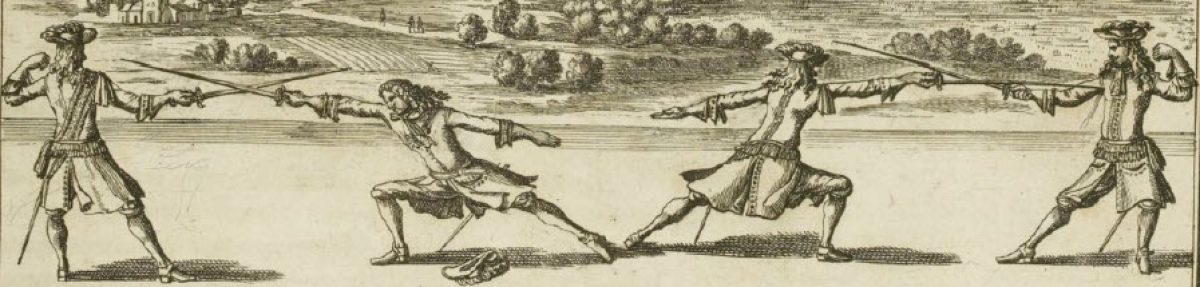


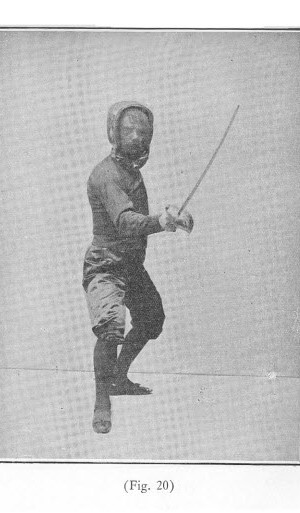
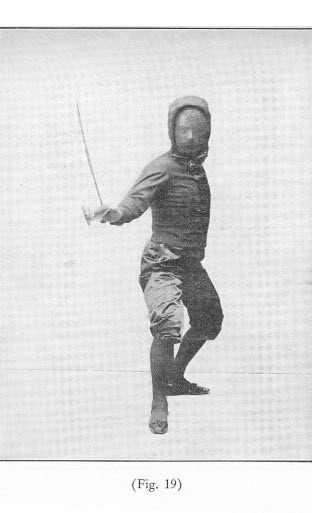




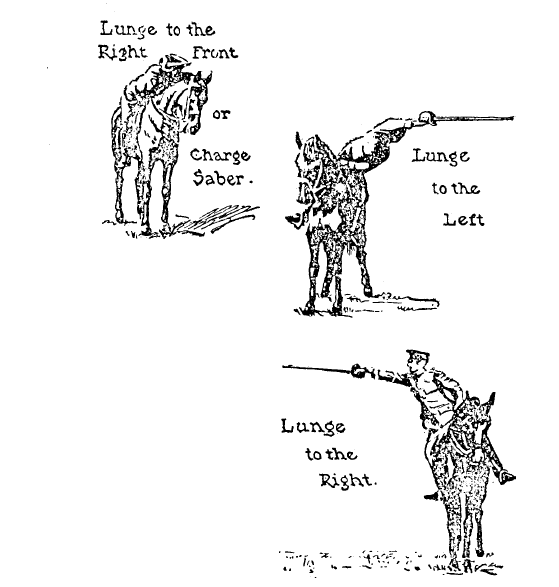
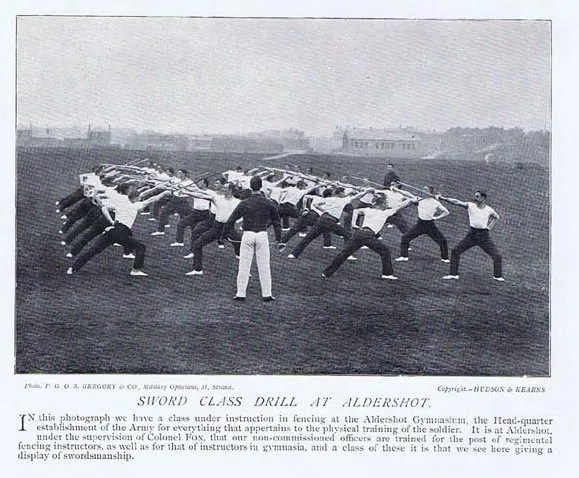
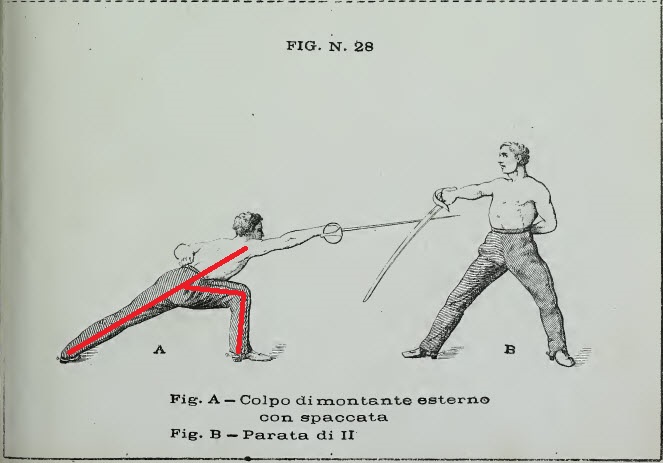

 Capitale Escrime Historical Fencing