An Ugly Truth about “HEMA”

Many in the “HEMA” community dislike academics. Actively, vehemently, dislike them. Unfortunate as that is, it gets worse: they tend to look to people who have somehow convinced the community that they have the training and background to expound upon historical sources when in fact they don’t possess that expertise. It would seem logical, given the nature of investigating past fight systems, that one might lean on subject experts, of whatever type, who might best help one do that, but for some complicated reasons that’s not the case. Many of these fencers are quicker to dismiss trained scholars than question those claiming the same expertise. While they wouldn’t take their cars to bakers for a tune-up, or visit a plumber when they need open heart surgery, somehow it’s perfectly okay to dismiss historians when it comes to history.

Nothing one says, does, writes, makes video of, etc. is going to sway most of those who dislike academics. Formed as it is by both prevailing culture and personal experience, the hatred runs too deep.

The purpose of this post is not to persuade—a recent, local disagreement with people I both respect and love has made the reality of the uselessness in trying to convince anyone that we should be on the lookout for charlatans (and pay better attention to real scholars) all too clear. Beyond any personal hurt this caused me, which is fleeting and with time and reflection easy to put in perspective, I thought that on the off chance that anyone reads this that maybe, just maybe I might be able to disabuse one or two people of some of the misconceptions they have about academic training, academics, and why some of us, me for example, so often play Chicken Little when it comes to those who spread poor information.

Academia is a Meat-Grinder

Francisco de Goya, “Saturno devorando a su hijo,” (1819-1823)

The picture of academia as a mix of Hogwarts and ca. 1920s Cambridge is persistent, but inaccurate. Academia is more Oliver Twist meets Mad Max—it’s a hard living with low pay, violent competition, and few rewards. It’s become a business first and foremost, and in good American fashion that means championing the bottom line, not the product or those who make it. Much as wider society is wary of academics, no one perhaps cares less about academics than other academics. To put it bluntly, most any grad program has more narcissists and similarly self-worth-compromised folk, that ego is everywhere a problem. Dogs fight hardest when there are so few scraps that fall from a table.

The academic world eats its own young. Before the 1990s, when there were fewer people obtaining advanced degrees (MAs, MPHILs, PhDs), and jobs were more plentiful, there was less competition for work. With the glut of PhDs in the late 1990s, early 2000s, there were suddenly more people vying for the same jobs, and with so few rewards attending these jobs (academics are not paid much, do not get stock options, and have piss-poor benefits) competition was fierce between perspective hires. To name one example, I applied for a part-time position at a college in rural New York in 2002 that, so the thin letter told me, had 500 PhDs apply for it. [1] For every PhD hired that feels lucky, there are more who see the choice of themselves over their colleagues as some manner of divine right. Clearly, so they believe, they were just better, others less than worthy. If one has had the misfortune to spend a few minutes with any graduate of a “name school,” a new vegan, or a crossfit cultist then this will seem familiar.

Most schools took and continue to take advantage of the situation. A friend of mine from graduate school, now teaching at a major university, told me that her department set out to hire a lower division workhorse—the job was intended to put all the courses they didn’t want to teach on the new hire, and, this same new hire, while full-time, would not receive benefits, have any chance for promotion, or any hope of tenure. My friend’s question to them about the ethics of this, her concern over the complete lack of sympathy, was all shrugged off; they had theirs, right? They filled the position. People who want to teach are that desperate, and despite the abuse, are told sotto voce that maybe, juuuust maybe things will work out for them. It never does.

The cycle is one where the carrot of full-time employ is held out, but never awarded. Best of all for the schools, if one quits in frustration they are immediately replaced. There are that many people willing to knife a nun or toddler to get a job. Why? Because they were trained to teach, and in a society where teachers are held in low esteem, the options outside of teaching are bleak. Add school debt to this, something they will never be able to pay back without full-time work, and their plight is all the more desperate.

ablum art, The Pop Group

My point in sharing this is that these days most academics are more likely serving you coffee or pumping your gas than they are teaching, never mind engaging in research. It takes funding and department support to conduct research. Worse still, with the advent of online serials, most journals—where the most cutting-edge scholarship resides—are behind paywalls that small schools can’t afford. This creates, for those poor bastards teaching at community colleges, another level of inequality with their better-positioned peers. If one is an adjunct or part-time hire on contract, it’s even worse: one is so expendable that zero funding is available for improving one’s position. [2]

The reality may not change one’s views of academia or academics, but I thought it worth the time to explain that it’s not a rosy world where people feel smart and important all the time, and consider all others as beneath them. No. Most academics these days question the decision to take on such a poor career and the debt that so often comes with it; most are anxious because they may not have a job next term or be able to pay rent; and, whatever achievement earning an advanced degree might be, with very few exceptions there’s not much in place to make one feel like celebrating it. That is especially true when that PhD is the albatross around one’s neck trying to find work outside academia. As I’ve often said, in popular culture, academics are either clowns or villains, not heroes.

Why do People Hate Academics?

Some are, to put it Bluntly, Dicks

First and foremost, thanks to so few rewards and so little respect, there are, alas, many academics who lord their training over those who don’t have it. There are several notorious examples active in HEMA and they have not only hurt themselves, but the rest of us with similar training. Bitterness, frustration, and the sense of injustice at having worked so hard for something makes some academics into annoying snobs. Others, so cowed by experience, so accustomed to scraping by, barely if ever acknowledge their training, especially if they have experienced prejudice because of it. [3]

Gilderoy Lockhart as portrayed by Kenneth Branagh

Arrogance is ugly and it’s small wonder that the HEMA community dislikes these people, and by extension, anyone like them. While I understand the arrogance behind the sort who insist that people use their academic titles (a defense mechanism), I don’t like it and resent what it does to the rest of us. Nothing quite like suffering for another person’s sins. There is a time and place to use those titles, and generally, it’s not in amateur pursuits like historical fencing.

In the past week I’ve been made aware that I come off like the very academics none of us find pleasant. Worse, not only have my own meager efforts to make things better gone unnoticed—the advice I’ve provided for reading mss on this website for example—but also that I’m an asshole for refusing to let academic posers off the hook. Sharing concern about this, pointing it out, doesn’t read to people like a warning or an attempt to caution them and steer them to better resources, but as rants. It comes off as bitter attacks on respected “contributors.” They see only the volume of the message, not the message itself, or maybe, they do see the message and either don’t get it or don’t care. The result is the same. People aping experts have more clout than actual experts, and any of the latter calling them out are the real problem.

People don’t really Understand what it is Academics Do

In fairness to most people, HEMA being no exception, most people lack the perspective to evaluate any difference between real scholars and a person playing at being one. Unless one has been in that mix or close to it, it all appears to be the same. Real scholars look at sources, but people playing scholar do too. So, they’re the same.

TV, movies, and popular fiction’s take on history has not helped this–at least one generation of people has grown up seeing the ancient aliens nutters treated with the same dignity as actual scientists, and if anything, because it gets ratings these shows shit on actual researchers and champion the loons who attract an audience. If one’s exposure to history, as such, has largely been pseudo history, then it’s little surprising that the difference between proper history and entertainment is indistinct. On a certain level, many people who enjoy shows about ancient aliens etc. know the hosts are nuts, but given that these are the “experts” they see, it’s hard not to conclude that this poisons opinion against actual experts too.

One of the worst results from these shows is that they impart poor reasoning and half-baked methodology. It boggles my mind that there are people who think that archaeologists are hiding evidence of giants, ufos, or Atlantis. The truth is, if there were evidence of giants or ufos scholars would be racing to share the news and murder any other scholar who so much as suggested a threat that they might steal their thunder. Such a sensational find would equal funding, a tenured chair, and more fame than most could ever imagine.

There’s Room for Both Amateurs and Academics

Despite the number of times I’ve stated this, that we need many different points of view, types of expertise, and a healthy mix of amateurs and academics, the recent attack I’ve made on charlatans obscures it.

To be clear: I do not have a problem with amateurs. When it comes to most things we’re all amateurs. What I have a problem with is first, people claiming expertise who don’t have it and who thus mislead people, and second, the general bias against academic expertise of any kind.

One of the things we were taught in graduate school is responsibility for our work. It is vital we do our best, to be as honest, transparent, and as evidence-based as possible. To own the truth, not every historian follows this, and in fact, some have actively falsified, mislead, or misrepresented ideas or people in their work. Consider only the monster that alleged, falsely, that vaccinations are linked to autism or the halfwits who maintain fluorinated water will poison the world. Again, I speak from experience about this—on a minor level, a visiting prof stole my dissertation title for their book, and on a more serious level, a PhD student I never met not only misrepresented the purpose of my own dissertation, but also attacked me personally in her own thesis. [4] Like I said, there are no doubt some serious stinkers in academia. I’ve met way more than I’d like.

As a final clarification: my purpose on this site has been the same as with the books I’ve published to date and the hundreds of pieces I wrote for an academic database—to share information more widely and to do my best to do so fairly and accurately. Monographs, while key for landing an academic job, are not of interest to me–that’s why I never wrote one. The four people who study the same thing I did already know all that and don’t need another tired dust-collector on the library shelves. If the so-called Ivory Tower is to have any meaning, any use at all, then the work it does must be shared outside the tower and as widely as possible. All the research in the humanities, at least, is pointless otherwise.

To those I offended with the vehement complaint I made about posers in HEMA: my motivation was duty, not some personal beef. If the language was more pointed, it’s because of frustration and disbelief that no one else seems to care about the ramifications of propping up people who mislead others. My concern with doing it right is professional responsibility, not sour grapes. I have no grapes, and don’t want them. I not only do not want the notoriety, but I’m more than happy to share the job. I just want it done right. In fact, I’m happier if other people deliver these papers as I’m naturally introverted and have to work exceptionally hard to address groups (never mind the recovery afterward). [5]

Just. Do. It. Right. And, if one isn’t trained to conduct research, then maybe consider collaborating with one of the myriad un- or under-employed academics out there. Most would be happy for the work even though it doesn’t pay—it might suggest that their hard-earned skills are worth something after all.


NOTES:

[1] There is ample literature about this for those interested, and, not all of it behind paywalls. See for example Kevin Carey, “The Bleak Job Landscape of Adjunctopia for PhDs,” The New York Times, 5 March 2020, https://www.nytimes.com/2020/03/05/upshot/academic-job-crisis-phd.html, accessed 6 Sept. 2020; Stephen Werner, “Reflections of a College Adjunct after 31 Years,” Inside Higher Ed, 1 March 2023, https://www.insidehighered.com/opinion/career-advice/2023/03/01/plight-adjuncts-reflects-academes-dysfunction-opinion, accessed 6 Sept. 2023.

[2] A friend from graduate school, one who got a job, was in my town for a conference and invited me to go. More than once I was asked, as one is, for a business card, and enjoyed the awkwardness of having to explain why I didn’t have any. Embarrassing as that was, it beat out the experience of a friend of mine who was an adjunct professor at one of the CalPoly schools who was told he, as an adjunct, had to pay for the free coffee.

[3] As a rule, I don’t talk about my training, not unless someone else brings it up or it’s actually germane in a conversation. Having that degree has been more often a liability than a plus. It’s not that I don’t value the training, I do, but I am suspicious of anyone who manages to complete graduate school and has a big head.

Working toward an advanced degree is an extremely humbling experience, least it should be, but naturally a lot of people come out of those programs thinking they are Einstein. Mixing with people smarter than we are, and spending a decade on the smallest fraction of the smallest fraction of all we know (never mind all we don’t) should serve to remind each of us that we’re tiny, insignificant animals and can never know enough. Ego, however, begets ego, and in a world as cut-throat as academia, the Peter Principle is alive and well.

[4] The person in question was a student at Queens University Belfast who dissertated in 2013. Though my dissertation has next to nothing to do with her own study, which concerned the dating of a collection of saints’ lives, my work was one of the only ones at that time on the subject of a particular Irish saint within that collection, and thus was worth a footnote (though nothing more). The points I made about the dating of this group of saints’ lives were minor and present in my own work because there was controversy over the dating at the time (2002) and not to address it would have been poor work. The author of the 2013 dissertation cherry-picked from my dissertation and misrepresented not only the point of my work, but also individual arguments I made. Worse still, she included ad hominems about my intelligence, ability, and suitability as a scholar.

I am not sure how her dissertation committee allowed such a breach of propriety and such egregious unprofessional behavior, but they did. Celtic Studies is a small field; most of us, at least when I was active, knew of one another if we hadn’t actually met, and this behavior was atypical. Mention of my Celtic prof in her diss, and her comments about his work, leads me to wonder if maybe she or her committee had issues with him, and if perhaps her attack on me, a virtually unknown, minor scholar not even active in the field, was actually an attack on him. He’s well-known, respected, and an absolute delight to be around, so it seems doubtful, but one never knows. Academics are pretty rabid sometimes.

[5] I acknowledge the irony of being extremely introverted and training as a teacher. In part, I was drawn to teaching as a way to combat my reserve. For me, it has always been the material, the subject, that interested me, not my role in it. A lucky thing, as it turns out, as my career path… as such… has been, well, “non-traditional.” In class, and even now teaching fencing, my focus is on the subject and sharing it, not my experience of it or how I come across. Apparently I need to worry more about that.

Shadows in Caves

One of the benefits of not having to suffer the tempests in teapots that boil over on social media is that I only hear of them second-hand. I’ve heard a lot in the past few days about an unfortunate debate on one of facebook’s smallsword pages concerned with a particular action. Controversies like this have a way of forcing people to show their colors, and this latest hullabaloo is no exception.

The lines, as I understand it, are drawn between those upset by the inclusion of a passing attack, a collection of enthusiasts including a number of English fencers, at least one sword-maker, and a few vocal students, largely American. Their opposition consists of an assortment of historical fencers who have argued for this attack based on the sources. If one is familiar with my posts here it will not be difficult to determine where I land in this debate (not that what I think will matter to many participants). However, as an instructor and historian I feel a duty to those I work with to say something.

False Equivalencies & the Fleche

The action in question is a rapid attack meant to surprise an opponent and one made by passing the back foot in front of the lead foot. To work, one chooses the right measure and tempo, and then applies the right speed and weapon angle to close the line. Whatever the name, these are the component features. It is, in truth, a dangerous action, especially if made poorly or at the wrong time or distance, but the fact that it shows up in so many works means it is worth study.

The criticism aimed at the passing-step proponents centers upon this action being too “sporty,” too “modern,” and since that first generation of classical and historical fencers arose in large part because of the excesses in the sport, anything remotely whiffing of the modern piste is immediately suspect. I  know because I was there, and like these poor folks, once over-compensated and over-corrected. This was easy to do in the 1990s and early 2000s for several reasons. The  complete lack of concern and disdain from fellow fencers about over-use of the fleche, of the flick in foil, of duck and cover, or any of the other aberrations was hard to understand and unpleasant to face. Second, and in ways that echo in the current debate, none of the evidence–and there was plenty–proving that these were departures from the point of fencing and ahistorical made the slightest dent in their resolve. On the one hand, older fencers unaffected by much of this failed to see the danger. On the other, many newer fencers, having made their reputations on these dubious actions were loath to condemn them; to do so would be to condemn themselves, to call into question their own position. 

Ego drove much of this, and, ego drives the anti-passing step side now. Combined with misunderstanding of the problem the anti-passing step faction has taken the suggestion that a move like the fleche is viable as a personal affront. Ironically, they decry the action despite the evidence from the very sources they claim to use. Ego is the first barrier: an inflated sense of self and one’s importance tends to blind one to reason. The second barrier is mistaking issues with a particular action for the action itself. Memories of fleche after fleche in the late 1990s and all the daft measures the FIE took have made any attack like it, never mind the fleche itself, anathema.

Of note, the pro-fleche camp, for lack of a better term, has not argued that the passing attack in Vadi or L’Abat is exactly the same as the flying leap sabreurs so took advantage of in the 1990s. Contexts are different, the weapons different. This said, the idea of a rapid, surprise attack made by throwing the weapon forward and passing the rear leg past the lead one is present in our sources. Whether one chooses to use it or not is another question. Whether one makes the attack well is another matter. Whether a master advocated it or merely included it is an additional consideration. Some masters specified that they didn’t care for an action, or, that it was dangerous outside the salle, but often we don’t know where they stood on its effectiveness or safety for actual fighting. [1] There is ample precedent for fleche-like actions on the record, so to poo poo the use of an effective passing attack in modern historical competitions, which we do for fun, is about turf and ego, not the sources.

Why the one faction should stubbornly argue against the evidence of the sources should make one pause. For smallsword works alone, the inclusion of the passing-step attack is common. It should be little wonder as to why. Given the place of cross-steps forward and back in earlier works (de Liancour, 1686, is a good example), adding speed to the same method of advancing follows logically. The same attack, however, appears earlier in the sources, from Vadi to many rapier treatises. What separates historical fencing from other branches is, supposedly, reliance on the sources, so to ignore the basis for interpretation, particularly when we can trace this action over time and across masters, is odd. If the source tradition isn’t their basis for support, then what is?

The Problem of Authority

One of the bugbears within “HEMA” is a blind appeal to assumed authority. In this case, a number of early researchers and their fan-base appeal to the early success and acclaim these luminaries enjoyed in the belief that it’s as valid now as it was in the early 2000s. That is, sadly, not often the case. Research has not stopped since their time, yet many of these same people stick to outdated theories and flawed interpretations.[2] Their argument, thus, is not made from evidence and analysis, but from ego, from fear of losing the status they depend upon from their acolytes. They fear being eclipsed. The last has already happened as this latest fracas, one skirmish of many in the past twenty to thirty years, demonstrates.

Time-in is another supposed source of authority. It can lend one credibility, but depends on other factors. On its own time-in means absolutely nothing. If one has been in “HEMA” for thirty years and has not only been working from poor theories, but also continues to argue that they were correct despite the evidence, then time-in means very little. This happens a lot–I’ve met many people who have wasted years with charlatans or in glorified fight-clubs or working from once key interpretations that have been superseded.

Complicating the stagnation is an often surprising lack of understanding of fundamental actions and concepts. For example, a well-known fencer recently quoted de Bazancourt with respect to rushing in, which not only demonstrates a failure to understand the intended use of the action, but also serves to corroborate the fact they are basing their view on misuse of the action. Preparation is everything in fencing, and attacks like the passing step and even its much abused 1990s version (ideally…) relied on setting an opponent up for it. The sabreurs who flung themselves stupidly at “allez!” and who never varied the game are a different animal. In the footage I’ve seen from a recent Canadian event, the fencer employing the “fleche” used it wisely, and, as intended: as a surprise against an unprepared opponent. I am a fan of much of de Bazancourt’s wisdom, but the quotation supplied is misapplied. Used at the appropriate time and in the right setting, the passing step or fleche is no more dangerous than a lunge. Both put one at risk. Every form of attack potentially does.

Another issue plaguing “HEMA” is the echo-chamber effect. Adherents to this idea or that group focus increasingly only on what those within their section of the community teach, believe, and use. Their views become myopic, limited, and prone to precisely the ego-driven arguing we see in this current example, because for them the debate is less about sources than it is their reputations as “authorities.” They view the shadows cast on the wall by the tiny flame in their hands or in those of their heroes and take those shadows for reality. It seems real and legitimate to them because they refuse to consider any other well-made argument. In like vein, if any light is cast from someone they don’t know or who fails to pass the anemic view of authority they employ, they ignore it, or, call them heretics.

Proof is in the Teaching

Perhaps it is the Hollywood notion of 18th century manners, of high style, and the romance around the waning influence and power of European aristocracy, but many of the interpretations from the anti-passing-step camp are wooden, slow, and lacking in vigor. They present more like demonstrations or dance than a fight. It’s form over function. For all the formality and etiquette that people of the past attempted to apply to personal conflict, in the end it was a sword fight. The intent was bodily harm or semi-acceptable ritual murder, and no evidence we possess suggests that two people, potentially angry and emotional, fighting fear, and terrified of public opinion, were more likely to square off and fight as if dancing. All evidence is to the contrary. Surviving footage of late period duels is no exception, and many of those were first-blood affairs, not to the death. For all the blather about “realism” few in “HEMA” spend much time if any pondering what that means, or, what it should mean in our context. [3]

The flaccid yet florid approach these fighters take to fencing reveals too much concern for aping the elegant plates within the treatises rather than what those treatises were meant to help teach: fighting. I am not the only one cautioning fencers about over-reliance on images, but time and again many in the community gravitate to the images because they don’t understand the text. [4] While language and diction are often challenging, the deeper issue is that these same fencers lack sufficient understanding to read the text. The one place they might go for help, a solid Olympic or traditional fencing program, is anathema among them, and so, they do their best to adopt what they see in the illustrations and produce pretty bouts largely devoid of any intent.

In the footage of their bouts, in their instructional videos, and especially in their attempts to shout down opponents, the shallowness of their understanding and skill emerge vividly. The inability to fence beyond a snail’s pace, the poor use of measure, and the more choreographed timing are red flags. No one fought in slow motion. It’s hard not to conclude that this is one reason that the clubs and cliques against passing step attacks avoid bouting anyone outside their little world. Against fencers with legitimate training and armed with sufficient knowledge they come up short. Such defeats should suggest to these fencers that maybe there is more to learn or better ways to learn it. In fairness to the newer students among them, hearing from their clubs that these defeats don’t count because others are wrong or too dangerous etc. is easier to accept within their echo chamber, when the only voices they hear are all part of the same program. [5]

Make the Bold Move

It takes courage to accept new ideas, even when well-presented and argued, but it remains the right choice if one wishes to retain any respectability. Lacking any official organization to manage these things, we are left only with each faction’s arguments and how to evaluate them. The best approach is to evaluate the respective arguments in light of the evidence, and, against what the purpose of fencing used to be. The masters who wrote these works, many of them anyway, meant for their books to help teach students how to fight. Sure, some, especially later, were more concerned with salle play than with duels, but for those clearly self-defense oriented, like many mentioned in the debate over the passing attack, the goal was effectiveness first and foremost. There was ample attention to deportment and conducting oneself with grace in many works, but this was, outside a fencing hall, a secondary goal. No master stayed employed long if their students died or were maimed for life. [6]

Those quick to condemn historical fencers using the passing step attack should take their example from other members of the older guard, people like Paul Wagner, Stephen Hand, and Dave Rawlings, all of whom have continued to learn, adapt, and alter their thinking based on new and better information. Though well-known, they have remained humble and thus open to learning, and between these factors and being gracious opponents, they have stayed relevant. They have not been eclipsed. 

When it comes to past fight systems, no one has a monopoly on the truth. Every interpretation must be tested and compared against the sources, and when new and better ideas make sense, when they follow from the sources, then they’re worth consideration however much that may disappoint one. At such times, hard as it is, once those shadows on the cave wall have been revealed for what they are, it’s time to do the hard thing and turn around. When one does, one sees better and grows, and often, one finds that those they have perceived as enemies turn out to be staunch allies.

Notes:

[1] De Liancour, for example, believed counter-attacks better suited for salle play than affairs on the ground (Le maitre d’armes/The Master of Arms, 1692, 13 in the pdf, 29; in Lynch’s translation, 36); Capt. John Godfrey, in his A Treatise upon the Useful Science of Defense, 1747, 12-13, expresses his dislike of the flanconade.

[2] A prime example is the demi-pointe lunge. See my papers related to this topic in the “Research” section found at the bottom of the Instructor page.

[3] I’ve spent a lot time on this in previous points, so here I’ll only add that while we strive to be historically accurate and as “realistic” as possible, the fact remains that we do this for fun, wear protective gear, and have no real need for this skillset in our own time and cultures.

[4] See my pieces on using and misusing images in historical fencing under “Research” in the Instructors section.

[5] Most fencing schools, most of the better martial arts programs, include working with and/or competing against those outside one’s own school. It’s critical for growth. It is never a good sign when instructors fear this or actively preach against it.

[6] Even in self-proclaimed self-defense works we see concern for deportment. In James Underwood, The Art of Fencing, Dublin, 1798, p. 7, he explains that he doesn’t like the off-hand arm forward because “I think the beauty of the figure is strangely disfigured by it, and that all fencers will allow that they cannot help being pleased with a symmetrical posture.”

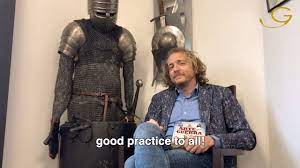
Russ & CO.–Interview with Chris Holzman on all things Radaelli!

This video is so good. SO. GOOD. Chris is a friend and a mentor, so I know I am partisan and possess some bias, but for those who listen and find themselves uncomfortable, I challenge you to listen to what he says. Some of it will be hard, but it’s important. Few people like being called out for the inconsistencies and nonsensical things we do, but wee bruised egos aside it’s healthy for us to do so.

This is also a wonderful introduction to Radaellian sabre, a thorough examination of how this system influenced so many others, of the development of the sport, and a personal bugbear, another nail in the coffin in the silly dichotomy people insist exists between so-called “military” sabre and “dueling” or “sport” sabre.

Who are you? With what authority do you speak thus?

She ordered Charles to have the horses put to. Holst understood this, which was said in French, and begged her for the love of God not to set out; he had orders not to let her depart. “You,” said she, in a somewhat haughty tone, “who are you? With what authority do you speak thus?” He said he had no written order, but by word of mouth, and that his governor would soon arrive…

From Memoirs of Leonora Christina, Daughter of Christian IV of Denmark, Written during her Imprisonment in the Blue Tower at Copenhagen, 1663-1685, translated by F. E. Bunnett, London, UK: Henry S. King & Co., 1872) [https://www.gutenberg.org/files/38128/38128.txt]

Last week I had a chance to discuss the Radaellian school of sabre with a distant colleague in Germany, Dr. Manouchehr Khorasani, on his channel Razmafzar TV. There is one topic we didn’t discuss in detail, and which in part I dreaded despite its importance, but which I shall try to address more fully here. This is the place of Italian sabre in “HEMA” and one of the major challenges within it. [1] Late period Italian “HEMA” is an archipelago of tiny islands scattered so widely that they are a related island chain in theory only.

There are several reasons for this. On the surface, and understandable, is the fact of geography. When pockets of interest are separated by miles, countries, and oceans naturally it’s hard for the inhabitants of these islands to visit one another. Beyond that, however, there is a less obvious reasons for division. There is an unfortunate cliquishness born of both a lack of familiarity with other, related groups, and some variance in concepts of authority.

When possible I prefer to build rather than burn bridges, and because I’ve met few of the people in the field in person, I can’t know how they will react. How one appears online is not a sure guide. The internet is notorious for skewing intent and meaning. It is not my wish to call anyone out or set fire to yet another bridge, but only to call out the elephant in the room. My sense, knowing what I do know about the inhabitants of some of these islands, is that they may take umbrage with someone they consider an unknown, an upstart daring to discuss topics which they believe belong only to them. If any do, then they do, and I can only hope they reach out to me to discuss it.

Cliques writ Large

“Mean Girls,” 2004

People, being social (least most of them—we introverts unite, separately, in our homes…), tend to congregate around those they identify with, who share their interests, and in some degree who provide some measure of external validation. These benefits of association are intensified when the group in question, for whatever reason, is actively under siege or feels as if they are. How one responds to attack, or the perception of one, varies. Some seek to adapt in hopes of crossing whatever barrier exists between themselves and the clique. Others seek to undermine that clique, to besiege the besiegers as it were. Still others solidify their own position and contend with their rivals as best they can. Some leave the contest all together.

Cliques writ Small

For my part, I lament the reality of the cliques I see within the conglomeration of Italian schools. We’re few enough as it is. No one in HEMA balks at mention of Fiore, Marozzo, or Giganti—to name only three popular Italian masters studied in historical fencing—but bring up Radaelli, Masiello, or Pecoraro and Pessina and suddenly one is categorized as “other.” The kinder sort relegate one to “classical” fencing (never well-defined); the nastier sort lump one in with the modern sport, HEMA’s favorite bugbear. I recognize, thanks to age and experience, the ways in which some of this is natural, but as a life-long student what I notice most acutely is that all of us lose more than we gain in maintaining these boundaries. Sad as it is to be the red-headed step-child in the larger community, it’s sadder that those who should be natural allies, our fellow late-Italian enthusiasts, should follow suit and treat their family members as poorly.

Outside geography and isolation, the hard lines seem to fall along the fault-lines of notions of authority and recognition. For example, those who have worked hard to obtain certifications sometimes believe that anyone who has not is, by definition, unqualified or certainly less qualified than they are to expound upon that subject. Sometimes this is true, but sometimes it needs adjustment: in “HEMA” certifications within modern traditions, while valuable, do not grant automatic authority for past systems, not even to those extinct branches which created one’s own.

While definitions of authority are often shared between cliques, there are often operating differences that work to demarcate one group from another. Credibility is important, but it doesn’t belong exclusively to the provosts and masters. This is an especially important fact for anyone believing that they themselves are an authority, because one of the unwritten rules of expertise is responsibility to manage it appropriately, and, to recognize just what “authority” entails. What is it, specifically, that grants authority? Is it the organization that grants it? The piece of paper declaring it? Is it the internal ability and knowledge? Some combination?

Just as important, however, and far, far more difficult for many established or certified individuals, is recognizing expertise or skill outside such certification. It takes more than memorizing rules, definitions, and regurgitating them to recognize and honor other capable folks. There are people within the Italian orbit who have done significant, important work, and yet don’t warrant an invite to major conferences, teaching seminars, or invitational tournaments (no, I do not mean me). Why is this? It’s not lack of skill, because in print, video, and in person they have demonstrated not only their grasp of the pedagogical tradition, but also proven their ability to teach it and fight it. Professional jealousy and fear, both outgrowths of ego, likely explain this “ghosting.” If one has worked hard to obtain a certification, but has done so without the proper sense of humility such a course should entail, it’s easy to fear the person outside that system that might show one up.

To be fair, comparatively speaking there are many masters and provosts in the Italian branch of “HEMA,” both from and in Italy as well as outside it, who are keen to work with lots of people, not just other masters. There are, however, some notable exceptions in North America who appear not to want to work with others save on their own terms. However much they believe they are guarding their sacred, occult tradition, the inability or unwillingness to provide more than that when it is readily available is a sure-fire way to sink a program. It leads to stagnation, cultic adherence to received learning as one learned it, and unless students of that program can hold their own against others, as fencers, teachers, or scholars, that program is going to atrophy. Certification programs should include the necessarily flexibility to adapt and adopt new ideas and approaches when those novel ideas might improve the course.

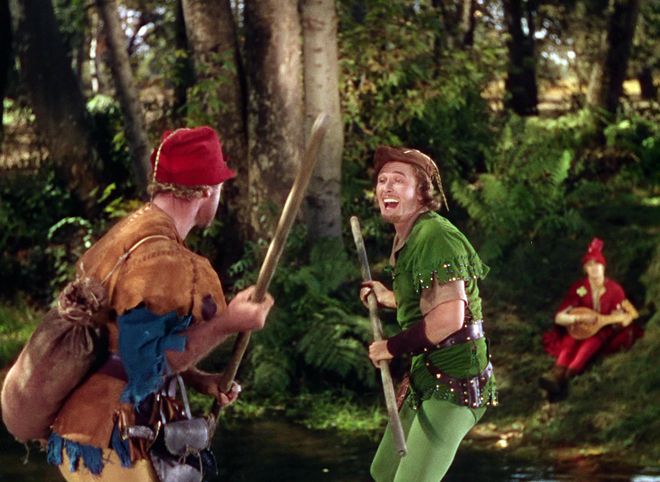
“The Adventures of Robin Hood,” 1938–in this scene Little John beats Robin and worries that the famous outlaw will be upset. Robin replies “On the contrary, I love a man who can best me.”

True confidence, true ability, recognizes that students can benefit from such experts, even if they are not card-carrying maestri. Not to enlist the aid of such people when the goal is learning and improvement is horribly short-sighted and limits one’s own program. It’s narrow-minded, the worst sort of conceit. It takes a degree of mental toughness to acknowledge an expert, let alone invite one in, but if one’s goal is learning, then this is the way it should be done. My model for this is the old-school model I learned as a graduate student in history: one doesn’t go to a school because it’s a “name school,” but instead applies to a person, to the people most qualified to guide one in one’s study. If they’re worth their repute, they will encourage one to see other experts too. That person might be at Turnpike Tech, not necessarily Oxford or the Sorbonne.

In an arena as varied and complex as historical martial arts it’s perhaps best to conceive of authority in the plural, as authorities, and recognize that while a master’s cert indicates significant training, that it’s not the only path. Patrick Bratton, in one of our chats, provided a few rubrics by which we might measure authority or credibility:

–can they teach effectively?

–are they a competent fencer in the system they are teaching?

–do they know the history/context and theory, AND can they effectively convey it to others?

Within these three broad categories are subsets of questions important to ask. In terms of teaching effectiveness, are they able to explain each technique, idea, or tactic in its most elemental specificity, from the position of the hand to the pressure exerted by control fingers, from the placement of the arm to the timing with which the technique is made in relation to the feet? Can they then incorporate that level of detail and build up? If they can, do they? There is a LOT of video out there, and so much of it is shared without any hint as to why. Teaching vids are some of the worst offenders in this regard. If one is sharing a teaching video, at least include what it is one is doing and why. With regard to fencing competency in the system in which they were certified, how adept are they? How often do they exercise and test this skill? Do they do so only with friends, or, do they venture out? When it comes to history and theory, how well do they know it, and, do they avail themselves of available resources?

Certification—What is it?

What the modern schools are supposed to teach is the current body of knowledge as handed down, and depending on rank, how to teach it. [2] This is as true of the USFCA as it is the Sonoma program. Masters emerging from either program should be able to teach anyone, at any level, and most importantly help train new teachers. What history they study, if they do, is generally minimal and/or tailored to the specific needs of their program. The USFCA, for example, is focused on the sport, not its development; the Sonoma program, which does cover some history, does so only within the confines of the work of their founder, Maestro William Gaugler. [3] What either program should provide is first an understanding of the universal principles in fencing, what Matire Robert Handelman refers to as “the elements of fencing.” [4] Second, they should impart technique and tactics, the first in fine-grained specificity, the second following logically from what it is possible to do with those techniques oneself, and, what one does when they’re used against one. Needless to say that all of the above must reflect the elements or universal principles. For the maestri, provosts, etc. who do study past systems, what gives them an edge is the fact that they are armed with a solid foundation in the application of the universals, technique, and tactics. It’s a lot easier to look at historical versions of this if one has a firm grasp on today’s systems.

Nothing in the purpose of modern fencing certification equates to expertise in historical fight systems. In fact, possession of the lanista’s rudis is not the only way, and in fact, might not be the best way. It depends on the person. There are other paths by which one may accrue both knowledge and skill. I will argue whenever I have the chance that everyone should take at least a year of foil or sabre, preferably in as traditional/classical as one can, before diving into HEMA, but beyond that I think it’s important to separate what one learns in becoming a provost or master today from what some certified teachers purport or suggest their sheepskin means.

A Challenge

For my colleagues within the late Italian sphere of fencing, especially those with the certifications of master or provost, I challenge you to reach beyond your clique; I challenge you to embrace discomfort and seek out those individuals who can best aid your students. Why pass up a good chance to improve your program? I challenge you to look beyond your certs and at what these individuals have to offer, humbly, without recourse to ego, fear, or envy. Put those aside, put what is best for your students first. It will be good for you too.

As a student myself, I seek out the best teachers I can, because I want to improve. My skill is never good enough for me; sure, it may be fair enough to impart basics to someone new, but for me myself the climb is eternal, the journey the point; it’s what I learn along the way more than it is any trophy, award, gift, or certification. The benchmarks we reach, such as certifications, signify key moments in study and growth, but are not destinations in and of themselves, least they ought not to be. [5] These honor my effort, and I appreciate them deeply, but I want to work with those who can best help me grow, certification or not.

NOTES:

[1] This is a topic I covered briefly in an earlier post, 22 March, 2021 “Italian Sabre & HEMA” https://saladellatrespade.com/2021/03/22/italian-sabre-hema/

[2] Ideally, any certification program, moniteur to master, is teaching one how to teach. This goes beyond watching and emulating, but down to actual discussion, instruction, and on-the-job training.

[3] Maestro Gaugler established a military masters’ program in San Jose, California, under the auspices of Italian programs like the Accademia Nazionale di Scherma in Naples and The Fencing Masters’ Preparatory Course at the National Institute of Physical Education, Rome. His works, A Dictionary of Universally Used Fencing Terminology (1997), The History of Fencing (1998), and The Science of Fencing (1997), perhaps with the addition of his articles, comprise the course reading at the program’s new home at Sonoma State University. Gaugler’s books are important additions, late ones, to a venerable corpus, but no replacement for the original sources or classics like Szabo’s Fencing and the Master.

[4] See for example Maitre Rob Handleman and Maitre Connie Louie, Fencing Foil: A Practical Training Guide for Coaches, Parents, and Young Athletes, San Francisco, CA: Pattinando Publishing, 2014, 308-312; see also Fencing Sabre: A Practical Guide for Coaches, Parents, and Young Athletes, 2010. The epee course I took in 2021, which is available in full via Fencing Metrics, takes the place of his book on epee. I’ve had the honor to take two courses with Maitre Handelman and he emphasizes over and over that everything we do, anything we teach, must emerge from the elements. The old masters would agree.

[5] My eldest son, when he completed his black belt, did so at a do jang with the right attitude. There is a poster hanging in the school that sums up what the students are meant to learn in acquiring that well-known symbol: a black belt means that they are now ready to start learning. I would suggest that our fencing certifications might be best viewed in a similar light.

Research & Criticism

In the last few weeks I’ve had frequent occasion to ponder the role criticism plays in research. I take it for granted that criticism is a part of research, start to finish, but this is something I’m finding I need to be more aware of when engaging those who are coming to research from other paths. No one likes being told that their hard work needs attention or revision, but it’s as necessary to effective research as having sources.

Evaluating a position is built in—it has to be if research is to work. We are fallible, all of us, no matter how much training we’ve had. We will make mistakes. Good researchers, good students, take those and use those mistakes to improve their work. Sometimes that means accepting the hard fact that a line of reasoning we’ve been working on is flawed and should be abandoned. It sucks when this happens. But, this is the way. It’s how we reach a vaccine that works instead of one poisoning us or having no effect whatsoever; it’s how we know the Egyptians built their own pyramids and not some fanciful space visitor; it’s how we know that Fiore, de Saint-Didier, and Aldo Nadi followed the same universal principles of fence.

Giving criticism is difficult, receiving it even harder, but it’s part of the process and so it makes sense to talk about it in more depth. [1] A decent analogy for the process is to consider refining an iron ingot to make steel. The smith heats then hammers it, reheats it and hammers again. In the process the dross drops to the floor and one ends up with steel suitable for work. Fire burns, hammer strokes hit hard, but they’re necessary. The smith doesn’t use fire or the hammer out of hatred for iron, but to improve it. It’s the same with “constructive criticism,” least it should be.

Elements of Research

Framing the Question

To conduct research well requires sufficient grounding in the topic. A student new to a subject is often given a question to answer or issue to explore. This is what teachers do in secondary school and college. With those new to Roman history, for example I used to give them a prompt because I couldn’t expect them to have command of the events, people, and issues of the time. When we covered one of Rome’s most lasting contributions, naturalized citizenship, I selected relevant works for them to read, and then gave them a question that had them use those selections to answer it. For freshmen, this might be relatively straight-forward, but for upper-division students I could take this one step deeper, such as focusing on one text or an aspect of the larger issue. For a graduate student this goes deeper still—they might read Tacitus, portions at least in Latin, and then familiarize themselves with the relevant scholarship about Tactius’ stance on Roman citizenship. Some upper-division students might do this too depending on ability, major, etc. It’s important we meet students where they are and then push them, gently, to the next step—sometimes we meet them at the door, sometimes sitting at the table in a large room. Assessing ability is part of the job, and, it’s something that test scores are next to useless in helping us do. Teaching someone new to sabre, for a different example, one starts with the most basic material, how to stand, move, and extend the arm, not with second intention attacks, compound parry-ripostes, and advanced tactical use of tempo.

Evaluating the Argument

Once that paper is drafted, or more usually now just turned in, the teacher evaluates it. Did the student answer the question? Did they support that answer using evidence, and, did they do so appropriately? Did they show me how that evidence supports their conclusion or merely state that it does? If they used any theoretical frameworks did they do so accurately? Are there logical fallacies or other errors in reasoning? A major portion of this, and easily the most disliked by students, is simultaneously assessing their grammar and syntax. Clarity is the goal, so extra verbiage, three-dollar words sprinkled for effect, and other distractions are important to excise. Just as we correct a fencing student to use only what they will need in a bout, so too do we correct excesses in writing that undermine a researcher’s thesis.

HOW we make this assessment, however, is everything. Effective editing with kindness is, in my view, one of the most difficult skills to learn. With sentences that are awkward, for example, writing the abbreviation “Awk” in red pen next to the offending line isn’t very helpful. Instead, I resort to “Perhaps rephrase? Maybe something like this: ….,” and now I do this even with seasoned writers. This is a gentler way of pointing out a problem area, but it also helps steer them toward what they need to do to fix it. When one of my fencing students moves their foot before the weapon, I don’t shout them down, but point it out and have them do it again. If the student is sensitive, I remind them that this stuff is really hard to do, that they don’t move like this 99.9% of the time, that we all go through this, and have them do it again, and again, until they get it right.

Term Paper vs. Research Article

The way one evaluates a peer’s research paper is similar to the process that one uses with a student paper, but more rigorous and approached with the assumption that the author has learned how to take criticism. This is a dangerous assumption, however, when working with amateur researchers (“amateur” here meaning not professional scholars). It is likely that an amateur scholar is not used to the process. This is one lesson I have learned painfully this year.

I do a fair amount of editing for colleagues, some professional, some amateur, both generally researchers of skill that know that I’m not blasting them for mistakes, but only trying to help them make their work stronger. It’s part of the job. We assist one another. In a talk I’m delivering this very week I have asked the host and a trusted researcher I know to go over my slides and notes. Each has given me useful feedback that will only help me. Now, I could feel bad or embarrassed that I didn’t think of some of these things, but why? This is why I sent them my work. Research, never mind sharing it, is hard! There is no shame in getting help—that goes for any stage of expertise. They are helping me increase the chances that my talk is a success. I am grateful to them for that. I will also be sure to announce their contribution.

Research Reserved is like a Broken Rapier

Research, if it is to have any meaning, must be shared. Even when I was teaching college courses and trying to publish on the side I embraced this idea. It’s one reason that teaching at junior colleges was important to me; it’s also why most of my publishing to date is what too many of my colleagues consider “soft publishing.” [2] It’s why I took the most important part of my dissertation and shared it for free on academia.edu: more people will see it via google than will read it as a monograph collecting dust on the handful of libraries that might buy it. All this work is useless and self-serving if the only people who benefit from it are other academics.

Scene of Hy Brasil sinking in “Erik the Viking” (1989)–an image that often comes to mind watching academia eat its own.

Of course, this is also one reason I don’t have a tenure-track position or why I am not writing reference works at the moment. It’s an imperfect analogy, because this example is more exalted than my own, but when Prometheus shared fire with humanity the gods felt that he had broken the rules. For those academics whose response to attack has been to hole up in the ivory tower and look down on the supposed rubes assailing them, those of us actively passing out research (or worse trying to teach people how to do it better without collecting a cent) are turn-coats. There’s not much they can do but keep us out of the mix and insult us from afar. Dying industries tend to entrench.

Donning the Big-Kid Pants

In sharing research, however, one must be prepared for criticism. If any prospect of that is repellent, then don’t write and share your work. Forget your friends and/or fans, forget the colleagues miles away who are likely to agree with you—they’re easy; consider only the person who wants to see you fail, because sad to say they sometimes exist. Normally it’s not personal, but it will feel that way. If you’re prepared for that clown, one you’re unlikely to meet, then you can handle anything. There was, in the 1990s, a notorious academic in medieval history, who delighted in shredding graduate students at the Huntington. His work is good, and I’m guessing his classes were, but fellow graduate students who delivered papers at that conference dreaded his responses. He took perverse delight in tearing them down, the way a deranged boxer might in punching a toddler. I never had to deal with him, lucky for me (and him—I was a different person in the 90s sad to say), but I ran into his type more than once. [3] Navigating failed humans like that guy, which no one should suffer, will toughen those up who survive it. Today, were I to deliver a paper and receive grief from this loser I’d be only too happy to engage–he attacks because he is weak.

Research & Responsibility

I can only speak for myself, though I think it holds for many people, but the longer one spends in research the harder it is to embrace arrogance or denigrate others who do this too. There is more out there to explore than we have life to live; producing an argument and then sharing it, globally, is not for the faint of heart. We gain nothing in being mean or beating on someone. However, when an argument is weak, flawed, or in some other way deficient it’s not only proper to say so but also to point it out how. Research may be conducted individually, but done right the product is collective—conclusions, right or wrong, affect the whole. They affect us all. By implication this means we have a shared responsibility, to ourselves, to one another, and to those who read us to do our best work. It’s a collaborative process, really.

It is best not to take it personally; after all, it’s rarely personal. More often that not we do not know or barely know others in the field when it comes to “HEMA.” Social media, unfortunately, has proved an ideal vehicle for “trolls,” half-wits, and those who having been bullied at some point feel they can retaliate anonymously and somehow get their own back. It shouldn’t be hard to tell the difference between a troll and someone pointing out a potential issue with our work. Some people are blunt, a personality aspect hard to detect in writing or online, but well-meaning; some are so apologetic they never get to the point; some are kind and just list the issue, and if we’re lucky, provide some help; and then there are the trolls. Analyzing the comments on your paper, blog, Youtube video, etc. will help you figure out who is who, and, whom it is worth listening to. To be honest, on social media and Youtube disabling comments is the best bet–legitimate critics can contact you in other ways.

Just as there are many ways to give a critique, there are many ways to respond. I’ve witnessed most in this context, and while many are acceptable, the best combines listening humbly and responding graciously. If it helps, fake it; pretend. Imagine that Capt. Red-pen is one of your friends just eager to help you improve your argument. In fairness, criticism, where it isn’t a case of right and wrong, sometimes comes down to style and preference. One editor may not like fancier turns of phrase; one may love it. It’s important to distinguish between substantive issues, which we should always consider, and stylistic ones, which we can examine and then decide if it merits further attention. For example, outside of the US there are countries where use of the “historical present” is acceptable if not normal. This is where the author writes about past events as if happening now, e.g. “Colum Cille visits Brude. They talk. The Pictish king is unconvinced, but polite” versus “Colum Cille visited Brude. They discuss various matters, but the Pictish king, while polite, was unconvinced by the missionary’s message.” If the paper you’re editing or reviewing is written this way ask your writer who the audience is and where they plan to publish it. If they are aiming at a North American market, suggest they revise and use a past tense; if for a journal in Europe suggest they check with the editor of that serial as it may be perfectly okay. For a more common example, some writers enjoy a good turn of phrase, some do not. You can suggest that the paragraph-long sentence might be broken up, but the writer doesn’t necessarily have to change a thing—that may just be the way they write. If they’re publishing, then the editor will have better call to make a case for brevity.

If however, your reader points out a misreading, a missing piece of evidence, an important article you haven’t referenced that should be there, or a misstep in reasoning, then set your ego aside and reread your work. Look at it plainly, as if reading someone else’s work, and see if they’re correct. If they are, thank them and revise; if not, and there is a back and forth, explain it. They may not agree, but at least you’ve had the conversation. There are times when we will make the wrong call, put our work out there, and realize that we should have revised. It happens. [4] It can also be avoided, and it gets easier too, especially if you’ve made that mistake and learned the lesson. Some people have to fall before they realize they can get back up. Some, however, will refuse to stand up, remain prone and fight to the death that they were correct when they’re not. [5] People are people.

A Figurative Glove cast in the Hazard

The excellent Maestro Giovanni Rapisardi (photo via fb)–his approach to historical fencing has much to recommend it

Do your best work. If someone with appropriate training comments on work you’ve shared publicly, have the good sense to consider it—thank them even if you decide to ignore it. You lose no face in being gracious and it will indicate that you are someone who knows how to play nicely with the other kids. A poor defensive response reads a certain way to professional researchers, and if you are going to play their game, then it behooves you to know the rules. They’ll hold you to them whether you like it or not.

I tell my fencing students that they should never, ever underestimate any opponent: treat each one as the most dangerous person that they’ll ever face. We practice, we drill, we train so that under pressure, when it counts, our technique and tactics will be effective. This often means working far more complicated actions in practice—that effort helps refine our game so that when we use the typical, less complicated maneuvers that we do in a bout they are that much crisper.

The same principle works in research—anticipate potential issues and correct them as best you can before sharing your work; read, reread, and verify; share your draft with people trained to evaluate both the material and process. Consider any suggestions. Once that paper is in print or posted online, it is exposed to the world and by extension, so are you. Be prepared for a variety of responses, some great, many more a near silent “meh,” and then a few that seem tailor-made to make you feel as small as possible. Answer each with calm, grace, and confidence—ignore fools, but cultivate a response to legitimate criticism that is measured and open-minded. A lot of researchers fail, some through fraud, some through hubris, some through just being too stupid to listen, and some because they quit when they get a bad review. Every successful scholar abides the dictates of the methodology of research and knows how to take criticism—they use the latter to make their position stronger. You should too.

Notes:

[1] See entry on this site entitled “Dealing with Criticism” 28 Oct. 2019.

[2] Academia is a brutal place. The rewards are few and small, so those lucky enough to find a position or who lick enough boots to land one tend to guard those hard-won prerogatives tenaciously. As with any organization composed of rigid hierarchies, there is a sense that those at the top deserve it, and that those who work below decks, as adjuncts, lecturers, and at junior colleges are where they are because they lack the genius and gifts their tenured peers must possess. It’s bullshit, but between poor pay and the fact that Americans dislike intellectuals their arrogance is unsurprising. What goes for teaching goes for publishing, and even now a monograph and second book are considered “real” work where publishing for the masses is considered less rigorous.

[3] I’ll not name this buffoon, but will say that his two volume medieval reader and work on the Merovingians remains popular. Smart as he might be, important as his work might be, he’s the perfect example of someone who believes their own painful path to full-time teaching entitles him to be abusive. I was far luckier—most of my PhD committee were older scholars, well-respected in their fields, and far too kind and intelligent to indulge in such behavior. The one exception was the guy who tested me on Greek history during my oral exams. It was disgusting enough to prompt my Celtic professor, the wonderful Jószi Nagy (then at UCLA), to ask me the next time I was down there for a class “So, what gives with the macho Greek professor?” He shared the story with the rest of the small class and they were horrified, and this was at UCLA where t.a.s received more comments about how they dress on student evaluations than anything else. Classes with Jószi were some of best I ever took; it didn’t hurt that he is Hungarian and I love sabre either 😉

[4] For a personal example, I contributed to my graduate advisor’s Festschrift, a collection of articles by students and colleagues celebrating his career and contributions to the field. My friend, the late Tom Sizgorich and I, were sort of outliers—Tom focused on early Islam, I focused on early Ireland—but if anything we serve as good examples of just how nimble our advisor, Hal Drake, can be. My submission was on the blending of Mediterranean and Irish narrative motives in the vita of the saint I worked on the most and whose life I translated in my dissertation, St. Áed mac Bricc. The editor requested that I remove the Latin portions of the quotations I used from my notes, and excise some of the examples I used for the nods to Celtic ideas of the “Otherworld” in the paper. I did. The review that came out in Bryn Mawr Classical Review was kind enough, but mentioned in re my paper that more examples from Irish texts would have helped. He wasn’t wrong. Nowadays I would have politely disagreed with the editor and left them in, but we live and learn.

[5] I’d rather not use an example from HEMA here, not after the most recent encounter with this, so I’ll stick to another academic topic. There’s a scholar in my field, a nice enough guy, and well-trained, but whose analysis tends to suffer from a propensity to make tenuous connections. I’ve seen him do this with both linguistics and historical topics. For the latter, he delivered a paper at one conference that would make a decent movie, but which was poor history. Taking three attestations of the name “Patricius,” instances separated geographically and in some degree temporally, he posited that each referred to the same man. Responses were polite, as they usually are at Celtic conferences (it’s a really small field), but they were to the point too. One of the audience asked “—-, a simpler explanation is that these three pieces of evidence refer to three, perhaps two different people, right? Is it likely that the one Patrick we all know traveled this extensively, and, had time and inclination to put his name on a brick?”

Academic Rigor, Accountability, and “Gate-keeping” in Historical Fencing

Disagreement makes most people uncomfortable—it forces even the most narcissistic to pause, if only briefly, and confront where they stand. If there is an audience, it’s even more painful. There are good and bad ways to handle this. Whether criticizing or receiving the critique compassion should temper the message. Well-intentioned criticism is important, from politics to dealing with fencers who disagree with us, but of late—in the U.S. anyway—holding people accountable has become taboo. Even when warranted, even when it can literally affect lives, the American response is “ain’t no one tells me what to do!” followed closely by “who the hell does his a-hole think they are?!” One doesn’t have to be Dr. Fauci to appreciate this.

In historical fencing anyone critical of the errors we make as a community is at best considered a clown, at worst a “gate-keeper.” Regardless they’re considered a pain in the ass. The nail that tells you this was a bad place to sit, however, is just a nail, and assuming one looks where one plans to sit that same nail is easily avoided. In the rush to sit, however, our collective bottom has planted itself on a number of nails and now, in pain and bleeding, we ignore it. Worse, some maintain that there are no nails, and anyone who says so is a meanie or deluded.

I have no interest in gatekeeping in the sense one can find in the august lexicon that is the Urban Dictionary, e.g.

Top Definition: When someone is an asshole enough to tell you that you don’t have enough qualities to like what you want to like or be what you want to be, solely based on their opinions and experiences, even if  they don’t know as much about what said person aspires to like / be.

or

2

Gatekeeper

1) One who devalues other’s opinions on something by claiming they’re not entitled to the opinion because they’re not qualified, the rightful decision-maker, a part of a particular group, etc. [https://www.urbandictionary.com/define.php?term=Gatekeeper]

In re the top definition, to dress someone down for what they like is stupid. People like what they like. Similarly, to tell someone that they lack the qualities to become something is, on its own, stupid. If it is additional training, then they can get that. The second definition, the one I think applies in most of the cases in which I’ve heard it, is more problematic. There are times this applies, and times when it doesn’t. What do we do when someone qualified attempts to point out something they’re actually qualified to point out? If HEMA is any guide, they get roasted on social media—middle schoolers can’t bully half as well.

We do not like expertise (again, mostly referencing my own nation here), but we apply this hatred unequally. Few people I know would be okay visiting a dentist who picked up the practice for fun and who had not been to school, but when it comes to many other fields, we tend to be more circumspect. The number of times as a teacher I had to refute pseudo-history that a student had learned on the “History Channel” (aliens and giants loom large) made it clear that my training mattered far less to them than what some asshat t.v. personality like the “Naked Archaeologist” (who is not an archaeologist by the way) said. I see the same issues in our community.

In historical fencing there is functionally no difference between a well-supported argument and opinion. But these are different. I can’t stand mushrooms in any form; my opinion is that dung flowers are best left out of meals. That’s an opinion. I cannot back that up with evidence apart from my own sense of revulsion and taste buds. Most people I know love mushrooms, so lucky them, they get mine should I have the misfortune to see them on a plate. I don’t judge them for it, though I may tease them, and they me. Conversely, the statement”vaccines save lives” is not an opinion—this is something we have hard data to back up, a lot of it, and that goes double for the staying power of the special species of idiocy that thinks they cause autism.

Returning to “HEMA,” the phrase “I love Messer, it’s the best!” is an opinion. That person enjoys it more than anything else, and there is nothing wrong with that. Cool, Messer person, do Messer. However, saying “one never retreats in the Liechtenauer tradition” is an argument that one can evaluate by an examination of the available evidence. In cases where there is a paucity of evidence one might be able to argue either pro or con; unless more evidence comes to light, we may be unable to say for certain. In such cases we follow the interpretation that makes the most sense to us given the evidence, and since this isn’t vaccine formulation or designing car brakes that’s okay. Historians still argue over Alexander of Macedon’s ultimate plan for his conquests.

One of the greatest assets within HEMA, as well as its greatest pitfall, is that we are an amateur-driven community. On the plus side, we get a multitude of views, skill sets, and experience helping drive our research. This is good. On the negative side, the amateurs who have made names for themselves are often less inclined to listen to experts, less because those experts might help than the fear they might steal the limelight. We need to remain an amateur pursuit. If academics overran HEMA it would become fossilized, prey to the same b.s. that has long stymied academia and helped make it the supposed den of baddies most people believe it to be. What we need, and don’t have, is better cooperation between amateurs and experts. A middle way.

To some degree we see this collaboration, but it is cliquish, not universal. This past year I meandered into an old, tired debate (lesson fucking learned there) that highlights this powerfully. The battle lines in this particular debate are revealing—on the one side is a group of ambitious up-and-comers who want to make a name for themselves, and on the other is a collection of people who in one way or another have been at this a lot, lot longer. Since I’m not a principle in the debate, just a bystander, it’s easier for me to see some things. This doesn’t mean I don’t get things wrong, I do, a lot, but if the various pieces I’ve read by both sides are any guide there is a gulf in understanding with the up-and-comers, paramount of which is how they approach both information and those whose profession it is, in whatever guise, to analyze that information.

The problem is that nothing is automatic. In this contest, for example, the long-time researcher under attack remembers the first iteration of this particular debate, but the fact that his own side emerged the victor in it apparently means nothing to those who weren’t there twenty years ago. Were this almost anything else but fencing research it’s hard not to conclude that the current group attacking a well-proven position would have either avoided the mistake or conceded defeat when it inevitably lost again. Getting them to see this, however, hasn’t worked, because their basis for authority is different. It’s a painful analogy to use, but apt—like Plato’s people in the cave mistaking shadows for reality, these fencers are either unable or unwilling to see how feeble some of these theories are and how unqualified in some instances those devising those theories are. They don’t see it, because if they do then the illusion of authority is brought into question—if one’s experience in HEMA is based off the view of that authority, it raises uncomfortable questions. No one enjoys being in the wrong or realizing that they have approached something with a faulty interpretation. It isn’t fatal, but can feel like it. Once we realize it, we set about trying to do it better; with something like reconstructing extinct fighting arts we are going to get it wrong sometimes. That experience, however, doesn’t need to have been a waste—we learn a lot through mistakes.

I have to wonder if this isn’t so much about research or a quest for the best interpretation, but about making a name for oneself by any means necessary, even at the cost of credibility outside their claque, that drives some of this. This is, anyway, how it looks to those of us trained to conduct research. When faced with damning evidence that defeats a cherished theory, we have but two recourses—quit, which is sometimes the best thing to do, or take that criticism and improve our position if we can. But if we can’t recognize damning evidence as such, then what?

I don’t have an answer to that. Nor do I see any viable solution, because the requirement is humility and that is in short supply in historical fencing. It’s apparently harder to acknowledge another’s training, skill, time in, or anything else unless that person somehow passes whatever the litmus test is for popularity and acceptability. Watching a recognized authority within the community face such deep disregard is both heart-breaking and embarrassing. It should be to everyone.

Should things continue along the same lines within HEMA’s research side it is only a matter of time before a split similar to the one that took place in Olympic fencing occurs. It likely has already. By the time it is obvious it is usually too late.

Italian Sabre & “HEMA”

A recent comment on facebook, one shared by a friend, illustrated something that has long troubled me—the failure to understand that tourney success is as poor a guide to how effective a tradition is as it can be individual prowess. The reason this should concern any sabreur remotely interested in historical fencing is two-fold.

First, there are well-known voices within HEMA who are influential and who have failed to appreciate these facts. Some have made public pronouncements without qualification that are likely to mislead many people and perpetuate ignorant ideas. Regardless of a fencer’s chosen area of focus in sabre one assumes they want as accurate a picture of past practice as they can garner, so for that reason alone it’s important to correct the error.

Second, competitors need to understand that daft comments about the prevalence of one style of sabre or another in major events reflect prevailing culture more than the merits or weaknesses within a given tradition. For a recent example one such commentator remarked

“nobody in modern times has ever won a major tournament using Italian sabre method. Sorry if that upsets you.” [1]

Where to start with this… If this individual, an Englishman, means within the span of modern competition beginning with the Olympics (1896), then there is ample evidence to the contrary. Of these examples my personal choice to illustrate the error would be H. Evan James, British sabre champion in 1905, who clearly didn’t share the commentor’s views. [2] If by “modern” he means HEMA, then that is worth examining in more detail.

There are two key reasons we don’t see more Italian sabre in HEMA and why we see even less in major competitions. Competitive HEMA sabre, by and large, reflects infantry sabre, and perhaps most often English infantry sabre, a watered-down version of a more complex methodology. [3] To be clear, it is not that more complete, sophisticated fencing didn’t exist in England, but that one isn’t going to find it in the Infantry Sword Exercise. Likewise, “simpler” here doesn’t mean “easy”—if anything, fans of infantry manuals face a greater challenge than those of us who prefer everything spelled out.

What this means is that rarely is one going to see any of the more sophisticated maneuvers and tactics one might find say in Masiello or Barbasetti, because those studying 40-page infantry manuals don’t learn them unless they dig deeper into their own corpus or parallel ones. Second, judging, such as it is, is calibrated to what those judges are expecting to see. So, if the level of sabre never rises beyond hop-and-chop, however well-performed, the judges will have a lot of trouble recognizing more complex actions. I’ve observed this first-hand myself at every single HEMA event I’ve ever attended or watched on video.

To use a local example, at the 2017 Winter’s End Tourney near Portland, Oregon, those fencers who attempted attacks into tempo with the point, such as an arrest or who attempted to manipulate distance tactically, suffered. Judges simply didn’t recognize what they were doing. What they saw, as the flags told it, was only what they knew to look for, obvious single-tempo attacks, all of which were made at close distance. Outside of the Italian and Olympic trained fencers present all of the fighters did their best to ape the images they saw in their sources, right down to never leaving close measure! Apparently, no instructor told them that what one might see on Angelo’s poster or described in a drill for the regiment to practice in unison, is not how one actually fights. One fencer, Italian trained, ate the competition alive but fared poorly because the judges lacked the ability to see what he was doing. [4] The fact that it was obvious meant nothing, because it was only obvious to the poor maestro I asked to officiate and to the few of us there who studied French or Italian fencing. Most everyone either missed it or ignored it because it didn’t look, and I quote, “martial” enough, a stupid term, much-used (incorrectly to boot) that boils down to one thing as HEMA-Bruh uses it, hitting hard and fast. A good fencer can hit hard, but chooses not to; a bad fencer doesn’t know the difference.

The quality of judging, like the quality of fencing, is relative—HEMA has yet to realize this. Any fencer who has spent time in Olympic fencing, on the contrary, knows all too well how true this is. An “A” ranked fencer in Bumblefuck, Middle of Nowhere, who is the best of all 6 people in their region, is likely not the same “A” that a fencer who earned that rank in a major city with hundreds of competitors is—what it takes to earn an “A” in the latter environment is a lot more demanding. In HEMA, however, most competitors possess only a modicum of skill, because their sources, even if they mine them top to bottom, do not include enough to make them brilliant one-on-one—the sources were not designed to do that. So, if both fencers only possess an “E” standard of skill (Olympic Fencing’s lowest rating), are held only to that elementary standard, and the judges lack the ability to judge beyond that, then however good those fencers might be, they remain “E” fencers. If this is all they know, and all they care to examine, then they will mistake that “E” for an “A.” This is what a lot of us outside or at the edges of HEMA see whenever we see HEMA bouts or what we conclude when some blowhard touts their supposed prowess.

There are exceptions too—there are students of Insular broadsword that bring out the best of their favored tradition. My go-to when I have questions about broadsword is Jay Maas of Broadsword Manitoba, Canada. In addition to being approachable, Jay is also one hell of a skilled fighter, one who to me exemplifies just how effective the Insular broadsword tradition can be. Why is he so good? Well, for one, he clearly has a knack for the Art, but he also studies not only regimental manuals, but those for highland broadsword, contemporary smallsword, and importantly—modern foil. Most significantly of all Jay understands these sources, that is, he has excellent command of the elements, fundamentals, or universal principles that make fencing what it is. He uses measure, his footwork is fantastic, his toolkit for technique and the options it provides deep, and his sense of timing is spot on. Jay puts in the time as anyone who has chatted with him or watched him fight or teach can attest. When I think of the people I want at an event, who represent their branch of sabre/broadsword, best, Jay is one of my top five, because I know he’s a gracious fencer and will give anyone, no matter what tradition, a fantastic fight.

With regard to officiating, if the standard by which HEMA judges fencing is rudimentary fencing, then it’s hardly surprising those competitors (and perhaps Youtube personalities) don’t realize the difference. Add their misguided hatred of all things non-HEMA and it makes even more sense—they refuse to learn by analogy, and what better analogy is there of how competition can go wrong than the excesses and gaming in Olympic fencing?

Italian sabre within HEMA, if we can even say that exists, is small. Because of the pedagogical approach, because of the source tradition, and because acquiring sufficient proficiency to compete takes time, there aren’t many of us competing. HEMA throws people into competition way too early, one result of which, well, I’m discussing here.

But there is another reason. No competitor who works hard to develop a sophisticated game is keen to jump into an event where none of that matters, where it will not even be seen, or where it will be, oddly enough, ridiculed. The shame there doesn’t belong to those of us in the Italian tradition, but to the boors who lack the inclination to look beyond their own source material, whose ego needs and dreams of badassdom cannot stomach the idea that someone else, or some other tradition, might have something to offer or, heaven forbid, be superior to their own.

It’s not an accident, after all, that Italian and French fencing stuck, that they were the traditions that formed modern fencing, because every nation in Europe, at the time, saw enough merit in the approaches to abandon their own native systems. It is worth noting that at the very time these nations adopted French or Italian methods both of those nations were still witness to the duel. It’s worth reflecting on all this, especially for those championing English infantry broadsword as the paragon of sabre systems, because if the popular Italian masters who so pissed off a certain Englishman circa 1599 don’t provide some hint as to the value Italian methods held for Englishmen, then perhaps the various repeated attempts to introduce more sophisticated sabre into England over the course of the late 19th and early 20th might.

Funny how for all the talk of English sabre no one ever talks about these men save Hutton (who recommended a “Continental” sabre by the way, page 2, Cold Steel, 1889). What about…

Francis Vere Wright, author of The Broadsword: As Taught By The Celebrated Italian Masters, Signors Masiello And Ciullini of Florence (W. H. Allen & Co., London,1889) or…

the Ministry of War’s 1895 Infantry Sword Exercise (based off of Masiello, but with errors in understanding) or…

Lt. Betts, The Sabre and How to Use It (Gale & Polden, Limited, Aldershot & Portsmouth, London, 1908) or…

Leon Bertrand, Cut and Thrust (Athletic Publications LTD, London, 1927)?

For some, I suspect, to discuss English attempts to improve their own fencing by introducing foreign ideas undermines the romance, jingoism, ethnic pride, and one sometimes suspects sadness over the loss of imperial glory. If those are the chief reasons one fences, they are poor reasons.

There is nothing wrong with studying regimental broadsword or infantry manuals, but there is in ignorantly claiming that they are the last word in sabre. For fans of English sabre who really want to know more about their chosen tradition looking beyond these sources is vital. For the Georgian/Regency period, a look at French smallsword and sabre (for the latter Le Marchant (1796) is a must) will be illuminating; both Angelo (1763 in French; 1765 in English) and Olivier (1771) wrote in English and French and Angelo has excellent plates and illustrations. As the grandfather of the Henry that wrote the Infantry Sword Exercise Domenico Angelo’s work will give one some idea of what the Angelo family’s salle offered in terms of instruction, that is, how much more there was to learn than what one sees in infantry manuals. For those more into Victorian sabre, contemporary French works (e.g. the Manuel d’escrime, 1877) and yes, Italian works (e.g. Del Frate (1868 & 1876), Rossi (1885), and especially Masiello (1887)), will help fill in the picture. There is merit in looking outside one’s own tradition, not only for what one might learn to help one’s game, but also because sabre then as now didn’t exist in a vacuum and gaining some sense of the larger picture will increase understanding.

In time, if HEMA survives its growing pains (betting is even money), we will likely see more events that allow for a wider, deeper variety of expression and sabre play than we do now. If and when it’s possible, one such event we’ve been trying to get off the ground here: a sabre invitational last held in 2019 that was slowly growing pre-Covid. The goal with this event is to provide a venue for fencers who want more than Mongo-chop-chop and who are capable of playing at a higher level. There is a lot of good sabre out there, most unfortunately drowned out by the din of arrogant single-tempo champs, but it doesn’t have to stay that way. The sources are there, and there are people who work from them, but that avails one little if they don’t take advantage of it.

NOTES:

[1] Matt Easton, facebook comment, shared with me March 19th, 2021. NB: The friend that shared this with me was quick to say that it may be a joke, that at least that some are treating it as one, and that Easton also appears to have walked back this comment somewhat.

I’ve not had the pleasure yet to meet Mr. Easton, but as a fellow fan of sabre and someone that has often pointed people to some of his videos, I might recommend in a friendly way that he be a trifle more careful. An experienced fencer, and no stranger to sources, Matt might make a joke that someone without his background takes at face value. Certainly the responses to his comment suggest wide support for what he said, and that is a problem being not only incorrect but needlessly inflammatory. No student of Italian sabre is unaware of what the majority of HEMA thinks of their tradition.

[2] Mr. James’ sabre is Radaellian, and if that seems incidental, then that very Italian leather sabre cuff should help cement the fact he studied Italian sabre. For his Olympic record, cf. https://www.olympedia.org/athletes/22152

[3] In an earlier post I discussed this issue, see “Dueling” or “Military” Sabre, May 15th, 2019. It should be obvious why an infantryman, relying on his rifle and bayonet more than a sabre or hanger, would require less training, but for those who don’t see that then a side-by-side comparison of Roworth or Angelo set against Del Frate, Masiello, Rossi, or Pecoraro & Pessina should make it pretty clear even if one is only counting techniques per source.

To reiterate: simpler texts do not equal easy to learn and fight, in fact they are far harder to use well. This system produced some very fine swordsmen, and does today when, like Jay Maas, Paul Wagner, Stephen Hand, Nick Thomas, and others read and study these works in light of fencing principles that supply what the authors of those texts assumed the reader knew.

[4] No, it wasn’t me, I was helping to officiate, but it was a friend of mine, a senior student of Maestro Sean Hayes, and a gifted fencer.

_Semper Anticus_: The Importance of Continuing Education

Resilience and creativity may not be the most lauded skills in fencing, but they probably deserve to be included among the virtues traditionally associated with it. Despite Covid-19, storms, fires, political upheaval, and much more, fencers have still found ways to study and train. The pandemic has forced everyone to find new ways to pursue the Art, from sharing solo drill footage to various online meetings. In a sense it’s an ideal time to work on self-improvement because most of us can’t congregate yet. We have time to expand our knowledge, increase our skill-base, and hone ability. It can help to have goals with this–this past week I started an extended course via the USFCA (the United States Fencing Coaches’ Association), online, and though we’ve only met once it’s clear to me just how valuable this class is going to be.

One thing I have always told students, be it in college courses or during fencing lessons, is that we never stop learning (we shouldn’t anyway). A teacher is first a student and if they’re smart they remain one. I have probably expressed this different ways, ad nauseum, in most settings, but it’s because I believe it’s true. Even if we have something down well and have taught it umpteenth times someone else may know a way to improve our approach. There’s always more to learn or new ways to do what we already do well. Every instructor should take time to continue their education–it’s important.

Interacting with new people, and especially a new maestro, can be difficult for many people, but for those of us farther along the introvert spectrum it can be down-right daunting. Luckily, a good friend alerted me to this course and is taking it himself–it turns out that two other people I know are as well, one a local coach, the other a master in California. I was nervous going into the class, partly because of the social interaction (something quarantine has done little to help), partly because despite using a lot of technology I tend to struggle with these online meeting platforms, and partly because as someone who has focused on historical fencing, who has had a challenging relationship with competitive fencing, it’s easy to feel out of place. Turns out there’s a lot that can tag along with that last one.

One Art, Many Paths

Like many people, I started teaching fencing when assigned the task by a maestro. The last two masters I studied with, both of whom I spent a fair amount of time with, asked me to help newer students or assist their more advanced fencers prep for an event. Dutiful and honored I did my best. I enjoy teaching and the chance to do so was fun, but teaching is also critical in improving our own ability and knowledge. Having to teach something goes beyond being able to do it–we have to understand it. I didn’t want to disappoint my maestri or steer my fellow students the wrong way. They trusted me to do a good job or they wouldn’t have asked me, but that doesn’t mean I felt up to the task every time.

My approach to teaching is, more or less, what I saw my own teachers do. This goes for everything: the sections of a lesson, the types of drills, the various cues–verbal and physical–we use, everything. In time, we develop our own style, we tweak this or that perhaps, but this method is by definition often informal, organic, and implicit rather than explicit. Feedback from those same masters helped, as does time in the saddle, but just how different this is from formal instruction in how to teach hit me hard last week.

This course is the first “how to teach” course in fencing I’ve taken. The maitre d’armes teaching it, a highly-respected, published, and extremely well-trained instructor, hit the ground running day one. He put names to things, gave explanations, and explained a lot of what we do as fencing instructors, things I have done but never really thought about. If that class had been the only one in the series it would still would have been extremely valuable, but to know that I have weeks and weeks of similar instruction coming is exciting. It’s also intimidating.

The course in question is on epee/spada, the weapon of the modern three I’ve had the least training in, but which I have fought quite a lot. I’ve read a lot about it, both in terms of its development as a distinct weapon and with regard to modern tactics. In addition to improving my teaching I hope to gain further insight into the weapon. Often tackling the hardest aspect of a challenge first makes sense, so epee being the least familiar to me, it’s a good place to start.

Fall Down 7 Times, Get up 8

The cosmos, if we’re paying attention, has a funny way of ensuring that we stay humble. Of the various gaffs in the universe’s comedic toolbox one of the most painful (if sometimes amusing) has to be self-sabotage. We can be our own worst enemies, and moreover, in different ways. In my case, the first homework assignment for the epee course put the spotlight on a prime example of this, and for spice, on multiple levels.

It may seem odd to share this, but to date I have found that sharing tales of failure as well as success isn’t just honest, but sometimes helpful. How, for example, is a student going to know it’s okay to make a mistake if we can’t admit our own? Maybe they will learn to harness failure or missteps without our help, but it sure might save them some pain if they have a model for how one might do that. As teachers we don’t expect or look for perfection, just improvement. Part of our role, I think, is making it okay to mess up, to fail, or as common parlance has it, “to suck.” We need to be able to be bad at something first if we wish to get better at it. I don’t think this is a one time deal either, but a reoccurring process we experience at various plateau moments in learning. I am not one to boast and it makes me uncomfortable when others do it–the culture I grew up in considered such behavior ugly–but I will say that I’ve been fencing a long time, teaching a long time, and I make mistakes too. I will make more. It’s part of learning. So, while the following story may read as more humiliating than illuminating, that’s okay–if it makes it even slightly less painful for anyone else to mess up, then great. Sharing this example also sticks it to my own ego, the root of the problem, and that is healthy as well.

In my own most recent example, I was intrigued but puzzled by the maestro’s homework assignment. I understood it, I thought, and it struck me as odd, but I assumed I more or less knew what he wanted so didn’t follow up with him. I should have. I always tell students to ask questions, and, that no question is stupid in class. Better to ask than not.

He had asked us to make a video where we coaches devise two responses against the student as the student recovers from the lunge. It will likely be immediately obvious to many reading this that after having shared these two options one would have the student demonstrate counters to them. I mean, that is what we do each time we teach, right?, we take them from this action to the next, sometimes building complexity, or changes of tempo, or working distance and the student eventually makes the touch. [1] Even with Covid I teach three times a week and never make this mistake. Well… I took the instructions rather literally.

Why? I’m not sure, but I’ve had a few days to think about it and I think I’ve figured it out. First, in the past when a maestro has given me an instruction I have carried it out, and, normally without question. If they said “okay, now do x, but in this tempo…” I did it; if they said “Help Sarah with transports,” I did it. In silent lessons they wouldn’t say anything and I had to figure it out from physical cues, precedent, or deduction based on principles. This may sound rather military in obedience or thoughtless, but it isn’t really. Two of the masters I worked with were retired military officers, and having grown up in that culture it’s comfortable if not natural to me, but one reason I didn’t join the military was because I actually don’t take orders well. [2] It’s also part of traditional fencing culture–there is a time and place to ask the maestro about something, but normally one doesn’t when the sala is full, the maestro busy, and there is work to do. If the master pauses a lesson and calls to us, we answer, especially when they are asking for us to help.

The other issue, the critical one, was over-thinking. On the one hand, I tend to feel like I wear a scarlet “H” on my jacket when I’m around many Olympic fencers. If you’ve read any of the previous posts here that will make sense, but if you haven’t in summary leaving the competitive world for the historical doesn’t earn one a joyous send-off at the pub, but the finger and all too often a loss of respect. The three other people I know in the class, all with experience in a variety of branches of fencing, also have more formal training in teaching fencing. [3] When we feel like the odd one out our brains can go crazy places–in this case, I focused too much on what the assignment said and not what we were supposed to get out of it. I was more worried about what the instructor would think of me, that I might earn a larger letter “H,” than just demonstrating via that homework what I’d do in that instance. That rabbit hole leads to crazy town and interior monologues such as “Maybe it’s a test of sorts to see what we know or how we think? If so, then it’s okay to focus on that alone… or is it…” repeat. It’s a horrible place to be. The solution was simple, but I was too worried to think of it: it’s a class on teaching, so, if I gave a student A and B, what might they do with them?

More wisdom from “Blackadder II” BBC

Coming up with two options as the student recovered was not the problem, but in worrying more about getting it right I neglected the most important aspect–why do it at all, so what, why does this matter? The most important question was to consider why the maestro assigned this, what it was meant to impart. Even in the midst of feeling bad about it that irony wasn’t lost on me.

Part of the assignment was to take video of these actions. My eldest son, a wiz at all this technology stuff, helped me, as did my spouse, and I put together option one and option two. This is where another layer popped up–trusting our gut. It felt like a really weird place to stop: if it’s just me showing the option, then the student is hit, and well, that’s not really what we do. We set things up for the student to make the touch properly. I was afraid to trust myself, reassured myself that this is what he asked for, and submitted it. But, the rest of the afternoon I just kept thinking about it. It bothered me.

Later, in chatting with a friend in the class, he showed me what he and his student had done. It was all there. He shared his two options, and significantly, what his student might do to counter them. I knew it! Panic set in. Every scenario blitzed through my head, and in each one I was hounded out of class, the look of polite disgust of my fellow students blatant in their zoom boxes, the maestro shaking his head slowly, the mean jailor from “Games of Thrones” pointing at me and saying slowly “shame…. shame….”

What could I do? Maybe nothing this time, but I needed to do something to change my mindset. I asked my son if he’d be willing to add an additional move; he was; so, we made another short video and I explained in it that I’d left out the most important part, where the student defeats those two options. The maestro saw it, and in discussion about it was kind, generous, and full of helpful feedback.

Teacher, Teach Thyself and Be Taught

I’d broken my own rule, the one by which I do most everything now, which was to leave ego out of it. I was so worried that I’d put it a poor showing, that I would mess up, that I would look stupid, etc., that I fulfilled the fear or at least felt that I did. Anyone who has weathered disappointment or failure ideally is better able to handle them the next time, and while it took a while to shake off the feeling of embarrassment, of letting myself down, and all the rest, when I could finally see it objectively I was glad it had happened. Having screwed up, what could I learn from it?

Too much concern over how we’ll be received or viewed, of what others will think, not only can taint an experience, but also prevent an experience from happening. Fear of censure or failure, worry about making a mistake or looking stupid, all of that can prevent us from doing the things we need to do, things we like to do, things we should do. Not the karmic burden I would have picked, but it’s hardly unique to me. Many if not all of us suffer this at one time or another.

We need to give ourselves, and sometimes be reminded…, that it’s okay to be new to something, to mess up, to be vulnerable. If we stumble, we get back up; if we fall again, we get back up. Ever forward.

If there is one thing more I learned it’s that being in this class, learning new things, and well… re-learning some of these same lessons again…, is precisely where I’m probably supposed to be. I’ve already learned a lot, and I’ll learn more, and really, that’s the point.

NOTES:

[1] The exception to allowing the touch is when a student performs the action incorrectly; in this case the attack may fail or we ensure that it does, and then examine why. All of that is geared toward helping them perform the correct action the right way and gain the touch.

[2] It’s a long story and not particularly interesting, but I had all but completed the initial ROTC courses at my first college and the commander met with me to figure out the next step. When I told him my major, he paused then said “Huh… well… um… let’s put down ‘undecided’ for now” and I realized then and there I was going to be a poor fit.

[3] These are three people I respect a great deal and whose friendship I value. The master in California is equally at home in Olympic, HEMA, and the SCA, and a super cool chap on top of it all; the local instructor, an old friend I’ve fenced with off and on for over a decade, and I were going to start on our certs together, but things happen and he started last year; and last, a good friend of mine and fellow devotee of Italian fencing is the one who told me about this class–he has taken a variety of courses, at Sonoma, in the USFCA, and in Europe.

Emus & Fences

Approached correctly every bout, win or lose, is a lesson. What we get out of it depends on our awareness, experience, and humility. However poetically one might view it ultimately there’s a direct correlation between what we learn and honest self-awareness. If the latter is lacking the lesson is likely lost. It’s the same with disagreements.

The minor furor over a post on this site (“‛Silver’ as Trigger-word in HEMA” 12-30-20) has had me pondering its lessons. Much of that exchange, sadly, proves the wisdom of both La Rochefoucauld, who said “we hardly find any persons of good sense save those who agree with us,” and Thomas Paine who remarked “To argue with a man who has renounced the use and authority of reason… is like administering medicine to the dead, or endeavoring to convert an atheist by scripture.” [1] Witnessing such a deep degree of intractability after the presentation of proof debunking a theory is painful, but with widespread examples of similar cognitive dissonance—“Q-anon,” anti-vaxers, the ancient aliens crowd, etc.—it should probably be less of a surprise if no less a disappointment.

It’s unfitting and small to celebrate anyone’s humiliation, especially when it’s public, obvious to all but them, and as divisive as it is amongst common associates. Just as one doesn’t deride and mock an opponent they’ve soundly beaten, so too should one refrain from crowing over another person’s embarrassment. The tired and pointless debate over George Silver’s “true times” etc. will persist as long as there are those who don’t understand what he said and how it conforms to the same bloody principles fencing masters with half a brain have espoused for centuries. To kick someone who has failed to grasp that is akin to scolding a child for not understanding calculus when they haven’t completed a basic study of algebra. It’s not nice and it’s counterproductive. In this case, and following the same analogy, too many children apparently skipped algebra and dove into calculus before they were ready. Called on it, they cross their arms, pout, and retort that math is stupid and so are we not only for pointing it out, but also for trying to help.

This issue with Silver isn’t a case of opinion, but of demonstrable fact, and yet no piece of evidence, no argument, nothing made the slightest impression. Research is difficult, more so than most people realize, and it’s easy to fall into one of the myriad pitfalls that await the unwary. These are pitfalls one must navigate or pull oneself out of in learning how to practice history—significantly, this is training that one never really completes, because the pitfalls remain. There are always pitfalls to avoid. As a professional researcher (among other jobs) I thought I might be able to help my wayward colleague. He had no interest in my help, called my ability into question, and then kindly offered to help me if I ever get “serious” about the topic. Not much one can do in such cases but Gallic shrug.

Fish Slapping Dance, Monty Python’s Flying Circus

I can’t explain why someone would staunchly defend a position so thoroughly undermined, but I worry about it because this problem goes beyond one hapless researcher. There are numerous examples of research gone wrong in most facets of “HEMA” study. Some would be relatively easy errors to correct, but as so often happens what should be about the material is really about ego. For example, there’s a glaring translation error, one that should have been obvious from the title page, in a smallsword text that came out in 2019. The mistranslation suggests the use of translation software, which is bad enough, but also of failure to have anyone expert in French review the finished product. Readers who asked about it were shut down by the “translator.” How the translator and his pals reconcile themselves to de St. Martin’s advice in using a “swordfish” instead of a sabre I don’t know—if I had to guess maybe they believe the French called sabres swordfish. Regardless, it’s it’s a poor translation. [2] This by itself reveals that the transcriber’s background is probably insufficiently deep to tackle this project. Few seem troubled by it, but it matters because he isn’t the only one producing shoddy translations.

Questionable translations tend to lead to questionable interpretations. At the very least the former call into question both translator’s skill and reader’s sense. In multiple cases I’ve witnessed a translator double down on their mistake, publicly—this reveals an attitude toward scholarship that defies reason. They either don’t know that they should be embarrassed or are incapable of feeling it. Quintilian supposedly remarked that “There is no one who would not rather appear to know than to be taught,” and in HEMA this apparently proves to be the rule rather than the exception. That’s a problem. From these shoddy translations to the misapplication of cutting mechanics borrowed from various Japanese sword-related ryū, from blind faith in images to a lack of familiarity with elementary fundamentals in fencing, HEMA scholarship is a patchwork composed of the finest linen and the most threadbare fabric. Bad as this is, the deeper concern is that too few people care, and that those with a stake in things, who enjoy their status, are quick to denounce any detractors however sensible their objections are.

Any parallel drawn between inferior HEMA research and a well-known parable by a famous Attic lover of wisdom concerning a cavern is likely to upset a lot of people, but it’s an easy parallel to draw. Less familiar, but far more succinct, are the words of another sage:

τί πρῶτόν ἐστιν ἔργον τοῦ φιλοσοφοῦντος; ἀποβαλεῖν οἴησιν: ἀμήχανον γάρ, ἅ τις εἰδέναι οἴεται, ταῦτα ἄρξασθαι μανθάνειν.

What is the first business of him who philosophizes? To throw away self-conceit. For it is impossible for a man to begin to learn that which he thinks that he knows. [Epictetus,  Διατριβαί‎ /Discourses, II.17] [3]

This is, I think, the major stumbling block in “HEMA,” too much unfounded belief in one’s own ability, be it knowledge, skill, or both. Second only to this is the collective failure in giving the floor to those so deluded. Unchallenged it’s hard to see that the shadows one takes for reality are illusory—after all, so many people make the same mistake. They go hand in hand and reinforce one another. As a community’s members begin to self-identify and are viewed as “those in the know” it becomes all the harder to see the problem or take criticism. When someone does eventually question them it goes poorly, because in so many ways it’s not about the subject, but about how they view themselves and how they believe others see them. External validation is powerful, but it’s dangerous. Acclaim can exist on falsehood just as much as truth. For HEMA, it has become more important to be seen as an expert than in fact to be one.

Authority & HEMA

Sunday! Sunday! Sunday! George Silver Theater!!! Ok, clearly quarantine has gotten to me too…

In an endeavor as multifaceted as ours, as broad in subject and timespan, there is no one expert, but a diverse collection of different experts. Authority, such as it is, should derive from informed consensus, not merely what is popular or because some swordy celebrity said so. That same authority should make logical sense, should be based upon the best each category of expert can supply in light of the evidence, and should be demonstrable to the degree possible. This demands an acceptance for what is logically sound and what is and what is not decent evidence or argument. If the recent episode of George Silver Theater is any guide our community can’t agree on the most elementary facts and struggles to apply the most basic reason—not much point in discussing anything when that’s the case.

We have multiple sources for authority in historical fencing. Many of them are worthy sources too. One of the strengths our community has is that so many skilled points of view inform it. We are less hidebound as a result, more open, and this is a good thing. The motley collection of artifacts (e.g. period weapons and armor), manuals and treatises, anecdotal evidence (e.g. accounts of duels and battles), legal proceedings, commentary (e.g. Brantôme or Gelli), artistic depictions, and fragmentary miscellanea of all kinds present us with a giant puzzle missing numerous pieces. We can get a general idea of what the image would be upon completion, but we can never assemble the whole. [4]

In light of this having different perspectives is vital. A sword-maker like Gus Trim has insights into more than the geometry necessary for balance, impact, and effectiveness in swords, but also perception into use because of those insights (not to mention long experience in Chinese swordsmanship). Kaja Sadowski of Valkyrie Western Martial Arts Assembly assists police in learning how to handle attackers—real-life experience as a martial arts instructor adds something to Kaja’s examination of rapier that most of us lack. The images produced by Roland Warzecha, a trained illustrator and artist, capture details that many of us miss. Examples are too many to count, and from most conceivable fields—archaeology, art history, dance, data analysis, engineering (of all sorts), equitation, history, linguistics, military experience, teaching, writing, and a wide variety of skilled trades. Most of all, there is passion for the topic, a love of swords, and much as we disagree this unites us. It should anyway.

Fencing Competition diploma, Milan

However, in assigning any one of these voices authority we must be careful—are they, in their field, up to the task? What qualifies them as an authority? Sometimes it’s easy to determine. Fencing masters who are certified to teach, who know the languages necessary, and who—importantly—have studied fencing history are one example. There are many who have proven their ability within the historical community, maestri such as David and Dori Coblentz, Puck Curtis, Sean Hayes, Francesco Loda, Kevin Murakoshi, Giovanni Rapisardi, and Gerard Six to name only a few. Certifications are not everything, but they are a measure, and so it follows that those possessing them might have some insights by virtue of that specialized study.

At other times, credibility is less obvious, and this is where we tend to get into trouble. Training, good sense, and demonstrated ability as defined by a person’s field seem good places to start when considering credibility, but this requires us to have some familiarity with the specific discipline. How much knowledge is enough to do that adequately? At a minimum we need to know to whom to go for help, and in a community with as many talented people as ours someone we know is bound to know the right people if we don’t. It’s important to ask the obvious questions too–if, for example, someone has put forth an edited version of an old master’s work, then we should look into their suitability for the task. What training have they had? How are they qualified beyond interest and self-confidence? Who backs their project, if anyone, and what are their qualiifications?

With respect to fencing we have to consider any training they’ve had, not only in terms of how long they’ve studied, but also the quality of that training. We must consider their strengths and weaknesses within this background—one may be a fabulous teacher, but a mediocre competitor or vice versa. There is a difference in training, most of the time, between someone who studied with a maestro for a decade and someone who worked with an instructor who has one year more experience than the student. If nothing else it is depth of material and established pedagogy; a maestro, by virtue of the process of certification and teaching, typically draws from a deeper pool than the amateur who has memorized all of Henry Angelo’s Infantry Sword Exercise or who has attempted to wrestle with “Die Zettel” and associated glosses.

In terms of scholarship, someone like Jeffrey Forgeng, who has both the academic credentials and demonstrated ability to handle historical fencing sources well, is a good guide. Not everyone need be as skilled as he is, but he’s an excellent role model, and if one is going to attempt something beyond a short essay, then examining carefully how Forgeng treats evidence, builds an argument, and supports that argument will be valuable. There is no shame, incidentally, in realizing that a project is beyond our skill. However, when one attempts an academic paper and proves that they have no idea what they’re doing those who do are likely to find issues with it. In that case, the sensible thing to do is put ego aside, listen, consider what they have to say, and see if it can improve the project. If something is more complex, find help, contact a scholar—there are a lot active in HEMA—and see if they might be interested in collaborating. [5]

ΓΝΩΘΙ ΣΑΥΤΟΝ—Know Thyself

The most difficult part of this process is assessing ourselves. We must know our limitations. This doesn’t mean we settle for them, but that we’re aware that we don’t know everything, we don’t have all the answers, and that none of us has a monopoly on skill. We should strive to improve always. It’s far easier to start the long road to improvement when we take honest stock of where we are now. We need to do so without censure or pride or we skew that assessment. This means that there will be times when we’re not good at something. Everyone is a beginner at some point—have the courage to be a beginner or at least to cultivate a beginner’s mind.

At the same time, we need to have the strength of character to recognize another person’s gifts. If we’re smart, we’ll lean on them and their expertise. This doesn’t mean playing the sycophant or using people, but doing what we do unconsciously all the time when we seek a new doctor, tattoo artist, or vacuum repair shop. Expertise, in most cases, includes an unending, continuing education—any credible expert knows that. Likewise, credible experts know that they make mistakes too, but the better ones acknowledge and correct them.

Cultural bias to the contrary, skilled researchers normally spend years acquiring the tools of their trade, not just those of analysis but also familiarity with the discipline and its scholarship. [6] A violinist, by analogy, must learn the instrument, how to produce vibrato and slide as well as familiarize themselves with the corpus of music they wish to pursue. This same violinist, if they work at it, may be able to play both the Capriccio No. 23 of Locatelli and “The Longford Tinker,” but it will require a great deal of work and not everyone has the discipline, time, and degree of talent necessary to achieve such virtuosity.

If we’re honest with ourselves it’s a lot easier to be honest with others, and, to appreciate their gifts. It will fall hard on some ears and hopes, but the truth is that the branches of the Art we study—with few exceptions—are extinct, so no one can master them. “We are all apprentices in a craft where no one ever becomes a master.” [7] I don’t wish to go into the issues around the idea of “mastery” or the specific meaning that goes with maestro d’armi, but if the historical record is incomplete then any study of it is too. We are all apprentices when it comes to historical fencing. We cannot be otherwise.

NOTES:

[The title of this post is a nod to a fact my first-grade teacher, Ms. May, shared with us from her time in Australia. She related that emus, when they want to get through a fence, have been known to keep butting it with their heads until the fence gives or they do. I leave it to Aussie colleagues to verify that, but it’s a good metaphor for how nonsensical HEMA’s approach to research can be]

[1] See reflection #347, La Rouchefoucauld, Reflections, https://www.gutenberg.org/files/9105/9105-h/9105-h.htm. For the French, “Nous ne trouvons guère de gens de bon sens, que ceux qui sont de notre avis,” see http://www.gutenberg.org/cache/epub/14913/pg14913.html

Thomas Paine, “The American Crisis,” V. March 21, 1778; (the series of pamphlets ran from 1776-1783, cf. https://americanhistory.si.edu/collections/search/object/nmah_307972); see also https://www.gutenberg.org/files/3741/3741-h/3741-h.htm#link2H_4_0002

There is a difference between building a case on limited evidence that is sound and one that mishandles that evidence or ignores it. Roman historians who study Julius Caesar rely on the same set of sources, but draw different conclusions based on them, especially with regard to Caesar’s goals in pushing change in the government. We cannot know absolutely what he meant to do, but we can devise reasonable possibilities. The question is important, even when our answers are imperfect, and we learn something of value even when a theory is incorrect but well-built.

[2] There are times, especially with older works, where the current, first option in a dictionary isn’t correct. Translations programs tend to provide the most common, current definition. So, when presented with espadon in French, and the work in question is from 1804, it’s smart to look beyond the first entry. My edition of the Petit Larousse (1961), provides the following:

ESPADON n., m. (ital. spadone, grande épée): Grande et large épée qu’on tenait à deux mains (Xve – XVIIe s.). Zool.  Poisson des mers chaudes et tempérées, atteignant 4 m de long et dont la mâchoire supérieure est allongée comme une lame d’épée (p. 398).

Helpful as this is, we can be sure that de St. Martin wasn’t talking about long- or great-swords, so, we keep looking. Cotgrave’s A Dictionarie of the French and English Tongues (1611) likewise defines espadon as a “short two-handed sword,” so it too is little help, though he includes espade which he defines as “a broad short sword” which gets us a little closer (http://www.pbm.com/~lindahl/cotgrave/397.html). The University of Chicago has an excellent, searchable database that looks to several period French dictionaries. In Le Dictionnaire de l’Académie française, Sixième Édition, 1835, there is a definition that makes more sense in re de St. Martin’s usage. It reads:

ESPADON. s. m. Le Dictionnaire de l’Académie française. Sixième Édition. T.1 [1835]

ESPADON. s. m. ESPADON. s. m. Grande et large épée qu’ on tenait à deux mains. Jouer de l’ espadon.

Il se dit, en termes d’ Escrime, Du sabre dont on apprend à se servir. Maître d’ espadon. Apprendre l’ espadon.

Il se dit, en Histoire naturelle, d’ Une espèce de grand poisson dont le museau est armé d’ un os plat et allongé comme un glaive.

[https://artflsrv03.uchicago.edu/philologic4/publicdicos/query?report=bibliography&head=espadon]

The second definition refers to the usage of espadon with regard to fencing where it means “sabre.” The 5th edition of this lexicon, published in 1798, six years before de St. Martin’s work came out, does not provide this definition. Like my Petit Larousse it offers only the late period two-handed weapon and the fish as suggestions. Significantly, the Academy dictionary at least as early as 1694 included the term sabre as we typically think of it. Any translator faced with a less common word must thus move beyond a dictionary and see how other contemporary writers used the same term; if that comes up short, then one must go by context. The images in de St. Martin’s treatise clearly depict a sabre, not a fish, and so one would be safe translated his espadon as sabre.

For de St. Martin, the safest source to use is the original, a copy of which can be found via Google books. Cf. M. J. de St. Martin, L’art de faire des armes, réduit a ses vrais principes (Vienne: de l’imprimerie de Janne Schrämble, 1804). In addition to the “translation” mentioned above, there is one that has been put out by P. T. Crawley and Victor Markland, The Art of Fencing Reduced to True Principles, Lulu Press, 2014).

[3] Perseus at Tufts University has a good translation, as well as the Greek text, on site: see http://www.perseus.tufts.edu/hopper/text?doc=Perseus%3Atext%3A1999.01.0236%3Atext%3Ddisc%3Abook%3D2%3Achapter%3D17 . The English text they provide, and quoted above, is Epictetus, The Discourses of Epictetus, with the Encheridion and Fragments, trans. George Long (London: George Bell and Sons, 1890). See also Epictetus, Discourses, Books 1-2, Translated by W. A. Oldfather, Loeb Classical Library 131 (Cambridge, MA: Harvard University Press, 1925).

[4] For Pierre de Brantôme (d. 1614), see Duelling Stories of the Sixteenth Century from the French of Brantôme, George Herbert Powell, Ed., London: A. H. Bullen, 1904 (available on Google Books); J. Sambix, ed., Mémoires de Messire Pierre de Bourdeille, seigneur de Brantôme, contenans les anecdotes de la cour de France, sous les rois Henry II, François II , Henry III et IV, touchant les duels, 1722.

For Jacopo Gelli (d. 1935), see his Bibliografia generale della scherma. Con note critiche, biografiche e storiche, Firenze, L. Niccolai, Firenze: Tipografia Editrice di L. Niccolai, 1890.

[5] Jeffrey Forgeng, in addition to non-HEMA related topics, has produced excellent editions of both Ms. I 33 The Walpurgis Manuscript and of Meyer’s system. Russ Mitchell, author of Hungarian Hussar Sabre and Fokos Fencing (2019) and translator of Leszák’s Sabre Fencing (1906), is another excellent example of how one might approach difficult sources effectively. His Hussar Sabre is particularly well-designed for HEMA.

[6] Historians in my field, for example, spend considerable time on secondary literature and the most recent evaluations of the topic because things change, we find new evidence or fault with older theories. Sometimes those changes are dramatic (we know far more about Stonehenge now than we did even ten years ago), and sometimes they’re slow (medieval historians in recent decades have realized there’s not only evidence for once neglected segments of the population, such as the poor or women, but also good reason to study them).

[7] Ernest Hemingway, The Wild Years, is a collection of articles from the Toronto Star collected by Gene Z. Hanrahan in 1962 after the writer’s suicide. It was published in New York by Dell Publishing Co. At least one scholar believes this collection was put together to capitalize on popular feeling concerning Hemingway’s death. See Frank Stewart, “Hemingway Scholarship and the Critical Canon in American Literature,” 広島修大論集/Studies in the Humanities and Sciences 41: 1 (2) (2000): 305-345.

Arguments Argentine

If you’ve followed the comments for the post “’Silver’as Trigger-Word” then you may have seen this, but if not I wish to share it here. Stephen Hand kindly reminded me that his response–far better to read than anything I might have to say–is free to view on his site:

https://stephen-hand.selz.com/

Thank you Mr. Hand.

I have read this paper–it’s very good–but neglected to link it–mea culpa! If you enjoy the ongoing saga over HEMA’s favorite Bogey man, The-Englishman-What-Shouldna-be-Nam-ed, then give this a read.

NB: As I explained in my comment yesterday my stake in this is general, more concerned with how research is conducted in historical fencing, the state of it, than with Silver per se. One does not have to be a card-carrying academic to do research; in fact I think our discipline would suffer were that the case. We’re stronger for a variety of views, but the value of this multifaceted view is only strong as the rigor we apply to this research. Like it or not, agree or not, there are standards in most research one ignores at one’s peril, least if they wish to be taken seriously.

Much of my career I’ve spent as a teacher and that tends to come out in situations like this–if my criticism appeared harsh that is unfortunate, but I stand by it. I do my best to express any criticism compassionately, and believe it or not that was my goal yesterday as well. I bear Mr. Winslow no ill will (we’ve never met) and sincerely hope he will continue to dive into the material–no one puts in as much time into a project as he clearly did unless they love it. This said, the rules that apply to anyone writing a research paper apply to him too. If we lack tools, we can acquire them and/or enlist the aid of someone who possesses them. There was, at last check, at least one fb page populated by various scholars who work on topics in historical fencing. That might be a good place to start.