Despite the cold and wind (it was 28F/-2C), a few of us met down by the waterfront in Salem this evening for smallsword. Though I am able to teach more often indoors again, there are still times where we lack that option, and so one either finds a way or doesn’t practice. The crew in Salem is dedicated, in no small part thanks to my friend Joshua, who approached me last year about the weapon and has done more than anyone to get others interested. It’s important to me to honor that commitment and drive, and to be honest easy to do since I enjoy smallsword so much. If they’re willing to meet on a chilly evening, I’m happy to make the trip.
It’s difficult working in the cold, especially in a two hour block, but we did our best to keep moving and stay out of the wind. Lucky for us, the amphitheater where we met has surprisingly good lighting, and thus we were able to continue practice after sundown. We were less successful avoiding the wind, but it kept us moving! We spent most of the time drilling specific actions and a few permutations following from them, but some measure/footwork exercises too.
Anatomy of a Lesson From time to time I discuss lessons and lesson-planning on this page, and tonight’s class provides another great opportunity to do that. Since this was a two-hour block it’s important to organize what we’ll cover–there is only so much “new” material one can digest. What I typically do is consider first, whom I’m teaching, and next what they need. In this case, one of the two students who showed up has been away for a while, so some review of fundamentals (which I always include at some level) seemed appropriate. The other student has been practicing with me and at another school, and so is less in need of a refresher, but was happy to go over things again. [1] Regardless of topic, I usually structure lessons, long or short, the same way:
warm up
progressive drill
main lesson
cool down [or depending on the type of lesson, bouting, then cool down]
The warm up tends to consist of plyometric-oriented drills and/or fundamental actions. For rapier and smallsword, for example, I often start people out with something like an arrest drill–this requires me to make purposeful mistakes by exposing the weapon arm in various lines and the student to counter attack via arrest to the exposed section and then cover/parry and riposte. From there, I might add a counter-parry/riposte on my side, and so on. Varying the measure, the speed, and line make this warm-up more realistic and sort of primes the pump as it were for the main lesson.
Format for Sunday Evening This time we began with a fencing version of a “push hands” drill. Joshua and Robert started with a glide in third, one fencer starting the attack, the other making a yielding parry in third, gaining leverage, and then attacking with a glide in their turn. There is a see-saw quality to it, but done well it’s a valuable drill: it helps both parties gain better sentiment du fer, helps them work on closing the line, provides them a convenient way to monitor how far to move the hand to parry, and tests the height of the hand on the thrust. [2] The same drill is useful in carte, half-circle/7th, and seconde. There are additions one can make to the base drill, but tonight we used the four main lines only and as a warm-up.
Next, we took this drill one step farther—we used the glide in third as a feint to draw the opponent’s tierce, then disengaged and made a thrust to the inside line with opposition in carte. Both fencers are taller than I am, and so one aspect of this exercise that proved particularly useful was changes in measure. Though the same attack can be made “firm-footed,” as the treatises refer to it, it’s important to vary the distance. Not every opponent stands still.
Girard, Traité des armes, 1740
I’ve often had students work from a glide, but at a certain point, once they have the concepts the glide teaches so well down, I expand upon it. [3] This time we discussed a guard where the glide doesn’t work well—Girard’s more extended tierce. One can make an attack by glide against this straighter guard, but it’s much easier for the defender to defeat it. [4] So, we discussed using a beat-feint instead. This was familiar ground, both offensively and defensively, but works a number of fundamental actions. It was a good set up to the prise de fer in seconde, and, the defenses against it.
The first line of defense against this attack, one anyway, is the derobement, that is, avoiding the envelopment by performing a tight circle around the opposing steel. Next, we used a yielding parry in seconde. Lastly, we upped the difficulty level and used a change of line from yielding seconde to yielding carte. This is not easy to do—it requires a keen sense of timing, distance, and evaluation of the line of attack. [5] It also raised additional questions—if one transports the blade to carte, one could riposte by flanconnade, but this is harder to do if the attacker’s hand is in tierce instead of carte.
As a way to reset and take a break from a complicated drill, we next played a version of glove tag. Often termed restricted or constrained bouting, this type of game limits one or both fencers to specific options. We started out having both fencers attack the inside line, but they could not parry—the only option was to use the feet and measure. Ideally, one provokes the opponent to fall short, then attack them as they recover back into guard, or, catch them on the march. It can be a workout. Next, each fencer could respond by parrying in carte and riposting, but nothing else.
Joshua lunges; Robert parries in carte
In the last twenty minutes we enjoyed a few unrestricted bouts. I urge fencers to do their best to use what we cover that day, and when I’m up I do my best to present students with opportunities to work on those actions. If the student is new, the cues I give are more obvious and I might hold them a second longer, but as much as possible I try to maintain the same conditions students face in actual bouts. Everything we do should relate to what students will need on the piste or in the ring, otherwise we do them a disservice. Footwork, warm-up, lessons, teaching bouts, pair drills, whatever it is we have students do, should always serve to improve their game.
Have Plastron, Will Travel Fencing, State-side at least, is an obscure pursuit and outside the Olympic world, which is far better known and supported, it can be difficult to attract and retain students. There are a number of models for running a club and providing lessons, but the one I’ve opted for is as flexible as my other responsibilities allow. The “they can come to me” approach might work for some, but I’ve become a big believer in meeting people half-way whenever I can.
These days I teach six days a week in some capacity, which can be a lot when one has a day-job and family duties. Four nights a week I teach for parks & rec, Sunday mornings I meet people outside that system either at the local Grange or at the community college satellite, and twice a week I provide individual instruction (sabre with one 11 year old girl, rapier for one man in his 60s). It can be a lot, but I love it. Not a day goes by that I’m not grateful to my spouse and children for their generosity with time and the various clumps of fencing gear that occupy different corners of the house.
The Portland metro area, and PNW in general, boast a number of options for those interested in martial arts, and, in fencing. What I offer will not appeal to everyone, and that’s okay–happily, knowing many other instructors and coaches I can refer people to places and people that might better suit them. My close friends among other instructors do the same for me, and in fact, many if not most of my students came to me via people like Mike Cherba (Northwest Armizare). We’re a small community, but we do our best to look after one another, because in the aggregate we all benefit. The more like-minded fencers we train, and the better we train them, the more people we have to enjoy the Art with, so in a sense it’s self-serving. However, the study of the Art beyond mechanics and tactics can impart so much more; it can become a way of life, a philosophical position, and like any such study is one we can pursue all our lives long. The more time I spend in the Art, as student always, as teacher often, the more I appreciate the lessons–all of them–it imparts.
NOTES:
[1] I’m a big proponent for the continual training in the most basic, fundamental actions and techniques. We should review them often if not in some fashion each time we train. Typically, I manage that in my lessons via drills and exercises, and, regardless of skill-level. The kendo master I studied with briefly told us about his yearly retreat with his own, elderly master. Despite all my sensei had achieved, his rank, etc., his master could still find things even in his grip on the weapon to correct. We are never finished being students.
[2] Smallsword texts, as I’ve mentioned before, can vary considerably when in comes to hand height on the attack. For my part, the advice of many masters, who suggest that the hand should be as high as the chin, seems to fulfill the requirements for covering the high-line when lunging well enough. Some later texts, likely more reflective of salle play, can have the hand super high (e.g. La Boessiere), but raised so high one is far more likely to eat a counter-thrust.
[3] I will likely never be able to thank Chris Holzman, one of my mentors for Italian fencing, enough for his suggestion to start new students off with the glide vs. a direct thrust. It has no lie revolutionized my approach. Thank you, again, Chris 🙂
[4] Girard’s guard, as you see in the image, is more or less extended. What we see there is supported by the text accompanying it as well. On page 12 of the pdf available at the BnF Gallica site, the text reads Il faut présenter la pointe de l’Epée droite, vis à vis la mamelle droite de l’ennemi, & que le demi tranchant regarde la terre and Que le bout du pommeau de l’Epée regarde entre le teton droit & l’aisselle, & tombe directement au-dessus du bout du pied droit. Here, the tip of the blade and the end of the pommel both suggest a more or less horizontal blade.
This is harder to describe than demonstrate, but Girard’s guard, because it is more extended and horizontal, makes it more difficult for an opponent to effect the glide, but more than that, to defend against such an attempt requires merely a shift of the wrist right or left to defend. A beat may not sufficiently move the line, especially if one beats to the side of the opponent’s blade opposite the thumb, but combined with a feint it is more likely to succeed.
[5] My approach to working more complex actions is progressive and determined by skill-level. Though where we stopped is a viable response, it is also an unlikely one. The simplest, most efficient response is normally best, however there are at least two reasons to explore more complex iterations. First, it is “medicine for the hand,” and in training more sophisticated actions we hone the basic ones that comprise them. Second, there is always the chance one will face an opponent where the simplest defenses and responses will not b enough, and so having additional options in one’s repertoire makes sense.
This video is so good. SO. GOOD. Chris is a friend and a mentor, so I know I am partisan and possess some bias, but for those who listen and find themselves uncomfortable, I challenge you to listen to what he says. Some of it will be hard, but it’s important. Few people like being called out for the inconsistencies and nonsensical things we do, but wee bruised egos aside it’s healthy for us to do so.
This is also a wonderful introduction to Radaellian sabre, a thorough examination of how this system influenced so many others, of the development of the sport, and a personal bugbear, another nail in the coffin in the silly dichotomy people insist exists between so-called “military” sabre and “dueling” or “sport” sabre.
Bouting is easily one of the most enjoyable aspects of fencing, but it can also prove to be a troublesome problem. The fact that it’s so fun only helps mask the issue. In this case I do not mean those clubs who focus on little else but “sparring,” a different misfortune, but the misuse of bouting, specifically focusing so much on winning that the value of bouting as a pedagogical tool is all but lost.
“HEMA,” because it lacks a robust coaching pool, is all over the map when it comes to teaching.[1] Some groups do their best to work fundamental actions, but many do not. Too many put a weapon in a new person’s hand, give them five minutes of instruction, and push them into the ring. People with busy lives and for whom swords are recreation often want to get fighting as soon as they can; it’s understandable, but lamentable. Instructors cater to this desire because they don’t want to lose people. That too is understandable, but again, lamentable. Given the audience for this site, and the unpopularity of my position on this, I don’t expect to sway many to adopt the approach I have embraced, but it would be remiss of me not to try, because I’m convinced after decades of watching what happens when people bout too early that there’s a better way to build solid skill.
Why Bouting Too Early is Unwise
There are several reasons why new students shouldn’t bout from the off, but spend time acquiring and drilling good technique, building a keen appreciation for measure, and an equally keen sense of timing.
Safety: First, fighting even with blunted weapons is dangerous. New fencers hit hard because they lack control and the fine motor skill required to modulate their attacks. Thrown into the stress and excitement of a bout in real time, these fencers are unlikely to learn finer motion because they’re too keen to strike and to a lesser extent defend. Their actions tend to be larger and harder, neither of which are hallmarks of skill.
Stunted Growth: Traditionally there’s a reason why new fencers weren’t thrown into the assault too early. Without solid fundamentals fighting before one is ready is a prime way to cement bad habits, none of which are easy to correct once they become ingrained. One of the reasons that “HEMA” suffers so badly from shoddy fencing is because many fencers are, ironically, rewarded for crappy fencing. It’s not hard to “git gud” in one’s local group, jump into a local tourney, and intimidate and/or hurt one’s opponents on the path to a medals and glory. I’ve judged a lot of tournaments and have seen this over and over again. Worse, these same fencers take their good luck for skill and start teaching, thus creating another generation of hard-hitting louts convinced of their own genius.
Wasted Opportunity: Bouting, approached correctly, is a pedagogical tool, at least that’s what it is supposed to be. It’s a chance for both fencers to test out what they’re learning in real time. Ideally the first bouts a fencer has is with their coach–these teaching bouts, as they’re often called, require a lot from the instructor. They must possess the skill to alter how they present an action, change tempo, play with distance, all of these things in order to provide the student with realistic scenarios.
Drill, good as it is, often consists of snapshots of actions made in an actual assault. The feint to the inside line, disengage to the outside line, for example, is something two fencers can practice and within a short time get down because they establish a rhythm. Fighting isn’t like that. The metronome effect that can occur in drills creates a fencer who can only make that action if the same, exact conditions are present. [2]
Free-bouting, as opposed to a teaching-bout, ideally takes the conditions a coach changes on purpose and randomizes them. This is to say that a coach usually tells a student what it is they’re working on, what they will set up, and what the student must try to do, at least at first. As a student advances, a coach can say less about the specifics. With a fellow fencer, however, the student normally does not get any advanced warning. They just jump in and either seize the initiative or react to that of their opponent. This can be a super effective learning tool IF both fencers take advantage of it, if both realize that the bout is way to test, break, and improve their tool sets.
One Upsmanship: No one is immune from ego issues. Competition is one place where we often see these normally hidden issues emerge. Whatever self-worth concern drives a person can easily take over a bout, because “winning” makes people feel good and serves as a species of external validation. When the goal is winning, in feeling good about one’s skill and self, then learning normally takes a back seat. One becomes more concerned with getting the touch than in how one makes the touch, and that how matters. It’s easy to hit an opponent, but not easy to hit them and not be hit oneself–that requires far more attention and presence of mind, far more calm and mental fortitude, and none of that is fostered well when the concern is ego-driven.
Moreover, too much concern with winning can make things ugly; it can break down what should be a partnership in learning into a battle of egos. If one person crows about landing a touch, the other may not take it well. Resentment may fuel hard-hitting in both directions, shots after the halt, and ill-will. Learning and improvement, the purpose of a class or lesson, suffers when behavior like this enters the picture. People tend to struggle to learn in a place where they don’t feel safe. Class should challenge students, but because it should push them it must be a place where other stressors are removed or at least reduced. Behavior which introduces needless distraction, which engages emotions unhelpful in the acquisition of skill, have no place in the sala.
Bouts as Learning Tools
The bout within the context of a class is not the place for the same energy, ethos, or goals as one has in competition. A fencing class is a cooperative learning lab, not the piste, not the ring. Everyone will get far more use and enjoyment from bouts when they bring the right mind-set to it. Use these bouts as a way to practice, to learn, to see what works and what doesn’t. Use them to play with measure and tempo, to test them out with different techniques and tactics.
Inevitably instructors will encounter students who struggle to embrace this notion of bouting as really just more or less unplanned drills in real time. My advice, if this goes against one’s plans, is to quash it immediately. I have a sort of “Defcon Levels” approach to managing this problem in my classes:
Level 1–Student is no longer allowed to bout Level 2–Less gentle reminders and a review of my approach to bouting Level 3–Gentle reminders that we’re partners in learning, opponents not adversaries Level 4–Cultivating and reemphasizing expectations about bouting Level 5–Establishing clear expectations about bouting
First, I make sure that my rules and expectations for bouting are explicit, not only when someone joins a class, but before each portion of class that includes bouting.
Be respectful: your opponent is your partner in learning
Be gracious: acknowledge a hit and refuse to accept a touch you know you didn’t make
Be humble: we’re here to learn. Save all the fire and drive for competitions
Be gentle: hard-hitting is the mark of a poor fencer, of an untutored brute
Be curious: ask questions if you have them; observe and analyze the action
Have fun!
Second, I actively cultivate the proper approach and do my best to model the behavior I want to see, from congratulating my partner on a good touch to keeping the mood light. When a student breaks protocol, if they crow about a point, get too aggressive, or start talking about who won/lost I remind them that we are here to learn, we are working together toward that goal, and that it’s not about win or lose, but improvement. If the gentle reminder fails, and it does sometimes, I stop class, have everyone remove their masks, and I lecture them: I reiterate the rules and expectations, and inform them that future infractions will mean no bouting for that person. If after a more stern warning a student persists, I stop the class and remove them from bouting. It’s not happened (yet…) but should a student persist in such behavior, I will ask them to leave until they’re ready to act responsibly.
What we do is dangerous. Part of my job as an instructor is to help students hone a dangerous skill set safely, to learn to use it responsibly, and in the spirit of camaraderie that should unite us all as comrades-in-arms. One of my goals is to instill in my students the truth of the school motto, vis enim vincitur arte, “for force is conquered by art.” Strength, power, all of these have their place in fighting, but our tools in fencing–applied correctly–replace and mitigate force. That’s why we use them. [3]
Each club or school will have its own approach and protocols for bouting. I have found, having visited so many schools, having fought so many people from different club cultures, that treating the bout as a tool produces better results. The assault engaged in as a learning exercise can still be fun, it can still be a fight, but with the focus on improvement over net performance, students are better prepared for competitions, they’re more likely to help others improve, and generally they’re a lot more fun to fight because they’re there to learn and have fun instead of beating people down. There is a time and place for the aggressive, go-get-’em approach, but generally it’s untoward and unhelpful within a class setting.
NOTES:
[1] There are many good instructors out there. However, there are also a lot of horrificly poor ones.
[2] This is one reason altering drills, even simple ones, via the universals is so important. In the example used here, changing the measure and footwork, changing the tempo the feint and thrust/cut are made in, changing the set up, all work to make this one action far more useful when the fencer needs to use it in a bout.
[3] We talk a lot in historical fencing about attribute fencers, about this person’s speed, that person’s strength, and we tend to downplay them because the milieu in which we work is focused on skill, not the application of natural abilities. In an actual fight, however, and depending on the context, something like strength does matter. It might not in a duel between two people with smallswords, but it almost definitely would in armored combat in the lists.
I’ve hesitated about posting this entry, but since it relates to a common problem many historical fencing instructors face, and since increasingly my chief role seems to be advising others like myself, I decided to chuck caution to Zephiros. I’ll not lie though: moving forward with this piece feels a lot like leaving a perfectly good guard position, dropping my weapon, and pointing to my chest so an opponent has only to extend to hit me.
Any group of people, however small, introduces complexity that should have one considering “success” on multiple levels, but here I mean in the usual sense behind this word in the United States. Success in this sense connotes “viable,” thriving, active; potential growing and improving. By implication stasis may be viewed as “less” successful, though most people would likely agree that stable trumps shrinking numbers. When most folks Stateside speak of a “successful club” they mean a certain thing—generally, they mean a club is large-ish, active, and popular. Logically, this is both valid and true given the premises most American historical fencers, if not others, assume in assessing these things, but the logic left out is as important. A club, group, or school can be successful if it doesn’t meet these qualifications. Popular doesn’t mean success on all fronts, and too often, not where it’s most important. Combating the normal attitude, however, is fighting uphill against greater numbers.
The problem is that being the common conception of success, if one’s school is smaller, less well-known, or uninterested in the usual pursuits, one still has to contend with the definition at large, with how others value and define everything. Well-meaning people will still seek out Club X because it’s popular. New to historical fencing, people do not necessarily have the tools to evaluate quality—big has to mean better, right? Maybe. Maybe not.
To demonstrate how extensive a problem this is, I have received advice—unsolicited—from both those who run other clubs and people completely unacquainted with fencing groups. Both have sometimes given me the advice that I might consider “redefining success.” I’ve balked every time for two reasons. First, I don’t share their definition of success, so there is no reason to redefine it. Second, even assuming I buy into the same definition, how, I ask myself, is this not a cop-out? How is it not really “relabeling failure?”
Debate over the relative merits of either position could occupy more time and space than necessary, but in brief here is a quick distillation. On the one hand, success should, in some if not most respects, relate to and reflect a collective definition of what constitutes achievement (key here is what we mean by “collective”). Without some degree of consensus, what denotes success becomes purely relative and ceases to mean much beyond the individual and their definition. On the other hand, widely held definitions of success can easily be outdated, myopic, or biased, and so, awareness at the very least of these potential pitfalls in assessing one’s own success seems prudent. The answer is to determine what success means to us and those in our circle and frame questions about it in light of that definition, not that of someone else. Sounds obvious, but it’s not.
It’s possible if not all too common to misapply a definition of success, even in a related field. For example, if the only rubric of success in historical fencing is increased understanding of the source material, but one’s interest is winning tournaments, then applying the former to the latter doesn’t make sense. There may be overlap, true, but neither tournament wins nor the ability to explicate a source require the other to be successful. It’s entirely possible to win a bout never having read a single word from a treatise. This said, any understanding of a treatise requires solid familiarity with the weapon and experience using it; theoretically, the more experience, the better the understanding, but then defining “experience” is just as prone to abuse. [1] It’s possible to gain understanding of a fencing text, in some degree, never having picked up a weapon, but far less possible to understand it well without some training. By this I mean not only a grasp of technique, but of theory, historical context, and the place of the text in situ. [2]
Apples and Oranges
How we define success, what it means to us, should determine much of what we do. Any such examination should consider one’s goals first. What is it that one wishes to accomplish in the study of historical fencing? There is no “right” or single answer. People jump into medieval, renaissance, and early modern martial arts for a variety of reasons. While I maintain there are better and worse ways to pursue most any avenue, the fact is that the choice of avenue is entirely up to the individual. [3]
There are many different “HEMA”s and thus there’s something for everyone. This said, how one defines progress and success should follow from one’s chosen path within those HEMAs, not necessarily the popular notion or that touted by folks with a different focus. Instructors most of all need to give thought to their purpose—it just makes sense: teachers need and want students, and students are easier to attract if one is explicit about what it is one teaches. Clubs doesn’t exist without students. An instructor on their own is just a practitioner—for those of us working with fewer people there will be, alas, times when we aren’t technically instructors.
The hard part for instructors who have students stick with their program beyond a Groupon is that invariably the question of how well one is doing will rear its ugly mug. This is where caution is important, and, where many of us go wrong. We look across the street, see Club X doing “well” (again by the standard definition), and think we’re failing. Unless we’re trying to do exactly what Club X does, that’s probably not true. We have to consider our goals, how those in our track specifically envision “success,” and evaluate our progress against that. Club heads, like any other individual fencer, can mix things up. The backyard brawler whose “cool tricks” beat fellow members of their fight-club should not assume that this means he is Leichtenauer reborn. The armchair historian who has never fenced but knows Capo Ferro in and out is not likely to find great success at the International Rapier Seminar. The SPES-clad tourney jock with a gold medal should assume neither that they’re Leichtenaur reborn nor that that their success at the IRS means they exemplify what Capo Ferro intended. If the instructor is making the same mistakes, not only will they be miserable, forever questioning their success, but also they’re likely to lose people. People do all this stuff for fun, and one-act plays featuring a teacher with ennui are not fun.
Instatwitterfacechat and False Reality
When we step back and think about this, we see how obvious this is, but that’s part of the problem: it’s hard to step back when so many arenas suggest everything is the same. Facebook, Instagram, Youtube, all of them, present a funneled version of reality, one no more as safe for historical fencing as it is for understanding politics. As presented, HEMA is mostly longsword, with some nods to rapier and the watered down world of infantry sabre. Tourney news makes headlines in a way that an article on Perinat will not. Name recognition is created more by flooding social media and “likes” than anything else. Authority, such as it is, follows suit, and yet most people wouldn’t use the same logic to find a surgeon or plumber. Strange women lying in ponds distributing swords is probably a better source of authority than these HEMA equivalents of swiping right on some dating app.
If one isn’t careful, one will assume that whatever they’re doing must conform to this pastiche of HEMAs, because everywhere one looks seemingly presents the same truth. Youtube, facebook, Instagram, none of these present reality, just specially tailored packages meant to convey what the creator desires and wants others to believe. These things are fine so long as one sees them for what they are, but no instructor, no fencer, should use them as a basis for comparison without first recognizing what they are and assessing whether or not it makes sense to use the media this way. [4]
Each of us, in conjunction with those on the same track, should decide what our goals are going to be, not the herd or those following paths going in different directions. If we’re lucky enough to find like-minded folk, people with similar goals, then they’re probably a lot safer to listen to than those who don’t share either our values or our reason for pursuing the Art. These are the people, not HEMA at large, who might help one define goals more appropriately.
NOTES:
[1] Experience means a lot of different things. Time in the saddle means nothing if that time wasn’t spent well. Over several decades I’ve watched many passionate fencers and fighters waste their time in programs which won’t help them improve. Saddest of all is watching a person like that try better schools, but leave because it’s either harder or because they feel less bad-ass. Serious students have to have the courage to be a beginner even when they’ve studied a long time. This doesn’t apply to the part-time folks just there to acquire enough skill and play for fun, but to those people who wish to grow in the Art.
[2] We have to consider, among other things, how was such a text used at the time. We need to ask… How were works on fencing understood? Why were they written and for what audience?
We often talk about the corpus of works as if it were homogenous, but it is anything but that save in broad outline—we have notes, lesson plans, fragments of larger works, government publications, poems, illustrations, treatises written for other teachers, popular works, and works meant to showcase a particular master’s approach for their patron.
[3] If the H and/or MA of “HEMA” are missing I’m not sure what separates what one is doing from Olympic save choice of weapon and a less viable, motley collection of pedagogical approaches.
[4] For example, I might suggest to a new rapier or smallsword fencer to look up Levi Fontaine or David Pascal’s bouts on Youtube, but this is so that they see what is possible, not because I’m expecting them to show up next week and move and fight as well as they do. New students shouldn’t compare themselves to people with so much more training, but, seeing beautiful fencing can inspire us. It also beats having them bump into the garbage out there that will only hurt their progress.
In fencing some skills are difficult by nature, some because we make them so. For the former, one must put in the time, sweat, and sometime frustration—there is no other way. For the latter, however, there is much we can do to limit the ways in which we make skill acquisition harder. As much as this applies to any student, it applies all the more to the instructor, for they plan the lessons and set the pace. It’s their responsibility to present material in a logical, progressive way so that shoes are not donned before pants, so that equines are not placed before carts. We do this in most things, and fencing is no different.
Culture & Approaches to Learning
So much of what we study is exciting and people can’t wait to dive in—deep—but the fact is that fencing, any fencing, requires considerable coordination, skill, and experience to do well. For the clubs (especially here in the U.S.), which are various takes on Chuck Palahniuk’s Fight Club, often newcomers are handed a weapon day-one and ten minutes later are bouting. It should be obvious why that’s a bad idea, but given how widespread the practice is, it’s not.
Often those running such clubs probably don’t realize how short-sighted this is; it might be the way they themselves got involved, so it seems normal. In addition, most clubs struggle to stay afloat, and the tired adage of “give the customer what they want so that they come back” may underpin this get-them-playing-right-away practice. It’s a tough spot for any club—we want people to stay, but the fact of the matter is that most people are there to play. It’s recreation. By and large “HEMA” consists of people in their late teens to those in their thirties, so college students, adults with jobs, people with time and just enough money to pursue this expensive hobby. It makes sense that many if not most folks don’t want to spend the little free time they have doing thirty minutes of footwork drills, working on point control, or exploring this play or that from technical aspects.
A caveat: I am not dogging play-time; however, I think it’s important to ask the question, to be mindful of what it is we offer, and why. If a club wishes to be the “HEMA” equivalent of fight-club meets theme-park, fine, but admit it; have the integrity to own that what you’re doing is less “martial” than it is playtime with a few historical “tricks” thrown in. There is room for this, and in my experience, that in fact is what most people actually want. This is to say that the numbers are telling. Those groups who focus more on technique, on building depth within the Art, not only tend to be far smaller than others, but also get people bouting at full tilt slowly. Between the length of time to learn enough skill to bout effectively and the fact that there is a lot of work up-front, few people stick. To reiterate: this is perfectly understandable. That doesn’t make it any less unfortunate.
The Difference between “Do this” and “Here is how to do this”
For those interested in comprehensive technical skill acquisition the old way is still the best way. Ideally students do this one-on-one with an instructor, but it also works in a group setting if slightly less well. In short, this approach takes “do this” and expands it to “this is how you do this.” For example, one could demonstrate how one stands in posta di donna in Armizare, ask the student to copy it, and when it looks right enough, say well done and continue. Alternatively, one could start there and then make the micro-adjustments that will save the student problems later. The instructor could speak to how far apart the feet out to be, what direction they’re pointing, and where one’s weight should be—between the feet? Front-weighted? Back-weighted? There is also more than one way to adopt posta di donna—one can adopt this stance with the sword over the right shoulder, over the left; one can stand in posta di donna pulsativa, which is more back-weighted, and, in the same way but with the sword on the left (posta di donna la senestra pulsativa). [1] The student might be wielding a longsword, a longsword as pole-arm, a spear, or a pole-axe, and while the stance is more or less the same the length and heft of the weapon change critical aspects, such as measure and tempo. Each one of these positions is useful for some instances, less so for others, and so it’s not enough to say “stand like this;” we also have to explain when and why to stand this specific way. If the student is shown one version of this posta they’re getting short shrift, and, it’s not going to work well for them.
An Argument for Slow & Steady
What’s the risk in not learning how to fence via a method which introduces complexity one step at a time? There are a few things. First, if their level of understanding is shallow, the student’s ability to add to their repertoire is affected. Lacking basic comprehension makes learning permutations for that skill or related ones harder. This is all the more true with fundamental actions. For example, if the student learns to lunge without ensuring that the front foot is pointed at their opponent/along the line of direction, there are cascading consequences. They increase the risk of injury to knee or ankle. They inhibit their ability to advance quickly or perform maneuvers which employ the same foot orientation, such as the advance lunge, jump lunge, or redoublement. In the worst cases the misdirected foot misdirects the body and thus the weapon.
Second, hard is it may be, the acquisition of skill in a logical, progressive sense builds confidence. Having mastered how to lunge, for example, the student is more inclined to use it, and often, more amendable to learning other methods of moving that employ it. Confidence—sensible confidence—is everything in fighting. Without it one is immobile, potentially at the mercy of a more confident opponent. Proper education instills proper confidence, because it is built on more than luck or the myopic reality of having something work in specific situations like tournaments where most people are at the same skill level. If one has learned to lunge well, and with it, when to lunge and from what distance, there is science in play—it’s adaptable, not tied to the conditions of any one situation. This is important, and, not only for the more source-driven, history-minded folks, but tournament folks too—fight long enough, in tournaments of different types, and one learns quickly whether their toolbox is as replete with tools as one thinks.
This brings us to a third reason the slow and steady approach to learning is important: resilience. When the tournament fighter reaches the day where their bag o’ tricks lets them down, the countdown to their quitting starts. They have nothing to fall back on; the more passionate among them seek out new tricks, but since these “tricks” are misapplied or misunderstood fundamental actions or composites of such actions, they are ultimately a dead end. This fighter doesn’t know how to recombine them. This is one reason, judging by local numbers, people jump into “HEMA” for two to three years, then leave. For the fighter, however, who possesses skill and understanding in the fundamentals, there is a built-in approach to analyze and problem-solve what went wrong in that bout or this tournament. So armed the student is less likely to hang up their mask and feder, but examine what went wrong and why, because they have the tools and technical vocabulary to do so.
Related to resilience, but perhaps more germane to the let us say the “mature” fencer…, a solid grounding in technique, not just in its use but in understanding, will allow them to keep fencing when they can no longer, or should no longer…, engage in some branches or fight with certain weapons. Call it adaptability. I work or have worked with fencers older even than I am, and the ones who are still fencing have been able to continue because their understanding isn’t shallow. Even moving say from KdF to smallsword wasn’t the speedbump some might think because they were well-trained in KdF. Their instructor at that club—one I knew and have a lot of respect for—taught them correctly. I didn’t have to teach them how to move, just adapt what they had been doing; I didn’t have to teach them to attack with the weapon first, because they already understood that; I didn’t have to introduce them to tempo because they’d learned this as well. All I have done is help them adapt the lessons they learned studying Liechtenauer, Dobringer, and the rest to new tools. With other fencers, in contrast, who have not received decent instruction, who, poor souls, were just thrown in the pool and told to swim, two things generally happen: they struggle in the first lesson where we go over basics, then in frustration they leave and I don’t see them again.
Further Examples
Specific examples help, so here I’d like to explore two. The first is from rapier, the second smallsword. I’ve not chosen these at random either—I see these very problems all the time. Seeing what sorts of issues these examples cause fencers has served to bolster my position on taking the time to learn to do things properly. The first example, from rapier, concerns adding too much too soon. The second, from smallsword, focuses on a complicated action as if it were simple.
Rapier and Dagger
One of the most popular combinations in historical fencing is rapier and dagger. Not going to lie, I love it too, and in fact it’s now difficult for me using any thrust-oriented weapon held in one hand not to want a dagger in the other. That defense-in-depth is a game-changer. Happily, we have a large number of rapier treatises that cover using an off-hand dagger, among other options, which means that we have comparatively less guess work than we do in so many areas.
If one examines a random selection of rapier works, it is worth noting when the source covers dagger, that is, where it is within the book. For example, I pulled these four from my shelves:
Camillo Agrippa, Trattato di Scientia d’Arme, 1553
Vincentio Saviolo, His Practice, 1595
Francesco Alfieri, La Scherma, 1640
Francesco Marcelli, Regole di Scherma, 1686
Agrippa is one of the oldest rapier texts, Marcelli arguably one of the latest, and so though brief this gives us some notion of changes over time. I also considered different translators as a sort of double-blind or check that I wasn’t favoring one (I have my favorites like anyone else).
from Agrippa’s _Trattato di Scientia d’Arme_
Agrippa’s Treatise on the Science of Arms features the pairing of sword and dagger from the off, and, in most sections. It is safe to assume, then, that working these in combination as one starts study of Agrippa makes some sense. In contrast, Saviolo covers sword alone first, then sword and dagger, then returns to sword alone. Likewise, Alfieri turns to sword and dagger later, in the twentieth chapter, in On Fencing. Marcelli’s Rules of Fencing covers the span of a bible before getting to sword and dagger—he begins coverage of it in part two, book one, chapter 1. [2]
Going by these four, and granted this is a tiny sample, starting with sword alone makes sense. There is another reason to study sword alone first—it’s hard enough studying one weapon without adding an additional set of positions and actions, never mind coordinating them both. Proper control of a single weapon is difficult, especially at first, so unless there is good reason to do so, why double that difficulty? [3] Put blunty, if the student can’t make a decent direct thrust or perform the most basic parries yet, then the addition of a second weapon isn’t going to help them: they’ll just have two tools with which they must struggle. Moreover, pairing sword and dagger changes one’s position—from a slightly profiled guard positon one adopts one that is more square, because the offhand weapon now provides some measure of security. To remain profiled limits if it doesn’t prevent one from using that offhand weapon. Thus, if a student’s footwork for sword alone isn’t decent, the addition of variations will only complicate things.
Smallsword
Turning to smallsword, a number of works discuss the demi-thrust, sometimes in English called a “half-thrust.” The term is deceptive—taken literally it might be mistaken for a thrust made half-way or perhaps some manner of in-fighting action, but it’s actually a species of false attack made by the defender. Girard’s Traité des armes (1740) illustrates this action well.
Demi-Botte de Quarte
Au dedans des armes pour tirer tierce, ou quarte dessus les armes
Ayant paré un coup de quarte au dedans des Armes, au lieu de riposte droit de quarte sans dégager, je fais level la main & la pointe plus basse, en frapant du pied droit, comme pour achiever le coup au dedans; & lorsque l’ennemi vient à la parade pour fraper l’Epée, dans le même-temps je fais dégager subtilement & tirer ferme au dehors, soit de tierce ou de quarte dessus les Armes, la main la premiere dans le principe, puis redouble de second sous la ligne du bras, ensuite faire retraite l’Epee devant soy. [4]
The defender, having parried in quarte, feigns a riposte in the same line (fourth), but as the opponent moves to parry in quarte, the defender makes an appel and disengages and thrusts in tierce with opposition. Seems simple, right? It is, if one has already a good command of the key actions that make up the demi-botte.
Girard covers this later in the text, well after discussion of the thrusts in tierce and quarte, the parries of the same number, how to move, and importantly, after explanations of feints, beats, and compound attacks in various tempi. Organized as it is, The Treatise on Arms proceeds from less to greater difficulty, so, if the demi-thrust is covered after these other complex actions, there is likely a good reason. There is complexity there.
An indication beyond placement within the treatise, Girard does not explain how to perform the specific actions that make up the demi-thrust; he just describes the action. He assumes that the reader, hopefully possessing at least a modicum of instruction, will supply the required skills and ideas. As it’s laid out, the demi-thrust reads like yet another technique employing a disengage, but it’s more than that. It recalls the section on feints, though it isn’t one, but it also assumes excellent timing and a keen sense of measure. [5] All of these must work in concert to make this defensive option viable.
Girard 1740, _Traité des armes_, plate 39
An instructor must know what each action within the text entails, and, plan what to cover (and in what depth) according to a student’s level. Following this example, if one wishes to cover the demi-botte, then the student needs at least to have a solid grasp on movement, the key lines of tierce and quarte, and the ability to use these techniques in more than one tempo.
Thanks Capt. Obvious
Often, most often really, I feel like my posts state the obvious, things people already know. I have my biases too, my blind spots, and that cuts both ways—I may assume people know something, or, I may assume they don’t. Apart from the handful of people who read this that I know, and who chat with me about things, I have no idea to what extent any of this is helpful, but the goal with these posts is to provide anyone who might need it some help. It’s offered in my role as a fellow-traveler, someone who’s been studying all of this for decades, and without any expectation or need for thanks, recognition, or anything else. Importantly, I’ll be the first to say I don’t know everything, and the longer I spend on the Art the more I realize how much greater what I will never know truly is (too large to measure).
Teaching is difficult, despite the sad maxim popular among my own people, and I’ve been fortunate to receive a LOT of training as a teacher, not only in fencing, but in higher education. [6] Lately, as I’ve been nursing injuries, teaching more than I’m bouting, I’ve been thinking it might be useful to share some of these things. Hopefully, it’s helpful, but if not, and you’ve read this far, thanks for reading it anyway.
[2] See Camillo Agrippa, Trattato di Scientia d’Arme, see Ken Mondschein, ed., Fencing: A Renaissance Treatise (New York, NY: Italica Press, 2009); Vincentio Saviolo, His Practice, see James L. Jackson, Three Elizabethan Fencing Manuals (Delmar, NY: Scholars’ Facsimiles & Reprints, 1972), 197-247, 247-298, 298-310; Francesco Alfieri, La Scherma, translated by Tom Leoni (Lulu Press, 2018); for Marcelli, see Francesco Marcelli, Rules of Fencing, translated by Christopher A. Holzman (Witchita, KS: Lulu Press, 2019), cf. p. 267.
[3] There are exceptions. Agrippa assumes a dagger in much the same way that Georgian Laskhroba assumes a buckler (pari) when using a sword (khmali). In the latter tradition, sword and buckler work together, and at least as I have learned it while one can separate the hands, and in some cases absolutely should, but that is a lot easier to do if one has learned how to keep the together first.
[4] P.J.F. Girard, Traité des armes, La Haye, Chez Pierre de Hondt, 1740; the BnF pdf features this action on page 109. Finishing the action in tierce is one option; one can also complete this with quarte over the arm, that is in the line of tierce but hand supinated/in fourth position. Moreover, one can redouble and strike in seconde as well, before retreating behind the point.
[5] Arguably one could call this a compound parry-riposte, a return that employs a feint to draw a counter-parry and then which changes lines. Regardless, like the demi-botte in Girard, the compound parry-riposte is normally taught after a student has good command of the basics of single tempo parry-riposte.
[6] The quip in question is “those who can’t, teach,” easily one of the stupidest phrases yet uttered, and a deep window into the anti-intellectual culture gaining prominence in the United States. If this seems like the bitter thing a former academic might say, well, consider how our movies and television programs, many popular world-wide, portray professors, scientists, and scholars—almost universally they’re villains or clowns. Mine is the only nation I’ve visited, so far, where more than one person has referred to a PhD as “post-hole digger,” a remark that shows at once the disdain for higher education, the glorification of manual labor (which is perfectly fine and necessary), and the fact that with a glut of PhDs and MAs running around many are in service jobs.
Sala delle Tre Spade & Barbasetti Military Sabre since 1895, Partners in Fencing
This weekend our sister-school, Barbasetti Military Sabre since 1895, based in beautiful Prague, Czechia, will host its annual event: SabreSlash! Day one consists of classes; day two presents a cutting event, the Zabłocki Sabre Tournament, and the highlight of the day, the Moustache Challenge, easily one of the more difficult historical fencing contests.
This year Michael Kňažko of Barbasetti Military Sabre is joined by another close friend, the excellent Patrick Bratton (Sala della Spada, Carlisle, PA). Patrick will be exploring Radaellian actions on the blade. They are joined by several other instructors, including Maestro Leonid Křížek (CZ), and Leonardo Britto Germoglio (D). Here is the full program:
SabreSlash 2022 program:
Saturday, October 1st – ”Actions on the blade in Radaellian sabre”, workshop led by Patrick Bratton, Sala Della Spada, Carlisle, PA, USA.
– “Akademische Fechten”, workshop led by Leonardo Britto Germoglio, Germany.
– “Molinelli in Barbasetti sabre”, workshop led by Leonid Křížek, Barbasetti Military Sabre (since 1895), Prague, Czech Republic.
– “Sciabola in Mano, controlled and conserved strength for cuts and thrusts”, workshop led by Michael Kňažko, Barbasetti Military Sabre (since 1895), Prague, Czech Republic.
Sunday, October 2nd – “SabreSlashing with light sabres”, test-cutting workshop
– “SabreSlash Moustache Challenge”. All gentlemen are encouraged to attend the event wearing a fully grown Ferdinando Masiello style moustache. The wearer of the most classical moustache will be awarded a very special prize.
– „ Zabłocki Sabre 2022“. The biggest Barbasetti sabre fencing tournament since the legendary 1895 Prague military fencing tournament organized by k.u.k lieutenant Dominik Riegel. The winner of the tournament will receive a brand new Swordsmithy practice sabre.
As Thanksgiving, a national holiday here, approaches I’ve been juggling lessons and classes as one does around any such occasion where both work and school schedules are in flux. Issues with the holiday aside—a different discussion—one doesn’t need an event to be reminded that it pays to be thankful. I don’t mean this in the trite, “live, laugh, love” sense, but in the active consideration of the myriad ways one should cultivate gratitude. My sad nod to Star Trek’s aggressively assimilating baddies notwithstanding, this post is a public celebration and confession of thankfulness for what several of us locally term “The Collective.” [1] The Borg, to be fair, are a poor analogy for what we aim to do with this conglomeration of fencers and clubs, but we do share one thing with the Cubist cyborgs: we are a tight-knit group.
What is this “Collective?” It’s not some quasi-communist organic hop-farm, though in Oregon perhaps that wouldn’t be a bad guess, nor is it a collection of silent-musicians or driftwood artists who work out of a local barn, but a loose confederation of fencers and clubs who have decided that they want to work together and that they like doing so. Generally, the fencing world is divided much like ancient Greek poleis were, this is to say that they are independent, sovereign, and while united by common purpose and sometime-allegiance to umbrella organizations, they are more or less rivals and constantly competing for the same meagre resources. That isn’t good or bad, just the way it is, but several of us, united by common purpose and similar values, have decided to buck the norm and form (following the nerdy Greek analogy) our own Boeotian League. Well, hopefully minus the issues that assailed that alliance post Persian Wars. [2]
Whose sala is that? We seek “The Collective”
This is an informal alliance, one open to anyone with similar goals and outlook, and all without meetings, dues, or anything else. It grew naturally out of the ever-changing landscape of local historical fencing but, being flexible, has tended to weather such changes better, and more than that, provide support as our own schools are buffeted. Clubs pop up and then disappear, grow great then decline, or somehow sustain themselves, but as all this happens the Collective continues and thrives. It’s hard for me not to conclude that despite what we might lose individually we gain a lot more collectively.
It may seem counter-intuitive, but in supporting one another, in helping with classes or seminars, in plugging one another’s events, in sending students to an instructor who might be a better fit, in loaning gear, whatever it is, we end up with stronger clubs. One of the schools in the collective is large, easily the largest in the state, whereas the rest of us run groups consisting of a few people; how the numbers fall out per location matters less than they what they represent as a whole. Any student from one of these schools is welcome at the others; instead of one head for help or advice they get multiple people with varied and deep backgrounds in various branches of the Art. These days, sadly, it’s worth noting that they are safe at any one of these schools as well. [3]
Personally I experience this collective on two fronts. First, and close to home, are friends, colleagues—family really—from An Tir, High Desert Armizare, Historic Combat, and Northwest Armizare; and second via the mixed modern miracle/curse of the internet, I also enjoy the wisdom, wit, and work of more extended kin from Barbasetti Military Sabre since 1895, The Guild of the Silent Sword/HAMA, Sala della Spada, and Sword School Wichita. Then there are the students I teach and the colleagues with whom I work each week.
Each of these individuals I chat or interact with regularly or failing that as often as I can. I learn from them, laugh with them, and do what I can to support and promote them. I’m grateful for their instruction, advice, humor, and backing. Thank you, each of you, for all that you do.
[2] The Boeotian League formed in the mid-6th cen. BCE under Thebes. When the allied Greek forces lost at Themopylae, the League sided with the Persians, the smart money being on the powerful rival from the east. When the Greeks managed to beat back the Persians they naturally were unhappy with those states that had supported the enemy. The League was broken in the wake of that victory and didn’t reform until 446 when with Spartan help the Boeotians successfully left the Athenian Empire. In the 4th century BCE the League’s allegiance switched back to the Athenians, but crises with the rise of the Macedonians led to a revolt against Alexander that was crushed. For more information cf. Raphael Sealey, A History of the Greek City States 700-338 BC (Berkeley, CA: University of California Press, 1976), esp. Chs. 16 & 17.
[3] News reports, regardless of bent, require far more corroboration than they should, especially for anything that will make for ratings, but this said Oregon has had a rough go the last few years. For all the blather about individuality, toughness, etc. the truth is that it only took a mask-mandate to undermine any pretense to civility or toughness. The small city where I teach harbors in microcosm what the rest of the state, the nation really, wrestles with in macrocosm. This is not just posturing either: I work with students who feel the prejudice leveled at them by those keen to return the US to 1850 (or make it Berlin ca. 1940); it’s not theoretical for them nor is it for me.
Mastery. It’s a word that conjures a variety of emotions and images. In fencing the word means different things depending on context. For most Olympic fencers the word refers primarily to a teaching position, that of “master,” and second, in a more abstract sense, to a high degree of skill. Often these are considered to go hand in hand. Outside the Olympic fencing world, however, it’s more difficult to define. On the one hand, because there are certified masters who dabble or contribute considerably to historical fencing and martial arts, we do have some masters in our midst, but on the other there is no single governing body within the historical community itself with the power to confer the title. [1] I’ve discussed this before (cf. post “Of Medals and the Illusion of Mastery” May 24, 2019), and will try not to rehash the points I made there, but instead will focus on the topic from a different angle, one that comes up frequently. What is “mastery” in historical fencing? Does it even make sense to discuss “mastery” in historical fencing? Is it possible to have “masters” in our corner of the fencing world? [2]
Master Ken
Though the topic of mastery can be a red herring, there are important lessons to be learned from examining the notion sans dreams of grandeur or aggressive McDojo-style marketing. It can help to unpack what “master” and “mastery” mean, because we use these words in different ways and they can mislead us if we aren’t careful.
“Master” as Occupational Title
There are ample resources that discuss master-as-instructor, so I’ll only briefly state here what that means in terms of a maestro di scherma or maître d’armes. [3] Fencing masters, with some variance by accrediting body, generally have demonstrated to other masters that they possess a thorough understanding of theory, a command of both fundamentals and advanced skills, ample grounding in tactics, and some degree of skill in execution: at the very least they must be able to impart their knowledge and skill to students correctly. They must demonstrate not only knowledge and skill, but an ability to teach, and much of their training from moniteur to master consists of OJT. This means something. It doesn’t mean everything, but variance by person notwithstanding that training has worked for close to two-hundred years if not longer. Masters are first and foremost teachers, concerned with fencing education. In most ways this is not new. For all the famous masters named in the history of dueling or competition there were ten times the number of them quietly working in the background.
Maestro Barbasetti
Some masters (extremely few) may know more history, but for the most part their focus has been the competitive sport and running a business. Historically, maestri were of humble station—a marquis or colonel might employ them, but they were not social equals. It wasn’t really until the modern Olympics and the birth of national competition that much of that changed. [4] Outside of world, national, and collegiate competition many maestri struggle to stay afloat. It is not an easy career path, and it’s not uncommon for fencing masters to hold down other jobs. [5]
What separates a certified master from others is the fact they have undergone and succeeded in a program managed by those who did so before them. In truth, anyone who puts in the time, and has good teachers, might learn as much and develop the necessary skill level, but without the approval of certified peers they will never be a master, not in terms of professional title anyway. In a recent lecture by Dr. John Sullins online at Sala della Spada, the maestro explained that there are people who are masters in all but name; the example he cited was a fellow student he knew in the Italian program whose knowledge, ability, and teaching were excellent, but who never took his master’s certs. In this case, that student was recognized by his peers as equivalent to a master, but he isn’t in terms of accreditation. This doesn’t mean that the title is meaningless or that anyone can do the same thing, but to say that from time to time there are people out there who can and sometimes do the same job as a maestro. Hopefully they have the decency to avoid the title not having earned it, but that doesn’t mean one can’t learn from them.
Historical Fencing & the Master
Maestro Alfieri (fl. 1640)
For the most part the term “master” within historical fencing refers to an ancient title and job description. We speak of Master Fiore, the Bolognese Masters, Master Girard, Master Santelli, etc. Ideally, we recognize that while all these fencers may have shared this title that the title itself, the responsibilities that went with it, varied over time and by context. It’s a convenient term for “past experts.” Outside of modern, accredited masters working within historical fencing the idea of master as expert from the past is the safest, least problematic use of the title. This is true even when we use the term for experts who didn’t hold a certification as we normally think of it.
Periodically the question of creating modern masters of historical fencing pops up, normally within the confines of social media, YouTube, and like ilk. There is something of the how many angels to a pinhead about this question—it’s decent navel-gazing, philosophical fodder, but functionally tends more to distract than inform. Our time would be better spent doing footwork drills. Where “master” as ancient title causes few issues, the discussion of creating modern masters of dead arts is a minefield. Opinion varies a lot as to the answer; here are my two cents.
Master of a Dead Art vs. Master of Historical Fencing
First, I’d make a distinction between master of a past art, say the Liechtenauer tradition or the Dardi School, and a master as it were of historical fencing. It may disappoint some of my associates, but I believe creating a master along the lines of the first definition is impossible. These are dead arts; the line was broken and in most cases a long, long time ago. Not only do we lack critical information about these past systems, but also our context is entirely removed from those of 15th century Germany or 16th century Bologna. It’s hubris to think we can do anything more than create a version of those arts, and, a version extremely modern and lacking much of what underpinned these ancient systems in their heyday. To name one example, the International Armizare Society (IAS) might create a neo-Armizare, but they cannot revive Armizare as Fiore taught it. Thus, they cannot create masters of Armizare per se, only masters of a modern take on Fiore’s teachings. [6]
A master of historical fencing, theoretically, might be possible to create, but this title or position would be akin to earning a master’s degree in the history of medicine versus earning the MD and becoming a practicing physician. The requirements would demand command of the universal principles underlying all hand-to-hand combat, at least a working knowledge of several areas of historical fencing, demonstrated skill across those areas, and sufficient understanding of fencing pedagogy to teach effectively. The board reviewing this would consist of those fencing masters who work on historical topics, historians or similar experts who work on the regions and periods under question, and a few carefully selected people from the historical fencing community whose ability and insight would temper both the perspective of maestri created in modern programs and historians who more than likely have never held a sword. I have often thought about what such a panel might look like, even down to course of study and whom I would pick for the committee, but in truth the wide divisions within the community, communities really, suggest that if such a program were to arrive it won’t be any time soon.
For now, I would suggest that the closest one can get to being a master of historical fencing is either to study formally the period in question and obtain training as a fencing instructor, or, become a fencing master and focus on the source tradition. This would mean attending an accredited program with ample attention paid to traditional technique. There are already maestri doing this. [7] Some of these masters may be associated with “HEMA,” but in the US this is less often the case—here the hoi polloi in “HEMA” shun sport or traditional fencing. The few masters I know who work on things historical by and large work in small cohorts independent from mainstream HEMA. The scarlet “M.d.S/E.” applied to their plastrons isn’t lost on them; it makes little sense to waste time on a community where one is unwelcome.
This is less a problem in Europe—fencing is venerable there where it has remained novel and exceptional State-side. To name only two examples, Maestro Francesco Loda, who also holds two PhDs in history, can navigate between historical and Olympic fencing easily. There is less of a stigma attached to the latter in Italy. Likewise, in Prague, Czechia, the Barbasetti Military Sabre since 1895 school actively works with maestri from Club Riegel. Prevot Michael Kňažko, who runs this program, has a classical focus intimately connected to the Radaellian tradition as expressed by Luigi Barbasetti, but works with fencers from a variety of backgrounds too, everything from historical to Olympic to actors working their way through The Academy of Performing Arts (HAMU) in Prague. Leonid Křížek and Michael Šolc, maestri at Riegel, also work with Barbasetti Military Sabre and I’ve seen how effective the combination of traditional pedagogy and attention to the sources is firsthand. [8]
HEMA & the Masters of the MiniVerse
“I said no grappling HEMA-man!”
As often as the topic comes up, and as badly as some obviously wish to be considered masters, the chance of a viable accreditation program in “HEMA” worth anything is slim. At present the likely outcome of any such effort would be a self-promoting society of vanity-degree holders. Even collectively, from every branch of the community, there is likely neither enough aggregate ability or agreement as to what this would look like or how to evaluate candidates. There is generally a poor understanding of theory where it’s not outright rejected, a shallow level of source knowledge except sometimes in the case of one’s particular focus, and by and large the average level of skill is mediocre.[9] Most importantly of all, there is no dedicated work toward improving teaching, and worse, even less interest in enlisting the help of people best situated to help correct, trained fencing maestri.
There are other issues around creating “masters” in HEMA. Outside the community would this certification mean much? Would traditional maestri consider them as well-trained as themselves? I don’t have an answer, but I think it would be a hard sell if the only actual teachers in the field weren’t involved in some respect. We can ruminate as to what qualifications such a “master” ought to have, but while perhaps a fun exercise no amount of boxes checked would likely make Person X a master in the eyes of most people.
Masters by Popular Acclaim Another possibility, one rife with issues, is the potential to become a master by acclaim. How this wouldn’t descend into trouble is hard to imagine: there would be the big fish in small ponds who are the best in their pond, but unremarkable outside it; there would be those desperate to be seen as masters and angle for it, but who aren’t remotely qualified or interested in the actual job; there are also people of sense who, if named, would wisely say thanks but no thanks. Off the top of my head I can think of two people right now, both less connected to HEMA but involved in historical fencing, who to me embody the best aspects of mastery—they’re truly skilled, but they’re also dynamite teachers. Neither I think would be comfortable with the title, honored though they might be, and it’s hard not to blame them. [No, I’m not one of the two—one lives in Kansas, the other in Texas, and that’s as much as I’m willing to say 😉]
Mastery—Goal or Approach?
Master Pai Mei, “Kill Bill” Vol. 2 (2004)
Leaving aside the traditional notion of a person capable of passing on a body of knowledge effectively, especially to other instructors, what about the concept of “mastery” itself? Most people mistakenly supply the idea of a superior fighter to the label. A master in this sense is more akin to the white-haired, long-bearded kung fu master in B movies, wise somehow and utterly capable of humiliating any foe. It’s a lovely fantasy. The reality is that some masters died fighting, others never had to fight—it was not their job. They were primarily teachers.
We’re conditioned to view a master through the lens of fiction and cinema. The scenes of challenge in films like Bruce Lee’s “The Chinese Connection/Fists of Fury” (1972) or its updated version “Fist of Legend” with Jet Li, where school rivalries lead to murder and additional challenges in vengeance, we unwittingly apply not only to Asian martial arts but others too. It’s present in the western canon of film as well—Prince Humperdink, remember, as he surveys the ground where Inigo and the Man in Black fought, concludes that they were both “masters.” I’ve yet to meet a master, of any kind, who has had to live or had any wish to live the life of Mister Miyagi; and while I’ve met more than one John Kreese of Cobra Kai, they stand out and in time bully themselves out of a job. “The Karate Kid” (1984; 2010) is not reality; it’s just a good story.
It is true that many western masters, from Fiore to Pini, fought duels. Many more did not. Many also lost. One examination of Talhoffer, for example, suggests that he lost to another fighter. [10] This was likely more common than we think. The context of these duels is important too, especially since we have nothing remotely related to them today. Competition between masters has often been more about attracting students and staying in business than beating rivals; how they do that today is just different. Where Fiore had to fight, sometimes without armor no less, because he might lose his following otherwise, today’s masters fight it out with sale memberships, ad campaigns, and hopefully offering the best program they can. For masters in Italy of the late 19th and early 20th centuries, professional rivalries might spill out onto the dueling ground, but not all the duels these masters fought were over teaching turf.
Masteries
Ron Burgundy, “Anchorman,” (2004)—I’ve seen too much of this attitude in “HEMA”
We define “mastery” different ways in fencing because in truth there are different aspects of it one can attempt to chase. Some fencers, probably most, look at mastery as a goal, as something they can attain by being the “best” fighter out there. Others, might focus on the most accurate knowledge and demonstration of technique. Still others might aim to possess near bardic knowledge of the sources. Then, there are the fencers who wish to possess all three. There are pros and cons to each of these, but the focus on “mastery” as a goal, as something we can work to achieve often leads us to the wrong places if not bad ones.
This is not to say that one shouldn’t strive to do one’s best. Nor is it to say that one shouldn’t try to win bouts, develop gorgeous technique, or an impressive knowledge of the sources, but it is to say that mastery is perhaps best used as a carrot. After all, “best” is a relative concept—the “best” fencer in Bigcity USA may lose to the “best” fighter in Pigsty Village. This is another area I’ve said far too much about, but it’s true. One adage to keep in mind in re the question of superiority is the anecdotal remark that the finest fencer in France doesn’t fear the second best, they fear the worst. The second will, as soon as they take guard, reveal the fact that they’ve been trained if the fact wasn’t widely known; the worst fencer, however, is unpredictable and therefore in many ways far more dangerous.
Tae Kwon Douglas, “Disjointed” (2017-2018)
Excellence, one’s best, is a good goal to work towards, but we do that work best when we realize that the concept of mastery itself is relative at best, chimerical at worst. Mastery, in many ways, is perhaps better viewed as more of a journey, an approach, than a destination or attainable goal. We can strive to improve, grow, and become better fencers and fighters, and with luck, better people. This focus does much to help rid of us the usual suspects that affect our growth and improvement. If our fiercest competition is ourselves; if the person we most want to beat is ourselves yesterday, then we’re more likely to see our fellow fencers as fellow travelers on the same journey. We will be more likely to view them as our partners, as our fellow guides. While we strive to beat them in bouts, we do so recognizing that ultimately they are helping us overcome ourselves and grow as fighters and people. [11]
Take Aways
I believe historical fencing would benefit from having something akin to a master of historical fencing program, but it’s hard to see that working out to the satisfaction of the majority. Perhaps one day we might see such a thing materialize. Until then, it behooves us to give credit to what today’s masters have to teach us. In like vein, I’d urge the masters, and especially the accreditation programs, to include more of the source material that informs today’s fencing than they do. Even the Italian program State-side doesn’t avail itself of the rich corpus that created it. [12]
For us as individual fencers, if we focus on mastery as something to reach for, but which we can never attain we’re more likely to focus on what we should and improve. The line between the urge to grow and the ambition to be seen a certain way can be a slippery slope; it’s far easier to seek public acclaim because our culture idolizes fame, even fame where a handful of people comprise the audience. The Art is difficult, it is demanding, and distractions that pander to our egos rather than support our practice we should avoid.
NOTES:
[1] There is an option in the USFCA for focus in historical fencing, but I’m not sure if this is a dead letter. Some unfortunate political ugliness entered the picture and so far as I know no additional fencers have been so certified.
[2] Facebook has been one platform of discussion, see especially Jay Mass, post Dec. 19, 2018; and Da’Mon Stith, post/video, July 10th, 2020.
[3] In short, masters are custodians of the tradition, not only as instructors in their own right, but as those who certify new instructors. Provosts/Prévôts do much the same work as masters, but focus more on training fencers vs. other teachers. Moniteurs are able to teach all the fundamental actions and techniques and some tactics. Among treatments of the occupation, see Sydney Anglo, The Martial Arts of Renaissance Europe (New Haven, CT: Yale University Press, 2000); J. D. Aylward, The English Master of Arms: From the Twelfth to the Twentieth Century (London, UK: Routledge and Kegan Paul, 1956); though dated and requiring caution, Egerton Castle’s Schools and Masters of Defense (Mineola, NY: Dover Books, 2003), originally published in 1885, remains useful; Richard Cohen, By the Sword (New York, NY: Random House, 2002); Zbigniew Czajkowski, “Domenico Angelo—A Great Fencing Master of the 18th Century and Champion of the Sport of Fencing,” in Studies in Physical Culture and Tourism 17: 4 (2010): 323-334; William H. Gaugler, The History of Fencing (Bangor, ME: Laureate Press, 1998); Jacopo Gelli, Bibliografia Generale della Scherma con note Critiche, Biografiche, e Storiche, Testo Italiano e Francese (Firenze: Tipografia Editrice di L. Niccolai, 1890); Michael Julian Kirby, “From Piste to Podium—A Qualitative Exploration of the Development of Fencing Coaching in Britain,” MPhil, Universty of Birmingham, UK, 2014.
[4] The social position of maestri historically was relatively low. In the Middle Ages fight-masters might be men of some degree of rank or an experienced commoner. Depending on where one was and when, some military training for young aristocrats might be obtained from extended family, friends of the family, or in some cases acquired living abroad. Local masters might be hired as well. Patronage was important and remained so into the 19th century. As the aristocracy increasingly transformed into the officer class, and as their time opened up for other pursuits, fencing started to become a “class” pursuit as well as important training. In time, fencing, like dancing, equitation, and good manners were considered proper elements of education, and this helped elevate those teaching these young people. Some, like Domenico Angelo, became minor celebrities, but for each Angelo there were just as many masters whom we only know by name or who had to rely on other avenues to stay afloat. James Figg, for example, a well-known instructor in early 18th century England is best remembered as a prize-fighter.
[5] Many of the masters I know or have worked with hold a “day job” in addition to teaching fencing. We used to joke that as formidable as Maestro Couturier was as a fencer and coach, the fact that he worked for the IRS made him twice as scary.
[6] As of this date the section on certification is under construction, but cf. https://armizare.org/
[7] There are a number of certified maestri working in historical fencing—to name only a few there are David and Dori Coblentz, Adam Crown, Puck Curtis, Sean Hayes, Leonid Křížek, Francesco Loda, Kevin Murakoshi, and Giovanni Rapisardi.
[8] The quality of teaching at Barbasetti Military Sabre is extremely high. There is a direct correlation between the fact that the instructors are all well-trained in fencing as well as in other branches of martial arts. They recently lost a dear friend and maestro, Jan Kostka—though he has passed on I didn’t want to mention the instructors at the school without mentioning his important place and contribution to their program.
[9] Experience is a relative concept and has to be viewed against several other important considerations. One might spend a lifetime fencing and have little to show for it; one might spend a few years and become a paragon of technique and application. However, these tend to be exceptions, poles of the spectrum, and most people fall somewhere in the middle. So, the HEMA player with five years’ experience in say KdF may know a bit about “The Zettel” and even more about Meyer, but will have little reason to weigh in on things Olympic and vice versa unless they’ve spent suitable time on them.
[11] For the cinematically inclined, the discussion about tea/martial arts in “Fearless” 2006) provides a nice example of the idea that “through the competition we can discover and get to know one’s true self” https://youtu.be/ZVkI0vbHcz4
[12] I have great respect for the Fencing Master’s Certificate program at Sonoma State University, California, but at last check they were using only the works penned by Maestro William Gaugler. It was Gaugler who brought the program to the US and established it in San Jose. Given the talent there, I’m unsure why they would limit themselves to Gaugler’s works when there are so many more, and many better, than those of the late maestro. Since the focus of the program, as I have understood it anyway, is both traditional and focused on pedagogy, it’s puzzling that they don’t rely on László Szabó’s Fencing and the Master or avail themselves of the translations made by Chris Holzman.
In a response to some of the comments on a video by another Youtuber, Matt Easton (Schola Gladitoria) shared some important insights about what HEMA is, and whether or not it is beset by deep elitism, gate-keeping, etc. [1] Much of what he has to say I’ve touched on here before, and Matt’s presentation is more eloquent than mine would be, so it’s best to watch his video for yourself. Here is the link:
However, there is one thing Matt left out that I’d like to address, again, because it can’t be stressed enough, and that is quality of interpretation. What makes HEMA unique is the “H,” the history part. Few people involved in historical fencing lack at least some interest in history, but very few actually have the skills to do it properly when it comes to the research aspect.
To quote Matt, one doesn’t need to do that research–one can learn from someone who has, or from someone who learned from someone who has. Most people, in my experience, fall into that category, and like Matt I think it’s great. There’s nothing wrong with that. As I remind myself when people decide to skip class the fact is that most of the adults who work with me are busy people, with families, jobs, other hobbies, and they do this stuff for fun, the same way they might go camping, or run, or see friends for game night. The amount of time I spend on the Art is not the norm.
Where I see the real problem is in the hubris too many in “HEMA” display in believing that cracking a book and offering up an interpretation is as easy as a fourth grade book report. It’s not. Call it gate-keeping if you will, by my history PhD says you’re wrong, and unless you have the same training and can make a better case, it might be worth considering that promoting and defending daft theories not only makes one a fool, but also may potentially mislead people. If that doesn’t seem like that big of a deal, perhaps a few analogies will help.
I like science. I read about it, I watch documentaries, and what little news I still follow is mostly science and/or history, art, or archaeology oriented. My spouse was a research scientist, and her family on both sides worked for or works for NASA. As a student I took classes in biology, botany, physics, chemistry, and geology. Despite this interest, you will not see me attempting to write articles on particle physics, Fermat’s theorem, or the latest work in RNA vaccine production. I am not qualified to do so. Even with a bachelor’s of science it would be inappropriate, even dangerous for me to try to speak on a professional level about these things. Outside a book club or circle of fellow-enthusiasts I have no business whatsoever making pronouncements about the latest black hole research. I don’t feel less a person for not having any works listed in PubMed.
One of the most interesting books I ever read was on 18th century medicine. It covered everything from vestigial ideas about the “humors” to surgery, and the illustrations–especially for amputation tools–were as chilling as they were morbidly fascinating. I’ve been to see a doctor countless times, been put under twice so far, had stitches, bones set, and I know a fair number of doctors. I’ve seen them portrayed on t.v., I’ve taken first-aid classes, and having health-care professionals in the family I hear a lot, A LOT, about trends in medicine. Much as I’ve learned, this is another subject that I will not be writing about or teaching, and I certainly won’t be submitting anything to Lancet or offering to perform that triple by-pass for your uncle. I’m not qualified to do any of those things. I know better than to try, and not just because of the jail-time I’d likely face; it would be irresponsible of me to play surgeon or dentist when I’m not one.
In the past, when I’ve made these types of analogies one of the first responses I get is “but those are important–they affect lives or wallets.” True. But, history is no less important, and getting it right is too. Without proper history and professional historians we can get important things wrong. Even now, and outside “HEMA,” we see this–there are the cretins who deny the Holocaust, despite ALL the evidence, and worse, attribute that evidence to some world-wide conspiracy. There are the sad cases that buy the “ancient aliens” bullshit that has made the shareholders of the “History Channel” wealthy. There are people who continue to argue that the Confederacy wasn’t about preserving slavery, but “culture” or “heritage,” ignoring the fact that this “culture” only existed because of slavery and that the “heritage” they celebrate is a slap in the face to citizens of our country whose ancestors were enslaved (and who continue to suffer discrimination).
It’s fair to say that interpreting historical fencing manuals is not on par with cases as severe and important as Holocaust denial. However, there are dangers to poor theories on the Art. On the one hand some interpretations might get one injured. [2] On the other hand, there is a danger in perpetuating the widespread crisis that is ignoring reason and handling evidence irresponsibly. It takes training to analyze and make sense of evidence effectively and responsibly, and like it or not some people have more of that training than others. That’s not gatekeeping, no more than telling your plumber that he’s not a neurosurgeon or your lawyer that they have no business discussing ethics.
If this sounds angry and disappointed–two things I’ve been accused of for daring to call out the poseurs playing historian–well, it is. Being angry about something doesn’t automatically make one wrong. It’s insulting to those of us who spent years learning to read, analyze, and communicate research to have untrained people attempt to shame us for it and call that training into question. They have no right to do so, and the only shame belongs to them.
I don’t follow this chap, but he’s well-known in HEMA circles.
[2] In the past year, to name one example, one theorist shared video that defies all reason, not just in what it depicts, but in the fact that he shared it as supposed proof for his theory. Does he not see how bad this is to anyone who actually knows anything about fencing?
The section of “HEMA” that buys into this b.s. has been remarkably silent about it–either they now see the b.s. for what it is and shame-faced haven’t recanted, or, they don’t see the problem and think it’s great. I’m not sure which is worse. Just as they don’t care for professional researchers who don’t agree with them, they also care nothing for long-established agreement on the fundamentals of fencing. One example should suffice to illustrate the problem: in the video, Fencer A steps into critical distance (close enough to be hit) without presenting a threat or covering himself; he is then clobbered, and after being hit finally reacts. Amazing and sad. The guy literally steps into be hit before doing anything… and this is a crowd that swallows the equally daft heavy-hitting is manly garbage. Not safe.
When we occupy any space lacking clear definition it can be both unsettling and liberating. In either case much of what feeds our experience in threshold areas comes down to external reaction to it, our earlier experiences, and our expectations. I’m not sure which is harder to manage; each in its own unique ways can play merry hell with us. Now three quarters through what is easily the best fencing course I’ve ever had the pleasure to take, I’ve had another chance to examine, closely, life-in-the-limen. This class, a twenty-one week exploration of everything one could wish to know about the techniques and teaching of epee, is fantastic, but it has reminded me powerfully that I am too “historical” for my Olympic colleagues, and too “Olympic” for my historical ones. I don’t really belong in either camp, but value both for what each offers. One of many pluses to being stuck in some ill-defined space is that for all the confusion there is clarity too—one is just distant enough to see things more objectively provided one is honest and looking. About a year ago I posted a piece, “Gang Affiliation or Natural Allies? Fencers and their Camps” [22-7-21], that touched on a few aspects of having one’s feet in multiple spots. This post picks up where that one stopped.
Culture & Tunnel Vision
We like to be comfortable, so we seek out and nestle into communities where we suffer less cognitive dissonance. While opinions vary in such communities there’s nonetheless a general acceptance of operating truths that allow for easy interaction, predictable outcomes, and a sense of contentment. We don’t like when someone disrupts the illusion. Sometimes we experience that as mild frustration and bewilderment, at others we become actively hostile. We don’t always pause, step back, and regard the scene with an analytical eye, though we should. This is all the harder to do when we’re used to a degree of conformity; any outlier can be dust in the eye, nothing necessarily fatal but nonetheless annoying. [1]
No one is exempt from the tunnel vision that comes with a culture, any culture, but it’s also true that one’s vision can widen. The more one struggles to see things within a different culture, the wider that perspective can become. It’s one reason that travel and exposure to other ways of life, of thinking, to different values, are so vital—not everyone emerges from those experiences more open-minded and compassionate, but many do. In a way it’s a particular form of learning how to pay attention, even knowing to, and that on its own is reason enough to try.
Too “Historical” for Olympic?
As a caveat, this particular master and I have not chatted about any of this, so what follows is nothing save my musings about a possible interpretation of what I’m seeing. I could be dead wrong. This is something I must be aware of and note: knowing my own mixed history with the competitive world I might be applying a bias where there isn’t one. With this said, there are a few things that have struck me that speak to the gulf in culture.
This class, online thanks to Covid, is taught by a well-known, talented, and excellent master. I’ve come to have a lot of respect for this man—he’s kind, a teacher’s teacher, and inclusive in outlook (e.g. he discusses the differences in teaching children, adults, and veterans [40 years +], and doesn’t just focus on male instructors). But as a long-time maestro in the competitive world he, like any of us, has assumptions when interacting with other fencers. Most of the people in this class, so far as I can tell, belong to more traditional salles, and thus have potential students working in the same way close to hand. A few of us do not. This matters, because teaching a fencer who has decent training in Olympic fencing will read differently than those of us who work with a wide variety of fencers.
A sport fencer understands, among other things, how individual lessons normally proceed. It’s part of their culture. Likewise, there are types of drills, expectations about practice, and attitudes toward new material that make it easier in a class like this to work with like-minded people. In contrast, my students come from very different backgrounds—not one, at present, has ever stepped foot in a typical Olympic salle. Some have never fenced or studied any martial art; others have studied empty-hand traditions, but nothing weapon-oriented; still others have extensive experience in other martial arts and weapons, and most of these I have met through “HEMA.” [2] Thus, when working with one of these students, in most cases they did not come up via the same individual lesson system. Their basis for authority is different, and, unlike most sport fencers they are more likely to question it. [3] One can tell not only by their kit, which is immediately recognizable in most instances from that worn for sport, but in how they move and their responses to particular actions. [4]
Even knowing (or accepting) that there are different types of fencers is not something one can take for granted. I have seen this play out many times, not only in Olympic contexts, but also in historical ones. As I’ve often remarked, on either side most people are familiar only with the excesses—to the degree that anyone is aware of historical fencing, they know it primarily through its least robust if most popular expressions, the sort of thing that makes for good t.v. (this is not a compliment). Olympic fencers see people in black (a color only masters in their world wear), whacking away at one another with little sense of tactics, poor fundamentals, and what appears to be a sad display of might makes right. HEMA players, on the other hand, mock the size of Olympic weapons, the lack of attention to fencing’s past, and that sport’s own celebration of the ridiculous (to cite an easy example the fact that any part of the sabre blade may score). Both camps are correct. Both are incorrect. However, unless one has spent sufficient time in either world that dichotomy will be hard to accept.
Too “Olympic” for Historical? Bias belongs to all, and having talked about many such examples before I will share one that I hope I’ve not already cited: if I did, my apologies (I searched this site for key words, but it’s not the most fine-tuned search tool). In 2016, at a large event, I had a chance to bout with a well-known HEMA personality. I was struck by how poorly this individual read the room. It’s normal practice to size up other fighters—we can tell a lot from watching them fight, but so too can we glean a lot from their kit. The kit my two friends and I wore should have told him a few things.
Santelli Sabre Mask, old sabre jacket, and three “non-standard” (as an instructor once remarked to me on seeing the one bottom right) sabres
If my age wasn’t something to notice (it should have been), then an old, battered Santelli sabre mask, an even older sabre jacket held together in parts by dental floss sutures, and a mix of weapons that included old AFS parts as equally unavailable as that mask should have said something. [5] That it didn’t told me a lot—this was someone who didn’t recognize that my gear was at least 16 to 20 years old; at my age this gear was likely mine and not an older sibling’s or parent’s, so… by process of elimination I had probably been fencing at least 16-20 years (at that time I had been fencing 29 years). I was polite, because one should be, but amused that this individual then proceeded to explain to me and the others what a “sabre” is, and, that we wouldn’t be using the point as his aluminum tools didn’t flex. His gear—his choice, but that was telling too: he doesn’t fence with people who have sufficient control to work with stiffer weapons.
I was the first to bout with him, and the little bit of intel I had gathered proved reliable. We set-to a few times, and it was eye-opening. Given his popularity I assumed, incorrectly, that this guy must be at least a decent fighter—he’s not. In fairness, I assumed he was likely dealing with some manner of health issue or had recently been ill (he was rather gaunt), something that seemed all the more likely when he stopped after a few passes, out of breath, and replied to my query of whether or not he was okay with “I just didn’t think it would last this long.” One of my two friends fought him next, with similar results, and after that he wouldn’t fence anyone save the friends who came with him. With his reputation I imagine that being schooled by two unknowns was unappealing press: again, very telling. Having been advised always to seek out better fighters by my masters, eastern and western, I would have wanted to chat with my opponent after the bout, maybe see about learning more from them.
As I thought about it that day, and as it has increasingly appeared to me since then, it’s not that my famous opponent hadn’t done his intel, but that he drew the wrong conclusions from it. He saw old Olympic equipment, and in my case, a man slightly older than himself, and assumed easy pickings. After all, what could a former sport fencer possibly know that would be of use in “real” sword-fighting? It’s a bias I’ve run into more often than not in “HEMA” contexts. It’s as erroneous an assumption as concluding that all HEMA is bad. It’s not. Some is great. Much of the tragedy both ways is a lack of ability to separate good and bad fencing. If nothing else during quarantine my interactions with a number of HEMA and Olympic folk have proved how painfully true this is.
Sword-bridges & the Time between Times
Sir Lancelot crossing the sword-bridge; relief from Sainte-Pierre, Caen, Normandy, France, ca. 14th century
In Chrétien de Troyes’ Chevalier de la charrete (The Knight of the Cart), Sir Lancelot must cross a bridge consisting of a sharp sword. Medieval images of the poor knight traversing this pointed symbol were popular, and regardless of what one may know about armor and its effectiveness, upon first viewing what we tend to see is a person trying to get across something dangerous. [6] They’re powerful, vivid images. In like guise, poised between two worlds but belonging to neither of them, is similar in that it often feels like one is walking a knife’s edge. Disaster, in this latter case, is less a danger than discomfort, but I wouldn’t discount that discomfort. It can be surprisingly brutal and difficult to navigate. If nothing else, where is one when the only two communities seemingly the most likely to take one seriously both consider one an oddball?
One thing that makes it easier is finding other oddballs—the handful I know, and I mean “oddball” here as a compliment—are spread out across the globe. They are the only reason I still have fb messenger. Interaction with them, normally virtual, is a lifeline, and sometimes the only medicine against the feeling that maybe we’re completely insane. Another product of not buying either branches’ interpretation in toto is that the confidence that comes with such conviction—however great a mistake—is a stranger to us. No one likes being told that a cherished belief might benefit from further study or reconsideration, but objective looks at both camps quickly demonstrates that neither is perfect. [7] The only antidote to misplaced conviction is to make such questioning habit, and we’re not living at a time when rational inquiry enjoys much popularity.
The uncertainly projected at us can undermine everything we do if we let it. However, it doesn’t have to, because if mythology teaches us anything it’s that liminal spaces are where things happen. Dawn or dusk, the meeting of sea and land, doorways, and similar boundaries are all locations of significance, preserves of magic, of change, of adventure, from Pwyll on the gorsedd to Halloween night. [8] This is to say that occupying a middle ground doesn’t have to be negative; it can be transformative. Following the mythological parallel, this change is rarely comfortable, in fact it is often harrowing, but it’s anything but boring. It’s not an easy place to be; it can be extremely disorienting and lonely. People will not understand it sometimes, they will judge it and us, but there is always a cost to growth. If the goal of martial arts is ultimately personal growth, with all the attendant good that should follow from it, then discomfort is worth it.
So What?
Why does this matter? How might the experience of one obscure fencer affect you? It depends. If you’re a fellow traveller, then you have another oddball in your corner. If you’re in a similar position in re being sort of stuck between two worlds, then maybe this offers some comfort or a way toward it. Maybe it means nothing—that’s okay too. Beyond the personal, though, there are some important ramifications for examining the boundaries we operate within or set up.
There are changes, for example, coming to Olympic fencing in the United States that will likely affect many of us. The official fencing organization, the USFA (United States Fencing Association), which is tied to the Olympic team, and the USFCA, the United States Fencing Coaches Association, which has overseen the training of instructors, will come together to meet the dictates of the US Olympic Committee which mandated that “coaching education be provided by each Olympic/Paralympic sports organization in order to be certified as a governing body in 2021.” [9] It goes beyond space to cover this adequately here, but on the ground this means the creation of even more effective gate-keeping.
I’m all for ensuring qualified coaches and instructors—regardless of one’s camp—but both organizations, especially the USFA, only acknowledge one type of fencer and one type of coach, both competitive. It remains to be seen how this will affect instructors like myself who teach on the local level and who are not sport-oriented. The first question I was asked when I approached my local parks & rec organization about starting a class was about my qualifications. “Time in the saddle” was the most honest answer I could offer along with a resume of experience. Will that work in a few years? I don’t know, but one thing I do know, and am happy to prove is that I can teach your kid basic foil, epee, and sabre. [10]
Maestro Gerevich with students [https://sportmonitor.info/?p=14739]
I don’t pretend to be a maestro, I don’t attempt to teach what I haven’t had sufficient training in, and I am quick to recommend other coaches as appropriate. My goal with the introduction to fencing class is exactly that, an introduction, exposure to the exciting world that is fencing in all its guises. That has value, but not all fencers see it that way, and it seems to me that allowing any hardliner to create and enforce boundaries that affect everyone is a bad idea. Reasoned arguments and rhetoric will not move anyone, but action might, so maybe the best preparation as these changes appear, as others attempt to pigeon-hole us, is to cultivate our inner Aladár Gerevichs. This fencer, at 50, was told by the Hungarian Olympic committee that he was too old to fight, so he challenged the entire team and beat the snot out of all of them. He then went on to win yet more gold medals. He didn’t let the committee define him, and we should let anyone else tell us who to be either.
NOTES:
[1] I will not talk current politics and society… I will not talk current politics and society… I will not talk current politics and society… I will not talk current politics and society…
[2] Among my current students are those with no martial arts training whatsoever; a former KdF longsworder, several current students of Fiore (whose works offer an unified approach to wrestling, dagger, sword in one hand, sword in two, polearms, and mounted combat), and a mix of people with some sabre, MMA, Eastern Martial Arts, and wrestling backgrounds.
[3] Authority in Olympic is rarely questioned. One is taught, one uses what is taught, and if it’s not effective (as happens sometimes) the reaction by most is “where did I go wrong with this?” vs. “this must be bunkum.” Authority rests with the body of technique and tactics passed down over centuries and taught by the maestri and their junior instructors. It is not source-based. Most Olympic fencers have little interest in the sources, and to be fair they don’t need them to do well in competition. The early sources approached fencing as martial art, not a sport, and the requirements in each are different however much they share.
[4] Kit differences are most obvious in masks and jackets. HEMA, for some reason, adopted black as its basic color, perhaps as a middle-finger to Olympic. I don’t know. The weapons too are often different. Sabres, for example, tend to be training copies of period weight versions. Responses are different as well. For example, a friend of mine this past weekend agreed to help me with my epee class homework—the assignment was to film a short teaching lesson on parry-riposte. He’s an experienced sabre fencer (ditto Fiore, Georgian, and MMA), so he was a quick study for what we were doing (I opted to work on parry seven)—as we added complexity to the basic p/r, we ended up in infighting distance. Modern epee employs a variety of techniques for this, but not grappling… My partner’s first reaction was a weapon-seizure—very historical. It wasn’t wrong, but wasn’t right for modern epee 😉
[5] Sabre-specific gear disappeared with the demise of Santelli Fencing in 2004. This company, which had been around since 1942, was the only one still making jackets without the cuissard, the section that covers the groin, as well as masks with leather attached to the top. The sabre jacket was outlawed for competition not long after sabre went electric in NCAA competition—sorry, forget which year that was—but if I recall correctly the latter years of the 1990s. Thus, anyone of a certain age still using this sort of gear should stand out, but won’t unless one knows the difference. Zen Warrior Armory/Triplette Competition Arms, makes a “Classical” jacket sans cuissard that many of us accustomed to the older sabre jacket wear. They’re excellent.
[6] Chrétien de Troyes, the French author and major figure in producing and spreading Arthurian romance in the Middle Ages, produced some of the most beloved Arthurian stories. Most of his work was penned, probably, between the 1150s and 1190s. In some depictions the knight is bleeding from his crossing, even when clad in armor of the time (mail). This is another reminder that art is tricky to use: clad in mail, and assuming that it would be in contact with the bridge, carefully crawling one’s way would not slice through the armor. For a few examples, and my source for the image above, see:
[7] Hard-liners either side of the divide often believe that their way and their way alone is best. Support for these assertions is often only gathered within the bubble they occupy. For example, HEMA players are quick to dump on Olympic right-of-way/ROW rules. The fact that both fencers might be hit, but only one scores sits ill with them. I get it. Were the weapons sharp… that would be bad, but no one in Olympic fencing is fighting as if the blades were sharp. They haven’t for a very long time. Instead, they’re playing a game, a sport based on fencing with sharps. It derives from the martial art—it is not the martial art. It’s the same for kendo, competitive TKD, etc.
Olympic fencers, on the other hand, find the lack of consistency in HEMA training abhorrent. Faced with such a wide variety of texts, weapons, and interpretations, quality is all over the map. It’s hard to point to any one place as a rubric by which to measure what they see, and to be fair most of HEMA is an absolute mess. The schlock people take for insightful interpretations would be laughably bad were it not so entrenched and popular. It’s hard to blame any sport fencer who pokes fun at some chump in black stepping into distance first, being brained, and only then making an action. It’s as baffling to them as it is to me that these same fighters then defend whatever the hell it is they think they’re doing. In contrast, traditional pedagogy is venerable and well-documented; it provides an easy check (or should) when a sport fencer sees something off in the sport.
All this said, ROW makes a lot of sense IF one understands it. Likewise, the difficulty in analysing and interpreting period texts would make sport fencers less likely to crow if they tried it themselves. Traditional pedagogy is the single most effective training in unpacking those ancient works, but it’s not automatic—the sport has changed a lot in the past century, in the past twenty to thirty years, so one can’t assume automatic equivalence between even the most basic concepts. They might be the same, but it has to be tested, compared, and verified, and even then unless the master who wrote the work is explicit it remains an interpretation.
[8] The tale of Pywll, Prince of Dyfed (POO-ilk *, Prince of DUH-ved) is one of the four tales in the Mabinogi, a collection of medieval Welsh tales. The gorsedd (GOR-seth), or hill, that he sits upon one morning while hunting, is a common motif in Celtic mythology, cf. Brú na Bóinne/Newgrange, north of Dublin, Ireland, and its associated mythology to name only one example. Patrick Ford’s The Mabinogi and Other Medieval Welsh Tales (Los Angeles, CA: University of California Press, 1977) is an excellent edition in English by a noted scholar. The stories were written in Middle Welsh, but there are good Modern Welsh versions too, e.g. Pedeir Keinc y Mabinogi: Allan o Lyfr Gwyn Rhydderch, edited by Ifor Williams (Caerdydd, CY: Gwasg Prifysgol Cymru, 1996). [*The double “l” in Welsh is hard to render in print, especially for me as I’ve only formally studied Middle Welsh, but this link provides some help: https://youtu.be/hQBGOb7iQZ0%5D
Halloween, All Hallow’s Eve, All Saints’ Day, etc. was originally the Celtic new year, Samhain (SAH-win), one of four major days marking the year (the others coinciding with the other major events in the agricultural year, though they also correspond more or less to the vernal equinox and the winter and summer solstices). The others are Beltaine (BEL-tinuh), May 1st; Lugnasa (LOO-nussa) Aug. 1st; and Imbolc (IM-bol-eg; there is an epenthetic vowel between “l” and “g”), Feb. 1, though in each case these dates are reckoned by night so that the last days of April, July, and January figure into the dating as well. For those familiar with the Venerable Bede’s account of the Augustinian mission to Britain ca. 600 CE (cf. The Ecclesiastical History of the English People, I.23ff), and especially Pope Greogry the Great’s advice in re adapting whatever might be from native Anglo-Saxon belief, the association between “pagan” festivals and Christian holy days should come as no surprise. Though dated, Rees and Rees Celtic Heritage remains one of the best explorations via myth, folklore, and late observations of certain traditions (Alwyn and Brinley Rees, Celtic Heritage: Ancient Tradition in Ireland and Wales, New York, NY: Thames & Hudson, 1990).
[10] One reason I am taking the class is to obtain certification that may become necessary down the road. Epee, as the most historical of the three weapons, and as the one in which I’ve received the least amount of training, seemed an ideal place to start. I’m on the fence in re foil and sabre—both have changed so much that I’m not sure the rubber stamp is worth the frustration of having to suffer through explanations for the perversities afflicting the teaching and use of either weapon.
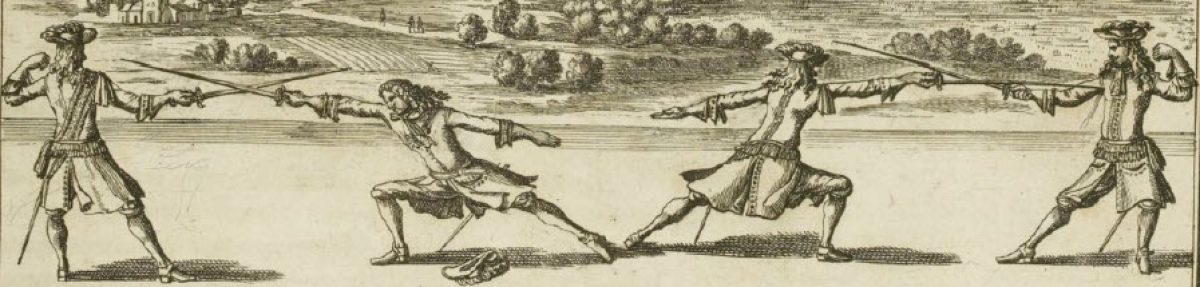


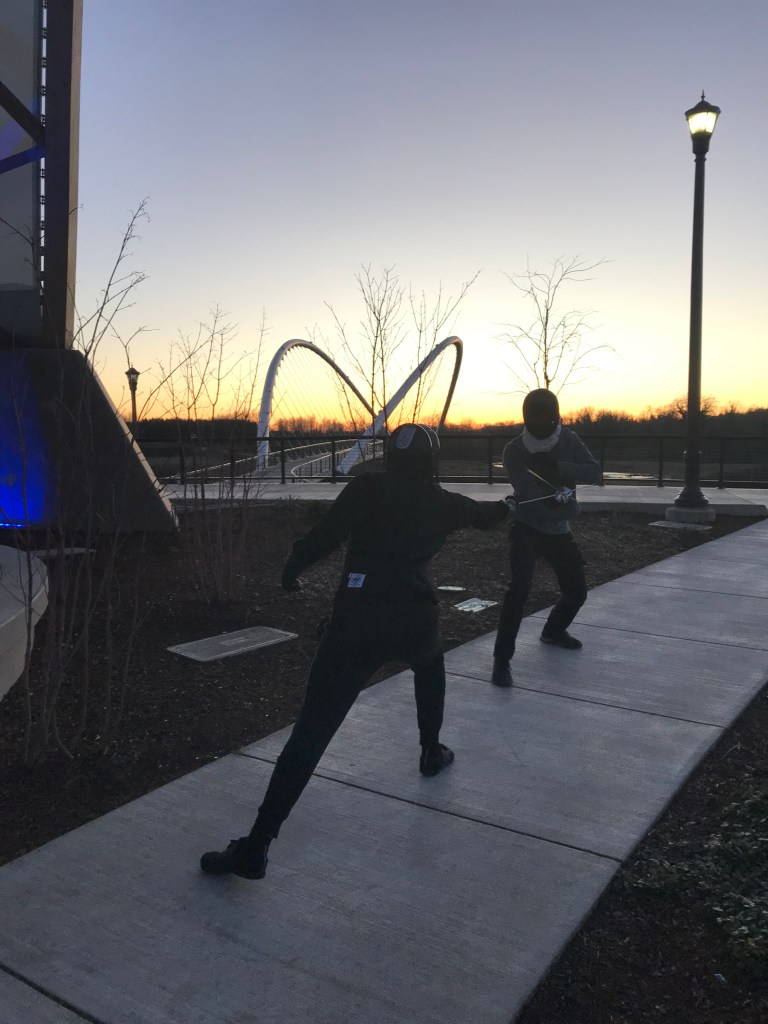




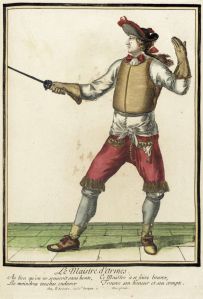
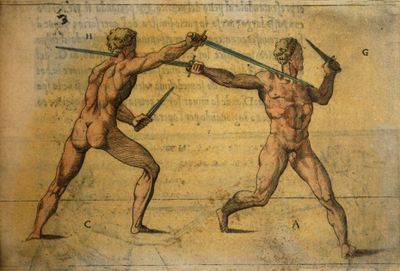
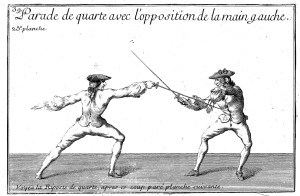









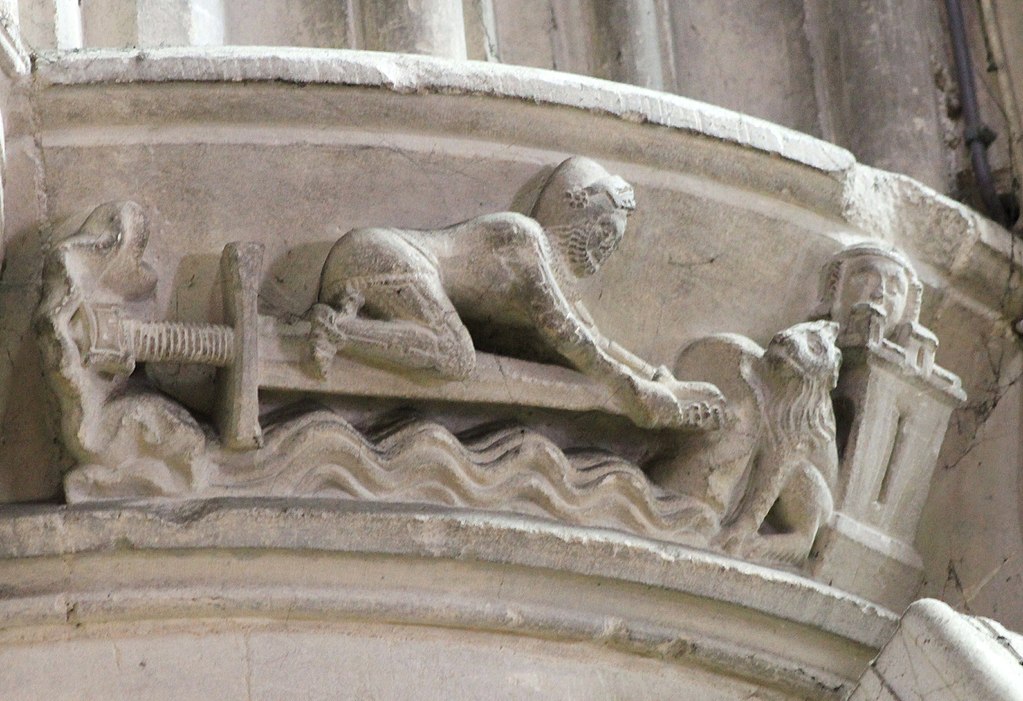
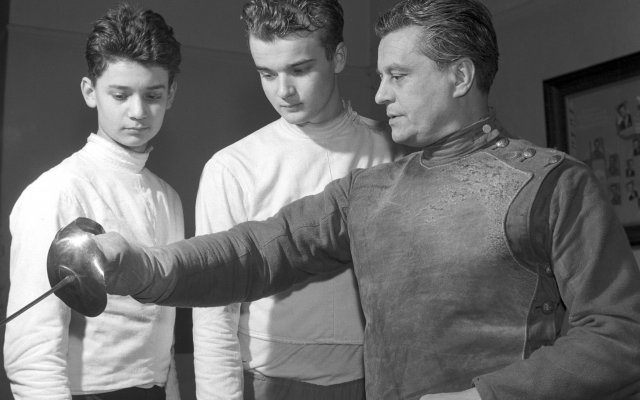
 Capitale Escrime Historical Fencing