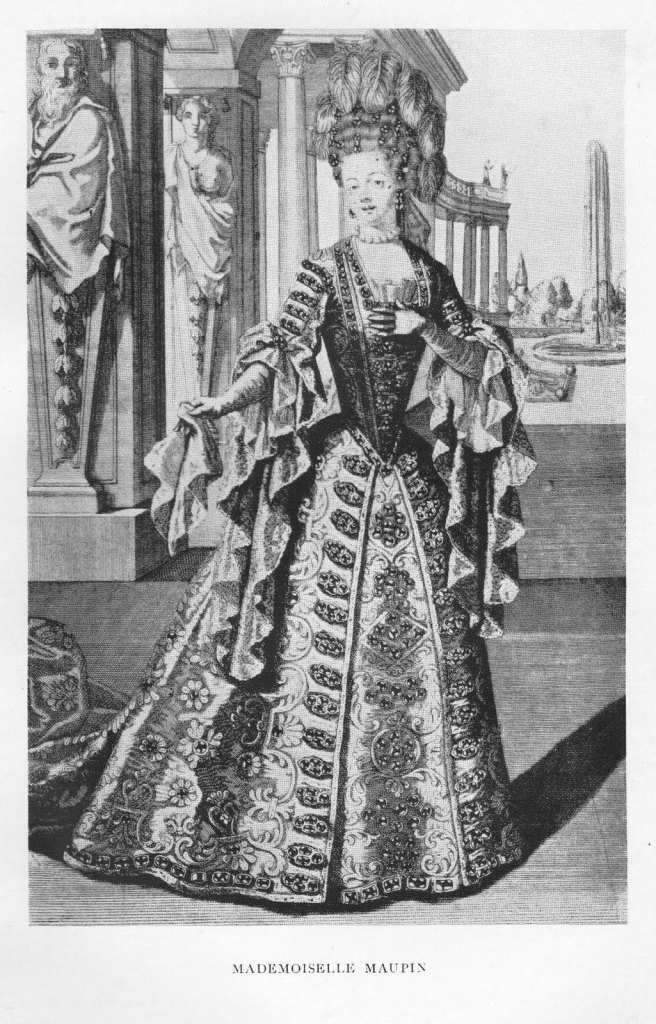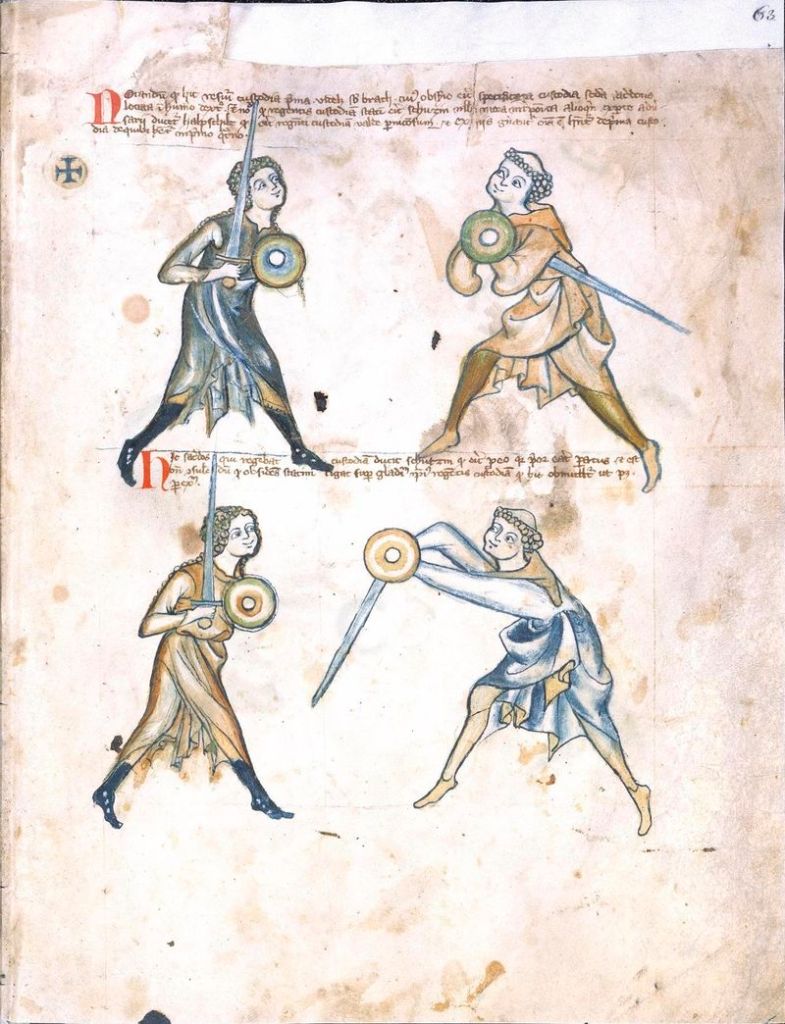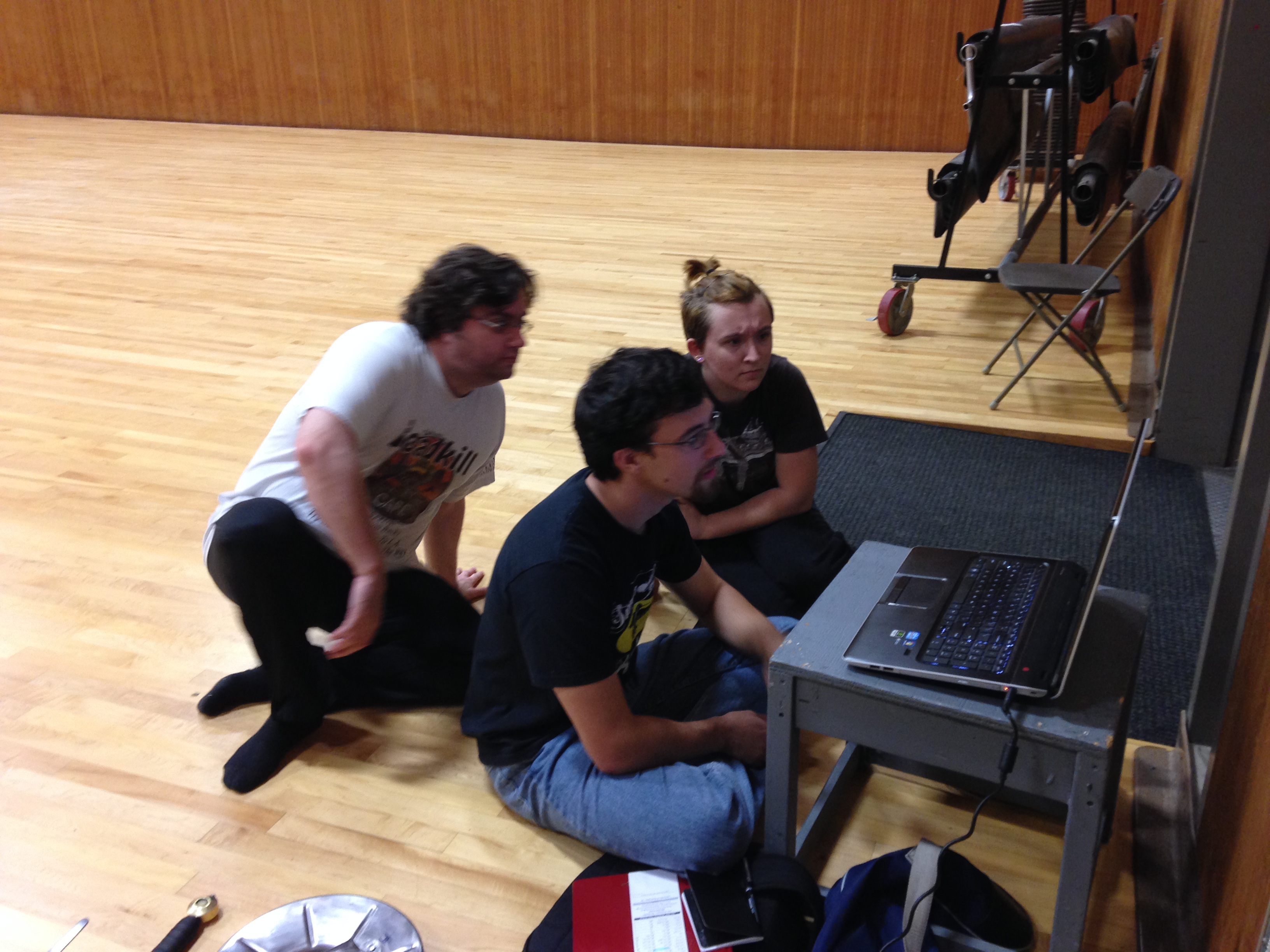
They Call it “Macaroni”

The Much-Maligned Smallsword and Foil and why it Matters
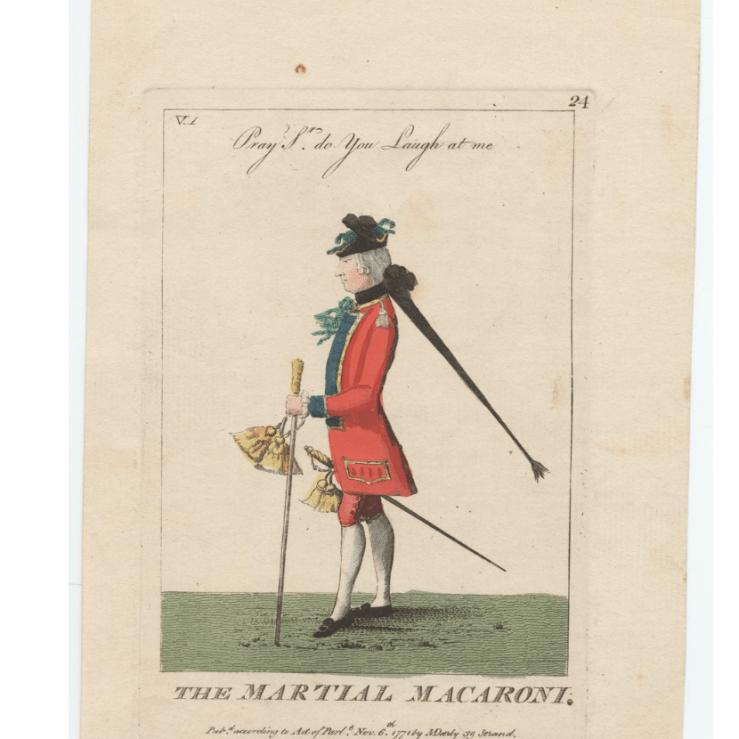
from Brown University Digital Repository [https://repository.library.brown.edu/studio/item/bdr:244908/]

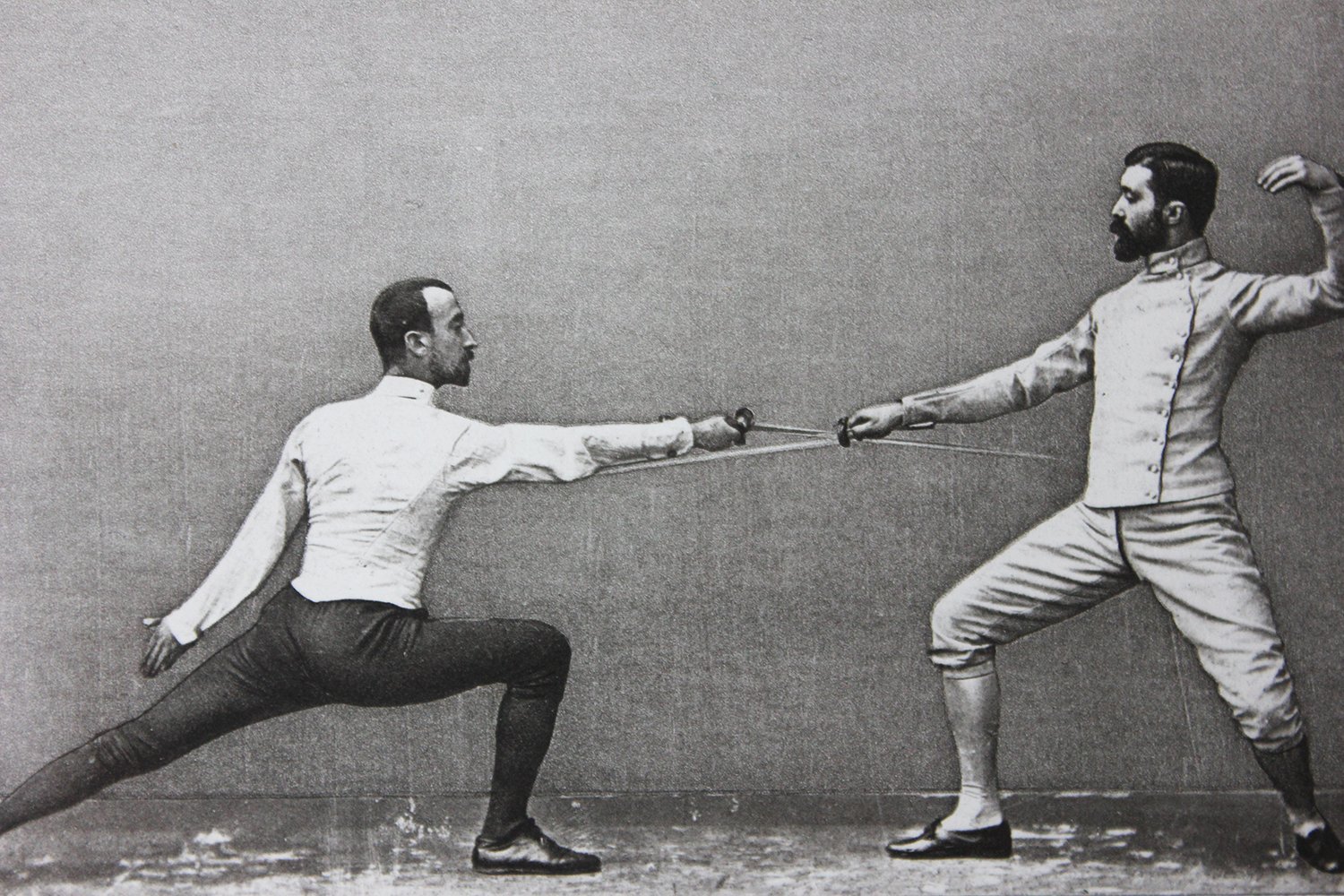
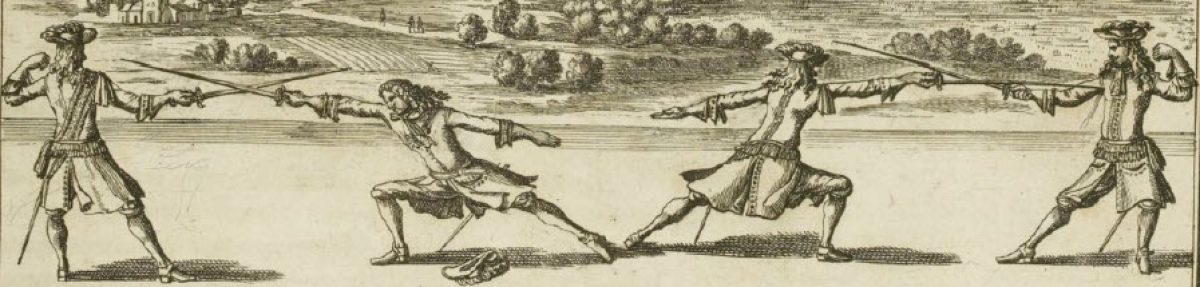
One of my favorite weapons to fence and teach is smallsword. I started fencing foil—a descendant of smallsword—in the 1980s, and though obviously adapted for safer training and the sport of fencing the fundamental elements of foil impart more than most people in “HEMA” believe. Moreover, my initial training was French, and the smallsword being perhaps the early modern French weapon par excellence there is something familiar and nostalgic (if that is the right word) about it. One benefit of subsequent training in a related, but distinct tradition (in my case Italian with Hungarian elements) is that one gains another view of that previous study, just as studying another language can illuminate one’s native grammar. While modern foil and smallsword are different, it is context more than anything else which separates them. The rebated weapons of two centuries ago, while similar to the tool of today, were used to mimic actual combat safely, not used purely as a game, and in this one key difference everything rests. Because so few people within historical fencing understand or accept this, however, one of the most deadly, sophisticated swords ever devised, and its descendant, is often the object of amusement and mockery. Sad as that is, what is worse is that in discounting smallsword and foil they lose the single greatest method by which to explore the extinct sword arts that do interest them.

Wigs, Lace, and Lorgnettes

“The Macaroni: A Real Character at the Late Masquerade,” (1773), Philip Dawe

The derision that smallsword suffers in “HEMA” reflects several failures within the community. Arguably it reveals a latent and wide-spread species of bigotry. The abuse aimed at this “dainty” or “tiny” or [insert equally facile insult here] weapon highlights the thinly veiled prejudice in HEMA’s macho culture, far too much of which poisons the community and retards its progress. Aside from compensatory attention devoted to big weapons, go hard or go home, and “I gots brusies bruh!” there is the bigoted notion where sophisticated = weak/effeminate/gay, the idiocy and ignorance of which speaks volumes. Second, dismissal of smallsword, just as with its descendants, indicates a complete failure to grasp the depth and importance of the primary means by which one learns the universals of fencing. This is not merely my opinion, but demonstrable on a number of levels, from the wide array of works on fencing published over the past five hundred years to the gulf in quality one sees in the historical community, not only in terms of performance, but also in terms of translation and teaching.

While fascinating, the parallels between modern disdain for smallsword and 18th century censure of the young people of fashion called “Macaroni” and “Macaronesses” goes beyond the confines of this piece. There are better places to go for the exploration of prejudice in the 18th century as well as the on-going discussion of the battle for equality and civil rights today. My stance on all that, for what it matters, should be obvious from previous posts, but I cannot speak to either issue as appropriately as I can to the second failure, that is, the mistake that most of HEMA makes with regard to anything they define—however poorly or inaccurately—as “sporty” versus what they deem “martial.” [1]

I dtir na Ndall [“In the Land of the Blind…”] [2]

As the old saying goes, in the land of the blind the one-eyed man is king, and if any one maxim summarizes HEMA it’s this one. Examining the usual allegations against smallsword and foil one sees how poorly they are glimpsed without full vision. First, the chief bias appears to be that smallsword (a weapon), because it is related to foil (a training device), is less a weapon than say broadsword. If foil is for sport, then anything like it must be too. Second, for those who see it as a weapon its size, complex method of use, and “late” appearance make it suspect. The logic here, such as it is, suggests that the older a system is, the more legitimate it is; that lighter weapons must be less “martial;” and that anything related to the duel—save rapier—are again less serious than the “heavier” and more manly longsword, axe, etc. The ridiculousness of each of these assertions is underserving of attention, so to be brief:

  • a foil is a practice weapon, be it the modern foil, a feder, or wooden wasters—that Messer you use? Yep, it’s a foil. Ditto your Albion, Regenyi, or Ensifer
  • puncture wounds, made by triangular bayonets or the often triangular smallsword blades, leave really nasty injuries; before the innovations of 20th cen. medicine there was little one could do to repair these wounds or deal with the infections that often resulted (cf. sepsis)
  • fighting in judicial combats with a pole-axe, sword, or anything else was just as formal and bound by convention as late period duels were by the restriction of ground and etiquette

These are all well-established by histories old and new. In truth the bias really has nothing to do with history at all, but with a strong desire to differentiate oneself from “sport.” Anything that is remotely connected to sport, then, is suspect in the eyes of HEMA-Bro. Late 19th century sabres of 650-800g? Too close to the modern sport sabres. Smallsword? Too much like modern foil. That’s it. That’s really all it comes down to, and such short-sightedness cripples not only their research, if they do any, but their own practice and pursuit of the Art.

Why Later Period Systems and Modern Fencing Matter

Misplaced bias against both later period historical systems and modern fencing means, in most cases, that these fencers lack a firm foundation in fencing universals and pedagogy. This lack is what tends to undermine their study most. For example, because they have no idea what actual fencing fundamentals are, they mistake aberrations for norms. When they see the problems that are easy to spot, such as the whip-like strikes from electric foils behind competitors’ heads or the floor-dragging sabre slap to a guard, they assume that what they see is the system. Wrong. Even now, decades into the worst offenses in foil, students are normally taught that extending the weapon proceeds movement of the foot and the body. This is universal and is reflected in literally centuries of treatises and hundreds of modern schools. Thus, when viewing anything in the Olympics, the World Cup, or the local NAC, one must differentiate between how a fencer performs that extension as well as how a director views and calls that same action, and examine it against what is taught. They’re often different. Competition, like it or not, comes down to successful exploitation of a rule-set. One doesn’t have to be the Chevalier de Saint-Georges or the Chevalier d’Éon to win; determination and skillful use of attributes win more fights than most fencers wish to admit.
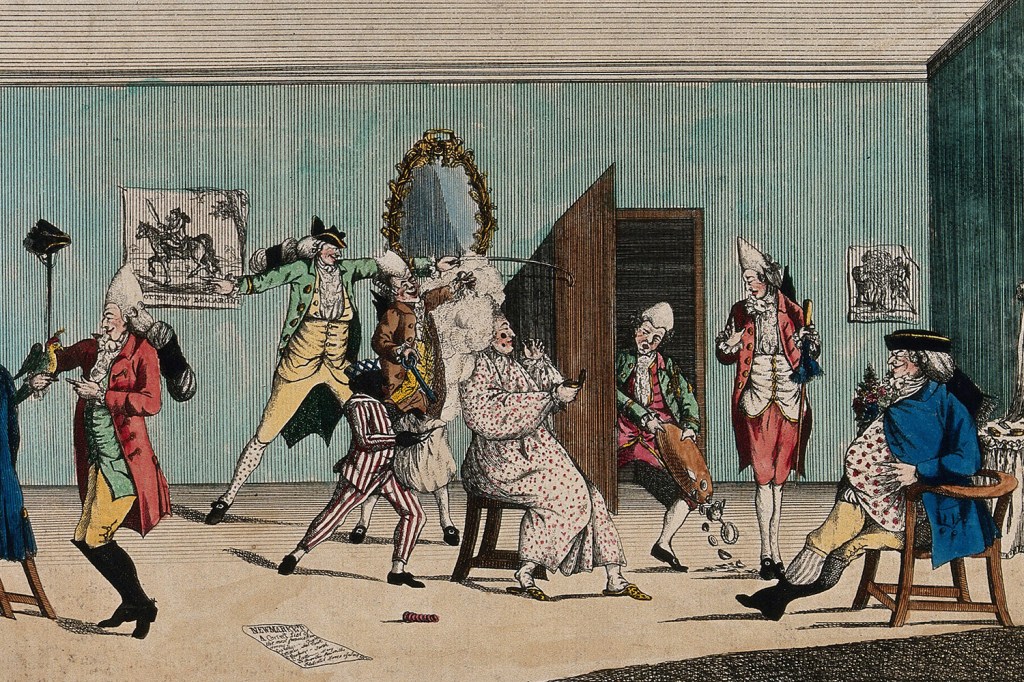
“A macaroni dressing room,” (26 June 1772) by I.W.

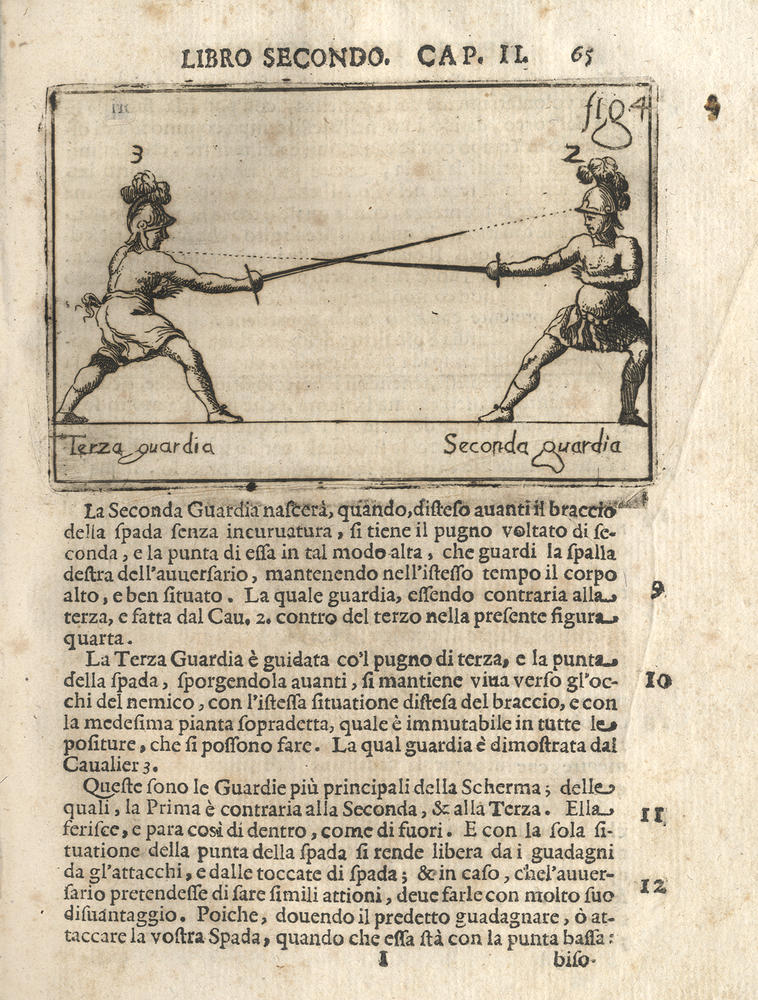
Not only do they fail to distinguish between what is taught and how it is used, but HEMAland also rejects traditional and sport pedagogy. They lose far more than they gain from this. Open most any decent work on fencing published in our own time and one will see first, that most do not include the ridiculous point-eating techniques, and those that do often with qualification—that is an admission, by the way, that the authors recognize that the technique is not part of the received tradition. [3] A fencing treatise is more than a collection of “moves;” it is an organized program that orders techniques, drill, and lessons in a meaningful way. It also instructs one in a vocabulary shaped by centuries of development, one benefit of which is that it provides a more effective means to discuss one’s study. Most of all, a year of foil—and this is reflected in the better modern works—imparts fundamentals that transcend foil. Knowing, for example, how the chief universals—time, measure, judgment/method—operate, and how one manipulates and achieves those universals effectively through movement, is crucial in examining any other system of martial arts, but especially those from which the modern version derives. [4] That may not seem important, but for the historical fencer it ought to be, because it is far easier to understand the unknown through the known than to come at the former with nothing or some half-conceived theory of one’s own.

In my last post (Sept. 20, 2020) I mentioned the infamous example of the misreading of Capoferro where the untutored surmised outlandish theories about his lunge. Had they had proper training in the modern lunge, done a bit more digging in the sources between now and Capoferro’s time, then the great mystery of Capoferro’s lunge would not be a mystery to them. Armed with even a nodding acquaintance with modern theory and practice would’ve helped those fencers avoid a grave mistake. Put bluntly, throwing out all that modern fencing has to teach, a system built—again literally—on centuries of work, is stupid and self-defeating. Modern fencing no more exists in a vacuum than did early modern or medieval fencing.

The Problem

For the same reason they poo poo later period weapons and modern fencing, HEMA-Bruhs refuse to listen to those who’ve studied them. Only people with the benefit of that training, or who take the trouble to learn about it, can see how all of this is actually a problem and not just sour-grapes or envy. The HEMA equivalent of anti-vaxers are convinced they have it right, refuse even to entertain that there might be something to learn from late period systems (though they’re ready enough to apply Japanese cutting mechanics and poorly understood kinesiology…), and so dismiss it out of hand. This is not a problem limited to the States either, though it’s perhaps particularly entrenched in American HEMA. We see it in the posers who ape the scholars they denigrate, in the sad attacks on established researchers by people who either deliberately misrepresent their position or are too stupid to understand it, in the idea that a few seminars make one an instructor, and in the odd notion that a 12 page pamphlet contains the same depth and sophistication as the works of Rosaroll & Gristetti or Prevost.

If those with respectable experience in Olympic and traditional fencing are ignored, then the only way to realize the value of later period arts or modern fencing is for the SPES-clad fencer to take that painful step and look at it more closely. Few do, and the results to an informed perspective are disappointing—half-baked theories, ill-conceived approaches, flawed interpretations, and a near complete lack of awareness of the importance of drilling fundamentals. [5] Our interpretations of past combat systems are only as good as the effective use of our research tools—studying extinct sword arts without some knowledge of fencing is akin to entering a bout without a weapon. Together, these flaws mean that much of HEMA is getting it wrong, and for a community supposedly interested in producing as accurate an interpretation of these extinct arts as possible, that makes little sense.

NOTES:

[1] I’m male, middle-aged, white, and hetero, and thus should not and will not speak to the experience of women or LGBT people. Friends and family who fall into either category, however, have shared a LOT with me about their own experience with bigotry so concluding that it juuuuust might bother them doesn’t seem too crazy to me. Just saying.

For related 18th cen. views, interested parties may wish to read some of the literature about notions of “masculine,” “feminine,” and the connections to contemporary ideas about sexuality in the Baroque and Georgian eras:

[2] For the person interested in the full Irish version: I dtir na ndall is rí fear na leathshúile.

[3] Compare for example Maxwell R. Garret, et al., Foil, Sabre, and Épée Fencing: Skills, Safety, Operations, and Responsibilities, University Park, PA: University of Pennsylvania Press, 1994, p. 134 on the “Flick (Cutover)” and Henry de Silva, Fencing: The Skills of the Game, Ramsbury, UK: The Crowood Press, 1997, p. 23, “The Cut-over or French Coupé.” Maxwell presents the flick as a cut-over, a reflection of how it was treated in competition in the mid-90s, where de Silva, writing a few years later, treats only the cut-over sans “flick.” It’s a subtle distinction, but for those of us competing at the time that remember the controversy over the flick and ROW, this reads a certain way.

[4] The universals always include tempo and measure, but the third term varies. Marcelli in The Rule of Fencing (1686) supplies “method” to the first two terms; Terracusa e Ventura, True Neapolitan Fencing (1725), speaks of velocity, tempo, and measure; de Bazancourt in Secrets of the Sword (1862) refers to judgment, control, and speed; Castello in The Theory and Practice of Fencing (1933) prefers distance, timing, calculation. To understand how these relate, why different masters chose different terms, requires reading them, not only for why they say what they do, but for how these terms relate to one another. Without a handle on the universals one’s ability to make sense of most works on fencing is hobbled—Girard (though see Traite des armes, Part III, “Advice for Good Composure when Fencing,” XI), Angelo, and many others assume the reader understands these or explains them within particular sections, so while not spelled out these concepts underlie all that they discuss.

[5] An informed perspective includes but is not limited to professionally trained fencing instructors, experienced fencers, or credible researchers. These is wiggle-room within these terms and I mean for there to be. There are veteran fencers, for example, who know more than many masters and teach as well or better; amateur researchers (vs. university trained researchers) who help us push the boundaries of what we know responsibly; and there are masters and professional scholars who raise the bar higher for our study of historical fencing. However, there are a lot of people who are teaching and shouldn’t be; there are a lot of people playing scholar who haven’t the least idea how to conduct research; and there are professional academics and maestri who don’t play well with others.

It is telling to me, for example, that while details may be in dispute among the maestri, scholars, and veteran fencers I know, none subscribe to the ridiculous theories that plague historical fencing, such as the silly theory of the lunge where the toe/balls of the feet land first. They are, generally, more open to new interpretations when those interpretations are better; less ready to make firm conclusions, especially for the medieval works; and understand the differences in the types of texts, how illustrations can work, and that the less a source contains, the more careful we must be. Most of all, they possess more sophisticated reading skills and realize that what they read or say must be analyzed, not just taken at face value. As a close friend has remarked, the “plates and plays” approach to HEMA is flawed; it fails to take into account all that is not right there in the image.

“I Only Read it for the Pictures”—Images & Interpretation in Historical Fencing

For the past few weeks I’ve been working on an article that treats an issue I seem to return to again and again—the challenge of using images in interpreting historical fencing sources. If this amounts to the proverbial flogging of deceased equines, then in my defense this particular horse is a zombie. It just won’t die. The deeper into this current project I dive, the more I see the ways that we can go wrong in interpretation. It’s tricky work. It’s one reason that professional scholars and researchers spend so many years acquiring the skills, contextual knowledge, and tools required to do this sort of work.

No one is immune or safe from a poor interpretation. It’s not an accident that scholars worthy of the name also learn to remain open to new evidence and interpretations better than their own. No one enjoys discovering that their conclusions have turned out to be incorrect or missing something important, but sometimes it happens and the best response is to meet the news with a becoming grace. Thank them for their insight and for alerting you to it, then revise and cite their contribution.

For those of us working with and from treatises with images we must always be careful. Modern life is awash in imagery and most of it we see without noticing it, from billboards to commercials on tele. We apply, again without conscious thought much of the time, an impressive array of reading skills as we encounter ads, instructions, news articles, and street signs. We are good at this. However, our relationship to images is often different from the ways people approached them in the past. We have to be aware of our assumptions and how we assign meaning to what we read.

IKEA’s wee question man

To approach a period treatise on fencing the way we do furniture instructions from IKEA is often unwise. With the exception of the abstract figure with the speech bubble and question mark, the instructions for assembling your new cabinet are intended to be as simple and realistic as possible. No matter what language one speaks or reads those images should make sense. They need to 99% of the time if that product is going to be successful. In contrast, while it is possible that the author (or artist they hired to illustrate a fencing manual) desired a one-to-one relationship between image and reality, we shouldn’t assume that.

Capo Ferro’s lunge, p. 49 in _Great Representation of the Art and Use of Fencing_ (1610)

As a case in point the famous image of the lunge in Capo Ferro’s Great Representation of the Art and Use of Fencing (1610), Plate 4, page 49, has been subject to debate as to how one lands on the front foot.

Looking at this image alone, what do we see? Is the figure in motion? Is this a snapshot of one action? How do we answer that?

From the image alone it’s not clear. This is a two-dimensional figure. The use of perspective is lovely, but while it informs us the figure is in the foreground, it doesn’t helps us much as to whether we are seeing a moment within a series of movements or a static pose. Is this a guard? The conclusion of an attack? To a fencer this looks to be a lunge, specifically, the conclusion of a lunge (to modern eyes the placement of the front knee would inspire a grumble). Taken alone we have little to go on, so, since we have text for this image it’s best to turn to that next.

Capo Ferro supplies capital letters in this image to help us “unpack” it.

A The left shoulder while in guard
B The left knee while in guard
C The sole of the left foot while in guard
D The regular stance while in guard
E The sole of the right foot while in guard
F The thigh and sloping leg while in guard
G The right hand while in guard
H The extension of the arm (equal to its length)
I The extension of the right knee (almost equal to your stance)
K The extension of the stance (a little over a shoe-length)
L The extension of the left foot and the turn it makes
M The extension of the left knee (equal to half your stance) [1]

Two things emerge from the list even before we look to see the placement of these letters in the image. First, A-G denote various positions of the limbs and body while in guard, H-M the various positions of the limbs and body after one has lunged. Second, we know that this image captures both a static moment (the conclusion of the lunge) and serves as a short hand to express movement from guard, through space, and into the lunge.

Even armed with this information we need more information. Capo Ferro, unlike most modern authors, explains movement in various places within his treatise. In the caption to this plate he says “Figure that shows the guard, as shown in our art, & the incredible increase of the long blow, compared to the limbs, which all move to wound.” [2]

The botta longa, often translated merely as “lunge,” here requires us to read more than the image and its accompanying legend. For example, in Chapter 13, section 11, Capo Ferro discusses walking. He says one must keep the right shoulder forward, and that one should step naturally, but that moving left or right (compassing) to move the left foot first, and in a straight line that one foot should follow the other. In discussing Plate 14 (p. 67) the master tells us that Fencer D, having gained the inside line, faces a disengage (cavando, i.e. cavazione) from C to his (D’s face). So, D drops the body and steps forward with the right leg wounding C in contratempo without parrying.

Plate 14, Capo Ferro, Gran Simulacro dell’Arte e dell’uso

Here as before we see a static image, but one that serves to illustrate movement–none of that comes across without reading the accompanying text.

Reading period manuals can be difficult. Even an experienced modern fencer will struggle because the vocabulary is often unfamiliar or used in a way different than they are accustomed to. To illustrate just how powerful this can be there are fencers within the historical community who refuse to call an obvious lunge a “lunge” simply because the word they expect, that defines the motion for them, is absent. It doesn’t matter that the treatise explains the exact same action, though it should. To expect each author, in different lands, at different times, to use a single term assumes a unity of fencing practice that did not exist until the 20th century. It also ignores what the author explicitly states. That’s a problem.

Our interpretations of these manuals mean little if we ignore what they say, what they describe and advise. It is worth the time and often painful effort to figure out what a master is saying. We may get it wrong, but that’s okay. We try again. We ask people who have sat with the text longer. We keep at it. Just as we should not assume people of the 17th century or any other had the exact same understanding of visual media we do, so too should we not assume that these texts are simple or easy to understand. Most often they’re not. The authors make assumptions about their readers then that do not hold for us now. So, we are translating more than just words and images, but a world-view too.

Returning to Plate 5, the lunge, and how the front foot lands, we have to go to the text. The foot is flat in the image. If Capo Ferro, who describes stepping “naturally” is to be taken at his word–a reasonable approach given that he is the author…–then the safest conclusion is that he wanted us to step as we normally do. From this figure that step is small, the distance between E and K (or if it helps think of this as KE = D or The extension of the stance (a little over a shoe-length) – The sole of the right foot while in guard = The regular stance while in guard). There is no reason to conclude that one must step in any other way. Next, we try it out–can we make a short lunge with the heel first, barely lifting it? Yep. Can we be 110% sure that Capo Ferro, for some reason, desired us to tippy-toe? No, but it is far from likely too, and given that he is specific about so much but felt no need to describe what a “natural” step is, we’re on firmer ground (pardon the pun) if we don’t second-guess him.

Post Script: I’ve delivered a few lectures on this topic, i.e. historical fencing and how we use images, the transcripts of which can be found here: https://saladellatrespade.com/instructors/research/

Notes:

[1] Capo Ferro, Gran Simulacro dell’Arte e dell uso della Scherma, Siena, IT: 1610, p. 48-19 [cf. https://www.google.com/books/edition/Gran_simulacro_dell_arte_e_dell_vso_dell/aT1qFVBHD0QC?hl=en&gbpv=1&dq=ridolfo+capoferro+gran+simulacro&printsec=frontcover ]; translation of A-M, Tom Leoni, Ridolfo Capo Ferro’s The Art and Practice of Fencing, Wheaton, IL: Freelance Press, 2011, page 32.

[2] Text, Capo Ferro, Gran Simulacro dell’Arte e dell uso della Scherma, 48. This is my loose translation, but I checked it against Tom Leoni’s and while less eloquent it captures the sense.

On Covering, or, the Difficulty in Hitting and not being Hit

PART I

ROW and SPORTFor a while now, I’ve been working hard on an issue we talk about all the time, but which we struggle to manifest: coverage. How to hit and not be hit. For historical fencers this is supposedly the guiding principle in how we approach the Art, and, what ostensibly separates us from our cousins in the Olympic world among others. This isn’t to say that the sport ignores proper coverage completely—ROW assumes it—but as often interpreted, taught, and scored “hit and don’t be hit” is less important than who made the touch with right-of-way, regardless of off-target or near simultaneous strikes. Historical fencers, particularly within their own sporting wing, struggle with the exact same issue only under different terminology. Considerable gymnastics form some answers to the problem, from over concern about “after-blows” to peculiar understandings of the angles for “effective” cuts, and to be fair similar gymnastics in rule-sets with point values by target…, so looked at honestly sport-HEMA faces the same challenges the Olympic world does. [1]
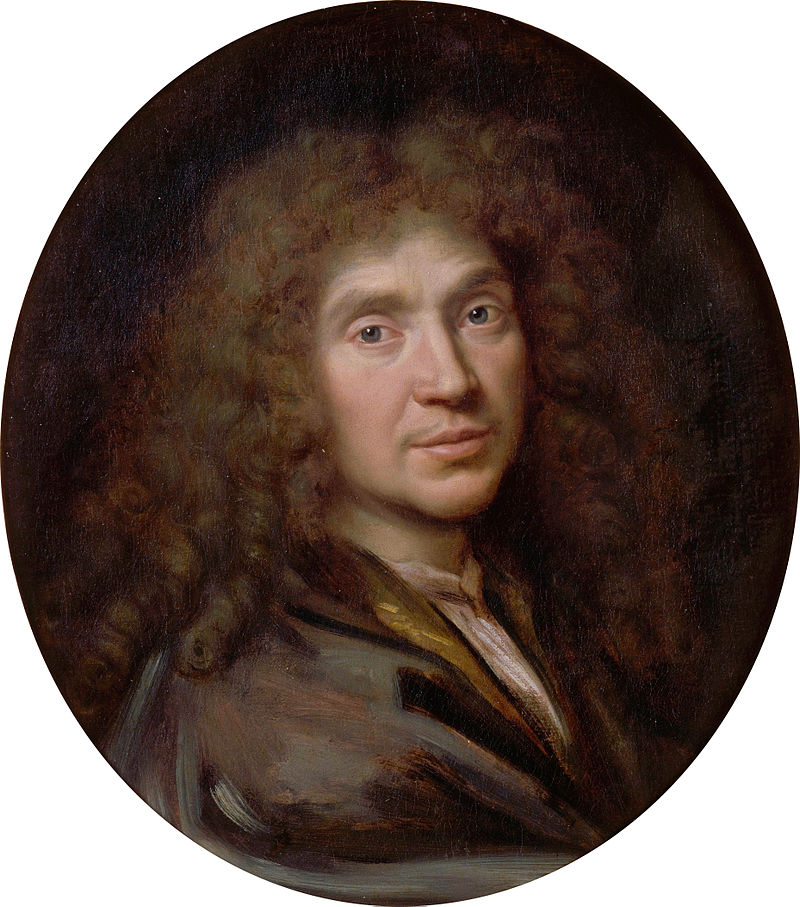
What exactly do we mean by “coverage?” In short, to quote Molière, it is “to give and not to receive” when fencing. This maxim derives from a line in a ballet by Jean-Baptiste Poquelin Molière (d. 1673), usually referred to only by his surname. He was a French dramatist whose work captured key social issues of the Ancien Régime. In his 1670 “Le Bourgeois Gentilhomme,” often translated as “The Would-be Gentleman,” Molière explored the ridiculousness of a social climber keen to take on the activities of his social superiors, something obvious to everyone but poor Monsieur Jourdain himself. Among those he employs to better his situation is a fencing master who, in an oft-quoted line in traditional fencing circles, remarks “As I have told you, the entire secret of fencing lies in two things: to give and not to receive.” [1] In the 1990s when “classical” fencing was quickly establishing itself in reaction to the excesses in the sport, this line was often the battle cry.
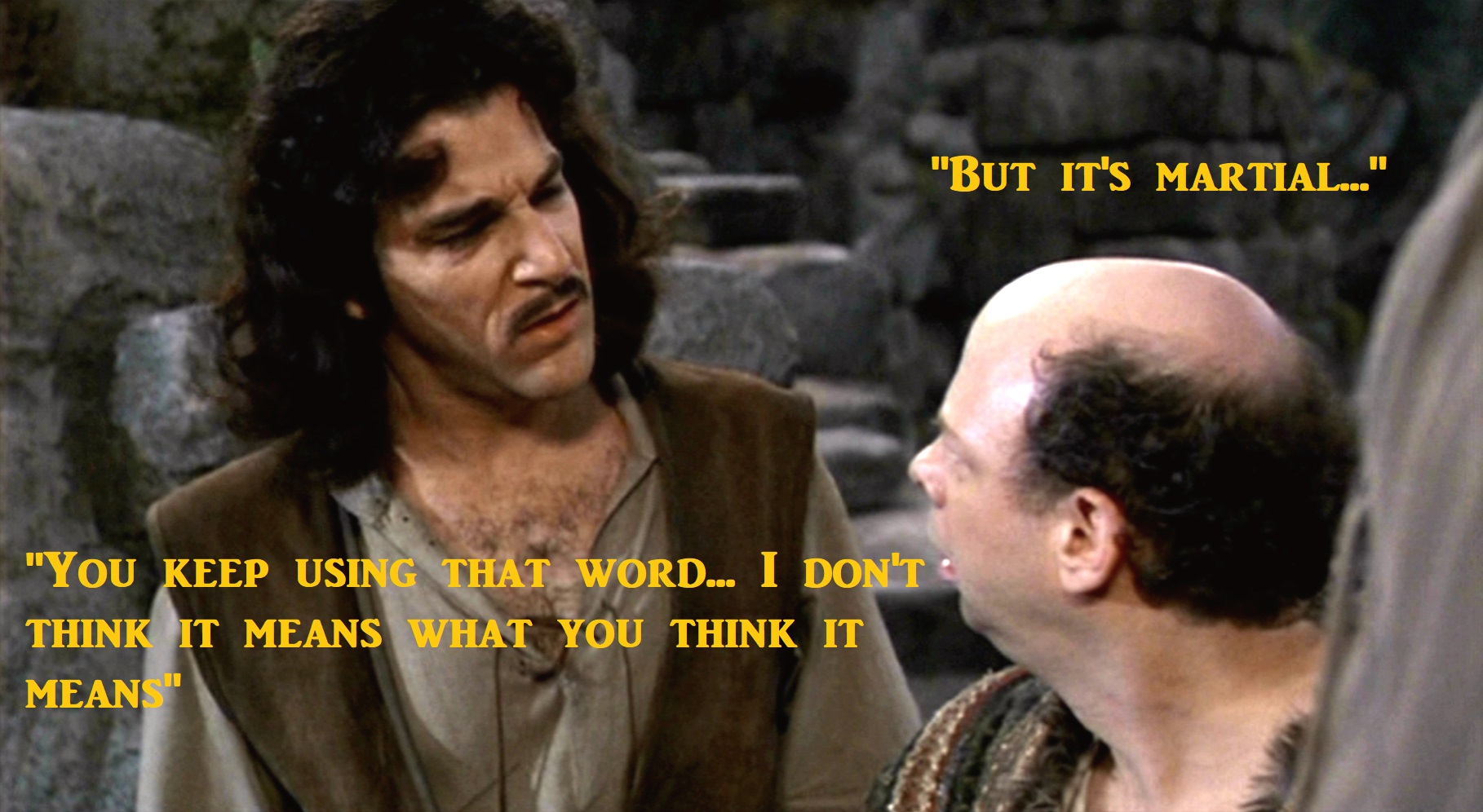
On its own, it’s a clear, simple, and direct notion—hit your opponent, but in doing so don’t be hit. This is far easier to say than to do. Why is that, and for those of us looking at period manuals, why is it that we still struggle to achieve this? What gets in our way? Does it even matter? [2]

Working backward, it doesn’t have to matter; that depends on one’s goals. Anyone purporting to pursue historical fencing should care, but there’s a spectrum within “HEMA” and naturally not everyone agrees. Assuming that not being spiked or slashed does matter, however, there are probably multiple explanations for why it is so difficult today. This first discussion of coverage will discuss a few of the big picture issues.

Through a Glass Sporty

Much of our way of thinking about “real” swordplay has been framed within a sportive context, so we often unwittingly apply this sportive filter to our look at works from the past. This particular blindness is born of working in a context so divorced from the original environment of the Art. One result of this is that we have nothing against which to compare our interpretations, progress, or effectiveness other than parallels within our context, and all of these are sportive. We can get close to more accurate interpretations, maybe be dead-on in some cases, but much if not most of what we build, especially for older systems, will remain tentative. It’s inescapable since we no longer use swords in war or fight duels. The emphasis many place on tournament bouts doesn’t take into account this filter, but it must—by definition a tourney bout is sportive. This has serious ramifications not only for how we train, but also for the value so much of the community places on medaling.[3]

It is easy to underestimate the importance of this. In the past, when the sword was still an active weapon, final proof of readiness and skill was pass or fail, something one only discovered in combat, in whether or not one survived. Setting aside the issues of infection resulting from wounds or a stray musket ball on a battlefield, one’s skill either effectively dispatched the enemy and saved one’s life or it didn’t. Confidence accrued over time as one continued to survive until one either retired, met one’s match, or was killed by some non-primary assailant. This is a perspective and style of confidence that we cannot really know. Modern military people with combat experience may better appreciate this psychologically, especially if they have experience in hand-to-hand combat, but even for them the nature of warfare is different in significant ways.

The Role of Fear

MartialThe confidence gained in “on the job training” didn’t mean a lack of fear, only the ability to put that fear in check. More than anything else, it is the lack of fear, the lack of dire consequences which most affect our approach. Some historical fencers assume that because the system they study is “martial,” by which I believe they mean either for the battlefield or as a synonym for “effective,” that they are  more or less automatically approaching it the same way as people did in the past. One may move much the same way a treatise suggests, but movement is mechanical however much informed by intent and to move the way a master recommends does not mean the mindset is the same. We can’t even be sure we’re moving the right way much of the time.
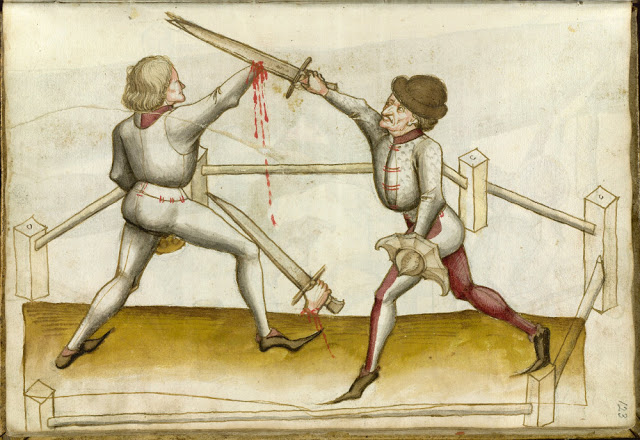
This is an old problem, one at least as old as fencing for sport, and there have been many proposed solutions. ROW in Olympic fencing, for example, is meant to reflect the reality of a duel—in short, if one is being attacked, one must defend, or, counter-attack in enough time to have hit the opponent before one is hit. The inclusion of “off-target” and poorly timed touches affect everything. The most important complaint about ROW is the fact that there is not enough emphasis on not being hit at all. If, for example, my opponent attacks me and I decide to attempt a counter-attack, ideally I do that in the correct tempo and cover myself on the retreat. However, by the rules, I just have to strike one tempo before my opponent to nullify their attack—this doesn’t mean that I’m not hit, just that I hit first, in sufficient time, and thus rob them of the touch and score one myself. As Olympic fencing is a sport this is perfectly sensible, but if we’re talking fencing as a martial art then it is a problem.

Rule sets in historical fencing have to make choices too, but for the most part they’re just as artificial. Anytime we game a combat system we introduce artificiality. Some suggest that only certain angles of cut, for example, are sufficient to do any damage and thus only cuts made at those angles count. This flies in the face of actual cutting practice, however, as even a tip cut with a longsword is going to do some serious damage, never mind weapons designed to cut that way. Other rule sets, and I’ve made one myself, try to introduce either benefits or punishments for bad tactical decisions. Some award points to “after-blows” in the belief that one should have covered, others attempt to promote better attention to defense by weighting the initial point more.

None of these are perfect and each have advantages and disadvantages. None, however, solve the problem of mindset. If cuts must be made at certain angles, then cuts that might have damaged someone but aren’t at those angles are ignored—”tippy” cuts to the hands, to name one example, aren’t considered “martial,” but the hands and forearms are common targets in the sources and as I learned from one sabre coach, if you remove the arm’s ability to wield the weapon, the rest of them is a lot easier to hit. The thorny issue of the “after-blow” likewise presents difficult choices—what is more important, responding properly, defensively to that initial attack or cutting into it to lessen its point value despite the fact both opponents are hit? Weighted point-systems set up similar challenges. For example, in my rule set I reasoned that weighting the first touch in a bout would make fencers more cautious and defensive, but the point advantage led more people to attack in hopes of being a point up from the start. These artificial attempts to infuse some species of “fear” and/or better fencing vary in quality, but none does the job super well.

So, if we cannot replicate the context and fear of actual sword combat, what can we do?

Interestingly enough, some dubious individuals have decided that the only way is to fight with sharps; I don’t mean in a drilling sense, but in a bouting sense. However, fighting with sharps “to the bloom” among fringe elements within the community is not the answer. In addition to the legal issues inherent in such idiocy, this activity resembles more some rite within a cult of machismo than anything else. Moreover, some of these groups are known alt-right, white supremacists with mixed up ideas of valor in addition to their ahistorical and unscientific notions of “race,” nationalism, and everything else. Their lack of credibility belies their approach to most things and one must remain suspicious that they even understand what they’re reading (assuming that they can read and do). [4] From the context perspective these dangerous fights are more ritual than a species of duel or battlefield combat. Groups like that in Hamburg do this by choice, with their friends, and while no doubt afraid in some degree, like the older institution of German student dueling at certain universities, this is more social than “martial.” Did I mention it’s stupid?


Cultivating “Fear”

zazenAt the risk of sounding too Pacific Northwest and as crunchy as organic granola, one thing we can do is cultivate a sense of danger, that is, be mindful from the moment we pick up a weapon that it’s a weapon. Blunt, not blunt, treat that sword like it’s dangerous. By analogy anyone who owns firearms knows to treat that rifle, pistol, or shotgun as if it is loaded. Always. Though clearly more critical for gunpowder, the same mind-set can help us approach our drill and bouting with more awareness of what it is, in theory, we’re doing. Employed appropriately our fencing will change. We can become more cautious. We may reconsider how that tip cut to the hand might have ended the fight. We can second guess an attack that puts us at too much risk even though we’re sure we’ll land the touch.
In itself this is not the answer. It’s a useful approach I’ve been trying experimentally, but I’m optimistic about it as a training aid for two reasons. First, the mindset of “all swords are sharp,” if we apply it well, puts us one step further from fencing for points. Second, the more sources I read—irrespective of system or time period—the more I notice the emphasis on avoiding being struck, on attacking wisely and whenever possible with cover, opposition, or room to maneuver away.


In the Part II of this discussion I will examine a few sources, from the 14th cen. to the 20th, and how they treat these issues.


NOTES:

[1] In the two years we used versions of the rule set I put together it has changed. Most of this change came from the insight and experience of those who competed and officials. Their input improves the rule set far greater than trying to do so on my own can, and it’s long past time for me to reexamine and improve it again. One major change will be taking away the weighted first touch.

[2] Hitting and not being hit includes a lot, from effective parries to attacking from the right measure and in the right tempo. It includes trying whenever possible to thrust with opposition to returning behind the point or under guard on our recover after attack. In Part II I will explore these in more detail.

[3] As another nail in the coffin of tournaments being “martial,” all of them are set up as duels, a fight between two individuals.

[4] For one example, see https://mindhost.tumblr.com/post/143979980172/iamafencer-fencing-to-the-bloom. For an example of the ultra-nationalist variety, see https://www.youtube.com/watch?v=y237mTaexrs. Rumor holds that they’ve had two people die. They also wear clothing directly associated with neo-Nazis. See https://www.reddit.com/r/wma/comments/6xma13/idiots_fight_shirtless_with_sharp_blades/.            

The Importance of Reading the Sources

One of the hallmarks of historical fencing vs. other branches is the central place of the sources. Olympic fencers may never crack open a book about fencing, let alone an old one, because they don’t need to. This isn’t to say they shouldn’t, but that it’s not required. The high level of teaching in Olympic fencing, the focus on individual lessons, and the crucible of the tournament experience all work well together to produce capable fencers. Historical fencers, however, can’t really pursue the Art without recourse to the texts, images, and tools that comprised parts of it. There is a spectrum within historical fencing—at one pole are the handful of academics focused on the texts, at the other are those who receive all they know through an instructor who (ostensibly) does the reading for them, and then there is a wide variety of approaches in between those poles. Wherever one may be along this spectrum they should, at least on occasion, read the sources that inform their study.

To use an appropriate cliché, reading the sources is a doubled-edged sword, because while diving into the source might illuminate a lot, it also requires reading skills most people don’t apply day to day. That can be daunting. Unlike a novel or magazine piece we can’t be passive; we must be active. We must apply close-reading skills, and many people haven’t exercised those since secondary school or college; some never have. Don’t worry: the good news is that one doesn’t normally have to do this in the detail sometimes required of many historical documents.[1]

It’s important to read, if only on occasion, to check that the interpretation we’re using or learning is still valid. In much of what people normally think of when someone says “HEMA,” for example, people rely on ideas and techniques which, if one looks further into, are flawed. One of the places this is most evident is in cutting dynamics. There are false equivalencies guiding much of current practice as well as a fundamental misunderstanding of fencing universals. The trouble is that those crowing loudest have gained what notoriety they have on these faulty foundations, so there’s little incentive to own it. There’s a direct analogy here with the FIE officials, coaches, and fencers who either made their way via dubious, non-traditional actions like the “flick” or allowed such actions to count in the 1990s. Vested interest and concern for reputation above all tend to work to undermine not only better work, but also actively seek to discredit it. That’s a problem. [2]

I’ve discussed this before, but there are many ways to cut a mat—cutting the mat, on its own, doesn’t mean that one has cut that mat as one’s chosen source or style has dictated. This is a false equivalency. It won’t register as a problem unless one knows the sources, however, so that means it’s on each of us to read. It’s especially incumbent upon those responsible for teaching cutting to get this right—not all of them do. Some of the loudest voices are using techniques more in common with certain Japanese schools than with KdF or other European systems. Anyone who dares suggest this, though, is assaulted with ad hominem attacks, even home-made memes featuring the offender’s photograph. Childish responses like this should be raising serious questions about the attacker’s credibility; it’s not just the lack of maturity and fair play displayed, but the unwillingness to counter with better research. In some part the name-calling is meant to mask the fact that some of these supposed experts don’t know how to do proper research. [3]

For those concerned with approximating as best they can their chosen branch of the Art it’s vital to gain a basic understanding of the source material. It’s as important as finding a qualified, informed, and open-minded instructor. Any instructor worth the name should be open to reevaluation in light of more information or a better interpretation. Just as one shouldn’t follow Deepak Chopra for medical advice based on t.v. spots, book sales, or wishful thinking, so too shouldn’t one take the advice of any HEMA luminary at face value.

Cutting can be a good litmus test for our practice, but only if one has at least a nodding acquaintance with the source and what it says, and importantly doesn’t say, about how to cut. It’s not enough to use the right tool, or to have read a source the way one does a magazine article—one must understand as much as is possible what the text advocates. [4]


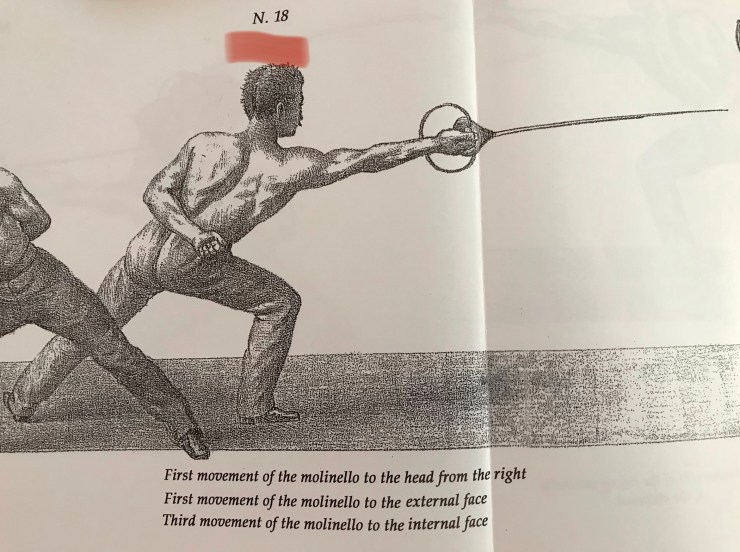
As an example, here is one of the molinelli as described by Settimo Del Frate:

47. Molinello to the Face from the Left in Three Movements

The execution of the molinello to the face follows the rules given for the molinelli to the head. The instructor gives the preparatory command and then the command of execution. For the molinello to the face from the left [hereafter, “external face”] from point in line, at the commands:

One! –turn the hand from right to left by rotating the forearm. The edge of the blade should point to the left (N. 18).

Two! –lift the sabre with the forearm, and straighten the body, carry the hand to the right of the head, approximately ten inches distant from the same. The sabre should be vertical, with the edge turned back diagonally, and the weight of the body equally squared between the legs (N. 20).

Three! –with arm power coming forward from behind, tighten the fist and give power to the movement of the sword with the body. The sabre should describe a horizontal semicircle at the height of the shoulders, so as to return the body and the sabre to the position of point in line. [5]

A fencer new to Del Frate’s seminal work on the Radaellian sabre method should have questions as they read this. Assuming they’re familiar with the term “molinelli” or “moulinets,” the French rendering being more common in the States, the next question might be “What did DF say about molinelli to the head?” The author assumes that the reader is familiar with these and indicates that they are either necessary or helpful in understanding what he’s about to share. If the reader hasn’t read that portion, they should now.

The reader should also notice that Del Frate breaks this particular action into three chief parts. Starting from a position, in guardia, of point in line (DF assumes the reader knows what this means), the fencer then:

1) turns their right hand from the right to the left (this means going from the hand in “first in second position” where the thumb is between 7 and 8 o’clock to the hand in fourth position where the thumb is at 3 o’clock); for reference one can reference Del Frate’s plate No. 18

2) from here the fencer bends the arm at the elbow and brings the weapon up by their ear; for reference examine Del Frate’s plate No. 20

3) from here, the fencer moves the sabre forward turning the hand to strike the opponent’s right cheek; this is powered by tightening the grip, using the elbow as axis of rotation, and putting the force of the body behind the blow; when the cut lands one should be more or less in the same position as 1), and then recover into guard

In broad outline this molinello is comprised of preparation, chambering, and the strike. The specifics of movement, however, require some attention. For those terms or ideas the reader doesn’t know, a glossary or reference work on fencing is useful, but so too is time spent actively thinking about each term, how they apply, and then putting them all together.

There are also things Del Frate doesn’t specify in this passage that one must know from the earlier section of his work. One assumes the point in line from guard, and upon completion of the cut, where one ends up in the same line, then reassumes guard. Of note, Del Frate simplifies the section on turning the hand; many Italian works not only break down the guards by number, but use specific positions of the hand too. Del Frate, for whatever reason, did not, neither in the section on sabre or spada. Likewise, the reader only realizes the thumb should be on top the backstrap if they’ve read Del Frate’s explanation of the grip.

Even for an experienced fencer the first attempts at this molinello might be a bit daunting. This is an older form, all but vanished in modern fencing, and much larger and more powerful than the direct cuts made today. It can make one feel vulnerable, and this is important because this is where personal experience and learning to date bumps into a seemingly less viable method. One of the complaints made against Radaellian sabre is that the fencer is more vulnerable in making these cuts. From a sport perspective that is true, but this assumes a sporting context which is very modern. When Del Frate wrote down his master’s ideas he wasn’t thinking about points, but about making cavalrymen more effective. This context is everything (cf. the last website post, “Sabre, Saddle, and the Vital Importance of Context,” 4-6-2020).

Most of us, however, are not fencing from the saddle, so the next question is “how do I make this work on the ground?” In this one passage on the molinello to the external cheek there is no explicit mention of how to cover. What do we do? We need to read more, and, perhaps dwell on those points, research them, and discuss them with more knowledgeable people. This is hard work, and it’s a lot less fun than bouting is most of the time, but it’s the work that separates a skilled fencer with deeper knowledge from a decent fencer who relies more on attributes and limited understanding. Without this work it is easy to assume that one knows better than the text. Even if that is true, a truly debatable point, IF one wants to cut the way Master X suggests, then one needs to give that master’s advice a fair try. Not one of the Radaellian masters suggests one rush into danger making wheeling cuts and exposing themselves, so, clearly they had thoughts about defense. Discussions of footwork, measure, timing, and parries all inform this, as do the molinelli themselves. A key aspect of the molinelli that’s easy to miss is how each of them moves through a particular parry. That’s not an accident.

Before a cutting target many people focus on cutting the target; that’s the goal, right? Yes, and, no. Yes we want to sever the bamboo, bottle, or tatami, but ideally we want to do so according to our chosen system. If possible, select a weapon suitable for that system. For these Radaellian cuts, for example, a sabre between 650 and 850g is perfect. Next, forget the goal and focus on the technique: think back to those three commands. From guard, establish a point in line, bring the arm back to chamber, and then cut. Use no more force than suggested.

One may not cut successfully through the target the first time. That’s okay. In time one will. This is why we do test-cutting, to help us figure out the system, to test our interpretations. Ideally, one cuts at target precisely as they make the same cuts in a bout—there is no reason one should cut differently just to sever the target. We are likely to undermine our hard work if we treat them differently. Approaching test cutting as an adjunct to our other modes of practice can be extremely valuable when conducted with the right frame of mind. There’s also nothing in shooting for accuracy within a tradition to make the exercise less fun.

Notes:

[1] In graduate school I once had the chance to take a class with Naphtali Lewis, a renowned papyrologist. He took us line by line, word by word, through the “Res Gestae” of the Emperor Augustus, a tour de force of propaganda. I have found that with most fencing works while it can help to focus on a single word, it isn’t always necessary. He impressed upon me, however, that starting out asking the question “Do I need to read in depth X” can often save us time and pain later.

[2] By “HEMA” here I mean, generally, those most associated with the sport side of HEMA (especially State-side). It is a spectrum, however, and many groups are “doing HEMA” without falling prey to the facile interpretations championed by this crowd or hobbled by their knee-jerk reaction to anything vaguely Olympic. The over-riding concern to distance themselves from Olympic fencing suggests they too see the similarities between themselves and our Olympic cousins just as the rest of us do.

[3] If fb is any guide the jealousy with which these individuals guard their view is matched only by their inability to play nicely with others. One learns a lot about anyone who’s first reply is an insult. So long as these people have a cult following, however, they’re unlikely to evaluate their own positions fairly. The recent mess of an attempt to reevaluate George Silver only last week is a case in point. On the one hand, there was a respected researcher, Stephen Hand, and a disparate, varied group of people voicing support or supplying corrections about aspects of this new theory, and on the other were the authors of the piece and their fans. The new theory doesn’t hold up well for several reasons, not least of which is that they failed to understand Hand’s position correctly. More than one researcher, myself included, concluded that this piece was less about Silver than it was about attempts to justify a) what the authors are already doing in tournaments and want to see the rules validate, and b) to fit the sources to their own interpretations. Watching this debacle of a debate was another reminder of why most serious researchers have so little to do with mainstream, sport HEMA.

[4] In fairness to those working with much earlier sources it’s often much harder to interpret how to cut. Many people view medieval and renaissance images as if they were photographs; this is generally unwise. The artist or author may have intended a realistic rendering, but that wasn’t always the case. See post “Using Period Manuals in Historical Fencing,” Sept. 18, 2019 here, and, “Transcription of Lecture delivered at the Thundermark Deed, March 20, 2019,” on my profile at academia.edu.

[5] Settimo Del Frate, Istruzione per La Scherma di Sciabola e di Spada del Prof. Giuseppe Radaelli, Scritta d’Ordine del Ministero della Guerra, Milano: Litografia Gaetano Baroffio, 1876, 43-44; for the English, see Christopher A. Hozlman, The Art of the Dueling Sabre, Staten Island, NY: SKA Swordplay Books, 2011, 34. The images from the 1876 are from the plates in Chris’ translation.

Lest a Fool be Believed

A Response to “Zero women can fight with a Sword”

The ahistorical and no doubt purposefully inflammatory drivel a conservative critic leveled at women fighting in the Netflix show “The Witcher” is undeserving of quotation. I’ll not share anything the ape said save what you read in the title. Interested parties can see the notes if they have the stomach for more—I will note that Forbes.com, which addressed this issue too, did cite the excellent example of London Longsword run by Dave Rawlings who, if you know him, would be (and was) quick to correct the ignorant critic (if you happen to see this, Hi Dave!  =) [1]

The problem with poor excuses for Y chromosomes like this critic is that they have an audience. The pathetic incels who never leave their parents’ basements are one problem, but here I wish to address everyone else, general audiences with more wit, who might read that review and assume there is any veracity to it. There isn’t. I state this as both fencer and historian. A quick search online would’ve been enough to dispel Mr. Manly Man how incorrect his assessment of women using swords is, but it’s doubtful he cares. His point had nothing to do with truth or history and everything to do with pandering to his equally insecure base.  Bad press is press, right?

Ella Hattan, “La Jaguarina”

There has been, rightly, enormous outcry about this. This is a good thing. Importantly, it’s not only been female fencers and fighters who’ve been quick to share examples of women with swords, but many of their male counterparts too. Now, more than ever, it is important for men—especially middle-aged white men like me—to stand up for their female colleagues and shout down the stupid. It’s as important as defending other historically marginalized colleagues such as People of Color and our comrades who are LGBT.

I know, firsthand, how difficult it can be trying to be an ally, but it’s important. You might also have difficulty overcoming how you look (something healthy for us old white dudes to experience from time to time); you might have someone’s unfortunate experiences with bad men grafted onto you, but that is part of advocacy. Not everyone sees you as an ally and some actively resent it. Some people will be happier using you as a convenient whipping post, especially if they’re unable to go after the men at work or in their families who have mistreated them. We all filter everything through our own experience. Do the right thing anyway.

Knowing my limitations, and my bailiwick, I’m trying to do my part as best I can. I tend to see my efforts to be a part of the solution as stumbling my way towards advocacy; I don’t claim to have all the answers or even most of them. But, I know A LOT of women who fence, as many if not more in martial arts generally, and I’ve been fighting alongside women since I first started studying the Art. As a colleague of female fencers, as the coach to several, I feel a responsibility to stand by them, and for the younger women I coach to serve as a good example.

I cannot and should not attempt to speak for women. However, I can hold up examples, ancient and modern, that put the half-baked notions of third-rate conservative critics in their proper light. The focus here will be on women and swords pre-20th century.

Women and Swords in History & Early Literature

Herakles fighting the Amazons, ca. 520 BCE, MET Museum

There are a number of excellent examples in the historical record and in heroic literature. Granted, saga is not history, but it’s a repository of values, a glimpse into what a culture holds dear, how it sees itself or wishes to see itself. Greek authors—among them Homer, Aeschylus, Herodotus, and Diodorus of Sicily all mention the “Amazons.” Of note, while many are said to have lived in central Eurasia, Diodorus cites an example from what is today Libya. In each case, by the way, we have some evidence to suggest that these were not mere tales, but based at least in part on fact. Archaeology bears this out. For example, in the last twenty years archaeologists in the Ukraine have studied the graves of over 300 female warriors. The graves are replete with weapons, some contain horse sacrifices, and there is clear evidence from the human remains that these women used these weapons. The bulk of the graves date to the 7th cen. BCE too suggesting that Homer yet again drew from actual fact in his tale of Troy.

Skull with metal head-dress pieces, from the Russian Academy of Sciences Institute of Archeology

The Amazons mentioned in Classical stories are not isolated. Irish literature’s most celebrated warrior, Cú Chulainn, was trained by two female fight-masters, Scathach and Aoife. The most important Irish war deity, the Morrigan, one of a triad, was a goddess (as were the rest of the triad, Badb and Nemain). The Scandinavian Valkyries (possibly influenced by these Irish deities) were the female warriors of Odin who selected the valiant dead for Valhalla. The connection between female deities and war was widespread, as evidenced by the Greek Athena and Near Eastern Ishtar to name only two. Though perhaps less common than in saga (Medh jumps to mind) there are accounts of women among the Celts leading armies, most famously Boudicca (who led a revolt in Britain against Rome in the mid-first century CE). [2]

To this early evidence we can add several medieval and early modern exemplars who either fought or led troops. Here, in brief synopsis, are a few:

Sichelgaita of Salerno

The wife of the Norman leader Robert Guiscard, Sichelgaita is best known for her role in rallying the fleeing Norman soldiers at the Battle of Dyrrachium in 1081. According to the Byzantine chronicler Anna Comnena, she confronted her fellow soldiers and urged them to stop fleeing. “As they continued to run, she grasped a long spear and charged at full gallop against them. It brought them to their senses and they went back to fight.” Another chronicler adds that she was wounded by an arrow during the battle, but the Normans were able to defeat the Byzantines. A further look at her career finds that she took part in and commanded sieges and was more involved in her husband’s military activities than was previously known.

Joanna of Flanders

Joanna of Flanders, the Siege of Hennebont

Joanna was known for her defense of the town of Hennebont in Brittany, against Charles, Count of Blois. After he had captured and imprisoned Joanna’s husband, he marched against the town in 1342. Joanna led the defense of the town. The chronicler Jean le Bel writes that “the brave countess was armed and armored and rode on a large horse from street to street, rallying everyone and summoning them to join the defense. She had asked the women of the town, the nobles as well as the others, to bring stones to the walls and to throw these on the attackers, as well as pots filled with lime.” The key moment of the siege was when she led 300 men out of Hennebont and burned down the enemy camp. She gained the nickname ‘Fiery Joanna’ for this feat. Joanna was able to hold off the besiegers until English troops arrived and forced the Count of Blois to retreat.

Jeanne Hachette

Jeanne “Hatchet” Laisne earned her nick-name defending Beauvais from the soldiers of Charles the Bold, Duke of Burgundy, in 1472. Like many women in the town, Jeanne grabbed a weapon to help defend the walls. She inspired her fellow defenders and famously fought against Charles’ standard-bearer.

Caterina Sforza

The Countess of Forli once said “if I must lose because I am a woman, I want to lose like a man.” A bold Italian noblewoman, Caterina was heavily involved in the papal politics of the late 15th century. Although her defense against a Venetian attack earned her the nickname ‘The Tiger of Forli’, in 1499 Pope Alexander VI sent his son Cesare Borgia to conquer her lands. Although she led a stout defense of Forli, she was eventually captured and taken back to Rome as a trophy.

Julie d’Aubigny

Julie d’Aubigny, Illus. attrib. to Henri Bonnart

Julie d’Aubigny was a 17th cen. singer, actress, and swordswoman. Her father was a secretary to the Comte d’Armagnac, King Louis XIV’s Master of Horse, and an expert fencer who trained court pages at the Grande Écurie. He trained his daughter alongside the boys. Her career as a fencer is fascinating. At one point, after having run away from her lover (as well as a husband conveniently posted to the provinces), she worked with a fencing master and in men’s clothing assisted him with public demonstrations. When questioned about her sex, she removed her top to a stunned crowd. Perhaps her most famous encounter was a duel with three men at one time—once again in men’s clothing, she kissed a woman on the dance floor and was challenged. She beat all three.

Ella Hattan, “La Jaguarina”

Ella Hattan was born in 1859 in Ohio. She was a professional actress, but a trained fencer as well. She was a student of Colonel Thomas Monstery, a famous mercenary fencing master, and pugilist. Ever the actress, Hattan created “La Jaguarina,” a modern Amazon, and sought out men to fight in different fencing engagements. In 1888 she fought a mounted sabre duel with a Captain Weidermann, and dominated the entire bout. [3]

Women in Early Fight Texts

Walpurgis MS I.33, 32 recto

To the compelling evidence of women known to have fought we can add the evidence from extant fight manuals. Walpurgis, the female fighter in the earliest known western text about swordplay, Ms I 33, the Walpurgis Fechtbuch, heads the list. This collection of instructions for fighting with sword and buckler hails from early 14th century Germany and now resides in the archives of the Royal Armouries at Leeds. Significantly, Walpurgis, like the two other figures illustrated in the manuscript (the monk and scholar), is depicted fighting. She is not a spectator. She’s not serving refreshing mugs of beer or cheering them on. She is one of them, a fighter. [4]

MS Thott. 290.2º, 82 recto

If you think she is an isolated case consider other well-known fight-books from Germany, perhaps most famously Talhoffer’s 1459 Fechtbuch (MS Thott.290.2º) which was produced in 1459. The images from 80 recto to 84 recto depict a woman engaged in a judicial duel with a man. With little explanation provided (the accompanying descriptions are terse) it can be difficult to appreciate what one sees here. Let’s start with the fact that women could fight judicial duels. Then consider that in these images we see her using not only a type of flail, but wrestling. In 82r she breaks his neck using the flail; in 82v he wins. However one look at this it’s clear that the female fighter is not completely out of her element. The man may start the fight in a small pit, but as we see their duel progress this woman clearly understands what she is doing, advantage or no. [5]

Addendum: One reader, Roderick, pointed out that I had neglected to include St. Joan d’Arc. This was not for any lack of respect for the saint. St. Joan not only led troops, but inspired them. She was often at the forefront of battle so her comrades as well as France’s enemies might see her. In fact, she was wounded on at least one occasion, and not even her enemies doubted her courage.

Statue of St. Joan d’Arc, Legion of Honor/Fine Arts Musuem, San Francisco (source: pinterest)

Women Fighting with Swords Today

Just as they have for centuries, many women in the modern world learn how to use swords (among other weapons), and, are damn good at it. Pick any field of fencing—Olympic, Classical/Historical, SCA, armored combat—and you will find women not only fighting, but teaching. There are organizations like Esfinges, a group dedicated to promoting and supporting women in historical fencing, and even events for women only. Women can and do fight with swords.

As fencers, as members of a small population often working in isolation, it’s on us to help dispel the misinformation so often associated with the Art, even when, as in this case, it’s obvious that the author’s comments were rhetoric intended for his own specious causes.

It may take different forms, we may pursue it differently, but the Art is for everyone.

NOTES:

[1] See among myriad recent responses https://www.forbes.com/sites/erikkain/2020/01/07/zero-women-can-fight-with-a-sword-claims-the-witcher-critic/#462c21751d8e. London Longsword, https://www.londonlongsword.com/

[2] For references in these authors, see for example Homer, “The Iliad,” 3.189, 6.186; Aeschylus, “Prometheus Bound,” §707 in Aeschylus, Translated by Herbert Weir Smyth, Loeb Classical Library Volumes 145 & 146, Cambridge, MA: Harvard University Press. 1926; Herodotus, The Histories, IV: 110-117. For Cú Chulainn’s training and relationship with the goddess(es) of war see especially, Cecile O’ Rahilly, Táin Bó Cúailnge, Recension 1, Dublin, IR: Dublin Institute for Advanced Studies, 1976; see also the excellent entries on the Morrigan et al in James MacKillop, A Dictionary of Celtic Mythology, Oxford, UK: Oxford University Press, 1998. For Boudicca’s revolt, key sources are Tacitus, The Annals, XIV, and Cassius Dio, Roman History, LXII: 1-2.

For a recent discussion of the “Amazons,” see https://www.npr.org/2020/01/12/795661047/remains-of-ancient-female-fighters-discovered. See also V.I. Guliaev, Amazons in the Scythia: New Finds at the Middle Don, Southern Russia,” in World Archaeology 35 (2003): 1, 112-125; Lyn Webster Wilde, On the Trail of the Woman Warriors: The Amazons in Myth and History, New York, NY: Thomas Dunne Books, 1999.

For the Libyan example, see Diodorus Siculus, World History, 3.52-53; see also W.F.G. Lacroix, Africa in Antiquity: A Linguistic and Toponymic Analysis of Ptolemy’s Map of Africa, Saarbrücken: Verlag für Entwicklungspolitik, 1998.

[3] https://www.medievalists.net/2014/07/ten-medieval-warrior-women/. See especially the list of works consulted to produce this article (scroll down and you’ll find them).

For Julie d’Aubigny, a great resource in English is Kelly Gardiner’s website. She wrote a novel about d’Aubigny, Goddess, but did extensive research on her subject first. Cf. https://kellygardiner.com/fiction/books/goddess/the-real-life-of-julie-daubigny/

For La Jaguarina, see https://blogs.harvard.edu/houghton/la-jaguarina/; https://www.northatlanticbooks.com/blog/womens-history-spotlight-jaguarina-and-colonel-monstery/; Ken Mondschein, in Game of Thrones and the Medieval Art of War, Jefferson, NC: McFarland & Company, Inc., Publishers, 2017, 171ff, discusses Hattan as well.

[4] See for example Folio 32r, https://wiktenauer.com/wiki/Walpurgis_Fechtbuch_(MS_I.33)#/media/File:MS_I.33_32r.jpg. See also Jeffrey L. Forgeng, The Medieval Art of Swordsmanship: Royal Armouries MS I.33, Union City, CA: The Chivalry Bookshelf, 2003; Paul Wagner and Stephen Hand, Medieval Sword and Shield: The Combat System of Royal Armouries MS I.33, Union City, CA: The Chivalry Bookshelf, 2010.

[5] See for example https://wiktenauer.com/wiki/Talhoffer_Fechtbuch_(MS_Thott.290.2%C2%BA). See also Hans Talhoffer, Medieval Combat: A Fifteenth-Century Illustrated Manual of Swordfighting and Close-Quarter Combat, Translated and Edited by Mark Rector, London, UK: Greenhill Books, 1998.

Using Period Manuals in Historical Fencing

IMG_8563
George Silver study group, 2015, Reed College, Portland

Perhaps the greatest difference between historical and Olympic fencing is our reliance on sources. Lacking a living tradition in most cases we’re dependent upon the happy accident of surviving works on fencing. Sabre and spada, being more recent developments historically speaking, have a larger corpus covering them than say those for pole-axe or medieval single-hand sword. Still, there are hurdles even with those works produced since the printing press, laid out in familiar ways, and with easy to read, regular typeface.

Living as we do in an age of literacy we take a lot about reading for granted. There are, however, facts we need to be aware of in reading most of these historical fight manuals. A few key ones to start this discussion are:

  • Translation
  • Historical & Social Context (including the purpose of the work)
  • Intended Audience [1]

To this we should add the perennial challenge of reading (or writing) any work that attempts to describe via the written word something that is performed physically. Unlike musical notes, themselves signs relating to finger, hand, or mouth placement on an object, fencing texts can explain an idea or action but have a less direct, one-to-one relationship to the activity. An open G on a violin requires the ability to recognize the sign on a page and where the corresponding string is. To perform an engagement from third in sabre, however, assumes a lot more than those four or five words suggest.

Translation

The topic of translation is a large one so here we’ll only look at some basics. Unless the texts you’re working with are in your native language or one you know super-well, chances are good you’re working from a translation. I work mostly within the Italian and to a slightly lesser extent French traditions, and while I have a working knowledge of both for reading, I am not fluent in either; in fact, I can’t read much outside of my historical field or fencing works (I’m useless with a menu and would likely struggle to find a bathroom in either language, though I can order beer. Yeah, potential problems there 😉 ). This means I rely heavily on translations, and even though I can set them side by side and get a decent sense of how good that translation is, I still defer to those I know who know those languages better than I do if I’m unsure about something. This is, by the way, a standard practice in research—we want to get things right, so, we do due diligence in assessing how correct a translation is. Even when I make translations in languages I work in all the time I have people check it.

Why is this important? It’s important because not all translations are the same. Some are better than others. So, how do we tell if a translation is decent? First step, check out the translator—

  • How are they qualified?
  • What else have they translated? How has it been received?
  • What, if anything, do other translators make of their work (if you can find that out)?
  • If they include a note or preface to their translations, what do they tell you about their process? If they don’t, that is important.
  • To what extent do they understand the context they’re working in?

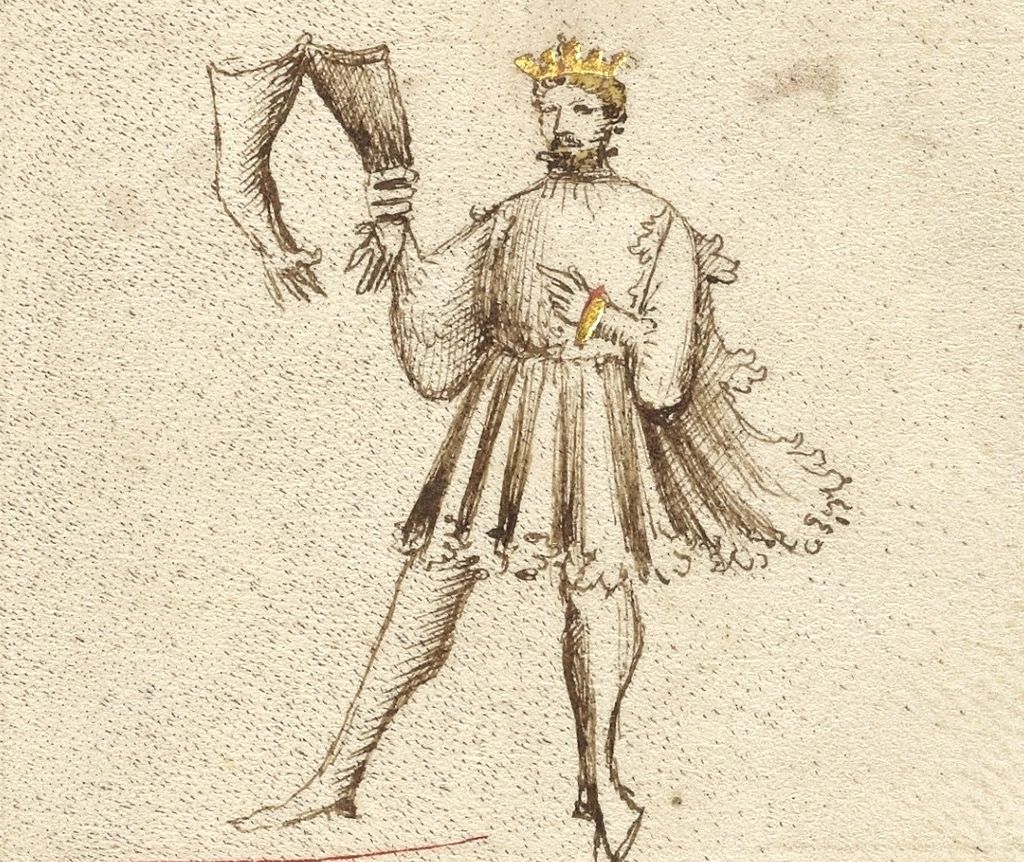
Marcelli ex

Someone can be fluent in Italian today and yet mistranslate a word because the meaning of that word has changed. Quick example from English, the word “doom.” We use this today to mean one’s fate often with a connotation that is negative. We might say “oh he’s doomed!” and mean that guy is in trouble—rarely do we use the same word when a friend gets a sweet new job and pay increase . Originally, however, Old English/Anglo-Saxon dōm, “doom” meant “judgment,” both in the sense of law and later, by extension, in a religious context of the Last Judgment, i.e. “Doomsday.” It is the nature of language to change, and while we might chafe at that, we need to know it when working with translations, especially of older works.

There are also different ways to translate something, and depending on how well it’s done, both can work. Some translators opt for as literal a translation as they can; others prefer a looser, but easier to read version. What you gravitate toward is up to you, but in either case make informed choices. It’s possible to make something work in English better and remain faithful to the original tongue, but it’s also possible to obscure meaning and confuse things if this is done poorly. A literal translation must be readable, which can be a challenge, but if too literal it fails— one “can” render sentence structure in some languages exactly as is, but if word-order runs counter to your own language’s word-order it’s a mess. There are values to each approach. If you’re lucky, you may find a literal and a looser translation of a single work. It means a lot of comparison, but you’re potentially getting a richer sense of what the original author intended (again provided the translators are good).

Historical & Social Context (any Applicable Context)

We ignore context at our peril. In historical fencing this is absolutely vital and too often ignored. I’ve touched on this before, so I’ll be brief here, but not all fencing works are equal. If your goal is to study Dutch maritime cutlass, then Roger Crosnier’s work on sabre and Roworth’s manual for broadsword are not the best place for you to go. [2] If you’re fighting on foot, you can learn a lot from a cavalry manual, but by definition sword meant for the saddle was stripped down to essentials, and armed only with that you will have trouble fencing those who’ve spent time on manuals for fighting on foot. This seems obvious, right? It isn’t. There are a lot of people in historical fencing using weapons too heavy for what they think they’re doing or misapplying other traditions to their favorite. It matters if the H in “HEMA” means anything to you.

Context invariably means having to read and study beyond the manual itself. This can be work, true, but it can be interesting work if you approach it right. It also pays to read the right stuff. There is a lot out there, and most bookstores carry what sells, not necessarily the latest word on subject X; libraries are similarly hobbled by finances and space. TV and the internet are a mixed bag—you’re more likely to find crap about Martians or Freemasons and “secret” knowledge than anything actually useful. So, be cautious, do a little homework, and apply the same basic detective questions to your outside reading: how credible is the author/researcher? What is their training? How well do they document their study? Do they provide examples, citations, and use decent research? Because we’re largely an amateur (again in the best sense) pursuit, we have a lot of people writing all sorts of things—not all of it is equally good, not all of it is well-reviewed or fact-checked before it’s shared.

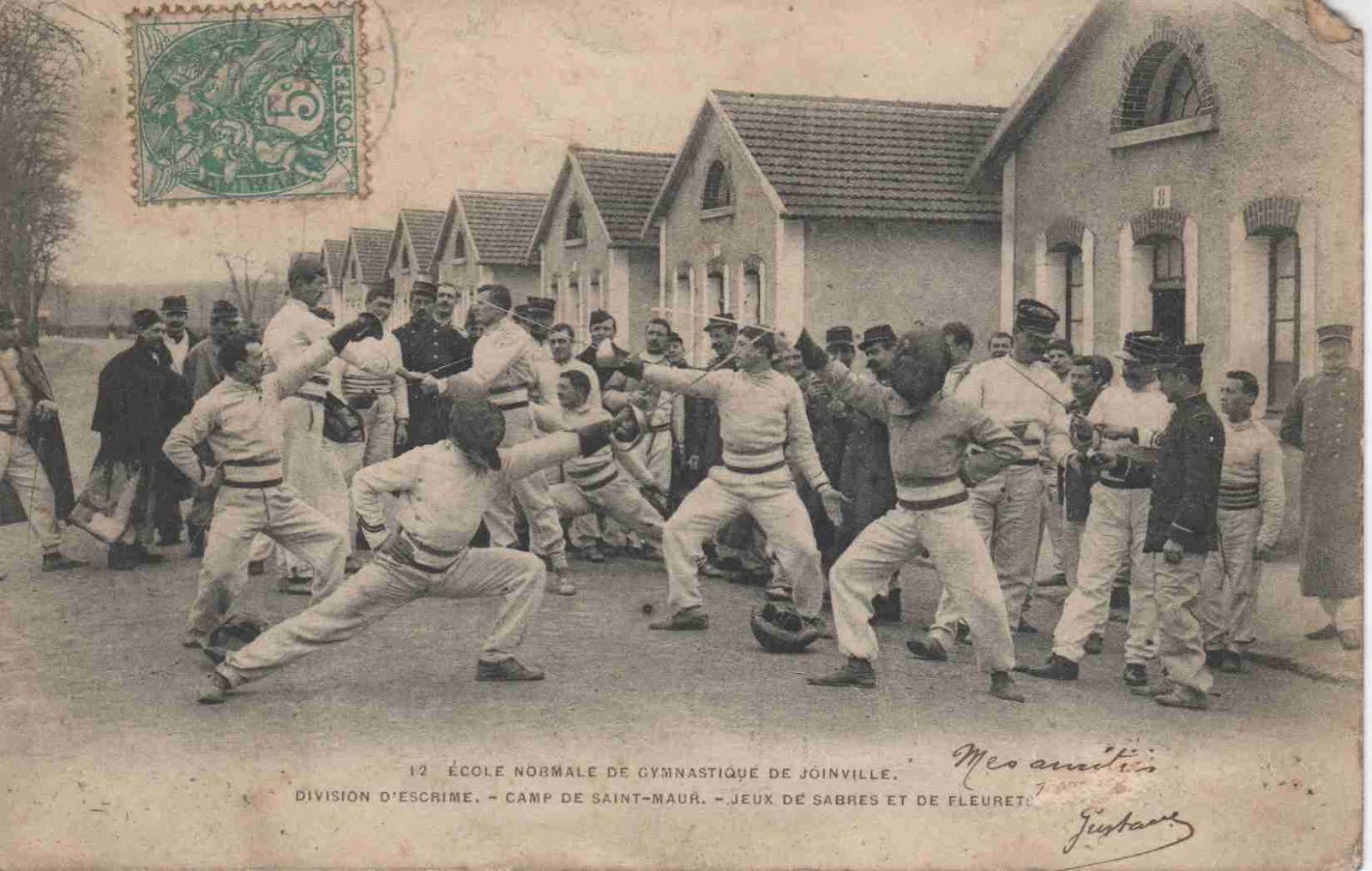
Joinville 2

Intended Audience

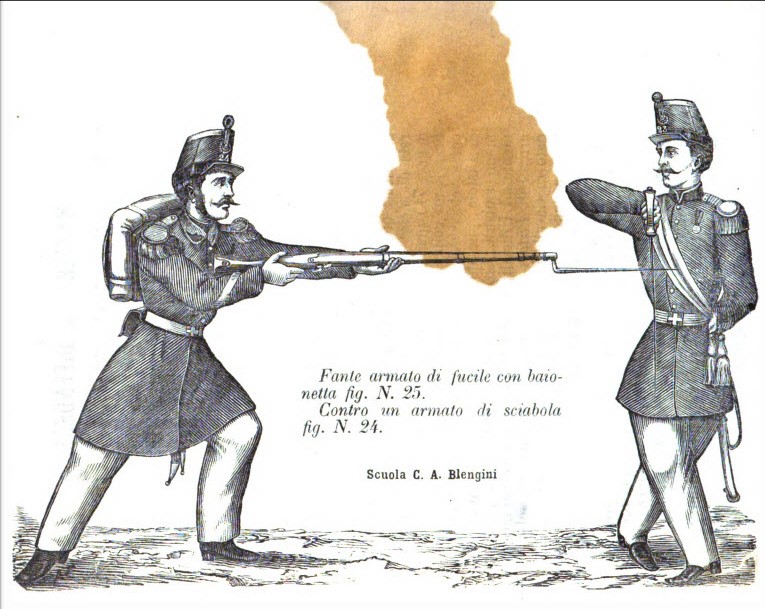
Is your chosen manual one meant for the military or civilians? What if anything does the author say about the purpose in writing it? A drill manual for infantry or cavalry will often have less detail than those written by the instructors training those same soldiers or troopers. Specific audiences often mean specialized vocabulary too. This can be difficult enough in one’s native language, so such jargon translated can be extra tricky. The titles of government officials are just one issue; often these authors assume their intended readers know the context, purpose, and lingo. Their original audience might have, but we don’t always know.

Even civilian works on fencing for civilians can assume  knowledge of fencing fundamentals that many within historical circles lack. Even for seasoned Olympic fencers some terms and ideas disappeared, so while they may know what a bind in foil is, they might not have heard the term croisé. One good example of this is the excellent The Art of the Sabre and Epee (1899; 1936) by Luigi Barbasetti—it’s clear he assumes the reader has at least a working knowledge of foil. Your author might too.

Other Issues

There is much that goes into assessing the value of a text. One issue we face with later fencing manuals, even some early ones, are editions of the same work. Some may be just a second print run, some may have changes. This is especially true with more popular works. For example, Charles Roworth’s The Art of Defence on Foot with the Broad Sword and Sabre was published in 1798, but so too was the second edition, and, with changes. There were later publications in 1804 and in 1824. The third edition (1804) has differences in the plates. So, if you are looking for “Roworth’s manual,” be aware that the copy made in New York in 1824 was a copy of the 1804, which is a little different from the first and second editions from 1798. [3] A more thorough student will want to see all four to see how they differ; they may want to read a bit about Roworth and his contemporaries, and his audience or audiences.

Ways of Reading

If you’re familiar with John Berger’s now somewhat dated Ways of Seeing (my edition, London: BBC/Penguin, 1982), you will understand this subtitle. We read in different ways, all the time, but are not always conscious we are doing it. Some works we read for retention, which requires one way of reading. Others we consult as we prepare a meal, fix a sink, or fence. Still others we read for the pleasure of reading, be it the art of language as expressed in poetry or the imaginative worlds in fiction. Some reading we chew, some we digest.

You can read a fencing manual like a novel, but you’re not likely to get much out of it in terms of its intended use. I read most of them cover to cover because it gives me a general sense of how the author organizes the topic, how they make sense of it, and I get a better sense not only of their views, but how their work fits into the big picture. That can be valuable. However, in preparing drills, or consulting a work to figure out all I can about a specific maneuver or action, I read it with more focus. Normally this means rereading the same passage several times. I might read several manuals for the same thing and compare them—this is easier for me as the Italian tradition has a lot of sabre manuals from ca. 1850 onward, but it may be possible for your tradition too.

What steps can help?

  • Read the page, passage, or line several times
  • Read it slowly
  • Read it again
  • List and look-up any terms that you don’t know or have questions about
  • Ask other fencers and researchers for help (if you’re stuck, message me and I’ll try to point you to helpful people)
  • If there are illustrations, compare what you read against them [4]
  • Try out what you read in space—if your weapon is close, great, if not, a pencil can work until you find a partner; be prepared to revise

MdHS

While this can be hard work, it gets easier; it’s worth the effort. Nothing ventured, nothing gained. Even the most experienced fencers stumble on some texts or some lines, and that’s okay—it can be a great opportunity to chat with knowledgeable people. If your interpretation doesn’t work, try again. If you’re still stuck, get help; with the internet this is a lot easier than it used to be.

Not all authors in the past were great writers (another issue, by the way, in translating), but even if the text is clear that doesn’t mean the topic is easy. Fencing is a highly technical art; there are a lot of moving pieces; and even the simplest thing, like moving forward, can be hard to describe or “unpack” from a particular author’s prose. Word-choice alone can change everything—witness for one example the battles over an “extended” vs. “extending” arm in foil during the late 1990s and early 2000s.

Practice in reading closely, slowly, and weighing the sentence, even individual words, can do a lot to assist you in making sense of your chosen texts. It can improve your knowledge of the work, deepen your appreciation for that branch of the Art, and help you improve. Each fencer is a student, and students need books. Fiore dei Liberi, in discussing his student Galeazzo de Mantova’s notion of the relationship between books and the Art wrote “without books, nobody can truly be a Master or student in this art. I, Fiore, agree with this: there is so much to this art that even the man with the keenest memory in the world will be unable to learn more than a fourth of it without books.” [5]

———-

[1] For brevity I’m only focusing on these three basic issues facing the reader. There are more. I’ve not prepared it yet, but I gave a talk last March covering some of these issues as regards medieval fight texts and will post that in time.

[2] A more general knowledge of the weapon and the variety of its use will do a lot to help you make sense of more specific, focused texts. Yes, this includes those written for “sport.” For Roworth, see note 4; for Crosnier, Fencing with the Sabre: Instruction and Technique, New York, NY: A.S. Barnes and Company, 1955.

[3] For a nice copy of the second edition, and a useful introduction to the text and its basic history, see Nick Thomas’s arrangement of the second edition; http://swordfight.uk/wp-content/uploads/2016/11/Art-of-Defence-on-Foot-Second-Edition.pdf

[4] Illustrations, just like the text, must be interpreted; there can be a one-to-one correspondence, but artistic conventions, style, skill, and a host of other factors can be at play as well.

[5] Fiore dei Liberi, Fiore de’ Liberi’s Fior di Battaglia, MS Getty Ludwig XV 13, translated by Tom Leoni, Rev. 4, Alexandria, VA: Lulu Press, 2009, 8.

Sabre with Rules, and, Without

Fencing Master (as Morgan Sheppard) 2
Morgan Sheppard, sword-master in “The Duellists”

There is this excellent scene in “The Duellists” (Ridley Scott, 1977) where the sword master, played by Morgan Sheppard, rushes upon the unprepared d’Hubert (played by Keith Carradine) during practice and says “On the watch, sir! Always on the watch… they don’t all fight like fine gentlemen.” A sword master like William Hobbs, who advised and choreographed the various duels in the film, no doubt knew well the reality of the duel—even with rules some people cheat. I’ve always loved this bit scene, because it reveals the reality behind what it takes to fight well (training), and, because it contains so much wisdom. It doesn’t hurt that it’s also packed with historical practice, e.g. duelists working out pre-duel with a master, an officer taking private instruction, a regimental master from the ranks as expert. The truth is that in fencing one must always be on the watch, can trust nothing, and assume nothing. We’re always safer assuming we face a superior opponent whether they prove so or not.

The traditional approach to teaching fencing, be it foil, spada, or sabre, assumes the duel, a battle between two people, on fixed ground, fought within the confines of rules. Even most longsword is taught this way at least as far as normally it’s approached one on one. There’s nothing wrong with that, but it’s important to remember, because off the dueling ground the experience could be quite different. In studying historical sabre, a weapon that draws greatly from military sources, we see a lot of overlap, but behind the fundamentals of footwork, attacks, parries, and drills is a context much different from that in most dueling codes. Sometimes we’re lucky and see glimpses of this in sources—Henry Angelo mentions several “grips” in the 1845 Infantry Sword Exercise; Rosaroll and Grisetti in the Science of Fencing (1803) list a number of similar maneuvers and their counters; Hutton too in his book The Swordsman explores those that Angelo must have read and that so far as I know go back at least as far as George Silver’s Brief Instructions upon my Paradoxes of Defense (1599).[i] A fencing instructor can teach technique; they can impart tactical reasoning and advice; but one thing they cannot do well is create the context of a fight outside of the duel.

Gladitoria MS_Germ.Quart.16_09v
Gladitoria, MS_Germ. Quart.16 09v

This is important. In historical circles more often than not fencers view the duel as somehow less worthy than a fight on a battlefield, despite the fact that most people actually train as if for a duel. In fairness, this bias really only affects the traditional three weapons and of those only sabre—no one says of Fiore, the Gladitoria, or works on rapier that the lists and Renaissance duels were less important. Why is that? Largely it’s bias against modern fencing—anything too “sporty” is immediately suspect. This is unfortunate, not only because so much of historical fencing pedagogy is borrowed from an Olympic context, but also because as far as competition is concerned, both “HEMA” and “Sport” fencing have more in common than either side is comfortable admitting. There is a lot of throwing out babies with bath-water when it comes to fencing tribalism.

Another, major factor is how difficult it is to create a battlefield scenario. Even small-squad tactics, fun as they are to play around with, often lack the surprises, set-backs, terrain, and chaos that so often attend such engagements historically. Being an agonistic vs. antagonistic endeavor we also lack fear. So, while we can train techniques, learn plays, and study tactics, we do so at an automatic disadvantage when it comes to how all these might have played out in the field. Many of the current venues that attempt this miss the mark—bohurt, for example, is plenty dangerous, but so far as I know no one is really trying to kill anyone or take and hold a position. I don’t wish to upset anyone, but as strong as these fighters are one sees less art than might.

I’ve argued elsewhere that one reason I think that the Italian military sources contain as much as they do was in a part because of the very real possibility that those reading it might be involved in a duel.[ii] Thus, officers needed to know more than what they’d likely need in actual combat. These manuals, however, had to work for rank and file, trooper as well as lieutenant, and so much of what we read there must have had practical applications on the battlefield too. While a solider might not find himself lunging a thrust or cut as he did in the sala or parade ground, what he acquired in learning to lunge were principles he could adapt to differences in terrain and situation. We do have some hints that regimental sword masters provided additional instruction too, often from their own practical experience.[iii] The surviving infantry manuals we have don’t often show one solider pitted against many, but we know they sometimes did; for example, Giuseppe Bolognini touches on this in his Sul Maneggio della Sciabola (1850).

Examining what is more appropriate for the dueling ground or battlefield within these manuals also begs the question—what isn’t gentlemanly? What is more appropriate or acceptable in war? Without rules one isn’t restricted, so pretty much anything you can imagine, like punching or shoving, as well as all the dirty tricks you can think of, from using terrain wisely to throwing dirt in their eyes, were possible. The grips, weapon-seizures, pommel strikes, punches with the bell-guard, and kicks while anathema in most duels were likely not only perfectly acceptable but preferable in war. This being the case, if we wish to train with these options how do we do so safely? Can we?

I believe we can, but with the caveat that safety must come first. By definition we are thus incompletely using the historical repertoire, but that’s okay. It’s important to appreciate this side of sabre, but being combat, life and death maneuvers, it makes sense we hold back. Students of Fiore dei Liberi, for example, are similarly hobbled—to use all that Fiore suggests we use in a fight would leave us without partners and very likely jail time. Even gaining minimal understanding of the options soldiers had will increase our appreciation for the weapon and its use.

The key to practicing these actions is to mix safety and control. Safety means an awareness that what we’re doing is dangerous and could hurt someone. Control means proceeding in such a way that we limit as much as possible the chance of injury. Not everyone has the control required to do this. If you’re sharing this with the inexperienced, I recommend moving at a snail’s pace. When I teach weapon seizures or the grips we start at slow speed, just going through the motions; there are only a few I typically teach and these have proved safe enough to do provided everyone behaves (and I work hard to ensure that). We speed the drill up as we go to instill a flavor of how these might have worked.

MS_Ludwig_XV_13_10r-b
MS Ludwig XV 13 10r-b (a.k.a. The Getty)

For those familiar with grappling from older works, especially medieval fight manuals, wrestling was the foundation for most everything. It makes sense—even disarmed one needs to be able to fight. My friends and colleagues locally who train Armizare and KdF are good examples for how to approach these potentially dangerous actions. The ligadure (It. “binds”) of Fiore, for example, could easily lead to a broken arm, elbow, or dislocated shoulder, so instructors like Mike Cherba and Alex Spreier take students through these moves slowly; even at “speed” the students slow down once the blades have made contact. Focus is on technique and timing. Because this is a partner drill the person turned into a pretzel is compliant; certainly this makes it easier but proficiency is gained through repetition, attention to detail, and making the maneuver, in time, as naturally as possible, not from fully performing the action as written. We do not have the “on the job training” that Fiore and his students did—in their case, this stuff either worked or they were hurt or killed. A lifetime of successful combat, especially against opponents less well-trained no doubt made skilled fighters formidable.

As an example for sabre, I’ll cover the “first grip” as shared by George Silver, Henry Angelo, and Alfred Hutton. Of note, this same maneuver is recommended in a number of bayonet texts. In this action, the attacker makes an attack at the left side of the opponent. Parrying in prima, the defender reaches under their own weapon and seizes the guard or wrist of the attacker and pulls them down and to the left—from here one can deliver a pommel strike, punch, and then cut or stab them after that.[iv] It’s a difficult maneuver to perform at speed, and from experience the seizure can become more of a check to the hand, but so long as one is quick with the follow-up blow it works pretty well.

Blengini, Trattato teorico-pratico di spada e sciabola e varie parate di quest’ultima contro la baionetta e la lancia

The first step I have them do is to practice oblique cuts at the left side of the head while the other parries in prima. Then they switch. Next, they take this move one step further—they parry the blow, step forward with the left-leg, passing the right as they reach under the parry to grab the guard or wrist. When they’re comfortable, I then have them deliver a tap to the mask as pommel strike (some stop short of the tap, which is fine). Lastly, they add a cut or thrust, e.g. a cut down the body from the attacker’s right shoulder to the left hip, and with the back edge of the sabre tip cut the back of the knee on the way back from that initial cut. Another option, if you have mats, is to take them to the floor after the pommel strike. We then go through the defense and grip for the right side (two versions), and follow up with the “Turkish disarm” or similar.

While no one is really punching, kicking, pommeling, or throwing dirt in anyone’s eyes, just moving through the grips can provide students a sense of sabre’s more rough and tumble side. This is usually material wholly unfamiliar to many students, and, it’s fun to learn! A further advantage to these exercises is that some, like that first grip, show up in a number of ways, not only for sword but as defense against bayonet. For students of “military” sabre some experience with the uglier side of the weapon can impart a deeper appreciation for the role the weapon played, for its use in the thick of things, but also for the ways in which traditional technique and combat intersected. Lacking as we do ideal sources for just how these formal techniques were adapted for war, such as a regimental sword master’s diary, we have to work with what we have, and, extrapolate the rest.[v] Any such experiment of course can, at best, reach what was possible, not necessarily what was actually done. This is unfortunate, but even in exploring what was possible we learn, sometimes ruling things out, but sometimes gaining insights we didn’t have before and so it’s worth it. It doesn’t hurt that it’s fun research to do either!


[i] See Henry Angelo, Infantry Sword Exercise (1845), 36ff; Rosaroll & Grisetti, The Science of Fencing, Milano: 1803, translated by Christopher A. Holzman, 2018, pages 219-236; Alfred Hutton, The Swordsman: A Manual of Fence and the Defense against an Uncivilized Enemy (1898), reprint by The Naval and Military Press in Association with the Royal Armouries, Leeds, 2009, 127ff; George Silver, Brief Instructions Upon My Paradoxes of Defence, 1599, Ch. 6, “The mannr of Certaine gryps & Closes to be used at yr single short sword fight Etc,” in James L. Jackson, Three Elizabethan Fencing Manuals, New York: Scholar’s Facsimiles and Reprints, 1972, 601ff.

[ii] See on this site, “‘Dueling’ or ‘Military’ Sabre?” May 16, 2019.

[iii] By the late 19th cen. sword combat outside colonial contexts was increasingly restricted to cavalry engagements. By its nature mounted sabre is more rudimentary; protecting one’s mount, delivering most attacks to right or left or just to either side of the horse’s head, and simple parries that might work best against sabre, lance, or bayonet require ample practice but much less technical know-how than the more complicated actions one might need on foot. It is also telling that regimental sword masters, some of whom must have been seasoned veterans, were responsible for teaching soldiers and troopers any additional “tricks” and skills they might need. See for just two examples Henry Angelo, Infantry Sword Exercise (1845), page 37, last paragraph; see also the Italian Ministry of War’s 1873 Regulations of Exercises and Evolutions for the Cavalry, Book I, trans. by Christopher A. Holzman, 2018,  70; 100.

[iv] See for example Cesare Alberto Blengini, Trattato della Modenra Scherma Italiana, Bolonga: Tipi Fava e Garagnani al Progresso, 1864, 78ff. Against rifle and bayonet this is a slightly easier grip to achieve.

[v] There are some anecdotal accounts that help inform us too. For one valuable collection of these J. Christoph Amberger’s The Secret History of the Sword: Adventures in Ancient Martial Arts, 1998, contains several such recollections, cf. “Battle Scenes from Balaclava” (p. 21) and “The Seduction of Art: Cut vs. Thrust in Military Swordplay” (33) contains several anecdotal snippets. This book can now be found online here [https://fencingclassics.files.wordpress.com/2015/01/the-secret-history-of-the-sword.pdf].

Rev. of Chris Holzman’s translation of Marcelli’s _Regole della Scherma_ (1686)

Marcelli, Francesco. The Rule of Fencing. Translated by Christopher A. Holzman. Wichita, KS: Lulu Press, 2019. Originally published, Rome: The Press of Domenico Antonio Ercole, 1686. 520pp. ISBN 978-0-359-71908-2. HC $42; Pb $32.99.

Francesco Marcelli’s Regole della Scherma (Rule of Fencing), published in 1686, is arguably one of the most important fencing treatises in the Italian tradition. On the one hand, it’s one of the core works on Neapolitan fencing, not only in terms of how thoroughly Marcelli explains the particularities of the southern school, but also as a book which retained its significance far after the author’s time. His influence is obvious from Terracusa e Ventura’s True Neapolitan Fencing (1725) to Rosaroll and Grisetti’s The Science of Fencing (1803), and even down to Masiello’s Italian Fencing (1887).

Francesco Marcelli was one of several masters within this tradition who codified the art of the Neapolitan school. There are differences between these authors, and it’s clear there were serious rivalries. Pallavicini, for example, refers to Francesco Mattei as a “modern” master, but receives a few barbs from Marcelli in turn. Their differences notwithstanding they have more in common than not and have long been considered proponents of the same regional style.

In some ways Rule of Fencing bridges older models of fencing manuals with those which came after—like earlier works, say by Marozzo, Marcelli covers additional weapons of his time (rapier, smallsword, dagger, and sabre), but the specificity and thoroughness of his system, while often peppered with Classical allusions or extended metaphors, reads more like works of the 19th and early 20th century. This holds true both in outline and precision. Marcelli’s coverage even includes discussions of terrain, fighting at night (with and without a lantern), and what it takes to be a good instructor.

Chris Holzman, as Tom Leoni, the author of the forward and a distinguished translator in his own right, remarks, is ideally suited to tackle the monumental task of translating Marcelli for an English audience. Where his training and deep knowledge of Italian fencing opens up the material, Chris’ language ability and sensitivity to nuances in Italian allow him to unpack the author. Rule of Fencing is not an easy read. Marcelli assumes a familiarity with Classical authors and fencing masters that few contemporary readers possess. His prose is complex, it’s fancy, and much of it expressed in a grammatical mood that doesn’t work well in English.

Chris’ approach here, as indeed in all of his translations, seeks to provide as much of the author’s ideas, language, and expression as possible. Keeping as best he can to what the original writer wrote is difficult, and can ring a little oddly in modern ears, but the advantage of Chris’ method is that he gives the reader a closer approximation of the original, and, with far less chance of the translator’s ideas creeping in. It is always clear if and when Chris’ voice interjects—this is important for anyone keen to keep clear what is Marcelli, and what is not. To assist us further there are notes, a short overview of the context in which Marcelli wrote, and brief explanations of the guard positions, Marcelli’s take on targeting lines (e.g. what he means by inside line), and less common terms such as the “scommosa.”

As important as Marcelli’s Rule of Fencing is for students of Italian fencing, it is equally important for any fencer truly interested in the concepts of the Art. Devotees of rapier will have more to chew on than most, but any fencer, Olympic or Classical, historical or SCAdian, will appreciate the degree of specificity, the completeness of Marcelli’s presentation, and the author’s use of illustrations. The connection between Neapolitan and Sicilian fencing with that of Spain is here, as it is in Pallavicini, everywhere evident, so students of destreza have yet another work to consider that touches on their own focus. Marcelli cites a number of earlier and contemporary Italian masters as well, opening a valuable window into how early modern masters looked back at their own, and other, fencing traditions and sources.

Perhaps one of the most valuable features of the Rule of Fencing is the way in which Marcelli breaks down complex ideas. As a quick example, in Ch. VI of Book I, Marcelli treats tempo. He starts with a short statement about when a student should learn it and why, then explores what other authors have said, from de Carranza to Alfieri, and finally provides his own insights into this core universal of fencing. There is a lot there to consider, and this is as true of Marcelli’s notions of universals (timing, distance, judgment) as it is in his explorations of particular techniques, their application, and the various contingencies that arise between fencers of different temperament and skill.

If you buy one book on rapier, or one book on Italian fencing, or even one book on fencing theory and application, let it be this one. One can and will return to it again and again, for there is more to mine here, to consider, to attempt within one’s own training than in most other works. You needn’t be a rapier fencer to benefit—there is something here, a lot of somethings, for every fencer.

JBT Emmons

Sala delle Tre Spade

Trust & Partner Drills

Badminton 1893Drill is a mainstay of fencing. We do footwork. We practice point control. We make molinelli in the air and at a target. We (should) be doing a lot of drill. In historical fencing we sometimes devise or find ourselves doing drills that are new, concocted out of our source material, and it’s a fair question to ask what might be signs that a drill isn’t up to par or might even be dangerous? What does it take for a drill to be “safe” when we’re talking about hitting people with weapons? Different types of partner drills require different levels of complexity, intensity, and safety-gear. The instructor has primary responsibility for introducing safe drills and monitoring how fighters are managing safety, but there’s an equally heavy burden on fencers performing the drill. They need to exhibit proper control and courtesy or they’ll injure their comrades and injured comrades mean fewer people to fence with.
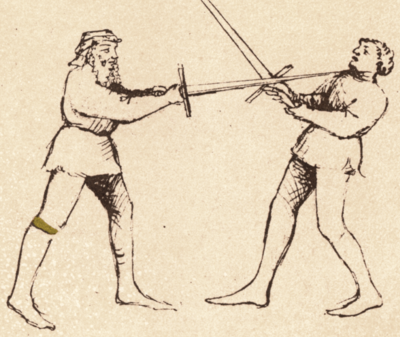
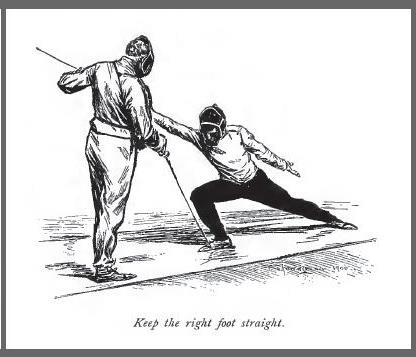
On the instructor side, it’s often a balance between imparting what a particular skill or play requires and safety. Teaching longsword and sabre, for example, requires modulating what safety means. If one is teaching Fiore dei Liberi’s Armizare, a combat system designed to main and murder people, either in the lists or in the field, then one must be more vigilant in some ways than when teaching sabre. Most if not all of Fiore’s techniques must be modified to make them safe and some of them one can never do at full speed save perhaps in armor (and sometimes not even then). Teaching a sabre class, in comparison, makes for an easier balance of technique and safety. The relative weight, flex, and delivery of the thrust in sabre, though deadly with sharps and in earnest, is likely to do little more than bruise someone, especially if they’re wearing proper protective gear. With a stout jacket, one is rarely marked at all. This is often not the case when thrusting with a longsword—there is more power generation, more mass, and more surface area to the weapon. One thrust against the mask with either weapon will demonstrate the difference. Each weapon was meant to do harm in different ways, in different contexts. Assuming the exact same safety requirements is dangerous–fencing masks, good as they are, were not designed for longsword.

An instructor must understand the dangers inherent in a drill and modify it when and as necessary. This is the first step. The second is monitoring a class to make sure that fencers aren’t doing anything to nullify that modification. There’s no room for leniency with this—if any fencer is acting in an unsafe way they either fix it or one pulls them out of the drill. In some cases the drill itself needs further refining. Safety gear, good as it is, is only a fail-safe, an additional layer after one’s technique fails. No mask, jacket, glove, or pad will make you invincible and it’s stupid to proceed as if they will.

The same heavy burden for safety is shared by the fencers executing the drill. Drills can be complicated and applying sufficient oomph to the play with the control required to ensure no one is hurt is a tough skill to learn. Not everyone, in fact, learns it. I’ve seen experienced fencers fail to exercise control in drills; I’ve seen them fail to pull a blow that had clearly gone wrong. No one should have to “Fence for Two”—it’s the responsibility of both drill partners to proceed in such a way that both fencers are as safe as they can be.

There are several attitudes and skills one needs to cultivate to be the sort of person people want to drill with:

Courtesy: It’s important to be a courteous partner, not just in the sense of polite salutes, hand-shakes, or the blade-smack to the butt or thigh a la American football, but most importantly in the sense of the Golden Rule. Do you want to be injured? Do you want to be fearful of working with someone? Of course not, no one does. Work to be a safe partner and you help everyone, yourself included.

Control: Control is the marriage of skill and awareness. It takes a long time to develop. It means having a full understanding of each move, its direction, intensity, and target, as well as the ability to modulate any of the three at will. It’s a hard-won but crucial skill that requires hours, weeks, months, and years of hard work, drill, and patience to develop. Never stop working to achieve it. Control is not fool-proof, however, as everyone can and will misjudge from time to time. However, once you have it, people will want to drill with you because they know you’re safe and can help them learn whatever technique it is you’re all working on. You will learn more too because you’re both comfortable.

Competence: A certain degree of skill, of the ability to use the weapon, is always to be desired. For beginners naturally this is not necessarily there, but it will develop over time and provided one puts in the time. Within historical fencing there is, unfortunately, this general sense that one can just “dive in” and become proficient. This is not true. Being aggressive and suicidal doesn’t make one a good fighter—have the patience and smarts to do it right first, to put in the time, to learn enough to make actual bouts worth your time. The truth is that those who just jump in do so because it’s fun, and it is, there is no arguing with that, but too often the goal is simply to win, not to learn, and bouts—like drills—are another learning opportunity. As ever, if your ego is driving you, if you’re relying on speed, strength, brutality, etc. alone, you’re never going to get very far, and moreover a lot of good people, better fencers who could help you improve, will avoid you. At my age, I don’t have time for macho b.s. and have no qualms refusing to fight people who don’t have the requisite skill or control. I have old injuries enough to deal with and I don’t care for more.

Consistency: Emerson’s ideas of a foolish consistency being the hobgoblin of little minds holds in fencing as elsewhere, so it’s important to be consistent in the right ways. First, developing the ability to perform the same action correctly and pretty much the same way each time is important. Likewise, the capacity to perform the same action in the same tempo or from a standard distance is helpful. Much of this comes down to practice, but a lot comes down to focus and awareness too. Staying zeroed in on the drill, its purpose, what you need to do to do it successfully seems obvious, but a lot of people sort of go through the motions, especially if it’s a drill they’ve done multiple times. Even the oldest, most basic drill remains useful if approached correctly.

These attitudes and skills work best where there is sufficient trust. When it comes to safety and a successful drill trust is at the very heart of it. Some time ago, in an Armizare practice, I saw a student, one with considerable skill for someone her age, break a drill out of fear. She knew how to do the drill; she knew what the instructor wanted her and her partner to do; but she didn’t trust her partner. In this drill, when she made a mandritto fendente as the initial attack, the defender was to counter by striking into it with bicornu—done right bicornu effectively takes the center-line and breaks the attack.Pisani-Dossi MS 19b-b

What she did was modulate her attack—if her opponent was likely to break her cut, she pulled and beat instead so as not to get spiked in the face. I spoke with her afterward during a break and it was clear she felt awful; in her mind she had messed up. I told her that, actually, she had demonstrated considerable skill in reading her opponent and adjusting things to keep herself safe. These are not bad things. She was just fencing for two because she didn’t want to get hurt. However, it also meant that the drill had failed. There are multiple sadnesses there: first, this dedicated, hard-working student learned less than she might have, as did her partner; second, this drill was a good one, but like anything it required trust to succeed; and lastly, a capable, skilled student left that drill feeling she had failed, when in fact, she had not. Trust is everything. Without it, nothing works or at least it won’t work as well.

Actively cultivating courtesy, control, competence, and consistency will do a lot to dispel fear, because on the one hand it helps train one to do things more effectively, but on the other it also alerts one’s classmates that one is a team-player, that they have your best interest at heart. It helps build trust, and when you’re playing with swords, even blunt ones, you need that. Students who don’t feel safe, who in fact aren’t safe, aren’t going to stay long, and that is a net loss for all of us.


First image, “Parry in Seconde,” from The Badminton Library of Sports and Pastimes,  Walter H. Pollock, E. B. Michell, and Walter Armstrong,  London: 1893.

Second image, sword in two hands, zogho largo/wide play, play of the first master, Pisani-Dossi MS 19b-b.

Fencing Drills and Artificiality

deB3

One question I’m asked about drills is to what degree they’re artificial, how they might set up ideal or unlikely scenarios. A related question concerns whether or not there’s a danger in having partners take turns making actions poorly, say in a stop-cut drill. Taking this last question first the answer is “no” if an instructor is on their game. Students, especially in their early training, shouldn’t be drilling poor actions. Conventional wisdom and practice demonstrate that the instructor should be the one exposing their arm for stop-cuts, holding a poor guard, or making any other action defectively. The question about artificiality, however, requires a longer answer.

In classical and historical fencing our concern is to fence as if the blades are sharp, to hit and not be hit, and so when a drill brings in maneuvers or plays that seem to defy this ethos it’s only natural to wonder about their value. Students often have assumptions about the nature of drill that informs this perspective, and some of those assumptions are incorrect.

There are different kinds of drills. Some we do solo, such as footwork drills or cutting against a pell, mask, or fencing Oscar.[i] Some we do with a partner. Others we do with an entire class. While “don’t be hit” and “hit and don’t be hit” are our guiding principles, applying these notions to every sort of drill, and each aspect of it, is reductionist and can blind students to the value of a drill. All study, drill included, should result in a style and method of fighting that illustrates this guiding principle. However, not every drill or part of a drill need conform to this absolutely all the time.

For a quick example from sabre, let’s examine two maneuvers, the first being a common compound attack, feint-cut head, draw the opponent’s parry of 5th, and cut flank or chest; the second being the riposte to the flank from 5th. Looking at the feint attack first, for it to work each partner has to act a certain way. The attacker must simultaneously work a key offensive action, the feint-cut, with a ton of technical movements designed to make that same attack effectively. The instructor or partner on the receiving end, the defender, must do the same; they must recognize and defeat the feint, and parry.[ii]

In the case of the instructor, and you often see this in their posture, they’re not necessarily mirroring exactly what an opponent would do, but performing those parts that will help the attacker succeed in the drill. If the feint is unconvincing, for instance, the instructor won’t parry and might counter depending on what they’re working and how advanced the student is. Judging a student’s readiness to go beyond a simple drill to a more complex version is one of the more difficult tasks an instructor faces—so much depends upon correct assessment.[iii]

In comparison to the instructor, the case of the partner is more complex. On the one hand, they need to help the attacker, just as the attacker will help them when they switch roles, but on the other they shouldn’t be fencing in such a way that the result is poor technique or tactically dubious choices.

Ideally, each partner is doing their best to make their half, offense or defense, work. The defending partner should use this opportunity to work on parries, specifically reacting to the cut to the head. For the basic set-up, this might be the goal in addition to gauging measure, working the feet, and maintaining the correct posture and hand/arm positions. One step deeper, however, the defender might have other options—they might for example, attempt to parry the actual cut after defeating the feint and then riposte. Drills usually start simply and develop into these more complex, multiple action versions as students advance in skill.

So far none of this is “artificial,” but one thing students have asked me about is the danger inherent in making that flank cut after the feint. Having drawn the defender’s arm up into 5th, the defender’s arm is then poised over the attacker making it possible to cut down onto the head. Isn’t that dangerous, they ask. In a word, no, because the defender should be worried about the fact that they’re about to be cut in the flank. Many fencers, because there is no actual danger decide to attempt a counter as, or just after, they’ve been hit rather than parry. This brings up an important aspect of fencing too deep to go into here, namely the priority of the touch, but for our purposes here is making this kind of attack artificial? Is it safe to assume that the defender will just accept the touch and not counter?

If one is fencing as if they’re sharp, then one should never assume anything, but at all times attempt to cover oneself. One solution is to add a side-step with the cut to the flank. Assuming a right-hander, the attacker can extend the arm to make the final cut and lunge a bit to the left by extending the back leg out and to the left after or as the front foot lands. This does two things: first, it removes one’s head from being just under the opponent’s weapon, and two, it gives one just enough measure to cover in 5th or 3rd after the cut in case of counter-attack. This makes more sense after making the feint to head first, because from 5th the defender may still be able to retreat and make a molinello to the head.

On the other hand, for the fencer riposting from 5th to the head, our second example, things change a little—the riposte, having been parried, has lost its momentum, so the fencer riposting to the flank has less to fear from the blade over them. The fencer whose head cut failed now has a choice before them—they can drop the blade on their opponent’s head, which remember has no momentum, or, they can consider that fully developed cut speeding its way to their flank. This is a simple choice if we apply the “fence as if they’re sharp” rubric—the partner with the unsuccessful cut to the head should be considering how they are going to parry that incoming cut. Whatever damage dropping the blade on the attacker’s head might do, it’s likely going to be much less than a fully developed cut to the flank.

The greatest danger of artificiality here is not in failing to account for that blade poised above one’s head, but in forgetting to behave as if both blades are sharp. When we forget that, we too often make actions we would never make (one hopes) were we fighting in earnest. But, if we cultivate the notion that the blades are “sharp,” then we’re more likely to make better decisions; in the example above, as the defender we’re more likely to worry about not getting hit and thus parry rather than go for a counter that will only mean both fencers are hit.

Ideally, the only “artificial” aspect of drill should be our cultivated sense of danger. No drill is worth the name which trains poor technique or tactics. This is especially true with partner drills. There is an inherent argument here, namely that instructors ought to be the only ones to present examples of poor technique. However, this is no less dangerous for them, so it behooves every instructor to continue to take lessons, to remain a student, so that they may not include pedagogical tools like an open line or exposed arm in their own assaults.


[i] This is what we called them, but there are probably other names—an “Oscar” is a mock opponent, often set up on a wooden frame, covered with jacket or similar material, a mask, and often with an adjustable arm to shift a blade to different positions.

[ii] This will vary with the level of the fencer. An instructor or senior student might not defend as effectively if focusing on a newer student learning this attack.

[iii] In his Fencing Illustrated (1670), Ch. XIV, Giuseppe Morsicato Pallavicini discusses this very issue. The first bout a student has should be with the instructor. Even when assigning a new student to work with a more experienced one Pallavicini tells us that the instructor must supervise them. See Giuseppe Moriscato Pallavicini, Fencing Illustrated, Trans. by Christopher A. Holzman, Wichita, KS: Lulu Press, 2018, 91-98.