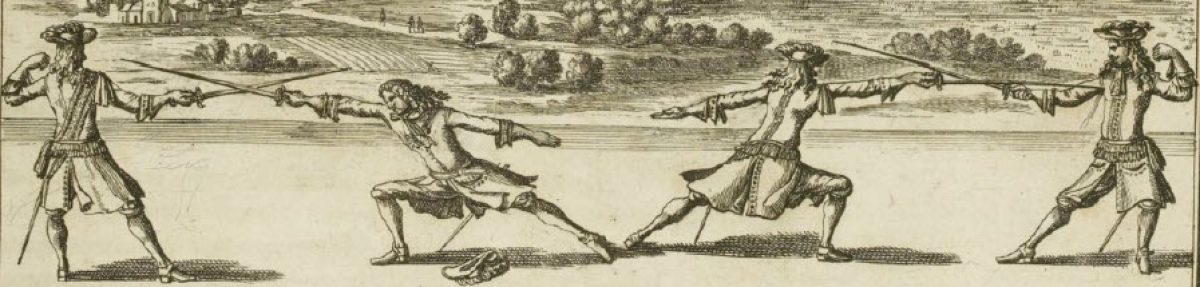
The excellent Carlo Parisi shared a new video, one in which he takes an unkind comment on some recent bouting footage he shared, and makes it a teachable moment. This is what scholar and gentiluomo do. Well done Carlo.
Tag: History of Fencing
More Marcelli!
My friend Patrick Bratton recently had Maestro Francesco Loda and Silvia Tomasetti over to teach. Loda has been studying Marcelli, among other works, for a long time and is one of the leading researchers into his system. Enjoy!
Marcelli’s Annervated Lunge Revisited
[NB: this is an updated look at this lunge, one that begins where this one left off: https://saladellatrespade.com/2021/11/09/a-note-on-francesco-marcellis-stoccata-annervata/]

On occasion someone will share a video or the like with me and I’m reminded just how difficult it is interpreting historical fencing treatises. In the last few days I’ve had a chance to chat with a few other instructors about a popular interpretation of Saviolo’s system as well as a new video purportedly covering Marcelli. [1] There were many threads in our discussion, but the thing that kept sticking in mind was the Marcelli video. I spend a good part of my week on that master’s text, Rules of Fencing (1686), and despite the qualifications of the instructor sharing that video I saw several things that stood out to me as features of more recent fencing versus what Marcelli taught.
As a caveat, I have a lot of respect for Maestro and Maestra Coblentz, and the student in the video, Justin, clearly has solid training, but I take a different view on Marcelli and think it’s important enough to share. Naturally, if there is something I’ve missed or concluded incorrectly, I invite them to chat and demonstrate how I’ve erred. It’s never my intention with posts like this to attack anyone personally—that sort of thing is nonsensical, unnecessary, and unhelpful. However, as someone who focuses closely on Neapolitan rapier and teaches it, I feel obligated to point out a few things in the video that don’t seem to match what Marcelli taught.
To be clear: what I am evaluating are aspects of their interpretation based on a close reading of the text, both as a fencer and someone trained to read historical texts. Anyone who shares an interpretation is opening the field to evaluation, but there is also a condition on the critic (in this case me) too—they should be fair, back up any criticism, and stay on topic. In what follows I will cover only a few things that stood out to me, because they are critical to understanding Marcelli’s system, and attempt to demonstrate these conclusions with textual support.
Lunge vs. Annervated Lunge
Some months ago I had a post on this stoccata annervata as it’s foreign to most people and difficult to adopt if one is used to the better known lunge. [2] It is not a lunge the way we normally conceive of it. This annervated lunge is used only with rapier and dagger—one doesn’t use it when fencing with rapier alone. The genius of it is that it allows one to extend the point while still maintaining defense, something the longer lunge does not do as well with the pairing of rapier and dagger. The annervated lunge is less a lunge than it is an unwinding—the weapon and arm are propelled by unwinding the torso, not by pushing off the back leg (something Maestro Coblentz makes clear in the video). This is how Chris Holzman and Patrick Bratton explained it to me too when I first started working on the Neapolitan school a few years ago.
If one has fought with rapier and dagger, and importantly with the mindset that one cannot be hit, then the value of that pairing should be not only be obvious, but also attractive. It layers defense and makes an attack all the more dangerous. It is, as my fellow rapier enthusiast Ken Jay remarks frequently, a game-changer. In order for the pair to work one cannot stand in guard as one does sword alone: a dagger, buckler, cloak, etc. does little good if it’s behind us. Thus, the body is more square to the front—we can face someone head on because the dagger is there to aid defense. To lunge out with the trunk still squared would be both short and easy to see, so the solution, a brilliant one, is to twist the body back toward profile and shoot the blade and arm out to target. One can thus reach a little farther but with minimal exposure.
Key to this is the front leg: it remains straight. Unlike the lunge most people know, where the knee is over the heel, calf perpendicular to the ground upon completion, the annervated lunge makes a short step and lands leg straight. Proper use of measure is what determines when to make the lunge, and it is a different measure than when lunging in profile. It’s not an annervated lunge if one is landing as one does today.
In the video, the offhand and dagger are swung dramatically back as the Maestro Coblentz and his student, Julian, lunge. On the surface this appears very much like the image in Bk I, Part II, Ch. V, p. 15, figure 4:

However, what Marcelli explains about this image reveals important information for the feet:
All the movements that I have proposed to be made in performing the thrust are seen marked with the numbers in the present illustration. The number 1 signifies that the aforesaid Cavaliere has started the sword hand first. The number 2, marked near the left knee, denotes that after having brought the hand forward he has violently extended that knee, which was bent. The number 3 that stands at the right foot indicates that it was the third movement of the body, and that after having advanced the hand and extended the knee he has advanced the foot, which is the last movement, because it has to do the least travel of all.
Tutti i moti, che hò proposto da farsi nel tirar la Stoccata, si veggono segnati co’i numeri nella presente figura; dove il nu. 1 significa, che il sopradetto Caval. hà partito prima la mano della spada. Il num. 2., segnato vicino il ginocchio sinistro, dinota, che doppo haver anticipate la mano, hà disteso con violenza quel ginocchio, che stave piegato. Il num. 3., che stà nel pie destro, signitica, che quello e stato il terzo moto del corpo; e doppo haver caminato la mano, & annervato il ginocchio, ha caminato il piede, il quale e l’ultimo moto, perche hà da far camino meno di tutti. [3]
Note that number 3 in the image does not pertain to the dagger, but to the right leg:
number 3 that stands at the right foot indicates that it was the third movement of the body, and that after having advanced the hand and extended the knee he has advanced the foot, which is the last movement, because it has to do the least travel of all.
How does one reconcile this information with the image? One option, and presumably what Maestro Coblentz has concluded, is that since the dagger is shown to the rear in the image, one should do the same upon the lunge. For reasons I have shared ad nauseum on this site I am cautious with images—they can be helpful, but must always be read against the text. Nothing in this passage suggests one should remove the dagger to a position where it can do little good, and if one lunges along more modern lines that is what happens—the dagger is too far back to be of any real use. In the annervated version, however, because it’s shorter, the dagger is easier to bring back into play should it be needed. [4] As shown in the video, the dagger arm is doing the right thing, but the feet are not.
Mezzaluna & Dagger Placement
In similar vein, Marcelli was clear on his expectations for the dagger while on guard. He writes
In all these methods of standing on guard it must be advised to keep the dagger strongly closed in the hand…the dagger arm must stand strong, extended, and annervated, because it must use force and not lightness in defending from all blows that are violently performed by the opponent.
In tutti cotesti Modi di stare in Guardia si deve avvertire à tenere fortemente stretto il pugnale in mano…mà il braccio del pugnale deve start forte, disteso, & annervato, perche deve usar forza, e non leggierezza, nel difendersi da tutti i colpi, che violentemente li sono tirarti dal nemico. [5]
We see this with all four guards, but especially the one I believe they are trying to use in the video, mezzaluna.
Marcelli says that the guard of mezzaluna (fig. 1 in the image below) has one
Extending the foot forward along the straight line meeting the rear foot, and bending the left knee, with the torso counterweighted on this foot, keeping the right knee extended, the right foot metting the opponent, and the rear foot oblique… the sword arm is withdrawn to the rear, with the hand near the pocket. He carries his dagger forward covering all the upper parts in such a way that the opponent only sees the chest below the dagger as target to strike. He cannot wound him in another part than this, and therefore it is called the guard below the weapons.
cioè, stendendo il piede avanti per linea retta incontro al piè di dietro, e piegando il ginocchio sinistro con la vita contrapesata sù questo piede, mantiene il ginocchio destroy disteso, il piè dritto incontro al nemico, e’l pie di dietro per traverso; e ritirando il braccio della Spada a dietro, con la mano vicino la saccoccia, hà portato il Pugnale avanti, coprendosi tutte le parti superiori, di modo che il nemico vedesolo per bersaglio da colpire il petto per le parti do sotto il Pugnale, nè può ferire in altra parte che in questa, e percio si chima Guardia sotto l’armi. [6]
Here, as with the image before, we have a discrepancy between the image and what Marcelli says of it:

In the image, Figure 1 has a clear gap between the weapons in direct contradiction of what Marcelli describes in the passage explaining it. Recall that
He carries his dagger forward covering all the upper parts in such a way that the opponent only sees the chest below the dagger as target to strike. He cannot wound him in another part than this.
Marcelli makes it clear that there is no middle passage to the chest. One can only attack in the low line.
For corroborating evidence we have the testimony of another Neapolitan master, Nicola Terracusa e Ventura, who in True Neapolitan Fencing (1725) claims that this guard is called “half moon” because the tips of the weapons form that shape, that is, are in contact. [7] If both masters are adamant that one can only attack below it, then there cannot be a gap between the sword and dagger. That would open a line in addition to the low line.
Closing the Line: Lesson and Reality
In one portion of the lesson (1:32), Maestro Coblentz has Justin hit him, again with a normal lunge, and then extends to hit him indicating that the student had left the line open. As set up, it’s true that Justin is open because he’s still in the lunge, however nothing, so far I can tell, cued Justin to know that an after-blow was likely. So far as I can tell the master has instructed the student to strike without the expectation that the instructor will parry or counter.
It’s important to note that there are many times, most even, when the instructor allows the student to hit them; in most ways the instructor is a willing target. But throwing a counter or after-blow into the mix is not normally something one does without some cue that it could happen. Ostensibly the maestro is reminding the student to close the line, but in this instance the student is slightly out of measure—they’re not wearing masks—and was told to lunge to target. It’s an occasion for potential confusion—is the student working an aspect of the lunge, doing so but with additional attention to the line, or both? This is to say that when teaching a student a new action, especially something as unusual as the annervated lunge, we tend to break it down into parts to make it easier to learn. Justin’s lunge (though not annervated) was solid and he struck target with his arm in the right place, so punishing him for that again can confuse things.
The solution they devise is to have the student drop the hand upon extending. Not only does this slow the thrust, but it opens the student up to a counter-attack to the arm. This addition would also be unnecessary if the lunge was properly annervated. Focus in most rapier and smallsword texts is on the torso as target, but the arm is a perfectly good target, often easier to hit, and a true liability if disabled. Lowering his arm in this fashion is dangerous. Again, this solution only works if one is using the modern lunge—annervated, one is not in as deep, and with the dagger more easily brought into play (since this lunge is shorter), it’s there to intercept any counter to the inside line by recovery into guard, the rapier there to defend the outside line.
To be fair the audio is not great in the video—it’s hard to hear Maestro Coblentz and there is at least one additional pair talking. It is entirely possible I missed something that would explain this. If the master didn’t provide some cue, then it makes little sense to punish the student when in fact they’ve performed the task they were asked to do correctly. If the student extends first, and their arm is in the right place, their measure good, then more than likely they have control of the line; adding an after blow introduces another layer of complexity that this drill didn’t seem to require.
We spend considerable time on the direct lunge. Marcelli himself says that there is no more important, or difficult, attack that the stoccata dritta. Moreover, he says
I certainly know that the parries are none other than direct thrusts performed either in the same tempo that it is parried, or ripostes to the opponent with it after having parried the blow. [8]
In other words, if the student knows how to attack properly, then they are already working on closing the line. Sure, they must defend against an after-blow, but this is a separate issue. Assuming the student made a good attack, from good measure, then they should be able to recover in such a way to avoid an after-blow. This is all the more true, and easier to do, with rapier and dagger. Regardless, it’s critical to set expectations and then stick within the parameters of them.
Conclusion
We all of us apply what we know to help us make sense of things we do not know. Knowledge and experience of the modern lunge aids us in understanding different versions, even older versions of the same action, but we must be cautious and pay careful attention to the differences. We must approach illustrations with the same diligence—taken alone they mislead us. It is often safer to go with what a master said over what the artist depicted (unless they were one in the same person). The artist may not have been a fencer, may not have been particularly skilled (just inexpensive), or may have been lazy, tired, or distracted. In the examples above, what Marcelli says and what his plates show do not match up 100%, so we have to make our best guess. That guess is going to be far better when we step back and compare what we know against what a text is actually saying.
Context is everything. Marcelli’s environment was very different from our own. We never fence in earnest, and so we are not conditioned to think the way one must when fighting with sharp swords. Even in a program as venerable as that which Sonoma represents, there is a mindset more akin to the sport than the dueling field. The longer, modern lunge puts one in far more danger against rapier and dagger than does the annervated version; this is why Marcelli advocated it. One can lunge as one normally does with rapier alone, but this too makes sense—we have no offhand weapon; we’re more in profile, and lunging this way keeps more of us behind the point and guard.
As a fan of the Neapolitan school, a tradition less popular than the earlier masters like Capo Ferro or those popular in “HEMA” and the SCA, such as Giganti, I’m thrilled to see others working on Marcelli. To have well-trained maestri working on it is a plus too–the Masters Coblentz, Maestro Francesco Loda, not to mention other well-respected researchers, help us bring what we read to life. We may not always agree on how to interpret something, but all of us are best guided by the text, however odd it may seem to us, and opportunities like the video discussed here help us push our collective understanding and with luck to better interpretations. [9]
NOTES:
[1] I’ve not seen the book, but a friend has a copy and we discussed the nomenclature, source, and other influences in the 1595 curriculum.
For the Marcelli video, see Maestro David Coblentz’ post https://youtu.be/jHZ3ynCAwVQ. The maestros Coblentz, David and Dori, are well-respected graduates of the Sonoma program and part of the team behind RASP (Rapier and Sabre Pedagogy), held in Georgia, USA.
[2] Cf. https://saladellatrespade.com/2021/11/09/a-note-on-francesco-marcellis-_stoccata-annervata_/
[3] Francesco Marcelli, Rules of Fencing, Trans. by Christopher A. Holzman (Wichita, KS: Lulu Press, 2019); for this passage, Marcelli, Rules of Fencing, Part II, Bk I, Ch. V, p. 15, fig. 4; Holzman, 288. See also Francesco Loda, Historical Fencing Manual: Rapier-Fencing in the 17th and 18th Centuries (Wheaton, IL: Freelance Academy Press, 2019).
[4] Marcelli, Rules of Fencing, Part II, Bk. I, Ch. V, 14; Holzman, 287:
The body, turned well in profile, must keep the dagger arm to the rear and the sword, advanced with lightness, must be squeezed in termination, and stopped in the right angle in the opponent’s chest.
Il corpo, voltato bene in profile, deve mantenere il braccio del pugnale à dietro; e la spada, caminata con leggierezza, si deve stringer nella termination fermata in angolo retto in petto al bersaglio.
[5] Marcelli, Rules of Fencing, Part II, Bk. I, Ch. IV, 10; Holzman, 281.
[6] Marcelli, Rules of Fencing, Part II, Bk I, Ch. III, p. 4, fig a.; Holzman, 273.
[7] Ibid, n. 113. See also Nicola Terracuse e Ventura, True Neapolitan Fencing, 1725, Trans. by Christopher A. Holzman, Wichita, KS: Lulu Press, 2017, 70.
[8] Marcelli, Rules of Fencing, Part I, Bk II, Ch. VI, p. 75; Holzman, 104.
[9] The annervated lunge is weird. It’s taken me a long time to warm up to it, and, only after a lot of awkward drilling. To someone well-versed in the modern lunge, that odd step onto the straight front leg seems like it will be jarring and unsteady. It was for me, initially, until wiser heads reminded me that the movement is driven by the torso, by unwinding, and that the step is short.
The Importance of Measure
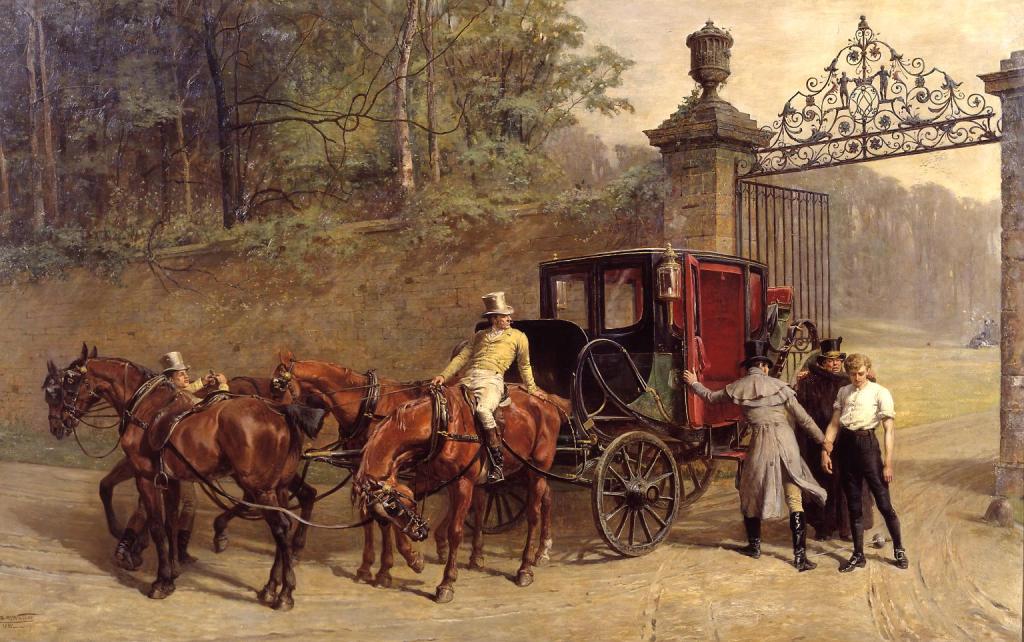
A number of dueling histories record the horrific duel between Colonel Barbier-Dufai and a young Captain, Raoul de Vere. According to most versions, the older adherent to Napoleon attempted to pick a fight with this member of the Royal Guard, but was initially unsuccessful. Barbier-Dufai, frustrated in finding the young man so unflappable, finally remarked that he was not insulting him, but his cockade, and after a heated exchange challenged the captain. However, when asked to select a weapon the captain replied that he had insufficient training in all of them. The colonel said he would not fight a child, a comment that irked de Vere and led him to slap the older man. A duel was now inevitable. In the ensuing sword fight, Barbier-Dufai disarmed his opponent several times. Finally, in frustration, the colonel suggested they hop into a carriage, arm themselves with daggers, tie their left arms to one another, and take two turns about the Place du Carousel. The young de Vere agreed and they set off in their mobile piste. When their seconds opened the carriage, blood was everywhere, Raoul clearly dead, and the colonel next to death. Both men died and honor was apparently satisfied. [1]
I share this story because it highlights the pure idiocy of fighting in close measure. There are times when it is unavoidable, but generally—unless one is in a confined space—there are means by which to extricate oneself from such proximity. One of the chief faults I see in both the wider community and among some of my own students is mismanagement of measure. Usually in my own classes, the culprit is a mix of well-intentioned aggression and fun—so intent on making the touch, some students neglect their own safety. I never want to chip away at the fun they’re having, especially among the younger students, because having fun is one reason people fence, but at the same time I need to ensure that they learn properly.
There are a few things we can do to ensure that our students have a proper notion of measure, and that can help them remember to use distance well in their bouts.
Teach them What Measure Is
First and foremost, from the off we need to teach them the various measures appropriate to their weapon or tradition. Regardless of the weapon or era my students study, I introduce them to the traditional breakdown of measure into three main categories:
- Out of measure
- In measure
- Close measure
Out of measure, what Giordano Rossi calls “double measure” and Luigi Barbasetti refers to as “normal distance,” is the distance that requires us to make an advance first in order to lunge to target.[2] In measure means that one can lunge to target. Close measure is that spot were either opponent can reach one another without the lunge. There are some subsets to this, but to start this is ample.
I hesitate to say that “all” systems of measure reflect these basic breakdowns, but I feel safe to say that measure, being a fight universal, is common to all systems however described. Even in those like Rossi’s “measure” and “double measure” or Fiore dei Liberi’s “largo” and “stretto,” there is implied space between these two poles. Regardless of nomenclature, one must learn how to navigate any space along the continuum of “measure.”
Measure Drills
Measure drills by definition involve footwork. Ideally, any footwork drill save perhaps those used in warming up a class—where everyone advances and retreats down the hall using various types of footwork—will work distance too. Below are several drills I typically use in classes:
Glove Tag is a crowd favorite and very much a game. One can run this as a linear partner drill, or, as a general melee. I usually ask if anyone wants to be it, and if not then select someone. Fencers must use the appropriate footwork only, and, can only target the wrist. There is no parry. One has to move, or, parry with the feet (in the non-pejorative sense). [3] Fun as this is, and much as it helps them move, making it a bit more realistic is helpful (see Mask Tag below).
Foil-Push or mask-push, have the students, in guard, suspending a foil/sabre/etc. or mask between their lead hands. The goal is to move back and forth without dropping the foil or mask. I emphasize that while they are taking turns driving, so to speak, they are working as partners—the only way to keep that foil up is to move in concert. If fencer A steps back, B needs to step forward, and vice versa.
Mask-Tag and 1-Touch Tag, fencers don their masks and use the weapon to tag. For sabre, students target only the head, and, cannot parry. Thrust fencers can only target the chest (or arm depending on what we’re working on), and, as with sabre, cannot parry. They must move their feet. Students must use distance to their advantage. Success depends on moving, recognizing someone fell short and is now vulnerable in the recovery, or, selecting the moment the opponent is occupied, such as mid-step, to strike. If the attack fails, then retreating under guard or behind the point is the best option, and the fencers reset.
Mask-Tag Plus takes this drill one step farther—each opponent can parry and riposte once per action, that’s it. So, if Fencer A lunges with a thrust to the chest, B can parry in quarte and riposte, but if A retreats half a step, then B must recover—B can’t redouble. For more advanced students one can allow the redoublement. This option should be included at some point as so many students starting out stop just shy of the target.
Two-Step Tag is something I’ve used with foil and smallsword students. Two of my foilists, for example, are offensively-minded, so tend to close quickly at “Allez!” and descend into a flurry of jabs, thrusts, etc. I don’t want to take that drive away, so I’m trying to channel it instead. In this version, the only attack they can make is an advance-lunge to the chest. It’s super hard to do, especially since one’s opponent knows what’s coming, so everything depends on precise and keen use of footwork, timing, and distance.
The goal with all of these drills is to emulate, as much as one can, the conditions of a bout, but restrict the options so that the students are forced to use measure. It’s not that good handwork is unimportant or cheating, but that it can easily become clatter and chaos instead of well-planned attacks and responses. It becomes reactive, not active. I teach them that if an attack fails or if something isn’t working, to retreat, regroup, and try something else. Persistence in the face of stout defense is brave, sure, but foolhardy—if what we’re doing isn’t working, we try something else. [4].
Reinforcing Proper Use/Awareness of Measure in Bouting
It does little good to encourage proper measure in drills if we fail to do so in bouts. There are a few way to do this. In both classes and individual lessons I save any bouting we might do for after any focus on technique and drills. [5] This helps prime the pump as it were—students are more likely to consider measure if they’ve spent a bit of time focusing on it before bouting.
Within the bout, I have students actively bouting and those observing analyze the action, not only because it reinforces attention to measure, but also because it buttresses other important aspects, from recognizing who had initiative/started the attack to breaking down each action within a given exchange. Too few fencers learn to analyze bouts well, and the sooner they start the better.
Why Measure Matters
If you view most any bouting footage posted to sites like Youtube you will see, or should see, why better attention to using measure is worth one’s time. In one recent video, for example, one fencer analyzes his bout, but misses the reason that he found himself in the situation he did—they were fighting too close to one another. [6] If their sabres cross near the middle, they’re too close. Certain actions are harder to thwart at such proximity—in this case, a slip of the leg will likely fail because there is insufficient measure to remove the leg and strike the opponent’s head without being hit. More likely, and we see it in this example, both parties will be hit.
In fairness to this fencer, the rule-set he’s likely fighting under is not as doctrinaire as I am about the guiding principle of “don’t be hit.” Even when a rule-set is explicit, so much depends upon judges who know what to look for and how to make sense of what they’re seeing, and by and large tourney HEMA lacks a reliable pool of judges capable of analyzing the action at such a level. Add to this the excitement and/or nerves in a bout and of course things can turn out less ideally than we plan. It is not my intention to denigrate my fellow fencer, only to point out something important he didn’t address (his focus was on the slip). Were he my student, we’d likely work on this very set of actions at the proper distance, that is, set it up so that he is just about a step or so farther back then we see in the video. From punta spada/sword tip one is more likely in a place not only to make the attacker’s feint and strike more successfully (i.e. without be clobbered doing it) but also provide the defender sufficient measure (and thus time) to assess and adjust.

Not all clubs or instructors take the same view I do. The more I read, the more I teach, the more I see how fencers learn, the more inclined I am to championing the goal of “don’t get hit.” It does change how we fence; it makes for a more circumspect, conservative, and hesitant game. The flash and fire, the dynamic move and rococo blade-work tend to impress, and that is what attracts many of us in the first place. It looks cool and we want to do that cool thing. While perhaps less flamboyant and exciting, I’d argue that there is as much beauty to the cold efficiency, exactness, and finality of a one-touch exchange. Moreover, training this way adds something else extremely important—improved confidence. The more one succeeds in gaining the line, striking, and getting out without suffering a counter-attack or double, the more one trusts themselves and the weapon they have in hand. In no way does that make one invulnerable, of course but confidence does much to help us cultivate the calm we need to fight with our heads and not our hearts. [7]
NOTES:
[1] There are a number of popular histories and websites that mention this duel, few with adequate citations. See for example Robert Baldick, The Duel: A History, New York, NY: Barnes & Noble, 1965, 164-165; Major Ben C. Truman, The Field of Honor, New York, NY: Fords, Howard, & Hulbert, 1884, 236, available online at [https://archive.org/stream/fieldofhonorbein00trumuoft/fieldofhonorbein00trumuoft_djvu.txt]; Thimm records a duel with daggers, minus a carriage, between two men in Italy in 1891, A Complete Bibliography of Fencing and Dueling, Reprint (Gretna, LA: Pelican Publishing, 1998), 457.
[2] Giordano Rossi, Sword and Sabre Fencing, Milan: Fratelli Dumolard Editori, 1885; translated by Sebastian Seager, Melbourne Fencing Society, 2021, 49-50; Luigi Barbasetti, The Art of the Sabre and Epee, New York, NY: E. P. Dutton & Co., Inc, 1936, 15-16. Cf. Gustav Arlow, Sabre Fencing, 1902, translated by Annamaria Kovacs and edited by Russ Mitchell, Austro-Hungarian Sabre Series, Vol. 3, Happycrow Publishing, 2022, 35.
The term “normal measure” is revealing–this is the distance from which one is still safe, but close enough to mount an attack. In other words, one isn’t four meters away from the opponent, and, isn’t in their lap.
[3] The “Coward’s Parry” or “Ninth Parry,” according to Morton, is the derisive term applied to those who avoid at attack by means of a step back. Where this idea originated I’m not sure, but it’s alive and well in HEMA. My guess, like Morton’s, is that this harkens back to the time with salle fencing, particularly in France, sought complex, elegant handwork over retreating (a “ninth” parry suggests an acceptable eight, and the French school in the 19th century looked to that number). See E.D. Morton, Martini A-Z of Fencing, London, UK: Antler Books, 1990[?], 43, 126.
[4] There are instances, of course, were it’s wiser not to break off the attack. If say one thrusts to the chest but lands short, and the opponent isn’t reacting properly, then redoubling to strike makes good sense.
[5] Most of my bouts are teaching bouts, that is, bouts in which I present what we covered in a lesson so that the student may work on those topics in real time. For classes, I still do this, but often include a little free-bouting at the end of class provided the students have enough in their toolkit to do so, otherwise I have them engage in restricted bouts where they move at real speed, but are restricted in what they can do.
[6] I do not know “@HEMA_Fight_Breakdowns,” and again, do not wish to disparage them in any way. Their video provided a great example of what I cover here, but my topic was not the same as theirs and I want to make that clear. To blast someone for not covering something we want them to, when that isn’t what they set out to do, is silly if all too common. This fencer has some good things to say about slipping the leg and one response to it–the topic of the video–it can be found here: https://youtu.be/Bk32YMYqiwA
[7] For this notion, see Master Perigore of Paris in the film adaptation of “Scaramouche” (1952): https://youtu.be/FQfsvMENYgc
Smallsword in Salem, OR

Despite the cold and wind (it was 28F/-2C), a few of us met down by the waterfront in Salem this evening for smallsword. Though I am able to teach more often indoors again, there are still times where we lack that option, and so one either finds a way or doesn’t practice. The crew in Salem is dedicated, in no small part thanks to my friend Joshua, who approached me last year about the weapon and has done more than anyone to get others interested. It’s important to me to honor that commitment and drive, and to be honest easy to do since I enjoy smallsword so much. If they’re willing to meet on a chilly evening, I’m happy to make the trip.
It’s difficult working in the cold, especially in a two hour block, but we did our best to keep moving and stay out of the wind. Lucky for us, the amphitheater where we met has surprisingly good lighting, and thus we were able to continue practice after sundown. We were less successful avoiding the wind, but it kept us moving! We spent most of the time drilling specific actions and a few permutations following from them, but some measure/footwork exercises too.
Anatomy of a Lesson
From time to time I discuss lessons and lesson-planning on this page, and tonight’s class provides another great opportunity to do that. Since this was a two-hour block it’s important to organize what we’ll cover–there is only so much “new” material one can digest. What I typically do is consider first, whom I’m teaching, and next what they need. In this case, one of the two students who showed up has been away for a while, so some review of fundamentals (which I always include at some level) seemed appropriate. The other student has been practicing with me and at another school, and so is less in need of a refresher, but was happy to go over things again. [1] Regardless of topic, I usually structure lessons, long or short, the same way:
- warm up
- progressive drill
- main lesson
- cool down [or depending on the type of lesson, bouting, then cool down]
The warm up tends to consist of plyometric-oriented drills and/or fundamental actions. For rapier and smallsword, for example, I often start people out with something like an arrest drill–this requires me to make purposeful mistakes by exposing the weapon arm in various lines and the student to counter attack via arrest to the exposed section and then cover/parry and riposte. From there, I might add a counter-parry/riposte on my side, and so on. Varying the measure, the speed, and line make this warm-up more realistic and sort of primes the pump as it were for the main lesson.
Format for Sunday Evening
This time we began with a fencing version of a “push hands” drill. Joshua and Robert started with a glide in third, one fencer starting the attack, the other making a yielding parry in third, gaining leverage, and then attacking with a glide in their turn. There is a see-saw quality to it, but done well it’s a valuable drill: it helps both parties gain better sentiment du fer, helps them work on closing the line, provides them a convenient way to monitor how far to move the hand to parry, and tests the height of the hand on the thrust. [2] The same drill is useful in carte, half-circle/7th, and seconde. There are additions one can make to the base drill, but tonight we used the four main lines only and as a warm-up.
Next, we took this drill one step farther—we used the glide in third as a feint to draw the opponent’s tierce, then disengaged and made a thrust to the inside line with opposition in carte. Both fencers are taller than I am, and so one aspect of this exercise that proved particularly useful was changes in measure. Though the same attack can be made “firm-footed,” as the treatises refer to it, it’s important to vary the distance. Not every opponent stands still.

I’ve often had students work from a glide, but at a certain point, once they have the concepts the glide teaches so well down, I expand upon it. [3] This time we discussed a guard where the glide doesn’t work well—Girard’s more extended tierce. One can make an attack by glide against this straighter guard, but it’s much easier for the defender to defeat it. [4] So, we discussed using a beat-feint instead. This was familiar ground, both offensively and defensively, but works a number of fundamental actions. It was a good set up to the prise de fer in seconde, and, the defenses against it.
The first line of defense against this attack, one anyway, is the derobement, that is, avoiding the envelopment by performing a tight circle around the opposing steel. Next, we used a yielding parry in seconde. Lastly, we upped the difficulty level and used a change of line from yielding seconde to yielding carte. This is not easy to do—it requires a keen sense of timing, distance, and evaluation of the line of attack. [5] It also raised additional questions—if one transports the blade to carte, one could riposte by flanconnade, but this is harder to do if the attacker’s hand is in tierce instead of carte.
As a way to reset and take a break from a complicated drill, we next played a version of glove tag. Often termed restricted or constrained bouting, this type of game limits one or both fencers to specific options. We started out having both fencers attack the inside line, but they could not parry—the only option was to use the feet and measure. Ideally, one provokes the opponent to fall short, then attack them as they recover back into guard, or, catch them on the march. It can be a workout. Next, each fencer could respond by parrying in carte and riposting, but nothing else.
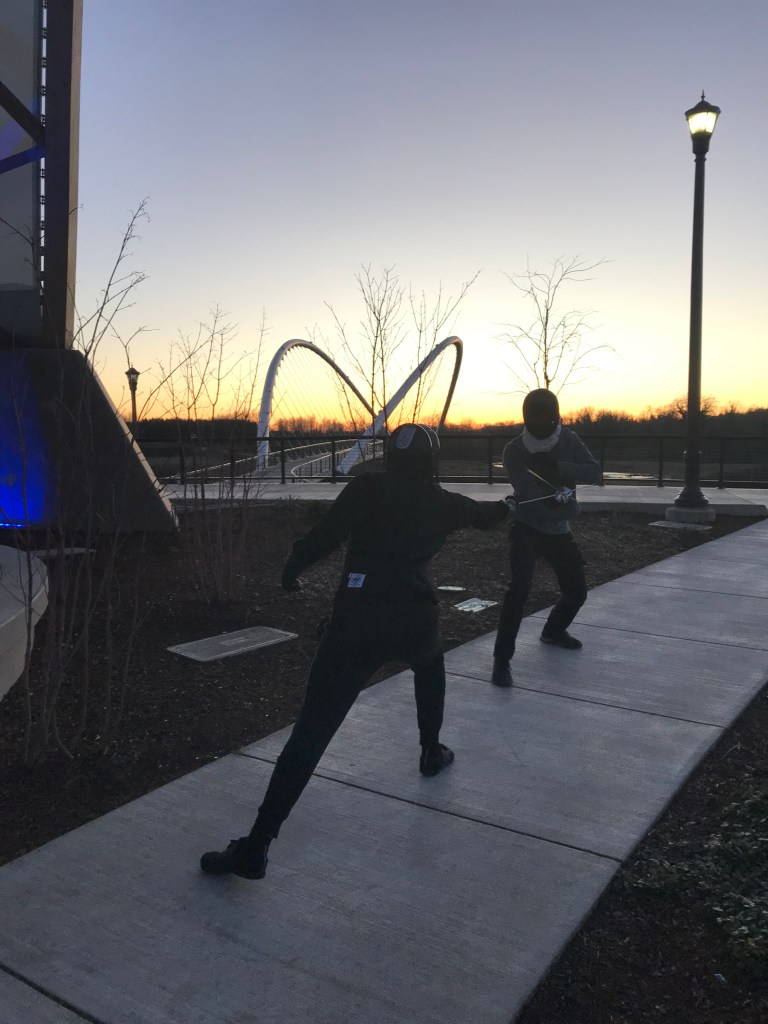
In the last twenty minutes we enjoyed a few unrestricted bouts. I urge fencers to do their best to use what we cover that day, and when I’m up I do my best to present students with opportunities to work on those actions. If the student is new, the cues I give are more obvious and I might hold them a second longer, but as much as possible I try to maintain the same conditions students face in actual bouts. Everything we do should relate to what students will need on the piste or in the ring, otherwise we do them a disservice. Footwork, warm-up, lessons, teaching bouts, pair drills, whatever it is we have students do, should always serve to improve their game.
Have Plastron, Will Travel
Fencing, State-side at least, is an obscure pursuit and outside the Olympic world, which is far better known and supported, it can be difficult to attract and retain students. There are a number of models for running a club and providing lessons, but the one I’ve opted for is as flexible as my other responsibilities allow. The “they can come to me” approach might work for some, but I’ve become a big believer in meeting people half-way whenever I can.
These days I teach six days a week in some capacity, which can be a lot when one has a day-job and family duties. Four nights a week I teach for parks & rec, Sunday mornings I meet people outside that system either at the local Grange or at the community college satellite, and twice a week I provide individual instruction (sabre with one 11 year old girl, rapier for one man in his 60s). It can be a lot, but I love it. Not a day goes by that I’m not grateful to my spouse and children for their generosity with time and the various clumps of fencing gear that occupy different corners of the house.
The Portland metro area, and PNW in general, boast a number of options for those interested in martial arts, and, in fencing. What I offer will not appeal to everyone, and that’s okay–happily, knowing many other instructors and coaches I can refer people to places and people that might better suit them. My close friends among other instructors do the same for me, and in fact, many if not most of my students came to me via people like Mike Cherba (Northwest Armizare). We’re a small community, but we do our best to look after one another, because in the aggregate we all benefit. The more like-minded fencers we train, and the better we train them, the more people we have to enjoy the Art with, so in a sense it’s self-serving. However, the study of the Art beyond mechanics and tactics can impart so much more; it can become a way of life, a philosophical position, and like any such study is one we can pursue all our lives long. The more time I spend in the Art, as student always, as teacher often, the more I appreciate the lessons–all of them–it imparts.
NOTES:
[1] I’m a big proponent for the continual training in the most basic, fundamental actions and techniques. We should review them often if not in some fashion each time we train. Typically, I manage that in my lessons via drills and exercises, and, regardless of skill-level. The kendo master I studied with briefly told us about his yearly retreat with his own, elderly master. Despite all my sensei had achieved, his rank, etc., his master could still find things even in his grip on the weapon to correct. We are never finished being students.
[2] Smallsword texts, as I’ve mentioned before, can vary considerably when in comes to hand height on the attack. For my part, the advice of many masters, who suggest that the hand should be as high as the chin, seems to fulfill the requirements for covering the high-line when lunging well enough. Some later texts, likely more reflective of salle play, can have the hand super high (e.g. La Boessiere), but raised so high one is far more likely to eat a counter-thrust.
[3] I will likely never be able to thank Chris Holzman, one of my mentors for Italian fencing, enough for his suggestion to start new students off with the glide vs. a direct thrust. It has no lie revolutionized my approach. Thank you, again, Chris 🙂
[4] Girard’s guard, as you see in the image, is more or less extended. What we see there is supported by the text accompanying it as well. On page 12 of the pdf available at the BnF Gallica site, the text reads Il faut présenter la pointe de l’Epée droite, vis à vis la mamelle droite de l’ennemi, & que le demi tranchant regarde la terre and Que le bout du pommeau de l’Epée regarde entre le teton droit & l’aisselle, & tombe directement au-dessus du bout du pied droit. Here, the tip of the blade and the end of the pommel both suggest a more or less horizontal blade.
This is harder to describe than demonstrate, but Girard’s guard, because it is more extended and horizontal, makes it more difficult for an opponent to effect the glide, but more than that, to defend against such an attempt requires merely a shift of the wrist right or left to defend. A beat may not sufficiently move the line, especially if one beats to the side of the opponent’s blade opposite the thumb, but combined with a feint it is more likely to succeed.
[5] My approach to working more complex actions is progressive and determined by skill-level. Though where we stopped is a viable response, it is also an unlikely one. The simplest, most efficient response is normally best, however there are at least two reasons to explore more complex iterations. First, it is “medicine for the hand,” and in training more sophisticated actions we hone the basic ones that comprise them. Second, there is always the chance one will face an opponent where the simplest defenses and responses will not b enough, and so having additional options in one’s repertoire makes sense.
Francois Perreault & Ecole Normale de Gymnastique et d’Escrime, Joinville
In yet another wonderful discussion, Russ Mitchell and friends discuss the role that the École de Joinville-le-Pont near Vincennes, France, played in European and later world sabre. As Russ remarks the program at Joinville was as influential as that of the Radaellians or those in the tradition of Kreussler.
Francois Perreault provides a fantastic introduction to this tradition.
Russ & CO.–Interview with Chris Holzman on all things Radaelli!
This video is so good. SO. GOOD. Chris is a friend and a mentor, so I know I am partisan and possess some bias, but for those who listen and find themselves uncomfortable, I challenge you to listen to what he says. Some of it will be hard, but it’s important. Few people like being called out for the inconsistencies and nonsensical things we do, but wee bruised egos aside it’s healthy for us to do so.
This is also a wonderful introduction to Radaellian sabre, a thorough examination of how this system influenced so many others, of the development of the sport, and a personal bugbear, another nail in the coffin in the silly dichotomy people insist exists between so-called “military” sabre and “dueling” or “sport” sabre.
Trust but Verify—the Perils of Translation
This week’s smallsword class presented a piquant reminder of the caution required in using translations, even good translations. In this instance the translator and author were the same person, Domenico Angelo. One can usually assume that anyone wearing both hats has a firm idea of what they want to express—how well, consistently, or accurately they convey that in another tongue, however, is another matter. We can be too close to a topic, it can be too familiar, and since it makes sense in our heads we may unwittingly proceed as if all we have to do is put pen to paper (or hands to keys). This is just as true for the reader nowadays.
I often harp on the importance of reading the text and not just relying on images in our interpretations, and without meaning to sing the same old tired song, the topic here concerns one nuance of this theme. As my own example will show, what we’ve read can bias us in viewing images too, and so, as ever, we need to be cautious and read closely even if we “think” we know what a passage or illustration means.
Half Circle, Circle, Circular…
Angelo uses the terms “half circle” and “circle” in several ways and there is some potential confusion possible in his English version. I don’t know and thus am hesitant to suggest what Angelo was thinking as he wrestled with the French and English in producing the respective copies of his The School of Fencing, but as someone who mines his work today if I had to guess, I’d imagine that it was oversight on part of the author/translator, or, a printer’s error.
On the face of it, some of these issues with language are self-explanatory, but syntax, punctuation, and translation can complicate some of these terms, and deserve a closer read. Call it due diligence. We lose nothing in checking our reading, and in some cases, as I discovered comparing Girard and Angelo, we not only might correct errors we’ve made in interpretation, but also gain new insights into the sources.
Similarities in Girard, in this case, likely skewed my reading of Angelo. I fix these things as I find them (or as they are pointed out to me), but this is a good example because I do my best to do things as accurately as I can and still screw up sometimes. It can happen to any of us (and will on occasion).
In what follows, I’ll present the French from the 1763 edition and the English from the 1787 as these are the two copies I have on hand. The story of the evolution of L’Ecole des Armes/The School of Fencing has been well-covered by others, so those interested in the editorial history of the text should refer to the works in the notes, at least as a place to start. [1] While variations in edition are important, I’m working with the versions to which I have access and focusing on a single, practical concern: navigating some issues of translation in making use of the work.
Examples: Demi-cercle
Angelo first covers this parry for plate 19, or, page 97 in the pdf provided by the Bibliothèque nationale de France’s Gallica. [2] He writes:
De la Parade du Demi-cercle sur le Coup de Quarte basse
Voïez la Dixneuvieme Planche
La parade du demi-cercle doit être formée au dedans des armes par un coup ferme sur le foible de la lame de l’advesaire, avec le trenchant du dedans & du fort de l’epée. Il faut tourner les ongles en dessus, tender bien le bras, tenir le poignet a la hauteur du menton, & la pointe de l’epée basse & soutenuë du fort au foible.
The English reads thus:
Of the Half Circle Parade, or the Parry Against the Inside Thrust under the Wrist, called the Low Carte
Plate XIX
This parry of the half circle should be made within the sword, by a smart beat on the feeble of the adversary’s blade with your inside edge; your nails must be upward, your arm strait, your wrist raised to the height of your chin, and the point low, but well opposed from fort to feeble. [3]
The accompanying plate accords well with the explanation provided here. Much like the modern parry of 7th in French foil, the fencer on the right has the hand in fourth/supinated, the arm is straight, and opposes the adversary’s thrust with the inside edge (one can just make out the knuckle-bow). This parry is made higher than modern 7th, but covers more or less the same line only more conservatively since the arm is extended to parry farther from oneself. [4]

The second mention of the term “demi-cercle” is used not to describe this parry, but the arc of the yielding parry made against a flanconade. The second paragraph of the section relating to the 20th plate reads
Le liement d’epée se fait aussi dans le tems qu’il tire le coup de flanconnade. Il faut ceder la pointe sans quitter sa lame, en forte que la pointe forme un demi-cercle en passant par dessous son poignet; & lorsque la parade sera formée, les deux poignets & lames se trouveront dans la position de quarte, comme on êtoit avant que le coup fut tiré, avec cette difference, que le poignet se trouvera plus bas que dans la garde ordinaire.
The English:
The second parade mentioned, called the binding of the blade, is made at the time the adversary attempts to thrust his flaconade. In order to [do] this, you must yield your point, and suffer your feeble to be taken, so as to let your point pas under his wrist, without quitting his blade in the least, that your sword may form a demi-circle; and, gathering his blade in carte, you will find that the two swords, and wrists, are in the same position as when the attack began, with only this difference, that the wrists will be a little lower than in the ordinary guard. [5]
In this instance, Angelo clearly means this descriptively, and so while the same term the context helps prevent confusion.
With the text for Plate 24, however, there is a potential problem. The French reads:
De la Risposte en Tierce sur le Coup de Tierce
Voïez la Vingt-quatriéme Planche
Dans le tems qu’on pare la tierece, en tendant le bras & baissant la pointe de l’épée au corps de l’adversaire, il faut lui risposter le coup de tierce le main tournée en tierce & le poignet cavé, faire en forte que la main parte le premiere en soutenant son épée dépuis le fort jusqu’à la pointe, puis se remettre en garde en prime, ou en demi-cercle. On peut aussi risposter en seconde et se remettre en garde en seconde, en tierce, ou en demi-cercle.

And the English:
Of the Return in Tierce, after the Tierce Thrust
Plate XXIV
At the time that you parry the tierce with a strait arm, and your point a little lowered to the adversary’s body, you must return the same thrust, only your wrist a little inclined to the outside. Take great care that the hand moves first, and oppose his blade well, from feeble to fort; to recover your guard in prime, or demi-circle parade.
You may also, after your tierce parry, return the thrust in seconde, and recover in seconde, demi-circle, or in tierce. [6]
Significantly, the punctuation is the same in the relevant section; both read “puis se remettre en garde en prime, ou en demi-cercle/to recover your guard in prime, or demi-circle parade.” Early on I had mistaken these clauses as appositive, but closer reading and practice have illustrated that this was an error. Angelo is referring to two, distinct parries.
Part of what threw me was Girard—I have spent more time with that text, and his “circular parry,” parries rather, are redolent of Angelo’s half circle parry, and, prime visually. Plate 19 in Girard looks like Angelo’s “half circle” but there is called “circle.” Plate 19 illustrates a circular parry with the hand in fourth or “nails upward; Girard has ensured that the off-hand check is depicted as well.
Plates 21 and 22 in Girard might be taken as if they represent one parry from different angles, but these are two, different parries. The images may appear similar, but each parry is made a little differently. Prime, generally, is made from tierce sweeping left (assuming a right-hander); circle, on the other hand, is achieved via a clockwise circle to gather up the incoming steel.
The parry in plate 22 could be the same “nails down” parry as 21, just seen from the other side and with the addition of the off-hand check, but 22 is Girard’s “prime,” 21 another version of “circle.” They’re not the same.
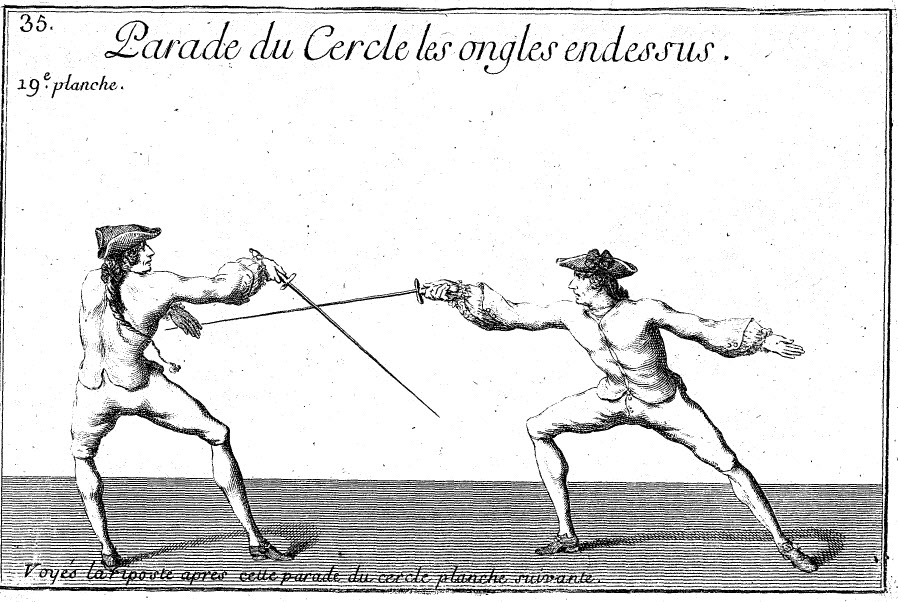
Girard writes:
Parade du Cercle,
La main tournée de quarte, les ongles en dessus, le poignet haut & la pointe basse. Avec cette parade on pare la quarte haute, la quarte coupée, la seconde, & la flanconnade.
Pour parer lesdits coups, je fais lever le poignet à la hauteur de la bouche & tourné de quarte les ongles en dessus, le bras droit tendu, la pointe de l’Epée basse parant du cercle, en frapant d’un coup ferme sur le foible de sa lame avec le fort du trenchant pour jetter le coup au dehors des Armes, en opposant la main gauche à son Epée, crainte qu’elle ne vous offense: Et le coup paré, lorsqu’il a le pied levé pour se retirer en Garde, lui riposte de quarte droite dans les Armes; ayant toûjours la main gauche opposée à sa lame, & sans la quitter redouble la main bien soutenuë, puis se retirer dans la Garde ordinaire.
Voyez pour l’opposition de la main gauche, page 39.
Voïez la Figure de la parade du cercle les ongles en dessus [35]
Philip Crawley’s translation for this passage makes the action clear. He renders it thus:
Circular Parry
The hand turned to quarte, nails upward, wrist high & the point low. With this parade one parries high quarte, quarte coupe, seconde & the flanconnade.
To parry the above said attacks, I raise my wrist to mouth height & turned to quarte, the nails above, the right arm outstretched, the sword point low parrying in a circle, firmly hitting the weak of the sword with the strong edge of the blade to push out the attack, opposing with the left hand on the sword, for fear that they will hit me: And having parried the attack, when he raises his foot to return to guard, riposte him with a straight quarte inside the sword; always opposing his blade with your left hand &, without quitting, redouble using a well-supported hand, then return to the ordinary guard.
See the opposition of the left hand [, page 39]
See the figure on the circular parry the nails upward
[7]
The image in plate 21, as I read it, captures the moment that the defender (on the left) has described the circle and met the incoming steel. Note that his hand is in tierce/nails down–a key difference from plate 19. If one took the image without the text, always a danger in historical fencing, this might be taken for seconde.

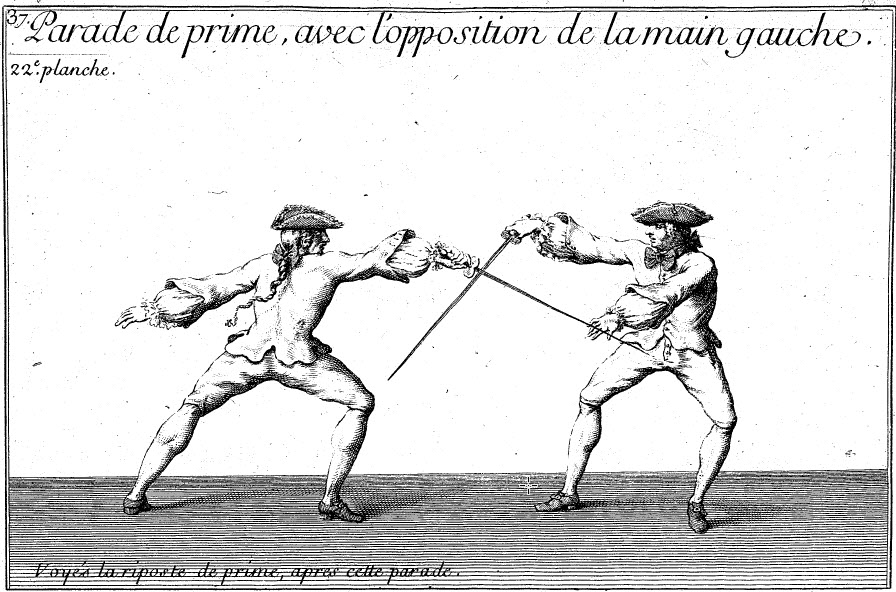
Read sans the filter of Girard, with whom I’m more familiar, Angelo’s passage in either language is much clearer: one can recover into guard and use a number of sweeping parries as one does so to ensure safety.
Example: Cercle or Half Circle?!
Lastly, there is section entitled “De la Parade du Cercle” [134] in the French text, and, what Angelo renders “Of the Half Circle Parry” [42]. It may be an error on either Angelo’s or his typesetter’s part, but regardless the English wording is, on the face of it, confusing. The description, however, makes it clear that this parry is not the same as the half circle parry covered earlier on page 29.
The French reads:
De la Parade du Cercle
Cette parade, qui est la principale des armes, pare non seulement tous les coups, mais aussi dérange toutes les feintes qu’un adversaire peut faire. Pour bien éxécuter cette parade, il faut bien tender le bras, tenir le poignet sur la ligne de l’epaule les ongles tournés in dessus, & par un movement ferré & vif du poignet la pointe de l’épée doit former de la droite a la gauche un cercle assez grand pour être a couvert depuis le tête jusqu’au genou. De cette maniere, en doublant le cercle jusqu’a ce qu’on ait arresté la lame de son adversaire, la parade sera formée.
Pour arrester cette parade du cercle, quand même il la doubleroit avec la plus grande vivacité, il faut arrester tout court sa lame en soutenant le poignet à la hauteur de l’épaule & tenant la pointe basse, comme dans la parade de quinte, & revenir promptement â l’épée en quarte.
Il faut s’exercer, autant qu’on peut, le poignet aux parades du cercle, au contre-dégagement, & du contre-dégagement au cercle. On peut prendre cette leçon tout seul, soit avec un fleuret, soit avec une épée. Cette exercise fortisie le poignet, le rend souple & le délie, & procure insensiblement le plus grande aisance & adresse pour se défendre dans le besoin.
The English:
Of the Half Circle Parade
This parade, which is the chief defensive parade of the sword, parries not only all the thrusts, but also obstructs all the feints that can be made; and, to execute it well, you should straiten your arm, keep your wrist in a line with your shoulder, your nails upward, and, by a close and quick motion of the wrist, the point should form a circle from the right to the left, large enough to be under cover from the head to the knee; in this manner, by doubling your circle till you have found the adversary’s blade, your parade will be formed.
And now, in order to stop this circle parade, notwithstanding its being redoubled with great vivacity, you may stop his blade short, by keeping your wrist the height of your shoulder, and lowering your point, as in the quinte parry; and, recovering, bind and gather his blade in carte.
You should exercise and practice these circle parades, from the counter disengages to the circle, and from the circle to the counter disengage. You may practice this lesson yourself, either with sword or foil: this will strengthen and supple your wrist, and will insensibly procure great ease and readiness to defend yourself upon all occasions. [8]
Of note, both Girard and Angelo’s parries of circle include a circular motion, something difficult to capture in the plates. We catch the action upon completion, at its start, or somewhere in between. Angelo’s “half circle,” on the other hand, does not include a circular motion, and thus, here, as ever, reliance on the plates alone will confuse one unless one is careful.
The Take-Away
This short examination of one term, whatever the reason for the discrepancy, hopefully serves as an example for why caution, even in a well-translated work, is sound. If, like me, you read a lot of different, contemporary sources, then this caution is all the more critical. It’s a truism of fencing old and less ancient that different authors, different masters will sometimes use the same terms to mean different things. Due appreciation for these nuances only aides us in our interpretations.
NOTES:
[1] See especially Ashley L. Cohen, “Fencing and the Market in Aristocratic Masculinity,” in Sporting Cultures, 1650-1850, Daniel O’Quinn and Alexis Tadie, eds., Toronto, CN: University of Toronto Press, 2018, 66-90, especially 69-72. See also Zbigniew Czajkowski, “Domenico Angelo—A Great Fencing Master of the 18th Century and Champion of the Sport of Fencing,” in Studies in Physical Culture and Tourism 17: 4 (2010): 323-334, esp. 327-328 for the circle parry and other content of the work; 329 for a quick look at publication; Jeannette Acosta-Martinez, “Domenico Angelo in History,” in The Fight Master 28:2 (Fall/Winter 2005): 12-15, esp. 13-14.
[2] The French edition I’m using is: Mr. Angelo, L’Ecole des armes, London, GB: Chez r. & J. Dodsley, 1763, found at the wonderful site provided by the Bibliothèque nationale de France’s Gallica site, cf. https://gallica.bnf.fr/ark:/12148/bpt6k15198162?rk=21459;2
[3] This is page 29 in this edition, The School of Fencing, London: 1787. I have a facsimile, in print, from Land’s End Press, New York, 1971, but also use the pdf available at The Smallsword Project, found here https://smallswordproject.com/historic-texts/
[4] Zbigniew Czajkowski, “Domenico Angelo—A Great Fencing Master of the 18th Century,” 328, suggests the modern septime/7th was a result of “’diminishing’ quinte and circular parries,” but I’m less convinced that this is so. Angelo’s “half circle” is, extended arm notwithstanding, clearly meant to do the same job, and, in the same plane. The difference, as I read it, is that Angelo’s fencer may have had to do this to preserve their life, not just their placement in the pools. The extended arm parry, the rear-weighted stance, and attention to measure all imply a conservative game, one meant to maintain the uneasy compromise between one’s safety and still being able to reach target. In similar vein, though not called “sixth,” smallsword’s “carte over the arm” is the clear antecedent to the chief guard in the modern French school. We have ample evidence from our texts not only of thrusts made carte-over-the-arm, but of fencers adopting a guard that is more or less sixth, that is, arm on the tierce side, but supinated/hand in fourth.
[5] French, 101 in the pdf; English, 29-31.
[6] French, 117; English, 38 .
[7] See P.J.F. Girard, Traité des Armes, La Haye: Chez Pierre de Hondt, 1740; the French text is, again, from the pdf made available by the Bibliothèque nationale de France’s Gallica site, page 35 in the text/page 62 of the pdf, cf. https://gallica.bnf.fr/ark:/12148/btv1b8626151m?rk=21459;2
The English I borrowed from the translation of the smallsword portion of Girard, Philip T. Crawley, The Art of the Smallsword: Featuring P.J.F. Girard’s Treatise of Arms, Wyvern Media, UK, 2014, p.77.
[8] French, 134; English, 42-43.
Rosaroll-Scorza’s _Spadancia_ trans. by Christopher A. Holzman
Chris has a new translation out:
This is an interesting work to say the least. Fans of Torquato Tasso’s Gerusalemme liberata/Jerusalem Delivered (1581) will drool (this guy really really really liked Tasso…), but so too will those interesting in some late period cut-and-thrust fencing from southern Italy. Few versions of this weapon remain–similar to a late cup-hilt or bilbao style rapier, this weapon shared much with the spada and smarra long in use in Naples and Sicily, but had a blade meant for cutting and sported other, notable features, such as the fact the quillons were sharpened.
Reach for the Sky—Hand Height in the Smallsword Lunge
The cliché of a picture being worth a thousand words may be correct, but that doesn’t mean the same image doesn’t require explanation. Rather than take a screen shot of the myriad instances one can capture on Youtube and elsewhere, which might upset people, I’ve opted to go with an iconic, period image, and perhaps one reason for the madness:

There are many examples of this hand-above-the-head extension:

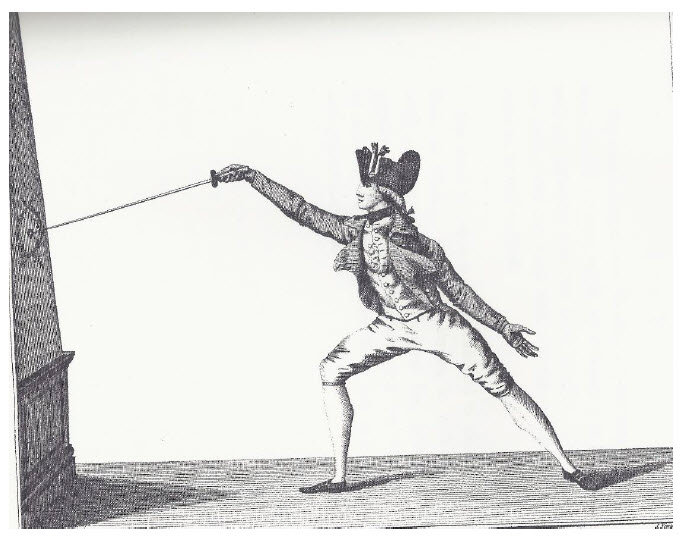
These are period images, mostly of foil play—to which I’ll return—and thus are “historical” in the sense that we normally mean it in historical fencing/martial arts. This said, there is an important distinction to be made between what we see in images like these and those from earlier works, equally historical but different in purpose. [1]
Every instructor has to make choices about what they want to include; they should be able to explain why as well. For me, lunging with one’s hand held so high is less covered than lunging with the hilt terminating at chin height as in earlier works for smallsword. If the goal is not to be hit, to reduce the chances of doubling, then a more conservative approach on the extension of the arm, the very first action made in the series of movements that comprise the lunge, makes sense.
The treatise from which I work most is P.J. F. Girard’s Traité des armes (1740), though much of my curriculum brings in ideas from Domenico Angelo’s L’École des armes/The School of Fencing (1763/1787) and de Liancour Le maître d’armes (1686), among others. I make a constant effort to read and compare the works I rely upon with others, incorporating material from some, merely noting others, and in some cases rejecting some ideas for inclusion in lessons. There are also times when I shelf a treatise for a time—with Le Perche du Coudray (L’Exercise des armes, 1750), there are sufficient reasons I’ve found to work on things and come back to it.
For example, the first lunge he covers, from quarte, depicts the hand higher than the rest of his work suggests. Is this so or an accident of the artist’s hand? The accompanying text has details, but isn’t specific as to hand height on the extension, he merely writes
Aprés sétre mes en garde et en mesure il faut dabord que ce soit la main qui parte la premiere en soutenant bien la poignet et baissant la pointe de l’Epée jusqu’a l’Estomach de l’Ennnemy, que les ongles soient tournés en En haut le bras bien etendue et bien soutenu…
After being in guard and in distance, the hand must move first, supporting the wrist well and lowering the point of the sword to the enemy’s stomach, so that the nails are turned upwards, the arm well-extended and well-supported… [2]
Here is the accompanying image:

In the illustration the lunging fencer’s hand is at his hairline, the lunge long, and nothing in the description offers an explanation as to why. Did Le Perche wish the fencer to lunge this way? Maybe. Parallels with other sources don’t offer much help. His lunge in tierce and seconde recall de la Touche’s (1670) super extended poses, the attacker’s head is much farther forward, and in some cases the attacker is not looking at target. [3]

The fencers in the plates all hold foils, but is that significant? In Plate 11, for example, the fencer attacking in quarte—his arm a bit lower than the hairline this time—uses the off-hand parry/check to prevent a double. This recalls similar images in Girard and suggests at least some attention to self-preservation. [4]
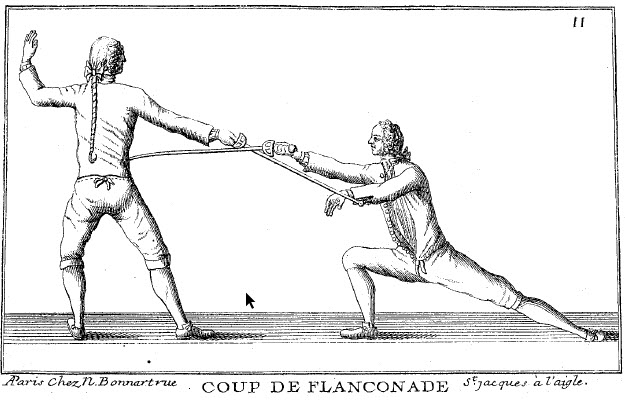
In sum, I’m not sure what to make of Le Perche yet and so, I’m noting what I see and will return to it later, hopefully armed with more information to help me read it more accurately. It’s possible that Le Perche is one of those texts that captures the subtle shift from practical swordplay to academic, salle play.
The hand in the air like one just doesn’t care… approach to the extension is popular in HEMA’s smallsword circles. While one can definitely point to sources for it, thus fulfilling the “H” of the acronym, the same cannot be said for the “MA” portion. To use a word I have come to detest, this raised hilt in the lunge is less “martial” than the custom preceding it.
Art vs. Practicality
It will come as no surprise that I do not teach this hand and hilt above the head approach to the extension. Graceful it may be, artful it may be, but from the standpoint of “don’t get hit” it’s less likely to protect one. Placed in this manner the weapon is more likely to fail to close the line as well as fall prey to an easy disarm.
Girard’s instruction illustrates well the more practical approach. In describing the guard, his very first point is revealing:
Il faut présenter la pointe de l’Epée droire, vis à vis la mamelle droite de l’ennemi, & que le demi tranchant regarde la terre.
The point of the sword must be presented straight, directed toward the right breast of the enemy, & so that the ridge of the blade is half turned to the ground [5]
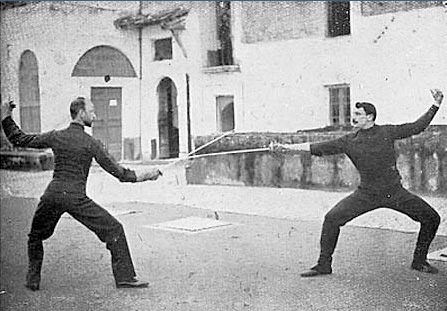
This point forward, semi-extended position places the sharp tip as close to the opponent as possible while keeping the body as far back as possible. This compromise will be very familiar to students of Italian fencing—we see similar guard positions from Rosaroll & Grisetti to that of 20th century masters like Agesilao Greco. [6]
Taking Girard’s thrust in tierce as an example, the same conservatism is in evidence. To thrust in third, one
Coup de Tierce Haute tire Droit au dehors des Armes
Etant bien en Garde & en mesure, l’Epée engagée de tierce dehors les Armes, les ongles regardant la terre, je fais partir la main la premiere, les bras étendus en forme de croix, la main gauche également tournée de tierce, le genou gauche bien étendu, le pied à plat, & ferme & sur la terre, le genou droit plié; de forte qu’il soit vis à vis le milieu du pied droit & dans las ligne de l’ennemi, le corps soutenu, le côté droit panché au-dessus du genou droit, les deux épaules effacées, & la tête le long du bras à l’oposite de l’Epée, pour se garantir le visage. Le coup achevé dans cette Attitude se retirer en Garde, l’Epée devant soy, sans laisser baisser le poignet.
The Thrust of High Third pushed Directly Outside the Sword
Being in a good guard and in measure, the Sword engaged in Tierce outside the Sword, the nails facing the ground, I extend the hand first, arms extended in the shape of a cross, the left hand also turned in Tierce, the left knee well-extended, the foot flat and firm on the ground, the right knee bent; so that it is over the middle of the right foot & in line with the enemy, the body propped up, the right side over the right knee, shoulders profiled, & the head along the arm opposite to the Sword, to protect the face. The attack complete, in this this posture return to Guard, Sword out in front, without dropping the wrist. [7]
The image accompanying this section of text accords with it well, but the text itself is clear—hand first, so weapon first, opposition as one thrusts, and body positioned so that it is not only behind the guard, but so situated that the head is leaning away from that opposition, both for safety—as the master remarks—and so, I suspect, one can see the thrust and the opponent’s reaction better.

As a check on this, it’s worth taking a look at Girard’s first attack, the thrust in quarte. He writes
Le Coup de Quarte Haute tire’ Droit Au-dedans des Armes
Etant bien dans la Garde qu’il dit & en mesure, l’Epée engagée de quarte dans les Armes, je fais partir la main la premiere en levant le poignet, les oncles tournés dessus, regardant le Ciel, ainsi que le dedans de la main gauche; les bras étendus en croix, le corps panche du cote droit, & soutenu au-dessus du genou droit; les épaules effacées, la tête panché du côté de l’Epaule droite pour regarder le coup à l’oposite de l’Epée, de forte que le pommeau regarde l’oeil gauche, le bout du pied droit vis à vis l’ennemi, que le genou tombe perpendiculairement au dessus du milieu du pied avec le pied gauche à plat & ferme sur la terre, la jambe & la cuisse gauche élevées. Le coup achevé & tiré dans l’Attitude qu’il est dit, se retirer bien en Garde l’Epée devant soy, sans laisser baisser le poignet.
Being well in guard & in measure, the Sword engaged in quarte within the Swords, I start the hand first by raising the wrist, the nails turned up, looking at the Sky, the left hand following suit; the arms outstretched like a cross, the body leaning to the right side, & supported above the right knee; the shoulders profiled, the head titled on the side of the Right Shoulder, to see the blow against the Opposite Sword, so that the pommel is in line with the left eye, the tip of the right foot towards the enemy, the knee falls perpendicular over the middle of the foot with the left foot flat and firm upon the ground, the leg and left thigh straight. Having made the thrust in this position, as stated, return well in Guard with the Sword in front of you, without letting the wrist fall. [8]

It’s possible to regard the attacker in the image “pushing” fourth as having his hand at the hairline, but given the description that doesn’t follow. More likely, the artist, who knew their craft well, meant to show the head leaning right over the shoulder. The fact that the right hand is nearly as large as the head suggests that it’s meant to present closer to the onlooker, again helping create perspective. With the head so tilted, lining up the left eye with the pommel occurs at an angle and thus lower than the top of the head were the head upright. As a side note, while the opponent may have been hit in the chest, it’s possible he was hit in the arm—few smallsword or rapier texts for that matter spend much time on the forward target (a topic for another time), but it would be unwise to assume that any instructor would have looked down on such a strike.
Text, Awareness, & Choice
As with most things in HEMAland one can adopt whichever hand-height one wishes. However, I will maintain that knowing why we do what we do and where it comes from makes sense. It’s historical fencing, and part of any historical examination is understanding the context for things; it’s all the more important when the waters are muddy. The overlap between smallsword and foil play is significant, and thus, it’s a lot easier to treat them as one in the same. Did many smallsword fencers, who sought to learn to use a sword in earnest, learn via foils? Absolutely. But… they didn’t show up to Stephen’s Green or The Dueling Oak armed with one, and if they attempted to use moves better suited to impressing their fellow salle mates with their grace and poise than keeping them safe, they were likely to leave the Green or the Oak on their backs.
The hand held high versus at chin height reflects a change in culture. It coincides with the decline of dueling in some areas on the one hand, but with the increasing importance of fencing as elite accomplishment on the other. Both are historical, but reflect different contexts, different attitudes. The later our “smallsword” texts are in time, generally the more we see this reach for the sky business. De St. Martin, for example, whose L’art de faire des armes came out in 1804, has it, and while perhaps not in each plate, it’s there. In discussing the parry and riposte from third, de St. Martin specifies that “la main bien élevée au dessus de la tête,” that is, that one should have the “hand well raised above the head.” [9] We see the concern for grace, poise, and elegant execution of technique not only increase in the treatises, but in other areas as well. Many 18th century advertisements, even in the American colonies, often paired fencing and dancing as two pursuits for the genteel portions of society or those who wished to join their ranks. [10]
People pursue historical fencing for their own reasons and enjoy different aspects of it. That’s really pretty awesome. For those keen for smallsword or the study of early foil as a distinct track, some attention to these distinctions will only help one’s study. An awareness of the differences between foil as art form and foil as safer training weapon for smallsword is especially important for anyone purporting to study the MA aspects of HEMA. Few people will notice or care which one chooses, but it’s logical to know what we’re doing, where it comes from, and why it was done that way.
NOTES:
[1] Images are from:
Antonine Texier La Boëssière, Traité de l’art des armes, Paris: de l’Imprimerie de Didot, 1818, plate 1.
Mr. Olivier, Fencing Familiarized, or, A New Treatise on the Art of Sword Play, London: John Bell, 1771
John McArthur, The Army and Navy Gentleman’s Companion, or, A New and Complete Treatise on the Theory and Practice of Fencing, London: James Laver, 1780, plate 6.
[2] Le Perche du Coudray, L’Exercise des armes, Paris: 1750, from the pdf made available from the Biblioteca de la Univeridad Polltécnica Madrid, España, plate 6 and text, 29 and 31 in the pdf.
[3] Le Perche, L’Exercise des armes, plate 7, p. 33 of the pdf. Cf. plates 8 (37) and 9 (41).
[4] Le Perche, L’Exercise des armes, plate 11, p. 49.
[5] Girard, Traité des armes, La Haye: Chez Pierre de Hondt, 1740, 5-6. In note IV of the same section he specifies that the hand and hilt are turned to half-quarte (Avoir le bras droit, & le poignet flexible & tourné demi quarte…de forte que le demi tranchant de la main droite regarde le Ciel…) so I have translated note I’s last clause, que le demi trenchant regarde la terre, as “half turned” to reflect this, demi tranchant meaning “half edge.” [Pagination is that of the BnF pdf]
[6] See Giuseppe Rosaroll & Pietro Grisetti, The Science of Fencing, Milan, 1803, trans. by Christopher A. Holzman, 99-101; table 2, figure 2.
Of note, in the Italian edition, § 66. Descrizione della stessa [guardia], explains this about the weapon and arm:
Il braccio destro disteso verso il nemico rappresenta la linea di offesa colla spada, la punta della quale dee essere diretta all’occhio del nemico, parlando di spade nuda, ed al centro del petto nelle accademie; il gomito del detto braccio dee essere volto alla terra, e propriamente sulla direttrice. [p.45 in the pdf]
The arm, much like Girard advocates, is more or less straight out, only pointing at the eye for serious encounters (diretta all’occhio del nemico) versus the chest.
Agesilao Greco, on the right as one looks, some timebefore 1900–not the arm:
[7] Girard, Traité des armes, p. 16.
[8] Girard, Traité des armes, p. 14-15.
[9] M. J. de St. Martin, L’art de faire des armes, Vienne: de l’Imprimerie de Janne Schrämble, 1804, p. 30. NB: this is not an isolated mention. When de St. Martin first mentions the direct thrust (le coup droit), he mentions that the wrist should be “well elevated” (le poignet bien élevé), p. 29. It’s always dangerous to take illustrations at face value, but overall most of his depictions of the lunge show the hand higher than Girard and other, earlier masters advise.
[10] See for example, https://adverts250project.org/tag/fencing-master/page/2/
 Capitale Escrime Historical Fencing