10 Questions with Patrick Bratton at Combative Corner
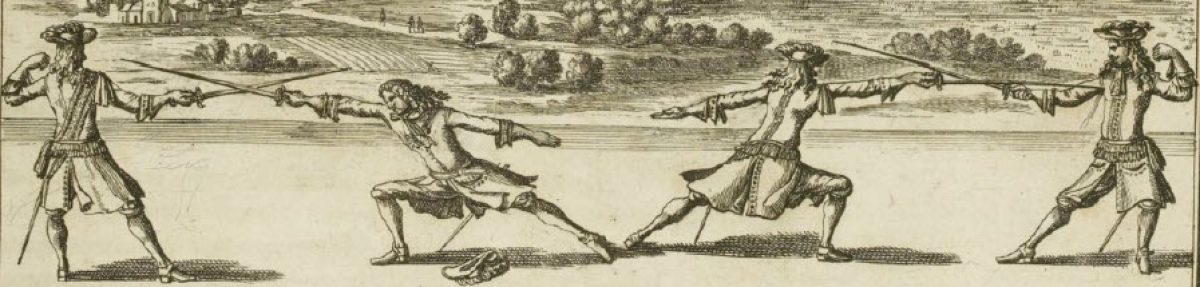
Patrick Bratton is the owner of Sala Della Spada in Carlisle, Pennsylvania and specializes in Italian military sabre and dueling sword, circa 1600-1900. CombativeCorner founder and fencing instructor Michael Joyce recently had the honor of bringing Patrick down to Winston-Salem, North Carolina for a workshop in dueling sabre. Directly afterwards, he agreed to answer both our students and readers questions in our popular interview series, “10 Question.”
Without further ado….
What brought you to an interest in fencing, and what brought you toward the Italian methodology in particular?
From a very young age, I was interested in swords and knights. As a young kid, I made armor out of trashcans and plastic flower pots and “fenced” with my dad. In the early 1990s, I got more serious training in a Korean karate style that had some weapons, and also Olympic fencing, the SCA shortly, and some other things. It was…
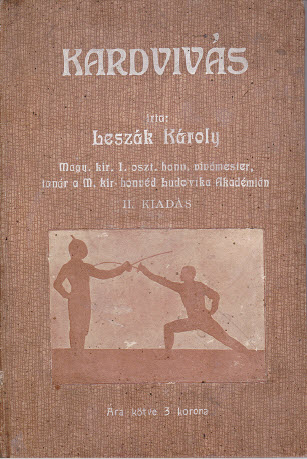
Karoly Leszák, Sabre Fencing, (Budapest: Adopted by the Ludovika Military Academy, 1906), translated by Russ Mitchell and Zalán Szalai, (Irving, TX: Happycrow Publishing, 2020), 158p. ISBN: 9798695368253. $20 US
Russ Mitchell, scholar, fencer, and instructor at Winged Sabre Historical Fencing school (Irving, Texas, USA), has published a translation of Károly Leszák’s Sabre Fencing (Kardvivás, 1906). This is the second in a series of works covering Austro-Hungarian Military Sabre (the first is Hungarian Hussar Sabre and Fokos Fencing, 2019). With this translation Russ and his colleague Zalán Szalai have opened an otherwise mostly shuttered window into this key fencing tradition. It can be obtained here:
This is an important text on multiple levels. First, most manuals written in Hungarian have not been translated into English, so unless one can read the original language the value of such works remains either unknown or incompletely understood. Since the importance of Hungary in the development of sabre cannot be overstated each new translation increasing access to that corpus is a boon. Second, any student of the Italo-Hungarian tradition should have an interest in this work as it was written at a pivotal time. Italo Santelli brought the Radaellian tradition to Budapest, Luigi Barbasetti to Vienna, and it was the merger of Italian and Hungarian elements that formed the system so many of us learned last century. Even today’s Olympic sabre program, though different in some key respects, owes most of their curriculum to the Italo-Hungarian system.
What works like Leszák’s give us is a look at a stage in development between Radaelli’s late 19th cen. students, men such as Barbasetti and Santelli, and what in some circles became the “bible” for mid-century sabre, Z. Beke and J. Polgár’s The Methodology of Sabre Fencing, published in 1963 (Budapest, HG: Corvina Press). The crucible which produced the mid-century game was largely the rise of the Olympics in the first half of the 20th century, a period that also witnessed the swan-song of the sword in combat. [1] What we see, in Sabre Fencing, then, is a snapshot of a tradition in transformation. Leszák was one of the masters at the Ludovika Military Academy–though these academies trained soldiers, the theater for combat they were increasingly preparing for was not a battlefield, but international competition.
If I may beg the reader’s forgiveness, I’d like to contextualize the importance of this as a product of the Italo-Hungarian school. Most of my sabre training came via Albert Couturier and his students, especially Larry Dunn and Brian Peña, though I also had the honor to take a few lessons with Ferenc Lukacs. Al’s master, Joseph Vince, was trained in Budapest when the system that Leszák describes was in place. Both Giorgio Santelli and Vince emigrated to the US, to New York, the same year, and went on to spread the mixed school on both coasts (Vince taught in New York, but is better known for his sala in Beverly Hills, California, where Tony Curtis, Cornel Wilde, and others studied fencing). [2] I have yet to determine which of the three schools in Budapest Vince attended, but if it is true that he was in the military then either Ludovika or the Toldi Miklos Royal Hungarian Sports Institution are the most likely (the third, the BEAC, the main university club, is also a possibility). Leszák, however, had studied at Weiner Neustadt Military School, Barbasetti’s campus, and both he and Gusztáv von Arlow (who authored another work on fencing, also entilted Kardvivás, 1902) studied the Italian school there. [3] For many years I’ve have researched the tradition in which I came up to see just what was Italian, what Hungarian, and how they mixed. Now, for the first time, and thanks to Russ’ expertise, one can do this more effectively. I’ve been reading Leszák with Joseph Vince’s Fencing (1940) next to me, and the parallels are striking, but so too are the departures. One can actually see, right there on the page, what is clearly Radaellian, what is Hungarian, and importantly how the two worked together to fuse what most people know as sabre. Looking through Vince’s work after reading Sabre Fencing is to see it in a new light; for one, though familiar with and an admirer of the French school, Vince’s foundation is Italian. One sees this in his foil and especially in sabre. Where Leszák included both direct cuts and Radaellian molinelli, Vince mentions the latter but focuses on the former. The realities of competition from 1906 to 1940 demonstrated that the traditional Italian extended guards left fencers’ arms vulnerable to wrist cuts; so too did the larger cuts. [4] This is just example of how access to a key Hungarian text informs our understanding of works we already know.
Russ’s work is a pleasure to read. His style is engaging, his obvious skill and insight into the context and material are matched in how humbly and good-naturedly he explores it. Few people possess the combination of talents to do this project justice, but Russ tops this short list. [5] There has been an explosion of translations, especially through print-on-demand self-publishing operations, and too often the hard work of the translators is undercut by their lack of expertise in the language, by failure to have skilled editors examine their drafts, and in failing to have another expert in that language go over their translations. With Russ Mitchell’s work we are on firm ground. He has lived and studied in Hungary, and he knows Hungarian, but he also enlisted the help of a native speaker to ensure accuracy. He had another brilliant translator, Christopher A. Holzman, read through the text as editor and to check the author’s use of Italian terminology and ideas. Moreover, Russ has the academic credentials, and experience, to conduct this type of research responsibly.
As to its contents, readers familiar with most works out of Italy in the 19th and 20th centuries may be startled by how similarly organized Sabre Fencing is. Like his contemporaries to the southwest, Leszák begins with the parts of the sabre, grip, first position (“basic stance”), the line of direction, and a break-down of the cuts. The cuts, significantly, he divides into “sabre swings”–following Hungarian and German terminology, and, molinelli, following Italian practice. Later, in section 21, he covers direct cuts. Both direct, short-path cuts and circular cuts from the elbow are there–this is just one example of the blending of traditions.
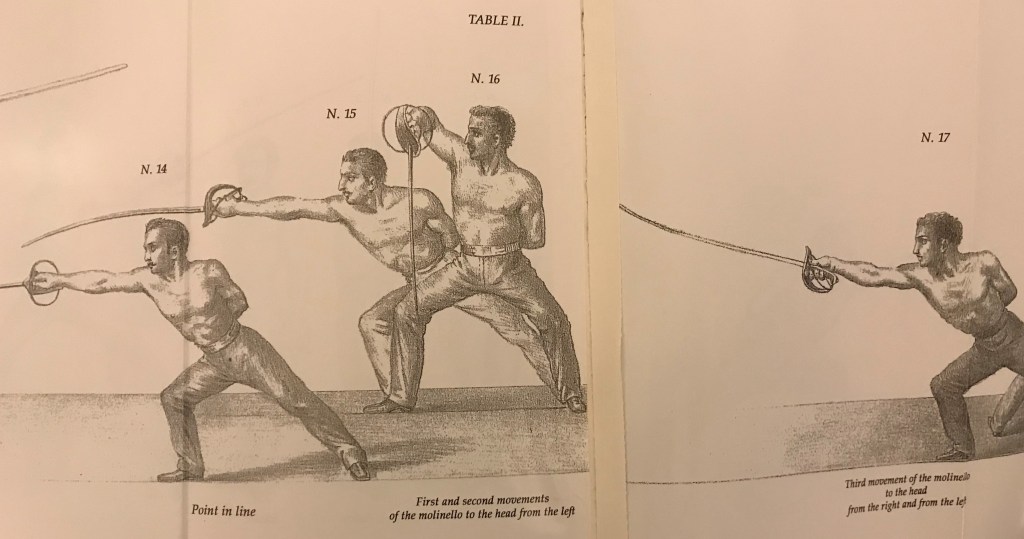
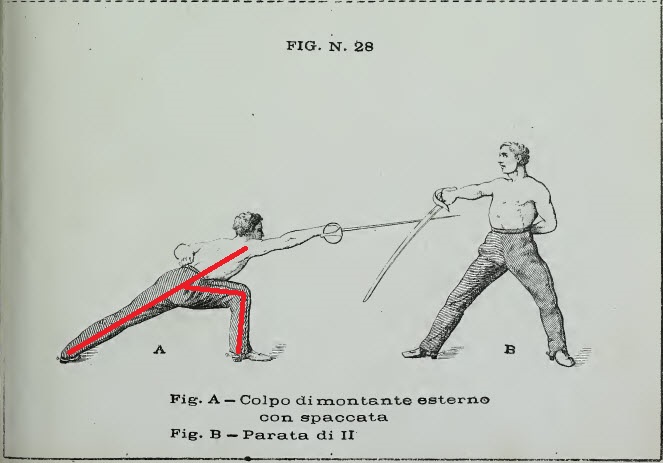
The author covers guards next and these are, with some minor changes, the guards of the Radaellian school, just positioned a little differently. The guard/invitation/parry of second, for example, is held more at chest height than shoulder height. Third is also lower than one sees in most Radaellian works. One version of low-fourth that may surprise is Leszák’s second way to form it–students of Hutton would call this a way to defend the “fork:” the hand and guard are to the right, the blade extended out left, straight, to defend/deflect a low thrust or ascending cut below the belt (cf. 27-28). A chapter on “parrying swings” and shadow-cuts (cuts made against an imaginary opponent) follows and reminds the reader that active-parries are an important part of the system. Molinelli, after all, we use in attacks, but can be used defensively too. The parrying swings were meant to help students hone the positioning required to defend themselves; today we refer to this exercise more often as “changes of engagement,” that is, moving from 2nd to first and back, from 2nd to 5th and back, etc.
Leszák Kardvivás, p. 10, two versions of Quarta Bassa/Low Fourth
Part Two, “School Fencing,” is an invaluable look at specific drills and lessons. A key pedagogical tool here, and one employed often in historical fencing, is pair-drills, only here students take turn as “master” and assist one another. Leszák notes that this allows them to be out of guard and rest, and thus fence longer, but that also it starts priming students who may go on to teach. It is, as he says, a more effective way to teach than group instruction. For fencers today, the lessons contained in part two run the gamut from actions on the blade to binds, from yielding/ceding parries to the counter-parry riposte game. Also included at the tail end of Part II are discussions of when and how one should begin bouting, some of the rules students were expected to follow in his time, and how to deal with both lefties and “instinctive” fencers.
Sabre Fencing is a rich source and the single most complete in English concerning the early Italo-Hungarian tradition. Leszák provides a thorough look at defense, offense, and tactics. Though “obviously, it is not possible to learn fencing from books” (9), as the author reminds us, this treatise will prove invaluable for those interested in the development of Hungarian fencing, the deep impact the Radaellian school had outside of Italy, and especially for students of the Italo-Hungarian tradition who wish to see, first-hand, what the Hungarian side of their heritage looks like up close. Parts of the book may be dense for some readers, especially newer fencers, because the author was writing for people with some training, and to a lesser degree because he knew that some students would arrive at the academy with a degree of experience in fencing (cf. 9), but Russ provides numerous notes to assist the reader with the more confusing or unusual aspects of the book. This is a must-have translation, and while perhaps of most interest to fencers in the Italian and Italo-Hungarian orbit, sabre fencers of any school will find much to mine within this text. Go. Buy it. Read it. Read it again, and start drilling.
NOTES:
[1] There were units in various armies issued swords in the Second World War, but they saw little action in most theaters. Japanese use in China and elsewhere is well and often graphically documented (a trip through the museum dedicated to the victims of the massacre in 1937 in Nanjing is not an experience one forgets). There were soldiers in the European theater who carried and/or used swords as well.
[3] Károly Leszák, wrote the manual for the Ludovika Military Academy’s program, Kardvívás [Sabre Fencing], in 1906, yes the one discussed here. He had been a student of the fencing school at Wiener Neustadt Military School, and so, was a product of Barbasetti’s program. I need to verify this, but one chap, Hungarian, claims that two Austrian lieutenants, Rudolph Brosch and Heinrich Tenner, learned Barbasetti’s method, introduced it to W-N, and in 1899 translated Barbasetti’s text into German. This same commentator says that both Leszák and another author, Gusztáv von Arlow (who authored a sabre text in Hungarian in 1902), were students of the Italian school as shared at W-N. For more on Barbasetti’s work within the Austro-Hungarian Empire, see http://www.ars-dimicatoria.cz/en/barbasetti-military-sabre-since-1895-2/
[4] The lighter blade developed in the early 20th cen. changed everything. Those quick to criticize the excesses possible with the sport blade often find the system guilty by association. This is to mistake effect for cause. As most works on sabre make clear, aberrations in rule-sets and nonstandard techniques reflect a concern for victory in sports, not inherent flaws within the tradition itself. My generation, for example, was taught proper edge-alignment and was penalized when we failed to execute an attack with it. Many within that same generation, to win, adopted the low-hanging fruit of whipover to score when sabre went electric.
[5] Russ has the chops to conduct research well. He possesses advanced degrees in history and in medieval studies, has experience publishing in academia, and studied in Hungary. His first book in this series set the bar high for publishing in historical fencing, and serves as a fantastic guide to sharing difficult information (in this case a broken sabre tradition) in a responsible, approachable, and useful way.
L’armee Française–Cavalerie Lègère–Trompettes de Chasseurs
If the last few posts were a clarion call against what not to do, then this one, in order to restore a little balance, is more a small bugle announcing more of a what to do. Those who know the oeuvre of Peter Sellers may recall the opening scene of “The Party” (1968) where his character, an actor named Hrundi V. Bakshi, plays a Gunga Din who refuses to die even after volley after volley by both the Thugee cultists and the colonial English army. Tone-deaf and prejudicial issues around cultural appropriation and stereotypes aside, that scene is perhaps an apt analogy for the amount of binary ink I spill about the proper and improper use of our sources. It comes up a lot, but then it’s a major problem within historical fencing and thus a fitting topic to treat. Again, and again.
Of the students that I’ve been able to meet with during the pandemic one is an experienced fencer with whom, until recently, I have worked sabre. In our discussions about it, however, we’ve occasionally discussed parallels with other weapons, chief of which—for my tradition—is foil and by extension, smallsword. The north Italian fencing tradition, because of French influence during the Napoleonic era, was different than the southern Italian tradition as exemplified by masters like Terracusa e Ventura (1725), Rosaroll & Grisetti (1803), and Parise (1882). A good friend and fellow student of fencing both Italian and French, Patrick Bratton (Sala della Spada, Carlisle, PA), can speak to this better than I can as he has been studying the source tradition for specific elements of that influence, but in short there are some parallels in north Italian sabre and foil.
I was surprised, if thrilled, that my friend and student wanted to take a look at smallsword. With the pandemic the need for variety and diversion is perhaps stronger than usual, and so switching over to smallsword for the last few weeks has been a nice break. This has been, parallels notwithstanding, new material for him, and just enough different that it’s been important to go slow so that we build the fundamentals correctly.
Converting Text to Technique
To illustrate this process, and by extension how one can use sources, I’m going to take a look at one of the more complicated actions that we’ve looked at in his lessons to date. It’s important to note a few things. First, this is a quick look at one source, not an exhaustive look at how various works at the time cover the same action. Second, “complicated” is a relative term. For many Olympic fencers this attack, while compound, is relatively simple in the sense of easy (not in the technical sense of simple attacks). However, here one must remember that the art of defense, by definition, is conservative. The more actions one makes, the more tempi, and this means that one’s opponent has more opportunities to disrupt one’s plans and strike.
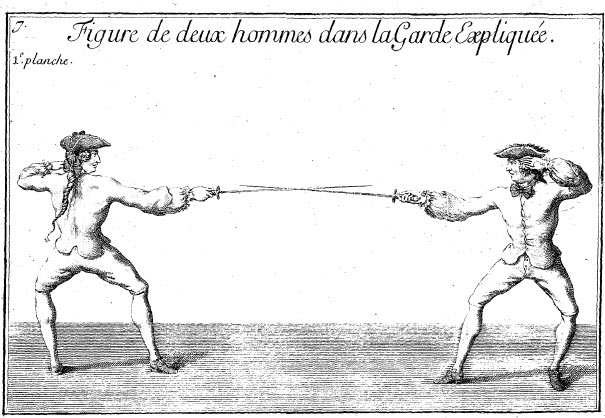
“Figure of two men in the guard as explained”–Girard (1740)
After having worked fundamental actions, in this case direct thrusts in tierce and quarte both firm-footed with a lean and with an advance-lunge, always with opposition, as well as simple feints, we took at look at double feints. For this drill I looked to P.J.F. Girard and his Traité des armes (1740), Second Part, “Double Feint Quarte:”
To Thrust Quarte
This thrust is done firm footed, advancing & retreating, with or without appels, as is generally the case with all fencing attacks, as has been said before.
Double Feint Quarte
Sword engaged in tierce, I feint quarte while stamping the right foot, hand at shoulder-height, with the nails turned upward & the point near the enemy’s hilt, body back, then feint tierce outside the sword; & when he returns to parry, thrust subtly in quarte inside the sword, the hand leading, to be ready for a parry in case of a riposte, & to riposte as you see fit. [1]
The original French reads thus:
Double Feinte de Quarte
Pour Tirer Quarte
Cette botte se fait de pied ferme, en marchant & en reculant, avec des appels du pied & sans appels; ainsi que généralement tous le coups d’Armes, comme il est déja dit.
Double Feinte de Quarte
L’Epée engagée de tierce, je fais faire une feinte de quarte en frapant du pied droit, la main à la hauteur de l’épaule, tournée les ongles en dessus & la pointe à côté de la Garde ennemie, le corps en arriere, puis la feinte de tierce dehors les Armes; & lorsqui’il revient à la parade, tirer subtilement de quarte au dedans des Armes, la main la premiere dans le principe, pour ȇtre en état de parer en cas de riposte, & de riposte à propos.[2]
There is a lot here and much of it requires familiarity with earlier material Girard covers in Part 1, in particular expressions such as “firm footed” (pied ferme), “sword engaged in tierce” (L’Epée engagée de tierce), or thrusting in “quarte inside the sword” (tirer… de quarte au dedans des Armes). These may or may not be obvious to the reader. Some expressions, such as “firm footed” are not part of modern fencing’s vocabulary, so, a first step is to go back and read the relevant sections in the work that explains these concepts. The master first mentions the idea in his twelve points for the en garde position, point 12 (Crawley, 38; BnF Girard, 7):
12. Finally the left foot is flat & firm upon the ground, presenting the inside of the foot to the right heel.
XII. Ensin le pied gauche à plat & ferme sur la terre, présentant le dedans du pied au talon droit.
Girard begins Part 1 with an examination of actions “against those who always remain firm footed” (Crawley, 48; BnF Girard, 14ff). [3] In simplest terms, he breaks down the assault into two major types, firm-footed (i.e. where they do not get in and out of measure, but remain in it) and those were at least one of the opponents is moving, either advancing or retreating.
I used the same break down to build a drill—initially we would approach this double feint firm-footed, and later employ more movement, in this instance where the student would begin out of measure and advance to engage.
What is Stated, and, What is Not
The concepts of “inside” and “outside” the sword refer to the same concepts today, that is, what we normally term the inside and outside lines. The outside is, assuming a right-hander, to the right of the weapon as one stands on guard; the inside line all that space on the left. To have the sword engaged in tierce, the fencer making the feint assumes the guard of tierce (modern Italian terza or French sixte), and makes contact with or engages the opposing steel so that the opponent’s blade is to the right. In this drill, we initially had both of us in tierce. [4] The feint is made in quarte, so, to the inside line. It is not stated here, but in order to do this one must disengage under the opposing steel, so, moving from tierce to quarte or from the outside to the inside line. Girard’s detail about the hand and place of the sword tip are crucial—this disengage must be tight and performed in such a way that one continues to block the threat of the opponent’s weapon.
Here too, Girard is not specific, but after the feint the assumption is that the opponent will move to parry in quarte thus safeguarding their inside line. As they do so, one feints in tierce or to the outside line—again via disengage—in order to draw the opponent once again into a parry of tierce. When they do, one then disengages a third time and thrusts along the inside line to target, but maintaining opposition in quarte. A student of modern foil with a few months of experience can likely puzzle this out, but even then some of the language is different, not to mention the emphasis placed on closing out the opposing steel.
It may be helpful for some fencers to render Girard’s instructions into modern fencing parlance:
From an engagement in third/sixth, disengage and feint to the inside line
As they parry fourth, disengage and feint to the outside line
As they reassume third/sixth, disengage and thrust in fourth to the inside line
*in each case, both feints and the final thrust, are made with opposition, that is, closing out the line so one is not hit
Start with both fencers in measure, blades engaged; later, have the student enter into distance and take the engagement
There is no reason one must retain the original wording, but it can help reinforce what one is reading sometimes. If the older expressions trip one up, then convert them to the modern versions if you know them—this exercise alone will force us to make sure that we really understand what it is we’re reading.
Languages
While a short passage, and seemingly clear, there is a lot that Girard assumes the reader will supply. He does not tell us to disengage; he assumes that we understand that we must because we are changing lines from outside to in, from inside to outside, and again from outside to inside. These are the little things that can make parsing historical fencing treatises difficult.
Blow of high quarte inside the swords–Girard 1740
I supplied the original French here for several reasons. First, we rely on translations—especially in the States—for most of our work. This means that we are attempting to recreate, as best we can, systems used in the past and conceived of and understood in a different language. Translation is as much science as art, and it takes considerable skill and training to do well; if you have French or Italian or whatever language your area of study was originally in, then it behooves you to ensure that your translations are solid. Check your English version against the original. If you don’t have French etc., but know someone who does, ask them to give it a once over. Second, because translations mean that the translator is making choices as to definitions, sentence structure, etc., it is useful to take a closer look at those choices. Sometimes, it makes little difference—pied ferme, for example, is pretty clear, “foot firm,” or as we would say in English, “firm foot.” But, if we look at tirer, for example, this is less clear. In modern French tirer can mean: “to pull, to pull to/to close; to draw (as in to draw curtains); to fire or shoot; to print; to take.” Not one of these definitions really works well here. The closest we get is the fifth meaning (according to my Collins French-English Dictionary), “to shoot or fire,” but we would not say that one “shoots a thrust” or “fires a thrust.” Philip T. Crawley renders tirer in Girard as “thrust,” and in context that makes good sense. Further examination into the use of this word in other works on fencing from the time would confirm that this is a good choice of definition. One might even note that the Italian cognate (tirare) was used the same way. [5]
Using Word & Image Together
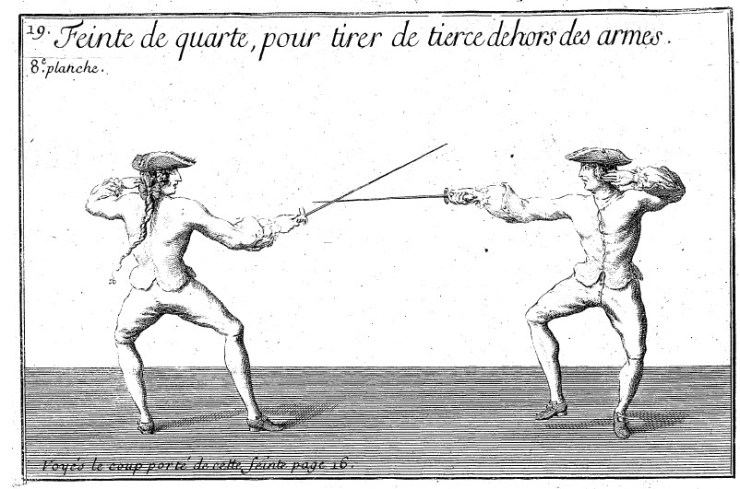
Feint of quarte, to thrust tierce outside the sword–Girard 1740
Girard included illustrations which aid the reader, but as static images they capture at best a moment in time, a snapshot of action. We can easily see what a guard might look like, or the moment that one fencer is about to act or has completed an action, but we cannot see a disengage. We cannot see the intensity and attitude needed to sell a feint. Here, in Girard’s 8th plate (8 planche), we see the fencer on the right lift his foot to make an appel, and he is clearly in preparation, but unless one can read the French or has a decent translation, it would be easy to conclude–as one example–that he is mid-extension and about to lunge. We cannot see what a lunge looks like as it happens, but we might see one prepare for it. We need to read the caption to realize the difference. We can and should make use of the images if we have them, but always with the caveat that we cannot assume that they are completely faithful to what the author intended and what the fencer should do. Some images supply added material, such as dotted lines meant to capture the movement of a weapon or a limb, but even here these are representational; they’re symbols, shorthand for complex ideas and motion.
Exploring what Girard, or any other master, advocates for a fencer requires that we pay close attention, that we read carefully, compare any illustrations against what we read, and that we remain open to correction as our study continues. Were we only to use Girard’s plates we would not get very far—there is too much he doesn’t depict, too much he couldn’t depict. As the example of the double feint in quarte hopefully demonstrates, even the text which explains an action leaves out key information. It may be covered elsewhere in the work, but it might not, and so taking the time to read closely, to compare the translation in our language against the original, to work via analogy as and when appropriate, and to set word and text side by side is vital if we are to have any hope of successfully recreating the systems of combat that these sources preserve.
NOTES:
[1] This translation is via Philip Crawley’s edition of Girard; P.J.F. Girard, The Art of the Smallsword: Featuring P.J.F. Girard’s Treatise of Arms, trans. by Philip T. Crawley (Wyvern Media, UK: 2014), 95.
[2] P.J.F. Girard, Traité des armes (La Haye: Chez Pieree de Hondt, 1740); available as a pdf or online at Bibliothèque nationale de France, Gallica, 48, https://gallica.bnf.fr/ark:/12148/bpt6k229941w.image . Hereafter, BnF Girard. I cannot express how much I value the hard work and generosity of libraries like the BnF for sharing so much online.
NB: Languages change over time and in the 1740 publication, either because Girard rendered it this way or because the printer decided to, the initial “e” in l’épée is capitalized and lacking an accent aigu where one might expect one in modern French.
[3]Contre ceux qui demeurent toujours de pied ferme. Bnf Girard, 14.
[4] Of note, tierce in smallsword is held nails-down or pronated, thumb at about 8 or 9 o’clock; modern Italian third, hand in fourth position (suppinated, thumb at about 3 o’clock) is more typical of the invitation in third; French sixth, likewise, has the hand suppinated. All three are meant to cover the outside line or defend it, and create invitations to attack the inside line, but it’s important to note that they do this somewhat differently.
[5] I am currently reading through every source for rapier and smallsword I can obtain (and read) looking at some specific elements, and the similarity in language between some of the Italian and French works are striking if not unsurprising. Originally I had intended to produce an article out of this study, but it has grown too large for that and so it will likely live here in some guise.
The Much-Maligned Smallsword and Foil and why it Matters
from Brown University Digital Repository [https://repository.library.brown.edu/studio/item/bdr:244908/]
One of my favorite weapons to fence and teach is smallsword. I started fencing foil—a descendant of smallsword—in the 1980s, and though obviously adapted for safer training and the sport of fencing the fundamental elements of foil impart more than most people in “HEMA” believe. Moreover, my initial training was French, and the smallsword being perhaps the early modern French weapon par excellence there is something familiar and nostalgic (if that is the right word) about it. One benefit of subsequent training in a related, but distinct tradition (in my case Italian with Hungarian elements) is that one gains another view of that previous study, just as studying another language can illuminate one’s native grammar. While modern foil and smallsword are different, it is context more than anything else which separates them. The rebated weapons of two centuries ago, while similar to the tool of today, were used to mimic actual combat safely, not used purely as a game, and in this one key difference everything rests. Because so few people within historical fencing understand or accept this, however, one of the most deadly, sophisticated swords ever devised, and its descendant, is often the object of amusement and mockery. Sad as that is, what is worse is that in discounting smallsword and foil they lose the single greatest method by which to explore the extinct sword arts that do interest them.
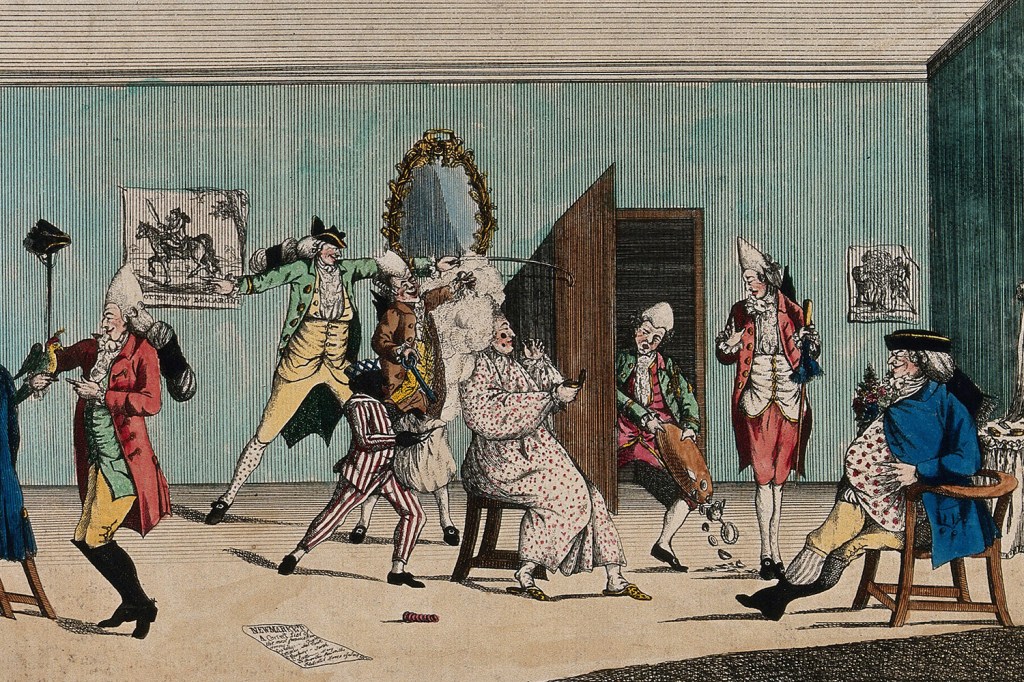
Wigs, Lace, and Lorgnettes
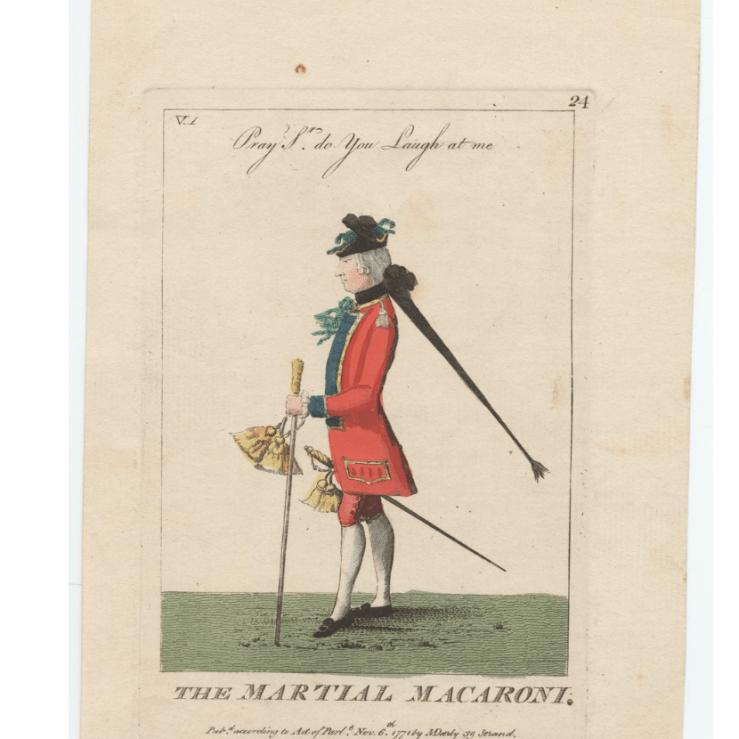
“The Macaroni: A Real Character at the Late Masquerade,” (1773), Philip Dawe
The derision that smallsword suffers in “HEMA” reflects several failures within the community. Arguably it reveals a latent and wide-spread species of bigotry. The abuse aimed at this “dainty” or “tiny” or [insert equally facile insult here] weapon highlights the thinly veiled prejudice in HEMA’s macho culture, far too much of which poisons the community and retards its progress. Aside from compensatory attention devoted to big weapons, go hard or go home, and “I gots brusies bruh!” there is the bigoted notion where sophisticated = weak/effeminate/gay, the idiocy and ignorance of which speaks volumes. Second, dismissal of smallsword, just as with its descendants, indicates a complete failure to grasp the depth and importance of the primary means by which one learns the universals of fencing. This is not merely my opinion, but demonstrable on a number of levels, from the wide array of works on fencing published over the past five hundred years to the gulf in quality one sees in the historical community, not only in terms of performance, but also in terms of translation and teaching.
While fascinating, the parallels between modern disdain for smallsword and 18th century censure of the young people of fashion called “Macaroni” and “Macaronesses” goes beyond the confines of this piece. There are better places to go for the exploration of prejudice in the 18th century as well as the on-going discussion of the battle for equality and civil rights today. My stance on all that, for what it matters, should be obvious from previous posts, but I cannot speak to either issue as appropriately as I can to the second failure, that is, the mistake that most of HEMA makes with regard to anything they define—however poorly or inaccurately—as “sporty” versus what they deem “martial.” [1]
I dtir na Ndall [“In the Land of the Blind…”] [2]
As the old saying goes, in the land of the blind the one-eyed man is king, and if any one maxim summarizes HEMA it’s this one. Examining the usual allegations against smallsword and foil one sees how poorly they are glimpsed without full vision. First, the chief bias appears to be that smallsword (a weapon), because it is related to foil (a training device), is less a weapon than say broadsword. If foil is for sport, then anything like it must be too. Second, for those who see it as a weapon its size, complex method of use, and “late” appearance make it suspect. The logic here, such as it is, suggests that the older a system is, the more legitimate it is; that lighter weapons must be less “martial;” and that anything related to the duel—save rapier—are again less serious than the “heavier” and more manly longsword, axe, etc. The ridiculousness of each of these assertions is underserving of attention, so to be brief:
a foil is a practice weapon, be it the modern foil, a feder, or wooden wasters—that Messer you use? Yep, it’s a foil. Ditto your Albion, Regenyi, or Ensifer
puncture wounds, made by triangular bayonets or the often triangular smallsword blades, leave really nasty injuries; before the innovations of 20th cen. medicine there was little one could do to repair these wounds or deal with the infections that often resulted (cf. sepsis)
fighting in judicial combats with a pole-axe, sword, or anything else was just as formal and bound by convention as late period duels were by the restriction of ground and etiquette
These are all well-established by histories old and new. In truth the bias really has nothing to do with history at all, but with a strong desire to differentiate oneself from “sport.” Anything that is remotely connected to sport, then, is suspect in the eyes of HEMA-Bro. Late 19th century sabres of 650-800g? Too close to the modern sport sabres. Smallsword? Too much like modern foil. That’s it. That’s really all it comes down to, and such short-sightedness cripples not only their research, if they do any, but their own practice and pursuit of the Art.
Why Later Period Systems and Modern Fencing Matter
Misplaced bias against both later period historical systems and modern fencing means, in most cases, that these fencers lack a firm foundation in fencing universals and pedagogy. This lack is what tends to undermine their study most. For example, because they have no idea what actual fencing fundamentals are, they mistake aberrations for norms. When they see the problems that are easy to spot, such as the whip-like strikes from electric foils behind competitors’ heads or the floor-dragging sabre slap to a guard, they assume that what they see is the system. Wrong. Even now, decades into the worst offenses in foil, students are normally taught that extending the weapon proceeds movement of the foot and the body. This is universal and is reflected in literally centuries of treatises and hundreds of modern schools. Thus, when viewing anything in the Olympics, the World Cup, or the local NAC, one must differentiate between how a fencer performs that extension as well as how a director views and calls that same action, and examine it against what is taught. They’re often different. Competition, like it or not, comes down to successful exploitation of a rule-set. One doesn’t have to be the Chevalier de Saint-Georges or the Chevalier d’Éon to win; determination and skillful use of attributes win more fights than most fencers wish to admit.
“A macaroni dressing room,” (26 June 1772) by I.W.
Not only do they fail to distinguish between what is taught and how it is used, but HEMAland also rejects traditional and sport pedagogy. They lose far more than they gain from this. Open most any decent work on fencing published in our own time and one will see first, that most do not include the ridiculous point-eating techniques, and those that do often with qualification—that is an admission, by the way, that the authors recognize that the technique is not part of the received tradition. [3] A fencing treatise is more than a collection of “moves;” it is an organized program that orders techniques, drill, and lessons in a meaningful way. It also instructs one in a vocabulary shaped by centuries of development, one benefit of which is that it provides a more effective means to discuss one’s study. Most of all, a year of foil—and this is reflected in the better modern works—imparts fundamentals that transcend foil. Knowing, for example, how the chief universals—time, measure, judgment/method—operate, and how one manipulates and achieves those universals effectively through movement, is crucial in examining any other system of martial arts, but especially those from which the modern version derives. [4] That may not seem important, but for the historical fencer it ought to be, because it is far easier to understand the unknown through the known than to come at the former with nothing or some half-conceived theory of one’s own.
In my last post (Sept. 20, 2020) I mentioned the infamous example of the misreading of Capoferro where the untutored surmised outlandish theories about his lunge. Had they had proper training in the modern lunge, done a bit more digging in the sources between now and Capoferro’s time, then the great mystery of Capoferro’s lunge would not be a mystery to them. Armed with even a nodding acquaintance with modern theory and practice would’ve helped those fencers avoid a grave mistake. Put bluntly, throwing out all that modern fencing has to teach, a system built—again literally—on centuries of work, is stupid and self-defeating. Modern fencing no more exists in a vacuum than did early modern or medieval fencing.
The Problem
For the same reason they poo poo later period weapons and modern fencing, HEMA-Bruhs refuse to listen to those who’ve studied them. Only people with the benefit of that training, or who take the trouble to learn about it, can see how all of this is actually a problem and not just sour-grapes or envy. The HEMA equivalent of anti-vaxers are convinced they have it right, refuse even to entertain that there might be something to learn from late period systems (though they’re ready enough to apply Japanese cutting mechanics and poorly understood kinesiology…), and so dismiss it out of hand. This is not a problem limited to the States either, though it’s perhaps particularly entrenched in American HEMA. We see it in the posers who ape the scholars they denigrate, in the sad attacks on established researchers by people who either deliberately misrepresent their position or are too stupid to understand it, in the idea that a few seminars make one an instructor, and in the odd notion that a 12 page pamphlet contains the same depth and sophistication as the works of Rosaroll & Gristetti or Prevost.
If those with respectable experience in Olympic and traditional fencing are ignored, then the only way to realize the value of later period arts or modern fencing is for the SPES-clad fencer to take that painful step and look at it more closely. Few do, and the results to an informed perspective are disappointing—half-baked theories, ill-conceived approaches, flawed interpretations, and a near complete lack of awareness of the importance of drilling fundamentals. [5] Our interpretations of past combat systems are only as good as the effective use of our research tools—studying extinct sword arts without some knowledge of fencing is akin to entering a bout without a weapon. Together, these flaws mean that much of HEMA is getting it wrong, and for a community supposedly interested in producing as accurate an interpretation of these extinct arts as possible, that makes little sense.
NOTES:
[1] I’m male, middle-aged, white, and hetero, and thus should not and will not speak to the experience of women or LGBT people. Friends and family who fall into either category, however, have shared a LOT with me about their own experience with bigotry so concluding that it juuuuust might bother them doesn’t seem too crazy to me. Just saying.
For related 18th cen. views, interested parties may wish to read some of the literature about notions of “masculine,” “feminine,” and the connections to contemporary ideas about sexuality in the Baroque and Georgian eras:
[2] For the person interested in the full Irish version: I dtir na ndall is rí fear na leathshúile.
[3] Compare for example Maxwell R. Garret, et al., Foil, Sabre, and Épée Fencing: Skills, Safety, Operations, and Responsibilities, University Park, PA: University of Pennsylvania Press, 1994, p. 134 on the “Flick (Cutover)” and Henry de Silva, Fencing: The Skills of the Game, Ramsbury, UK: The Crowood Press, 1997, p. 23, “The Cut-over or French Coupé.” Maxwell presents the flick as a cut-over, a reflection of how it was treated in competition in the mid-90s, where de Silva, writing a few years later, treats only the cut-over sans “flick.” It’s a subtle distinction, but for those of us competing at the time that remember the controversy over the flick and ROW, this reads a certain way.
[4] The universals always include tempo and measure, but the third term varies. Marcelli in TheRule of Fencing (1686) supplies “method” to the first two terms; Terracusa e Ventura, True Neapolitan Fencing (1725), speaks of velocity, tempo, and measure; de Bazancourt in Secrets of the Sword (1862) refers to judgment, control, and speed; Castello in The Theory and Practice of Fencing (1933) prefers distance, timing, calculation. To understand how these relate, why different masters chose different terms, requires reading them, not only for why they say what they do, but for how these terms relate to one another. Without a handle on the universals one’s ability to make sense of most works on fencing is hobbled—Girard (though see Traite des armes, Part III, “Advice for Good Composure when Fencing,” XI), Angelo, and many others assume the reader understands these or explains them within particular sections, so while not spelled out these concepts underlie all that they discuss.
[5] An informed perspective includes but is not limited to professionally trained fencing instructors, experienced fencers, or credible researchers. These is wiggle-room within these terms and I mean for there to be. There are veteran fencers, for example, who know more than many masters and teach as well or better; amateur researchers (vs. university trained researchers) who help us push the boundaries of what we know responsibly; and there are masters and professional scholars who raise the bar higher for our study of historical fencing. However, there are a lot of people who are teaching and shouldn’t be; there are a lot of people playing scholar who haven’t the least idea how to conduct research; and there are professional academics and maestri who don’t play well with others.
It is telling to me, for example, that while details may be in dispute among the maestri, scholars, and veteran fencers I know, none subscribe to the ridiculous theories that plague historical fencing, such as the silly theory of the lunge where the toe/balls of the feet land first. They are, generally, more open to new interpretations when those interpretations are better; less ready to make firm conclusions, especially for the medieval works; and understand the differences in the types of texts, how illustrations can work, and that the less a source contains, the more careful we must be. Most of all, they possess more sophisticated reading skills and realize that what they read or say must be analyzed, not just taken at face value. As a close friend has remarked, the “plates and plays” approach to HEMA is flawed; it fails to take into account all that is not right there in the image.
The question asked of sound and trees falling in the woods works for many situations. It’s especially apt as so many of us work alone thanks to the pandemic, but even in the best of times fencing is—be it conducted within a club, school, or team—a solitary pursuit. Our training partners and opponents are instrumental in our growth, and we cannot progress far without them, but the hours of footwork, conditioning, and drill honing technique is a responsibility on the individual fencer. All the flash and fire, all the joy experienced in flow during a bout, little to none of that does one enjoy advancing, retreating, and lunging, doing point-control drills, or performing molinelli against a pell. At its best it can be meditative, but normally, about as good as it gets is merely the awareness that the dull work matters, that one has successfully executed the necessary discipline, and that it’s all important. Unlike bouting, it is not “fun,” though absolutely crucial in our development.
Solo Drill & Isolation
On a another level, however, there is or can be a loneliness in fencing. In most ways it’s a journey we take alone, so that makes sense, but in the deeper waters of the Art and in trying to find other explorers at that depth the isolation, if we’re not aware of it and careful, can be detrimental to our study. With the pandemic, when most of what we can do safely is solo drill, it’s hard enough to find motivation to do the grunt work let alone fight that added sense of isolation if it assails us. Thanks to the internet this is a problem we can alleviate in some degree—few days pass where I don’t chat with the few people I know who are as keen to plumb the Art’s depths, explore texts, and learn as I am. After all, few people in our community, never mind people outside of it, enjoy the deep dive and can discuss the Art for hours on end. I know I’m not the only one who has watched a hapless friend’s eyes glaze over with the unmistakable look of a person that realizes they should never have asked us about fencing. The ability to chat with people far distant is a lifeline we’ve not always had and we should be grateful for it.
“The IT Crowd,” BBC, on sports
On a public level too fencing can be lonely. Like any more or less obscure pursuits fencing is not one of the typical dinner-party topics or likely to come up at a rave, farmer’s market, or appropriately distanced line at a grocery checkout (the six feet rule protects us not only from the virus, but small talk 😉 ). [1] American football, however, or the other sports-ball games, the latest shows on television, etc. are far more likely as topics of conversation. In short, most fencers have no one else to discuss the Art with apart from other fencers, not all of whom devote the same amount of time to it.
Moreover, with all that is going on in the world, with the dire challenges of climate change, Covid-19, social and political turmoil, and every person’s own trials, devoting time to a complicated, obsolete martial art probably seems silly or irresponsible to many people. Even assuming the fears of the conspiracy-minded sorts out there panned out, it would be a long, long time before anyone needed to use a sword again in earnest–in the US alone it will take centuries to run out of bullets–so in terms of the “practical” side to fencing it’s a hard sell. Not impossible–a cane, umbrella, or stick in the hands of a decent fencer is not something anyone should want to experience. So, maybe studying a dead martial art ranks low among the wines and spirits, but the Art can also be a healthy diversion, decent exercise, and intellectual entertainment, which are reasons enough to pursue it. It can be more than that too. The combination of physical and mental stimulation and exertion can be great stress relief.
Of the various perspectives perhaps one of the hardest is the lack of interest or even censure from other fencers. It’s hard enough to feel isolated generally, but when it comes from seemingly like-minded people it is that much harder. Typically this is something, when I’ve experienced it myself, that comes from either Olympic fencers or from similarly narrow-minded sections within “HEMA.” Truth is that everyone filters things through their own experience; reason, evidence, all that has little to do with it.
For example, in the 1990s when some of us defected from Olympic fencing to explore ways to make fencing about swordplay again, there was little support from our comrades. Impassioned appeals were usually met with laughter or hostility. I know my own disappointment and frustration with the poor decisions the FIE was making were made worse by the near complete lack of sympathy from teammates. Our vocal complaints about the system, especially with newer fencers in the mix, were not conducive to group cohesion, but we wanted those newer fencers to know there was a difference between defense-minded approaches and the slap-happy b.s. then in vogue. This is something that typically hits harder as one has more perspective. As it turns out, those of us upset about some of these changes were correct, and this is maybe one reason that to this day some former teammates haven’t forgiven us. [2]
Scene from “Gaslight,” 1944
It is extremely easy to feel gas-lighted in situations like this. I tend to hate terms like “gas-light,” but having had too much experience with it, even in fencing, it’s appropriate. Like many things, there is a spectrum for gas-lighting, but one of the most difficult to manage and overcome is the particular species wherein people believe that you believe something, but do not believe you’re correct and actively do things, wittingly or unwittingly, that make one feel like they’re losing their mind. [3] They offer what seems like positive reinforcement but which really only confuses everything–one comes away under the false assumption that they agree, when they don’t. We discover that the face they present to us is not the one they share with everyone else, the result of which breeds further confusion when in company with shared associates and it becomes clear there is a difference in what they’ve heard.
For fencing, an illuminating example is where people stand with regard to a silly rule that to this day affects Olympic sabre, t. 70 1 & 2, which states:
METHOD OF MAKING A TOUCH t.70
The sabre is a weapon for thrusting and cutting with the cutting edge, the flat and the back of the blade.
All touches made with the cutting edge, the flat or the back of the blade are counted as good (cuts and back-cuts). [4]
It should be obvious why this is a problem. The decision to allow the flat of the blade to score was the FIE/USFA’s “solution” to the problem of whip-over in sabre. The logic was apparently that an attack made with right-of-way, even if it hit the guard, was valid if the light went off. Since the director cannot overrule the light (see for example t. 73.1), the only arbiter of the validity of a touch is the box, so despite the idiocy of attacking literally the strongest area of defense, one can–and people do–score by slapping the bell-guard. Because competition reflects responses to a rule-set, the nature of fencing and in time instruction (in some areas) changed.
Those of us unhappy about this were ignored, ridiculed, or told to shut up. Of these the response easiest to manage was ridicule–at least that was honest. We mined older works on fencing and photographs and illustrations of sabres with wider blade profiles. At one point, I collaborated with a close friend and fellow sabreur, an engineer, and we rigged up electric sabre kit with the closest thing we could find to period blades, schlager blades, and demonstrated that fixing the problem was as simple as returning to an earlier blade style. Whip-over disappeared. We even had one of our master’s assistant coaches try it, and while he agreed that it was better, he shrugged it off. It didn’t affect him at his level of competition–where training reflected a pre-electric mindset–so he didn’t see the issue. In his mind, the problem with whip-over wasn’t anything other than the fact that most people experiencing it were just “bad fencers.” To those of us trained as he was, but having to fence people increasingly taught to exploit this rule, it was maddening. One either adapted and did the same or quit.
The facts, evidence, the goal of helping the community fix an error meant nothing. A lot of us, myself included, felt abandoned, and it was easy to feel like it was all in one’s head. Rationally we knew the evidence supported us, but it didn’t matter to anyone else. What does one do when that happens? Our solution was to press on, and apparently a lot of other people did too, because now there are multiple companies making blades along earlier lines. There is also the classical/historical community that mushroomed in the wake of the exodus from Olympic competition.
So What?
The take away lesson is this: pursue the Art for you, for the reasons that make sense to you, and close your ears to those who mock, attack, or play Janus with you. If Olympic is your thing, do that; if classical/historical is, do that; if it’s bohurt, LARP, SCA, or anything else, go for it. So long as you’re honest in your study, with yourself, and with everyone else it’s hard to go wrong. Not everyone will see it that way, but the right people will and they are the ones who matter. They are your community even if they live half way around the world. As the pandemic continues, as we are forced to train more or less in isolation, we may as well do that the best way possible, and use this time to examine our study more closely, more honestly, and separate wheat from chaff, not only in terms of the Art, but of those who help or hinder us in our pursuit of it.
NOTES:
[1] Yes, I know, no one is going to raves or anything, but still.
[2] One of the hardest parts about owning one’s own share of the responsibility in a bad situation is that other parties will take advantage of it even so far as to use your admission against you. In this instance, both my close friend and I apologized for “souring” younger sabre fencers, but it did no good. It doesn’t matter that we were correct, it doesn’t matter that we did the right thing in owning our share of things, it changed nothing. It neither fixed that relationship or any other, and arguably it made some worse. This said, it was still the right thing to do.
For the past few weeks I’ve been working on an article that treats an issue I seem to return to again and again—the challenge of using images in interpreting historical fencing sources. If this amounts to the proverbial flogging of deceased equines, then in my defense this particular horse is a zombie. It just won’t die. The deeper into this current project I dive, the more I see the ways that we can go wrong in interpretation. It’s tricky work. It’s one reason that professional scholars and researchers spend so many years acquiring the skills, contextual knowledge, and tools required to do this sort of work.
No one is immune or safe from a poor interpretation. It’s not an accident that scholars worthy of the name also learn to remain open to new evidence and interpretations better than their own. No one enjoys discovering that their conclusions have turned out to be incorrect or missing something important, but sometimes it happens and the best response is to meet the news with a becoming grace. Thank them for their insight and for alerting you to it, then revise and cite their contribution.
For those of us working with and from treatises with images we must always be careful. Modern life is awash in imagery and most of it we see without noticing it, from billboards to commercials on tele. We apply, again without conscious thought much of the time, an impressive array of reading skills as we encounter ads, instructions, news articles, and street signs. We are good at this. However, our relationship to images is often different from the ways people approached them in the past. We have to be aware of our assumptions and how we assign meaning to what we read.
IKEA’s wee question man
To approach a period treatise on fencing the way we do furniture instructions from IKEA is often unwise. With the exception of the abstract figure with the speech bubble and question mark, the instructions for assembling your new cabinet are intended to be as simple and realistic as possible. No matter what language one speaks or reads those images should make sense. They need to 99% of the time if that product is going to be successful. In contrast, while it is possible that the author (or artist they hired to illustrate a fencing manual) desired a one-to-one relationship between image and reality, we shouldn’t assume that.
Capo Ferro’s lunge, p. 49 in _Great Representation of the Art and Use of Fencing_ (1610)
As a case in point the famous image of the lunge in Capo Ferro’s Great Representation of the Art and Use of Fencing (1610), Plate 4, page 49, has been subject to debate as to how one lands on the front foot.
Looking at this image alone, what do we see? Is the figure in motion? Is this a snapshot of one action? How do we answer that?
From the image alone it’s not clear. This is a two-dimensional figure. The use of perspective is lovely, but while it informs us the figure is in the foreground, it doesn’t helps us much as to whether we are seeing a moment within a series of movements or a static pose. Is this a guard? The conclusion of an attack? To a fencer this looks to be a lunge, specifically, the conclusion of a lunge (to modern eyes the placement of the front knee would inspire a grumble). Taken alone we have little to go on, so, since we have text for this image it’s best to turn to that next.
Capo Ferro supplies capital letters in this image to help us “unpack” it.
A The left shoulder while in guard B The left knee while in guard C The sole of the left foot while in guard D The regular stance while in guard E The sole of the right foot while in guard F The thigh and sloping leg while in guard G The right hand while in guard H The extension of the arm (equal to its length) I The extension of the right knee (almost equal to your stance) K The extension of the stance (a little over a shoe-length) L The extension of the left foot and the turn it makes M The extension of the left knee (equal to half your stance) [1]
Two things emerge from the list even before we look to see the placement of these letters in the image. First, A-G denote various positions of the limbs and body while in guard, H-M the various positions of the limbs and body after one has lunged. Second, we know that this image captures both a static moment (the conclusion of the lunge) and serves as a short hand to express movement from guard, through space, and into the lunge.
Even armed with this information we need more information. Capo Ferro, unlike most modern authors, explains movement in various places within his treatise. In the caption to this plate he says “Figure that shows the guard, as shown in our art, & the incredible increase of the long blow, compared to the limbs, which all move to wound.” [2]
The botta longa, often translated merely as “lunge,” here requires us to read more than the image and its accompanying legend. For example, in Chapter 13, section 11, Capo Ferro discusses walking. He says one must keep the right shoulder forward, and that one should step naturally, but that moving left or right (compassing) to move the left foot first, and in a straight line that one foot should follow the other. In discussing Plate 14 (p. 67) the master tells us that Fencer D, having gained the inside line, faces a disengage (cavando, i.e. cavazione) from C to his (D’s face). So, D drops the body and steps forward with the right leg wounding C in contratempo without parrying.
Plate 14, Capo Ferro, Gran Simulacro dell’Arte e dell’uso
Here as before we see a static image, but one that serves to illustrate movement–none of that comes across without reading the accompanying text.
Reading period manuals can be difficult. Even an experienced modern fencer will struggle because the vocabulary is often unfamiliar or used in a way different than they are accustomed to. To illustrate just how powerful this can be there are fencers within the historical community who refuse to call an obvious lunge a “lunge” simply because the word they expect, that defines the motion for them, is absent. It doesn’t matter that the treatise explains the exact same action, though it should. To expect each author, in different lands, at different times, to use a single term assumes a unity of fencing practice that did not exist until the 20th century. It also ignores what the author explicitly states. That’s a problem.
Our interpretations of these manuals mean little if we ignore what they say, what they describe and advise. It is worth the time and often painful effort to figure out what a master is saying. We may get it wrong, but that’s okay. We try again. We ask people who have sat with the text longer. We keep at it. Just as we should not assume people of the 17th century or any other had the exact same understanding of visual media we do, so too should we not assume that these texts are simple or easy to understand. Most often they’re not. The authors make assumptions about their readers then that do not hold for us now. So, we are translating more than just words and images, but a world-view too.
Returning to Plate 5, the lunge, and how the front foot lands, we have to go to the text. The foot is flat in the image. If Capo Ferro, who describes stepping “naturally” is to be taken at his word–a reasonable approach given that he is the author…–then the safest conclusion is that he wanted us to step as we normally do. From this figure that step is small, the distance between E and K (or if it helps think of this as K – E = D or The extension of the stance (a little over a shoe-length) – The sole of the right foot while in guard = The regular stance while in guard). There is no reason to conclude that one must step in any other way. Next, we try it out–can we make a short lunge with the heel first, barely lifting it? Yep. Can we be 110% sure that Capo Ferro, for some reason, desired us to tippy-toe? No, but it is far from likely too, and given that he is specific about so much but felt no need to describe what a “natural” step is, we’re on firmer ground (pardon the pun) if we don’t second-guess him.
[2] Text, Capo Ferro, Gran Simulacro dell’Arte e dell uso della Scherma, 48. This is my loose translation, but I checked it against Tom Leoni’s and while less eloquent it captures the sense.
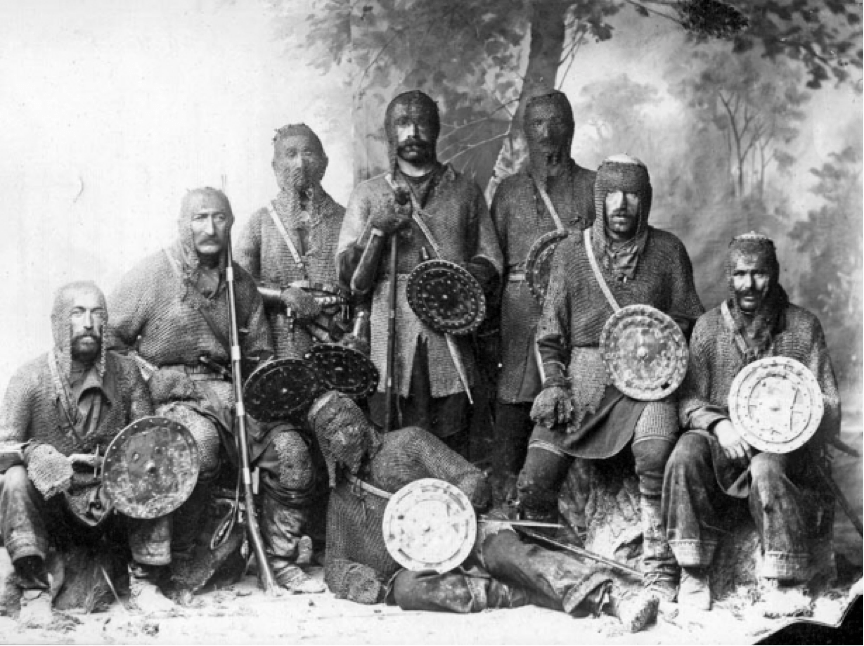
Photo of warriors from Khevsureti, 1935, taken by Halliburton.
This past Friday I had the honor to assist my friend Mike Cherba of Northwest Armizare with his online class for “Cybersquatch” (hosted by the fine folk at Lonin League in Seattle). In preparation for the class we worked in Mike’s backyard–it’s a large space and allows us to follow better the protocols necessary during this pandemic. None of us had counted on wildfires and smoke, so, at the last minute we were forced indoors. While not ideal, we made it work, but you can see from our actions how cramped it was–this was less an issue for the Georgian material than the examples Mike pulled from the Dardi School or I 33. It was, as always, great fun!
Our friends at Lonin have shared the footage of this year’s Zoom classes online, both on fb and via Youtube; a link to Mike’s class I’ve placed below. NB: there is valuable information here for interested fencers at any stage of training, but newer students may be unfamiliar with the examples. MS I. 33 or the Walpurgis Fechtbook, ca. 14th century, is the earliest known work on swordplay from western Europe and features selections of a sword and buckler system that may reflect less aristocratic combat traditions. The Dardi School, often referred to as the “Bolognese School,” looks to a Bolognese master, Filippo Dardi (d. 1464), whose successors–Antonion Manciolino, Achille Marozzo, Angelo Viggiani, and Giovanni dall’Agocchie–produced works that share many features in common. All cover the sword, but some also include buckler, rotella, montante/spadone, and pole-arms. Many students of I 33 and the Bolognese tradition pursue sword and buckler, though naturally there are differing interpretations of both systems.
Georgian _pari_ or buckler with “Shashka” trainer next to my usual Italian tools.
Mike Cherba, who has worked on the highland Georgian fighting arts for over a decade, has introduced this fascinating folk system to an audience outside the Republic of Georgia and Georgian enclaves outside it. In this he has been aided by two Georgian friends, Vakhtang and Niko, both of whom had a chance to study with the last three surviving masters of this art in the 1990s. This was a combat system that employed sword and buckler into the 20th century! Mike’s research, and the experience of Georgian martial artists, smiths, and dance teams continue to reveal aspects of what was clearly an intense, viable, and sometimes brutally efficient martial art. The Soviets, to name a modern example, not only had their special forces adopt some Georgian principles, but even tried to transform the more playful version of the system, Parikaoaba, into a “people’s” pastime.
In a recent conversation with an old friend and fellow fencer, one on the Olympic side of things, I realized just how poorly understood “historical” fencing is. To be fair, what most people consider to be historical is horribly inaccurate—it takes a part for the whole. This is not completely their fault; it’s mostly a result of what they’ve seen. The most publicized and well-known aspect of it is the black-clad longsword tournament sect, and balk at it though the SPES-donned might, they’re not representative. Much of what falls under the umbrella term of “HEMA” is much older than that; as much rests on better premises as well. [1]
Trying to explain to this friend what historical fencing is (or ought to be) was difficult. It was not only that historical fencing encompasses so much, over so long a time, but also that his preconceived notions were hard to refute given the one example he knows. Reflecting on that conversation I’ve been devising a short list of features to help round out the limited picture my friend and others have of historical fencing.
If you are easily offended it may be best if you stop reading here, for what I am about to say, however true, might upset some people. Happily, my readership is small, more inclined to agree than whine, and realistically what one obscure fencer thinks about HEMA makes no never-mind to those most likely to take umbrage.
HEMA to Your Standard Olympic Fencer
Silly meme made for some others in no-man’s land
Much of competitive longsword is bad. To a trained fencer it looks like apes with sticks whacking away at one another with little regard for art or safety. There are several reasons for this. Too many people begin competing too soon. Coaching is inconsistent and sometimes outright horrible. Rulesets, though they continue to evolve, tend to reveal the state of current opinion in re some pet concern (e.g. the “after-blow”) more than they do the logic of not being hit. Directing and judging, so often staffed by the same new folk, is dicey. Put together, to anyone who has fought within the Olympic world competitive longsword is one codpiece away from LARP and more closely resembles bohurt save that for some reason longsworders detest metal armor.
This is not to say that there are not skilled fencers among competitive longsworders. There definitely are. I know a few and know others by repute from credible witnesses and mutual friends. Likewise, this is not to say that competitive “sport” fencing is devoid of problems—nothing could be farther from the truth. HEMA, as such, would not have grown as it has from the late 1990s on had the Olympic world had its act together. Among the many similarities between competitive “sport” and “historical” fencers is that too many of them either fail or refuse to see the problems within their own camp. It’s a lot easier to point at the flaws in the other and count oneself and one’s view as the correct one.
So, what is “Historical Fencing” then?
Setting aside, for now, the mutual dislike and focusing instead on the easily demonstrable, here is what my Olympic friends tend to miss about historical fencing:
it is not just competitive longsword (skilled or apish)
it is source-based
it attempts to approach the Art as a martial art more than a sport
it encompasses sources from the High Middle Ages to the early 20th cen. [2]
it increasingly incorporates more than European systems [3]
modern fencing would not exist without some of these sources/systems
like anything some of it is really good; some of it really bad
This is a short list, but it’s important and contains most of the key details my Olympic friends miss.
HEMA ≠ longsword
This view again mistakes a tree for the forest. While arguably the most popular weapon among those interested in competition, longsword is merely one weapon and maybe the most visible of those systems people tend to see. Many if not most of the surviving sources which cover longsword also cover other weapons, such as spear, pole-axe, sword in one-hand (or single-sword), dagger, wrestling, dussack, Messer (a large, usually single-edged knife), agricultural tools turned weapons (e.g. sickles and scythes), and sword and buckler; some include material for fighting in armor as well as out of it. Many if not most of these have their competitive side too, though with allowances necessary for safety—fighting in armor, for example, and with weapons like poleaxes which greatly multiply force, requires excising those maneuvers intended to end fights. [4]
There is no “HEMA” without Sources
Unlike traditional and competitive fencing, historical fencing—by and large—focuses on extant sources. These can, however, take many forms. Not all are crusty old manuscripts or obscure books. The techniques one sees within any weapon class are—or should be—interpretations of techniques, ideas, and plays found in these sources. Due to the difficulties and vagaries inherent in interpretation there are often differences of opinion about even seemingly simple things. A researcher’s background and training have a significant effect on what they see, and thus in how they interpret what they find. The disdain many Olympic fencers have toward sources is, oddly enough, not uncommon among people in HEMA either, at least as expressed in the wide-spread dislike and distrust of formal academics. [5]
Not everyone in historical fencing reads the source material. Ideally, they would, but to be fair some of it is challenging to read, some poorly written, and much of it dull to modern eyes and ears. To name one example, long expositions on geometry couched as a discussion between a learned master and an eager student tend to be tedious to modern readers. Moreover, not all translations are equal, and there is little formal training or attention paid to teaching students how to separate wheat and chaff. [6] As in most things, politics and cliques often attend one’s choice of translation—it’s ridiculous, but remember while based on sources historical fencing is not populated by scores of trained historians or paleographers. Most people, probably 99%, “do HEMA” as a hobby, for fun; doing homework for a hobby after a long day at school or work doesn’t appeal to most of them. These students look instead to an instructor for guidance, drills, and a chance to try out what they’ve learned with others. This is a major difference from Olympic fencing where an instructor, most often certified, hands down a tradition passed on to them the same way. [7]
Combat Art vs. Combat Sport
Historical fencing is, depending with whom you speak, one or the other, or, both. There is a competitive wing, but being competitive is by definition less combat oriented. This is true however much one desires for it to be “martial.” It’s the nature of the beast. One cannot use, for example, all of Fiore’s Armizare or people would be maimed or killed (Master Fiore really liked breaking joints and thrusting the pommel and cross into people’s faces). This said, for the most part historical fencers try to approach these old fight systems as a martial art. Some attempts are more successful than others. Not everyone competes either, and this is an important point—”HEMA” is far more recreational than it is competitive.
MS Ludwig XV 13 28v-a
In Olympic fencing, just to illustrate the difference a little more clearly, the rules and training reflect a sport based on a former martial art. Off-target touches, some uses and interpretations of ROW (“right of way”), and the weapons themselves all demonstrate this well. There is no off-target in historical fencing—if one is hit, one is hit. [8] Hitting first or with priority—depending on rule-set—tends to take second place to being hit at all. Lastly, the weapons, while blunt, are meant to approximate more closely their historical predecessor. So, rather than foils we use smallswords or spada, which are still light and quick; in sabre we use 16mm wide blades or larger that weigh anywhere from 650g to 1000g. [9] Then there are the weapons that didn’t survive into the modern world, such as rapier, longsword, the knightly sword, the so-called “side-sword” and buckler, and pole-arms.
Historical Fencing & Non-European Systems
Strictly speaking HEMA, as named, refers to “historical European martial arts,” thus the acronym. This is one reason I do not favor this term, but instead use “historical fencing” or “historical martial arts.” As someone who values and incorporates the research that colleagues are producing in the study of various African, Persian, or Asian systems, I prefer a more inclusive term. In addition, as in so many fields, “European” can be and is defined a variety of ways. Most of our extant medieval works are in Latin, early German, French, Italian, or Spanish, so what about those in other languages that are less well-known? What about those from regions that are partly European, but heavily influenced by non-European peoples, such as the Republic of Georgia? [10] Happily, aside from the fools within the community who embrace ultra-nationalist notions, most people are pretty open, even excited to see what students of other regions are discovering.
Even within “HEMA,” however, there is a wide variety of difference in source type and purpose. Some works were hand-made and illustrated where later period ones were printed; some were meant for the aristocratic warrior caste, others for civilians; some were personal gifts to a patron, some mass-produced manuals from a government print house; some cover one weapon and context, some a multitude of weapons for a variety of contexts. We have some complete works, and some that are fragmentary. We have groups that identify a master or school, such as the Mss. that cover aspects of Fiore’s Armizare or the various masters associated with the later Dardi School. There are works written in simple language such as most 18th and 19th century sabre manuals, and then there are those written in purposefully obscure language to protect a master’s ideas from non-students, like “The Zettel.” To these we can add some rather poorly written works as well.
Modern and Ancient
Guard positions, Del Frate 1876; photo by Sarahorsomeone, Deviant Art, from the 2012 Olympics
Like it or not Olympic fencers learn and use a system that was the product of those that came before, especially those from 18th and 19th century Italy and France. Today’s foil and epee look back, each in its own way, to smallsword; sabre to 19th century works. It’s obvious to anyone watching modern fencing that a lot has changed, and not always for the best.
An explanation for how these changes occurred is lengthy and not one we need to dwell on here. In short, the requirements of sport are different than those for the dueling ground or battle field, and that meant changes in the rules, in the very weapons, that allowed for and in some ways created fencing today, good and bad. Competition, especially between nations, meant not only cheating but mutations in technique to exploit vulnerabilities and loopholes in the ruleset. Ridiculous attacks like the “flick” in foil a while back and the still undeniably stupid ability to score with the flat of the sabre blade are two such examples.
I urge anyone I know interested in fencing, really interested, to start with foil. It’s one reason I normally start my own students with foil. A good sport coach will provide any fencer with the fundamentals they need to pursue any other branch of fencing. Foil imparts the universals of swordplay and develops the core principles upon which all hand-to-hand fighting rests, distance/measure, timing, and judgment.
The Good, the Bad, the Ugly, and People
Olympic fencers may look down their noses at some interpretations within historical fencing (historical fencers certainly do), but they should understand that more often than not that smallsword or sabre fencer is working from texts either directly or indirectly related to what they themselves have learned and fence. Not all interpretations are equally good. Some are flat-out bad. This is to say that if some meathead is doing something that seems odd, it may be that meathead and not the system which is at fault. Don’t make the mistake of assuming all historical fencing is bad based on one practitioner or one clip of longsword tourney footage. There are many people who’ve made names for themselves and inspired a following who have some things demonstrably incorrect.
My caution to any fencer, especially my Olympic friends, is to ask questions before passing judgment. This list should help a little—if nothing else one can ask what sources that historical fencer is using and look into their instructor’s background. Unlike “sport” historical fencing is largely an amateur pursuit, in the best sense, which is to say that most instructors are not certified maestri. HEMA has no such program, and the attempts to create them have come to little in part due to the variety of sources and interpretation that make up HEMA and in part because of a lack of leadership. [11] The historical fencing community, as such, is decentralized, fragmented, and outside of a few major events most clubs work in isolation from others.
Just as in the Olympic world the historical community can claim some gifted fencers and some clowns. As someone who has lived in both populations, and currently occupies some strange no-man’s land in between them, I work hard to explain both sides to both branches. To be honest I don’t believe this has been particularly successful either way—the historical fencers who agree with me either have similar backgrounds to my own or some analogous path; those who disagree most likely don’t really care what the other camp does or thinks; they’re content with their own view. It’s the same for Olympic fencers.
Multae Viae, Una Ars The Art is one, but there are many roads that lead to it. None of this may matter to you. That’s okay. I believe, however, that any true student of the Art will look for wisdom and help wherever it may be found. We have, potentially, a lot we might learn from one another, but it requires humility, curiosity, and a willingness to retain a beginner’s mind.
It means setting aside the concerns of affiliation or what one’s peers think. I hate to say it, but fencers, wherever they are, could give most middle schools a run for the money when it comes to cliques, cattiness, and drama. All that rot just gets in our way. The Art is hard enough to chase without those added pressures. They add little, detract a lot.
I’m due to have another Zoom call with my old comrade from our college fencing team. He may likely fire another shot at me for my “LARPing,” but that’s okay—this time I’m a little better prepared to set him right 😉
NOTES:
[1] Ignoring earlier efforts at recreating historical arts, such as those that took place in the Victorian Age with people like Hutton, much of todays’ “HEMA” derives from two things, the exodus of Olympic fencers in the 90s unhappy with changes in competition and the creation of the internet. HACA, ARMA, etc. all came about in the late 90s and started sharing texts. Those of us already doing that research were thrilled—in what felt like a change overnight many of the works we had read about in Thimm’s bibliography were suddenly available in pdf.
[2] The sources for HEMA are legion. Some are medieval, many renaissance and early modern, and still more produced in the last two or three centuries. Though it must be used with caution, one can gain some sense of this from a visit to Wiktenauer, a wiki attempting to collate and share many past works on martial arts. Some translations shared there are good, others less so. It is popular because it is free, which is great, but the lack of academic rigor means that it’s best used like most wikis, as a place to start.
[3] Two standout, non-European projects include the excellent work of Dr. Manouchehr Moshtagh Khorasani, researcher, author, instructor, and the force behind Razmafzar, a world-wide group of practitioners who rely on his work (see for example https://www.moshtaghkhorasani.com/books/persian-archery-and-swordsmanship/). There are also the various projects under HAMAA, the “Historical African Martial Arts Association.” One of the best places to go for current research within HAMAA is its fb page, but Da’Mon Stith’s school site, http://www.silentsword.org/, is also a great resource.
[4] Polearms, because of the physics involved, are dangerous, and any researcher working on them should be quick to say this. Even in harness, never mind within a class where people are in workout clothing, there are risks. Be wary of anyone or any school that doesn’t take these dangers seriously.
[5] Yes, I know, there are many people in “HEMA” who do value the work and contributions from academics. However, this said, if social media is any guide, there is a sizable voice within the community that not only thinks little of academic training, but also dismisses any criticism they don’t agree with, however correct. I’ve encountered this hostility myself from people popular within HEMA’s ranks. To borrow an analogy from “Firefly,” it’s like Patience running her little moon: they’re rather impressed with themselves and do not want anyone from “off-world” meddling in the fantasy. The difference is that unlike a tv show, assuming that they have the same skill as someone who spent a decade learning how to handle and interpret historical sources is as prone to error as it is presumptuous. I’ve watched shows about doctors, read books by them, and have had to use first aid, but I don’t think that qualifies me as a cardiologist. Training matters.
[6] Most students of historical fencing rely on translations or someone else reading translations. Any translator will tell you that the work is as much art as science, and the uncritical too often assume that a translation is good merely because it exists. This isn’t so. To name one example, there are two major translations of Giganti’s rapier text. One is really bad, and the other is Tom Leoni’s. Those who favor the former do so out of misplaced loyalty, not based on rigor or skill. Locally, I’ve worked with Mike Cherba of Northwest Armizare, who shares this concern about translations, to help people in selecting and using translations. I have transcripts of these lectures, with slides, on my academia.edu site, but will happily share them with anyone if they want them and don’t have access to that one.
[7] HEMA is mostly amateur led, that is to say that most people instructing are people who have spent more time with the material than others rather than certified fencing masters or experts in that time period or source tradition. One reason that HEMA has retained its appeal is because this diversity of expertise is more inclusive than exclusive. Had only a bunch of academics been in charge, fewer people would be working on this stuff and we’d make less progress. We need both, experts and amateurs, and we need them to work together better. In contrast, within the Olympic world there are very few people teaching fencing, at least teaching it well, who have not been to coaching school or who haven’t spent decades learning and teaching.
[8] I’m giving this complex issue short shrift for the sake of brevity, but for those interested there is a sizable collection of articles, books, and diatribes bemoaning or celebrating ROW and the use and abuse of the FIE/USFA rule book. Ping me if you’re interested.
[9] Despite a plethora of historical examples, there is a dedicated section within historical sabre that idolizes ridiculously heavy sabres. Most—not all, just most—meant for use on foot fall into the 650-900g range. Those at the top-end, however, more often than not are weighted for horsemen or systems of combat that were as simple. While one “can” make more sophisticated actions with a 1000g sabre, one cannot do so for long, and so the use of such a weapon for much beyond a sharp club is limited. There is an ever-growing list of extant sabres with specs that Chris Holzman, Kevin Murakoshi, and others maintain that I can share with you if you’re interested. There is also an excellent, but difficult to find article by Christoph Amberger on sabre weights.
[10] This is a shameless plug for my friend Mike’s hard work on a Georgian system that survived, no kidding, into the 1990s. Mike shares his research freely—you can find some of it here:
[11] There are a number of organizations that attempt to organize the community, such as the HEMA Alliance (https://www.hemaalliance.com/), but not everyone follows their lead or accepts their decisions. Fb is one of the best places to look for these groups, but many have webpages too. Some are specific to one area, like IAS, the “International Armizare Society” (www.armizare.org, though as of today the site seems to be down), and for most anyone not interested primarily in competitive longsword it is to these smaller groups that they should probably look to.
This year has proved to be a challenge the world over in a multitude of ways. Few people are free from the trials that 2020 has thrown our collective way. State-side it is not an exaggeration to say that we’re undergoing some serious growing pains as a nation. Like a petulant toddler who refuses its veggies, we’re in “time-out” and can’t play with the other kids until we reflect on our choices, or to use the colloquial American, “get our shit together.”
It’s not just the mishandling of the pandemic, but the all too visible cracks in our political system, weaknesses now more obvious and impossible to ignore. We can hope but must also act so that this time of unrest becomes another important phase toward greater equality and not a return to Jim Crow era evils. News outlets, and especially the perniciousness of social media like facebook, tend to funnel everything into a spectre of doom that is, to be fair, at best a failure to report well, and at worst a directed, purposeful attempt to mislead. This month I decided to mothball fb and retain only messenger. If nothing else it has helped my blood-pressure lol
However challenging the times there is always room for gratitude, and so, in the spirit of emphasizing the positive while not ignoring the negative, I’d like to take a moment to express my thanks to several people. I am focusing here on people within the fencing community who have worked hard to keep their corner of the community active, and, who have remained particularly helpful to others even as they face their own hurdles. Moreover, these are people who mean a lot to me, whose friendship, guidance, and companionship have helped me through the last six months.
NB: I am listing them alphabetically so as to avoid any hint of preference, and, I am using images only with the permission of those mentioned. I have not included my family or students, though my first thanks and offers of appreciation are to all of them.
Patrick Bratton
Patrick Bratton, Instructor at Sala della Spada, Carlisle, PA
Patrick and I met as many of us do initially, online, and via a mutual friend and mentor, Chris Holzman (mentioned below). I had the great pleasure to meet Patrick and his family in person a year ago June when they came out for SdTS’s second annual sabre invitational. Over the few days that the Brattons stayed with us we had many occasions to discuss fencing, history, and everything else. That week and our subsequent interaction convinces me that I have made a friend for life.
We continue to share anything of interest in our respective research, some of which overlaps, and enjoy the never-ending learning process. Patrick’s breadth of skill and knowledge, which he shares without hesitation, has not only increased my own knowledge, but also inspired me when I’ve felt less than thrilled at the turn of events this year in re fencing.
Mike Cherba Anyone who knows me at all well will know how difficult it can be for me to see good in bad situations. It was at a particularly terrible event that I had the pleasure to meet Mike Cherba and Alex Spreier (see below). An occasional visitor at a now defunct club in town, and in the spirit of trying to bolster the program, I offered to hold an introduction to Henry Angelo’s infantry broadsword, the topic one of the instructors then was offering. He and his business partner were extremely busy with other events, and so this seemed a good win-win: I could help, they could do their thing.
Ten till start, the instructor waltzed in, informed me he was taking over, and left me in a bind—do I say “oh, well fuck you then” or do I suck it up and try to salvage the thing? I opted for the latter. By noon he had run out of material. After lunch he began making stuff up, so Mike and Alex, suspicious of one drill, asked me about it. This started a conversation that has, in some ways, continued to this day. I cut all ties with that club after giving the instructor my thoughts, and then joined Mike at a joint practice with another club, Indes WMA as it was called then, run by Brent Lambell.
I spent several years with Mike studying Fiore dei Liberi’s Armizare and acting as his pell as he researched a unique branch of the historical martial arts tree, the highland Georgian system of Lashkroba [1]. Mike, Alex, and I discuss the depths of the “Art” most every day; I didn’t realize how much I missed this in my life until I had friends with whom I could share it. Mike has held twice weekly online meetings during the pandemic, encouraged people to read, share video of solo drills, and keep moving while we all wait for that special day we can train together again.
Velah Gilbert, administrator of fb’s “Military/Classical Sabre” page, Medic (Red Cross cert.), and fencer (destreza sable a la Simon de Frias, Italian sabre, and Thibault rapier fan)
Velah Gilbert Like Mike and Alex, I met Velah at that school which shall remain unnamed. I had been gone for a while—it was an expensive place and I had read and drilled of Angelo what one can—and was working on my own again. He asked that I return if only to give his student, Velah, someone with whom to work as she prepared for a tournament. From the off we got on well—a passionate fencer, possessed of a sense of humor as dark as my own, and a sensible woman of the world, we became friends easily.
What stands out to me most about Velah is her mix of fortitude and generosity. An extrovert, people sometimes see only her friendliness and humor, and miss the person within them, and this is a terrible loss for them. Though it may embarrass her, not to mention me, I need to say this. In 2017, when depression and poor choices came to a head, the only friend I knew I could trust absolutely was Velah. Had it not been for my wife and Velah I doubt I’d be here writing this now.
It is a rare soul that can call you out for stupid choices and yet do so in such a way that it’s clear they care and support you. There was, on paper, zero reason for Velah to do so; she would have been within her rights to break ties with a mess like me, but she didn’t. I never feared what she might say behind my back, because she very compassionately said it to my face. If friends are the family we chose for ourselves, then Velah is my adopted sister, my fellow drunken toddler, and I am truly grateful for her wisdom, kindness, and ability to send me the most messed up jokes you can imagine.
Christopher A. Holzman I can’t remember now what led me to contact the translator of one of my favorite works on sabre, but I did and never have I been more fortunate in contacting someone I don’t know. As a rule, I don’t do that—call it old-fashioned, but I prefer to meet in person first or be introduced by a mutual associate. I’ve not yet had the honor to take lessons with Chris—it’s on my list—but to say that he transformed my understanding of and approach to sabre is an understatement. In discussions with him, through his translations, and in working with him on a few projects I have learned twice what I did on my own in the nearly 30 years before I met him.
Chris Holzman is a masterful instructor—his knowledge is deep, his ability to communicate simple and complex actions and ideas equally strong, and his commitment to imparting the all too critical fundamentals unwavering. People literally fly out to work with him from all over the world, which says something, but he also instructs via his contributions to the community. Before Chris began translating the core works of the late Italian tradition (and a few key earlier ones, e.g. Marcelli), the only way to access the corpus was possession of Italian and deep familiarity with the tradition. In the span of less than ten years he made Del Frate, Parise, Masiello, Rossaroll and Grisetti, and others accessible to a much wider audience. Any student of the Italian tradition, particularly from the 17th century on, now has reliable translations from which to work. Though still very much a mentor, I count Chris a friend, and have found his humor, talents as tailor, fabricator, and cook equally deep and delightful. He even shares my distaste for gin.
Matthew Howden, Instructor, Historic Combat, Portland OR
Matthew Howden The excellent Matthew Howden I met, officially, in 2013 I think, but I’ve only come to know him at all well in the past two years. He is, like everyone listed here, a multi-talented, congenial, intelligent, and passionate fencer. Splitting time between the SCA and his research into destreza, particularly the work of Gerard Thibault and the sabre system of Simon de Frias, Matthew is a busy man. It is in keeping with his generosity that he shares his translation of Frias and insights online where all can access it.
He’s a dedicated teacher, ever ready to discuss a point in class, and always encouraging. During the pandemic he has held weekly meetings online to go through Frias. My schedule has not allowed me to sit in on these as much as I should like, but it’s a great class. I look forward to working with Matthew when time and conditions allow again, and it doesn’t matter what he is working on—I’ll learn a lot.
Michael Knazko Michael Knazko, of the Barbasetti Military Sabre School in Prague, Czech Republic, is a fencing instructor and the driving force behind “Sabre Slash,” the K.u.K. Military Fencing Tournament held in Prague each year. We were to meet in person this October, but between Covid-19 and now travel-restrictions, I am unable to join in the fun. My hope is that perhaps I shall make it in 2021.
Following the fencing tradition I do can be lonely. I say that not for pity, but as simple fact—not a lot of people pursue traditional Italian fencing in the States. [2] With the exception of a few local students, Chris Holzman, Patrick Bratton, and one or two others in the U.S., most of those with whom I discuss fencing are abroad. Michael, as a student in the Barbasetti tradition, is not only within the Italian orbit, but like a cousin—Barbasetti was active in Vienna when my master’s master was a student in Budapest, and thus we are both lineal descendants—as it were—of Radaellian instructors. Like me, he also enjoys fencing bayonet and foil, and, he is also keen to build bridges. His school has connections in Taiwan, for example, which now has its own Barbasetti group under the excellent Huang Chun-Yi of the Lionheart Historical European Swordsmanship school. Fingers crossed I can meet him and his crew in October of 2021.
Jay Maas, Broadsword Academy Manitoba, Winnipeg, MB, Canada
Jay Maas I’m not going to lie, Jay is one of my very favorite fencers and researchers, and the more I get to know him the more I like him. As a person of sense, Jay doesn’t exclude paths that many other historical fencers shun, such as foil lessons with an Olympic coach. He is source-bound, which naturally someone like me would approve of, but combines that inquisitive examination with a willingness to update ideas in the light of new information or better interpretations. Jay has become my go-to for all things British sabre and broadsword—not only is his knowledge deep, but he shares it without hesitation. His videos on broadsword are some of the best on Youtube.
It was Jay that invited me to help put together another event, and as luck would have it, another casualty of 2020, the first SABR meet (Sabre and Broadsword Retreat). We had found a site in Minneapolis, MN, and were lining up an exciting series of classes. Between the two of us, especially having worked as mods on the fb page “Military/Classical Sabre,” we’re able to draw upon a global pool of talent. Much as I am down on fb at the moment, I value that page more than any other, and it’s one of the few things I miss about fb.
Alex Spreier I mentioned Alex above in reference to meeting Mike Cherba. With Mike, Alex represents one corner of the triangle of instructors teaching Fiore’s Armizare in Oregon (the third being Maestro Sean Hayes in Eugene). He is unlikely to mention it, so I will, but he studied classical Italian foil, has spent considerable time on the 15th century Burgundian pole-axe work “Le Jeu de la Hache” (“The Play of the Axe”), and studies a number of branches of the Art, from western wrestling and grappling to Xing Yi and Ba Gua. One of his major interests is the “Viking” Age, an extremely difficult period to unravel when it comes to martial arts; if anyone can do it responsibly, Alex can. [3]
I’ve taken classes from Alex, classes with Alex, and had the pleasure of him attending my seminars too, and he is one of those people who understands that a teacher is first and always a student (he is also one of our heroic elementary school teachers). We chat nearly every day about things, but especially about the deeper waters of the Art, teaching, and the perils of research. While he wrestles with the fact sometimes, Alex is not a one-trick pony, but a versatile, all-around martial artist, and it is one of the reasons he is so damn good. I mean that. I’ve fought him in a number of contexts, with a variety of weapons, and each one affords me a chance to grow.
Da’Mon Stith
Da’Mon Stith, Instructor, Guild of the Silent Sword, Austin, TX; one of the founding members of HAMAA
Despite growing fame, from the historical martial arts community to television appearances, Da’Mon Stith remains humble and grounded. It’s the rare person who can balance his degree of skill and attention, but he does, and if you’ve met him you know why—Da’Mon is a gentleman, a man of noble heart, a keen mind, and is as generous with his skill and knowledge as he is in his life outside fencing. I’ve been studying martial arts a long time, fencing a long time, and no other experience has forced me to work harder, to question what I know, and grow like Da’Mon’s seminar he held at Northwest Armizare a few years ago. It’s not exaggerating that he made instant converts out of us.
Few areas of study for historical and cultural martial arts present the challenge that African systems do. Da’Mon is one of the organizers and heads of HAMAA, the “Historical African Martial Arts Association,” and it is worth every single researcher’s time to see how Da’Mon, Osa nKante, and Mansa Myrie pursue their study. First, they use any source of information of worth, from ethnographic studies to dance, from exported systems to the New World (e.g. Capoeira) to living African traditions like Al Matreg. To do this well requires not only considerable analytical ability, but also an awareness of the limitations inherent in such a disparate body of evidence and the humility to be honest and open about it. I aspire in my own work to follow Da’Mon’s model. Did I mention he is one of the finest opponents it has been my honor to cross swords with? He is. If you have a chance to take a class with him, any class, do it. If you have a chance to fight him, do it—you will learn a lot and have a blast at the same time.
There are a lot of people I didn’t mention here, but who are also doing great work during this difficult time, and I mean no insult in not mentioning them here. To them, to anyone reading this, wherever you are, I hope you are well and that you are finding ways to train as we figure out how to live in the light of Covid.
[2] In addition to those mentioned, the center for most things Italian tradition is the master’s program at Sonoma State University in California. Run by Dr. John Sullins, this program carries on the work of William Gaugler who was the first to establish a sanctioned American branch of the Military Master’s Program in Italy.
With the disadvantages we face during the pandemic it helps to think outside the piste. Drill is rote even in the best of the times, but lessons often afford us that sense of time moving, of progression. As students we work on something, then next lesson may work on something new as well. Improvement may be slow sometimes, but it still feels more like progress than the same set of exercises month after month with no variation.
When it’s less safe to do much of the usual work, especially that which puts us well within six feet of one another, lessons can become repetitive and dull. In truth, doing the same thing over and over again in attempt to do it better is just part of fencing, but even with that acknowledgement there are only so many ways, for example, to attack and defend the extended target.
I have a few students right now who are at a stage where some attention to tangential material is possible. By tangential I mean aspects of sabre that have disappeared in the modern game. These were, however, once a necessary part of one’s training. It was only last century that competitive bayonet fencing died out; smallsword died out nearly a century before that in most places, but a number of works treat dealing with different types of swords. [1] Sabre vs. bayonet was a key aspect of most military training programs, whether for infantry or cavalry, and still has application today.
Sabre vs. Bayonet
Last weekend I introduced one student to the rudiments of defense against bayonet. Some of the maneuvers one can employ, for reasons of safety, I left out, such as parry, seize rifle, pommel strike with follow-up attack. Everything we did started with the student in seconda/2nd while I adopted one of the basic guard positions with bayonet, in this case what the English called “High Port:”
“High Port” from Bayonet Training Manual, 1917
As you see here, the left hand grips the rifle and is level more or less with the left shoulder; the right hand is centered above the fork and just in front of the solar plexus; left foot forward. The student might assume the guard of terza/3rd just as easily, but seconda is the preferred guard for several reasons. First, it places one squarely and safely behind the steel, the point threatening the opponent. Second, from 2nd, the shift to quinta/5th or prima/1st is quick. Both of these parries are quick, sweep the line, and set up powerfull molinelli.
My initial attack was to the student’s inside line with the “long thrust,” that is, a thrust made from about 4-5ft away–as with the sword, bayonet and rifle move first. The student takes a half-step back, parries in prima, then steps slightly to their right and delivers a cut to the arm or down the barrel to the attacker’s hands (this second riposte must be made carefully, one reason that this is not a drill I run with beginners). There are other options, such as a cut to the head via molinello, but we were doing our best to maintain the requisite distance in light of Covid.
The next drill started the same way, but as soon as I saw the student shift to prima, I made a cut-over the parry to the outside line. The student then had to take a second half-step and sweep back to seconda or terza. From there they stepped slightly to the left and delivered a cut to the forward hand on the rifle., before detaching and delivering a thrust with cover.
It was a valuable exercise for a number of reasons. First, because we were on grass, it mean having to be careful with footwork. Given the length of the bayonet trainer the student had to move–to plant and attempt to defend would mean a best we both got hit. Best of all, seeing the versatility of the first triangle parries–1st, 2nd, and 5th–cemented why we focus on them so much. Lastly, it was fun, and that is important.
Sabre vs. Smallsword
Yesterday, in a another lesson, I had a different student defend against smallsword.
D. Angelo, School of Fencing, 1765
This particular student has considerable experience, and at this stage of his training it’s possible to incorporate more and more of the more advanced, less standard material. Among the traditions he has studied is long experience with KdF (Kunst des Fechtens), which means that dealing with a variety of weapons is not new to him, and, that use of the weapon for defense as well as strategies for coming to the grapple are second-nature. He is far more comfortable with grappling/stretto play than I am, but I am learning a lot from him in the process (what little I’ve studied comes down to a few years studying Fiore’s armizare and weapon-seizures in sabre and smallsword or spada).
Here too we were keen to maintain “social distance,” so as per current custom attacks were mostly to the forward target. My initial guard was Girard’s high tierce/3rd, his was his choice of 2nd or 3rd. As with the bayonet drill, I focused first on attacks to the inside line, mostly toward the wrist; he countered with 1st or 4th depending on where he was as my lunge completed. Ripostes were generally to the arm, or, with a diagonal forward step right, to the head. Next, I performed a simple disengage/cavazione moving from the inside to the outside line. He countered with 2nd or 3rd, again, depending on where our relative distance was and how time affected the choice.
Finally, I adopted Girard’s guard of high quarte/4th, and attempted a variety of thrusts
Girard, Traité des armes, 1740
with opposition or via a feint. My student countered these as before, either attempting a stop-cut or arrest with a parry-riposte, or, when unsure of the tempo just parry/riposte.
I was surprised, but thrilled he enjoyed this exercise as much as he did.
The quickness of the smallsword and the fact that the point was always on him meant that he had to be conservative. Any attack, as he put it, had to deal with that preeminent fact. A little over a century after Girard another Frenchman, Baron César de Bazancourt, remarked in his Secrets of the Sword that
La pointe d’une épée est une réalité qui fait disparaître bien des fantômes.
“The sharp point of a sword is a reality which quickly makes illusions disappear.” My translation is a bit free, and less eloquent than de Bazancourt’s translator, C. F. Clay, but I think illustrates the lesson well. [2]
In the attack, this same point had to be dealt with safely before anything else. A decent sforzo or expulsion was effective, but had to be measured well since the lightness of the smallsword makes recovery to line a little easier. Since his weapon is heavier–he was using Castille Armory’s 16mm blade in a Radaellian guard–feint via cut was less safe than a feint followed by a thrust. This is yet another reason that the guard of 2nd is so excellent.
He did well in both offense and defense; his key concern was not to be hit, and so, if there was the slightest chance of mishap, he regrouped or attempted to provoke me to attack. I am really happy with how well he has taken to sabre, how skillfully he adapts to different and often difficult scenarios, and how much he enjoys it.
What’s Next?
I plan to continue the inclusion of both bayonet and smallsword on occasion. It’s fun, diverting, and forces the student to apply what they know to a new situation. As my student and I discussed yesterday, exercises like this force one to look at their toolbox and figure out how to make a hammer perform like a screwdriver, or, vice versa. Against the advantage in reach offered by a bayonet, one must adapt to handle that; against the lighter, faster, and more nimble smallsword larger actions and those to deeper target are dangerous, and so to achieve either option one must plan well or be hit.
I do not yet have a smarra, but I have an Italian epee that will perform the job until I do, and I may pair that with an off-hand dagger. I have not explored off-hand options with these students yet, and we have a lot to choose from, from cape (one of my favorites since a jacket, towel, or blanket remain similarly useful today) to buckler to dagger. In each case, it’s important to note, much of what we are doing is examining how we use the fundamental science within sabre to tackle non-standard scenarios. It’s a good mental exercise, forces the student to consider those fundamentals from a different perspective, and it’s a ton of fun.
NOTES:
[1] The one I had in mind as I typed this up was Domenico Angelo’s The School of Fencing, first published in 1765. In the edition I have he treats the use of the smallsword against various nationalities of fencer, Spanish, German, and Italian, and against a variety of weapons and off-hand accessories, dagger, dark lantern, cloak. A few other works of note that deal with multiple weapons include Pierre Girard’s Traité des armes (1740), which likewise pits his student against various European foes and their “favorite” guards; Charles Roworth’s The Art of Defence on Foot, 2nd ed. 1798, includes directions for sabre or broadsword against smallsword, spadroon, and musket and bayonet; and Nicola Terracusa e Ventura, True Neapolitan Fencing (1725), which includes defense against sword and dagger, buckler, rotella, and cape (an excellent English translation of this was made by Christopher A. Holzman in 2017 (available via LuLu Press).
[2] The English translation of C. F. Clay, originally published in 1900, was reprinted by Laureate Press in 1998. It was first published, in French, in 1862, and then again in 1875.