The Importance of Measure

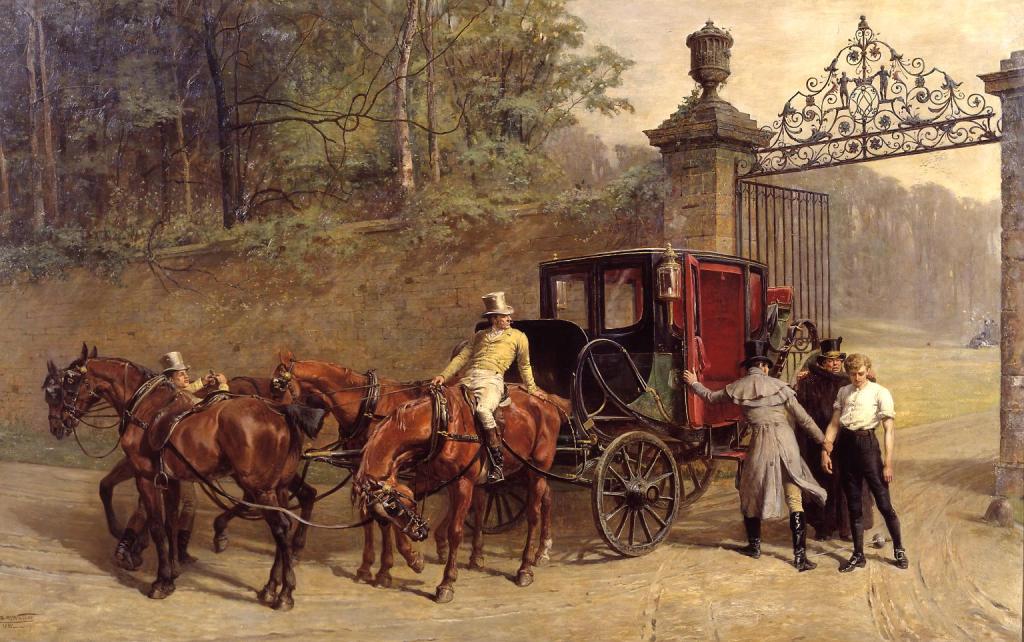
“Success!” 1881 Samuel Waller 1850-1903 Presented by Sir Henry Tate 1894 http://www.tate.org.uk/art/work/N01551

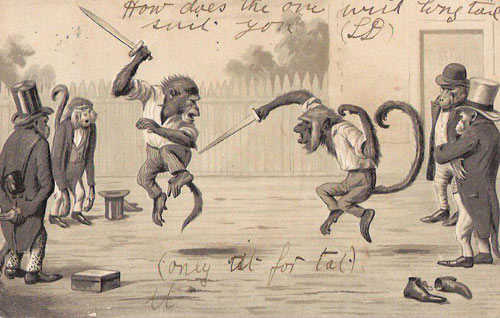
A number of dueling histories record the horrific duel between Colonel Barbier-Dufai and a young Captain, Raoul de Vere. According to most versions, the older adherent to Napoleon attempted to pick a fight with this member of the Royal Guard, but was initially unsuccessful. Barbier-Dufai, frustrated in finding the young man so unflappable, finally remarked that he was not insulting him, but his cockade, and after a heated exchange challenged the captain. However, when asked to select a weapon the captain replied that he had insufficient training in all of them. The colonel said he would not fight a child, a comment that irked de Vere and led him to slap the older man. A duel was now inevitable. In the ensuing sword fight, Barbier-Dufai disarmed his opponent several times. Finally, in frustration, the colonel suggested they hop into a carriage, arm themselves with daggers, tie their left arms to one another, and take two turns about the Place du Carousel. The young de Vere agreed and they set off in their mobile piste. When their seconds opened the carriage, blood was everywhere, Raoul clearly dead, and the colonel next to death. Both men died and honor was apparently satisfied. [1]

I share this story because it highlights the pure idiocy of fighting in close measure. There are times when it is unavoidable, but generally—unless one is in a confined space—there are means by which to extricate oneself from such proximity. One of the chief faults I see in both the wider community and among some of my own students is mismanagement of measure. Usually in my own classes, the culprit is a mix of well-intentioned aggression and fun—so intent on making the touch, some students neglect their own safety. I never want to chip away at the fun they’re having, especially among the younger students, because having fun is one reason people fence, but at the same time I need to ensure that they learn properly.

There are a few things we can do to ensure that our students have a proper notion of measure, and that can help them remember to use distance well in their bouts.

Teach them What Measure Is

First and foremost, from the off we need to teach them the various measures appropriate to their weapon or tradition. Regardless of the weapon or era my students study, I introduce them to the traditional breakdown of measure into three main categories:

  • Out of measure
  • In measure
  • Close measure

Out of measure, what Giordano Rossi calls “double measure” and Luigi Barbasetti refers to as “normal distance,” is the distance that requires us to make an advance first in order to lunge to target.[2] In measure means that one can lunge to target. Close measure is that spot were either opponent can reach one another without the lunge. There are some subsets to this, but to start this is ample.

I hesitate to say that “all” systems of measure reflect these basic breakdowns, but I feel safe to say that measure, being a fight universal, is common to all systems however described. Even in those like Rossi’s “measure” and “double measure” or Fiore dei Liberi’s “largo” and “stretto,” there is implied space between these two poles. Regardless of nomenclature, one must learn how to navigate any space along the continuum of “measure.”

Measure Drills

Measure drills by definition involve footwork. Ideally, any footwork drill save perhaps those used in warming up a class—where everyone advances and retreats down the hall using various types of footwork—will work distance too. Below are several drills I typically use in classes:

Glove Tag is a crowd favorite and very much a game. One can run this as a linear partner drill, or, as a general melee. I usually ask if anyone wants to be it, and if not then select someone. Fencers must use the appropriate footwork only, and, can only target the wrist. There is no parry. One has to move, or, parry with the feet (in the non-pejorative sense). [3] Fun as this is, and much as it helps them move, making it a bit more realistic is helpful (see Mask Tag below).

Foil-Push or mask-push, have the students, in guard, suspending a foil/sabre/etc. or mask between their lead hands. The goal is to move back and forth without dropping the foil or mask. I emphasize that while they are taking turns driving, so to speak, they are working as partners—the only way to keep that foil up is to move in concert. If fencer A steps back, B needs to step forward, and vice versa.

Mask-Tag and 1-Touch Tag, fencers don their masks and use the weapon to tag. For sabre, students target only the head, and, cannot parry. Thrust fencers can only target the chest (or arm depending on what we’re working on), and, as with sabre, cannot parry. They must move their feet. Students must use distance to their advantage. Success depends on moving, recognizing someone fell short and is now vulnerable in the recovery, or, selecting the moment the opponent is occupied, such as mid-step, to strike. If the attack fails, then retreating under guard or behind the point is the best option, and the fencers reset.

Mask-Tag Plus takes this drill one step farther—each opponent can parry and riposte once per action, that’s it. So, if Fencer A lunges with a thrust to the chest, B can parry in quarte and riposte, but if A retreats half a step, then B must recover—B can’t redouble. For more advanced students one can allow the redoublement. This option should be included at some point as so many students starting out stop just shy of the target.

Two-Step Tag is something I’ve used with foil and smallsword students. Two of my foilists, for example, are offensively-minded, so tend to close quickly at “Allez!” and descend into a flurry of jabs, thrusts, etc. I don’t want to take that drive away, so I’m trying to channel it instead. In this version, the only attack they can make is an advance-lunge to the chest. It’s super hard to do, especially since one’s opponent knows what’s coming, so everything depends on precise and keen use of footwork, timing, and distance.

The goal with all of these drills is to emulate, as much as one can, the conditions of a bout, but restrict the options so that the students are forced to use measure. It’s not that good handwork is unimportant or cheating, but that it can easily become clatter and chaos instead of well-planned attacks and responses. It becomes reactive, not active. I teach them that if an attack fails or if something isn’t working, to retreat, regroup, and try something else. Persistence in the face of stout defense is brave, sure, but foolhardy—if what we’re doing isn’t working, we try something else. [4].

Reinforcing Proper Use/Awareness of Measure in Bouting

It does little good to encourage proper measure in drills if we fail to do so in bouts. There are a few way to do this. In both classes and individual lessons I save any bouting we might do for after any focus on technique and drills. [5] This helps prime the pump as it were—students are more likely to consider measure if they’ve spent a bit of time focusing on it before bouting.

Within the bout, I have students actively bouting and those observing analyze the action, not only because it reinforces attention to measure, but also because it buttresses other important aspects, from recognizing who had initiative/started the attack to breaking down each action within a given exchange. Too few fencers learn to analyze bouts well, and the sooner they start the better.

Why Measure Matters

If you view most any bouting footage posted to sites like Youtube you will see, or should see, why better attention to using measure is worth one’s time. In one recent video, for example, one fencer analyzes his bout, but misses the reason that he found himself in the situation he did—they were fighting too close to one another. [6] If their sabres cross near the middle, they’re too close. Certain actions are harder to thwart at such proximity—in this case, a slip of the leg will likely fail because there is insufficient measure to remove the leg and strike the opponent’s head without being hit. More likely, and we see it in this example, both parties will be hit.

In fairness to this fencer, the rule-set he’s likely fighting under is not as doctrinaire as I am about the guiding principle of “don’t be hit.” Even when a rule-set is explicit, so much depends upon judges who know what to look for and how to make sense of what they’re seeing, and by and large tourney HEMA lacks a reliable pool of judges capable of analyzing the action at such a level. Add to this the excitement and/or nerves in a bout and of course things can turn out less ideally than we plan. It is not my intention to denigrate my fellow fencer, only to point out something important he didn’t address (his focus was on the slip). Were he my student, we’d likely work on this very set of actions at the proper distance, that is, set it up so that he is just about a step or so farther back then we see in the video. From punta spada/sword tip one is more likely in a place not only to make the attacker’s feint and strike more successfully (i.e. without be clobbered doing it) but also provide the defender sufficient measure (and thus time) to assess and adjust.

“Halberd against the Sword,” Hector Paulus Mair, MSS Dresd.C.93/C.94 (ca. 1540s)

Not all clubs or instructors take the same view I do. The more I read, the more I teach, the more I see how fencers learn, the more inclined I am to championing the goal of “don’t get hit.” It does change how we fence; it makes for a more circumspect, conservative, and hesitant game. The flash and fire, the dynamic move and rococo blade-work tend to impress, and that is what attracts many of us in the first place. It looks cool and we want to do that cool thing. While perhaps less flamboyant and exciting, I’d argue that there is as much beauty to the cold efficiency, exactness, and finality of a one-touch exchange. Moreover, training this way adds something else extremely important—improved confidence. The more one succeeds in gaining the line, striking, and getting out without suffering a counter-attack or double, the more one trusts themselves and the weapon they have in hand. In no way does that make one invulnerable, of course but confidence does much to help us cultivate the calm we need to fight with our heads and not our hearts. [7]

NOTES:

[1] There are a number of popular histories and websites that mention this duel, few with adequate citations. See for example Robert Baldick, The Duel: A History, New York, NY: Barnes & Noble, 1965, 164-165; Major Ben C. Truman, The Field of Honor, New York, NY: Fords, Howard, & Hulbert, 1884, 236, available online at [https://archive.org/stream/fieldofhonorbein00trumuoft/fieldofhonorbein00trumuoft_djvu.txt]; Thimm records a duel with daggers, minus a carriage, between two men in Italy in 1891, A Complete Bibliography of Fencing and Dueling, Reprint (Gretna, LA: Pelican Publishing, 1998), 457.

[2] Giordano Rossi, Sword and Sabre Fencing, Milan: Fratelli Dumolard Editori, 1885; translated by Sebastian Seager, Melbourne Fencing Society, 2021, 49-50; Luigi Barbasetti, The Art of the Sabre and Epee, New York, NY: E. P. Dutton & Co., Inc, 1936, 15-16. Cf. Gustav Arlow, Sabre Fencing, 1902, translated by Annamaria Kovacs and edited by Russ Mitchell, Austro-Hungarian Sabre Series, Vol. 3, Happycrow Publishing, 2022, 35.

The term “normal measure” is revealing–this is the distance from which one is still safe, but close enough to mount an attack. In other words, one isn’t four meters away from the opponent, and, isn’t in their lap.

[3] The “Coward’s Parry” or “Ninth Parry,” according to Morton, is the derisive term applied to those who avoid at attack by means of a step back. Where this idea originated I’m not sure, but it’s alive and well in HEMA. My guess, like Morton’s, is that this harkens back to the time with salle fencing, particularly in France, sought complex, elegant handwork over retreating (a “ninth” parry suggests an acceptable eight, and the French school in the 19th century looked to that number). See E.D. Morton, Martini A-Z of Fencing, London, UK: Antler Books, 1990[?], 43, 126.

[4] There are instances, of course, were it’s wiser not to break off the attack. If say one thrusts to the chest but lands short, and the opponent isn’t reacting properly, then redoubling to strike makes good sense.

[5] Most of my bouts are teaching bouts, that is, bouts in which I present what we covered in a lesson so that the student may work on those topics in real time. For classes, I still do this, but often include a little free-bouting at the end of class provided the students have enough in their toolkit to do so, otherwise I have them engage in restricted bouts where they move at real speed, but are restricted in what they can do.

[6] I do not know “@HEMA_Fight_Breakdowns,” and again, do not wish to disparage them in any way. Their video provided a great example of what I cover here, but my topic was not the same as theirs and I want to make that clear. To blast someone for not covering something we want them to, when that isn’t what they set out to do, is silly if all too common. This fencer has some good things to say about slipping the leg and one response to it–the topic of the video–it can be found here: https://youtu.be/Bk32YMYqiwA

[7] For this notion, see Master Perigore of Paris in the film adaptation of “Scaramouche” (1952): https://youtu.be/FQfsvMENYgc

Smallsword in Salem, OR

Waterfront Park, Salem, Oregon

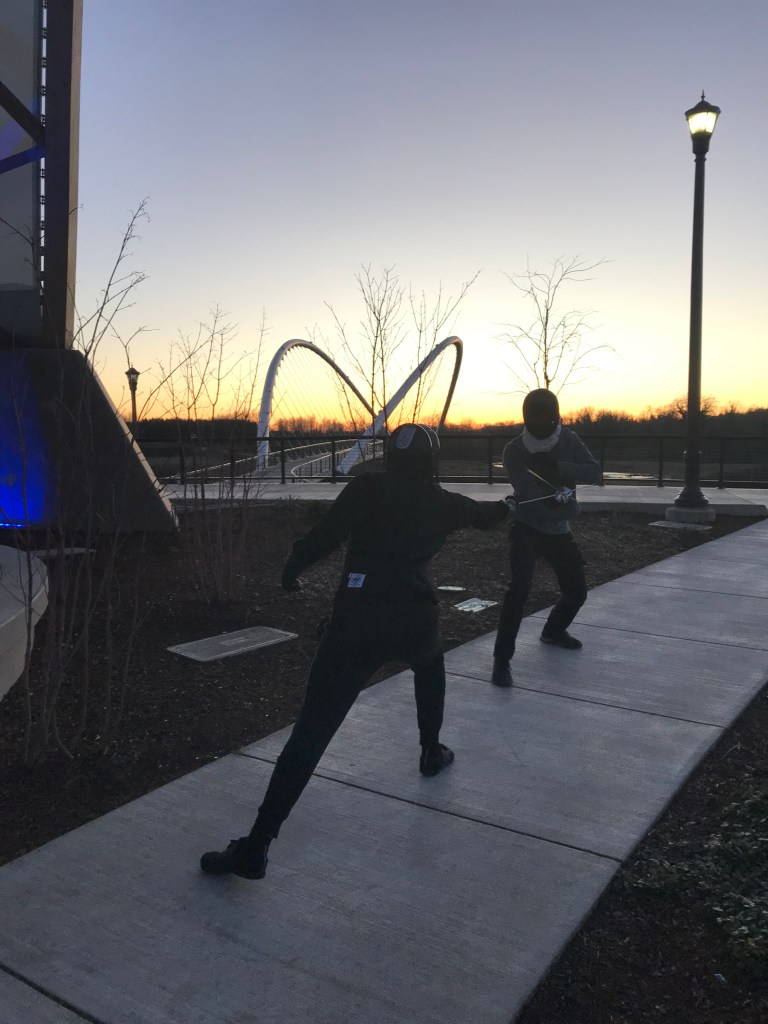
Despite the cold and wind (it was 28F/-2C), a few of us met down by the waterfront in Salem this evening for smallsword. Though I am able to teach more often indoors again, there are still times where we lack that option, and so one either finds a way or doesn’t practice. The crew in Salem is dedicated, in no small part thanks to my friend Joshua, who approached me last year about the weapon and has done more than anyone to get others interested. It’s important to me to honor that commitment and drive, and to be honest easy to do since I enjoy smallsword so much. If they’re willing to meet on a chilly evening, I’m happy to make the trip.

It’s difficult working in the cold, especially in a two hour block, but we did our best to keep moving and stay out of the wind. Lucky for us, the amphitheater where we met has surprisingly good lighting, and thus we were able to continue practice after sundown. We were less successful avoiding the wind, but it kept us moving! We spent most of the time drilling specific actions and a few permutations following from them, but some measure/footwork exercises too.

Anatomy of a Lesson
From time to time I discuss lessons and lesson-planning on this page, and tonight’s class provides another great opportunity to do that. Since this was a two-hour block it’s important to organize what we’ll cover–there is only so much “new” material one can digest. What I typically do is consider first, whom I’m teaching, and next what they need. In this case, one of the two students who showed up has been away for a while, so some review of fundamentals (which I always include at some level) seemed appropriate. The other student has been practicing with me and at another school, and so is less in need of a refresher, but was happy to go over things again. [1] Regardless of topic, I usually structure lessons, long or short, the same way:

  • warm up
  • progressive drill
  • main lesson
  • cool down [or depending on the type of lesson, bouting, then cool down]

The warm up tends to consist of plyometric-oriented drills and/or fundamental actions. For rapier and smallsword, for example, I often start people out with something like an arrest drill–this requires me to make purposeful mistakes by exposing the weapon arm in various lines and the student to counter attack via arrest to the exposed section and then cover/parry and riposte. From there, I might add a counter-parry/riposte on my side, and so on. Varying the measure, the speed, and line make this warm-up more realistic and sort of primes the pump as it were for the main lesson.

Format for Sunday Evening
This time we began with a fencing version of a “push hands” drill. Joshua and Robert started with a glide in third, one fencer starting the attack, the other making a yielding parry in third, gaining leverage, and then attacking with a glide in their turn. There is a see-saw quality to it, but done well it’s a valuable drill: it helps both parties gain better sentiment du fer, helps them work on closing the line, provides them a convenient way to monitor how far to move the hand to parry, and tests the height of the hand on the thrust. [2] The same drill is useful in carte, half-circle/7th, and seconde. There are additions one can make to the base drill, but tonight we used the four main lines only and as a warm-up.

Next, we took this drill one step farther—we used the glide in third as a feint to draw the opponent’s tierce, then disengaged and made a thrust to the inside line with opposition in carte. Both fencers are taller than I am, and so one aspect of this exercise that proved particularly useful was changes in measure. Though the same attack can be made “firm-footed,” as the treatises refer to it, it’s important to vary the distance. Not every opponent stands still.

Girard, Traité des armes, 1740

I’ve often had students work from a glide, but at a certain point, once they have the concepts the glide teaches so well down, I expand upon it. [3] This time we discussed a guard where the glide doesn’t work well—Girard’s more extended tierce. One can make an attack by glide against this straighter guard, but it’s much easier for the defender to defeat it. [4] So, we discussed using a beat-feint instead. This was familiar ground, both offensively and defensively, but works a number of fundamental actions. It was a good set up to the prise de fer in seconde, and, the defenses against it.

The first line of defense against this attack, one anyway, is the derobement, that is, avoiding the envelopment by performing a tight circle around the opposing steel. Next, we used a yielding parry in seconde. Lastly, we upped the difficulty level and used a change of line from yielding seconde to yielding carte. This is not easy to do—it requires a keen sense of timing, distance, and evaluation of the line of attack. [5] It also raised additional questions—if one transports the blade to carte, one could riposte by flanconnade, but this is harder to do if the attacker’s hand is in tierce instead of carte.

As a way to reset and take a break from a complicated drill, we next played a version of glove tag. Often termed restricted or constrained bouting, this type of game limits one or both fencers to specific options. We started out having both fencers attack the inside line, but they could not parry—the only option was to use the feet and measure. Ideally, one provokes the opponent to fall short, then attack them as they recover back into guard, or, catch them on the march. It can be a workout. Next, each fencer could respond by parrying in carte and riposting, but nothing else.

Joshua lunges; Robert parries in carte

In the last twenty minutes we enjoyed a few unrestricted bouts. I urge fencers to do their best to use what we cover that day, and when I’m up I do my best to present students with opportunities to work on those actions. If the student is new, the cues I give are more obvious and I might hold them a second longer, but as much as possible I try to maintain the same conditions students face in actual bouts. Everything we do should relate to what students will need on the piste or in the ring, otherwise we do them a disservice. Footwork, warm-up, lessons, teaching bouts, pair drills, whatever it is we have students do, should always serve to improve their game.

Have Plastron, Will Travel
Fencing, State-side at least, is an obscure pursuit and outside the Olympic world, which is far better known and supported, it can be difficult to attract and retain students. There are a number of models for running a club and providing lessons, but the one I’ve opted for is as flexible as my other responsibilities allow. The “they can come to me” approach might work for some, but I’ve become a big believer in meeting people half-way whenever I can.

These days I teach six days a week in some capacity, which can be a lot when one has a day-job and family duties. Four nights a week I teach for parks & rec, Sunday mornings I meet people outside that system either at the local Grange or at the community college satellite, and twice a week I provide individual instruction (sabre with one 11 year old girl, rapier for one man in his 60s). It can be a lot, but I love it. Not a day goes by that I’m not grateful to my spouse and children for their generosity with time and the various clumps of fencing gear that occupy different corners of the house.

The Portland metro area, and PNW in general, boast a number of options for those interested in martial arts, and, in fencing. What I offer will not appeal to everyone, and that’s okay–happily, knowing many other instructors and coaches I can refer people to places and people that might better suit them. My close friends among other instructors do the same for me, and in fact, many if not most of my students came to me via people like Mike Cherba (Northwest Armizare). We’re a small community, but we do our best to look after one another, because in the aggregate we all benefit. The more like-minded fencers we train, and the better we train them, the more people we have to enjoy the Art with, so in a sense it’s self-serving. However, the study of the Art beyond mechanics and tactics can impart so much more; it can become a way of life, a philosophical position, and like any such study is one we can pursue all our lives long. The more time I spend in the Art, as student always, as teacher often, the more I appreciate the lessons–all of them–it imparts.

NOTES:

[1] I’m a big proponent for the continual training in the most basic, fundamental actions and techniques. We should review them often if not in some fashion each time we train. Typically, I manage that in my lessons via drills and exercises, and, regardless of skill-level. The kendo master I studied with briefly told us about his yearly retreat with his own, elderly master. Despite all my sensei had achieved, his rank, etc., his master could still find things even in his grip on the weapon to correct. We are never finished being students.

[2] Smallsword texts, as I’ve mentioned before, can vary considerably when in comes to hand height on the attack. For my part, the advice of many masters, who suggest that the hand should be as high as the chin, seems to fulfill the requirements for covering the high-line when lunging well enough. Some later texts, likely more reflective of salle play, can have the hand super high (e.g. La Boessiere), but raised so high one is far more likely to eat a counter-thrust.

[3] I will likely never be able to thank Chris Holzman, one of my mentors for Italian fencing, enough for his suggestion to start new students off with the glide vs. a direct thrust. It has no lie revolutionized my approach. Thank you, again, Chris 🙂

[4] Girard’s guard, as you see in the image, is more or less extended. What we see there is supported by the text accompanying it as well. On page 12 of the pdf available at the BnF Gallica site, the text reads Il faut présenter la pointe de l’Epée droite, vis à vis la mamelle droite de l’ennemi, & que le demi tranchant regarde la terre and Que le bout du pommeau de l’Epée regarde entre le teton droit & l’aisselle, & tombe directement au-dessus du bout du pied droit. Here, the tip of the blade and the end of the pommel both suggest a more or less horizontal blade.

This is harder to describe than demonstrate, but Girard’s guard, because it is more extended and horizontal, makes it more difficult for an opponent to effect the glide, but more than that, to defend against such an attempt requires merely a shift of the wrist right or left to defend. A beat may not sufficiently move the line, especially if one beats to the side of the opponent’s blade opposite the thumb, but combined with a feint it is more likely to succeed.

[5] My approach to working more complex actions is progressive and determined by skill-level. Though where we stopped is a viable response, it is also an unlikely one. The simplest, most efficient response is normally best, however there are at least two reasons to explore more complex iterations. First, it is “medicine for the hand,” and in training more sophisticated actions we hone the basic ones that comprise them. Second, there is always the chance one will face an opponent where the simplest defenses and responses will not b enough, and so having additional options in one’s repertoire makes sense.

Sources & the Lesson

In a recent discord discussion one participant asked a series of insightful questions about how we use sources in lessons and classes. [1] Specifically, they asked:

So as an instructor, do you prefer referencing texts right away, or introducing technique in a more generic way until your students have some foundation?

It’s one of those obvious questions that is in the background of most lesson planning, but for me at least not one I’ve asked aloud, and, it’s an important question. To what degree should we discuss the sources during class? How much should we quote from a text? Do we merely cite a source? Do we share a brief summary of how we’ve used the source before or after a lesson? Do we avoid mentioning, citing, or quoting the sources we use during lessons and classes? How much should one incorporate sources if at all in the actual business of teaching?

Here I’d like to share some of the salient points others made as well as my own take on this. Starting with my own view, how much I mention or include sources in class or an individual lesson depends a lot on purpose and context. We teach in different ways, so it follows that we might incorporate our sources differently depending on the audience, goals, and topic.

In a seminar where I’m introducing people to a general area of study, say Radaellian sabre, I normally begin with a brief explanation detailing critical information (who, what, when, and where) as well as its significance (why). The rest of the time we spend more or less on the “how,” that is, exploring the system in such a way that participants gain an idea of what distinguishes this sabre school from others. In the course of a seminar people may ask questions about the system or the sources for it, and that’s fine, but focus remains on actually working on the material sword in hand. Often, there is either a formal chance at the end to go into more detail, or, an informal chance afterwards to chat about things in more depth.

In a more focused seminar, say a particular aspect of a source or tradition, I may say a bit more, because I must. Radaellian molinelli, for example, require some explanation. It’s not just what they were used for, which one could wax upon at length, but also detailing and explaining the mechanics behind them. The nature of close study is normally a decent place to cite sources or passages within them directly. That’s not always the case. In a general seminar I may say that Del Frate, Masiello, and Rossi all say this about the molinelli, but in a more focused class I might just zero in on what one master says. In this case, not using what Del Frate or whomever said makes little sense: ostensibly the people attending are there because they want to know more about this author and their take on the topic. [2] There is often overlap. The last time I discussed the molinelli, for example, I drew heavily from Del Frate but brought in Barbasetti and others as appropriate. My class was one of two that day and we had ample time to spend using these circular cuts in different ways.

For a regular class, say one with 5 to 10 people that meets once or twice a week, I normally save the bulk of the source discussion for post-class review sheets. This said, there are times when in order to explain how or why we do something I do reference the texts. These snippets can be diverting and can eat up time, so I try to keep them to a minimum. It’s a judgment call in many cases—will sharing what Girard or Rossi or Marcelli said here help the student understand or introduce a speedbump to the learning process and pace of class? Sometimes I get that wrong. Few things let you know that like a student turning to look at a clock or shuffling impatiently because they’re eager to jump back into activity.

Individual lessons, by their nature, tend to mean that we spend very little time discussing source material. This too, however, can vary by student, skill level, and the length of the lesson. It also varies by age. One on one lessons are the best way to learn and an opportunity to go through material with focus. Much as I can, I try to stick to the meat of the lesson and less so everything underpinning it. Yes, it’s often relevant, but there are better ways to share all the substrata and more appropriate times.

But you Harp on about Sources all the Time? What Gives?!

True, I do, and I will continue to do so, but using sources doesn’t necessarily mean consulting the sacred tomes between each action. For historical fencing, the sources should guide and inform what we teach, but how we do that is another matter. I look at it this way:

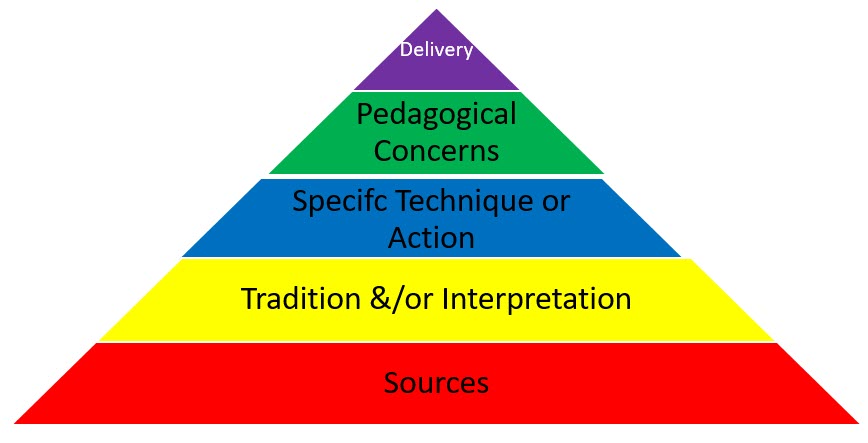
One way to visualize text to teaching [3]

I start with the source. Maybe it’s Del Frate, maybe Girard, but regardless I read through the work or works and see what they say. Next, I consider what I know about the passage I’ve read and its context. Del Frate was writing for the cavalry and a close friend, Giuseppe Radaelli; this system went on to transform sabre most everywhere via the Radaelli’s students and their students. As someone trained within that lineage, I can compare what I was taught with earlier iterations, and then interpret what I want to do with that topic. If I plan to cover feints, I again compare what the source tradition says with what I was taught, and devise a lesson plan.

My lesson plans follow a traditional format—we start with a warm up, jump into the topic, then cool down. How much we do in the main lesson depends on the student, but I introduce the topic and then we explore it via drill, and importantly, by varying the drill. This is where pedagogical concerns come in—is the student new or experienced? What weight of weapon are they using? Where are they strong, where weak, and what balance do I strike so that they build confidence in what they find easy and improve in what challenges them? What kind of lesson is it? Is it a teaching lesson where they’re learning a new skill? An option lesson where we explore actions or tactics in different ways? A bouting lesson where one is preparing a student for a match?

Lastly, there are the nuts and bolts of delivery—how do I introduce the topic, drill, etc.; what language makes it most clear? What examples, analogies, or previous study will aid the student? In what order should we cover the material? For an experienced fencer, I can normally state things generally, such as we’ll be working feints, give them direction to feint by thrust, molinelli to the head, and we start. There will be more variation of movement, tempo, and the order of actions. For a newer student, we may just work on making that thrust convincing, or starting from the right distance. With a new student, I spend more time on basic mechanics; perhaps we just work on the extension or a convincing feint.

Macro vs. Micro

One approach, and what I’ve more or less described above, is to adjust source-inclusion according to the follow logic:

General points/summary/introduction = more source inclusion

Teaching specific movements/actions/technique = less source inclusion

The use of the comparative adjective “more” here is intentional, because so much depends on whom it is one is teaching, and what one is teaching. A seasoned, experienced fencer new to a specific tradition may need less explanation of how to make the action and more of what this particular source says about it. In contrast, a newer fencer, someone very young, generally needs far less explanation of why de Liancour advocated X or Y and way more time spent trying to do X or Y.

As should be evident, this places a considerable burden on the instructor to know, understand, and be able to use the sources. It goes beyond that: it also means the instructor must be able to assess audience, experience, and attentiveness in various contexts, and with luck, be able to adjust on the fly. Much of this depends on an instructor’s goals and what the club is there to do. [4] In some degree, however, if the school is “historical” in focus than there should be some attention to the sources regardless of what one does with it.

Incorporating Sources into Lessons

Specific examples never hurt, so below I’d like to provide a screen shot of one of the ways in which I do this. This selection is a portion of some post-class notes from a smallsword class. As one can see, I provide a scan of the original text, and in this case a transliteration as these students are less used to 18th cen. English orthography and typesetting. Within the transliteration I provide a few explanations and definitions. A few notes follow.

Of note, these explanations follow a lesson in which I mention but do not spend much time on the text—with only an hour in class I focus on technique and its application. This often consists of something like “Today we will cover the glide from third. In the sources this is often called a ‘glizade,’ and in modern works there are more terms still.” That’s it. If someone asks me which text I tell them, but again the focus is to learn how to make and use the action, not a history lesson. Most of my time is taken up setting them up to learn the drill, reviewing the weak and strong portions of the blade, what an engagement means, what opposition entails, and how measure and timing play into this action. That’s a lot of information, and, a lot to do.

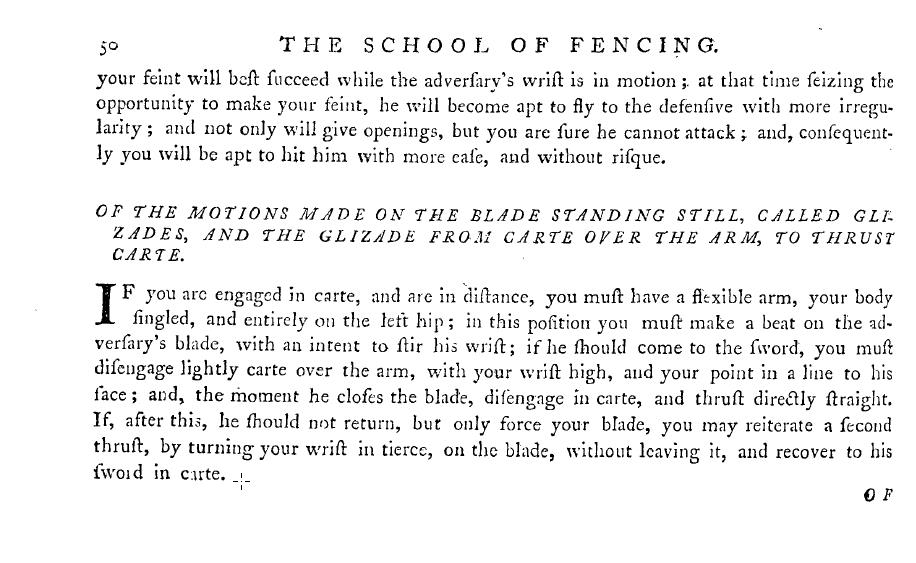
D. Angelo, _The School of Fencing_, p. 50, on the glizade

[50] Of the Motions made on the Blade Standing Still, called Glizades, and the Glizade from Carter over the Arm, to Thrust Carte.

If you are engaged in carte [4th], and are in distance, you must have a flexible arm, your body singled [profiled], and entirely on the left hip:* in this position you must make a beat** on the adversary’s blade, with an intent to stir his wrist [get them to parry]; if he should come to the sword [parry], you must disengage lightly carte over the arm [in third, but nails up], with your wrist high, and your point in line to his face; and, the moment he closes the blade [parries], disengage in carte, and thrust directly straight. If, after this, he should not return [riposte], but only force your blade [stay in the parry], you may reiterate a second thrust***, by turning your wrist in tierce, on the blade, without leaving it, and recover to his sword in carte.

*in the day, most masters recommended keeping the weight on the rear leg while in guard

**we have not covered this yet, but will; it’s a quick, powerful wrap against the opposing blade with your own to open the line

***this is called a remise; it’s to make the attack a second time, in the same line, often by redoubling or double-lunging

There are other ways I use texts, but this is a common one and useful for introducing the “what” and “why” behind what I teach. It’s sort of bite-sized, and for people more keen to use swords than read about them, this is a decent happy-medium. I cite my sources so to speak and provide them information that might help them should they wish to practice on their own, but the choice is theirs–they can read or ignore these sheets as they wish.

On the course and lesson-planning side, having the word and pdf copies of these notes does much to help me revise or correct material as I continue. Each class, each student is a different, so I tend to recycle the historical portions but update and tailor the explanations and comments. I’ve also found it useful to compare my interpretations against the sources from time to time, because colleagues provide insights that change things, as do students. One of the best things about teaching historical fencing is that it can be collaborative—students will question why we do X or Y and each time there is the chance that they may see something I’ve missed. It happens more often than one might think, particularly if the students have a martial arts and/or fencing background. As a last point, for instructors who aren’t quite sure how to engage the sources, this is one way—pick a topic, say the glide, and sit with what a source or two says about it. Work it out in real time, sword in hand, and devise drills if they’re not provided. With practice, it gets easier to do and increases not only the usefulness of these texts, but also our enjoyment of them.

NOTES:

[1] the conversation took place within the local historical fencing Discord 12 Dec. 2022 run by Northwest Armizare’s Mike Cherba.

[2] Usually seminar and class titles are announced ahead of events, so my own operating assumption is that if someone is in that seminar they have at least a nominal interest.

[3] The sources codify, preserve, and help create a tradition, school, or style. There are often particular features in technique that distinguish one style from another, such as footwork, guard, the axis of rotation for cuts, etc. Teaching a particular tradition combines the body of technique with that tradition’s approach to delivery as well as the specific concerns that come with teaching, both individually and in groups. All of that informs how we deliver this material, how we share it, teach, and transmit the tradition.

[4] One issue inherent in this, and a bit of a bugbear in “HEMA,” is the place of the sources and by extension what we mean by “historical.” As the same participant noted in Discord, in re sources and faithfulness to them

What’s tricky though is that even the “H” in HEMA is still a bit vague … Someone might interpret the “Historical” as having an implied “accuracy” associated with it, whereas someone else might interpret “Historical” as just broadly drawing from a past time period…And even if the latter doesn’t mix in any modern technique, a combination of historical techniques is still technically historical to some people.

Maybe the least divisive way to handle this is for each instructor and group to determine what it is they want to do, that is, what “historical” is going to mean to them. It will seem passively relative to say this, but I stand by it—I can hold one definition of “historical” and seek to abide it while at the same time recognizing that not everyone will agree.

Francois Perreault & Ecole Normale de Gymnastique et d’Escrime, Joinville

In yet another wonderful discussion, Russ Mitchell and friends discuss the role that the École de Joinville-le-Pont near Vincennes, France, played in European and later world sabre. As Russ remarks the program at Joinville was as influential as that of the Radaellians or those in the tradition of Kreussler.

Francois Perreault provides a fantastic introduction to this tradition.

Russ & CO.–Interview with Chris Holzman on all things Radaelli!

This video is so good. SO. GOOD. Chris is a friend and a mentor, so I know I am partisan and possess some bias, but for those who listen and find themselves uncomfortable, I challenge you to listen to what he says. Some of it will be hard, but it’s important. Few people like being called out for the inconsistencies and nonsensical things we do, but wee bruised egos aside it’s healthy for us to do so.

This is also a wonderful introduction to Radaellian sabre, a thorough examination of how this system influenced so many others, of the development of the sport, and a personal bugbear, another nail in the coffin in the silly dichotomy people insist exists between so-called “military” sabre and “dueling” or “sport” sabre.

The Problem with Bouting

Bouting is easily one of the most enjoyable aspects of fencing, but it can also prove to be a troublesome problem. The fact that it’s so fun only helps mask the issue. In this case I do not mean those clubs who focus on little else but “sparring,” a different misfortune, but the misuse of bouting, specifically focusing so much on winning that the value of bouting as a pedagogical tool is all but lost.

“HEMA,” because it lacks a robust coaching pool, is all over the map when it comes to teaching.[1] Some groups do their best to work fundamental actions, but many do not. Too many put a weapon in a new person’s hand, give them five minutes of instruction, and push them into the ring. People with busy lives and for whom swords are recreation often want to get fighting as soon as they can; it’s understandable, but lamentable. Instructors cater to this desire because they don’t want to lose people. That too is understandable, but again, lamentable. Given the audience for this site, and the unpopularity of my position on this, I don’t expect to sway many to adopt the approach I have embraced, but it would be remiss of me not to try, because I’m convinced after decades of watching what happens when people bout too early that there’s a better way to build solid skill.

Why Bouting Too Early is Unwise

There are several reasons why new students shouldn’t bout from the off, but spend time acquiring and drilling good technique, building a keen appreciation for measure, and an equally keen sense of timing. 

Safety: First, fighting even with blunted weapons is dangerous. New fencers hit hard because they lack control and the fine motor skill required to modulate their attacks. Thrown into the stress and excitement of a bout in real time, these fencers are unlikely to learn finer motion because they’re too keen to strike and to a lesser extent defend. Their actions tend to be larger and harder, neither of which are hallmarks of skill.

Stunted Growth: Traditionally there’s a reason why new fencers weren’t thrown into the assault too early. Without solid fundamentals fighting before one is ready is a prime way to cement bad habits, none of which are easy to correct once they become ingrained. One of the reasons that “HEMA” suffers so badly from shoddy fencing is because many fencers are, ironically, rewarded for crappy fencing. It’s not hard to “git gud” in one’s local group, jump into a local tourney, and intimidate and/or hurt one’s opponents on the path to a medals and glory. I’ve judged a lot of tournaments and have seen this over and over again. Worse, these same fencers take their good luck for skill and start teaching, thus creating another generation of hard-hitting louts convinced of their own genius.

Wasted Opportunity: Bouting, approached correctly, is a pedagogical tool, at least that’s what it is supposed to be. It’s a chance for both fencers to test out what they’re learning in real time. Ideally the first bouts a fencer has is with their coach–these teaching bouts, as they’re often called, require a lot from the instructor. They must possess the skill to alter how they present an action, change tempo, play with distance, all of these things in order to provide the student with realistic scenarios.

Drill, good as it is, often consists of snapshots of actions made in an actual assault. The feint to the inside line, disengage to the outside line, for example, is something two fencers can practice and within a short time get down because they establish a rhythm. Fighting isn’t like that. The metronome effect that can occur in drills creates a fencer who can only make that action if the same, exact conditions are present. [2]

Free-bouting, as opposed to a teaching-bout, ideally takes the conditions a coach changes on purpose and randomizes them. This is to say that a coach usually tells a student what it is they’re working on, what they will set up, and what the student must try to do, at least at first. As a student advances, a coach can say less about the specifics. With a fellow fencer, however, the student normally does not get any advanced warning. They just jump in and either seize the initiative or react to that of their opponent. This can be a super effective learning tool IF both fencers take advantage of it, if both realize that the bout is way to test, break, and improve their tool sets.

One Upsmanship: No one is immune from ego issues. Competition is one place where we often see these normally hidden issues emerge. Whatever self-worth concern drives a person can easily take over a bout, because “winning” makes people feel good and serves as a species of external validation. When the goal is winning, in feeling good about one’s skill and self, then learning normally takes a back seat. One becomes more concerned with getting the touch than in how one makes the touch, and that how matters. It’s easy to hit an opponent, but not easy to hit them and not be hit oneself–that requires far more attention and presence of mind, far more calm and mental fortitude, and none of that is fostered well when the concern is ego-driven.

Moreover, too much concern with winning can make things ugly; it can break down what should be a partnership in learning into a battle of egos. If one person crows about landing a touch, the other may not take it well. Resentment may fuel hard-hitting in both directions, shots after the halt, and ill-will. Learning and improvement, the purpose of a class or lesson, suffers when behavior like this enters the picture. People tend to struggle to learn in a place where they don’t feel safe. Class should challenge students, but because it should push them it must be a place where other stressors are removed or at least reduced. Behavior which introduces needless distraction, which engages emotions unhelpful in the acquisition of skill, have no place in the sala.

Bouts as Learning Tools

The bout within the context of a class is not the place for the same energy, ethos, or goals as one has in competition. A fencing class is a cooperative learning lab, not the piste, not the ring. Everyone will get far more use and enjoyment from bouts when they bring the right mind-set to it. Use these bouts as a way to practice, to learn, to see what works and what doesn’t. Use them to play with measure and tempo, to test them out with different techniques and tactics.

Inevitably instructors will encounter students who struggle to embrace this notion of bouting as really just more or less unplanned drills in real time. My advice, if this goes against one’s plans, is to quash it immediately. I have a sort of “Defcon Levels” approach to managing this problem in my classes:

Level 1–Student is no longer allowed to bout
Level 2–Less gentle reminders and a review of my approach to bouting
Level 3–Gentle reminders that we’re partners in learning, opponents not adversaries
Level 4–Cultivating and reemphasizing expectations about bouting
Level 5–Establishing clear expectations about bouting

First, I make sure that my rules and expectations for bouting are explicit, not only when someone joins a class, but before each portion of class that includes bouting. 

RULES for BOUTING

  • Safety equipment–mask, jacket, glove, etc.–are mandatory
  • Be respectful: your opponent is your partner in learning
  • Be gracious: acknowledge a hit and refuse to accept a touch you know you didn’t make
  • Be humble: we’re here to learn. Save all the fire and drive for competitions
  • Be gentle: hard-hitting is the mark of a poor fencer, of an untutored brute
  • Be curious: ask questions if you have them; observe and analyze the action
  • Have fun!

Second, I actively cultivate the proper approach and do my best to model the behavior I want to see, from congratulating my partner on a good touch to keeping the mood light. When a student breaks protocol, if they crow about a point, get too aggressive, or start talking about who won/lost I remind them that we are here to learn, we are working together toward that goal, and that it’s not about win or lose, but improvement. If the gentle reminder fails, and it does sometimes, I stop class, have everyone remove their masks, and I lecture them: I reiterate the rules and expectations, and inform them that future infractions will mean no bouting for that person. If after a more stern warning a student persists, I stop the class and remove them from bouting. It’s not happened (yet…) but should a student persist in such behavior, I will ask them to leave until they’re ready to act responsibly.

What we do is dangerous. Part of my job as an instructor is to help students hone a dangerous skill set safely, to learn to use it responsibly, and in the spirit of camaraderie that should unite us all as comrades-in-arms. One of my goals is to instill in my students the truth of the school motto, vis enim vincitur arte, “for force is conquered by art.” Strength, power, all of these have their place in fighting, but our tools in fencing–applied correctly–replace and mitigate force. That’s why we use them. [3] 

Each club or school will have its own approach and protocols for bouting. I have found, having visited so many schools, having fought so many people from different club cultures, that treating the bout as a tool produces better results. The assault engaged in as a learning exercise can still be fun, it can still be a fight, but with the focus on improvement over net performance, students are better prepared for competitions, they’re more likely to help others improve, and generally they’re a lot more fun to fight because they’re there to learn and have fun instead of beating people down. There is a time and place for the aggressive, go-get-’em approach, but generally it’s untoward and unhelpful within a class setting.

NOTES:

[1] There are many good instructors out there. However, there are also a lot of horrificly poor ones.

[2] This is one reason altering drills, even simple ones, via the universals is so important. In the example used here, changing the measure and footwork, changing the tempo the feint and thrust/cut are made in, changing the set up, all work to make this one action far more useful when the fencer needs to use it in a bout.

[3] We talk a lot in historical fencing about attribute fencers, about this person’s speed, that person’s strength, and we tend to downplay them because the milieu in which we work is focused on skill, not the application of natural abilities. In an actual fight, however, and depending on the context, something like strength does matter. It might not in a duel between two people with smallswords, but it almost definitely would in armored combat in the lists.

Who’s on First? Francesco Marcelli’s Guard of _Prima_

Agrippa, “Prima,” 1553

A comparative look at Italian rapier texts will reveal how Francesco Marcelli’s prima differs from the guard of first advocated by most other masters. First is an iconic guard/parry, and dramatic in most depictions. We see it, amongst many works, in:

  • Camillo Agrippa, ca. 1553 (born Milan, active in Rome)
  • Fabris, 1606 (Padua, Denmark)
  • Giganti, 1606 (born Fossombrone, central Italy, active in Venice)
  • Capo Ferro, 1610 (born Cagli, central Italy; active in Seina, Tuscanny)
  • Alfieri 1640, (Padua, under Venetian power)
  • Pallavicini (1670, Sicily)
Alfieri, “Prima,” 1640 (figure 2)

I asked Christopher Holzman, who translated Marcelli into English, why Marcelli’s prima is effected so differently, and he suggested that the master’s choice of “prima” as the term for his preferred guard likely reflects its importance. That’s certainly plausible. It stands out against the choice of other Neapolitan masters, especially Pallavicini. This master, who was not one to miss a chance to take shot at his rivals, complains about modern masters breaking tradition. Though he appears to have respected the elder Marcelli, he didn’t think much of some of his later students. He seems especially to have had it in for Francisco Antonio Mattei (author of Della Scherma Napoletana, 1669). Mattei, like Giuseppe Villardita (1670), was a student of Mattei’s older brother, Giovanni, who was taught by the elder Marcelli, Giovanni Battista. [1] Set side by side, the works by both Mattei and Villardita pale in comparison to those by Pallavicini and Marcelli—they’re not particularly eloquent, well-organized, or as comprehensive. It’s possible that Francesco Marcelli’s guard of first he learned from his father, but at the time of this post I’ve not yet discovered whether that is so or not.

Parry of Prime

Setting aside the questions of origin and development, for the instructor teaching Neapolitan rapier there are some considerations to manage prior to the lesson. Prima, as Marcelli presents it, reads and functions much differently than the prima/prime of more recent schools. Anyone trained in foil in the late 20th century, for example, likely learned either the French or Italian parries for first. The French school’s parry, in the United States, is probably better known, but the Italian is as venerable. Neither of these assists one in understanding, using, or teaching Marcelli’s version. [2] If the instructor is familiar with smallsword treatises, then they may know the two key versions found within that corpus, the earlier false-edge parry of prime and the later, true-edge parry that gave birth to the guard of the same name of the modern French school. [3]

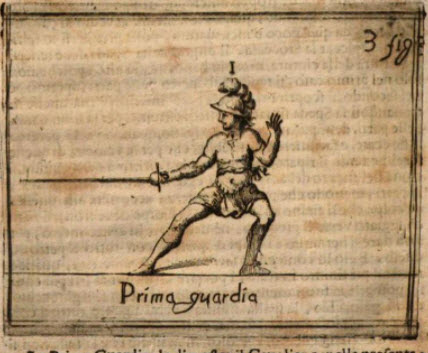
Compared to any of these iterations the low, almost-flat third or oddball second of Marcelli’s prima seems strange. Preconceptions about what first is must thus be abandoned and The Rules of Fencing’s advice taken instead. The hand and blade are held lower than third, and too low for more recent versions of second. Marcelli provides us an illustration, but as always one must consider any image against what the author says. Of prima Marcelli writes:

Marcelli, _Rule of Fencing_, Bk 2, Ch. 2, p. 64

La Prima Guardia, la dimostra il Cavalier I. nella presente figura; & ella si fà, quando (situato sù la pianta accennata,) si porta avanti il braccio della Spada, tenendo la mano di mezza quarta; e la punta di essa, fermata in angolo retto, starà equalmente alta del pugno, che la sostiene; e tenendola così bassa, si porta sempre per sotto la lama del nemico.

In the present illustration, Cavaliere 1 shows the First Guard; it is made when (situated in the indicated stance) the sword arm is brought forward, keeping the hand in half-fourth, and the point is in the right angle, equally as high as the hand that holds it. Keeping it so low, it is always carried below the opponent’s blade. [4]

Charles Blair remarked that “Marcelli [Giovanni Battista] was known for a lightning-fast lunge: before one realized what was happening, one was hit; therefore, one could not craft a defence.” [5] Hyperbole aside, though seemingly open this guard is effective and difficult to confront, and it’s possible to launch a quick attack from it. This should not, to any student of modern epee, be all that surprising. This is essentially the guard often used in that weapon.

While knowledge of modern epee might help, rapier is different enough in weight, length, and context to change a few things. This is not to say that one can’t use modern epee technique in rapier—the SCA’s “Black Tigers” do a bang-up job of using modern fencing in this way, complete with an assumed ROW if the lack of concern about being hit is any guide. However, if one is working from the textual evidence in rapier works, it makes sense to note the parallels with today’s epee and then set them aside.

Warm-Up Drills from Prima
I often start rapier lessons with stop-thrust/arrest drills. It’s a nice way to loosen up the arm, work some point-control, and practice closing the line simultaneously. Typically, I have the student in prima (or whichever guard we’re working on) and make the arrest to my arm as I make purposefully poor attacks. [6] I start these from various guards and attack in different lines. We start slow, but the purpose is to increase the pace so that we end up in situations the student might face in a bout at speed. They will encounter fencers who attack poorly as well as those who attack properly, and must be prepared for both.

A second warm-up drill is simple parry-riposte. In this case, however, I leave out the purposeful mistakes and increase the difficulty as we proceed. For example, student is in prima; I’m in terza or third. First, I may make a direct thrust to the inside line; the student, from prima, parries in quarta or fourth and ripostes with opposition. Depending on the student, this takes two forms; with my advanced students, for example, they work this as both a one-tempo action and as a two-tempi action, meaning that in the first instance the parry and riposte are simultaneous, in the second the parry and riposte are distinct, sequential actions.

Lessons with Prima

Marcelli, like many masters of his time, breaks some maneuvers into those made with a firm-foot and those made advancing. I use this distinction as well to organize the lesson. For example, firm-footed, I may have the student work on gaining the blade from a specific starting position. Marcelli, in Ch. VII of Part One, Book II, cautions us wisely on the dangers of seeking to gain the blade—if done poorly the opponent will see it and disengage to strike in tempo. Working this action from different distances helps a student learn to make taking the blade effectively and with less danger to themselves as they do so—were we only to practice this in measure the student would have less success outside that specific distance (which is, after all, somewhat relative to the opponent).

From prima, which is below the opponent’s blade, engagements or gaining the blade take, initially at least, specific forms. It is a fantastic guard to adopt against an opponent interested in gaining the blade too—the arm is withdrawn so the point is less easy to defy and secure. Offensively, however, it is fantastic. I usually have the student keep the blade still part of the time, then shift it from guard, constantly shifting aim both to increase the difficulty it taking their blade and to keep the opponent (in this case me) guessing. It is not difficult to effect engagements, beats, or feints from prima. As Marcelli commented, one is well situated:

La Prima Guardia è più secura dell’altre due; e si rende padrona della propria spada più di quello, che sà la Seconda, e la Terza. Poiche in essa, tenendosi il braccio dritto dolce, e curuato, si mantinene anco ritirata la punta, che non stia molto soggetta alla discrettione del nemico. E da questa situatione ancora nascono molto veloci le stoccate, per lo spirito, che naturalemente si prende da quella incuruatura del braccio, il quale, à guise d’un arco, scocca con violenza nel partire.

The First Guard is more secure than the other two, and makes him master of the his sword more than that which the Second and Third do. Since in it, keeping the right arm soft and bent, it also keeps the point withdrawn so that it would not be very subjected to the opponent’s discretion. The thrusts also occur very quickly from this situation, due to the spirit that is naturally taken from the curvature of the arm, which like a bow, lets fly with violence in the beginning. [7]

Prima is also useful for helping students ensure that they are moving everything in the proper sequence. For example, if making the finta scorsa, the advancing feint, the student must be careful to minimize the danger to themselves. Marcelli, unlike some of his contemporaries, remarks that one should feint a thrust to thrust, a cut to cut, versus a cut to thrust or thrust to cut. The actions are larger and more prone to counters.

In essence, the student is making an advance-lunge and performing a half-thrust on the advance in coordination with the front foot. The disengage (cavazione) is made as the rear foot moves, and the action finishes with the completion of the extension as one lunges. Importantly, the student must then break measure, moving the head and body first and staying secure behind the weapon, which retracts last. To increase the difficulty, I will sometimes defend, sometimes not, so the student must stay on their game and be vigilant. Normally we change roles as well so that the student can practice the counter to the finta scorsa.

Sample Lesson Plan:

Warm up:
S, from prima: arrests to arm as I. (Instructor) attacks from various lines/guards
Parry riposte: simultaneous, two tempi

Lesson:
●Direct thrust from prima
●Direct thrust from prima parried by I., counter parry-riposte from S.

●Firm-footed, feint direct to inside line; I. parries 4th, S disengages
●Firm-footed, feint direct to inside line; I. parries 4th, S disengages, I. parries and ripostes, S. counter-parries and ripostes

Finta Scorsa, feint direct to inside line; I. parries 4th, S disengages
Finta Scorsa, feint direct to inside line; I. parries 4th, S disengages, I. parries and ripostes, S. counter-parries and ripostes

*I. alters guard, S. feints to a different line
**switch roles

Cool Down:
●Three point bout (I. sets up situations for S. to work, in real-time, the material of the day)
●Arrest drill or Parry-riposte to close

Prima, Seconda, Terza, Quarta

While keen to share some thoughts on Marcelli’s prima, the process described will work for any of his guards, and indeed, those he advocates when rapier is paired with dagger. The more a student works the actions found within the text, and faces them from various positions, the more robust their game will prove. We are fortunate that the Rules of Fencing is as well-written and clear as it is—I have found it to be a thorough and exciting font of knowledge, as full of technical brilliance as tactical sense. Moreover, spending so much time on this text has made the others in the Neapolitan orbit clearer. Next to Marcelli I like Pallavicini’s work best, but I have found it more opaque in sections; similarities with Marcelli do not necessarily explain those sections in Pallavicini, but they can provide a more solid starting place to attempt to unravel them.

NOTES:

[1] See Charles Blair, “The Neapolitan School of Fencing: Its Origins and Early Characteristics,” in Acta Periodica Duellatorum 2: 1 (2015): 9-26 [published online 2015 and available at ADP, https://bop.unibe.ch/apd/issue/view/1082]; see especially pages 9-10. See also the brief history by Chris Holzman in his translation of Marcelli’s Rules of Fencing, xi-xiv (similar coverage can be found in his translations of both Pallavicini and Terracusa e Ventura). Blair’s article provides a solid overview, but for guards he focuses on rapier and dagger versus those used for sword alone.

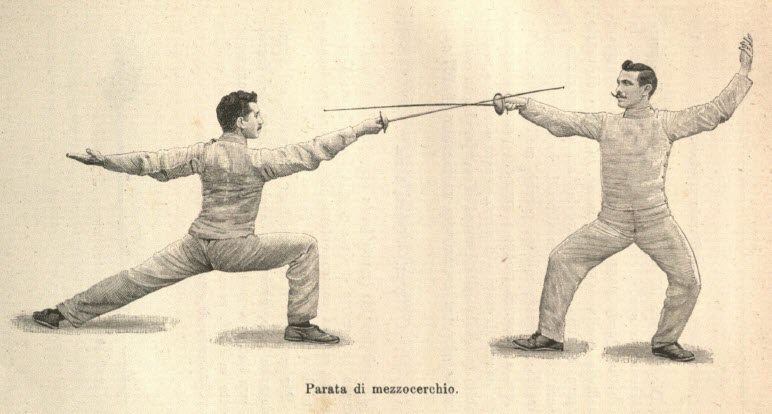
[2] The images explain it better than I probably can, but French prime sweeps from outside to inside, hand about temple height; Italian prima in Del Frate is much the same, but we see a different parry in some works, mezzocerchio, which is sort of quarta with the blade tip dropped, somewhat akin to French septime.

Parise, mezzocerchio, 1904

[3] As smallsword transformed into foil play, a game all its own, the necessity for the false edge parry of first, which helped keep one farther away from the incoming steel and which set up the offhand parry well, gave way to the faster prime with the true edge. The latter is an all or nothing parry, one that should it fail to sweep the line leaves one horribly open.

[4] Cf. Marcelli, Regole della Scherma, 64; Holzman, Rules of Fencing, 88. In his note for that passage Chris explains that in “half-fourth, or 3rd in 4th position, the true edge is turned diagonally downward to the inside. What Marcelli calls First Guard, we would probably call a guard of 4th today.” I would add that later smallsword texts that have one hold the blade in fourth, but framed on the right, somewhat like modern French sixte, get close to this, the key difference being the height of the hand and direction of the point.

[5] Blair, ““The Neapolitan School of Fencing: Its Origins and Early Characteristics,” 9.

Poor Rob Childs will, I’m sure, be sad to discover that he didn’t invent the invincible thrust (exploitation of his “critical angle,” i.e. selecting an open spot and hitting it from the right distance and at the right time…). But, hey, he still has his jump-lunge (oops, no…, that’s a balestra), and his “vertical” and “horizontal” (dang, no, those words first appear in English in the 16th century). Well… he still has is hand-puppet distractor… no, dang again, Joseph Fiennes did that best in “Shakespeare in Love” (Miramax 1998)…

Joseph Fiennes, “Shakespeare in Love,” 1998–fight scene with Wessex. Notice the fool’s marotte in the off-hand.

Good-natured teasing aside, for those interested in HEMA’s competitive side time spent with Rob’s videos will help—though he might footnote some of what he shares, the fact is that he provides the “historical” fencer with solid modern technique and ways to exploit the rule-set.

[6] Purposeful mistakes are not something I have students make with one another. That burden is on me. I don’t advocate having students working on anything that requires one of them to fence poorly on purpose. As the instructor, and as someone whose competitive days are behind him, I have less to worry about. Those actively competing or fighting should learn how to exploit mistakes, but not make them.

[7] Marcelli, Regole della Scherma, 66; Holzman, Rules of Fencing, 89.

Defining (Redefining?) a Successful Club

I’ve hesitated about posting this entry, but since it relates to a common problem many historical fencing instructors face, and since increasingly my chief role seems to be advising others like myself, I decided to chuck caution to Zephiros. I’ll not lie though: moving forward with this piece feels a lot like leaving a perfectly good guard position, dropping my weapon, and pointing to my chest so an opponent has only to extend to hit me.

Any group of people, however small, introduces complexity that should have one considering “success” on multiple levels, but here I mean in the usual sense behind this word in the United States. Success in this sense connotes “viable,” thriving, active; potential growing and improving. By implication stasis may be viewed as “less” successful, though most people would likely agree that stable trumps shrinking numbers. When most folks Stateside speak of a “successful club” they mean a certain thing—generally, they mean a club is large-ish, active, and popular. Logically, this is both valid and true given the premises most American historical fencers, if not others, assume in assessing these things, but the logic left out is as important. A club, group, or school can be successful if it doesn’t meet these qualifications. Popular doesn’t mean success on all fronts, and too often, not where it’s most important. Combating the normal attitude, however, is fighting uphill against greater numbers.

The problem is that being the common conception of success, if one’s school is smaller, less well-known, or uninterested in the usual pursuits, one still has to contend with the definition at large, with how others value and define everything. Well-meaning people will still seek out Club X because it’s popular. New to historical fencing, people do not necessarily have the tools to evaluate quality—big has to mean better, right? Maybe. Maybe not.

To demonstrate how extensive a problem this is, I have received advice—unsolicited—from both those who run other clubs and people completely unacquainted with fencing groups. Both have sometimes given me the advice that I might consider “redefining success.” I’ve balked every time for two reasons. First, I don’t share their definition of success, so there is no reason to redefine it. Second, even assuming I buy into the same definition, how, I ask myself, is this not a cop-out? How is it not really “relabeling failure?”

Debate over the relative merits of either position could occupy more time and space than necessary, but in brief here is a quick distillation. On the one hand, success should, in some if not most respects, relate to and reflect a collective definition of what constitutes achievement (key here is what we mean by “collective”). Without some degree of consensus, what denotes success becomes purely relative and ceases to mean much beyond the individual and their definition. On the other hand, widely held definitions of success can easily be outdated, myopic, or biased, and so, awareness at the very least of these potential pitfalls in assessing one’s own success seems prudent. The answer is to determine what success means to us and those in our circle and frame questions about it in light of that definition, not that of someone else. Sounds obvious, but it’s not.

It’s possible if not all too common to misapply a definition of success, even in a related field. For example, if the only rubric of success in historical fencing is increased understanding of the source material, but one’s interest is winning tournaments, then applying the former to the latter doesn’t make sense. There may be overlap, true, but neither tournament wins nor the ability to explicate a source require the other to be successful. It’s entirely possible to win a bout never having read a single word from a treatise. This said, any understanding of a treatise requires solid familiarity with the weapon and experience using it; theoretically, the more experience, the better the understanding, but then defining “experience” is just as prone to abuse. [1] It’s possible to gain understanding of a fencing text, in some degree, never having picked up a weapon, but far less possible to understand it well without some training. By this I mean not only a grasp of technique, but of theory, historical context, and the place of the text in situ. [2]

Apples and Oranges

How we define success, what it means to us, should determine much of what we do. Any such examination should consider one’s goals first. What is it that one wishes to accomplish in the study of historical fencing? There is no “right” or single answer. People jump into medieval, renaissance, and early modern martial arts for a variety of reasons. While I maintain there are better and worse ways to pursue most any avenue, the fact is that the choice of avenue is entirely up to the individual. [3]

There are many different “HEMA”s and thus there’s something for everyone. This said, how one defines progress and success should follow from one’s chosen path within those HEMAs, not necessarily the popular notion or that touted by folks with a different focus. Instructors most of all need to give thought to their purpose—it just makes sense: teachers need and want students, and students are easier to attract if one is explicit about what it is one teaches. Clubs doesn’t exist without students. An instructor on their own is just a practitioner—for those of us working with fewer people there will be, alas, times when we aren’t technically instructors.

The hard part for instructors who have students stick with their program beyond a Groupon is that invariably the question of how well one is doing will rear its ugly mug. This is where caution is important, and, where many of us go wrong. We look across the street, see Club X doing “well” (again by the standard definition), and think we’re failing. Unless we’re trying to do exactly what Club X does, that’s probably not true. We have to consider our goals, how those in our track specifically envision “success,” and evaluate our progress against that. Club heads, like any other individual fencer, can mix things up. The backyard brawler whose “cool tricks” beat fellow members of their fight-club should not assume that this means he is Leichtenauer reborn. The armchair historian who has never fenced but knows Capo Ferro in and out is not likely to find great success at the International Rapier Seminar. The SPES-clad tourney jock with a gold medal should assume neither that they’re Leichtenaur reborn nor that that their success at the IRS means they exemplify what Capo Ferro intended. If the instructor is making the same mistakes, not only will they be miserable, forever questioning their success, but also they’re likely to lose people. People do all this stuff for fun, and one-act plays featuring a teacher with ennui are not fun.

Instatwitterfacechat and False Reality

When we step back and think about this, we see how obvious this is, but that’s part of the problem: it’s hard to step back when so many arenas suggest everything is the same. Facebook, Instagram, Youtube, all of them, present a funneled version of reality, one no more as safe for historical fencing as it is for understanding politics. As presented, HEMA is mostly longsword, with some nods to rapier and the watered down world of infantry sabre. Tourney news makes headlines in a way that an article on Perinat will not. Name recognition is created more by flooding social media and “likes” than anything else. Authority, such as it is, follows suit, and yet most people wouldn’t use the same logic to find a surgeon or plumber. Strange women lying in ponds distributing swords is probably a better source of authority than these HEMA equivalents of swiping right on some dating app.

If one isn’t careful, one will assume that whatever they’re doing must conform to this pastiche of HEMAs, because everywhere one looks seemingly presents the same truth. Youtube, facebook, Instagram, none of these present reality, just specially tailored packages meant to convey what the creator desires and wants others to believe. These things are fine so long as one sees them for what they are, but no instructor, no fencer, should use them as a basis for comparison without first recognizing what they are and assessing whether or not it makes sense to use the media this way. [4]

Each of us, in conjunction with those on the same track, should decide what our goals are going to be, not the herd or those following paths going in different directions. If we’re lucky enough to find like-minded folk, people with similar goals, then they’re probably a lot safer to listen to than those who don’t share either our values or our reason for pursuing the Art. These are the people, not HEMA at large, who might help one define goals more appropriately.

NOTES:

[1] Experience means a lot of different things. Time in the saddle means nothing if that time wasn’t spent well. Over several decades I’ve watched many passionate fencers and fighters waste their time in programs which won’t help them improve. Saddest of all is watching a person like that try better schools, but leave because it’s either harder or because they feel less bad-ass. Serious students have to have the courage to be a beginner even when they’ve studied a long time. This doesn’t apply to the part-time folks just there to acquire enough skill and play for fun, but to those people who wish to grow in the Art.

[2] We have to consider, among other things, how was such a text used at the time. We need to ask… How were works on fencing understood? Why were they written and for what audience?

We often talk about the corpus of works as if it were homogenous, but it is anything but that save in broad outline—we have notes, lesson plans, fragments of larger works, government publications, poems, illustrations, treatises written for other teachers, popular works, and works meant to showcase a particular master’s approach for their patron.

[3] If the H and/or MA of “HEMA” are missing I’m not sure what separates what one is doing from Olympic save choice of weapon and a less viable, motley collection of pedagogical approaches.

[4] For example, I might suggest to a new rapier or smallsword fencer to look up Levi Fontaine or David Pascal’s bouts on Youtube, but this is so that they see what is possible, not because I’m expecting them to show up next week and move and fight as well as they do. New students shouldn’t compare themselves to people with so much more training, but, seeing beautiful fencing can inspire us. It also beats having them bump into the garbage out there that will only hurt their progress.

E.g.

Pants before Shoes: Skill Progression in Fencing

from the genius of Gary Larson and his “Far Side”

In fencing some skills are difficult by nature, some because we make them so. For the former, one must put in the time, sweat, and sometime frustration—there is no other way. For the latter, however, there is much we can do to limit the ways in which we make skill acquisition harder. As much as this applies to any student, it applies all the more to the instructor, for they plan the lessons and set the pace. It’s their responsibility to present material in a logical, progressive way so that shoes are not donned before pants, so that equines are not placed before carts. We do this in most things, and fencing is no different.

Culture & Approaches to Learning

So much of what we study is exciting and people can’t wait to dive in—deep—but the fact is that fencing, any fencing, requires considerable coordination, skill, and experience to do well. For the clubs (especially here in the U.S.), which are various takes on Chuck Palahniuk’s Fight Club, often newcomers are handed a weapon day-one and ten minutes later are bouting. It should be obvious why that’s a bad idea, but given how widespread the practice is, it’s not.

Often those running such clubs probably don’t realize how short-sighted this is; it might be the way they themselves got involved, so it seems normal. In addition, most clubs struggle to stay afloat, and the tired adage of “give the customer what they want so that they come back” may underpin this get-them-playing-right-away practice. It’s a tough spot for any club—we want people to stay, but the fact of the matter is that most people are there to play. It’s recreation. By and large “HEMA” consists of people in their late teens to those in their thirties, so college students, adults with jobs, people with time and just enough money to pursue this expensive hobby. It makes sense that many if not most folks don’t want to spend the little free time they have doing thirty minutes of footwork drills, working on point control, or exploring this play or that from technical aspects.

A caveat: I am not dogging play-time; however, I think it’s important to ask the question, to be mindful of what it is we offer, and why. If a club wishes to be the “HEMA” equivalent of fight-club meets theme-park, fine, but admit it; have the integrity to own that what you’re doing is less “martial” than it is playtime with a few historical “tricks” thrown in. There is room for this, and in my experience, that in fact is what most people actually want. This is to say that the numbers are telling. Those groups who focus more on technique, on building depth within the Art, not only tend to be far smaller than others, but also get people bouting at full tilt slowly. Between the length of time to learn enough skill to bout effectively and the fact that there is a lot of work up-front, few people stick. To reiterate: this is perfectly understandable. That doesn’t make it any less unfortunate.

The Difference between “Do this” and “Here is how to do this”

For those interested in comprehensive technical skill acquisition the old way is still the best way. Ideally students do this one-on-one with an instructor, but it also works in a group setting if slightly less well. In short, this approach takes “do this” and expands it to “this is how you do this.” For example, one could demonstrate how one stands in posta di donna in Armizare, ask the student to copy it, and when it looks right enough, say well done and continue. Alternatively, one could start there and then make the micro-adjustments that will save the student problems later. The instructor could speak to how far apart the feet out to be, what direction they’re pointing, and where one’s weight should be—between the feet? Front-weighted? Back-weighted? There is also more than one way to adopt posta di donna—one can adopt this stance with the sword over the right shoulder, over the left; one can stand in posta di donna pulsativa, which is more back-weighted, and, in the same way but with the sword on the left (posta di donna la senestra pulsativa). [1] The student might be wielding a longsword, a longsword as pole-arm, a spear, or a pole-axe, and while the stance is more or less the same the length and heft of the weapon change critical aspects, such as measure and tempo. Each one of these positions is useful for some instances, less so for others, and so it’s not enough to say “stand like this;” we also have to explain when and why to stand this specific way. If the student is shown one version of this posta they’re getting short shrift, and, it’s not going to work well for them.

An Argument for Slow & Steady

What’s the risk in not learning how to fence via a method which introduces complexity one step at a time? There are a few things. First, if their level of understanding is shallow, the student’s ability to add to their repertoire is affected. Lacking basic comprehension makes learning permutations for that skill or related ones harder. This is all the more true with fundamental actions. For example, if the student learns to lunge without ensuring that the front foot is pointed at their opponent/along the line of direction, there are cascading consequences. They increase the risk of injury to knee or ankle. They inhibit their ability to advance quickly or perform maneuvers which employ the same foot orientation, such as the advance lunge, jump lunge, or redoublement. In the worst cases the misdirected foot misdirects the body and thus the weapon.

Second, hard is it may be, the acquisition of skill in a logical, progressive sense builds confidence. Having mastered how to lunge, for example, the student is more inclined to use it, and often, more amendable to learning other methods of moving that employ it. Confidence—sensible confidence—is everything in fighting. Without it one is immobile, potentially at the mercy of a more confident opponent. Proper education instills proper confidence, because it is built on more than luck or the myopic reality of having something work in specific situations like tournaments where most people are at the same skill level. If one has learned to lunge well, and with it, when to lunge and from what distance, there is science in play—it’s adaptable, not tied to the conditions of any one situation. This is important, and, not only for the more source-driven, history-minded folks, but tournament folks too—fight long enough, in tournaments of different types, and one learns quickly whether their toolbox is as replete with tools as one thinks.

This brings us to a third reason the slow and steady approach to learning is important: resilience. When the tournament fighter reaches the day where their bag o’ tricks lets them down, the countdown to their quitting starts. They have nothing to fall back on; the more passionate among them seek out new tricks, but since these “tricks” are misapplied or misunderstood fundamental actions or composites of such actions, they are ultimately a dead end. This fighter doesn’t know how to recombine them. This is one reason, judging by local numbers, people jump into “HEMA” for two to three years, then leave. For the fighter, however, who possesses skill and understanding in the fundamentals, there is a built-in approach to analyze and problem-solve what went wrong in that bout or this tournament. So armed the student is less likely to hang up their mask and feder, but examine what went wrong and why, because they have the tools and technical vocabulary to do so.

Related to resilience, but perhaps more germane to the let us say the “mature” fencer…, a solid grounding in technique, not just in its use but in understanding, will allow them to keep fencing when they can no longer, or should no longer…, engage in some branches or fight with certain weapons. Call it adaptability. I work or have worked with fencers older even than I am, and the ones who are still fencing have been able to continue because their understanding isn’t shallow. Even moving say from KdF to smallsword wasn’t the speedbump some might think because they were well-trained in KdF. Their instructor at that club—one I knew and have a lot of respect for—taught them correctly. I didn’t have to teach them how to move, just adapt what they had been doing; I didn’t have to teach them to attack with the weapon first, because they already understood that; I didn’t have to introduce them to tempo because they’d learned this as well. All I have done is help them adapt the lessons they learned studying Liechtenauer, Dobringer, and the rest to new tools. With other fencers, in contrast, who have not received decent instruction, who, poor souls, were just thrown in the pool and told to swim, two things generally happen: they struggle in the first lesson where we go over basics, then in frustration they leave and I don’t see them again.

Further Examples

Specific examples help, so here I’d like to explore two. The first is from rapier, the second smallsword. I’ve not chosen these at random either—I see these very problems all the time. Seeing what sorts of issues these examples cause fencers has served to bolster my position on taking the time to learn to do things properly. The first example, from rapier, concerns adding too much too soon. The second, from smallsword, focuses on a complicated action as if it were simple.

Rapier and Dagger

One of the most popular combinations in historical fencing is rapier and dagger. Not going to lie, I love it too, and in fact it’s now difficult for me using any thrust-oriented weapon held in one hand not to want a dagger in the other. That defense-in-depth is a game-changer. Happily, we have a large number of rapier treatises that cover using an off-hand dagger, among other options, which means that we have comparatively less guess work than we do in so many areas.

If one examines a random selection of rapier works, it is worth noting when the source covers dagger, that is, where it is within the book. For example, I pulled these four from my shelves:

  • Camillo Agrippa, Trattato di Scientia d’Arme, 1553
  • Vincentio Saviolo, His Practice, 1595
  • Francesco Alfieri, La Scherma, 1640
  • Francesco Marcelli, Regole di Scherma, 1686

Agrippa is one of the oldest rapier texts, Marcelli arguably one of the latest, and so though brief this gives us some notion of changes over time. I also considered different translators as a sort of double-blind or check that I wasn’t favoring one (I have my favorites like anyone else).

from Agrippa’s _Trattato di Scientia d’Arme_

Agrippa’s Treatise on the Science of Arms features the pairing of sword and dagger from the off, and, in most sections. It is safe to assume, then, that working these in combination as one starts study of Agrippa makes some sense. In contrast, Saviolo covers sword alone first, then sword and dagger, then returns to sword alone. Likewise, Alfieri turns to sword and dagger later, in the twentieth chapter, in On Fencing. Marcelli’s Rules of Fencing covers the span of a bible before getting to sword and dagger—he begins coverage of it in part two, book one, chapter 1. [2]

Going by these four, and granted this is a tiny sample, starting with sword alone makes sense. There is another reason to study sword alone first—it’s hard enough studying one weapon without adding an additional set of positions and actions, never mind coordinating them both. Proper control of a single weapon is difficult, especially at first, so unless there is good reason to do so, why double that difficulty? [3] Put blunty, if the student can’t make a decent direct thrust or perform the most basic parries yet, then the addition of a second weapon isn’t going to help them: they’ll just have two tools with which they must struggle. Moreover, pairing sword and dagger changes one’s position—from a slightly profiled guard positon one adopts one that is more square, because the offhand weapon now provides some measure of security. To remain profiled limits if it doesn’t prevent one from using that offhand weapon. Thus, if a student’s footwork for sword alone isn’t decent, the addition of variations will only complicate things.

Smallsword

Turning to smallsword, a number of works discuss the demi-thrust, sometimes in English called a “half-thrust.” The term is deceptive—taken literally it might be mistaken for a thrust made half-way or perhaps some manner of in-fighting action, but it’s actually a species of false attack made by the defender. Girard’s Traité des armes (1740) illustrates this action well.

Demi-Botte de Quarte

Au dedans des armes pour tirer tierce, ou quarte dessus les armes

Ayant paré un coup de quarte au dedans des Armes, au lieu de riposte droit de quarte sans dégager, je fais level la main & la pointe plus basse, en frapant du pied droit, comme pour achiever le coup au dedans; & lorsque l’ennemi vient à la parade pour fraper l’Epée, dans le même-temps je fais dégager subtilement & tirer ferme au dehors, soit de tierce ou de quarte dessus les Armes, la main la premiere dans le principe, puis redouble de second sous la ligne du bras, ensuite faire retraite l’Epee devant soy. [4]

The defender, having parried in quarte, feigns a riposte in the same line (fourth), but as the opponent moves to parry in quarte, the defender makes an appel and disengages and thrusts in tierce with opposition. Seems simple, right? It is, if one has already a good command of the key actions that make up the demi-botte.

Girard covers this later in the text, well after discussion of the thrusts in tierce and quarte, the parries of the same number, how to move, and importantly, after explanations of feints, beats, and compound attacks in various tempi. Organized as it is, The Treatise on Arms proceeds from less to greater difficulty, so, if the demi-thrust is covered after these other complex actions, there is likely a good reason. There is complexity there.

An indication beyond placement within the treatise, Girard does not explain how to perform the specific actions that make up the demi-thrust; he just describes the action. He assumes that the reader, hopefully possessing at least a modicum of instruction, will supply the required skills and ideas. As it’s laid out, the demi-thrust reads like yet another technique employing a disengage, but it’s more than that. It recalls the section on feints, though it isn’t one, but it also assumes excellent timing and a keen sense of measure. [5] All of these must work in concert to make this defensive option viable.

Girard 1740, _Traité des armes_, plate 39

An instructor must know what each action within the text entails, and, plan what to cover (and in what depth) according to a student’s level. Following this example, if one wishes to cover the demi-botte, then the student needs at least to have a solid grasp on movement, the key lines of tierce and quarte, and the ability to use these techniques in more than one tempo.

Thanks Capt. Obvious

Often, most often really, I feel like my posts state the obvious, things people already know. I have my biases too, my blind spots, and that cuts both ways—I may assume people know something, or, I may assume they don’t. Apart from the handful of people who read this that I know, and who chat with me about things, I have no idea to what extent any of this is helpful, but the goal with these posts is to provide anyone who might need it some help. It’s offered in my role as a fellow-traveler, someone who’s been studying all of this for decades, and without any expectation or need for thanks, recognition, or anything else. Importantly, I’ll be the first to say I don’t know everything, and the longer I spend on the Art the more I realize how much greater what I will never know truly is (too large to measure).

Teaching is difficult, despite the sad maxim popular among my own people, and I’ve been fortunate to receive a LOT of training as a teacher, not only in fencing, but in higher education. [6] Lately, as I’ve been nursing injuries, teaching more than I’m bouting, I’ve been thinking it might be useful to share some of these things. Hopefully, it’s helpful, but if not, and you’ve read this far, thanks for reading it anyway.

NOTES:

[1] Online, cf. http://www.nwarmizare.com/Pocket-Fiore/assets/www/index.html

[2] See Camillo Agrippa, Trattato di Scientia d’Arme, see Ken Mondschein, ed., Fencing: A Renaissance Treatise (New York, NY: Italica Press, 2009); Vincentio Saviolo, His Practice, see James L. Jackson, Three Elizabethan Fencing Manuals (Delmar, NY: Scholars’ Facsimiles & Reprints, 1972), 197-247, 247-298, 298-310; Francesco Alfieri, La Scherma, translated by Tom Leoni (Lulu Press, 2018); for Marcelli, see Francesco Marcelli, Rules of Fencing, translated by Christopher A. Holzman (Witchita, KS: Lulu Press, 2019), cf. p. 267.

[3] There are exceptions. Agrippa assumes a dagger in much the same way that Georgian Laskhroba assumes a buckler (pari) when using a sword (khmali). In the latter tradition, sword and buckler work together, and at least as I have learned it while one can separate the hands, and in some cases absolutely should, but that is a lot easier to do if one has learned how to keep the together first.

[4] P.J.F. Girard, Traité des armes, La Haye, Chez Pierre de Hondt, 1740; the BnF pdf features this action on page 109. Finishing the action in tierce is one option; one can also complete this with quarte over the arm, that is in the line of tierce but hand supinated/in fourth position. Moreover, one can redouble and strike in seconde as well, before retreating behind the point.

[5] Arguably one could call this a compound parry-riposte, a return that employs a feint to draw a counter-parry and then which changes lines. Regardless, like the demi-botte in Girard, the compound parry-riposte is normally taught after a student has good command of the basics of single tempo parry-riposte.

[6] The quip in question is “those who can’t, teach,” easily one of the stupidest phrases yet uttered, and a deep window into the anti-intellectual culture gaining prominence in the United States. If this seems like the bitter thing a former academic might say, well, consider how our movies and television programs, many popular world-wide, portray professors, scientists, and scholars—almost universally they’re villains or clowns. Mine is the only nation I’ve visited, so far, where more than one person has referred to a PhD as “post-hole digger,” a remark that shows at once the disdain for higher education, the glorification of manual labor (which is perfectly fine and necessary), and the fact that with a glut of PhDs and MAs running around many are in service jobs.

SabreSlash 2022, October 1-2

Sala delle Tre Spade & Barbasetti Military Sabre since 1895, Partners in Fencing

This weekend our sister-school, Barbasetti Military Sabre since 1895, based in beautiful Prague, Czechia, will host its annual event: SabreSlash! Day one consists of classes; day two presents a cutting event, the Zabłocki Sabre Tournament, and the highlight of the day, the Moustache Challenge, easily one of the more difficult historical fencing contests.

This year Michael Kňažko of Barbasetti Military Sabre is joined by another close friend, the excellent Patrick Bratton (Sala della Spada, Carlisle, PA). Patrick will be exploring Radaellian actions on the blade. They are joined by several other instructors, including Maestro Leonid Křížek (CZ), and Leonardo Britto Germoglio (D). Here is the full program:

SabreSlash 2022 program:

Saturday, October 1st
– ”Actions on the blade in Radaellian sabre”, workshop led by Patrick Bratton, Sala Della Spada, Carlisle, PA, USA.

– “Akademische Fechten”, workshop led by Leonardo Britto Germoglio, Germany.

– “Molinelli in Barbasetti sabre”, workshop led by Leonid Křížek, Barbasetti Military Sabre (since 1895), Prague, Czech Republic.

– “Sciabola in Mano, controlled and conserved strength for cuts and thrusts”, workshop led by Michael Kňažko, Barbasetti Military Sabre (since 1895), Prague, Czech Republic.

Sunday, October 2nd
– “SabreSlashing with light sabres”, test-cutting workshop 😊

– “SabreSlash Moustache Challenge”. All gentlemen are encouraged to attend the event wearing a fully grown Ferdinando Masiello style moustache. The wearer of the most classical moustache will be awarded a very special prize.

– „ Zabłocki Sabre 2022“. The biggest Barbasetti sabre fencing tournament since the legendary 1895 Prague military fencing tournament organized by k.u.k lieutenant Dominik Riegel. The winner of the tournament will receive a brand new Swordsmithy practice sabre.

[cf. https://www.facebook.com/events/415973570345249/?ref=newsfeed]

Sala delle Tre Spade & Barbasetti Military Sabre since 1895