Chris Holzman has translated and is now offering the 1910 Italian Regulations for Fencing Events (see link below). For anyone interested in the rise of academic and sport iterations of fencing this short rule-set has a lot to offer. It covers, among other things, both civilian and military tournament formats as well as public demonstrations.
Much of the content, Chris suggests, will need to be updated to accommodate our own context. Weapon dimensions and weights, to name one example, have changed. Modern legal issues, especially in re insurance, will also mean some adaptation, but here is a period guide to how several key events were organized and orchestrated a little over a century ago. If you’re keen for a more historically inclined tournament or demonstration this book will prove a great aid.
An additional plus is that the translation is affordable, and LuLu this week is offering a 15% off code as well.
A few weeks ago the excellent Paul Wagner (Stoccata School of Defense, Australia) posted a video as his answer to a… paper that attempted to reimagine the fight system of George Silver (ca. 1599). [1] I read the paper when it came out, promptly wrote a response, and decided not to do anything with it–to do so would suggest that the paper in question was worth the time and effort of a point-by-point response. It’s not. Save yourself the trouble and just watch Paul’s video.
The authors had asked for Paul’s response, so with his usual step by step process and humor he did, at least the main point of it. To address all the issues would take far too long, and what is more would be an utter waste of time. Here is a link to Paul’s video:
From what friends still braving facebook tell me Silver has once again worked his magic as HEMA’s favorite “trigger-word” in the aftermath of Paul’s review. There are the people who understand universal fight principles backing Paul, and then those who are quick to rush to the defense of their Dunning-Kruger demagogues. The sadness in this is that the latter are fighting an unnecessary fight–the only people likely to lose respect for them in taking the time to learn something of the universals, to acquire basic, fundamental understanding of fencing, are fools.
Like Paul, I don’t want to waste time–mine or anyone else’s–giving the red pen treatment to the paper, but it’s only right I share why I found it lacking. I don’t know the authors of the paper, and from what I’ve seen of them online, in video, and in this paper, I doubt they’d give two figs for what anyone outside their bubble thinks. But when my own students used to see me about a paper that was sure to fail or earn them a D I did all I could to help them, and so on the very off chance that they’d see this and/or care here are a few of the major red flags.
Sources Analysis
The chief criticism is that the authors drew selectively from Silver (and others) in order to support their thesis. One rule of research is that if you set out to find something, you will, meaning that it’s easy to find only what you’re looking for and leave out those aspects that fail to meet that goal. All the evidence must be addressed, especially any evidence that undercuts your thesis. Think of the “Ancient Aliens” crowd–they focus on superficial similarities and ignore evidence or logic against them. In a similar way both what this paper looks at and how affects the outcome. It’s best, hard as it is to do, to let a theory arise from the evidence, and if an old theory, say Hand’s in this case, doesn’t hold up to a reader, then they have some work to do, because the entire argument in this paper rests on some convoluted English that, once broken down, is pretty clear in what it says. Hand has explained it well and more in line with how the text reads. This is to say that it’s clear if you understand universal principles in fencing the way they’re normally imparted and used in fencing sources anyway. To put it bluntly, this paper wrestles with a concept that any first day foil student learns, to wit, that the weapon and hand proceed the feet.
In fairness, M&C think they have done this, and they tried to some degree. Rightly, they contacted Stephen Hand to make sure they understood him correctly. That is to be applauded. There are, however, some underlying assumptions even there that they didn’t address. Hand’s theory has changed over time with his continued study, and in my experience not one person working Silver has advocated this “slow hand” idea they attribute to him [see https://saladellatrespade.com/2021/03/29/note-concerning-george-silver-and-the-notion-of-a-slow-hand/ for the updated discussion about this]. This idea of the hand moving first and then slowing down, for example, is not a notion I’ve heard from anyone, Hand included. Maestro Sean Hayes, among others, doesn’t see it that way, and he’s a fan of the “True Times” model; it holds up just fine with the Italian iteration. Nathan Barnett likewise did not teach it that way the last time I took his class (first year at SwordSquatch, 2016). So, while including Hand’s supposed old theory, which they needed to do, they also needed to examine and consult more current devotees/theories of Silver. Paul Wagner and Nathan Barnett are only two they might have consulted. I’ve not had a chance to see Hand’s 2006 English Swordsmanship: The True Fight of George Silver as yet, so I’m not sure if he actually included the “slow hand” idea or not. No where in his videos on Youtube does Hand say anything of the kind.
Time, Tempo, and Tangents
Second, they introduce a discussion on timing that would be better as a stand-alone paper. They attempt to show the Italian position on timing etc. in Silver’s era, but examine works not necessarily representative of the Italian school or those branches of the Italian school most applicable. Some of the texts were written by Italians, sure, but do they represent some monolithic Italian position or that one author’s view of these ideas? Since the Italian masters disagreed with one another on points large and small, a monolithic “Italian” position isn’t tenable.
For the masters they do mention, the period between 1570 and 1600 is arguably as much “sidesword” as it is rapier so Fabris and Capo Ferro aren’t great examples. Both wrote after Silver–Fabris published in 1606, Capo Ferro in 1610, and while both discuss cutting the core of their systems was the thrust. That’s important to note since Silver, while he employs the thrust, cannot be said to typify a thrust-oriented school. “Downright blows” are his bread and butter. Thrusts are faster than cuts, something Silver tried (and failed) to disprove, so one can compare the two sides as it were in a general way, but one has to realize too that there are significant differences there, just as there are between an onager/catapult and a howitzer. There were contextual differences too.
There is not, oddly, a single mention of Marozzo or anyone else in the Bolognese tradition/Dardi School, easily the closest thing out of Italy to Silver. There is, likewise, no mention of contemporary French authors who treat cut-and-thrust fencing such as St. Didier (1573) and Peloquin (late 16th cen.). The authors also seem to have issues with the Italian school generally; it almost appears in their paper as it does for Silver, as a bugbear, and while I think the goal of gaining a better appreciation for “native” English ideas is a fair one, between mishandling Silver and misrepresenting the Italians they don’t succeed. [2] Some grappling with the fact that Silver includes guards with Italian names might be worth consideration too.
Beyond what Silver’s texts tell us of time, which is precious little save as applied to a fight, we must be careful. Silver’s concern was not an explication of Aristotelian ideas of time, nor that of anyone else, but how to fight according to his principles (in contrast to Thibault, who does discuss Aristotelian time in his 1626 Academy of the Sword, and Camillo Agrippa, Treatise on the Science of Arms, 1559, who spends several chapters discussing time–this last, being Italian and only preceding Silver by 40 years, might have been worth examining too on this specific topic…). [3] Silver doesn’t define time in his work, but uses the word in reference to when one does X or Y. I’m all for examining prevailing theories of time and how that might have influenced his work, but there’s not enough in his texts to do more than suggest what was likely in the big picture. As valuable as understanding the worldview is for understanding Silver’s time, the discussion about concepts of time adds little to the discussion and does even less to illuminate Silver’s use of the word. It throws in big names which sound impressive but have nothing to do with the issue at hand.
Fight Universals
Third, while the Italians and to a lesser extent the French distilled the concepts of measure, timing, and judgment most succinctly, the concepts they so well explained are universal to all fighting. This is to say that whether discussing boxing or using a pole axe, a katana or kris, these factors apply. These ideas aren’t ethnic in and of themselves. To suggest that is akin to saying Newton’s three laws only pertain to physics in England. Maybe that wasn’t their intention, but if so that sort of language needs to be tightened up to make it clear they’re not saying that. This is to say that while there’s a difference in how these concepts (tempo, measure, judgment, speed, etc.) are expressed, that any version will nonetheless reflect these universals. M&C ostensibly accept this since they bring in Japanese swordsmanship briefly as support.
Their treatment of Silver with regard to what moves first, and the “True Times,” illustrate these problems well. They talk around the universals, I think to avoid “Italian” ideas, but again these are not purely Italian. The idea of moving into attack distance is just stating the obvious—you can’t hit someone from 10m away. Every system has ways of navigating that. In this case, the Italians used both passing steps, as did Silver, as well as movement that in time became the advance and retreat of more recent fencing. The salient part, indeed the only part perhaps worth addressing, is which moves first, the hand/weapon or foot. To me, it’s not shocking that they don’t understand this well, since in most areas of US HEMA students lack the benefit provided in even short-term formal study of traditional or Olympic fencing. The general disdain if not outright hatred of both tends to mean that proverbial babies get thrown out with the bath-water, one effect of which we see here, failure to understand elementary fundamentals of distance/measure in fencing.
But, do we mean “first” getting into distance, or, “first” when in distance to strike? Do they believe that Silver’s rivals were advocating sticking the sword out there from forever away and then walking in? That’s hard to believe, especially as not one Italian source advocates throwing the point out half a mile from the opponent before starting to get close. The advance and the attack are not the same thing, though they may coincide. They prove nothing in suggesting one needs to be in distance; of course one does. Water is wet.
So, one passage in question they discuss, here taken directly from Jackson’s Three Elizabethan Fencing Manuals, p. 582/Silver’s p. 82-83 of his Brief Instructions upon my Paradoxes of Defense, Ch. 1, reads thus:
The reason wherof these 4 grownds or prnciples be the syrst and cheefest, are the followinge, because through Judgment, yō kepe yor dystance, through Distance yō take yō Tyme, through Tyme yō safly wyne or gayne the Place of yor adursarie, the Place beinge woon or gayned yō haue tyme safly eyther to stryke, thrust, ward, cloze, grype, slyp or go backe, in the wch tyme yor enemye is disapoynted to hurt yō, or to defend himself, by reason that he hath lost his true Place, the reason yt he hath lost his True place is by the length of tyme through the numbg of his feet, to wch he is of necessytie Dryven to yt wilbe Agent.
In modern English:
The reason why these four grounds or principles are the surest and chiefest, are the following, because through Judgment, you keep your distance, through Distance you take your Time, through Time you safely win or gain the Place of your adversary, the Place being won or gained you have time safely either to strike, thrust, ward, close, grip, slip or go back, in the which time your enemy is disappointed to hurt you, or to defend himself, by reason that he has lost his true Place, the reason that he has lost his True place is by the length of time through the numbering of his feet, to which he is of necessity Driven to that will be Agent.
Borrowing from Nathan Barnett’s page, here is the next section:
The 4 governors are those that follow
1. The first governor is judgment which is to know when your adversary can reach you and when not, and when you can do the like to him, and to know by the goodness or badness of his lying, what he can do, and when and how he can perform it.
2. The second governor is Measure. Measure is the better to know how to make your space true to defend yourself, or to offend your enemy.
3. The third and forth governors is a twofold mind when you press in on your enemy, for as you have a mind to go forward, so you must have at that instant a mind to fly backwards upon any action that shall be offered or done by your adversary.
Theories to the contrary, there is no great mystery in these passages in terms of movement, or, what comes first, weapon or foot. In short, all that Silver says in the Brief Instructions distills down into manipulating distance cautiously and at the right moment. No specific instructions on how to move are provided there, only general guidelines. The “Place” that M&C make such hay about is just Silver’s equivalent of what today we normally refer to as being “in distance,” that is, where either opponent might hit one another. It’s merely his wording for the same idea that other authors mention too. In this instance it means that so long as one does this right, one will be so situated as to take advantage of that fact, of the ability to strike first. The English is Early Modern and a mouthful, and that last sentence is a mess, but that’s what this section amounts to. Are there nuances within that depending on what an opponent is doing? Sure, but nothing Silver advocates is so divorced from his contemporaries as to comprise a wholly separate theory of fight.
M&C also quote from Silver’s polemical Paradoxes of Defense, section 14:
Of the difference between the true fight & the false. Wherein consists (the Principles being had with the direction of the four Governors) the whole perfection of fight with all manner of weapons.
14
The true fights be these: whatsoever is done with the hand before the foot or feet is true fight. The false fights are these: whatsoever is done with the foot or feet before the hand, is false, because the hand is swifter than the foot, the foot or feet being the slower mover than the hand, the hand in that manner of fight is tied to the time of the foot or feet, and being tied thereto, has lost his freedom, and is made thereby as slow in his motions as the foot or feet, and therefor that fight is false.
Silver’s line from the Paradoxes is no different from anything the Italians or others said. He says the “true fight” (i.e. the one that wins) is that wherein the fencer extends the weapon first. Again, a day-one foilist learns this. The false fight, in contrast, is to tie the hand to the actions of the feet, because they’re slower. Thus, assuming both opponents are in range to strike, the one who extends the weapon first, will hit first; the one who moves his hand with his feet is less likely to strike first. It may be somewhat difficult to read, but to suggest that this passage means the opposite or that the feet should precede the hand or even move with the hand are incorrect. One’s opponent may make these mistakes, so Silver provides suggestions for how to exploit them.
Due Diligence
Important in all this is the fact that Paradoxes was published in 1599, but the Brief Instructions, so far as we know, was not published until 1898 when G.R. Matthey found it in the British Museum. [4] As far as we know no one at the time read this work. M&C do not mention this. On this note, the “Additional Notes” they consult, found on the Wiktenauer selection for Silver, appear to have been added by a person named “Thornborow,” but it’s not certain when these were added or how. Are they present in the 1599 edition of Paradoxes? The 1606? The Leuven transcription (1800?) listed on Wiktenauer? [5] As Wiktenauer explains, unless someone can see the placement on the actual manuscript we’re not even sure to which work the “Additional Notes” pertain, Paradoxes or the Brief Instructions. That’s an important point, especially if one is building an argument using them–even a note that one is aware of the issue is important, because it shows one has been as thorough as one can without a trip to the British Museum. Had M&C’s paper been an academic one, it would be prudent sans such a trip to contact the BM and ask for help.
For all the discussion of the Brief Instructions, and important as they are in understanding Silver’s method, since it wasn’t published at the time we can’t be sure how widespread or representative of “native English fencing” it may have been. As a window into Silver, it’s great, but as a window into English fencing we need to be a bit more cautious. In a similar way, Paradoxes of Defense was a polemic written by a guy who was sort of the MAGA dude of his day, an Englishman upset about losing business to people he saw as upstart foreigners (the fear of it anyway). One can sympathize easily with Silver’s disgust with the duel (a portion worth reading), and, with the fact that there was a connection between the practice and Italy, but in large degree his book was a litany of personal woe and attempts to prove his rivals false; it was a proverbial case of sour grapes.
The success of Italian teachers in England no doubt did help popularize the blight of dueling, but few systems last long in any society that fail to work. However good Silver’s fight might be, there was something to be said for di Grassi, Saviolo, and other Italian masters or people would not have joined their ranks. After all, we are talking self-defense systems of that time, how to preserve one’s life, a very different context to our own where the sword is a sport/hobby/research past-time. We can approach the sword as a martial artist, and many of us think we all should, but the mindset, the need to know how to use one, all of that is so removed from our context that we must be careful not to apply our own situation to that of the past. [6]
NOTES:
[1] The paper in question is by Cory Winslow and Michael Edelson, “An Alternative Interpretation of the True Fight of George Silver,” April 13th, 2020, available on a website entitled historicalfencer[dot]com. CAVEAT: you should know that this page, so far as I can tell, is hosted by a known right-wing nationalist/apologist. Make of that what you will, but it does little to bolster the authors’ credibility, at least among anyone of sense or ethics.
[2] I have often wondered if much of the anti-Italian sentiment in HEMA is on account of the importance of Italy in the creation of modern fencing. Were those who take issue with the Italian school to read any of its sources, from Fiore (ca. 1410) down to Pessina-Pignotti (1972) or even Gaugler (2000), they’d see this bias is misplaced. Issues with the modern sport aside, it’s self-defeating to reject such a rich corpus of work because of excesses that really only took deep root in the 1990s.
[3] M&C do bring in Capo Ferro in their “Universality of Theory” portion, but not in CF’s discussion of time. Moreover, they mistake Italian ideas of contra-tempo for basic defense–they’re different.
[4] Matthey’s version is available via Google Books, and is worth a look for what he says about the Ms. history, its discovery in the BM in 1890, and the role Alfred Hutton played in verifying it as having been written by Silver.
[6] The idea of weapon-hand-then-feet is not mine, but a widely accepted and well-demonstrated and accepted theory concerning universals in using a sword, from the Walpurgis Ms. and Fiore on down to late 19th, early 20th century military manuals. It’s in pretty much every work on fencing, but we see it in Asian martial arts, boxing, etc. These universal principles of fight are elements that are always there, but which are expressed in different ways according to need, situation, context, time, ability, mindset, and purpose.
It’s also worth noting that the duel was relatively short-lived in England. The practice thrived longer in Ireland, but there too died out before it did on the Continent. France and Italy retained the duel far longer, one reason for the number of works on fencing produced in those two languages, and so it is little wonder that so much of what became the sport was influenced by the two nations where a fight between two opponents to first blood or death was still a possibility into the 20th century.
Anyone expecting a tale of disinterred bodies, zombies, or revenants a la the Acallam na Senórach is going to be disappointed by my use of “exhume.” Here I mean exhume as in attempting to resurrect an idea or practice. Instructors within my tradition face an interesting dilemma when it comes to looking at the past. The Italo-Hungarian school is a lineal descendant of the Radaellian school, so our emphasis in examining the earlier history of our tradition looks less to mining archives for lost sources and attempting, almost from scratch, to recreate them than it does stripping away a century of accretion from the modern sport. This is not to say, in any sense, that familiarity with classical or Olympic fencing fails us in looking at rapier, longsword, or anything else—not at all—but it is to say that where those looking at Thibault or Dobringer face extinct arts we face an altered one.
Students of mine can no doubt relate (perhaps with some impatience) at least one story of my tangential forays into sources and history during lessons. It’s not that I relish any comparison to Polonius, but that context is everything, and while not necessary to learn technique or tactics having some of that context helps. Knowing why we do something matters. In attempting to strip away modern cutting dynamics, for example, one needs to understand how the modern direct cut works and developed. If that is missing, then the chances of understanding how Radaellian molinelli work and why will be that much more difficult. This applies more to experienced fencers looking to study the earlier system than it does students completely new to sabre. Regardless, and to borrow a favorite analogy, like learning a new language sometimes we learn what we know better via something new. Even if one decides they favor the restricted molinello or direct cut, study of the larger, elbow-driven cuts will broaden their understanding.
Molinello, Molinello Ristretto, and Direct Cuts
What is a molinello? Etymologically, the term comes from Italian mulino (“mill”) as in mulino a vento (“windmill”). Like its cognate in French, moulinet, from moulin (“mill”), both look to Latin molinum. The diminutive endings suggest a “little” mill, in this case to rotating the sabre in circular fashion reminiscent of a windmill’s sails or watermill’s wheel. In a Radaellian context, molinelli refer to elbow-driven cuts. Some authors, such as Giordano Rossi (Manuale Teorico-Practico per la Scherma di Spada e Sciabola, 1885), also refer to a molinello ristretto or “restricted molinello,” a form that makes a smaller circular rotation. The elbow is still the fulcrum, but the shoulder and upper arm have less work to do.
Direct cuts, which are pushed at the opponent, are quick and performed correctly can arrive with more force than one might think possible. Much of this is achieved by the fingers which sort of snap the cut to as it arrives to target (cf. post 11-14-20 on Leszák’s Sabre Fencing). Direct cuts are impracticable for cavalry because they rely more on the extension of the arm and use of the fingers; from the saddle reaching to either side, to the front, or more especially down one must use more of the torso. A direct cut can be delivered with more of a lean, but they are not often taught that way. Many sabre systems employ the wrist to rotate cuts; this was true of many cavalry programs as well. Radaelli’s major “revolution” was to substitute the elbow for the wrist then in vogue–battlefield experience had shown that wrist molinelli were less telling.
Looking to sources, the first to share Radaelli’s ideas was Settimo Del Frate. In his Instruction for Fencing Sabre and Sword Fencing (1868/1876) Del Frate explains that the molinello is
the circular movement the sabre makes when striking a blow… The objective of the practice molinello is to acquire flexibility and agility in sabre-handling, to learn to move it firmly and well-balanced in the hand, and to direct the blows with proper edge-alignment, as well as with force and speed… The totality of practice of the molinelli enshrines the practical application of every blow and every parry. This is because in the execution of various molinelli the sabre passes exactly through all the movements and positions pertinent to the various blows and parries.
The elbow is the main fulcrum for the arm and sabre in every molinello. The body must always aid the movement of the weapon in order to achieve the necessary flexibility, to develop a long and accurate blow, as well as to be able to s top the sabre and recover in guard with the greatest balance and effortlessness.
Per molinello s’intende in generale il movimento di rotazione che fa la Sciabola vibrando un colpo… Scopo del molinello d’esercizio, si è quello di far acquistare scioltezza ed elasticità nel maneggio della Sciabola, di fare imparare a ruotarla ben ferma ed equilibrata nel pugno e dirigerne i colpi con esatta direzione del filo con forza e velocità… Nel complesso delle esercitazioni dei molinelli si trova la pratica applicazione d’ogni colpo e d’ogni parata, perchè la sciabola nell-esecuzione dei diversi molinelli passa appunto per tutti quei movimenti e per tutte quelle posizioni che sono proprie ai diversi colpi e parate di scherma.
L’articolazione del gomito deve essere il perno principale del movimento di rotazione del braccio e della Sciabola in ogni molinello. Il corpo deve sempre assecondare il movimento del ferro per acquistare la necessaria elasticità e per imparare ad allungare, dirigere, fermare il colpo, e ritirarsi in guardia con maggior equilibrio e facilità. [1]
The key term here, in terms of a major shift in cutting mechanics for many sabre fencers, is the use of the elbow (gomito). Those trained in the mid-century school, even those trained in modern Olympic sabre, attack in many of the same lines, require the same parries, and ultimately wish to achieve the same goal, at least in part, but how each executes this varies. [2] One way to illustrate the difference is by imaging the cone of defense as becoming ever narrower from Radaelli’s time to our own. As a system originally developed for cavalry, a fact we should never forget, the sphere of action is larger. In the saddle, one reaches to target, but must do so with security, and be able to recover quickly. On the modern piste, and especially with the role that speed has taken in competition, the sphere of action is very compact and linear. The modern sabre guard position has all but left defense aside in order to ready the fencer to pounce. The two images below, the first from Del Frate, the second from the 2012 Olympics, illustrates this:
Del Frate, 1876 Guard of 2nd ; cut scene from 2012 Olympic sabre final, Korea vs. Romania
Defense, the purpose of fencing, has given way to scoring points, and thus less attention is paid to one’s own safety in attacking. Where Del Frate’s example projects a sharp point, the modern fencer faces forward, back arm limp at their side, and is all but ready to use a starting block. Olympic rules of ROW (right of way) and HEMA’s various rulesets both suffer from people too ready to jump in and strike, not enough concern about not being hit at all. The weapons might be different, but the sense of invulnerability is the same.
Radaelli’s system was aggressive. Cavalry were put to best effect in quick attacks, in over-running positions, and though it undercuts the customary romance that attends the world of Radaelli and the Comte de Lasalle, at chasing and cutting up retreating infantrymen. This said, it is harder to defend oneself in the saddle, because one must also maneuver the mount. This is why the defense is elementary when mounted, and secondary to the effective use of mounted troops in offense. Supposedly Radaelli remarked that the parry does not exist—a well-planned and executed attack means one doesn’t need to parry.
On foot, however, one must adjust. While one can retain the lean often made with the molinelli in the saddle, measure and tempo work differently, as does how we move. The men who were taught as a platoon performed drills mounted and unmounted, but they did not always train one-on-one or have provisions for such exercise. Practice varied by nation, but for Italy, cavalry training focused more on maneuvers en masse and making the most of point and edge through drill. [3]
These “Molinelli” sound Cool—how do I do them?
Fencers who learned direct cuts within the late Italo-Hungarian tradition or within the modern game sometimes find the adjustment to the larger cuts unsettling. They seem so large, so prone to counters, and that is true. They are larger, and must be used in such a way that one is as safe as one can be when attacking. Any attack puts one at risk. However, were they as risky as these fencers think then they would not have been taught for sabre for foot as well. While some of Radaelli’s students, such as Ferdinando Masiello, continued to teach mounted combat, others like Luigi Barbasetti and Italo Santelli, taught this same cutting dynamic to men who never spent time (or very little of it) in the saddle. Of note, it was Radaelli’s students who, with colleagues in the Austro-Hungarian Empire, fused Italian and Hungarian principles to create the grandfather of the modern sabre game. Like it or not, chances are good if one has made any formal study of sabre that one has worked in a milieu influenced if not created by the Radaellian tradition.
Exploring an Example: Molinello to the Head from the Left
One of the least difficult molinelli for most people is the molinello to the head from the left as described by Settimo Del Frate.
Head cuts are easily the most common attack in sabre. Modern preference for the guard of third more easily facilitates a direct cut to the head—it’s more, well, direct, linear, and thus fast.
The Radaellian school and the generation which succeeded it preferred second as a guard position. There are solid reasons for this. First, second provides the fencer a greater degree of safety because the blade is extended closer to the opponent. It presents a clear threat; one is less likely to rush forward with a sharp blade pointed at them. Second, from the guard of second it’s short work to parry first, which covers the inside line, and fifth, which covers the head. Lastly, it provides a safer starting place to start larger cuts. Where third will expose the arm, and all with minimal protection as one does so, second keeps the opponent farther away and allows one to start the rotation (provided one does so at the right time and in the right situation) more safely. The opponent must move in to hit one as that arc begins—they must decide between a chancy arrest against the far more definite giant cut speeding their way. Take away the competitive mind-set and this choice becomes no choice.
Del Frate lays out this molinello in three movements:
42. Molinello to the Head from the Left in Three Movements
Molinello to the head from the left, from point in line, one the commands:
One!—turn the fist from right to left by rotating the forearm, so that the edge of the sabre is turned up without raising the first (N. 15).
Two!—bend the arm, lowering the blade top toward the ground, and carry the sabre along the left flank with the edge turned to the left. The grip is to the left of and at head height approximately eight inches in front of the head; the body is balanced as in the guard position (N. 16).
Three!—with power from the arm and body movement, the sabre describes three-quarters of a circle from high to low, starting above and behind the head, bringing the sabre and the extended arm to a horizontal position in front of the body at head height with the edge turned toward the ground (N. 17).
42. Molinello di Testa da Sinistra in Tre Movimenti
Pel molinello di testa da sinistra dalla posizione di finta puntata al commando:
Uno—con un giro di pugno da sinistra a destra eseguito per rotazione d’avambraccio, si volge il filo della Sciabola in alto senza alzare il pugno (fig. 15).
Due—piegando il braccio si abbassa la lama colla punta verso terra, e si porta la Sciabola lungo il fianco sinistro, il filo rivolto a sinistra, l’impugnatura a sinistra ed all’altezza della testa e 20 centimentri circa più avanti; l’avambraccio all’altezza e in direzione della fronte; il corpo equilibrato come nella postura di guardia (fig. 16).
Tre—con slancio del braccio dall’avanti indietro, alzando il pugno e assecondando col corpo il movimento del ferro, si fa descrivere all Sciabola ¾ di circolo dall’indietro in avanti e dall’alto in basso, riportandola col braccio disteso in posizione orizzontale davanti al corpo ed all’altezza della testa col filo verso terra (fig. 17). [4]
The plates provide a stop-motion illustration of these three steps.
Figures 14-17, steps of the Molinello to the head from the Left
This descending molinello from the left is here described as both exercise and as offensive action, however it moves through the parry of first as well. The second step, as Del Frate points out in section 45, is the same as the parry of first. [5]. For the classical or modern sabreur most of this should be familiar—point in line, rotating the arm to move the blade to new lines, even the position taken in step two which recalls the parry of first.
What will seem new is the use of the elbow. Cutting to the head from first in contemporary sabre is tighter. From the parry, one starts the cut by rotating the wrist so that the blade begins its arc, then one drops the first to interpose some opposition as one pushes a cut to the head. [6] It’s a very linear vs. circular cut. The arm, as the cut finishes, returns to the plane of third and from there back to guard. So, for the fencer used to this dynamic, the first step is often just getting comfortable with the use of the elbow.
Getting Comfortable with Using the Elbow
Gross Motor Skills Drill
Drilling the gross motor actions of the molinelli will help. It can be easiest to start from first position (so, standing) and begin from a point in line. All one does is make rotations at the elbow, doing their best to keep the upper arm and shoulder relaxed and as motionless as possible. The goal is to isolate the elbow and forearm. Start in the air and when comfortable make the same strike against a mask or pell. It’s important to know how the cut lands, because the change in force, even before one adds the use of the body, will be different. Depending on the sabre one is using, one can still employ the fingers to finish the cut—one with a grip intended for a thumb along the back will do this easily; one requiring a racquet or hammer grip will not.
From Guard
Next, one can start the molinelli from guard. It’s easiest to start it from a point in line at first, but in truth the molinelli can be made from guard, on the march, as parries, or as part of a compound attack. [7] I normally have students use a point in line until they’re comfortable, then have them start from en garde and in second. This is an easy shift. As before, one executes the molinelli trying to isolate the elbow and forearm, only now one is shifting from a guard to do so rather than straight from a point in line.
With an Attack
One practical way to set this up as an attack is to take turns with a partner or instruct the student to begin with a feint thrust to the chest (inside line) from second. Made well, this feint should draw the opponent’s parry of fourth. [8] Rather than disengage with the point to the outside line and thrust, the attacker disengages under the guard only enough to then start the rotation along the left side of the body to complete the attack, the molinello from the left to the head.
Masiello, Sabre Fencing on Horseback, 1891, fig. III–this image depicts the scarto to the left, unmounted drill
When sufficiently comfortable, I then have them try the same attack, on its own or with a feint, using the body to assist the cut. This action employs the scarto, an evasive action where one draws the trunk back and chambers the sabre. Performed correctly the opponent’s attack falls short, and then using the potential energy gained in the scarto, one begins the return. The blade still moves first, the body still follows. In the example we’re examining, from second, the student shifts their weight and trunk backwards and as they do so they start the rotation along the left side of their body. At the furthest point back the blade is nearly perpendicular to the ground. The blade arcs overhead and the body follows—it can help to think of it as being pulled by the sabre forward. The trunk leans into the cut helping drive it to target. All of this can be done from guard, just shifting the trunk back and forth; it can be a very useful drill.
Adding the Lunge
Del Frate, 1868: while rendered rather extended, as the red lines I’ve drawn indicate the trunk should be no farther than the angle of the rear leg.
Next, I mix the lunge and scarto. There are several critical observations about the combination of lunge and lean to make. First, as always, the weapon leads the way, so one does not begin the lunge until the arm is all but extended. The lean follows the lunge. In terms of steps, it helps to break this down into two portions. First, from second, begin the rotation, extend, lunge, and finally lean into the cut, but no farther than the angle the of rear leg. Beyond that it is difficult to recover out of the lunge, forward or backward.
Next, practice this with the rest of the scarto. One way to do this is to have one fencer attack and force the other to parry first, and as they do so shift their torso toward the rear. Then execute the molinello as before.
Great, but when and how should I use these molinelli?
I’ve touched on several ways already. The molinelli constitute a drill on their own, but are also a good way to warm up—they incorporate more of the upper body than the woodchop drill does, for instance. They’re an ideal daily exercise.
One can use them to attack. This is most often, and certainly most safely done, after a preparatory action that clears the line. The example above employed a feint, but one can use beats and other actions on the blade to set them up too.
Defensively, each of the molinelli move through the principal parries, so they are an option for the riposte. [9] Moreover, with practice, one can use molinelli more defensively as a sort of active-parry, that is, performing them against the incoming attack. This is, more or less, the Italian version of “cross-cutting;” it’s a way of intercepting versus blocking an attack that uses the force of that blow to drive the return.
Molinelli or Direct Cuts?
This question, for me anyway, is in the same category that seeks to compare every sword against the Japanese katana: pointless. Context, damn it, context. Is a hammer better than a screwdriver? It is for pounding nails, less so for turning screws. In short, there are times where one might use molinelli and times when either molinelli ristretti or direct cuts are a wiser choice. [10] We limit ourselves if the only thing in our toolbox is a wrench, so why restrict ourselves to one style of cut?
It makes more sense to learn as many effective methods as possible if for no other reason than to know how to counter whatever one might face. Sun Tzu remarked that “Water shapes its course according to the nature of the ground over which it flows; the soldier works out his victory in relation to the foe whom he is facing.” [11] The analogy of water is old, more recently made famous by Bruce Lee, and it’s an apt one–where water must shift around or over rocks, logs, and navigate ever-shifting banks, so we fencers must cultivate a similar flexibility. In addition to honing our own technique, we must understand more than its sum; we must be ready to deal with the unexpected, the unforeseen, and that is far more easily done if we have some idea of what all we might face. This doesn’t mean we can’t have favorites—I’ve come to prefer the molinelli to direct cuts—only that learning all three versions has its merits.
So, molinelli or direct cuts? In answer the word that first come to me are the words of two other sages, Tulio and Miguel, who together said “Both? Both? Both. Both. Both is good.” [12]
“Road to El Dorado,” Dreamworks, 2000
NOTES:
[1] The English translation here is from Chris Holzman’s The Art of the Dueling Sabre: A Translation and Explanation of Cav. Settimo Del Frate’s Award-Winning Textbook on Giuseppe Radaelli’s Sabre Method for the Fencing Masters School of Milano, Staten Island, NY: SKA Swordplay Books, 2011, 10-11.
The Italian is from the Google Books pdf of Del Frate’s 1876 edition—the one Chris translated—Istruzione per la scherma di Sciabola e di spada del professore Giuseppe Radaelli Scritta d’ordine del ministero della Guerra, Milano, IT: Litografia Gaetano Baroffio, 1876, 16-17.
[2] The goal of making the touch is the same, but understanding, appreciation, and attention to execution in making that touch without being hit differs. Right of way (ROW) is meant to capture the spirit of hit and don’t be hit, but functionally is scored and taught as hitting legitimately with priority.
[3] See for example Ministry of War, Regulations of Exercises and Evolutions for the Cavalry, Book I, translated by Christopher A. Holzman, (Rome: Carlo Voghera, Printer Publisher of the Military Journal, 1873; Wichita, KS: Lulu Press, 2018).
[4] Holzman, The Art of the Dueling Sabre, 31-32; Del Frate, Istruzione per la scherma, 40.
[5] Holzman, The Art of the Dueling Sabre, 33; Del Frate, Istruzione per la scherma, 42.
[6] Fascination with coverage can get silly. I’ve seen some interpretations have fencers gyrate in crazy directions all to cover their ripostes. In this instance to drop the wrist and push forward would stop the arc mid-way and rob of it power.
[7] Cf. Holzman, The Art of the Dueling Sabre, 101.
[8] When the defender parries in first it changes things. Disengaging under is less sure as one is likely to run into the opposing steel, so making a disengage over, or cut-over, makes more sense, but this will mean making a molinelli to a different line. One option is to make the same feint, but when the defender parries first cut-over, and moving through sixth parry make a molinello to the outside cheek.
[9] Main molinelli vs. more advanced. Some of the molinelli are difficult. Barbasetti, for example, does a wonderful job describing the ascending cut from the right, but even his explanation makes it clear that how one contracts the back to make this cut is a lot harder than the example above.
[10] It may make my stricter Radaellian colleagues uncomfortable, but I think direct cuts have their place. In certain contexts they are appropriate. They’re just not Radaellian. For a long time I was more on the fence about this, but cutting practice using both styles of cutting has demonstrated for me that both can be pretty nasty. There is no question that elbow-driven cuts are more powerful. Using a 20mm blade I have no trouble sinking the blade a quarter to half-way through a pumpkin with a direct cut; a full molinello, however, easily severed the gourd and unless I was careful sunk into the wood beneath as well. This is to say that a direct cut, while it arrives with less force, would not be something someone would wish to receive in a duel.
[11] Sun Tzu, The Art of War, translated by Lionel Giles (London: Luzac & C0.,1910); The Internet Classics Archive, http://classics.mit.edu/Tzu/artwar.html , VI. 31.
[12] “The Road to El Dorado,” Dreamworks Animation, 2000. What? Sometimes “both” is a solid answer 😉
Lulu Press is offering 10% off purchases today (Code is FESTIVE10). For any fan of rapier, Neapolitan fencing, and late coverage of weapon combinations such as sword and buckler, rotella, etc. Chris Holzman’s latest translation, Part Two of Fencing Illustrated by Pallavicini, is out and worth your time. This second half provides more than the inclusion of the rest of the master’s repertoire, but a fuller picture of his approach in toto and how it fits in to the Neapolitan system. Other key works from the Neapolitan orbit, also available at Lulu, include Marcelli’s Rule of Fencing (1686), Terracusa e Ventura’s True Neapolitan Fencing (1725), Rosaroll & Grisetti’s The Science of Fencing (1804), and Chris’ edition of the collected works of Parise, The Roman-Neapolitan School of Fencing.
Though not as well-written as Part One (1670), Chris’ ability as a translator makes part two of Pallavicini’s dense, sometimes rambling work accessible and sensible. Like Chris’ other translations, this one offers something too many translations of historical fencing works do not–a well-made, vetted edition by an acknowledged specialist. There are a lot of translations out for historical fencing, and many are quite good, but not everyone has the background to understand these texts well, and worse, many lack the linguistic chops to do the job properly. In addition to possessing the necessary skillset to tackle these works, Chris also has each translation checked over by competent speakers, several of them native speakers of Italian who are also fencers and have training in earlier phases of the language. What Reinier van Noort has done for Dutch, German, and French works on rapier (among other topics), and Tom Leoni has done for 15th and 16th century Italian works, Chris has done for much of the Italian corpus from Marcelli (1686) to Pecoraro & Pessina (1912).
Beyond technique there is still more of interest to be found within Fencing Illustrated. Like many authors of his period, from other fencing masters to more well-known writers like Michel de Montaigne (d. 1592), Pallavicini peppers his study with numerous classical allusions. Some are meant to illustrate, some to bolster a point he wishes to make, but regardless these examples provide a window into the works available to these authors and the uses to which they were put. In a similar way Pallavicini refers to other masters of his time, both Italian and from other lands, demonstrating not only the degree to which ideas traveled, but to the importance placed even then on study outside one’s own tradition.
Lulu is bound to have more sales in future, but ten percent isn’t bad, especially for books Chris prices for much less than he could (I say that as someone who has worked in translation too–you get a lot of quality for the price). Lastly, Pallavicini is a fun read; no, really, he is. His views on fencing are important, but what he has to say of those he admires, and rivals, adds a lot to what might otherwise be a rather droll technical work. It’s a good read.
L’armee Française–Cavalerie Lègère–Trompettes de Chasseurs
If the last few posts were a clarion call against what not to do, then this one, in order to restore a little balance, is more a small bugle announcing more of a what to do. Those who know the oeuvre of Peter Sellers may recall the opening scene of “The Party” (1968) where his character, an actor named Hrundi V. Bakshi, plays a Gunga Din who refuses to die even after volley after volley by both the Thugee cultists and the colonial English army. Tone-deaf and prejudicial issues around cultural appropriation and stereotypes aside, that scene is perhaps an apt analogy for the amount of binary ink I spill about the proper and improper use of our sources. It comes up a lot, but then it’s a major problem within historical fencing and thus a fitting topic to treat. Again, and again.
Of the students that I’ve been able to meet with during the pandemic one is an experienced fencer with whom, until recently, I have worked sabre. In our discussions about it, however, we’ve occasionally discussed parallels with other weapons, chief of which—for my tradition—is foil and by extension, smallsword. The north Italian fencing tradition, because of French influence during the Napoleonic era, was different than the southern Italian tradition as exemplified by masters like Terracusa e Ventura (1725), Rosaroll & Grisetti (1803), and Parise (1882). A good friend and fellow student of fencing both Italian and French, Patrick Bratton (Sala della Spada, Carlisle, PA), can speak to this better than I can as he has been studying the source tradition for specific elements of that influence, but in short there are some parallels in north Italian sabre and foil.
I was surprised, if thrilled, that my friend and student wanted to take a look at smallsword. With the pandemic the need for variety and diversion is perhaps stronger than usual, and so switching over to smallsword for the last few weeks has been a nice break. This has been, parallels notwithstanding, new material for him, and just enough different that it’s been important to go slow so that we build the fundamentals correctly.
Converting Text to Technique
To illustrate this process, and by extension how one can use sources, I’m going to take a look at one of the more complicated actions that we’ve looked at in his lessons to date. It’s important to note a few things. First, this is a quick look at one source, not an exhaustive look at how various works at the time cover the same action. Second, “complicated” is a relative term. For many Olympic fencers this attack, while compound, is relatively simple in the sense of easy (not in the technical sense of simple attacks). However, here one must remember that the art of defense, by definition, is conservative. The more actions one makes, the more tempi, and this means that one’s opponent has more opportunities to disrupt one’s plans and strike.
“Figure of two men in the guard as explained”–Girard (1740)
After having worked fundamental actions, in this case direct thrusts in tierce and quarte both firm-footed with a lean and with an advance-lunge, always with opposition, as well as simple feints, we took at look at double feints. For this drill I looked to P.J.F. Girard and his Traité des armes (1740), Second Part, “Double Feint Quarte:”
To Thrust Quarte
This thrust is done firm footed, advancing & retreating, with or without appels, as is generally the case with all fencing attacks, as has been said before.
Double Feint Quarte
Sword engaged in tierce, I feint quarte while stamping the right foot, hand at shoulder-height, with the nails turned upward & the point near the enemy’s hilt, body back, then feint tierce outside the sword; & when he returns to parry, thrust subtly in quarte inside the sword, the hand leading, to be ready for a parry in case of a riposte, & to riposte as you see fit. [1]
The original French reads thus:
Double Feinte de Quarte
Pour Tirer Quarte
Cette botte se fait de pied ferme, en marchant & en reculant, avec des appels du pied & sans appels; ainsi que généralement tous le coups d’Armes, comme il est déja dit.
Double Feinte de Quarte
L’Epée engagée de tierce, je fais faire une feinte de quarte en frapant du pied droit, la main à la hauteur de l’épaule, tournée les ongles en dessus & la pointe à côté de la Garde ennemie, le corps en arriere, puis la feinte de tierce dehors les Armes; & lorsqui’il revient à la parade, tirer subtilement de quarte au dedans des Armes, la main la premiere dans le principe, pour ȇtre en état de parer en cas de riposte, & de riposte à propos.[2]
There is a lot here and much of it requires familiarity with earlier material Girard covers in Part 1, in particular expressions such as “firm footed” (pied ferme), “sword engaged in tierce” (L’Epée engagée de tierce), or thrusting in “quarte inside the sword” (tirer… de quarte au dedans des Armes). These may or may not be obvious to the reader. Some expressions, such as “firm footed” are not part of modern fencing’s vocabulary, so, a first step is to go back and read the relevant sections in the work that explains these concepts. The master first mentions the idea in his twelve points for the en garde position, point 12 (Crawley, 38; BnF Girard, 7):
12. Finally the left foot is flat & firm upon the ground, presenting the inside of the foot to the right heel.
XII. Ensin le pied gauche à plat & ferme sur la terre, présentant le dedans du pied au talon droit.
Girard begins Part 1 with an examination of actions “against those who always remain firm footed” (Crawley, 48; BnF Girard, 14ff). [3] In simplest terms, he breaks down the assault into two major types, firm-footed (i.e. where they do not get in and out of measure, but remain in it) and those were at least one of the opponents is moving, either advancing or retreating.
I used the same break down to build a drill—initially we would approach this double feint firm-footed, and later employ more movement, in this instance where the student would begin out of measure and advance to engage.
What is Stated, and, What is Not
The concepts of “inside” and “outside” the sword refer to the same concepts today, that is, what we normally term the inside and outside lines. The outside is, assuming a right-hander, to the right of the weapon as one stands on guard; the inside line all that space on the left. To have the sword engaged in tierce, the fencer making the feint assumes the guard of tierce (modern Italian terza or French sixte), and makes contact with or engages the opposing steel so that the opponent’s blade is to the right. In this drill, we initially had both of us in tierce. [4] The feint is made in quarte, so, to the inside line. It is not stated here, but in order to do this one must disengage under the opposing steel, so, moving from tierce to quarte or from the outside to the inside line. Girard’s detail about the hand and place of the sword tip are crucial—this disengage must be tight and performed in such a way that one continues to block the threat of the opponent’s weapon.
Here too, Girard is not specific, but after the feint the assumption is that the opponent will move to parry in quarte thus safeguarding their inside line. As they do so, one feints in tierce or to the outside line—again via disengage—in order to draw the opponent once again into a parry of tierce. When they do, one then disengages a third time and thrusts along the inside line to target, but maintaining opposition in quarte. A student of modern foil with a few months of experience can likely puzzle this out, but even then some of the language is different, not to mention the emphasis placed on closing out the opposing steel.
It may be helpful for some fencers to render Girard’s instructions into modern fencing parlance:
From an engagement in third/sixth, disengage and feint to the inside line
As they parry fourth, disengage and feint to the outside line
As they reassume third/sixth, disengage and thrust in fourth to the inside line
*in each case, both feints and the final thrust, are made with opposition, that is, closing out the line so one is not hit
Start with both fencers in measure, blades engaged; later, have the student enter into distance and take the engagement
There is no reason one must retain the original wording, but it can help reinforce what one is reading sometimes. If the older expressions trip one up, then convert them to the modern versions if you know them—this exercise alone will force us to make sure that we really understand what it is we’re reading.
Languages
While a short passage, and seemingly clear, there is a lot that Girard assumes the reader will supply. He does not tell us to disengage; he assumes that we understand that we must because we are changing lines from outside to in, from inside to outside, and again from outside to inside. These are the little things that can make parsing historical fencing treatises difficult.
Blow of high quarte inside the swords–Girard 1740
I supplied the original French here for several reasons. First, we rely on translations—especially in the States—for most of our work. This means that we are attempting to recreate, as best we can, systems used in the past and conceived of and understood in a different language. Translation is as much science as art, and it takes considerable skill and training to do well; if you have French or Italian or whatever language your area of study was originally in, then it behooves you to ensure that your translations are solid. Check your English version against the original. If you don’t have French etc., but know someone who does, ask them to give it a once over. Second, because translations mean that the translator is making choices as to definitions, sentence structure, etc., it is useful to take a closer look at those choices. Sometimes, it makes little difference—pied ferme, for example, is pretty clear, “foot firm,” or as we would say in English, “firm foot.” But, if we look at tirer, for example, this is less clear. In modern French tirer can mean: “to pull, to pull to/to close; to draw (as in to draw curtains); to fire or shoot; to print; to take.” Not one of these definitions really works well here. The closest we get is the fifth meaning (according to my Collins French-English Dictionary), “to shoot or fire,” but we would not say that one “shoots a thrust” or “fires a thrust.” Philip T. Crawley renders tirer in Girard as “thrust,” and in context that makes good sense. Further examination into the use of this word in other works on fencing from the time would confirm that this is a good choice of definition. One might even note that the Italian cognate (tirare) was used the same way. [5]
Using Word & Image Together
Feint of quarte, to thrust tierce outside the sword–Girard 1740
Girard included illustrations which aid the reader, but as static images they capture at best a moment in time, a snapshot of action. We can easily see what a guard might look like, or the moment that one fencer is about to act or has completed an action, but we cannot see a disengage. We cannot see the intensity and attitude needed to sell a feint. Here, in Girard’s 8th plate (8 planche), we see the fencer on the right lift his foot to make an appel, and he is clearly in preparation, but unless one can read the French or has a decent translation, it would be easy to conclude–as one example–that he is mid-extension and about to lunge. We cannot see what a lunge looks like as it happens, but we might see one prepare for it. We need to read the caption to realize the difference. We can and should make use of the images if we have them, but always with the caveat that we cannot assume that they are completely faithful to what the author intended and what the fencer should do. Some images supply added material, such as dotted lines meant to capture the movement of a weapon or a limb, but even here these are representational; they’re symbols, shorthand for complex ideas and motion.
Exploring what Girard, or any other master, advocates for a fencer requires that we pay close attention, that we read carefully, compare any illustrations against what we read, and that we remain open to correction as our study continues. Were we only to use Girard’s plates we would not get very far—there is too much he doesn’t depict, too much he couldn’t depict. As the example of the double feint in quarte hopefully demonstrates, even the text which explains an action leaves out key information. It may be covered elsewhere in the work, but it might not, and so taking the time to read closely, to compare the translation in our language against the original, to work via analogy as and when appropriate, and to set word and text side by side is vital if we are to have any hope of successfully recreating the systems of combat that these sources preserve.
NOTES:
[1] This translation is via Philip Crawley’s edition of Girard; P.J.F. Girard, The Art of the Smallsword: Featuring P.J.F. Girard’s Treatise of Arms, trans. by Philip T. Crawley (Wyvern Media, UK: 2014), 95.
[2] P.J.F. Girard, Traité des armes (La Haye: Chez Pieree de Hondt, 1740); available as a pdf or online at Bibliothèque nationale de France, Gallica, 48, https://gallica.bnf.fr/ark:/12148/bpt6k229941w.image . Hereafter, BnF Girard. I cannot express how much I value the hard work and generosity of libraries like the BnF for sharing so much online.
NB: Languages change over time and in the 1740 publication, either because Girard rendered it this way or because the printer decided to, the initial “e” in l’épée is capitalized and lacking an accent aigu where one might expect one in modern French.
[3]Contre ceux qui demeurent toujours de pied ferme. Bnf Girard, 14.
[4] Of note, tierce in smallsword is held nails-down or pronated, thumb at about 8 or 9 o’clock; modern Italian third, hand in fourth position (suppinated, thumb at about 3 o’clock) is more typical of the invitation in third; French sixth, likewise, has the hand suppinated. All three are meant to cover the outside line or defend it, and create invitations to attack the inside line, but it’s important to note that they do this somewhat differently.
[5] I am currently reading through every source for rapier and smallsword I can obtain (and read) looking at some specific elements, and the similarity in language between some of the Italian and French works are striking if not unsurprising. Originally I had intended to produce an article out of this study, but it has grown too large for that and so it will likely live here in some guise.
With the disadvantages we face during the pandemic it helps to think outside the piste. Drill is rote even in the best of the times, but lessons often afford us that sense of time moving, of progression. As students we work on something, then next lesson may work on something new as well. Improvement may be slow sometimes, but it still feels more like progress than the same set of exercises month after month with no variation.
When it’s less safe to do much of the usual work, especially that which puts us well within six feet of one another, lessons can become repetitive and dull. In truth, doing the same thing over and over again in attempt to do it better is just part of fencing, but even with that acknowledgement there are only so many ways, for example, to attack and defend the extended target.
I have a few students right now who are at a stage where some attention to tangential material is possible. By tangential I mean aspects of sabre that have disappeared in the modern game. These were, however, once a necessary part of one’s training. It was only last century that competitive bayonet fencing died out; smallsword died out nearly a century before that in most places, but a number of works treat dealing with different types of swords. [1] Sabre vs. bayonet was a key aspect of most military training programs, whether for infantry or cavalry, and still has application today.
Sabre vs. Bayonet
Last weekend I introduced one student to the rudiments of defense against bayonet. Some of the maneuvers one can employ, for reasons of safety, I left out, such as parry, seize rifle, pommel strike with follow-up attack. Everything we did started with the student in seconda/2nd while I adopted one of the basic guard positions with bayonet, in this case what the English called “High Port:”
“High Port” from Bayonet Training Manual, 1917
As you see here, the left hand grips the rifle and is level more or less with the left shoulder; the right hand is centered above the fork and just in front of the solar plexus; left foot forward. The student might assume the guard of terza/3rd just as easily, but seconda is the preferred guard for several reasons. First, it places one squarely and safely behind the steel, the point threatening the opponent. Second, from 2nd, the shift to quinta/5th or prima/1st is quick. Both of these parries are quick, sweep the line, and set up powerfull molinelli.
My initial attack was to the student’s inside line with the “long thrust,” that is, a thrust made from about 4-5ft away–as with the sword, bayonet and rifle move first. The student takes a half-step back, parries in prima, then steps slightly to their right and delivers a cut to the arm or down the barrel to the attacker’s hands (this second riposte must be made carefully, one reason that this is not a drill I run with beginners). There are other options, such as a cut to the head via molinello, but we were doing our best to maintain the requisite distance in light of Covid.
The next drill started the same way, but as soon as I saw the student shift to prima, I made a cut-over the parry to the outside line. The student then had to take a second half-step and sweep back to seconda or terza. From there they stepped slightly to the left and delivered a cut to the forward hand on the rifle., before detaching and delivering a thrust with cover.
It was a valuable exercise for a number of reasons. First, because we were on grass, it mean having to be careful with footwork. Given the length of the bayonet trainer the student had to move–to plant and attempt to defend would mean a best we both got hit. Best of all, seeing the versatility of the first triangle parries–1st, 2nd, and 5th–cemented why we focus on them so much. Lastly, it was fun, and that is important.
Sabre vs. Smallsword
Yesterday, in a another lesson, I had a different student defend against smallsword.
D. Angelo, School of Fencing, 1765
This particular student has considerable experience, and at this stage of his training it’s possible to incorporate more and more of the more advanced, less standard material. Among the traditions he has studied is long experience with KdF (Kunst des Fechtens), which means that dealing with a variety of weapons is not new to him, and, that use of the weapon for defense as well as strategies for coming to the grapple are second-nature. He is far more comfortable with grappling/stretto play than I am, but I am learning a lot from him in the process (what little I’ve studied comes down to a few years studying Fiore’s armizare and weapon-seizures in sabre and smallsword or spada).
Here too we were keen to maintain “social distance,” so as per current custom attacks were mostly to the forward target. My initial guard was Girard’s high tierce/3rd, his was his choice of 2nd or 3rd. As with the bayonet drill, I focused first on attacks to the inside line, mostly toward the wrist; he countered with 1st or 4th depending on where he was as my lunge completed. Ripostes were generally to the arm, or, with a diagonal forward step right, to the head. Next, I performed a simple disengage/cavazione moving from the inside to the outside line. He countered with 2nd or 3rd, again, depending on where our relative distance was and how time affected the choice.
Finally, I adopted Girard’s guard of high quarte/4th, and attempted a variety of thrusts
Girard, Traité des armes, 1740
with opposition or via a feint. My student countered these as before, either attempting a stop-cut or arrest with a parry-riposte, or, when unsure of the tempo just parry/riposte.
I was surprised, but thrilled he enjoyed this exercise as much as he did.
The quickness of the smallsword and the fact that the point was always on him meant that he had to be conservative. Any attack, as he put it, had to deal with that preeminent fact. A little over a century after Girard another Frenchman, Baron César de Bazancourt, remarked in his Secrets of the Sword that
La pointe d’une épée est une réalité qui fait disparaître bien des fantômes.
“The sharp point of a sword is a reality which quickly makes illusions disappear.” My translation is a bit free, and less eloquent than de Bazancourt’s translator, C. F. Clay, but I think illustrates the lesson well. [2]
In the attack, this same point had to be dealt with safely before anything else. A decent sforzo or expulsion was effective, but had to be measured well since the lightness of the smallsword makes recovery to line a little easier. Since his weapon is heavier–he was using Castille Armory’s 16mm blade in a Radaellian guard–feint via cut was less safe than a feint followed by a thrust. This is yet another reason that the guard of 2nd is so excellent.
He did well in both offense and defense; his key concern was not to be hit, and so, if there was the slightest chance of mishap, he regrouped or attempted to provoke me to attack. I am really happy with how well he has taken to sabre, how skillfully he adapts to different and often difficult scenarios, and how much he enjoys it.
What’s Next?
I plan to continue the inclusion of both bayonet and smallsword on occasion. It’s fun, diverting, and forces the student to apply what they know to a new situation. As my student and I discussed yesterday, exercises like this force one to look at their toolbox and figure out how to make a hammer perform like a screwdriver, or, vice versa. Against the advantage in reach offered by a bayonet, one must adapt to handle that; against the lighter, faster, and more nimble smallsword larger actions and those to deeper target are dangerous, and so to achieve either option one must plan well or be hit.
I do not yet have a smarra, but I have an Italian epee that will perform the job until I do, and I may pair that with an off-hand dagger. I have not explored off-hand options with these students yet, and we have a lot to choose from, from cape (one of my favorites since a jacket, towel, or blanket remain similarly useful today) to buckler to dagger. In each case, it’s important to note, much of what we are doing is examining how we use the fundamental science within sabre to tackle non-standard scenarios. It’s a good mental exercise, forces the student to consider those fundamentals from a different perspective, and it’s a ton of fun.
NOTES:
[1] The one I had in mind as I typed this up was Domenico Angelo’s The School of Fencing, first published in 1765. In the edition I have he treats the use of the smallsword against various nationalities of fencer, Spanish, German, and Italian, and against a variety of weapons and off-hand accessories, dagger, dark lantern, cloak. A few other works of note that deal with multiple weapons include Pierre Girard’s Traité des armes (1740), which likewise pits his student against various European foes and their “favorite” guards; Charles Roworth’s The Art of Defence on Foot, 2nd ed. 1798, includes directions for sabre or broadsword against smallsword, spadroon, and musket and bayonet; and Nicola Terracusa e Ventura, True Neapolitan Fencing (1725), which includes defense against sword and dagger, buckler, rotella, and cape (an excellent English translation of this was made by Christopher A. Holzman in 2017 (available via LuLu Press).
[2] The English translation of C. F. Clay, originally published in 1900, was reprinted by Laureate Press in 1998. It was first published, in French, in 1862, and then again in 1875.
One of the hallmarks of historical fencing vs. other branches is the central place of the sources. Olympic fencers may never crack open a book about fencing, let alone an old one, because they don’t need to. This isn’t to say they shouldn’t, but that it’s not required. The high level of teaching in Olympic fencing, the focus on individual lessons, and the crucible of the tournament experience all work well together to produce capable fencers. Historical fencers, however, can’t really pursue the Art without recourse to the texts, images, and tools that comprised parts of it. There is a spectrum within historical fencing—at one pole are the handful of academics focused on the texts, at the other are those who receive all they know through an instructor who (ostensibly) does the reading for them, and then there is a wide variety of approaches in between those poles. Wherever one may be along this spectrum they should, at least on occasion, read the sources that inform their study.
To use an appropriate cliché, reading the sources is a doubled-edged sword, because while diving into the source might illuminate a lot, it also requires reading skills most people don’t apply day to day. That can be daunting. Unlike a novel or magazine piece we can’t be passive; we must be active. We must apply close-reading skills, and many people haven’t exercised those since secondary school or college; some never have. Don’t worry: the good news is that one doesn’t normally have to do this in the detail sometimes required of many historical documents.[1]
It’s important to read, if only on occasion, to check that the interpretation we’re using or learning is still valid. In much of what people normally think of when someone says “HEMA,” for example, people rely on ideas and techniques which, if one looks further into, are flawed. One of the places this is most evident is in cutting dynamics. There are false equivalencies guiding much of current practice as well as a fundamental misunderstanding of fencing universals. The trouble is that those crowing loudest have gained what notoriety they have on these faulty foundations, so there’s little incentive to own it. There’s a direct analogy here with the FIE officials, coaches, and fencers who either made their way via dubious, non-traditional actions like the “flick” or allowed such actions to count in the 1990s. Vested interest and concern for reputation above all tend to work to undermine not only better work, but also actively seek to discredit it. That’s a problem. [2]
I’ve discussed this before, but there are many ways to cut a mat—cutting the mat, on its own, doesn’t mean that one has cut that mat as one’s chosen source or style has dictated. This is a false equivalency. It won’t register as a problem unless one knows the sources, however, so that means it’s on each of us to read. It’s especially incumbent upon those responsible for teaching cutting to get this right—not all of them do. Some of the loudest voices are using techniques more in common with certain Japanese schools than with KdF or other European systems. Anyone who dares suggest this, though, is assaulted with ad hominem attacks, even home-made memes featuring the offender’s photograph. Childish responses like this should be raising serious questions about the attacker’s credibility; it’s not just the lack of maturity and fair play displayed, but the unwillingness to counter with better research. In some part the name-calling is meant to mask the fact that some of these supposed experts don’t know how to do proper research. [3]
For those concerned with approximating as best they can their chosen branch of the Art it’s vital to gain a basic understanding of the source material. It’s as important as finding a qualified, informed, and open-minded instructor. Any instructor worth the name should be open to reevaluation in light of more information or a better interpretation. Just as one shouldn’t follow Deepak Chopra for medical advice based on t.v. spots, book sales, or wishful thinking, so too shouldn’t one take the advice of any HEMA luminary at face value.
Cutting can be a good litmus test for our practice, but only if one has at least a nodding acquaintance with the source and what it says, and importantly doesn’t say, about how to cut. It’s not enough to use the right tool, or to have read a source the way one does a magazine article—one must understand as much as is possible what the text advocates. [4]
As an example, here is one of the molinelli as described by Settimo Del Frate:
47. Molinello to the Face from the Left in Three Movements
The execution of the molinello to the face follows the rules given for the molinelli to the head. The instructor gives the preparatory command and then the command of execution. For the molinello to the face from the left [hereafter, “external face”] from point in line, at the commands:
One! –turn the hand from right to left by rotating the forearm. The edge of the blade should point to the left (N. 18).
Two! –lift the sabre with the forearm, and straighten the body, carry the hand to the right of the head, approximately ten inches distant from the same. The sabre should be vertical, with the edge turned back diagonally, and the weight of the body equally squared between the legs (N. 20).
Three! –with arm power coming forward from behind, tighten the fist and give power to the movement of the sword with the body. The sabre should describe a horizontal semicircle at the height of the shoulders, so as to return the body and the sabre to the position of point in line. [5]
A fencer new to Del Frate’s seminal work on the Radaellian sabre method should have questions as they read this. Assuming they’re familiar with the term “molinelli” or “moulinets,” the French rendering being more common in the States, the next question might be “What did DF say about molinelli to the head?” The author assumes that the reader is familiar with these and indicates that they are either necessary or helpful in understanding what he’s about to share. If the reader hasn’t read that portion, they should now.
The reader should also notice that Del Frate breaks this particular action into three chief parts. Starting from a position, in guardia, of point in line (DF assumes the reader knows what this means), the fencer then:
1) turns their right hand from the right to the left (this means going from the hand in “first in second position” where the thumb is between 7 and 8 o’clock to the hand in fourth position where the thumb is at 3 o’clock); for reference one can reference Del Frate’s plate No. 18
2) from here the fencer bends the arm at the elbow and brings the weapon up by their ear; for reference examine Del Frate’s plate No. 20
3) from here, the fencer moves the sabre forward turning the hand to strike the opponent’s right cheek; this is powered by tightening the grip, using the elbow as axis of rotation, and putting the force of the body behind the blow; when the cut lands one should be more or less in the same position as 1), and then recover into guard
In broad outline this molinello is comprised of preparation, chambering, and the strike. The specifics of movement, however, require some attention. For those terms or ideas the reader doesn’t know, a glossary or reference work on fencing is useful, but so too is time spent actively thinking about each term, how they apply, and then putting them all together.
There are also things Del Frate doesn’t specify in this passage that one must know from the earlier section of his work. One assumes the point in line from guard, and upon completion of the cut, where one ends up in the same line, then reassumes guard. Of note, Del Frate simplifies the section on turning the hand; many Italian works not only break down the guards by number, but use specific positions of the hand too. Del Frate, for whatever reason, did not, neither in the section on sabre or spada. Likewise, the reader only realizes the thumb should be on top the backstrap if they’ve read Del Frate’s explanation of the grip.
Even for an experienced fencer the first attempts at this molinello might be a bit daunting. This is an older form, all but vanished in modern fencing, and much larger and more powerful than the direct cuts made today. It can make one feel vulnerable, and this is important because this is where personal experience and learning to date bumps into a seemingly less viable method. One of the complaints made against Radaellian sabre is that the fencer is more vulnerable in making these cuts. From a sport perspective that is true, but this assumes a sporting context which is very modern. When Del Frate wrote down his master’s ideas he wasn’t thinking about points, but about making cavalrymen more effective. This context is everything (cf. the last website post, “Sabre, Saddle, and the Vital Importance of Context,” 4-6-2020).
Most of us, however, are not fencing from the saddle, so the next question is “how do I make this work on the ground?” In this one passage on the molinello to the external cheek there is no explicit mention of how to cover. What do we do? We need to read more, and, perhaps dwell on those points, research them, and discuss them with more knowledgeable people. This is hard work, and it’s a lot less fun than bouting is most of the time, but it’s the work that separates a skilled fencer with deeper knowledge from a decent fencer who relies more on attributes and limited understanding. Without this work it is easy to assume that one knows better than the text. Even if that is true, a truly debatable point, IF one wants to cut the way Master X suggests, then one needs to give that master’s advice a fair try. Not one of the Radaellian masters suggests one rush into danger making wheeling cuts and exposing themselves, so, clearly they had thoughts about defense. Discussions of footwork, measure, timing, and parries all inform this, as do the molinelli themselves. A key aspect of the molinelli that’s easy to miss is how each of them moves through a particular parry. That’s not an accident.
Before a cutting target many people focus on cutting the target; that’s the goal, right? Yes, and, no. Yes we want to sever the bamboo, bottle, or tatami, but ideally we want to do so according to our chosen system. If possible, select a weapon suitable for that system. For these Radaellian cuts, for example, a sabre between 650 and 850g is perfect. Next, forget the goal and focus on the technique: think back to those three commands. From guard, establish a point in line, bring the arm back to chamber, and then cut. Use no more force than suggested.
One may not cut successfully through the target the first time. That’s okay. In time one will. This is why we do test-cutting, to help us figure out the system, to test our interpretations. Ideally, one cuts at target precisely as they make the same cuts in a bout—there is no reason one should cut differently just to sever the target. We are likely to undermine our hard work if we treat them differently. Approaching test cutting as an adjunct to our other modes of practice can be extremely valuable when conducted with the right frame of mind. There’s also nothing in shooting for accuracy within a tradition to make the exercise less fun.
Notes:
[1] In graduate school I once had the chance to take a class with Naphtali Lewis, a renowned papyrologist. He took us line by line, word by word, through the “Res Gestae” of the Emperor Augustus, a tour de force of propaganda. I have found that with most fencing works while it can help to focus on a single word, it isn’t always necessary. He impressed upon me, however, that starting out asking the question “Do I need to read in depth X” can often save us time and pain later.
[2] By “HEMA” here I mean, generally, those most associated with the sport side of HEMA (especially State-side). It is a spectrum, however, and many groups are “doing HEMA” without falling prey to the facile interpretations championed by this crowd or hobbled by their knee-jerk reaction to anything vaguely Olympic. The over-riding concern to distance themselves from Olympic fencing suggests they too see the similarities between themselves and our Olympic cousins just as the rest of us do.
[3] If fb is any guide the jealousy with which these individuals guard their view is matched only by their inability to play nicely with others. One learns a lot about anyone who’s first reply is an insult. So long as these people have a cult following, however, they’re unlikely to evaluate their own positions fairly. The recent mess of an attempt to reevaluate George Silver only last week is a case in point. On the one hand, there was a respected researcher, Stephen Hand, and a disparate, varied group of people voicing support or supplying corrections about aspects of this new theory, and on the other were the authors of the piece and their fans. The new theory doesn’t hold up well for several reasons, not least of which is that they failed to understand Hand’s position correctly. More than one researcher, myself included, concluded that this piece was less about Silver than it was about attempts to justify a) what the authors are already doing in tournaments and want to see the rules validate, and b) to fit the sources to their own interpretations. Watching this debacle of a debate was another reminder of why most serious researchers have so little to do with mainstream, sport HEMA.
[4] In fairness to those working with much earlier sources it’s often much harder to interpret how to cut. Many people view medieval and renaissance images as if they were photographs; this is generally unwise. The artist or author may have intended a realistic rendering, but that wasn’t always the case. See post “Using Period Manuals in Historical Fencing,” Sept. 18, 2019 here, and, “Transcription of Lecture delivered at the Thundermark Deed, March 20, 2019,” on my profile at academia.edu.
[5] Settimo Del Frate, Istruzione per La Scherma di Sciabola e di Spada del Prof. Giuseppe Radaelli, Scritta d’Ordine del Ministero della Guerra, Milano: Litografia Gaetano Baroffio, 1876, 43-44; for the English, see Christopher A. Hozlman, The Art of the Dueling Sabre, Staten Island, NY: SKA Swordplay Books, 2011, 34. The images from the 1876 are from the plates in Chris’ translation.
Unable to train with others during quarantine we make do. Solo drill is one avenue, but so too are discussions that allow us to dive deep into the Art. I had the pleasure this morning to chat a few moments with my friend Patrick Bratton, instructor at Sala della Spada in Carlisle, Pennsylvania, USA, [1] about a crucial fact we forget to our peril in studying Italian sabre: our tradition was born in the saddle. Radaelli and many of his students were cavalrymen, and if we forget this, then there are aspects of our practice that may have us scratching our heads.
This is a well-established and well-known fact, and one we pay lip-service to frequently, much as one mentions smallsword in the context of foil or that ROW (right-of-way) is meant to mimic the conditions of a duel, but the fact that we began as a cavalry method is something we need to dwell on from time to time. Why? In brief, ruminating on the cavalry elements within our technique and tactics not only informs our understanding of the history and development of Italian sabre, but also helps explain how the shift from saddle to foot occurred, and, what differentiates each method. Moreover, awareness of the differences can aid us in making the best use of both mounted and unmounted aspects of the weapon.
For example, the molinelli as presented in Del Frate and other key Radaellian texts are meant to do two things. First, the molinelli are exercise meant to build the muscles and responses needed to use the weapon effectively. In addition to edge-alignment, we work power-generation, timing, measure, and hand-eye coordination. Second, the molinelli teach us about parries. We talk about them as powerful cuts, and they are, but as Patrick mentioned today they are defensive in nature. Our mentor for all things Radaellian, Chris Holzman, sees it this way—here I quote Patrick from our earlier discussion: Ours is both a conditioning exercise and made to teach parry ripostes, the other systems are conditioning, but teach attacks not parry-ripostes. So as Chris stresses we don’t attack first intention with them, we use the point or an action on the blade. Naturally there are offensive applications for the molinelli too—our texts make this clear from Del Frate to Barbasetti—but if we ignore the fact that these fundamental exercises were meant for defense too, then we miss something important.
[addendum: counter-offensively, the molinelli can be used much like the cavazioni, that is to change lines; using them this way is a species of action on the blade. For example, from second one might make a molinello moving through prima as the opponent’s blade thrusts to the inside line, and cut a fendente/descending cut to the head. Thank you Chris =) ]
There are two points I’d like to follow up with in Chris’ summation. The first, is the defensive aspect, the second the importance of preparatory actions. In the saddle a fencer’s range of motion is different; timing is different too since the speed and size of the mount affect movement. The molinelli, because they sweep through each parry, also assume that parry in their arc; this means that they can be used as “active parries,” something valuable when range of motion and even sight are limited. They can be used this way on foot as well.
The second point, the importance of preparatory actions, is critical for anyone using these chambered cuts. They are larger cuts, so potentially open to counters, especially as those made from certain guards, such as third, mean a momentary exposure of the wrist. As such, we don’t normally use molinelli in direct attacks; instead, we set them up using a feint with the point, a beat, or some similar action to increase our safety. The goal here is to get the opponent to move (by feinting) or to move their steel for them (actions on the blade), both of which then clear the way for the chambered cut. [2]
For those of us who came up through a much later iteration of the tradition, like I did, this subtle difference can hit like a shock when it finally does.[3] However, it’s liberating too. One of the best questions I’ve had from students is how to make molinelli “work,” that is, how can we use these effectively and without opening ourselves up. This question has been at the heart of my own journey with earlier Italian sabre, and it’s revealing to me just how much my own understanding has changed, and, how that has informed my approach in class.
Early on, I used the molinelli primary as warm up, partly because they’re great for that, and partly because I didn’t feel completely comfortable incorporating them yet save as ripostes from certain parries (e.g. from prima or fifth). These days I will have students work the molinelli to warm-up, but we cover them tactically too. We’ll even cover them as direct attacks, but this latter exercise is more technical than tactical. It’s sort of a baby-steps approach toward making them a normal part of their game. Accustoming oneself to using the elbow as the axis of rotation takes time and practice; there is technique involved, from the way our fingers shift on the grip to the way we lean in and out slightly when cutting and defending. Likewise, I will have them play with measure to see from what distance they can safely chamber and still make the touch. It’s not easy. It’s also not immediately obvious to all what the value of this is.
Because these drills are not always obvious to students, I do my best to explain why we are drilling say a chambered cut from 3rd when we don’t normally attack with it. Normally I use a progressive approach, explaining at each step how it will lead into the next, e.g.
from in guardia, chamber and cut from 3rd to head or chamber from 2nd and cut right cheek
same drill, only with a lunge against a partner, working on what each person’s safe distance is to make this attack (NB switching partners is vital here as that measure changes)
finally, we add a preparatory action and mix the molinello into it, e.g. feint with thrust from 2nd to draw their fourth, then cut over with a molinello to the head
Before quarantine, I was including more and more work with molinelli both in class and in individual lessons. They’re an important part of our heritage as fencers of Italian sabre, but more than that they allow for a more powerful cut, something ostensibly important in historical sabre where our focus is nuanced–after all, presumably we’re not after points alone, but may be cutting bamboo or, more typically, explaining to new students why we see these larger cuts in the texts. For students from other traditions, and especially from the Olympic world, the shift from direct to chambered cuts can be off-putting. Direct cuts are faster, travel more efficiently, and made well tend to close off the line (the fist/guard often remains in the plane of third when cutting to any line, at least for many cuts, and can effectively block or set one up well to parry).
The molinelli, however, were a fundamental part of Italian sabre on foot after Radaelli’s reforms, and it is telling that his students retained them for so long, and more than that, that other nations saw the merit in this approach, most famously England (the 1895 Infantry Sword Exercise is largely based on Masiello’s work, though there are some errors of transmission that confuse a few things, the molinelli in particular). These cuts were more effective, because they’re more powerful and–importantly–made in a way to maximize defense so long as one has decent footwork and timing (thus the importance of drill). This does not mean hitting hard or with maximum force, but developing a controlled, powerful blow for when it is important to use one.
Herein is a major quandary for many within historical fencing. There is a cult around the word “martial” that seems to hold that only a hard, game-ending blow is legitimate. Hard-hitting was and remains a sign of poor training and/or attitude. Anyone can hit hard if they want, but hitting effectively with the force actually required in that instance, having that demonstrable control is the hallmark of a skilled fighter. The fact is that these more powerful cuts can be made safely—it just takes training and practice. Each drill, solo or paired, that we do with molinelli is ostensibly building this skill.
One of the exercises Patrick takes students through is the unmounted drill from works such as Masiello’s Sabre Fencing on Horseback and the 1873 Cavalry Regulations. This is such a fantastic idea, and one I am working on implementing on occasion myself. On the one hand students see, as they’re doing the very drill, how this might work in the saddle, but on the other they are afforded an opportunity to ponder how they might make use of this drill for fighting on foot. Thinking about and trying to make all this work in real time helps us develop skill, and with it, control. For fencers like me, who learned some molinelli, but spent more time on direct cuts initially, this sort of training makes all the difference. The ability to make both cuts is, I firmly believe, important, for even if one chooses one style over the other one must be able to counter whatever is thrown at them.
For me, this is in keeping with the spirit if not letter of the law. After all, many of these works were intended to assist a soldier not only in the field or saddle, but to prepare officers unfortunate enough to find themselves facing a duel. In this way, many of these works were not just cavalry drill, but sword drill meant to cover all the bases. It is, arguably, one of the facts that make Italian sabre so dynamic and flexible, and why it came to define sabre at its apogee as military practice was transformed into sport.
[1] For a little more about Patrick and Sala della Spada, see https://www.saladellaspada.com/. He also maintains a facebook page.
[2] One can use molinelli as direct attacks, but it’s more difficult and dangerous. One way is to cut in such a way as to close the line. For example, from the guard in 2nd, one can chamber a cut in third, then cut to the chest, but more across the chest closing the line. Rather than cutting through and rolling back to guard in the same plane, one would cut in such a way that one ends up more or less in fourth.
[3] Understanding something doesn’t equal confidence in it. Having learned a few molinelli from Al Couturier and his assistant coaches, and having used them for a long time, made it easier to pick up the others, but using them as Del Frate and others recommend took me longer to feel confident about. In some ways, my experience with historical sabre has been a long, slow process of stripping away layer upon layer of habit and outlook acquired from decades in mid-century sabre. Tactical reasoning in particular is so tied to ROW that it can be difficult to get around the short-comings in it, and for a while I was trying to use Radaellian maneuvers as substitutes for the mid-century ones I originally learned, but that is not always a one-to-one correspondence. More of it is than not, but even so, some actions, like the sforzi di cambiamenti went out of favor after Rossi (1885), and so these were not actions we drilled. To me, to be a teacher means one is always a student, and happily research into Radaelli’s system means I have a lot to look forward to, a lot yet to learn.
IMAGES: these images are from Cav. Ferdinando Masiello, Sabre Fencing on Horseback, trans. Christopher A. Holzman, Wichita, KS: Lulu Press, 2015 (orig. published 1891).
from _Istruzioni per la sciabola di sciabola_ [_ (Instructions for Sabre Fencing_], by Arnoldo Ranzatto, first published in 1885, Venice; this is from the third edition, 1889.
Like most of my posts nothing I’m writing in this one is earth-shattering or new. Any reader familiar with individual lessons will recognize quickly what I’m talking about and why. Readers on the historical side, however, who often have little experience with this or who less often have a chance for individual lessons, may find this helpful. Regardless, discussing methods for increasing a student’s comfort and improving their ability to see actions and make decisions in real-time is valuable.
Generally, traditional individual lessons employ the same basic structure. A coach’s focus, personality, time-constraints, and student ages and experience weigh into this too, but normally it’s more a question of altering or augmenting the basic structure rather than adopting a completely different approach.
warm-up –> drill or new material –> cool down
Using sabre as an example, we usually start with a warm-up, such as a series of thrusts to the inside line from standing, then via the lunge; or a simple parry-riposte drill up and down the strip; or the “wood-chop” drill or similar. [1] This may be followed by drilling fundamentals—thrust and lunge, add disengage, or cuts to major targets, stop-cut drills, beats, feints—or by the introduction of a new technique or maneuver. To close there is usually a cool-down, often much like the warm-up (parry-riposte exercises, stop-cut drills, wood-chop drill, etc.).
In a sala where students are in class several days a week it’s possible to use the lesson to introduce new material and then have them drill with more advanced students. Assuming an appropriate degree of dedication this can be an effective strategy. If, however, one sees a student once a week, and especially if that student lacks others with whom to practice, it’s more difficult. Instructors are normally the first “foe” one faces, but improvement in fencing comes via meeting and overcoming new challenges, new challengers, not via habit and the familiar movements and tactics of one opponent.
Ideally, that lone student finds a way, either with you or another club, to find opponents and partners with whom to drill. This is always to be preferred, but until that happens what can one do to help them along, especially in terms of increasing their comfort with movement and the phrase? How can we speed them along, in a sense, when they have fewer opportunities to use what they’re learning? How can we get them to move beyond the one-two nature of so many drills?
Beyond the Play
MS Ludwig XV 13, 25 r2 (“The Getty”)
One of the challenges in historical fencing is deriving a useful curriculum from the sources. It’s especially difficult with older sources where more is assumed, the method of expression unusual, and where details we’d expect today are lacking. In Fiore’s corpus, for example, there are illustrations and descriptions, but a lot left unsaid too. Students working on the first master of the longsword wide plays, for example, have an illustration of the master and student crossed at punta spada (the top third of the sword or foible), another of the second option from this crossing, and an explanation:
Here begins the Gioco Largo (Wide Plays) of the sword in two hands. This Master who is crossed at the point of his sword with this player says: “When I am crossed at the points, I quickly switch my sword to the other side, and strike him from that side with a downward blow to his head or his arms. Alternatively, I can place a thrust into his face, as the next picture will show.”
Fiore dei Liberi, 1409
After the second image the Master continues:
“I have placed a thrust into his face, as the previous Master said. Also, I could have done what he told you, that is, when my sword was crossed on the right I could have quickly switched sides to the left, striking his head or arms with a downward blow.” [2]
MS Ludwig XV 13, 25 r3 (“The Getty”)
There’s a lot here to work with, and the images help considerably, but it’s clear that Fiore assumes substantial knowledge on the part of the reader. Notice what is not there: there is no mention of how one gets to this crossing; we’re not told how the scholar might defend himself; while we know this is “wide play” there are no details about ideal distance or tempo; we’re not provided any indication as to which option to choose when, just that there are two. We have, thus, little context for this play, and not surprisingly when many of us learn it we do so as a set-drill. There are more and less effective ways to do this, but one hurtle many students must overcome is how to recognize that they’re in this situation within a bout, and, be prepared for what can happen after one of these options has been exercised. [3]
A similar conundrum faces students working on more recent material. One of my sabre students, for example, asked me how he might improve beyond the initial actions of a particular attack. In this case, he had no trouble making a feint-cut to right cheek, cavazione/disengage with a thrust from second, but if the attack was parried he found he tended to stop. He added that he often felt that way—there was the initial set-to, then he wasn’t sure what to do.
As we drill so we fight
In order to help him, we did the following:
Stage 1: from the engagement of second, cut right cheek (10x)
Stage 2: from the engagement of second, feint right cheek, cavazione/disengage and thrust to the chest (10X) [4]
Stage 3: from the engagement of second, feint right cheek, cavazione/disengage and thrust to the chest, BUT this time I parry the thrust and riposte
The first two stages are set-drills. Stage 1, which focuses on the attack the feint will simulate, is intended to prime the fencer to make as realistic a feint as possible. In Stage 2 they make the same action, this time as a feint, and finish the maneuver with a thrust. So far, the student is the “agent” as older English sources would term it, the instructor the “patient” or receiver. As is, these stages exercise the techniques which comprise this compound attack, but apart from working distance (potentially), they don’t situate the actions within the context of a bout. It’s a set-play focused on technique, distance, and tempo, but all on its own, isolated.
In Stage 3, we add just a little context. The instructor reacts rather than just receive the touch. When I employ this method I make sure that the first few parry/ripostes are consistent and the same, e.g. a half-step back, retake second, thrust, or I take fourth and riposte to the right cheek. After a few rounds of this, I then tell the student that I will vary the target on the riposte. This does a few important things. First, it alerts and prepares them to watch what I’m doing; they can’t just anticipate the same response. Second, it mimics what they’ll have to do in bouts when their opponent doesn’t call their shots. Lastly, they’re primed to continue fencing and not just stop after their attack, a common problem many fencers face starting out. Depending upon their skill level we may take it further with additional actions, especially if focusing on not stopping after the first three stages.
In the next exercise, we turn it around—I make the same attack (the one we’ve been drilling) and they practice the defense. Here too we start small and progressively add more actions. Depending on the student they can vary their defense too.
Approached well this takes a drill into what is, more or less, a bout in miniature. It situates a specific action or drill in context. It adds more movement. Because it’s a drill there is slightly less pressure for some students than a bout. Put another way, rather than face the giant question mark that is all the possibilities they might face in a bout, they face the smaller question mark of what to do following something they know, that they’ve been drilling the whole time. In the example just above, watching to see if I parry second and or fourth is much easier because it’s explicit, it’s limited to one of two responses, but it still trains the eye to watch the response and not anticipate or react blindly. This introduces a level of psychological comfort necessary for learning at the same time that it’s helping them grow accustomed to incorporating new actions into real time and honing observation skills.
from Sir William Hope’s _New Method_ (2nd Ed., 1714)
There are other benefits to this approach. Placing the drill within a more combative context can serve as a pressure-cooker for testing more than how well they’re picking up a technique. If for example the student hesitates after the first few ripostes, encouraging them not to let up is important—if they have the advantage they should never stop before the halt. This said if they persist in the attack when it has failed, and up to that point neither person has been hit, encouraging them to take distance and reset is an acceptable goal. [5] Building confidence with a set of actions makes it that much easier for a student to incorporate them into their repertoire when they’re in the assault.
Progressive Drills in a Group Setting
Progressive drills can work in a group setting too. When I use this approach within a class setting I am careful to explain it at each stage, and check each pair of fencers frequently. This style of drill works best, however, with intermediate and advanced students. These students can help newer ones, but should have sufficient background to be able to notice basic trouble spots. Depending on the size of the class some amount of self-policing is necessary, another reason that it works better with more experienced fencers.
My more advanced students are quick to ask whenever they’re unsure about anything, and these discussions become opportunities to trouble-shoot, explain finer details, and explore variations on that particular drill. Time is often at a premium for many of us—we have barely two hours Sundays—but time taken to explain why we do something is important and isn’t wasted.
For beginners, I only use the progressive approach one on one, because the level of detail and attention required by both student and instructor is so much greater. One can make fewer assumptions, and sometimes we have to dial-back the complexity, something far easier to spot and correct one on one than in a group setting.
Progressive Drills & Curriculum Building
There is potential for this style of drill with our earlier works on the Art too. Returning to Fiore’s first master of the sword in two hands, wide play, the two options the master suggests could be Stage 1. Each partner would take turns attacking to work the two options. Stage 2 could introduce a defensive response—for the thrust, perhaps the defender counters with posta breve or frontale and cuts in turn or with the scambiar de punta (“The Exchange of the Thrust”). For the cut to the left side, one response might be posta fenestra followed by a thrust or a cut-around (or through) of the defender’s own. Stage 3, then, would allow the original attacker a chance to parry riposte, or, perhaps employ a move from the gioco stretto or close plays.
In the case of Fiore, whose exquisitely brutal system seems to have been intended to end a fight in two or three moves, there’s probably less need for long, extended plays (naturally proper safety gear is a must). This said there is value is situating his plays and exploring effective responses to them. Instructors in modern fencing will put students through drills with multiple actions within a lesson—something we rarely if ever need in an assault—because learning to work those multiple actions makes simple actions better.
For instructors struggling to get their students beyond drill and into effective use of what they’re learning, to move them beyond set plays, progressive drills offer one potentially rich source. For students working without an instructor, say in a study group, this can also be an effective method of practice. It might be especially helpful for those small historical fencing study groups looking for ways to expand their practice and build curriculum.
NOTES:
[1] Wood-chop or Around the Horn Drill: this drill primarily works target placement and the fingers. With a mask as target, either hanging up or on a partner, the fencer makes a cut to the right cheek with a double tap of the fingers, then to the top of the mask, then a single bandolier cut to the bib, and either repeats the sequence or goes through various parry/ripostes before continuing the sequence.
This example is taken from the Getty, but a quick look at the three other known mss. adds little additional information. The Morgan is almost verbatim what the Getty offers and the Paris/Florius and Pisani-Dossi contain much less explanation.
[3]Drilling First Master: researchers approach it differently, but one of the most sound I’ve seen is that employed by Mike Cherba (Northwest Armizare, Sherwood, OR) and Alex Spreier (High Desert Armizare, Bend, OR), both of whom first studied with Maestro Sean Hayes (Northwest Fencing Academy, Eugene, OR). Mike, for example, will have students start at punta spada, or start of out measure and meet there; if there is pressure against the agent’s sword, they cut around; if there’s not, they thrust through. Though first master of gioco largo doesn’t necessarily require pressure to work, the advantage here is that it provides one possible framework for the play and trains the student’s sentiment du fer.
[4] A look at most 19th cen. and many early 20th cen. Italian works on sabre will demonstrate the importance of having the hand about chin high on the thrust. With the hand in second position (thumb to the left, knuckles up) or in first in second position a la Barbasetti, the top of the arm is covered by the guard, the hand high enough to prevent an unexpected shot to the face, and the arm is poised to make the parries of first, second, or fifth quickly.
[5] If defense is the goal, if the goal is not to be hit, it’s better to break off than risk a counter attack or attack into tempo. The longer a phrase continues the more likely one might be hit.
There is this excellent scene in “The
Duellists” (Ridley Scott, 1977) where the sword master, played by Morgan
Sheppard, rushes upon the unprepared d’Hubert (played by Keith Carradine)
during practice and says “On the watch, sir! Always on the watch… they
don’t all fight like fine gentlemen.” A sword master like William Hobbs,
who advised and choreographed the various duels in the film, no doubt knew well
the reality of the duel—even with rules some people cheat. I’ve always loved this
bit scene, because it reveals the reality behind what it takes to fight well
(training), and, because it contains so much wisdom. It doesn’t hurt that it’s
also packed with historical practice, e.g. duelists working out pre-duel with a
master, an officer taking private instruction, a regimental master from the
ranks as expert. The truth is that in fencing one must always be on the watch,
can trust nothing, and assume nothing. We’re always safer assuming we face a
superior opponent whether they prove so or not.
The traditional approach to teaching fencing, be it foil, spada, or sabre, assumes the duel, a battle between two people, on fixed ground, fought within the confines of rules. Even most longsword is taught this way at least as far as normally it’s approached one on one. There’s nothing wrong with that, but it’s important to remember, because off the dueling ground the experience could be quite different. In studying historical sabre, a weapon that draws greatly from military sources, we see a lot of overlap, but behind the fundamentals of footwork, attacks, parries, and drills is a context much different from that in most dueling codes. Sometimes we’re lucky and see glimpses of this in sources—Henry Angelo mentions several “grips” in the 1845 Infantry Sword Exercise; Rosaroll and Grisetti in the Science of Fencing (1803) list a number of similar maneuvers and their counters; Hutton too in his book The Swordsman explores those that Angelo must have read and that so far as I know go back at least as far as George Silver’s Brief Instructions upon my Paradoxes of Defense (1599).[i] A fencing instructor can teach technique; they can impart tactical reasoning and advice; but one thing they cannot do well is create the context of a fight outside of the duel.
Gladitoria, MS_Germ. Quart.16 09v
This is important. In historical circles more often than not fencers view the duel as somehow less worthy than a fight on a battlefield, despite the fact that most people actually train as if for a duel. In fairness, this bias really only affects the traditional three weapons and of those only sabre—no one says of Fiore, the Gladitoria, or works on rapier that the lists and Renaissance duels were less important. Why is that? Largely it’s bias against modern fencing—anything too “sporty” is immediately suspect. This is unfortunate, not only because so much of historical fencing pedagogy is borrowed from an Olympic context, but also because as far as competition is concerned, both “HEMA” and “Sport” fencing have more in common than either side is comfortable admitting. There is a lot of throwing out babies with bath-water when it comes to fencing tribalism.
Another, major factor is how difficult it is to create a
battlefield scenario. Even small-squad tactics, fun as they are to play around
with, often lack the surprises, set-backs, terrain, and chaos that so often
attend such engagements historically. Being an agonistic vs. antagonistic endeavor
we also lack fear. So, while we can train techniques, learn plays, and study
tactics, we do so at an automatic disadvantage when it comes to how all these
might have played out in the field. Many of the current venues that attempt
this miss the mark—bohurt, for example, is plenty dangerous, but so far as I
know no one is really trying to kill anyone or take and hold a position. I
don’t wish to upset anyone, but as strong as these fighters are one sees less
art than might.
I’ve argued elsewhere that one reason I think that the Italian military sources contain as much as they do was in a part because of the very real possibility that those reading it might be involved in a duel.[ii] Thus, officers needed to know more than what they’d likely need in actual combat. These manuals, however, had to work for rank and file, trooper as well as lieutenant, and so much of what we read there must have had practical applications on the battlefield too. While a solider might not find himself lunging a thrust or cut as he did in the sala or parade ground, what he acquired in learning to lunge were principles he could adapt to differences in terrain and situation. We do have some hints that regimental sword masters provided additional instruction too, often from their own practical experience.[iii] The surviving infantry manuals we have don’t often show one solider pitted against many, but we know they sometimes did; for example, Giuseppe Bolognini touches on this in his Sul Maneggio della Sciabola (1850).
Examining what is more appropriate for the dueling ground or battlefield within these manuals also begs the question—what isn’t gentlemanly? What is more appropriate or acceptable in war? Without rules one isn’t restricted, so pretty much anything you can imagine, like punching or shoving, as well as all the dirty tricks you can think of, from using terrain wisely to throwing dirt in their eyes, were possible. The grips, weapon-seizures, pommel strikes, punches with the bell-guard, and kicks while anathema in most duels were likely not only perfectly acceptable but preferable in war. This being the case, if we wish to train with these options how do we do so safely? Can we?
I believe we can, but with the caveat that safety must
come first. By definition we are thus incompletely using the historical repertoire,
but that’s okay. It’s important to appreciate this side of sabre, but being
combat, life and death maneuvers, it makes sense we hold back. Students of
Fiore dei Liberi, for example, are similarly hobbled—to use all that Fiore
suggests we use in a fight would leave us without partners and very likely jail
time. Even gaining minimal understanding of the options soldiers had will
increase our appreciation for the weapon and its use.
The key to practicing these actions is to mix safety and control. Safety means
an awareness that what we’re doing is dangerous and could hurt someone. Control
means proceeding in such a way that we limit as much as possible the chance of
injury. Not everyone has the control required to do this. If you’re sharing
this with the inexperienced, I recommend moving at a snail’s pace. When I teach
weapon seizures or the grips we start at slow speed, just going through the
motions; there are only a few I typically teach and these have proved safe
enough to do provided everyone behaves (and I work hard to ensure that). We
speed the drill up as we go to instill a flavor of how these might have worked.
MS Ludwig XV 13 10r-b (a.k.a. The Getty)
For those familiar with grappling from older works, especially medieval fight manuals, wrestling was the foundation for most everything. It makes sense—even disarmed one needs to be able to fight. My friends and colleagues locally who train Armizare and KdF are good examples for how to approach these potentially dangerous actions. The ligadure (It. “binds”) of Fiore, for example, could easily lead to a broken arm, elbow, or dislocated shoulder, so instructors like Mike Cherba and Alex Spreier take students through these moves slowly; even at “speed” the students slow down once the blades have made contact. Focus is on technique and timing. Because this is a partner drill the person turned into a pretzel is compliant; certainly this makes it easier but proficiency is gained through repetition, attention to detail, and making the maneuver, in time, as naturally as possible, not from fully performing the action as written. We do not have the “on the job training” that Fiore and his students did—in their case, this stuff either worked or they were hurt or killed. A lifetime of successful combat, especially against opponents less well-trained no doubt made skilled fighters formidable.
As an example for sabre, I’ll cover the “first grip” as shared by George Silver, Henry Angelo, and Alfred Hutton. Of note, this same maneuver is recommended in a number of bayonet texts. In this action, the attacker makes an attack at the left side of the opponent. Parrying in prima, the defender reaches under their own weapon and seizes the guard or wrist of the attacker and pulls them down and to the left—from here one can deliver a pommel strike, punch, and then cut or stab them after that.[iv] It’s a difficult maneuver to perform at speed, and from experience the seizure can become more of a check to the hand, but so long as one is quick with the follow-up blow it works pretty well.
Blengini, Trattato teorico-pratico di spada e sciabola e varie parate di quest’ultima contro la baionetta e la lancia
The first step I have them do is to practice oblique cuts at the left side of the head while the other parries in prima. Then they switch. Next, they take this move one step further—they parry the blow, step forward with the left-leg, passing the right as they reach under the parry to grab the guard or wrist. When they’re comfortable, I then have them deliver a tap to the mask as pommel strike (some stop short of the tap, which is fine). Lastly, they add a cut or thrust, e.g. a cut down the body from the attacker’s right shoulder to the left hip, and with the back edge of the sabre tip cut the back of the knee on the way back from that initial cut. Another option, if you have mats, is to take them to the floor after the pommel strike. We then go through the defense and grip for the right side (two versions), and follow up with the “Turkish disarm” or similar.
While no one is really punching, kicking, pommeling, or
throwing dirt in anyone’s eyes, just moving through the grips can provide
students a sense of sabre’s more rough and tumble side. This is usually
material wholly unfamiliar to many students, and, it’s fun to learn! A further
advantage to these exercises is that some, like that first grip, show up in a
number of ways, not only for sword but as defense against bayonet. For students
of “military” sabre some experience with the uglier side of the
weapon can impart a deeper appreciation for the role the weapon played, for its
use in the thick of things, but also for the ways in which traditional
technique and combat intersected. Lacking as we do ideal sources for just how
these formal techniques were adapted for war, such as a regimental sword
master’s diary, we have to work with what we have, and, extrapolate the rest.[v]
Any such experiment of course can, at best, reach what was possible, not
necessarily what was actually done. This is unfortunate, but even in exploring
what was possible we learn, sometimes ruling things out, but sometimes gaining
insights we didn’t have before and so it’s worth it. It doesn’t hurt that it’s
fun research to do either!
[i]
See Henry Angelo, Infantry Sword Exercise
(1845), 36ff; Rosaroll & Grisetti, The
Science of Fencing, Milano: 1803, translated by Christopher A. Holzman,
2018, pages 219-236; Alfred Hutton, The Swordsman:
A Manual of Fence and the Defense against an Uncivilized Enemy (1898),
reprint by The Naval and Military Press in Association with the Royal
Armouries, Leeds, 2009, 127ff; George Silver, Brief Instructions Upon My Paradoxes of Defence, 1599, Ch. 6,
“The mannr of Certaine gryps & Closes to be used at yr single short
sword fight Etc,” in James L. Jackson, Three
Elizabethan Fencing Manuals, New York: Scholar’s Facsimiles and Reprints,
1972, 601ff.
[ii]
See on this site, “‘Dueling’ or ‘Military’ Sabre?” May 16, 2019.
[iii]
By the late 19th cen. sword combat outside colonial contexts was
increasingly restricted to cavalry engagements. By its nature mounted sabre is
more rudimentary; protecting one’s mount, delivering most attacks to right or
left or just to either side of the horse’s head, and simple parries that might
work best against sabre, lance, or bayonet require ample practice but much less
technical know-how than the more complicated actions one might need on foot. It
is also telling that regimental sword masters, some of whom must have been
seasoned veterans, were responsible for teaching soldiers and troopers any
additional “tricks” and skills they might need. See for just two examples
Henry Angelo, Infantry Sword Exercise
(1845), page 37, last paragraph; see also the Italian Ministry of War’s 1873 Regulations of Exercises and Evolutions for
the Cavalry, Book I, trans. by Christopher A. Holzman, 2018, 70; 100.
[iv]
See for example Cesare Alberto Blengini, Trattato
della Modenra Scherma Italiana, Bolonga: Tipi Fava e Garagnani al
Progresso, 1864, 78ff. Against rifle and bayonet this is a slightly easier grip
to achieve.
[v]
There are some anecdotal accounts that help inform us too. For one valuable
collection of these J. Christoph Amberger’s The
Secret History of the Sword: Adventures in Ancient Martial Arts, 1998,
contains several such recollections, cf. “Battle Scenes from
Balaclava” (p. 21) and “The Seduction of Art: Cut vs. Thrust in
Military Swordplay” (33) contains several anecdotal snippets. This book
can now be found online here [https://fencingclassics.files.wordpress.com/2015/01/the-secret-history-of-the-sword.pdf].
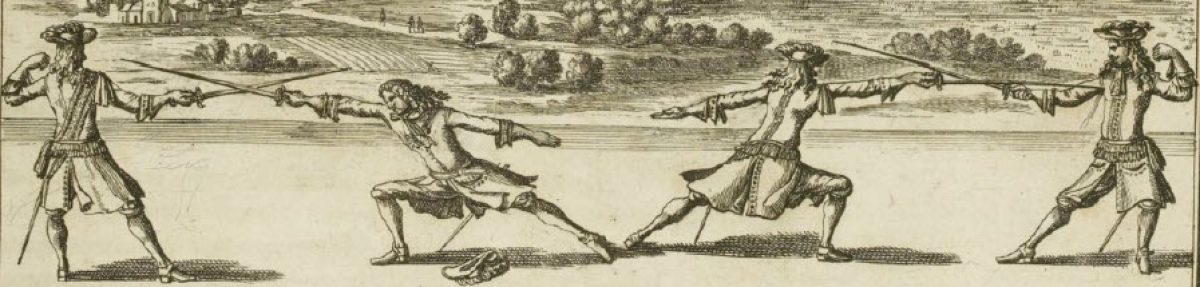


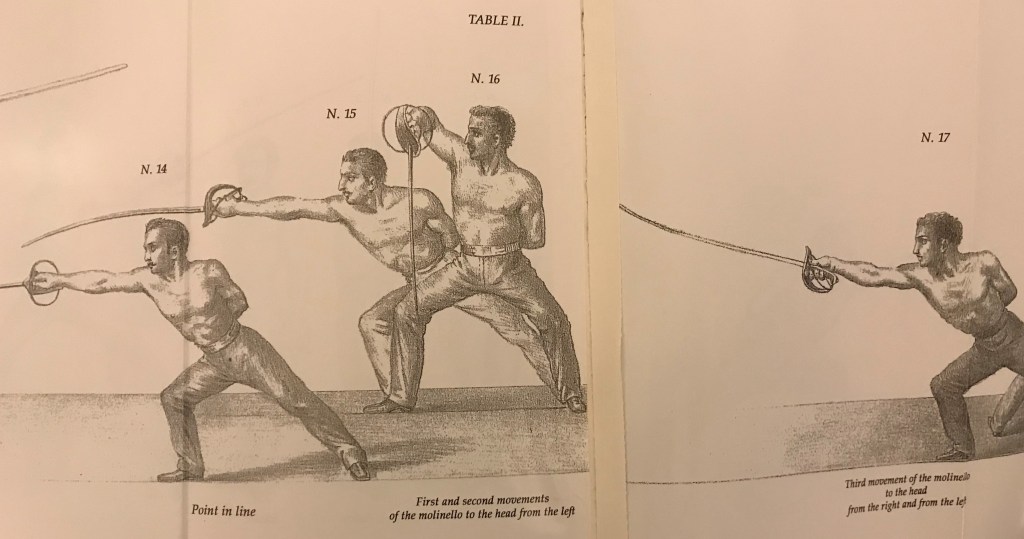

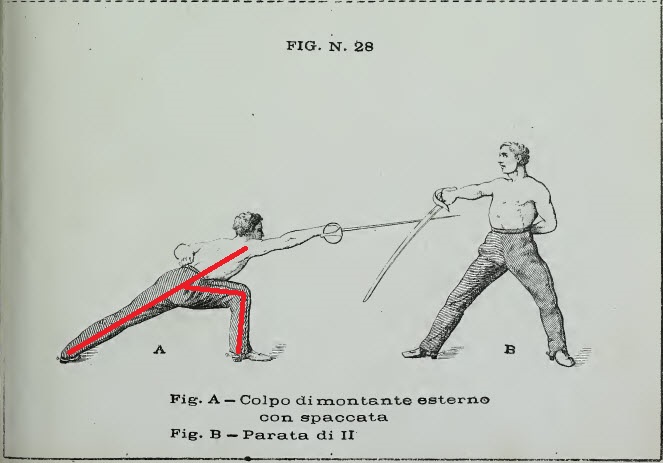


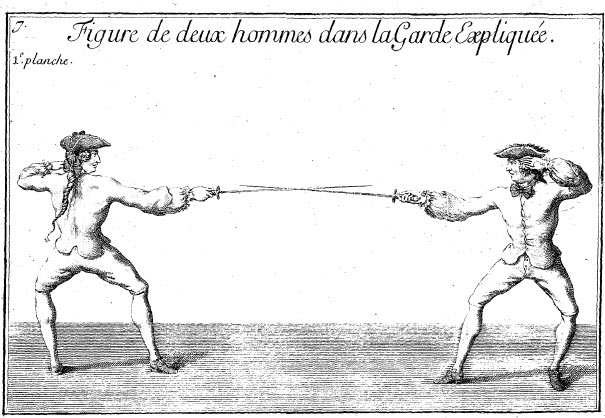


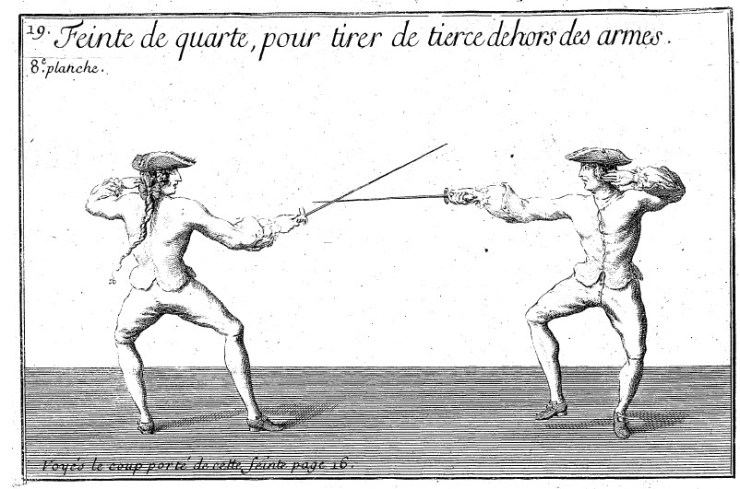
 With the disadvantages we face during the pandemic it helps to think outside the piste. Drill is rote even in the best of the times, but lessons often afford us that sense of time moving, of progression. As students we work on something, then next lesson may work on something new as well. Improvement may be slow sometimes, but it still feels more like progress than the same set of exercises month after month with no variation.
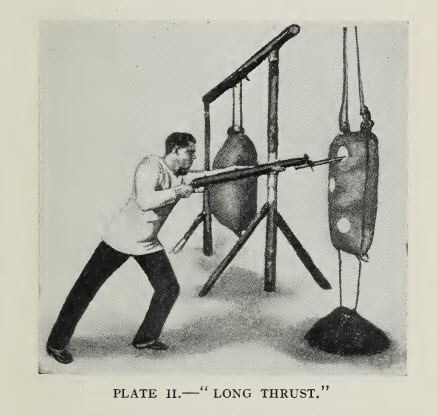 made from about 4-5ft away–as with the sword, bayonet and rifle move first. The student takes a half-step back, parries in prima, then steps slightly to their right and delivers a cut to the arm or down the barrel to the attacker’s hands (this second riposte must be made carefully, one reason that this is not a drill I run with beginners). There are other options, such as a cut to the head via molinello, but we were doing our best to maintain the requisite distance in light of Covid.

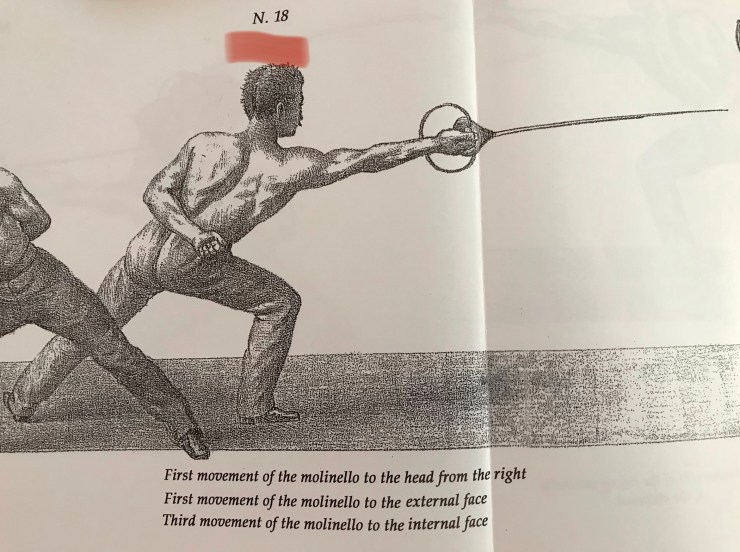


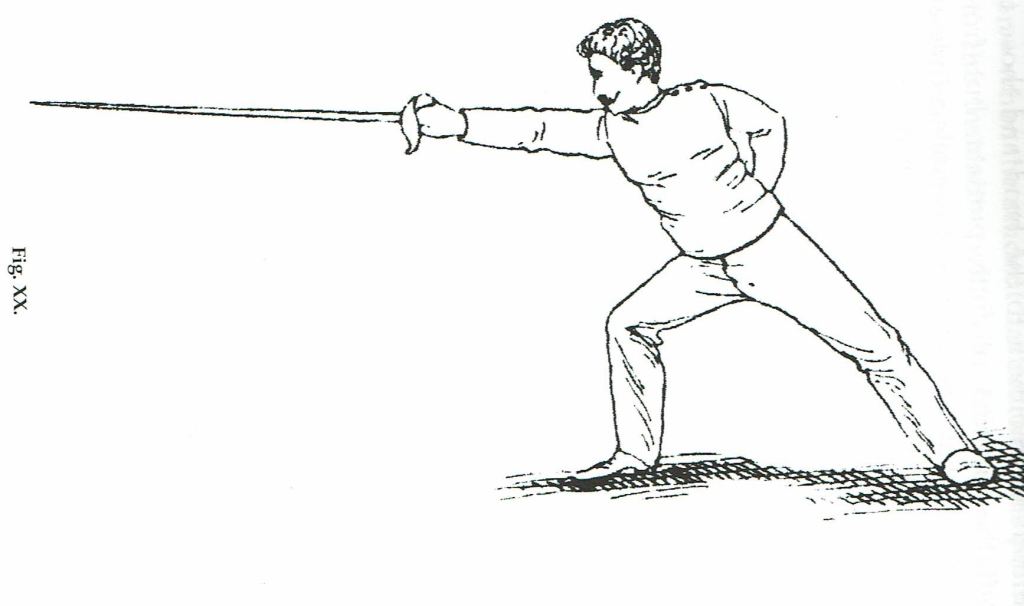

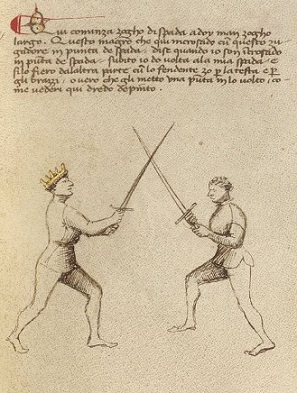


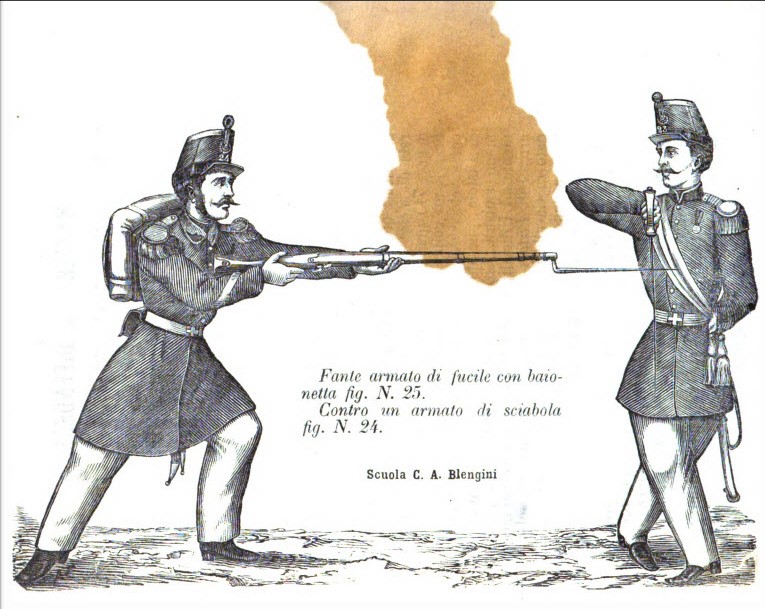
 Capitale Escrime Historical Fencing