Tag: sabre
Some News
An old friend and fencing comrade, the excellent Jon Brammer, pointed out that I had mentioned but not followed up upon the master of arm’s examination I took in Prague. Apologies.
While happy to write about fencing, I find it difficult to write about myself, so I’ll be brief and say that I passed and share some photos.
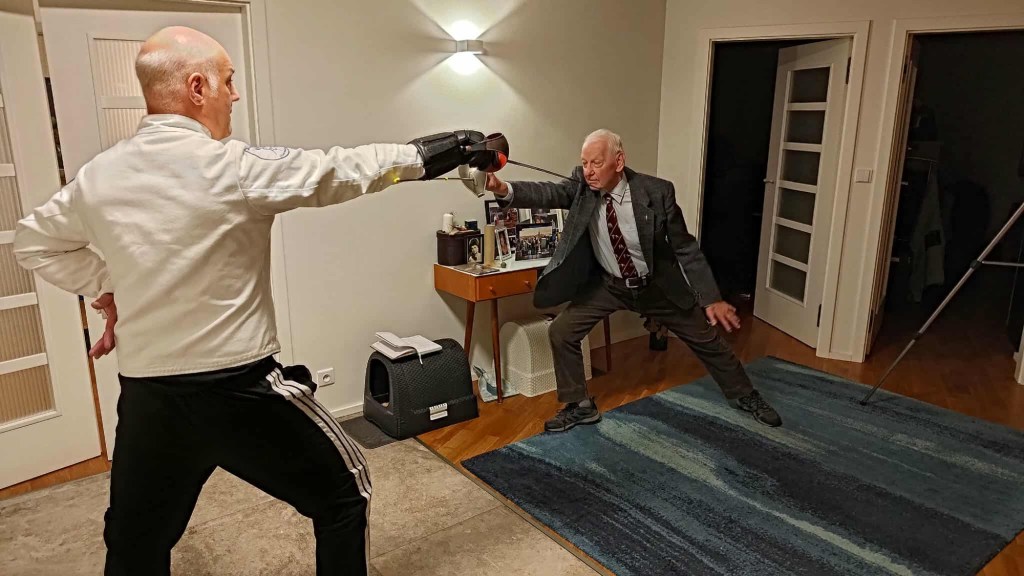
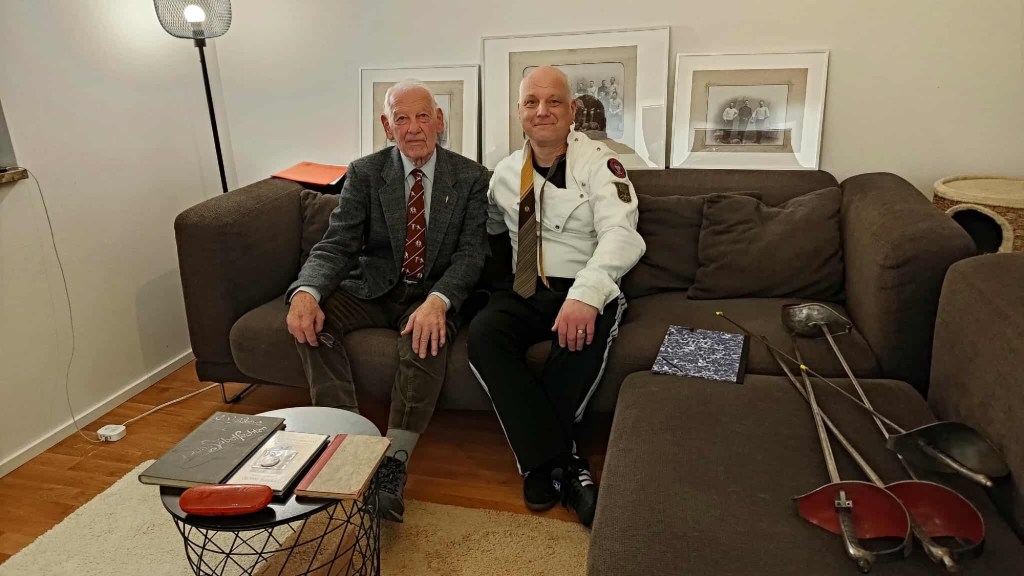

Congratulations to Maestro Michael Kňažko!
I am very pleased to share good news from my esteemed colleague Michael Kňažko–he has passed his master of arms exam!
Blahopřeji!/Congratulations!!!

Michael is one of the masters at our sister school, Barbasetti Military Sabre (since 1895) in Prague, Czechia, and a dear friend. See the link in “Our Sister School and Affiliates” for more information.
A Bar Raiser

Super late last night I returned from a weekend of instruction, teaching, discussion, bouting, and all manner of swordy fun at the St. George’s Day Exhibition of Arms held at the beautiful Chateau South, Atlanta, Texas. The event was put on by Russ Mitchell and the excellent people at Winged Sabre Historical Fencing, and hosted by the generous owner of the Chateau, Raoul, who not only trusted us to honor the integrity and safety of this property, but also who grilled a feast for us. If you’re in eastern Texas, “Piney Texas,” and need a venue for any event–wedding, family reunion, business retreat, you name it–I can’t recommend Chateau South enough (https://www.chateau-south.com/). Raoul and the family who take care of the property and are helping to restore it, Shawn and Rebecca, put the hospitality in southern hospitality. Seriously nice and generous folk.
Learning, Camaraderie, and Cross-Fertilization
I hope that the St. George’s Day Exhibition of Arms will become a regular event, because it needs to be. We have tournaments, we have seminars, conferences, and in some rare instances a mix of the three, but in some cases the dates are tough to make, the cost prohibitive, or the environment/attitude less than welcoming. Russ Mitchell and the fine folk at Winged Sabre put together a fantastic event–it was friendly, open-minded, and welcoming, but more than that the classes and discussion, the chat over meals or between sessions, all were informative and thought-provoking.
In addition to my two classes, there were a class on movement and balance by Russ that has changed not only my understanding of footwork, but also how I will teach it from here on out; there were two by Francois Perrault (Montreal, CAN), first on French foil as a way to understand the second topic, contre-pointe (the French approach to sabre ca. 1800-1908); and two by Jonathan Carr (Dallas, TX), one that made more sense of Hutton’s sabre than anything I’ve read, seen, or heard until then, and then a fascinating lecture on Sir Richard Francis Burton’s 1875 sword system.
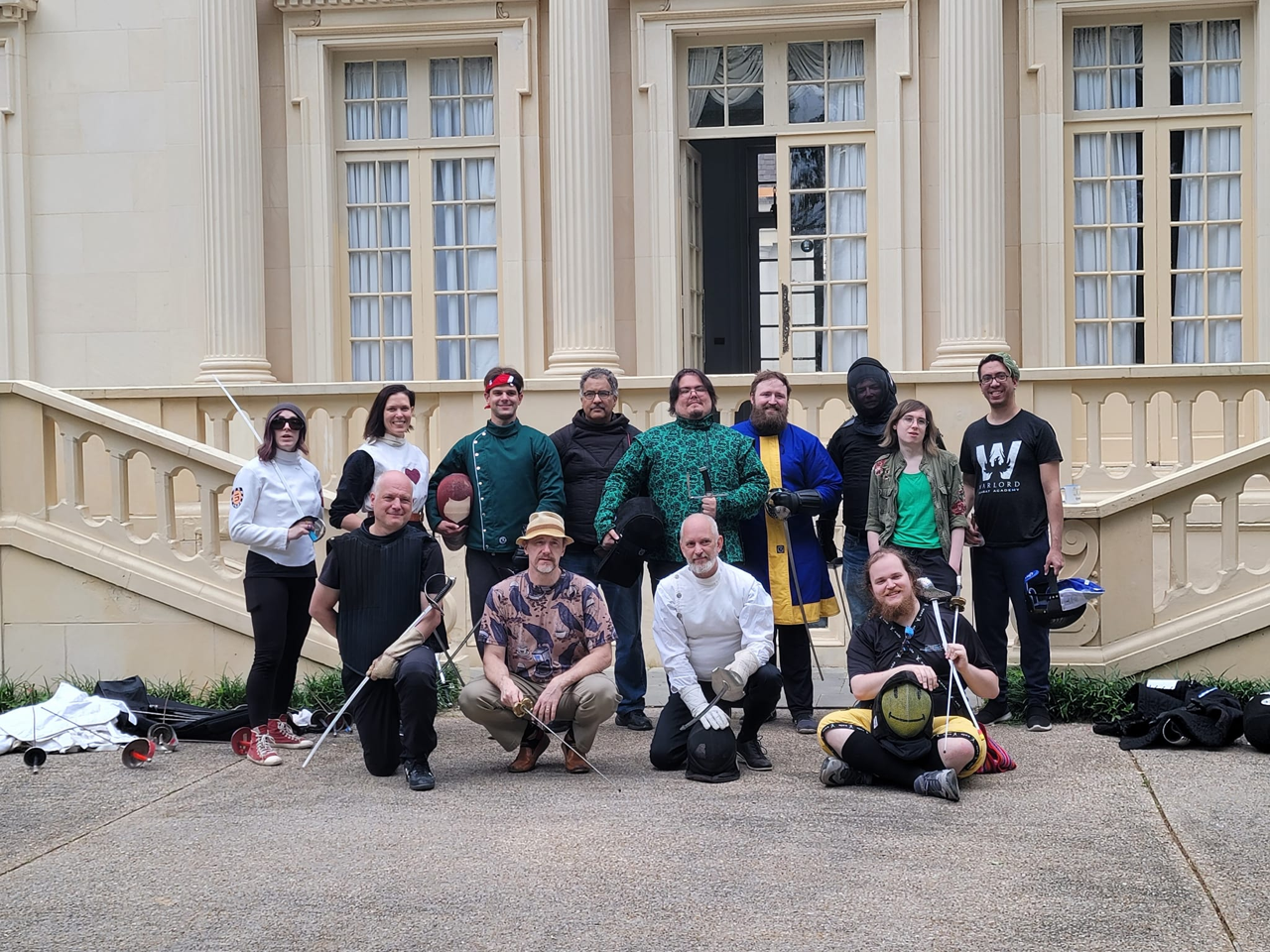
Discussion between classes, over meals, and especially at the end of the instruction-day, were as valuable. They were also a chance to get to know one another, share ideas, and increase understanding on the various tangents covered in the topics. For someone as introverted as I am, and who normally has to bow out to recharge, the fact I wasn’t once in need of that recharge should suggest a lot.

Exhibition of Arms vs. Deeds of Arms
Both have their place, but what an exhibition of arms seeks to do is share a particular style or tradition’s uniqueness within the Art, that is, what makes it what it is. While I cannot say to have represented the Radaellian school particularly well in my own bouts, I will say that my compatriots did a wonderful job. Russ’ students have been studying hussar sabre, which is very different than the profiled styles that predominate; Francois’ early French approach and Jonathan’s debt to English sabre and broadsword were clear as well. The focus in our bouts was to do our best to fight within the body of techniques and tactics of our specific traditions, and, to have fun doing it.
We also had time to explore a venerable Hungarian weapon, the fokos, a shehpard’s axe that the Magyars brought with them from the Steppes in the Early Middle Ages and which was used in the trenches of the Great War. Never have I faced a more challenging weapon sabre in hand than I have that wee axe. Russ made a few converts among us, I’m sure; least, I’m looking into the more than academically now.

Raising the Bar
Winged Sabre’s “St. George’s Day Exhibition of Arms” raises the bar for what we can and should be doing more often in historical fencing. Each of the classes had students drilling. There, I said it, the “d-word,” drill. It’s become a dirty word in “HEMA,” and to the detriment of that community. The garbage posted so often on Youtube as championship sabre is a case in point. The hop and chop, simultaneous single-tempo cuts lauded as the end-all be-all of sabre are to Plato’s cave what shadows on the wall are to the sun outside the cave that creates them.
Drill. Hard work. Effort, time, and sweat. These are what make a decent fencer. One can spend weeks, years even, in study, but if intentional, well-designed drill is missing, there is only far someone will go in that time. Another way to say this is that much of HEMA is doing it wrong, and should seek better methods, better instructors. I’ll not go so far as to list myself among their number, but I will say that I know some people you should talk to.
St. George’s Day Exhibition of Arms

[21-23 April, 2023] Next week the excellent Russ Mitchell and crew at Winged Sabre Historical Fencing, Atlanta, Texas, are hosting the St. George’s Day Exhibition of Arms (see link below). I have the honor to teach at this event and will cover two, related topics in Radaellian sabre.
The first is all things molinelli, that is, an exploration of the powerful, elbow-as-axis cuts fundamental to Radaelli’s approach. They were used not only for exercise and to build the muscles required for these cuts, but had offensive as well as defensive uses too.
The second class covers Masiello’s unmounted cavalry drill and exercises. Since the Radaellian method was primarily developed for cavalry it makes sense to acquaint oneself with this aspect of the tradition. Cavalry troopers not only practiced their style of combat in the saddle, but on foot as if in the saddle, what Masiello called come a cavallo, “as if on horseback.”
For more information, see:
https://chateau-south.ticketleap.com/exhibition-of-arms/details
Sources & the Lesson
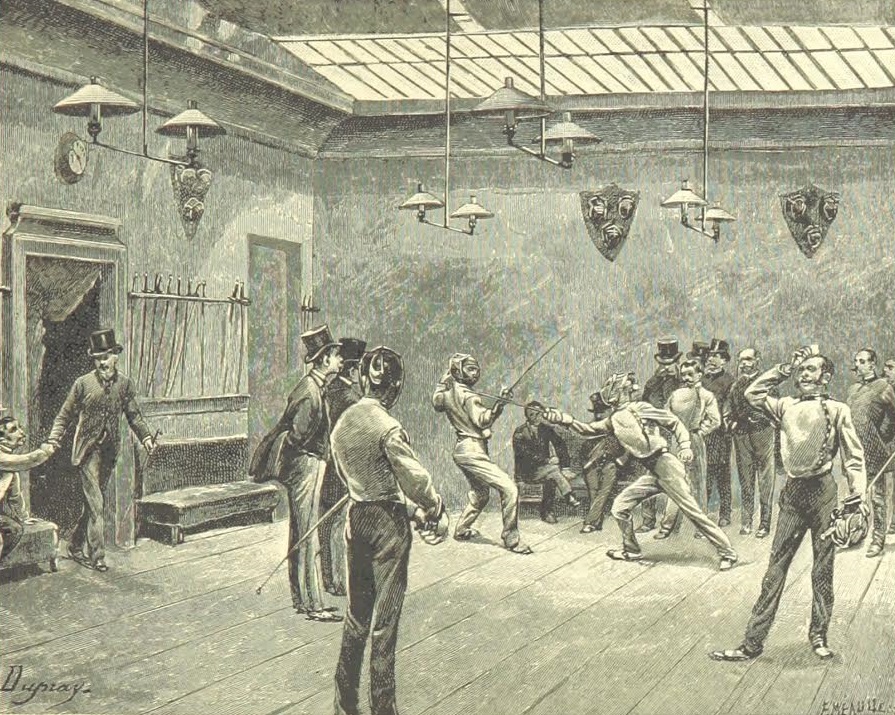
In a recent discord discussion one participant asked a series of insightful questions about how we use sources in lessons and classes. [1] Specifically, they asked:
So as an instructor, do you prefer referencing texts right away, or introducing technique in a more generic way until your students have some foundation?
It’s one of those obvious questions that is in the background of most lesson planning, but for me at least not one I’ve asked aloud, and, it’s an important question. To what degree should we discuss the sources during class? How much should we quote from a text? Do we merely cite a source? Do we share a brief summary of how we’ve used the source before or after a lesson? Do we avoid mentioning, citing, or quoting the sources we use during lessons and classes? How much should one incorporate sources if at all in the actual business of teaching?
Here I’d like to share some of the salient points others made as well as my own take on this. Starting with my own view, how much I mention or include sources in class or an individual lesson depends a lot on purpose and context. We teach in different ways, so it follows that we might incorporate our sources differently depending on the audience, goals, and topic.
In a seminar where I’m introducing people to a general area of study, say Radaellian sabre, I normally begin with a brief explanation detailing critical information (who, what, when, and where) as well as its significance (why). The rest of the time we spend more or less on the “how,” that is, exploring the system in such a way that participants gain an idea of what distinguishes this sabre school from others. In the course of a seminar people may ask questions about the system or the sources for it, and that’s fine, but focus remains on actually working on the material sword in hand. Often, there is either a formal chance at the end to go into more detail, or, an informal chance afterwards to chat about things in more depth.
In a more focused seminar, say a particular aspect of a source or tradition, I may say a bit more, because I must. Radaellian molinelli, for example, require some explanation. It’s not just what they were used for, which one could wax upon at length, but also detailing and explaining the mechanics behind them. The nature of close study is normally a decent place to cite sources or passages within them directly. That’s not always the case. In a general seminar I may say that Del Frate, Masiello, and Rossi all say this about the molinelli, but in a more focused class I might just zero in on what one master says. In this case, not using what Del Frate or whomever said makes little sense: ostensibly the people attending are there because they want to know more about this author and their take on the topic. [2] There is often overlap. The last time I discussed the molinelli, for example, I drew heavily from Del Frate but brought in Barbasetti and others as appropriate. My class was one of two that day and we had ample time to spend using these circular cuts in different ways.
For a regular class, say one with 5 to 10 people that meets once or twice a week, I normally save the bulk of the source discussion for post-class review sheets. This said, there are times when in order to explain how or why we do something I do reference the texts. These snippets can be diverting and can eat up time, so I try to keep them to a minimum. It’s a judgment call in many cases—will sharing what Girard or Rossi or Marcelli said here help the student understand or introduce a speedbump to the learning process and pace of class? Sometimes I get that wrong. Few things let you know that like a student turning to look at a clock or shuffling impatiently because they’re eager to jump back into activity.
Individual lessons, by their nature, tend to mean that we spend very little time discussing source material. This too, however, can vary by student, skill level, and the length of the lesson. It also varies by age. One on one lessons are the best way to learn and an opportunity to go through material with focus. Much as I can, I try to stick to the meat of the lesson and less so everything underpinning it. Yes, it’s often relevant, but there are better ways to share all the substrata and more appropriate times.
But you Harp on about Sources all the Time? What Gives?!
True, I do, and I will continue to do so, but using sources doesn’t necessarily mean consulting the sacred tomes between each action. For historical fencing, the sources should guide and inform what we teach, but how we do that is another matter. I look at it this way:
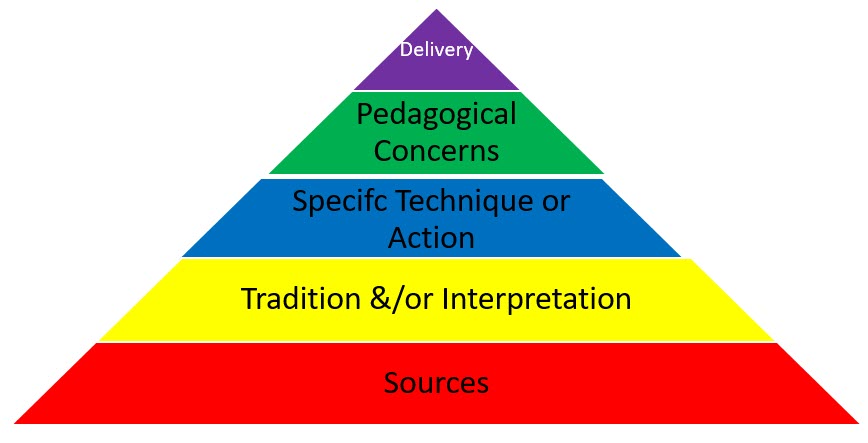
I start with the source. Maybe it’s Del Frate, maybe Girard, but regardless I read through the work or works and see what they say. Next, I consider what I know about the passage I’ve read and its context. Del Frate was writing for the cavalry and a close friend, Giuseppe Radaelli; this system went on to transform sabre most everywhere via the Radaelli’s students and their students. As someone trained within that lineage, I can compare what I was taught with earlier iterations, and then interpret what I want to do with that topic. If I plan to cover feints, I again compare what the source tradition says with what I was taught, and devise a lesson plan.
My lesson plans follow a traditional format—we start with a warm up, jump into the topic, then cool down. How much we do in the main lesson depends on the student, but I introduce the topic and then we explore it via drill, and importantly, by varying the drill. This is where pedagogical concerns come in—is the student new or experienced? What weight of weapon are they using? Where are they strong, where weak, and what balance do I strike so that they build confidence in what they find easy and improve in what challenges them? What kind of lesson is it? Is it a teaching lesson where they’re learning a new skill? An option lesson where we explore actions or tactics in different ways? A bouting lesson where one is preparing a student for a match?
Lastly, there are the nuts and bolts of delivery—how do I introduce the topic, drill, etc.; what language makes it most clear? What examples, analogies, or previous study will aid the student? In what order should we cover the material? For an experienced fencer, I can normally state things generally, such as we’ll be working feints, give them direction to feint by thrust, molinelli to the head, and we start. There will be more variation of movement, tempo, and the order of actions. For a newer student, we may just work on making that thrust convincing, or starting from the right distance. With a new student, I spend more time on basic mechanics; perhaps we just work on the extension or a convincing feint.
Macro vs. Micro
One approach, and what I’ve more or less described above, is to adjust source-inclusion according to the follow logic:
General points/summary/introduction = more source inclusion
Teaching specific movements/actions/technique = less source inclusion
The use of the comparative adjective “more” here is intentional, because so much depends on whom it is one is teaching, and what one is teaching. A seasoned, experienced fencer new to a specific tradition may need less explanation of how to make the action and more of what this particular source says about it. In contrast, a newer fencer, someone very young, generally needs far less explanation of why de Liancour advocated X or Y and way more time spent trying to do X or Y.
As should be evident, this places a considerable burden on the instructor to know, understand, and be able to use the sources. It goes beyond that: it also means the instructor must be able to assess audience, experience, and attentiveness in various contexts, and with luck, be able to adjust on the fly. Much of this depends on an instructor’s goals and what the club is there to do. [4] In some degree, however, if the school is “historical” in focus than there should be some attention to the sources regardless of what one does with it.
Incorporating Sources into Lessons
Specific examples never hurt, so below I’d like to provide a screen shot of one of the ways in which I do this. This selection is a portion of some post-class notes from a smallsword class. As one can see, I provide a scan of the original text, and in this case a transliteration as these students are less used to 18th cen. English orthography and typesetting. Within the transliteration I provide a few explanations and definitions. A few notes follow.
Of note, these explanations follow a lesson in which I mention but do not spend much time on the text—with only an hour in class I focus on technique and its application. This often consists of something like “Today we will cover the glide from third. In the sources this is often called a ‘glizade,’ and in modern works there are more terms still.” That’s it. If someone asks me which text I tell them, but again the focus is to learn how to make and use the action, not a history lesson. Most of my time is taken up setting them up to learn the drill, reviewing the weak and strong portions of the blade, what an engagement means, what opposition entails, and how measure and timing play into this action. That’s a lot of information, and, a lot to do.
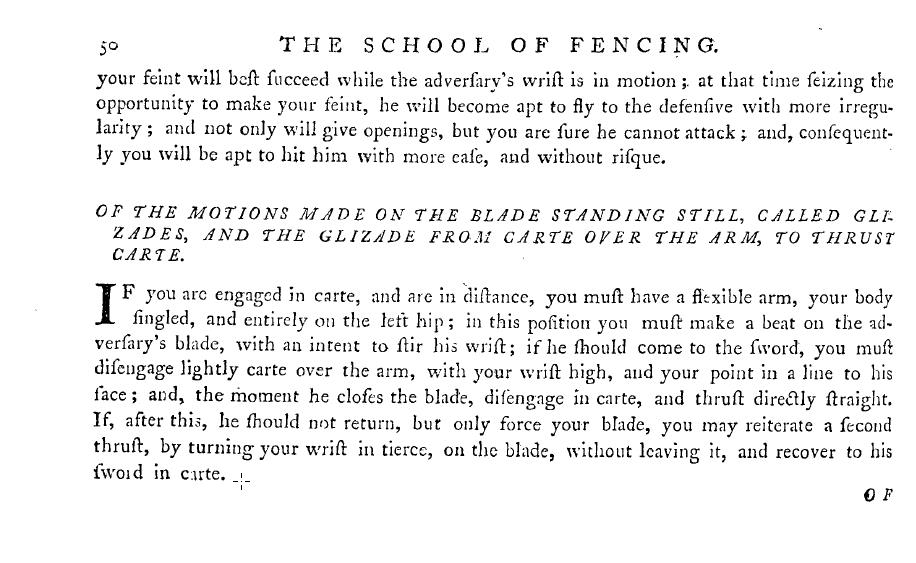
[50] Of the Motions made on the Blade Standing Still, called Glizades, and the Glizade from Carter over the Arm, to Thrust Carte.
If you are engaged in carte [4th], and are in distance, you must have a flexible arm, your body singled [profiled], and entirely on the left hip:* in this position you must make a beat** on the adversary’s blade, with an intent to stir his wrist [get them to parry]; if he should come to the sword [parry], you must disengage lightly carte over the arm [in third, but nails up], with your wrist high, and your point in line to his face; and, the moment he closes the blade [parries], disengage in carte, and thrust directly straight. If, after this, he should not return [riposte], but only force your blade [stay in the parry], you may reiterate a second thrust***, by turning your wrist in tierce, on the blade, without leaving it, and recover to his sword in carte.
*in the day, most masters recommended keeping the weight on the rear leg while in guard
**we have not covered this yet, but will; it’s a quick, powerful wrap against the opposing blade with your own to open the line
***this is called a remise; it’s to make the attack a second time, in the same line, often by redoubling or double-lunging
There are other ways I use texts, but this is a common one and useful for introducing the “what” and “why” behind what I teach. It’s sort of bite-sized, and for people more keen to use swords than read about them, this is a decent happy-medium. I cite my sources so to speak and provide them information that might help them should they wish to practice on their own, but the choice is theirs–they can read or ignore these sheets as they wish.
On the course and lesson-planning side, having the word and pdf copies of these notes does much to help me revise or correct material as I continue. Each class, each student is a different, so I tend to recycle the historical portions but update and tailor the explanations and comments. I’ve also found it useful to compare my interpretations against the sources from time to time, because colleagues provide insights that change things, as do students. One of the best things about teaching historical fencing is that it can be collaborative—students will question why we do X or Y and each time there is the chance that they may see something I’ve missed. It happens more often than one might think, particularly if the students have a martial arts and/or fencing background. As a last point, for instructors who aren’t quite sure how to engage the sources, this is one way—pick a topic, say the glide, and sit with what a source or two says about it. Work it out in real time, sword in hand, and devise drills if they’re not provided. With practice, it gets easier to do and increases not only the usefulness of these texts, but also our enjoyment of them.
NOTES:
[1] the conversation took place within the local historical fencing Discord 12 Dec. 2022 run by Northwest Armizare’s Mike Cherba.
[2] Usually seminar and class titles are announced ahead of events, so my own operating assumption is that if someone is in that seminar they have at least a nominal interest.
[3] The sources codify, preserve, and help create a tradition, school, or style. There are often particular features in technique that distinguish one style from another, such as footwork, guard, the axis of rotation for cuts, etc. Teaching a particular tradition combines the body of technique with that tradition’s approach to delivery as well as the specific concerns that come with teaching, both individually and in groups. All of that informs how we deliver this material, how we share it, teach, and transmit the tradition.
[4] One issue inherent in this, and a bit of a bugbear in “HEMA,” is the place of the sources and by extension what we mean by “historical.” As the same participant noted in Discord, in re sources and faithfulness to them
What’s tricky though is that even the “H” in HEMA is still a bit vague … Someone might interpret the “Historical” as having an implied “accuracy” associated with it, whereas someone else might interpret “Historical” as just broadly drawing from a past time period…And even if the latter doesn’t mix in any modern technique, a combination of historical techniques is still technically historical to some people.
Maybe the least divisive way to handle this is for each instructor and group to determine what it is they want to do, that is, what “historical” is going to mean to them. It will seem passively relative to say this, but I stand by it—I can hold one definition of “historical” and seek to abide it while at the same time recognizing that not everyone will agree.
Francois Perreault & Ecole Normale de Gymnastique et d’Escrime, Joinville
In yet another wonderful discussion, Russ Mitchell and friends discuss the role that the École de Joinville-le-Pont near Vincennes, France, played in European and later world sabre. As Russ remarks the program at Joinville was as influential as that of the Radaellians or those in the tradition of Kreussler.
Francois Perreault provides a fantastic introduction to this tradition.
Russ & CO.–Interview with Chris Holzman on all things Radaelli!
This video is so good. SO. GOOD. Chris is a friend and a mentor, so I know I am partisan and possess some bias, but for those who listen and find themselves uncomfortable, I challenge you to listen to what he says. Some of it will be hard, but it’s important. Few people like being called out for the inconsistencies and nonsensical things we do, but wee bruised egos aside it’s healthy for us to do so.
This is also a wonderful introduction to Radaellian sabre, a thorough examination of how this system influenced so many others, of the development of the sport, and a personal bugbear, another nail in the coffin in the silly dichotomy people insist exists between so-called “military” sabre and “dueling” or “sport” sabre.
Rosaroll-Scorza’s _Spadancia_ trans. by Christopher A. Holzman
Chris has a new translation out:
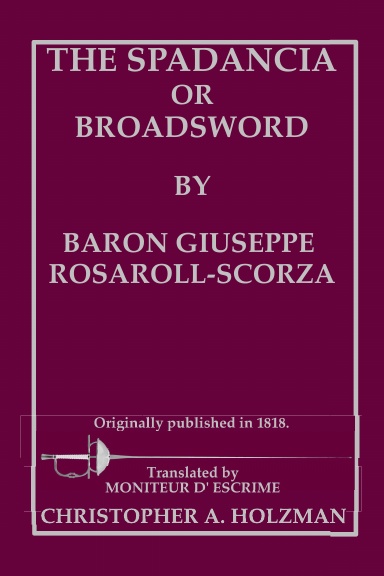
This is an interesting work to say the least. Fans of Torquato Tasso’s Gerusalemme liberata/Jerusalem Delivered (1581) will drool (this guy really really really liked Tasso…), but so too will those interesting in some late period cut-and-thrust fencing from southern Italy. Few versions of this weapon remain–similar to a late cup-hilt or bilbao style rapier, this weapon shared much with the spada and smarra long in use in Naples and Sicily, but had a blade meant for cutting and sported other, notable features, such as the fact the quillons were sharpened.
Russ Mitchel on Timmlich
As someone who regularly points out how daft it is to use a trooper-weight sabre for foot combat (tough to make any complicated action well), I feel it only right to share this lovely video from Russ. Timmlich’s excellent treatise provides the historical fencer into BIG sabres a way to use them, on foot, effectively. Check it out!
 Capitale Escrime Historical Fencing